Finding safe haven in the climate change future: Alaska and Hawaii

Yahoo! News

Finding safe haven in the climate change future: Alaska and Hawaii

David Knowles, Senior Editor – December 10, 2022

This Yahoo News series analyzes different regions around the country in terms of climate change risks that they face now and will experience in the years to come. For other entries in the series, click here.

As the negative consequences of rising global temperatures due to mankind’s relentless burning of fossil fuels become more and more apparent in communities across the United States, anxiety over finding a place to live safe from the ravages of climate change has also been on the rise.

“Millions and likely tens of millions of Americans” will move for climate reasons through the end of the century, Jesse Keenan, an associate professor of real estate in Tulane University’s School of Architecture, told Yahoo News. “People move because of school districts, affordability, job opportunities. There are a lot of drivers, and I think it’s probably best to think about this as ‘climate is now one of those drivers.’”

In late October, a report by the United Nations concluded that average global temperatures are on track to warm by 2.1 to 2.9° Celsius by the year 2100. As a result, the world can expect a dramatic rise in chaotic, extreme weather events. That increase is already happening. In the 1980s, the U.S. was hit with a weather disaster totaling $1 billion in damages once every four months, on average. Thanks to steadily rising temperatures, they now occur every three weeks, according to a draft report of the latest National Climate Assessment, and they aren’t limited to any particular geographical region.

Warmly clad visitors in single file pick their way through a melting glacier.
Melting ice water flows past visitors on a guided tour July 10 on the Matanuska Glacier, which feeds water into the Matanuska River, near Palmer, Alaska. (Patrick T. Fallon/AFP via Getty Images)

To be sure, calculating climate risk depends on a dizzying number of factors, including luck, latitude, elevation, the upkeep of infrastructure, long-term climate patterns, the predictable behavior of the jet stream and how warming ocean waters will impact the frequency of El Niño/La Niña cycles.

“No place is immune from climate change impacts, certainly in the continental United States, and throughout the U.S. those impacts will be quite severe,” Keenan said. “They will be more severe in some places and less severe in other places. Certain places will be more moderate in terms of temperature and some places will be more extreme, but we all share the risk of the increase of extreme events.”

In this installment, we look at the two U.S. states separated from the lower 48, neither of which was included in the rankings of counties compiled by the ProPublica and the New York Times that formed the backbone of this series.

Alaska

Broken-up chunks of sea ice arrive at a broad swath of shoreline.
Chunks of sea ice float off Utqiagvik, formerly known as Barrow, Alaska, in July 2018. (Yereth Rosen/Reuters)

The coldest U.S. state in terms of annual mean temperature, Alaska is also America’s fastest-warming one. Since 1970, the average temperature in Alaska has risen a disconcerting 4.22°F, unleashing an array of hazards that have upended daily life.

On Monday, the northernmost city in Alaska, Utqiagvik, smashed its all-time winter high temperature record by an astonishing 6°F, when it hit 40°F, despite the fact that it lies 300 miles north of the Arctic Circle.

“Every new day brings with it new evidence of climate change in Alaskan communities — warmer, record-breaking temperatures have resulted in thawing permafrost, thinning sea ice, and increasing wildfires,” the Alaska Department of Commerce states on its website. “These changes have resulted in a reduction of subsistence harvests, an increase in flooding and erosion, concerns about water and food safety and major impacts to infrastructure: including damage to buildings, roads and airports.”

The upper third of Alaska is located inside the Arctic Circle, a place where temperatures this month have so far been observed at an average of 11.5°F above normal, according to data provided by the University of Maine.

A hybrid touristic boat threads its way through clumps of sea ice.
The Kvitbjorn (Polar Bear, in Norwegian), a hybrid boat with a diesel motor and electric batteries, makes its way on May 3 through sea ice in the Borebukta Bay, near Isfjorden, in Svalbard Archipelago, northern Norway. (Jonathan Nackstrand/AFP via Getty Images)

Until recently, the portion of Alaska inside the Arctic Circle rarely, if ever, experienced wildfires. A 2020 study by researchers at the University of Alaska, however, found that climate change has made wildfires in the state much more common, because higher temperatures dry out vegetation more rapidly and shorten the amount of time that snow covers the ground.

The snowpack in Alaska now accumulates a week later, on average, than in the 1990s, and melts away two weeks earlier. Large fires have been starting earlier and lasting longer. Fire season in the state now lasts a month longer than it did 30 years ago.

That has resulted in a steady uptick in the number of acres burned.

“From 2000 to 2020, 2.5 times more acres burned than in the previous 20 years, and 3 of the 4 highest-acreage fire years have occurred since 2000,” the U.S. Department of Agriculture notes on its website.

Also on the rise are so-called “zombie fires” that feast not just on the trees of the boreal forest but also duff, an organic layer of dead, dried-out plants that covers much of the ground and helps insulate the permafrost. Zombie fires are fires believed to have been extinguished that keep burning throughout the harsh Alaskan winter, even under snow cover. “From 2005 to 2017, fire managers in Alaska and in Canada’s Northwest Territories reported 48 zombie, or holdover, fires that survived the long winter,” Scientific American reported in 2021.

In a wooded area of downed, burned saplings, smoke rises from a hot spot.
Smoke rises from a hot spot in the Swan Lake Fire scar at Alaska’s Kenai National Wildlife Refuge in June 2020. (Dan White/AlaskaHandout via Reuters)

Higher temperatures have dramatically increased evaporation rates, so that even relatively short periods with scant precipitation have the effect of transforming Alaska’s flora into the equivalent of ready-to-burn kindling. That gives zombie fires the opportunity to reemerge, making the state much more vulnerable in general to wildfire risk.

“The frequency of these big seasons has doubled from what it was in the second half of the 20th century,” Rick Thoman, a climate specialist with the Alaska Center for Climate Assessment and Policy at the University of Alaska’s International Arctic Research Center, told the PBS News Hour. “And there’s no reason to think that’s not going to continue.”

While sea level rise in Alaska is not, for the moment, as great a problem as in other coastal areas, due to the fact that plate tectonics is pushing land higher at a rate outpacing the rising ocean, steadily dwindling sea ice has left thousands of residents, not to mention polar bears, at risk of storms, which have become more intense due to rising temperatures.

“With climate change and a warming climate, sea ice is being impacted. A lack of sea ice is going to mean that there’s no longer any protection from the fall/winter storms that come in,” Jason Geck, a glaciologist at Alaska Pacific University, told the Associated Press in October. “Instead, we’re having major storm events that are happening more frequently, and we’re having major storm events that are causing a lot more coastal erosion.”

The uncanny blue face of the melting LeConte Glacier, with a swill of broken ice chunks in front of it.
The glacier face of the LeConte Glacier, a tidal glacier in LeConte Bay, in Tongass National Forest, Southeast Alaska. (Wolfgang Kaehler/LightRocket via Getty Images)

Winter storms are not caused by climate change, but recent studies have concluded that the disappearance of sea ice and the continued warming of the ocean will continue to supercharge storms in Alaska by the end of the century.

“Alaska can expect three times as many storms, and those storms will be more intense,” Andreas Prein, a scientist with the U.S. National Center for Atmospheric Research and the author of the 2021 studies on sea ice, said in a statement. “It will be a very different regime of rainfall.”

Already, several Indigenous tribes are being forced to decide whether to abandon their waterfront villages due to persistent flooding and erosion.

“Arctic residents, communities, and their infrastructure continue to be affected by permafrost thaw, coastal and river erosion, increasing wildfire, and glacier melt,” the U.S. Climate Resilience Toolkit states on its website. “As temperatures continue increasing, individuals and even whole communities will need to decide how and where to live.”

In October, the Alaska Department of Fish and Game announced that it was, for the first time ever, canceling the snow crab fishing season due to the collapse and disappearance of 90% of the crab population. In a letter to Department of Commerce Secretary Gina Raimondo seeking a declaration of a fishery disaster for both Bristol Bay and the Bering Sea, Alaska’s Republican Gov. Mike Dunleavy laid out the climate change connection.

Gina Raimondo against a backdrop of American flags.
Gina Raimondo, U.S. secretary of commerce, at a news conference in College Park, Md., on Dec. 5. (Ting Shen/Bloomberg via Getty Images)

“Available information indicates the decline for … crab stocks resulted from natural causes linked to warming ocean temperatures,” Dunleavy wrote.

As rising global temperatures cause sea ice to melt earlier and reform later, the oceans it used to cover warm even faster. This phenomenon amplifies a feedback loop known as the albedo effect, which the Climate Resilience Toolkit describes as “the decline in cover of sea ice, glaciers, and snow cover replaces a white reflective surface with a darker, more absorptive surface of land or water. This increases the absorption of heat by the surface and thus increases the rate of Arctic warming.”

In Alaska, warmer waters are wreaking havoc on the state’s seafood industry, which generated an annual economic output of $5.6 billion in 2018. In recent years, 14 major fishery disasters there have been linked to climate change, according to a draft of the latest National Climate Assessment released in November.

On land, another feedback loop has scientists on edge. It concerns the permafrost that lies beneath the duff. When permafrost melts — and recent studies have found a growing number of places in Alaska where that is now happening — it releases methane, a greenhouse gas more potent than carbon dioxide in the short term. If the Arctic transforms into a net emitter of greenhouse gases, that could cause global temperatures to rise even further, which would result in more permafrost melt.

A ring of  bubbles of methane gas on Esieh Lake.
Methane gas released from seep holes at the bottom of Esieh Lake ripples the surface. (Jonathan Newton/The Washington Post via Getty Images)

Alaska residents have long known that climate change had the potential to negatively impact their way of life. Back in 2007, then-Gov. Sarah Palin signed an administrative order establishing the first Alaska Climate Change Sub-Cabinet, which went on to release a 2010 report that found that rising temperatures had “already begun to render ground and building foundations unstable, disrupt transportation routes, and trigger phenomena placing coastal communities in imminent danger from flooding and erosion.”

State agencies later produced documents such as the Alaska Department of Fish & Game Climate Change Strategy, and in 2017, the state’s Gov. Bill Walker established a task force to propose a climate change adaptation plan “that will safeguard Alaska now and for future generations.”

After his inauguration in 2019, Gov. Dunleavy quietly revoked Walker’s order and disbanded the climate response team.

Hawaii

Waves splash into lava rocks as the sun sets.
Sunset at Makena Beach and cove on Maui. (Jonathan Newton/The Washington Post via Getty Images)

In 2021, Hawaii became the first U.S. state to pass a resolution to declare a climate emergency. While State Senate Concurrent Resolution 44 is symbolic and nonbinding, it acknowledged “an existential climate emergency threatens humanity and the natural world, declares a climate emergency, and requests statewide collaboration toward an immediate just transition and emergency mobilization effort to restore a safe climate.”

Like island nations that climate change threatens to wipe off the map, the threats facing the seven Hawaiian islands where people live start with sea level rise. Given that nearly half of the state’s land area is within 5 miles of the ocean, exacerbated by the fact that much of the land there is sinking, rising seas should factor highly in any decision about selecting a place to live to be safe from global warming.

“The sea level around Hilo Bay [on the Big Island] has risen by 10 inches in 1950, and now, it’s rising faster, at about 1 inch every 4 years,” the state says on its climate change portal. “This increases the frequency and reach of coastal floods, which affect our communities. 2017 was a record flood year for Honolulu (37 flood days, when historically, the average has been around 4 days). These floods were fully attributed to climate change/sea level rise. Today, Hawai’i has 66,000 people regularly at risk from coastal flooding. In Kailua for example, 50% of the population is locked in below expected flood zones.”

A man picks his way through puddles on a road next to a home damaged by flooding.
A man walks next to a home damaged by flooding on the Big Island after Hurricane Lane, on Aug. 25, 2018, in Hilo, Hawaii. (Mario Tama/Getty Images)

A 2018 study by researchers at the University of Hawaii found that 34% of the state’s shorelines are already vulnerable to waves and storms made more intense by climate change. To date, coastal erosion has eaten away 13 miles of beaches in the state, and has left 70% of the existing beaches in a precarious state, according to Hawaii’s climate change portal.

“Unless we take action today, we will lose all the beauty, many of our beaches throughout not only this state, throughout the world,” Maui Mayor Mike Victorino told ABC News last year.

For any tourist who has visited Waikiki Beach more than once over several years, the reality of sea level rise is impossible to miss. Water levels now regularly lap against concrete barriers that shield the iconic strip of beachfront hotels, and the uninterrupted expanse of sand that made the beach famous exists only in memory. By 2100, projections are that Hawaii will see another 1 to 4 feet of sea level rise, possibly as much as 8 feet, potentially spelling the end of the Waikiki coastline as we know it.

But it’s not just beaches that are at risk. Coastal flooding in the state has risen sharply since the 1960s. By 2100, should sea levels rise by 3.2 feet, a 2017 report by the Hawaii Climate Change Mitigation and Adaptation Commission projected that 25,800 acres of land will become unusable and “6,500 structures located near the shoreline would be compromised or lost.”

Two bodyboarders holding their boards wait to enter the ocean near the remains of trees destroyed by flooding after Hurricane Lane.
Bodyboarders wait to enter the ocean near the remains of trees destroyed by flooding from Hurricane Lane at Honoli’i Beach Park on Aug. 26, 2018, in Hilo, Hawaii. (Mario Tama/Getty Images)

The primary cause of global sea level rise in Hawaii is the warmer temperatures melting polar ice caps and glaciers. While temperatures are rising fastest in the Arctic, they have also gone up in Honolulu by 2.6°F since 1950, with the bulk of this warming in the past decade, according to data from NOAA. In the years to come, if greenhouse gas emissions are not slashed, Hawaii will become much warmer still. “Average temperatures could increase by as much as 5-7.5° F by the end of the century,” state officials warn.

The world’s oceans have absorbed 90% of the warming in recent decades caused by the burning of fossil fuels, according to NASA. In Hawaii, as elsewhere, higher ocean temperatures threaten another local treasure: coral reefs. The Environmental Protection Agency has predicted that if warming continues at its current pace, 40% of Hawaii’s coral reefs could be lost by the end of this century.

Climate change is also changing rainfall patterns in the state.

“Hawai‘i is getting drier. Rainfall has declined significantly over the past 30 years, with widely varying rainfall patterns on each island,” the state says on its climate change portal. “This means some areas are flooding and others are too dry. Since 2008, overall, the islands have been drier, and when it does finally rain, it rains a lot.”

A Big Island firefighter hoses a blaze as a curtain of smoke rises.
A Big Island firefighter puts out a blaze near Waimea, Hawaii, in August 2021, after the area was scorched by the state’s largest ever wildfire. (Caleb JonesAP Photo)

In April 2018, epic rainfall hit the island of Kauai. An all-time-U.S.-record 50 inches of rain fell in a 24-hour period, damaging or destroying 532 homes, wrecking roads and racking up damages of almost $180 million.

Climate scientists noted the Clausius-Clapeyron effect, which established that for every degree Celsius of temperature rise, 7% more moisture is added to the atmosphere. In short, when conditions are right, rain is abundant, including in the place that already receives the most annual rainfall on Earth.

Such overwhelming downpours will become an increasingly common feature of life on Hawaii going forward, research shows, forcing officials to prepare.

“We need to get used to climate events like this,” Honolulu’s mayor, Rick Blangiardi, told the Associated Press. “A tremendous concentration of rain in a small amount of time in focused areas is going to result in flooding anywhere. If we have situations like that, then we need to really approach and attack.”

On the bright side, a 2022 study by researchers at the University of Hawaii at Manoa and published in the journal Global Environmental Change found that, thanks to rising temperatures, Hawaii can expect about 5% more days with a rainbow in the next 80 years.
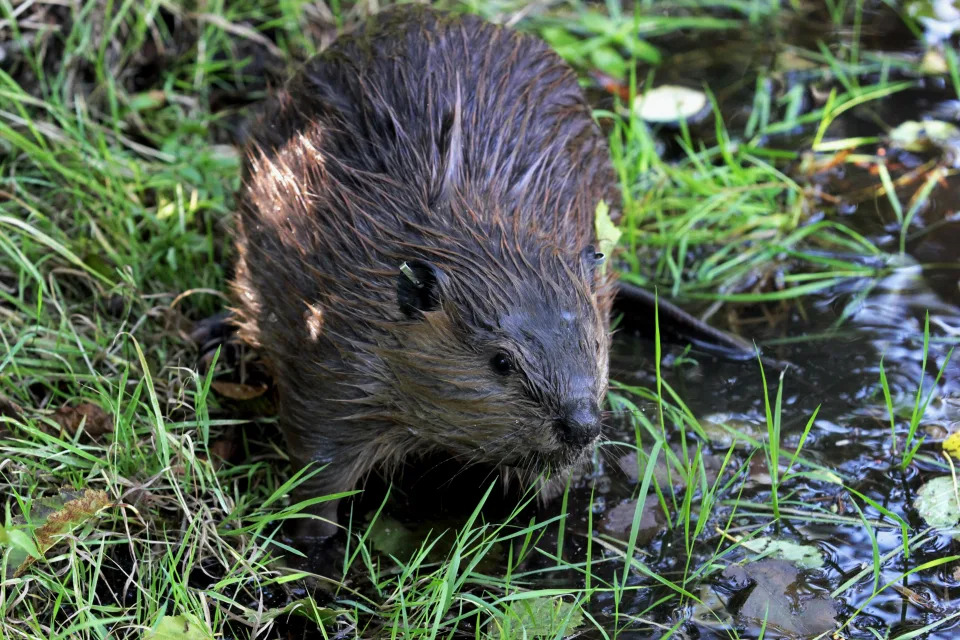
Beavers are moving into the warming Arctic. It could be a threat like ‘wildfire.’

USA Today

Beavers are moving into the warming Arctic. It could be a threat like ‘wildfire.’

Sharon Levy – December 10, 2022

It began decades ago, with a few hardy pioneers slogging north across the tundra. It’s said that one individual walked so far to get there that it rubbed the skin off the underside of its long, flat tail. Today, its kind have homes and colonies scattered throughout the tundra in Alaska and Canada — and their numbers are increasing. Beavers have found their way to the far north.

It’s not yet clear what these new residents mean for the Arctic ecosystem, but concerns are growing, and locals and scientists are paying close attention.

Researchers have observed that the dams beavers build accelerate changes already in play due to a warming climate. Indigenous people are worried the dams could pose a threat to the migrations of fish species they depend on.

“Beavers really alter ecosystems,” says Thomas Jung, senior wildlife biologist for Canada’s Yukon government. In fact, their ability to transform landscapes may be second only to that of humans: Before they were nearly extirpated by fur trappers, millions of beavers shaped the flow of North American waters. In temperate regions, beaver dams affect everything from the height of the water table to the kinds of shrubs and trees that grow.

In this Sept. 12, 2014, photo, a tagged young beaver explores water hole near Ellensburg, Wash., after he and his family were relocated by a team from the Mid-Columbia Fisheries Enhancement Group.

Until a few decades ago, the northern edge of the beaver’s range was defined by boreal forest because beavers rely on woody plants for food and material to build their dams and lodges. But rapid warming in the Arctic has made the tundra more hospitable to the large rodents: Earlier snowmelt, thawing permafrost and a longer growing season have triggered a boom in shrubby plants like alder and willow that beavers need.

Aerial photography from the 1950s showed no beaver ponds at all in Arctic Alaska. But in a recent study, Ken Tape, an ecologist at the University of Alaska Fairbanks, scanned satellite images of nearly every stream, river and lake in the Alaskan tundra and found 11,377 beaver ponds.

Further expansion may be inevitable.

How does climate change affect you? Subscribe to the weekly Climate Point newsletter

Beaver hotspots

All these new dams could do far more than alter the flow of streams. “We know that beaver dams create warm areas,” Tape explains, “because the water in the ponds they create is deeper and doesn’t freeze all the way to the bottom in the winter.” The warm pond water melts the surrounding permafrost; the thawed ground, in turn, releases long-stored carbon in the form of the greenhouse gases carbon dioxide and methane — contributing to further atmospheric warming.

While changes to the Arctic brought on by warming will happen with or without beavers, the fragility of the far-north ecosystems leaves them especially vulnerable to the kinds of disturbances beavers may cause. In fact, the tundra may be the environment most threatened by climate change on the planet, according to paleobotanist Jennifer McElwain of Trinity College Dublin, author of an article about plant reactions to ancient warming episodes in the Annual Review of Plant Biology.

READ MORELatest climate change news from USA TODAY

McElwain and her colleagues examine fossil leaves and use the number and size of pores, or stomata, on the leaves to infer the level of carbon dioxide in the atmosphere those plants breathed. “When there’s very high carbon dioxide atmospheres, you see plants with bigger and fewer stomata,” she explains. At times when atmospheric CO2 was higher than around 500 ppm, forests grew in the high Arctic.

“During greenhouse intervals in the Earth’s deep past, we have forested ecosystems all the way up to 85, 86 degrees north and south latitude,” McElwain says. There were no places on Earth where the climate was too cold for trees to grow during these times. And where there are trees, the animals that depend on them — such as beavers — can thrive. In fact, there is evidence that a forested Arctic is where the beaver’s dam-building skills first evolved, millions of years ago (see sidebar).

In the past, as now, the polar regions warmed faster than the rest of the planet because heat is carried poleward by the global circulation patterns of the oceans and atmosphere. And since human combustion of fossil fuels has now pushed atmospheric COlevels to 415 ppm and climbing, the spread of shrubs and trees onto today’s warming tundra appears unavoidable — as does the spread of animals that need those plants to survive.

Tape has tracked both beavers and other creatures that have moved north onto the tundra in the wake of climate change, including moose that feast on tall, dense growths of shrubs that didn’t exist there 70 years ago. But the impact of beavers on the landscape is unique.

“It’s best to think of beavers as a disturbance,” Tape says. “Their closest analogue is not moose. It’s wildfire.”

CLIMATE POINT: Feds make big commitments to tribal communities and the Salton Sea

Meet the new neighbors

Scientists like Tape are only just beginning to study what that disturbance means for other Arctic animals, including fish and the people who depend on them.

Inupiat people near Kotzebue in northwest Alaska first noticed beavers living in local streams in the 1980s and 1990s. Inuvialuit hunters on the north slope of the Yukon saw their first beaver dams in 2008 and 2009. Because beavers can have such a dramatic impact on the landscapes they inhabit, seeing these animals in the fragile tundra ecosystem sparked concern.

“The Inuvialuit and Inuit people that I’ve heard from do have some big questions about what changes will happen because of beaver arriving in the Arctic,” says the Yukon biologist Jung.

Those concerns have grown as the beaver numbers increased. Tape and his colleagues’ work tracking the expansion of the beaver population has shown that the tundra around Kotzebue hosted only two beaver dams in 2002, but had 98 dams by 2019. In the adjacent Baldwin Peninsula, he has seen the number of dams grow from 94 to 409 between 2010 and 2019.

READ: Native villages fleeing climate change effects get millions in aid from Biden administration

But how the beavers will affect specific areas and species in the Arctic is an open question.

In the beaver’s traditional range, which before the arrival of fur trappers stretched from south of the Arctic tundra to northern Mexico and from the Pacific to the Atlantic, the dams they build provide a haven from predators as well as habitat for an array of creatures, including insects, frogs and songbirds. Scientists have come to view their landscape engineering as beneficial, and even critical in some vulnerable ecosystems. In many places south of the tundra, conservationists have moved to protect and reintroduce beavers to restore stream and wetland habitats.

But in the Arctic, beavers are sometimes seen as unwelcome intruders that could disrupt life on the tundra. Beaver dams are already making hunting and fishing more difficult for some people in the Arctic, forcing them to portage their canoes around the dams, for example. But scientists are only beginning to investigate whether larger concerns about impacts on the health of both humans and fish are warranted. Studies are underway to see, for example, if beaver dams increase the risk of the parasite Giardia in tundra streams — a charge that has been leveled against beavers, which can carry  Giardia but are a less likely source of infection than humans, pets and livestock.

Some Indigenous people who live by fishing and hunting are worried that beaver dams may block the migration of fish like the Dolly Varden, an Arctic salmonid that lives in the ocean for part of its life cycle but spawns and overwinters in tundra streams. The fish may be able to cope, says Michael Carey, a research fish biologist with the US Geological Survey.

In northwestern Alaska where Carey studies Dolly Varden and Arctic grayling, almost all the beaver dams he’s seen are on small side channels. “We don’t see them cutting off the system for fish to migrate up and down,” he says.

It’s possible that beaver dams could actually benefit fish in some parts of the Arctic. On Alaska’s Seward Peninsula, researchers have found evidence that beaver dams create good rearing habitat for juvenile coho salmon. In northwest Alaska, Tape and his colleagues have found that the unfrozen water in beaver ponds creates potential refugia for Arctic fish.

As beavers settle in and their numbers increase, things may change. To understand the ongoing impacts of beavers’ range expansion, Tape has helped establish the Arctic Beaver Observation Network, and is participating in a roundtable discussion about beaver activities with native residents, land managers and research scientists in Yellowknife, Canada.

People in the Arctic are used to living with wildlife, but peacefully coexisting with beavers may require clever strategies that accommodate both species.

In 2010, for example, beavers settled in at Serpentine Hot Springs, an ancient cultural site in the Bering Land Bridge Natural Preserve in Alaska. Beaver dams have caused flooding of the bunkhouse there. The isolated spot can only be reached by plane or snowmobile, and a new beaver dam built in 2021 threatened to flood the runway, making it unusable. The National Park Service responded by installing a beaver flow device — a pipe built through the dam to moderate the water level in the beaver pond. This allows the animals to live there while protecting the runway — a win for beavers and people alike.

The beaver dam’s Arctic origins

Paleobiologist Natalia Rybczynski will never forget her first visit to the Beaver Pond fossil site on Ellesmere Island, in the Canadian High Arctic. “You’re standing there in barren tundra, but you look on the ground, and it’s got these pieces of trees with cut marks,” she says. “There’s this whole different forest ecosystem” — one in which tree-gnawing beavers thrived.

Beavers first reached the North American Arctic from Eurasia by crossing the Bering Land Bridge perhaps 7 million years ago, when global temperatures and levels of atmospheric CO2 were higher, enabling forests to grow at high latitudes.

Rybczynski, now with the Canadian Museum of Nature, believes high-latitude forests are where the beaver’s dam-building skills evolved, driven by the need to adapt to cold, dark winters. Caching willow branches in water for winter food may have come first; heaped branches would have acted as weak dams. Over time, the beavers developed complex dam-building behaviors and a whole survival strategy centered on dams.

The Beaver Pond site also holds bones of Dipoides, an extinct beaver species that lived around 3.9 million years ago. It was about two-thirds as large as a modern beaver and had less powerful jaws. But the patterns of cut sticks and sediments found with the bones show strong similarities to those left behind at a 9,400-year-old fossil dam built by members of the modern genus of beaver,  Castor, in northeast England. This suggests that  Dipoides were also builders, and if the assemblage on Ellesmere Island was a dam,  it would be the oldest one yet found.

This article originally appeared in Knowable Magazine, an independent journalistic endeavor from Annual Reviews. Sign up for the newsletter.

Kansas residents hold their nose as crews mop up massive U.S. oil spill

Reuters

Kansas residents hold their nose as crews mop up massive U.S. oil spill

Erwin Seba and Nia Williams – December 10, 2022

Investigators, cleanup crews begin scouring oil pipeline spill in Kansas

WASHINGTON, Kan. (Reuters) -Residents near the site of the worst U.S. oil pipeline leak in a decade took the commotion and smell in stride as cleanup crews labored in near-freezing temperatures, and investigators searched for clues to what caused the spill.

A heavy odor of oil hung in the air as tractor trailers ferried generators, lighting and ground mats to a muddy site on the outskirts of this farming community, where a breach in the Keystone pipeline discovered on Wednesday spewed 14,000 barrels of oil.

Pipeline operator TC Energy said on Friday it was evaluating plans to restart the line, which carries 622,000 barrels per day of Canadian oil to U.S. refineries and export hubs.

“We could smell it first thing in the morning; it was bad,” said Washington resident Dana Cecrle, 56. He shrugged off the disruption: “Stuff breaks. Pipelines break, oil trains derail.”

TC Energy did not provide details of the breach or say when a restart on the broken segment could begin. Officials are scheduled on Monday to receive a briefing on the pipeline breach and cleanup, said Washington County’s emergency preparedness coordinator, Randy Hubbard, on Saturday.

OIL FLOWS TO CREEK

Environmental specialists from as far away as Mississippi were helping with the cleanup and federal investigators combed the site to determine what caused the 36-inch (91-cm) pipeline to break.

Washington County, a rural area of about 5,500 people, is about 200 miles (322 km) northwest of Kansas City.

The spill has not threatened the water supply or forced residents to evacuate. Emergency workers installed booms to contain oil that flowed into a creek and that sprayed onto a hillside near a livestock pasture, said Hubbard.

TC Energy aims to restart on Saturday a pipeline segment that sends oil to Illinois, and another portion that brings oil to the major trading hub of Cushing, Oklahoma, on Dec. 20, Bloomberg News reported, citing sources. Reuters has not verified those details.

It was the third spill of several thousand barrels of crude on the 2,687-mile (4,324-km) pipeline since it opened in 2010. A previous Keystone spill had caused the pipeline to remain shut for about two weeks.

“Hell, that’s life,” said 70-year-old Carol Hollingsworth of nearby Hollenberg, Kansas, about the latest spill. “We got to have the oil.”

TC Energy had around 100 workers leading the cleanup and containment efforts, and the U.S. Environmental Protection Agency was providing oversight and monitoring, said Kellen Ashford, an EPA spokesperson.

U.S. regulator Pipeline and Hazardous Materials Administration (PHMSA) said the company shut the pipeline seven minutes after receiving a leak detection alarm.

CRUDE BOTTLENECK

A lengthy shutdown of the pipeline could lead to Canadian crude getting bottlenecked in Alberta, and drive prices at the Hardisty storage hub lower, although price reaction on Friday was muted.

Western Canada Select (WCS), the benchmark Canadian heavy grade, for December delivery last traded at a discount of $27.70 per barrel to the U.S. crude futures benchmark, according to a Calgary-based broker. On Thursday, December WCS traded as low as $33.50 under U.S. crude, before settling at around a $28.45 discount.

“The real impact could come if Keystone faces any (flow) pressure restrictions from PHMSA, even after the pipeline is allowed to resume operations,” said Ryan Saxton, head of oil data at consultants Wood Mackenzie.

(Reporting by Erwin Seba in Washington, Kansas, and Nia Williams in Calgary, Alberta;Additional reporting by Arathy Somasekhar in Houston, Rod Nickel in Winnipeg and Stephanie Kelly in New YorkEditing by Gary McWilliams, Stephen Coates and Matthew Lewis)

‘The party’s on fire’: Florida GOP roiled by far right takeover efforts despite 2022 wins

Herald – Tribune

‘The party’s on fire’: Florida GOP roiled by far right takeover efforts despite 2022 wins

Zac Anderson, Sarasota Herald-Tribune – December 10, 2022

Urged on by prominent far right figures such as Steve Bannon and Michael Flynn, ultra conservative GOP activists are seeking to take over county parties across Florida during leadership elections this month.

Some have failed, such as the recent effort to install a Flynn acolyte as county party chair in Sarasota County.

Some already have been successful. Candidates backed by far-right businessman Alfie Oakes, who was at the U.S. Capitol when it was overrun by Trump supporters on Jan. 6, 2021, took over the Collier County GOP.

Other leadership battles are still playing out. Whatever happens, the wave of far right activity across Florida shows how former President Donald Trump continues to reshape the party.

Previously:Former President Donald Trump’s Mar-a-Lago club back in a spotlight it never really left

Previously:Michael Flynn pushes far right takeover of Sarasota Republican Party

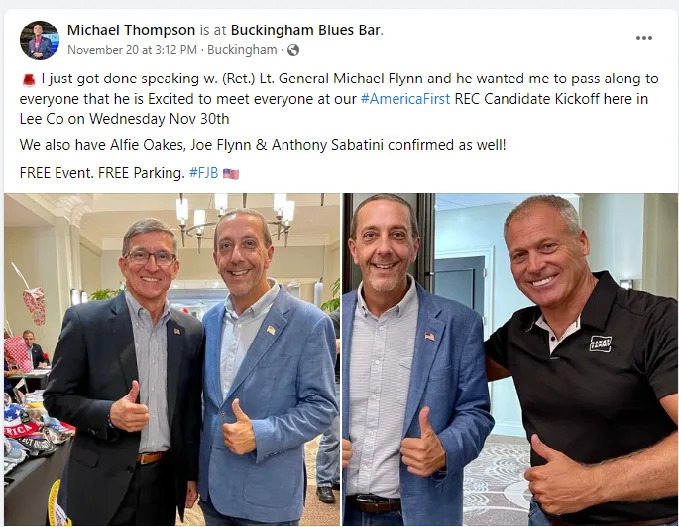
A Facebook post by Michael Thompson shows him with Michael Flynn, left, and Collier County businessman Alfie Oakes, right. Thompson, who is wearing the light blue blazer in both photos, is running for Lee County GOP chair.
‘America First’ candidates

Many of the activists seeking control of local parties have been motivated by Trump’s stolen election claims and his battles with the GOP establishment. They often identity as “America First” candidates, a slogan with a long history in American politics that Trump popularized again.

In Lee County, an activist backed by Flynn who worked for an affiliate of The America Project, a nonprofit Flynn is involved with that promotes Trump’s unfounded election fraud allegations, won the county GOP chair job. The Lee activist, Michael Thompson, posted on Facebook recently that the Arizona election “was stolen” from Kari Lake, the failed far-right candidate for governor. Thompson wants to create a committee within the Lee GOP focused on “election integrity.”

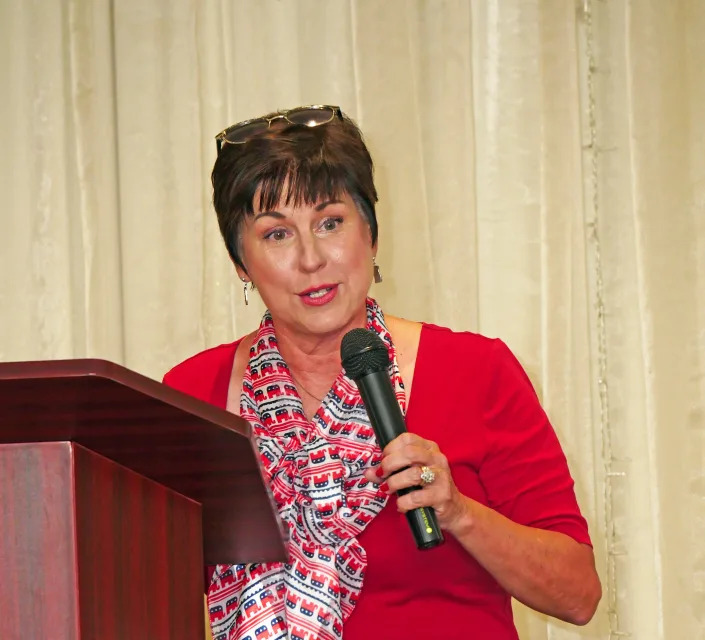
In Pinellas County, activist and conservative author Cathi Chamberlain, who worked as campaign manager for a Jan. 6 defendant who ran for Congress from jail, is running for county party chair. Chamberlain emphasized “the stolen election in 2020” when she announced her campaign at a Pinellas GOP meeting last month.

In Lake County, far right former state House member Anthony Sabatini is running for county party chair amid speculation he might use the post to run for state party chair. Sabatini is an ardent Trump supporter who has frequently battled with members of his own party. He recently tweeted — without any evidence — that “2022 may have even MORE election fraud than 2020.”

Far right former Florida State Representative Anthony Sabatini is running for Lake County GOP chair amid speculation he may use the post to run for Florida GOP chair.
Fizzled red wave

The focus on 2020 was a problem for the GOP this election cycle. Candidates such as Lake, Doug Mastriano in Pennsylvania and others who embraced Trump’s election denialism lost key races, causing a predicted red wave to fizzle.

Florida was a different story. Gov. Ron DeSantis, who has avoided directly answering questions about whether he believes the 2020 election was stolen, won big.

Yet the 2020 election continues to motivate many on the far right, even in Florida, a state Trump carried by three points over President Joe Biden. Trump’s national loss to Biden left many in the GOP frustrated and searching for ways to have influence on the political process.

“The party’s on fire, people want to see change and there’s not change happening, and they look at the party as a way to change,” said state Sen. Joe Gruters, R-Sarasota, chairman of the Florida Republican Party.

Florida GOP Chair Joe Gruters says "the party's on fire." Encouraged by far right figures such as Steve Bannon and Michael Flynn, ultra conservative GOP activists are seeking to seize control of county GOP leadership positions across Florida.
Florida GOP Chair Joe Gruters says “the party’s on fire.” Encouraged by far right figures such as Steve Bannon and Michael Flynn, ultra conservative GOP activists are seeking to seize control of county GOP leadership positions across Florida.

Trump’s unwillingness to accept defeat shaped how the GOP responded to 2020, prompting many in the party to channel their energy into the stolen election narrative. Flynn was at the forefront of that effort nationally. He was deeply involved in trying to overturn the 2020 election. His nonprofit helped fund a controversial recount in Arizona.

In Florida, Flynn — briefly Trump’s national security adviser in 2017 — has been allied with Defend Florida, a loosely organized group that gathered thousands of “affidavits” that the organization implies are possible instances of voter fraud, claims law enforcement and election authorities have dismissed.

Chamberlain has been heavily involved with Defend Florida, and Thompson also is aligned with the group.

‘RINO’ attacks

In Manatee County, GOP Chair Steve Vernon said he’s also being challenged by a Defend Florida volunteer.

The group of activists trying to unseat Vernon has called him a RINO — which stands for “Republican in Name Only” — even though he once led a tea party group and once challenged Gruters, a prominent Trump ally, from the right for a state House seat.

“I’m the ex-president of the tea party, yet they’re calling me a RINO and I’m thinking what world are you in?” Vernon said. “I’m no more RINO than the man on the moon. That’s how bad it is.”

Vernon identifies as a staunch conservative, but he said the people challenging him are “so far right” they’re “off the planet.”

“I am conservative; however, they want to take it to the stratosphere. They have a 100% purity test,” Vernon said.

Vernon said he blames Bannon, a former Trump adviser, for all the pressure on county GOP leaders from the right. Bannon, who was sentenced last year to four months in prison after being found guilty of contempt of Congress, uses his “War Room” program to promote a takeover of the GOP at the local level and build from there, until the party has been transformed statewide and nationally.

Manatee GOP Chair Steve Vernon is facing a challenge for the top county party job from a right wing activist. Vernon identifies as a staunch conservative, but he said the people challenging him are "so far right" they're "off the planet"
Manatee GOP Chair Steve Vernon is facing a challenge for the top county party job from a right wing activist. Vernon identifies as a staunch conservative, but he said the people challenging him are “so far right” they’re “off the planet”

Flynn has pushed a similar message. After failing to overturn the 2020 election, he bought a home in Englewood in Southwest Florida and launched a series of initiatives aimed at engaging the GOP base. Flynn’s motto is “Local Action = National Impact.” He has demonstrated his commitment by joining the Sarasota GOP executive committee and volunteering as a precinct captain.

Bannon talks about taking over the GOP “precinct by precinct.”

Flynn and other far-right individuals backed GOP activist Conni Brunni for Sarasota GOP chair but she fell short by 33 votes to Jack Brill, who was endorsed by the vast majority of GOP elected officials in the county.

Sarasota GOP activist Conni Brunni tried to win control of the county party with backing from Michael Flynn, but came up short by 33 votes.

Chamberlain also likely faces an uphill battle against Adam Ross, a prosecutor who works as executive director of the state attorney’s office covering Pinellas County and has a long list of endorsements from local GOP leaders.

Republicans were hugely successful in Pinellas this cycle, and Ross says he wants to continue the “professional leadership” that has proven effective.

“I think it’s good to have a spirited debate, but I don’t want to see it turn negative where we start using terms like RINO and that,” Ross said. “We all need to work together, we’re all part of the big tent. When I’m chairman everybody will be welcome, but it has to stay professional.”

Chamberlain is critical of Ross, the current vice chair of the Pinellas GOP, saying he hasn’t been aggressive enough in investigating claims of voter fraud. The fraud issue drove her decision to run for party chair. Nationwide, nearly 60 federal judges, including those appointed by Trump, dismissed lawsuits filed by the former president and his allies challenging the 2020 election or its outcome.

“When the establishment was going around telling everybody to keep quiet about the 2020 election my question was why? Why aren’t we hitting this head-on?” Chamberlain said of Trump’s fraud allegations. “I’m a former building contractor and I can tell you if the foundation of a building I was working on wasn’t solid I wouldn’t take one step forward until it was fixed.”

Ross says the local party has taken “election integrity very seriously.”

With Trump running for president again, questions about the 2020 election are likely to continue dividing the party.

“The Republican Party, there’s no question about it is split in half right now,” Chamberlain said. “And the establishment rules currently and the America Firsters… are fighting to regain the values our party stands for.”

Russia grinds on in eastern Ukraine; Bakhmut ‘destroyed’

Associated Press

Russia grinds on in eastern Ukraine; Bakhmut ‘destroyed’

Jamey Keaten – December 10, 2022

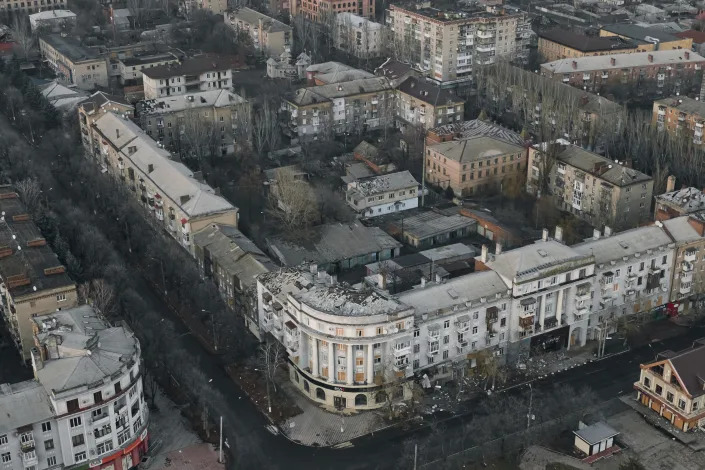
An aerial view of Bakhmut, the site of the heaviest battles with the Russian troops, in the Donetsk region, Ukraine, Friday, Dec. 9, 2022. (AP Photo/LIBKOS)
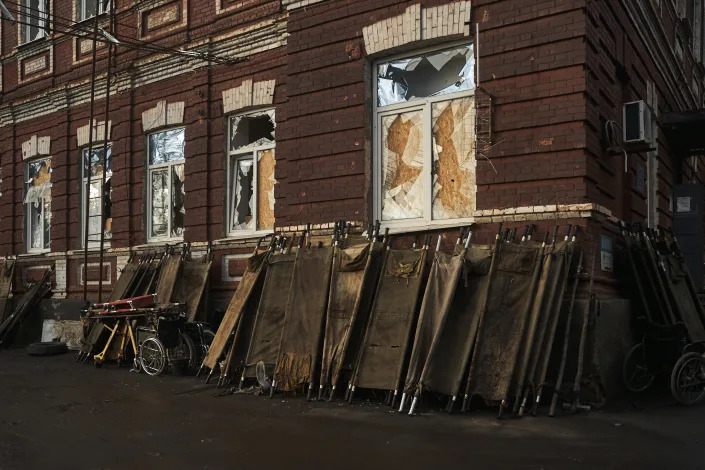
Stretchers are seen outside a city hospital, where wounded Ukrainian soldiers are brought for treatment, in Bakhmut, the site of heavy battles with Russian troops, in the Donetsk region, Ukraine, Friday, Dec. 9, 2022. (AP Photo/LIBKOS)
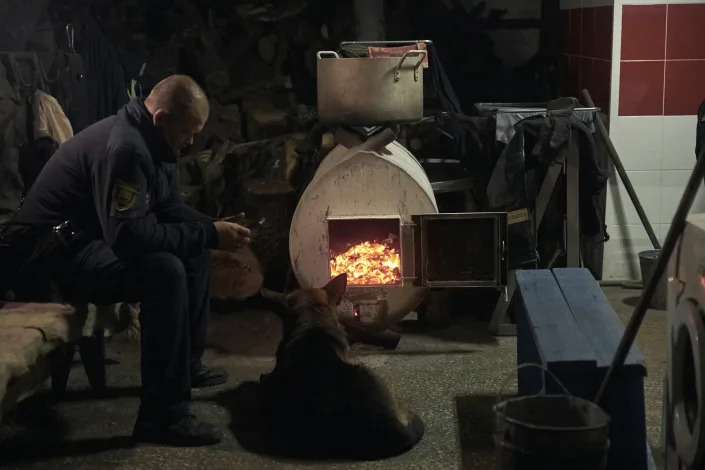
An emergency worker and his dog warm up in front of a wood-burning oven in a shelter in Bakhmut, the site of the heaviest battles with the Russian troops, in the Donetsk region, Ukraine, Friday, Dec. 9, 2022. (AP Photo/LIBKOS)

KYIV, Ukraine (AP) — Russian forces have turned the eastern Ukrainian city of Bakhmut into ruins, President Volodymyr Zelenskyy said, while Ukraine’s military on Saturday reported missile, rocket and air strikes in multiple parts of the country that Moscow is trying to conquer after months of resistance.

The latest battles of Russia’s 9 1/2 month war in Ukraine have centered on four provinces that Russian President Vladimir Putin triumphantly — and illegally — claimed to have annexed in late September. The fighting indicates Russia’s struggle to establish control of those regions and Ukraine’s persistence to reclaim them.

Zelenskyy said the situation “remains very difficult” in several frontline cities in eastern Ukraine’s Donetsk and Luhansk provinces. Together, the provinces make up the Donbas, an expansive industrial region bordering Russia that Putin identified as a focus from the war’s outset and where Moscow-backed separatists have fought since 2014.

“Bakhmut, Soledar, Maryinka, Kreminna. For a long time, there is no living place left on the land of these areas that have not been damaged by shells and fire,” Zelenskyy said in his nightly video address, naming cities that have again found themselves in the crosshairs. “The occupiers actually destroyed Bakhmut, another Donbas city that the Russian army turned into burnt ruins.”

Some buildings remain standing in Bakhmut, and the remaining residents still mill about the streets. But like Mariupol and other contested cities, it endured a long siege and spent weeks without water and power even before Moscow launched massive strikes to take out public utilities across Ukraine.

The Donetsk region’s governor, Pavlo Kyrylenko, estimated seven weeks ago that 90% of the city’s prewar population of over 70,000 had fled in the months since Moscow focused on seizing the entire Donbas.

The Ukrainian military General Staff reported missile attacks, about 20 airstrikes and more than 60 rocket attacks across Ukraine between Friday and Saturday. Spokesperson Oleksandr Shtupun said the most active fighting was in the Bakhmut district, where more than 20 populated places came under fire. He said Ukrainian forces repelled Russian attacks in Donetsk and neighboring Luhansk.

Russia’s grinding eastern offensive succeeded in capturing almost all of Luhansk during the summer. Donetsk eluded the same fate, and the Russian military in recent weeks has poured manpower and resources around Bakhmut in an attempt to encircle the city, analysts and Ukrainian officials have said.

After Ukrainian forces recaptured the southern city of Kherson nearly a month ago, the battle heated up around Bakhmut, demonstrating Putin’s desire for visible gains following weeks of clear setbacks in Ukraine.

Taking Bakhmut would rupture Ukraine’s supply lines and open a route for Russian forces to press on toward Kramatorsk and Sloviansk, key Ukrainian strongholds in Donetsk. Russia has battered Bakhmut with rockets for more than half of the year. A ground assault accelerated after its troops forced the Ukrainians to withdraw from Luhansk in July.

But some analysts have questioned Russia’s strategic logic in the relentless pursuit to take Bakhmut and surrounding areas that also came under intense shelling in the past weeks, and where Ukrainian officials reported that some residents were living in damp basements.

“The costs associated with six months of brutal, grinding, and attrition-based combat around #Bakhmut far outweigh any operational advantage that the #Russians can obtain from taking Bakhmut,” the Institute for the Study of War, a think tank in Washington, posted on its Twitter feed on Thursday.

The Russian Defense Ministry said Saturday that Russian troops also pressed their Donbas offensive in the direction of the Donetsk city of Lyman, which is 65 kilometers (40 miles) north of Bakhmut. According to the ministry, they “managed to take more advantageous positions for further advancement.”

Russia’s forces first occupied the city in May but withdrew in early October. Ukrainian authorities said at the time they found mines on the bodies of dead Russian soldiers that were set to explode when someone tried to clear the corpses, as well as the bodies of civilian residents killed by shelling or who had died from a lack of food and medicine.

On Friday, Putin lashed out at recent comments by former German Chancellor Angela Merkel, who said a 2015 peace deal for eastern Ukraine negotiated by France and Germany had bought time for Ukraine to prepare for war with Russia this year.

That deal was aimed to cool tensions after pro-Russia separatists seized territory in the Donbas a year earlier, sparking a war with Ukrainian forces that ballooned into a war with Russia itself after the Feb. 24 full-scale invasion.

Ukraine’s military on Saturday also reported strikes in other provinces: Kharkiv and Sumy in the northeast, central Ukraine’s Dnipropetrovsk, Zaporizhzhia in the southeast and Kherson in the south. The latter two, along with Donetsk and Luhansk, are the four regions Putin claims are now Russian territory.

A month ago, Russian troops withdrew from the western side of the Dniper River where it cuts through Kherson province, allowing Ukrainians forces to declare the region’s capital city liberated. But the Russians still occupy a majority of the province and have continued to attack from their news positions across the river.

Writing on Telegram, the deputy head of Zelenskyy’s office, Kyrylo Tymoshenko, said two civilians died and another eight were wounded during dozens of mortar, rocket and artillery attacks over the previous day. Residential areas, a hospital, shops, warehouses and critical infrastructure in the Kherson region were damaged, he said.

To the west, drone attacks overnight left much of Odesa province, including its namesake Black Sea port city, without electricity, regional Gov. Maxim Marchenko said. Several energy facilities were destroyed at once, leaving all customers except hospitals, maternity homes, boiler plants and pumping stations were without power, electric company DTEK said Saturday.

The Odesa regional administration’s energy department said late Saturday that fully restoring electricity could take as long as three months and it urged families whose homes are without power to leave the region if possible.

Attacks on Pacific north-west power stations raise fears for US electric grid

The Guardian

Attacks on Pacific north-west power stations raise fears for US electric grid

Dani Anguiano in Los Angeles – December 10, 2022

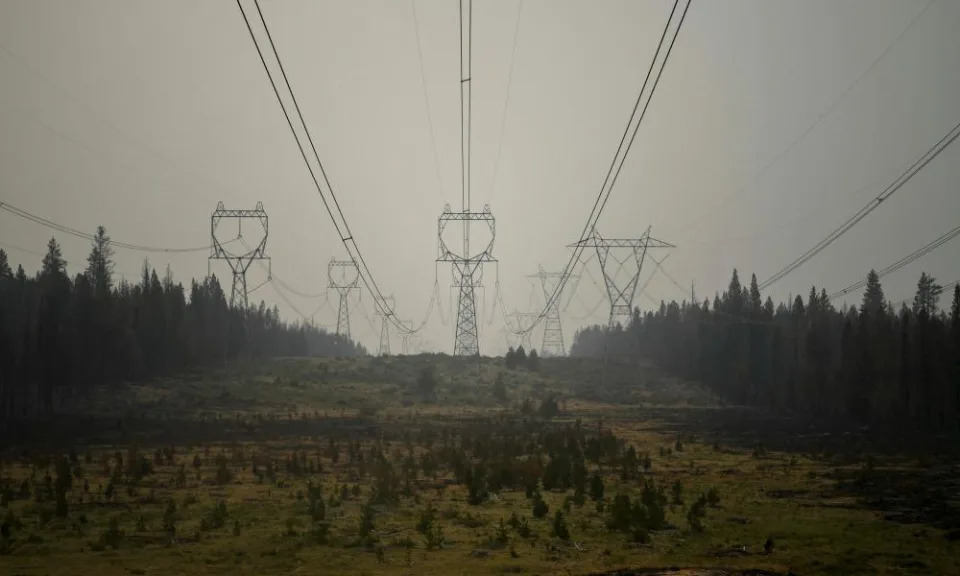
<span>Photograph: Mathieu Lewis-Rolland/Reuters</span>
Photograph: Mathieu Lewis-Rolland/Reuters

A string of attacks on power facilities in Oregon and Washington has caused alarm and highlighted the vulnerabilities of the US electric grid.

The attacks in the Pacific north-west come just days after a similar assault on North Carolina power stations that cut electricity to 40,000 people.

As first reported by Oregon Public Broadcasting and KUOW Public Radio, there have been at least six attacks, some of which involved firearms and caused residents to lose power. Two of the attacks shared similarities with the incident in Moore county, North Carolina, where two stations were hit by gunfire. Authorities have not yet revealed a motive for the North Carolina attack.

The four Pacific north-west utilities whose equipment was attacked have said they are cooperating with the FBI. The agency has not yet confirmed if it is investigating the incidents.

It’s unknown who is behind the attacks but experts have long warned of discussion among extremists of disrupting the nation’s power grid.

Related: FBI joins investigation into attack on North Carolina power grid

Bonneville Power Administration (BPA) said in a statement on Thursday that it was seeking tips about “trespassing, vandalism and malicious damage of equipment” at a substation in Clackamas county on 24 November that caused damage and required cleanup costing hundreds of thousands of dollars.

“Someone clearly wanted to damage equipment and, possibly, cause a power outage,” said John Lahti, the utility’s transmission vice-president of field services. “We were fortunate to avoid any power supply disruption, which would have jeopardized public safety, increased financial damages and presented challenges to the community on a holiday.”

Any attack on electric infrastructure “potentially puts the safety of the public and our workers at risk”, said BPA, which delivers hydropower across the Pacific north-west .

Portland General Electric, a public utility that provides electricity to nearly half of the state’s population, said it had begun repairs after suffering “a deliberate physical attack on one of our substations” that also occurred in the Clackamas area in late November 2022. It said it was “actively cooperating” with the FBI.

Puget Sound Energy, an energy utility in Washington, reported two cases of vandalism at two substations in late November to the FBI and peer utilities, but said the incidents appeared to be unrelated to other recent attacks.

“There is no indication that these vandalism attempts indicate a greater risk to our operations and we have extensive measures to monitor, protect and minimize the risk to our equipment and infrastructure,” the company said in a statement.

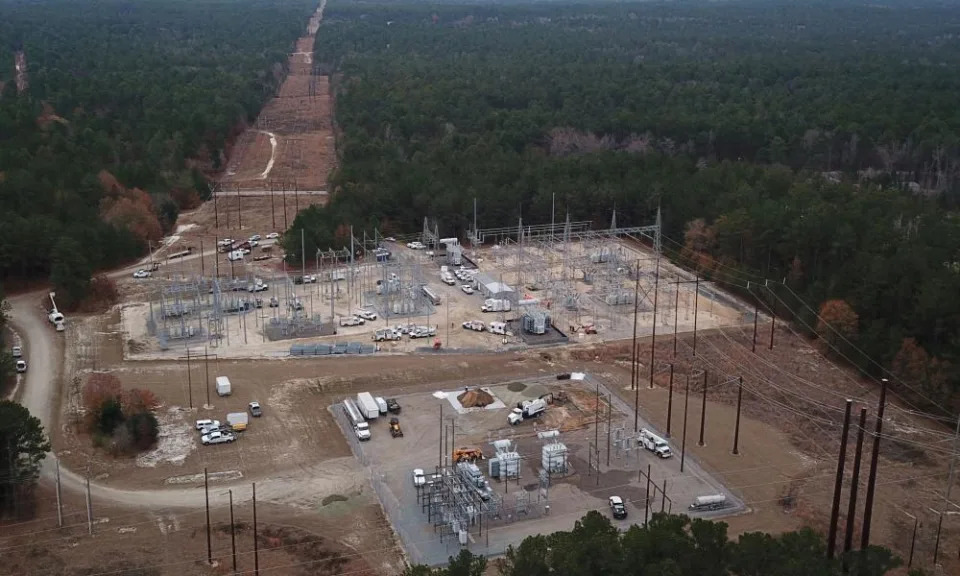
overhead view of substation
Duke Energy workers repair an electrical substation that they said was hit by gunfire, near Pinehurst, North Carolina, on Tuesday. Photograph: Drone Base/Reuters

Experts and intelligence analysts have long warned of both the vulnerability of the US power grid and talk among extremists about attacking the crucial infrastructure.

“It’s very vulnerable,” said Keith Taylor, a professor at the University of California, Davis, who has worked with energy utilities. “[These attacks] are a real threat.”

The physical risks to the power grid have been known for decades, Granger Morgan, an engineering professor at Carnegie Mellon University, told CBS. “We’ve made a bit of progress, but the system is still quite vulnerable,” he said.

US Department of Homeland Security (DHS) report released in January warned that domestic extremists have been developing “credible, specific plans” to attack electricity infrastructure since at least 2020.

The DHS has cited a document shared on a Telegram channel used by extremists that included a white supremacist guide to attacking an electric grid with firearms, CNN reported.

“These fringe groups have been talking about this for a long time,” Taylor said. “I’m not at all surprised this happened – I’m surprised it’s taken this long.”

Three men who law enforcement identified as members of the Boogaloo movement allegedly planned to attack a substation in Nevada in 2020 to distract police and attempt to incite a riot.

In 2013, still unknown assailants cut fiber-optic phone lines and used a sniper to fire shots at a Pacific Gas & Electric substation near San Jose in what appeared to be a carefully planned attack that caused millions of dollars in damage. The attack prompted the Federal Energy Regulatory Commission (Ferc) to order grid operators to increase security.

“They knew what they were doing. They had a specific objective. They wanted to knock out the substation,” Jon Wellinghoff, the then chair of Ferc, told 60 Minutes, adding that the attack could have “brought down all of Silicon Valley”.

After the 2013 attack in California, a Ferc analysis found that attackers could cause a blackout coast-to-coast if they took out only nine of the 55,000 substations in the US.

The US electrical grid is vast and sprawling with 450,000 miles of transmission lines, 55,000 substations and 6,400 power plants. Power plants and substations are dispersed in every corner of the country, connected by transmission lines that transport electricity through farmland, forests and swamps. Attackers do not necessarily have to get close to cause significant damage.

“In a centralized system, if I [want] to take out one coal-fired plant, I don’t even have to take out the plant, I just have to take out the transmission line,” said Taylor. “You can cause a ripple effect where one outage can cause an entire seaboard to go down.”

The Associated Press contributed to this report

Spat Over Patriot Missiles Reveals Deepening Rifts in Europe Over Ukraine

The New York Times

Spat Over Patriot Missiles Reveals Deepening Rifts in Europe Over Ukraine

Steven Erlanger – December 10, 2022

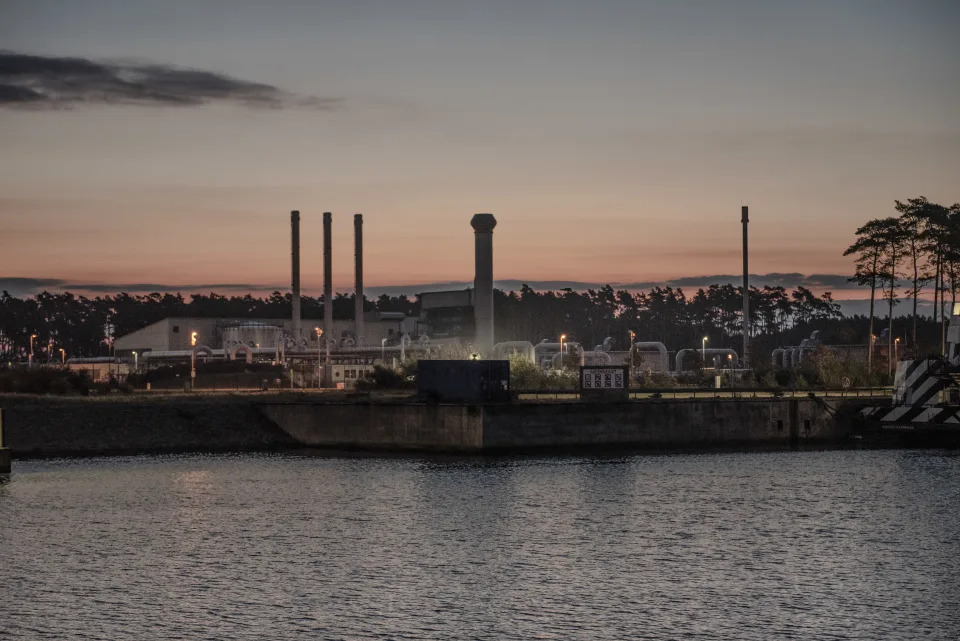
The facility where the Nord Stream 1 gas pipeline emerges from the Baltic Sea in Lubmin, Germany, Sept. 30, 2022. (Laetitia Vancon/The New York Times)

BRUSSELS — A bitter political and diplomatic rift between Germany and Poland, both important members of the European Union and NATO, has worsened as Russia’s war in Ukraine has ground on, undermining cohesion and solidarity in both organizations.

The toxic nature of the relationship was underscored recently by a German offer to provide two batteries of scarce and expensive Patriot air defense missiles to Poland, after a Ukrainian missile strayed off course and killed two Poles last month in the little town of Przewodow.

Poland initially accepted the offer of the Patriots, then rejected it. They then insisted that the batteries be put in Ukraine, a nonstarter for NATO, since the missile systems would be operated by NATO personnel. After considerable allied concern and public criticism, the Poles now seem to have accepted the missiles again.

“This whole story is like an X-ray of miserable Polish-German relations,” said Michal Baranowski, the regional managing director of the German Marshall Fund in Warsaw. “It’s worse than I thought, and I’ve watched it a long time.”

Poland has long been wary of Germany; Hitler’s invasion in 1939 was the start of World War II. It was also critical of Germany’s policy of Ostpolitik, the Cold War effort at rapprochement with Moscow and the countries of Eastern and Central Europe occupied by the Soviet Union.

Democratic Poland consistently criticized German dependency on Russian energy and the two Nord Stream pipelines that were designed to take cheap Russian gas directly to Germany and bypass Poland and Ukraine. The Russian invasion of Ukraine has only intensified the view in Poland that Germany’s close relations with Russia and President Vladimir Putin were not just naive but selfish and, possibly, just on hold rather than permanently sundered.

Both sides have made mistakes in the current dispute, said Jana Puglierin, the Berlin director of the European Council on Foreign Relations. “The relationship has been deteriorating for years, but it’s peaking now and doing real damage,” she said. “There is a gap emerging between Europe’s east and west, old Europe and new Europe, and that’s beneficial only for Vladimir Putin.”

Germany thought this gesture of military help would be “an offer that was too good to be refused,” and would help convince Poles that Germany is a reliable ally, said a senior German diplomat, who would speak only anonymously in accordance with diplomatic practice. After all, he said, the Poles themselves are trying to buy Patriots, a surface-to-air anti-missile system, “so we wanted to make this government’s caricature of Germany more hollow.”

But after the Polish defense minister and president quickly accepted the offer, Jaroslaw Kaczynski, the powerful 73-year-old leader of Poland’s governing Law and Justice party, rejected it just two days later.

Not only did he insist that the Patriots go to Ukraine, but he suggested that Germany, which he regularly attacks as siding with Russia over Poland, and whose soldiers would be operating the Patriots, would not dare to confront Russia. “Germany’s attitude so far gives no reason to believe that they will decide to shoot at Russian missiles,” Kaczynski said.

Kaczynski has no formal role in the Polish government, but the defense minister, Mariusz Blaszczak, fell into line within hours. Poland’s president, Andrzej Duda, from the same party, and who is also Poland’s commander in chief, was embarrassed by the painfully obvious display of his powerlessness.

NATO allies were quietly furious, precisely because the Patriots would be operated by German soldiers and the defense bloc has made it clear that it will not deploy troops to Ukraine and risk a NATO-Russian war. Any decision to send Patriots to Ukraine, Germany said, would have to be a NATO decision, not a bilateral one.

“Kaczynski knew this and was being totally cynical,” said Piotr Buras, the Warsaw director of the European Council on Foreign Relations. “Everyone knew the Germans would not and could not send Patriots to Ukraine. And, of course, there are no Polish soldiers in Ukraine, either.”

The only explanation for Kaczynski’s response is political, Baranowski of the German Marshall fund said, since Poland is in an electoral campaign and the party’s support has been slipping. With elections scheduled for next autumn, Law and Justice is reinforcing its base, and “criticism of Germany is a constant party line,” he said.

Some analysts detected a political motive on the German side as well. The offer by Berlin, so soon after the deaths of the Poles, was “clearly a German effort to have a win in the bitter, toxic Polish-German diplomatic war,” said Wojciech Przybylski, chief editor of Visegrad Insight and president of the Warsaw-based Res Publica Foundation, a research institution. “And it also harms Kaczynski’s electoral strategy.”

Even so, “for Poland’s leading politician, and head of the ruling coalition, to say that he has no trust in Germany as an ally was shocking,” Baranowski said. “If mismanaged this can hurt alliance unity, beyond the two countries — I’ve never seen security instrumentalized in this way, in this toxic mixture.”

But Germany decided to keep the offer open, the German diplomat said, and opinion polls showed that a large percentage of Poles thought that having German Patriots in Poland was a good idea.

On Tuesday night, the Polish government shifted its position again. Blaszczak, the defense minister, announced that after further talks with Berlin, he “disappointedly” accepted that the missiles would not go to Ukraine, adding, “We are beginning working arrangements on deploying the launchers in Poland and making them part of our command system.”

But the bitterness will persist, and few expect Kaczynski and his party to stop questioning German sincerity. Only in October, for instance, Warsaw suddenly demanded Germany pay reparations for World War II, calculating $1.3 trillion in wartime losses, an issue that Berlin said had been settled in 1990.

But the criticism of German hesitancy toward helping Ukraine, and of France’s early willingness to push for peace talks at Ukraine’s expense, is not limited to Poland but is also prevalent in central, eastern and northern Europe, although less charged.

“There is a lot of talk about Western and EU unity and cooperation on Ukraine, but at the same time this war has triggered a significant wave of criticism of Western Europe in Poland and the Baltics,” said Buras of the European Council on Foreign Relations. “It deepened the skepticism and criticism, especially of Germany and France, and fed a sense of moral superiority toward them, that we’re on the right side and they were on the wrong side,” he said. “And it has deepened mistrust about security cooperation with them, that we can’t rely on them, but only on the U.S. and the U.K.”

The Polish debate mixes two things, he said. First, there is a “ruthless political instrumentalization of Germany by Law and Justice — it’s incredible how they portray Germany as an enemy and Berlin as dangerous to Poland as Moscow, that Berlin wants Russia to win and is not really helping Ukraine at all.”

But beyond the crude propaganda, Buras said, there is a failure in Poland to recognize that there is a post-invasion realization in Berlin that war has come back to Europe, that Germany needs to rearm and has become far too dependent on Russian energy and Chinese trade.

Poland may not be the only country criticizing Germany over Ukraine, Puglierin said, but on another level, “it’s the political layer in Poland, toxic and nasty.” Law and Justice “jump on this German hesitation and use it for domestic political reasons, and I think it will only get worse before the elections, at the very time when unity is useful.”

There is one brighter spot of cooperation. Earlier this month, the two countries signed an agreement to work to ensure the future of the giant Schwedt refinery, a German facility that had processed Russian oil, now under sanctions.

Sophia Besch, a German analyst with the Carnegie Endowment, insisted that Germany had changed since the Russian invasion. She pointed to the sharp change in policy toward a stronger military and more economic resilience, the “Zeitenwende,” or historical turning point, announced by Chancellor Olaf Scholz. “Scholz is much more committed to listening to Central European countries,” she said. “I believe our romance with Russia is over.”

America’s Toxic Gun Culture

By The Editorial Board – December 10, 2022

An array of gun cartridges set against a black background.
Credit…Sam Kaplan/Trunk Archive

This editorial is the fifth in a series, “The Danger Within,” urging readers to understand the danger of extremist violence and possible solutions. Read more about the series in a note from Kathleen Kingsbury, the Times Opinion editor.

A year ago, Representative Thomas Massie of Kentucky posted a Christmas photo on Twitter. In it, Mr. Massie, his wife and five children pose in front of their ornament-bedecked tree. Each person is wearing a big grin and holding an assault weapon. “Merry Christmas! ps. Santa, please bring ammo,” Mr. Massie wrote on Twitter.

The photo was posted on Dec. 4, just four days after a mass shooting at a school in Oxford, Mich., that left four students dead and seven other people injured.

The grotesque timing led many Democrats and several Republicans to criticize Mr. Massie for sharing the photo. Others lauded it and nearly 80,000 people liked his tweet. “That’s my kind of Christmas card!” wrote Representative Lauren Boebert of Colorado, who then posted a photo of her four sons brandishing similar weapons.

These weapons, lightweight and endlessly customizable, aren’t often used in the way their devotees imagine — to defend themselves and their families. (In a recent comprehensive survey, only 13 percent of all defensive use of guns involved any type of rifle.) Nevertheless, in the 18 years since the end of the federal assault weapons ban, the country has been flooded with an estimated 25 million AR-15-style semiautomatic rifles, making them one of the most popular in the United States. When used in mass shootings, the AR-15 makes those acts of violence far more deadly. It has become the gun of choice for mass killers, from Las Vegas to Uvalde, Sandy Hook to Buffalo.

The AR-15 has also become a potent talisman for right-wing politicians and many of their voters. That’s a particularly disturbing trend at a time when violent political rhetoric and actual political violence in the United States are rising.

Addressing violent right-wing extremism is a challenge on many fronts: This board has argued for stronger enforcement of state anti-militia laws, better tracking of extremists in law enforcement and the military, and stronger international cooperation to tackle it as a transnational issue. Most important, there is a civil war raging inside the Republican Party between those who support democracy and peaceful politics and those who support far-right extremism. That conflict has repercussions for all of us, and the fetishization of guns is a pervasive part of it.

The prominence of guns in campaign ads is a good barometer of their political potency. Democrats have sometimes used guns in ads — in 2010, Joe Manchin of West Virginia, running for the Senate, shot a hole through a copy of the cap-and-trade climate bill with a single-shot hunting rifle. Since then, guns have all but disappeared from Democratic messaging. But in the most recent midterm elections, Republican politicians ran more than 100 ads featuring guns and more than a dozen that featured semiautomatic military-style rifles.

In one of the most violent of those ads, Eric Greitens, a Republican candidate for Senate in Missouri and a former Navy SEAL, kicks in the door of a house and barges in with a group of men dressed in tactical gear and holding assault rifles. Mr. Greitens boasts that the group is hunting RINOs — a derogatory term for “Republicans in name only.” The ad continues, “Get a RINO hunting permit. There’s no bagging limit, no tagging limit, and it doesn’t expire until we save our country.”

Twitter flagged the ad, Facebook banned it for violating its terms of service, and Mr. Greitens lost his race for office. He may have been playacting in the ad, but many other heavily armed people with far-right political views are not. Openly carried assault rifles have become an all too common feature of political events around the country and are having a chilling effect on the exercise of political speech.

This intimidating display of weaponry isn’t a bipartisan phenomenon: A recent New York Times analysis examined more than 700 demonstrations where people openly carrying guns showed up. At about 77 percent of the protests, those who were armed “represented right-wing views, such as opposition to L.G.B.T.Q. rights and abortion access, hostility to racial justice rallies and support for former President Donald J. Trump’s lie of winning the 2020 election.”

As we’ve seen at libraries that host drag queen book readingsJuneteenth celebrations and Pride marches, the Second Amendment’s right to bear arms is fast running up against the First Amendment’s right to peaceably assemble. Securing that right, and addressing political violence in general, requires addressing the armed intimidation that has become commonplace in public places and the gun culture that makes it possible.


A growing number of American civilians have an unhealthy obsession with “tactical culture” and rifles like the AR-15. It’s a fringe movement among the 81 million American gun owners, but it is one of several alarming trends that have coincided with the increase in political violence in this country, along with the spread of far-right extremist groups, an explosion of anti-government sentiment and the embrace of deranged conspiracy theories by many Republican politicians. Understanding how these currents feed one another is crucial to understanding and reversing political violence and right-wing extremism.

The American gun industry has reaped an estimated $1 billion in sales over the past decade from AR-15-style guns, and it has done so by using and cultivating their status as near mythical emblems of power, hyper-patriotism and manhood. Earlier this year, an investigation by the House Committee on Oversight and Reform found that the gun industry explicitly markets its products by touting their military pedigree and making “covert references to violent white supremacists like the Boogaloo Boys.” These tactics “prey on young men’s insecurities by claiming their weapons will put them ‘at the top of the testosterone food chain.’”

This marketing and those sales come at a significant cost to America’s social fabric.

In his recent book “Gunfight: My Battle Against the Industry That Radicalized America,” Ryan Busse, a former firearms company executive, described attending a Black Lives Matter rally with his son in Montana in 2020. At the rally, dozens of armed men, some of them wearing insignia from two paramilitary groups — the 3 Percenters and the Oath Keepers — appeared, carrying assault rifles. After one of the armed men assaulted his 12-year-old son, Mr. Busse had his epiphany.

“For years prior to this protest, advertising executives in the gun industry had been encouraging the ‘tactical lifestyle,’” Mr. Busse wrote. The gun industry created a culture that “glorified weapons of war and encouraged followers to ‘own the libs.’”

The formula is a simple one: More rage, more fear, more gun sales.

A portion of those proceeds are then funneled back into politics through millions of dollars in direct contributions, lobbying and spending on outside groups, most often in support of Republicans.

All told, gun rights groups spent a record $15.8 million on lobbying in 2021 and $2 million in the first quarter of 2022, the transparency group OpenSecrets reported. “From 1989 to 2022, gun rights groups contributed $50.5 million to federal candidates and party committees,” the group found. “Of that, 99 percent of direct contributions went to Republicans.”


The Danger Within

It is important, of course, to distinguish between the large majority of law-abiding gun owners and the small number of extremists. Only about 30 percent of gun owners have owned an AR-15 or similar rifle, a majority support common sense gun restrictions and a majority reject political violence.

Institutions and individuals — prominent politicians, for instance, and responsible gun owners — could do far more to insist that assault weapons have no place in public spaces, even if they are permitted in many states, where the open carry of firearms is legal. Public condemnation of such displays is a good place to start.

Republicans should also show more courage in condemning extremists in their own ranks. When Representative Massie posted his Christmas photo, Representative Adam Kinzinger of Illinois responded on Twitter: “I’m pro second amendment, but this isn’t supporting right to keep and bear arms, this is a gun fetish.” There’s a difference between celebrating Christmas secure in the knowledge that you have a weapon to defend your home and family and sending out a photo of your arsenal days after a school shooting.

Democrats, while they may hope for stricter gun laws overall, should also recognize that they do share common ground with many gun owners — armed right-wing extremists and those who fetishize AR-15s do not represent typical American gun owners or their beliefs. That’s especially true given the changing nature of who owns guns in the United States: women and Black Americans are among the fastest-growing demographics.

This summer, for the first time in decades, Congress passed major bipartisan gun safety legislation — a major accomplishment and a sign that common ground is not terra incognita. It should have gone further — and can in the future: preventing anyone under 21 from buying a semiautomatic weapon, for instance, and erasing the 10-year sunset of the background-check provision. States should also be compelled to pass tougher red-flag laws to take guns out of the hands of suicidal or potentially violent people. Mandatory gun-liability insurance is also an idea with merit.

States and the federal government should also pass far tougher regulations on the gun industry, particularly through restrictions on the marketing of guns, which have helped supercharge the cult of the AR-15. New York’s law, which allows parties like victims of gun violence and the state government to sue gun sellers, manufacturers and distributors, is a good model for other states to follow.

Federal regulators should also do more to regulate the arms industry’s marketing practices, which are becoming more deadly and deranged by the year. They have the legal authority to do so but, thus far, not the will to act.

Americans are going to live with a lot of guns for a long time. There are already more than 415 million guns in circulation, including 25 million semiautomatic military-style rifles. Calls for confiscating them — or even calls for another assault weapons ban — are well intentioned and completely unrealistic. With proper care and maintenance, guns made today will still fire decades from now. Each month, Americans add nearly two million more to the national stockpile.

But even if common-sense regulation of guns is far from political reality, Americans do not have to accept the worst of gun culture becoming pervasive in our politics. The only hope the nation has for living in and around so many deadly weapons is a political system capable of resolving our many differences without the need to use them.

Tornadoes, blizzard conditions, floods all possible from upcoming massive storm in central US

AccuWeather

Tornadoes, blizzard conditions, floods all possible from upcoming massive storm in central US

Alex Sosnowski – December 9, 2022

An enormous cross-country storm is likely to be at its worst over the central United States early next week when a potential tornado outbreak may occur at the same time a blizzard rages about 1,000 miles farther to the north, AccuWeather meteorologists warn.

The same storm will also raise the risk of flooding in the Tennessee Valley, causing temperatures to plunge and winds to howl in the Southwest. It could even spread some snow and ice into the Northeast later in the week.

“You name it, this storm will bring it in terms of wild weather next week,” AccuWeather Chief On-Air Meteorologist Bernie Rayno said.

Much of the extreme weather will occur during the three-day period from Monday to Wednesday in the middle of the nation.

The storm will be in a strengthening phase as it pushes onshore and moves inland over the Pacific Coast states this weekend. Many low-elevation areas from western Washington to Southern California will be drenched by heavy rain as feet of snow pile up in the mountains.

The storm system will spread broad areas of heavy snow and gusty winds over the Intermountain West later this weekend and into early next week before it expands across the northern Plains.

Several inches will pile up in the major metro area of Salt Lake City, as well as Flagstaff, Arizona, from the storm. Blowing and drifting snow on top of the heavy accumulation will lead to difficult travel even outside of the major mountain passes in the region.

The full fury of the storm’s wintry side will be on display from later Monday to Wednesday across the Great Plains. Temperatures will drop, and snow will expand from parts of Colorado to the Dakotas and northern Minnesota.

For example, in Rapid City, South Dakota, temperatures will plummet from the mid-50s on Sunday to the teens on Monday night and remain there through Tuesday and Wednesday as winds gusts of between 30 and 60 mph howl and snow spreads through the area.

While the worst of the snowstorm may occur to the north and west of Denver, blizzard conditions will unfold over tens of thousands of square miles from parts of Colorado, Wyoming and Montana to near the Canada border in North Dakota and Minnesota.

The extensive blowing of the dry, powdery snow is likely to create massive drifts that can block roads and strand motorists along vast portions of interstates 25, 29, 70, 80, 90 and 94, forecasters say.

About 500 to 1,000 miles farther to the south, a significant risk to lives and property will unfold as thunderstorms erupt, become severe and likely unleash multiple tornadoes.

“It does not matter what time of time of the year it is for severe weather,” Rayno said. “If the ingredients are there, then severe weather can occur any time of the year.”

Last year, on Dec. 10-11, 2021, a swarm of tornadoes struck part of the Mississippi Valley, killing dozens of people and injuring numerous others.

As stiff breezes rapidly transport Gulf of Mexico moisture northward next week, stronger and shifting winds higher up in the atmosphere will cause thunderstorms to rotate. Rotating thunderstorms can carry a high risk of spawning tornadoes.

Surging humidity levels, combined with an incredible amount of jet stream energy, will lead to a major severe weather outbreak, according to Rayno.

As if the risk of multiple strong tornadoes was not serious enough, a number of the violent storms are likely to occur after dark on both Monday and Tuesday nights. This means that millions of people in the path of the storm should closely monitor severe weather alerts as visual confirmation of tornadoes on the ground may not be possible in every case.

Following a few scattered thunderstorms this weekend from central Texas to Tennessee, severe thunderstorms will ramp up on Monday afternoon from north-central Texas to western and central Oklahoma. All types of severe weather are possible in this zone that will focus on an area just west of the major metro areas of Oklahoma City and Dallas. Potent storms could wander into these locations prior to daybreak on Tuesday, forecasters warn.

During Tuesday and Tuesday night, the severe weather and tornado threat will expand and cover an area farther to the east, reaching areas from northeastern Texas and eastern Oklahoma to the Mississippi River.

Multiple strong tornadoes are possible in this zone, along with large hail, high winds and torrential downpours. Even where tornadoes occur during the daylight hours, they may be difficult to see in advance due to hilly, wooded terrain and poor visibility due to rain in some cases.

The severe thunderstorm and tornado threat will occur mostly during the nighttime hours on Tuesday and may be focused near and east of the Mississippi River in areas as far along as western Kentucky middle Tennessee, all of Mississippi and western and central Alabama.

It is possible the severe weather threat continues on Wednesday along a portion of the interstate 10 and 20 corridors farther to the east in the South.

Since much of the south-central region has been receiving rain on a more regular basis in recent weeks, not only have drought conditions improved, but the soil has gotten progressively wetter. The saturated ground means that where downpours persist for a longer period of time, the risk of urban and small stream flooding will be significantly higher when compared to recent weeks. The massive storm next week could bring a fresh 1-2 inches of rain in 12-24 hours with locally higher amounts.

Substantial rises are likely on some of the secondary rivers, but river flooding is not expected along the Ohio and lower Mississippi due to very low levels. On a positive note, the additional rain forthcoming from the storm will provide yet another boost in river levels. Minor surges in water levels have allowed some increase in barge operations along the lower portion of the Mississippi in recent days.

The storm may deliver some significant impacts to the East later next week as well.

The initial surge of moisture may occur before the atmosphere has a chance to warm up in portions of the Appalachians, New England and the eastern Great Lakes region late Wednesday night to Thursday. This could lead to a zone of accumulating snow or dangerous ice in some locations. Rain will push toward the southeastern U.S. coast by the end of the week.

However, there is also the possibility of a spin-off storm developing at the end of the week. If all the pieces fall into place, the storm could strengthen quickly, producing wind, heavy rain and even heavy snow for some areas of the Northeast as well.

Want next-level safety, ad-free? Unlock advanced, hyperlocal severe weather alerts when you subscribe to Premium+ on the AccuWeather app. AccuWeather Alerts are prompted by our expert meteorologists who monitor and analyze dangerous weather risks 24/7 to keep you and your family safer.

Just 1 minute of exercise a few times per day may help you live longer, a new study suggests

Insider

Just 1 minute of exercise a few times per day may help you live longer, a new study suggests

Gabby Landsverk – December 9, 2022

a busy business woman walking up stairs
A quick walk up the stairs could have similar benefits as a longer exercise routine, according to a new study.Westend61/Getty Images
  • Getting your heart rate up for a few minutes each day could help stave off disease and early death.
  • A study suggests quick activities like taking the stairs were linked to similar benefits as a gym session.
  • Regular exercise reduces the risk of dying from cancer and heart disease, and every minute could count.

If you struggle to find time for the gym, you may be able to reap some benefits of exercise in just minutes a day, new research suggests.

Short, vigorous activities in your daily routine — like power walking, intense housecleaning, or playing with kids or pets — may significantly reduce your risk of dying from cancer or heart disease, according to a study published December 8 in Nature Medicine.

Researchers from the University of Sydney looked at data from 25,241 UK residents who were self-described “non-exercisers” over seven years of follow-up, to analyze their habits and health outcomes.

They found that without going to the gym, some participants still got a daily dose of exercise in the form of brief, strenuous actions like running to catch a bus, taking the stairs, or doing high-energy chores.

Despite being just one to two minutes at a time, the short activities were linked to similar health benefits as more structured exercise. Typical exercise recommendations call for 150 to 300 minutes per week of moderate activity, or 75 to 150 minutes of vigorous activity.

But as little as 4 to 6 minutes a day of vigorous activity (spread out across 3 sessions) was linked to up to 49% lower risk of dying from heart disease and up to 40% lower risk of dying from any cause during the study.

More activity was even better, researchers noted. Up to 11 short sessions per day was linked to 65% lower risk of dying from cardiovascular disease, and 49 lower risk of dying from cancer, compared to people who didn’t do any vigorous activity.

A caveat to the research is that it doesn’t directly show that short bursts of movement cause better health outcomes, but does indicate a connection.

More research is needed, but the study results suggest that getting more movement in your daily routine may be a useful strategy for improving your health, even if you can’t make it to the gym, according to the researchers.

“A few very short bouts totaling three to four minutes a day could go a long way, and there are many daily activities that can be tweaked to raise your heart rate for a minute or so,” Emmanuel Stamatakis, lead author of the study and professor of physical activity, lifestyle, and population health at the University of Sydney, said in a press release.

Exercise is one of the best strategies for better health, and every little bit counts

Extensive previous evidence suggests exercise offers a wealth of benefits, including better mental health, lower risk of disease, and slower physical and cognitive decline as we age. Both aerobic exercise (cardio) and resistance training such as lifting weights have been show to boost health.

Studying smaller doses of exercise, especially outside the gym, could help bring the benefits of fitness to people without the time, money, or access to keep up with other workout routines, according to the study authors.

“Upping the intensity of daily activities requires no time commitment, no preparation, no club memberships, no special skills. It simply involves stepping up the pace while walking or doing the housework with a bit more energy,” Stamatakis said.