Chinese Rocket Stage Now a Cloud of Orbital Debris After Disintegrating in Space
Passant Rabie – December 13, 2022
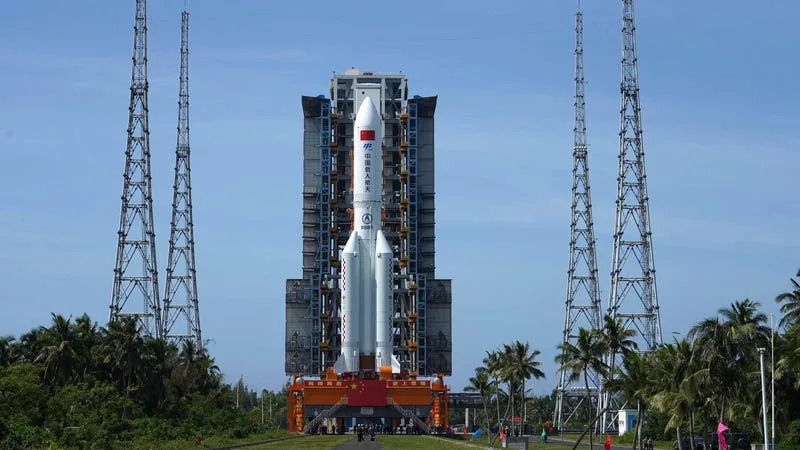
China’s Long March-5B Y3 rocket carried the Wentian lab module to China’s space station in July.
On November 12, China’s Long March 6A rocket broke apart after launch, scattering debris in low Earth orbit. Now, reports suggest that the disintegrated upper stage of the rocket has grown to a cloud of 350 pieces of space debris.
The rocket launched at 5:52 p.m. ET on November 11 from Taiyuan Satellite Launch Center in north China, carrying the Yunhai 3 environmental monitoring satellite.
Shortly after delivering the satellite to low Earth orbit, the upper stage of the Long March 6A rocket broke apart, the South China Morning Post reported at the time. The U.S. Space Force’s 18th Space Defense Squadron tracked 50 pieces of space debris resulting from the rocket’s break up at an estimated altitude of 310 miles to 435 miles (500 to 700 kilometers), the squadron announced on November 13.
Nearly a month later, experts are still tracking the disintegrated pieces from the rocket. “There are now 350 debris objects cataloged from the Nov 12 disintegration of a Chinese rocket stage (CZ-6A Y2), in sun-sync orbit,” Jonathan McDowell, an astronomer at the Harvard-Smithsonian Center for Astrophysics, wrote on Twitter based on ongoing tracking by the Space Defense Squadron.
China has been reckless with its rockets before, but the Long March 6A rocket breakup wasn’t meant to happen. The rocket’s upper stage was supposed to reenter Earth’s atmosphere in one piece, and burn up during reentry. It’s not clear what went wrong to cause the rocket to break up before its reentry.
The rocket breakup sent debris flying near Starlink’s internet satellites, but Chinese officials are claiming that pieces of the rocket will not threaten other low Earth orbit assets. “As far as we know, the relevant incident will not affect the Chinese space station or the International Space Station,” Mao Ning, spokesperson for China’s Foreign Ministry, is quoted in the South China Morning Post as saying during a press conference.
As of last year, more than 27,000 pieces of space debris were being tracked in orbit by the Department of Defense’s global Space Surveillance Network, with lots of smaller pieces also floating around undetected.
Tempted to joke about global warming amid a blizzard? Here’s what experts say about that.
Elizabeth Weise, USA TODAY – December 13, 2022
Winter storms are pummeling the United States, snow is piling up, temperatures are dropping, traffic is snarling and there’s always the threat of thunderstorms and thundersnow.
Just like clockwork, the emails, tweets and Facebook posts start flowing. Maybe it’s a joke, maybe it’s a snarky critique, maybe it’s a meme. The words change, but the format is familiar: If global warming is real, why is it so cold out?
Scientists likely don’t think that joke is as funny as another familiar climate change quip: Never argue about climate change – it always turns into a heated debate.
But we asked experts to weigh in on the winter weather trope. Here’s a few thoughts on what winter means in an era of global warming.
Cold winters don’t mean there’s no global warming
Atmospheric science professor Dan Chavas at Purdue University in Indiana says these arguments don’t frustrate him because they’re a chance to engage.
“I think most of the time when people say that, they are joking and do not seriously believe that the occurrence of winter disproves climate change,” he said. “For me personally as a scientist, I see that type of comment as a potential opportunity to talk about climate, the seasons, and climate change if they seem interested.”
He starts that conversation by agreeing that climate has always had seasons, but notes climate change is a gradual warming – on top of the seasons – that’s making winters, springs, summers and falls all warmer over time.
Higher temperatures don’t mean it’s hotter everywhere all the time
Global temperatures have risen 1.9 degrees Fahrenheit since 1880. That doesn’t mean it’s hotter everywhere all at once but that the entire system is becoming more volatile.
“As you add energy to the system, both extremes grow. You can have Texas ice storms as well as 33 million people displaced in Pakistan due to heat and flooding,” said Julio Friedmann, chief scientist at Carbon Direct, a carbon-management firm and a former professor at Columbia University. “These sorts of changes were predicted in 1996, it’s not news that this is happening.”
That said, winters are indeed getting warmer.
Since 1896, average winter temperatures across the lower 48 states have increased by nearly 3 degrees, according to the Environmental Protection Agency. Nationally, 57% of US Weather Service stations have shown a decline in snowfall since the 1930s.
Winter weather is now on average 14-and-a-half days shorter and summers are seven and a half days longer, according to Brian Brettschneider, a climate scientist with the University of Alaska at Fairbanks
“Global warming will not stop the seasons, but it is causing long-term trends in winter conditions that are robust and accelerating,” said Jason Smerdon, a climate physicist at Columbia University.
The odds are shifting to hotter extremes
But climate change is never all one thing or another. Rather it is a shift in the odds of occurrences of extremes, said Gerald Meehl, a senior scientist with the National Center for Atmospheric Research.
Over the U.S. during the past decade, it is twice as likely that a daily record high maximum temperature occurred at a given location compared to a daily record low minimum, he said.
“For every two daily record high maximums that are set, there is only one daily record low minimum. This is climate change happening before our eyes,” he said. “If the climate wasn’t warming, there would be an equal chance of a daily record high temperature being set compared to a daily record low minimum.”
Over the rest of this century, the number of extreme heat events will rise, even though there are a few extreme cold events.
“I’ve said that the scientist sitting at my desk in the year 2100 will get a phone call on a cold day in January 2100 when a daily record low minimum temperature is set in Denver,” he said.
That caller will want to know what happened to global warming because a record cold temperature has just been recorded.
“That scientist in my seat will answer that yes, it was cold on that one day,” he said. “But think back to the previous summer when nearly every day set a daily record high maximum temperature.
Bombing of Putin’s Most Feared Fighters Infuriates Russia
Allison Quinn – December 13, 2022
AFP via Getty
The Russian mercenaries hailed by their leader as the most skilled and experienced soldiers in the war against Ukraine have gotten themselves blown up over the weekend.
Pro-Kremlin Russian media channels were the first to reveal the strike Sunday on a hotel in the occupied Luhansk region, furiously noting that “the enemy used HIMARS to hit the hotel in Kadiivka where Wagner fighters were located.”
Photos showed the building, a hotel called “Zhdanov’s Guest House,” blown to smithereens, though no details were immediately given on how many Wagner fighters were killed. Russian state-run media was largely mum on the whole affair (with the exception of a Kremlin-friendly tabloid saying the site had been targeted because the U.S. knew Wagner founder Yevgeny Prigozhin frequented the private army’s headquarters there.)
Ukrainian authorities say the Russian military is “carefully concealing” its losses in the strike. Serhiy Haidai, the Ukrainian governor of Luhansk, confirmed the strike and quipped on Telegram that “many” Wagner mercenaries would undoubtedly be absent for their next roll call.
On Tuesday, Haidai issued a statement saying “hundreds” of Wagnerites have been killed before reaching the frontline in the last week and a half, either by “‘explosions’ caused by smoking in their headquarters or their barracks.”
Meanwhile, Bildreported Tuesday that a selfie taken in front of the hotel in Kadiivka may have alerted Ukraine’s military to the Wagner fighters’ whereabouts and sealed their fate. Russian media channels circulated the photo, speculating that the Russian soldier shown grinning in front of “Zhdanov’s Guest House” was none other than Pavel Prigozhin, the son of the Wagner founder, who previously said his son was serving in the ranks of the private army.
It was not immediately clear when the selfie was taken, and Prigozhin himself denied that his son had been impacted by the HIMARS strike. The Daily Beast has not independently verified the authenticity of the photo and its potential links to the bombing.
“Don’t worry, my son is fine,” the Putin-friendly businessman said in a statement Sunday.
How nuclear fusion works, and why it’s a big deal for green energy that scientists made a ‘breakthrough’
Paola Rosa-Aquino – December 12, 2022
Engineers work at the National Ignition Facility in California’s Lawrence Livermore Laboratory.David Butow / Contributor
Scientists produced a nuclear fusion reaction that created a net energy gain, preliminary results suggest.
The Department of Energy is expected to make an official announcement about the finding on Tuesday.
Fusion energy advocates say it’s a step forward in clean, cheap, and almost limitless electricity.
Scientists have reportedly made a “breakthrough” in their quest to harness nuclear fusion.
The US Department of Energy is expected to make an official announcement regarding the milestone in fusion energy research on Tuesday, the the Financial Times reported.
For the first time, researchers created a nuclear fusion reaction that produced more energy than they put into it, FT and the Washington Post reported.
The experiment, conducted within the last two weeks at Lawrence Livermore National Laboratory in California, generated 2.5 megajoules of energy, 120% more than the 2.1 megajoules put into creating it, FT reported, citing preliminary data.
“Scientifically, this is the first time that they showed that this is possible,” Gianluca Sarri, a physicist at Queen’s University Belfast, told New Scientist. “From theory, they knew that it should happen, but it was never seen in real life experimentally.”
What is fusion energy and why is it a big deal?
This illustration shows how lasers heat a target to the necessary conditions for nuclear fusion to occur.Lawrence Livermore National Laboratory
Nuclear fusion works by forcing together two atoms — most often hydrogen — to make a heavier one — like helium.
This explosive process releases massive amounts of energy, the Department of Energy explains. Fusion is the opposite of fission, the reaction that powers nuclear reactors used commercially today.
Fusion occurs naturally in the heart of the sun and the stars, providing these cosmic objects with fuel.
Since the 1950s, scientists have been trying to replicate it on Earth in order to tap into what nuclear energy advocates suggest is clean, cheap, and almost limitless electricity.
According to the International Atomic Energy Agency, fusion generates four times more energy per kilogram than the fission used to power nuclear plants, and nearly 4 million times more energy than burning oil or coal.
What’s more, unlike fossil fuels, fusion doesn’t release carbon dioxide — the greenhouse gas that’s the main driver of climate change — into the atmosphere. And unlike nuclear fission, fusion doesn’t create long-lived radioactive waste, according to the Department of Energy.
A view of Leningrad Nuclear Power Plant, in Leningrad, Russia on September 14, 2022.Sezgin Pancar/Anadolu Agency via Getty Images
But so far, nuclear fusion hasn’t solved our energy problems on a grand scale.
What Tuesday’s ‘breakthrough’ announcement means for the future
Tuesday’s announcement is likely a huge step forward in nuclear fusion energy, but applying the technology at commercial scale is likely still years away.
Chanda Prescod-Weinstein, a theoretical physicist, pointed out that the process the Department of Energy uses requires tritium, a rare and radioactive isotope of hydrogen.
“It may yet yield important information that is ultimately transformative. We don’t know yet,” Prescod-Weinstein tweeted on Monday. “Being able to do this once a day with a laser does not at all mean that this mechanism will scale!”
What is nuclear fusion, and could it power our future?
Haley Ott – December 12, 2022
What is nuclear fusion, and could it power our future?
Scientists, governments, and companies from around the world have been increasingly investing in a potential source of energy that could provide unlimited, clean power to everyone on Earth: nuclear fusion. Fusion is the process that powers the sun and the stars. It’s the opposite of nuclear fission, the process used in today’s nuclear power plants, which splits atoms apart.
U.S. Department of Energy was expected to announce in mid-December a major breakthrough in the quest to harness the power of nuclear fusion. The Financial Times reported that scientists at the government-run Lawrence Livermore National Laboratory (LLNL) in California had managed for the first time ever to create more energy in a fusion reactor than was required to drive the process — a “net energy gain.”
U.S. Rep. Ted Lieu, a California Democrat, said if confirmed it “could be a game changer for the world” in the bid to create sustainable electricity.
The interior of the Joint European Torus (JET) tokamak in the United Kingdom is shown with a superimposed plasma. / Credit: EUROfusion
In fusion, two atomic nuclei are combined to create a heavier nucleus, and the process releases energy. The reaction takes place in a state of matter called plasma, which is distinct from liquids, solids or gasses.
In the sun, nuclei collide at hot enough temperatures to overcome the electric repulsion that would normally keep them apart. When they are very close together, the attractive nuclear force between them becomes stronger than the electric repulsion, and they are able to fuse. The gravity of the sun ensures that nuclei are kept close enough together to increase their chances of colliding.
If humans can harness the power of fusion on an industrial scale, it could help create a virtually limitless source of clean energy on earth, with the power to generate four million times more energy than burning coal or oil, according to the U.N.’s International Atomic Energy Agency.
Scientists believe fusion plants would be much safer than today’s nuclear fission plants — if the process can be mastered.
Parts of the ITER tokamak are prepared for assembly, August 3, 2022. / Credit: Haley Ott/CBS News
“It can’t run away. It’s a very difficult reaction to sustain; it needs to be driven. Whereas fission can run on a chain reaction, and it has to be controlled,” Tim Luce, the head of science at ITER, told CBS News.
Fusion also creates much less radioactive byproduct than fission, and what it does leave behind is “not water soluble — they won’t get into the food supply, the water supply,” Luce said.
Some concepts for fusion reactors being developed today will use two types of hydrogen atoms, deuterium and tritium, for fuel.
Deuterium can be easily and cheaply extracted from sea water. Tritium, which does not exist abundantly in nature, could potentially be produced by a reaction between fusion-generated neutrons and lithium. It is also a byproduct of the nuclear fission process used in power plants around the world today.
Scientists have already managed to produce fusion reactions, but not without using more energy to trigger the process than they were able to produce through it.
Assuming scientists are able to achieve “net energy” — producing more energy than they use to create the fusion reaction — other things will still need to fall in place for fusion to become a secure, viable energy source for the world.
“We must also prepare the path broadly for fusion commercialization, going well beyond R&D,” Dr. Scott C. Hsu, lead fusion coordinator in the Office of the Undersecretary for Science and Innovation at the U.S. Department of Energy, said in a Senate hearing last month.
“This includes public engagement and energy justice, diverse workforce development, a regulatory framework that engenders public trust and supports timely deployment, market identification, attracting investment and commercialization partners, export controls, nuclear nonproliferation, cybersecurity, international coordination, building critical supply chains and manufacturing capabilities, and waste disposition,” Hsu said.
Here’s the Healthiest Way to Drink Alcohol, According to a Dietitian
Erica Sweeney – December 12, 2022
“Hearst Magazines and Yahoo may earn commission or revenue on some items through the links below.”
ENJOYING A NICE glass of red wine with dinner, sipping a tumbler of bourbon after a long day, trying a new craft beer, or mixing up your own cocktail. Everyone loves a good drink from time to time. Though drinking too much (and, we’ve all been there) isn’t good for you, it is possible to incorporate your favorite alcoholic beverage into a healthy lifestyle.
So, what is healthy drinking? “Moderation is key,” says Brittany Kunza, M.D., a medical director at virtual health platform PlushCare. “Alcohol really shouldn’t be considered ‘healthy,’ but it certainly can be part of social gatherings.”
The Centers for Disease Control and Prevention (CDC) recommends no more than two drinks a day for men and one for women. But, two-thirds of adults say they drink more than that at least once a month.
Drinking too much long-term can bring many health consequences, such as high blood pressure, heart disease, liver disease, and stomach problems. It can also weaken your immune system and increase your risk for certain cancers.
Either inspired by these health risks or striving to cut back for other reasons, many people are partaking in Dry January or permanently embracing a “sober curious” lifestyle. And, non-alcoholic, booze-inspired drinks are becoming more popular.
Many aspects of drinking can affect your health—how much you drink, how often, and your beverages of choice. A healthy approach to drinking alcohol is part of a healthy approach to life. Often, that means choosing drinks that are lower in sugar and calories, such as skipping sugary mixers and using seltzer in place of tonic.
What’s the best way to balance drinking and a healthy lifestyle?
It’s best not to overdo it when it comes to alcohol and stick to two drinks or less a day. But, having a few more from time to time likely won’t harm your health—just don’t drive when you’re drinking.
Plan Shooting 2 / Imazins
Everyone is different in terms of how they handle alcohol. Some people can drink more than others before they feel drunk.
“Alcohol impairment is an individual number that is different from person to person,” says Ernest Gelb, D.O., president of the American Osteopathic Association. “The legal limit is 0.08, but there are many individuals who can’t tolerate that much alcohol. The end result of impairment is the same and will not end well.”
It’s a good idea to understand what’s considered a “standard drink,” too, says Dr. Kunza. According to the CDC, standard drink sizes include:
12 ounces of beer
8 ounces of malt liquor
5 ounces of wine
1.5 ounces of distilled spirits, like gin, vodka, or whiskey
What Kinds of Alcohol Are the Healthiest Options?
Ignore the myths you heard in high school about your body processing certain alcoholic beverages in different ways. Your liver doesn’t recognize wine from beer from a Long Island Iced Tea—it only processes alcohol.
That said, if a drink is higher in alcohol, your liver has to work hard. So if you’re drinking a finger of Scotch whisky neat (typically about 40% alcohol by volume, or ABV), your liver is going to have an easier time than with that Long Island Iced Tea (typically four shots of alcohol—all of which are roughly 40% ABV).
So, usually, the simpler the drink—and the less of it that you’re drinking—the better off your liver (and you!) will be. Here’s what to know about drinking different kinds of booze.
Beer
Beer can contain anywhere from 103 to 350 calories per 12 ounces. Craft beers often have a higher ABV than traditional macro-beers. And more alcohol means more calories.
For example, a 12-ounce beer with 9% ABV (typical for craft brews) has about 270 calories. But because craft breweries don’t have to list the calorie count on their beers, you can use this handy equation to estimate the number of calories in your beer: Multiply the ABV by 2.5, then multiply that by the number of ounces in your beer.
Vodka, tequila, and other spirits
Put this in the myth category. Tequila—as well as vodka, rum, and gin—all have zero grams of carbs, so they won’t raise your blood sugar if you drink them straight up. If you have diabetes, you should count your drink as two fat exchanges.
Oliver Henze / EyeEm
But don’t fall for the hype that choosing a tequila made from 100 percent agave changes the impact. All of the health attributes of agave (aka lower glycemic index, etc.) are gone once it’s been distilled into tequila. That said, choosing pure, agave tequila means you’ll typically skip unnecessary additives like caramel coloring. It’s also gluten-free.
Most hard seltzers are lower in alcohol, ranging from 4% to 6% ABV. But, they can contain added sugar.
Look for brands that offer very little sugar per serving. Otherwise, you’ll take in an overload of calories, mainly from the sweet stuff. Spiked seltzers, on the other hand, aren’t a bad option. Ideally, you want one that’s zero-calorie flavored sparkling water with booze added.
Wine
Most wines contain 120-130 calories per 5-ounce glass. But, the sugar content can vary. A glass of red table wine contains about 0.9 grams of sugar, according to the U.S. Department of Agriculture. Some white wines, like chardonnay, can contain 1.4 grams of sugar, and super-sweet dessert wines can have 7 grams.
Cocktails
Determining the calorie and sugar content of a cocktail is tricky, as it depends on what ingredients they contain. A simple vodka soda with seltzer and a squeeze of lime would be a low-calorie, low-sugar option.
But, sweet cocktails like a mai tai can have as much as 300 calories and loads of sugar. Creamy drinks like a White Russian or Piña Colada can clock in at more than 500 calories.
It’s always a good idea to opt for low-calorie mixers and avoid drinks overflowing with sugar, Dr. Gelb says.
You also need to drink plenty of water, too
Alcohol is a dehydrator. So, it’s crucial to drink plenty of water while you’re enjoying a beer or cocktail.
ljubaphoto
“Physicians recommend a one-for-one ratio, which is one 8-ounce glass of water for every alcoholic drink,” says Brian Fiani, D.O., attending neurosurgeon at Weill Cornell Medicine/NewYork-Presbyterian Hospital and vice chair of the American Osteopathic Association Bureau of Emerging Leaders.
Drinking alcohol can also irritate the stomach, worsen acid reflux, and contribute to gastritis, Dr. Kunza says. So, it’s a good idea to eat something before you drink or while you’re drinking.
How Drinking Too Much Affects Your Body
Having a few too many glasses of wine or overdoing it on the beer is OK every so often. Drinking too much of even low-calorie alcohol long-term can be detrimental to your health.
For one, it can affect the brain and spine. “Specifically, regarding the central nervous system, alcohol slows down the cerebral cortex process, which can lead to poor judgment,” Dr. Fiani says.
Long-term drinking can damage the brain’s frontal lobes, which can affect decision-making, memory, judgment, and impulses, he adds. It can also lead to degenerative disc disease of the spine and cause back pain.
Excessive alcohol intake over a long time period can cause a thiamine deficiency, which might lead to someone developing the brain disorder Wernicke-Korsakoff Syndrome, Fiani says. “This condition can cause irreversible mental confusion, loss of coordination, and memory problems similar to dementia.”
Overdoing it on alcohol can cause (or increase your risk for) a number of other health problems, like liver disease, pancreatitis, cancer, high blood pressure, anemia, GI problems, and other conditions.
Signs You Might Be Drinking Too Much
Excessive daily drinking could signal a drinking problem. “Individuals who can’t just have one drink would be a warning sign,” Dr. Gelb says.
The bottom line is: When alcohol or any substance use begins to interfere with your life, it’s problematic, says Lea McMahon, LPC, Ed.D., chief clinical officer at Symetria Recovery.
Mental health and addiction professionals use criteria from the Diagnostic and Statistical Manual of Mental Disorders (DSM-5) to assess substance use and how it affects someone’s life, she says. Patients are asked a series of questions, including:
Do you drink more than you mean to?
Do you want to stop but can’t?
Is drinking taking over your life?
Is drinking getting in the way of day-to-day activities?
Is drinking getting in the way of your relationships?
Do you need to drink more than you used to?
“The number of yes answers determines the degree to which one’s substance use is problematic,” McMahon says. For example, two or three yeses might signal a mild alcohol use disorder, four or five a moderate disorder, and six or more a severe disorder.
Health Experts Say This Is The One Type Of Carb You Should Stop Eating Because It Leads To Inflammation
Faith Geiger – December 11, 2022
woman holding jelly donut and to-go coffee cup outside
Ah, carbs—one of the most deviously delicious food groups. From pasta to bread to potato chips, who among us can resist the pull of these foods? It is worth noting that, fortunately, not all carbohydrates are bad for you. In fact, healthy carbs are an essential part of any balanced diet. However, there’s one specific variety that health experts agree you should avoid as much as possible if you care about your overall health: refined carbs.
To learn more about the affect an excessive intake of refined carbs can have on your body, we spoke to registered dietitian Trista Best from Balance One Supplements. She told us all about how these foods can lead to chronic inflammation, gut issues, weight gain, and more. Find all of her insight below!
Refined carbs
Refined carbs are a type of carb that have been stripped of their nutrients, making them a bad choice for your overall health. These include options like breakfast pastries, cereal, bagels, white bread, and more. “Foods made with refined carbohydrates are those that have undergone a processing step which removes portions of the grain’s nutrients and adds them back in synthetically,” Best tells us, explaining that “this process lessens beneficial nutrients and causes it to take a form that the body processes quickly.” And when your body can easily process the food you eat, it sets you up for a range of health issues, including blood sugar spikes, insulin resistance, increased cravings, a slower metabolism, and, ultimately, weight gain.
Weight gain isn’t the only risk posed by refined carbs and other processed foods, though. They can also be highly inflammatory and take a serious toll on your gut. As Best points out, refined carbs “wreak havoc on the body through gut dysbiosis and inflammation.” Gut dysbiosis is an imbalance of good and bad bacteria in your gut microbiome, which can lead to an array of digestive issues such as leaky gut, diarrhea, irritable bowel syndrome, and more, as your gut fights against the chronic inflammation.
Amy Baefsky, who had to sell 10 percent of her and her husband’s hundreds of cow-calf pairs after a lack of rain and brutal winds left little grass for feeding; on her way to feed cattle at Fort Union ranch in Watrous, N.M., Nov. 29, 2022. (Ramsay de Give/The New York Times)
Rock Ulibarri had a vision for his ancestral homestead nestled in a canyon in the mountains of northeast New Mexico: Open it up to tourists, who would pay for pit-smoked pork, mountain bike tours of the craggy terrain and works by local artisans.
He wanted to build the sort of business that could raise local income levels and help rural residents stay on their land, rather than sell to outsiders. That aligned with the state’s plans, too: The governor had created a division in her economic development department to promote outdoor recreation.
So Ulibarri started building campsites and a small guesthouse, even retrofitting the one-room cabin where his father was born. Early this year, he was ready to book a summer of visits.
Then, on an April day with blistering winds following months of only trace rainfall, the mountain went up in flames.
Ulibarri and his partner, Becky Schaller, held out as long as they could, even as the electricity failed and smoke clouded the sky. When the winds turned in their direction and they saw the blaze creeping over the mountain, they loaded up their goats, dogs, horses and parrots into a big trailer and drove slowly down to safety.
Surveying the damage later, they saw their buildings had been spared, but the trees on the ridges were gone — along with the fences they needed to confine their animals, and the trails in the surrounding forest they were counting on for bikers and hikers. Also, the river was running inky black with ash. A year’s worth of food in their freezer had perished. And the business plan was on ice.
By the end of the season, they were able to host one group, and they plan to try again next year. But Ulibarri wonders whether the business model he’d hoped his neighbors could emulate is viable. Even before the fires, he noticed less snow on the mountains and fewer fish in dwindling streams. For years, fire managers had suppressed natural blazes, so there’s still plenty of timber left to burn again.
“Climate change does scare me, a lot, because we really don’t know what it’s going to look like, you know?” he said. “Just what I’ve seen so far in my lifetime, the changes are incredible.”
The changes are indeed incredible. So are the costs.
The study of how climate change affects economies is still relatively nascent, but evolving fast. Economists are grappling with bigger shocks than even scientists had anticipated, in the form of catastrophic events like hurricanes and wildfires, as well as the slow, creeping influence of drought, extreme heat and rising sea levels.
Unlike its neighbors to the east and west, New Mexico is tackling the economic challenge head-on, passing legislation and funding programs to mitigate the effects of climate change. Complicating that effort: The state’s primary taxpayer, the oil and gas industry, is also the main source of the disruption.
For that reason, New Mexico faces what economists call “physical risk” and “transition risk”: the financial damages of extreme weather and shifting temperatures, and the damage caused by doing something about it. To offset those risks, the state is working to diversify into other industries. The problem is, some of those that offer the most potential are vulnerable to climate change themselves.
“In looking for alternatives to extraction as ways to fuel New Mexico’s economy, the two that always jump out most immediately are tourism or outdoor recreation and agriculture,” said Kelly O’Donnell, an economic consultant. “And obviously those are two of the industries that very likely will suffer extreme damage from fires, floods and drought.”
Getting ‘Hit Over and Over’
The days before the fire carried a sense of foreboding — different, Phoebe Suina remembers, from years past. She had dealt with the aftermath of many blazes before, as an environmental engineer who helps communities respond to natural disaster. This time, it had barely rained in the northern part of the state in months, the snowpack was already gone, humidity was minimal and the winds were so intense that it was hard to walk outside.
“This April, I remember having that sinking feeling — how I can explain it in English is, all the elements of a major imbalance were occurring,” Suina said. “And it wasn’t going to be a one-time thing. We have to figure out how we’re going to survive.”
The Hermit’s Peak and Calf Canyon fires started in April, after the U.S. Forest Service conducted what was supposed to have been a controlled burn to thin the dense undergrowth. High winds whipped both fires into a megacomplex that ultimately torched 342,000 acres across three counties, and wasn’t fully controlled until mid-August.
Then came the flooding. With no trees to hold back the mountains, monsoon season sent rivers of sediment coursing through the gullies, spilling over roads and onto the homes below. Irrigation channels have been filled with dirt and rocks, but there’s no point in dredging them until the deluges stop.
Michael Maes’ home in Mora, an Edenic valley town a few canyons away from Ulibarri’s place, stands right in the path of this water. At one point, it rose to his waist, and even after clearing out all the mud, he had to scramble repeatedly to channel fresh flooding around the structure instead of through it. Water pressure has remained low, so he’s had to carry buckets around just to flush toilets.
“We just get hit over and over,” Maes said. All of that work kept him from his day job, cutting hair about 40 minutes down the valley, and drained his savings. Every time the sky darkens, he keeps in touch with friends on a text chain, dreading the wreckage that follows. “There’s a cloud that rolls over, all of a sudden,” he said, and the question is: “Who’s going to get it today?”
Because the U.S. Forest Service took responsibility for the fire, it is footing the bill for reconstruction and compensating those who suffered financial losses with an aid package worth $2.5 billion. Eventually, if people are able to prove their claims — a complicated endeavor in a place where property ownership often isn’t fully documented — they should be made whole. Meanwhile, the White House is asking for $2.9 billion more, as part of a $37 billion package for victims of the year’s natural disasters across the country.
In New Mexico, the physical risk from climate change comes in two forms. One is the creeping loss of prosperity brought on by prolonged drought, which in the Mora area had already completely dried up the system of ditches that had irrigated crops and watered cattle for generations. Catastrophic fire exemplifies the other kind: a destructive event that vaporizes assets all at once.
Mora County, population 4,200, has seen both. Long sustained by small-scale agriculture and logging, local nonprofits had been working to develop a tourism economy. They were building up a social media presence, and one group even talked to film studios drawn by the sweeping views and ranches that seem right out of the Old West.
The vision is to become something more like Colorado, where the Commerce Department reported that outdoor recreation generated $6.1 billion in salaries in 2021; New Mexico brought in only $1.2 billion.
This year, rather than promote economic development, Mora officials tried to just keep people alive and restore what they had lost. Airbnbs burned alongside primary residences, the few hotels filled up with reconstruction workers and the landscape was left so scarred that film studios would have to rewrite their scripts.
In Taos, Awaiting Disaster
On the other side of the mountain from Mora, Taos has been watching closely.
Although the fires never reached the posh ski town or its magnificent surroundings, Sanjay Poovadan, a real estate broker and landlord, saw the fires’ effect immediately in bookings of his rental properties. “People said, ‘We hear there’s a fire in the Hermit’s Peak area, and it’s near Taos, so we’re canceling; we don’t want to be breathing that air,’” Poovadan recalled. “And, of course, why do you come to northern New Mexico? Because you get clean air.”
That kind of hit is particularly hard for the outdoor economy, given its seasonality — a forest that’s closed for one month can wipe out one-third of a business’ profits.
A direct hit from a wildfire would multiply that effect many times over. And although there’s more forest-thinning activity around Taos than there had been around Mora — in part because of a billion-dollar effort led by the Nature Conservancy — the task is so vast that a major fire seems inevitable.
In an explicit acknowledgment of the risk, the city has devoted $10,000 of the revenue from its lodgers tax — which by statute has to fund tourism promotion — for forest restoration. “We’re making the argument that if the fire had come over to our side of the mountain, we would’ve had no tourism at all,” Mayor Pascualito Maestas said.
The Taos Ski Valley, a resort that’s been operating since the 1950s, is at a relatively high elevation and says it has more snow than other increasingly desperate ski areas across the West. But it hasn’t been unscathed: Last year, a freak windstorm took out a huge swath of mature trees, as if mowing the lawn.
Regardless of whether another fire erupts, climate change has already made living in Taos more difficult, and more expensive. Air conditioning is now needed to stay comfortable in the summer, and home insurance premiums are skyrocketing, given the likelihood of having to rebuild a burned home. Meanwhile, Taos’ relative isolation and lack of other disasters like hurricanes has attracted a new influx of high-income, part-time residents who have created a housing crunch for locals.
Poovadan sees both sides of that squeeze. He worries that when a big fire does come, the most harmed will be those with no other place to go.
“The folks who can afford to leave will leave,” Poovadan said. “And the people here will be picking up the pieces.”
From Drought to Flood
The extremes that increasingly characterize New Mexico’s climate are even harder to deal with when you don’t know when they’ll arrive. That especially applies to water: There’s not enough, except for when there’s too much.
Consider Nick Baefsky and Amy Wright, who have more food than they need for the number of mouths they have to feed. Six months ago, they had the opposite problem.
The couple, who manage cattle on a 96,000-acre ranch on a vast plain beneath the mountains that burned over the summer, had to sell 10% of their hundreds of cow-calf pairs in the spring. Rains hadn’t arrived to green up the fields, and brutal winds sheared off the grass left standing, so there wasn’t enough for them to eat.
“It felt like it was the worst it could be,” said Wright, relaxing after a long day fixing fences. They kept checking the weather forecasts but couldn’t see a safe path through to the rainy season.
The other snag: Despite investing in pipes and troughs to supplement natural watering holes, some of the 40 wells that the ranch has to keep the cows hydrated are producing less water, as the aquifers beneath them dry up. “Even if there was good grass, if you can’t water them, you can’t run them,” Baefsky said.
Then, at the end of June, it started raining. And raining. At that point, they could easily have supported the extra cattle. But buying them back is expensive.
Not everyone is so much at the mercy of rain. Some farmers of high-value cash crops have more control over their water supply, through deep aquifers and rights to divert from the state’s major rivers. They have figured out ways to maintain their yields.
Expansive pecan groves, whose owners drilled deep wells in the 1950s and which produce more of the nuts than any state save Georgia, would pay any price to avoid having to rip out their trees. Farmers of New Mexico’s iconic chiles, under pressure from drought, have invested in technology to get more from less acreage.
There are limits to even that degree of control, however.
Mike Hamman, the state engineer, is in charge of maximizing the water supply when nearly all of it is spoken for and the total pool is shrinking. After years of increasing efficiency, returns are diminishing.
“I would say we’ve squeezed that sponge out pretty good by now,” Hamman said.
What Climate Change Costs
The fires in the spring are just a snapshot of climate change’s economic impact in one year, in one corner of the state. To add it all up beyond that is a daunting task, but there have been attempts.
In 2009, Ernie Niemi, an environmental and economic development consultant, worked up a forecast for how climate change would affect New Mexico’s economy at various points in the future. It was part of a project housed at the University of Oregon that aimed to show state legislators, wary of hurting their economies by easing off fossil fuels, the cost of doing nothing.
He found the cost would be about $1.7 billion by 2020 — including $488 million for wildfire costs, $421 million for health-related expenses and $286 million for lost recreation opportunities. He imagined the figure would be much larger, in ways they couldn’t calculate. The list includes costs from more frequent and intense storms — and items like regulations for protecting additional endangered species.
In an update for the state of Oregon in 2018, Niemi found that costs had significantly escalated, and the same was likely true for New Mexico.
Now, estimates are piling up for how climate change will affect the national and even global economy — moving beyond the cost of an individual hurricane or fire, and ballparking the economic drag from rising temperatures. The World Meteorological Organization, for example, has calculated that the U.S. economy has lost $1.4 trillion to climate-related weather events over the past 50 years, while Deloitte says it stands to lose an additional $14.5 trillion over the next 50, if further warming isn’t averted. For the first time, this year the draft U.S. National Climate Assessment includes a chapter on economic effects.
But the economic damage of climate change isn’t always measurable by traditional methods, because the full value of nature isn’t computed in gross domestic product. A forest doesn’t have statistical worth until it’s cut down — even though it cleans the air and sequesters carbon in a way that blunts the damage to human civilization down the line.
That’s why the federal government is developing “natural capital accounts,” a standardized way of valuing healthy ecosystems. A state can figure out what it’s worth to keep forests thinned so they’re less likely to erupt in flames and more likely to stay in place to keep mountaintops from washing into valleys.
That’s the kind of math Joshua Sloan is doing. The associate vice president at New Mexico Highlands University, he has tried to convince the state legislature that it’s worth spending $68 million on a reforestation center. If built, it could supply seedlings to burned acreage across the western United States, generating both revenue and the forests on which communities depend.
So far, lawmakers haven’t agreed.
“Typically direct costs are much more immediately felt than those more diffuse social and ecological benefits,” Sloan said.
Predicting the Future
Two and a half billion dollars: That’s the budget surplus New Mexico ended up with for fiscal year 2024, most of it from higher gas prices that increased royalties from oil and gas extraction in the Permian Basin, the nation’s most productive oil field. All in all, the industry supplied about 40% of the state’s general fund revenues in 2022.
That money is a huge windfall for a historically poor state that has few other major industries. But it also represents “transition risk”: the collateral damage incurred by decline in the use of fossil fuels.
That dynamic was on display in October in Santa Fe, in the stately round building that houses New Mexico’s all-volunteer Legislature. Oil and gas revenues pay for lots of things, including addressing what emissions can lead to: For fiscal year 2023, out of an $8.4 billion budget, the Legislature appropriated $36.7 million for climate change resilience, mostly in drought mitigation; $42 million for energy-efficiency initiatives; and $105.8 million in water infrastructure and wildfire prevention. In the halls of the Capitol, agriculture lobbyists and environmental advocates were asking for hundreds of millions more.
Despite the riches the industry pumps into state coffers, legislators are uneasy.
“I support oil and gas, but I am concerned that they have an inordinate place in our revenue structure,” said state Sen. Patty Lundstrom, who heads the powerful Appropriations Committee.
Lundstrom is from Gallup, in the northwest part of the state. The region is facing the retirement of two coal plants required by the Energy Transition Act of 2019, which committed the state to meeting aggressive renewable energy targets for its own utilities. The state is pursuing federal funding to potentially convert some of that infrastructure to produce hydrogen. The resulting fuel emits zero carbon, but it would likely require lots of natural gas — and water — to run. For that reason, the state’s environmentalists have been dead set against the idea, which Lundstrom finds confounding.
“Because we’re looking at reducing carbon emissions, we need to embrace things like hydrogen so we can get to that point,” she said. “If we don’t, we’ve lost everything. We’ve lost not only those industrial jobs, but the opportunity for industrial jobs.”
Rather than a complicated, energy-intensive project like hydrogen, environmentalists say the state should focus on conserving land for outdoor recreation, investing in more sustainable agriculture methods such as those practiced by Native communities, and pursuing the billions of dollars unlocked by the Inflation Reduction Act for wind and solar energy.
While in-state energy needs are mostly met, demand across the West could support thousands more megawatts per year. New Mexico has the land, wind and sun for it. It also has an untapped resource: a relatively high share of people who aren’t working, which means thousands of people who could be deployed to build things.
However, even if wind and solar installations were erected as rapidly as possible, when the construction phase is over, the industry couldn’t employ everyone who might want to leave jobs in oil and gas.
“If we expect renewables to replace oil and gas 1-to-1, we will never be satisfied,” said Rikki Seguin, the executive director of Interwest Energy Alliance, a trade group of wind and solar developers.
Dealing with physical risk and transition risk at the same time is a dizzying task. One way to tackle both at once is employing people to fix the problems caused by climate change, whether it’s planting seedlings or developing drought-tolerant crops.
Getting that started is expensive, but there’s probably no better time to do it. With billions of dollars filtering down from the federal government, New Mexico has the potential to develop whole new industries devoted to restoring fire-scarred lands and adapting to survive with ever-shrinking supplies of water. Other regions face similar challenges. Such expertise could even become an export itself — partially replacing the revenues that oil and gas now supplies in abundance.
Nathan Small, a state representative from the Las Cruces area, has been among those trying to smooth New Mexico’s transition to an economy that’s viable. Its best chance to get there, he thinks, goes beyond resilience inside the state. It’s marketing techniques for how to live on a hotter planet. It is, in his view, a growth industry.
“We have to reckon with the challenge that in 10, 15, 30 years, that these might be considered pretty good years,” he said.
Arizona Gov. Ducey stacks containers on border at term’s end
Anita Snow and Ross D. Franklin – December 11, 2022
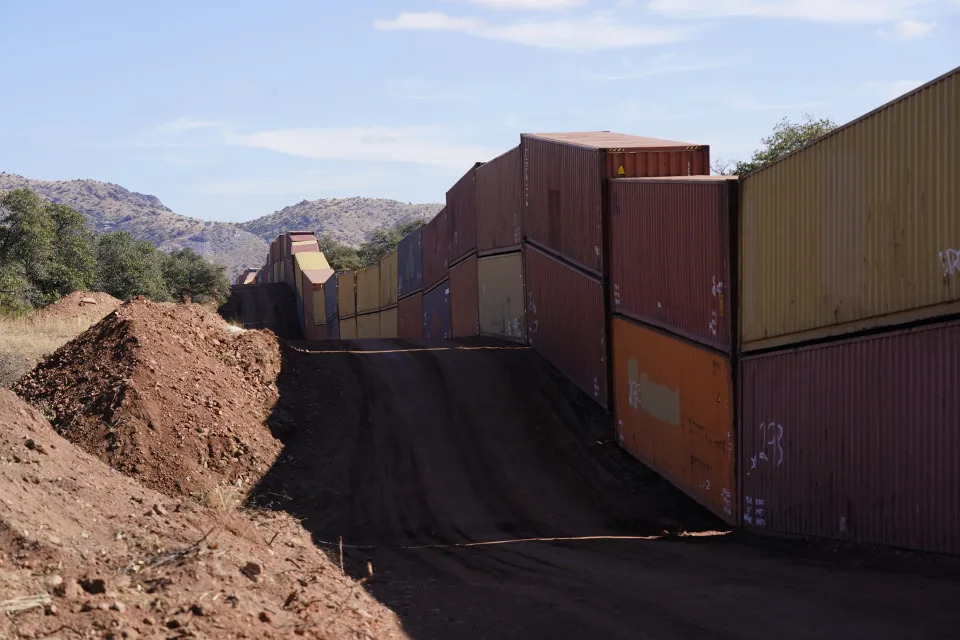
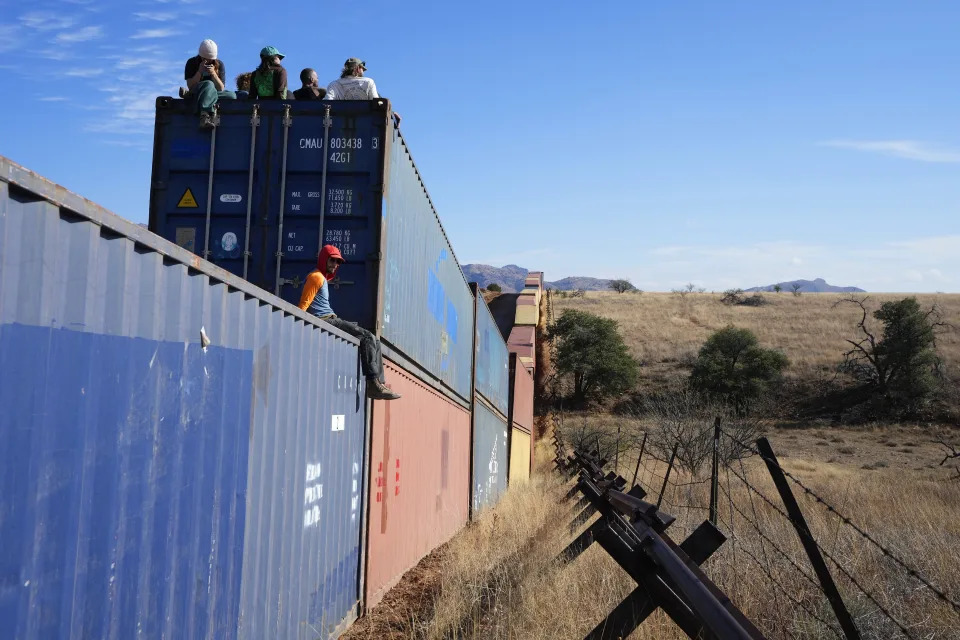
A long row of double-stacked shipping contrainers provide a new wall between the United States and Mexico in the remote section area of San Rafael Valley, Ariz., Thursday, Dec. 8, 2022. Work crews are steadily erecting hundreds of double-stacked shipping containers along the rugged east end of Arizona’s boundary with Mexico as Republican Gov. Doug Ducey makes a bold show of border enforcement even as he prepares to step aside next month for Democratic Governor-elect Katie Hobbs. (AP Photo/Ross D. Franklin)Activists sit on newly installed shipping containers along the border creating a wall between the United States and Mexico in San Rafael Valley, Ariz., Thursday, Dec. 8, 2022. Work crews are steadily erecting hundreds of double-stacked shipping containers along the rugged east end of Arizona’s boundary with Mexico as Republican Gov. Doug Ducey makes a bold show of border enforcement even as he prepares to step aside next month for Democratic Governor-elect Katie Hobbs. (AP Photo/Ross D. Franklin)
Work crews have steadily erected hundreds of double-stacked shipping containers topped by razor wire along Arizona’s remote eastern boundary with Mexico in a bold show of border enforcement by Republican Gov. Doug Ducey even as he prepares to leave office.
Until protesters slowed, then largely halted the work in recent days, Ducey pressed forward over the objections of the U.S. government, environmentalists and an incoming governor who has called it a poor use of resources.
Democratic Gov.-elect Katie Hobbs said last week she was “looking at all the options” and hasn’t decided what to do about the containers after her Jan. 5. inauguration. She previously suggested the containers be repurposed as affordable housing, an increasingly popular option for homeless and low-income people.
“I don’t know how much it will cost to remove the containers and what the cost will be,” Hobbs told Phoenix PBS TV station KAET in an interview Wednesday.
Federal agencies have told Arizona the construction on U.S. land is unlawful and ordered it to halt. Ducey responded Oct. 21 by suing federal officials over their objections, sending the dispute to court.
Environmental groups say the containers could imperil natural water systems and endanger species.
“A lot of damage could be done here between now and early January,” said Russ McSpadden, a Southwest conservation advocate for the Center for Biological Diversity who has regularly traveled to the site since late October.
Ducey insists Arizona holds sole or shared jurisdiction over the 60-foot (18.2 meter) strip the containers rest on and has a constitutional right to protect residents from “imminent danger of criminal and humanitarian crises.”
“Arizona is going to do the job that Joe Biden refuses to do — secure the border in any way we can.” Ducey said when Arizona sued the U.S. government. “We’re not backing down.”
The federal agencies want Ducey’s complaint dismissed.
Border security was a focus of Donald Trump’s presidency and remains a potent issue for Republican politicians. Hobbs’ GOP rival, Kari Lake, campaigned on a promise to dispatch the National Guard to the border on her first day in office. Texas Republican Gov. Greg Abbott, recently reelected to a third term, has pushed to keep building Trump’s signature wall on the mostly private land along his state’s border with Mexico and has crowdsourced funds to help pay for it. He also has gotten attention for busing migrants to Democratic-led cities far from the southern border, including New York City, Chicago, Philadelphia and Washington, D.C.
Ducey’s move comes amid a record flow of migrants arriving at the border. U.S. border officials have stopped migrants 2.38 million times in the fiscal year that ended Sept. 30, up 37% from the year before. The annual total surpassed 2 million for the first time in August and is more than twice the highest level during Trump’s presidency, in 2019.
Ducey’s container wall effort began in late summer in Yuma in western Arizona, a popular crossing point, with scores of asylum-seekers arriving daily and often finding ways to circumvent the new barriers. The containers filled areas left open when Trump’s 450-mile (724 km) border wall was built. But remote San Rafael Valley — the latest construction site — is not typically used by migrants and was not contemplated in Trump’s wall construction plan. McSpadden said he has not seen migrants or Border Patrol agents there, just hikers and backpacking cyclists.
The construction there stretches from oak forests in the Huachuca foothills southeast of Tucson and across the valley’s grasslands. As of the middle of last week, cranes had transported more than 900 blue or rust-colored metal containers down a dirt road freshly scraped into the landscape, then double stacked them up to 17 feet (5.2 meters) high alongside waist-high vehicle barriers of crisscrossed steel. Workers bolted the containers together and welded sheet metal over gaps.
Still, yawning gaps remain in the new container wall, including an open space of several hundred yards (meters) on terrain far too steep to place the containers. In some low lying wash areas there are gaps nearly three feet (1 meter) wide.
Environmental activists demonstrating at the Cochise County site in the past week largely stopped the work in recent days by standing in front of construction vehicles. One recent day, a dozen demonstrators sat atop stacked containers or in camp chairs near tents and vehicles where they sleep.
The work in Yuma cost about $6 million and wrapped up in 11 days with 130 of the containers covering about 3,800 feet (about 1,160 meters). The Bureau of Reclamation told Arizona it violated U.S. law by building on federal land. The Cocopah Indian Tribe also complained the state did not seek permission to build on its nearby reservation.
The newer project is far larger, costing some $95 million and using up to 3,000 containers to cover 10 miles (16 km), in Arizona’s southeastern Cochise County. The U.S. Forest Service also told Arizona to halt its work in the Coronado National Forest, and recently alerted visitors to potential hazards posed by construction equipment involved in the state’s “unauthorized activities.”
The Center for Biological Diversity has sided with the federal government’s position that the construction violates U.S. law.
While Ducey’s lawsuit does not address environmental concerns, groups like the center say the work in the Coronado National Forest imperils endangered or threatened species like the western yellow-billed cuckoo and the Mexican spotted owl, as well as big cats including the occasional ocelot.
The biologically diverse region of southeastern Arizona is known for its “sky islands,” or isolated mountain ranges rising over 6,000 feet (1,828 meters) above “seas” of desert and grasslands. Wildlife cameras in the region regularly photograph black bears, bobcats, ringtails, spotted skunks, white-nosed coatis and pig-like javelina.
McSpadden said the work has toppled oak and juniper trees and he’s found spools of razor wire and other construction debris on national forest land.
Environmentalists warn of the dangers of placing the containers atop a watershed of the San Pedro River that floods during the monsoon season each summer. Just south of the border lies a protected area called Rancho Los Fresnos, home to the beaver, a threatened species in Mexico.
Biologist Myles Traphagen of Wildlands Network told a briefing on border issues last month that much damage caused during the Trump administration’s border wall construction was never fixed. Last year, he mapped the Arizona and New Mexico sections of that border wall to highlight damaged areas. A report this year highlights areas the group considers priorities for reconstruction.
Dynamite blasts forever reshaped the remote Guadalupe Canyon in Arizona’s southeast corner. Towering steel bollards closed off wildlife corridors, preventing animals like tiny elf owls, pronghorns and big cats from Mexico to cross into the U.S. to hunt and mate.
‘Firmageddon’: Researchers find 1.1 million acres of dead trees in Oregon
Evan Bush – December 11, 2022
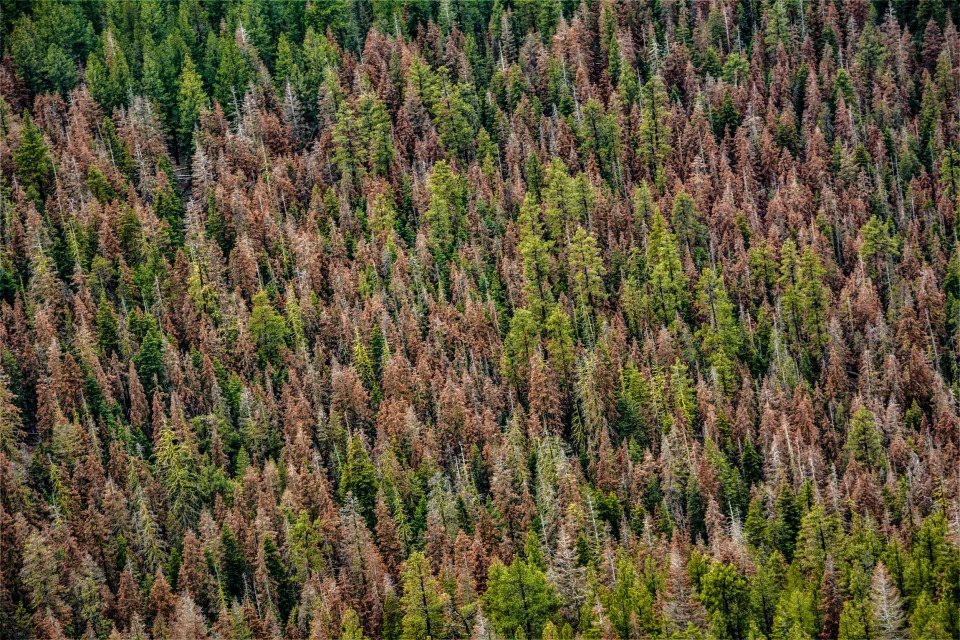
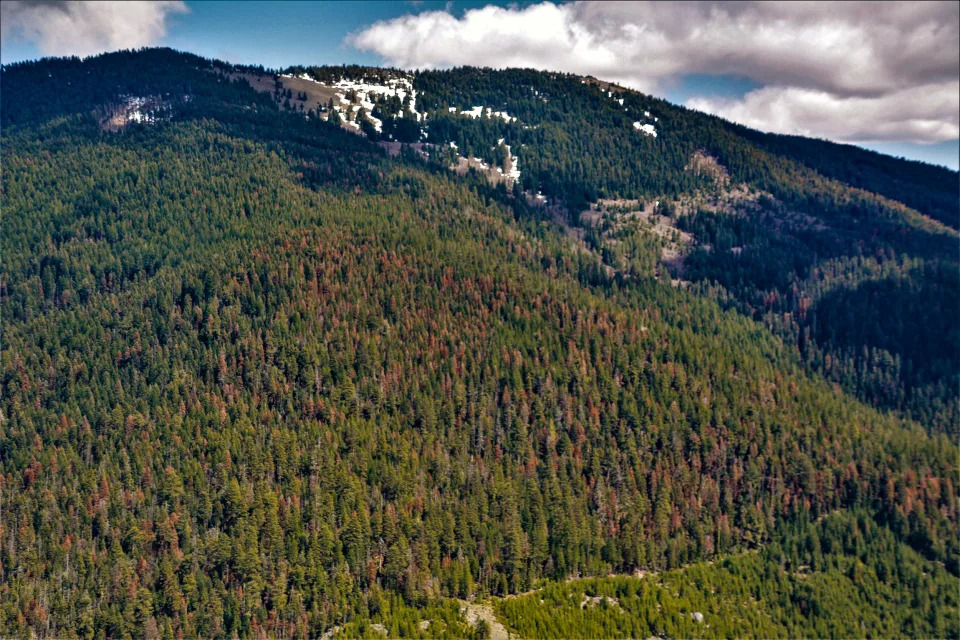
Drought-stricken Oregon saw a historic die-off of fir trees in 2022 that left hillsides once lush with green conifers dotted with patches of red, dead trees.
The damage to fir trees was so significant researchers took to calling the blighted areas “firmageddon” as they flew overhead during aerial surveys that estimated the die-off’s extent.
The surveyors ultimately tallied about 1.1 million acres of Oregon forest with dead firs, the most damage recorded in a single season since surveys began 75 years ago.
Oregon’s dead firs are a visceral example of how drought is reshaping landscapes in Western states that have been experiencing extreme heat conditions. In many areas, these firs might be replaced by more drought-hardy species in the future, reshaping how ecosystems function and changing their character.
“When I looked at it and crunched the numbers, it was almost twice as bad as far as acres impacted than anything we had previously documented,” said Danny DePinte, an aerial survey program manager for the U.S. Forest Service. “Nature is selecting which trees get to be where during the drought.”
Fir die-off as observed during this year’s aerial survey in the Fremont-Winema National Forest in southern Oregon. (Daniel DePinte / USFS)
Oregon is known for towering volcanic domes covered by a blanket of conifers that becomes sparse and patchwork on the eastern side of the Cascade Mountains before it tucks into the high desert.
The people who know the trees best say there are many signs of problems in Oregon.
“We’re seeing forms of stress in all of our species of trees,” said Christine Buhl, a forest entomologist with the Oregon Department of Forestry. “We just need to shift our expectations of what tree species we can expect to be planted where.”
Researchers have been surveying Pacific Northwest forests by air since 1947. Little about the process has changed during that time, according to Glenn Kohler, an entomologist with the Washington State Department of Natural Resources, which operates the program alongside the U.S. Forest Service and Oregon Department of Forestry.
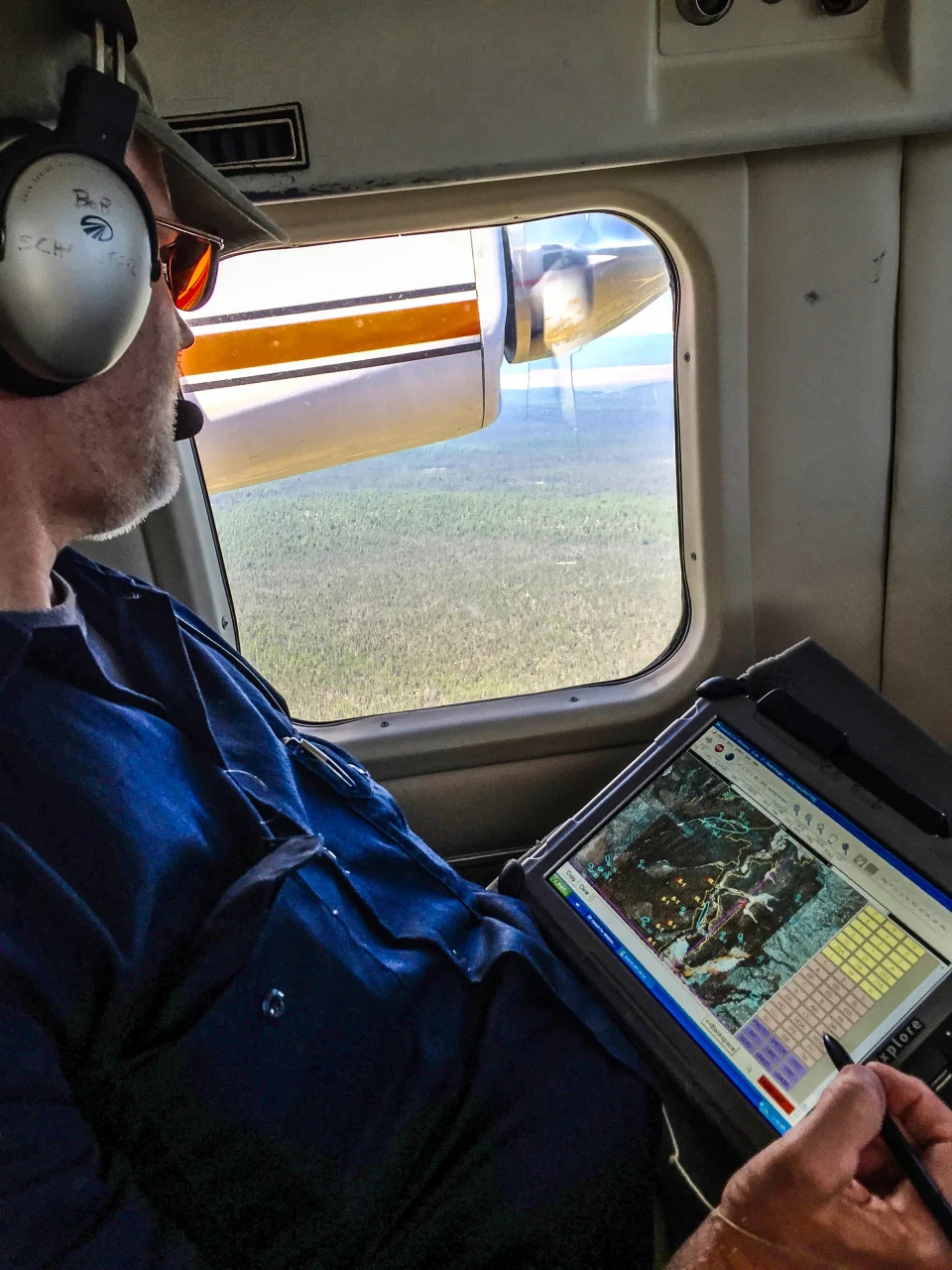
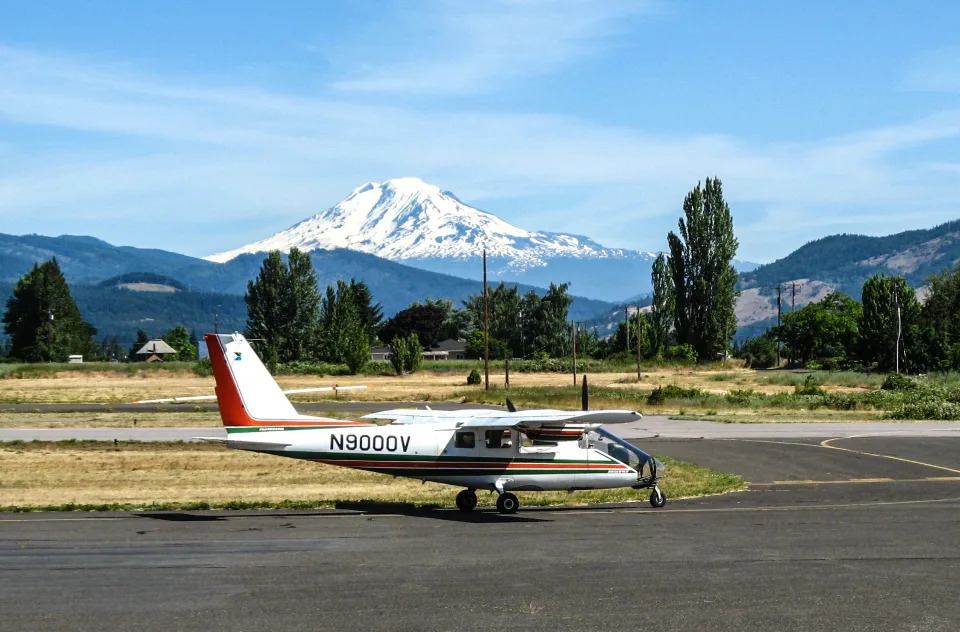
Each summer, small high-wing planes soar about 1,000 feet above the tree canopy at about 100 mph. Trained observers peer outside both sides of the plane, looking for noticeable damage to trees.
Dead trees — conifers that are completely red or orange — are the easiest to spot, but the observers can also pinpoint trees that are barren of needles in some areas.
The observers rate the intensity of damage and map its location. Pilots fly in a grid pattern with flight lines about 4 miles apart to cover every swath of the forest.
“It’s literally like mowing the lawn,” Kohler said of the flight trajectory.
Paper maps of the past have been replaced today by Samsung Galaxy tablets that track the plane’s progress and make mapping easier — and probably more accurate.
Observers require a season of training, Kohler said. It can be a dizzying task.
Brent Oblinger, a plant pathologist on the Deschutes National Forest, while in the process of conducting a portion of the survey. (USFS)
“We’re analyzing 16-30 acres per second,” DePinte said, noting that small planes can offer a more turbulent ride. “You definitely have to have a stomach of steel.”
This year, the aerial observation program flew over about 69 million acres of Washington and Oregon forest in about 246 hours.
“We’re just really painting the picture. It’s not hard science. You’re not counting individual trees or inspecting individual trees. The purpose is — what are the major trends and to detect outbreaks,” Kohler said.
“We had never seen anything to this level,” DePinte said. “It sets you back and makes you pause. Your scientific mind starts questioning why. We don’t always have the answers.”
Trees are susceptible to bark beetles, root diseases and defoliators like caterpillars. Aerial surveys help researchers capture the booms and busts of these pathogens.
Healthy trees typically can defend themselves against these threats. When beetles drill into a trees’ bark, for example, a healthy tree can push the beetles out by excreting pitch, a gooey substance, where they entered the tree, Kohler said.
Each summer, small high-wing planes soar about 1,000 feet above the tree canopy at about 100 mph, trained observers peer outside both windows of the plane, looking for noticeable damage to trees. (USFS)
But disturbances like drought, wildfire and windstorms can stress trees and weaken their defenses. Large numbers of dead and dying trees could allow bark beetles to lay eggs, feed their larvae and flourish.
Scientists still only have a coarse understanding of the factors that are causing widespread die-offs in Oregon, but many view drought as the underlying culprit.
“There are multiple factors at play here. One of the things most of us agree on: The primary factor we have going on here is hot drought,” Buhl said, meaning that the state has been hampered by higher-than-normal temperatures and also low precipitation.
DePinte said damage was most pronounced in White, Shasta and Red firs on the eastern side of the Cascade Mountain range’s crest, where the climate is drier.
Oregon’s average temperatures have risen about 2.2 degrees Fahrenheit since 1895, according to a 2021 state climate assessment delivered to the state’s Legislature. The severity of drought has increased over the past two decades in part because of human-caused climate change, the report says. Summers in Oregon are expected to become warmer and drier.
“We’ve been hearing about climate change for some time. Climate change is happening. We’re now feeling it,” Buhl said. “These summers are getting warm and long. We’re seeing evidence on the landscape. We needed to pay more attention decades ago, but we didn’t.”
Buhl said impacts to forest health are taking out roughly as many trees as wildfires, which are also now more likely and more intense by climate change.
Heat waves are a growing threat, too. On Oregon’s west side, trees were scorched by the June 2021 heat dome, which sent Portland’s temperature as high as 116. Scientists have said the intense heat wave was “virtually impossible” without climate change.
Fir die-off as observed during this year’s aerial survey in the Fremont-Winema National Forest in southern Oregon. (USFS)
Aerial assessments last year documented nearly 230,000 acres of heat scorch across Oregon and Washington, DePinte said. Most of the damage was on hillsides with south-facing aspects that soak up more sunlight because of the sun’s angle in the sky.
“It was the combination of the high temperatures in the afternoon with the sun boring down,” said Chris Still, a professor in the College of Forestry at Oregon State University. “We think a lot of those leaves just cooked in place.”
Still speculated that the heat dome could have contributed to this year’s fir die-off, also, but more research and evidence is needed to examine any possible connection.
DePinte said the 2021 scorching was the largest ever recorded, which means the Pacific Northwest has now seen two events of record-breaking damage in its forests in as many years.