The Russian invasion of Ukraine accounts for more than a third of U.S. inflation, forecaster says
Steve Goldstein – June 13, 2022
A soldier maneuvers his tank on June 08, 2022 near Sloviansk, Ukraine. In recent weeks, Russia has concentrated its firepower on Ukraine’s Donbas region, where it has long backed two separatist regions at war with the Ukrainian government since 2014. SCOTT OLSON/GETTY IMAGES
The Russian invasion of Ukraine and the sanctions that it triggered is behind more than a third of the 40-year high inflation of 8.6%, according to analysis from a leading forecaster.
Mark Zandi, chief economist at Moody’s Analytics, says after decomposing the numbers, the Russian invasion represented 3.5% year-over-year growth, mostly through the direct of higher commodity prices. But, he added on a podcast by the firm that higher diesel prices causes food prices to be higher, and it’s also bleeding into things like airfares.
The COVID-19 pandemic, he said, represented 2% year-over-year growth, mostly through supply chains.
“The bulk of the supply chain constraint component on CPI is new and used vehicles, but it also includes bedding, furniture, children’s apparel, things that are really affected by the supply chains,” added Ryan Sweet, senior director at Moody’s Analytics.
The lack of affordable housing is further responsible for 0.6% year-over-year price growth, according to Moody’s calculations.
He said the American Rescue Plan, the stimulus plan that President Biden signed into law, had a negligible impact.
In all, Zandi says the typical American household is paying $460 per month more to buy the same goods and services that they would have at the same time last year.
Cris DeRitis, deputy chief economist, said the inflation readings may not have peaked. “But as we get past the summer, past the summer driving season, I think then you might to see some of that moderation,” he said. “It’s just a matter of time.”
Blame monopolies for today’s sky-high inflation, Boston Fed researchers say
Ben Winck – May 26, 2022
Grocery shopping in Rosemead, California on April 21, 2022.
Dwindling industrial competition has made the US’s inflation problem even worse, Fed researchers said.
A new paper found that increased concentration led firms to pass a greater share of cost shocks onto consumers.
Weaker competition also amplified the inflation impacts of the labor shortage and rising energy prices.
The decades-long decline of industry competition made today’s inflation crisis much worse than it needed to be, researchers at the Federal Reserve Bank of Boston said in a new paper.
The US’s industrial concentration problem isn’t anything new. The economy is at least 50% more concentrated now than it was in 2005, according to the Herfindahl-Hirschman Index, a commonly used measure of industry concentration. That means a smaller group of companies control the lion’s share of their respective sectors.
Companies typically pass higher input costs on to consumer prices. Yet that pass-through “becomes about 25 percentage points greater when there is an increase in concentration similar to the one observed since the beginning of this century,” Fed economists Falk Bräuning, José L. Fillat, and Gustavo Joaquim said. Put simply, dwindling industry competition leads to companies raising prices at a much faster pace.
The pass-through happens through a variety of channels, according to the paper. The rise in concentration over the past two decades has been an “amplifying factor” to cost shocks from supply shortages, energy price spikes, and the labor shortage, the team said.
All three trends have been rife in the US economy over the past several months. Lockdowns in China roiled the global supply chain in 2021, and rising coronavirus case counts in Beijing threaten to repeat that cycle. Russia’s invasion of Ukraine boosted energy prices around the world. And the labor market is the tightest it’s been in decades, with job openings at record highs and companies still struggling to find available workers.
Encouragingly, the above-trend price increases don’t last forever, the economists said. When companies face cost shocks, they tend to pass those on to consumers over the next four quarters before returning to a more typical inflation trend. The fastest inflation typically arrives one quarter after the cost shock, according to the study. The pace of price growth then slows over the next three quarters.
Still, the research details yet another dynamic that’s allowed US inflation to recently hit its highest level since the 1980s. While factors like the labor shortage and rising energy prices are practically guaranteed to lift inflation, companies represent a critical junction between higher input costs and higher prices paid by Americans. The Boston Fed’s research signals that, unless competition rebounds, the economy will be even more susceptible to inflationary shocks in the future.
Off-grid living beckons more than just hardy pioneer types. Here’s why it’s taking off.
Katherine Roth – June 12, 2022
The Solterre Concept House in Nova Scotia, an off-grid home featured in the book “Downsize, Living Large In a Small House” by Sheri Koones.
Living off-grid conjures images of survivalists in remote places and a rustic, “Little House on the Prairie” lifestyle with chores from morning to night.
Yet only a tiny fraction of people living off-grid do it like that, and fewer still live more than an hour from any town.
“Living off-grid doesn’t mean you don’t buy your groceries at a store or take your waste to the local dump,” says Gary Collins, who has lived off-grid, or mostly off-grid, for a decade. “It just means you are not connected to utility grids.”
He has published books on the subject, and leads online classes.
Although precise numbers of off-grid households are hard to come by, Collins estimates that only 1% of those living off-grid are in truly remote areas. Overall, the off-grid movement remains small. But it got a boost after the COVID-19 pandemic hit: City dwellers began to explore different ways of living.
Off-grid living unique to each person
More-frequent power outages, utility grids’ struggles and price hikes to handle the severe weather events brought on by climate change have added to interest.
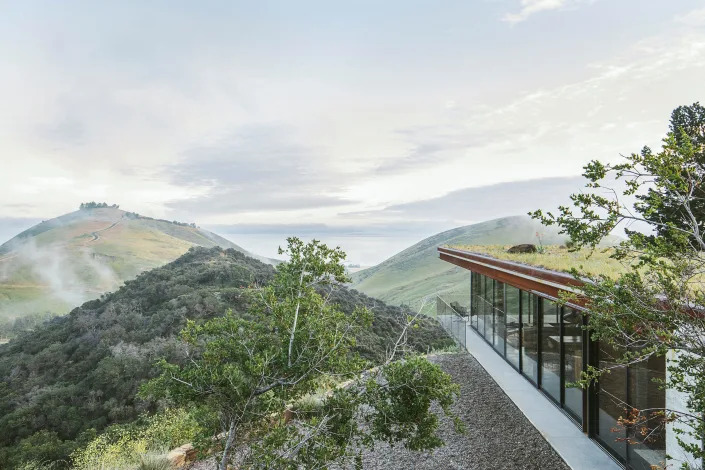
The view from an off-grid guest house in Hollister Ranch, Calif., one of the last remaining undeveloped coastal areas in California, located on a wildlife preserve. The Anacapa Architecture firm, in Santa Barbara, California, and Portland, Oregon, has designed several upscale off-grid homes in recent years, and has several more off-grid projects in the works.
There are also those who remain connected to the grid but try to power their homes independent of it. Author Sheri Koones, whose books about sustainable houses include “Prefabulous and Almost Off the Grid,” cites the rise in “net metering,” when your property’s renewable energy source – usually solar – is producing more energy than you use, and your local utility pays you for the excess.
Today, off-grid living encompasses everything from “dry camping” in RVs (with no electrical or water hookups) to swank Santa Barbara estates, from modest dwellings tucked just outside of towns to – yes – remote rustic cabins.
Mount Jefferson looms over off-grid homes at the Three Rivers Recreational Area in Lake Billy Chinook, Ore., on April 26, 2007. Everyone in this community lives “off the grid”, part of a growing number of homeowners now drawing all their power from solar, wind, propane and other sources.
“Everyone does it differently and everyone does it their own way, because it’s their own adventure,” Collins says.
Elegant designs for a modern feel
The Anacapa Architecture firm, in Santa Barbara, California, and Portland, Oregon, has built several upscale off-grid homes in recent years, and has several more off-grid projects in the works.
“There’s definitely an increase in traction for this kind of lifestyle, especially in the last two years,” says Jon Bang, marketing and PR coordinator for Anacapa Architecture. “There’s a desire to get more in tune with nature.”
The lifestyle that Anacapa homes aim for is one of modernist elegance, not roughing it. Bang says new technologies can ensure comfortable self-sufficiency.
Another image of an off-grid guest house in Hollister Ranch, Calif., designed by The Anacapa Architecture firm. A high level of sensitivity to environmental impacts was exercised throughout all phases of design and construction, the firm says.
Such homes also are carefully designed to take advantage of the site’s landscape features with an eye to sustainability. For example, one of the firm’s homes is built into a hillside and has a green roof.
For those without the means to hire architects, there are numerous recent books, blogs, YouTube videos and more dedicated to the subject.
“A lot of people are interested in it now,” Collins says. “They contact me after watching something on TV or on YouTube and I tell them, `If you learned everything you know on YouTube, you are never going to survive.'”
He makes regular grocery runs, but also grows some of his own food and hunts wild game. He has his own septic system and well. While his previous home was entirely off-grid, with solar panels and a wind turbine for power, his current home is hooked up to an electrical grid, mainly, he says, because the bills are too low to warrant the cost of solar panels.
The off-grid guest house in Hollister Ranch, Calif., designed by the Anacapa Architecture firm, has nearly 360-degree views of the Pacific Ocean.
What health and safety considerations factor into the off-grid lifestyle?
If you want to be totally self-sufficient, he says, it takes a lot of time and physical effort. You won’t have time to hold down a job. If you’re living in a remote location, you need to consider access to medical care, and whether you are mentally prepared for that much isolation.
“Your wood won’t cut itself. You’ll have to haul water,” he says, warning, “People die off-grid all the time, because of things like chain saw accidents. You have to be very careful and think everything through. No EMS will get to you in time.”
And depending on how it’s done, he says, off-grid living is not necessarily environmentally sustainable – not if you’re driving a fuel-guzzling truck and relying on a gas-powered generator, for example.
Still, improved alternative energy sources and construction techniques are making off-grid living more thinkable for more people, including those who don’t want to haul buckets of water from a well or live by candlelight.
Reynolds designed off-the-grid homes called Earthships, according to Earthship Visitor Center, using sustainable building practices, including the usage of discarded steel and tin cans for the foundation of homes.
Architect and experimental house builder Michael Reynolds who used a variety of recycled materials to complete his first experimental home near Taos in 1974. Owned by lawyer Steve Natelson, shown in the picture, the home had a lawn on the roof, a common feature of sustainable design today, but an unusual concept for homes at the time. This experimental lawn required daily attention because of the dry environment.Inspired by the problem of trash and the lack of affordable housing, Reynolds created the “can brick” out of discarded steel and tin cans.Architect and experimental house builder Michael Reynolds who lives near Taos, New Mexico, used tires, empty steel beer and soft drink cans as some of the materials used to build the structure, with a goal of building homes 20% cheaper than conventional methods at the time.Interior view of the all aluminum beer and soft drink can experimental house near Taos, New Mexico.This photo from June 1974 shows a well housing that architect and experimental house builder Michael Reynolds built from old tires that have been covered with plaster.
Iterations of these homes evolved over the next decade to incorporate passive solar and natural ventilation.
Reynolds’ legacy continues to be a presence in the region today through a fully off-the-grid community, using exclusively solar and wind power, northwest of Taos. The community sits on over 600 acres and includes more than 300 acres of shared land.
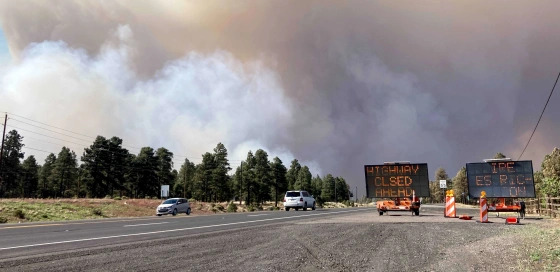
FLAGSTAFF, Ariz. (AP) — Evacuations are in effect in parts of northern Arizona as a wildfire about 6 miles (9 kilometers) north of Flagstaff steadily grew Sunday, authorities said.
Coconino National Forest officials said the Pipeline Fire was reported at 10:15 a.m. by a fire lookout and had burned approximately 4,000-5,000 acres by late Sunday, pushing about 15 miles (24 kilometers).
In connection with the fire, Forest Service law enforcement said they have arrested and charged a 57-year-old man with natural resource violations. The cause of the wildfire wasn’t immediately known.
Coconino County Sheriff’s officials said the Arizona Snowbowl ski resort and people living in the area of the west Schultz Pass Road must evacuate. People living in Doney Park and the area near Mt. Elden should be prepared.
Euelda King and her family evacuated their home for the second time this year because of wildfires. She hadn’t settled back in from a springtime blaze before leaving again Sunday, this time able to grab photographs and clothing she didn’t get earlier.
“Here we go again,” she said.
The family of 11 is planning to stay at the Navajo Nation casino, which is offering assistance to tribal members who evacuated.
The family was waiting in a parking lot ahead of road closure signs, watching smoke billow through the air and aircraft flying overhead.
“The winds are high, and I think they’re going to have a little bit of a battle with it,” King said.
Wind gusts were sweeping the smoke through Schultz Pass toward Doney Park and authorities said recreationists were being told to leave immediately, especially those in the Schultz Pass area.
The American Red Cross Arizona opened a shelter at Sinagua Middle School for residents who evacuated.
“With this thing going as fast as it is, it could get much closer, of course hoping it doesn’t,” King said.
Authorities said 13 engines, nine crews, six prevention patrol units, three bulldozers and one water tender were involved in the fighting the fire. An Incident Management Team is scheduled to arrive Monday.
The Arizona Department of Transportation has closed U.S. Route 89. The department said in a Twitter post that there is no estimated time to reopen the road.
I took a CO2 detector on a flight: It showed me when I was most likely exposed to COVID
Trevor Hughes, USA TODAY – June 12, 2022
DENVER — On seat 10D, my eyes flicker between my fellow passengers crammed in the aisle and the carbon dioxide detector balanced on my knee.
I can’t help but shudder a little every time someone coughs or sneezes as they board, and the numbers on the detector climb steadily, from about 800 parts per million to more than 1,600 ppm.
Experts say that the level of carbon dioxide in indoor air is an easy proxy for potential COIVD-19 exposure, and now that masks are voluntary on planes and international arrivals no longer have to test, I wanted to see what my potential risk was.
Outdoor air typically has less than 400 ppm of carbon dioxide, and although the levels of CO2 on my plane never reach anything near what’s considered even mildly unhealthy, the numbers suggest I’m being exposed to coronavirus. I can’t help but touch my mask for reassurance.
USA TODAY reporter Trevor Hughes on a United Express flight to Dulles International Airport on April 18, 2022.
I’m wearing a mask on this flight to visit my elderly parents in Vermont. The last time I visited, I was on one of the last mandatory masked flights, and I’ve taken several flights since then, sometimes masked, sometimes not.
Nationally, about 300 people a day are dying from COVID still. While rapid tests are now widely available, they only measure whether you’re infected. There’s no way to know about the people around you – especially when many people don’t seem to care whether they’re infected or not, or what the consequences could be for my parents or other at-risk communities.
That’s where the CO2 detector comes in. I bought a $140 KOPUO tester from Amazon, which an expert later tells me is one of the cheapest but still accurate detectors. Cheaper ones use a different measuring system that can be inaccurate if there’s a lot of hand sanitizer being used around it.
Why measure CO2?
An area with high CO2 levels may put you at higher risk for infection, while a space with low CO2 levels can be considered safer, says University of Colorado-Boulder Prof. Jose-Luis Jimenez.
Jimenez is an expert on how particles and gases move around a room, and he’s tested lots of inexpensive CO2 detectors and found that many are remarkably accurate compared to laboratory-grade equipment.
“It’s the only thing that we have found that approximates having this information,” Jimenez said. “It’s not perfect, because everyone exhales carbon dioxide, but not every who exhales has COVID.”
Jimenez and his colleagues found that in a library, if an influx of people makes CO2 levels double from 800 ppm to 1,600, COVID transmission risk triples. And if CO2 levels in a gym drop from 2,800 ppm to 1,000, the risk of COVID-19 transmission drops 75%.
There are of course caveats to his models, particularly when it comes to masks, airplanes and HEPA filters. HEPA stands for “high-efficiency particulate air” and most large airplanes made by Boeing and Airbus have them installed. HEPA filters are effective at removing dust, pollen, bacteria and virus particles from the air, but they don’t remove carbon dioxide because it’s a dissolved gas with far smaller molecules.
Multiple studies conducted by the federal government, airlines, aircraft manufacturers and other researchers have concluded air travel poses a relatively low risk of COIVD infection, in large part because the HEPA filters remove virus particles. But that’s only relevant when the aircraft is pumping air through the filters. Airbus says its systems completely replace cabin air every 2-3 minutes while flying.
Measuring CO2 levels on my flight, at the airport
My measurements show CO2 levels skyrocketed during boarding of my Airbus A319 headed to Vermont, but remained virtually unchanged on my flight back to Denver. That indicates the pilot or ground crew were doing something different at boarding that kept the air fresher, even though both flights were similarly full and I was seated in almost the same place on both directions.
United Airlines did not respond to a request for comment on its specific policies but sent a statement saying, in part, “There is always fresh air on the aircraft. The primary HEPA benefits are when airborne, because significant outdoor air is circulated through the cabin and jet bridge on the ground anyway.”
In the Denver International Airport terminal, the CO2 levels remained relatively consistent at about 800 ppm, and I felt comfortable removing my mask to wolf down some McDonald’s hash browns. The levels hit about 1,000 ppm on the airport train to the concourse, but sitting at the gate I was actually more concerned with how few men had washed their hands after using the restroom. That thought also made me shudder.
Aboard the plane, CO2 levels hit 1,520 ppm when flight attendants closed the boarding door, rose to about 1,800 when the pilot appeared to turn on a different ventilation system, dropped to about 1,600 as we taxied to the runway, and then jumped back to 1,900 as we approached the end of the runway for takeoff.
The levels began dropping immediately as the engines spooled up, and then leveled off around 1,200 as the seatbelt sign came off at 28,000 feet.
Watching the monitor, the levels rose back up to 1,550 as the flight attendants (one masked, one not) distributed cookies and then stayed at about that level until we landed. After getting off the plane in Burlington, the CO2 level was about 1,000 in the terminal, and I finally removed by mask.
Risk assessment
Returning home on Monday, the CO2 in the airport was about 400 ppm, which is the same level it was outside. The Burlington airport is far smaller than Denver’s, and fewer people were wearing masks, including me. The CO2 levels for the return flight topped out at about 1,000 ppm as the boarding door closed, and it dropped to about 850 at takeoff and remained there until we touched down in Denver.
Riding the train back from the concourse to the terminal, the CO2 level touched 650, significantly lower than my outbound ride. Given those lower levels, I felt reassured that leaving my mask off was a safe bet.
Jimenez said my behavior follows what’s known as a “budget of risk” – by using data, I adjusted my responses. Jimenez said he still wears N-95 masks on planes and tries to eat beforehand if it’s a short flight, but otherwise has to take it off when eating onboard. He said carrying around a CO2 detector has helped him make informed decisions about possible COVID exposure.
“We are all being forced to do that,” he said of the constant decisions about risk. “We don’t want to live like monks.”
For me, the detector is an easy form of reassurance about my relative risks: Indoor areas with high levels of CO2 will prompt me to wear a mask, while areas with lower levels mean I can skip it.
Going forward, the proof will be in the pudding, as my parents like to say. And in this case, it means yet another negative COVID-19 test result upon my return to Denver.
Members of white nationalist group charged with planning riot at Idaho pride event
Joseph Ax – June 11, 2022
Group of men arrested after they were found in the rear of a U Haul van in Coeur d’Alene
(Reuters) – Police in northwest Idaho arrested more than two dozen members of a white nationalist group on Saturday and charged them with planning to stage a riot near a LGBTQ pride event, authorities said.
Lee White, police chief in the city of Coeur D’Alene, told reporters 31 members of Patriot Front face misdemeanor charges of conspiracy to riot and additional charges could come later.
A local resident spotted the men, wearing white masks and carrying shields, getting into a U-Haul truck and called police, telling the emergency dispatcher it “looked like a little army,” according to White. Police pulled the truck over about 10 minutes after the call.
Video taken at the scene of the arrest and posted online showed about 20 men kneeling next to the truck with their hands bound, wearing similar khaki pants, blue shirts, white masks and baseball caps.
Police recovered at least one smoke grenade and documents that included an “operations plan” from the truck, as well as shields and shin guards, all of which made their intentions clear, White said.
“They came to riot downtown,” he said.
The men come from at least 11 states, White said, including Texas, Colorado and Virginia.
Patriot Front formed in the aftermath of the 2017 white nationalist “Unite the Right” rally in Charlottesville, Virginia, when it broke off from another extremist organization, Vanguard America, according to the Southern Poverty Law Center, which tracks hate groups.
(Reporting by Joseph Ax; Editing by Daniel Wallis)
But as the high court prepares to decide another major climate case in the coming days and resolve a controversy over water pollution this fall, the mood among environmental groups is more gloomy – and the sense of foreboding, experts say, is likely justified.
That’s not only because the Supreme Court is more conservative than it has been in decades – and perhaps more willing to reconsider precedent – but also because environmental rules are caught up in a broader fight over whether federal agencies may regulate businesses without explicit approval from Congress.
The answer to that question will have sweeping implications for President Joe Biden’s administration beyond the Environmental Protection Agency if Republicans capture control of Congress this year. Presidents of both parties often turn to agency regulations when they’re unable to move their agenda through Congress – even though those policies frequently run into trouble in court.
“Environmentalists are holding their breath to see just how bad it will be,” said Robert Percival, director of the environmental law program at the University of Maryland. “It seems likely that they’re going to be making major cutbacks in the EPA’s authority.”
Power plant emissions
In one of the most significant climate cases to reach the high court in years, the justices will soon decide whether the EPA may regulate carbon emissions from power plants. Nineteen states, led by West Virginia, challenged climate regulations approved by the Obama administration and later abandoned by President Donald Trump.
The decision will land as scientists and international groups issue dire warnings about the Earth’s changing climate. A United Nations report in April found that without significant and immediate emission reductions, limiting global warming to 1.5 degrees Celsius – a threshold that risks more severe effects – would be “beyond reach.”
As the Supreme Court prepares to decide a major climate case in the coming days and resolve a controversy over water pollution this fall, the mood among environmental groups is more gloomy.
In the eviction case, the Trump and Biden administrations relied on a 1944 public health law that lets officials “make and enforce such regulations” as they deem “necessary to prevent the…spread of communicable diseases.” But the law, the court said, doesn’t say anything specifically about halting evictions during a pandemic.
“It strains credulity to believe” Congress meant to give the Centers for Disease Control and Prevention “the sweeping authority” it used to impose the moratorium, a majority of the court ruled in August. “We expect Congress to speak clearly when authorizing an agency to exercise powers of ‘vast economic and political significance.'”
President Barack Obama’s EPA required states to reduce emissions by shifting power plants away from coal. The Supreme Court blocked enforcement of those rules in 2016 and Trump repealed them a year later, prompting a new round of lawsuits. While the court’s three liberal justices signaled support for the EPA during oral arguments in February, the court’s six-member conservative bloc was harder to read.
One of the issues the justices debated then was the “major questions doctrine,” the principle that Congress can delegate some decisions to agencies but not those that involve “vast” economic or political matters. One sticky issue with that doctrine is that there’s no clear definition of “vast significance.” Those who oppose the doctrine say that if a law is vague then Congress intended to give agencies wide deference to interpret it.
Another case the high court will take up later this year deals with the 1972 Clean Water Act which requires Americans to obtain a permit before putting certain pollutants into the “waters of the United States.” The law doesn’t define exactly what that term means.
In one of the most significant climate cases to reach the high court in years, the justices will soon decide whether the EPA may regulate carbon emissions from power plants.
The couple told the court last year that the agency’s interpretation was “emblematic of all that has gone wrong with the implementation of the Clean Water Act.” Their lot, they said, doesn’t include a stream, river, or lake – the kind of navigable waterways usually covered by the federal requirements.
But the Biden administration countered in court filings that EPA’s designation was made eight years before the family bought the property and that the couple dumped nearly 2,000 cubic yards of gravel and sand to fill the wetlands anyway. The wetlands are adjacent to water that eventually feeds into Priest Lake, the government concluded.
‘Pushing the boundaries of their powers’
Legal experts point to several factors they say explain why complicated questions about agency power pop up so often in environmental cases. Some of it has to do with how the legal system works broadly as it weighs the impact of laws and regulations.
One of the challenges environmentalists face in federal court is demonstrating the cost of not protecting the environment. It’s easier for industries to quantify the expense of updating a power plant to reduce emissions, for instance, than it is to tally up the costs that climate change may impose on an entire society.
“Because we all bear the costs of pollution, the benefits of regulation are often spread broadly, while the costs of reducing pollution are concentrated where they belong – on polluters,” said Sambhav Sankar, senior vice president of programs at Earthjustice, an environmental law group.
And while there’s often an economic incentive for industries to challenge environmental regulations, there’s not always a similarly powerful force to support those rules.
“So that means that this is always a target for pro-industry conservatives,” Sankar said. “And when these cases show up in court, the court sometimes struggles to appreciate the value of regulation to society as a whole.”
Adam White, a senior fellow at the right-leaning American Enterprise Institute, said the agencies themselves also have a role to play. Administrations may decide that getting legislation through Congress is impossible and so turn to regulations instead. Lawmakers may not be compelled to take a difficult vote if they think the administration is going to act on its own. And agencies, sometimes, may just overstep their authority.
“The agencies with a lot of political wind in their sails have a kind of emergency mentality that they need to do as much as they can as fast as they can,” said White, who is also the co-director of the Center for the Study of the Administrative State at George Mason University. “They end up pushing the boundaries of their powers.”
Another problem with deferring to agencies, White argued, is that their leadership changes every time a new president is sworn into office.
The upside to that, he said, is that presidential elections “have consequences.”
“But the downside is that every four or eight years you get a total overhaul in regulatory policy,” White said. “At some point, everybody – the courts, the private sector, all of us – we can look at this and say, ‘That’s no way to run a country.'”
House Republican leaders told their members to vote against 8 gun-safety bills, citing opposition from the NRA and Gun Owners of America
Bryan Metzger – June 8, 2022
House Minority Leader Kevin McCarthy and other GOP members at a press conference on Capitol Hill on March 1, 2022.Tom Williams/CQ-Roll Call via Getty Images House Republican leaders told their members to vote against 8 gun-safety bills, citing opposition from the NRA and Gun Owners of America
The House is set to vote Wednesday on a package of gun-related bills dubbed the “Protect Our Kids Act.”
GOP leaders told members to vote against the package, calling it the “Unconstitutional Gun Restrictions Act.”
The notice sent to GOP offices included links to talking points from the NRA and Gun Owners of America.
House Republicans are poised to vote against eight bills aimed at preventing gun violence on Tuesday, in part due to opposition from powerful pro-gun groups on the right.
House Democratic leaders have scheduled votes for Wednesday evening on the “Protecting Our Kids Act” — a package of seven gun violence-related measures that includes raising the age for legal purchase of semiautomatic rifles and shotguns to 21, closing the “bump stock” loophole, and other measures aimed at preventing the illegal trafficking of guns.
The House will also vote on the “Federal Extreme Risk Protection Order Act,” a federal “red flag” bill that would allow family members and law enforcement officials to temporarily block firearm access to those who a court determines pose a danger to themselves or others.
In a “whip notice” sent to rank-and-file members on Tuesday afternoon, House GOP leadership urged a “no” vote on all eight bills, referring to the seven-bill package as the “Unconstitutional Gun Restrictions Act.” They wrote that House Democrats had “thrown together this reactionary package comprised of legislation that egregiously violates law-abiding citizens’ 2nd Amendment rights and hinders Americans’ ability to defend and protect themselves and their families.”
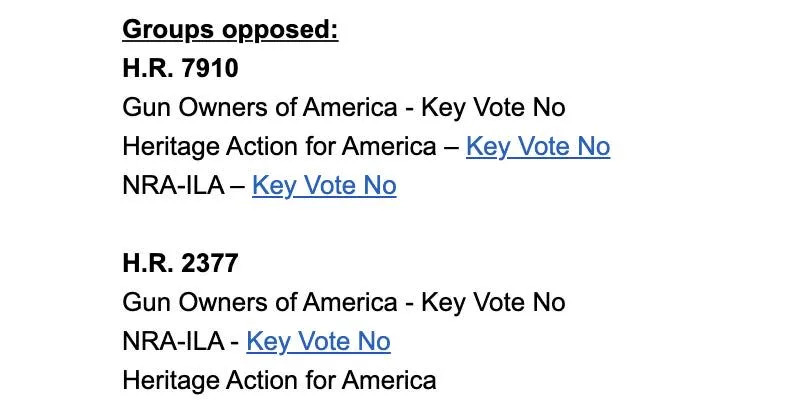
The email also noted the opposition of the National Rifle Association and Gun Owners of America, including links to talking points from the NRA about both the gun package and the red flag law. Leaders also noted the opposition of Heritage Action for America, an advocacy group tied to the conservative Heritage Foundation.
“Due to the importance of this issue, votes on this legislation will be considered in future candidate ratings and endorsements by the NRA Political Victory Fund,” declares one of the memos shared by party leaders.
Screenshot of the end of the June 7th whip notice, including links to talking points from the NRA and Heritage Action for America.House Republican Whip Steve Scalise
It’s not uncommon for party leaders to note the opposition of outside groups to major pieces of legislation. For example, in a February whip notice urging Republicans to vote against a major piece of legislation aimed at boosting the US semiconductor industry, GOP leaders noted the opposition of the Federation for American Immigration Reform, National Taxpayers Union, and Americans for Prosperity.
But the two gun groups’ inclusion — and the NRA’s threat to downgrade candidate ratings or withhold endorsements should any Republicans back the measures — underscores the enduring influence of pro-second amendment groups on the right, despite the NRA’s recent financial troubles and shrinking membership.
NRA talking points distributed by House GOP leadership, including a warning that candidate ratings and endorsements are at stake.National Rifle Association
Meanwhile, Democrats are planning to stage a striking visual contrast to Republicans — House Speaker Nancy Pelosi asked her caucus members on Tuesday to be present on the House floor for debate on the gun measures on Wednesday, when the floor would otherwise be empty.
“On behalf of the survivors of gun violence, and out of respect for those who lost their lives, I am asking all Members of our Caucus to be present on the Floor of the House for the two hours of debate, which should begin at approximately 2:30 p.m. following the vote on the Rule,” she said.
Climate-driven flooding poses well water contamination risks
Michael Phillis and John Flesher – June 8, 2022
Homes are surrounded by floodwaters from Tropical Storm Harvey in Spring, Texas, Tuesday, Aug. 29, 2017. Experts say more intense storms driven by climate change are boosting contamination risks for privately-owned drinking water wells. (AP Photo/David J. Phillip, File)This photo provided by Stefanie Johnson shows Johnson’s private well in Blandinsville, Ill. Her well was contaminated during major flooding in 2013. Johnson’s family was without drinking water for nearly two months. She says contaminated wastewater likely drained in through the top, causing her well to test positive for E. coli. (Stefanie Johnson via AP)Neil and Bea Jobe pose in their home March 8, 2022, in Primm Springs, Tenn., which sits near Lick Creek. Several times a year, when there is heavy rain and a nearby creek floods, their well water turns “dingy,” Bea Jobe said. While estimates vary, roughly 53 million U.S. residents, about 17% of the population, rely on private wells, according to a study done in part by Environmental Protection Agency researchers. (AP Photo/Mark Humphrey) ASSOCIATED PRESSAn oil sheen drifts between a sunken shrimp boat and pieces of a destroyed home along Bayou Pointe au Chien in the aftermath of Hurricane Ida in Pointe-aux-Chenes, La., on Sept. 14, 2021. Experts say more intense storms driven by climate change are boosting contamination risks for privately-owned drinking water wells. (AP Photo/Gerald Herbert, File)n this photo taken in September 2017, Sandy Wynn-Stelt, of Belmont, Mich., stands in a wooded area near her home where industrial wastes containing PFAS chemicals were dumped for many years. High levels of the toxic compounds later were detected in drinking water from her well. While estimates vary, studies say roughly 53 million U.S. residents rely on private wells. While many provide safe water, experts say some are vulnerable to contamination from bacteria or other impurities from floodwaters or from groundwater tainted with PFAS or other pollutants. (Nic Antaya/The Grand Rapids Press via AP)
ST. LOUIS (AP) — After a record-setting Midwestern rainstorm that damaged thousands of homes and businesses, Stefanie Johnson’s farmhouse in Blandinsville, Illinois, didn’t have safe drinking water for nearly two months.
Flood water poured into her well, turning the water a muddy brown and forcing Johnson, her husband and their two young children to use store-bought supplies. Even after sediment cleared, testing found bacteria — including E. coli, which can cause diarrhea. The family boiled water for drinking and cooking. The YMCA was a refuge for showers.
“I was pretty strict with the kids,” said Johnson, who works with a private well protection program at the local health department. “I’d pour bottled water on their toothbrushes.”
Though estimates vary, roughly 53 million U.S. residents — about 17% of the population — rely on private wells, according to a study conducted in part by Environmental Protection Agency researchers. Most live in rural areas. But others are in subdivisions near fast-growing metro regions or otherwise beyond the reach of public water pipes.
While many private wells provide safe water, the absence of regulation and treatment afforded by larger municipal systems may expose some users to health risks, from bacteria and viruses to chemicals and lead, studies have found.
Risks are elevated after flooding or heavy rainfall, when animal and human feces, dirt, nutrients such as nitrogen and other contaminants can seep into wells. And experts say the threat is growing as the warming climate fuels more intense rainstorms and stronger and wetter hurricanes.
“Areas that hadn’t been impacted are now. New areas are getting flooded,” said Kelsey Pieper, a Northeastern University professor of environmental engineering. “We know the environment is shifting and we’re playing catch-up, trying to increase awareness.”
Pieper is among scientists conducting well testing and education programs in storm-prone areas. After Hurricane Harvey caused widespread flooding along the Texas coast in 2017, sampling of more than 8,800 wells in 44 counties found average E. coli levels nearly three times higher than normal, she said.
Sampling of 108 wells in Mississippi following Hurricane Ida in 2021 produced a similar bump in E. coli readings. Other studies turned up higher levels in North Carolina after Hurricane Florence in 2018.
The following year, above-average snowfall and a March storm unleashed flooding in Nebraska. Levees and dams were breached. Fremont, a city of more than 25,000, turned into an island when the nearby Platte and Elkhorn rivers overflowed.
The municipal system continued to supply drinking water but some nearby private wells were damaged or contaminated. Julie Hindmarsh’s farm was flooded for three days, and it took months to make the well water drinkable again. At times, the cleanup crew wore protective suits.
“They didn’t know what was in that floodwater,” she said.
CONTAMINATION RISK
Groundwater is often a cleaner source than surface supplies because soil can provide a protective buffer, said Heather Murphy, an epidemiologist at the University of Guelph in Canada. But she said that can give well owners a false sense of security, leading them to forgo testing, maintenance and treatment.
“There’s a big misconception that it’s underground, therefore it’s safe,” said Murphy, who estimates 1.3 million cases of acute gastrointestinal illness in the U.S. are caused annually by drinking untreated water from private wells.
Old, poorly maintained wells are especially vulnerable to floodwaters entering through openings at the top. “It just runs right in and it’s full of bacteria,” said Steven Wilson, a well expert at the University of Illinois.
It doesn’t always take a flood or hurricane to pollute wells. Industrial contamination can reach them by seeping into groundwater.
Around 1,000 residential wells in Michigan’s Kent County were tainted for decades with toxic per- and polyfluoroalkyl substances, or PFAS, in landfill sludge from footwear company Wolverine World Wide. The pollution, discovered in 2017, spurred lawsuits and a $69.5 million settlement with the state that extended city water lines to affected houses.
“We thought we were getting this pristine, straight-from-nature water and it would be much better for us,” said Sandy Wynn-Stelt, who has lived across from one of the dump sites since the early 1990s.
She said tests detected high levels of PFAS chemicals in her water and blood, leaving her fearful to drink or even brush her teeth with well water. In a suit later settled, she blamed the contamination for her husband’s 2016 death from liver cancer. She was diagnosed with thyroid cancer four years later.
LITTLE REGULATION FOR WELL OWNERS
While many well owners don’t have the option of hooking up to a public water system, others are happy with well water. They might favor the taste or want to avoid monthly bills and government regulation.
“What I hear from people is freedom,” said Jesse Campbell, private well coordinator for the Midwest Assistance Program Inc., which addresses rural water needs.
Private well owners are responsible for them. While public water systems must meet federal safety standards, those rules don’t apply to wells that have fewer than 15 connections or serve fewer than 25 people.
State and local standards usually involve only construction and design, although some states set tougher rules.
New Jersey requires water quality testing before sales of property with private wells. Rhode Island requires testing when new wells are built and when property with a well is sold.
But many states rely on public outreach and voluntary action to protect private well users.
“There’s an overall lack of education,” Campbell said. He meets with well owners from Montana to Missouri, providing free inspections and advice.
A lot of harm can be prevented if owners make sure the well’s top keeps out debris and that the pump is turned off before a storm to keep out floodwaters. Experts recommend testing after a flood and decontaminating wells with chlorine if a problem is found.
“People aren’t regularly testing,” said Riley Mulhern, an environmental engineer at the research group RTI International.
Indiana’s health department offers testing for bacteria, lead, copper, fluoride and other contaminants. Some land-grant universities and private labs provide similar services.
While many owners know how to maintain their wells, others ignore problems even if the water isn’t sanitary. Water that tastes fine can still be contaminated.
“I wish I had a nickel for everyone who’s walked into a workshop and said, ‘I’ve been drinking this water forever and it’s fine,’” said Jason Barrett, who directs a Mississippi State University program that educates well owners.
It provides free testing. But where such assistance isn’t available, costs can run to a few hundred dollars, according to experts. Some owners avoid testing because they are concerned it will reveal an expensive problem.
Johnson, the Illinois resident whose well was fouled by the 2013 downpour that killed four people and caused $465 million in flood damage, paid about $3,500 for repairs and upgrades.
“Luckily, none of us became ill,” she said.
Even ordinary rainstorms can carry diseases into groundwater, said Mark Borchardt, a microbiologist formerly with the U.S. Department of Agriculture.
“A lot of times people say, ‘Well, no one got sick,’” Borchardt said. “It’s hard to see when people get sick unless it is a huge outbreak.”
Bea and Neil Jobe live in Primm Springs, Tennessee, an hour’s drive from Nashville. Several times a year, when there is heavy rain and a nearby creek floods, their well water turns “dingy,” Bea Jobe said.
The discoloration disappears after a few days but Jobe takes precautions such as keeping bottled water available.
Uvalde gunman threatened rapes and school shootings on social media app Yubo in weeks leading up to the massacre, users say
Daniel A. Medina, Isabelle Chapman, Jeff Winter and Casey Tolan
May 28, 2022
CNN: Salvador Ramos told girls he would rape them, showed off a rifle he bought, and threatened to shoot up schools in livestreams on the social media app Yubo, according to several users who witnessed the threats in recent weeks.
But those users – all teens – told CNN that they didn’t take him seriously until they saw the news that Ramos had gunned down 19 children and two adults at an elementary school in Uvalde, Texas, this week.
Three users said they witnessed Ramos threaten to commit sexual violence or carry out school shootings on Yubo, an app that is used by tens of millions of young people around the world.
The users all said they reported Ramos’ account to Yubo over the threats. But it appeared, they said, that Ramos was able to maintain a presence on the platform. CNN reviewed one Yubo direct message in which Ramos allegedly sent a user the $2,000 receipt for his online gun purchase from a Georgia-based firearm manufacturer.
“Guns are boring,” the user responded. “No,” Ramos apparently replied.
In a statement to CNN, a Yubo spokesperson said “we are deeply saddened by this unspeakable loss and are fully cooperating with law enforcement on their investigation.” Yubo takes user safety seriously and is “investigating an account that has since been banned from the platform,” the spokesperson said, but declined to release any specific information about Ramos’ account.
Use of Yubo skyrocketed during the coronavirus pandemic, as teens trapped indoors turned to the app for a semblance of in-person interactions. The company says it has 60 million users around the world – 99% of whom are 25 and younger – and has trumpeted safety features including “second-by-second” monitoring of livestreams using artificial intelligence and human moderators.
Despite those safety features, the users who spoke to CNN said Ramos made personal and graphic threats. During one livestream, Amanda Robbins, 19, said Ramos verbally threatened to break down her door and rape and murder her after she rebuffed his sexual advances. She said she witnessed Ramos threaten other girls with similar “acts of sexual assault and violence.”
Robbins, who said she lives in California and only ever interacted with Ramos online, told CNN she reported him to Yubo several times and blocked his account, but continued seeing him in livestreams making lewd comments.
“[Yubo] said if you see any behavior that’s not okay, they said to report it. But they’ve done nothing,” Robbins said. “That kid was allowed to be online and say this.”
Robbins and other users said they didn’t take Ramos’ comments seriously because troll-like behavior was commonplace on Yubo.
Hannah, an 18-year-old Yubo user from Ontario, Canada, said she reported Ramos to Yubo in early April after he threatened to shoot up her school and rape and kill her and her mother during one livestream session. Hannah said Ramos was allowed back on the platform after a temporary ban.
Hannah, who requested CNN withhold her last name to protect her privacy, said Ramos’ behavior turned increasingly brazen in the last week. In one livestream, she said, Ramos briefly turned his webcam to show a gun on his bed.
The users said they didn’t make recordings of Ramos’ threats during the livestreams.
Yubo’s community guidelines tell users not to “threaten or intimidate” others, and ban harassment and bullying. Content that “promotes violence such as violent acts, guns, knives, or other weapons” is also banned.
Just a week before the Uvalde attack, Yubo announced an expanded age verification process that involves users taking a photo of themselves and the app using artificial intelligence to estimate their age. The platform only allows people 13 and older to sign up, and doesn’t allow users 18 and older to interact with those under 18.
Yubo, which is based in Paris, has attracted controversy since it launched in 2015 under the name Yellow, with some local law enforcement officials warning about the possibility of abuse. Police have arrested men in Kentucky, New Jersey and Florida who allegedly used Yubo to meet or exchange sexually explicit messages with kids. Last month, Indiana police investigating the 2017 murder of two teenage girls said they were seeking information about a Yubo user who had solicited nude photos of underage girls on other social media platforms.
Ramos’ disturbing social media interactions didn’t only take place on Yubo. One user, a girl from Germany who met Ramos on Yubo, said she had some troubling interactions with him via text and FaceTime. The 15-year-old said she received text messages from him shortly after he shot his grandmother and before his assault at the elementary school, as CNN previously reported.
The girl said she thought any violent or strange comments Ramos made were in jest.
But after the shooting, she said, “I added everything up and it made sense now… I was just too dumb to notice all the signals he was giving.”