Megan Rapinoe, sports world react to Supreme Court decision on abortion rights: ‘The cruelty is the point’

Yahoo! Sports

Megan Rapinoe, sports world react to Supreme Court decision on abortion rights: ‘The cruelty is the point’

Henry Bushnell and Chris Cwik – June 24, 2022

Athletes and sports organizations reacted, mostly with horror, to the Supreme Court’s decision Friday to overturn Roe v. Wade and enable dozens of state laws that will criminalize abortions.

“This decision shows a branch of government that is so out of touch with the country and any sense of human dignity,” the WNBA players association said in a statement less than two hours after the Court officially ruled on Dobbs v. Jackson Women’s Health Organization.

Sue Bird tweeted that she was “gutted.” Her team, the Seattle Storm, said they were “furious and ready to fight.”

The WNBPA statement continued: “This ruling provides a treacherous pathway to abortion bans that reinforce economic, social and political inequalities and could lead to higher rates of maternal mortality while eviscerating rights to reproductive freedom for everybody.”

The NWSL players association also “strongly condemned” the decision — “a decision that effectively takes away a person’s right to make decisions about their own body, a basic human right at the core of every aspect of life,” the NWSLPA said in a statement later Friday afternoon.

Megan Rapinoe delivers emotional response, call to action

Individual soccer players also spoke out against the ruling while in camp with the U.S. women’s national team. On a previously-scheduled Zoom call with reporters Friday afternoon, midfielder Lindsey Horan said she was “still a little bit shocked,” and called it a “step backwards for our country.”

Forward Megan Rapinoe, who was not originally slated to meet with reporters, asked to speak in light of the Court’s ruling, and wiped away tears as she described a “disheartening,” “infuriating” and “scary day.”

In an unscripted opening statement that lasted more than nine minutes, she stressed that the decision will hit various groups of marginalized women most forcefully.

“We know that this will disproportionately affect poor women, Black women, Brown women, immigrants, women in abusive relationships, women who have been raped, women and girls who have been raped by family members — [or] who, you know what, maybe just didn’t make the best choice,” she said.

“And that’s no reason to be forced to have a pregnancy. It will completely exacerbate so many of the existing inequalities that we have in our country. It doesn’t keep not one single person safer. It doesn’t keep not one single child safer, certainly. And it does not keep one single — inclusive term — woman safer. We know that the lack of abortion [rights] does not stop people from having abortions, it stops people from having safe abortions.”

Rapinoe also responded emotionally to the concern — sparked by Justice Clarence Thomas’ concurring opinion in Friday’s ruling — that the Court could ultimately overturn Obergefell v. Hodges, which protects same-sex marriage, and other landmark rulings as well:

“I absolutely think gay rights are under attack, I absolutely think we will see legislation pop up state by state by state that will eventually come to this radical court. I have zero faith that my rights will be upheld by the court. I have faith in our country, and I have faith in people, and I have faith in the voters. And if you ever needed a f*cking motivation to vote, to get involved — quite literally, people’s lives depend on it. Actual lives. We’re talking life and death, and also your life in terms of, what does it mean to even be alive? If you can’t be your full self, what the f*ck is the point?”

She also explained why she doesn’t view the ruling as “pro-life,” pointing to other areas — such as healthcare — that will be affected by the Supreme Court’s decision.

“I just can’t understate how sad, and how cruel this is. I think the cruelty is the point. Because this is not pro-life by any means. This way of thinking, or political belief, is coupled with a complete lack of motivation around gun laws, it comes with pro-death penalty, it comes with anti-healthcare, anti-prenatal care, anti-childcare, anti-pre-K, anti-food assistance, anti-welfare, anti-education, anti-maternity leave, anti-paternity leave.

“This is not pro-life. And it’s very frustrating and disheartening, and frankly just infuriating to hear that be the reason that people are wanting to end abortion rights, and end this vital aspect of a woman’s — not only healthcare and general basic safety in this country, but her bodily autonomy, and the right to freedom, and the pursuit of happiness and liberty, is being assaulted in this instance. And it’s just incredibly disheartening.”

She concluded with a call to men who’ve “been silent” on abortion rights. “Stand up,” she said. “Say something.”

She pointed out that the decision was made by a majority-male court, and that the many systems and laws that discriminate against women in the U.S. were created by men.

“You are allowing a violent and consistent onslaught on the autonomy of women’s bodies, on women’s rights, on women’s minds, on our hearts, on our souls,” Rapinoe said when asked what her message to men, as a monolith, would be. “We live in a country that forever tries to chip away at what you have enabled, at what you have been privileged enough to feel your entire life.

“You also have the opportunity to do better every single day. You have the opportunity to show up, make your voices heard, whether that’s in the workplace, on a media zoom, in stadiums, in your family, the way that you vote. It is not a women’s issue. It is everyone’s issue.”

Other prominent athletes speak out on Supreme Court overturning Roe v. Wade

Several athletes past and present referenced the timing of the decision, one day after the 50th anniversary of Title IX, the watershed law that helped spark a decades-long women’s sports boom. “Yesterday we celebrated Title IX,” Orlando Magic guard Devin Cannady tweeted. “Today we tell these same women that they don’t have the freedom to make decisions about their own body.

“I’m sick for you, I stand with you,” Cannady wrote. “This country needs to be better, this sh*t is so backwards.”

Several teams and leagues responded with incisive statements, including the NBA and WNBA, which vowed to ensure access to reproductive health care for their employees.

“The NBA and WNBA believe that women should be able to make their own decisions concerning their health care and future, and we believe that freedom must be protected,” the joint statement reads. “We will continue to advocate for gender and health equity, including ensuring our employees have access to reproductive health care regardless of their location.”

In the NWSL, the Kansas City Current said they were “heartbroken.” The OL Reign said they “fiercely oppose the decision.” Gotham FC said it “vehemently objects to any rollback of Roe v. Wade and believes reproductive rights are human rights.”

The NWSL released its own statement, saying the ruling denies individuals “liberty and equality.”

“The Supreme Court’s ruling today denies individuals in this country the full liberty and equality that is the cornerstone of a just society. Reproductive rights are human rights. Until every individual has the same freedoms as their neighbor, our work is not done. We will continue to make our voices heard. The NWSL is more than just a soccer league; we are a collective who will stand up every day for what is right.”

While most strong statements came from women’s leagues and teams, the Seattle Sounders of MLS said they “believe in the right to autonomy over our bodies, and the right to choose.” Their goalkeeper, Stefan Frei, tweeted that “our country is actively moving in the wrong direction.”

Orlando City, in a joint statement with the NWSL’s Orlando Pride, said that this autonomy, and access to safe reproductive healthcare, were “basic, nonnegotiable human rights, and our club deeply objects to today’s Supreme Court decision.”

“Today’s reversal of Roe v. Wade is one that will not only put many at risk, disproportionately those in BIPOC and underserved communities, but is one that opens the door for future discrimination and civil rights violations of other marginalized groups,” the two Orlando clubs continued.

“Defending human rights is a battle that we will continue to fight, both for those impacted today, and for those who may be targeted in the future.”

With Roe v. Wade defunct, a ‘poverty shock’ is coming

Yahoo! Finance

With Roe v. Wade defunct, a ‘poverty shock’ is coming

Rick Newman, Senior Columnist – June 24, 2022

On June 24, the U.S. Supreme Court overturned the landmark Roe v. Wade decision that had secured the federal right to obtain an abortion.

Now a political earthquake is likely to ensue.

Abortion protections have been in place since the court’s decision in 1973, and polls show roughly two-thirds of Americans think it should stay that way. Yet the explosive opinion in Dobbs v. Jackson Women’s Health Organization invalidates Roe and leaves abortion laws up to states. About half of states plan to partially or fully ban abortions, which is bound to generate storms of protest.

There will also be stark financial implications for many women who want to end a pregnancy but find they can’t. “What we’re going to see is a shock to poverty and inequality for poor women, Black women, young women in the Deep South,” economist Caitlin Myers told Yahoo Finance in a recent interview, before the June 24 decision came down. “What we will see are poor, vulnerable women, many of whom are already parenting, having children that they do not feel prepared for and suffering financial shocks as a result.”

Myers organized more than 150 economists and other researchers who filed an amicus brief in Dobbs v. Jackson, which began in Mississippi in 2018 when the state legislature banned abortions after 15 weeks of pregnancy. There were prompt legal challenges, and the Supreme Court heard the case last December. With the court overturning Roe, it won’t make abortion illegal everywhere, but will leave the decision up to states. Some states are ready to impose bans much stricter than the Mississippi law.

While there are obvious moral arguments against abortion, it may also be morally dubious to ban abortions and effectively impose financial hardship on reluctant mothers. Research shows that abortion protections afforded by Roe have helped reduce teenage motherhood by 34% and teen marriage by 20%. That has allowed more young women to complete high school, attend college and establish professional careers. People who go further in school have higher lifetime earnings, in general. By most metrics, the improved outcomes are more pronounced for Black women than for whites, which suggests Black women would suffer more from a new set of bans than white women would.

“Some of the financial instability that these women experience, it is severe, it can last for years,” Myers told Yahoo Finance. “We do see some evidence of recovery, particularly at about five years out. But then there are other components of the shock, for instance, shocks to the probability that these women complete their desired education, that they finish high school, that they finish college, that they enter a professional occupation. Those shocks appear to be much more permanent. And they can have long run effects on the probability that women live in poverty.”

Doctors perform about 800,000 abortions in the United States each year. Despite the new abortion bans on the way, most women seeking an abortion in the United States will still be able to get one by traveling to a state that allows them if they live in one that doesn’t. But some women who live in an anti-abortion state won’t have the means to travel for the procedure, and researchers estimate that overall, 10% to 15% of women who want an abortion won’t be able to get one. So the total number of abortions might decline by 100,000 per year, or a little more.

That may not sound like a lot, but women who can’t afford to travel out of state are generally in tough financial circumstances already. They’re unlikely to be able to afford $10,000 or more per year for child care so they can work after the child is born. They’re at risk of falling into or remaining in the poverty trap Roe has helped some women avoid.

States that do enact abortion bans can put programs into place that would help keep new mothers afloat, such as child-care and health-care subsidies and more generous welfare programs. But they seem unlikely to, given that virtually all the states likely to enact bans have Republican governors or legislatures that tend to oppose well-funded social programs. Of the 12 states that have refused to expand Medicaid, as the Affordable Care Act allows them to do, for instance, 10 also have abortion bans on the books or in the works, including Florida and Texas, the most populous anti-abortion states. Abortion opponents who think they’ve won a historic victory should consider the women who will lose from the decision.

I know exactly why Uvalde police didn’t rush that classroom. And who can blame them?

Fort Worth Star – Telegram

I know exactly why Uvalde police didn’t rush that classroom. And who can blame them?

June 23, 2022

Eric Gay/AP
Officers had reasonable fears

I don’t need to see the body camera footage to understand why police officers in Uvalde waited more than an hour before confronting a gunman who killed 19 children and two teachers. They obviously feared for their own lives, knowing that they’d be facing a military-style assault rifle capable of shooting through cars, doors and walls.

The failure of police in Uvalde must be shared with every police union in the country. They’ve stood by and done nothing to protect their officers from being outgunned. Police departments across the country should go on strike and demand that Congress ban assault weapons with high-capacity magazines to ensure the safety of officers as well as every child they’ve sworn to protect.

– Sharon Austry, Fort Worth

John Mellencamp slams politicians for not doing more to prevent gun violence: ‘They don’t give a f*** about our children’

Yahoo! Entertainment

John Mellencamp slams politicians for not doing more to prevent gun violence: ‘They don’t give a f*** about our children’

Suzy Byrne, Editor Yahoo Entertainment – June 22, 2022

John Mellencamp is slamming lawmakers for not doing more to stop school shootings.

The “Small Town” singer criticized politicians over their response to gun violence, saying they “don’t give a f*** about our children.”

“Only, in America, can 21 people be murdered and a week later be buried and forgotten, with a flimsy little thumbnail, a vague notion of some sort of gun control law laying on the senators’ desks,” the 70-year-old musician and painter wrote on Twitter Tuesday, referring to the Uvalde, Texas, school shooting on May 24.

“What kind of people are we who claim that we care about pro-life?” he continued. Just so you know, anyone that’s reading this… politicians don’t give a f*** about you, they don’t give a f*** about me, and they don’t give a f*** about our children.”

He concluded, “So, with that cheery thought in mind, have a happy summer, because it will be just a short time before it happens again.”

Mellencamp’s comments came on Tuesday as the Senate voted to advance a new bipartisan gun control bill. It would enhance background checks and give authorities up to 10 business days to review the juvenile and mental health records of gun purchasers under 21. Funding would also go to help states implement red flag laws as well as to expand mental health resources in communities and schools and boost school safety, among other things.

It would not include raising the minimum age to purchase an assault weapon from 18 to 21 or banning high-capacity magazines like the House of Representatives bills approved earlier this month.

The Uvalde shooter legally purchased an AR-15-style rifle on May 17 — one day after he turned 18. Three days later, he purchased a second rifle, and in between bought 375 rounds of ammunition. On May 24, he killed19 fourth graders and two teachers at Robb Elementary. The gunman also shot his grandmother in the face.

Mellencamp has long spoken out against gun violence, joining 200 other artists and music execs in 2016 in calling for gun reform in the wake of the Orlando nightclub shooting. Following the Uvalde shooting, he said on MSNBC’s The Beat last week that news outlets should start showing the carnage of school shootings to open the eyes of those resisting reform.

“I don’t know if you’re old enough, but I remember when Vietnam first started, and it was a conversation on the news,” the father of five said. “But then, when they started showing dead teenagers, people did something about it, and the country united. I think that we need to start showing the carnage of these kids who have died in vain… If we don’t show it, then they’re dying in vain, because they’re just going to pass more bulls*** laws like they’re trying to get through now. Show us. Let the country see what a machine gun can do to a kid’s head.”

EPA finds no safe level for two toxic ‘forever chemicals,’ found in many U.S. water systems

USA Today

EPA finds no safe level for two toxic ‘forever chemicals,’ found in many U.S. water systems

Kyle Bagenstose, USA TODAY – June 17, 2022

The Environmental Protection Agency stunned scientists and local officials across the country on Wednesday by releasing new health advisories for toxic “forever chemicals” known to be in thousands of U.S. drinking water systems, impacting potentially millions of people.

The new advisories cut the safe level of chemical PFOA by more than 17,000 times what the agency had previously said was protective of public health, to now just four “parts per quadrillion.” The safe level of a sister chemical, PFOS, was reduced by a factor of 3,500. The chemicals are part of a class of chemicals called per- and polyfluoroalkyl substances (PFAS), also known as forever chemicals due to their extreme resistance to disintegration. They have been linked to different types of cancer, low birthweights, thyroid disease and other health ailments.

In effect, the agency now says, any detectable amounts of PFOA and PFOS are unsafe to consume.

The announcement has massive implications for water utilities, towns, and Americans across the country.

The Environmental Working Group, a national environmental nonprofit, has tracked the presence of PFOA, PFOS, and other PFAS chemicals in drinking water. Because the chemicals are not yet officially regulated, water systems are not required to test for them. But their use for decades in a range of products such as Teflon and other nonstick cookware, clothing, food packaging, furniture, and numerous industrial processes, means they are widespread in both the environment and drinking water.

Scott Faber, senior vice president with the group, said this week that at least 1,943 public water supplies across the country have been found to contain some amount of PFOS and PFOA. And there are likely many more that contain the chemicals but haven’t tested, Faber said, potentially placing many millions of Americans in harm’s way.

“This will set off alarm bells for consumers, for regulators, and for manufacturers, who thought the previous (advisories) were safe,” Faber said. “I can’t find the words to explain what kind of a moment this is. … The number of people drinking what are, according to these new numbers, unsafe levels of PFAS, is going to grow astronomically.”

Hundreds of barrels of dirt sample collected from a former Wolverine World Wide tannery site in Rockford, March 1, 2019.

Previous research has found Americans have already faced widespread exposure to the chemicals for decades.

What are PFAS?: A guide to understanding chemicals behind nonstick pans, cancer fears

What’s in your blood?: Attorney suing chemical companies wants to know if it can kill you

More on EPA and your health: Is EPA prioritizing interests of chemical companies? These experts think so

More than 96% of Americans have at least one PFAS in their blood, studies show. Dangers are most studied for PFOA and PFOS, which were used heavily in consumer goods before a voluntary agreement between the EPA and industry phased them out of domestic production in the 2000s. Since then, the amount of PFOA and PFOS in the blood of everyday Americans has fallen, but scientists are now concerned about a newer generation of “replacement” chemicals that some studies show are also toxic.

Indeed, EPA on Wednesday released two additional, first-time health advisories for PFAS chemicals GenX, which has contaminated communities along the Cape Fear River in North Carolina, as well as PFBS.

For years, scientists have grown increasingly concerned about how the entire class of chemicals, which number in the thousands, may be impacting public health in the United States. In highly contaminated communities like Parkersburg, West Virginia, studies have linked PFOA to kidney and testicular cancers, ulcerative colitis, thyroid disease, and other serious ailments.

But other studies have found a range of PFAS may be toxic even at the extremely low levels found in the general population, potentially impacting the immune system, birth weights, cholesterol levels, and even cancer risk.

Philippe Grandjean, a PFAS researcher at the Harvard T.H. Chan School of Public Health who has called for extremely protective limits on PFAS, said the chemicals don’t have acute toxicity. Consumers shouldn’t expect to fall instantly ill from consuming amounts common in drinking water.

Instead, PFAS work in the background, with risks building up over a lifetime of consumption. His work shows PFAS can decrease the immune response in children. They may come down with more infections than they would otherwise. Vaccinations aren’t as successful, an effect that may even extend to COVID-19 vaccination, a question research is now exploring.

No single individual is likely to know when PFAS caused their illness. But public health officials can detect its presence when studying overall rates, Grandjean said.

“If increased exposures have been in a community, then there will be an increased occurrence of these adverse effects,” Grandjean said.

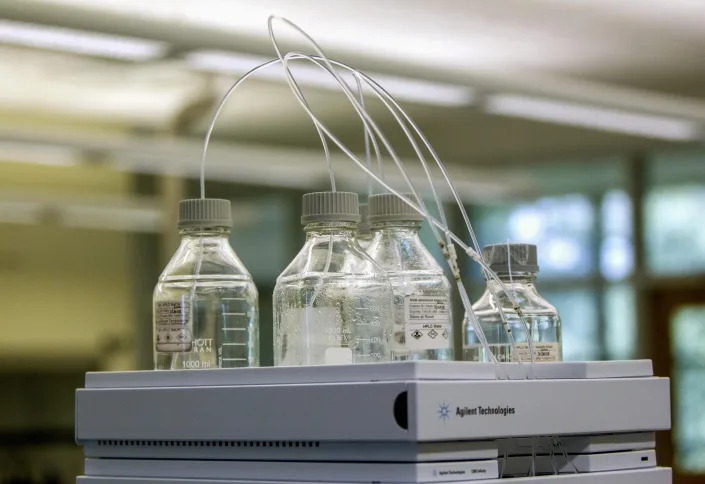
Equipment used to test for perfluoroalkyl and polyfluoroalkyl substances, known collectively as PFAS, in drinking water is seen at Trident Laboratories in Holland, Michigan. As part of its attempt to clean up the chemical, the military is spending millions on research to better detect, understand and filter the chemicals.

Even with deep experience studying PFAS, a primary reaction among Grandjean and other experts to the EPA’s Wednesday announcement was surprise. The agency has grappled with how to handle PFAS for decades and has often been criticized for a perceived lack of action. The thorniest problem is the sheer scope of PFAS: regulating the substances, particularly at very low levels, has nationwide implications for water utilities, industry, and the public.

But the EPA under the Biden administration, Faber said, is signaling they are serious about moving in that direction.

“This administration has pledged to do more, and has accomplished more, than any other,” Faber said.

In releasing the new health advisories, EPA said they fit into a larger picture under the agency’s “Strategic Roadmap.” That includes an intention to propose a formal drinking water regulation for PFOS, PFOA, and potentially other chemicals this fall. The agency also says it is taking a holistic approach to PFAS, with measures planned to clean up contamination hotspots, address PFAS in consumer products, and offer support to impacted communities.

In a press release, the agency says it is making available the first $1 billion of a total of $5 billion in grant funding from the bipartisan infrastructure law passed last year to assist  communities contaminated with PFAS. Another $6.6 billion is potentially available through existing loan programs for water and sewer utilities.

“People on the front lines of PFAS contamination have suffered for far too long,” EPA Administrator Michael Regan said in the release. “That’s why EPA is taking aggressive action as part of a whole-of-government approach to prevent these chemicals from entering the environment and to help protect concerned families from this pervasive challenge.”

PFAS foam floats along Van Etten Creek after being dumped from a storm pipe of water treated at a granular activated carbon GAC plant from the former Wurtsmith Air Force Base in Oscoda on Wednesday, March 13, 2019.

But the EPA is already receiving pushback from various corners.

The American Chemistry Council, an industry group representing many of the companies that use PFAS, said it believes the agency’s new advisories are “fundamentally flawed.”

“ACC supports the development of drinking water standards for PFAS based on the best available science. However, today’s announcement … reflects a failure of the agency to follow its accepted practice for ensuring the scientific integrity of its process,” the council said in a release.

Meanwhile, utilities remain skeptical the agency will ultimately do enough to tackle industry and other sources of pollution.

In 2016, Tim Hagey, general manager of the Warminster Municipal Authority in southeast Pennsylvania, came face to face with a nightmare for anyone tasked with providing safe drinking water to the public.

PFOA and PFOS — invisible, odorless, and dangerous — had slipped into the town’s water supply after leaking from nearby military bases. The discovery set off a years-long struggle in Warminster and neighboring communities, which decided to go beyond the EPA’s prior advisory and filter out the chemicals entirely. Hagey said they saw the writing on the wall.

“The EPA told us over the years that the more they study the chemicals, the uglier they are,” Hagey said. “Our local leaders had the courage to say, ‘We’re going to filter to zero.’”

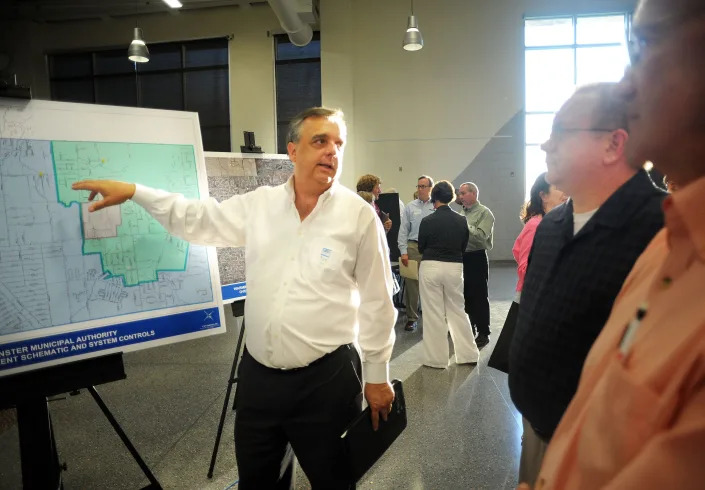
Tim Hagey, left, general manager of Warminster Municipal Authority, speaks with residents during a public information session about water quality in Warminster. The meeting followed the announcement that public and private wells in Warminster (and nearby Horsham) were contaminated by two chemicals used when the Navy was operating the Naval Air Warfare Center.

But the decision was costly, adding up to tens of millions of dollars and requiring significant surcharges on customer water bills.

Hagey said the EPA’s new advisories are a “pleasant surprise” when it comes to protecting public health. But he’s frustrated that the Department of Defense has not yet addressed the contaminated groundwater beneath his town, contributing to ongoing cost fears.

“The aquifer has not been cleaned up. There needs to be leadership on that,” Hagey said.

Emily Remmel, director of regulatory affairs for the National Association of Clean Water Agencies, which represents wastewater authorities, said water and sewer utilities across the country are facing similar dilemmas. In many ways, PFAS contamination is unprecedented. The chemicals are everywhere, and the EPA has now found they are dangerous at levels smaller than can even be detected.

“We can’t measure to these levels, we can’t treat to these levels,” Remmel said. “So how do you deal with this from a public health standpoint?”

Remmel said she’d also like to see EPA take more action to get rid of PFAS at the source. Often they come from everyday consumer products that people use and wash down the drain.

“Washing your clothes, washing your face, washing your dishes,” Remmel said.

The costs to remove and dispose of PFAS are astronomical. A filter on a single water well can cost $500,000. Remmel said while the new funding is helpful, it’s also just a “drop in the bucket” for what’s needed across the country.

Ultimately, costs will need to be passed onto water consumers, who have already seen rates rising steeply over the past decade as utilities have invested in other priorities such as replacing lead pipes and outdated sewer infrastructure. Remmel said she wants the EPA to do a better job engaging at the local level to assist with the public health and financial burdens PFAS create.

“This should not be on the backs of municipalities, of ratepayers,” Remmel said.

Kyle Bagenstose covers climate change, chemicals, water and other environmental topics for USA TODAY. 

Heat stress blamed for thousands of cattle deaths in Kansas

CBS News

Heat stress blamed for thousands of cattle deaths in Kansas

June 16, 2022

Thousands of cattle in feedlots in southwestern Kansas have died of heat stress due to soaring temperatures, high humidity and little wind in recent days, industry officials said.

The final toll remains unclear, but as of Thursday at least 2,000 heat-related deaths had been reported to the Kansas Department of Health and Environment, the state agency that assists in disposing of carcasses. Agency spokesman Matt Lara said he expects that number to rise as more feedlots report losses from this week’s heat wave.

The cattle deaths have sparked unsubstantiated reports on social media and elsewhere that something besides the weather is at play, but Kansas agriculture officials said there’s no indication of any other cause.

Heat Wave Cattle Deaths
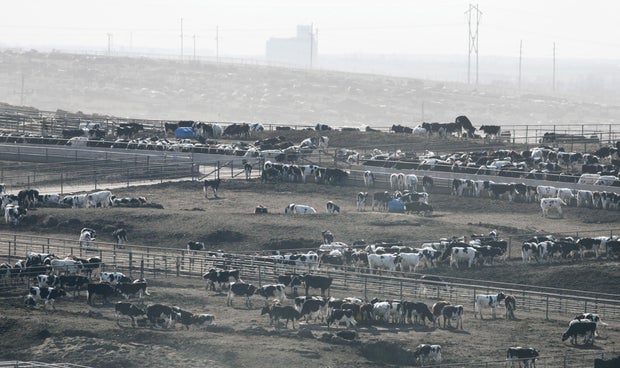
Cattle feed at a feed lot near Dodge City, Kansas, March 9, 2007. Thousands of cattle in feedlots in southwestern Kansas have died of heat stress amid soaring temperatures coupled with high humidity and little wind in recent days, industry officials said Thursday, June, 16, 2022.ORLIN WAGNER / AP

“This was a true weather event — it was isolated to a specific region in southwestern Kansas,” said A.J. Tarpoff, a cattle veterinarian with Kansas State University. “Yes, temperatures rose, but the more important reason why it was injurious was that we had a huge spike in humidity … and at the same time wind speeds actually dropped substantially, which is rare for western Kansas.”

Last week, temperatures were in the 70s and 80s, but on Saturday they spiked higher than 100 degrees, said Scarlett Hagins, spokeswoman for the Kansas Livestock Association.

“And it was that sudden change that didn’t allow the cattle to acclimate that caused the heat stress issues in them,” she said.https://2bfa6c9b6538fcc17b8fb63e5c030472.safeframe.googlesyndication.com/safeframe/1-0-38/html/container.html

The deaths represent a huge economic loss because the animals, which typically weigh around 1,500 pounds, are worth around $2,000 per head, Hagins said. Federal disaster programs will help some producers who incurred a loss, she added.

And the worst may be over. Nighttime temperatures have been cooler and — as long as there is a breeze — the animals are able to recover, Tarpoff said.

Hagins said heat-related deaths in the industry are rare because ranchers take precautions such as providing extra drinking water, altering feeding schedules so animals are not digesting during the heat of the day, and using sprinkler systems to cool them down.

“Heat stress is always a concern this time of year for cattle and so they have mitigation protocols put in place to be prepared for this kind of thing,” she said.

Many cattle had still not shed their winter coats when the heatwave struck.

“This is a one in 10-year, 20-year type event. This is not a normal event,” said Brandon Depenbusch, operator of the Innovative Livestock Services feedlot in Great Bend, Kansas. “It is extremely abnormal, but it does happen.”

While his feedlot had “zero problems,” he noted that his part of the state did not have the same combination of high temperatures, high humidity, low winds and no cloud cover that hit southwestern Kansas.

Elsewhere, cattle ranchers haven’t been so hard hit.

The Nebraska Department of Agriculture and the Nebraska Cattlemen said they have received no reports of higher-than-normal cattle deaths in the state, despite a heat index of well over 100 degrees this week.

Oklahoma City National Stockyards President Kelli Payne said no cattle deaths have been reported since temperatures topped 90 degrees last Saturday, after rising from the mid 70s starting June 1.

“We have water and sprinklers here to help mitigate heat and the heat wave,” Payne said, but “we don’t have any control over that pesky Mother Nature.”

One Surprising Theory Why the Philippines Has Very Few Mass Shootings—Despite Easy Access to Lots of Guns

Time

One Surprising Theory Why the Philippines Has Very Few Mass Shootings—Despite Easy Access to Lots of Guns

Chad de Guzman / Manila – June 15, 2022

Shop assistants pose with various handgu

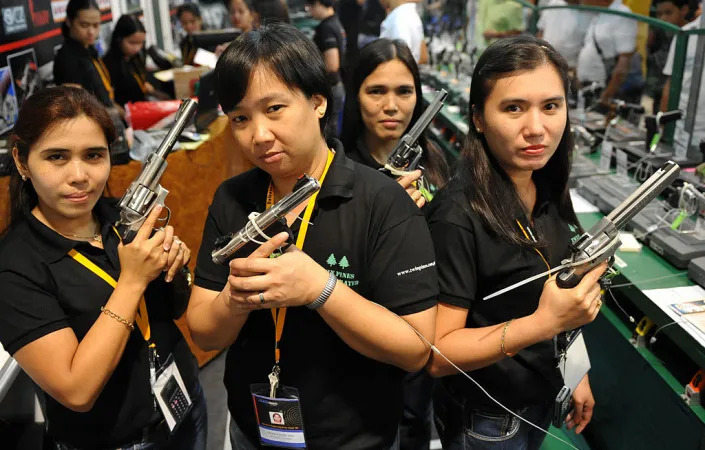
Shop assistants pose with various handguns at the Defense and Sporting Arms show at a shopping mall in Manila on July 16, 2009. Credit – TED ALJIBE/AFP via Getty Images

Mass shootings are a result of a confluence of factors, but at the heart of the problem are guns—of which the Philippines has plenty. Firearms are sold openly in malls, and almost anyone can carry them, even priests and accountants.

Fixers can reportedly take care of formalities standing in the way of gun ownership, such as drug and psychological tests, and there are estimated to be some four million firearms in the nation of 110 million people. Hundreds of thousands of weapons are illegally owned. Poverty, corruption, crime, and outgoing President Rodrigo Duterte’s brutal war on drugs have left deep social scars.

No consensus has been reached in the Philippines over what sets a mass shooting apart from other gun deaths, but indiscriminate slayings are uncommon. When eight people died and 11 were injured after a drunk gunman began firing wildly in the southern province of Cavite back in 2013, the tragedy was notable for its sheer rarity.

To be clear, homicides involving firearms are a fact of life in the Philippines. Hitmen can be hired for as little as $300. In fact, the Philippines is one of the deadliest places in Asia when it comes to firearm homicides. The country saw over 1,200 intentional killings using firearms in 2019. This meant guns killed one in every 100,000 people in the Southeast Asian country—one of the highest rates in Asia. (In 2020, the comparable figure for the U.S. is four.)

From the Archives: Inside Rodrigo Duterte’s Drug War

Elections can be particularly bloody times, with lethal attacks on poll officers and political rivals. One of the country’s worst killings, the 2009 Maguindanao massacre of 58 people, took place during a gubernatorial election. But it was a political atrocity. Shootings not related to politics or crime are uncommon—and there has been nothing as extreme as Columbine, Sandy Hook, or Uvalde.

“I think it’s just a matter of time,” says Gerry Caño, Dean of the School of Criminology and Criminal Justice at Cagayan de Oro College. “I think our authorities and the public safety practitioners are just waiting for that time to happen, considering that Philippine culture is greatly influenced by the West, particularly the United States.”

For now, though, powerful social factors continue to have a restraining effect on indiscriminate violence. Philippine academic Raymund Narag, a criminology associate professor at Southern Illinois University and a former prisoner himself, says mass shootings in his native country are in part deterred by hiyâ, a Tagalog word meaning shame or embarrassment. Avoidance of hiyâ, and sparing one’s family and community from it, is often described as a core Philippine value.

“It reflects on you, and reflects on your family,” Narag says. “When I was jailed, our entire clan felt humiliated.”

Visitors view displayed firearms during the Tactical, Survival and Arms Expo in Pasay City, the Philippines, Nov.15, 2019.<span class="copyright">Rouelle Umali/Xinhua via Getty</span>
Visitors view displayed firearms during the Tactical, Survival and Arms Expo in Pasay City, the Philippines, Nov.15, 2019.Rouelle Umali/Xinhua via Getty
Gun culture in the Philippines

While the right to bear arms isn’t enshrined in the nation’s constitution, as it is in the United States, there is no denying the Philippine love of guns.

When the U.S. colonized the Philippines in the early 1900s, private citizens were allowed to own high-powered guns for “lawful purposes” and hunting. After Ferdinand Marcos declared martial law in 1972, owners were limited to one low-powered rifle and a pistol or revolver—and both had to be licensed. But in 2000, President Joseph Estrada lifted these limits and allowed citizens to possess as many guns as they wanted, of any type and caliber.

A 2013 law set down qualifications for owning guns and carrying them in public. Licensed gun owners had to be 21 years old and take a firearm safety seminar, among other requirements. Depending on their license, most owners could possess up to 15 handguns, rifles and shotguns (collectors are allowed more than 15). Licenses were issued for as long as 10 years.

Before he was president, Estrada was a gun-wielding hero in action movies—a genre beloved of Filipinos for playing up machismo and depicting shootouts as legitimate forms of defense in a crime-riddled country. The action movie craze certainly helped Filipinos embrace gun culture.

Read More: These Countries Restricted Assault Weapons After Just One Mass Shooting

In some of the country’s poorest communities, guns became a common sight among warring gangs, who sourced low-priced firearms from illegal sellers. Shooting clubs opened for those with more money and an interest in shooting for sport. Many affluent Filipinos took up gun collecting, while the wealthiest citizens began enthusiastically arming their bodyguards.

But despite the glorification of firearms, when gun violence takes place, the victims are rarely random bystanders in movie theaters or shopping malls. Almost a quarter of the Philippine population falls below the poverty line and “the money or the reward seems to be the best motivating factor” in many homicide cases involving firearms, Caño says.

In January, a provincial hitman admitted to committing his crime in exchange for $500 to help his child, who was suffering from meningitis. In April, another gunman confessed to killing a mechanic for $400.

Displaced children playing with wooden toy guns inside a temporary shelter area in Mamasapano, Maguindanao, on August 22, 2018, in Mamasapano, Maguindanao, southern Philippines.<span class="copyright">Jes Aznar/Getty Images</span>
Displaced children playing with wooden toy guns inside a temporary shelter area in Mamasapano, Maguindanao, on August 22, 2018, in Mamasapano, Maguindanao, southern Philippines.Jes Aznar/Getty Images
How hiyâ plays a role in social control

Narag says the strong ties of Philippine kinship mean troubled individuals are more likely to be identified before they become mass shooters. He contrasts that with the situation in the U.S., where he presently lives and teaches.

“Here, if you have problems, you have to go to a health professional,” he tells TIME. “You’ll divulge everything there. You don’t talk to your neighbors—sometimes you don’t talk to your own parents—because [there isn’t] an engaged culture where one’s problem is everyone’s problem.”

Jose Antonio Clemente, a professor of social psychology at the University of the Philippines, says community is everything. “At an early age, we are trained to give importance to our families and our relationships,” he says. “Maybe at some point we’re also taught to value our community, since there are a lot of communities that are very close-knit because of the high population density.”

Read More: We Need to Take Action to Address the Mental Health Crisis

National police do have mass shooting protocols in place. Authorities have also suggested an increased police presence on college campuses to deter insurgent groups from recruiting students. But it seems that ingrained values in the Philippines are restraining people from using guns indiscriminately.

Whether that is enough is up for debate. For now, however, hiyâ means you cannot “just start shooting people,” Narag says. “Because if that happens, you know the community won’t support you.”

Hellfire: Uvalde Shooter Owned a Device That Makes AR-15s Even More Deadly

Rolling Stone

Hellfire: The Uvalde Shooter Owned a Device That Makes AR-15s Even More Deadly

Tim Dickinson – June 15, 2022

US-TEXAS-GUNS-NRA - Credit: Patrick T. Fallon/AFP/Getty Images
US-TEXAS-GUNS-NRA – Credit: Patrick T. Fallon/AFP/Getty Images

“Unleashing ‘Hell-Fire.’”

It pictures a gunman, wearing a skull mask with blacked out eyes, who unloads an AR-15 that is sending spent cartridges flying from its ejection port. The ad copy reads: “All you do is squeeze the trigger and shoot at rates up to 900 rpm” — or rounds per minute.

The sales pitch is for a hellfire trigger device, a gun accessory that allows a semi-automatic rifle to fire at rates similar to machine gun. Although the physics behind the device are nearly identical to that of a bump-stock — now illegal under federal law — hellfires remain cheap and easy to acquire. Including, evidently, by a teenager bent on mass murder.

The gunman in the Uvalde massacre had purchased a hellfire device, which was recovered from one of the classrooms where the massacre took place, according to investigative documents reviewed by the New York Times. Federal authorities reportedly don’t believe the device was used in the attack. But had it been deployed, the carnage at Robb Elementary School — where 19 children and two teachers were murdered — might have been, unimaginably, worse.

Even in the trigger-happy US of A, machine guns are supposed to be illegal. A central fixture of federal firearms law since the days of Al Capone’s 1930s is that fully-automatic weapons are too powerful to be in civilian hands. Yes, modern consumers can buy high-powered weapons, like AR-15-style rifles, that are nearly identical to guns used in the U.S. military, but these guns fire only one round with each trigger pull.

But in the poorly regulated market of fire-arms accessories, a small but dedicated band of companies have pushed the legal envelope. They’ve engineered and marketed devices that circumvent the limitations of semi-automatic weapons, turning rifles into bullet hoses that can fire hundreds of rounds per minute.

After a 2017 massacre in Las Vegas, the Bureau of Alcohol, Tobacco and Firearms — better known as ATF — outlawed one class of these accessories, known as bump stocks, by classifying them as machine guns. But they didn’t touch hellfire triggers.

That differential treatment has no logic, insists Josh Sugarmann, Executive Director of the Violence Policy Center. When it comes to hellfires and similar “trigger activators,” he says, “ATF has been very, very lenient in its interpretation of federal law.”

Screenshot of an ad for a Hellfire style device - Credit: Youtube
Screenshot of an ad for a Hellfire style device – Credit: Youtube

Youtube

“Bump firing without the stock”

A hellfire device and a bump-stock both rely on the same physics to mimic fully automatic fire. They absorb the energy from the recoil of a single gunshot, then rebound the weapon slightly forward, activating the trigger against a shooter’s otherwise stationary finger — again and again and again and again and again.

With a bump-stock, this rebound is generated in the butt of the rifle pressed against the shooter’s shoulder. A hellfire device attaches to the pistol grip and rebounds, instead, against the shooter’s palm.

ATF itself recognized the similarity of the devices, explicitly comparing them in 2013 correspondence with a congressman, back when both devices were deemed legal. Gun enthusiasts today praise the hellfire as offering “bump firing without the stock.” (ATF did not answer questions from Rolling Stone about why the devices are treated differently.)

From San Francisco to Waco

Hellfires are not new. In fact, the trigger devices have dark history. In a 1993 mass shooting in a San Francisco high rise, the gunman used hellfire triggers, attached to a pair of assault pistols with 50-round magazines; he killed eight, wounded six, and then took his own life. Hellfire triggers were also believed to have been in use at David Koresh’s militarized Waco, Texas, cult compound.

These days, the trigger devices are cheap, and marketed with disturbing slogans and imagery. It’s not immediately clear what device the Uvalde shooter purchased. But there are many models available online. At one retailer, just $29.95 can get you the “Classic” hellfire “made infamous by David Koresh and the Branch Davidians in Waco,” according to the sales pitch.

The “Gen II” model offers “recoil assist technology” to enable “one handed operation,” and will set you back $59.95. A new “Stealth” model, meanwhile, is for sale at just $39.95, and can be installed “invisibly within your grip on any AR15 style rifle” and be “activated or deactivated in seconds.”

Banning Bump-Stocks

It was the Trump administration, surprisingly, that banned bump-stocks — after they were used to catastrophic effect in a 2017 Las Vegas shooting. In that attack, a gunman fired bump-stock-equipped AR-15s from the 32nd floor of the Mandalay Bay hotel. The spray of more than 1,000 rounds killed 60 people and wounded more than 400 at a concert festival below.

Without the need of new legislation, the ATF issued a rule in 2019 outlawing bump stocks. The devices, the regulation states, “convert an otherwise semiautomatic firearm into a machinegun” by harnessing “the recoil energy… [to] continue firing without additional physical manipulation of the trigger by the shooter.” (The regulation has, at least so far, held up in court)

Despite operating on the same principle, hellfire triggers remain street legal — putting machine gun firepower in the hands of untrained amateurs. The rate of fire enabled by these devices is so high, in fact, that the more expensive hellfire models actually offer features to slow down the firing cycle “to save ammo!”

Hellfire triggers can be finicky to master — which may be why the young Uvalde shooter ultimately didn’t deploy his. And it’s impossible to know whether automatic fire would have led to even more devastation at Robb Elementary School. (The shooter was left unimpeded for more than an hour by dithering local police; the gunman was not pressed for time.)

Marketing Lethality

The “most important” takeaway from the hellfire purchase is what it reflects about “the mindset of the shooter,” argues Sugarmann. “He had done everything he could, in his mind, to find the most lethal combination of weaponry and accessories when he planned the attack.”

Such lethality is — not coincidentally — the top selling point of a the modern firearms industry, which pitches its customers on military-grade precision and firepower. That includes the maker the Uvalde shooter’s rifle, Daniel Defense, whose Georgia headquarters are located at “101 Warfighter Way.”

The Uvalde shooter simply found, in the hellfire, a low-cost accessory that promised to unlock his weapon’s full military pedigree, by mimicking the automatic fire reserved for soldiers.

Sugarmann insists the ATF has the authority to send a warning to the industry by targeting hellfire makers, who are small operators and operate at the margins of the industry. “They’re the bottom feeders,” he says. “If you took action against one of them, it would send a message throughout the industry that ATF has regulatory role that it can use to the to protect public safety.”

The Violence Policy Center founder insists that the agency “could move against them, the way that they moved against bump-stocks.” But at least so far, Sugarmann laments, “the agency has chosen not to.”

Indeed, the text of ATF’s own bump-stock regulation notes that public commenters argued the broad language could be read to encompass “Hellfire trigger mechanisms” and similar devices. The agency’s response? Simply that it “disagrees that other firearms or devices… will be reclassified as machineguns under this rule.”

‘Moment of reckoning:’ Federal official warns of Colorado River water supply cuts

Yahoo! News

‘Moment of reckoning:’ Federal official warns of Colorado River water supply cuts

Ben Adler, Senior Editor – June 15, 2022

The Colorado River’s reservoirs have diminished to the point that significant cuts to the water supplied to the seven states that rely on it will be necessary next year, a federal official warned Tuesday.

Bureau of Reclamation Commissioner Camille Calimlim Touton told the Senate Energy and Natural Resources Committee maintaining “critical levels” at the largest reservoirs in the United States — Lake Mead and Lake Powell — will require large reductions in water deliveries.

“A warmer, drier West is what we are seeing today,” she said at a hearing. “And the challenges we are seeing today are unlike anything we have seen in our history.”

From above, a river flows through a rocky desert landscape.
The relatively arid desert Southwest is viewed at 33,000 feet on May 19 near Moab, Utah. The Colorado River, flowing from Colorado’s Rocky Mountain through Utah, Arizona, Nevada and California is dependent on winter snowfall in the Rockies. (George Rose/Getty Images)

Colorado, New Mexico, Utah, Wyoming, Arizona, California, and Nevada all receive water from the Colorado River and next year will see a decrease of between 2 million and 4 million acre-feet of water due to the ongoing drought that has gripped most of the Western U.S. (An acre-foot is the amount of water needed to cover one acre of land in one-foot-deep water.) Current allotments of water from the Colorado range from 300,000 acre-feet for Nevada to 4.4 million acre-feet for California.

“What has been a slow-motion train wreck for 20 years is accelerating, and the moment of reckoning is near,” John Entsminger, general manager of the Southern Nevada Water Authority, told the Senate hearing. “We are 150 feet from 25 million Americans losing access to the Colorado River, and the rate of decline is accelerating.”

The West has been suffering through an acute drought since 2020, part of a megadrought that began in 2000. The last 20 years have been the driest two decades in the last 1,200 years. This year is so far the driest on record in California. Scientists attribute these conditions to climate change, which causes more water evaporation due to warmer temperatures.

“As a climate scientist, I’ve watched how climate change is making drought conditions increasingly worse — particularly in the western and central U.S.,” wrote Imtiaz Rangwala, research scientist in climate at the Cooperative Institute for Research in Environmental Sciences at the University of Colorado Boulder, in May. “The last two years have been more than 2 degrees Fahrenheit (1.1 Celsius) warmer than normal in these regions. Large swaths of the Southwest have been even hotter, with temperatures more than 3 F (1.7 C) higher.”

A thick white ring above the coastline of a lake, and below a darker mountainous terrain, shows the dramatic decline of water levels at Lake Mead.
A thick white ring shows the dramatic decline of water levels at Lake Mead, the nation’s largest reservoir, which has reached its lowest water levels on record since it was created by damming the Colorado River in the 1930s, as growing demand for water and climate change shrink the Colorado River and endanger a water source millions of Americans depend on, near Boulder City, Nevada, April 16. (Caitlin Ochs/Reuters)

Western states have already been undertaking emergency measures to deal with the water scarcity. Seven months ago, California, Arizona and Nevada signed an agreement to take less water from Lake Mead, and six weeks ago the Department of Interior announced it is withholding some water from Lake Powell. Otherwise, DOI feared, the reservoir could drop so low that Glen Canyon Dam would not be able to generate electricity.

Last year, for the first time ever, the federal government declared a shortage on the river, which led to reductions in water deliveries to Arizona and Nevada. Some farmers in Arizona have had to leave some fields unplanted as a result.

Local governments and water utilities have been imposing restrictions on water usage. On June 1, the Metropolitan Water District of Southern California instituted limits on outdoor watering; typically it will be restricted to one or two days per week. But the water shortage persists.

“Despite those efforts and a previous deal among the states to share in the shortages, the two reservoirs stand at or near record-low levels,” the Los Angeles Times reported. “Lake Mead near Las Vegas has dropped to 28% of its full capacity, while Lake Powell on the Utah-Arizona border is now just 27% full.”

A formerly sunken boat rests on a now-dry section of lakebed.
A formerly sunken boat rests on a now-dry section of lakebed at the drought-stricken Lake Mead on May 10, 2022 in the Lake Mead National Recreation Area, Nevada. (Mario Tama/Getty Images)

Touton told the Senate committee that her agency is negotiating with the seven states that depend on the Colorado River to develop a plan for apportioning the water supply reductions in the next two months. In all, nearly 40 million people rely on water from the river.

Sen. Martin Heinrich, D-N.M., attributed the gathering crisis to a lack of coordinated action to mitigate climate change.

“It’s frankly a direct result of the lack of action on climate that we have seen for more than 20 years,” Heinrich said.

More than 65 million Americans are experiencing ‘severe to exceptional drought’

Yahoo! Finance

More than 65 million Americans are experiencing ‘severe to exceptional drought’

Grace O’Donnell, Assistant Editor – June 13, 2022

As of May 31, around 90 million Americans were being affected by drought while more than 65 million were experiencing “severe to extreme drought,” according to the National Oceanic and Atmospheric Administration (NOAA).

The Western and Southwestern states are particularly parched — nearly three-quarters of the Western region is in a state of severe to exceptional drought.

“There are a lot of downstream effects when it comes to a drought like this,” Andrew Hoell, a co-lead on the NOAA Drought Task Force, told Yahoo Finance.

Hoell explained that drought isn’t just a matter of precipitation but can be exacerbated by the evaporative effects of higher temperatures and inadequate snowpack runoff in the winter.

“By the time it’s summertime,” he said, “that vegetation is really dry. And if you get a spark, and you get a series of unfortunate events in that regard, you then have wildfires. So when it comes to drought in the West, there are just a variety and a spectrum of effects that you can feel later on whether it’s water resources and fires and reduced agricultural yields. The effects are numerous.”

NOAA
NOAA

Depleted water reservoirs and wildfire damage are already taking a toll on residents and businesses. The Hermits Peak Fire, which continues to blaze in New Mexico, has already scorched around 315,830 acres.

Meanwhile, states like California have instituted severe water restrictions, though water consumption has continued to rise. On an even grimmer note, low water levels at Lake Mead have threatened hydropower plants and exposed bodies once submerged in the reservoirs.

While conditions may ease slightly as the region enters its summer monsoon season, the outlook remains dry as the region navigates a historic, multi-decade megadrought.

A number of states including California, Colorado, New Mexico, Utah, Arizona, and tribal nations like the Navajo Nation have all declared drought states of emergency and allocated resources for managing the water crisis.

Nick Messing pull a kayaks down to the waters edge at Wahweap Marina at Lake Powell on April 6, 2022 in Page, Arizona when water levels at Lake Powell were at a historic low. (Photo by  RJ Sangosti/MediaNews Group/The Denver Post via Getty Images)
Nick Messing pull a kayaks down to the waters edge at Wahweap Marina at Lake Powell on April 6, 2022 in Page, Arizona when water levels at Lake Powell were at a historic low. (Photo by RJ Sangosti/MediaNews Group/The Denver Post via Getty Images)
Population growth

Since 2000, droughts have cost the U.S. around $160.8 billion, according to the NOAA. That figure jumps to $272 billion when accounting for destructive wildfires that are more prone in arid conditions.

With water already becoming more scarce, the increasing population in the West — and therefore demand for water — has inflamed the situation.

An Economic Innovation Group report using county-level population data found that the trend of people moving to water-starved states has only accelerated during the pandemic.

Inland California, the Mountain West, and eastern Texas saw the greatest growth, and overall, 10 of the top 15 counties for population growth were in the Western U.S: Maricopa County, Arizona (Phoenix), was ranked first, followed by Collin County, Texas, and Riverside County, California.

A graph showing the projected rise in population in drought-prone areas. (EIG)

“The map of these demographic shifts shows some familiar pre-pandemic trends and some new patterns,” the author stated. “Overall, the Sunbelt and the Mountain West continued to outshine the rest of the country. Remote rural counties in eastern Oregon and northern Idaho experienced robust population growth while every single county in Nevada gained population.”

Another EIG study found that an additional 20 million residents could move to drought-stricken counties by 2040. Water managers are already balancing razor-thin water budgets at current population levels.

“With reservoirs at record low levels throughout the West and the effects of sustained drought conditions increasingly being felt from agriculture to development, one of the most far-reaching questions in the United States over the coming decades is whether growth trends will ultimately collide with nature’s ability to sustain such a large influx of people,” Daniel Newman, the report’s author, wrote.

Fire and water

Doling out water supplies isn’t the only issue residents have to contend with.

Suburban neighborhoods sprawling out into more rural areas are creating a more substantial wild-urban interface at the same time as the wildfire season creeps earlier and longer.

In the last month, two Colorado Springs neighborhoods were evacuated due to fires, as were the owners of coastal California mansions caught in a blaze. For those unfortunate enough to sustain damage from fires, it can leave lasting financial scars in addition to physical and emotional ones.

The damage to a neighborhood and its multi-million dollar homes is show three-weeks after a wind-driven wildfire burned through a canyon May 11 and into their neighborhood in Laguna Niguel, California , U.S., June 1, 2022. Picture taken with a drone.      REUTERS/Mike Blake
The damage to a neighborhood is shown after a wind-driven wildfire burned through a canyon and into their neighborhood in Laguna Niguel, California, June 1, 2022. REUTERS/Mike Blake

“Most people in the Western United States are very underinsured because they base the amount of insurance coverage on the average cost to rebuild” despite higher property costs in some regions like Lake Tahoe, California, Christina Restaino of the University of Nevada Cooperative Extension said in a webinar.

According to Restaino, the current water crisis “underscores the need to prepare communities for wildfire, because when these large emergency incidents occur what we end up having to do is use a ton of water in an already water-scarce environment to suppress wildfires.”

There are some steps residents in high-risk areas can take to protect themselves, however.

“The No. 1 thing that people can do is to create a 5-foot ember-resistant zone around their house, so you don’t want to have anything combustible within five feet around your house,” she said. “Second-easiest thing, I would say, is to screen all of your vents.”

Of equal importance, “be prepared to evacuate,” Restaino stressed. “If you have medications that you take or important things you cannot leave home without, make sure you have backups of all those in an evacuation go-bag.”

A sign indicating extreme fire danger is pictured at Storrie Lake State Park as the Hermits Peak and Calf Canyon wildfires burn near Las Vegas, New Mexico, May 2, 2022. REUTERS/Kevin Mohatt

While the current period of intense drought may ease in months or years as it has in previous years, rising temperatures due to climate change mean that many will have to get used to living with these risks.

“If I had to guess — and if there is a silver lining here — if we’re to look at the next 10 years, will they necessarily be as bad as the last 10 years in terms of precipitation?” Hoell said. “I would say probably not.”

He added that the primary problem “is the climate has not shown any indication of warming temperatures slowing down. That right there is a problem in and of itself because it changes the amount of snow that you get during the wintertime, changes the amount of snow that then makes its way into reservoirs, thereby replenishing them. So we have these different factors that kind of commingled to bring together this hydrologic situation that is not ideal for us right now.”

Grace is an assistant editor for Yahoo Finance.