UN sums up climate science: world heading in wrong direction
September 13, 2022
Victims of heavy flooding from monsoon rains crowd carry relief aid through flood water in the Qambar Shahdadkot district of Sindh Province, Pakistan, Sept. 9, 2022. The United Nations says weather disasters costing $200 million a day and irreversible climate catastrophe looming show the world is “heading in the wrong direction.” (AP Photo/Fareed Khan, File)Floating boat docks sit on dry ground as water levels have dropped near the Callville Bay Resort & Marina in the Lake Mead National Recreation Area, Tuesday, Aug. 30, 2022, near Boulder City, Nev. The United Nations says weather disasters costing $200 million a day and irreversible climate catastrophe looming show the world is “heading in the wrong direction.” (AP Photo/John Locher)A railway worker hands out bottles of water to passengers at King’s Cross railway station where there are train cancellations due to the heat in London, July 19, 2022, during a heat wave. The United Nations says weather disasters costing $200 million a day and irreversible climate catastrophe looming show the world is “heading in the wrong direction.” (AP Photo/Kirsty Wigglesworth, File) A man wipes his forehead as he walks along the lower than normal bank of the Jialing River during a drought in southwestern China’s Chongqing Municipality, Aug. 19, 2022. The United Nations says weather disasters costing $200 million a day and irreversible climate catastrophe looming show the world is “heading in the wrong direction.” (AP Photo/Mark Schiefelbein, File)
GENEVA (AP) — With weather disasters costing $200 million a day and irreversible climate catastrophe looming, the world is “heading in the wrong direction,” the United Nations says in a new report that pulls together the latest science on climate change.
“There is nothing natural about the new scale of these disasters. They are the price of humanity’s fossil fuel addiction,” he said. “This year’s United in Science report shows climate impacts heading into uncharted territories of destruction.”
“Yet each year we double-down on this fossil fuel addiction, even as the symptoms get rapidly worse,” he added.
The report, drawn from data compiled by several U.N. agencies and partners, cited a 48% chance that global temperature rise compared to pre-industrial times will reach 1.5 degree Celsius (2.7 Fahrenheit) in the next five years. There’s a 93% percent chance that one year in the next five will see record heat.
Associated Press climate and environmental coverage receives support from several private foundations. See more about AP’s climate initiative here. The AP is solely responsible for all content.
The Consumer Price Index (CPI) in August reflected an 8.3% increase over last year and a 0.1% increase over the prior month, the Bureau of Labor Statistics reported Tuesday. Economists had expected prices to rise 8.1% over last year and fall 0.1% over last month, according to estimates from Bloomberg.
On a “core” basis, which strips out the volatile food and energy components of the report, prices rose 6.3% over last year and 0.6% over the prior month in August.
Expectations were for a 6.1% annual increase and 0.3% monthly increase in core CPI.https://flo.uri.sh/visualisation/6180194/embed?auto=1
The unexpected rise in Tuesday’s headline figure came despite a 5% drop in energy prices over the month, driven by 10.6% plunge in the gasoline index.
Inflationary pressures remained strong across other components of the report, with declining gas and energy prices offset by increases in the costs of shelter, food, and medical care — the largest of many contributors to the broad-based monthly increase, per the Bureau of Labor Statistics.
August’s CPI report sent stocks tumbling. Shortly after the release, Nasdaq futures were down as much as 1.8%, S&P 500 futures sank 1.2%, and Dow futures fell 0.9%
The reading also likely affirms that Federal Reserve officials will raise interest rates by 75 basis points at their policy-setting meeting Sept. 20-21.
“Today’s inflation data cements a third consecutive 0.75% increase in the Fed funds rate next week,” Principal Global Investors Chief Global Strategist Seema Shah said in a note.
WASHINGTON, DC – MAY 23: (L-R) Vice Chair of the Federal Reserve Lael Brainard shakes hands with Jerome Powell after he took the oath of office for his second term as Chair of the Board of Governors of the Federal Reserve System at the William McChesney Martin Jr. Building of the Federal Reserve May 23, 2022 in Washington, DC. Powell has served as Federal Reserve Board of Governors Chair since February of 2018. (Photo by Drew Angerer/Getty Images)
“Headline inflation has peaked but, in a clear sign that the need to continue hiking rates is undiminished, core CPI is once again on the rise, confirming the very sticky nature of the US inflation problem,” Shah added, pointing out that 70% of the CPI basket logged an annual price rise of more than 4% month-on-month. “Until the Fed can tame that beast, there is simply no room for a discussion on pivots or pauses,” Shah said.
The higher-than-expected inflation print also comes after a round of more aggressive talk from central bank officials, notably Vice Chair Lael Brainard, who said last week: “While the moderation in monthly inflation is welcome, it will be necessary to see several months of low monthly inflation readings to be confident that inflation is moving back down to 2 percent.”
“Monetary policy will need to be restrictive for some time to provide confidence that inflation is moving down to target,” Brainard added, “We are in this for as long as it takes to get inflation down.
A person arranges groceries in El Progreso Market in the Mount Pleasant neighborhood of Washington, D.C., U.S., August 19, 2022. REUTERS/Sarah Silbiger
Among individual components of the report, the food index increased 0.8% in August, the smallest monthly increase since December 2021. Meanwhile, the food at home index rose 0.7% during the month, with all six major grocery store food group indexes rising.
Housing prices continued their climb, with the cost of shelter recording its largest increase month-on-month increase — 0.7% — since January 1991. Over the last year, the shelter index jumped 6.2%, accounting for roughly 40% of the broader index increase in all items excluding food and energy.
The cost of medical care notably rose 0.7% in August after a 0.4% increase in July, with major medical care component indexes climbing across the board.
Stressed Colorado River keeps California desert farms alive
Kathleen Ronaynet – September 13, 2022
Farmer Larry Cox walks in a field of Bermudagrass with his dog, Brodie, at his farm Monday, Aug. 15, 2022, near Brawley, Calif. The Cox family has been farming in California’s Imperial Valley for generations. (AP Photo/Gregory Bull)
Water flows along the All-American Canal Saturday, Aug. 13, 2022, near Winterhaven, Calif. The canal conveys water from the Colorado River into the Imperial Valley. (AP Photo/Gregory Bull)
Irrigator Raul Quirarte, 56, pauses during work to prepare a field to receive water from the All-American Canal, Sunday, Aug. 14, 2022, near Brawley, Calif. Quirarte started as an irrigator at the age of 18, taught by his father, who also was an irrigator. (AP Photo/Gregory Bull)
Water flows along the All-American Canal Saturday, Aug. 13, 2022, near Winterhaven, Calif. The canal conveys water from the Colorado River into the Imperial Valley. (AP Photo/Gregory Bull)
Farmer Larry Cox watches a tractor at work on a field at his farm Monday, Aug. 15, 2022, near Brawley, Calif. The Cox family has been farming in California’s Imperial Valley for generations. (AP Photo/Gregory Bull)
Farmer Larry Cox looks at soil on a field at his farm Monday, Aug. 15, 2022, near Brawley, Calif. The Cox family has been farming in California’s Imperial Valley for generations. (AP Photo/Gregory Bull)
Farmer Larry Cox walks stands in a field of Bermudagrass at his farm Monday, Aug. 15, 2022, near Brawley, Calif. The Cox family has been farming in California’s Imperial Valley for generations. (AP Photo/Gregory Bull)
Colorado River Compact California. A small pond sits between a field irrigated with water from the All-American Canal and a highway, Sunday, Aug. 14, 2022, near Brawley, Calif. The canal conveys water from the Colorado River into the Imperial Valley. (AP Photo/Gregory Bull)
Farmer Larry Cox walks to his truck as his dog, Brodie, soaks in a water canal at his farm Monday, Aug. 15, 2022, near Brawley, Calif. The Cox family has been farming in California’s Imperial Valley for generations. (AP Photo/Gregory Bull)
A worker diverts water as a sprinkler system is installed for alfalfa at the Cox family farm Monday, Aug. 15, 2022, near Brawley, Calif. The Cox family has been farming in California’s Imperial Valley for generations. (AP Photo/Gregory Bull)
Water from the All-American Canal flows in a canal alongside fields Saturday, Aug. 13, 2022, near El Centro, Calif. The canal conveys water from the Colorado River into the Imperial Valley. (AP Photo/Gregory Bull)
SACRAMENTO, Calif. (AP) — When Don Cox was looking for a reliable place to build a family farm in the 1950s, he settled on California’s Imperial Valley.
The desert region had high priority water rights, meaning its access to water was hard for anyone to take away.
“He had it on his mind that water rights were very, very important,” said his grandson, Thomas Cox, who now farms in the Valley.
He was right. Today the Imperial Valley, which provides many of the nation’s winter vegetables and cattle feed, has one of the strongest grips on water from the Colorado River, a critical but over-tapped supply for farms and cities across the West. In times of shortage, Arizona and Nevada must cut first.
But even California, the nation’s most populous state with 39 million people, may be forced to give something up in the coming years as hotter and drier weather causes the river’s main reservoirs to fall to dangerously low levels. If the river were to become unusable, Southern California would lose a third of its water supply and vast swaths of farmland in the state’s southeastern desert would go unplanted.
“Without it, the Imperial Valley shuts down,” said JB Hamby, a board member for the Imperial Irrigation District, which holds rights to the largest share of Colorado River water.
EDITOR’S NOTE: This is part of a collaborative series on the Colorado River as the 100th anniversary of the historic Colorado River Compact approaches. The Associated Press, The Colorado Sun, The Albuquerque Journal, The Salt Lake Tribune, The Arizona Daily Star and The Nevada Independent are working together to explore the pressures on the river in 2022.
A century ago, California and six other states — Arizona, Colorado, Nevada, New Mexico, Utah and Wyoming — created a compact that split the water into two basins and set rules for how much water each would get. A series of deals, laws and court cases that followed led California to get the most water and made it the last to lose in times of shortage.
Fear and frustration over California’s use of the river has driven the compact since its early days. In western water law, the first person who taps the source gets the highest right, and California cities and farmers have relied on the river for more than a century.
Other western states worried California would lay claim to all the river’s water before their own populations grew. The compact and the series of deals that followed attempted to find a balance to protect California’s supply while ensuring other states got some too. California, meanwhile, benefitted when the federal government began building the Hoover Dam to help control the river’s flow.
Today, the states are now gearing up for a 2026 deadline to renegotiate some of the terms to better deal with drought and protect two major reservoirs, Lake Powell and Lake Mead. But before that, the U.S. Bureau of Reclamation has demanded the states find a way to cut their use by roughly 15% to 30% to stave off a crisis. The states failed to meet a mid-August deadline to reach a deal, but negotiations are continuing and no new date for an agreement has been set.
All eyes are on California and its major water rights holders — namely the Imperial Irrigation District and Metropolitan Water District of Southern California — to see if they will give up some of their share. Both districts say they’re willing to use less water or pay others to do so — especially if cooperating means they can avoid challenges to their senior rights.
But they’re playing coy about what exactly they’re willing to give.
The river is the only water supply for the Imperial Irrigation District, whose farmers grow broccoli, onions, carrots and other winter vegetables as well as alfalfa and other feedstock. The limited water underneath the ground in the region, near California’s border with Arizona and Mexico, is not usable, and it does not have access to state water supplies.
The irrigation district was historically entitled to more water than either Arizona or Nevada, though it’s given some up over the years in exchange for payment from cities like San Diego and Los Angeles. In 2019, its board rejected a drought contingency plan signed by other water users in Arizona, Nevada and California.
This time around, officials say the district would be open to leaving fields unplanted to save water on a temporary, emergency basis. But neither Hamby nor board spokespeople would say how much.
State officials are looking to the $4 billion approved by Congress for the Colorado River as a possible source of money that could be used to pay the district and, in turn, farmers, to use less water.
The farmers aren’t privy to all of the district’s negotiating tactics, but are trying to organize among themselves to avoid having cuts foisted on them, Cox said. Many farmers have already installed drip irrigation lines that use less water, but they would be willing to adopt more conservation tactics if they’d be paid to do so.
Already, Cox said he’s making decisions about whether to plant on all of his vegetable fields this fall because he’s getting less water than normal under a new system adopted by the board.
“With water uncertainty, there’s going to be more uncertainty on food supply,” he said.
And it’s not just farmers who rely on the Imperial Irrigation District’s water. Runoff from the farms feeds the Salton Sea, a massive inland lake created in the early 1900s when the Colorado River flooded. It’s now rapidly drying up, exposing surrounding communities to toxic dust and killing the habitat that birds and fish rely on. The state and federal government are now looking for other ways to support the sea in the absence of river water, and its being eyed as a possible site for lithium extraction.
“We’re talking about a body of water surrounded by communities who have been marginalized for so (long), that don’t have the infrastructure or capacity to protect themselves from climate change, from less availability of water, from more dust,” said Silvia Paz, executive director for Alianza Coachella Valley, an organization fighting to improve the economy and health outcomes in the region.
Behind the irrigation district, the Metropolitan Water District is the state’s second largest user of the river’s water. The Colorado makes up about one-third of the water supply the district uses to provide water for drinking, bathing, landscaping and recreating to roughly half the state’s population. Los Angeles County, the nation’s largest, is one of the many areas in Southern California that relies on the river’s water.
It’s allowed to store some of the water it doesn’t use in Lake Mead, which California officials say has actually helped stave off a river crisis in recent years. But this year, short on other supplies, the district may actually try to pull some of that water out if needed, a move that would likely cause friction with other states in the basin.
The district also gets water from the Sacramento-San Joaquin River Delta, the state’s main source of water supplies. But the Delta is suffering from drought, too, and the state only approved 5% of requested supplies this year. As it looks to stabilize its water supply for the future, the district is spending billions on a water recycling plant and urging people to use less water for their lawns.
Still, ensuring the Colorado River is available in dry years when other supplies aren’t available is the district’s priority, said Bill Hasencamp, the district’s Colorado River manager.
Farm-heavy water districts in the Coachella Valley and Riverside County also get Colorado River water, which they use for crops like citrus, melons and barley. The Fort Mojave Indian Reservation and Colorado River Indian Reservation are among the tribes in California with river rights.
Looking to the future, both climate change and politics are at play as California’s water users debate what it will take to keep the river alive.
“What they really want is reliability and predictability,” said Michael Cohen, a Colorado River expert with the Pacific Institute. “What they don’t want is Arizona screaming that Phoenix and Tucson are dried up and California doesn’t take a drop of reductions.”
The Associated Press receives support from the Walton Family Foundation for coverage of water and environmental policy. The AP is solely responsible for all content. For all of AP’s environmental coverage, visit https://apnews.com/hub/climate-and-environment
California’s drought touches everyone, but water restrictions play out unevenly across communities
Soudi Jiménez – September 13, 2022
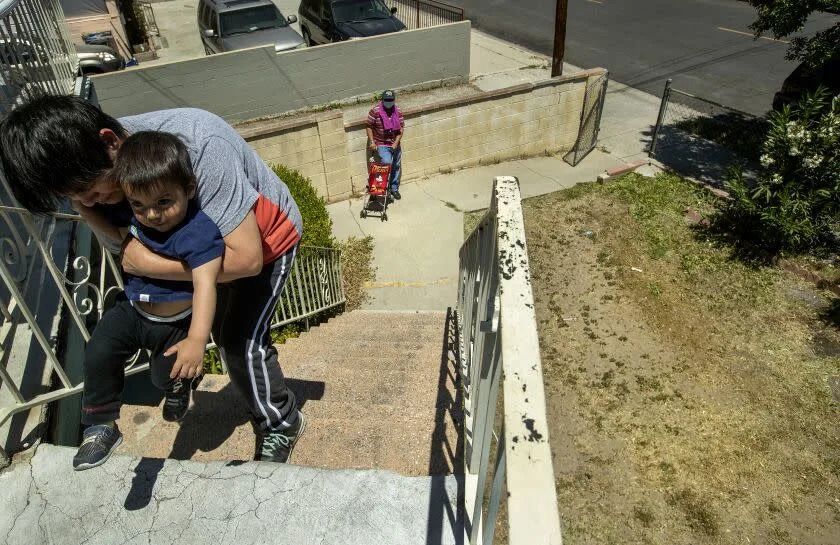
Benita Perez teaches her grandson, Nevaeh Perez, 1, how to walk at their apartment building in Lincoln Heights. Area at right, below used to be all grass until a year ago, because of the drought. (Mel Melcon/Los Angeles Times)
Raúl Monterroso of San Fernando knows that he can do little to help the struggling garden patio in front of his house. After all, he takes the new water restrictions seriously.
“Here, everything is dry, we have the entire irrigation system closed, my poor wife is crying over her plants,” said the Guatemala native, who stopped watering the grass on June 1 when instructions to cut outdoor watering to once a week were issued.
Further restrictions went into effect Sept. 6, when a 15-day ban through Sept. 20 was mandated by an emergency repair that shut down the 36-mile Upper Feeder pipeline that brings water from the Colorado River to Southern California. The Metropolitan Water District of Southern California said that more than 4 million people are being affected by the shutdown across the region, including Beverly Hills and Malibu, Burbank and Glendale, Long Beach, the city of Inglewood and a large swathe of the South Bay, and other areas stretching as far east as Pomona.
Also under the ban is the city of San Fernando, at the northern edge of L.A.’s San Fernando Valley, 92% of whose 24,000 residents are Latino.
“The reality is that when they give you the alert, you have to be aware. The measures must be followed, there is no other option,” Monterroso said.
In Long Beach, an hour’s drive south of San Fernando, businesswoman Sandy Cajas said that urgent measures are needed to maintain a steady flow of water and find new sources of it.
“We are experiencing the worst drought in decades,” she said. “What is going to happen here is that we are going to have to recycle the water due to the scarcity that exists.”
That’s one item, among many, on the state capital’s agenda. Last month, a 16-page document released by Gov. Gavin Newsom, “California’s Water Supply Strategy — Adapting to a Hotter, Drier Future,” indicated that California’s water supply will shrink 10% by 2040.
Among other measures, the plan, backed by billions of dollars in investment, calls for recycling more wastewater and desalinating seawater and salty groundwater, as well as speeding up infrastructure development and pushing conservation, in hopes of providing enough water for more than 8.4 million homes by 2040.
According to Newsom, this “aggressive plan” will guarantee that future generations “continue to call California home in this hotter, drier climate.”
“The best science tells us that we need to act now to adapt to California’s water future. Climate change means drought won’t just stick around for two years at a time like it historically has — extreme weather is the new normal here in the American West and California will adapt to this new reality,” Newsom said in an Aug. 11 statement.
Yet the drought is playing out unevenly across different communities and among different households. Since June 1, about 6 million residents in Los Angeles, Ventura and San Bernardino counties have had to limit outdoor water use to once a week. But not everyone is complying.
Every day since 2003, Álex Guzmán has driven a truck for work from the San Fernando Valley to Beverly Hills. The Mexican immigrant labors for a landscaping company. His task is to maintain the trees and lawns of the mansions. But, above all, to water lots and lots of plants.
Hearing that additional restrictions on water use have been implemented, Guzmán just smiles.
“We have never stopped working in Beverly Hills, we have never stopped watering mansion gardens because of the restrictions,” he said.
“We are working normally, the bosses have not told us anything about lowering the use of water,” Guzmán added.
As reported by The Times, celebrities such as Sylvester Stallone, Dwyane Wade, Kevin Hart, Kim and Kourtney Kardashian are among the more than 2,000 customers who have received “notices of exceedance” for surpassing 150% of their monthly water budgets at least four times since the Las Virgenes Municipal Water District declared a drought emergency in late 2021.
That disparity in following restrictions shows up in many public spaces, said Patty López, a former Assemblywoman for District 39, pointing for example to the contrast between the independent city of San Fernando and Sylmar, which is part of the city of Los Angeles.
“If you look at the Veterans Memorial Community Regional Park in Sylmar it is completely green, but in the parks in our area the grass is dead,” said López, a San Fernando resident, lamenting that there is no clear, consistent application of policies, or rigorous follow-up and enforcement, throughout the region.
Under current conditions, if the use of water is not controlled, worse consequences won’t be long in coming.
Samuel Sandoval Solís, professor of water resources management at UC Davis, said that California has 30% of its water stored in dams, meaning that, because of the drought’s effects, 70% of its capacity is gone. Water level in the subsoil has dropped 25 feet since 2016.
“Everything is looking very bad,” said the academic, who has been researching, monitoring and teaching on the subject of water for 20 years.
According to a UC Berkeley study, as temperatures in California rose between 1960 and 1980, rainfall also diminished, based on climatological records and analyzing the cores of trees.
Given the current scarcities of water, and recent extreme heatwaves across the Golden State, even downpours in the upcoming rainy season wouldn’t be enough to compensate, Sandoval Solís said.
“It’s not enough to make it to the next year,” he said.
Sandoval Solís said that if Californians don’t do more to conserve water, the authorities will have to implement restrictions such as those imposed on some municipalities during a previous drought phase between 2014 and 2016. Those restrictions limited the amount of gallons per person to between 12 and 15 daily.
According to the California Dept. of Water Resources, the “current statewide median indoor residential water use is 48 gallons per capita per day, and that a quarter of California households already use less than 42 gallons per capita per day.” The U.S. Environmental Protection Agency website states that each American uses an average of 82 gallons per day at home, including consumption.
“We need to raise awareness that we must all enter this equally,” Sandoval Solís said, “regardless of whether you live in a luxury house or in an apartment, we all have to reduce water consumption.”
In Arizona, worry about access to Colorado River water
Tony Davis – September 13, 2022
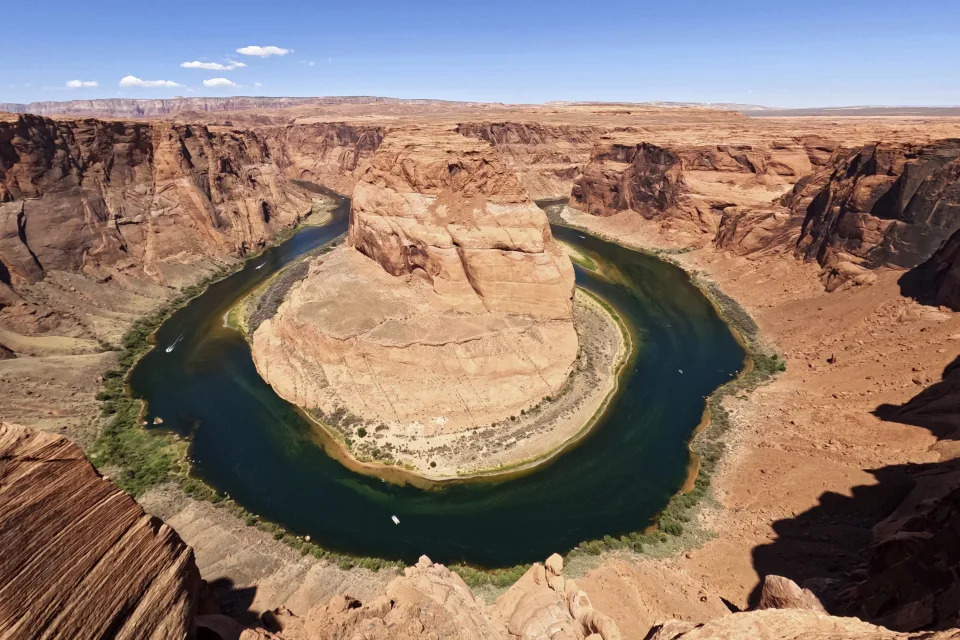
Utah State University master’s student Barrett Friesen steers a boat near Glen Canyon dam on Lake Powell on June 7, 2022, in Page, Ariz. In Arizona, water officials are concerned, though not panicking, about getting water in the future from the Colorado River as its levels decline and the federal government talks about the need for states in the Colorado River Basin to reduce use. (AP Photo/Brittany Peterson, File) The Colorado River flows at Horseshoe Bend in Glen Canyon National Recreation Area, Wednesday, June 8, 2022, in Page, Ariz. In Arizona, water officials are concerned, though not panicking, about getting water in the future from the Colorado River as its levels decline and the federal government talks about the need for states in the Colorado River Basin to reduce use. (AP Photo/Brittany Peterson, File) Water from the Colorado River diverted through the Central Arizona Project fills an irrigation canal, Aug. 18, 2022, in Maricopa, Ariz. In Arizona, water officials are concerned, though not panicking, about getting water in the future from the Colorado River as its levels decline and the federal government talks about the need for states in the Colorado River Basin to reduce use. (AP Photo/Matt York, File)New home construction encroaches dormant fields owned by Kelly Anderson, left, Aug. 18, 2022, in Maricopa, Ariz. Anderson grows specialty crops for the flower industry and leases land to alfalfa farmers whose crops feed cattle at nearby dairy farms. (AP Photo/Matt York, File)Boats move along Lake Powell along the Upper Colorado River Basin, June 9, 2021, in Wahweap, Ariz. In Arizona, water officials are concerned, though not panicking, about getting water in the future from the Colorado River as its levels decline and the federal government talks about the need for states in the Colorado River Basin to reduce use. (AP Photo/Ross D. Franklin, File) Tourists carry a kayak up a sandy hill Tuesday, June 7, 2022, in Page, Ariz. As Lake Powell levels drop, recreation is becoming tougher to access as boat ramps and marinas close. (AP Photo/Brittany Peterson, File)
TUCSON, Ariz. (AP) — Robbie Woodhouse’s grandfather began nearly a century of family farming along the Gila River near Yuma in the middle 1920s when he dug up a bunch of mesquite stumps on his land to make way for his barley, wheat, Bermuda seed, cotton and melon fields.
Farming never really took off at the Woodhouse homestead until 1954, when the federal government finished a 75-mile-long concrete canal to bring Colorado River water to what’s now known as the Wellton-Mohawk Irrigation and Drainage District, which covers about 58,500 acres along the Gila River east of the Colorado.
Today, Woodhouse presides over the governing board of a district with more than 120 individual growers, partnerships, trusts and other operating entities growing about 100 different crops, including seed crops as well as staples like wheat, cotton, lettuce and other produce. Wellton-Mohawk is one of six agricultural districts in the Yuma area that together grow 90% of the cauliflower, lettuce, broccoli and other winter vegetables sold in the U.S.
But now, the future of this district, of farming in the Yuma area in general and of Arizona’s second largest drinking water supply for urban residents are all mired in a sea of uncertainty. Due to a logjam in interstate negotiations for massive cuts in Colorado River water deliveries, farmers and urban users have no idea how much water use they’ll be ordered to cut, possibly starting next year.
All the Yuma area irrigation districts depend entirely on Colorado River water to nourish their crops. While groundwater does lie beneath many of the farm fields, its quality is uncertain or poor in many places.
“Obviously we’re very, very concerned,” said Woodhouse, whose 1,250 acres grow mostly produce, such as cauliflower, broccoli and lettuce. “Without the water, we don’t grow anything. But I wouldn’t say we are scared. We do feel an obligation to do our part.”
___
EDITOR’S NOTE: This is part of a collaborative series on the Colorado River as the 100th anniversary of the historic Colorado River Compact approaches. The Associated Press, The Colorado Sun, The Albuquerque Journal, The Salt Lake Tribune, The Arizona Daily Star and The Nevada Independent are working together to explore the pressures on the river in 2022.
___
Water officials of Arizona cities of Tucson, Goodyear and Scottsdale are also concerned and a little on edge although they’re not panicking. They are the most dependent of Arizona cities on river water delivered through the Central Arizona Project, a $4 billion, 336-mile-long canal system running from the river to the Phoenix and Tucson areas.
While all these cities have backup supplies, led by groundwater, to cushion them in the short- to medium-term in the event of river water cuts, their long-term picture is more uncertain because the CAP was extended into Arizona nearly 40 years ago precisely to get them off groundwater.
Arizona got about 36% of its total water supply from the river as recently as 2020. That share of river water feeding farms and cities has declined some since then, with the advent of a federally approved Drought Contingency Plan that will cut the state’s river water use by 21% starting in 2023. It’s expected to drop even further in the coming years but nobody knows how much right now.
The uncertainty was triggered first in June, when Reclamation Commissioner Camille Touton testified at a U.S. Senate Committee hearing that to stabilize the river’s declining reservoirs Lakes Mead and Powell, the basin states need to cut their water use by roughly up to 30% starting in 2023, and come up with a plan to do that by mid-August. If a plan doesn’t appear by then, she warned the federal government would impose its own, to “protect the system.”
But mid-August came and went with no agreement and no plan or timetable for a plan from the bureau. The bureau did say at an Aug. 16 news conference, however, that it was going to look closely at several measures such as modifying the Hoover and Glen Canyon dams so they can keep delivering water at lower elevations and counting evaporation of water from Lake Mead and the river against the Lower Basin’s total water supply, thereby reducing that supply by hundreds of thousands of acre-feet a year.
So now, Wellton Mohawk and the other irrigation districts are pushing a plan to cut one acre-foot of water used per acre annually, on 925,000 acres along the Lower Colorado River in Arizona and California. In return, they’re seeking $1,500 an acre-foot in compensation, or a total of $1.387 billion annually.
With that money, they’ll invest in water-efficient farming tools like drip irrigation, gradually switch to less thirsty crops from water-slurping alfalfa and weather economic losses from reduced water use, Woodhouse said.
“What we want to have happen is for each individual farmer to operate their farms in the matter that they want to operate and plant the crops that they feel they can maintain the fertility of their soils,” he said. “I’m sure it’s going to greatly change crop rotations and also change management practices of individual farmers, to exist on less water. It’s real important that those decisions be left to each individual farm.”
This proposal has been roundly criticized by urban water leaders, however. While saying farms must take the biggest water use curbs because they use 72% of Arizona’s water and close to 80% basin-wide, Central Arizona Project officials say the farmers’ price tag is unrealistically high and that whatever money is paid should be used strictly to modernize irrigation practices for the long term.
“Anytime anyone wants to sit down with us and talk about it, we’re more than willing to do so. But no one has been willing to discuss it,” countered Wade Noble, an attorney representing the Yuma-area irrigation districts. “Until we get to that point, our voluntary forbearance of a significant amount of the water we control will remain on the terms we put on the table. We’re not going to negotiate with ourselves.”
Where both Arizona farms and cities agree is that the other river basin states and the federal government haven’t moved fast enough to reduce water use.
“Reclamation has got to show some leadership and say this has got to be done and give us a guide map as to how the system is protected as the commissioner promised what it would be,” Noble said.
The CAP’s board president Terry Goddard and its previous president Lisa Atkins wrote a letter on Aug. 19 to Interior Secretary that made essentially the same point. To date, no written response from Interior has been forthcoming.
With no action forthcoming on a deal, some Arizona water users have pulled back on past commitments to leave water in Lake Mead to prop it up. The Tucson City Council, for instance, had pledged earlier this year to leave 30,000 acre-feet in the lake in 2022 and 2023 but has since backed off that pledge and voted to order its full allocation of 144,191 acre-feet for 2023 pending the negotiations’ outcome. The Gila River Indian Community withdrew an even larger commitment, to leave nearly 130,000 acre-feet in Mead next year. The CAP is holding onto 35,000 acre-feet it was going to leave in Mead and announced plans to remove another 18,000 acre-feet from the lake next year.
“Unfortunately, the community has been shocked and disappointed to see the complete lack of progress in reaching the kind of cooperative basin-wide plan necessary to save the Colorado River system,” said Gila River Indian Community Chairman Stephen Roe Lewis.
Until now, it’s left almost 600,000 other acre-feet of its CAP supply in Mead since 2016. In 2022 alone, CAP users and other Arizona Colorado River users left nearly 800,000 acre-feet in Mead, led by 512,000 acre-feet it legally had to leave there under the terms of the 2019 Drought Contingency Plan due to the lake’s falling levels. Arizona and California left another 268,000 acre-feet in the lake this year from what’s called the “500 Plus Plan,” which had sought a half-million acre-feet in voluntary contributions to the lake, but projections for next year show more water will be removed from the lake under that plan than will be left in it.
Many Arizona cities using river water are preparing for the inevitability they’ll have to use less. In Goodyear, in the Phoenix area’s West Valley, whose population is about 101,000, the city has recharged about half of its annual CAP supplies into the ground for several years. It’s also been recharging treated sewage effluent into the ground, and has stored a total of seven years’ supply of both sources. It anticipates no short-term problems in delivering water to customers, said Ray Diaz, Goodyear’s water resources and sustainability manager.
Colorado River shortfalls aren’t going to affect what the city does now but could in the future.
“What would happen if we were shorted and had to continue our approved development?” said Diaz. “It’s something we would have to look into and really assess what we could afford for the future — how much water we can provide.”
In Scottsdale in the Phoenix area’s East Valley, CAP supplies about 70% of the water for its 250,000 residents. Most is delivered directly to homes and businesses rather than recharged. If the city had to sustain a large cut in CAP supplies, it would have to rely much more heavily on groundwater, said Gretchen Baumgardner, the city’s water policy manager.
It has stored about 230,000 acre-feet of CAP water and treated sewage effluent in the ground — about 2.5 years worth of its current supply — but town officials don’t want to use it all at once, Baumgardner said. It also gets about 15% of its supply from Salt and Verde River surface supplies, delivered by the quasi-public utility the Salt River Project.
“There will be a larger portion of groundwater” used in the future, said Baumgardner, adding that city officials won’t know how much until they learn how drastic the cuts in CAP deliveries will be.
The city is also looking to extend its supply further. Its wastewater treatment plant in North Scottsdale operates a pilot project to treat a small amount of effluent to exceed state drinking water standards, a process called “direct potable reuse.” The city is working with the State Department of Environmental Quality to help set up new state regulations that would allow the plant to reuse its wastewater for drinking on a larger scale.
But when asked if a “Day Zero” could ever arrive in which Scottsdale failed to meet all residents’ demands for water, Baumgardner replied, “It’s just one of those uncertainties right now. That will really be hard to answer,” in part because of a pending effort by federal officials to overhaul its guidelines for operating its reservoirs — an effort that won’t be finished until 2026.
In Tucson, officials of the Tucson Water utility are more optimistic about their ability to survive major CAP cuts. The utility about 40 years ago signed up to take almost a third more CAP water than it needs today to serve the 735,610 customers living inside and outside city limits. That’s allowed it to store nearly five and a half years worth of CAP in large, recharge basins — water that can be pumped when needed during CAP shortages later. The utility also has access to a huge aquifer lying under a large expanse of former farmland northwest of the city that it bought and retired in the 1970s. It also is regularly recharging and storing underground large amounts of partially treated effluent that can be pumped later for drinking.
But there is one cautionary note. A recent Bureau of Reclamation study found that as the Southwest’s climate warms up, runoff of melting snows into rivers and washes surrounding the city is likely to decline, meaning less water will be replenishing its aquifer than in the past. That would increase the possibility that groundwater pumping in place of CAP water use could put increased pressure on the aquifer, triggering higher pumping costs and more likelihood of subsidence in which the ground collapses, possibly triggering fissures.
Ultimately, the story of CAP water in Arizona is a story about groundwater, added Kathryn Sorensen, a researcher for Arizona State University’s Kyl Center for Water Policy. When there’s less Colorado River water delivered to Arizona, the cities, farms and other users fall back on groundwater, she said.
“We are very blessed to have plentiful aquifers in central Arizona we can fall back on,” Sorensen said while noting they are fossil aquifers, meaning water entered them thousands of years ago and they are not easily replaced.
“If we pump them and are unable to replenish the pumping, the aquifers will pay the price,” she said.
100 years after compact, Colorado River nearing crisis point
Chris Outsalt and Brittany Peterson – September 12, 2022
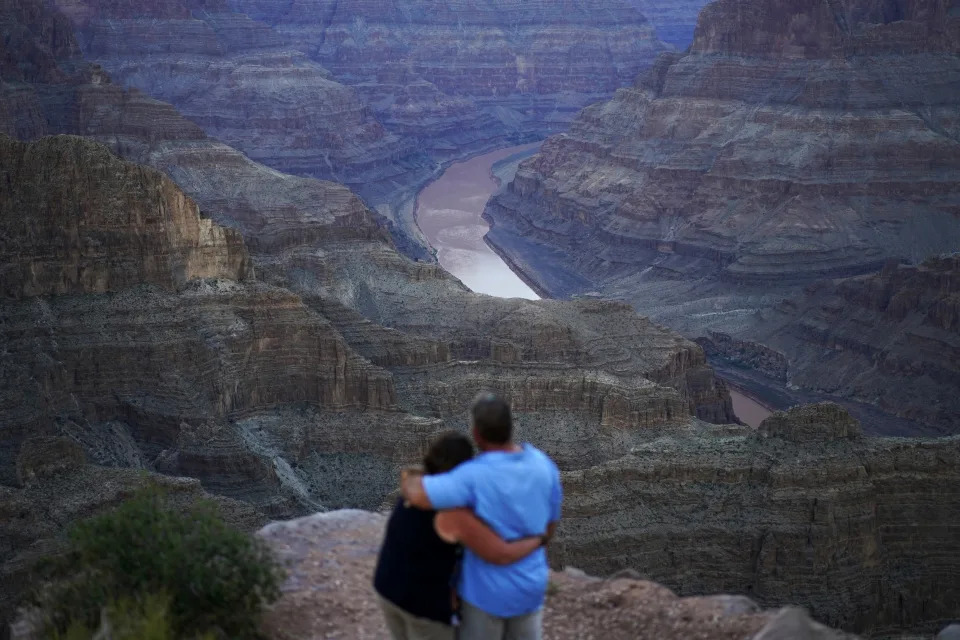
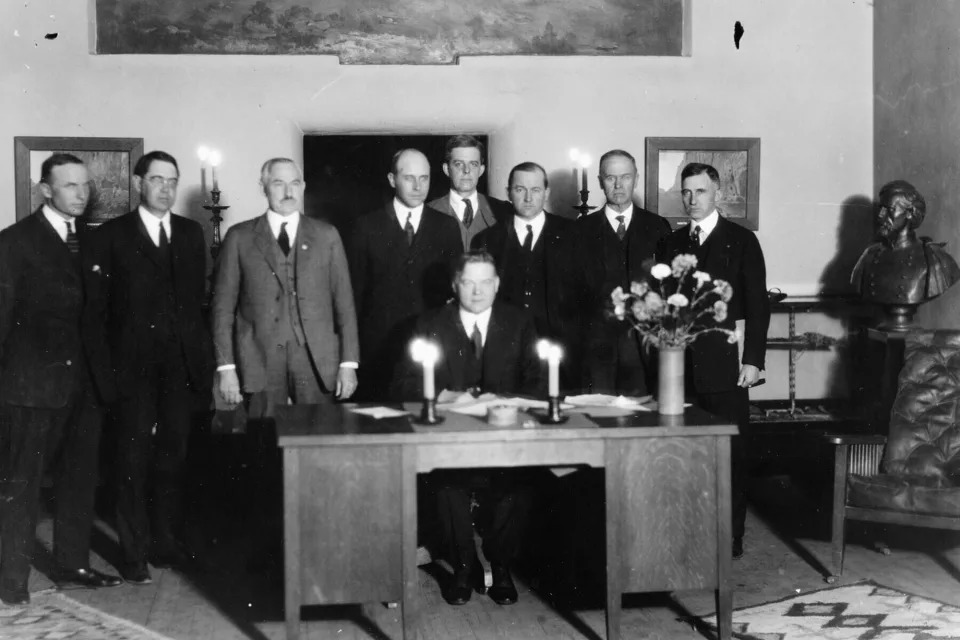
Alyssa Chubbuck, left, and Dan Bennett embrace while watching the sunset at Guano Point overlooking the Colorado River on the Hualapai reservation Monday, Aug. 15, 2022, in northwestern Arizona. In November 1922, seven land-owning white men brokered a deal to allocate water from the Colorado River, which winds through the West and ends in Mexico. During the past two decades, pressure has intensified on the river as the driest 22-year stretch in the past 1,200 years has gripped the southwestern U.S. (AP Photo/John Locher)FILE – A formerly sunken boat sits upright into the air with its stern stuck in the mud along the shoreline of Lake Mead at the Lake Mead National Recreation Area, June 10, 2022, near Boulder City, Nev. In November 1922, seven land-owning white men brokered a deal to allocate water from the Colorado River, which winds through the West and ends in Mexico. During the past two decades, pressure has intensified on the river as the driest 22-year stretch in the past 1,200 years has gripped the southwestern U.S. (AP Photo/John Locher, File)In this photo provided by the U.S. Bureau of Reclamation, Commerce Secretary Herbert Hoover presides over the signing of the Colorado River Compact in Santa Fe, N.M., on Nov. 24, 1922. Seven land-owning white men brokered a deal to allocate water from the Colorado River, which winds through the West and ends in Mexico. (U.S. Bureau of Reclamation via AP)Garnett Querta carries a hose as he fills his water truck on the Hualapai reservation Monday, Aug. 15, 2022, near Peach Springs, Ariz. The divvying up between Colorado River Basin states never took into account Indigenous Peoples or many others, and from the start the calculation of who should get what amount of that water may never have been balanced. (AP Photo/John Locher)A truck tire once in the water as part of a marina sits on dry ground as water levels have dropped near the Callville Bay Resort & Marina in the Lake Mead National Recreation Area, Tuesday, Aug. 30, 2022, near Boulder City, Nev. In November 1922, seven land-owning white men brokered a deal to allocate water from the Colorado River, which winds through the West and ends in Mexico. During the past two decades, pressure has intensified on the river as the driest 22-year stretch in the past 1,200 years has gripped the southwestern U.S. (AP Photo/John Locher)Floating boat docks sit on dry ground as water levels have dropped near the Callville Bay Resort & Marina in the Lake Mead National Recreation Area, Tuesday, Aug. 30, 2022, near Boulder City, Nev. As water levels plummet, calls for reduced use have often been met with increased population growth. (AP Photo/John Locher)Water flows along the All-American Canal Saturday, Aug. 13, 2022, near Winterhaven, Calif. In November 1922, seven land-owning white men brokered a deal to allocate water from the Colorado River, which winds through the West and ends in Mexico. During the past two decades, pressure has intensified on the river as the driest 22-year stretch in the past 1,200 years has gripped the southwestern U.S. (AP Photo/Gregory Bull)
DENVER (AP) — The intensifying crisis facing the Colorado River amounts to what is fundamentally a math problem.
The 40 million people who depend on the river to fill up a glass of water at the dinner table or wash their clothes or grow food across millions of acres use significantly more each year than actually flows through the banks of the Colorado.
In fact, first sliced up 100 years ago in a document known as the Colorado River Compact, the calculation of who gets what amount of that water may never have been balanced.
“The framers of the compact — and water leaders since then — have always either known or had access to the information that the allocations they were making were more than what the river could supply,” said Anne Castle, a senior fellow at the Getches-Wilkinson Center at the University of Colorado Law School.
EDITOR’S NOTE: This is part of a collaborative series on the Colorado River as the 100th anniversary of the historic Colorado River Compact approaches. The Associated Press, The Colorado Sun, The Albuquerque Journal, The Salt Lake Tribune, The Arizona Daily Star and The Nevada Independent are working together to explore the pressures on the river in 2022.
During the past two decades, however, the situation on the Colorado River has become significantly more unbalanced, more dire.
A drought scientists now believe is the driest 22-year stretch in the past 1,200 years has gripped the southwestern U.S., zapping flows in the river. What’s more, people continue to move to this part of the country. Arizona, Utah and Nevada all rank among the top 10 fastest growing states, according to U.S. Census data.
While Wyoming and New Mexico aren’t growing as quickly, residents watch as two key reservoirs — popular recreation destinations — are drawn down to prop up Lake Powell. Meanwhile, southern California’s Imperial Irrigation District uses more water than Arizona and Nevada combined, but stresses their essential role providing cattle feed and winter produce to the nation.
Until recently, water managers and politicians whose constituents rely on the river have avoided the most difficult questions about how to rebalance a system in which demand far outpaces supply. Instead, water managers have drained the country’s two largest reservoirs, Lake Mead and Lake Powell, faster than Mother Nature refills them.
In 2000, both reservoirs were about 95% full. Today, Mead and Powell are each about 27% full — once-healthy savings accounts now dangerously low.
The reservoirs are now so low that this summer Bureau of Reclamation Commissioner Camille Touton testified before the U.S. Senate Energy and Natural Resources Committee that between 2 million and 4 million acre-feet would need to be cut next year to prevent the system from reaching “critically low water levels,” threatening reservoir infrastructure and hydropower production.
The commissioner set an August deadline for the basin states to come up with options for potential water cuts. The Upper Basin states — Colorado, Utah, New Mexico and Wyoming — submitted a plan. The Lower Basin states — California, Arizona and Nevada — did not submit a combined plan.
The bureau threatened unilateral action in lieu of a basin-wide plan. When the 60-day deadline arrived, however, it did not announce any new water cuts. Instead, the bureau announced that predetermined water cuts for Arizona, Nevada and Mexico had kicked in and gave the states more time to come up with a basin-wide agreement.
STILL LEFT OUT
A week before Touton’s deadline, the representatives of 14 Native American tribes with water rights on the river sent the Bureau of Reclamation a letter expressing concern about being left out of the negotiating process.
“What is being discussed behind closed doors among the United States and the Basin States will likely have a direct impact on Basin Tribes’ water rights and other resources and we expect and demand that you protect our interests,” tribal representatives wrote.
Being left out of Colorado River talks is not a new problem for the tribes in the Colorado River Basin.
The initial compact was negotiated and signed on Nov. 24, 1922, by seven land-owning white men, who brokered the deal to benefit people who looked like them, said Jennifer Pitt of the National Audubon Society, who is working to restore rivers throughout the basin.
“They divided the water among themselves and their constituents without recognizing water needs for Mexico, the water needs of Native American tribes who were living in their midst and without recognizing the needs of the environment,” Pitt said.
Mexico, through which the tail of the Colorado meanders before trickling into the Pacific Ocean, secured its supply through a treaty in 1944. The treaty granted 1.5 million acre-feet on top of the original 15 million acre-feet that had already been divided, 7.5 million each for the Upper and Lower Basins.
Tribes, however, still don’t have full access to the Colorado River. Although the compact briefly noted that tribal rights predate all others, it lacked specificity, forcing individual tribes to negotiate settlements or file lawsuits to quantify those rights, many of which are still unresolved. It’s important to recognize the relationship between Native and non-Native people at that time, said Daryl Vigil, water administrator for the Jicarilla Apache Nation in New Mexico.
“In 1922, my tribe was subsistence living,” Vigil said. “The only way we could survive was through government rations on a piece of land that wasn’t our traditional homeland. That’s where we were at when the foundational law of the river was created.”
COMPETING INTERESTS
Agriculture uses the majority of the water on the river, around 70% or 80% depending on what organization is making the estimate. When it comes to the difficult question of how to reduce water use, farmers and ranchers are often looked to first.
Some pilot programs have focused on paying farmers to use less water, but unanswered questions remain about how to transfer the savings to Lake Powell for storage or how to create a program in a way that would not negatively impact a farmer’s water rights.
Antiquated state laws mean the amount of water that a water right gives someone access to can be decreased if not fully used.
That’s why the Camblin family ranch in Craig in northwest Colorado plans to flood irrigate once a decade, despite recently upgrading to an expensive, water-conserving pivot irrigation system. Nine years out of 10, they’ll receive payment from a conservation group in exchange for leaving the surplus water in the river. But in Colorado, the state revokes water rights after 10 years if they aren’t used.
Not only would losing that right mean they can’t access a backup water supply should their pivot system fail, but their property’s value would plummet, Mike Camblin explained. He runs a yearling cattle operation with his wife and daughter, and says an acre of land without water sells for $1,000, about a fifth of what it would sell for with a water right attached.
There are other ways to improve efficiency, but money is still often a barrier.
Wastewater recycling is growing across the region, albeit slowly, as it requires massive infrastructure overhauls. San Diego built a robust desalination plant to turn seawater to drinking water, and yet some agricultural users are trying to get out of their contract since the water is so expensive. Some cities are integrating natural wastewater filtration into their landscaping before the water flows back to the river. It’s all feasible, but is costly, and those costs often get passed directly to water users.
One of the biggest opportunities for water conservation is changing the way our landscapes look, said Lindsay Rogers, a water policy analyst at Western Resource Advocates, a nonprofit dedicated to protecting water and land in the West.
Converting a significant amount of outdoor landscaping to more drought-tolerant plants would require a combination of policies and incentives, Rogers explained. “Those are going to be really critical to closing our supply-demand gap.”
After years of incentive programs for residents, Las Vegas recently outlawed all nonfunctional grass by 2026, setting a blueprint for other Western communities. For years, the city has also paid residents to rip out their lawns.
In Denver, Denver Water supplies about 25% of the state’s population and uses about 2% of the water. The city has had mandatory restrictions in place for years, limiting home irrigation to three days per week.
This summer, in southern California, the Metropolitan Water District instituted an unprecedented one-day-a-week water restriction.
Still, regardless of the type of water use, more concessions must be made.
“The law of the river is not suited to what the river has become and what we see it increasingly becoming,” Audubon’s Pitt said. “It was built on the expectation of a larger water supply than we have.”
Visa, Mastercard, AmEx to start categorizing gun shop sales
Ken Sweet- September 10, 2022
FILE – Visa credit cards are seen on Aug. 11, 2019, in New Orleans. Payment processor Visa Inc. said late Saturday, Sept. 10, 2022, that it plans to start separately categorizing sales at gun shops. (AP Photo/Jenny Kane, File) (ASSOCIATED PRESS)
NEW YORK (AP) — Payment processor Visa Inc. said Saturday that it plans to start separately categorizing sales at gun shops, a major win for gun control advocates who say it will help better track suspicious surges of gun sales that could be a prelude to a mass shooting.
But the decision by Visa, the world’s largest payment processor, will likely provoke the ire of gun rights advocates and gun lobbyists, who have argued that categorizing gun sales would unfairly flag an industry when most sales do not lead to mass shootings. It joins Mastercard and American Express, which also said they plan to move forward with categorizing gun shop sales.
Visa said it would adopt the International Organization for Standardization’s new merchant code for gun sales, which was announced on Friday. Until Friday, gun store sales were considered “general merchandise.”
“Following ISO’s decision to establish a new merchant category code, Visa will proceed with next steps, while ensuring we protect all legal commerce on the Visa network in accordance with our long-standing rules,” the payment processor said in a statement.
Visa’s adoption is significant as the largest payment network, and with Mastercard and AmeEx, will likely put pressure on the banks as the card issuers to adopt the standard as well. Visa acts as a middleman between merchants and banks, and it will be up to banks to decide whether they will allow sales at gun stores to happen on their issued cards.
Gun control advocates had gained significant wins on this front in recent weeks. New York City officials and pension funds had pressured the ISO and banks to adopt this code.
Two of the country’s largest public pension funds, in California and New York, have been pressing the country’s largest credit card firms to establish sales codes specifically for firearm-related sales that could flag suspicious purchases or more easily trace how guns and ammunition are sold.
Merchant category codes now exist for almost every kind of purchase, including those made at supermarkets, clothing stores, coffee shops and many other retailers.
“When you buy an airline ticket or pay for your groceries, your credit card company has a special code for those retailers. It’s just common sense that we have the same policies in place for gun and ammunition stores,” said New York City Mayor Eric Adams, a former police captain who blames the proliferation of guns for his city’s deadly violence.
The city’s comptroller, Brad Lander, said it made moral and financial sense as a tool to push back against gun violence.
“Unfortunately, the credit card companies have failed to support this simple, practical, potentially lifesaving tool. The time has come for them to do so,” Lander said recently, before Visa and others had adopted the move.
Lander is a trustee of the New York City Employees’ Retirement System, Teachers’ Retirement System and Board of Education Retirement System — which together own 667,200 shares in American Express valued at approximately $92.49 million; 1.1 million shares in MasterCard valued at approximately $347.59 million; and 1.85 million shares in Visa valued at approximately $363.86 million.
The pension funds and gun control advocates argue that creating a merchant category code for standalone firearm and ammunition stores could aid in the battle against gun violence. A week before the mass shooting at the Pulse Nightclub in Orlando, Florida, where 49 people died after a shooter opened fire in 2016, the assailant used credit cards to buy more than $26,000 worth of guns and ammunition, including purchases at a stand-alone gun retailer.
Gun rights advocates argue that tracking sales at gun stores would unfairly target legal gun purchases, since merchant codes just track the type of merchant where the credit or debit card is used, not the actual items purchased. A sale of a gun safe, worth thousands of dollars and an item considered part of responsible gun ownership, could be seen as a just a large purchase at a gun shop.
“The (industry’s) decision to create a firearm specific code is nothing more than a capitulation to anti-gun politicians and activists bent on eroding the rights of law-abiding Americans one transaction at a time,” said Lars Dalseide, a spokesman for the National Rifle Association.
Over the years, public pension funds have used their extensive investment portfolios to influence public policy and the market place.
The California teacher’s fund, the second largest pension fund in the country, has long taken aim on the gun industry. It has divested its holdings from gun manufacturers and has sought to persuade some retailers from selling guns.
Four years ago, the teacher’s fund made guns a key initiative. It called for background checks and called on retailers “monitor irregularities at the point of sale, to record all firearm sales, to audit firearms inventory on a regular basis, and to proactively assist law enforcement.”
David Segal and José Bautista – September 10, 2022
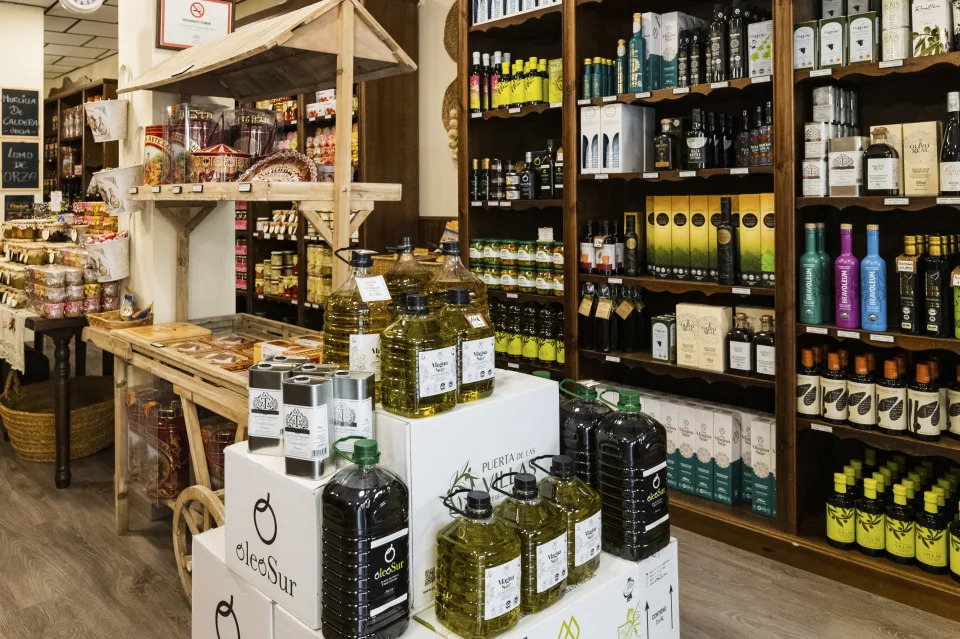
A variety of olive oils at a shop in the town of Úbeda, in Spain’s olive oil producing province of Jaén, Aug. 26, 2022. (Emilio Parra Doiztua/The New York Times)
EL MOLAR, Spain — The branch, plucked from one of thousands of trees in a densely packed olive grove in this village, has browning leaves and a few tiny, desiccated buds that are bunched near the end. To Agustín Bautista, the branch tells a story, and the story is about a harvest that is doomed.
Typically, those buds are green and healthy, and can produce 13,000 gallons of olive oil in a season. That is more than enough for Bautista, a 42-year-old with a booming voice and close-cropped red hair, to support his wife and two young kids. Starting in October, when olives are shaken from the trees and gathered in nets on the ground, he’ll be lucky to produce one-fifth of that amount.
“I’m going to lose money,” he said, in the resigned tone of a man squarely in the acceptance stage of grief. As he looked around the arid acres of his property, he summed up the reality facing Spain’s olive farmers: “No water, no future.”
Drought has ravaged dozens of crops throughout Europe: corn in Romania, rice in Italy, beans in Belgium, and beets and garlic in France. Among the hardest hit is the olive crop of Spain, which produces half of the world’s olive oil. Nearly half of Spain’s output comes from Jaén, a landlocked southern province of 5,200 square miles, about the size of Connecticut, that yields far more olive oil annually than all of Italy, according to the International Olive Council. It is often called the olive oil capital of the world.
Farmers and political leaders are now searching for answers to a pressing question: What happens to a one-crop economy when that crop is scorched by record-breaking temperatures?
This has never been much of a tourist destination, but those who come, mostly to see Moorish fortresses and Renaissance-style cathedrals, are treated to a landscape unlike any other. Sixty-seven million olive trees are planted on every hill and valley, alongside every highway and road, in every direction. It has been called the largest man-made forest.
Since the Romans began planting this forest centuries ago, olive trees have sustained thousands of farmers and itinerant workers here. The trees thrive in a Mediterranean climate and need a minimal amount of rain. But not this minimal. Europe is suffering through its worst drought in 500 years, says the European Drought Observatory, a service run by the European Commission’s Joint Research Center, and is experiencing heat waves so severe that the nearby city of Seville gave one of them a name — Zoe — the way hurricanes and tropical storms are named in the United States.
The morning that Bautista studied the withered olive tree branch, he was sweating in heat that was already headed above 100 degrees by 11 a.m. As he drove his Toyota pickup truck around the 5,000 trees that he cultivates in a grove beside this tiny village where he grew up, he was already ruing lost profits. He and other farmers expect that the olive crop of Jaén will be about 50% smaller than last year. Government estimates of lost income now stand at $1 billion.
“The situation is critical,” said Francisco Reyes Martínez, president of the Provincial Council of Jaén. “A lot of people here are going to struggle.”
The harvest is just the latest setback for the hundreds of villages that dot Jaén and have relied for decades on the olive crop. El Molar has one bar, one church, no restaurants and an official population tally of 237.
“I think the actual number is closer to 200,” said the village mayor, Misericordia Jareño. “Some people have died.”
There were 1,000 people here when she moved to El Molar as a girl of 10, back in 1963. The place did not have a single paved road, and homes lacked running drinking water. But it had a high school, its own cuisine — she urged a visitor to return for dinner and try her gachamiga, a dish of olive oil, garlic, salt, water and wheat flour — and a sense of community that has endured even as the place slowly emptied.
Many remaining residents are fourth- or fifth-generation farmers who can trace their holdings back more than 100 years. They have an attachment to the business that transcends facts and figures, tiptoes into romance and bursts with civic pride. Oil from here winds up in dozens of varieties sold around the world, many of which can be purchased online directly from local mills.
The landscape has inspired some of Spain’s greatest poets (Miguel Hernández, Antonio Machado), singers (Juanito Valderrama) and painters (Rafael Zabaleta). Now the groves are turning up on social media. One Jaén farmer who has 1.7 million followers on TikTok makes gargantuan sandwiches, all generously slathered with olive oil.
With a nudge from the local government, a nascent olive oil tourism industry, dubbed oleoturismo, is starting to grow. There are spas with olive oil treatments and specialty shops, like Panaderia Paniaceite, that sell dozens of varieties of olive oil. One almazara, as traditional mills are known, offers olive oil tastings like wine tastings at a vineyard. Visitors can also spend a day working and living as an olive farmer, meals included, for 27 euros (about $27).
“It was a surprise to us, the amount of interest there is in seeing how we produce olive oil,” said José Jiménez, co-owner of the mill, Oleícola San Francisco, in a village called Baeza. “We’ve already had 50,000 visitors from 78 countries.”
Tourism will never offset losses in the fields nor thwart a variety of tectonic shifts that go far beyond the weather. A harvest that once took tens of thousands of people, including a massive influx of seasonal migrant workers, now requires a fraction of manpower because so much of the work is now done by machines. Most notably, there is the vibradora, a hand-held, gasoline-powered device — it looks like a chain saw with a very long, thin snout — that shakes olives out of trees by clamping onto branches and rattling them.
A person armed with a vibradora can shake 1,500 kilograms (about 3,300 pounds) of olives to the ground in a day. Using the traditional slap-it-with-a-stick technique, the number is closer to 200 kilograms a day.
That is one reason El Molar has been shedding population; far fewer people are needed for the harvest. And those still toiling in the groves face higher costs, especially now that inflation is over 9% in the eurozone, raising the price of electricity, fuel, fertilizer and labor.
“The cost of producing olive oil is now two or three times as expensive as it was 10 years ago,” said Juan Carlos Hervás, a farmer and expert with the local branch of a farmers union. He laid out the math: A liter of extra-virgin olive oil, the highest grade, now fetches 3.90 euros, well above the 1.8 euros per liter that was the going rate before the pandemic. But the price of harvesting that liter has gone up by 2.40 euros.
“We’re losing money now,” Hervás said. “For the first time in many years we’re seeing a good price for olive oil, but our costs are going up and it hasn’t rained in three months.”
Without expensive irrigation systems to water trees, many are fruitless. During Bautista’s drive through the groves of El Molar, there was a clear dichotomy: Trees that were quenched from a nearby reservoir, using many miles of black tubing, looked healthy and green. Those that were not were brown and barren.
“Eight liters per hour, for eight hours, one night a week,” said Bautista, explaining how much each tree is watered. That water is expensive, and farmers here need to buy a share of a reservoir cooperative, created in 2001, to access it. Many decided long ago to save their money, betting that rain would do the job for free.
That bet has never looked more catastrophic, although the portents were evident 15 years ago. José Felguera, the secretary of Asolite, a nonprofit association of olive tree farmers, said that in the mid-aughts, he and colleagues met with climatologists from Galicia, Spain, to pose a question: Why was there less and less rain?
“We saw lot more airplanes flying overhead, so we thought it had something to do with planes,” said Felguera, sitting near a public swimming pool in Arquillos, the village where he lives. “The climate scientists said that the planes had nothing to do with it.”
Felguera, who grew up in Arquillos, remembers two or three snowfalls a year as a child and creeks that were frozen so solid during winter that a rock couldn’t break the ice. Now, winters are dry and short, which he says is even more damaging to olive trees than torrid summers.
“These are trees made for dry weather, and periods of drought have been around forever,” he said. “But now the droughts are stronger and longer.”
Subsidies from the European Union have been essential to the olive farmers in Jaén for years. Currently, the rate is roughly 690 euros a year per hectare, said Juan Vilar Hernández, an agricultural analyst and professor at the University of Jaén. Given that the average farmer owns 1.58 hectares — about 4 acres — the average subsidy is roughly 1,090 euros a year.
“If you removed subsidies, about 80% of the farmers in Jaén would lose money,” he said. The subsidy is set to decrease in coming years, which alarms many farmers. One long-term solution is for farms here to embrace “modern oliviculture,” which means packing more trees into the same physical footprint, and then using additional industrial equipment during the harvest.
For much of Jaén, however, that isn’t possible. Most of its groves are on sloping hills where expensive new machines like olive harvesters — essentially, massive $500,000 tractors that drive over 14-foot trees — can’t operate. Inevitably, Jaén is going to lag in productivity compared with groves in California, Chile, Australia and elsewhere, Hernández said. The province may always be synonymous with olive production, but in the future it will be a competition that the province can’t win.
“The average age of an olive farmer here is 60,” he said. “And their children are all moving to cities. So in 20 years, no one is going to live in these villages.”
Luis Planas, Spain’s agriculture minister, said in an interview that the country needed to adapt to new conditions. He outlined a number of steps the government has already taken to provide short-term relief, including tax breaks and an increase in employment benefits. The goal is to save and sustain more than an industry.
“If villages like El Molar disappear, Spain will lose a very important part of its identity,” he said. “If the olive grove disappears, that area will become a desert.”
One recent Friday evening, El Molar ignored the weather and the laws of market economies arrayed against it and gathered for its annual summer fiesta. It had the feel of a family reunion, and included more than a few Bautistas, including a reporter of this story, who is Agustín’s cousin. Not much happened before about 11 p.m., when a brass band with a drummer noisily marched up the main street, playing a kid’s song, “Soy una Taza.” Beer and tortillas were sold at a pop-up restaurant and bar while children caromed around a bouncy castle set up nearby.
Many gathered under white tents set up in the village square. A few recent college graduates were on hand and rhapsodized about growing up here.
“My childhood was beautiful,” said Mario Romero, who was celebrating his 25th birthday. “When I was young, my parents taught me how to work in the olive trees and how to love this way of life.”
He liked being in nature, repairing broken equipment and having a sense of self-sufficiency. But he studied to be a teacher, and there is no longer a school for children older than 11 in the village. Like a lot of his friends, he won’t settle in El Molar because it lacks any opportunities aside from olive farming. That said, it will always be a part of his life. His parents still own 600 olive trees, and he has no intention of selling even one when he inherits them.
“I’d like to buy more,” he said. He imagines having children someday, and even if they never want to farm for a living, he wants to teach them how it is done. “The way my parents taught me.”
About midnight, a DJ showed up and started playing dance music at a tinnitus-inducing volume. As if on cue, the wind picked up, napkins started swirling in the air and to everyone’s collective delight, it started to rain, lightly at first.
An elderly woman named María la de Ricardo walked by, smiling.
“It is not normal to have rain in August,” she said. “But I was praying for it, and God listened.”
By then, it started to pour and everyone scurried for cover to watch the deluge.
‘Triple-dip’ La Niña is on the way. Here’s what it means for weather in the US
Doyle Rice, USA TODAY – September 9, 2022
La Niña just won’t go away.
Meteorologists say that for the third straight year, La Niña will persist throughout the winter in the Northern Hemisphere. This is the first “triple-dip” La Niña of the century, according to a recent update from the United Nations’ World Meteorological Organization.
This La Niña began in September 2020.
The La Niña climate pattern is a natural cycle marked by cooler-than-average ocean water in the central Pacific Ocean. It is one of the main drivers of weather in the United States and around the world, especially during late fall, winter and early spring.
It’s the opposite to the more well-known El Niño, which occurs when Pacific ocean water is warmer than average. While this would be the first “triple-dip” La Niña this century, it’s not unprecedented for the pattern to last more than nine months to a year, which is typical for a La Niña, according to ABC News.
A typical La Niña winter in the U.S. brings cold and snow to the Northwest and unusually dry conditions to most of the southern tier of the U.S., according to NOAA’s Climate Prediction Center. The Southeast and Mid-Atlantic also tend to see warmer-than-average temperatures during a La Niña winter.
Meanwhile, New England and the Upper Midwest into New York tend to see colder-than-average temperatures, the Weather Channel said.
Climate change also plays a role
However, the WMO said all naturally occurring climate events now take place in the context of human-induced climate change, which is increasing global temperatures, exacerbating extreme weather and climate, and impacting seasonal rainfall and temperature patterns.
“It is exceptional to have three consecutive years with a La Niña event,” said WMO Secretary-General Petteri Taalas in a news release. “Its cooling influence is temporarily slowing the rise in global temperatures – but it will not halt or reverse the long-term warming trend,” he added.
Where did the term La Niña come from?
Both La Niña and El Niño are Spanish language terms: La Niña means “little girl,” while El Niño means “little boy,” or “Christ child.” South American fishermen first noticed periods of unusually warm water in the Pacific Ocean in the 1600s, the National Oceanic and Atmospheric Administration said. The full name they used was “El Niño de Navidad” because El Niño typically peaks around December.
The entire natural climate cycle is officially known by climate scientists as El Niño – Southern Oscillation (ENSO), a see-saw dance of warmer and cooler seawater in the central Pacific Ocean.
During La Niña events, trade winds are even stronger than usual, pushing more warm water toward Asia, NOAA said. Off the west coast of the Americas, upwelling increases, bringing cold, nutrient-rich water to the surface.
Britain’s Queen Elizabeth II has died, ending a historic 70-year reign. She was 96.
The Queen died at Balmoral, her beloved palace in the Scottish Highlands, which was purchased by her great-great-grandfather Prince Albert for Queen Victoria in 1852. She was surrounded by her children and grand-children.
Prince Charles, her eldest son, succeeds her.
The Queen’s death comes just under 18 months and after that of her husband, Prince Philip, Duke of Edinburgh, who died on April 9, 2021.
Earlier this year, the Queen celebrated her Platinum Jubilee, which commemorated a record-breaking 70 years on the throne. In a rare personal statement to mark the occasion of her accession, she said: “It is a day that, even after 70 years, I still remember as much for the death of my father, King George VI, as for the start of my reign.”
Celebrations began on Feb. 6, which is the day she officially acceded to the throne, and carried on into June, when she appeared on the balcony of Buckingham Palace for the first day of a long Jubilee weekend, with the British public getting an extra public holiday to celebrate.
However, the monarch did not attend subsequent Jubilee events, including a concert in her honor featuring Adam Lambert and Queen, Lin-Manuel Miranda and Sir Elton John, after experiencing discomfort during the Trooping the Colour parade on the first day of the celebrations. She made a brief appearance on the Sunday at the conclusion of the festivities.
On 6 Sept., she officially appointed the U.K.’s latest Prime Minister, Liz Truss, in a ceremony at Balmoral. Traditionally a new Prime Minister is appointed at Buckingham Palace, in the capital, but the venue was changed due to the Queen’s “mobility problems,” the palace said in a statement. In photographs released of the event the Queen was shown using a walking stick but smiling as she shook Truss’s hand. The following day she was forced to cancel an audience with ministers after being advised to rest by her doctors.
The Queen, who acceded to the throne in 1952, was the world’s oldest reigning monarch. In 2015, she also became the longest-reigning British sovereign of all time, surpassing the previous record set by Queen Victoria.
She holds the record for the second-longest reigning monarch of all time after France’s Louis XIV, who was on the throne for 72 years.
During her reign, the Queen saw 15 British prime ministers serve under her, beginning with Winston Churchill, and met 13 of the last 14 U.S. presidents, from Harry S. Truman through to Joe Biden, as well as countless heads of state across the world. (The only U.S. president she did not meet was Lyndon Johnson.)
Princess Elizabeth was not expected to become a queen when she was born to the Duke and Duchess of York on April 21, 1926 in Mayfair, London. When her uncle, Edward VIII, abdicated in 1936 over his relationship with American divorcee Wallis Simpson, Elizabeth’s father was declared King George VI, moving the then 10-year-old princess into the direct line of succession. (Edward VIII’s abdication has been portrayed on screen in films including Oscar-winning “The King’s Speech,” starring Colin Firth and Helena Bonham Carter, and in Madonna’s biopic of Wallis Simpson, “W.E.”)
In 1947 Princess Elizabeth married Prince Philip, Duke of Edinburgh, with whom she had four children: Charles, Prince of Wales and Anne, Princess Royal, were both born before she acceded to the throne, followed almost ten years later by Prince Andrew, Duke of York and Prince Edward, Earl of Wessex, who were born while she was queen.
On Feb. 6, 1952, King George VI died suddenly at the age of 56 from a coronary thrombosis and Princess Elizabeth, then on a tour of Kenya, acceded to the throne, becoming Queen Elizabeth II. Her coronation in Westminster Abbey the following year was the first in British history to be televised.
While she continued to undertake her royal duties until the very end of her reign, in the last few years of her life she was restrained by her health, using a walking stick and occasionally, according to local reports, a wheelchair, although she was never seen publicly with the latter.
In February 2022, a statement from Buckingham Palace to royal reporters confirmed that the Queen had contracted COVID-19. “Her Majesty is experiencing mild cold like symptoms but expects to continue light duties at Windsor over the coming week,” said a statement from the palace. “She will continue to receive medical attention and will follow all the appropriate guidelines.” However, she appeared to make a full recovery.
The Queen became a cultural staple during her long and eventful reign. She was the most photographed woman in history – gracing the cover of Time magazine at age three, the first of several such appearances – and was depicted on the big screen, the small screen, the stage, in music, and in art.
She is the main subject of the Netflix original series “The Crown,” which follows the Queen from the 1940s to modern times and examines her relationship with the various prime ministers who led Her Majesty’s Government as well as other figures, both within the Royal Family and outside it. Over the show’s six seasons, each of which covers approximately a decade in her life, she has been portrayed by three different actors: Claire Foy, who won a Golden Globe for her portrayal, and Olivia Colman, who won both a Golden Globe and an Emmy, and Imelda Staunton, who will portray the queen in her 70s and 80s during the show’s fifth and sixth (also believed to be its final) season. Season 5 will premiere on Netflix in November 2022.
Helen Mirren also memorably played the British monarch in the 2006 film “The Queen,” written by “The Crown” creator Peter Morgan and directed by Stephen Frears. The film was set in the aftermath of Princess Diana’s death, a low point for the British royal family, and won Mirren a best actress Oscar for her performance. Mirren went on to play Elizabeth again in the West End and on Broadway, in the stage hit “The Audience.”
The monarch was also depicted in “Spencer,” played by Stella Gonet – the film stars Kirsten Stewart as her daughter-in-law Princess Diana – while the Queen’s early childhood was portrayed in Oscar-winning film “The King’s Speech.” The 2015 film “A Royal Night Out” offered a fictionalized glimpse of the night Elizabeth and her sister Princess Margaret were allowed secretly to slip out of Buckingham Palace to join the crowds celebrating V-E Day on the streets of London in 1945.
In 2016, the Queen was a character in “The BFG,” Steven Spielberg’s adaptation of the book by Roald Dahl and “The Naked Gun: From the Files of Police Squad!” also tackled the British monarch — literally. In the 1988 comedy, Leslie Nielsen’s character uses a running tackle to save the Queen from what he wrongly believes to be an assassination attempt. The actor who plays her in the film, Jeannette Charles, has made a career of royal impersonation, standing in as Elizabeth in about 20 movies and TV programs over a 40-year period.
In animated form, the Queen in her Cinderella-like royal coach survived an attempted robbery of her crown in the 2015 film “Minions” and a rear-ending by Homer Simpson in a 2003 episode of “The Simpsons” (titled “The Regina Monologues”). She wasn’t so lucky in a 2012 episode of “Family Guy,” in which a high-speed chase of her carriage ends in a royal fatality, and in 2007 an episode of “South Park” sparked outrage after it showed her dying by suicide on the throne. She also made an appearance in Gary Janetti’s short-lived animated comedy “The Prince,” which ran for one season on HBO Max.
In 2022, the Queen delighted viewers around the world by guest-starring in a video with Paddington Bear. In the skit, which was filmed at Windsor Castle and broadcast before the Platinum Jubilee concert, Paddington is invited to the Queen’s abode for tea where chaos ensues. At one point, the bear offers Her Majesty a marmalade sandwich fished out of his hat, as he tells her: “I always keep one for emergencies.” In response, the Queen replies, “So do I” and opens her handbag to pull out a marmalade sandwich of her own. The two-minute video quickly went viral, with the Queen’s great-grandchildren, Prince George and Princess Charlotte shown in the audience responding with joy to the clip.
The cameo echoed her 2012 appearance at the London Olympics when the Queen appeared in a pre-recorded video shown at the opening ceremony. In the clip, she greets Daniel Craig (in character as James Bond) at Buckingham Palace before he escorts her to a waiting helicopter. They’re shown flying over London towards the Olympic stadium before Craig and the Queen appear to jump out of the chopper with parachutes strapped to their back. As the video was being played in the stadium a real helicopter appeared in the sky and two figures – one clad in a regal peach dress – parachuted out. With perfect timing, the Queen then appeared in person at the ceremony in an identical dress before taking her seat in the stadium to the sound of wild cheers.
Despite her occasional cameos and innumerable public appearances, the Queen remained an enigma to her subjects, deliberately cultivating an air of majesty and mystery. She never gave a single interview during her lifetime and maintained an aloofness in an age of over-sharing and public emotion, even as the lives of her own children — and grandchildren — came to resemble a reality show, with lurid details of their relationships and scandalous antics regularly making headlines in the British tabloids.
All of which made her rare expressions of sentiment all the more meaningful although it also, on occasion, alienated her from the public. In 1992, during her annual televised Christmas Day speech, she memorably declared that year to be an “annus horribilis.” It had been a tumultuous 12 months during which three of her children separated from their spouses – Prince Charles from Diana, Prince Andrew from Sarah Ferguson and Princess Anne from her husband Mark Phillips – while Windsor Castle was badly damaged in a fire.
An even lower point for the monarchy came five years later, following Diana’s death in a car crash in Paris. During the outpouring of grief that followed, the Queen was accused of being cold and unfeeling and it took almost a decade for the royal family’s popularity to rebound.
But rebound it did, particularly the Queen’s, who generated an almost universal respect and gratitude around the world as she continued to fulfill her duties as head of state and national symbol into her tenth decade of life.
“When it comes to how to mark 70 years as your Queen, there is no guidebook to follow,” she said in a letter addressed to the British public in 2022. “It really is a first. But I have been humbled and deeply touched that so many people have taken to the streets to celebrate my Platinum Jubilee.”
“While I may not have attended every event in person, my heart has been with you all; and I remain committed to serving you to the best of my ability, supported by my family.”
Queen Elizabeth II is survived by her four children, eight grandchildren, and 12 great-grandchildren, the youngest of whom was born in 2021.



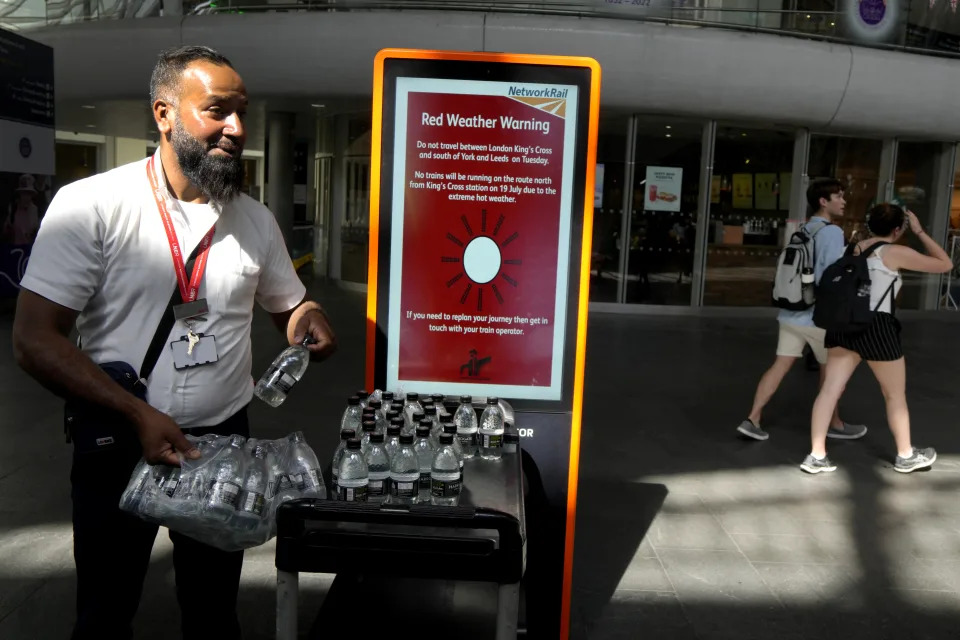

 Farmer Larry Cox walks in a field of Bermudagrass with his dog, Brodie, at his farm Monday, Aug. 15, 2022, near Brawley, Calif. The Cox family has been farming in California’s Imperial Valley for generations. (AP Photo/Gregory Bull)
 Water flows along the All-American Canal Saturday, Aug. 13, 2022, near Winterhaven, Calif. The canal conveys water from the Colorado River into the Imperial Valley. (AP Photo/Gregory Bull)
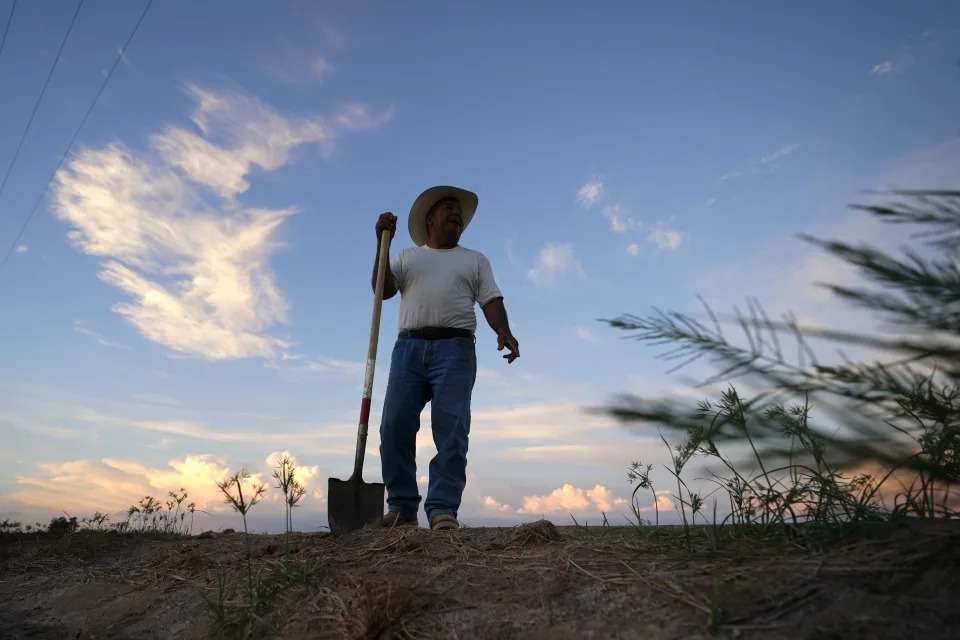 Irrigator Raul Quirarte, 56, pauses during work to prepare a field to receive water from the All-American Canal, Sunday, Aug. 14, 2022, near Brawley, Calif. Quirarte started as an irrigator at the age of 18, taught by his father, who also was an irrigator. (AP Photo/Gregory Bull)
 Water flows along the All-American Canal Saturday, Aug. 13, 2022, near Winterhaven, Calif. The canal conveys water from the Colorado River into the Imperial Valley. (AP Photo/Gregory Bull)
 Farmer Larry Cox watches a tractor at work on a field at his farm Monday, Aug. 15, 2022, near Brawley, Calif. The Cox family has been farming in California’s Imperial Valley for generations. (AP Photo/Gregory Bull)
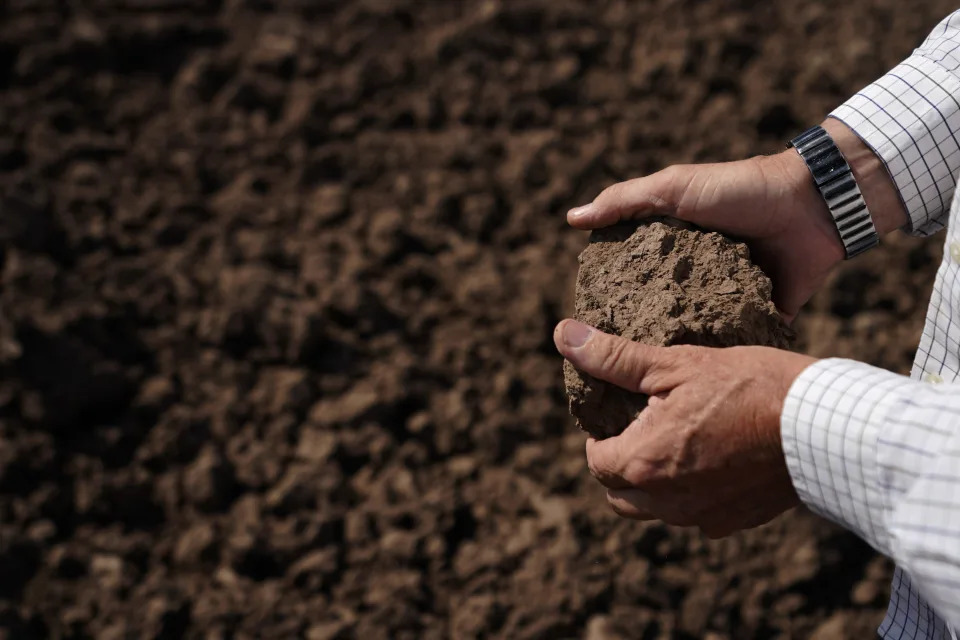 Farmer Larry Cox looks at soil on a field at his farm Monday, Aug. 15, 2022, near Brawley, Calif. The Cox family has been farming in California’s Imperial Valley for generations. (AP Photo/Gregory Bull)
 Farmer Larry Cox walks stands in a field of Bermudagrass at his farm Monday, Aug. 15, 2022, near Brawley, Calif. The Cox family has been farming in California’s Imperial Valley for generations. (AP Photo/Gregory Bull)
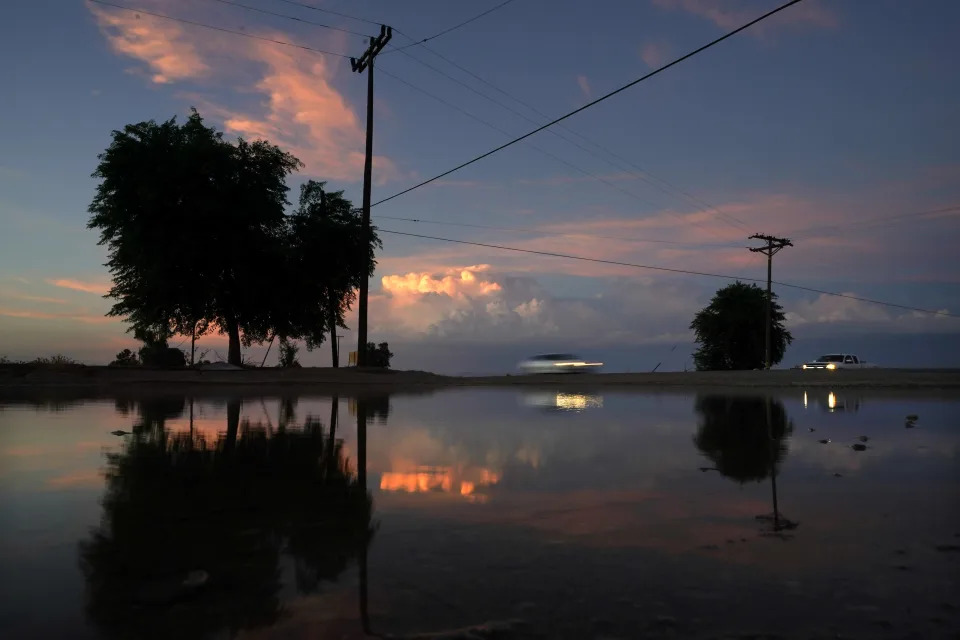 Colorado River Compact California. A small pond sits between a field irrigated with water from the All-American Canal and a highway, Sunday, Aug. 14, 2022, near Brawley, Calif. The canal conveys water from the Colorado River into the Imperial Valley. (AP Photo/Gregory Bull)
 Farmer Larry Cox walks to his truck as his dog, Brodie, soaks in a water canal at his farm Monday, Aug. 15, 2022, near Brawley, Calif. The Cox family has been farming in California’s Imperial Valley for generations. (AP Photo/Gregory Bull)
 A worker diverts water as a sprinkler system is installed for alfalfa at the Cox family farm Monday, Aug. 15, 2022, near Brawley, Calif. The Cox family has been farming in California’s Imperial Valley for generations. (AP Photo/Gregory Bull)
 Water from the All-American Canal flows in a canal alongside fields Saturday, Aug. 13, 2022, near El Centro, Calif. The canal conveys water from the Colorado River into the Imperial Valley. (AP Photo/Gregory Bull)