Hazardous ‘forever chemicals’ are in our water, food, and air. Here are 6 simple ways to reduce exposure at home.

Business Insider

Hazardous ‘forever chemicals’ are in our water, food, and air. Here are 6 simple ways to reduce exposure at home.

Morgan McFall-Johnsen – September 17, 2022

toddler child drinks bottled water
A child drinks bottled water in Reynosa, Mexico, on June 9, 2021.Daniel Becerril/Reuters
  • Hazardous “forever chemicals” called PFAS are contaminating drinking water, food, and air.
  • It may be impossible to completely avoid PFAS, but there are a few simple ways to reduce your exposure.
  • Eating at home, ditching nonstick pans and unnecessary carpets, and filtering your water can help.

Hazardous, long-lasting “forever chemicals” are all over the news lately, and they’re all over our day-to-day environments too.

Per- and polyfluoroalkyl substances, or PFAS, is a class of thousands of man-made substances that are common in everyday objects, but research is making it increasingly clear that they may be harmful to human health. Peer-reviewed studies have linked them to some cancers, decreased fertility, thyroid disease, and developmental delays.

That’s bad news since PFAS last for decades without breaking down, earning them the “forever chemicals” nickname. Researchers have found them in drinking water and household dust across the planet, in the oceans, at both poles, and drifting through the atmosphere.

In a paper published last month, leading researchers at the University of Stockholm concluded that all the planet’s rainwater, and probably all of its soil, are contaminated with unsafe levels of PFAS. Ian Cousins, who spearheaded that research, fears it’s impossible to avoid the chemicals.

“I don’t bother,” Cousins told Insider, adding, “It’s almost mission impossible. You can’t really do it.”

Even if you can’t completely dodge PFAS, there are a few easy ways to reduce exposure in your daily life.

Eat at home, with minimal grease-resistant packaging
two adults one child eat dinner at a table with paper plates and bouquet of flowers
A family eats dinner at their home in Calumet Park, Illinois, on December 8, 2020.Shannon Stapleton/Reuters

PFAS were developed in the 1940s to resist heat, grease, stains, and water. That means they’ve ended up in a lot of food packaging. That includes pizza boxes, microwave popcorn bags, some wrappers, and grease-resistant paper.

Restaurants and fast-food chains may use such packaging more than grocery stores do. A 2019 study found that people had lower PFAS levels in their blood after eating at home, and higher levels after eating fast food or at restaurants.

Throw out scratched nonstick pans

red onion slices cooking in a black pan
Red onion slices cooking in a black pan.Erin McDowell/Insider

The coating used in nonstick cookware usually contains PFAS, and they can easily leach into your food at high heat and once the coating gets scratched.

The Washington Department of Ecology advises against heating nonstick cookware above 400 degrees Fahrenheit, and recommends throwing it out once the nonstick coating scratches. Cast-iron pans are a safe alternative.

Ditch your carpet and stain-resistant fabrics

Other household items like carpeting, water-resistant clothing, and stain-resistant treatments for fabrics can also contain PFAS. Researchers don’t think the chemicals can easily absorb into your body through your skin, but those fabrics shed fibers that can travel through the house as dust, eventually getting ingested or inhaled.

Vacuum, dust, and open the windows
man opens sliding glass door window in living room
A property manager opens the window of a vacant house in the town Kamakura outside Tokyo, on November 15, 2014.Thomas Peter/Reuters

PFAS accumulate in dust, which lingers in the air and allows humans to breathe the chemicals into their lungs. By dusting and vacuuming regularly, along with opening windows to allow for airflow and ventilation, you can keep dust levels low in your home and reduce the amount of PFAS you inhale.

Test and maybe treat your drinking water

You can test your water for PFAS through a laboratory certified by your state. If the water exceeds guidelines, you may want to consider doing something about it, especially if you have children.

Person filling water bottle from sink faucet
A person fills a bottle with tap water.Catherine Falls Commercial/Getty Images

Even at very low levels, exposure to two of the most common PFAS — called PFOA and PFOS — has been linked to decreased vaccine response in children. That research prompted the US Environmental Protection Agency to revise its drinking-water guidelines, decreasing the safe levels of those substances by a factor of 17,000. In August, the agency issued a proposal to classify those two PFAS as hazardous substances.

A few types of water filters can diminish PFAS levels, though they may not completely remove the chemicals from the water. State environmental departments recommend filtration systems that use reverse osmosis for tap water. They also recommend filter systems that use granular activated carbon (aka charcoal), which can be installed on faucets house-wide or used in a tabletop pitcher, but a 2020 study found mixed results from those systems.

If you get your drinking water from a well, the EPA recommends testing it regularly and contacting your state environmental or health agency for certified labs and safety standards.

Check before you buy cosmetics
woman applies eyeliner to another womans eye
A woman applies makeup to her friend in Nashville, Tennessee, on December 20, 2013.Harrison McClary/Reuters

Last year, a group of researchers published the results of testing 231 cosmetic products in the US and Canada for PFAS. More than half the products contained indicators of the chemicals.

The Environmental Working Group (EWG) has a public, searchable database of cosmetics and personal-care products, highlighting ingredients with potential risks to human health, such as PFAS like Teflon. They also maintain a map where you can check if you live near a PFAS contamination site.

The Green Science Policy Institute also keeps a list of PFAS-free products, including a guide to cosmetics.

Ultimately, Cousins said, people don’t need to be “super worried” about low-level exposure, since there’s no strong evidence of major health impacts across the population. Still, reducing PFAS use in consumer products could keep the problem from getting worse in the future.

“I think we should use this to get a bit angry about what’s happened and try and make change, so that we don’t keep doing this,” Cousins said. “Maybe we have to use [PFAS] in some cases, but only when they’re absolutely essential. And then we should also try to innovate, to try and replace them in the longer term.”
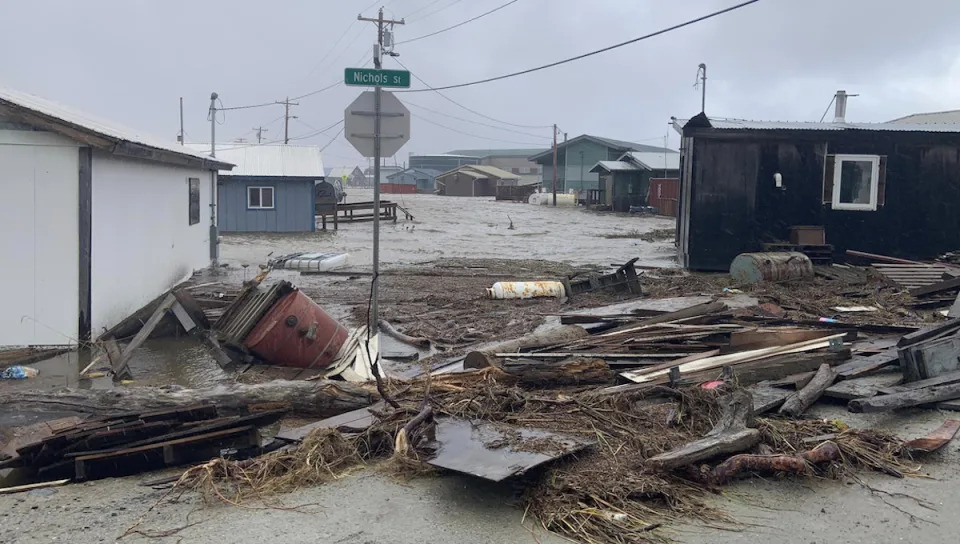
Alaska towns flooded, residents evacuated as massive storm batters state

CBS News

Alaska towns flooded, residents evacuated as massive storm batters state

Sophie Reardon – September 17, 2022

A massive, potentially record-breaking storm brought major flooding and damage to coastal towns in Alaska Saturday, and some residents were evacuated. Gov. Mike Dunleavy said he “verbally declared” a disaster for communities impacted by the storm.

The center of the storm was making its way up the Bering Strait Saturday afternoon, the National Weather Service said.

On Alaska’s western coast, the towns of Nome, Hooper Bay, Skaktoolik, Kotlik and Nunam Iqua were all hit hard by the storm, according to the Alaska Department of Transportation and Public Facilities (ADOT&PF).

The governor said on Twitter that there had been no reported injuries as of Saturday morning. “We will continue to monitor the storm and update Alaskans as much as possible,” he tweeted. A news briefing was scheduled for 7:30 p.m. local time Saturday night.

The state had also established an emergency operations center.

Rep. Mary Peltola also tweeted Saturday afternoon, asking that Alaskans “please be safe and seek shelter. It’s imperative we all look out for each other and keep each other safe. We will get through this, but stay safe.”

Flooding is seen in Golovin, Alaska, on Saturday, Sept. 17, 2022. / Credit: Heidi Varga

In the town of Golovin, major flooding was reported early Saturday, according to the National Weather Service, and forecasters warned it would only get worse. The town could see an additional 1 to 2 feet of water by the day’s end. The Old Golovin Airport was under water, according to ADOT&PF.

“Water is surrounding the school, homes and structures are flooded, at least a couple homes floating off the foundation, some older fuel tanks are tilted over,” the weather service’s office in Fairbanks tweeted.

Photos from the weather service showed the high water levels there.

Wales – the westernmost town in both Alaska and the U.S., located on the Bering Strait coast – was seeing flooding in “low lying areas,” the weather service reported.

“Water levels will peak this afternoon with the high tide, then gradually fall through Sunday,” the weather service tweeted.

Another town, Shaktoolik, reported coastal flooding, with water “entering the community and getting close to some homes,” according to the weather service. Residents there were evacuated to a school and clinic. Shaktoolik was also expected to see the worst of the storm later in the day.

According to the weather service, the water level in Nome rose above 10 feet Saturday, and is expected to continue to rise.

The weather service also shared footage from a webcam in Unalakleet, comparing an average day in the town against the scene there Saturday morning.

As of Saturday afternoon, large swaths of the state’s western coast were under coastal flooding and high wind warnings. The weather service said flood warnings would remain in effect for several areas through Sunday night, while the wind warnings were expected to expire by Saturday night.

The weather service said the Yukon–Kuskokwim Delta would see a “smaller surge” during high tide in the afternoon and evening hours Saturday.

The “highest water levels are expected from Kipnuk north to Newtok,” the NWS tweeted. A coastal flood warning was extended for that region through 10 p.m. Saturday.

A massive storm hits Gambell, Alaska. Sept. 16, 2022.  / Credit: Clarence Irrigoo Jr.
A massive storm hits Gambell, Alaska. Sept. 16, 2022. / Credit: Clarence Irrigoo Jr.

Other portions of the state are under gale warnings, according to the weather service.

The weather service shared peak reported wind gusts as of 8 a.m. local time — the highest recorded was 91 mph in Cape Romanzof. Several other towns, including Golovin, saw winds topping 60 mph.

The storm is the remnants of Typhoon Merbok, and forecasters predicted this week it could bring “potentially historical” flooding, with some coastal areas seeing water levels up to 11 feet higher than the normal high tide.

Angry sea’: Huge storm floods roads, homes in Alaska as governor declares disaster

USA Today

‘Angry sea’: Huge storm floods roads, homes in Alaska as governor declares disaster

Christine Fernando and Claire Thornton – September 17, 2022

This image provided by the National Hurricane Center and Central Pacific Hurricane Center/National Oceanic and Atmospheric Administration shows a satellite view over Alaska, Friday, Sept. 16, 2022.

Alaska Gov. Mike Dunleavy has declared a state of disaster Saturday as a powerful storm threatens huge swaths of the state’s western coastline.

Towns are facing strong winds and flooding, and bracing for possible power outages caused by a storm forecasters are calling one of the worst in the state’s recent history.

The storm systems continued to “produce a potentially historic and long-duration storm surge, and damaging high winds across southwestern and western Alaska,” the National Weather Service said Saturday.

The remnants of Typhoon Merbok are expected to bring moderate to heavy rainfall to the region until Sunday morning. On Saturday morning, a “very angry sea” brought storm surge into the community of Port of Nome, the Weather Service station in Fairbanks, Alaska tweeted. Wind gusts could reach hurricane strength in some areas, Weather Service forecasts say.

Significant coastal flooding is expected until Sunday morning, with the highest water levels Saturday afternoon, the Weather Service said.

Related video: Heavy rain, strong winds from Kay send small pane off runway

 https://s.yimg.com/rx/martini/builds/49027198/executor.htmlScroll back up to restore default view.

On Saturday, photos showed roads in Golovin, Alaska, were covered with floodwater and the tide reached homes, causing a couple of homes to float off their foundations, the Weather Service station in Fairbanks, Alaska said. Golovin, Alaska is a small town about 70 miles east of Nome.

Other photos shows flooded vehicles and a building stuck under a bridge after being swept off its foundation.

‘HISTORIC-LEVEL STORM’: Alaska braces for floods, power outages

Likely wind gusts of 50 to 75 mph may also topple trees, damage roofs and buildings, and lead to substantial power outages, according to AccuWeather. The storm will also create “life-threatening conditions” for fishing operations, AccuWeather said, warning small boats to remain in port.

There were no injuries reported as of Saturday afternoon, Dunleavy said on Twitter.

‘One of the strongest storms to ever hit the state,’ forecasters say

The storm’s impacts may exceed the 2011 Bering Sea Superstorm, one of the most powerful cyclones to affect Alaska on record, the National Weather Service in Fairbanks said, adding that some parts of the state may experience their worst coastal flooding in almost 50 years.

AccuWeather called it “one of the strongest storms to ever hit the state of Alaska.”

The storm is expected to calm later in the weekend as it drifts across the Arctic Circle, AccuWeather said, adding that most of the storm’s impacts will be concentrated in western and northern Alaska.

Other parts of the state, including Fairbanks and Anchorage, may see some rain Sunday night to Monday, AccuWeather forecast.

This image provided by the National Hurricane Center and Central Pacific Hurricane Center/National Oceanic and Atmospheric Administration shows a satellite view over Alaska, Friday, Sept. 16, 2022.

TROPICAL STORM FIONA FORMS: Storm headed toward Puerto Rico

Tropical Storm Fiona to hit Puerto Rico

Meanwhile, Tropical Storm Fiona is expected to dump up to 16 inches of rain on parts of Puerto Rico on Saturday, threatening severe flooding, landslides and power outages.

The storm is expected to become a hurricane as it nears Puerto Rico, just after battering the eastern Caribbean islands. One death was reported Saturday in Guadeloupe, a French territory in the southern Caribbean Sea.

Puerto Rican authorities have opened shelters and shuttered public beaches, theaters and museums, urging people to remain indoors.

Contributing: The Associated Press

Largest Western wildfires burn mostly uncontrolled during above-average season

Fox Weather

Largest Western wildfires burn mostly uncontrolled during above-average season

September 16, 2022

Air Quality Index alerts for areas near the Mosquito Fire.

With more than 6.7 million acres in the U.S. engulfed by wildfires so far this year, the active fire season continues without much relief for Western states plagued by warm and dry weather that has driven explosive fire growth in recent weeks.

According to the National Interagency Fire Center, the U.S. is 116% above the 10-year average for 2022. Most of that uptick is attributed to the Alaska wildfires earlier this summer. Sufficient rainfall in Alaska over the last several weeks eliminated drought conditions for most of Alaska, improving fire weather overall. After 366 fires to date this year, there are no active wildfires in Alaska, according to the Alaska Wildland Fire database.

For California and much of the Northwest, a record heat wave and dry weather fueled significant wildfire growth in September. More than 140 wildfires greater than 100 acres are burning in the U.S., consuming 1.3 million acres. Nearly all the active fires are in the Northwest.

Smoke from Western wildfires continues to push east, even creating hazy skies as far as the Northeast on Friday.

Air quality in areas near the wildfires will be the poorest in the early hours of the day.

“So many people in the Tahoe area love to hike, they love to be out on the lake and so those activities, honestly, just can’t happen safely for the entire day,” FOX Weather meteorologist Britta Merwin said. “The time frame that you want to avoid is the morning, so we’ve had some stable air move in overnight, and with that stable air it literally traps that smoke down to the ground, and you’re going to breathe that in as you head out for that morning walk.”

As daylight heats the air, it should mix up, and air quality could improve later in the day.

Very unhealthy air quality alerts are in place for areas outside California’s Mosquito Fire in the Tahoe National Forest, including Carson City and Reno in Nevada. Unhealthy air quality extends east to Lovelock.

Hazardous air quality levels above 301 were recorded in Nevada County, California, on Friday.

Now at more than 69,900 acres, the Mosquito Fire continues to burn in the Tahoe National Forest and, until recently, was out of control. Firefighters have gained ground on the explosive fire with 20% containment as of Friday.

The fire began on Sept. 6, and the cause of the fire remains under investigation.

A front is expected to bring rain and increased winds to the fire area beginning Saturday and into next week.

Earlier in the week, strong southwesterly winds caused the fire behavior to increase, and critically dry fuels drove rapid fire growth toward Foresthill Road, according to CAL Fire.

Nearly 12,000 people have been forced to evacuate as evacuation orders remain in place for areas in Placer and El Dorado counties. According to the Placer County Sheriff’s Office, the fire continues to threaten more than 9,000 homes. The Mosquito Fire has destroyed at least 70 structures and damaged 10 others.

HEAT WAVES SAPPING SOIL OF MOISTURE, INCREASING WILDFIRE DANGER, SCIENTISTS SAY

The wildfire continues to send waves of smoke into neighboring states, creating air that is unhealthy to breathe. The school district that includes Reno, Nevada, canceled classes on Wednesday due to poor air quality from wildfire smoke.

According to the Washoe County School District, when a majority of the air quality sensors reach hazardous levels, district officials will work with the National Weather Service to determine if classes will be canceled.

CAL Fire and the U.S. Forest Service have reported more than 6,200 fires have burned over 316,000 acres in the Golden State this year.

Numerous wildfires across Washington and Oregon are blanketing the region in smoke and unhealthy air conditions. Air Quality Alerts are in place for parts of Oregon, Washington and Idaho on Friday due to ongoing wildfires.

More than 2,300 firefighting personnel are working to contain the now more than 93,000-acre Cedar Creek Fire in Oregon’s Willamette National Forest, which remains uncontrolled.

Most of the flames are burning inside the National Forest, but private lands are threatened in the western part of the state. An estimated 1,900 homes have been put under some type of evacuation notice as the blaze is out of control.

August lightning is believed to be the cause of the fire. The U.S. Forest Service said about 20 to 30 new fires started because of the storms.

Oregon Gov. Kate Brown declared an emergency last Friday to help mobilize resources for the fire burning in Lane County.

“The Cedar Creek Fire grew rapidly towards Oregon communities this morning, and the fire’s growth potential in the coming days is troubling, requiring additional resources to battle the fire and support the state’s response,” Brown said in a statement.

Also in Oregon is the Double Creek Fire, the Pacific Northwest’s largest fire of the year. As of the latest update, the fire has consumed more than 157,000 acres in eastern Oregon along the Snake River. On Sunday morning alone, the fire grew to more than 42,800 acres. The fire is more than 20% contained.

Officials said that between 100 and 200 homes are threatened, and the fire is burning close to the community of Imnaha.

Like the Cedar Creek Fire, August thunderstorms that produced lightning are blamed for starting the Double Creek Fire.

In Washington state, the Boulder Mountain Fire has been burning in the northeastern corner since late August after being sparked by lightning.

Because of the rural nature of the fire, only 24 structures are threatened, but crews have had some success in controlling the wildfire.

More than 2,300 acres have burned, and official containment has improved to about 60%.

A mixture of state, federal and private land is being impacted, and firefighters have reported difficulty working the fire because of the terrain and heavy timber.

While rain was forecast for earlier in the week in the Cusick, Washington, area, Northeast Washington Fire officials said it would be welcome but only provide momentary aid to firefighting efforts.

“While rain is always welcome, it will provide only a temporary relief to fire behavior until a significant event occurs due to the dry heavy fuels. A wind shift from the southwest has the potential to reduce the potential for spotting on the southern edge of the fire,” fire officials wrote.

Burnin about 37 miles east of Seattle, the Bolt Creek Fire is threatening hundreds of homes and has burned more than 9,400 acres.

According to the Washington State Department of National Resources, firefighters have 5% of the blaze contained.

Evacuations have been ordered around the town of Skykomish by the King County Sheriff’s Office.

First responders said the fire threatened at least 300 homes.

So far, there’s no word on what sparked the initial flames.

Much-needed rainfall has moved over one of the Northwest’s largest wildfires, allowing firefighters to make progress in containing the Moose Fire.

The Moose Fire started north of Salmon, Idaho, and has now burned more than 130,000 acres. It’s one of six new wildfires that sparked in the Salmon-Challis National Forest this week, according to forestry officials.

National Forest officials report the fire area recorded about a quarter to half an inch of rain early in the week.

Cooler temperatures, increased humidity and chances of rain are in the forecast for the weekend. That cooling trend will continue into next week.

About 850 firefighting personnel have gained 50% containment on the Moose Fire as of the last update.

Alaska storm could bring “worst coastal flooding in 50 years”

CBS News

Alaska storm could bring “worst coastal flooding in 50 years”

Li Cohen – September 16, 2022

/ AP

Alaska is bracing for dangerous weather as the remnants of Typhoon Merbok move toward the Bering Sea region. Forecasters predict that the storm, set to hit on Friday, could bring “potentially historical” flooding, with some coastal areas seeing water levels up to 11 feet higher than the normal high tide.

“Latest models show coastal surge higher than the November 2011 storm that brought significant flooding to the area,” the National Weather Service forecasted early Friday morning, adding that the flooding could be “potentially historical.”

“This is a dangerous storm that will produce widespread coastal flooding south of the Bering strait with water levels above those seen in nearly 50 years,” the service said.

The state is expected to see hurricane-force winds with gusts up to 90 mph, according to the service, and wave heights up to 48 feet. Coastal flooding could go beyond 12 feet over the western mainland. Depending on the location, other areas can see gusts between 40 and 80 miles per hour between Friday and Saturday night. The main concern, according to the service, is flooding, structural damage and blown-down power lines.

Much of Alaska’s west coast is already under warning and watches. All areas along the coastline from Quinhagak to Point Hope are under coastal flood and high wind warnings, while Cape Lisburne and northern coastal areas stretching to Teshekpuk Lake are under coastal flooding watches. In Nome, water levels will be up to 11 feet above normal high tide and the city’s mayor said on Thursday that residents of Belmont Point should “prepare for possible evacuation.”

Related video: As Hurricane Kay weakens, parts of West continue to face extreme weather

 https://s.yimg.com/rx/martini/builds/49027198/executor.htmlScroll back up to restore default view.

In Golovin, water levels could go up to 13 feet above normal. The National Weather Service’s Anchorage office said that the overall moisture content of the storm is “quite extreme” with enough moisture that equates to “200 to 300% of normal.”

Widespread power outages are also expected, the National Weather Service said, and the worst water levels are expected on Saturday.

Rick Thoman, a climate specialist at the Alaska Center for Climate Assessment and Policy, said that the situation is “a near worst case coastal flooding scenario” for the Bering Sea coast. The storm extends “roughly 500 miles in all directions from the low center,” the weather service’s Anchorage office reported.

“This is very serious: in some communities there’s the potential for the worst coastal flooding in 50 years,” Thoman said, echoing the National Weather Service’s warning.

Meteorologist Ed Plumb told the Associated Press that the storm will be “the deepest or strongest storm we’ve ever seen in September,” a fact that makes it “quite an unusual storm.”

Trevor Noah Dismantles Racist Response to ‘The Little Mermaid’ Trailer: ‘Really, People? We’re Doing This Again?’

The Wrap

Trevor Noah Dismantles Racist Response to ‘The Little Mermaid’ Trailer: ‘Really, People? We’re Doing This Again?’

Adam Chitwood – September 16, 2022

Trevor Noah took aim at the racist backlash to Disney’s live-action “The Little Mermaid” trailer on Thursday’s “The Daily Show,” wondering why we’re all doing this again.

Shortly after racist backlash to people of color playing elves and dwarves in Amazon’s “The Lord of the Rings: The Rings of Power” series, Disney debuted the first trailer for “The Little Mermaid” that revealed Black actress playing Ariel. Racists on the internet, predictably, were extremely Mad Online.

“Once again a bunch of internet racists are upset that a fictional character is being played by a Black person, and honestly I don’t know what the big deal is,” Noah said before joking, “You guys realize that Nemo was Black too, right? Yeah, that whole movie was about a fish that can’t find his dad. Calm down, I can say that because my dad left and he’s white, so who’s racist now?”

Also Read:
Disney’s Live-Action ‘Little Mermaid’ Teaser Trailer Reveals Halle Bailey’s Ariel (Video)

The jokes continued, “First of all, of course the Little Mermaid is Black. Everyone whose name starts with Lil’ is Black. Lil’ Wayne, Lil’ Nas X, Lil’ Kim. Honestly if you heard there was a woman named Lil’ Mermaid you’d just assume she was on a track with Cardi B.”

But then Noah launched into another joke with a stinging twinge of truth to it.

“Stop being ridiculous. It’s imaginary,” he began. “I hope this scandal doesn’t overshadow the rest of the movie. ‘The Little Mermaid’ is a beautiful story about a young woman changing her core identity to please a man, let’s not forget about that, people.”

Noah concluded the segment by underlining the ridiculousness of the whole backlash and also pointing out that Disney introduced a Black mermaid in the animated “Little Mermaid” series that aired from 1992 to 1994 and nobody batted an eye.

“If we had more time we could talk about how Disney already created a Black mermaid 30 years ago and nobody cared, or how there’s still plenty of white princesses for little girls whose dream it is to be in a monarchy. And let’s not forget, you can still watch the original ‘Little Mermaid.’ It’s not like if you try to turn it on Mickey’s gonna jump out of the screen and go, ‘You’re racist, haha!’”

Watch Noah’s segment in the video above. Disney’s “The Little Mermaid” opens in theaters on May 26, 2023.

Democrats Buoyed by Abortion and Trump, Times/Siena Poll Finds

The New York Times

Democrats Buoyed by Abortion and Trump, Times/Siena Poll Finds

Lisa Lerer and Nate Cohn – September 16, 2022

President Joe Biden speaks at the 45th Congressional Hispanic Caucus Institute Gala to kick-off the White House's celebration of Hispanic Heritage Month at the Walter Washington Convention Center, Thursday, Sept. 15, 2022, in Washington. (AP Photo/Alex Brandon)
President Joe Biden speaks at the 45th Congressional Hispanic Caucus Institute Gala to kick-off the White House’s celebration of Hispanic Heritage Month at the Walter Washington Convention Center, Thursday, Sept. 15, 2022, in Washington. (AP Photo/Alex Brandon)
Fury over abortion has helped mask deep Democratic vulnerabilities, according to a New York Times/Siena College poll. (Hannah Beier/The New York Times)

Even as they struggle to persuade voters that they should be trusted on the economy, Democrats remain unexpectedly competitive in the battle for Congress as the sprint to November’s midterm election begins, a New York Times/Siena College poll has found.

The surprising Democratic strength has been bolstered by falling gas prices and President Joe Biden’s success at breaking through legislative gridlock in Washington to pass his agenda. That shift in political momentum has helped boost, in just two months, the president’s approval rating by 9 percentage points and doubled the share of Americans who believe the country is on the right track.

But Democrats are also benefiting from factors over which they had little control: the public outcry in response to the Supreme Court’s overturning of federal abortion rights and the return of former President Donald Trump to an attention-commanding presence on the national stage.

Overall, 46% of registered voters say they back the Democratic candidate for Congress in their district, compared with 44% for Republicans — a difference well within the survey’s margin of error. The findings are similar to those from the last Times/Siena poll in July, when voters preferred, by just 1 percentage point, Democratic to Republican control of Congress.

Yet the fundamentals of the race — high inflation, an uncertain economy and an unpopular president — remain challenging for Democrats. The national mood, while brighter than earlier in the summer, remains gloomy. Republicans still score higher on some social issues, including illegal immigration. And the president’s approval rating is still just 42%— as weak as or weaker than the ratings of every president whose party went on to lose control of Congress in midterm elections, going back to 1978.

For now, the fury over abortion and the renewed spotlight on Trump have helped mask deep Democratic vulnerabilities that might ultimately make Republicans favored to retake Congress — if Republicans could refocus the electorate on the economy and inflation. Republicans would lead by 6 percentage points in the race for Congress, if they could merely win over voters who say they agree with the GOP most on the economy.

Marvin Mirsch, 64, a self-identified independent from suburban Minneapolis, said he agreed with the Republicans on economic issues but still planned to back Democrats in November. A biomedical engineer, he attributed his vote largely to one man: Trump.

“I think that every person in the nation should work hard to purge Donald Trump from the Republican Party in one way or another,” Mirsch said. “Because we need a healthy Republican Party, and it’s not right now — it’s sick.”

The survey underscored how Republicans have been weakened by Trump’s decision to play a vocal role in his party’s primaries. Voters said that the word “extreme” described the Republicans better than the Democrats by a 6-point margin, 43% to 37%. And, although they deemed economic issues most important, more voters said that Democrats were focused on the most important issues than those who said that Republicans were, by 40% to 38%.

While the poll did not directly ask voters how Trump weighed on their midterm vote, it found Biden leading Trump by 3 percentage points, 45% to 42%, in a hypothetical 2024 matchup — nearly identical to voter preferences in the race for Congress.

In contrast, voters trust the Republicans more on the economy by a 14-point margin, 52% to 38%. And they say that economic issues will matter more to their vote than do societal issues by an 18-point margin.

Yet 9% of the voters who trust Republicans more on economic issues and say that those issues are most important are voting for Democrats, anyway.

Jeanine Spanjers, 44, from Racine, Wisconsin, said that rising inflation had caused her to change her lifestyle, including driving less, skipping vacations and even abstaining from popcorn when she goes to the movies. A state employee, she also said she believed that Democrats were handing out too many government subsidies, pointing to relief payments distributed during the pandemic.

“What’s getting on my nerves is all this free stuff,” she said, criticizing how all the children at her son’s school received food stamp cards, including families who could afford to pay for lunch. “Republicans would never do something like that. It disincentivizes people to go out and do something. I’m starting to feel like people are being rewarded for not doing anything.”

Still, Spanjers said she planned to vote only for Democrats, saying abortion is her top issue. “I had made that choice once, and I have two sons,” she said. “There’s people who can’t afford kids and shouldn’t have kids, or just maybe it isn’t the right time in their life.”

The poll’s findings also suggest that Biden’s legislative successes have done relatively little to boost his or his party’s credibility on economic issues.

Only 36% of voters said they approved of a centerpiece of Biden’s legislative agenda, the health and climate spending bill passed by Congress last month known as the Inflation Reduction Act. More than one-quarter said they had never even heard of it. The country was divided over the administration’s student debt plan, with 49% saying they supported the cancellation of up to $20,000 worth of federal student loans, compared with 45% who say they opposed it.

Just 15% of voters said that Biden’s policies had helped them personally, while 37% said that his policies had hurt them. Nearly half said the president had not made much of a difference either way — including 59% of voters younger than 30.

“I’ve been working since I was 16, and I don’t have a high school diploma, so the costs of inflation are really affecting me,” said Mykie Bush, 19, who works at an auto dealership in rural Oregon. “I can barely leave my house right now because of inflation.”

Still, Bush said she planned to vote Democratic, saying her views on issues like abortion, immigration and LGBTQ rights outweighed her economic worries: “At the end of the day, we’re not fighting over politics. We’re fighting over our human rights.”

Democrats held an overwhelming 73%-18% lead among voters who said that “societal issues” like abortion or threats to democracy would be most important in their vote this November, rather than economic issues like jobs and the cost of living.

But on issues like immigration, crime and even gun policy that had appeared likely to dominate the midterm campaign before the Supreme Court’s decision to overturn Roe v. Wade, Republicans appear to hold important advantages. Despite a summer of mass shootings, voters by a narrow margin said they opposed a ban on semi-automatic weapons and high-capacity magazines.

Republican strength extends even to one of the most divisive elements of Trump’s agenda, with voters narrowly supporting a border wall. And, by a 14-point margin, voters said they agreed more with the Republican Party’s stance on illegal immigration.

The electorate remains deeply divided along the demographic fault lines of the last election, with Democrats leading among white college graduates, young voters and nonwhite voters; Republicans hold a commanding lead among white voters without a college degree. As in the July Times/Siena survey, Republicans show even greater strength among white voters without a degree than they did in 2020, with an overwhelming 61%-29% lead among that group.

Jason Anzaldua, a Republican from Jefferson County, Arkansas, who is a police lieutenant in rural Redfield, said that he could not afford the gas to transport his children to compete in rodeo events and had to sell some of his horses because the price of feed was too high. But he said he was equally frustrated with what he saw as Biden’s disrespect of those who supported Trump and the MAGA movement.

“I swore an oath to the Constitution to uphold it, to protect it, to protect the citizens here on America’s front lines,” Anzaldua said. “So for him to stand up and tell me that I’m part of the problem is a slap in the face as an American.”

Democrats and Republicans were nearly equally likely to say they intended to turn out this November, with 52% of Republicans and 51% of Democrats saying they were “almost certain” to vote.

Voters continue to believe that abortion should be mostly or always legal by around a 2-1 margin. However, the supporters of legal abortion rights enjoy an even larger enthusiasm edge: 52% of voters said they strongly opposed the Supreme Court’s ruling to overturn Roe v. Wade; just 19% said they strongly supported it.

“What has taken place is unacceptable to me,” said James Moran, 82, a registered Republican from New Rochelle, New York, who said that he planned to vote Democratic this year. “They’ve denied women the ability to control their own bodies. Should there be some limit on that? There’s limits on everything but everything within reason.”

Trump warns of ‘problems’ like ‘we’ve never seen’ if he’s indicted

Politico

Trump warns of ‘problems’ like ‘we’ve never seen’ if he’s indicted

Myah Ward and Andrew Desiderio – September 15, 2022

Mary Altaffer/AP Photo

Former President Donald Trump said Thursday the nation would face “problems … the likes of which perhaps we’ve never seen” if he is indicted over his handling of classified documents after leaving office, an apparent suggestion that such a move by the Justice Department could spark violence from Trump’s supporters.

The former president said an indictment wouldn’t stop him from running for the White House again and repeatedly said Americans “would not stand” for his prosecution.

“If a thing like that happened, I would have no prohibition against running,” Trump said in an interview with conservative talk radio host Hugh Hewitt. “I think if it happened, I think you’d have problems in this country the likes of which perhaps we’ve never seen before. I don’t think the people of the United States would stand for it.”

Hewitt asked Trump what he meant by “problems.”

“I think they’d have big problems. Big problems. I just don’t think they’d stand for it. They will not sit still and stand for this ultimate of hoaxes,” Trump said.

It’s not the first time Republicans have hinted at potential civil unrest if the DOJ indicts Trump. Republican Sen. Lindsey Graham made headlines last month when he said there would be “riots in the street” if “there is a prosecution of Donald Trump for mishandling classified information.” Graham’s comments were slammed as “irresponsible” and “shameful.” White House press secretary Karine Jean-Pierre, without naming the South Carolina senator, said these comments from “extreme Republicans” were “dangerous.”

Hewitt appeared to see Trump’s comments as a nod toward potential unrest, asking the former president how he would respond when the “legacy media” accuses him of inciting violence.

“That’s not inciting. I’m just saying what my opinion is,” Trump said. “I don’t think the people of this country would stand for it.”

On Capitol Hill, senior FBI and DHS officials briefed members of the Senate Judiciary and Homeland Security committees Thursday on the uptick in threats against federal law enforcement in the aftermath of the Mar-a-Lago search. Senators said the briefers didn’t specifically pinpoint a politician or political party when it comes to the threats, but they said the trend was clear.

“It was stunning the number of threats that have been cataloged since the Aug. 8 search of Mar-a-Lago,” Senate Judiciary Chair Dick Durbin (D-Ill.) said after the briefing, specifically mentioning the gunman who tried to enter an FBI building in Cincinnati, Ohio, in the days following the search. “It’s a much more dangerous environment because of the political statements made by some individuals since Aug. 8 — it’s alarming to me.”

Durbin said the threats ranged from explicit and specific to more generalized ones, most notably on social media. He also called out Trump for his rhetoric.

“Inviting a mob to return to the streets is exactly what happened here on Jan. 6, 2021. This president knew what he was doing…and we saw the results,” Durbin added. “His careless, inflammatory rhetoric has its consequences.”

Sen. Rick Scott (R-Fla.), a Trump ally and member of the Homeland Security Committee, said after the briefing that the Justice Department needed to be more transparent about the justification for the search in order to push back against “conspiracies.”

“You have to give people good information so these rumors don’t continue,” Scott said, condemning attacks on law enforcement. “I don’t know why they raided the former president’s house … They know the conspiracy theories that are out there. So convince people that they’re not true.”

The FBI search of Trump’s Mar-a-Lago residence in Florida sparked a political firestorm last month. According to a Justice Department court filing released in August, prosecutors obtained a search warrant for the estate after receiving evidence there was “likely” an effort to conceal classified documents at the residence in defiance of a grand jury subpoena. Agents recovered highly classified records mixed among personal items, in addition to dozens of empty folders with classified markings.

The DOJ and Trump’s lawyers are now in the midst of legal deliberations on an outside review of the seized documents.

Graham, one of Trump’s staunchest Capitol Hill allies, echoed concerns that the Justice Department may have overstepped in its dealings with the former president. But he left open the possibility that the department’s probe could uncover material that might justify an indictment.

“There’s a belief from many on the right that the DOJ and the FBI have been less than unbiased when it comes to Trump. But having said that, nobody’s above the law including the president, but the law’s gonna be about politics,” Graham said. “So let’s wait and see what they find. I’ve got an open mind about what they find, but they need to have something that would justify what I think is political escalation.”

Speaking with Hewitt on Thursday, Trump continued to use the defense that he “declassified” everything he took to Mar-a-Lago, a claim his legal team has thus far declined to make in court.

Rhetoric that could be seen as alluding to violence is not out of character for Trump. In his speech on Jan. 6, 2021, to supporters before rioters stormed the Capitol in an effort to block the certification of President Joe Biden’s Electoral College victory, the then-president told the crowd to “fight much harder” against “bad people” and to “show strength.” His comments that day have been a focal point of Jan. 6 select committee’s investigation into the president and his inner circle, with investigators using one of their summer hearings to make the case that Trump’s efforts to hold on to power resonated with extremist groups and brought them to the Capitol.

Nancy Vu contributed to this report.

Patagonia founder is giving away his billion dollar company and ensuring that all profits go towards fighting climate change

Insider

Patagonia founder is giving away his billion dollar company and ensuring that all profits go towards fighting climate change

Kelsey Vlamis and Lakshmi Varanasi – September 14, 2022

yvon chouinard tom brokaw
  • Yvon Chouinard announced Wednesday he is giving away his multi-billion dollar company, Patagonia.
  • Chouinard said instead of selling it or taking it public, Patagonia will be owned by a trust and nonprofit.
  • The trust is set up to ensure Patagonia’s profits go towards addressing climate change.

Patagonia founder Yvon Chouinard is giving away the company by transferring it to a newly established trust and nonprofit in order to ensure its profits go towards combatting the climate crisis.

Chouinard, the rock climber-turned-billionaire, announced the move in a statement on Wednesday.

“Instead of ‘going public,’ you could say we’re ‘going purpose.’ Instead of extracting value from nature and transforming it into wealth for investors, we’ll use the wealth Patagonia creates to protect the source of all wealth,” he wrote.

Chouinard, 83, said that he opted for the unique ownership model instead of selling the company to an owner that could potentially compromise Patagonia’s values, or going public and leaving the company beholden to shareholders first.

Instead, ownership of the outdoor apparel company, valued at around $3 billion, is being transferred to the Patagonia Purpose Trust and Holdfast Collective.

“It’s been nearly 50 years since we began our experiment in responsible business, and we are just getting started. If we have any hope of a thriving planet—much less a thriving business—50 years from now, it is going to take all of us doing what we can with the resources we have. This is another way we’ve found to do our part,” Chouinard said.

Patagonia said going forward all profits that are not reinvested back into the company will be distributed to Holdfast Collective to go towards environmental causes, according to an additional statement provided to Insider. The company estimates this amount will total about $100 million each year.

Founded by Chouinard nearly 50 years ago, Patagonia is well known for breaking with conventional business practices and for its commitment to sustainability

In an interview with The New York Times about the decision, Chouinard said he hopes the move will “influence a new form of capitalism that doesn’t end up with a few rich people and a bunch of poor people.”

“We are going to give away the maximum amount of money to people who are actively working on saving this planet,” he said.

Dan Mosley of merchant bank BDT & Co., who helped Patagonia structure the move, told The Times he’s never seen anything like it: “In my 30 plus years of estate planning, what the Chouinard family has done is really remarkable.”

“It’s irrevocably committed. They can’t take it back out again, and they don’t want to ever take it back out again,” Mosley said.

Chouinard and his family have given away most of their wealth throughout his lifetime, making them one of the most charitable families in the US.

Chouinard has also famously said that Patagonia’s decisions that were good for the planet have also been good for business.

“I didn’t know what to do with the company because I didn’t ever want a company,” Chouinard told The Times. “I didn’t want to be a businessman. Now I could die tomorrow and the company is going to continue doing the right thing for the next 50 years, and I don’t have to be around.”

You don’t need to walk 10,000 steps a day — walking faster is what counts to protect you from heart disease and cancer

Insider

You don’t need to walk 10,000 steps a day — walking faster is what counts to protect you from heart disease and cancer

Gabby Landsverk – September 14, 2022

a person with dark curly hair wearing black pants and a white T shirt, walking on a brightly lit sidewalk in front of a stone building during the day
Walking at least 3,800 steps a day may help prevent dementia, and hitting up to 9,800 steps at a brisk pace is ideal, according to a new study. 
  • There’s even more research that daily walking can help prevent early death and dementia. 
  • As few as 3,800 daily steps may stave off illness, with more benefits for every 2,000 extra steps you take.
  • Walking faster, at about 2.7 to 3 miles an hour, may be even better for health, according to data.  

Over 3 million people read Morning Brew  ; you should too!Email addressBy clicking ‘Sign up’, you agree to receive marketing emails from Insider as well as other partner offers and accept our Terms of Service and Privacy Policy.

Walking is a great way to improve your health and stave off cognitive decline and other age-related ailments, even if you only do a moderate amount each day, new research suggests. 

While 10,000 steps a day is considered the ideal to improve health, as few as 3,800 steps per day has benefits, and walking at a faster pace is even better for you, according to a study published September 6 in JAMA Neurology.

Researchers from the University of Sydney looked at data from 78,430 mostly white UK adults aged 40 to 70, comparing step counts, average speed, and health outcomes over about seven years of follow-up. 

They found that for every 2,000 steps participants took per day, on average, their risk of early death was 8-11 percent lower, up to 10,000 steps a day. 

But walking just 3,800 steps a day had benefits, specifically for brain health, reducing the risk of dementia by 25 percent, according to data. People who walked about 9,800 steps per day had a 50 percent lower risk of dementia. 

Walking pace and intensity also made a difference for health outcomes, with faster walkers showing greater benefits for cognitive health and prevention of illnesses like heart disease and cancer, according to data.

The optimal speed for a 30 minute walk was about 112 steps per minute, slightly faster than what previous research has identified as a healthy, brisk walking speed of 2.7 miles an hour, or 100 steps per minute.

Participants got more benefits in fewer steps if they were purposeful with their walking, and did it with the intention of exercising rather than simply moving from room to room during their day. Researchers found the ideal amount of purposeful walking was around 6,000 steps a day. 

The findings suggest that both walking distance and speed could be helpful tools for improving health and reducing risk of illness, according to the researchers. 

“The take-home message here is that for protective health benefits, people could not only ideally aim for 10,000 steps a day but also aim to walk faster,” Dr Matthew Ahmadi, co-lead author of the study and research fellow at the University of Sydney, said in a press release. 

Previous research supports the idea that vigorous walking is good for you, even if you get less than 10,000 steps

Earlier studies have also found a fast walking pace and shorter step count may have benefits. 

A 2022 study found a brisk walking pace, more than three miles an hour, was most effective for slowing signs of biological aging, potentially leading to a longer, healthier life by as much as 16 years

And one 2019 study found that walking seemed to reduce the risk of early death in as few as 4,400 steps per day.

The idea that walking 10,000 steps per day is optimal may be as much based in marketing as in science, Daniel Lieberman, a Harvard paleoanthropologist who has studied the evolution of exercise, previously told Insider.

The number was popularized by a Japanese company to help sell the first commercial pedometer, and 10,000 was chosen because it was both catchy and easy to remember. 

Aiming for 10,000 steps can be overly ambitious, since it’s a total of about five miles, but having a convenient goal may be helpful if it motivates you to be active. 

“We all have deep fundamental instincts to avoid unnecessary activity, so we need those nudges to help people get started,” he said.