The ‘uniparty’? Conservatives bash bipartisanship by attacking fellow Republicans
Sahil Kapur and Allan Smith – March 3, 2024
WASHINGTON — An empowered faction of Donald Trump – aligned Republicans is seeking to redefine dealmaking as an insult by deploying the term “uniparty” to attack colleagues who work with Democrats and strike deals that fall short of what their base wants.
The growing use of the word among the GOP’s ascendant culture warriors represents an effort by conservative lawmakers, activists and commentators to disparage bipartisan agreements on matters that have broad support in Congress like government funding, infrastructure spending and aid for U.S. allies like Ukraine.
Rep. Bob Good, R-Va., chair of the far-right Freedom Caucus, called the recent House passage of a bill to avert a partial government shutdown an example of a “uniparty vote,” with Republicans who “talk about spending cuts and talk about fiscal responsibility” but ultimately support compromise spending measures.
“The uniparty is when the rubber meets the road and Republicans and Democrats join hands to stick it to the American people,” Good told NBC News.
He added that “unfortunately, too many Republicans are all too eager” to compromise with Democrats.
While Republicans control the House, Democrats hold the Senate majority and the White House, where President Joe Biden on Friday signed into law the short-term funding bill that was negotiated with House Speaker Mike Johnson, R-La., to keep the government open.
House and Senate Republicans who have assailed the so-called uniparty — including Reps. Lauren Boebert of Colorado, Marjorie Taylor Greene of Georgia and Matt Gaetz of Florida, as well as Sens. Rick Scott of Florida and J.D. Vance of Ohio — all voted against the latest government funding bill.
The House voted 320-99 to pass the measure, followed by a 77-13 vote in the Senate — evidence that there is “absolutely” a “uniparty” in Washington, according to Boebert.
“It means Republicans who vote Democrat Light, who side with the other party because they are weak and refuse to take a stand,” she said in an interview. “Unfortunately, too many Republicans campaign as conservatives and govern like Nancy Pelosi.”
Vance, a leading critic of additional funding for Ukraine’s military effort, said he doesn’t know where the term “uniparty” came from but cited the recent debate over assisting Ukraine in fending off Russia as an example.
“Whether you call it a uniparty or something else, I do think it suggests something’s broken about our democratic process,” he said.
Where did the term come from?
The modern use of “uniparty” traces back a few years, though its roots run deeper. The term’s framing has long been a favorite of Steve Bannon, the former Trump White House official and right-wing media personality who has been deploying it for years. Trump himself has reposted items from supporters who use the descriptor on his Truth Social platform.
The right has previously embraced similar wording, like “regime,” which Florida Gov. Ron DeSantis used repeatedly during his 2024 presidential campaign to describe the federal government, and “drain the swamp,” a rallying cry during Trump’s 2016 campaign. There’s also “the cathedral,” a term used by some on the right to describe institutions they see as controlling acceptable political discourse.
Meanwhile, the left and third-party candidates have at times embraced similar terminology. An aide to former President Barack Obama described the foreign policy establishment as “the Blob,” while former Green Party presidential nominees Ralph Nader and Jill Stein have used “uniparty” in railing against the U.S. political system.
In the 2024 campaign, independent presidential candidate Robert F. Kennedy Jr. has invoked the term, including when he wrote in The Baltimore Sun last month that special interest groups “control our government to such an extent that — no matter which party is in charge — many Americans now refer to the two parties as the ‘uniparty.’”
Stefanie Spear, a Kennedy spokesperson, said in a statement that “more Americans of all political persuasions are recognizing that both establishment parties largely represent the same corporate interests.”
“The term uniparty is therefore quite natural, and Mr. Kennedy is pleased that it is gaining traction,” she said.
Sen. Rand Paul, the son of libertarian former Rep. Ron Paul of Texas, noted the third-party roots of the uniparty framework, saying, “There’s been a uniparty since I was a kid and would come up here in the 1970s.”
“Libertarians always used it when they were running as another independent party,” Paul, R-Ky., said in an interview. “Hadn’t been used as much within the Republican Party, but I think it’s catching on.”
Some Republicans dislike the framing
The term is most often used when discussing two distinct issues — funding for Ukraine and government spending. And the leader who finds himself most under attack on that front is Senate Minority Leader Mitch McConnell, R-Ky., who recently announced he will step down from leadership after the November elections.
McConnell has vociferously pushed for additional funding for Ukraine and, in a time of divided government, has been able to cut a series of deals with the Biden administration.
“Believe me, I know the politics within my party at this particular moment in time,” McConnell said during a portion of his Senate floor speech on Wednesday announcing his pending retirement that focused on the need for America to lead on the global stage. “I have many faults; misunderstanding politics is not one of them.”
Yet some Republicans, including those aligned with the lawmakers who voted against the short-term spending agreement and have pushed back on new funding for Ukraine, find the term odd.
“What, you can’t differentiate between a Democrat and Republican up here?” said Rep. Troy Nehls, R-Texas.
Asked why his colleagues are using the term, he replied: “I don’t know. I guess everybody’s gotta come up with something clever.”
And one Senate Republican aide, speaking on condition of anonymity, said they “don’t like the term, frankly.”
“I think it went from ‘the swamp,’ which I do like, to ‘the regime,’ which I like less, then ‘uniparty,’ which I like even less,” this person said. “And they all kind of mean the same thing. But I think it sounds increasingly nerdy and weird and people don’t really know what they mean.”
This person said they feel some lawmakers are using this language because it sounds “like a vaguely intellectual term, even though it’s not, actually.”
As for what separates “uniparty” initiatives from the kind of bipartisanship some of these right-wing lawmakers might take part in, this person said the distinction was simple: If leadership on both sides is for it, it’s “uniparty,” but if the leaders of both parties oppose it, it’s not.
Democrats continue to celebrate bipartisanship
Sen. Brian Schatz of Hawaii, a member of Democratic leadership, said the use of the term by certain Republicans highlights their interest in catering only to a narrow slice of the electorate.
“If they want to make it crystal clear that their coalition comprises 28% of the public, then I welcome that,” he said. “They are a minority and they are trying to turn the fact that their views are minority opinions into some sort of virtue. But the truth is that they’re way out of the mainstream, and any competent political party would not emphasize that point.”
Democrats have not hesitated to celebrate acts of bipartisanship, even when it leads to legislation or policies they consider imperfect.
“As I said directly to the speaker over and over and over again, the only way to get things done here is with bipartisanship, and this agreement is another proof point,” Senate Majority Leader Chuck Schumer, D-N.Y., said on the floor Thursday of the short-term government funding bill. “When bipartisanship is prioritized, when getting things done for the American people takes a high priority, good things can happen even in divided government.”
In a statement Wednesday, White House press secretary Karine Jean-Pierre used “bipartisan” three times in one sentence to describe the legislation.
“The bipartisan agreement announced today would help prevent a needless shutdown while providing more time to work on bipartisan appropriations bills and for the House to pass the bipartisan national security supplemental as quickly as possible,” she said.
Could it apply to Trump?
Rep. Tim Burchett, R-Tenn., framed his use of “uniparty” entirely around spending, using the term to describe “the group that always votes for more spending and more debt.”
“The letter beside their name does not matter: [They’re] Republicans that vote like Democrats and the Democrats that vote like Republicans,” Burchett said.
By that measure, the term could extend to Trump, whose policies in office led to increased spending and deficits, even when Republicans controlled both the House and Senate.
Former South Carolina Gov. Nikki Haley, who worked in the Trump administration as U.S. ambassador to the United Nations, has repeatedly brought up Trump-era spending on the campaign trail as she seeks to defeat her onetime boss for the GOP nomination.
“I would love to tell you that Joe Biden did that to us,” she said in South Carolina last month while expressing dismay over the national debt. “But I always have spoken to you in hard truths. And I’m going to do that with you tonight. Our Republicans did that to us too. You look at the fact that President Trump put us $8 trillion in debt in just four years. More than any other president.”
One word she did not use in describing that predicament: uniparty.
Trump’s White House Was ‘Awash in Speed’ — and Xanax
Noah Shachtman and Asawin Suebsaeng – March 3, 2024
If you ever looked at the actions of the Trump White House and wondered, ‘Are they on drugs?’ — the answer was, in some cases, yes. Absolutely, yes.
In January, the Defense Department’s inspector general released a report detailing how the White House Medical Unit during the Trump administration distributed controlled substances with scant oversight and even sloppier record keeping. Investigators repeatedly noted that the unit had ordered thousands and thousands of doses of the stimulant modafinil, which has been used by military pilots for decades to stay alert during long missions.
The report didn’t say why so many of those pills had been given out. But for many who served in the Trump White House, the investigation highlighted an open secret. According to interviews with four former senior administration officials and others with knowledge of the matter, the stimulant was routinely given to staffers who needed an energy boost after a late night, or just a pick-me-up to handle another day at a uniquely stressful job. As one of the former officials tells Rolling Stone, the White House at that time was “awash in speed.”
Knowledgeable sources say that samples of the stimulant were passed around for those contributing lines to major Trump speeches, working late hours on foreign policy initiatives, responding to Special Counsel Robert Mueller’s probe, coping with the deluge of media inquiries about that investigation, and so much more. (Trump’s campaign did not respond to an email seeking comment for this story.)
Modafinil — also known by its brand name, Provigil — wasn’t the only controlled substance that Trump officials young and old routinely acquired. “It was kind of like the Wild West. Things were pretty loose. Whatever someone needs, we were going to fill this,” one source with direct knowledge of the matter recalls.
The anti-anxiety medication Xanax was also a popular, easy-to-get drug during the Trump years, three sources tell us. Neither Xanax nor its generic, alprazolam, is mentioned in the Pentagon report, which notes that it is not a comprehensive list of the controlled substances ordered during the Trump years. Two people with direct knowledge of the situation recall senior officials getting Xanax from the White House Medical Unit — and sharing it with colleagues.
The Trump administration was well known for its chaotic, often-erratic approach to policymaking — and for its atmosphere of paranoia, where staffers regularly spilled their colleagues’ secrets and bureaucratic factions often spent as much energy attacking one another as addressing matters of state. It’s impossible to know how much of that was fueled by the widespread availability of drugs like Xanax and Provigil. But what’s clear is that there was a breakdown of medical standards and safeguards at the highest levels of the American government; some staffers even believed that confidential information about their mental health was at risk. With Trump pushing to return to power on an agenda even more vicious than his first, a full accounting of the misuse of powerful stimulants and sedatives by his staff isn’t just a matter of historical interest. It’s a preview of a very possible future.
During Trump’s presidency, two sources say, senior staffers would repeatedly down Xanax with alcohol. Such a combination increases the risk of “serious, life-threatening side effects,” according to the National Library of Medicine. Nevertheless, senior officials would use Xanax and alcohol together to soothe themselves while enduring the sky-high levels of stress that come with working at the highest pressure environment job in America — with the added pleasure of serving the whims of the infamously volatile, intemperate Trump.
As one former senior administration official puts it: “You try working for him and not chasing pills with alcohol.”
THE WHITE HOUSE MEDICAL UNIT has been handing out prescription medications to staffers for decades — especially when they’re traveling abroad, and need to combat jet lag. “I think any White House staff knows that overseas trips are very grueling,” Stephanie Grisham, Trump’s former White House press secretary, recalls. “For us, you’d be on a flight with a president who never sleeps, and then you hit the ground running in a foreign country, and you have to be alert and ready for the president and other foreign leaders.”
She describes a procedure broadly familiar to staffers across administrations: On overseas trips, physician to the president Dr. Ronny Jackson “would come around Air Force One asking Donald Trump’s senior staff if they needed anything. This included Provigil and [the sleep aid] Ambien, and he would hand them out, typically in the form of packets with two or three pills in them. When this happened on Air Force One, a nurse would be trailing him, writing down who got what.”
It’s back home where things got sloppier, the Defense Department investigation and our sources note. Pills were often handed out without a specific need or diagnosis. Black-and-white procedures that doctors and pharmacists routinely follow when prescribing controlled substances were ignored. Orders for pills were often written down incorrectly, or not at all. One former White House Medical Unit staffer told Pentagon investigators that the unit “work[ed] in the gray… helping anybody who needs help to get this mission done.” Another said, “Is it being done appropriately or legally all the time? No. But are they going to get to that end result that the bosses want? Yeah.”
So while prescription drugs have long been in the White House — John F. Kennedy reportedly took a cocktail of uppers and downers to fight back pain, and Richard Nixon allegedly took an anti-epileptic drug “when his mood wasn’t too good” — they have rarely been dispensed as widely as they were in the Trump years.
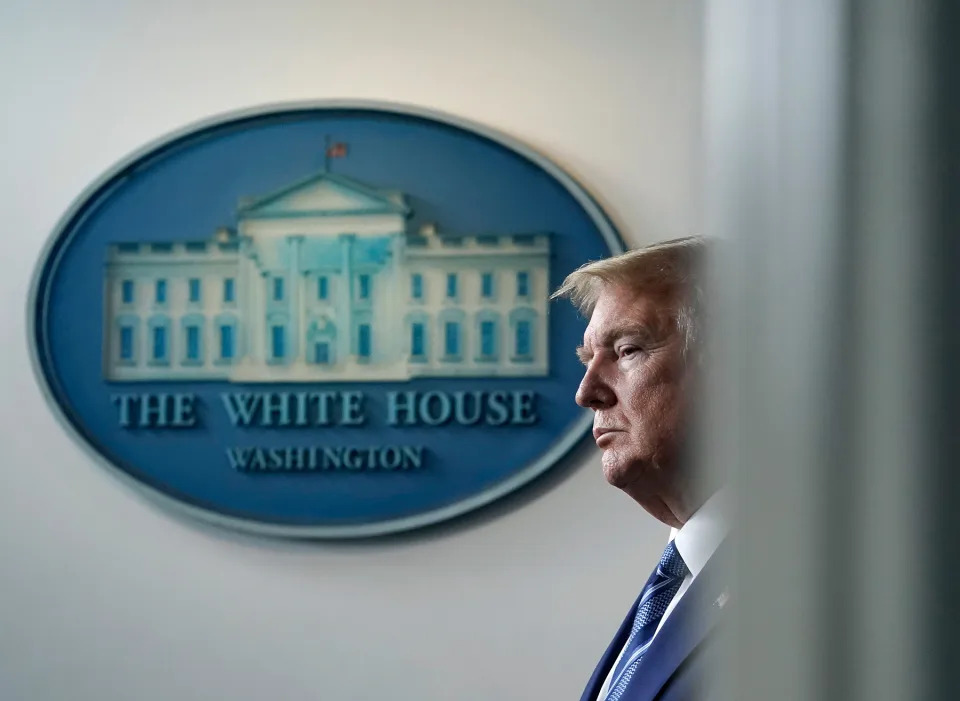
Then-President Donald Trump participates in a briefing at the White House on April 21, 2020.
The anything-anytime-anywhere approach inspired a sense of entitlement among Trump staffers. Some senior administration officials would casually mention their Xanax intake, one source with direct knowledge of the matter recalls. The source describes a time when an aide to Melania Trump walked into the White House Medical Unit and said, “‘Could you prescribe me Xanax.’ She just came in and demanded it.” The source wasn’t a doctor or pharmacist, however, and wasn’t allowed to prescribe the anti-anxiety drug. The source politely turned the aide down. “She stormed out,” the source says.
This is not, to put it mildly, how these drugs are ordinarily handled. “We tightly track controlled substances like this because they’re addictive or can cause overdoses,” says Dr. Beata Lewis, a psychiatrist based in Brooklyn. “It sounds like with all of these substances, people could get whatever they wanted. That puts people at risk for addiction.”
She adds: “The significant thing is these rules apply to everyone … except for the White House. It’s a culture of entitlement and being above the rules to the point of putting people in danger.”
There wasn’t much the medical unit staffers could do, even if they wanted to hold the line. Several told Pentagon investigators “they feared they would receive negative work assignments or be “fired” if they spoke out.
ADDING TO THE CLIMATE OF FEAR was the sense that even private therapy sessions would not be kept private in the Trump White House. The medical unit provided psychological counseling on request. But White House staffers were instructed to be on their guard. One former senior administration official tells Rolling Stone that within the first two years of the Trump presidency, they were warned by a colleague against divulging anything during a private White House medical session that they “would not want to be used against” them. At the time, this source notes, this puzzled the official, who was then told that under Trump, the office had a reputation for being more porous with private information “than you might expect.”
The former administration official didn’t think much of it at the time. The source shrugged the warning off as mere gossip and moved on. However, according to other individuals with intimate knowledge of the matter, it was hardly an idle rumor. Immediately after counseling sessions, therapists were pressed for information about what they were told.
“They’d say, ‘We need you to see this person.’ They’d walk me over there. I’d see this person. Then as soon as I got out, they would ask, ‘Hey what happened?’” one of these sources tells us. To this source, this was a blatant violation of patient confidentiality. The source would try to be as vague as possible in their responses to the questions, but in the Trump White House, “it was all kind of open kimono,” they say.
Keith Bass, who led the White House Medical Unit from 2017 to 2019, confirms that these sorts of debriefs did, in fact, happen after counseling sessions. But he says they never went into details; they were merely to determine whether a “medical/behavioral health event” would prevent a “military/DoD staff” member “from performing their duties or impac[t] their ability to maintain a [top secret] clearance while assigned to the White House,” Bass says in an email. “Detailed clinical notes were not required from the psychologist; only a broad overview to determine fitness for duty status.”
Our source says that’s not entirely accurate. For starters, these debriefs happened after therapy sessions with civilian staffers as well. And while the questions may have been “seemingly innocent,” the source says they could be seen as the start of a “slippery slope,” which would then “drif[t] down into asking for information that was not appropriate.”
The White House Medical Unit’s often casual approach to giving out controlled substances didn’t exactly inspire confidence. “The sloppiness around handing out medications had me highly concerned about the protection of behavioral health information — medical information at large. There was no protection of sensitive patient information, period,” the source says.
Any attempts to add more rigor were entirely unwelcome, the source adds. “The more I held to professional standards” — the more the source objected to the pressure to divulge details about therapy sessions, and to keep patient information private — the worse it got. White House staffers “ostracized me,” the source says. “Nobody would talk to me. The culture was toxic as fuck.”
MODAFINIL WAS DISCOVERED in the 1970s by French scientists and was first handed out to pilots to help keep them awake and on task in the 1991 Gulf War. The U.S. military started to use modafinil in earnest around the 2003 invasion of Iraq. At the time, it was heralded as a massive improvement over previous stimulants: stronger and more effective than caffeine, less physically addictive than amphetamines. “These medications aren’t stimulants like the old military ‘go pills,’ there are few if any side effects when taken as prescribed. They simply stave off drowsiness until the medication wears off, then you naturally fall asleep,” one knowledgeable source writes.
But that “taken as prescribed” caveat is crucial. When handed out willy-nilly, outside a doctor’s supervision, modafinil can pose serious risks, notes Dr. Rachel Teodorini, a researcher at London South Bank University’s division of psychology who has examined the drug and its effects. “If people have cardiovascular problems, heart problems, or blood pressure issues, it could cause things like strokes or heart attacks,” she tells us. And while modafinil doesn’t appear to physically hook patients, “there’s an element of at least psychological dependence. Tolerance builds up, and you need more and more.”
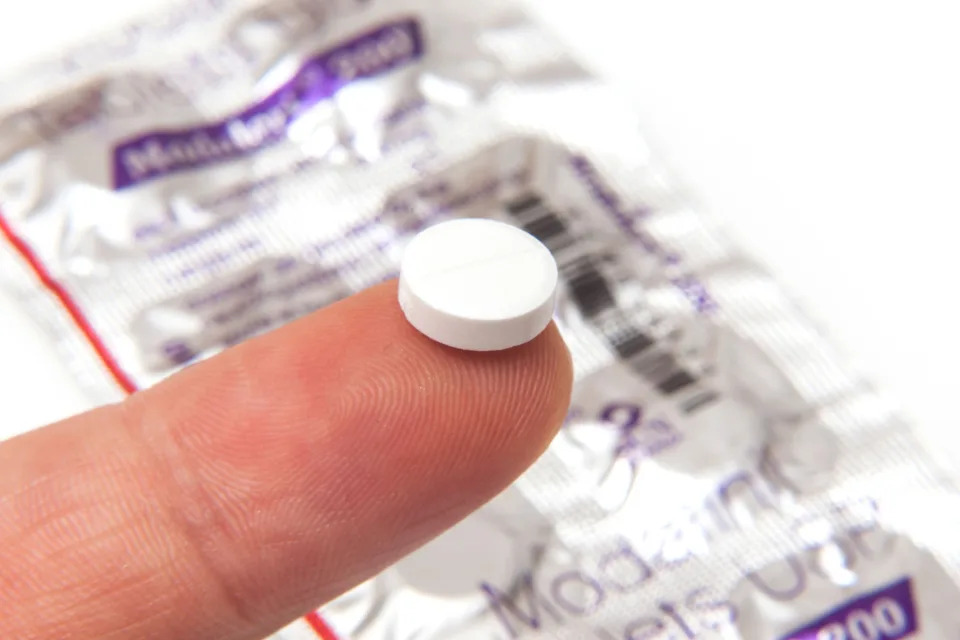
Modafinil tablets.
As a recent study in the journal Military Medicine notes, “although modafinil was initially said to comprise no risk for abuse, there are now indications that modafinil works on the same neurobiological mechanisms as other addictive stimulants.”
And just like with other stimulants, the overuse of modafinil can lead to the perceived need for anti-anxiety medications like Xanax. “Effectively, you’re using one drug to get you up and another to get you down,” Teodorini said.
Some former Trump staffers tell Rolling Stone they didn’t get these drugs directly from the White House Medical Unit. One former Trump White House aide concedes they “borrowed” some modafinil from “a friend,” who said they’d gotten it from the unit. “I had a lot going on in my life and I wanted some,” they say.
In other administrations, modafinil was used “99 percent of the time” for jet lag, one source notes. The Trump White House was a free-for-all. Two other sources each independently compared the White House during those years to college campuses where students cramming for finals or pulling all-nighters would pass around Adderall and other drugs, prescriptions be damned. But it wasn’t just the administration’s junior staffers — the recent college grads — who partook. The sources add that midlevel and certain senior officials — including those who reported to then-President Trump and First Lady Melania Trump — came to rely on modafinil, as well. The sources and former senior Trump officials, who all requested anonymity to discuss sensitive matters, recall instances of staff casually slipping the medical unit-provided stimulant to one another, in efforts to stay focused and help navigate the exhausting chaos of the Trump presidency.
It was “ironic” that Trump’s White House was “one place the war on drugs wasn’t being fought,” one of the former officials sardonically notes, given Trump and many of his lieutenants’ zeal for waging the internationalwar on drugs.
NEARLY EVERY SOURCE INTERVIEWED for this story traced the problems with the White House Medical Unit back to Jackson, who joined the team during the George W. Bush administration and became physician to President Barack Obama in 2013. Before then, he was known as an eccentric. Afterward, he became a menace, as several Defense Department investigations detail.
On a trip to Argentina in March 2016, one of those reports notes, Jackson’s “intoxicated behavior in the middle of the night, pounding on [a female subordinate’s] hotel room door, screaming, yelling, and overall loud behavior in his hotel room exhibited less than exemplary workplace conduct while on official travel to provide medical care for the President.” The Pentagon interviewed 60 of Jackson’s former subordinates; 56 “experienced, saw, or heard about [him] yelling, screaming, cursing, or belittling subordinates.” During a six-week stretch in 2018, a Defense Department hotline received 12 complaints” about Jackson. (Jackson’s office did not respond to a request to comment on this article.)
His nomination to become Secretary of Veterans Affairs that same year was derailed over accusations he handed out pills to White House staffers like a “candyman.” (In one case, a Senate report noted, medical staffers fell “into a panic” because he had given such “a large supply” of Percocet pain pills to a member of the White House Military Office.)
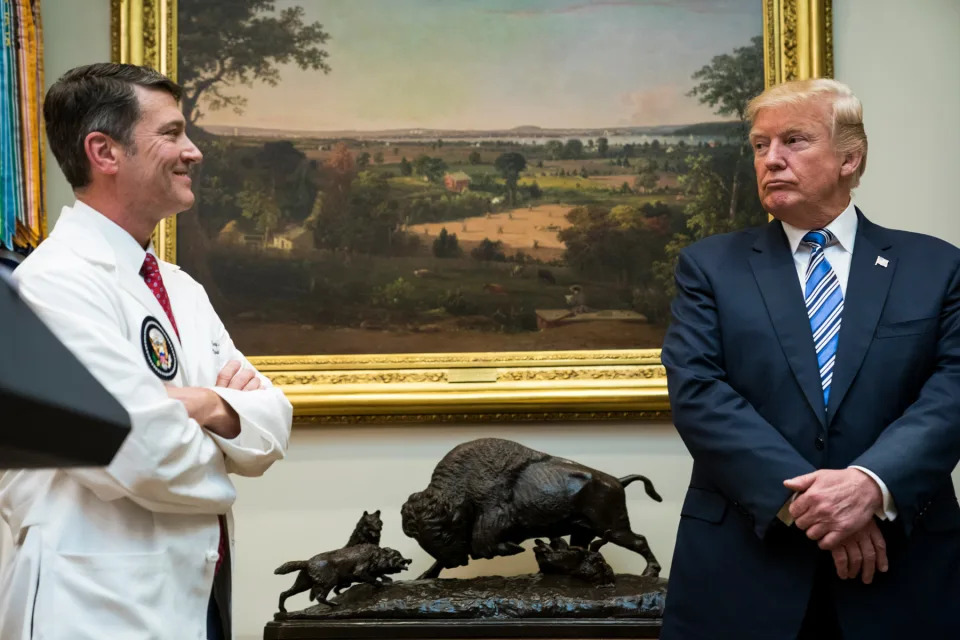
Then-President Donald Trump looks to White House physician Ronny Jackson during an event at the White House on Aug. 3, 2017.
Jackson briefly returned to the White House as Trump’s “chief medical adviser” in 2019 before running for Congress. But no matter what position he held, several sources tell us, his influence dominated medical care at the Trump White House, and Jackson’s “minions” and “loyalists” ran the White House Medical Unit in his stead. “Any practices existing at that time were all set up by Jackson, who’d been there for a dozen years. Though the med unit was led by an administrator, little happened without his say-so,” one of those sources say.
The source adds, “Unit leadership did slowly start making appropriate changes, but due to [the] complicated nature of missions, individual expectations within the organization, a self-imposed cone of silence and fear of being held liable for sins of the father, it took a long time to find the right way forward.”
OUR INTEREST IN THIS STORY was sparked, in part, by a handwritten ledger reprinted on page 14 of the January inspector general’s report: a tracking form for the controlled substances ordered by the White House Medical Unit. In addition to the thousands of pills of Ambien and Provigil listed are even more potent sedatives and pain pills: morphine, hydrocodone, diazepam and lorazepam (better known by their brand names, Valium and Ativan), fentanyl, and even ketamine.
Jackson, now a Republican congressman from Texas, told the Washington Post that his team prescribed narcotics “less than five times” across his tenure. And according to the paper’s sources, drugs like fentanyl were “kept on hand for extreme emergencies — such as a White House fence jumper impaling themselves on a spike.”
That’s a ridiculous example, a well-placed source tells us. “Someone just made up something. If there was a jumper, someone would call 911,” the source says. The jumper would then be transferred to a nearby civilian hospital.
But there was a grain of truth to the idea that the medical unit retained fentanyl and the like for extreme events. In the wake of the wars in Iraq and Afghanistan, there was a desire to bring the advances in battlefield medicine to the White House. If the president or vice president were to get shot in a remote location, far from any hospital, the unit’s physicians wanted to be able to insert a breathing tube into the VIP almost instantaneously, a process known as “rapid sequence induction and intubation.” Doing that requires sedating the patient in a hurry with powerful drugs.
“The unit employed the world’s standards in pre-hospital trauma care, as directed by the DoD’s Joint Trauma System & Committee on tactical-combat casualty-care guidelines. That includes the use of ketamine, fentanyl, etc. for pain management,” a second knowledgeable source writes. “The whole mission is contingency planning for providing most/best possible care for the worst/craziest scenarios.”
Needless to say, they never encountered a scenario that nuts. And we didn’t uncover any evidence that ketamine or fentanyl were handed out to White House staff the way Xanax and Provigil were.
But as the handwritten ledger shows — and our sources confirm — the medical unit’s procedures had grown so sloppy, so lax, that it’s impossible to prove the negative, that these sedatives and dissociatives weren’t given to White House staff. “In our analysis of the White House Medical Unit’s controlled substance records, we found that medications, such as opioids and sleep medications, were not properly accounted for,” the inspector general’s report reads. “These records frequently contained errors in the medication counts, illegible text, or crossed-out text that was not appropriately annotated.”
That might sound like minor errors in paperwork. They’re not. They’re the kind of transgressions that turn patients into addicts, and doctors into ex-doctors. “If you’re sloppy even a little bit with controlled substances, you’ll lose your [medical] license,” one source notes. Without proper record keeping, there’s no way to say just how much of the Trump White House was on drugs. There’s no way to tell how they might use — and abuse — prescription medications if they come back to power. “Nothing is written down,” another source says of the unit’s drug distribution during the Trump years, “because we will always get to yes.”
Trump warns of ‘languages coming into our country’ that ‘nobody’ has heard of
Alec Hernández, Jake Traylor and Katherine Koretski – March 3, 2024
Warning about the dangers of illegal immigration at the southern border has long been one of Donald Trump’s campaign mainstays, going back to the day he launched his first presidential bid. At the time, he said Mexico was sending “rapists” and people who were bringing “drugs” and “crime.”
But lately, the former president has seized on a new thing he says migrants are bringing: languages.
“We have languages coming into our country. We don’t have one instructor in our entire nation that can speak that language,” Trump said before a crowd of thousands of supporters at the Conservative Political Action Conference outside Washington, D.C., last month.
“These are languages — it’s the craziest thing — they have languages that nobody in this country has ever heard of. It’s a very horrible thing,” he added.
Trump repeated the comment the following week during an appearance at the southern border alongside Texas Gov. Greg Abbott, saying that migrants are entering the country speaking “truly foreign languages.”
“Nobody speaks them,” he said after a tour of the border in Eagle Pass.
And addressing a rally in Virginia Saturday night, Trump described New York classrooms as overwhelmed with “pupils from foreign countries, from countries where they don’t even know what the language is.”
“We have nobody that even teaches it. These are languages that nobody ever heard of,” he claimed.
It’s not entirely clear what languages Trump is referencing.
When asked to clarify Trump’s remarks, campaign spokesman Steven Cheung responded, “There are migrants invading from countries that we know nothing about, which is the point.” He did not respond to a follow-up question about what those countries are.
At campaign rallies, Trump routinely says he would carry out the largest domestic deportation operation in history if re-elected. Trump also vows to reinstate his infamous Muslim travel ban, expand it to include Gazan refugees, and incorporate “ideological screenings” for all immigrants. Trump has also claimed multiple times that immigrants are poisoning the blood of America, a comment President Joe Biden’s campaign likened to the rhetoric of Adolf Hitler.
“I’ve been so proud of how Joe has placed women at the center of his agenda. But Donald Trump?” the first lady said to boos. “He spent a lifetime tearing us down and devaluing our existence. He mocks women’s bodies, disrespects our accomplishments and brags about assault. Now he’s bragging about killing Roe v. Wade.”
The first lady continued: “He took credit again for enabling states like Georgia to pass cruel abortion bans that are taking away the right of women to make their own health care decisions. How far will he go? When will he stop? You know the answer: He won’t. He won’t.”
As the first lady embarks on a three-day, four-stop battleground state campaign swing, launching the “Women for Biden-Harris” coalition, her role in the reelection effort is becoming clearer. The campaign is looking to use a top surrogate to organize – and mobilize – female voters heading into the general election, all while delivering a clear message about Trump.
“Donald Trump is dangerous to women and to our families. We simply cannot let him win,” she said in Atlanta.
The first lady is also traveling through Arizona, Nevada and Wisconsin, and she’s expected to court Black and Latino communities as the campaign looks to make inroads with those key demographic groups.
Much of the first lady’s work in the early stages of the campaign has focused on crisscrossing the country for fundraisers, but in the months ahead she’s expected to become a more frequent presence on the trail advocating on behalf of her husband and his agenda.
The first lady has long said that she’s not a political adviser to the president, instead explaining to CNN that she helps her husband by relaying what she sees and hears from people on the road. But she is his most trusted partner and holds influence in the White House and campaign. She sits in on some of the president’s political meetings and hiring decisions for some key staff, sources familiar with the matter said, and is eager to hit the road to push for a second Biden term.
The first lady is juggling her campaign work with her official role and her full-time teaching job at Northern Virginia Community College. While she took a break from teaching for part of 2020 to focus on the campaign, there’s no indication just yet that she’s decided to do the same this year. The campaign is looking to hire staff to support the first lady as she ramps up her outreach, a source familiar with the plans said.
A majority of her travel in 2024 will be stateside with campaign season in full swing, but it’s possible she could travel alongside the president to the G7 summit in Italy in June, as well as attend the Paris Olympics, according to a source familiar with her plans.
How to use a less-divisive Biden
Jill Biden was an active surrogate on behalf of her husband in 2020 and campaigned for Democratic candidates down the ballot during the 2022 midterm elections. As she’s traveled the country to promote the administration’s initiatives, she’s appeared in a mix of red states and more moderate areas and is expected to take a similar approach in 2024.
“She’s not going to just go to deep, deep blue areas. She’s going to go to a variety of areas in this country,” a source familiar with the planning said.
Biden campaign advisers believe the first lady’s appeal has far reach – particularly with women and grassroots supporters and in moderate parts of the country.
“The first lady’s trusted voice has been critical in reaching the voters who will decide this election. As a mom, grandmother, and educator, the first lady is uniquely able to reach and relate to core constituencies and effectively communicate the President’s message to the American people,” Biden campaign manager Julie Chavez Rodriguez told CNN in a statement.
Like many first ladies who have come before her, Biden is making her pitch as a surrogate who is significantly more popular than her husband. A recent CNN poll conducted by SSRS found that 59% of respondents had an unfavorable opinion of the president, compared with 30% who viewed the first lady unfavorably. As a less polarizing and relatable figure, the first lady is now being deployed to sell her husband’s policies and candidacy to the critical coalition of women that he’ll need once more in November.
Female voters made up a key part of the president’s 2020 coalition – he won 57% of female voters, who made up 52% of all voters in the 2020 election, according to CNN exit poll data.
“Women for Biden-Harris” is the first coalition effort the campaign has launched as it hopes to use the days around Super Tuesday to mobilize voters. The women-focused effort will include organizing calls from campaign surrogates and digital ad buys targeted toward women. This will include digital ads from the first lady’s swing, marking the first time she and her campaign work will be a central focus of an advertising push this cycle.
The push for female voters was on display in Atlanta on Friday as the first lady encouraged women to use their voices to organize heading into November.
“We’re going to do what we did in 2020 and 2022. We’re going to talk to our friends, and we’re going to tell them why this election is so important. We’re going to tell them what’s at stake. Sign up for phone banks and canvassing shifts. We’re going to meet this moment as if our rights are at risk because they are. As if our democracy is on the line, because it is,” she said.
Dr. Biden, who is the first presidential spouse to keep her full-time job teaching English at a community college, often approaches her speeches from that teaching experience, trying to distill policy issues for voters in “real terms.” She’s also expected to leverage her personal background as a working mother and grandmother to connect with female voters, tapping into common threads in their lives to talk about the power of women.
“Here’s the thing about men like Donald Trump – they underestimate our power because they don’t understand it,” she said in Atlanta. “They see us working night shifts and making grocery lists, driving to soccer practices and volunteering, caring for parents and raising money for those in need, and they think we can be ignored. They don’t know that our to-do lists are our battle maps.”
“When our daughters’ futures are at stake, when our country and its freedom hangs in the balance, we are immovable and unstoppable,” she added.
On Saturday, the first lady was confronted with an issue that has caused frustration within parts of the Democratic Party – the president’s handling of the Israel-Hamas war. She was interrupted several times by pro-Palestinian protesters as she spoke in Tucson, Arizona, at an event for Arizona List, which works to elect Democratic women who support abortion rights.
Taking on Trump
Jill Biden’s willingness to hit the campaign trail aggressively – and to support a reelection campaign, her husband’s fourth and final presidential bid – stems in part from the president’s predecessor and expected opponent, she told journalist Katie Rogers in an interview for her book, “American Woman,” which explores the role of the modern first lady.
“I would rail against injustice if I feel like somebody who would be Joe’s opponent would not be a good thing for this country,” the first lady told Rogers when asked about Trump being the possible Republican nominee. “I think I would work even harder.”
As she prepared for her first speech of this week’s campaign swing, the first lady specifically wanted to tap into the feelings many Democrats had when Trump beat Hillary Clinton in the 2016 race to remind voters about what’s at stake in November’s election, a source familiar with her thinking said.
“We can’t wake up on November 6 like we did in 2016 terrified of the future ahead of us, thinking, ‘My God, what just happened? What are we gonna do now?’’” she said. “We must reelect Joe Biden and Kamala Harris.”
Many of her critiques of her husband’s predecessor this campaign season have come in off-camera fundraisers. In one of her first fundraisers of the campaign, she expressed shock that Republicans appeared to continue supporting the former president as he faced his first indictment.
In the hours after Trump called on Republicans in a social media post to block the president’s hard-fought bipartisan border package this year, Jill Biden fired back, telling a group of donors in Houston, “Trump is trying to do everything he can to make Joe look bad, you know, even at the lives – sacrificing lives of so many people just for his own political gain.”
The first lady, a fierce defender of the president, has also pushed back on other critiques of her husband, including from special counsel Robert Hur, whose report questioned the president’s mental faculties while noting that he couldn’t remember the year their son Beau Biden passed away from brain cancer.
That detail struck a nerve with the Biden family, and the campaign channeled the first lady’s frustration into an email sent in her name to defend her husband and call out “inaccurate and personal political attacks against Joe.” The personal missive, which only featured a donate button at the end and did not include a specific contribution ask from the first lady, became the campaign’s second most lucrative email since the president’s launch announcement.
Influence and issues
With her efforts on the trail, Jill Biden joins a long line of first ladies who have campaigned for incumbent presidents seeking a second term. That role comes with an inherent ability to influence public perception of their husbands.
“A first lady definitely has that opportunity and privilege, really, to soften the messages – even the hardest messages,” said Anita McBride, who served as a top aide to former first lady Laura Bush.
Biden is confronting challenges to women’s health care and reproductive rights, an issue her husbad’s campaign is making a centerpiece of its strategy to attract moderate voters.
While Vice President Kamala Harris is the administration’s lead voice on the topic, the first lady is also using her platform, meeting with women affects by the Supreme Court’s Dobbs decision that overturned Roe v. Wade and extending an early invitation to the State of the Union address to Kate Cox, the Texas mother of two who had to leave her state to seek an abortion to end a life-threatening pregnancy. She’s spoken about abortion in personal terms, recounting how she helped a high school friend recover from an abortion in the era before Roe v. Wade.
“Women will not let this country go backwards,” the first lady said. “We’ve fought too hard for too long. And we know that there is just too much on the line.”
She approaches the conversation from a practical, less political standpoint.
“It’s just the nature of the job of first lady – that is probably the only person who’s campaigning for the president that could really find the windows of opportunity to rise above the politics, turn down the heat a little bit, appeal to people’s sensibilities and compassion for each other,” McBride said, adding that Biden is able to speak to more controversial issues such as abortion in a “humanizing way, and just a less combative way” than elected politicians.
The first lady is also looking for ways to interact with people in the community, aside from formal events and campaign speeches.
Before leaving Atlanta on Friday, she visited 3 Parks Wine Shop, a small business owned by a Black woman, to hear about its work and the neighborhood while also partaking in a wine tasting.
The first lady decided to take two bottles – a red and a white – for the plane ride out West. And as the group members sampled a sauvignon blanc, they raised their glasses to a campaign season toast: “To 2024.”
The context behind Joe Biden, Donald Trump’s dueling immigration speeches at Texas border
Maria Ramirez Uribe – March 2, 2024
The two 2024 presidential election front-runners traveled to Texas on Thursday to deliver vastly different messages about a key election issue: immigration.
Former President Donald Trump stoked fear about the people crossing the southern U.S. border, citing recent high-profile criminal cases in which authorities charged immigrants who were in the U.S. illegally. President Joe Biden blamed Republicans for sidelining a Senate immigration bill he said would have given his administration the resources and powers needed to reduce illegal immigration.
Speaking at Eagle Pass, the epicenter of a feud between the state and the federal government, Trump joined Gov. Greg Abbott, the Border Patrol union’s leader and Texas National Guard members.
A few minutes after Trump spoke and about 300 miles south, Homeland Security Secretary Alejandro Mayorkas, U.S. Rep. Vicente Gonzalez, D-McAllen, and Border Patrol agents joined Biden as he spoke in Brownsville.
Trump spent the hours before his speech blasting Biden’s immigration policies over social media and in a Daily Mail article, seeking to position himself as the only person able to “stop Biden’s illegal immigrant invasion.”
At the end of his speech, Biden asked Trump to join him in getting Congress to pass the Senate border security bill.
“Instead of playing politics with the issue, why don’t we just get together and get it done,” Biden said.
PolitiFact listened to both presidential candidates. Biden overstated the authority provided to him in the border security bill. Trump made broad, often unsubstantiated statements about the migrants entering the U.S. and his administration’s immigration successes.
Here’s the context behind some of their statements:
Biden overstates possible effect of emergency authority in border security bill
The Senate bill “would also give me as president, or any of the next presidents, emergency authority to temporarily shut down the border between ports of entry.” — Biden in Brownsville
The Senate proposal, which failed 49-50, sought to enable the executive branch to block people from seeking asylum in between ports of entry if illegal immigration encounters reach certain levels.
That doesn’t mean people would stop coming to the border. A public health policy to mitigate COVID-19’s spread that was in place from March 2020 to May 2023 also largely blocked people from seeking asylum, but border encounters rose.
“There is this idea that we control how many migrants attempt illegal crossings. We do not,” Theresa Cardinal Brown, the Bipartisan Policy Center’s senior adviser for Immigration and border policy, previously told PolitiFact. “We control what happens once we encounter someone who has already crossed the border illegally.”
Under current immigration law, people on U.S. soil can seek asylum regardless of how they entered the country. The bill’s emergency authority tried to change that. But the government’s ability to quickly remove people from the U.S. would still hinge on its resources and other countries’ willingness to take back immigrants.
“In short, there is no authority that Congress could pass that would allow for a ‘complete and total shutdown of the border,’” Brown told us in February. “That’s just not how borders work in any real sense. Especially not our border with Mexico.”
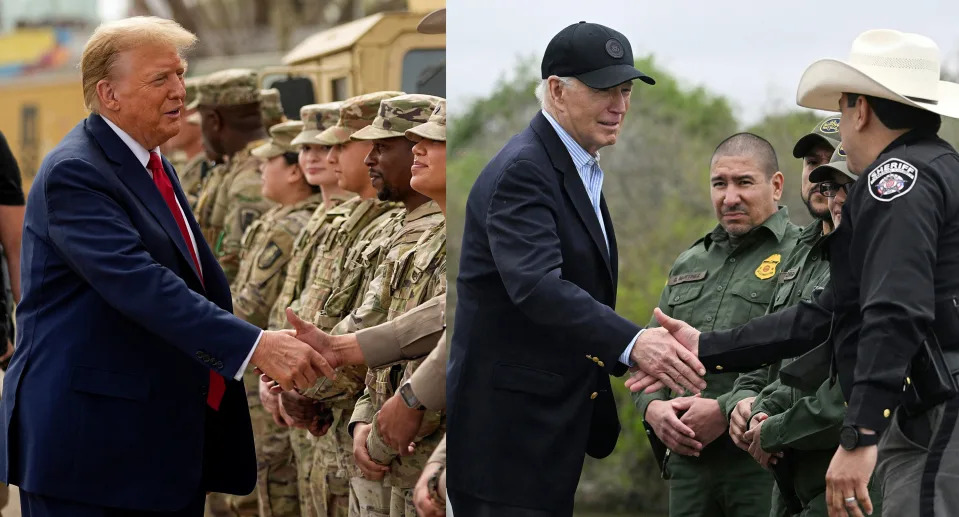
Former President Donald Trump and President Joe Biden were both on the border Thursday, with Trump in Eagle Pass and Biden in Brownsville.
Trump leaves out context on migrants and crime, exaggerates his administration’s success
The person charged with a Georgia nursing student’s murder “is an illegal alien migrant who was led into our country and released into our communities by ‘Crooked Joe’ Biden.'” — Trump in Eagle Pass
Laken Riley, a 22-year-old University of Georgia nursing student, was killed while on a run Feb. 22. Authorities charged Jose Ibarra with the murder.
Ibarra, a 26-year-old from Venezuela, was stopped by U.S. Customs and Border Protection when he illegally crossed the border in September 2022, according to Immigration and Customs Enforcement. Ibarra was paroled in, allowing him to be released in the U.S. to await further immigration proceedings.
There is conflicting information on whether he was arrested in New York City. ICE told PolitiFact the New York Police Department arrested Ibarra on Aug. 31, 2023, and charged him with “acting in a manner to injure a child less than 17 and a motor vehicle license violation.” ICE said the police released him before immigration authorities were able to issue a detainer request for him. But NYPD told PolitiFact there were no arrests under the name “Jose Ibarra” in 2023.
Despite high-profile cases of crimes committed by, or charged to immigrants in the U.S. illegally, research shows that immigrants aren’t more likely to commit crimes than U.S.-born people. A 2023 Stanford University study found immigrants are 30% less likely to be incarcerated than people born in the U.S. Research published in 2024 by the libertarian Cato Institute found that in Texas, immigrants in the U.S. illegally have a lower homicide conviction rate than people born in the U.S.
“We ended catch and release.” — Trump in Eagle Pass
This is misleading and doesn’t reflect what happened. Republicans often use the term “catch and release” to describe immigration authorities stopping immigrants at the border and releasing them so they can await their court hearings outside of federal custody.
Both Democratic and Republican administrations have followed this practice for decades because there’s limited detention space and court rulings have capped how long someone can be held.
In January 2017, Trump signed an executive order to end “catch and release.” But a few months later, his own attorney general testified to the Senate that the practice continued because of the long case backlog and a shortage of immigration judges.
“We built 571 miles of border wall, much more than I promised I’d build.” — Trump in Eagle Pass
During his 2016 presidential campaign, Trump promised to build a border wall along at least 1,000 miles of the nearly 2,000-mile U.S. southern border. He didn‘o‘t fulfill that promise.
U.S. Customs and Border Protection data say the Trump administration built barriers along 458 miles. But even most of that construction replaced existing smaller, dilapidated barriers and didn’t add to the total miles of southern border barriers.
The amount of new primary barriers built — 52 miles — is about 10 times less than Trump’s estimate. Primary barriers are the first impediment people encounter when trying to cross the border from Mexico; they can block people who are walking or driving.
Trump waves at migrants he’s trying to keep out at the US-Mexico border
Alia Shoaib – March 2, 2024
Donald Trump waved at migrants at the southern border and exclaimed that they like him.
Trump has proposed launching a mass deportation campaign if reelected in 2024.
On a rival visit, Biden urged Trump to support a bipartisan border security package.
Former President Donald Trump waved and pumped his fist at migrants at the southern border with Mexico — the very same ones he is trying to keep out of the country.
“They like me, governor,” Trump added to Texas Gov. Greg Abbot, who was taking him on a border tour.
Trump has suggested that he would launch the largest deportation campaign in history if he’s reelected in 2024, among other stringent measures to keep migrants out.
Not long after he waved at the migrants, Trump gave a speech at Eagle Pass in which he said Biden had the “blood of countless innocent victims” on his hands” because of his immigration policies.
He listed specific cases in which undocumented immigrants were reported to have attacked people, including the killing of 22-year-old Laken Riley, whose death has grabbed national attention.
“The monster charged in the death is an illegal alien migrant who was led into our country and released into our country by crooked Joe Biden,” Trump said.
Despite such individual cases, studies have found that immigrants are less likely to commit crimes than US-born individuals.
President Biden tells Trump — ‘join me’
Migrants wait in line adjacent to the border fence under the watch of the Texas National Guard to enter into El Paso, Texas, May 10, 2023.Andres Leighton/AP Photo
President Joe Biden simultaneously visited another border town across the state on Thursday as both tried to score political points on the flash point issue of immigration as the November election nears.
Polls show that immigration is one of Biden’s major vulnerabilities, and Trump has continued to highlight his contrastingly draconian approach.
On his rival Texas visit, Biden urged Trump to help him pass his proposed border security package, which Republicans tanked under Trump’s orders.
On his rival Texas visit, Biden urged Trump to help him pass his proposed border security package, which was tanked by Republicans under Trump’s orders.
The package would see billions of dollars put toward staff and resources on the southern border, where officials have been overwhelmed by a surge in migrant crossings.
“Here’s what I would say to Mr Trump,” Biden said. “Instead of playing politics with the issue, instead of telling members of Congress to block this legislation, join me.”
“You know, and I know it’s the toughest, most efficient, most effective border security bill this country’s ever seen. So instead of playing politics with the issue, why don’t we just get together and get it done?” Biden said.
Don’t want Russia to successfully invade your country? Then do this.
Michael Peck – March 2, 2024
Russia’s attempt to seize Hostomel airport in 2022 was part of a “well-established playbook.”
“Appreciation of this playbook is key for states who might find themselves in the crosshairs,” experts wrote.
Even though Russia may dwarf a small state, that doesn’t guarantee a successful airport seizure.
Here’s some advice for nations who don’t want Russian troops as uninvited guests: Guard your airport.
That’s the recommendation from two American defense experts who point to a pattern in Russian operations over the last 50 years: when the Kremlin wants to occupy another nation, it goes for the airport.
Russia’s failed attempt to seize Kyiv’s Hostomel airport at the start of the 2022 Ukraine invasion was part of a “well-established playbook,” Kevin Stringer and Heather Gregg wrote in an essay for West Point’s Modern War Institute. Moscow sent commandos and paratroopers to seize airports in Prague in 1968, Kabul in 1979 and Sevastopol in 2014, to facilitate an advance by ground troops invading across the border.
“An appreciation of this playbook is key for states who might find themselves in the crosshairs of future Russian aggression,” the essay warned. The strategy can work with blistering speed as elite assault troops seize the airport to create an aerial beachhead. Air transports can then fly in reinforcements to expand the airhead, while waiting to link up with armored columns pouring across the border.
Russian operations follow a typical sequence, according to the essay. “Positioning conventional forces on the borders of the targeted country to amplify political pressure and organize for invasion; infiltrating special operations (Spetsnaz) units to prepare and spearhead the incursion; seizing a strategic airport through airborne units; and airlanding additional assault troops to secure the battlespace and decapitate the national government in conjunction with the already inserted special operations units.”
The airport invasion force typically comprises a “special forces detachment to achieve surprise, followed with a battalion-sized element to pave the way for at least a brigade to follow on,” Stringer, a retired US Army colonel, told Business Insider. A Russian brigade typically numbers about 4,000 paratroops.
The strategy doesn’t always work. The 2022 Kyiv air assault was a fiasco: air strikes failed to suppress Ukrainian air defenses that shot down numerous helicopters, close air support for the airhead was lacking, and Ukrainian forces quickly counterattacked the 300 beleaguered paratroopers.
However, other Russian airport takedowns have been largely successful. The Prague attack helped Warsaw Pact forces to occupy Czechoslovakia with minimal fighting and casualties. The Kabul attack, which aimed to topple Afghan president Hafizullah Amin, was bloodier: Hundreds of Afghans, as well as KGB and Spetznaz commandos, died during an assault on the presidential palace that ended with Russian troops killing Amin. At Sevastopol, Spetznaz units (the notorious “little green men” in unmarked uniforms) seized two airfields in a mostly bloodless operation.
Russian soldiers take their position upon their landing at an unspecified location in Ukraine in this image released on Dec. 6, 2022.Russian Defense Ministry Press Service/AP Photo
Given that seizing airports has worked for Russia in the past, it’s reasonable to assume the Kremlin will use similar methods against other potential targets, such as the Baltic States, Moldova or Georgia. But that’s easier said than done for small nations with small militaries. “Russia may have its hands full in Ukraine right now, but adequately preparing for Russia’s invasion playbook takes time,” the essay said. “This, combined with Russia’s pattern of invading a country and deposing its leadership, makes it critical for vulnerable countries to take measures to counter the threat. For countries like Moldova and Georgia, this preparation is no small feat, given that both have Russian troops already in their country, are relatively small, and are faced with a range of resource constraints.”
The authors suggest several solutions that aren’t ruinously expensive. The first is to deploy special military units to defend key airports. “The Ukrainians left elements of the 4th Rapid Reaction Brigade of the National Guard at the Antonov Airport, despite the overwhelming need for Ukrainian troops to confront the Russian invasion at its borders,” the essay noted. “This unit of around three hundred troops succeeded in frustrating the Russian forces’ seizure of the airport and rendered the airstrip unusable, foiling subsequent Russian efforts to land forces and seize the capital.”
Stringer points to a special airport defense regiment that Switzerland stationed at Zurich Airport during the Cold War, as a good model. “It was a brigade-sized element of approximately 3,000 personnel, primarily local reservists on standby. It consisted of four operational battalions armed with machine guns, 81-mm and 60-mm mortars, armored personnel carriers with 20-mm cannon, and Stinger anti-aircraft missiles. Airport vehicles could be used to block the runway. I think this model would be both pragmatic and affordable for a small state today.”
Even though Russia may dwarf a small state in military power, that doesn’t guarantee a successful airport seizure. Lightly armed airborne troops have historically been vulnerable to anti-aircraft defenses as they fly in and counterattacks by the defender before they can organize a ground position. “If the defense is prepared, the Russians are vulnerable,” Stringer said. “This vulnerability increases if they do not have air superiority over the airfield.”
If Russian troops do manage to capture an airport, the defender’s best option is “immediate counterattack to dislodge the assaulting force and block the runway in order to prevent reinforcement and expansion of the airhead,” Stringer said.
The US and Europe can also assist vulnerable nations in defending their airports. “The United States military has several units dedicated to seizing or securing airstrips, particularly within the Army’s 75th Ranger Regiment and Air Force special operations forces,” the essay said. “These units could provide valuable training on how to plan for and disrupt a Russian assault on critical airports. Similar capabilities exist within European special operations and conventional forces, including countries with total defense plans, such as Finland and Sweden.”
In addition, the US and Europe may also be able to provide intelligence warnings of Russian plans to capture airports. For example, before Russia’s February 2022 invasion, the CIA reportedly warned Ukraine of plans to capture Hostomel Airport.
“Ultimately, at-risk states and the countries that advise and support them should aim to increase the costs for Russia to execute its invasion playbook,” the essay concluded. “Understanding and delineating the sequence of events Russia has historically used to initiate a coup and devising countermeasures to thwart these actions may prove critical in defending against the next Russian invasion.”
Michael Peck is a defense writer whose work has appeared in Forbes, Defense News, Foreign Policy magazine, and other publications. He holds a master’s in political science.
Rachel Maddow Fries SCOTUS for Trump Immunity Hearing Date: ‘It’s BS’ and ‘They Don’t Care That We Know It’ | Video
Ross A. Lincoln – February 28, 2024
Rachel Maddow had strong feelings about the news Wednesday that the Supreme Court will take up Donald Trump’s “presidential immunity” claims, but won’t hear the case until late April.
Maddow appeared alongside fellow MSNBC host Lawrence O’Donnell as a guest on Wednesday’s “All In With Chris Hayes” where, during their discussion, she explained why the decision to even hear the case at all makes no sense and called the nearly 2 month delay “BS.”
“They know it, and they don’t care that we know,” Maddow added. You can watch the clip now at the top of the page.
For background, at issue is the unconstitutional argument Trump introduced last fall in the criminal trial over his efforts to overthrow the government after the 2020 election: That U.S. presidents have total legal immunity from all criminal acts. In case you forgot, yes, his lawyers say this applies even if a president literally murdered political opponents.
After that trial was delayed, Special Counsel Jack Smith attempted to fast track this question to SCOTUS but in December the court denied that request without explaining why. Then on Feb. 6, a federal appeals court firmly rejected it, after which Trump’s lawyers appealed to SCOTUS.
So it is that on Wednesday, after taking nearly all month to say anything, SCOTUS announced it will hear arguments on April 22. Legal experts and critics of the court’s right wing majority say this is nothing more than an effort to help delay Trump’s criminal trials until after the 2024 election. Which brings us back to Maddow.
During the discussion with Hayes and O’Donnell, Maddow said, “the cravenness of the court is evident in what they are doing with the pacing here… putting this off for seven weeks, sitting on it for two weeks for no reason, obviously pushing all of the cases that they can push, pushing them to the point where Trump will be standing for election before any of us have heard the verdicts in any of those cases.”
“Got it? It’s the timing but it’s also the idea that the immunity thing is an open question,” she continued, displaying some sarcasm in her voice. “Right. Is it really? Presidential immunity an open question? Because what’s the most famous pardon in American history? Gerald Ford pardoning Richard Nixon once he had resigned and was a former president.”
“Why did Gerald Ford pardon Richard Nixon? Quote, ‘as a result of certain acts or omissions occurring before his resignation as president,’ meaning as a result of stuff he did while President, quote, ‘Richard Nixon has become liable to possible indictment. Whether or not he shall be so prosecuted depends on findings of the appropriate grand jury and the discretion of the authorized prosecutor,” Maddow continued.
“So the idea that this is an open question, that it might be that a former president can never be tried for something that he did, because he was president when he did it, is disproven by a plain reading of American history and the whole justification for Richard Nixon being pardoned in the first place,” Maddow explained. “So the idea that this has to be taken up, is them saying ‘the sky is green.’”
“And I think even for the non lawyers among us to be able to say, ‘you know what, the sky is not green, even on our worst day, this is B.S., you’re doing this as a dilatory tactic to help your political friend, your partisan patron.’ It’s just flagrant, flagrant bull pucky, and they know it, and they don’t care that we know it. And that’s disturbing about the future legitimacy of the court,” Maddow concluded.
“More indictments await”: Experts say Jan. 6 architect’s secret tweets may lead to “felony charges”
Igor Derysh – February 27, 2024
Kenneth Chesebro Alyssa Pointer/Getty Images
Right-wing attorney Kenneth Chesebro, one of the keyarchitects of former President Donald Trump’s Jan. 6 fake elector scheme, concealed a secret Twitter account from Michigan prosecutors that was filled with posts that undercut his statements to investigators about his role in Trump’s election subversion scheme, according to CNN.
Chesebro denied having a Twitter account or any “alternate IDs” when asked by Michigan prosecutors last year, according to recordings of his interview obtained by the outlet.
But CNN’s K-FILE linked Chesebro to a secret account — BadgerPundit — based on matching details, including biographical information about his work and travels as well as his family and investments.
The posts show that before the election and days after polls closed, Chesebro promoted a “far more aggressive election subversion strategy than he later let on in his Michigan interview,” CNN reported.
Chesebro’s attorneys confirmed to CNN that the account belonged to Chesebro, calling it his “random stream of consciousness” where he was “spitballing” theories about the election but argued that it was separate from his legal work for Trump’s campaign.
“When he was doing volunteer work for the campaign, he was very specific and hunkered-down into being the lawyer that he is, and gave specific kinds of legal advice based on things that he thought were legitimate legal challenges, versus BadgerPundit, who is this other guy over there, just being a goof,” Chesebro’s attorney Robert Langford told the outlet.
Chesebro, who framed himself as a moderate go-between who was pulled in deeper by Trump’s extremist lawyers, has not been charged with any crimes in Michigan.
“Our team is interested in the material and will be looking into this matter,” a spokesman for the Michigan attorney general’s office told CNN.
Chesebro claimed to investigators that the so-called fake elector plot was just a contingency in case Trump’s team won any of the election lawsuits, which they ultimately failed to do. He claimed to Michigan prosecutors that he told the Trump team that “state legislatures have no power to override the courts.”
But BadgerPundit argued that the litigation did not matter and that Republican-controlled state legislatures had the power to send their own electors.
“You don’t get the big picture. Trump doesn’t have to get courts to declare him the winner of the vote. He just needs to convince Republican legislatures that the election was systematically rigged, but it’s impossible to run it again, so they should appoint electors instead,” BadgerPundit wrote on Nov. 7, 2020, days after President Joe Biden was projected as the election winner.
Chesebro claimed to prosecutors that he saw “no scenario” in which then-Vice President Mike Pence could “count any vote for any state because there hadn’t been a court or a legislature in any state backing any of the alternate electors.”
BadgerPundit tweeted more than 50 times that Pence had the power to count the alternate electors, according to CNN.
Chesebro also claimed that he was “misled” by the Trump campaign concealing the entire plan for him and claimed he only realized they planned to deploy the fake electors regardless of what happened with the lawsuits. But on Twitter, he shared an Atlantic article citing a “Trump legal adviser” who described the full plan.
Chesebro’s attorneys acknowledged to CNN that “there’s clearly a conflict” between some of the tweets and what he told prosecutors, but argued that some of his online theories were “inconsistent” with legal advice he gave the Trump campaign.
Though Chesebro has not been charged in Michigan, he agreed to plead guilty in the Fulton County, Ga., RICO case to one felony count and gave proffer interviews to prosecutors. Chesebro was also identified as an unindicted co-conspirator in the federal D.C. election subversion case.
“Chesebro appears to have pursued a legally perilous path in his dealings with Michigan authorities,” Ryan Goodman, a law professor at New York University, told CNN. “The Twitter posts strongly suggest Chesebro committed the crime of making false statements to investigators… his entire cooperation agreement may now fall apart.”
Goodman added that it appears that Chesebro “hid highly important evidence in the form of these social media posts from the investigators,” which could put him at “great legal risk.”
“We should have asked for clarity, and that was our screw-up,” Chesebro attorney Manny Arora acknowledged to CNN when asked about his client denying his Twitter account. Arora added that he has since provided “all the information on BadgerPundit” to investigations in “all the different states that are involved.”
But CNN legal analyst Elie Honig, a former federal prosecutor, argued that the news further undercuts Chesebro’s value to prosecutors in Georgia.
“Kenneth Chesebro is facing more legal jeopardy now, and he is not and never has been a viable cooperator for prosecutors in Georgia,” he said Monday, arguing that Chesebro’s statements to investigators were “misleading at best, outright false at worst.”
Honig called Chesebro’s attorneys’ defense “utterly nonsensical.”
“He is not a viable cooperator for the Fulton County D.A.,” Honig added. “They gave Kenneth Chesebro a softball deal. They let him plead out to probation. And the reason they gave us well, he’s cooperating, no he is not, he has not come clean. He is a failed cooperator. That’s a black eye for the Georgia district attorney as well.
Longtime Harvard legal scholar Laurence Tribe predicted that “more indictments await” following the Twitter revelation.
“Chesebro’s secret Twitter account could lead to serious felony charges in Michigan and will augment his eventual federal indictment by Jack Smith,” Tribe tweeted. “The guy is in a huge heap of trouble that his guilty plea in Georgia barely touches.”
Yellen Sees Moral Case to Use Russian Assets to Aid Ukraine
Viktoria Dendrinou and Christopher Condon – February 27, 2024
Yellen Sees Moral Case to Use Russian Assets to Aid Ukraine
(Bloomberg) — US Treasury Secretary Janet Yellen called on the world’s largest advanced economies to find a way to “unlock the value” of immobilized Russian assets to help bolster Ukraine’s defense against Russia’s invasion and for long-term reconstruction after the war.
“There is a strong international law, economic and moral case for moving forward,” Yellen said Tuesday in Sao Paulo in remarks before meeting with counterparts from the world’s top economies. “The G-7 should work together to explore a number of approaches that have been suggested.”
Her comments come as Group of Seven nations are debating what to do with sovereign assets that were frozen at the outbreak of the invasion, with Ukraine’s financing needs remaining persistently high and the war now in its third year with no sign of abating.
The European Union, G-7 nations and Australia have frozen about €260 billion ($282 billion) in the form of securities and cash, with more than two-thirds of that immobilized in the EU. The parties all agree that those funds should remain off-limits to Russia unless it agrees to assist in Ukraine’s reconstruction, but they’re at odds over the legality of seizing the assets outright.
Yellen said that beyond simply seizing the assets, other ideas include using them as collateral to borrow from global markets.
Unlocking the assets to help Ukraine “would be a decisive response to Russia’s unprecedented threat to global stability,” Yellen said. “It would make clear that Russia cannot win by prolonging the war and would incentivize it to come to the table to negotiate a just peace with Ukraine.”
In the wake of the freezing of Russian assets and far-reaching sanctions on the country, a number of emerging nations have called for reducing the role of the dollar in global trade and finance. But Yellen in her remarks Tuesday suggested little concern on that front.
Read More: De-Dollarization Wins Applause at BRICS Summit
Group Effort
“Realistically there are not alternatives to the dollar, euro, yen, so I’m not too worried about that,” she said. “With regard to financial stability I suppose a risk would arise if there were a massive shift away from currencies, but I think that is extremely unlikely — especially given the uniqueness of this situation, a situation where Russia is brazenly violating international norms.”
The Treasury chief noted that the US didn’t move unilaterally to capture Russia’s assets. “A group of countries representing half of the global economy and all of the currencies that really have the capacity at this point to serve as reserve currencies, we all act together.”
Discussions on using Russian assets have intensified as President Vladimir Putin’s forces gain momentum on the battlefield. As Republicans in Washington continue to set hurdles for new aid for Kyiv, the Biden administration is keen to offer Ukraine another important signal of its support.
The US and UK have been pushing G-7 allies to seize the central bank assets outright, but the group’s European members, especially France and Germany, are currently opposed to the move over legal concerns and worries that it could damage the stability of the euro as well as set a dangerous precedent.
Earlier: France and Netherlands Back Plan to Buy Non-EU Ammo for Ukraine
The position of EU member states is crucial as the vast majority of the funds are in Europe, mostly at the Belgium-based clearing house Euroclear. The clearing house and the European Central Bank are both skeptical of the right to seize the assets.
Still, G-7 nations are discussing options. Among the ideas under discussion is using the funds as collateral to raise debt or as guarantees for loans.
The EU is slowly making progress on plans to at least apply a windfall tax to the profits generated by the immobilized funds. Last year, the funds enabled profits of €4.4 billion.
(Adds tout before ‘Group Effort’ subheadline. A previous version of this story was corrected to reflect the assets were frozen not seized.)