Letters to the Editor: Dear Trump supporters: You’re better than this, right?
Los Angeles Times Opinion – March 7, 2024
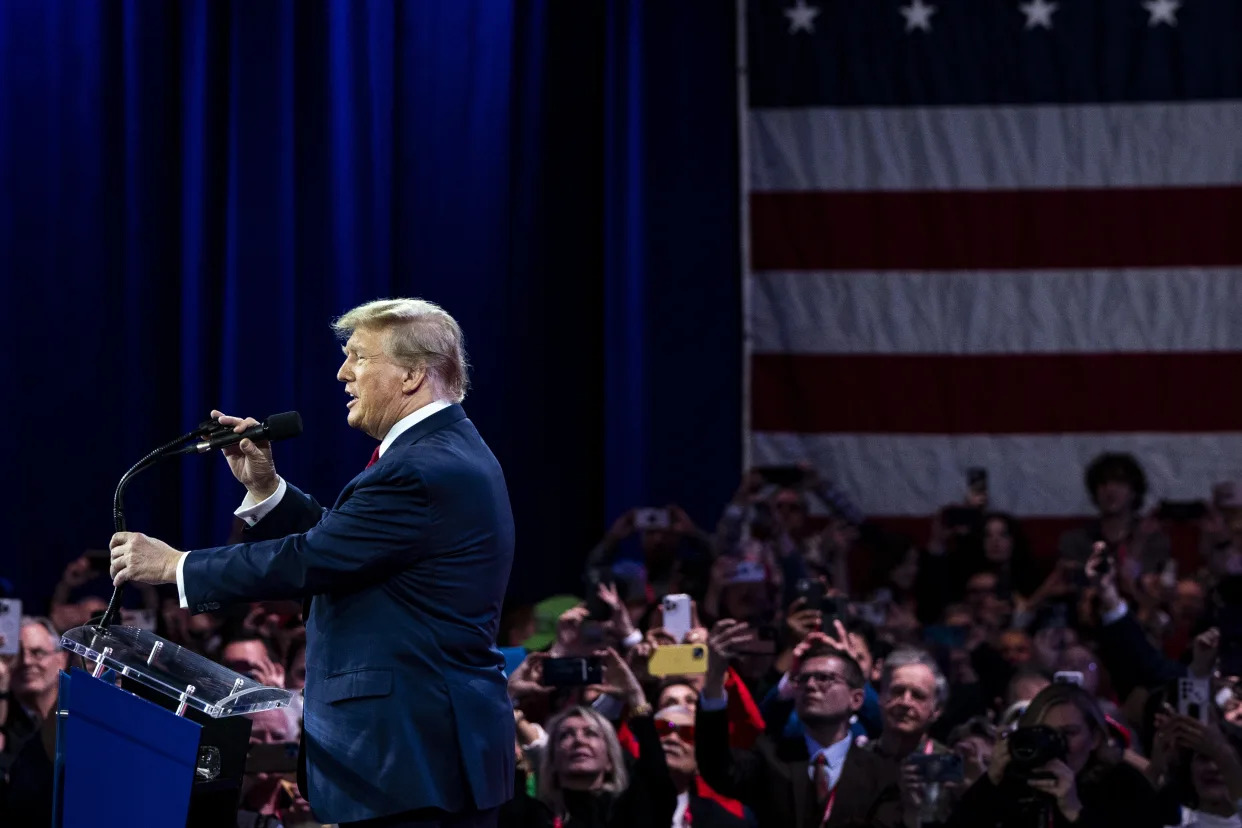
Donald Trump speaks at a primary election night party at Mar-a-Lago in Palm Beach, Fla., on March 5. (Rebecca Blackwell / Associated Press)
You don’t need me to tell you that the former president is a liar, a cheat, a fraud, a bigot, a bully — I could go on. You know this and ignore it.
What I want you to consider is, what does this say about you? Is this the kind of person your parents taught you to be or to support? Are these the values you grew up with? I doubt it, or there would be a lot more evil in the country than there already is.
Yet you succumb to this man’s act. You are better than this.
I am writing this not to get out the vote for President Biden, but rather to ask you about your own motives. I may even vote for Republican Nikki Haley if she is nominated — at least she is honest.
For most of us, our family histories didn’t begin in America. We are a country of immigrants. To elect a person such as Trump is to spit in the faces of ancestors who struggled to come to this country to escape rulers like him.
Deborah Coplein, Newark, Del.
..
To the editor: Imagine having elected politicians with the courage to abandon some of the least popular presidential candidates in history rather than to go along to try to hang on to their own power.
Imagine them choosing presidential candidates who will offer choices based on statesmanship in international affairs.
Imagine presidential candidates able to think straight and understand that the needs of the nation may be larger than their egos.
Imagine the same politicians forced to run in districts not designed to keep them in office without real competition.
Imagine them all striving to create a true liberal-versus-conservative debate based on actual issues rather than name calling, ideology and fear.
Imagine the effective and honest democracy all this would create.
Philip Borden, Rancho Palos Verdes
..
To the editor: Most patriotic Americans agree that stopping Trump is the obligation of all citizens and should be for all politicians.
If Biden is the patriot that he would like us all to believe he is, then he should ask Republican Nikki Haley to be his vice presidential running mate.
Doing so would certainly bring the country together in a way never seen before and demonstrate his commitment to putting country first.
How Trump’s Crushing Primary Triumph Masked Quiet Weaknesses
Michael C. Bender – March 7, 2024
Former president Donald Trump speaks at the Conservative Political Action Conference gathering at the Gaylord Hotel in National Harbor, Md., Feb. 24, 2024. (Haiyun Jiang/The New York Times)
Donald Trump’s daunting level of Republican support helped him vanquish a field of presidential primary rivals in under two months.
But he still hasn’t won over one small but crucial group of voters — the men and women who cost him a second term in 2020.
His overwhelming primary victories, including more than a dozen Tuesday that pushed Nikki Haley from the race, have masked his long-term problems with voters who live in the suburbs, those who view themselves as moderates or independents, and Republicans who backed Joe Biden in 2020.
On Tuesday, Trump lost suburban precincts in Virginia despite carrying the state by a staggering 28 percentage points. In North Carolina, his 51-point victory was tempered by much narrower margins in the highly educated and affluent suburbs around Charlotte and Raleigh.
While many Republican strategists anticipate that most Haley voters will eventually support the party’s nominee, Trump’s failure to bring these voters into the fold less than four years after they helped block him from a second term in the White House raises pressing questions about what he can do in the next eight months to win them over.
He has not seemed especially concerned about this challenge, recently threatening to excommunicate his rival’s donors from his political movement. On Wednesday, he posted on social media that Haley “got TROUNCED last night, in record setting fashion,” even as he invited “all of the Haley supporters to join the greatest movement in the history of our Nation.”
Trump’s inability to broaden his support stands among the biggest threats to his party’s efforts to reclaim the presidency. Notably, Haley appeared to be a stronger November candidate: Polls including a recent New York Times/Siena College survey suggested that she would have had an easier time unseating Biden.
Throughout the Republican primary race and in this week’s Super Tuesday contests, Trump amassed blowout winning margins. Voters rallied around him even as he accumulated 91 felony charges in four criminal cases and looked past their party’s disappointing elections under his leadership in 2018, 2020 and 2022.
His victory last month in Iowa, the first nominating contest, was declared before many caucusgoers had even weighed in, a fitting metaphor for the air of inevitability he proudly carried into the race. The Republican primaries in New Hampshire and South Carolina drew record turnout, thanks mostly to Trump voters, and he swept every Super Tuesday state except Vermont, where Haley won thanks to the tiny state’s large percentage of college-educated voters.
“That’s the big lesson from the primary states so far: There are a significant number of Republican voters who wanted a choice in this primary process, and they are people the former president has to win over by the time November comes around,” said Rob Godfrey, who served as a top aide to Haley when she was governor of South Carolina and as a senior adviser to Gov. Henry McMaster’s reelection campaign in 2022. “He can do it if he runs a disciplined campaign on policy and not personality, and one that focuses on the perceived failures of his opponent.”
Trump’s campaign expects to focus heavily on turning out supporters but will look for ways to reach out to disaffected Republicans. The former president has been looking to again calibrate his position on abortion rights, with Republicans still feeling the backlash of the overturning of Roe v. Wade by a conservative Supreme Court majority he helped usher in.
Two Unpopular Nominees in Waiting
Biden, for his part, is struggling to hold his winning 2020 coalition together. He is significantly less popular than he was four years ago, and polls show that Democrats are skeptical of his second campaign.
Just 83% of voters who backed Biden in 2020 said they would do so again this year, a stark contrast from the 97% of Trump voters planning to stick with the former president, according to the Times/Siena poll released last week.
Biden’s age, his support for Israel in its war in the Gaza Strip and lingering economic unease have chipped away at his support among young Democrats, Black voters and progressives.
“We can learn a little bit from these primaries — for one, Trump has reenergized his base,” said Adam Geller, a longtime Republican pollster who has worked for past Trump campaigns and super political action committees. “But beyond that it remains to be seen, because all the public polls show that moderate general-election voters aren’t ready to give a bouquet of roses to either Trump or Biden quite yet.”
But while many of Biden’s challenges revolve around policy, Trump faces more persistent doubts about his personality and temperament that have trailed him for years.
Cory Barnett, 48, a physician in Nashville, Tennessee, who usually backs Republicans, said he would rather see a second term for Biden than for Trump. He voted Tuesday for Haley even though he knew the former president was on a clear path to the nomination.
“I actually feel like I’m throwing away my vote today,” he said. “It’s just a personal statement, I guess.”
Shying Away From Trump in the Suburbs
Trump has repelled suburban moderates since his takeover of the Republican Party in 2016. He has yet to draw them back.
In the suburbs, Trump split the vote with Haley in Iowa and New Hampshire, even though he won both states with ease. He carried the suburbs in South Carolina, but by a smaller margin than his overall victory in the state.
Those trends continued Tuesday in Virginia, where Haley won suburban precincts by 1.8 percentage points despite losing the state by 28 points.
In North Carolina, where Trump scored an easy victory by 74% to 23%, he finished only 7 points ahead in Mecklenburg County, home to Charlotte and its suburbs. Haley also cut heavily into his edge in Durham, Orange and Wake counties, highly educated, affluent suburban areas where Democrats see an opportunity to compete in the state.
“Trump can’t expand his reach beyond the MAGA base,” two of Biden’s top campaign aides, Jennifer O’Malley Dillon and Julie Chávez Rodríguez, wrote in a memo Wednesday. “In exit poll after exit poll, he has consolidated support only among the most conservative voters.”
In Minnesota, where Trump won by 40 points, Haley finished within 10 points of him in Hennepin and Ramsey counties, which include Minneapolis, St. Paul and the first ring of the cities’ suburbs.
Trump’s loss in 2020 was driven in part by independent voters, who soured on him after helping him win his 2016 campaign. The most recent Times/Siena poll showed independent voters split, 42% to 42%, in a rematch between Biden and Trump, but primary results signal persistent struggles for the former president with these voters.
In New Hampshire in January, Haley won independents by 58% to 39%, according to exit polls. On Tuesday, she narrowly won independents in Virginia by 49% to 48%.
Lillard Teasley, 60, a small-business owner in Nashville who calls himself a conservative, said he was not supporting Trump on Tuesday but suggested that could change in November.
“I’m anybody but Biden,” he said.
Disagreement on Abortion and the 2020 Election
A small yet significant share of Republicans continue to express concerns about Trump’s criminal cases, which remain pending after several financially damaging setbacks for him in civil suits.
CNN exit polls Tuesday found that 1 in 5 Republican primary voters in California and nearly 1 in 3 in North Carolina said Trump would not be fit for the presidency if he were convicted of a crime. An overwhelming majority of these voters backed Haley on Tuesday.
“There are a lot of Republicans and independents voting against Trump, even though they know he’s going to win,” said Sarah Longwell, an anti-Trump Republican pollster. “That tells me there is a real weakness in the party for Trump.”
The Super Tuesday results highlighted other softness for Trump. He lost to Haley among Republican primary voters in Virginia who oppose a nationwide abortion ban, an issue that has driven independents and even some moderate Republicans to Democrats, exit polls show.
The same polls found that she also won Republican primary voters in California, North Carolina and Virginia who said Biden had fairly won the 2020 election and those who said immigrants in the country illegally should be given a chance to apply for legal status. A majority of the party disagreed that Biden’s victory was legitimate and preferred deportation as an immigration solution. Trump carried both groups by overwhelming margins.
Republican strategists expect most of the party’s primary voters to support Trump in the general election, pointing to exit polls that found that 4 in 10 of Haley’s voters in New Hampshire and South Carolina had backed Biden in 2020.
That data point, however, could also underscore Trump’s weaknesses.
In 2020, roughly 9% of Republicans said they had voted for someone other than Trump for president. That was about double the share of Democrats who said they had backed someone other than Biden in that election.
On Tuesday, roughly 1 in 3 Republican primary voters in California, North Carolina and Virginia told pollsters they would not commit to supporting the party’s nominee in November.
Roughly three-fourths of those voters backed Haley.
Nikki Haley exits race with a message Trump may not want to hear:
Rick Klein – March 6, 2024
She outlasted the “fellas.” The money behind the mission never dried up. In the end, she won a pair of contests — in Washington, D.C., and Vermont.
Nikki Haley still came nowhere near the Republican nomination. She couldn’t prevent Super Tuesday from becoming a blowout, with former President Donald Trump cleaning up in red states (Texas, Oklahoma, Arkansas, Alabama), blue states (California, Massachusetts, Colorado) and historic and potentially emerging or reemerging battlegrounds (Virginia, North Carolina, Minnesota).
In exiting the race on Wednesday morning, Haley issued a broad call for Republicans to rediscover what the party has previously stood for. She also called on Trump himself to reach out to voters who are not yet convinced that he’s the right choice for their party or for the country.
“It is now up to Donald Trump to earn the votes of those in our party and those beyond it to support him,” Haley said in brief remarks in her home state of South Carolina. “I hope he does that.”
Pretty much at the same time she was speaking, Trump invited Haley supporters to join his campaign. But that was almost an afterthought in a social-media post that also declared that Haley “got TROUNCED last night, in record setting fashion” and alleged that she was secretly funded by “Radical Left Democrats.”
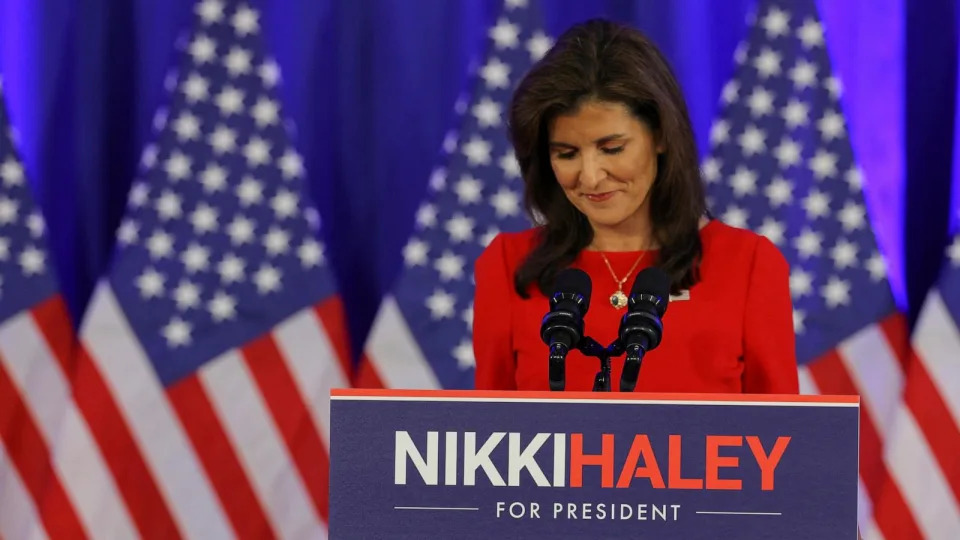
PHOTO: Republican presidential candidate and former U.S. Ambassador to the United Nations Nikki Haley speaks as she announces she is suspending her campaign, March 6, 2024, in Charleston, S.C. (Brian Snyder/Reuters)
Contrast that with the statement President Joe Biden released Wednesday morning, praising Haley for the “courage” to run for president and try to defeat Trump.
“Donald Trump made it clear he doesn’t want Nikki Haley’s supporters. I want to be clear: There is a place for them in my campaign,” the president said in a campaign statement.
Words aside, Haley’s campaign served to highlight potential limitations in Trump’s electoral coalition. While he romped across the primary states and even won every single county in giant states like California and Texas, Haley wound up — to use Trump’s choice word — trouncing him in the suburbs and exurbs of Denver, Boston and northern Virginia, outside Washington. Those results closely mirrored prior geographic outcomes in Iowa, New Hampshire and South Carolina.
Many of those Haley voters have been adamant about what their votes mean. Across the GOP primary states with exit polls, 79% of Haley voters said they would dissatisfied with Trump as the nominee and a similar 79% said Trump would be unfit for office if he is convicted of a crime. (He denies all wrongdoing.)
Evan as Trump continues to spread false claims about the 2020 election, 83% of Haley voters in exit polls said Biden legitimately won the presidency. Those voters appear more moderate across a range of other issues, including immigration and abortion, that are likely to be central to the fall campaign.
Haley said repeatedly on the trail not just that Trump should not win but that he cannot win. She even said that the nation “can’t survive” another four years of the “chaos” that surrounds him.
Haley, of all people — having served as one of Trump’s ambassadors — knows better than to expect a new version of him, much less one who changes course because of nudges from an erstwhile ally. Her shifting reactions to prior versions of Trump are head-spinning, even considering the immensely complicated relationship between Trump and their shared party.
Haley campaigned for a rival Republican in 2016; made amends to serve as Trump’s U.N. ambassador; pronounced herself “disgusted” by Trump’s actions after Jan. 6; came back into the fold to say she wouldn’t challenge him if he ran again; then ran anyway and was the last of a dozen-plus rivals standing in the Republican race.
Even as the campaign grew sharper, as Trump mocked her intelligence, mangled her given name and elevated baseless questions about her eligibility for office, Haley never quite ruled out supporting him in the end — or even potentially serving as his running mate.
PHOTO: Republican presidential candidate former President Donald Trump arrives to speak at a Super Tuesday election night party, Mar. 5, 2024, at Mar-a-Lago in Palm Beach, Fla. (Evan Vucci/AP)
In recent days, as the end of the road came into view, Haley cast her campaign as a mission to bring the Republican Party back to its fiscal-discipline and stand-by-our-allies roots. Last Friday, speaking with a group of reporters and columnists in Washington, she rejected the label of “anti-Trump.”
“In all the narratives, everybody pretty much assumes that this is an anti-Trump movement. And it’s actually not. This is a movement where people want to be heard,” Haley said. “I get why Democrats are leaving the Democrat Party, because of how far left they’ve gone. And I get why Republicans are leaving the Republican Party, because we were just always about small government and freedom — economic freedom and personal freedom.”
Shortly after Jan. 6, 2021, in what became an infamous interview, she gave the sharpest critique she ever offered of Trump.
Notably, she also laid some responsibility on Republicans who essentially enabled him by echoing his false rhetoric about the 2020 election.
“He went down a path he shouldn’t have, and we shouldn’t have followed him, and we shouldn’t have listened to him. And we can’t let that ever happen again,” Haley told the journalist Tim Alberta.
In getting out of the race now, Haley sought to put the onus on Trump to listen to Republican voters, particularly those who are hesitating before backing Trump again. But responsibility for action may fall on those same voters — and on prominent party members like Haley — if Trump chooses to hear different messages.
I worked for three elected county assessors in my 36-year career in Riverside County. All three were very good — knowledgeable with high integrity and interest in service over recognition.
In that time I also worked very closely with most of the other 57 elected county assessors throughout California. They too were quite good — dedicated to their constituents and not looking for a higher office.
Ironically, when term limits are imposed or people vote in the least-experienced or least-qualified candidates, it’s lobbyists and special interests who often steer the ship, because those who lack background are easily swayed — the very outcome voters hope to avoid by opposing “career politicians.”
Cathy Colt, Beaumont
..
To the editor: “Career politician” is a label that opposing campaigns hang upon persons who have worked in elected offices — usually a decade or more — when they want to suggest that a candidate is not deserving of support when running for their next office.
When an inexperienced aspirant to an office is campaigning against a longtime elected legislator or executive, the “career politician” label is a convenient way to cast some doubt on an old hand’s motivation to run for public office.
Campaigning goons will use whatever they must to tar opponents. There are plenty of very honorable labels for longtime public servants. Those are what ought to be used by honest brokers during election periods, including “experienced legislator,” “experienced public servant” and so forth.
Kinzinger blasts Trump for calling US third-world country: ‘Eat dirt scumbag’
Lauren Irwin – March 6, 2024
Kinzinger blasts Trump for calling US third-world country: ‘Eat dirt scumbag’
Former Rep. Adam Kinzinger (R-Ill.) took to social media to tell former President Trump to “eat dirt” after Trump called the United States a third-world country in his Super Tuesday victory speech.
“Trump just called America a ‘third world’ country.’ With all due respect (which is none), eat dirt scumbag,” Kinzinger posted on X, the platform formerly known as Twitter. “This is the best country on earth. You, are our biggest embarrassment and stain. But you’ll be over in a year.”
In a roughly 20-minute speech from his Mar-a-Lago estate after winning more than 10 primary contests, Trump highlighted a key talking point — border security and immigration — and likened the U.S. to a third-world country.
He argued that the United States is “in some ways … a third-world country,” referencing border security. He later added that “our country is dying,” Forbes reported.
Kinzinger, an outspoken critic of Trump, served on the House committee investigating the Jan. 6, 2021, Capitol attack before leaving office. He has warned of the danger Trump will pose if reelected and asserted that the former president does not care about the U.S. Constitution.
In a Wednesday appearance on CNN, Kinzinger acknowledged that Trump’s victory Tuesday is an “impressive political victory.” Still, he said he hates “to normalize” Trump’s wins, especially now that he is the only candidate lined up to take the GOP’s nomination.
“After an insurrection, it’s tough for me to just talk about this horse race as normal, but regardless, it was an impressive victory,” he said, pointing to Trump’s landslide wins in states including Texas.
The former congressman said Trump’s speech “was okay,” though he noted there is a “low bar for him” and took issue with the former president calling America a third-world country. He questioned “in what world” Trump provides the “inspirational leadership” needed in the country.
Kinzinger said he is glad that the GOP primary is now largely over, since former United Nations Ambassador Nikki Haley announced she would be suspending her campaign, and “now we can kind of go forward” and prepare for the general election.
Joe Biden’s Superfans Think the Rest of America Has Lost Its Mind
Rebecca Davis O’Brien and Katie Glueck – March 4, 2024
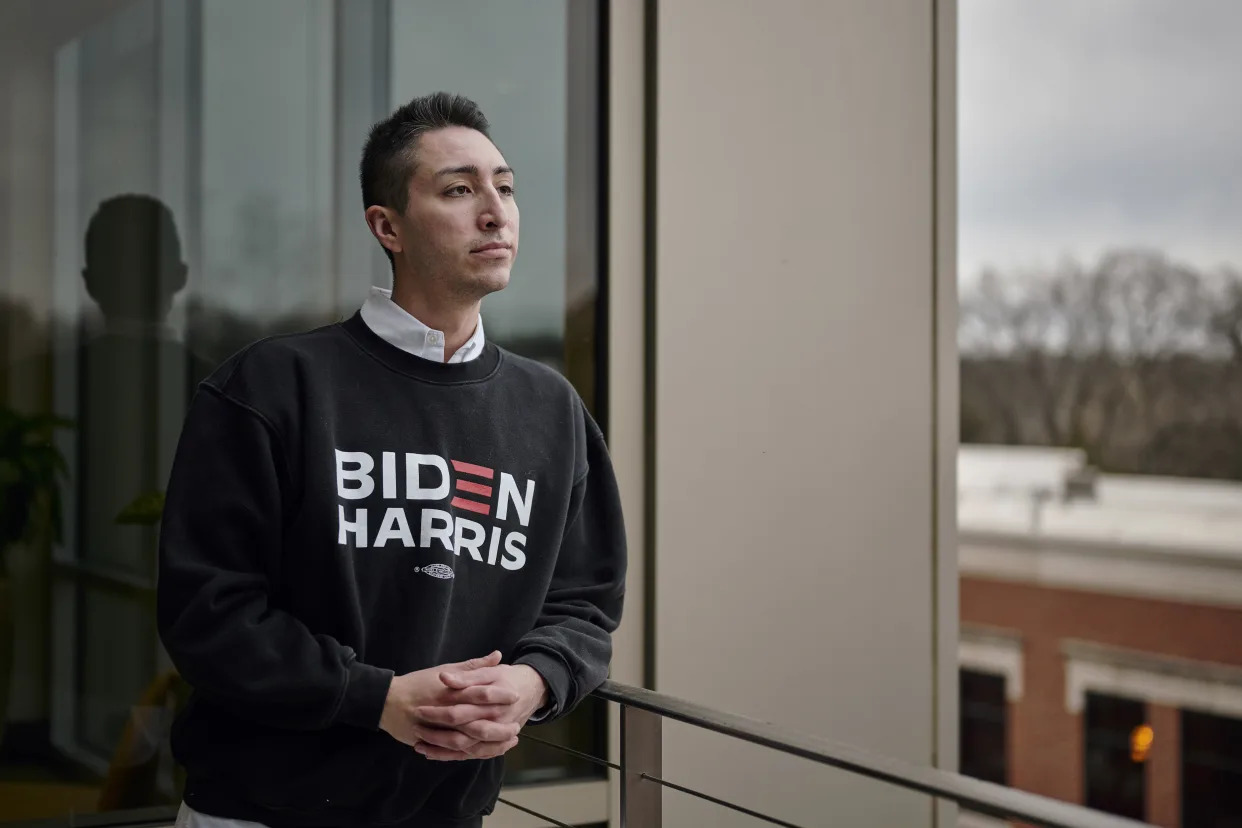
Dakota Galban, the chair of the Davidson Democratic Party, before the start of a party meeting in Nashville, Tenn., on Feb. 27, 2024. (William DeShazer/The New York Times)
PHILADELPHIA — Andrea Russell is a fixture on Earp Street, the quiet strip of row houses in South Philadelphia where she has lived for 45 years. In the afternoons, neighbors come and go from her living room as her 16-year-old cat, George, sits perched above a television that is usually tuned to cable news.
Russell, a 77-year-old retired legal secretary, thinks President Joe Biden would fit right in. “He’d come on by Earp Street,” she said. “I could picture going up to him and saying, ‘Hi, Joe.’ I can see him here.” She identifies with him, she said, and admires his integrity and his record. She also loves his eyes.
Her friend, Kathy Staller, also 77, said she was as eager to vote for Biden as she was for Barack Obama in 2008. “I am excited,” she said. “I hope more people feel the way I do.”
Russell and Staller are ardent, unreserved supporters of Biden — part of a small but dedicated group of Democratic voters who think that he is not merely the party’s only option against Donald Trump but, in fact, a great, transformative president who clearly deserves another four years in office.
They occupy a lonely position in American politics.
Biden, 81, has never inspired the kind of excitement that Obama did, and he is not a movement candidate, in contrast to his likely 2024 rival, Trump, who is 77. Historically, he has been far more skilled at connecting one to one on the campaign trail than energizing crowds with soaring oratory.
But his poll numbers have been especially rough lately. A New York Times/Siena College poll released this weekend found that just 43% of respondents would vote for him if the election were today, compared with 48% for Trump.
Forty-five percent of Democratic primary voters surveyed said they thought he should not be the party’s nominee — and just 23% of primary voters said they were enthusiastic about Biden being the Democratic nominee. That stands in contrast to the nearly half of Republican primary voters who said they were enthusiastic about Trump’s candidacy.
The Biden campaign dismissed the latest numbers over the weekend, pointing to strong Democratic performances in recent special elections and highlighting Republican divisions and cash problems.
Biden also has a slice of voters who adore him. They wave off concerns about his age and bristle at the suggestion that anyone else could meet the moment.
In interviews with nearly two dozen of these Democrats — many of them older, and most of them women — they sounded by turns beleaguered, bewildered and protective.
“I’m sorry Joe doesn’t know how much I love him, but I do love Joe,” said Constance Wynn, 73, of Wilkes-Barre, Pennsylvania. “I don’t even know why people want to pester the man, because the man has things to do.”
A president who could ‘use a little bit of bucking up’
Biden’s superfans say he deserves more credit for a substantive first-term record. Passing an infrastructure bill. Canceling some student loan debt. Protecting the environment with a sweeping climate measure. Capping the cost of insulin and other drugs. Supporting unions and abortion rights. Putting the first Black woman on the Supreme Court. Backing Ukraine and navigating international crises with his deep foreign policy experience.
They praise his personal qualities, describing his devotion to his family, his regular church attendance, his down-to-earth, workingman vibes. They say that they feel as if they know him, and that the swing voters in their lives might relate to him, too.
And sometimes they worry about him.
Susan D. Wagner, a founder of Markers For Democracy, which pushes get-out-the-vote efforts through the writing of postcards, has begun a project to send thank-you notes to Biden for his work — and to show him he has support at a challenging moment.
“It did seem like he was taking his lumps and could use a little bit of bucking up,” said Wagner, 66, who lives in New York City and is heavily involved in grassroots activism. “I wrote that in this day and age, every once in a while somebody needs a smiling face. And I put a little smiling face on it.”
‘He came out of retirement to save the country’
The president does have a following among some younger Democrats — both on social media and among those involved with local politics.
Dakota Galban, 28, has a day job in human resources at a construction company, but he also serves as the chair of the Davidson Democrats, a county party organization based in Nashville, Tennessee.
He loves Biden. “And I feel like I’m the only one,” he said, arguing that the news media had overwhelmingly focused on Biden’s tepid support. “Does anybody care that I exist?”
Galban, like many of Biden’s fans, acknowledges that the president is not a candidate who generates a lot of enthusiasm. But they argue that’s a positive thing — Biden’s strength isn’t in his energy, they say, but his management skills and his understated ability to get things done.
“He came out of retirement to save the country, save our democracy, a fight for the soul of our nation — he didn’t have to run for president,” Galban said. “He made it his mission to take our country back from Donald Trump.”
But when Galban praises the president in committee meetings, his fellow Democrats chuckle. At home, his partner has gently suggested that he keep the life-size cutouts he has of Biden and Vice President Kamala Harris in storage.
It is a familiar dynamic to fans of the TV show “Parks and Recreation,” whose lead character, Leslie Knope — played by Amy Poehler — is obsessed with Biden, much to the confusion of her colleagues and loved ones. (Asked to describe her ideal man, Knope says, “He has the brains of George Clooney, and the body of Joe Biden.”)
Julie Platt, 34, works for a lobbying firm in Philadelphia and serves as a committee member in the city’s 2nd Ward. She describes herself as a progressive “ambassador” for Biden, saying her enthusiasm for him has only grown even as her friends who supported Bernie Sanders or Elizabeth Warren in the 2020 primaries see the president as insufficiently progressive, not exciting enough and too old.
“I don’t see it as a choice between two bad candidates,” she said, referring to a Biden-Trump rematch. “I couldn’t be more honored to vote for him.”
Two years ago, Platt started keeping a list of Biden’s accomplishments in the Notes app on her phone. “He’s done so much,” she said. “It’s driving me crazy that people don’t see it.”
‘Everybody I talk to loves Joe Biden’
Some of Biden’s biggest supporters, unsurprisingly, are in Philadelphia politics. He was born in Scranton, Pennsylvania, and Jill Biden is a Philadelphia sports fan. The president has visited the city frequently since taking office.
Jim Donnelly, the leader of the 58th Ward, in the city’s conservative-leaning northeast, said he had at least seven Joe Biden signs on his front lawn. He has gotten into fights with his neighbors who have vandalized or stolen them.
Aside from cops, firefighters and his barber, he said, “Everybody I talk to loves Joe Biden.” Among his reasons for supporting Biden, he listed the president’s well-known friendliness to train conductors, his foreign policy experience and his record of job creation.
Some of Biden’s biggest supporters have loudly countered his detractors. After protesters calling for a cease-fire in the Gaza Strip interrupted Biden’s speech in January at a South Carolina church, one woman cried out: “You’re an understanding person. They don’t realize that. You’re a good man.”
That was Tomi Greene, 74, of Charleston, South Carolina. She said that she first met Biden at a town-hall meeting sometime around 2018, and that she had since become friends with Jill Biden.
“He is the right person to take us where we need to be,” Greene said. “He is very compassionate, and he’s smart. He relates to people.”
Of his detractors, she said, “I just wish they could see and feel what I feel.”
Russell, the Joe Biden backer on Earp Street in Philadelphia, said there was only one thing she would change about him — the flip of white hair on the back of his neck, which sometimes sticks out over his suit collar.
‘Morning Joe’: Trump’s Constant Speech Gaffes Paint Him as ‘Deranged, Demented and Pathetic – Not to Mention Dangerous’ | Video
Sharon Knolle – March 4, 2024
“Morning Joe” hosts Mika Brzezinski and Joe Scarborough and commentator and “How the Right Lost Its Mind” author Charlie Sykes watched incredulously while playing clips from Donald Trump campaign rallies over the weekend that showed the former president appearing lost for words, mixing up Joe Biden and Barack Obama and referring to the country Argentina as “a great guy.”
After wrapping the montage of consistent speech gaffes, Sykes determined Trump to be “deranged, demented and pathetic” and that he “looks lost.”
Scarborough began the Monday segment by playing back a series of clips of Trump from rallies in North Carolina and Virginia where the GOP candidate said Argentina is “a big Trump guy. He loves Trump,” and added, “I took his call. Anybody that loves me, I like them.”
Trump had earlier mentioned Argentina’s president, Nicolás Maduro, by name, but in connection with Venezuela. He struggled to pronounce the name of the South American country. In another speech, Trump said he had spoken with the leader of the Taliban, who, he said, called him, “your highness.”
“He’s reading teleprompters and his mind still blanks out,” Scarborough said, pointing to occasions where Trump mixed up Obama and Biden. “It’s just so pathetic and sad. It’s a sad scene, to me, to see someone up on stage and blanking out.”
Scarborough continued, calling the 77-year-old politician as “an old man who is losing his ability to communicate.”
“Unfortunately, I’m not a psychiatrist,” Sykes chimed in. “What’s on display is, OK, Joe Biden is old, but the other guy is deranged, demented and pathetic, as you point out — not to mention, dangerous. And this is on display.”
The pundit then reflected on Trump being named the likely Republican presidential nominee over Nikki Haley as results for Super Tuesday come in later this week.
“As we’re sitting here talking about this, we’re less than 48 hours away from that guy clinching the Republican presidential nomination. The Republicans have one last out and they’re not going to take it,” he lamented. “They look at this guy — this is the extraordinary thing, is that Republicans look at him — and I don’t have to repeat all of the things, you know, he’s been found viable for rape, he’s facing 91 felony charges — you have this gaseous malice that you get from these gaffe-filled speeches, and they’re looking at him like, ‘Yeah, we’d like four more years of that.’”
“If there’s any upside here, it will be that Joe Biden can say, ‘Yeah, I’m old, I’m very stiff when I walk. But this guy is also old and he’s crazy and he’s dangerous and he is incoherent,’” Sykes added.
March 5 is Super Tuesday, in which 15 states — Alabama, Alaska, Arkansas, California, Colorado, Maine, Massachusetts, Minnesota, North Carolina, Oklahoma, Tennessee, Texas, Utah, Vermont and Virginia — hold primaries in the presidential election.
Watch the full “Morning Joe” segment in the video above.
Trump confuses Obama for Biden again at Virginia rally speech
Nina Lakhani – March 3, 2024
Donald Trump confused Barack Obama for Joe Biden at a rally in Virginia on Saturday, triggering further questions about the age of the likely Republican presidential nominee who has made a string of such gaffes.
It also comes at a time of similar concerns about Biden. At 77 and 81 respectively, Trump and Biden are the oldest people to run for the presidency in US history.
“Putin has so little respect for Obama that he’s starting to throw around the nuclear word. You heard that. Nuclear. He’s starting to talk nuclear weapons today,” said Trump, on Saturday night in Richmond.
The crowd reportedly went silent as Trump referenced Obama, who left office more than seven years ago. It’s the third time Trump has made the blunder in the past six months.
The former US president’s other gaffes include confusing his Republican rival Nikki Haley with the former House speaker Nancy Pelosi.
Haley, 52, who has defied Trump and several primary defeats to continue in the race for the Republican nomination, has tried to frame herself as the younger, healthier option – referring to Trump and Biden as Grumpy Old Men in her campaign ads.
Trump’s mistake came the day after Biden, twice confused Ukraine and Gaza as he announced that the US would airdrop humanitarian supplies to Palestinians in Gaza who are dying of starvation due to the Israeli bombardment and blockades.
“In the coming days, we’re going to join with our friends in Jordan and others who are providing airdrops of additional food and supplies into Ukraine,” Biden said on Friday. The US will “seek to open up other avenues into Ukraine, including possibly a marine corridor”, he added.
A White House official later clarified that Biden meant Gaza – not Ukraine. The gaffe had been changed in the transcript of his remarks.
Questions about Biden’s age have intensified in recent months.
The latest lapse came days after was declared “fit for duty” at his annual health check. The White House physician, Dr Kevin O’Connor, said Biden “fully executes all of his responsibilities without any exemptions or accommodations”.
A new New York Times/Siena College poll found that 73% of registered voters polled believe Biden is too old to be an effective president, including 61% of those who voted for him in 2020. Voters seem less bothered about Trump, who is just four years younger, with 42% of those polled saying he “just too old” to be an effective president.
While criticisms of the age issue on both sides are laced with political spin, age-related cognitive decline is real.
As a person gets older, changes occur in all parts of the body including the brain. According to the National Institute on Aging (NIA) certain parts of the brain shrink, including those important to learning and other complex mental activities; communication between neurons may be less effective; and blood flow in the brain may decrease.
Healthy older adults can however learn new skills, form new memories, improve vocabulary and language skills. The NIA is conducting research on so-called cognitive super-agers, the minority of octogenarians and nonagenarians whose memories are comparable to people 20 to 30 years younger.
Trump Is ‘Surrounded Entirely by Enablers’ Eager to Diminish Apparent Cognitive Decline, Jonathan Lemire Says
Benjamin Lindsay – March 4, 2024
MSNBC
Analyzing a series of public Donald Trump gaffes while he campaigned in North Carolina and Virginia over the weekend, Politico’s White House bureau chief Jonathan Lemire said Monday that the former president is “surrounded entirely by enablers” who are just “forging forward” through apparent cognitive decline.
“He’s surrounded entirely by enablers during this campaign and would be again if he were to be in the White House for a second time,” Lemire said on Monday’s “Morning Joe.” “There would be no guardrails, there would be no adults in the room, there would just be people doing what he wants.”
The conversation began with cohosts Mika Brzezinski and Joe Scarborough relentlessly replaying clips of Trump mixing up Barack Obama and Joe Biden, of him stumbling through the pronunciation of “Venezuela,” of him referring to the South American country Argentina as if it were a person and more.
“There is nobody around Donald Trump that can protect him from himself,” Scarborough said, indicating that even if the gaffes were signs of ailing health, the former president would likely hear nothing of it.
“He’s just not the same guy he was five, 10, even 15 years ago. Nobody’s saying he was a saint then, but we knew him, he’s radically different. You look at him talking radically different,” Scarborough continued. “You look at Jan. 6 — he had every single person in the White House begging him to stop the riot … Didn’t listen to anybody. He’s alone. So as we go through this sad scene, there is nobody that can take him off the stage and say, ‘You’re not well. You need to get checked and taken care of.’”
“To your point, he’s not the same guy,” Lemire added. “You can watch video footage of the 2016 campaign, some of his time in the White House. We played last week a clip from the debate between Trump and Biden back in 2020, and it was striking even then how much Trump has changed, how he’s aged. I mean, he is in his late 70s.”
Lemire then became confounded by the differences in public perception between President Biden’s aged state and Trump’s.
“He’s only a couple years younger than President Biden, and we’re seeing with more and more frequency, even as the media [is] full of polls and obsessions about President Biden’s age, it’s this — it’s Trump who day after day is showing the signs of age, but also pressure,” Lemire said. “Indeed, pressure because he is not getting as much of the share of the Republican vote as he would like — Nikki Haley even posting a win over the weekend. Pressure because of the money he now owes, nearly half a billion dollars in a couple cases in New York City. And pressure that his first criminal case, a case that could theoretically put him in prison, starts in just three weeks.
“We’re seeing it night after night on the rally stage where he seems to even just lose control of the English language … This is something that his team knows, but they’re just forging forward.”
Today’s Supreme Court is a threat to democracy — but activists plan to fight back
Paul Rosenberg – March 3, 2024
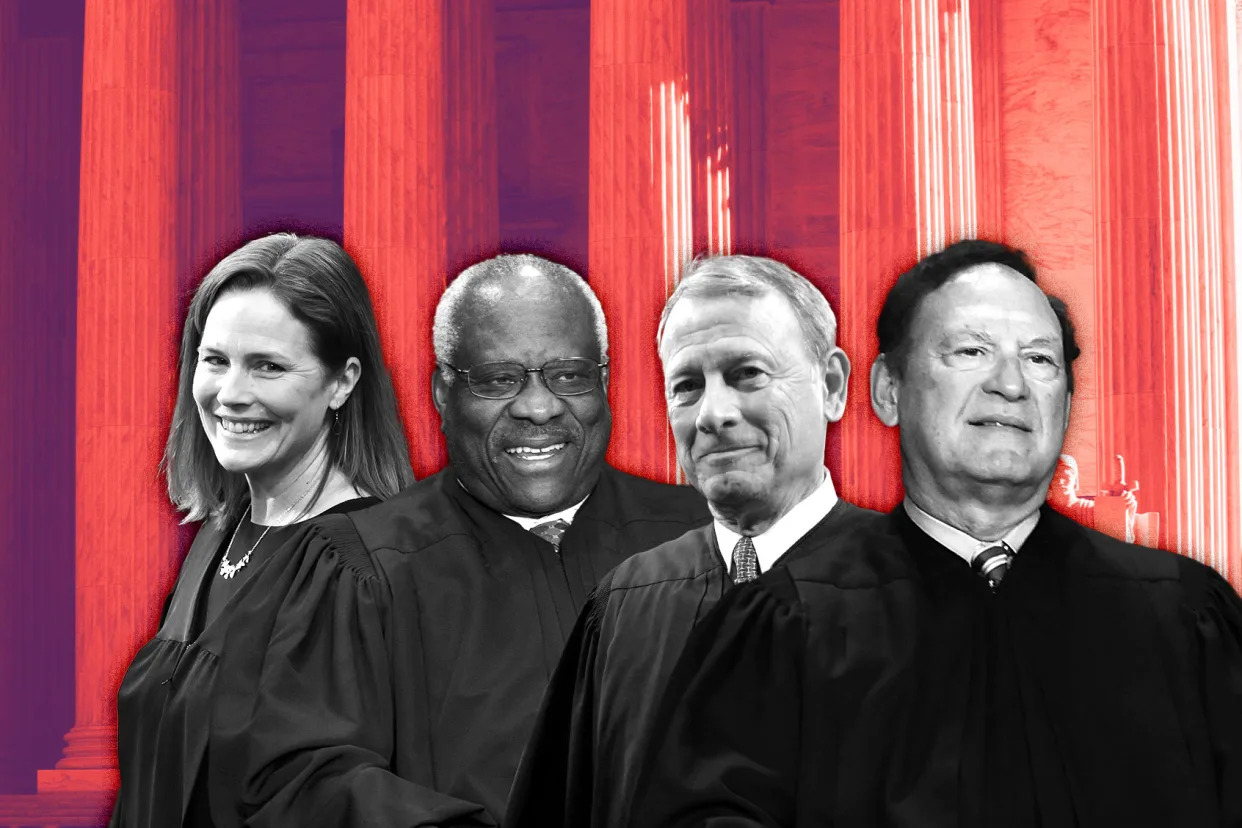
Amy Coney Barrett, Clarence Thomas, John Roberts and Samuel Alito Photo illustration by Salon/Getty Images
The Supreme Court is a supreme threat to American democracy. That was Abraham Lincoln’s view in light of the Dred Scott decision, expressed in his First Inaugural Address. And it was vividly illustrated after Lincoln’s assassination, when the Civil War amendments and civil rights legislation passed by Congress were effectively nullified by the Supreme Court, enabling former Confederates and other white supremacists to destroy the possibility of multiracial democracy for almost a century. “Our democracy suffers when an unelected group of lawyers take away our ability to govern ourselves,” as Harvard Law professor Nikolas Bowie wrote in 2021, based on his testimony before the do-nothing Presidential Commission on the Supreme Court of the United States.
Since then, the Court’s decision in Dobbs v. Jackson Women’s Health, which overturned the precedent of Roe v. Wade, has brought Bowie’s point home with a vengeance. But it’s not just about abortion. On guns, environmental protection, discrimination, labor rights, affirmative action, student debt relief and numerous other issues, Mitch McConnell’s court-packing scheme and Donald Trump’s appointments have succeeded in dramatically undercutting Americans’ people’s capacity for self-government and the promotion of “the general welfare” promised in the preamble to the U.S. Constitution.
While the electoral backlash against Dobbs has been heartening, that’s essentially a reaction to the most alarming and personally invasive Supreme Court decision, not a proactive effort to dismantle the source of the threat. That’s why the new online lecture and discussion course, “What to Do About the Courts,” feels so important: It’s an effort to begin laying the groundwork for fundamental court reform. It’s a collaboration between the Law and Political Economy Project and the People’s Parity Project which featured Bowie as its leadoff lecturer on Jan. 30. A second session, looking at the history of reform efforts, was held Feb. 20.
“This is really core to what our organizations are doing and how we’re thinking about the work that we need to be engaged in for many years to come,” PPP executive director Molly Coleman told Salon. The online venue, she said, made it possible to “open this up quite a bit more than if we had done this as an in-person meeting group on a law school campus.”
The discussion component is critical, according to LPEP executive director Corinne Blalock: “It really does reflect our theory of change and how we understand how ideas move in the world.”
“We didn’t want this to just be a lecture series,” Coleman added. “Court reform should be something that’s built by the people. Part of this project is thinking about how we end judicial supremacy, how we make sure that the people have power, and not just unelected, unaccountable judges. We would be remiss if that wasn’t modeled in our programming.”
For generations, Americans have largely been blind to the Supreme Court’s profoundly anti-democratic character, because under former Chief Justice Earl Warren, the court was instrumental in reversing the post-Reconstruction destruction of democracy, most notably with the landmark ruling in Brown v. Board of Education, which officially ended school segregation. But however significant Brown was in cultural and historic terms, in reality it only reduced segregation and certainly did not restore multiracial democracy. Congress began to do that with the 1965 Voting Rights Act — but nearly 50 years later, in Shelby County v. Holder, the Supreme Court undid much of that law and once again began undermining democracy.
The halo effect around the Supreme Court, resulting from the Brown decision and the Warren court’s legacy more broadly — which continued into the 1970s with Roe v. Wade — was finally shattered for most attentive Americans by the Dobbs decision in 2022. Now, perhaps, Bowie’s unheeded warning a year before that may get the hearing it deserves, fleshed out by a range of possible court reforms that have been considered, implemented in the past (the subject of the course’s second session) or modeled elsewhere by healthier democracies (the subject of its upcoming third one).
“Really thinking about transforming the court felt politically inconceivable a few years ago,” said Blalock. “There were certainly scholars who felt the urgency, but we needed the material stakes to really connect it to people’s lives. With all the atrocious things that the Supreme Court has done recently, that piece has sort of been done for us. So our role is helping people connect that to a set of political ideas.”
There’s another and perhaps larger concern, Blalock continued. “For everyone on the left or left of center who’s thinking about transformative change, whether it’s climate change, reproductive rights or labor, it feels like the Supreme Court is looming,” she said. “We felt that our two organizations were particularly well-suited to step in and help connect the dots.”
“Despite this moment where the Supreme Court is at the center of so many conversations, despite a lot of excitement and energy around the possibility of court reform, there is a lack of information about what court reform can look like,” Coleman added. “Even folks who are living and breathing this work in advocacy spaces might be talking about expansion or might be talking about ethics reform, but so many of these other reforms that have been tried in the past haven’t entered the mainstream conversation. We felt there was an important void to fill, to take some of these ideas that are being discussed in the legal academy or by historians and bring them to the mainstream of progressive organizing spaces.”
The series began with Bowie addressing the foundation of the problem: the wildly disproportionate power of the Supreme Court, where five individuals can effectively thwart the will of 340 million citizens. Because judicial supremacy is so deeply ingrained in our system, people tend to assume it’s enshrined in the Constitution. It’s not. Lawyers are taught that it derives from the Supreme Court’s legendary 1803 decision Marbury v. Madison, but they’re generally not taught the larger story that casts the decision in a questionable partisan light. One might describe it, in fact, as a judicial coup.
As Bowie recounted, when the Federalist government under President John Adams passed the wildly unconstitutional Alien and Sedition Acts in 1798, the opposing party led by Thomas Jefferson didn’t turn to the courts. “Federal judges were just as partisan, just as committed to stamping out political opposition, as anyone else,” Bowie said. “So Jefferson’s party ended up getting rid of this law not by going to court, but by winning an election.”
In the lame-duck session that followed Jefferson’s victory in the controversial election of 1800, Adams and the Federalists created a bunch of new federal courts and packed them with supportive judges. That included Adams’ appointment of John Marshall, the outgoing secretary of state, as chief justice of the Supreme Court. After that, Bowie said, Jefferson’s party proposed a bill to destroy or undo all these new courts, which led to fierce debate:
Federalists responded [that] federal courts need to have this power to strike down federal laws. If Congress can simply get rid of the courts, then federal courts won’t have this power anymore. And for Jefferson’s party in Congress, they thought the idea that federal courts would strike down federal laws was this crazy innovation. Just a really bad idea and obviously partisan in motivation. … They thought there was nothing in the Constitution that says a federal judge can strike down a federal law. It would be a really weird distribution of power to give federal judges this control.
In the wake of that debate, Bowie said, Marshall authored the famous majority opinion in Marbury v. Madison, which “effectively just parroted the Federalist position from Congress.” In short, the position held by a minority in Congress became the law of the land — and not on some narrow legalistic point, but on the fundamental question of who is allowed to interpret the Constitution.
That remained a purely theoretical issue for more than 50 years. “Marshall didn’t end up disagreeing with Congress about the constitutionality of any legislation for the remainder of his term,” Bowie said. Then came the 1857 Dred Scott decision, which struck down the Missouri Compromise and denied Congress the right to prohibit slavery in the nation’s territories. This became a defining issue for the newly-formed Republican Party, which didn’t just shrug and accept it. As Bowie put it, “They responded, ‘What is the court doing? The court should not have this power,’” and ran on a platform “that repudiated the court’s power to decide this constitutional question.” After Lincoln was elected in 1860, “he and Congress passed legislation that did precisely what the Supreme Court said Congress could not do.”
There was certainly much more to Bowie’s presentation — and much more Supreme Court mischief that undermined the rights of Black Americans for generations — but that should be sufficient to show that our meek modern-day acceptance of judicial supremacy rests upon a profound ignorance of our own history. Both Jefferson and Lincoln, revered today as the founders of our two major parties, vehemently rejected judicial supremacy. It’s time for 21st-century Americans to seriously consider doing the same — or at the very least, to place significant limitations on it. The question, of course, is exactly how to limit or replace judicial supremacy, and what specific reforms can get us there.
The February session of “What to Do About the Courts” began to answer those questions, looking into the history of court-disempowering reforms and proposals, with professors Samuel Moyn of Yale and William Forbath of the University of Texas. Moyn cited a number of reform ideas:
Popular overrides of court decisions by referendum, as proposed by Theodore Roosevelt in his 1912 third-party presidential campaign.
“Jurisdiction stripping,” meaning laws that limit the court’s jurisdiction over certain kinds of statutes.
A supermajority requirement, meaning a bare majority of five justices could not invalidate laws passed by Congress, as proposed by progressive Sen. William Borah in 1923.
Congressional authority to override any Supreme Court decision by a two-thirds vote, as proposed by Sen. Robert La Follette Sr. in his 1924 third-party presidential campaign.
Prohibiting federal court injunctions in labor disputes, as mandated by the 1932 Norris–La Guardia Act.
Forbath looked more closely at the history of labor law: how the growth of a national economy increased the use of secondary strikes and boycotts, how common law and the Sherman Anti-Trust Act were used to declare them illegal and how that, along with court-sanctioned state violence, “inspired a decades-long, high-profile campaign of official union defiance of anti-strike and anti-boycott decrees,” undergirded by “a richly elaborated moral and constitutional order, a rival order built on the First and 13th amendments.” That movement declared, Forbath said, that “courts were quite literally creating property rights in man and elevating property rights over human rights.”
During the 1920s, Forbath continued, there were “constant calls and dozens of bills and proposals for laws and amendments to the Constitution that would enact what we call court reform. They brought movement constitutionalism to the halls of Congress,” resulting in the aforementioned Norris-La Guardia Act, even before FDR’s New Deal. That came about in part, Forbath said, because the judiciary had “squander[ed] its own legitimacy. Too many working-class Americans had come to see the courts for what they were: They were the place where the ruling class went to rule, dispensing class-bound decisions in the name of the Constitution.”
That kind of keen historical awareness, vigilance and activism may well be needed today. Arguably that shouldn’t be difficult to ignite, given the current radical Supreme Court and its recent actions. It may be much more difficult to create a unified movement with a clear vision for change. Divisions. to be sure, existed in earlier eras as well. “Back in the early 20th century, there was a rift between Black freedom organizations like the NAACP and labor and progressives who were most invested in labor reforms,” Forbath said. While the latter groups wanted to disempower the courts, the Black freedom movement largely did not, because the courts — however inadequate they were — appeared to be its most reliable allies.
That particular division no longer applies, but there are undeniably different priorities for different constituencies that could fragment reform efforts. More broadly, Forbath asked: “Do we want movement justices and judges, as brash in their way as the right-wing movement justices today? Or do you want more technocratic judges, committed above all to judicial restraint and a fair reading of progressive statutes?” The answer is not immediately obvious.
The seminar’s next session, Blalock said, will be “on the international and comparative perspective, which helps make this all feel so much more doable, particularly when for so long these have been treated like radically fringe ideas. After that, we’re going to dig a little more into the weeds about what the options are [and] really walk through the specific nature of how the reform would work. The final session is going to be on how we build a movement around this. We’re bringing in Astra Taylor from the Debt Collective, in conversation with Sabeel Rahman, who comes from more the government policy side, to talk about how we take these ideas forward beyond the reading group.”
So far, the feedback has been “alarmingly positive,” Coleman said. “The biggest thing we’re hearing is that even current law students aren’t hearing these ideas on their campus. They really feel that they’re getting something unique in this space [and] they’re really excited to bring it back to broader communities.” Beyond law school campuses, there are leaders in progressive organizations who “want every single person they work with to be at the next iteration of the reading group,” she said. “People want more folks to know what conversations are happening. That’s been pretty exciting.”
While attorneys, law students and activists are important audiences for these ideas, there’s also a need for broader conceptual, narrative and communications work aimed at a general audience. The right has successfully unified under the rhetoric of constitutional “originalism,” regardless of how vacuous that idea is in practice (Salon stories here and here). Conservative power is grounded in conceptual simplicity, even though the right’s ideas have proven inherently inadequate to the complexity of the modern world. To counter it, liberals and progressives must address that complexity — real history and real science, not myths — while heeding Einstein’s advice: “Everything should be made as simple as possible, but not simpler.” In short, the progressive movement needs a counternarrative of its own, although identifying just one narrative might prove impossible.
One possible narrative, alluded to above, is to focus on the constitutional concept of “general welfare,” articulated in terms of public goods, an underlying logic laid out in Donald Cohen and Allen Mikalean’s 2022 book “The Privatization of Everything.” Another possibility is to focus on public health, which, as I argued in 2021, can “serve as a long-term, overarching framework to reframe our politics, to provide us with new common sense in addressing a wide range of diverse issues by highlighting common themes and connecting what works.”
Other narratives are surely possible. But it’s crucial that they encompass those four elements: common sense, a wide range of diverse issues, common themes and a pragmatic focus on what works. It’s no accident that the common law tradition encompasses those central themes. The promise of “What to Do About the Courts” is that history teaches us that change is possible and we can make it happen: Once legal scholars and activists on the left have fashioned the right framework, they believe they’ll have the wind at their backs.