
Solar energy farms gaining traction in Nebraska

The Seattle Times

Solar energy farms gaining traction in Nebraska

By Grant Schulte and Tess Williams, Associated Press       June 3, 2108

Lexington, Nebraska Solar Farm, GenPro Energy Solutions.  The solar farm went online in May 2017 and was at the time the largest solar project in the State at 3.57 MW AC power.

Lincoln, Neb. (AP) — Solar energy is gaining traction in Nebraska as a growing number of cities adopt the technology, and state officials are looking for ways to help the trend along.

The technology has become so popular that some cities have had to expand their recently built solar farms or build new ones to keep pace with customer demand.

Many of the cities are taking advantage of the Nebraska Public Power District’s SunWise Community Solar Program, approved in 2016 to help cities and villages adopt solar power in a central location for residents to use.

The program has helped launch new solar farms in Scottsbluff, Venango and Kearney since 2017, and more than half a dozen other cities have expressed interest, said NPPD General Retail Manager Tim Arlt.

Separately, Fremont is moving forward with a second solar farm due to high demand on the first array that went live earlier this year.

                                                         Lexington, Nebraska

Fremont City Administrator Brian Newton said the farm allows customers to buy their own solar panel or pay a one-time fee to use power generated in the farm. He said the first farm sold out to 217 residents within seven weeks.

Arlt said the challenges include finding available land that’s close enough to feed into NPPD’s grid and making sure the local grid can handle the additional power.

“We want to say yes if a community wants it,” he said.

Nebraska lawmakers may review some of the challenges as well.

Sen. Rick Kolowski, of Omaha, has introduced a legislative study to explore ways to promote solar energy, noting its environmental benefits. Kolowski said he wants to see the state use renewable resources more effectively, and he hopes the study could lead to legislation that would provide incentives or tax breaks to encourage more solar energy.

“This isn’t going away,” Kolowski said. “We have to do it not just for ourselves, but for the future of our state.”

The NPPD arrays let residents buy into solar energy without having to install their own rooftop panels. Residents who want to use the energy shoulder the expense to keep the costs from shifting to those who don’t.

Despite its rapid growth in Nebraska, solar energy has spread faster in some areas than others because of the state’s patchwork of local public utilities, said Cliff Mesner, a Central City attorney, developer and solar energy advocate.

Homeowners who don’t live in an area that offers solar energy have few options other than to install solar panels on their property, Mesner said. That in turn can draw objections from neighborhood groups that don’t like the appearance of solar panels on rooftops or in yards.

Also concerning is the looming threat of tariffs on aluminum and steel, with are used in solar arrays and could substantially raise costs, Mesner said. President Donald Trump recently signed a bill to extend a federal solar tax credit for homeowners, but it’s scheduled to expire in 2021.

Mesner said solar energy has grown faster in states with higher electric rates than Nebraska’s because purchasing it made financial sense. But as Nebraska’s rates rise, he said, solar will become more feasible.

“I think it’s made some great strides in the last few years, but we are behind where other states have been,” Mesner said. “We’re doing some great things right now, but we’ve got a long, long ways to go.”

Mesner said many homeowners have bought into solar because the costs are fixed for 20 to 25 years as electricity prices continue to rise. Many current solar customers are paying more now, but could end up saving money over the long term, he said.

Kearney launched Nebraska’s largest community solar array last year on 53 acres of city-owned land near a technology park. The farm can meet about 5 percent of the city’s peak energy needs, enough to power 900 homes.

City officials partnered with NPPD to connect the system to the city’s grid and sold off shares of the electricity it produces.

So far, city officials have sold or reserved about 90 percent of the shares and will use some as a recruiting tool for new businesses that want to use green energy, said Kearney Mayor Stan Clouse. The University of Nebraska at Kearney bought about half of the total shares in an effort to use more renewable energy and hedge against long-term price increases.

“It’s still in the infant stages, but I’m optimistic,” Clouse said.

Clouse said his city approved the project to give residents more energy choices and potentially attract small and mid-sized technology companies with the promise of renewable energy. City officials can’t install wind turbines in the area because it’s in the migratory flight path of Nebraska’s Sandhill cranes, Clouse said.

Clouse, an account manager for the Nebraska Public Power District, pointed to Facebook’s decision in 2013 to build a data center in Altoona, Iowa, instead of Kearney, citing nearby wind energy as one factor.

Related:

To fight the Keystone XL pipeline, the #NoKXL Build Our Energy Barn, located near York, Nebraska, built their solar barn in the path of the Keystone XL pipeline. Activists have started a campaign to build more. Mary Anne Andrei/Bold Nebraska

(May 24, 2015) “Geronimo Energy, LLC (“Geronimo”) announced the sale of a portfolio of its wind farm and solar energy projects to BHE Renewables, LLC (“BHE Renewables”), a subsidiary of Berkshire Hathaway Energy.”

“Included in the portfolio acquired by BHE Renewables are: the Grande Prairie Wind Farm (“Grande Prairie”) in Holt County, Nebraska; the Walnut Ridge Wind Farm (“Walnut Ridge”) in Bureau County, Illinois; and a portfolio of Minnesota solar project developments (“the Solar Portfolio”).”
Bill Maher on Conspiracy theorists

Bill Maher

June 2, 2018

Conspiracy theorists used to be ‘crazy,’ now they’re called Senator. Republicans, you’re the Alex Jones party now. There is literally nothing too stupid & conspiratorial that you will not swallow.

Conspiracy Wingnuts

Conspiracy theorists used to be ‘crazy,’ now they’re called Senator. Republicans, you're the Alex Jones party now. There is literally nothing too stupid & conspiratorial that you will not swallow.

Posted by Bill Maher on Friday, June 1, 2018

Trump ignores his own government agencies

War On Our Future

May 24, 2018

Trump wants to prop up fossil fuels, but his own government agencies keep reporting on the climate change threat. A newly obtained memo reveals his solution: Just ignore them. #YEARSproject #WarOnOurFuture

The Ignorance Memo

President Donald J. Trump wants to prop up fossil fuels, but his own government agencies keep reporting on the climate change threat. A newly obtained memo reveals his solution: Just ignore them. #YEARSproject #WarOnOurFuture

Posted by War On Our Future on Thursday, May 24, 2018

Eternal Sunshine of the Trumpless Mind

Funny Or Die MASHUPS

April 28, 2018

Joel (Jim Carrey) just can’t handle the Donald Trump presidency, but lucky for him the good people Lacuna, Inc. are here to make his mind totally Trumpless.

Eternal Sunshine Of The Trumpless Mind

Joel (Jim Carrey) just can't handle the Donald Trump presidency, but lucky for him the good people Lacuna, Inc. are here to make his mind totally Trumpless.

Posted by Funny Or Die MASHUPS on Saturday, April 28, 2018

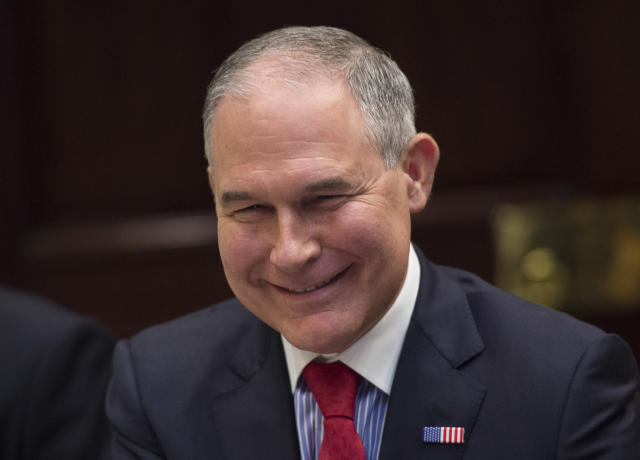
Scott Pruitt Prefers Fancy Silver Fountain Pens At $130 A Pop

HuffPost

Scott Pruitt Prefers Fancy Silver Fountain Pens At $130 A Pop

Chris D’Angelo, HuffPost                 June 1, 2018

If you thought Environmental Protection Agency chief Scott Pruitt’s expenditures couldn’t possibly get more ridiculous, guess again.

The Washington Post on Friday reported that the EPA purchased a dozen silver fountain pens from a jewelry store in Washington, D.C., featuring the agency’s seal and Pruitt’s signatures. The cost to taxpayers: $130 apiece.

The pens were part of a $3,230 order in August from Tiny Jewel Box that also reportedly included personalized journals.

“The cost of the Qty. 12 Fountain Pens will be around $1,560.00,” an account manager at the jewelry store wrote in an email to Millan Hupp, Pruitt’s head of scheduling and advance. “All the other items total cost is around $1,670.00 which these items are in process. Please advise.”

“Yes, please order,” Hupp responded that same day. “Thank you.”

EPA spokesman Jahan Wilcox defended the pen purchase in a statement to the Washington Post, saying they “were made for the purpose of serving as gifts to the Administrator’s foreign counterparts and dignitaries upon his meeting with them.”

The expense comes as Pruitt faces a whirlwind of corruption accusations and ethical scandals. While pushing for sweeping budget cuts at the federal agency, Pruitt has been seemingly loose with the taxpayer’s dime.

In April, a government watchdog found that Pruitt broke the law when he spent $43,000 to install a soundproof phone booth in his office. Other questionable, high-end expenses include non-commercial and first-class airfare and an unprecedented security detail. Several high-ranking officials at the agency were reassigned, demoted or opted to leave after expressing concerns about pricey office furniture, as well as requests for a bulletproof SUV, a 20-person security detail and $100,000-a-month charter aircraft membership, as The New York Times reported in April.

Pruitt has largely pointed the finger at his own staff at the agency he runs.

“I’m having to answer questions about decisions that others made,” Pruitt said in an interview with the Washington Free Beacon this week. “And that’s not an excuse, it’s just reality.”

America’s poor becoming more destitute under Trump: U.N. expert

Reuters

America’s poor becoming more destitute under Trump: U.N. expert

By Stephanie Nebehay, Reuters             June 2, 2018

                                     A tent is seen next to Echo Park Lake in Los Angeles, California, U.S. April 11, 2018. REUTERS/Lucy Nicholson

GENEVA (Reuters) – Poverty in the United States is extensive and is deepening under the Trump administration whose policies seem aimed at removing the safety net from millions of poor, while rewarding the rich, a U.N. human rights investigator has found.

Philip Alston, U.N. special reporter on extreme poverty, called on U.S. authorities to provide solid social protection and address underlying problems, rather than “punishing and imprisoning the poor”.

While welfare benefits and access to health insurance are being slashed, President Donald Trump’s tax reform has awarded “financial windfalls” to the mega-rich and large companies, further increasing inequality, he said in a report.

U.S. policies since President Lyndon Johnson’s war on poverty in the 1960s have been “neglectful at best”, he said.

“But the policies pursued over the past year seem deliberately designed to remove basic protections from the poorest, punish those who are not in employment and make even basic health care into a privilege to be earned rather than a right of citizenship,” Alston said.

Almost 41 million people live in poverty, 18.5 million of them in extreme poverty, and children account for one in three poor, he said. The United States has the highest youth poverty rate among industrialized countries, he added.

“Its citizens live shorter and sicker lives compared to those living in all other rich democracies, eradicable tropical diseases are increasingly prevalent and it has the world’s highest incarceration rate…and the highest obesity levels in the developed world,” Alston said.

However, the data from the U.S. Census Bureau he cited covers only the period through 2016, and he gave no comparative figures on the extent of poverty before and after Trump came into office in January 2017.

The Australian, a veteran U.N. rights expert and New York University law professor, will present his report to the United Nations Human Rights Council later this month.

It is based on his mission in December to several U.S. states, including rural Alabama, a slum in downtown Los Angeles, California, and the U.S. territory of Puerto Rico.

U.S. officials in Geneva were not immediately available for comment.

“SHAMEFUL STATISTICS”

Citing “shameful statistics” linked to entrenched racial discrimination, Alston said that African Americans are 2.5 times more likely than whites to live in poverty and their unemployment rate is more than double. Women, Hispanics, immigrants, and indigenous people also suffer high rates.

At least 550,000 people are homeless in America, he said.

“The tax reform will worsen this situation and ensure that the United States remains the most unequal society in the developed world,” Alston said. “The planned dramatic cuts in welfare will essentially shred crucial dimensions of a safety net that is already full of holes.”

The tax overhaul, which sailed through the Republican-controlled U.S. Congress in December, permanently cut the top corporate rate to 21 percent from 35 percent. Tax cuts for individuals, however, are temporary and expire after 2025.

Trump has said they will lead to more take-home pay for workers and have touted bonuses some workers received from their employers as evidence the law is working.

Alston dismissed allegations of widespread fraud in the welfare system and criticized the U.S. criminal justice system. It sets large bail bonds for a defendant seeking to go free pending trial, meaning wealthy suspects can afford bail while the poor remain in custody, often losing their jobs, he said.

“There is no magic recipe for eliminating extreme poverty and each level of government must make its own good-faith decisions. At the end of the day, however, particularly in a rich country like the United States, the persistence of extreme poverty is a political choice made by those in power,” he said.

(Reporting by Stephanie Nebehay; editing by David Stamp)

This is what Costa Rica can teach us about democracy and green energy

June 1, 2018
If you learn these lessons, you may become more content.

Read more stories about Costa Rica: ecowatch.com/tag/costa-rica

This is what Costa Rica can teach the world about democracy and green energy

If you learn these lessons, you may become more content. Read more stories about Costa Rica: ecowatch.com/tag/costa-rica

Posted by EcoWatch on Friday, June 1, 2018

Why is Greenland Melting?

June 1, 2018

“I think about younger generations who will say, ‘What have you done, when you knew all this was happening?'” Explore why Greenland’s glaciers are melting faster than expected in our 360° video.

360°: Why Is Greenland Melting?

"I think about younger generations who will say, 'What have you done, when you knew all this was happening?'" Explore why Greenland's glaciers are melting faster than expected in our 360° video.

Posted by FRONTLINE on Friday, June 1, 2018

CEO Pay! Rewarding or Hoarding?

act.tv

May 31, 2018
We are dealing with a crisis of inequality and that is why we must start making the wealthy pay their fair share in taxes, not give breaks to those at the top.

CEO Pay: Rewarding or Hoarding?

We are dealing with a crisis of inequality and that is why we must start making the wealthy pay their fair share in taxes, not give breaks to those at the top.via U.S. Senator Bernie Sanders

Posted by act.tv on Thursday, May 31, 2018

Costco boosting hourly wages for 130,000 U.S. employees

The Seattle Times

Costco boosting hourly wages for 130,000 U.S. employees

The raise is a windfall from Costco’s savings due to U.S. federal corporate tax cuts that took effect this year. Costco also reported that its profit jumped about 7 percent in its fiscal third quarter to $750 million or $1.70 a share, matching Wall Street analyst expectations.

By Benjamin Romano, Seattle Times Business Reporter      May 31, 2018 

Employees stock the bakery department at Costco in Issaquah in this March 14, 2016, file photo. (Bettina Hansen / The Seattle Times)

Costco’s hourly employees are the latest U.S. retail workers to get a boost from the Trump tax cuts.

On June 11, Costco will increase the starting wage for its U.S. employees by $1 to as much as $14.50 an hour, while other hourly wage rates will increase 25 to 50 cents an hour.

The raise, to be paid for with part of Costco’s savings from U.S. federal corporate tax cuts that took effect this year, will go to upwards of 130,000 U.S. employees, costing the company about $110 million to $120 million a year before taxes, Costco chief financial officer Richard Galanti said during the company’s fiscal third quarter earnings report Thursday.

The warehouse club retailer hauled in $32.36 billion in sales and membership revenue in the 12-weeks ended May 13, a 12.1 percent increase over the same period in 2017. It was the company’s fourth consecutive quarter of double-digit sales growth.

Costco profit jumped about 7 percent in its fiscal third quarter to $750 million or $1.70 a share, matching analyst expectations. But investors bid down Costco shares 2 percent in after-hours trading, where they finished at $194.23. The company’s profit margins were slightly slimmer than expected as rising freight costs took a toll.

The wage increases will help Costco keep to its strategy of offering employees total compensation that executive say leads the retail industry. Costco competitors including Target and Walmart announced wage increases and bonuses for their employees tied to the tax cuts earlier this year.

Galanti said that many companies, not just retailers, have “a desire to use some of this (tax windfall) to help employees, to share that wealth if you will, to drive their business.”

But not everyone at Costco is happy. Some salaried employees, including some in the company’s Issaquah corporate headquarters, say they’re being left out of the equation as Costco spreads around the tax benefit. One person, who asked not to be named for fear of retaliation, said after the wage increase announcement, “I would make a considerable amount more going back and gathering carts for the warehouse in the parking lot.”

Galanti did not respond to a request for comment on the benefits, if any, planned for salaried employees.

About 90 percent of Costco’s employees are paid hourly, and earn $22.50 an hour, on average, with access to health insurance benefits for which the company pays 90 percent of annual costs, Galanti said in March.

Costco reported 231,000 employees in its 2017 annual report – 133,000 full-time and 98,000 part-time – numbers that have surely increased as it continues opening new warehouses. It had 750 at the end of the last quarter and planned to open a net 15 new locations in the current quarter.

Some 54 percent of Costco employees in a recent PayScale survey thought their compensation was fair, compared to 21 percent of all employees in the survey. That level was enough to rank Costco 18th on PayScale’s list of fair payers.

PayScale notes that perception is reality when it comes to pay, particularly in a tight job market. “Investing in how you pay and how you communicate pay is more important than it’s ever been for your organization,” the company said as part of its pay fairness report.

Costco is indeed trying to communicate its pay practices, and relative compensation, more clearly to employees.

In an April internal Costco newsletter, Pat Callans, senior vice president of human resources and risk management, addressed the announcements from Target and Walmart – though he didn’t mention them by name.

“At Costco, we’re not in the habit of issuing press releases about our compensation, but we have always looked for ways to pay our hourly employees well, and we’ll continue to do so,” Callans wrote in the newsletter for store management teams. “Our annual increases to the top of our wage scales, and regular increases throughout the scale, are evidence of this.”

Callans said that in addition to a 60-cent-per-hour increase in March – part of the company’s regular cadence of increases – Costco gave long-term employees their biannual extra checks and “made discretionary company contributions to employees’ 401(k) accounts.”

Callans mentioned these and other benefits, including health care, and suggested that newer employees who don’t realize their value or are not yet eligible for them should be reminded by management teams.

“It is our total compensation, not just our starting wage, that sets us apart from our retail competition,” he wrote.

On Thursday, Galanti suggested that the tax-cut related wage increase would likely be an addition to, rather than a replacement of, the company’s regular wage increases. Despite having a small union-represented workforce of about 15,600 people, Costco regularly negotiates a new agreement with employees every three years with prescribed annual wage increases. The next such agreement is due in March 2019.

“We looked at it independent of that,” Galanti said of the June 11 increases.

Galanti said Costco’s third-quarter effective U.S. tax rate was 28.8 percent down from what would have been a rate of 35.3 percent a year earlier, but for an $82 million tax benefit the company realized as part of a $7 a share special dividend. Galanti said he expects Costco’s tax rate in its 2019 fiscal year to be about 28 percent.

The tax cut will save Costco in the low $300 million range a year, Galanti said.

“I don’t think it’s been life-changing for any company,” he said, noting that the cost of the company’s special dividends has been in the range of $2 billion to $3 billion.

Costco continues to return cash to shareholders through stock repurchases totaling $55 million in the third quarter and dividends. The company announced a quarterly dividend of 57 cents a share in April, up from the 50 cent per share dividends it had issued each of the previous four quarters.