It may be impossible to completely avoid PFAS, but there are a few simple ways to reduce your exposure.
Eating at home, ditching nonstick pans and unnecessary carpets, and filtering your water can help.
Hazardous, long-lasting “forever chemicals” are all over the news lately, and they’re all over our day-to-day environments too.
Per- and polyfluoroalkyl substances, or PFAS, is a class of thousands of man-made substances that are common in everyday objects, but research is making it increasingly clear that they may be harmful to human health. Peer-reviewed studies have linked them to some cancers, decreased fertility, thyroid disease, and developmental delays.
That’s bad news since PFAS last for decades without breaking down, earning them the “forever chemicals” nickname. Researchers have found them in drinking water and household dust across the planet, in the oceans, at both poles, and drifting through the atmosphere.
In a paper published last month, leading researchers at the University of Stockholm concluded that all the planet’s rainwater, and probably all of its soil, are contaminated with unsafe levels of PFAS. Ian Cousins, who spearheaded that research, fears it’s impossible to avoid the chemicals.
“I don’t bother,” Cousins told Insider, adding, “It’s almost mission impossible. You can’t really do it.”
Even if you can’t completely dodge PFAS, there are a few easy ways to reduce exposure in your daily life.
Eat at home, with minimal grease-resistant packaging
A family eats dinner at their home in Calumet Park, Illinois, on December 8, 2020.Shannon Stapleton/Reuters
PFAS were developed in the 1940s to resist heat, grease, stains, and water. That means they’ve ended up in a lot of food packaging. That includes pizza boxes, microwave popcorn bags, some wrappers, and grease-resistant paper.
Restaurants and fast-food chains may use such packaging more than grocery stores do. A 2019 study found that people had lower PFAS levels in their blood after eating at home, and higher levels after eating fast food or at restaurants.
Throw out scratched nonstick pans
Red onion slices cooking in a black pan.Erin McDowell/Insider
The coating used in nonstick cookware usually contains PFAS, and they can easily leach into your food at high heat and once the coating gets scratched.
The Washington Department of Ecology advises against heating nonstick cookware above 400 degrees Fahrenheit, and recommends throwing it out once the nonstick coating scratches. Cast-iron pans are a safe alternative.
Ditch your carpet and stain-resistant fabrics
Other household items like carpeting, water-resistant clothing, and stain-resistant treatments for fabrics can also contain PFAS. Researchers don’t think the chemicals can easily absorb into your body through your skin, but those fabrics shed fibers that can travel through the house as dust, eventually getting ingested or inhaled.
Vacuum, dust, and open the windows
A property manager opens the window of a vacant house in the town Kamakura outside Tokyo, on November 15, 2014.Thomas Peter/Reuters
PFAS accumulate in dust, which lingers in the air and allows humans to breathe the chemicals into their lungs. By dusting and vacuuming regularly, along with opening windows to allow for airflow and ventilation, you can keep dust levels low in your home and reduce the amount of PFAS you inhale.
Test and maybe treat your drinking water
You can test your water for PFAS through a laboratory certified by your state. If the water exceeds guidelines, you may want to consider doing something about it, especially if you have children.
A person fills a bottle with tap water.Catherine Falls Commercial/Getty Images
Even at very low levels, exposure to two of the most common PFAS — called PFOA and PFOS — has been linked to decreased vaccine response in children. That research prompted the US Environmental Protection Agency to revise its drinking-water guidelines, decreasing the safe levels of those substances by a factor of 17,000. In August, the agency issued a proposal to classify those two PFAS as hazardous substances.
A few types of water filters can diminish PFAS levels, though they may not completely remove the chemicals from the water. State environmental departments recommend filtration systems that use reverse osmosis for tap water. They also recommend filter systems that use granular activated carbon (aka charcoal), which can be installed on faucets house-wide or used in a tabletop pitcher, but a 2020 study found mixed results from those systems.
If you get your drinking water from a well, the EPA recommends testing it regularly and contacting your state environmental or health agency for certified labs and safety standards.
Check before you buy cosmetics
A woman applies makeup to her friend in Nashville, Tennessee, on December 20, 2013.Harrison McClary/Reuters
Last year, a group of researchers published the results of testing 231 cosmetic products in the US and Canada for PFAS. More than half the products contained indicators of the chemicals.
The Environmental Working Group (EWG) has a public, searchable database of cosmetics and personal-care products, highlighting ingredients with potential risks to human health, such as PFAS like Teflon. They also maintain a map where you can check if you live near a PFAS contamination site.
The Green Science Policy Institute also keeps a list of PFAS-free products, including a guide to cosmetics.
Ultimately, Cousins said, people don’t need to be “super worried” about low-level exposure, since there’s no strong evidence of major health impacts across the population. Still, reducing PFAS use in consumer products could keep the problem from getting worse in the future.
“I think we should use this to get a bit angry about what’s happened and try and make change, so that we don’t keep doing this,” Cousins said. “Maybe we have to use [PFAS] in some cases, but only when they’re absolutely essential. And then we should also try to innovate, to try and replace them in the longer term.”
‘A Crisis Coming’: The Twin Threats to American Democracy
David Leonhardt – September 17, 2022
The United States faces two distinct challenges, the movement by Republicans who refuse to accept defeat in an election and a growing disconnect between political power and public opinion. (Matt Chase/The New York Times)
The United States has experienced deep political turmoil several times before over the past century. The Great Depression caused Americans to doubt the country’s economic system. World War II and the Cold War presented threats from global totalitarian movements. The 1960s and ’70s were marred by assassinations, riots, a losing war and a disgraced president.
These earlier periods were each more alarming in some ways than anything that has happened in the United States recently. Yet during each of those previous times of tumult, the basic dynamics of American democracy held firm. Candidates who won the most votes were able to take power and attempt to address the country’s problems.
The current period is different. As a result, the United States today finds itself in a situation with little historical precedent. American democracy is facing two distinct threats, which together represent the most serious challenge to the country’s governing ideals in decades.
The first threat is acute: a growing movement inside one of the country’s two major parties — the Republican Party — to refuse to accept defeat in an election.
The violent Jan. 6, 2021, attack on Congress, meant to prevent the certification of President Joe Biden’s election, was the clearest manifestation of this movement, but it has continued since then. Hundreds of elected Republican officials around the country falsely claim that the 2020 election was rigged. Some of them are running for statewide offices that would oversee future elections, potentially putting them in position to overturn an election in 2024 or beyond.
“There is the possibility, for the first time in American history, that a legitimately elected president will not be able to take office,” said Yascha Mounk, a political scientist at Johns Hopkins University who studies democracy.
The second threat to democracy is chronic but also growing: The power to set government policy is becoming increasingly disconnected from public opinion.
The run of recent Supreme Court decisions — both sweeping and, according to polls, unpopular — highlights this disconnect. Although the Democratic Party has won the popular vote in seven of the past eight presidential elections, a Supreme Court dominated by Republican appointees seems poised to shape American politics for years, if not decades. And the court is only one of the means through which policy outcomes are becoming less closely tied to the popular will.
Two of the past four presidents have taken office despite losing the popular vote. Senators representing a majority of Americans are often unable to pass bills, partly because of the increasing use of the filibuster. Even the House, intended as the branch of the government that most reflects the popular will, does not always do so because of the way districts are drawn.
“We are far and away the most countermajoritarian democracy in the world,” said Steven Levitsky, a professor of government at Harvard University and a co-author of the book “How Democracies Die,” with Daniel Ziblatt.
The causes of the twin threats to democracy are complex and debated among scholars.
The chronic threats to democracy generally spring from enduring features of American government, some written into the Constitution. But they did not conflict with majority opinion to the same degree in past decades. One reason is that more populous states, whose residents receive less power because of the Senate and the Electoral College, have grown so much larger than small states.
The acute threats to democracy — and the rise of authoritarian sentiment, or at least the acceptance of it, among many voters — have different causes. They partly reflect frustration over nearly a half-century of slow-growing living standards for the American working class and middle class. They also reflect cultural fears, especially among white people, that the United States is being transformed into a new country, more racially diverse and less religious, with rapidly changing attitudes toward gender, language and more.
The economic frustrations and cultural fears have combined to create a chasm in American political life between prosperous, diverse major metropolitan areas and more traditional, religious and economically struggling smaller cities and rural areas. The first category is increasingly liberal and Democratic, the second increasingly conservative and Republican.
The political contest between the two can feel existential to people in both camps, with disagreements over nearly every prominent issue. “When we’re voting, we’re not just voting for a set of policies but for what we think makes us Americans and who we are as a people,” said Lilliana Mason, a political scientist and the author of “Uncivil Agreement: How Politics Became Our Identity.” “If our party loses the election, then all of these parts of us feel like losers.”
These sharp disagreements have led many Americans to doubt the country’s system of government. In a recent poll by Quinnipiac University, 69% of Democrats and 69% of Republicans said that democracy was “in danger of collapse.” Of course, the two sides have very different opinions about the nature of the threat.
Many Democrats share the concerns of historians and scholars who study democracy, pointing to the possibility of overturned election results and the deterioration of majority rule. “Equality and democracy are under assault,” Biden said in a speech this month in front of Independence Hall in Philadelphia. “We do ourselves no favor to pretend otherwise.”
Many Republicans have defended their increasingly aggressive tactics by saying they are trying to protect American values. In some cases, these claims rely on falsehoods — about election fraud, Biden’s supposed “socialism,” Barack Obama’s birthplace and more.
In others, they are rooted in anxiety over real developments, including illegal immigration and “cancel culture.” Some on the left now consider widely held opinions among conservative and moderate Americans — on abortion, policing, affirmative action, COVID-19 and other subjects — to be so objectionable that they cannot be debated. In the view of many conservatives and some experts, this intolerance is stifling open debate at the heart of the American political system.
The divergent sense of crisis on left and right can itself weaken democracy, and it has been exacerbated by technology.
Conspiracy theories and outright lies have a long American history, dating to the personal attacks that were a staple of the partisan press during the 18th century. In the mid-20th century, tens of thousands of Americans joined the John Birch Society, a far-right group that claimed Dwight Eisenhower was a secret communist.
Today, however, falsehoods can spread much more easily, through social media and a fractured news environment. In the 1950s, no major television network spread the lies about Eisenhower. In recent years, the country’s most watched cable channel, Fox News, regularly promoted falsehoods about election results, Obama’s birthplace and other subjects.
These same forces — digital media, cultural change and economic stagnation in affluent countries — help explain why democracy is also struggling in other parts of the world. Only two decades ago, at the turn of the 21st century, democracy was the triumphant form of government around the world, with autocracy in retreat in the former Soviet empire, Argentina, Brazil, Chile, South Africa, South Korea and elsewhere. Today, the global trend is moving in the other direction.
In the late 1990s, 72 countries were democratizing, and only three were growing more authoritarian, according to data from V-Dem, a Swedish institute that monitors democracy. Last year, only 15 countries grew more democratic, while 33 slid toward authoritarianism.
Some experts remain hopeful that the growing attention in the United States to democracy’s problems can help avert a constitutional crisis here. Already, Donald Trump’s efforts to overturn the 2020 election failed, partly because of the refusal of many Republican officials to participate, and both federal and state prosecutors are investigating his actions. And while the chronic decline of majority rule will not change anytime soon, it is also part of a larger historical struggle to create a more inclusive American democracy.
Still, many experts point out that it still not clear how the country will escape a larger crisis, such as an overturned election, at some point in the coming decade. “This is not politics as usual,” said Carol Anderson, a professor at Emory University and the author of the book, “One Person, No Vote,” about voter suppression. “Be afraid.”
The Will of the Majority
The founders did not design the United States to be a pure democracy.
They distrusted the classical notion of direct democracy, in which a community came together to vote on each important issue, and believed it would be impractical for a large country. They did not consider many residents of the new country to be citizens who deserved a voice in political affairs, including Natives, enslaved Africans and women. The founders also wanted to constrain the national government from being too powerful, as they believed was the case in Britain. And they had the practical problem of needing to persuade 13 states to forfeit some of their power to a new federal government.
Instead of a direct democracy, the founders created a republic, with elected representatives to make decisions, and a multilayered government in which different branches checked one another. The Constitution also created the Senate, where every state had an equal say regardless of population.
Pointing to this history, some Republican politicians and conservative activists have argued that the founders were comfortable with minority rule. “Of course we’re not a democracy,” Sen. Mike Lee, R-Utah, has written.
But the historical evidence suggests that the founders believed that majority will — defined as the prevailing view of enfranchised citizens — should generally dictate national policy, as George Thomas of Claremont McKenna College and other constitutional scholars have explained.
In the Federalist Papers, James Madison equated “a coalition of a majority of the whole society” with “justice and the general good.” Alexander Hamilton made similar points, describing “representative democracy” as “happy, regular and durable.” It was a radical idea at the time.
For most of American history, the idea has prevailed. Even with the existence of the Senate, the Electoral College and the Supreme Court, political power has reflected the views of people who had the right to vote. “To say we’re a republic not a democracy ignores the past 250 years of history,” Ziblatt, a political scientist at Harvard University, said.
Before 2000, only three candidates won the presidency while losing the popular vote (John Quincy Adams, Rutherford Hayes and Benjamin Harrison), and each served only a single term. During the same period, parties that won repeated elections were able to govern, including the Democratic-Republican Party of Thomas Jefferson’s time, the New Deal Democrats and the Reagan Republicans.
The situation has changed in the 21st century. The Democratic Party is in the midst of a historic winning streak. In seven of the past eight presidential elections, stretching back to Bill Clinton’s 1992 victory, the Democratic nominee has won the popular vote. Over more than two centuries of American democracy, no party has previously fared so well over such an extended period.
Yet the current period is hardly a dominant Democratic age.
What changed? One crucial factor is that, in the past, the parts of the country granted outsize power by the Constitution — less populated states, which tend to be more rural — voted in broadly similar ways as large states and urban areas.
This similarity meant that the small-state bonus in the Senate and Electoral College had only a limited effect on national results. Both Democrats and Republicans benefited and suffered from the Constitution’s undemocratic features.
Democrats sometimes won small states like Idaho, Montana, Utah and Wyoming in the mid-20th century. And California was long a swing state: Between the Great Depression and 2000, Democratic and Republican presidential candidates won it an equal number of times. That the Constitution conferred advantages on residents of small states and disadvantages on Californians did not reliably boost either party.
In recent decades, Americans have increasingly sorted themselves along ideological lines. Liberals have flocked to large metropolitan areas, which are heavily concentrated in big states like California, while residents of smaller cities and more rural areas have become more conservative.
This combination — the Constitution’s structure and the country’s geographic sorting — has created a disconnect between public opinion and election outcomes. It has affected every branch of the federal government: the presidency, Congress and even the Supreme Court.
In the past, “the system was still anti-democratic, but it didn’t have a partisan effect,” Levitsky said. “Now it’s undemocratic and has a partisan effect. It tilts the playing field toward the Republican Party. That’s new in the 21st century.”
In presidential elections, the small-state bias is important, but it is not even the main issue. A subtler factor — the winner-take-all nature of the Electoral College in most states — is. Candidates have never received extra credit for winning state-level landslides. But this feature did not used to matter very much, because landslides were rare in larger states, meaning that relatively few votes were “wasted,” as political scientists say.
Today, Democrats dominate a handful of large states, wasting many votes. In 2020, Biden won California by 29 percentage points; New York by 23 points; and Illinois by 17 points. Four years earlier, Hillary Rodham Clinton’s margins were similar.
This shift means that millions of voters in large metropolitan areas have moved away from the Republican Party without having any impact on presidential outcomes. That’s a central reason that both George W. Bush and Trump were able to win the presidency while losing the popular vote.
“We’re in a very different world today than when the system was designed,” said Mindy Romero, director of the Center for Inclusive Democracy at the University of Southern California. “The dynamic of being pushed aside is more obvious and I think more frustrating.”
Republicans sometimes point out that the system prevents a few highly populated states from dominating the country’s politics, which is true. But the flip is also true: The Constitution gives special privileges to the residents of small states. In presidential elections, many voters in large states have become irrelevant in a way that has no historical antecedent.
The Curse of Geographic Sorting
The country’s changing population patterns may have had an even bigger effect on Congress — especially the Senate — and the Supreme Court than the presidency.
The sorting of liberals into large metropolitan areas and conservatives into more rural areas is only one reason. Another is that large states have grown much more quickly than small states. In 1790, the largest state (Virginia) had about 13 times as many residents as the smallest (Delaware). Today, California has 68 times as many residents as Wyoming, 53 times as many as Alaska and at least 20 times as many as another 11 states.
Together, these trends mean that the Senate has a heavily pro-Republican bias that will last for the foreseeable future.
The Senate today is split 50-50 between the two parties. But the 50 Democratic senators effectively represent 186 million Americans, while the 50 Republican senators effectively represent 145 million. To win Senate control, Democrats need to win substantially more than half of the nationwide votes in Senate elections.
This situation has led to racial inequality in political representation. The residents of small states, granted extra influence by the Constitution, are disproportionately white, while large states are home to many more Asian American, Black and Latino voters.
In addition, two parts of the country that are disproportionately Black or Latino — Washington, D.C., and Puerto Rico — have no Senate representation. Washington has more residents than Vermont or Wyoming, and Puerto Rico has more residents than 20 states. As a result, the Senate gives a political voice to white Americans that is greater than their numbers.
The House of Representatives has a more equitable system for allocating political power. It divides the country into 435 districts, each with a broadly similar number of people (currently about 760,000). Still, House districts have two features that can cause the chamber’s makeup not to reflect national opinion, and both of them have become more significant in recent years.
The first is well known: gerrymandering. State legislatures often draw district boundaries and in recent years have become more aggressive about drawing them in partisan ways. In Illinois, for example, the Democrats who control the state government have packed Republican voters into a small number of House districts, allowing most other districts to lean Democratic. In Wisconsin, Republicans have done the opposite.
Because Republicans have been more forceful about gerrymandering than Democrats, the current House map slightly favors Republicans, likely by a few seats. At the state level, Republicans have been even bolder. Gerrymandering has helped them dominate the state legislatures in Michigan, North Carolina and Ohio, even though the states are closely divided.
Still, gerrymandering is not the only reason that House membership has become less reflective of national opinion in recent years. It may not even be the biggest reason, according to Jonathan A. Rodden, a political scientist at Stanford University. Geographic sorting is.
“Without a doubt, gerrymandering makes things worse for the Democrats,” Rodden has written, “but their underlying problem can be summed up with the old real estate maxim: location, location, location.” The increasing concentration of Democratic voters into large metro areas means that even a neutral system would have a hard time distributing these tightly packed Democratic voters across districts in a way that would allow the party to win more elections.
Instead, Democrats now win many House elections in urban areas by landslides, wasting many votes. In 2020, only 21 Republican House candidates won their elections by at least 50 percentage points; 47 Democrats did.
Looking at where many of these elections occurred helps make Rodden’s point. The landslide winners included Rep. Diana DeGette in Denver; Rep. Jerry Nadler in New York City; Rep. Jesús García in Chicago; Rep. Donald Payne Jr. in northern New Jersey; and Rep. Barbara Lee in Oakland, California. None of those districts are in states where Republicans have controlled the legislative boundaries, which means that they were not the result of Republican gerrymandering.
Again and again, geographic sorting has helped cause a growing disconnect between public opinion and election results, and this disconnect has shaped the Supreme Court as well. The court’s membership at any given time is dictated by the outcomes of presidential and Senate elections over the previous few decades. And if elections reflected popular opinion, Democratic appointees would dominate the court.
Every current justice has been appointed during one of the past nine presidential terms, and a Democrat has won the popular vote in seven of those nine and the presidency in five of the nine. Yet the court is now dominated by a conservative, six-member majority.
There are multiple reasons (including Ruth Bader Ginsburg’s decision not to retire in 2014 when a Democratic president and Senate could have replaced her). But the increasingly undemocratic nature of both the Electoral College and Senate play crucial roles.
Trump was able to appoint three justices despite losing the popular vote. (Bush is a more complex case, having made his court appointments after he won reelection and the popular vote in 2004.) Similarly, if Senate seats were based on population, none of Trump’s nominees — Justices Neil Gorsuch, Brett Kavanaugh and Amy Coney Barrett — would likely have been confirmed, said Michael J. Klarman, a law professor at Harvard. Senate Republicans also would not have been able to block Obama from filling a court seat during his final year in office.
Even Justice Clarence Thomas’ 1991 confirmation relied on the Senate’s structure: The 52 senators who voted to confirm him represented a minority of Americans.
The current court’s approach has magnified the disconnect between public opinion and government policy, because Republican-appointed justices have overruled Congress on some major issues. The list includes bills on voting rights and campaign finance that earlier Congresses passed along bipartisan lines. This term, the court issued rulings on abortion, climate policy and gun laws that seemed to be inconsistent with majority opinion, based on polls.
“The Republican justices wouldn’t say this and may not believe it,” Klarman said, “but everything they’ve done translates into a direct advantage for the Republican Party.”
In response to the voting rights decision, in 2013, Republican legislators in several states have passed laws making it more difficult to vote, especially in heavily Democratic areas. They have done so citing the need to protect election security, even though there has been no widespread fraud in recent years.
For now, the electoral effect of these decisions remains uncertain. Some analysts point out that the restrictions have not yet been onerous enough to hold down turnout. In the 2020 presidential election, the percentage of eligible Americans who voted reached the highest level in at least a century.
Other experts remain concerned that the new laws could ultimately swing a close election in a swing state. “When you have one side gearing up to say, ‘How do we stop the enemy from voting?’ that is dangerous to a democracy,” Anderson, the Emory professor, said.
An upcoming Supreme Court case may also allow state legislatures to impose even more voting restrictions. The court has agreed to hear a case in which Republican legislators in North Carolina argue that the Constitution gives them, and not state courts, the authority to oversee federal elections.
In recent years, state courts played an important role in constraining both Republican and Democratic legislators who tried to draw gerrymandered districts that strongly benefited one party. If the Supreme Court sides with the North Carolina legislature, gerrymandering might increase, as might laws establishing new barriers to voting.
Amplifying the Election Lies
If the only challenges to democracy involved these chronic, long-developing forces, many experts would be less concerned than they are. American democracy has always been flawed, after all.
But the slow-building ways in which majority rule is being undermined are happening at the same time that the country faces an immediate threat that has little precedent. A growing number of Republican officials are questioning a basic premise of democracy: that the losers of an election are willing to accept defeat.
The roots of the modern election-denier movement stretch back to 2008. When Obama was running for president and after he won, some of his critics falsely claimed that his victory was illegitimate because he was born in Kenya rather than Hawaii. This movement became known as birtherism, and Trump was among its proponents. By making the claims on Fox News and elsewhere, he helped transform himself from a reality television star into a political figure.
When he ran for president himself in 2016, Trump made false claims about election fraud central to his campaign. In the Republican primaries, he accused his closest competitor for the nomination, Sen. Ted Cruz, of cheating. In the general election against Hillary Clinton, Trump said he would accept the outcome only if he won. In 2020, after Biden won, the election lies became Trump’s dominant political message.
His embrace of these lies was starkly different from the approach of past leaders from both parties. In the 1960s, Ronald Reagan and Barry Goldwater ultimately isolated the conspiracists of the John Birch Society. In 2000, Al Gore urged his supporters to accept George W. Bush’s razor-thin victory, much as Richard Nixon had encouraged his supporters to do so after he narrowly lost to John F. Kennedy in 1960. In 2008, when a Republican voter at a rally described Obama as an Arab, Sen. John McCain, the Republican nominee and Obama’s opponent, corrected her.
Trump’s promotion of the falsehoods, by contrast, turned them into a central part of the Republican Party’s message. About two-thirds of Republican voters say that Biden did not win the 2020 election legitimately, according to polls. Among Republican candidates running for statewide office this year, 47% have refused to accept the 2020 result, according to a FiveThirtyEight analysis.
Most Republican politicians who have confronted Trump, on the other hand, have since lost their jobs or soon will. Of the 10 House Republicans who voted to impeach him for his role in the Jan. 6 attack, for example, eight have since decided to retire or lost Republican primaries, including Rep. Liz Cheney of Wyoming.
“By any indication, the Republican Party — upper-level, midlevel and grassroots — is a party that can only be described as not committed to democracy,” Levitsky said. He added that he was significantly more concerned about American democracy than when his and Ziblatt’s book, “How Democracies Die,” came out in 2018.
Juan José Linz, a political scientist who died in 2013, coined the term “semi-loyal actors” to describe political officials who typically do not initiate attacks on democratic rules or institutions but who also do not attempt to stop these attacks. Through their complicity, these semi-loyal actors can cause a party and a country to slide toward authoritarianism.
That’s what happened in Europe in the 1930s and in Latin America in the 1960s and ’70s. More recently, it has happened in Hungary. Now there are similar signs in the United States.
Often, even Republicans who cast themselves as different from Trump include winking references to his conspiracy theories in their campaigns, saying that they, too, believe “election integrity” is a major problem. Gov. Glenn Youngkin of Virginia and Gov. Ron DeSantis of Florida, for example, have both recently campaigned on behalf of election deniers.
In Congress, Republican leaders have largely stopped criticizing the violent attack on the Capitol. Rep. Kevin McCarthy, the Republican House leader, has gone so far as to signal his support for colleagues — like Rep. Marjorie Taylor Greene, R-Ga. — who have used violent imagery in public comments. Greene, before being elected to Congress, said that she supported the idea of executing prominent Democrats.
“When mainstream parties tolerate these guys, make excuses for them, protect them, that’s when democracy gets in trouble,” Levitsky said. “There have always been Marjorie Taylor Greenes. What I pay closer attention to is the behavior of the Kevin McCarthys.”
The party’s growing acceptance of election lies raises the question of what would happen if Trump or another future presidential nominee tried to replay his 2016 attempt to overturn the result.
In 11 states this year, the Republican nominee for secretary of state, a position that typically oversees election administration, qualifies as an “election denier,” according to States United Action, a research group. In 15 states, the nominee for governor is a denier, and in 10 states, the attorney general nominee is.
The growth of the election-denier movement has created a possibility that would have seemed unthinkable not so long ago. It remains unclear whether the loser of the next presidential election will concede or will instead try to overturn the outcome.
‘There Is a Crisis Coming’
There are still many scenarios in which the United States will avoid a democratic crisis.
In 2024, Biden could win reelection by a wide margin — or a Republican other than Trump could win by a wide margin. Trump might then fade from the political scene, and his successors might choose not to embrace election falsehoods. The era of Republican election denial could prove to be brief.
It is also possible that Trump or another Republican nominee will try to reverse a close defeat in 2024 but will fail, as happened in 2020. Then, Brad Raffensperger, Georgia’s Republican secretary of state, rebuffed Trump after he directed him to “find 11,780 votes,” and the Supreme Court refused to intervene as well. More broadly, Mitch McConnell, the Republican leader in the Senate, recently said that the United States had “very little voter fraud.”
If a Republican were again to try to overturn the election and to fail, the movement might also begin to fade. But many democracy experts worry that these scenarios may be wishful thinking.
Trump’s most likely successors as party leader also make or tolerate false claims about election fraud. The movement is bigger than one person and arguably always has been; some of the efforts to make voting more onerous, which are generally justified with false suggestions of widespread voter fraud, predated Trump’s 2016 candidacy.
To believe that Republicans will not overturn a close presidential loss in coming years seems to depend on ignoring the public positions of many Republican politicians. “The scenarios by which we don’t have a major democracy crisis by the end of the decade seem rather narrow,” Mounk of Johns Hopkins said.
And Levitsky said, “It’s not clear how the crisis is going to manifest itself, but there is a crisis coming.” He added, “We should be very worried.”
The most promising strategy for avoiding an overturned election, many scholars say, involves a broad ideological coalition that isolates election deniers. But it remains unclear how many Republican politicians would be willing to join such a coalition.
It is also unclear whether Democratic politicians and voters are interested in making the compromises that would help them attract more voters. Many Democrats have instead embraced a purer version of liberalism in recent years, especially on social issues. This shift to the left has not prevented the party from winning the popular vote in presidential elections, but it has hurt Democrats outside of major metropolitan areas and, by extension, in the Electoral College and congressional elections.
If Democrats did control both the White House and Congress — and by more than a single vote, as they now do in the Senate — they have signaled that they would attempt to pass legislation to address both the chronic and acute threats to democracy.
The House last year passed a bill to protect voting rights and restrict gerrymandering. It died in the Senate partly because it included measures that even some moderate Democrats believed went too far, such as restrictions on voter identification laws, which many other democracies around the world have.
The House also passed a bill to grant statehood to Washington, D.C., which would reduce the Senate’s current bias against metropolitan areas and Black Americans. The United States is currently in its longest stretch without having admitted a new state.
Democracy experts have also pointed to other possible solutions to the growing disconnect between public opinion and government policy. Among them is an expansion of the number of members in the House of Representatives, which the Constitution allows Congress to do — and which it regularly did until the early 20th century. A larger House would create smaller districts, which in turn could reduce the share of uncompetitive districts.
Other scholars favor proposals to limit the Supreme Court’s authority, which the Constitution also allows and which previous presidents and Congresses have done.
In the short term, these proposals would generally help the Democratic Party, because the current threats to majority rule have mostly benefited the Republican Party. In the long term, however, the partisan effects of such changes are less clear.
The history of new states makes this point: In the 1950s, Republicans initially supported making Hawaii a state because it seemed to lean Republican, while Democrats said that Alaska had to be included, too, also for partisan reasons. Today, Hawaii is a strongly Democratic state, and Alaska is a strongly Republican one. Either way, the fact that both are states has made the country more democratic.
Over the sweep of history, the American government has tended to become more democratic, through women’s suffrage, civil rights laws, the direct election of senators and more. The exceptions, like the post-Reconstruction period, when Black Southerners lost rights, have been rare. The current period is so striking partly because it is one of those exceptions.
“The point is not that American democracy is worse than it was in the past,” Mounk said. “Throughout American history, the exclusion of minority groups, and African Americans in particular, was much worse than it is now.
“But the nature of the threat is very different than in the past,” he said.
The makeup of the federal government reflects public opinion less closely than it once did. And the chance of a true constitutional crisis — in which the rightful winner of an election cannot take office — has risen substantially. That combination shows that American democracy has never faced a threat quite like the current one.
Trevor Noah Dismantles Racist Response to ‘The Little Mermaid’ Trailer: ‘Really, People? We’re Doing This Again?’
Adam Chitwood – September 16, 2022
Trevor Noah took aim at the racist backlash to Disney’s live-action “The Little Mermaid” trailer on Thursday’s “The Daily Show,” wondering why we’re all doing this again.
Shortly after racist backlash to people of color playing elves and dwarves in Amazon’s “The Lord of the Rings: The Rings of Power” series, Disney debuted the first trailer for “The Little Mermaid” that revealed Black actress playing Ariel. Racists on the internet, predictably, were extremely Mad Online.
“Once again a bunch of internet racists are upset that a fictional character is being played by a Black person, and honestly I don’t know what the big deal is,” Noah said before joking, “You guys realize that Nemo was Black too, right? Yeah, that whole movie was about a fish that can’t find his dad. Calm down, I can say that because my dad left and he’s white, so who’s racist now?”
The jokes continued, “First of all, of course the Little Mermaid is Black. Everyone whose name starts with Lil’ is Black. Lil’ Wayne, Lil’ Nas X, Lil’ Kim. Honestly if you heard there was a woman named Lil’ Mermaid you’d just assume she was on a track with Cardi B.”
But then Noah launched into another joke with a stinging twinge of truth to it.
“Stop being ridiculous. It’s imaginary,” he began. “I hope this scandal doesn’t overshadow the rest of the movie. ‘The Little Mermaid’ is a beautiful story about a young woman changing her core identity to please a man, let’s not forget about that, people.”
Noah concluded the segment by underlining the ridiculousness of the whole backlash and also pointing out that Disney introduced a Black mermaid in the animated “Little Mermaid” series that aired from 1992 to 1994 and nobody batted an eye.
“If we had more time we could talk about how Disney already created a Black mermaid 30 years ago and nobody cared, or how there’s still plenty of white princesses for little girls whose dream it is to be in a monarchy. And let’s not forget, you can still watch the original ‘Little Mermaid.’ It’s not like if you try to turn it on Mickey’s gonna jump out of the screen and go, ‘You’re racist, haha!’”
Watch Noah’s segment in the video above. Disney’s “The Little Mermaid” opens in theaters on May 26, 2023.
Democrats Buoyed by Abortion and Trump, Times/Siena Poll Finds
Lisa Lerer and Nate Cohn – September 16, 2022
President Joe Biden speaks at the 45th Congressional Hispanic Caucus Institute Gala to kick-off the White House’s celebration of Hispanic Heritage Month at the Walter Washington Convention Center, Thursday, Sept. 15, 2022, in Washington. (AP Photo/Alex Brandon)Fury over abortion has helped mask deep Democratic vulnerabilities, according to a New York Times/Siena College poll. (Hannah Beier/The New York Times)
Even as they struggle to persuade voters that they should be trusted on the economy, Democrats remain unexpectedly competitive in the battle for Congress as the sprint to November’s midterm election begins, a New York Times/Siena College poll has found.
The surprising Democratic strength has been bolstered by falling gas prices and President Joe Biden’s success at breaking through legislative gridlock in Washington to pass his agenda. That shift in political momentum has helped boost, in just two months, the president’s approval rating by 9 percentage points and doubled the share of Americans who believe the country is on the right track.
But Democrats are also benefiting from factors over which they had little control: the public outcry in response to the Supreme Court’s overturning of federal abortion rights and the return of former President Donald Trump to an attention-commanding presence on the national stage.
Overall, 46% of registered voters say they back the Democratic candidate for Congress in their district, compared with 44% for Republicans — a difference well within the survey’s margin of error. The findings are similar to those from the last Times/Siena poll in July, when voters preferred, by just 1 percentage point, Democratic to Republican control of Congress.
Yet the fundamentals of the race — high inflation, an uncertain economy and an unpopular president — remain challenging for Democrats. The national mood, while brighter than earlier in the summer, remains gloomy. Republicans still score higher on some social issues, including illegal immigration. And the president’s approval rating is still just 42%— as weak as or weaker than the ratings of every president whose party went on to lose control of Congress in midterm elections, going back to 1978.
For now, the fury over abortion and the renewed spotlight on Trump have helped mask deep Democratic vulnerabilities that might ultimately make Republicans favored to retake Congress — if Republicans could refocus the electorate on the economy and inflation. Republicans would lead by 6 percentage points in the race for Congress, if they could merely win over voters who say they agree with the GOP most on the economy.
Marvin Mirsch, 64, a self-identified independent from suburban Minneapolis, said he agreed with the Republicans on economic issues but still planned to back Democrats in November. A biomedical engineer, he attributed his vote largely to one man: Trump.
“I think that every person in the nation should work hard to purge Donald Trump from the Republican Party in one way or another,” Mirsch said. “Because we need a healthy Republican Party, and it’s not right now — it’s sick.”
The survey underscored how Republicans have been weakened by Trump’s decision to play a vocal role in his party’s primaries. Voters said that the word “extreme” described the Republicans better than the Democrats by a 6-point margin, 43% to 37%. And, although they deemed economic issues most important, more voters said that Democrats were focused on the most important issues than those who said that Republicans were, by 40% to 38%.
While the poll did not directly ask voters how Trump weighed on their midterm vote, it found Biden leading Trump by 3 percentage points, 45% to 42%, in a hypothetical 2024 matchup — nearly identical to voter preferences in the race for Congress.
In contrast, voters trust the Republicans more on the economy by a 14-point margin, 52% to 38%. And they say that economic issues will matter more to their vote than do societal issues by an 18-point margin.
Yet 9% of the voters who trust Republicans more on economic issues and say that those issues are most important are voting for Democrats, anyway.
Jeanine Spanjers, 44, from Racine, Wisconsin, said that rising inflation had caused her to change her lifestyle, including driving less, skipping vacations and even abstaining from popcorn when she goes to the movies. A state employee, she also said she believed that Democrats were handing out too many government subsidies, pointing to relief payments distributed during the pandemic.
“What’s getting on my nerves is all this free stuff,” she said, criticizing how all the children at her son’s school received food stamp cards, including families who could afford to pay for lunch. “Republicans would never do something like that. It disincentivizes people to go out and do something. I’m starting to feel like people are being rewarded for not doing anything.”
Still, Spanjers said she planned to vote only for Democrats, saying abortion is her top issue. “I had made that choice once, and I have two sons,” she said. “There’s people who can’t afford kids and shouldn’t have kids, or just maybe it isn’t the right time in their life.”
The poll’s findings also suggest that Biden’s legislative successes have done relatively little to boost his or his party’s credibility on economic issues.
Only 36% of voters said they approved of a centerpiece of Biden’s legislative agenda, the health and climate spending bill passed by Congress last month known as the Inflation Reduction Act. More than one-quarter said they had never even heard of it. The country was divided over the administration’s student debt plan, with 49% saying they supported the cancellation of up to $20,000 worth of federal student loans, compared with 45% who say they opposed it.
Just 15% of voters said that Biden’s policies had helped them personally, while 37% said that his policies had hurt them. Nearly half said the president had not made much of a difference either way — including 59% of voters younger than 30.
“I’ve been working since I was 16, and I don’t have a high school diploma, so the costs of inflation are really affecting me,” said Mykie Bush, 19, who works at an auto dealership in rural Oregon. “I can barely leave my house right now because of inflation.”
Still, Bush said she planned to vote Democratic, saying her views on issues like abortion, immigration and LGBTQ rights outweighed her economic worries: “At the end of the day, we’re not fighting over politics. We’re fighting over our human rights.”
Democrats held an overwhelming 73%-18% lead among voters who said that “societal issues” like abortion or threats to democracy would be most important in their vote this November, rather than economic issues like jobs and the cost of living.
But on issues like immigration, crime and even gun policy that had appeared likely to dominate the midterm campaign before the Supreme Court’s decision to overturn Roe v. Wade, Republicans appear to hold important advantages. Despite a summer of mass shootings, voters by a narrow margin said they opposed a ban on semi-automatic weapons and high-capacity magazines.
Republican strength extends even to one of the most divisive elements of Trump’s agenda, with voters narrowly supporting a border wall. And, by a 14-point margin, voters said they agreed more with the Republican Party’s stance on illegal immigration.
The electorate remains deeply divided along the demographic fault lines of the last election, with Democrats leading among white college graduates, young voters and nonwhite voters; Republicans hold a commanding lead among white voters without a college degree. As in the July Times/Siena survey, Republicans show even greater strength among white voters without a degree than they did in 2020, with an overwhelming 61%-29% lead among that group.
Jason Anzaldua, a Republican from Jefferson County, Arkansas, who is a police lieutenant in rural Redfield, said that he could not afford the gas to transport his children to compete in rodeo events and had to sell some of his horses because the price of feed was too high. But he said he was equally frustrated with what he saw as Biden’s disrespect of those who supported Trump and the MAGA movement.
“I swore an oath to the Constitution to uphold it, to protect it, to protect the citizens here on America’s front lines,” Anzaldua said. “So for him to stand up and tell me that I’m part of the problem is a slap in the face as an American.”
Democrats and Republicans were nearly equally likely to say they intended to turn out this November, with 52% of Republicans and 51% of Democrats saying they were “almost certain” to vote.
Voters continue to believe that abortion should be mostly or always legal by around a 2-1 margin. However, the supporters of legal abortion rights enjoy an even larger enthusiasm edge: 52% of voters said they strongly opposed the Supreme Court’s ruling to overturn Roe v. Wade; just 19% said they strongly supported it.
“What has taken place is unacceptable to me,” said James Moran, 82, a registered Republican from New Rochelle, New York, who said that he planned to vote Democratic this year. “They’ve denied women the ability to control their own bodies. Should there be some limit on that? There’s limits on everything but everything within reason.”
Trump warns of ‘problems’ like ‘we’ve never seen’ if he’s indicted
Myah Ward and Andrew Desiderio– September 15, 2022
Mary Altaffer/AP Photo
Former President Donald Trump said Thursday the nation would face “problems … the likes of which perhaps we’ve never seen” if he is indicted over his handling of classified documents after leaving office, an apparent suggestion that such a move by the Justice Department could spark violence from Trump’s supporters.
The former president said an indictment wouldn’t stop him from running for the White House again and repeatedly said Americans “would not stand” for his prosecution.
“If a thing like that happened, I would have no prohibition against running,” Trump said in an interview with conservative talk radio host Hugh Hewitt. “I think if it happened, I think you’d have problems in this country the likes of which perhaps we’ve never seen before. I don’t think the people of the United States would stand for it.”
Hewitt asked Trump what he meant by “problems.”
“I think they’d have big problems. Big problems. I just don’t think they’d stand for it. They will not sit still and stand for this ultimate of hoaxes,” Trump said.
It’s not the first time Republicans have hinted at potential civil unrest if the DOJ indicts Trump. Republican Sen. Lindsey Graham made headlines last month when he said there would be “riots in the street” if “there is a prosecution of Donald Trump for mishandling classified information.” Graham’s comments were slammed as “irresponsible” and “shameful.” White House press secretary Karine Jean-Pierre, without naming the South Carolina senator, said these comments from “extreme Republicans” were “dangerous.”
Hewitt appeared to see Trump’s comments as a nod toward potential unrest, asking the former president how he would respond when the “legacy media” accuses him of inciting violence.
“That’s not inciting. I’m just saying what my opinion is,” Trump said. “I don’t think the people of this country would stand for it.”
On Capitol Hill, senior FBI and DHS officials briefed members of the Senate Judiciary and Homeland Security committees Thursday on the uptick in threats against federal law enforcement in the aftermath of the Mar-a-Lago search. Senators said the briefers didn’t specifically pinpoint a politician or political party when it comes to the threats, but they said the trend was clear.
“It was stunning the number of threats that have been cataloged since the Aug. 8 search of Mar-a-Lago,” Senate Judiciary Chair Dick Durbin (D-Ill.) said after the briefing, specifically mentioning the gunman who tried to enter an FBI building in Cincinnati, Ohio, in the days following the search. “It’s a much more dangerous environment because of the political statements made by some individuals since Aug. 8 — it’s alarming to me.”
Durbin said the threats ranged from explicit and specific to more generalized ones, most notably on social media. He also called out Trump for his rhetoric.
“Inviting a mob to return to the streets is exactly what happened here on Jan. 6, 2021. This president knew what he was doing…and we saw the results,” Durbin added. “His careless, inflammatory rhetoric has its consequences.”
Sen. Rick Scott (R-Fla.), a Trump ally and member of the Homeland Security Committee, said after the briefing that the Justice Department needed to be more transparent about the justification for the search in order to push back against “conspiracies.”
“You have to give people good information so these rumors don’t continue,” Scott said, condemning attacks on law enforcement. “I don’t know why they raided the former president’s house … They know the conspiracy theories that are out there. So convince people that they’re not true.”
The FBI search of Trump’s Mar-a-Lago residence in Florida sparked a political firestorm last month. According to a Justice Department court filing released in August, prosecutors obtained a search warrant for the estate after receiving evidence there was “likely” an effort to conceal classified documents at the residence in defiance of a grand jury subpoena. Agents recovered highly classified records mixed among personal items, in addition to dozens of empty folders with classified markings.
The DOJ and Trump’s lawyers are now in the midst of legal deliberations on an outside review of the seized documents.
Graham, one of Trump’s staunchest Capitol Hill allies, echoed concerns that the Justice Department may have overstepped in its dealings with the former president. But he left open the possibility that the department’s probe could uncover material that might justify an indictment.
“There’s a belief from many on the right that the DOJ and the FBI have been less than unbiased when it comes to Trump. But having said that, nobody’s above the law including the president, but the law’s gonna be about politics,” Graham said. “So let’s wait and see what they find. I’ve got an open mind about what they find, but they need to have something that would justify what I think is political escalation.”
Speaking with Hewitt on Thursday, Trump continued to use the defense that he “declassified” everything he took to Mar-a-Lago, a claim his legal team has thus far declined to make in court.
Rhetoric that could be seen as alluding to violence is not out of character for Trump. In his speech on Jan. 6, 2021, to supporters before rioters stormed the Capitol in an effort to block the certification of President Joe Biden’s Electoral College victory, the then-president told the crowd to “fight much harder” against “bad people” and to “show strength.” His comments that day have been a focal point of Jan. 6 select committee’s investigation into the president and his inner circle, with investigators using one of their summer hearings to make the case that Trump’s efforts to hold on to power resonated with extremist groups and brought them to the Capitol.
You don’t need to walk 10,000 steps a day — walking faster is what counts to protect you from heart disease and cancer
Gabby Landsverk – September 14, 2022
Walking at least 3,800 steps a day may help prevent dementia, and hitting up to 9,800 steps at a brisk pace is ideal, according to a new study.
There’s even more research that daily walking can help prevent early death and dementia.
As few as 3,800 daily steps may stave off illness, with more benefits for every 2,000 extra steps you take.
Walking faster, at about 2.7 to 3 miles an hour, may be even better for health, according to data.
Over 3 million people read Morning Brew ; you should too!Email addressBy clicking ‘Sign up’, you agree to receive marketing emails from Insider as well as other partner offers and accept our Terms of Service and Privacy Policy.
Walking is a great way to improve your health and stave off cognitive decline and other age-related ailments, even if you only do a moderate amount each day, new research suggests.
While 10,000 steps a day is considered the ideal to improve health, as few as 3,800 steps per day has benefits, and walking at a faster pace is even better for you, according to a study published September 6 in JAMA Neurology.
Researchers from the University of Sydney looked at data from 78,430 mostly white UK adults aged 40 to 70, comparing step counts, average speed, and health outcomes over about seven years of follow-up.
They found that for every 2,000 steps participants took per day, on average, their risk of early death was 8-11 percent lower, up to 10,000 steps a day.
But walking just 3,800 steps a day had benefits, specifically for brain health, reducing the risk of dementia by 25 percent, according to data. People who walked about 9,800 steps per day had a 50 percent lower risk of dementia.
Walking pace and intensity also made a difference for health outcomes, with faster walkers showing greater benefits for cognitive health and prevention of illnesses like heart disease and cancer, according to data.
The optimal speed for a 30 minute walk was about 112 steps per minute, slightly faster than what previous research has identified as a healthy, brisk walking speed of 2.7 miles an hour, or 100 steps per minute.
Participants got more benefits in fewer steps if they were purposeful with their walking, and did it with the intention of exercising rather than simply moving from room to room during their day. Researchers found the ideal amount of purposeful walking was around 6,000 steps a day.
The findings suggest that both walking distance and speed could be helpful tools for improving health and reducing risk of illness, according to the researchers.
“The take-home message here is that for protective health benefits, people could not only ideally aim for 10,000 steps a day but also aim to walk faster,” Dr Matthew Ahmadi, co-lead author of the study and research fellow at the University of Sydney, said in a press release.
Previous research supports the idea that vigorous walking is good for you, even if you get less than 10,000 steps
Earlier studies have also found a fast walking pace and shorter step count may have benefits.
The number was popularized by a Japanese company to help sell the first commercial pedometer, and 10,000 was chosen because it was both catchy and easy to remember.
Aiming for 10,000 steps can be overly ambitious, since it’s a total of about five miles, but having a convenient goal may be helpful if it motivates you to be active.
“We all have deep fundamental instincts to avoid unnecessary activity, so we need those nudges to help people get started,” he said.
Complaints about inaccurate credit reports are soaring
Khristopher J. Brooks – September 14, 2022
Americans are on pace to set a record this year for the most complaints about credit report inaccuracies filed with the Consumer Financial Protection Bureau, according to Consumer Reports.
Credit score concerns accounted for slightly more than half of all complaints sent to the federal agency in 2020 and 2021, the nonprofit consumer advocacy group found. But during the first half of this year, that number has ballooned to three-quarters of all complaints.
“Mistakes on credit reports are all too common and can have serious consequences, especially for those who are already struggling to make ends meet,” Consumer Reports policy analyst Syed Ejaz said in a statement. “No one should have to pay to access their own financial information.”
Consumer Reports urged the three major credit bureaus — Equifax, Experian and TransUnion — to take action to ensure that people’s credit reports are accurate. One way to accomplish this, it said, is to stop making consumers pay for their report. Equifax and TransUnion charge between $20 and $30 a month for unlimited access to personal credit reports. Experian’s reports are free.
Under the Fair and Accurate Credit Transactions Act, consumers can get a free, complete credit report once a year at the site annualcreditreport.com. Experian and TransUnion charge consumers for repeated access to their reports.
Free access
Seeing your credit report once a year isn’t enough, Ejaz said in a letter to the credit bureaus. Consumers need constant and free access to their report so they can quickly spot and dispute errors, he argued. “[C]onsumers should be able to access their credit reports securely and for free at any time, as frequently as they deem necessary,” Ejaz said.
Companies use credit scores for employment decisions, while landlords use them to assess new tenants, and insurance companies use them to set prices. So a person’s financial history shouldn’t be locked behind a paywall, Ejaz said.
The push for unlimited free access to credit reports comes a few months after Equifax accidentally sent the wrong credit score out for hundreds of thousands of Americans. Equifax now faces a class-action lawsuit over the credit scores, which were sent out between March 17 and April 6. Federal lawmakers also have called on Equifax to explain what caused the error and how consumers will be compensated for the mistake.
Aside from free reports, said Ejaz in the letter, credit bureaus can also improve accuracy by:
Double-checking a consumer’s full name, date of birth and full Social Security number before placing a mark on someone’s credit report;
Letting a consumer dispute the investigation findings of a previously submitted inaccuracy dispute;
Mot locking a consumer out of their credit report if the person cannot answer identity questions.
Consumer Reports has launched an online petition further urging the credit bureaus to make their reports free always.
Inaccurate credit reports have become a growing national problem in recent years, with many consumers reporting difficulty inn getting Equifax, Experian or TransUnion to delete mistakes from their file.
An analysis from the CFPB found that the three credit bureaus collectively resolved less than 2% of credit report complaints they received in 2021, down sharply from 25% in 2019. The number of complaints Americans sent to the CFPB about inaccurate credit reports more than doubled between 2018 and 2021, Consumer Reports said.
California’s drought touches everyone, but water restrictions play out unevenly across communities
Soudi Jiménez – September 13, 2022
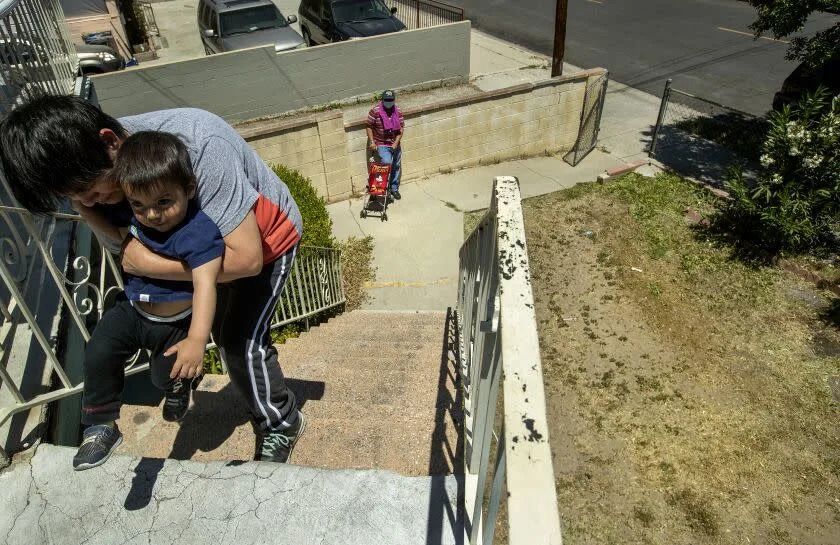
Benita Perez teaches her grandson, Nevaeh Perez, 1, how to walk at their apartment building in Lincoln Heights. Area at right, below used to be all grass until a year ago, because of the drought. (Mel Melcon/Los Angeles Times)
Raúl Monterroso of San Fernando knows that he can do little to help the struggling garden patio in front of his house. After all, he takes the new water restrictions seriously.
“Here, everything is dry, we have the entire irrigation system closed, my poor wife is crying over her plants,” said the Guatemala native, who stopped watering the grass on June 1 when instructions to cut outdoor watering to once a week were issued.
Further restrictions went into effect Sept. 6, when a 15-day ban through Sept. 20 was mandated by an emergency repair that shut down the 36-mile Upper Feeder pipeline that brings water from the Colorado River to Southern California. The Metropolitan Water District of Southern California said that more than 4 million people are being affected by the shutdown across the region, including Beverly Hills and Malibu, Burbank and Glendale, Long Beach, the city of Inglewood and a large swathe of the South Bay, and other areas stretching as far east as Pomona.
Also under the ban is the city of San Fernando, at the northern edge of L.A.’s San Fernando Valley, 92% of whose 24,000 residents are Latino.
“The reality is that when they give you the alert, you have to be aware. The measures must be followed, there is no other option,” Monterroso said.
In Long Beach, an hour’s drive south of San Fernando, businesswoman Sandy Cajas said that urgent measures are needed to maintain a steady flow of water and find new sources of it.
“We are experiencing the worst drought in decades,” she said. “What is going to happen here is that we are going to have to recycle the water due to the scarcity that exists.”
That’s one item, among many, on the state capital’s agenda. Last month, a 16-page document released by Gov. Gavin Newsom, “California’s Water Supply Strategy — Adapting to a Hotter, Drier Future,” indicated that California’s water supply will shrink 10% by 2040.
Among other measures, the plan, backed by billions of dollars in investment, calls for recycling more wastewater and desalinating seawater and salty groundwater, as well as speeding up infrastructure development and pushing conservation, in hopes of providing enough water for more than 8.4 million homes by 2040.
According to Newsom, this “aggressive plan” will guarantee that future generations “continue to call California home in this hotter, drier climate.”
“The best science tells us that we need to act now to adapt to California’s water future. Climate change means drought won’t just stick around for two years at a time like it historically has — extreme weather is the new normal here in the American West and California will adapt to this new reality,” Newsom said in an Aug. 11 statement.
Yet the drought is playing out unevenly across different communities and among different households. Since June 1, about 6 million residents in Los Angeles, Ventura and San Bernardino counties have had to limit outdoor water use to once a week. But not everyone is complying.
Every day since 2003, Álex Guzmán has driven a truck for work from the San Fernando Valley to Beverly Hills. The Mexican immigrant labors for a landscaping company. His task is to maintain the trees and lawns of the mansions. But, above all, to water lots and lots of plants.
Hearing that additional restrictions on water use have been implemented, Guzmán just smiles.
“We have never stopped working in Beverly Hills, we have never stopped watering mansion gardens because of the restrictions,” he said.
“We are working normally, the bosses have not told us anything about lowering the use of water,” Guzmán added.
As reported by The Times, celebrities such as Sylvester Stallone, Dwyane Wade, Kevin Hart, Kim and Kourtney Kardashian are among the more than 2,000 customers who have received “notices of exceedance” for surpassing 150% of their monthly water budgets at least four times since the Las Virgenes Municipal Water District declared a drought emergency in late 2021.
That disparity in following restrictions shows up in many public spaces, said Patty López, a former Assemblywoman for District 39, pointing for example to the contrast between the independent city of San Fernando and Sylmar, which is part of the city of Los Angeles.
“If you look at the Veterans Memorial Community Regional Park in Sylmar it is completely green, but in the parks in our area the grass is dead,” said López, a San Fernando resident, lamenting that there is no clear, consistent application of policies, or rigorous follow-up and enforcement, throughout the region.
Under current conditions, if the use of water is not controlled, worse consequences won’t be long in coming.
Samuel Sandoval Solís, professor of water resources management at UC Davis, said that California has 30% of its water stored in dams, meaning that, because of the drought’s effects, 70% of its capacity is gone. Water level in the subsoil has dropped 25 feet since 2016.
“Everything is looking very bad,” said the academic, who has been researching, monitoring and teaching on the subject of water for 20 years.
According to a UC Berkeley study, as temperatures in California rose between 1960 and 1980, rainfall also diminished, based on climatological records and analyzing the cores of trees.
Given the current scarcities of water, and recent extreme heatwaves across the Golden State, even downpours in the upcoming rainy season wouldn’t be enough to compensate, Sandoval Solís said.
“It’s not enough to make it to the next year,” he said.
Sandoval Solís said that if Californians don’t do more to conserve water, the authorities will have to implement restrictions such as those imposed on some municipalities during a previous drought phase between 2014 and 2016. Those restrictions limited the amount of gallons per person to between 12 and 15 daily.
According to the California Dept. of Water Resources, the “current statewide median indoor residential water use is 48 gallons per capita per day, and that a quarter of California households already use less than 42 gallons per capita per day.” The U.S. Environmental Protection Agency website states that each American uses an average of 82 gallons per day at home, including consumption.
“We need to raise awareness that we must all enter this equally,” Sandoval Solís said, “regardless of whether you live in a luxury house or in an apartment, we all have to reduce water consumption.”
Panel: Archives still not certain it has all Trump records
Farnoush Amirit – September 13, 2022
WASHINGTON (AP) — The National Archives is still not certain that it has custody of all Donald Trump’s presidential records even after the FBI search of his Mar-a-Lago club, a congressional committee said in a letter Tuesday.
The House Committee on Oversight and Reform revealed that staff at the Archives on an Aug. 24 call could not provide assurances that they have all of Trump’s presidential records. The committee in the letter asked the Archives to conduct an assessment of whether any Trump records remain unaccounted for and potentially in his possession.
“In light of revelations that Mr. Trump’s representatives misled investigators about his continued possession of government property and that material found at his club included dozens of ‘empty folders’ for classified material, I am deeply concerned that sensitive presidential records may remain out of the control and custody of the U.S. Government,” Rep. Carolyn Maloney, D-N.Y., the chairwoman of the Oversight Committee, wrote in the letter.
The House committee has jurisdiction over the Presidential Records Act, a 1978 law that requires the preservation of White House documents as property of the U.S. government. The request is the latest development in a months long back-and-forth between the agency and the committee, which has been investigating Trump’s handling of records.
Trump wants his White House records back so he can add them to his presidential library
Donald Trump asked for all documents taken from his Mar-a-Lago home to be returned so that he can give the files to the National Archives and Records Administration, while also claiming they will be needed again later for his presidential library.
The request also comes weeks after the FBI recovered more than 100 documents with classified markings and even more than 10,000 other government documents from Trump’s Mar-a-Lago estate. The search came after lawyers for Trump provided a sworn certification that all government records had been returned.
But the letter notes a call between Archives staff and the committee on Aug. 24, where lawmakers were informed that documents could still be missing.
As a result, Maloney wrote, the committee is asking the agency to conduct an “urgent review” of all of the government records that have been recorded from the Trump White House to determine whether any additional records remain unaccounted for and potentially in the possession of the former president.
In addition, the committee also asked for the Archives to get a personal certification from Trump “that he has surrendered all presidential records that he illegally removed from the White House after leaving office.”
The committee is asking the Archives to provide an initial assessment of this review by Sept. 27.
For Trump’s Lawyers, Legal Exposure Comes With the Job
Michael S. Schmidt and Luke Broadwater – September 11, 2022
A dark joke has begun circulating among lawyers following the many legal travails of former President Donald Trump: MAGA actually stands for “making attorneys get attorneys.”
Over six years and nine major investigations by Congress, the Justice Department and local prosecutors, as Trump has managed to avoid removal from the presidency and indictment, it has become clear that serving as one of his lawyers is a remarkably risky job — and one that can involve considerable legal exposure. Time after time, his attorneys have been asked to testify as witnesses to potential crimes — or evaluated as possible criminal conspirators themselves.
While the consequences his lawyers faced were extraordinary when Trump was in the White House, the dangers have only intensified since he left office and have become increasingly acute in recent weeks, as the former president has come under scrutiny in two different Justice Department investigations and has been forced yet again to find lawyers willing to represent him.
Last week, a Justice Department filing revealed that Trump’s lawyers had misled federal investigators about whether he had handed over to the Justice Department all the classified documents he took from the White House when he left office. That raised questions about whether the lawyers, M. Evan Corcoran and Christina Bobb, could be prosecuted themselves and might ultimately be forced to become witnesses against their client. (Bobb recently retained a lawyer, according to a person familiar with the situation.)
The revelation capped a summer in which a team of lawyers that had been advising Trump as he tried to overturn the 2020 election faced a range of repercussions across the country from federal investigators, local prosecutors, state bar associations and government accountability groups.
One of Trump’s highest-profile lawyers, Rudy Giuliani, was named as a target in a state criminal investigation in Georgia. Conservative lawyer John Eastman, who came up with what he conceded privately was an unlawful strategy to help Trump overturn the election, said he believed he was a target in that same investigation and declined to answer questions while being deposed before a grand jury. Giuliani and Eastman have also been named as subjects of interest in a flurry of federal grand jury subpoenas seeking evidence about attempts by Trump’s allies to create fake slates of electors to help keep him in office.
Two others who worked for Trump in the White House — White House counsel Pat A. Cipollone and his deputy Patrick F. Philbin — were subpoenaed to appear before a federal grand jury in Washington investigating the efforts to overturn the 2020 election, including the roles that Giuliani and Eastman had played in helping Trump.
Cipollone, Philbin and at least nine other lawyers who worked for Trump have testified before the congressional committee investigating the Jan. 6 attack. Earlier this year, Cipollone and Philbin also were interviewed by the FBI as part of its investigation into the classified documents investigation.
And 17 mostly lesser-known lawyers who represented Trump in battleground states as he tried to overturn the election are facing ethics complaints, putting them at risk of being disciplined or disbarred by bar associations or the courts.
Vigorously defending the client — even one known for unscrupulous behavior or accused of an egregious crime — is part of a lawyer’s basic job description. But attorneys are bound by a code of professional conduct that forbids them from crossing certain lines, including knowingly making false claims, filing frivolous lawsuits or motions, and doing anything to further a crime.
The adage for lawyers representing clients accused of criminality, said Fritz Scheller, a longtime Florida defense lawyer, is that at the end of the day, no matter how bad it may have been for the client, the lawyer still gets to walk out the front door of the courthouse without any personal legal issues.
“That bad day for the criminal defense attorney becomes his worst day when he leaves through the courthouse door used for defendants on their way to jail,” Scheller said.
Long before he became president, Trump viewed lawyers as tools to carry out whatever unsavory errand he required. As president, his disdain for institutional norms and demand for unswerving loyalty meant that Trump expected White House lawyers to act in his personal interest, whether or not doing so was within the bounds of the law or in the interest of the country.
He is also known for refusing to pay his lawyers for their work; last year, the Republican National Committee agreed to settle up to $1.6 million of Trump’s personal legal bills.
Six weeks after taking office, Trump made clear to his aides what he expected of his lawyers when he raged about Jeff Sessions, the attorney general, for recusing himself from the inquiry into whether Russia had meddled in the 2016 election.
“I don’t have a lawyer,” Trump said to aides in the Oval Office, including White House counsel Donald F. McGahn II. “Where’s my Roy Cohn?”
Trump was referring to the notorious New York fixer who had represented and mentored Trump in the 1970s when he was an up-and-coming real estate investor. Cohn, who was chief counsel to Sen. Joseph McCarthy during the 1954 Army-McCarthy hearings investigating suspected communists, was disbarred by a New York court in 1986 for unethical conduct.
Trump’s quest for such a lawyer fueled a destructive cycle: As his legal difficulties mounted, he hired more lawyers, who in turn faced problems for their work on his behalf, leading established lawyers concerned about their reputations to balk at representing him.
“There’s no way to adhere to your ethical integrity and keep your job,” Kimberly Wehle, a University of Baltimore law professor who has closely tracked the investigations into the Jan. 6, 2021, attack on the Capitol, said of the dilemma Trump’s lawyers have faced. “There’s just no way to not step into a mess.”
The personal ramifications of doing legal work for Trump became painfully apparent to lawyers around him four months into his administration when McGahn and several of his lieutenants — fearing they could be held responsible for Trump’s conduct — retained a high-powered Washington lawyer to represent them in an investigation into whether the president had obstructed justice.
Within two years, McGahn had racked up hundreds of thousands of dollars in legal bills, and prosecutors had turned him into a chief witness against Trump.
Around the same time, Trump’s longtime New York lawyer, Michael Cohen, began a three-year prison sentence for his role in paying off a woman in the final days of the 2016 presidential campaign to ensure she did not disclose an affair with Trump.
More recently, a long list of lawyers who have represented Trump have found themselves on the receiving end of ethics complaints and disciplinary action.
“Ultimately, we want to demonstrate to all the lawyers that the next time that Sidney Powell or Rudy Giuliani calls and says, ‘Hey, will you sign your name to this?’ they’ll say no because they’ll realize that there are professional consequences,” said Michael Teter, the director of the 65 Project, which has filed complaints against 40 lawyers who took part in suits challenging the 2020 results, including 17 last month.
Teter’s group has identified more than 110 lawyers across 26 states who agreed to participate in various plots by Trump and his allies as they sought to overturn the 2020 election. Thus far, at least 10 of them have been fined or sanctioned.
“This is part of a well-funded effort to attack every attorney who participated in any of the 2020 election challenges,” Eastman said in a statement in response to a bar complaint filed against him, adding that the goal of the 65 Project was to “shame them and make them toxic in their communities and their firms.”
The most serious repercussions have come for four lawyers who acted as ringleaders in the effort. Giuliani’s licenses to practice law in the District of Columbia and New York were suspended, while Powell has been sanctioned in Detroit and faces a disciplinary action brought by the state bar of Texas. Both are also facing separate defamation lawsuits by Dominion, a voting machine company that claims that the two acted recklessly in falsely asserting that Dominion machines had helped flip votes from Trump to Biden. The suits each seek more than $1 billion in damages.
Lin Wood is under investigation by the bar association in his home state of Georgia and was sanctioned in Michigan. Eastman, who has said he could also be a target of the Georgia inquiry, may face additional legal jeopardy; federal agents have seized his phone, and a federal judge said in March that he and Trump likely committed felonies while attempting to overturn the 2020 election.
Among the 40 lawyers whom Teter’s group has singled out for ethics complaints are James Bopp; Kenneth Chesebro; Sen. Ted Cruz, R-Texas; Joseph diGenova; Jenna Ellis; Boris Epshteyn; Cleta Mitchell; and William Olson.
The House investigation into Jan. 6 has also focused on potential wrongdoing by Trump’s lawyers, particularly their role in the scheme to put forward slates of pro-Trump electors in states won by Joe Biden.
Giuliani also faced a federal investigation in New York by prosecutors who are said to be looking into his dealings in Ukraine to help Trump dig up dirt on Biden’s son. As part of that investigation, federal agents seized cellphones and computers from Giuliani in April during searches of his apartment on Madison Avenue and his Park Avenue office in Manhattan. The investigation is unlikely to result in charges.
Powell’s nonprofit organization, Defending the Republic, which raised millions of dollars by spreading lies about election fraud, is under investigation by a federal grand jury in Washington, according to two people with direct knowledge of the inquiry.
Ellis was also accused of professional misconduct in an ethics complaint in Colorado by the bipartisan legal watchdog group the States United Democracy Center. It said that Ellis assisted Trump in an “unsuccessful and potentially criminal effort” to stave off his electoral defeat.
Some lawyers who worked for Trump have managed to emerge with their careers intact, including Emmet T. Flood, who took the lead at the White House dealing with the Russia investigation, and two other lawyers who represented the president around that time: Jane Raskin and Joanna C. Hendon.
Now two of them are among the lawyers being hired by Trump’s former attorneys to represent them as they deal with the fallout from their work for Trump.
Flood is now representing Cipollone, the former White House counsel, who is facing federal investigators’ questions about Trump’s conduct. And Raskin is helping to represent Ellis.