The real story behind America’s population bomb: Adults want their independence

USA Today

The real story behind America’s population bomb: Adults want their independence

Clay Routledge and Will Johnson – October 12, 2022

Declining birth rates are a major concern for the United States and many countries around the world, so we – an expert in existential psychology and an expert in pulsing public opinion – surveyed the Americans choosing not to have children to learn the reasons why.

Americans are having fewer children than are needed to keep population numbers stable.

Low birth rates are not only an American problem. In 2020, researchers at the University of Washington’s Institute for Health Metrics and Evaluation projected that the global fertility rate will drop below 1.7 by the end of this century. And countries such as Italy, South Korea, Spain and Thailand will lose more than half their population within the lifetimes of children being born this year.

Fear of not just climate change and affordable housing

Much of the conversation in the United States about this issue has focused on fears about the future of the world or major economic challenges. For instance, the threat of climate change and the affordability of housing are frequently referenced as reasons that Americans don’t want to have kids.

While those are concerns of course, when you look at the data, family planning appears to be influenced more by people’s personal views about the independent life they want to live than their worries about potential environmental or economic issues.

This has important implications for how we as a nation approach the demographic challenge of declining birth rates.

A Harris Poll found that of those without children, about half do not want to have a child in the future, while 20% remain unsure. The only factor that the majority (54%) of Americans who don’t want to have kids endorsed as influencing their decision was maintaining personal independence.

Specifically, we surveyed a representative sample of just over 1,000 U.S. adults about their future family planning. Of those without children, about half (52%) do not want to have a child in the future, while 20% remain unsure.

We then asked these individuals whether their decision to not have children was influenced by a wide range of factors. Only 28% of them reported that climate change influenced their decision to not have kids. Similarly, only 33% indicated that housing prices influenced their decision.

Other factors we asked about including the political situation in the United States (31%), safety concerns (31%), personal financial situation (46%) and work-life balance (40%) were endorsed by less than half of respondents.

The only factor that the majority (54%) of Americans who don’t want to have kids endorsed as influencing their decision was maintaining personal independence.

Chrissy Teigen’s Q&A with Feeding America: How can we help children who are going hungry?

Desire for personal independence is most powerful

Moreover, since respondents were able to indicate multiple reasons for not having kids, we also asked them which of those factors most influenced their decision. Further suggesting that this decision is more about personal preferences than other factors, we found that maintaining personal independence was reported as the most influential factor for more respondents than any other factor; 43% of those who considered independence to be a factor indicated that it was the most influential reason for not having kids.

For comparison, only 26% of those who considered climate change when deciding whether to have children reported that it was the most influential reason and only 9% of those who considered housing prices indicated such.

Americans may have multiple reasons for opting out of parenting, but their desire for personal independence is the most powerful one.

Children’s mental health: Alarm on children’s mental health has been ringing for decades. Too few have listened.

It is also worth noting that men and women were generally similar in their reasoning; 53% of females and 55% of males reported that their desire to maintain their personal independence influenced their decision to not have children. No other reason for not having kids was cited by a majority of men or women.

We shouldn’t oversimplify the story of why more and more Americans are choosing to not start families. It is undoubtedly complex and involves facets that public opinion surveys can’t fully capture. However, our results have important implications for cultural and political discussions around this issue.

Changes in public policy may not help

Perhaps most important, our findings suggest that public policy solutions are unlikely to have much impact on birth rates. Because Americans who are opting out of having children are more influenced by their desire to maintain their personal independence than concerns about climate change or affordable housing, or other issues such as work-life balance and safety, efforts to promote a more pro-natal society will need to be more cultural in nature.

More specifically, these efforts will need to address psychological needs related to individuals’ life goals and priorities.

How do we change people’s attitude about how children will affect their lives if they privilege personal freedom over other ideals? A good place to start is to focus on one of the most fundamental psychological needs, the need for existential meaning.

Humans are highly motivated to perceive their lives as meaningful. And it is when they perceive their lives as full of meaning that they are most mentally healthy, resilient, goal-driven, self-disciplined and self-reliant. In this way, meaning can be thought of as a key ingredient to achieving personal independence.

The Americans concerned about how having children may affect their personal independence may not realize that meaning is so empowering and that family is a fundamental source of meaning. For instance, surveys find that when people are asked what makes their lives feel meaningful, the most common response is family.

In addition, studies find that parents report higher levels of meaning than adults without children and have a greater sense of meaning when they are taking care of their children than when they are engaged in other activities.

Goldie Hawn on mental health issues: ‘Don’t turn a blind eye’ to kids

Cultural narratives that treat parenting as a threat to personal independence and a roadblock to a fulfilling life may contribute to declining birth rates more than many realize.

There are of course environmental, economic and other challenges that can make people worried about bringing another human into this world and that can make raising children difficult.

But this is not new. For much of our history, most humans lived far more perilous lives than we live today. Our challenge is less about our material conditions and more about our mindset.

If we want a world with more children, we are going to have to convince people that having and raising kids is a critical ingredient of, not a barrier to, the good life.
Republicans Plan to Use Debt Limit Leverage to Reduce Social Security, Medicare: Report

The Fiscal Times

Republicans Plan to Use Debt Limit Leverage to Reduce Social Security, Medicare: Report

Michael Rainey – October 12, 2022

Republicans in the House are planning to use a potential showdown next year over raising the federal debt limit to make changes in Social Security and Medicare, Bloomberg’s Jack Fitzpatrick reports.

The developing plan hinges on Republicans winning control of the House in the midterm elections, an outcome that is looking likely. Four GOP lawmakers who are vying for leadership of the House Budget Committee in the event of a Republican victory told Fitzpatrick that the need to raise the debt ceiling could give them the leverage they need to force Democrats to make concessions.

“The debt limit is clearly one of those tools that Republicans — that a Republican-controlled Congress — will use to make sure that we do everything we can to make this economy strong,” Rep. Jason Smith (R-MO), the senior Republican on the current Budget Committee, said.

Republicans are still discussing exactly what changes they might try to enact. “What would we consider a win?” said Rep. Lloyd Smucker (R-PA), who is interested in the top spot on the Budget Committee. “What would we consider to be a fiscally responsible budget?”

Although the details are still up in the air, one theme is clear: House Republicans want to reduce federal spending, and the major entitlement programs are a target. Rep. Buddy Carter (R-GA) Carter said that Republicans’ “main focus has got to be on nondiscretionary — it’s got to be on entitlements.”

Shrinking the safety net: One option reportedly being discussed is raising the eligibility age for Social Security and Medicare, the two largest mandatory spending programs. Each faces financial squeezes in the coming years as the baby boomers age and continue to retire. Under current rules, the Social Security system would be forced to cut benefits starting in 2034, while Medicare could run short of funds by 2028.

Earlier this year, the Republican Study Committee released a plan to raise the eligibility age for Social Security to 70 and the eligibility age for Medicare to 67. The increases would be phased in over time and once the target is reached, the eligibility age would then be indexed to life expectancy. The lawmakers also called for increased means testing in the Medicare program, and a privatization option for Social Security.

Other options being considered include more stringent work requirements and income limits for what Smith called “welfare programs,” including the Supplemental Nutrition Assistance Program more commonly known as food stamps. And new caps on discretionary spending could limit spending increases over 10 years.

One thing that won’t be cut: defense spending. Rep. Jodey Arrington (R-TX) told Bloomberg that he wants to cut nondefense spending in order to provide more money for the military.

Willing to risk “catastrophe”? Republicans say they are leery about pushing too far in their demands, but many experts think that any effort to use the debt limit as leverage in negotiations is unacceptably risky. Treasury Secretary Janet Yellen has warned that defaulting on U.S. debt payments — which would occur if the U.S. failed to raise the debt ceiling — would cause a “catastrophe” in the global economy.

Speaker Nancy Pelosi (D-CA) accused the GOP of taking huge risks in order to cut important social programs. “House Republicans are openly threatening to cause an economic catastrophe in order to realize their obsession with slashing Medicare and Social Security,” a Pelosi spokesperson told Bloomberg. “As House Republican leaders’ own words constantly reveal, dismantling the pillars of American seniors’ financial security is not a fringe view in the extreme MAGA House GOP, it is a broadly held obsession at the core of their legislative agenda.”

House Budget Committee Chair John Yarmuth (D-KY) also criticized Republican plans. “Holding the full faith and credit of the United States hostage to implement an extreme and unpopular agenda is not governing, it’s desperation,” Yarmuth said in a statement. “Congressional Republicans are so hellbent on gutting Social Security and ending Medicare as we know it that they are willing to risk economic catastrophe to get it done. This is a desperate attempt to shower the wealthy and big corporations with even more tax giveaways by intentionally sacrificing the needs of American families.”

Democrats do have one option for disarming Republicans ahead of a debt ceiling showdown: They could attempt to raise the ceiling on their own during the lame-duck session at the end of the year, potentially denying the GOP the use of that weapon. But both Yarmuth and Sen. Tim Kaine (D-VA) told Bloomberg there has been no discussion among Democrats about such a plan.

The bottom line: Taking a page from the tea party playbook from a decade ago, expect to see Republicans attempting to force spending reductions in the next Congress — reductions that could involve fundamental changes in the way the country’s top safety net programs operate.

Hurricane Ian exposed a flood insurance nightmare for homeowners in Florida

NBC News

Hurricane Ian exposed a flood insurance nightmare for homeowners in Florida

Phil McCausland – October 11, 2022

Hurricane Ian’s storm surge brought numerous feet of water into homes on Florida’s west coast, and left behind mold, muck, mud and a flood insurance nightmare for residents who want to rebuild.

Many Floridians who suffered extensive flooding did not carry a separate flood insurance policy to cover the damage caused by the deadly storm. It’s left homeowners — and even renters — with a hefty and, possibly, life-changing expense that could decide whether they are rendered homeless.

Susan Cavanaugh and her two kids are living through that ordeal after the first floor of their home on Sanibel Island, where all three live and work, was engulfed by the storm surge. While going through a costly divorce earlier this year, Cavanaugh’s flood insurance coverage lapsed.

Now she doesn’t know how to get her family back into their home without an insurance check to pay for contractors and building materials.

“I can only do so much as a single mom,” said Cavanaugh, who is staying in a motel and is unsure where to live next. “We just want to go back to the house. It’s been deemed structurally sound, but we have to get it back online and it’s not just a cosmetic issue. It’s going to take blood, sweat and tears and it’s going to take a lot of muscle and a lot of work to get there.”

Image: Resident Pamela Brislin who has lived on Sanibel Island since 2020 cleans up the damage from Hurricane Ian, on Oct. 6, 2022, in Sanibel Island, Fla. (Scott Smith / AP)

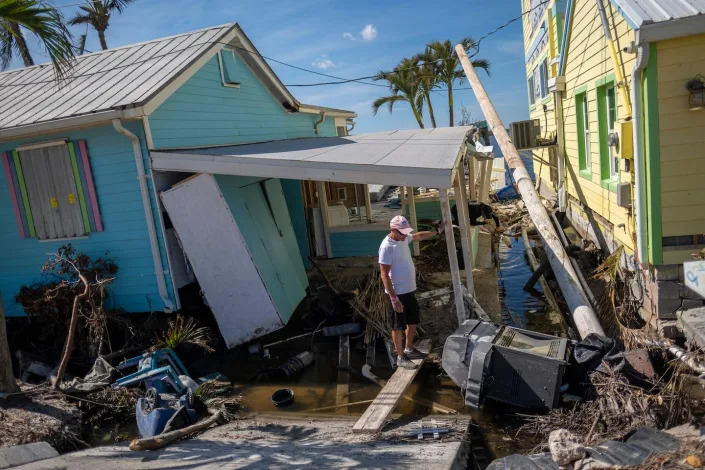
Sanibel Island last month suffered a direct hit from the Category 4 storm and the surge of water, up to 15 feet in some places, it brought from the gulf into people’s homes. The community remains inaccessible by car, forcing many to pay boat captains to ferry them to begin the cleanup.

Cavanaugh is not alone in facing flood damage without the backing of insurance coverage. Many people in the small coastal community, which faces the Gulf of Mexico southwest of Fort Myers, did not have flood insurance coverage.

What’s more, Sanibel Island is a microcosm of a greater insurance challenge facing Florida and the country.

Only about 18.5% of homes in Florida counties that faced a mandatory or voluntary evacuation order the evening before Hurricane Ian landed had a flood insurance policy with the National Flood Insurance Program, the federal government program administered by FEMA, according to an analysis conducted by the risk management consulting firm Milliman. Even in designated flood hazard zones within those counties, fewer than half of the homes had a policy on file.

It appears that, despite an increased occurrence of devastating flood events, a declining percentage of people nationwide have flood insurance policies. The number of policies maintained by the National Flood Insurance Program has declined by nearly 700,000 since 2008, according to data acquired from the federal agency.

“There are many factors that influence this drop in policyholders, including the economic impact of the pandemic, the housing market, affordability, or purchasing flood insurance from the private market,” David Maurstad, the senior executive of the National Flood Insurance Program, said in a statement.

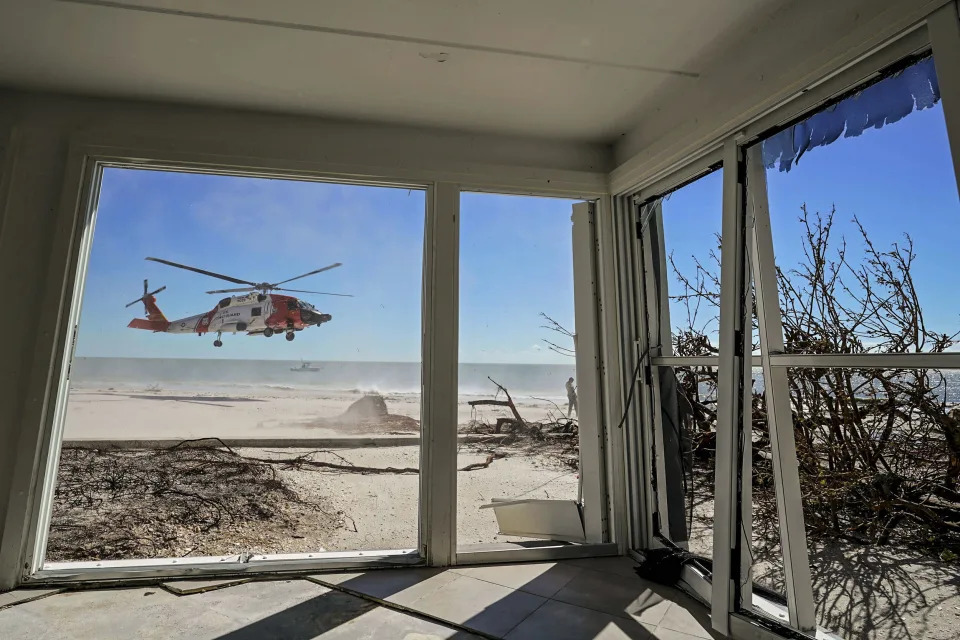
Image: A U.S. Coast Guard helicopter takes off, seen from inside a home damaged by Hurricane Ian on Sanibel Island, Fla., on Sept. 30, 2022. (Steve Helber / AP filw)

He said that FEMA “continues to market the flood insurance product throughout the country” in an effort “to increase the number of properties covered by flood insurance.” Currently about 5 million policies are under the National Flood Insurance Program, which was created in the 1960s because the private insurance market increasingly declined to cover flood events.

It’s an expensive undertaking for the federal government. Since 2008, the program has paid out $40.1 billion to slightly more than 910,000 claims, according to FEMA’s data, and the agency still owes about $20 billion to the U.S. Treasury after borrowing funds to pay out many of those claims.

With climate change leading to more dangerous storms and expanding the risk of flooding, the U.S. and its coastal communities are beginning to suffer the pitfalls of building in flood-prone areas.

“The risk is there as weather losses are on the rise,” said Lynne McChristian, the director of the Office of Risk Management & Insurance Research at the University of Illinois, “and those exposures are growing because we’re building more expensive things in the most vulnerable areas.”

That has become a growing challenge for FEMA, as it often provides aid to communities prone to flooding. It has hoped that more people in these areas would sign up for insurance — especially those in flood-prone areas. FEMA guidelines have gone so far as to refuse aid to those who have received funds from the federal agency for flooding in the past if they have not picked up flood insurance coverage in the meantime.

“I think anybody who lives near water should certainly purchase flood insurance because it’s your No. 1 tool to help protect your family and your home after the storm,” FEMA administrator Deanne Criswell told CNN last week.

Image: Damaged vehicles and debris are seen on Sanibel Island, Fla., during Hurricane Ian. (Chuck Larsen / SantivaChronicle.com via AP)

One significant issue is that many homeowners assume a typical homeowner’s insurance policy covers floods. Florida law requires insurers to inform their clients about the coverage gap, but many Floridians expressed surprise to find their policy did not cover flooding.

One Florida requirement is that each policy at issuance and renewal must include in at least 18-point bold font four sentences warning that a separate flood policy is necessary. “Your homeowner’s insurance policy does not include coverage for damage resulting from a flood even if hurricane winds and rain caused the flood to occur,” the warning text states.

“I think people might read them less now because it’s all electronic,” McChristian said of the policies and the warnings. “Regulators in several states have tried to do it, but it’s not moving the needle.”

Affordability also remains an essential reason many gave for forgoing flood insurance. The average cost of flood insurance from the National Flood Insurance Program is $995 a year, according to Forbes Advisor analysis. That number can fluctuate depending on the location and floodwater risk the home faces, and it is an additional cost on top of other homeowner policies. That can make it unaffordable or, at the very least, a burden.

Although mortgage companies often require coverage upon purchase of a home in areas prone to flooding, some allow their coverage to lapse as costs have gone up. Others, who own their homes outright, no longer have to maintain that coverage.

Leslie Weyhrich said that she and her husband decided to cut back on insurance coverage for their second home on Sanibel Island in May after 15 years of holding a policy. Each year the price grew astronomically and they knew they would be facing another massive cost for a needed roof repair. Now they will be stuck footing the bill for much of the damage themselves.

“It went up significantly, maybe about five or six years ago,” said Weyhrich. “But every year that bill came due, we discussed whether it was worth it or not because the deductibles were so high, it didn’t cover as much as it used to and it just made less fiscal sense.”

But decisions like these could prove existential for many on the island and for communities across Florida, and it is an issue that is unlikely to be sorted in the near term and could lead to litigation.

“Half the people I’ve talked to on this island are uninsured for flooding and that is absolutely terrifying,” said Chuck Bergstrom, a realtor on Sanibel Island who stayed in his home through the storm. “And whether you have it or not, these insurance companies aren’t here to help these folks right now. They’ll negotiate as hard as they can.”

Those who have flood coverage are also gearing up for their own insurance nightmare as they debate with their carriers whether a home’s damage was caused by floodwaters or the hurricane’s wind.

The separate policies means companies on both sides are likely to have a drawn-out battle that could become litigious.

“The lawyers are going to have a field day with this,” Bergstrom added. “I mean, who pays for what exactly?”

Patients in charge of the asylum: Another Challenge to New York’s Gun Law: Sheriffs Who Won’t Enforce It

The New York Times.

Another Challenge to New York’s Gun Law: Sheriffs Who Won’t Enforce It

Jesse McKinley and Cole Louison – October 9, 2022

Sheriff Robert Milby in his office in Lyons, N.Y., Sept. 15, 2022. (Lauren Petracca/The New York Times)

LYONS, N.Y. — Robert Milby, Wayne County’s new sheriff, has been in law enforcement most of his adult life, earning praise and promotions for conscientious service. But recently, Milby has attracted attention for a different approach to the law: ignoring it.

Milby is among at least a half-dozen sheriffs in upstate New York who have said they have no intention of aggressively enforcing gun regulations that state lawmakers passed last summer, forbidding concealed weapons in so-called sensitive areas — a long list of public spaces including, but not limited to, government buildings and religious centers, health facilities and homeless shelters, schools and subways, stadiums and state parks, and, of course, Times Square.

“It’s basically everywhere,” said Milby, in a recent interview in his office in Wayne County, east of Rochester. “If anyone thinks we’re going to go out and take a proactive stance against this, that’s not going to happen.”

On Thursday, a U.S. District Court judge blocked large portions of the law, dealing a major blow to lawmakers in Albany who had sought to blaze a trail for other states after the Supreme Court in June struck down a century-old New York law that had strictly limited the carrying of weapons in public. Between the court challenge and the hostility of many law enforcement officers, New York’s ambitious effort could be teetering.

The judge, Glenn T. Suddaby, agreed to a three-day delay of his order to allow an emergency appeal to a higher federal court. But even before Suddaby ruled, a collection of sheriffs from upstate New York were already saying they would make no special effort to enforce the law, citing lack of personnel, an overbroad scope and possible infringements on the Second Amendment.

Nationwide, conservative sheriffs have been at the front line of an aggressive pushback on liberal policies — often framing themselves as “constitutional sheriffs,” or as self-declared arbiters of any law’s constitutionality. Sheriffs in other states have also been part of efforts to prove a fallacious conspiracy theory that former President Donald Trump won the 2020 election.

In New York, dissent has walked a fine line between loud complaints and winking resistance, including pledges of selective — and infrequent — enforcement.

“I have to enforce it because I swore to uphold the laws, but I can use as much discretion as I want,” said Richard C. Giardino, the Republican sheriff in Fulton County, northwest of Albany. “If someone intentionally flouts the law, then they’re going to be handled one way. But if someone was unaware that the rules have changed, then we’re not going to charge someone with a felony because they went into their barbershop with their carry concealed.”

Such criticism has been heard from Greene County, in the Hudson Valley, to Erie County, home to Buffalo, the state’s second-largest city, as well as from groups like the New York State Sheriffs’ Association, which called the new law a “thoughtless, reactionary action” that aims to “restrain and punish law-abiding citizens.”

“We will take the complaint, but it will go to the bottom of my stack,” said Mike Filicetti, the Niagara County sheriff, who appends a Ronald Reagan quote to his emails. “There will be no arrests made without my authorization and it’s a very, very low priority for me.”

The law took effect Sept. 1, and, at least anecdotally, has been used only sparingly since. Jeff Smith, the sheriff in mostly rural Montgomery County, west of Albany, said his office has had no calls for enforcement of the new law, noting that “almost every household” in his jurisdiction had some sort of gun.

Smith, a Republican, said he understands the motives of lawmakers to quell violence and mass shootings, but that the gun law inadvertently targeted lawful gun owners.

“The pendulum swung way too far,” he said.

An element of the New York law makes it a crime to carry a firearm onto any private property, including homes, unless there is “clear and conspicuous signage” indicating that the owner allows such weapons. Some sheriffs have printed their own signs and distributed them to gun-friendly businesses and residents.

“I don’t think you could find one case in this country, in United States history, where a sign said ‘SCHOOL ZONE NO GUNS PERMITTED,’ and it stopped an active shooter,” said Giardino.

For supporters of the law, the opposition is insincere, considering that sheriffs’ demands for law and order are often coupled with complaints that the state is in disarray, that crime is rampant and that the Legislature has empowered lawbreakers.

“To turn around and say, ‘For the laws that we don’t like, or we may disagree with politically, we will refuse to enforce,’ to me is the height of hypocrisy,” said state Sen. Zellnor Myrie, a Brooklyn Democrat who voted for the bill.

John Feinblatt, the president of Everytown for Gun Safety, said sheriffs weren’t just endangering the public, they were also “endangering their colleagues in law enforcement.”

Myrie added that if sheriffs are angry, they should direct their ire at the Supreme Court, noting that the majority decision in the case, New York State Rifle and Pistol Association v. Bruen, was written by Justice Clarence Thomas, an avowed conservative — and specifically noted a historical basis for restrictions in “sensitive places.”

Kelly Roskam, the director of law and policy at the Johns Hopkins Center for Gun Violence Solutions, said that the Supreme Court left many unsettled questions that lower courts must address. One particular challenge is a lack of clarity in the court’s test for constitutionality: whether a sensitive place is identical to or sufficiently similar to one that existed at the time of the Second Amendment’s adoption in the late 18th century.

“We face different problems with firearms than those who ratified the Constitution did,” she said. “You’re likely to see challenges to these laws, and different judges will come to different conclusions.”

The nation has a long history of banning guns in certain places, said David Pucino, the deputy chief counsel at Giffords Law Center, which seeks to stem gun violence, with dozens of states restricting concealed weapons in places like airports, courthouses and locations that serve alcohol.

“The statements that we’ve been seeing here are ideological statements,” Pucino said of the sheriffs. “And that’s not an appropriate basis for a sheriff to enforce or not enforce laws.”

The dispute evinces a larger rift between Democratic lawmakers in Albany — heavily represented by downstate liberals — and more conservative law enforcement and elected officials upstate. The schism was intensified by the pandemic, with some sheriffs defying COVID-19 occupancy rules for Thanksgiving dinners in 2020, while other Republican county officials refused to abide by mask mandates in schools.

“The people who are doing this, a lot of them are New York City legislators and they don’t have a clue,” said Todd Hood, the sheriff of Madison County, east of Syracuse, who says that “firearms are what made our country great.”

“There are different people up here,” said Hood, a Republican. “It’s run totally different.”

Jeffrey A. Fagan, a law professor at Columbia University, said that Albany lawmakers and Gov. Kathy Hochul, a Democrat, performed a critical test of the Bruen decision’s limits, even if the law is overturned.

“What New York did in response to Bruen was just about as strong or any other state in the country,” he said. “The governor and the Legislature were sticking their chins out in service of making a very important point.”

For her part, Hochul says she and her staff consulted with a raft of state and county law enforcement officials before the gun bill’s passage. “It was an intense process, but it was necessary,” Hochul said in late August, on the eve of the law taking effect.

The rollout was not without hiccups, including concerns from some military re-enactors who have canceled events out of fear of running afoul of the new law. Officials in Adirondack Park, the 6-million-acre swath of greenery and small towns in the state’s North Country, also pressed Hochul on whether guns would be allowed there.

For his part, Milby, a Republican elected in November, reiterated that his officers, fewer than 100 in a county of nearly 100,000 people, would not be actively pursuing offenders of the new law, although they would respond to calls about concealed weapons if they came in.

More than anything, he said his office is getting “an awful lot of calls” from residents confused by the law, many of whom are “very pro-Second Amendment.”

“It’s basically been clear as mud since Sept. 1,” he said.

And as for who was to blame, Milby said the opinions in Wayne County were crystal clear long before Thursday’s decision.

“There’s a very strong sentiment in this county that the governor has just thumbed her nose at the Supreme Court, in what’s being touted as an unconstitutional conniption fit,” he said. “She’s absolutely overstepped.”

Research Shows Lung Health May Be the Number One Indicator of Living a Long, Healthy Life

Parade

Research Shows Lung Health May Be the Number One Indicator of Living a Long, Healthy Life—Here’s How To Improve Yours

Kaitlin Vogel – October 7, 2022

We all know the importance of brain health, gut health, and heart health, but when it comes to lung health, it’s probably not something many of us think too much about.

But according to research, your lung health can predict how long you live. One study that involved a 30-year follow-up found that there is a direct link between lung function and mortality.

In 1960 and 1961, researchers looked at 2,273 men and women between the ages of 15 and 96, gathering data on lifestyle, health and lung function. In 1990, a follow-up study showed which participants had died and their cause of death. Results showed that the 20 percent of men with the poorest lung function at the start of the study were more than twice as likely to have died compared to men with the best lung function. Women with the poorest lung function were more than one-and-a-half times more likely to have died.

Since lung health is key to living a long life, here are ways to keep yours healthy.

Why Lung Health Is Important

“Your lungs don’t just help you breathe—they also help to deliver oxygen to every organ in your body,” says Dr. Robert Goldber, MD, a pulmonologist with Providence Mission Hospital. “Plus, they help to remove carbon dioxide as you exhale—this is incredibly important to your overall health. And your lungs help to protect your airways from harmful irritants and substances.”

Having healthy lungs also helps to reduce your risk of developing severe complications of any illnesses that enter your respiratory system, such as the common cold, Dr. Goldberg adds. That’s why it’s important to keep them healthy by not smoking and avoiding exposure to indoor and outdoor pollutants that can cause respiratory damage, such as secondhand smoke and other chemicals. Get plenty of exercise and avoid outdoor activities on days when there is poor air quality.

Related: 13 Signs Your Lungs May Not Be Healthy

Signs of Poor Lung Health

One of the most important signs of poor lung health is having trouble breathing—this is incredibly serious, especially in older adults. It’s extremely important to contact your doctor immediately if it continues to be tough to breathe, as it could be a sign of asthma, lung cancer or chronic obstructive pulmonary disease (COPD), Dr. Goldberg explains.

COPD, which is a group of diseases including emphysema and chronic bronchitis, can cause a blockage in your airway and other breathing-related challenges.

Other poor lung health symptoms include a chronic cough or chest pain, wheezing, shortness of breath and coughing up blood. If you have any of these systems, make an appointment with your doctor, Dr. Goldberg adds.

How To Improve Your Lung Health
Steer clear of toxic pollutants

Healthy lungs can stay healthy by avoiding toxic inhalational agents including smoke, dust and other pathogens, Dr. Thomas Yadegar, MDpulmonologist, Medical Director of the ICU, Providence Cedars-Sinai Tarzana Medical Center, explains.

Engage in regular exercise and practice deep breathing techniques

Exercise and deep breathing exercises also promote healthy lung function. 4-7-8 breathing, where patients inhale deeply for four seconds, hold for seven seconds and exhale slowly for eight seconds, is a simple tool to help recruit more oxygenation, Dr. Yadegar states.

Wash your hands regularly

You can help to prevent respiratory infections, especially during cold and flu season, by regularly washing your hands with soap and water, avoiding large crowds and getting an annual flu shot, Dr. Goldberg explains. And, if do catch a cold or the flu, make sure to stay home to avoid exposing others to your illness.

Next up: The Best Foods for Healthy Lungs—And the Ones You Should Avoid

Sources
  • Chest: “Pulmonary function is a long-term predictor of mortality in the general population: 29-year follow-up of the Buffalo Health Study”
  • Dr. Robert Goldberg, a pulmonologist with Providence Mission Hospital
  • Dr. Thomas Yadegar, pulmonologist, Medical Director of the ICU, Providence Cedars-Sinai Tarzana Medical Center

I don’t care if Herschel Walker paid for an abortion or if he blew up the planet Alderaan

USA Today

I don’t care if Herschel Walker paid for an abortion or if he blew up the planet Alderaan

Rex Huppke, USA TODAY – October 6, 2022

There’s a report that Herschel Walker, the staunchly anti-abortion Republican running in Georgia’s Senate race, got a woman pregnant then paid for her abortion back in 2009.

Like other staunchly anti-abortion Republicans, I have one thing to say about that: DON’T CARE!

Dana Loesch, a conservative radio host and former spokesperson for the National Rifle Association, put it best this week when she said: “I don’t care if Herschel Walker paid to abort endangered baby eagles. I want control of the Senate.”

Abortions are unacceptable – except for this one 

Amen, sister. Abort those eagle babies! Like Loesch, I believe deeply in the sanctity of life and oppose all abortions – except for this one, which I will accept to prevent it from costing my party control of the Senate.

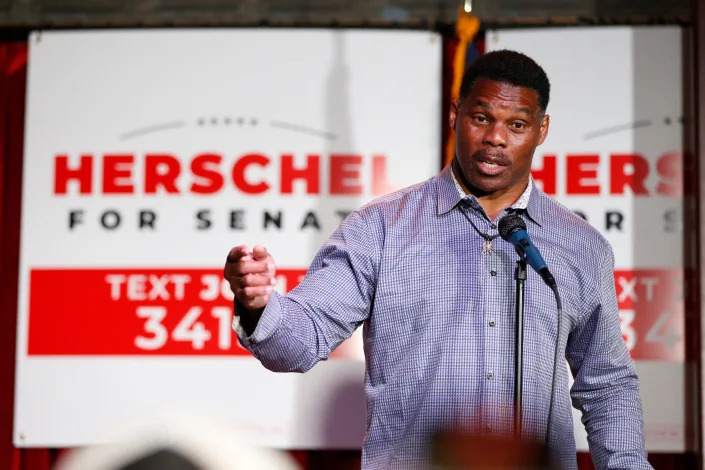
Republican U.S. Senate candidate Herschel Walker speaks at a rally in Athens, Ga., in May 2022.

The right to control our own fates is at stake: Can suburban women save it?

Republicans should have been ready: Dumping Roe may backfire on abortion opponents

The report came from The Daily Beast, and all they had to back it up was: a receipt from the abortion provider; a canceled check Walker sent to the woman five days after the procedure; and the get-well card Walker sent the check in. Walker denies the whole thing and claims he doesn’t know the woman, who, as The Daily Beast reported Wednesday, is also the mother of one of his children.

I’m going to have to side with Walker on this one, because I want my party in power and believe it’s a sin to use the word “hypocrisy.”

Control of the Senate is what matters here, and he played football!

As a matter of fact, I don’t think Loesch went far enough in defending Walker with her hypothetical eagle abortion clinic.

Like the many Republicans who’ve rushed in to stick up for Walker in the wake of the abortion news, I don’t care if the former football star is an ancient, trans-dimensional, shape-shifting entity of pure evil that takes the form of a clown named Pennywise and terrorizes a small town in Maine. I want control of the Senate, and I’m sure Walker regrets any past desire to feed on humans.

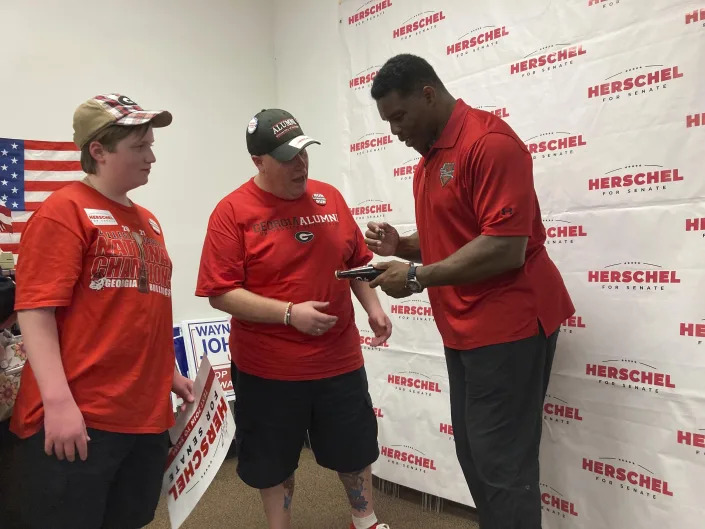
Republican Senate candidate Herschel Walker signs memorabilia for supporters in Columbus, Ga.

Iran’s Gen Z is fed up: Protests aren’t just about hijab, they’re about regime change

Americans want stricter gun safety measures: Gen Z will help us get there

The destruction of a planet or two is fine if it leads to power

Heck, I don’t care if Walker oversaw the construction of a moon-size space station that blew up the 2-billion-person planet of Alderaan, then later got in an argument with his son and chopped his right hand off. We have to secure that Georgia Senate seat so we can stop President Joe Biden’s immoral agenda!

I’m not the least bit bothered if Walker, in the year 1219, let loose the Mongol hordes on the Khwarazmian Empire in Persia after the shah, Ala ad-Din Muhammad II, broke a treaty. Control of the Senate is of tantamount importance to the moral fabric of our nation.

Ruling Mordor isn’t so bad when you think about it

The possibility Walker may have been described in the epic Anglo-Saxon poem “Beowulf” as the monster Grendel, “accursed of God, the destroyer and devourer of our human kind,” doesn’t bother me a whip if it leads to a Republican becoming Senate majority leader. And the additional claims that he slaughtered the inhabits of the mead hall of Heorot, built by King Hrothgar? A minor detail if the power to cut corporate taxes is in play.

Student loan relief: Biden’s fly-by-the-seat-of-his-pants approach creates huge mess

Children’s mental health: Alarm has been ringing for decades. Too few have listened.

No, I see no logical or moral inconsistency between my firmly held religious beliefs and the lack of concern I would feel if I learned Walker had remained a noncorporeal evil for centuries before rising again in the land of Mordor and building the dark fortress Barad-dûr not far from Mount Doom. And if he gathered massive armies of orcs and trolls then tricked the elven-smith Celebrimbor into forging the Rings of Power? Well that’s a small price to pay to defeat Democratic Sen. Raphael Warnock, who is a pastor and has probably never paid to abort endangered baby eagles.

Basically, nothing matters as long as we win

The discovery that Walker is, in fact, the Dark Lord Voldemort, “He Who Must Not Be Named,” and is plotting, with the help of Death Eaters, to rid the world of Muggles, would in no way impact my support for a candidate whose qualifications include being somewhat famous.

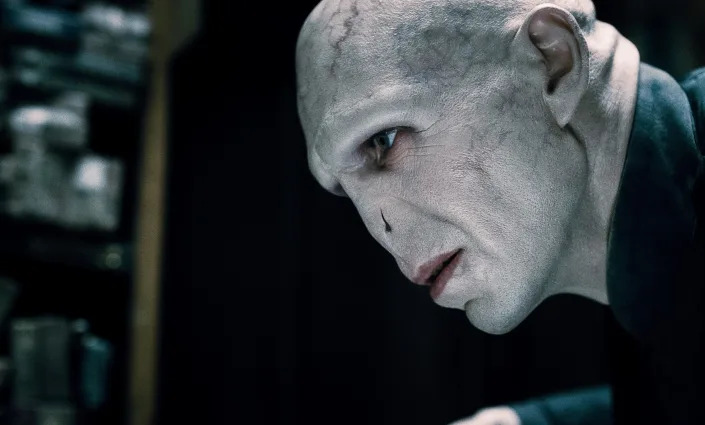
The dark wizard Voldemort (Ralph Fiennes) lords over the wizarding world in "Harry Potter and the Deathly Hallows: Part I."
The dark wizard Voldemort (Ralph Fiennes) lords over the wizarding world in “Harry Potter and the Deathly Hallows: Part I.”

I want control of the Senate. Getting Herschel Walker elected is key to that end. And if that means being OK finding out he once snapped his fingers while wearing the Infinity Gauntlet and instantly wiped out half of all life in the universe, well … so be it. I’m not about to let the morality I use to disguise my craven thirst for power get in the way of my craven thirst for power.

The big reason Florida insurance companies are failing isn’t just hurricane risk – it’s fraud and lawsuits

The Conversation

The big reason Florida insurance companies are failing isn’t just hurricane risk – it’s fraud and lawsuits

Shahid S. Hamid – October 5, 2022

Shahid S. Hamid is Professor of Finance, Florida International University.

The big reason Florida insurance companies are failing isn’t just hurricane risk – it’s fraud and lawsuits

Hurricane Ian’s widespread damage is another disaster for Florida’s already shaky insurance industry. Even though home insurance rates in Florida are nearly triple the national average, insurers have been losing money. Six have failed since January 2022. Now, insured losses from Ian are estimated to exceed US$40 billion

Hurricane risk might seem like the obvious problem, but there is a more insidious driver in this financial train wreck.

Finance professor Shahid Hamid, who directs the Laboratory for Insurance at Florida International University, explained how Florida’s insurance market got this bad – and how the state’s insurer of last resort, Citizens Property Insurance, now carrying more than 1 million policies, can weather the storm.

What’s making it so hard for Florida insurers to survive?

Florida’s insurance rates have almost doubled in the past five years, yet insurance companies are still losing money for three main reasons.

One is the rising hurricane risk. Hurricanes Matthew (2016), Irma (2017) and Michael (2018) were all destructive. But a lot of Florida’s hurricane damage is from water, which is covered by the National Flood Insurance Program, rather than by private property insurance.

Another reason is that reinsurance pricing is going up – that’s insurance for insurance companies to help when claims spike.

But the biggest single reason is the “assignment of benefits” problem, involving contractors after a storm. It’s partly fraud and partly taking advantage of loose regulation and court decisions that have affected insurance companies.

It generally looks like this: Contractors will knock on doors and say they can get the homeowner a new roof. The cost of a new roof is maybe $20,000-$30,000. So, the contractor inspects the roof. Often, there isn’t really that much damage. The contractor promises to take care of everything if the homeowner assigns over their insurance benefit. The contractors can then claim whatever they want from the insurance company without needing the homeowner’s consent.

If the insurance company determines the damage wasn’t actually covered, the contractor sues.

So insurance companies are stuck either fighting the lawsuit or settling. Either way, it’s costly.

Other lawsuits may involve homeowners who don’t have flood insurance. Only about 14% of Florida homeowners pay for flood insurance, which is mostly available through the federal National Flood Insurance Program. Some without flood insurance will file damage claims with their property insurance company, arguing that wind caused the problem.

How widespread of a problem are these lawsuits?

Overall, the numbers are pretty striking.

About 9% of homeowner property claims nationwide are filed in Florida, yet 79% of lawsuits related to property claims are filed there.

The legal cost in 2019 was over $3 billion for insurance companies just fighting these lawsuits, and that’s all going to be passed on to homeowners in higher costs.

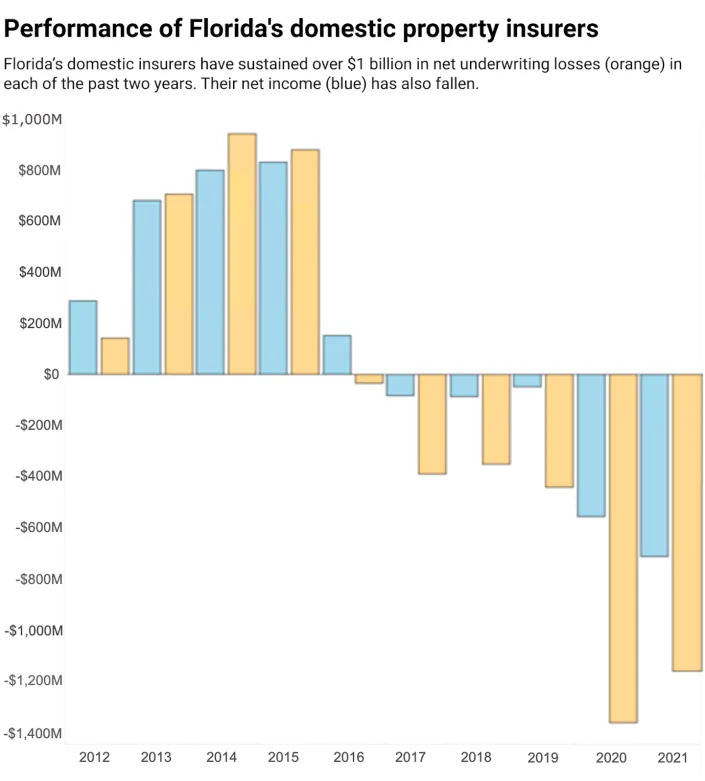
Insurance companies had a more than $1 billion underwriting loss in 2020 and again in 2021. Even with premiums going up so much, they’re still losing money in Florida because of this. And that’s part of the reason so many companies are deciding to leave.

Assignment of benefits is likely more prevalent in Florida than most other states because there is more opportunity from all the roof damage from hurricanes. The state’s regulation is also relatively weak. This may eventually be fixed by the legislature, but that takes time and groups are lobbying against change. It took a long time to pass a law saying the attorney fee has to be capped.

How bad is the situation for insurers?

We’ve seen about a dozen companies be declared insolvent or leave since early 2020. At least six dropped out this year alone.

Thirty more are on the Florida Office of Insurance Regulation’s watch list. About 17 of those are likely to be or have been downgraded from A rating, meaning they’re no longer considered to be in good financial health.

Florida’s Leaders Opposed Climate Aid. Now They’re Depending on It.

The New York Times

Florida’s Leaders Opposed Climate Aid. Now They’re Depending on It.

Christopher Flavelle and Jonathan Weisman – October 4, 2022

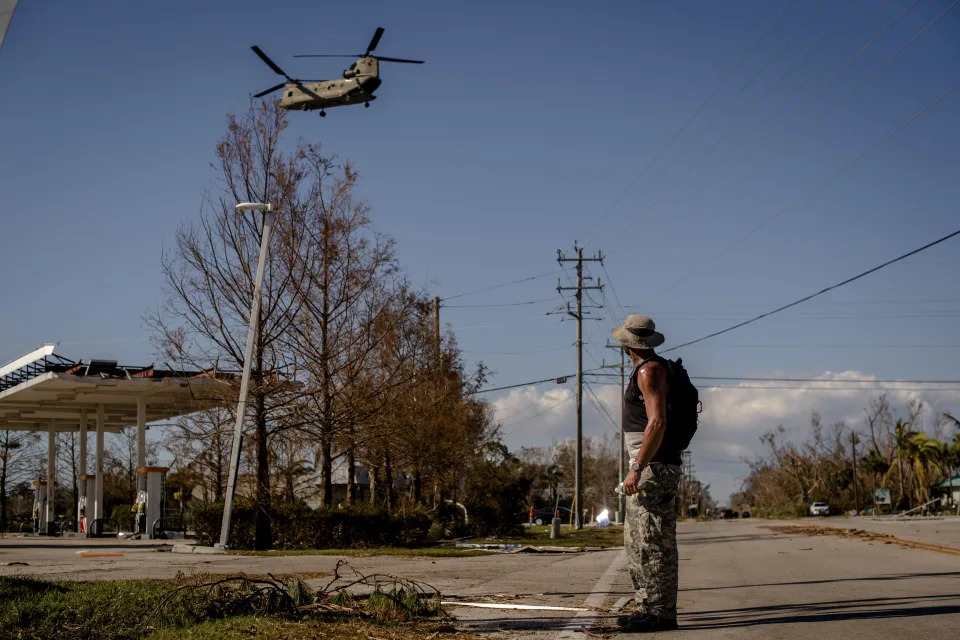
A helicopter carries evacuees from Pine Island, Fla., on Saturday, Oct. 1, 2022. (Hilary Swift/The New York Times)

Hurricane Ian’s wrath made clear that Florida faces some of the most severe consequences of climate change anywhere in the country. But the state’s top elected leaders have opposed federal spending to help fortify states against and recover from climate disasters, as well as efforts to confront their underlying cause: the burning of fossil fuels.

Sens. Marco Rubio and Rick Scott opposed last year’s bipartisan infrastructure law, which devotes some $50 billion to help states better prepare for events like Ian, because they said it was wasteful. And in August, they joined their fellow Republicans in the Senate to vote against a new climate law, which invests $369 billion in reducing greenhouse gas emissions, the largest such effort in the country’s history.

At the same time, Republican Gov. Ron DeSantis has blocked the state’s pension fund from taking climate change into account when making investment decisions, saying that politics should be absent from financial calculations.

In the aftermath of Ian, those leaders want federal help to rebuild their state — but don’t want to discuss the underlying problem that is making hurricanes more powerful and destructive.

As Hurricane Ian approached Florida’s coast, the storm grew in intensity because it passed over ocean water that was 2 to 3 degrees warmer than normal for this time of year, NASA data show. Its destructive power was made worse by rising seas; the water off the southwest coast of Florida has risen more than 7 inches since 1965, according to data from the National Oceanic and Atmospheric Administration. Finally, warmer air resulting from climate change increased the amount of rain that Ian dropped on Florida by at least 10%, or about 2 extra inches in some places, according to a study released last week.

Rubio has secured millions of dollars to restore the Everglades as a way to store floodwaters and repair coral reefs to buffer storm surges. One of his House colleagues, Rep. Mario Diaz-Balart, a South Florida Republican, has secured billions for climate resiliency.

But none of the top Republicans in the state have supported legislation to curb the greenhouse gas emissions causing climate change.

With its sun and offshore wind, Florida could be a leader in renewable energy, said Rep. Kathy Castor, a Democrat who represents Tampa. Instead, it imports natural gas that it burns to produce electricity.

“To not admit that climate change is real and we need to address it bodes nothing but a harm for the future for Florida and the nation,” said Charlie Crist, a former Republican Florida governor who won a House seat as a Democrat and is now challenging DeSantis’ reelection.

Hurricane Ian is far from the first time Florida has felt the impacts of climate change. In Miami, the rising ocean means streets and sidewalks regularly flood during high tide, even on sunny days. In the Florida Keys, officials are looking at raising roadbeds that will otherwise become impassable.

Yet the state’s leaders have long resisted what scientists say is needed to stave off a catastrophic future: an aggressive pivot away from gas, oil and coal and toward solar, wind and other renewable energy sources.

“Attempting to reverse-engineer the U.S. economy to absolve our past climate sins — either through a carbon tax or some ‘Green New Deal’ scheme — will fail,” Rubio wrote in 2019. “None of those advocates can point to how even the most aggressive (and draconian) plan would improve the lives of Floridians.”

Scott, the former governor of Florida who is now the state’s junior senator, has argued the cost of attacking climate change is just too great.

“We clearly want to and need to address the impacts of climate change,” Scott told NPR last summer. “But we’ve got to do it in a fiscally responsible manner. We can’t put jobs at risk.”

Hurricane Ian could be among the costliest storms to hit Florida, with losses estimated in the tens of billions.

The two senators also voted against last year’s infrastructure bill, which provided about $50 billion toward climate resilience — the country’s largest single investment in measures designed to better protect people against the effects of climate change.

That bill, which passed the Senate with support from 19 Republicans, included measures designed to help protect against hurricanes. It provided billions for sea walls, storm pumps, elevating homes, flood control and other projects.

Many of those measures were co-written by another coastal Republican, Sen. Bill Cassidy of Louisiana, who called it “a major victory for Louisiana and our nation.” Sen. Lisa Murkowski, R-Alaska, also supported the bill. Both states face enormous threats from climate change.

But Rubio called it “wasteful,” while Scott said it was “reckless spending.” Both voted no.

Scott and DeSantis did not respond to requests for comment.

Dan Holler, a deputy chief of staff to Rubio, said the senator opposed the infrastructure bill because it included unnecessary measures, just as he opposed the final version of relief for Hurricane Sandy in 2013 because of what he called extraneous pork barrel spending.

But the larger issue, Holler said, is that those pushing broad measures to wean the nation from fossil fuels have yet to prove to Rubio that such efforts would actually slow sea level rise, calm storms or mitigate flooding.

Other Republicans offer similar explanations. Anna Paulina Luna, a Republican candidate expected to win the House district around Tampa Bay, spoke of the devastation she said she saw in Fort Myers, Pine Island and Sanibel Island.

“The damage is so catastrophic, we are going to need help,” she said Monday.

But Luna pushed back hard on the need to address climate change by cutting fossil fuel emissions. She called it “completely bonkers” that the United States would harm its own economy “while we send manufacturing to a country that is one of the top polluters of the world,” referring to China.

Crist sounded almost sympathetic as he discussed the bind that Florida Republicans find themselves in — accepting donations from the oil and gas industry, unwilling to raise the issue of climate change with their most loyal voters, while surveying the damage it is doing to their state.

The oil and gas industry is not a major source of campaign cash for politicians in Florida, where offshore drilling is prohibited. Rubio has received $223,239 from the oil and gas industry since 2017, which puts the industry at 15th on his donor list, federal records show. Scott has received $236,483 from oil and gas, his 14th most generous industry.

But the National Republican Senatorial Committee, which Scott leads, has received $3.2 million in oil and gas donations this campaign cycle, according to the Center for Responsive Politics, eclipsed only by real estate, Wall Street and retirees. By contrast, the fossil fuel business isn’t among the top 20 industries that have given this cycle to the Democratic Senatorial Campaign Committee.

“There’s an ‘ideological versus reality’ divide here that must be very excruciating to these Republican politicians,” Crist said.

Republicans in the state have taken steps to fund climate resilience and adaptation efforts but shy away from using the term “climate.” In 2017, Diaz-Balart, then the Republican chair of the House appropriations subcommittee that funds housing programs, secured $12 billion for “mitigation” measures in block grants to states and communities, $1.4 billion of that for Florida. The word “climate” did not appear in the definition of “mitigation.”

“If you’re from Florida, you should be leading on climate and environmental policy, and Republicans are still reticent to do that because they’re worried about primary politics,” Carlos Curbelo, a former Republican congressman from South Florida. “But on this, the consequences are so serious, it’s worth putting politics aside and addressing climate head on.”

While DeSantis announced a program last year to provide $1 billion over four years to local governments to address flooding, rising seas and other challenges, he has blocked his state’s pension plan from accounting for the environmental performance of companies in making investment decisions.

“We are prioritizing the financial security of the people of Florida over whimsical notions of a utopian tomorrow,” DeSantis said in a statement announcing the decision.

DeSantis’ record on other climate decisions may also come back to haunt him. As a congressman in 2013, he voted against a bill to provide extra disaster aid to victims of Hurricane Sandy — the same type of extra support that Florida is now seeking for Ian.

On Friday, Rubio and Scott wrote to their Senate colleagues asking them to support a package of disaster aid. Like DeSantis, Rubio opposed a similar measure after Sandy struck the Northeast in 2012. (Scott had not yet been elected to the Senate.)

Yoca Arditi-Rocha, executive director of the CLEO Institute, a nonprofit group in Florida that promotes climate change education, advocacy and resilience, said the state’s top elected officials need to do much more than react after disaster strikes.

“Florida will continue to be on the front lines of more destructive hurricanes fueled by a warming climate,” Arditi-Rocha said. “We need Republican leaders to step up.”

Hurricane Ian aftermath: Tour of damage shows parts of Naples look like “a war zone”

Naples Daily News

Hurricane Ian aftermath: Tour of damage shows parts of Naples look like “a war zone”

Laura Layden, Naples Daily News – October 3, 2022

In a drive around the city, Naples Police Lieutenant Bryan McGinn pointed to some of the worst and costliest damage caused by Hurricane Ian.

On Friday, he whizzed around the city streets, as much as he could, driving through sludge, stopping at every dark traffic light and dodging clean-up and repair crews — and a slew of curious onlookers wanting to see the destruction for themselves.

Scene of Gulf Shore Boulevard North of stranded, flooded cars.

One of the worst-hit areas by the Category 4 storm? Gulf Shore Boulevard North — where the water had finally receded enough to have a better look at Ian’s wrath.

Sludge still filled much of the road, patio furniture lay tangled in the median, cars sat angled in front of condos, a sign of the powerful, unexpected surge that put them completely under water. A crooked boat sat in a parking lot, moved from its perch, with another halfway submerged in waters nearby.

Video: Hurricane Ian in North Naples

Assessing the damage: Aftermath of Hurricane Ian in Naples and Collier County in Florida

Flood help: Hurricane Ian flooded my house. What do I need to do now?

A boat displaced from its dock on Gulf Shore Boulevard North.

Residents had started the clean-up, dragging everything from drenched carpet to soaked couches to the curb. Along with a snarl of landscaping.

Clearly, there’s much more work to be done in the Moorings, Park Shore and elsewhere in the city. With gobs of debris started to make it to the curb.

City residents are picking up the pieces from Hurricane Ian after extreme flooding.
Boats uplifted from their docks

At the Village Shops on Venetian Bay, business owners worked to deal with the mess, a stranded boat sat in the parking lot, with no name on it.

“Unfortunately, there was a lot of water surging,” McGinn said. “That storm came in real fast.”

It wasn’t just water that roared onto the shore in the city. It was loads of sand and sediment from the Gulf of Mexico and Naples Bay, which did plenty of damage of its own.

Ian’s impact: Hurricane Ian causes flood damage in Naples and heavily damages Naples Pier

Naples mayor: Rebuilding from Hurricane Ian is going to ‘take time’

Scene from Gulf Shore Boulevard North.

That sand and sediment turned into a slippery, sticky muck that covered city streets — and the insides of homes and businesses. Some have complained about its stench.

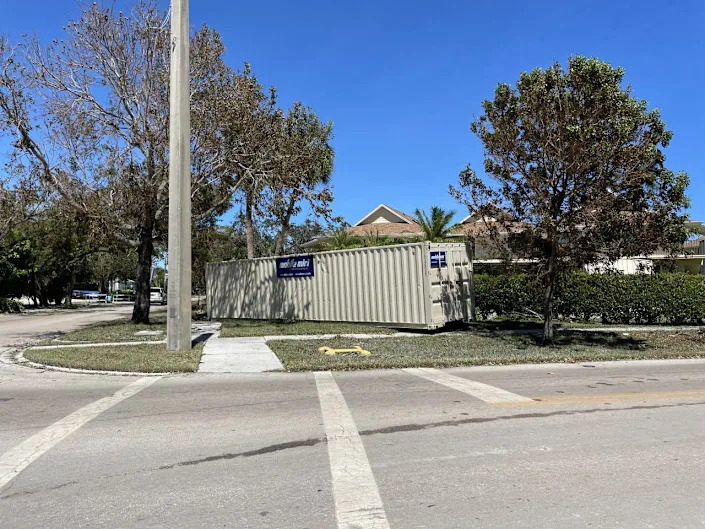
During the tour, McGinn pointed to an extra-wide, steel mobile mini storage container sitting near the intersection of 8th Street South and Broad Avenue, feet from the Cove Inn On Naples Bay, that mysteriously appeared there, likely from a construction site nearby, taking up the entire corner.

“That storage container doesn’t belong there,” he said.

Storage container deposited roadside by surging waters in Naples at 8th Street South and Broad Avenue South.

Its weight is in the thousands of pounds, showing the power of the surge.

In Crayton Cove, McGinn took a turn toward the City Dock, rebuilt a few years ago at a cost of $7 million. He happily reported it fared well.

Businesses are picking up the pieces

Nearby businesses, however, weren’t as lucky, including The Dock, a Naples landmark. It’s still standing, but crews worked busily to clean up its insides, which clearly saw a heavy impact from the storm surge.

Across the way, Napoli On The Bay, didn’t look so good either, with a water line stain halfway up the door.

Hurricane Ian: ‘Very difficult time’ as it will take weeks to assess Bonita Springs damage

Water line at Napoli On The Bay.

“Pretty unbelievable,” McGinn said.

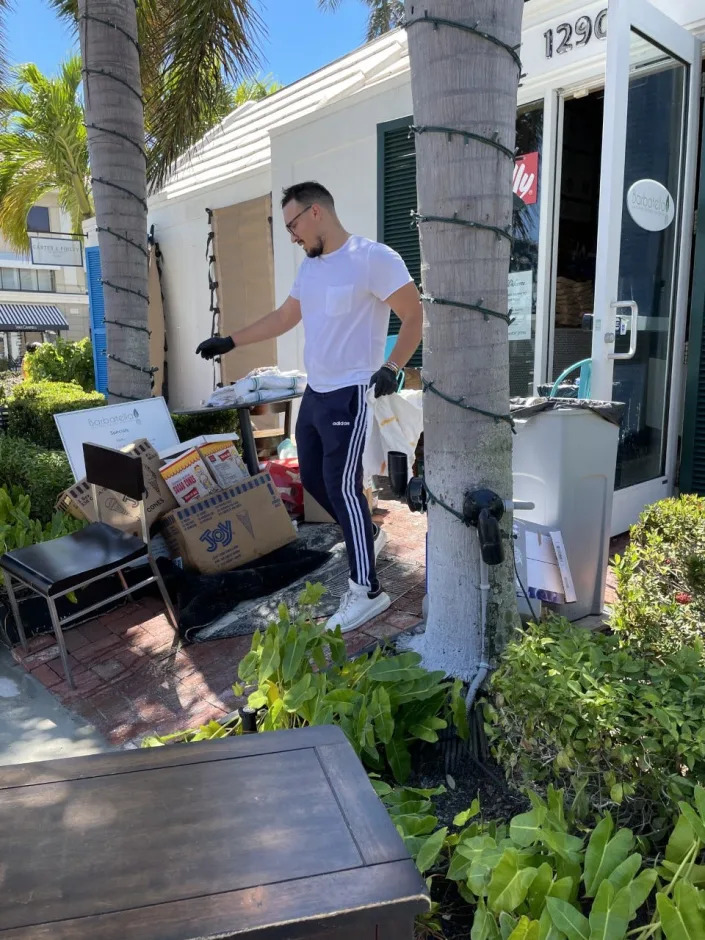
On Third Avenue South downtown, store owners scrambled to pick up the pieces. Chain saws roared, vacuum trucks rumbled as they sucked out water, and power washers echoed, as owners, employees and hired contractors worked to wash down all the sediment left behind on everything from parking lots to plant pots.

Water stains again showed just how high the water got.

Some business owners have lost virtually everything.

On Third Street and nearby Fifth Avenue South, shops, restaurants and other businesses have scrambled to reopen, if possible.

“Fortunately, our city is resilient,” McGinn said. “So, many business owners are making a push. They want to be able to help people. That’s what they do.”

Businesses are picking up the pieces on Third Street South in downtown Naples.

As soon as it could, Liki Tiki, the local “Tiki Bar” and classic BBQ restaurant on U.S. 41, reopened on Thursday, serving drinks only — because that’s all it could do.

“It was packed,” McGinn said. “It’s a good sight to see. It’s good camaraderie.”

Port Royal may have fared better than others

In Port Royal, known as one of the priciest neighborhoods in America, the damage didn’t seem as great. Signs of water intrusion were harder to spot, but landscaping took a hit, with a near-constant buzz of chain saws.

“A lot of these are new construction homes,” McGinn said. “So, maybe they did fare a little better.”

The Port Royal Club sustained damage.

Closer to the coast, surging waters forced some residents to their roofs, for higher ground, to wait out rescue crews.

“I’m sure there were lives lost,” McGinn said. “But we won’t know how many for some time. It’s hard to tell.”

Some of the stranded cars still spotted around the city, he said, are the result of residents driving around during the storm, failing to heed warnings. They had to walk or swim away, abandoning their vehicles, McGinn said.

“People were still out and about, not listening to shelter in place,” he said, or evacuation orders.

After the storm, vehicles blocking streets were taken to Baker Park, but eventually, the city ran out parking spaces for them.

Mansions on the Gulf could have seen extensive damage

On Gordon Drive, it’s hard to tell how much damage multimillion-dollar mansions sitting directly on the Gulf of Mexico took, but McGinn said the water and sand likely did a lot of damage to them.

Parts of Gordon Drive were still blocked on Friday, with piles of sand dropped by Ian still in the road.

Much of the city saw flooding.

“Even areas like Lake Park had several feet of water in their homes,” McGinn said, after the Gordon River flooded.

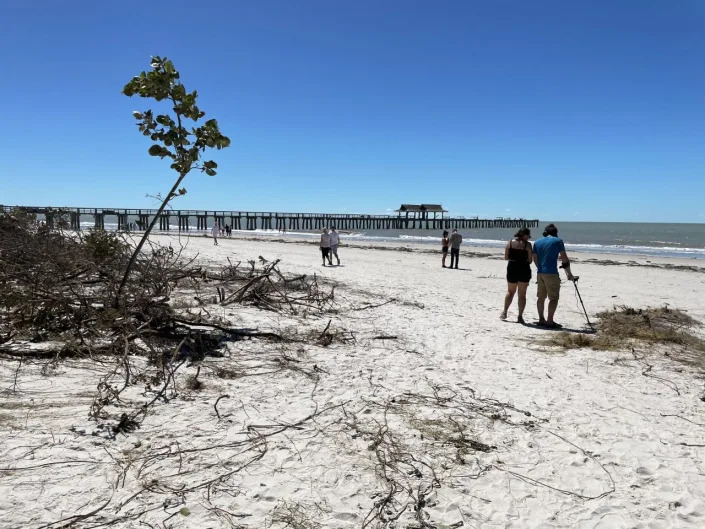
The Naples Pier is heavily damaged, but not destroyed.

“It’s sad,” McGinn said.

Treasure hunters and curious visitors at beach, near Naples Pier, damaged by Hurricane Ian, on Friday, Sept. 30, 2022.

While beach ends, or public access points, haven’t reopened, residents and visitors alike have flocked to them, to see the damages with their own eyes shooting photos and videos to document the storm.

“This is how well people listen,” McGinn said. “I get it. Everybody wants to see how the city of Naples fared. It all comes from a good place.”

At the Horizon Way beach access in Park Shore, he pointed to what looked like structural damage at St. Croix Club condominiums, but it was hard to determine the extent of it.

“That’s no bueno,” McGinn said.

Parts of Naples look like a “war zone”

In the Moorings area, Regency Towers looked like it took a heavy hit too — along with other condos and homes.

“It looks like a war zone up here,” McGinn said.

While water wiped out the contents of condos, homes and businesses, he said, structural damage might not be extensive since winds weren’t as extreme as with past storms.

“Their personal property is gone,” McGinn said. “But they can be replaced over time.”

Looking over all the damage in Naples, it’s hard to fathom how bad others had it just one county over, McGinn said.

“What’s crazy is we are not even the hardest hit area,” he said.

Republican’s Plan if They Take Back the Congress in November

CNN: Previously Published

26 things Rick Scott’s ‘rescue’ plan for America would do

(October 4, 2022) – Chris Cillizza, CNN Editor-at-large February 23, 2022

01 Rick Scott FILE 1118

Joe Raedle/Getty ImagesCNN — 

Florida Sen. Rick Scott kicked off the 2024 2022 campaign on Tuesday by releasing an 11-point plan “to rescue America.”

“If Republicans return to Washington’s business as usual, if we have no bigger plan than to be a speed bump on the road to America’s collapse, we don’t deserve to govern,” Scott wrote in the plan’s introduction. “We must resolve to aim higher than the Republican Congresses that came before us. Americans deserve to know what we will do.”

Scott’s decision to put his name to a series of specific proposals for what Republicans could and should do if they retake the Senate and House this fall stands in direct contrast to Senate Minority Leader Mitch McConnell, who has pointedly refused to offer an alternative policy agenda.

When asked last month what the GOP’s agenda would be if they took control of Congress, McConnell told reporters: “That is a very good question and I’ll let you know when we take it back.”

Scott seems to acknowledge the fact that he is rebelling against his party leadership, writing: “Like the ‘Contract with America’ before it, the Washington insiders will hate this plan.” (The Contract with America was the Republican agenda unveiled during the 1994 midterms, when the GOP won control of the House.)

Why did Scott do it then? Well, at least in part (a large part) because of politics. Scott, the former governor of Florida who was elected to the Senate in 2018, has his eye on bigger prizes. He’s currently serving as the chairman of the Senate Republican campaign arm and has done very little to knock down talk that he would be interested in a presidential bid down the line.

This plan feels like the sort of thing that could become the basis of a Scott presidential run, whether in 2024 or 2028.

So what’s actually in the plan? A fair amount of it is just red-meat rhetoric sure to make the base of the party happy. But amid the spin – and the attacks on Democrats, “wokeness” and the media – there are some actual policy proposals. Let’s go through them.

1. Kids in public schools would say the Pledge of Allegiance and be required to stand for the National Anthem. They also would have to “honor” the American flag.

2. The Department of Education would close. “Education is a state function,” wrote Scott.

3. The government would never be able to ask you to disclose your race, ethnicity or skin color “on any government form.” (On a related note, the US Census Bureau is on line one, Sen. Scott.)

4. The US military would engage in “ZERO diversity training” or “any woke ideological indoctrination that divides our troops.”

5. If a college or university uses affirmative action in admissions, it would be “ineligible for federal funding and will lose their tax-exempt status.”

6. “Strict” mandatory minimum sentences would be required in every case in which a police officer is seriously injured.

7. Any “attempt to deny our 2nd Amendment freedoms” would be strongly opposed.

8. The wall along the US southern border would be completed and named after former President Donald Trump.

9. Immigrants to the US would not be able to collect unemployment benefits or welfare until they have lived in the country for seven years.

10. So-called sanctuary cities would be stripped of all federal funding.

11. The federal budget would be balanced and, if not, members of Congress would not be paid.

12. All Americans would pay some income tax “to have skin in the game.” (At present, roughly half of Americans do not pay taxes because their taxable income doesn’t meet a minimum threshold.)

13. Federal debt ceiling increases would be prohibited unless accompanied by a declaration of war.

14. All federally elected officials, as well as all federal workers, would be subject to a 12-year term limit.

15 All federal legislation would have a sunset provision five years after it passes. (People currently on Social Security or Medicare might be particularly interested in that one.)

16. Funding for the IRS, as well as its workforce, would be cut by 50%.

17. Politicians would be banned from becoming lobbyists when they leave office.

18. Voter ID would become the law of the land. “All arguments against voter ID are in favor of fraud,” according to Scott.

19. Same-day voter registration would be banned.

20. “No federal program or tax laws will reward people for being unmarried or discriminate against marriage.”

21. No government form would offer options related to “gender identity” or “sexual preference”

22. Biological males would be banned from competing in women’s sports.

23. “All social media platforms that censor speech and cancel people will be treated like publishers and subject to legal action.”

24. No tax dollars could be used for “diversity training or other woke indoctrination that is hostile to faith.”

25. No dues would be paid to the United Nations or “any international organization that undermines the national interests of the USA.”

26. “The weather is always changing. We take climate change seriously, but not hysterically. We will not adopt nutty policies that harm our economy or our jobs.”

There’s more in there, but those are the main points.

It’s an attempt – both rhetorically and from a policy perspective – to make permanent many of the changes that Trump ushered in during his four years in office. It’s a promise of all the things you liked about Trump without some of the bombast and unpredictability. It’s a blueprint for Trumpism without Trump.