DOJ Slams Trump Filing Claiming 9 Mar-A-Lago Files Are His ‘Personal’ Property
Mary Papenfuss – October 21, 2022
The Department of Justice has fired back at Donald Trump’s claim that nine White House files seized from his Mar-a-Lago compound by the FBI are his “personal” property.
The files include two documents related to U.S. immigration policy, six requests for clemency to the then-president, and a letter to him from someone in a military academy, according to the DOJ’s letter, filed Thursday in Florida to U.S. District Judge Raymond Dearie, the special master appointed to review the confiscated documents.
The Justice Department dismissed the notion that any of the materials belong to Trump. It pointed out that the pardon requests, for example, “were received by plaintiff in his capacity as the official with authority to grant reprieves and pardons, not in his personal capacity.”
The DOJ letter cited the Presidential Records Act, which states that all documentary materials created or received by a president, his staff or his office in the course of official activities are government property that should go to the National Archives when a president leaves office.
Trump also claimed that four documents should be withheld from investigators because of executive privilege. They include the two immigration policy documents, which Trump’s team said were “predecisional materials,” and two documents about meetings.
The Justice Department argued that the former president can’t claim the immigration documents are both his personal records and protected by executive privilege. The claims are contradictory and he must argue one or the other, the filing said.
Dearie made a similar point about mixed and confusing claims concerning the documents in a conference call with the parties earlier this week. He pointed out that there’s “certainly an incongruity there” when Trump’s lawyers insist that some documents are protected both by executive privilege and as Trump’s personal records.
Dearie also complained on the call that Trump’s legal team hadn’t offered much substance in either case to support its claims.
The special master was appointed last month by U.S. District Judge Aileen Cannon at Trump’s request. He is tasked with reviewing about 11,000 pages of documents to determine if any should be shielded by attorney-client or executive privilege. Dearie’s name was submitted by Trump’s legal team.
The U.S. Court of Appeals for the 11th Circuit ruled earlier this month that the Justice Department can resume reviewing the seized classified records, blocking part of a stay issued earlier by Cannon. The appeals court also prohibited Dearie from vetting the documents marked classified.
How unhealthy is red meat? And how beneficial is it to eat vegetables? A new rating system could help you cut through the health guidelines
Aleksandr Aravkin, Associate Professor of Applied Mathematics, University of Washington, Jeffrey Stanaway, Assistant Professor of Global Health and Health Metrics Sciences, University of Washington, and Christian Razo, Postdoctoral Fellow at the Institute for Health Metrics and Evaluation, University of Washington – October 21, 2022
The new rating system shows that eating the right amount of vegetables can lower your risk of heart disease by nearly 20%. Westend61/Getty Images
The Research Brief is a short take about interesting academic work.
The big idea
We developed a new method for assessing health risks that our research suggests should make it a lot easier for people to determine which health advice to follow – and which to ignore. The approach, recently published in the journal Nature Medicine, offers a straightforward way for both policymakers and the general public to assess the strength of evidence for a given health risk – like consuming red meat – and the corresponding outcome – ischemic heart disease – using a rating system of one to five stars.
The system we developed is based on several systematic reviews of studies regarding risk factors like smoking and health outcomes such as lung cancer. Well-established relationships between risks and outcomes score between three and five stars, whereas cases in which research evidence is lacking or contradictory garner one to two stars.
In our analysis, only eight of the 180 pairs that we analyzed received the top rating of five stars, indicating very strong evidence of association. The relationship between smoking and lung cancer, as well as the relationship between high systolic blood pressure – the higher of the two numbers in a blood pressure reading – and ischemic heart disease were among those eight five-star pairs.
This rating system enables consumers to easily identify how harmful or protective a behavior may be and how strong the evidence is for each risk-outcome pair. For instance, a consumer seeing a low star rating can use that knowledge to decide whether to shift a health habit or choice.
While the visualization tool provides a nuanced understanding of risk across the range of blood pressures, the five-star rating signals that the overall evidence is very strong. As a result, this means that clear guidelines can be given on the importance of controlling blood pressure.
Why it matters
Clear messages and evidence-based guidance regarding healthy behaviors are crucial. Yet health guidance is often contradictory and difficult to understand.
Currently, most epidemiological analyses make strong assumptions about relationships between risks and health outcomes, and study results often disagree as to the strength of risk-outcome relationships. It can be confusing for experts and nonexperts alike to parse through conflicting studies of varying strength of results and determine if a lifestyle change is needed.
This is where our method comes in: The star-based rating system can offer decision-makers and consumers alike much-needed context before headline-grabbing health guidance is dispensed and adopted.
For example, the average risk of ischemic heart disease with a blood pressure of 165 mmHG – or millimeters of mercury, the basic unit used for measuring pressure – is 4.5 times the risk of the disease with blood pressure of 100 mmHG; but this is just a single estimate. The relative risk of ischemic heart disease increases by more than four times across the blood pressure range, and there is inherent uncertainty in the estimate based on available data. The rating of five stars incorporates all of this information, and in this case means that relative risk of ischemic heart disease across the entire range of exposures increases by at least 85%.
On the other hand, take the example of red meat consumption. Consuming 100 grams of red meat per day – as opposed to none – results in a very modest (12%) increase in risk for ischemic heart disease. That’s why it scores a rating of just two stars, consistent with only a weak association.
People should be well aware of their levels of exposure to risks classified with three to five stars, such as systolic blood pressure. By monitoring and keeping one’s blood pressure as low as possible, a person can substantially reduce the risk of developing ischemic heart disease.
What’s next
Our hope is that decision-makers will be able to use our star rating system to create informed policy recommendations that will have the greatest benefits for human health. We also hope the public can use the ratings and the visualization tool as a way to more clearly understand the current level of knowledge for different pairs of health risks and outcomes.
Jeffrey Stanaway receives funding from the Bill and Melinda Gates Foundation.
Aleksandr Aravkin and Christian Razo do not work for, consult, own shares in or receive funding from any company or organization that would benefit from this article, and have disclosed no relevant affiliations beyond their academic appointment.
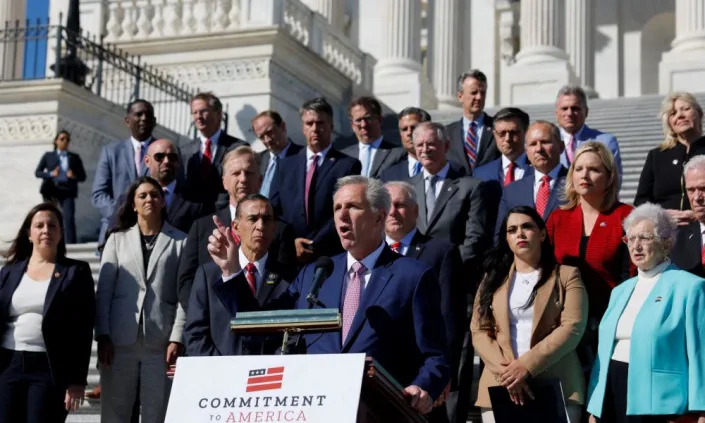
Republicans plan to torpedo key Biden policies as polls predict midterm victory
Chris Stein in Washington DC – October 21, 2022
Photograph: Evelyn Hockstein/Reuters
A standoff over the debt ceiling. Aid to Ukraine on the chopping block. And impeachment proceedings against homeland security secretary Alejandro Mayorkas – or perhaps even president Joe Biden himself.
With polls indicating they have a good shot of winning a majority in the House of Representatives in the 8 November midterms, top Republican lawmakers have in recent weeks offered a preview what they might do with their resurgent power, and made clear they have their sights set on key aspects of the Biden administration’s policies at home and abroad.
Kevin McCarthy, the top Republican in the chamber, this week signaled in an interview with Punchbowl News that if Congress is going to approve an increase in the amount the federal government can borrow – as it’s expected to need to by sometime next year – Republicans are going to want an agreement to cut spending in return.
“You can’t just continue down the path to keep spending and adding to the debt,” said McCarthy, who is likely to be elevated to speaker of the house in a Republican led-chamber. “And if people want to make a debt ceiling [for a longer period of time], just like anything else, there comes a point in time where, okay, we’ll provide you more money, but you got to change your current behavior.”
Asked if he might demand that Social Security and Medicare, the two massive federal retirement and healthcare benefit programs that are nearing insolvency, be reformed as part of debt ceiling negotiations, McCarthy replied that he would not “predetermine” anything.
But the California lawmaker warned that members of his caucus were starting to question the money Washington was sending to Ukraine to help it fend off Russia’s invasion. “Ukraine is important, but at the same time it can’t be the only thing they do and it can’t be a blank check,” he told Punchbowl.
Then there’s the question of if Republicans will choose to exercise the House’s powers of impeachment – as they did against Bill Clinton in 1998, and as Democrats did to Donald Trump in 2019 and 2021.
The prime target appears to be Mayorkas, whom Republicans have pilloried amid an uptick in arrivals of migrants at the United States’ border with Mexico. Yet another target could be Biden himself – as Jim Banks, chair of the conservative Republican Study Committee, which crafts policy for the party, suggested on Thursday.
Political realities may pose an obstacle to McCarthy and his allies’ ability to see their plans through. High inflation and Biden’s low approval ratings have given them momentum to retake the House, but their chances of winning a majority in the Senate are seen as a toss-up. Even if they did win that chamber, they’re unlikely to have the two-thirds majority necessary to convict Biden, Mayorkas, or whomever else they intend to impeach – or even the numbers to overcome Democratic filibusters of any legislation they try to pass.
Matt Grossman, director of Michigan State University’s Institute for Public Policy and Social Research, questioned the GOP’s willingness to legislate. The party’s plans, as outlined in the Commitment to America McCarthy unveiled last month, appear thin in comparison to similar platforms rolled out in 1994 and 2010, when Republicans again took back Congress’ lower chamber from Democratic majorities.
“There’s a longstanding asymmetry between the parties. Republicans legitimately want government to do less,” he said.
“They’re doing pretty well electorally without necessarily needing a policy agenda, and they’re tied to, kind of, defending the Trump administration or attacking the Biden administration. There’s not much of a felt need for a lot of policy.”
There are also signs of division within the party over how the GOP should use its new majority. In his interview with Punchbowl, McCarthy said he was against “impeachment for political purposes” and focused instead on addressing crime, border security and economic issues, all familiar themes for Republicans running this year.
The split was even more pronounced when it came to Ukraine. On Wednesday, Trump’s former vice-president Mike Pence called in a speech at influential conservative group the Heritage Foundation for Republicans to continue to support the country, saying “there can be no room in the conservative movement for apologists to” Russian president Vladimir Putin.
The day after, the foundation’s president Kevin Roberts put out a statement saying: “Heritage will vigorously oppose Washington’s big spenders who attempt to pass another Ukrainian aid package lacking debate, a clear strategy, targeted funding and spending offsets.”
Democrats are assured control of Congress until the end of the year, and have taken note of the apparent erosion of will to support Kyiv. NBC News reports they may push for another big military aid infusion in a year-end spending bill, intended to keep the Ukrainians armed for months to come.
It seems clear that Republicans will eventually coalesce behind a strategy to strong-arm the Biden administration for some purpose, but Grossman predicted the likely result would be similar to the 2013 government shutdown, when then president Barack Obama and the Democrats refused the GOP’s demands to dismantle his signature health care law.
“With McCarthy it just seems like he is a go along,” he said. “He’s going to be a go-along speaker and that’s going to be the case with a pretty fractious caucus.”
Photos show the Mississippi River is so low that it’s grounding barges, disrupting the supply chain, and revealing a 19th-century shipwreck
Morgan McFall-Johnsen, Paola Rosa-Aquino – October 21, 2022
Randy Statler sits on a rock to watch people walk to Tower Rock, an attraction normally surrounded by the Mississippi River and only accessible by boat, in Perry County, Missouri, on October 19, 2022.Jeff Roberson/AP Photo
The waters of the Mississippi River have fallen to historic lows, driving a shipping and industry crisis in the heart of the US.
The Mississippi is a major channel for shipping and tourism, running from northern Minnesota down through the Midwest plains and emptying through Louisiana, with numerous tributaries stretching east and west. All that boat-based commerce relies on the river’s deep waters, which can accommodate hefty vessels carrying cargo like soybeans, corn, fertilizer, and oil, or cruise-line passengers.
A barge tow floats past the exposed banks of the Mississippi River in Vicksburg, Mississippi, on October 11, 2022.Rogelio V. Solis/AP Photo
For the past month, though, the water has dwindled so low that ships are getting stuck in the mud and sandbars at the river bottom. The Coast Guard imposed new restrictions on how low ships and barges can sit in the water. The price of shipping goods along the river skyrocketed, The Wall Street Journal reported on Friday, and the US Army Corps of Engineers (USACE) began emergency dredging to deepen the river at more than a dozen key choke points, where a backup of about 2,000 barges built up.
A NASA satellite image from October 7 shows the parched river, with barges queued up along its shorelines.
An image from a Landsat satellite shows the parched Mississippi River north of Vicksburg, Mississippi, on October 7, 2022.NASA Earth Observatory/USGS Landsat
“This is the most severe we’ve ever seen in our industry in recent history,” Mike Ellis, the CEO of American Commercial Barge Line, told CNBC on Wednesday.
A close look at the satellite image reveals barges waiting on the river’s shores.NASA Earth Observatory/USGS Landsat
“That’s a significant impact to our supply chain,” Ellis said, adding, “We can’t get the goods there.”
Even more barges were waiting in another part of the satellite image.NASA Earth Observatory/USGS Landsat
The water receded so much that it revealed human remains and a 200-year-old shipwreck along the river’s new banks. In Missouri, people are walking across the dry, exposed riverbed to an island that’s normally only accessible by boat.
A man walking along the Mississippi River in Baton Rouge, Louisiana, stops to look at a shipwreck revealed by the low water level on October 17, 2022.Sara Cline/AP Photo
On the Louisiana coast, the river is so low that ocean water from the Gulf of Mexico began pushing upstream. USACE is racing to build a 1,500-foot-wide underwater levee to prevent saltwater from creeping further up the river, where it could contaminate drinking water, CNN reported on Tuesday. Already, there’s a drinking water advisory in effect for the coastal region of Plaquemines Parish.
Drought is drying the Mississippi River to record lows
A passenger paddle wheeler passes between the river bridges in Vicksburg, Mississippi, on October 11, 2022.Rogelio V. Solis/AP Photo
Just a few months ago, the Mississippi River basin was flooding. This summer, historic rainfall caused flash flooding and overflowing rivers in Kentucky, St. Louis, Missouri, parts of Illinois, and Jackson, Mississippi.
Despite these extreme sporadic rainfall events, overall, the Midwest is in an abnormal drought. The Ohio River Valley and the Upper Mississippi aren’t getting enough rain to feed the giant river.
US Drought Monitor
Up and down the Mississippi, waters have dropped to levels approaching the record low set in 1988. In Memphis, Tennessee, the waters plunged below that record on Monday, according to data from the National Weather Service.
“There is no rain in sight, that is the bottom line,” Lisa Parker, spokeswoman for the USACE Mississippi Valley Division, told the Journal. “The rivers are just bottoming out.”
Boats rest in mud at Mud Island Marina as the water on the Mississippi River continues to recede in Memphis, Tennessee, on October 19, 2022.Scott Olson/Getty Images
Scientists must conduct rigorous analysis to attribute any single event to climate change. However, this year’s extreme conditions of both drought and floods is consistent with what scientists have been predicting and observing: Rising global temperatures are driving more weather variability in the central US, fueling both more severe droughts and one-off rainfall events.
That’s because climate change, driven by all the greenhouse gasses that humans have released into the atmosphere, is changing the planet’s water cycle. Rising temperatures are increasing water evaporation and changing the atmospheric and ocean currents that distribute moisture across the globe.
Droughts are unearthing relics and remains of the past
The remains of a ship lay on the banks of the Mississippi River after recently being revealed due to the low water level, in Baton Rouge, Louisiana, on October 17, 2022.Sara Cline/AP Photo
The severe drought along the river is so intense that it uncovered a centuries-old shipwreck. In early October, low water levels revealed the old sunken ship along the banks of the Mississippi River in Baton Rouge, Louisiana. Archaeologists believe these remains are from a ferry that sunk in the late 19th or early 20th century, The Associated Press reported.
Though this is the first time the ship has been fully exposed, it’s not a new discovery. Small parts of the vessel emerged from low waters in the 1990s.
“At that time the vessel was completely full of mud and there was mud all around it so only the very tip tops of the sides were visible,” Chip McGimsey, Louisiana’s state archaeologist, told the AP. “They had to move a lot of dirt just to get some narrow windows in to see bits and pieces,” McGimsey said.
A shipwreck is exposed along the banks of the Mississippi River due to low water levels, in Baton Rouge, Louisiana, on October 18, 2022.Stephen Smith/AP Photo
McGimsey thinks the ship could be the Brookhill Ferry, which carried people and possibly horse-drawn wagons across the Mississippi, until it sunk in a storm in 1915, according to news stories from the State Times archives.
The river’s receding waters also led to a more gruesome discovery. On Saturday, a Mississippi woman found human remains while searching for rocks with her family on the banks of the drought-stricken river. The remains included a lower jawbone, rib bones, and some unidentified bone pieces, Scotty Meredith, Coahoma County’s chief medical examiner, told CNN.
“Because these water levels are so low that we knew it was only a short matter of time before human remains were found,” Crystal Foster, the woman who found the remains, told WMC.
They are the latest in a bevy of discoveries to surface from receding waters. Over the summer, multiple set of remains were found in Nevada’s Lake Mead, which fell to historically low levels amid climate change-fueled drought.
But it’s not all bad news. Shrinking bodies of water could be a boon for experts tasked with solving missing persons cases, according to Jennifer Byrnes, a forensic anthropologist who consults with the Clark County coroner’s office, which reviews deaths in Lake Mead.
“A big body of water disappearing is going to help us, from a forensic perspective,” Byrnes told Insider.
Correction: October 21, 2022 —A photo caption in an earlier version of this story misstated the location of Vicksburg. The city is in Mississippi, not Louisiana.
Study: Cancer-causing gas leaking from CA stoves, pipes
Drew Costley – October 20, 2022
Gas stoves in California homes are leaking cancer-causing benzene, researchers found in a new study published on Thursday, though they say more research is needed to understand how many homes have leaks.
In the study, published in Environmental Science and Technology on Thursday, researchers also estimated that over 4 tons of benzene per year are being leaked into the atmosphere from outdoor pipes that deliver the gas to buildings around California — the equivalent to the benzene emissions from nearly 60,000 vehicles. And those emissions are unaccounted for by the state.
The researchers collected samples of gas from 159 homes in different regions of California and measured to see what types of gases were being emitted into homes when stoves were off. They found that all of the samples they tested had hazardous air pollutants, like benzene, toluene, ethylbenzene and xylene (BTEX), all of which can have adverse health effects in humans with chronic exposure or acute exposure in larger amounts.
Of most concern to the researchers was benzene, a known carcinogen that can lead to leukemia and other cancers and blood disorders, according to the National Cancer Institute.
The finding could have major implications for indoor and outdoor air quality in California, which has the second highest level of residential natural gas use in the United States.
“What our science shows is that people in California are exposed to potentially hazardous levels of benzene from the gas that is piped into their homes,” said Drew Michanowicz, a study co-author and senior scientist at PSE Healthy Energy, an energy research and policy institute. “We hope that policymakers will consider this data when they are making policy to ensure current and future policies are health-protective in light of this new research.” 0:01 0:38 Scroll back up to restore default view.
Homes in the Greater Los Angeles, the North San Fernando Valley, and the San Clarita Valley areas had the highest benzene in gas levels. Leaks from stoves in these regions could emit enough benzene to significantly exceed the limit determined to be safe by the California Office of Environmental Health Hazards Assessment.
This finding in particular didn’t surprise residents and health care workers in the region who spoke to The Associated Press about the study. That’s because many of them experienced the largest-known natural gas leak in the nation in Aliso Canyon in 2015.
Back then, 100,000 tons of methane and other gases, including benzene, leaked from a failed well operated by Southern California Gas Co. It took nearly four months to get the leak under control and resulted in headaches, nausea and nose bleeds.
Dr. Jeffrey Nordella was a physician at an urgent care in the region during this time and remembers being puzzled by the variety of symptoms patients were experiencing. “I didn’t have much to offer them,” except to help them try to detox from the exposures, he said.
That was an acute exposure of a large amount of benzene, which is different from chronic exposure to smaller amounts, but “remember what the World Health Organization said: there’s no safe level of benzene,” he said.
Kyoko Hibino was one of the residents exposed to toxic air pollution as a result of the Aliso Canyon gas leak. After the leak, she started having a persistent cough and nosebleeds and eventually was diagnosed with breast cancer, which has also been linked to benzene exposure. Her cats also started having nosebleeds and one recently passed away from leukemia.
“I’d say let’s take this study really seriously and understand how bad (benzene exposure) is,” she said.
Trump drops F-bombs and shares potentially sensitive information in newly released audio
Stephen Proctor – October 19, 2022
Previously unheard audio featuring former President Donald Trump aired Tuesday on Anderson Cooper 360. Famed journalist Bob Woodward recorded 20 conversations he had with the former president, with Trump’s knowledge, from 2016 through 2020. Trump, who is facing possible legal peril for taking classified documents when he left office, appears in one recording to share sensitive information with Woodward.
“I have built a weapons system that nobody’s ever had in this country before,” Trump said. “We have stuff that you haven’t even seen or heard about. We have stuff that Putin and Xi have never heard about before.”
Trump also spoke of Russia’s nuclear capabilities.
“Getting along with Russia is a good thing, not a bad thing, alright?” Trump said. “Especially because they have 1,332 nuclear f***ing warheads.”
Throughout his presidency, Trump was criticized for his apparent affinity for authoritarian leaders, which he spoke about to Woodward.
“It’s funny, the relationships I have, the tougher and meaner they are, the better I get along with them. You know? Explain that to me someday, OK,” Trump said. “But maybe it’s not a bad thing. The easy ones are the ones I maybe don’t like as much or don’t get along with as much.”
In another recording, Trump brags about how he handled being impeached, while at the same time taking shots at two of his predecessors who also faced impeachment.
“There’s nobody that’s tougher than me,” Trump said. “Nobody’s tougher than me. You asked me about impeachment. I’m under impeachment, and you said, you know, you just act like you won the f***ing race. Nixon was in a corner with his thumb in his mouth. Bill Clinton took it very, very hard. I just do things, OK?”
In 2016, Woodward asked then-candidate Trump about having his staff sign non-disclosure agreements. Woodward recorded Trump talking to his staff about who had and who had not yet signed one. Trump was confident in the effectiveness of these agreements at the time, but a multitude of former officials wrote tell-all books after leaving the administration.
Woodward plans to release the more than eight hours of recordings as an audiobook titled The Trump Tapes on Oct. 25.
Former DOJ official says Trump’s reaction to the January 6 panel is starting to look like the makings of an insanity defense
Cheryl Teh – October 17, 2022
Former President Donald Trump at a rally in Wilkes-Barre, Pennsylvania, on September 3.Mary Altaffer/AP
The former DOJ official Neal Katyal commented on Donald Trump’s 14-page response to the DOJ.
Katyal said he did not think the response would help Trump unless he was trying to plead insanity.
He said Trump’s response showed “evidence” of an insanity plea.
Neal Katyal, a former Justice Department official, says former President Donald Trump’s written response to the House Capitol-riot panel’s intention to subpoena him looks like an insanity defense.
Katyal — a law professor and an Obama-era acting solicitor general — made an appearance on NBC on Sunday, three days after the House panel investigating January 6, 2021, unanimously voted to subpoena Trump. The subpoena will compel the former president to cooperate with the committee or be held in contempt of Congress and referred to the Justice Department for prosecution — much like Trump’s allies Steve Bannon and Peter Navarro.
In response to the decision, Trump sent a document to the panel that started with the sentence, “THE PRESIDENTIAL ELECTION OF 2020 WAS RIGGED AND STOLEN!” and contained multiple baseless claims of election fraud. It also included four photos of the crowd near the Washington Monument on January 6, 2021.
“Yeah, so, this is a 14-page screed, Jonathan, that’s very hard to follow. But it does seem to dig the hole in deeper for Donald Trump,” Katyal told the MSNBC host Jonathan Capehart.
“I can’t see it in any legal way helping him unless he is trying to go for the insanity defense, of which this paper seems, you know, to be some evidence of,” Katyal added.
Katyal also said he thought it was a “pretty fanciful” idea that Trump would just give in and testify to the panel because of the congressional subpoena.
“I mean, this is a man who took the Fifth Amendment more than 400 times the last time he was questioned under oath. And I doubt he’s suddenly become eager to testify,” Katyal said.
Katyal added that he thought Attorney General Merrick Garland would indict Trump, as there’s overwhelming evidence to do so and “no contrition whatsoever” on Trump’s part.
A representative at Trump’s post-presidential press office did not immediately respond to a request for comment.
As FBI probed Jan. 6, many agents sympathized with insurrection, according to newly released email
Will Carless, USA TODAY – October 15, 2022
A “sizable percentage” of FBI employees felt sympathy towards the Jan. 6 insurrectionists, and considered the riot at the U.S. Capitol “no different than the BLM protests,” according to a warning email sent to a top FBI official by someone with apparent connections to the bureau.
In the email, which is included in a trove of documents released by the bureau this week, the sender’s name is redacted. The documents indicate the message came from an email address outside the bureau, though the subject line is “Internal concerns.”
The email was sent to Paul Abbate, now the second highest official at the FBI, who responded an hour later, thanking the sender for the message.
FBI Deputy Director Paul Abbate at a news conference in 2021.
The Jan. 13, 2021, email contained a stark warning about attitudes toward the insurrection within the bureau:
“I literally had to explain to an agent from a ‘blue state’ office the difference between opportunists burning and looting during protests that stemmed legitimate grievance to police brutality vs. an insurgent mob whose purpose was to prevent the execution of democratic processes at the behest of a sitting president,” the email states. “One is a smattering of criminals, the other is an organized group of domestic terrorists.”
And it relayed concerns from agents within the bureau:
“I’ve spoken to multiple African American agents who have turned down asks to join SWAT because they do not trust that every member of their office’s SWAT team would protect them in an armed conflict.”
Michael German, a former FBI special agent and a fellow with the Brennan Center for Justice’s Liberty and National Security Program at New York University and an outspoken critic of the bureau, said the email didn’t surprise him.
“It didn’t tell me anything I didn’t expect already, but I think it’s important to substantiate the suspicions me and many other people had,” German said. “They clearly are on notice about a much more serious problem within the FBI.”
An FBI spokesperson declined to comment on the email.
While there may be some sympathy towards the Capitol rioters within the FBI, the bureau’s investigations have nonetheless contributed to Justice Department prosecutions of almost 900 people who were there that day. Scores of defendants have received jail time for their crimes. Dozens more have agreed to cooperate with the prosecutions.
But there has been pushback. Earlier this year, FBI special agent Stephen Friend was suspended for refusing to participate in prosecutions of Jan. 6 protesters. Friend’s stance was praised by Republican lawmakers, who called him “patriotic.”
The FBI email sheds more light on a problem that has been endemic in American law enforcement for decades, said Heidi Beirich, co-founder of the Global Project Against Hate and Extremism, who has studied white supremacists since the 1980s.
“The situation has been serious enough that the FBI for almost 20 years, has been warning of insider threats from cops,” Beirich said. “And the thing is, nobody’s done anything about it.”
A 2009 warning about extremists recruiting members of the military and police officers went largely ignored by the federal government, and resulted in the ostracizing of the author of the study, a senior Department of Homeland Security official.
Ten years later, a 2019 study by the Center for Investigative Reporting found that hundreds of active duty police officers were active inside racist, Islamophobic and anti-government groups on Facebook. Another study by the Plain View Project compiled hundreds of hateful and racist posts made on Facebook by police officers. Last year, USA TODAY found more than 200 people who claimed they worked for police departments in a leaked database of members of the Oath Keepers, an armed extremist group that is now the subject of one of the biggest prosecutions emerging from Jan. 6.
And as USA TODAY reported last month, the FBI itself has also been heavily criticized for directing domestic extremism investigations overwhelmingly towards left-wing targets.
The FBI has a long and troubled history of focusing on groups on the left of the political spectrum while largely turning a blind eye to domestic extremists on the far-right, Matthew Guariglia, a policy analyst at the Electronic Frontier Foundation, told USA TODAY.
“Both historically speaking and in current events, we’ve seen the amount of surveillance that has been marshaled specifically against groups fighting for racial justice increased exponentially than from what we’ve seen being monitored on the right,” said Guariglia, who holds a doctorate in the history of police surveillance.
Beirich said given the conservative nature of law enforcement, there is bound to be some “overlap” into far-right extremism within the ranks. The biggest problem is a lack of action taken by departments to root out extremists on the payroll, she said.
“Even right now, there aren’t policies in a whole lot of departments about what to do with these guys — there’s no screening mechanisms,” Beirich said. “There’s no effort to really deal with it.”
A Trump aide was caught on security camera moving boxes from a Mar-a-Lago storage room before and after the DOJ subpoenaed Trump for top-secret documents: NYT
Cheryl Teh – October 13, 2022
Walt Nauta, a longtime Trump aide, was seen moving boxes out from a storage room the FBI searched.
The incidents were caught on security footage, The New York Times reported.
Nauta was seen moving boxes before and after the DOJ demanded top-secret files be returned in May.
A Trump aide was caught on security camera moving boxes out of a storage room in Mar-a-Lago, per a report from The New York Times. The Times did not view the security footage and Insider was not independently able to verify its contents.
The Times spoke to three people familiar with the matter, who said longtime Trump staffer Walt Nauta was seen on Mar-a-Lago’s security footage moving boxes out of a storage room that was later searched by the FBI. This took place both before and after the Department of Justice issued a subpoena in May ordering Trump to hand over classified documents, per the NYT’s sources.
Intrigue has swirled around what was kept in the storage room, and whether anything was removed from it before the DOJ searched Trump’s property. The Times’ piece dropped hours after The Washington Post reported that Trump himself explicitly directed employees to move boxes of White House documents from the storage room. These boxes were taken from the storage area to the former president’s private residence after Trump advisers received the DOJ’s subpoena in May, per The Post.
The FBI also interviewed Nauta several times before it raided Mar-a-Lago on August 8, according to one of The Times’ sources.
The DOJ is currently investigating whether Trump broke three federal laws — including the Espionage Act — by keeping the files at his Florida residence. In an August court filing, the Justice Department said it had evidence “that government records were likely concealed and removed” from the storage room at Mar-a-Lago, and that “efforts were likely taken to obstruct the government’s investigation.”
Nauta’s lawyer, Stanley Woodward Jr., declined to comment on The Times’ reporting. Taylor Budowich, Trump’s spokesman at his post-presidential press office, told The Times the Biden administration was “colluding with the media through targeted leaks in an overt and illegal act of intimidation and tampering.”
Budowich and Woodward Jr. did not immediately respond to Insider’s requests for comment.
A Trump aide was caught on security camera moving boxes from a Mar-a-Lago storage room before and after the DOJ subpoenaed Trump for top-secret documents: NYT
Cheryl Teh – October 13, 2022
Donald Trump at Mar-a-Lago.NICHOLAS KAMM/AFP via Getty Images A Trump aide was caught on security camera moving boxes from a Mar-a-Lago storage room before and after the DOJ subpoenaed Trump for top-secret documents: NYT
Walt Nauta, a longtime Trump aide, was seen moving boxes out from a storage room the FBI searched.
The incidents were caught on security footage, The New York Times reported.
Nauta was seen moving boxes before and after the DOJ demanded top-secret files be returned in May.
A Trump aide was caught on security camera moving boxes out of a storage room in Mar-a-Lago, per a report from The New York Times. The Times did not view the security footage and Insider was not independently able to verify its contents.
The Times spoke to three people familiar with the matter, who said longtime Trump staffer Walt Nauta was seen on Mar-a-Lago’s security footage moving boxes out of a storage room that was later searched by the FBI. This took place both before and after the Department of Justice issued a subpoena in May ordering Trump to hand over classified documents, per the NYT’s sources.
Intrigue has swirled around what was kept in the storage room, and whether anything was removed from it before the DOJ searched Trump’s property. The Times’ piece dropped hours after The Washington Post reported that Trump himself explicitly directed employees to move boxes of White House documents from the storage room. These boxes were taken from the storage area to the former president’s private residence after Trump advisers received the DOJ’s subpoena in May, per The Post.
The FBI also interviewed Nauta several times before it raided Mar-a-Lago on August 8, according to one of The Times’ sources.
The DOJ is currently investigating whether Trump broke three federal laws — including the Espionage Act — by keeping the files at his Florida residence. In an August court filing, the Justice Department said it had evidence “that government records were likely concealed and removed” from the storage room at Mar-a-Lago, and that “efforts were likely taken to obstruct the government’s investigation.”
Nauta’s lawyer, Stanley Woodward Jr., declined to comment on The Times’ reporting. Taylor Budowich, Trump’s spokesman at his post-presidential press office, told The Times the Biden administration was “colluding with the media through targeted leaks in an overt and illegal act of intimidation and tampering.”
Budowich and Woodward Jr. did not immediately respond to Insider’s requests for comment.