Critics say Virginia’s Youngkin wants to rewrite history

Yahoo! News

With new standards draft, critics say Virginia’s Youngkin wants to rewrite history

Marquise Francis, National Reporter – November 18, 2022

Gov. Glenn Youngkin against a big blue sky with a few gray clouds.
Virginia Gov. Glenn Youngkin at a campaign rally in Smithfield, Va., on Oct. 27. (Alex Wong/Getty Images)

A number of cultural groups, historians and Virginia residents are sounding the alarm about historical inaccuracies and oversights in the latest draft of history standards for K-12 education in the state proposed last week by Republican Gov. Glenn Youngkin.

Chief among their frustrations is the draft’s omission of teaching about the ongoing legacy of slavery and the Civil War in Virginia today, as well as LGBTQ history. Critics believe this shows that the governor is using his political power to rewrite history and downplay unsavory episodes in American history.

“The Youngkin administration is proposing revised standards that are racist and factually incorrect,” James J. Fedderman, president of the Virginia Education Association, the state’s largest teachers’ union, told Yahoo News. “This attack on these standards continues to be a divisive approach to put parents against teachers and to put teachers against parents.”

Last week’s draft, which has since been slightly revised, removed mention of Martin Luther King Jr. Day from the K-5 standards and made no mention of Juneteenth. Both have since been restored to the draft.

A line of schoolchildren from behind, showing an array of backpacks.
Students line up to enter their classrooms for kindergarten orientation at Lyles-Crouch Traditional Academy in Alexandria, Va., on Aug. 19. (Craig Hudson for the Washington Post via Getty Images)

Charles Pyle, a spokesman for the Virginia Department of Education, said the omissions were unintentional.

“The August draft included the broad standards and much more granular curriculum frameworks for each grade level and course,” Pyle told Yahoo News in an email. “Much of the recent public comment has centered on content that is still in the draft curriculum frameworks.”

The latest draft put forth by the Virginia DOE contains a bevy of changes from a draft it released in July, written largely by the Democratic administration of then-Gov. Ralph Northam. The Northam administration’s draft standard attempted to include a full breadth of history that included eras in which racism and slavery were widely accepted and antisemitism and homophobia were rampant in American society. Youngkin’s proposed rewrite seeks to downplay the role of bigotry in U.S. history.

Words like “Nazis” and “Final Solution,” which are essential to understanding the Holocaust, are omitted in the latest version. Inaccuracies include a statement saying that Virginia’s capital was relocated from Jamestown to Williamsburg during the Revolutionary War, when it was in fact relocated to Richmond.

A view of from above shows Jamestown, surrounded on all sides by a river and a larger body of water.
An aerial view of Jamestown, Va., from a 17th century painting. (Universal History Archive/Universal Images Group via Getty Images)

The draft also states that the last U.S. president from Virginia was Zachary Taylor, who was elected in 1848, not Woodrow Wilson, elected in 1912. Wilson was born and raised in Virginia, though he served as governor of New Jersey before becoming U.S. president.

In August, the Virginia Board of Education was originally scheduled to vote on the recommended guidelines, which would have been the standards put together by the Northam administration. The decision was delayed after state Superintendent of Public Instruction Jillian Balow urged the board to give Youngkin’s five newly appointed board members additional time to review the documents.

Under Virginia law, history standards are required to be updated every seven years; the last time they were updated was 2015. They set Virginia’s expectations for student learning in history and social sciences statewide, which are eventually assessed through various tests.

The sweeping changes in this latest draft come less than 60 days after the department announced that it did not anticipate “any major changes or deletions of content” to a previous draft under Northam.

The original document under Northam was developed over nearly two years of consultation with a team of historians, professors, parents, students and museums, according to the Richmond Times-Dispatch.

Fedderman said the original version went through more than 400 experts, who devoted thousands of hours of their time on the standards, and he lamented that their work is now being “discredited” and “thrown out.”

“Gov. Youngkin continues to say, ‘We want to hear from parents.’ Well, there are educators who are parents,” Fedderman said, adding that he did not know why there had been no collaboration with his union.

Glenn Youngkin at the microphone surrounded by supporters carrying banners bearing his name and saying Latinos for Youngkin.
Youngkin, then Virginia’s Republican gubernatorial nominee, addresses a rally in Henrico, Va., on Oct. 23, 2021. (Zach Gibson/Getty Images)

“There’s never been a decision that has been made that impacted children and public education, the teaching profession, without the Virginia Education Association being consulted,” he said. “Whether they took our advice or not, we were always consulted, there was always a discussion.”

The process that was followed for the latest document proposed by the Youngkin administration is unclear. The DOE did not provide answers to a direct question on the process posed by Yahoo News.

But Balow, the state superintendent, has publicly acknowledged seeking consultation with the Thomas Fordham Institute, a conservative education policy think tank, and Michigan’s Hillsdale College, which played an instrumental role in the drafting of the “1776 Report” on U.S. history commissioned by then-President Donald Trump. That report sought to promote a “patriotic education” about race and the birth of the nation, a direct counter to the New York Times’s “1619 Project,” a Pulitzer Prize-winning report on the major role of slavery in the founding of the United States. The “1776 Report” was widely condemned by groups like the American Historical Association for being “written hastily in one month after two desultory and tendentious ‘hearings’” and “without any consultation with professional historians of the United States.”

Stacks of Nikole Hannah-Jones's book
Nikole Hannah-Jones’s book, “The 1619 Project: A New Origin Story,” displayed in a bookstore in 2021. (Spencer Platt/Getty Images)

The new document also does not once mention the word “racism,” which James Grossman, executive director of the American Historical Association, described as “a problem.”

“You can argue that the central concepts in American history are freedom or liberty or democracy, but you cannot teach American history without helping students to understand that racism has been a central theme,” Grossman told the Times-Dispatch. “You just can’t.”

Gail Flax, a retired Virginia educator, told the Virginia Mercury that learning accurate history is the best way to understand the world around us.

“You have to know what happened before and what happened afterward to be able to analyze and contextualize history,” she said.

In all, the revision was more than 300 pages shorter than its predecessor, mainly because it excluded a curriculum framework, a more detailed document that the Board of Education approves a year before its implementation.

Lindsey Lienau does a headcount of her small students.
Kindergarten teacher Lindsey Lienau does a headcount of her students at Lyles-Crouch Traditional Academy on Aug. 19. (Craig Hudson for the Washington Post via Getty Images)

Cassandra Newby-Alexander, an endowed professor of Virginia Black history and culture at Norfolk State University, told VPM, a Richmond-based NPR affiliate, that she is “disturbed and troubled” by the new draft.

“This is not an update. … This is an entirely different document,” she said. “I have never seen such a messy, incoherent and inaccurate document that is age-inappropriate for the content that is being taught.”

Fedderman objected that any revisions to date have not shown any “significant improvement.”

“I believe that this is another attempt to show that Virginia Public Schools are failing our students, because if they push these standards through in the middle of the year, and students are assessed on all of these new standards without preparation, it’s going to show that they don’t have the skill set to be successful,” he said. “And that’s not the case. It’s just that this administration continues to move the goalposts every day.”

Cover thumbnail photo: Demetrius Freeman/The Washington Post via Getty Images

6 Popular Supplements Don’t Lower ‘Bad’ Cholesterol, Study Finds

TODAY

6 Popular Supplements Don’t Lower ‘Bad’ Cholesterol, Study Finds

Kristin Kirkpatrick – November 17, 2022

Longhua Liao

About 94 million U.S. adults have cholesterol levels higher than normal laboratory values, yet only a little more than half of these individuals use pharmacological approaches to treat it. A new study found that six popular supplements didn’t lower “bad” cholesterol levels or improve cardiovascular health, but statin medications did.

The study, presented at the American Heart Association’s Scientific Sessions and published in the Journal of the American College of Cardiology, sheds light on the effectiveness of statin drugs in lowering LDL cholesterol versus supplements. It was conducted at the Cleveland Clinic and funded by AstraZeneca, which makes the statin that was used in the study.

The trial followed 190 adults between the ages of 40 to 75 with no history of cardiovascular disease for 28 days. Individuals were randomized into groups and given either a low-dose statin medication (5mg of rosuvastatin daily), placebo or supplement. The supplements included fish oil, cinnamon, garlic, turmeric, plant sterols or red yeast rice. At the end of the trial, researchers assessed the percentage change in LDL cholesterol from baseline. Researchers found that the statin drug reduced LDL cholesterol by more (a 37.9% decrease in LDL cholesterol and a 24% decrease in total cholesterol) than all the supplements and the placebo.

In fact, none of the supplements showed any significant reductions in LDL cholesterol compared to the placebo and each supplement. As an added benefit, the statin drug was also found to reduce triglycerides (a marker of fat in the blood) and total cholesterol.

Dr. Luke Laffin was the lead author on the trial and is a cardiologist and co-director for the Center for Blood Pressure Disorders at Cleveland Clinic. Laffin said that the popularity of supplements among his patients as a motivating factor in conducting the study. He explained that “we see our patients taking all the tested supplements for ‘heart health’ or ‘cholesterol management’ — and that’s why we chose to evaluate them in the study.” Laffin said the most common that he sees in clinical practice are fish oil, red yeast rice, turmeric, and garlic.

There were several limitations to the trial. For example, the duration of the intervention was only 28 days in length. Although this time frame falls within the timeline of assessing the impact of statins based on the 2018 American College of Cardiology and American Heart Association guidelines, more studies may be needed to determine more long-term results. “We cannot definitively say that supplements would not have an impact if taken for longer,” Laffin said.

Dr. Paul Jurgens, preventative cardiologist at South Denver Cardiology Associates in Littleton, Colorado, was not involved with the study but is familiar with the findings. Jurgens said he was not surprised by the results, noting that “there have been some studies in the past looking at red yeast rice and garlic. These studies have not shown significant reductions in LDL cholesterol which is a major risk factor for heart attack and stroke.”

What to know about supplements and cardiovascular health

While supplements have often received mixed data in terms of effectiveness for lowering lipids, other studies have demonstrated potential benefits to other cardiac risk factors. A 2022 study, for example, showed that fish oil supplementation might help lower blood pressure. A study in the Journal of the American Medical Association found that folic acid and B12 supplementation may reduce the risk of heart attack and stroke.

Despite some positive data, the Food and Drug Administration regulates supplements differently than foods and drug products so consumers may need professional guidance in identifying which options are high quality, appropriate — and without added risk.

Laffin cautioned that patients need to assess the risk of treating high cholesterol with supplements. “One potential risk of supplements is that patients are not addressing a known cardiovascular risk factor — high cholesterol. Another risk of supplements is drug to drug interactions. We often do not know what is in these products, and they can interact with medications taken for any number of medical conditions,” he explained.

Lifestyle changes and, for some, medication play a role in lowering cholesterol

Lifestyle approaches, such as diet, exercise, and stress management, have also been cited as contributing factors in lowering and managing high cholesterol. Studies have shown that specific dietary patterns, such as the Nordic diet, may also help reduce cholesterol. Particular foods such as avocados, walnuts, and soy have also been implicated in reductions and incorporation of physical activity, and relaxation techniques such as yoga may also play a role.

Laffin explained that lifestyle changes “clearly play a role and can help not only with cholesterol reduction but reducing overall cardiovascular risk.” He also pointed out that genetics play a role as well, stating that a “large contribution to cholesterol levels are genetically mediated so certain individuals even with great lifestyle habits also need cholesterol-lowering medications.”

Jurgens agreed that lifestyle intervention is a key factor in management, stating, “For all of my patients, regardless of where they are in their heart health, I always recommend a combination of dietary interventions and physical activity.” He also frequently uses statins in his practice as well, explaining that, for his patients, he “calculates a unique and personalized risk assessment and then potentially recommends statins from there.”

Laffin explained that “cholesterol management is not one thing or another but rather a combination of factors. “An important point to remember is that it’s not a question of medications or lifestyle — the two go hand in hand. As I say to my patients, cardiovascular risk reduction takes a three-pronged approach: nutrition, exercise, and in certain cases, medications.”

Some studies have shown statin medication has benefits beyond improving cholesterol levels. A 2002 study showed that statin drugs might help reduce the risk of depression, and a 2022 analysis showed that they might even plan a role in preventing cancer cell metastasis. Statins have even been cited to positively impact the severity of COVID-19.

2018 review examining the treatment of cardiovascular disease found that diets heavy in plant-based foods, which provide a natural source of vitamins and minerals, should be reinforced as a treatment over the supplemental form. This advice aligns with the current trial’s findings: Eat more plants, move, and, if necessary, consider discussing stains with your physician. There is no one size fits all approach to health. Working with your physician on sustainable approaches that lead you towards a path of happiness, health, and longevity is perhaps the first step to better cholesterol levels.

Editor’s note: The author is a registered dietitian who works at the Cleveland Clinic, but had no role in the study.

CORRECTION (Nov. 18, 2022 at 8:41 a.m. ET): An earlier version of this article misstated that supplements are unregulated. The FDA regulates supplements under a different set of regulations than those covering food and drug products.

Julia Brownley wins House race as lead grows to nearly double digits; Jacobs concedes

VC Star – Ventura County Star

Julia Brownley wins House race as lead grows to nearly double digits; Jacobs concedes

Tom Kisken, Ventura County Star – November 17, 2022

U.S. Rep. Julia Brownley has won a sixth term in Congress.

The Democrat from Westlake Village declared victory in her race on Saturday and Republican challenger Matt Jacobs conceded on Tuesday. Election updates two days later left Brownley with 54% of the votes to 46% for Jacobs.

U.S. Rep. Julia Brownly has won a sixth term in Congress. Here, she's shown the day after the election at a dedication ceremony of the new Veterans Affairs clinic in Ventura.
U.S. Rep. Julia Brownly has won a sixth term in Congress. Here, she’s shown the day after the election at a dedication ceremony of the new Veterans Affairs clinic in Ventura.

Districtwide, Brownley received 117,609 votes as of the latest tally. Jacobs, a former federal prosecutor who lives in Westlake Village, had 100,018 votes.

“I am humbled and honored by the voters’ decision to elect me once again to represent our community in Congress,” she said in a victory statement issued Saturday after CNN, NBC and ABC declared her the winner. Several hours later, the Associated Press also called Brownley the winner.

“This was a race about values, about the economy and the economic prosperity of America’s working families and about our future,” she said.

Election central: Your guide to Ventura County races

Jacobs, a former federal prosecutor making his first race for office, conceded late Tuesday afternoon.

“The election was fair, the result is legitimate and I sincerely wish Congresswoman Brownley and her family all the best, both personally and as our representative in Congress,” he said in a written statement that also expressed pride in his campaign.

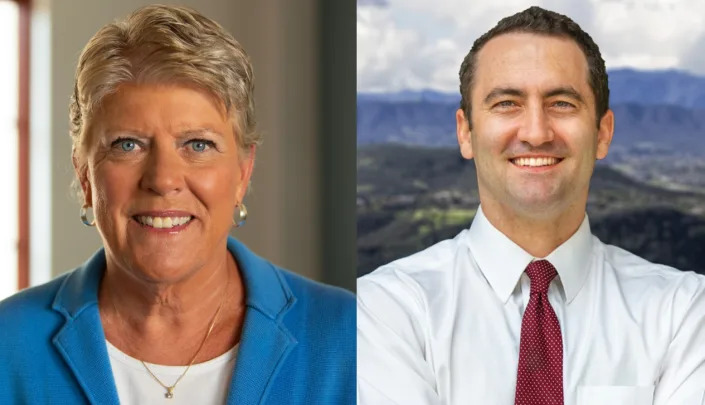
Julia Brownley and Matt Jacobs

Election officials estimated about 79,000 votes are still to be processed across Ventura County though some are from outside of the district, which does not include Ventura and Ojai. It’s unclear how many ballots are still to be counted in the small part of the district in Los Angeles County.

In her victory statement and in her campaign, Brownley focused on abortion rights.

“While the Republican party focused solely on inflation with no plan to address it, they failed to understand that protecting a woman’s right to choose is not only a moral issue but an economic one,” she said.

The race was one of several being tracked nationally as Republicans and Democrats vied for control of the House. The contest gained more attention immediately before the election amid a flurry of fundraising and reports of polls showing a tight race.

Redistricting brought all of more conservative Simi Valley into the 26th but Democrats still accounted for 43% of the registered voters across the district as of late October, compared to 28% for Republicans

Red tide update: State report shows toxic algae levels from Sarasota south to Marco Island

The Fort Myers News Press

Red tide update: State report shows toxic algae levels from Sarasota south to Marco Island

Chad Gillis, Fort Myers News-Press – November 17, 2022

Scientists are saying a red tide bloom that’s lingered along the coast for a few weeks is now being fed by nutrients running off the landscape in the wake of Hurricane Ian.

Red tide (Karenia brevis) is a naturally occurring organism in the Gulf of Mexico that sometimes blooms to toxic levels.

But research shows that nutrients from farm fields, lawns and septic tanks fuel red tide blooms close to shore — making them more frequent, longer-lasting and more intense.

“I don’t see any good evidence that hurricanes initiate a red tide, but once you have a red tide started, runoff will make it worse,” said Larry Brand, a water quality expert, scientist and professor at the University of Miami.

Fish kills: Red tide bloom moves into Lee County waters as fish kills reported in Pine Island Sound

Florida red tide map:  Check the current status

Why is it still so hot? Cold front to break up string of above-average highs, for a day

Ian didn’t create the conditions for the original bloom; but rain water and storm surge has helped fuel the bloom, which now stretches from the Sarasota area south to Marco Island.

Counts of 1 million cells per liter and higher have been reported at multiple locations along the Southwest Florida coast.

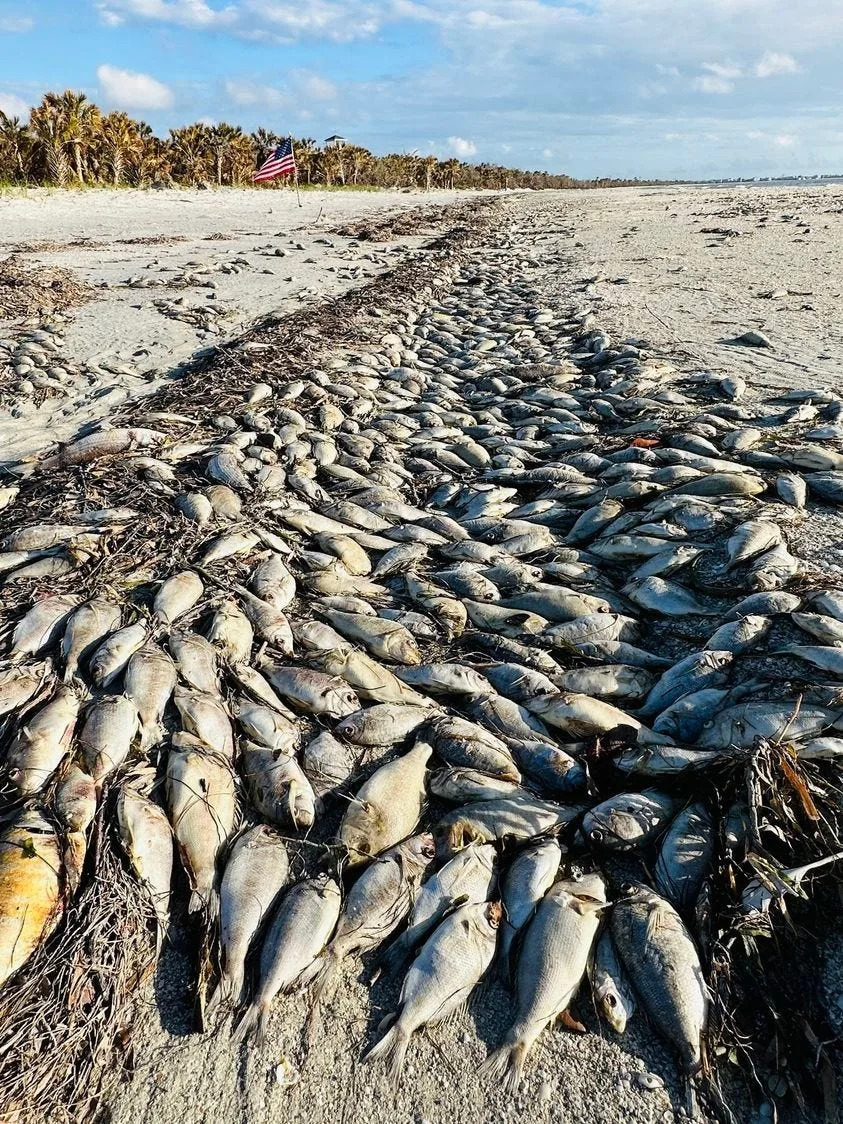
Dead fish litter many beaches in the region, and the Florida Department of Health in Collier County issued an exposure advisory Wednesday.

DOH agrees with Brand, that nutrients flowing off the landscape contribute to the intensity and duration of the bloom.

Thousands of dead fish line the high tide line at Cayo Costa State Park on Nov. 14, 2022. Red tide has moved into Lee County waters in recent weeks.

“Once inshore, these opportunistic organisms can use nearshore nutrient sources to fuel their growth,” a Wednesday DOH press release reads. “Blooms typically last into winter or spring, but in some cases, can endure for more than one year.”

What should Southwest Florida residents do?

DOH says people who live along the coast should even check their air conditioning filters.

“Residents living in beach areas are advised to close windows and run the air conditioner, making sure that the A/C filter is maintained according to manufacturer’s specifications,” DOH says. “If outdoors near an affected location, residents may choose to wear masks, especially if onshore winds are blowing.”

Carly Jones, spokeswoman for the Florida Fish and Wildlife Conservation Commission — the state agency charged with monitoring red tide, said offshore winds can help push the contaminated waters and the microscopic algae away from the coast.

Lake O levels: Herbert Hoover Dike around Lake O remains safe during Hurricane Nicole

More: Cassani calling it quits after six years as Calusa Waterkeeper for Caloosahatchee system

The latest FWC report show the strongest red tide counts have been found in northern Lee and Sarasota counties.

“Some people experience respiratory irritation (coughing, sneezing, tearing and an itchy throat) when the red tide organism is present and winds blow onshore,” Jones wrote in an email to The News-Press. “Offshore winds usually keep respiratory effects experienced by those on the shore to a minimum. The Florida Department of Health advises people with severe or chronic respiratory conditions, such as emphysema or asthma, to avoid red tide areas.”

Red tide can contaminate shellfish, and the DOH recommends against collecting and eating shellfish from this region at this time.

Locally caught, properly cleaned and cooked fish can be eaten, the press release says.

DOH recommends washing yourself and all clothing if you make contact with waters containing the toxic algae.

Hurricane Irma also stirred nutrients in toxic algae bloom in 2017

Calusa Waterkeeper John Cassani has been monitoring the bloom online.

“I’m hearing people aren’t seeing as many gamefish species as compared to (Hurricane) Irma (2017),” Cassani said. “It’s mostly foraging fish but most are decayed to the point you can’t determine the species.”

Hurricane Irma stirred up nutrients in the Lake Okeechobee/Caloosahatchee River system five years ago, and the following summer was virtually lost to a massive red tide and blue-green algae bloom in the river.

Lee County was part of a state of emergency for both blooms.

Some scientists have speculated that Hurricane Ian’s aftermath will cause similar conditions between now and the spring of 2024.

The Hurricane Irma-fed red tide lasted from the fall of 2017 until the spring of 2019.

“It’s a neurotoxin,” Cassani said. “There are neurological symptoms that have been defined in response for red tide. And people with asthma are showing up in emergency rooms. There’s an influx often during a bloom. It’s an unregulated contaminant.”

Red tide worsens and spreads to Tampa Bay. Dead fish found on Anna Maria Island

Bradenton Herald

Red tide worsens and spreads to Tampa Bay. Dead fish found on Anna Maria Island

Ryan Ballogg – November 16, 2022

A red tide bloom has worsened in Southwest Florida waters this week, the latest samples from the state show.

The algae that causes red tide, Karenia brevis, was observed at elevated levels in Tampa Bay, around Anna Maria Island, Longboat Key and in Sarasota Bay. Dead fish and breathing irritation have been reported on local beaches.

The bloom remains most intense further south offshore of Sarasota, Charlotte and Lee counties, according to samples from the Florida Fish and Wildlife Conservation commission.

On Monday, a very low concentration of red tide algae was detected in a water sample near the Rod and Reel Pier in Anna Maria —down from medium levels last week— and a medium concentration was again found in waters near Longboat Pass in Bradenton Beach.

University of South Florida’s red tide for predicts that very low levels of the algae will continue to circulate around Anna Maria Island through this weekend. At very low levels, respiratory irritation is possible.

USF predicts that low to medium levels of the algae will circulate around Longboat Key, with high levels persisting farther south in Sarasota Bay.

At levels of medium and above, which are considered “bloom concentrations” of the algae, respiratory irritation and fish kills are likely.

Slight breathing irritation and a few dead fish were reported on Anna Maria Island beaches this week, Mote Marine Laboratory’s red tide beach conditions report said. To the south, moderate breathing irritation and numerous dead fish were observed on several Sarasota County beaches.

Red tide’s patchy nature means that even beaches in close proximity can have very different conditions. Respiratory irritation and dead fish can also become more or less present as wind directions and tides change.

The National Oceanic and Atmospheric Administration forecasts the respiratory threat from red tide. On Wednesday, NOAA warned that beachgoers in Manatee, Sarasota, Charlotte, Lee and Collier counties could experience moderate to high levels of respiratory irritation over the next 36 hours.

On Monday, the Florida Department of Health Manatee County issued a red tide health alert for the following beaches:

  • Bayfront Park
  • Coquina Beach South
  • Longboat Pass/Coquina Boat Ramp
  • Rod and Reel Pier (City of Anna Maria Island)

FDOH-Manatee offers the following red tide safety tips:

  • Look for informational signage posted at most beaches.
  • Stay away from the water.
  • Do not swim in waters with dead fish.
  • Those with chronic respiratory problems should be especially cautious and stay away from these locations as red tide can affect your breathing.
  • Do not harvest or eat molluscan shellfish or distressed or dead fish from these locations. If caught live and healthy, finfish are safe to eat as long as they are filleted and the guts are discarded. Rinse fillets with tap or bottled water.
  • Wash your skin and clothing with soap and fresh water if you have had recent contact with red tide.
  • Keep pets and livestock away and out of the water, sea foam and dead sea life. If your pet swims in waters with red tide, wash your pet as soon as possible.
  • Residents living in beach areas are advised to close windows and run the air conditioner, making sure that the A/C filter is maintained according to manufacturer’s specifications.
  • If outdoors near an affected location, residents may choose to wear masks, especially if onshore winds are blowing.

FDOH-Sarasota issued a health advisory for all 16 of Sarasota County’s public beaches last week.

A map from University of South Florida’s Ocean Circulation Lab shows the red tide forecast in the Tampa Bay region over the coming days.

Kari Lake has finally met her match: Arizona voters

AZ Central – The Arizona Republic

Kari Lake has finally met her match: Arizona voters

Elvia Díaz, Arizona Republic – November 15, 2022

Kari Lake, the leading lady of the Make America Great Again movement, has finally met her match: Arizona voters.

Lake’s hopes of becoming Arizona’s MAGA governor evaporated with every drop of new vote counts. But on Monday evening, some news networks and the Associated Press called the race for Hobbs.

Lake had been hanging by a thread, but her chances of pulling off a victory against Democrat Katie Hobbs seem more like an illusion than a realistic possibility, given the number of remaining votes in key Maricopa County.

As of Monday night, she was losing by 20,481 votes – just under 1 percentage point. If the final margin is a half a percentage point or less, there would be an automatic recount. That would mean dragging out this whole drama for weeks.

But the voters who turned on Lake must pat themselves on the back. These voters are the defenders of democracy, who successfully built a wall to hold off the MAGA restrictionists’ scheme.

None of Lake’s or other MAGA claims are sticking
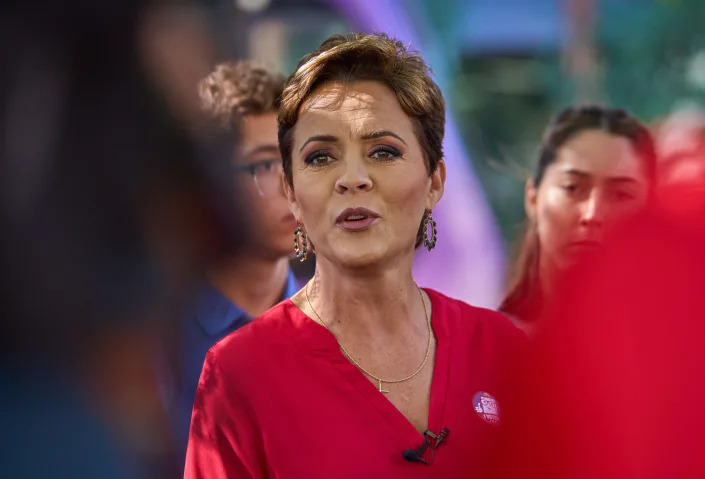
Kari Lake gives a press conference on the sidewalk outside of the Downtown Phoenix Post Office after casting her ballot on Nov. 8, 2022.

For days now, we’ve seen and heard voters’ powerful message. None of the MAGA candidates’ tantrums are sticking, and that’s a great thing.

On Election Day, they huffed and puffed over a computer glitch that affected some vote-counting machines. They screamed voter fraud.

That was a serious glitch, but it didn’t keep voters from casting their ballots. And so, it didn’t stick with Arizonans who are tired of hearing conspiracy theories and the lies of a stolen election.

In the midterm: Arizona’s politically purple credentials are hard to top

Lake and other MAGA candidates later accused Maricopa County election officials of purposefully “dragging their feet” in counting votes – conveniently forgetting those overseeing the vote count are mostly Republicans merely following state law set by a Republican-controlled government.

That didn’t stick, either.

Cue Donald Trump. The former president was fuming to see that his hand-picked candidates, including Lake, were losing. Predictably, he fired off accusations of a stolen election.

That didn’t stick, either.

Their reaction is reassurance: You voted wisely

Over the weekend, some of Lake’s supporters called for military intervention because she’s losing.

“We the people are requesting the military to step in and redo our election,” a protester outside the Maricopa County ballot counting center said.

I kid you not. Lake’s supporters want the U.S. military to take over elections and presumably make sure she wins.

Don’t dismay, though. That call isn’t sticking, either.

If anything, those few protesters calling for military intervention make Lake look like a dictator wanna be – reassuring the Arizona voters who rejected her of their decision.

The slow vote count was exasperating, but that also gave us – the people – a real sense of normalcy.

There was actual excitement and gasps with every vote count revealed. That’s because we, the people, were hungry for mutual respect at the ballot box.

Elvia Díaz is the editorial page editor for The Republic and azcentral. 

Far-Right Republican Who Called For ‘More Gallows’ Wonders If GOP Had A Messaging Problem

HuffPost

Far-Right Republican Who Called For ‘More Gallows’ Wonders If GOP Had A Messaging Problem

Matt Shuham – November 15, 2022

Far-Right Republican Who Called For ‘More Gallows’ Wonders If GOP Had A Messaging Problem

As updated vote tallies began to cement a loss for Trump-backed Arizona governor candidate Kari Lake on Monday, a far-right state lawmaker who told a gathering of white nationalists that “we need to build more gallows” started to have second thoughts about her party’s pitch to voters. 

“We wonder now if we were in an echo chamber,” said state Sen. Wendy Rogers (R), who has also suggested throwing county officials in solitary confinement and spent years lying about the 2020 election. 

“I don’t know, I’m just beginning to get some perspective,” added Rogers.

In the final days of her unsuccessful campaign against Democrat Katie Hobbs, Lake bear-hugged Rogers, despite the fellow Republican being one of the nation’s foremost elected supporters of the white nationalist influencer Nick Fuentes

Rogers’ realization about echo chambers occurred in an interesting place: She was speaking to Charlie Kirk on his YouTube show, which is also broadcast on the Salem Radio Network.

Kirk is the founder of the right-wing youth group Turning Point USA, which has close ties to the Trump family and spent considerable time and money working to elect Arizona Republicans. The group’s nationwide endorsement page is now sprinkled with painful losses, including Lake and U.S. Senate candidate Blake Masters (R).

“Every pollster was wrong, every single one,” Kirk told Rogers. Later, he apologized to listeners for getting the projections wrong ― referring to positive polling for Lake as “Kool-Aid” ― and mentioned that he’d heard “they didn’t run an internal poll the whole campaign.”

“Never again are we going to trust polls, or tracking, or any of that stuff,” Kirk said.

As the results rolled in, the crew speculated that Lake, who in many ways emulated former President Donald Trump’s election denialism and theatrical antagonism of the press, was simply too much for some otherwise winnable Arizona voters.

“If every person who voted to retire [House Speaker Nancy] Pelosi in Arizona voted for Kari Lake, she’s governor,” Kirk said, referring to Arizona’s U.S. House delegation, which went from 5-4 Democratic to 6-3 Republican with this election.

“What that means … is a Republican undervote, and it looks like that happened,” he added, referring to voters who supported Republicans other than Lake.

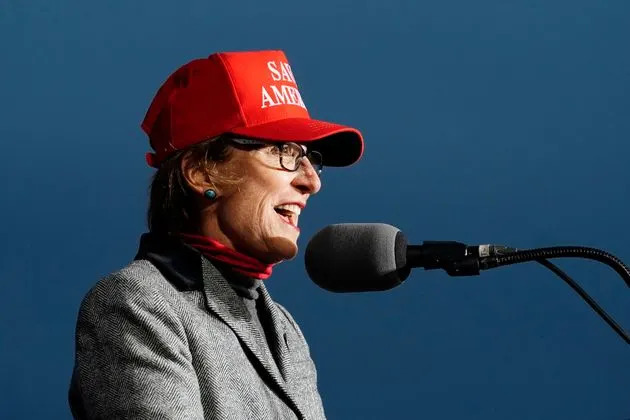
Arizona state Sen. Wendy Rogers (R) has spent years making false claims about the 2020 election.

Arizona state Sen. Wendy Rogers (R) has spent years making false claims about the 2020 election.

Tyler Bowyer, TPUSA’s chief operating officer and a falsepresidential “elector” for Trump’s 2020 campaign, said “the same Trump attack messaging seemed to work” against Lake.

“I love Trump, I love him to death, but the Trump rally is an echo chamber,” Bowyer said separately, responding to Rogers’ comment. He recalled warning Lake’s political team against having “all the same people showing up to the same events” and not bringing in new supporters but rather “fangirls and fanboys.”

Rogers agreed that Trump’s more recent rallies felt like a “family reunion.”

“I do think voters are telling us that they’re fatigued,” Kirk said. “I think people are telling us, they’re trying to send it in more ways than one: ‘I’m going to vote for the more boring person.’”

A few minutes later, Kirk read the latest returns from Maricopa County ― home to more than half of Arizona’s residents ― which sealed the deal on Hobbs’ projected victory.

Then he read an email from a listener as he and his guests’ heads sank. “We all have Trump fatigue syndrome,” he read. “I reluctantly voted for Kari Lake but all my friends couldn’t do it. We don’t want all the bombast.”

When Kirk announced that Lake was trailing Hobbs by 20 points in Pima County, the second largest county in the state, Rogers did a double take. “You said 20 points?” she confirmed, seemingly stunned as she looked at her phone.

Related…

There’s more to Katie Hobbs than anyone understood (including media, MAGA and Democrats)

AZ Central – The Arizona Republic

There’s more to Katie Hobbs than anyone understood (including media, MAGA and Democrats)

Phil Boas, Arizona Republic – November 15, 2022

Finally, the wait is over! Katie Hobbs is the next governor of Arizona, and Trump Republicanism suffers another major defeat.

The MAGA energy that swept Kari Lake to victory in her primary has become hemlock in general elections.

Lake joins the list of hapless MAGA candidates who lost the governor’s offices in Michigan, Pennsylvania, New York and now Arizona.

Donald Trump recently boasted he created the modern Republican brand. Well, today the modern Republican brand is what, Edsel? Polaroid? Enron?

Nope.

It’s Old Hat.

Many of us dismissed Katie Hobbs

The temptation will be great to say Hobbs didn’t win the governor’s seat. Kari Lake lost it. Had Lake run as a normal Republican with her polished delivery and anchorwoman looks she’d be recarpeting the hallways right now on the Ninth Floor.

But let’s give Hobbs her due. This was a candidate widely underestimated by not only the Republicans but the media and even her own party, the Democrats.

Hobbs vs. Lake: Arizona’s politically purple credentials are hard to top

Soft-spoken and understated, she was dismissed from the beginning as a lightweight and novice filled with self-doubt and struggling to find the right words in front of TV cameras. She stuck with her much-maligned strategy (that also took criticism from this corner) to skip debates in the primary and general elections.

Many of us said that was wrong. She’s not meeting the moment.

What we didn’t know was that Hobbs had a brought a sledgehammer of her own to this race. She used it to smash conventional wisdom.

But Democrats have real reason to celebrate

Now that Hobbs has won the all-important Arizona governor’s race, Democrats are aglow. They should be.

To call what happened in Arizona and nationally a “red ripple” suggests the Republicans eked out a victory that could have been much larger. But this was not a Republican win. It was an indisputable and historic triumph for the Democratic Party and its candidates.

In a year when inflation was pushing up the price of milk and eggs, when the Democratic president was drowning in dismal approval ratings, when border crossings were at record highs and urban crime was beginning to scare people, the liberal party defied predictions and proved it is more in tune with the American people than its rival.

In fact, the Democrats pulled off the best midterm performance in 20 years by the party holding the White House, The New York Times reported.

Democrats retained control of the Senate, and lost the House by such a fine margin, Republicans will be dancing with the devil trying to manage it.

Beneath the angst, Katie Hobbs has steel
Gubernatorial candidate Katie Hobbs speaks as the Arizona Democratic Party hosts a Unity Rally with statewide candidates to energize Democratic voters and volunteers ahead of the November election at Carpenters Union Hall on Saturday, Aug. 27, 2022.

In Arizona, Democrats could not wait to start their well-earned gloating. Lobbyist and former state lawmaker Chris Herstam got the jump on it Sunday night by picking a Twitter fight with me:

“@boas_phil’s so-called “leftists” have done quite well in the midterm (in Arizona & DC). Arizona Democrats will do even better in ‘24 with a presidential election turnout & a reproductive freedom initiative on the ballot.”

I bring this up to illustrate just what a long haul this has been for Hobbs and to show that beneath all the surface angst and insecurity, Katie Hobbs has some steel.

Herstam’s tweet reminded me that from the very beginning Hobbs had to endure attacks from a large part of the Democratic establishment.

When she got into the race, Herstam tried to bury her campaign.

He pointed loudly to a recent jury verdict that found that Democratic legislative leadership had discriminated against Senate aide Talonya Adams when they fired her in 2015.

Hobbs faced a torrent of criticism

Hobbs was Senate Democratic leader at the time, so she faced a storm of criticism.

“I think she’s in real trouble,” Herstam told KJZZ radio. “Katie Hobbs needs to apologize profusely and compassionately, and she hasn’t really done that yet.

“Frankly, she should have apologized very directly when she announced her candidacy.  … And she didn’t do so. … That was a bonehead political move by her team.”

Herstam at the time was plumping the potential candidacy of U.S. Rep. Greg Stanton, the former Phoenix mayor who had not yet decided to skip the gubernatorial race.

“The anti-Hobbs storm, it’s still to come,” said Herstam, predicting the Republicans would run ads on the discrimination verdict. “They will be a real blow to her candidacy, as well as the entire Democratic ticket.”

Republicans ran with the ‘bigot’ theme

Herstam was prescient in one sense. The Republicans did pick up the “Hobbs is a bigot” theme. They got the idea from Democrats.

Then Kari Lake took her chainsaw to Hobbs: “I think a lot of people don’t realize she’s a twice-convicted racist.”

No. Hobbs was never convicted. Never charged. This was a civil case, not criminal. Chainsaws are poor instruments for making such distinctions.

Still, it’s worth remembering that before Republicans got to Hobbs many Democrats were on a tear.

Even Democrats criticized her in the primary

Five high-profile leaders of the Phoenix African American community put out this statement: “We ask that all persons, especially people of color, reconsider any support for Katie Hobbs to become the next governor of Arizona.”

Understand that this was during the social upheaval sparked by the police killing of George Floyd. Feelings were raw. And a number of Democrats were working hard to destroy her campaign.

Warren Stewart, once a centrist Democrat who morphed into a sharper-edged social-justice hawk, said he was done with Hobbs.

“I’m at a place where I am not impressed by apologies and videos,” Stewart told CNN in January. “I think the most noble thing that Katie could do is to step down and wait until she has proven herself as a leader.”

We shouldn’t underestimate Hobbs again

Now that Hobbs has won the main prize in Arizona’s 2022 election, many will forget the onslaught she survived just to get her party’s nomination.

They’ll forget she showed up for the fight as other big-name Democrats demurred. That she fought through all the insults from her own party before Kari Lake fired her artillery.

It’s one thing to bring Kari Lake-level confidence to an election, throwing flames and spitting nails. It’s another to wrestle down your self-doubt every day before you armor up to compete.

Hobbs could not match the smooth delivery of Kari Lake and always seemed self-conscious of it.

She looked like she was fighting through private doubts that may have been her most formidable opponent. And yet she stayed with it. No one was going to push her out.

That takes guts.

And we would all do well never to underestimate her again.

Phil Boas is an editorial columnist with The Arizona Republic. 

Why a Trump-appointed Texas judge blocked Biden’s student-debt cancellation plan

Insider

Why a Trump-appointed Texas judge blocked Biden’s student-debt cancellation plan

Ayelet Sheffey – November 14, 2022

A view of the US Capitol before a news conference to discuss student-debt cancellation on September 29, 2022.
A view of the US Capitol before a news conference to discuss student-debt cancellation on September 29, 2022.Drew Angerer/Getty Images
  • Trump-appointed Judge Mark Pittman struck down Biden’s debt relief in Texas last week.
  • He argued the two student-loan borrowers who sued have sufficient standing to block the plan.
  • But some legal experts and Democrats said Pittman should never have taken up the case in the first place.

A federal judge doesn’t think President Joe Biden’s plan to cancel student debt for millions of borrowers is legal.

On Thursday evening, Mark Pittman — a Texas judge appointed by former President Donald Trump — struck down Biden’s plan to forgive up to $20,000 in student-loans for federal borrowers making under $125,000 a year. He ruled in favor of two student-loan borrowers who filed the lawsuit because each of them didn’t qualify for the full amount of relief, and at this point, Pittman’s ruing bars the Education Department from discharging student loans until a final verdict is made.

Biden’s Justice Department has filed an appeal, but the administration is not accepting any new student-loan applications at this time.

The Texas case, along with a number of other lawsuits backed by conservative groups, challenges Biden’s authority to use the HEROES Act of 2003, which gives the Education Secretary the ability to waive or modify student-loan balances in connection with a national emergency, like COVID-19. They claimed that enacting broad student-loan forgiveness is an overreach of the authority and should require Congressional approval, while Biden has maintained one-time student-loan forgiveness is well within the administration’s legal authority.

Pittman appeared sympathetic to the conservatives’ arguments in his ruling. “This case involves the question of whether Congress—through the HEROES Act—gave the Secretary authority to implement a Program that provides debt forgiveness to millions of student-loan borrowers, totaling over $400 billion,” Pittman wrote in his ruling. “Whether the Program constitutes good public policy is not the role of this Court to determine. Still, no one can plausibly deny that it is either one of the largest delegations of legislative power to the executive branch, or one of the largest exercises of legislative power without congressional authority in the history of the United States.”

The other lawsuits are also moving through the courts. The 8th Circuit Court of Appeals, for example, ruled on Monday that its temporary pause on student-debt relief will remain in place until further orders from the court on a separate lawsuit in which six Republican-led states sued the loan forgiveness, arguing it would hurt their states’ tax revenues.

One of the key parts of Pittman’s ruling is that the plaintiffs actually met the legal requirements for a valid lawsuit. He ruled that they have standing to sue the administration, but several prominent Democrats and legal experts have questioned that decision — and other courts have thrown out similar conservative lawsuits due to a lack of standing.

The plaintiffs’ standing to sue

Both of the plaintiffs who brought the Texas lawsuit hold student loans. The first plaintiff, Myra Brown, sued because her loans are commercially-held and therefore ineligible for Biden’s debt relief, which requires the borrower to owe their debt directly to the federal government. And the other plaintiff, Alexander Taylor, sued because he was eligible only for $10,000 in debt forgiveness and not the full $20,000 since he did not receive a Pell Grant in college.

They both argued they were not given the opportunity to challenge the relief before its announcement since it didn’t go through the Administrative Procedure Act’s notice-and-comment period, and they said that failure to go through typical rulemaking processes, along with overstepping authority granted through the HEROES Act, were reasons why the debt relief should be blocked.

Pittman ruled that the plaintiffs have valid reasons for suing the administration. In his opinion, Pittman wrote that standing contains three legal requirements: there must be concrete injury, there must be causation, and there must be redressability, which is the likelihood the requested relief — in this case, blocking debt cancellation — would repair the injury caused. Pittman said that Biden’s Justice Department argument that the plaintiffs’ standing does not exist is “untrue.”

“Plaintiffs do not argue that they are injured because other people are receiving loan forgiveness,” Pittman wrote. “Their injury—no matter how many people are receiving loan forgiveness—is that they personally did not receive forgiveness and were denied a procedural right to comment on the Program’s eligibility requirements.”

And while Pittman concluded that debt relief did not violate procedural requirements, he said it violates authority under the HEROES Act because the “pandemic was declared a national emergency almost three years ago and declared weeks before the Program by the President as ‘over.’ Thus, it is unclear if COVID-19 is still a ‘national emergency’ under the Act.”

Some Democrats and legal experts take issue with the ruling

While Republican lawmakers were quick to laud Pittman’s decision, some legal experts weren’t sold on the merits of the ruling. Steve Vladeck, a CNN legal analyst and professor at the University of Texas School of Law, wrote in an opinion piece that “the biggest problem with Pittman’s ruling isn’t its substance; it’s why he allowed the case to be brought in the first place.”

Vladeck referenced prior conservative lawsuits seeking to challenge the debt relief that had been dismissed for lack of standing, and that if “the complaint is just that the government is acting unlawfully in a way that doesn’t affect plaintiffs personally, that’s a matter to be resolved through the political process – not a judicial one.”

And Leah Litman, a professor at the University of Michigan School of Law, wrote on Twitter that the ruling “is just the latest example of Trump-appointed district judges doing completely outlandish, lawless things to rule against policies by Democratic administrations,” referring to what she said was a lack of standing on the plaintiffs’ side.

Massachusetts Sen. Elizabeth Warren also slammed the ruling, telling NBC News on Sunday that “we have a court down in Texas, and if they’re going to play politics instead of actually following the law, they do put the program at risk.”

After a Senate Loss in Wisconsin, Democrats Turn on Each Other

Rolling Stone

After a Senate Loss in Wisconsin, Democrats Turn on Each Other

Kara Voght – November 13, 2022

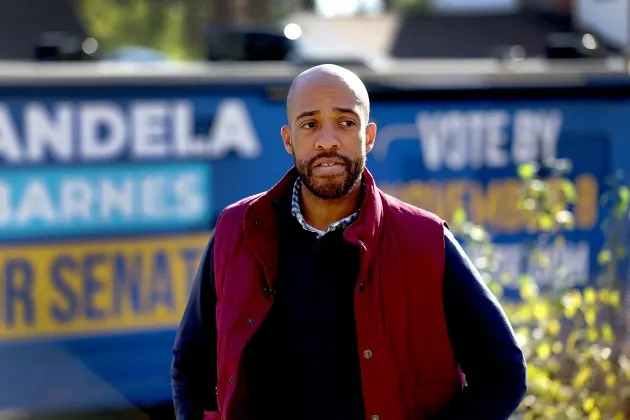
how-did-mandela-barnes-lose.jpg Mandela Barnes Campaigns Across Wisconsin On Eve Of Midterm Election - Credit: Scott Olson/Getty Images
how-did-mandela-barnes-lose.jpg Mandela Barnes Campaigns Across Wisconsin On Eve Of Midterm Election – Credit: Scott Olson/Getty Images

In the weeks leading up to Election Day, Mandela Barnes’ supporters felt frustrated. They believed in Barnes as the best Democrat to take on Sen. Ron Johnson (R-Wisc.), and election forecasts all but guaranteed a Johnson victory. That frustration gave way to fury, however, once the ballots were counted on Wednesday. Barnes lost to Johnson by a single point.

It was a performance far stronger than what former Sen. Russ Feingold (D-Wisc.) achieved in his back-to-back runs against Johnson in 2010 and 2016. It also shouldn’t have been a shock. “This was a result that tracks with what our model suggested might happen,” says Ben Wikler, the chair of the Wisconsin Democratic Party. He’d spent the last few weeks explaining, both publicly and privately, that the race was tied — even as credible public polls found Barnes uncomfortably behind.

The unexpectedly sunny outcomes for Democrats on Tuesday night mostly staved off party soul searching — with one notable exception: The U.S. Senate race in Wisconsin. It wasn’t as if Democrats couldn’t win statewide there. Gov. Tony Evers won his reelection on Tuesday by more than 90,000 votes. The Senate race, meanwhile, had been the Democrats’ top target in 2022 as polls consistently deemed Johnson unpopular among Wisconsin voters. His reported efforts to help overturn Wisconsin’s 2020 presidential election results only made his ousting more desirable.

Barnes’ near miss has reopened intraparty wounds as Democrats lament the Senate seat that got away. At the root of it is a perennial question that follows high-profile losses: Was the candidate the wrong choice, or did he have insufficient resources to make his case?  Barnes’ progressive allies point fingers at the Democratic establishment, whom they blame for discouraging big money from stepping in to counter tens of millions in attack ads unleashed upon Barnes after the primary. Democratic operatives, meanwhile, blame the Barnes campaign for not doing enough to counter those attacks with his own messaging — and for not putting enough distance between himself and past progressive positions they believe are toxic to Democrats running in tight races.

Barnes had been the early favorite to take on Johnson. The 35-year-old Black lieutenant governor had been a Democratic rising star ever since he’d won a Milwaukee-area seat in the Wisconsin legislature at age 25. He shared the winning gubernatorial ticket with Gov. Evers in 2018, a victory that boosted his visibility statewide. Barnes didn’t fit squarely in any ideological frame; both progressive stalwarts like Sen. Elizabeth Warren (D-Mass.) and moderate Black leaders like Rep. Jim Clyburn (D-S.C.) claimed Barnes as their own. It was a seemingly winning quality he shared with Pennsylvania’s John Fetterman, another Democratic lieutenant governor trying to flip a U.S. Senate seat. (”Just two tall bald dudes trying to get the job done,” Barnes told Politico of their very online bromance in July.)

He and Fetterman also shared a vulnerability: Liberal sensibilities to criminal justice reform. Barnes became the face of the Evers administration during the Kenosha riots that followed the police shooting of Jacob Blake, a Black man, in August 2020. He made frequent cable news appearances to demand police accountability. At one point, he suggested diverting funding from “over-bloated budgets in police departments” to community programs. The sentiment seemed to align Barnes with the goals of “defund the police,” the left-wing rallying cry that had grown radioactive in Democratic circles. Barnes had also been photographed holding an “Abolish ICE” T-shirt, another liberal slogan the GOP insisted on weaponizing.

Barnes tailored his campaign to neutralizing those attacks. He introduced himself as a candidate with a middle-class upbringing and a pocketbook-oriented platform. When asked about his criminal justice positions, Barnes would say he supported investing in both crime-prevention measures and law enforcement in equal measure. The strategy worked for the Democratic primary: He cleared a crowded field before any votes were cast as challengers, seeing Barnes as the clear frontrunner, dropped out and threw their support behind him.

The view from Washington, however, hadn’t been so convinced of Barnes’ obvious ascent. The Senate Democrats’ campaign arm had seen multiple candidates as strong contenders to challenge Johnson, declining to put its thumb on the scales for any candidate during the race. In the months leading up to the primary, a number of influential Democrats had privately raised doubts over Barnes’ electability — including Senate majority leader Chuck Schumer (D-N.Y.), according to several sources with knowledge of conversations. (“That’s ridiculous,” says a Schumer spokesperson, who noted that Schumer transferred $1 million from his own campaign coffers to Barnes’ efforts. “Sen. Schumer worked tirelessly to ensure Mandela Barnes and other Democratic candidates across the country had the resources they needed to run strong and competitive campaigns.”)

Then, just two weeks after the primary, the predictable happened. Four Johnson-aligned super PACs blanketed Wisconsin airwaves with ten different ads tying rising crime rates to Barnes. The spots preyed on the trauma of the Kenosha riots as well as a violent scene in Waukesha, where a man killed five attendees at the city’s annual Christmas parade as drove his car in November 2021. Nearly $25 million was spent in TV, radio, and digital advertising against Barnes during that period — including more than $10 million from Wisconsin Truth, a super PAC founded by three billionaire Johnson backers.

Barnes led Johnson by seven points in the first Marquette University poll taken after the primary, a time when a third of the Wisconsin electorate still hadn’t formed any opinion of Barnes. By the beginning of October, the Marquette poll found that Johnson had pulled ahead of Barnes by six points. “They were able to make Mandela look like a scary black man,” says Angela Lang, the executive director of BLOC, a Milwaukee-based Black civic engagement organization. The crime-ridden messaging had even penetrated among the city’s older Black voters, according to Lang. As BLOC’s organizers went door-to-door, they’d sometimes be asked: “Is Mandela really trying to let all these violent criminals out?”

“If the GOP smears had been met with equal intensity, I don’t think the country would have lost track of the fact that he really did have the chance,” Wikler, the Wisconsin Democratic chair, says. But Democrats disagree on what meeting those smears should have looked like. To Barnes’ progressive allies, the major Democratic party organs didn’t hit back hard enough during the GOP’s August and September blitz. They blame the lack of pushback on doubts prominent democrats raised over Barnes’ electability, saying it discouraged key donors from investing in the race. That attitude, according to Barnes’ boosters, delivered his campaign a fatal blow at a key moment. “That window was such a critical window — Mandela was ascendant,” says Maurice Mitchell, the executive director of the progressive Working Families Party, which backed Barnes in the race.

Indeed, the Senate Democrats’ campaign arm had, by that point, viewed Fetterman’s race for Pennsylvania’s open seat as a safer bet and decided to focus its resources on winning that race. Even so, Democrats had thrown $11.6 million behind opposing Johnson in those post-primary weeks — including $3 million from the DSCC in airtime “with the hopes that our nominee would use the air cover during this period to get their own advertising plans in order,” says a DSCC spokesperson. But Democrats defending those efforts point out that no amount of anti-Johnson spending would be as effective as hearing from Barnes himself. Research from the Center for American Progress, shared with Democratic campaigns in September, had found that the most effective strategies for combating crime attacks came from the candidates deflecting allegations themselves. Democratic Senate strategists had relayed these finds to the Barnes campaign and encouraged him to be prepared to face attacks on his record.

The Barnes campaign, attuned to this, stayed on the air throughout August and September with a series of ads that featured Barnes refuting GOP claims. One from late August opened with Barnes in his kitchen in the midst of the quotidian tasks of putting away groceries. “Now they’re claiming I’m going to defund the police and abolish ICE,” Barnes said directly to camera. “That’s a lie.” It still wasn’t enough to counter the Republican onslaught with so many GOP attacks going unanswered; the Barnes campaign, still rebuilding its fundraising coffers from the primary, couldn’t match the spending. “We knew people needed to hear directly from him — ‘This is nonsense, this is what I believe,’” says Barnes campaign manager Kory Kozlowski. “The thing you can’t control is three of their ads for one of yours.”

Still, other Democrats point out that the attacks would have lost their sting if the candidate hadn’t held controversial positions in the first place. Matt Bennett, a cofounder of Third Way, a centrist Democratic political organization that supported Barnes in the general election, admits money was a huge factor — as was race, especially given the 120,000-vote delta between Barnes and Evers. “But it also can be true that Barnes did not effectively put distance between himself and his positions,” Bennett adds. Other Democrats point out that Barnes never walked away from his support of ending cash bail, a vulnerability Republicans successfully linked to the Waukesha tragedy, which had been perpetrated by a freed felon. “Proof points like that become really hard to overcome,” says Navin Nayak, the president of the Center for American Progress Action Fund. “That’s where good policy can bump up against scare tactics.”

But the Barnes campaign did find a potent strategy to crawl back into contention. Much of that was premised on hammering Johnson over his anti-abortion stances, a charge the Barnes campaign learned performed best against Johnson’s crime accusations. The Barnes campaign outraised Johnson in the final stretch and achieved a spending parity — and, at times, an advantage — as it got its own attack ads up in early October. Education among voters, too, softened the attack lines. “Naming the racism was important,” BLOC’s Lang says. “He’s talking about getting rid of cash bail, but that doesn’t actually keep our community safe.”

Barnes’ poll numbers steadily climbed each week leading up to the election. “One more week and we would have won,” Kozlowski, Barnes’ campaign manager, laments.

Johnson’s victory has no bearing on Democrats retaining their Senate majority. The caucus will, however, fall short of the 52 senators they needed to kill the filibuster — perhaps just one short if Sen. Rapahel Warnock (D-Ga.) wins a December runoff election.