US official warns of risks posed by heavy electric vehicles
Tom Krisher – January 11, 2023
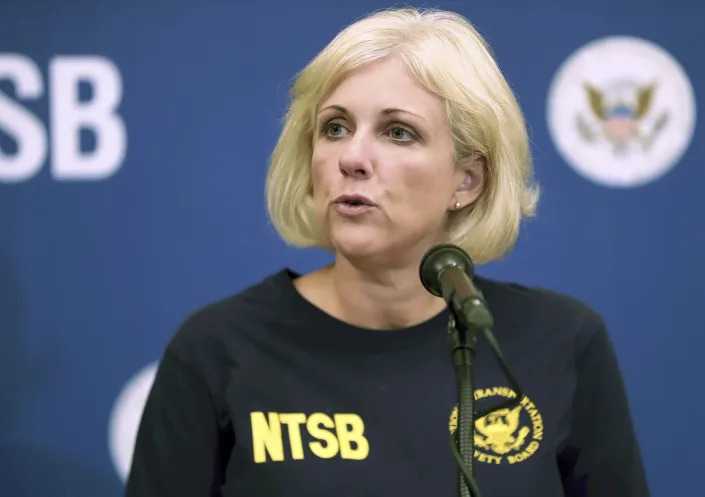
FILE – Jennifer Homendy of the National Transportation Safety Board speaks during a news conference, Oct. 3, 2019, in Windsor Locks, Conn. On Wednesday, Jan. 11, 2023, Homendy, the chairwoman of the National Transportation Safety Board, said she is concerned about the risk that heavy electric vehicles pose if they collide with lighter vehicles. (AP Photo/Chris Ehrmann, File) (ASSOCIATED PRESS)
DETROIT (AP) — The head of the National Transportation Safety Board expressed concern Wednesday about the safety risks that heavy electric vehicles pose if they collide with lighter vehicles.
The official, Jennifer Homendy, raised the issue in a speech in Washington to the Transportation Research Board. She noted, by way of example, that an electric GMC Hummer weighs about 9,000 pounds (4,000 kilograms), with a battery pack that alone is 2,900 pounds (1,300 kilograms) — roughly the entire weight of a typical Honda Civic.
“I’m concerned about the increased risk of severe injury and death for all road users from heavier curb weights and increasing size, power, and performance of vehicles on our roads, including electric vehicles,” Homendy said in remarks prepared for the group.
The extra weight that EVs typically carry stems from the outsize mass of their batteries. To achieve 300 or more miles (480 or more kilometers) of range per charge from an EV, batteries have to weigh thousands of pounds.
Some battery chemistries being developed have the potential to pack more energy into less mass. But for now, there’s a mismatch in weight between EVs and smaller internal combustion vehicles. EVs also deliver instant power to their wheels, making them accelerate faster in most cases than most gas-powered cars, trucks and SUVs.
Homendy said she was encouraged by the Biden administration’s plans to phase out carbon emissions from vehicles to deal with the climate crisis. But she said she still worries about safety risks resulting from a proliferation of EVs on roads ands highways.
“We have to be careful that we aren’t also creating unintended consequences: More death on our roads,” she said. “Safety, especially when it comes to new transportation policies and new technologies, cannot be overlooked.”
Homendy noted that Ford’s F-150 Lightning EV pickup is 2,000 to 3,000 pounds (900 to 1,350 kilograms) heavier than the same model’s combustion version. The Mustang Mach E electric SUV and the Volvo XC40 EV, she said, are roughly 33% heavier than their gasoline counterparts.
“That has a significant impact on safety for all road users,” Homendy added.
The NTSB investigates transportation crashes but has no authority to make regulations. For vehicles, such authority rests largely with the National Highway Traffic Safety Administration.
Even apart from EVs, the nation’s roads are crowded with heavy vehicles, thanks to a decadelong boom in sales of larger cars, trucks and SUVs that’s led to extreme mismatches in collisions with smaller vehicles. But electric vehicles are typically much heavier than even the largest trucks and SUVs that are powered by gasoline or diesel.
Michael Brooks, executive director of the nonprofit Center for Auto Safety, said he, too, is concerned about the weight of EVs because buyers seem to be demanding a range of 300 or more miles per charge, requiring heavy batteries.
Setting up a charging network to accommodate that may be a mistake from a safety perspective, Brooks said.
“These bigger, heavier batteries are going to cause more damage,” he said. “It’s a simple matter of mass and speed.”
Brooks said he knows of little research done on the safety risks of increasing vehicle weights. In 2011, the National Bureau of Economic Research published a paper that said being hit by a vehicle with an added 1,000 pounds increases by 47% the probability of being killed in a crash.
He points out that electric vehicles have very high horsepower ratings, allowing them to accelerate quickly even in crowded urban areas. “People are not trained to handle that type of acceleration. It’s just not something that drivers are used to doing,” Brooks said.
Also, many newer electric SUVs are tall with limited visibility that poses risks to pedestrians or drivers of smaller vehicles, he said.
Sales of new electric vehicles in the U.S. rose nearly 65% last year to 807,000 — about 5.8% of all new vehicle sales. The Biden administration has set a goal of having EVs reach 50% of new vehicle sales by 2030 and is offering tax credits of up to $7,500 to get there. The consulting firm LMC Automotive has made a more modest prediction: It expects EVs to make up one-third of the new-vehicle market by 2030.
Why Trump loyalist went to prison rather than blame the boss
Nada Tawfik – BBC News, New York – January 10, 2023
Allen Weisselberg worked for former President Donald Trump for decades (file image)
Former US President Donald Trump’s long-serving chief financial officer, Allen Weisselberg, has been sentenced to five months in jail for his role in a tax fraud scheme.
Weisselberg, 75, was given a shorter-than-expected jail term after agreeing to a plea deal in which he served as a prosecutor’s witness against the Trump Organization.
But Mr Trump had little reason to fear that Weisselberg’s testimony in the autumn trial would harm him or overshadow his announcement in mid-November that he was launching another run for president.
Indeed, as expected, his employee – who started with his father Fred Trump and who was one of the first to join his company in 1986 – remained loyal even under immense pressure.- ADVERTISEMENT -https://s.yimg.com/rq/darla/4-10-1/html/r-sf-flx.html
While Mr Trump sounded off on social media, pinning the fraud scheme on Weisselberg, he continued to offer him his support in arguably more meaningful ways. Jurors heard how the Trump Organization was still paying Weisselberg his same salary under the title senior adviser, covering his legal fees, and recently celebrated his birthday in the office.
“In a normal organisation, a corrupt CFO would be terminated and thrown out the door,” says Professor Maurice Schweitzer from the Wharton School of Business. “And you would want to separate and preserve the integrity of the institution. In this case, it’s the exact opposite.”
The trial provided a fascinating insight into the relationship between the loyal lieutenant and his boss – as well as prosecutors’ efforts to try to turn one against the other by threatening Weisselberg with a lengthy sentence at Rikers Island.
Weisselberg is expected to report to the notorious New York prison to begin serving his sentence immediately.
His attorney, Nicholas Gravante, said after Tuesday’s hearing: “He deeply regrets the lapse in judgment that resulted in his conviction, and he regrets it most because of the pain it has caused his loving wife, his sons and wonderful grandchildren.”
Under the plea deal, Weisselberg admitted to 15 felonies including tax evasion, and must pay nearly $2m (£1.65m) in fines in addition to the five-month prison term.
But without the deal, he could have faced as much as 15 years in prison.
But despite prosecutors’ focus on Mr Trump, Weisselberg refused to co-operate with the wider investigation into the former president and his business practices.
The question of what Mr Trump potentially knew about executives deceiving the tax authorities and not properly reporting benefits became a persistent and tricky one throughout the trial given he was not personally charged with wrongdoing.
Weisselberg prepared for his testimony with both the prosecution and the defence, an unusual arrangement. The Trump Organization’s lawyers repeatedly argued during the trial that he was motivated by greed, and that “Weisselberg did it for Weisselberg”. The defence strategy, in a nutshell, was that the former CFO was not shown the door because he was regarded as a family member, “a prodigal son”.
Prosecutors throughout the trial carefully tried to extract concessions from Weisselberg to bolster their case, while also poking holes in his story that Mr Trump and the business knew nothing of his 15-year tax dodging scheme. They walked the jury through how Weisselberg joined Mr Trump from day one and rose from accountant to controller to CFO. He had deep knowledge of all of the financial workings of the business as it grew. His testimony was key to exposing corruption and fraud at the Trump Organization and gave insight into how the family operated.
On the stand, he teared up as he was asked: “Did you betray the trust that was placed in you?”
“I did,” he answered.
Defence lawyer Alan Futerfas continued: “Are you embarrassed by what you did?”
“More than you can imagine,” he replied.
The man who Mr Trump once described as tough to contestants on an episode of The Apprentice, his old reality show, appeared timid and nervous.
A source close to the case insists Weisselberg’s testimony under oath was truthful and that he chose not to make up stories about Mr Trump. “That’s just common moral decency. And it’s also consistent with the rule of law, you should not make up lies about someone and then offer to give that testimony, which is perjury, just to improve your own legal situation after you have messed up in order to try to get a reduced sentence,” the source told the BBC.
His determination to take blame, however, did not convince the jury, which unanimously decided to convict the Trump Organization. Nor did it convince former federal prosecutor Mitchell Epner, who got the impression that the 75-year-old was very scared. “He was hoping to be able to placate Donald Trump by his testimony. And I took those tears to be self-pity for fear that he is going to be frozen out of Trump World,” said Mr Epner.
Prof Schweitzer says the dynamics at play in this trial were in line with Mr Trump’s management style, what academics refer to as a “dominant” leader.
“There’s broadly two kinds of leaders, there are leaders who gain status because of their expertise and wisdom and capabilities, and there are leaders who maintain their positions of power because of dominance,” says Prof Schweitzer.
“Basically, they pull levers of rewards and punishments to coerce or compel people to do what they want.”
Mr Trump has been successful throughout his business and political career figuring out “loyalty levers to reward friends and hammer foes”, says Prof Schweitzer.
The former president has a history of rewarding those who stand by him and attacking those who don’t. Before he left office, he pardoned several of his former aides of their convictions, including his National Security Adviser Michael Flynn, his ex-adviser Roger Stone and his former campaign chairman Paul Manafort.
On social media, President Trump praised Manafort for not “breaking” like his former lawyer Michael Cohen. Cohen and Manafort’s deputy Rick Gates were convicted in the Mueller probe into Russian interference in the 2016 election, but both co-operated with prosecutors. They, to the surprise of no-one, did not get pardons from Mr Trump.
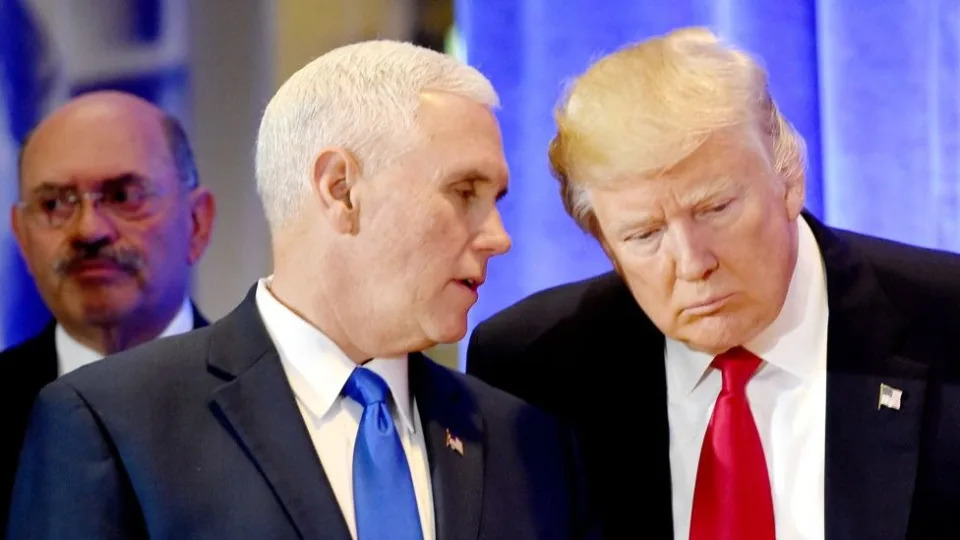
Weisselberg stands behind Mr Pence and the former president at Trump Tower in New York in 2017
The former president’s treatment of Mike Pence is another example of how he places loyalty above other values. Mr Trump reportedly told the former vice-president not to “wimp out” and to not certify the results of the 2020 election, according to an excerpt from Mr Pence’s book. He recounts Mr Trump asking him: “If it gives you the power, why would you oppose it?”
Prof Schweitzer says both Mr Trump and Weisselberg were shaped by the era of ’80s New York and the mindset that greed is good. “Greed was celebrated and endorsed in a way that it is not today, we had different mindsets about this wild west of capitalism,” he says. “Things that we are saying are illegal were common practice. These men really enjoyed the privileges that came with being a very powerful, wealthy person in the 1980s who were not constrained by the rules that bound the rest of us.”
Mr Epner agrees. “The New York real estate business has been a dirty business for not decades, but centuries. And he [Mr Trump] was part and parcel of the dirty part of the NY real estate business and then he shone the biggest spotlight in the world on himself [with the presidency].”
On the final day of the trial, Assistant Manhattan District Attorney Joshua Steinglass said during closing statements that the evidence had shown that Mr Trump knew exactly what was going on. He reminded the jury of that evidence, including a memo the former president initialled authorising a pay cut for another executive for the exact amount of his perk, rent paid by the company.
“Mr Trump explicitly sanctioning tax fraud! That’s what this document shows,” Mr Steinglass said.
To many, it begged the question why the former president, who built his entire reputation and bravado off the back of his namesake company, wasn’t charged, too. The Manhattan District Attorney’s office says investigations into Mr Trump are ongoing.
Here’s why the House GOP made defunding the IRS its first priority
Ben Werschkul, Washington Correspondent – January 10, 2023
The House GOP’s first policy bill out of the gate didn’t address inflation or gas prices or immigration, but instead went after the Internal Revenue Service.
The bill was passed Monday evening on a straight party line vote of 221 to 210 to reverse much of the $80 billion in extra funding set aside for the agency by 2022’s Inflation Reduction Act.
While it has little chance of it being enacted anytime soon with Democrats in control of the Senate and President Biden promising a veto, the prominence of the issue shows just how much the IRS has become a heated target of Republicans. That’s despite experts saying the funds in question would go toward prosaic concerns like helping the agency chase down tax cheats and refresh its outdated technology.
The enhanced funding for the IRS is “part of the broad Biden administration strategy to tax and audit exponentially more Americans,” said Rep. Adrian Smith (R-NE) as debate got underway on Monday. He added that the bill would “stops autopilot funding for an out-of-control government agency that is perhaps most in need of reform.”
Speaker Kevin McCarthy then announced the final results of the vote once it had passed, noting that it had been a GOP promise.
Newly-elected Speaker of the House Kevin McCarthy finally won the gavel early on Saturday morning after a protracted fight. (Elizabeth Frantz/For The Washington Post via Getty Images)
‘Absolutely false’ viral claims
The claim from countless Republicans, from Speaker McCarthy on down, is that the influx of money will lead to a flood of 87,000 new IRS agents who will then turn and harass everyday Americans. Some critics of the agency go even further and claim these new agents will be armed.
The viral claims are “absolutely false,” Rettig wrote at the time, adding his agency “is often perceived as an easy target for mischaracterizations,” but he promised the new money will not lead to increased audit scrutiny on households making under $400,000.
The plan is instead for much of the money to go toward wealthy tax cheats. IRS estimates of the so-called “tax gap” — the difference between what taxes are owed to the government and what is actually paid — is hundreds of billions of dollars a year.
Much of the $80 billion will be focused on taking a bite out of the gap, focusing on wealthy tax payers. The investment is projected to pay for itself and then bring in over $100 billion in increased tax revenue over the coming decade.
By contrast, a new analysis from the Congressional Budget Office released Monday afternoon found that the net effect of the House GOP bill’s to defund the agency would increase the deficit by more than $114.3 billion over the coming decade if enacted.
With the new funding, the IRS could hire an estimated 86,852 new employees, according to a May 2021 report by the Department of Treasury, but many of those would not be agents. Many would work in other areas like information technology.
And nearly all new agents would be unarmed. Very few IRS agents carry weapons as part of their responsibilities. Some of the hires may also be used to replace thousands of existing IRS workers expected to retire in the coming years.
Nonetheless, claims of a flood of new agents have persisted, repeated by figures ranging from the GOP chairwoman to Elon Musk.
The chronically understaffed IRS has until recently been a bipartisan concern, but the increased funding became an issue during the 2022 campaign and played into conservative suspicions of the agency that have been growing for years.
Conservatives have long claimed the IRS targeted the tax-exempt status of political groups during the Obama administration, while a 2017 Treasury report on the controversy found that groups on both sides of the political spectrum had faced scrutiny.
‘The average American cares about defunding 87,000 IRS agents’
This week’s vote comes just as Danny Werfel is set to return this year as IRS Commissioner, leading the agency’s revamp.
The newly elected chairman of the House Ways and Means Committee, Jason Smith (R-MO), said in a statement Monday that Werfel “should plan to spend a lot of time before our committee answering questions about the leaking of sensitive taxpayer information and an agency with a history of targeting conservative Americans.”
In a recent Fox News appearance, Rep. Dan Crenshaw (R-TX) additionally argued that “the average American cares about defunding 87,000 IRS agents.”
An Internal Revenue Service building in Washington, DC. (KAREN BLEIER/AFP via Getty Images)
On the other side, Democrats repeatedly attacked Republicans for holding a vote on the bill and also for making it their first priority, implying they will use it against Republicans in the coming years.
In a statement calling the move a giveaway to rich tax cheats, Vice President Kamala Harris said House Republicans were trying to undo recent progress under Democrats and hoping to allow “millionaires, billionaires, and corporations to cheat the system.”
This post has been updated.
Ben Werschkul is a Washington correspondent for Yahoo Finance.
‘What madness looks like’: Russia intensifies Bakhmut attack
Andrew Meldrum – January 10, 2023
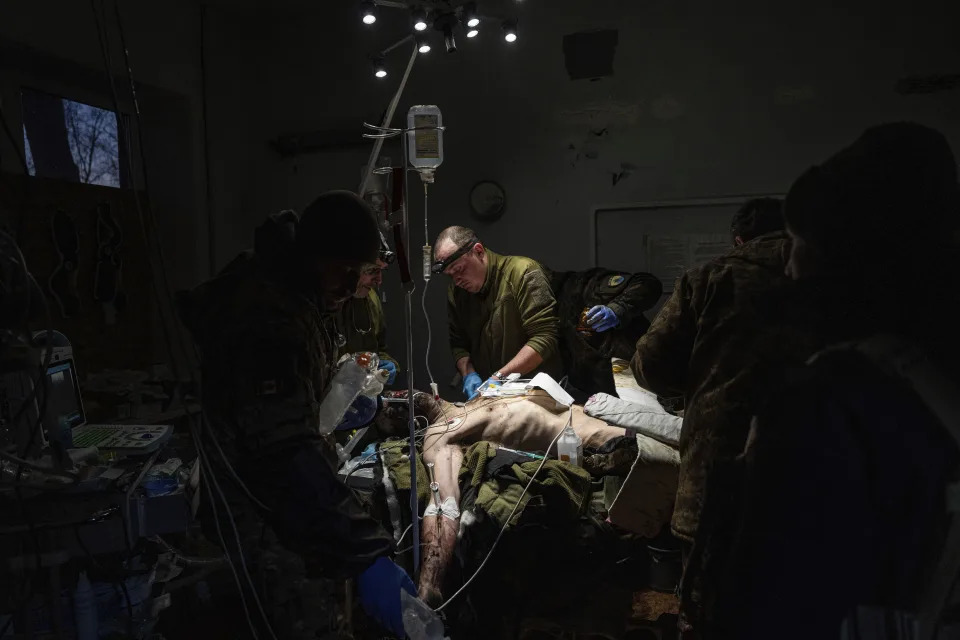
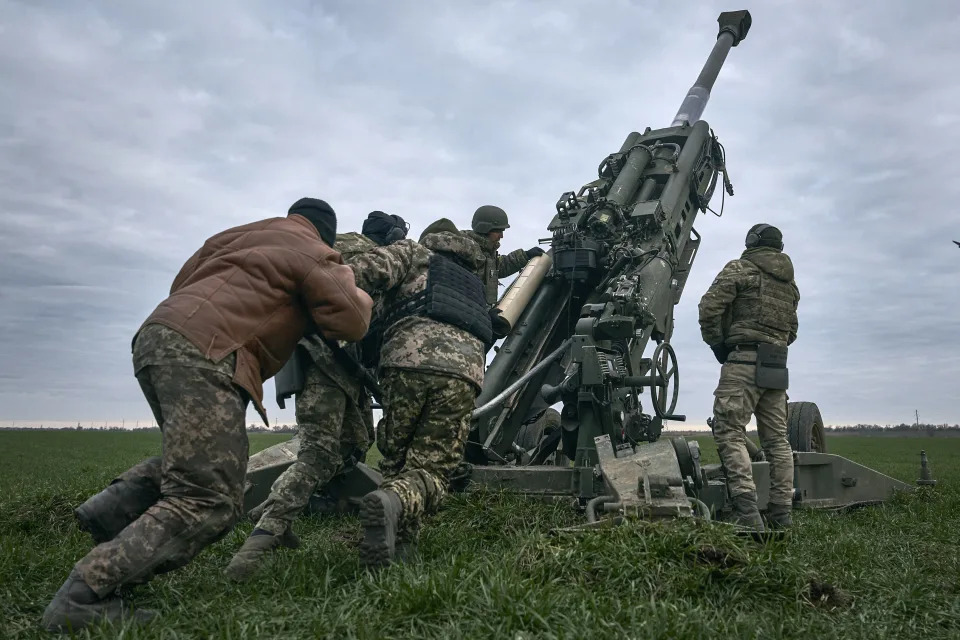
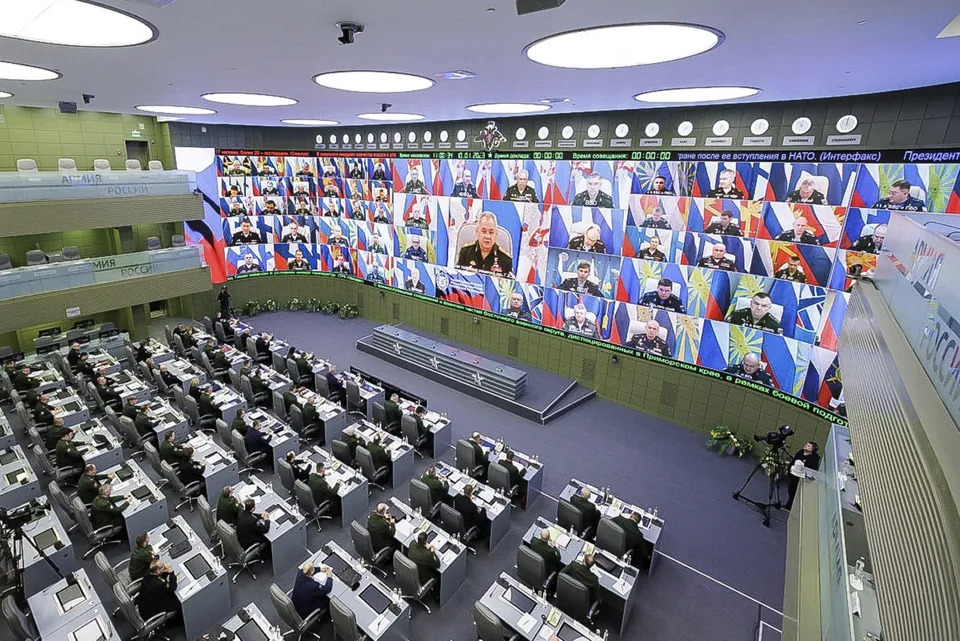
Ukrainian military medics carry an injured Ukrainian serviceman evacuated from the battlefield into a hospital in Donetsk region, Ukraine, Monday, Jan. 9, 2023. The serviceman did not survive. (AP Photo/Evgeniy Maloletka)Ukrainian military doctors treat their injured comrade who was evacuated from the battlefield at the hospital in Donetsk region, Ukraine, Monday, Jan. 9, 2023. The serviceman did not survive. (AP Photo/Evgeniy Maloletka)A Ukrainian serviceman carries his injured comrade evacuated from the battlefield into a hospital in Donetsk region, Ukraine, Monday, Jan. 9, 2023. (AP Photo/Evgeniy Maloletka)Ukrainian military medics carry an injured Ukrainian serviceman evacuated from the battlefield into a hospital in Donetsk region, Ukraine, Monday, Jan. 9, 2023. A serviceman did not survive. (AP Photo/Evgeniy Maloletka)Ukrainian soldiers prepare a U.S.-supplied M777 howitzer to fire at Russian positions in Kherson region, Ukraine, Jan. 9, 2023. (AP Photo/Libkos)In this handout photo released by Russian Defense Ministry Press Service on Tuesday, Jan. 10, 2023, Russian Defense Minister Sergei Shoigu is seen on the screen as he speaks during a meeting with Russian high level officers in Moscow, Russia. (Russian Defense Ministry Press Service via AP)
KYIV, Ukraine (AP) — Russian forces are escalating their onslaught against Ukrainian positions around the wrecked city of Bakhmut, Ukrainian officials said, bringing new levels of death and devastation in the grinding, monthslong battle for control of eastern Ukraine that is part of Moscow’s wider war.
“Everything is completely destroyed. There is almost no life left,” Ukrainian President Volodymyr Zelenskyy said late Monday of the scene around Bakhmut and the nearby Donetsk province city of Soledar, known for salt mining and processing.
“The whole land near Soledar is covered with the corpses of the occupiers and scars from the strikes,” Zelenskyy said. “This is what madness looks like.”
Late Tuesday, the head of the Wagner Group, a Russian private military contractor, Dmitry Prigozhin, claimed in audio reports posted on his Russian social media platform that his forces had seized control of Soledar, with battles continuing in a “cauldron” in the city’s center. Ukrainian officials did not comment on the claim, and The Associated Press was unable to verify it.
The U.K. Defense Ministry said earlier that Russian troops alongside soldiers from the Wagner Group had advanced in Soledar and “are likely in control of most of the settlement.”
The ministry said that taking Soledar, 10 kilometers (6 miles) north of Bakhmut, was likely Moscow’s immediate military objective and part of a strategy to encircle Bakhmut. But it added that “Ukrainian forces maintain stable defensive lines in depth and control over supply routes” in the area.
A Western official, speaking on condition of anonymity, said the Wagner Group “has moved from being a niche sideshow of Russia’s war to a major component of the conflict,” adding that its forces now make up as much as a quarter of Russian combatants.
The Kremlin, whose invasion of its neighbor 10 1/2 months ago has suffered numerous reversals, is hungry for victories. Russia illegally annexed Donetsk and three other Ukrainian provinces in September, but its troops have struggled to advance.
After Ukrainian forces recaptured the southern city of Kherson in November, the battle heated up around Bakhmut.
Ukraine’s deputy defense minister, Hanna Malyar, said Russia has thrown “a large number of storm groups” into the fight for the city. “The enemy is advancing literally on the bodies of their own soldiers and is massively using artillery, rocket launchers and mortars, hitting their own troops,” she said.
Pavlo Kyrylenko, the Donetsk region’s Kyiv-appointed governor, on Tuesday described the Russian attacks on Soledar and Bakhmut as relentless.
“The Russian army is reducing Ukrainian cities to rubble using all kinds of weapons in their scorched-earth tactics,” Kyrylenko said in televised remarks. “Russia is waging a war without rules, resulting in civilian deaths and suffering.”
Wounded soldiers arrive around the clock for emergency treatment at a Ukrainian medical stabilization center near the front line around Bakhmut. Medics fought for 30 minutes Monday to save a soldier, but his injuries were too severe.
Another soldier suffered a head injury after a fragment pierced his helmet. Medics quickly stabilized him enough to transfer him to a military hospital.
“We fight to the end to save a life,” Kostyantyn Vasylkevich, a surgeon and the center’s coordinator, told The Associated Press. “Of course, it hurts when it is not possible to save them.”
The Moscow-backed leader of the occupied areas of Donetsk, Denis Pushilin, told Russian state TV control over the city would create “good prospects” for taking over Bakhmut, as well as Siversk, a town further north where Ukrainian fortifications “are also quite serious.”
An exceptional feature of the fighting near Bakhmut is that some of it has taken place around entrances to disused salt mine tunnels which run for some 200 kilometers (120 miles), the British intelligence report noted.
“Both sides are likely concerned that (the tunnels) could be used for infiltration behind their lines,” it said.
In Russia, two signs emerged Tuesday that officials were grappling with the military shortcomings revealed during the conflict in Ukraine.
Russian Defense Minister Shoigu, whose performance has been fiercely criticized in some Russian circles but who has retained Russian President Vladimir Putin’s confidence, said Tuesday that his military would use its experience in Ukraine to improve combat training.
Military communications and control systems will be improved using artificial intelligence, Shoigu said, and troops will be given better tactical gear and equipment.
The second indication of trouble involves Russia’s production of weapons and other supplies its military needs for the fight in Ukraine. The deputy head of Russia’s Security Council, Dmitry Medvedev, warned that officials who failed to meet deadlines for such items could face criminal charges.
Putin appointed Medvedev last month to head a new commission tasked with trying to solve the military’s supply problems. Numerous reports have suggested Russia is running low on certain weapons and was sending some troops into battle with insufficient equipment and clothing.
Part of the Kremlin’s challenge is keeping up with the weapons and supplies that Western allies are providing to Ukraine.
The Patriot surface-to-air guided missile defense system is one of the weapons Ukraine is about to receive, and the Pentagon announced Tuesday that about 100 Ukrainian troops will head to Oklahoma’s Fort Sill as soon as next week to begin training on it. That will help Ukraine protect itself against Russian missile attacks. The United States pledged one Patriot battery last month, and Germany has pledged an additional system.
Germany’s foreign minister, Annalena Baerbock, announced Tuesday while visiting Ukraine’s second largest city, Kharkiv, that her country would also provide 40 million euros ($43 million) to help with demining, energy infrastructure and internet connections, German news agency dpa reported.
Several front-line cities in eastern Ukraine’s Donetsk and Luhansk provinces have witnessed intense fighting in recent months.
Together, the provinces make up the Donbas, a broad industrial region bordering Russia that Putin identified as a focus from the war’s outset and where Moscow-backed separatists have fought since 2014.
Russia’s grinding eastern offensive captured almost all of Luhansk during the summer. Donetsk escaped the same fate, and the Russian military subsequently poured manpower and resources around Bakhmut.
Taking Bakhmut would disrupt Ukraine’s supply lines and open a route for Russian forces to press toward Kramatorsk and Sloviansk, key Ukrainian strongholds in Donetsk.
Like Mariupol and other contested cities, Bakhmut endured a long siege without water and power even before Moscow launched massive strikes to take out public utilities across Ukraine.
Kyrylenko, the Donetsk region’s governor, estimated more than two months ago that 90% of Bakhmut’s prewar population of over 70,000 had fled since Moscow focused on seizing the entire Donbas.
Ukraine’s presidential office said at least four civilians were killed and another 30 wounded in Russian shelling between Monday and Tuesday.
Vitaliy Kim, the governor of the southern Mykolaiv region, said Russian forces shelled the port of Ochakiv and the area around it late Monday and again early Tuesday. He said 15 people, including a 2-year-old child, were wounded.
Grand jury in Georgia delivers report on Trump, charges could come in next few months
Michael Isikoff, Chief Investigative Correspondent – January 9, 2023
Former President Donald Trump at a rally in Commerce, Ga., in March of last year. (Megan Varner/Getty Images)
A Georgia special grand jury investigating Donald Trump’s efforts to overturn the results of the 2020 election in that state has delivered its report to local judges, paving the way for Fulton County District Attorney Fani Willis to potentially bring criminal charges against the former president and some of his allies in the next few months.
The special grand jury completed its work late last year after taking testimony from dozens of witnesses — including former White House chief of staff Mark Meadows and Sen. Lindsey Graham, R-S.C. — who never testified before the House committee investigating Jan. 6. But Willis never subpoenaed Trump himself to testify, apparently concluding that it would needlessly bog down her investigation with legal motions and other court challenges from the former president.
Willis herself is expected to get a copy of the report sometime on Monday. The Fulton County judge overseeing the case, Robert McBurney, filed an order Monday morning with the court declaring that the special grand jury — which had been convened at Willis’s request and began taking testimony last June — had completed its work.
Fulton County Superior Court Judge Robert McBurney instructs potential jurors during proceedings in May of last year. (Ben Gray/AP)
“It is the ORDER of this Court that the special purpose grand jury now stands DISSOLVED,” McBurney wrote in his order. “The Court thanks the grand jurors for their dedication, professionalism, and significant commitment of time and attention to this important matter. It was no small sacrifice to serve.”
McBurney also scheduled a hearing for Jan. 24, to determine if portions of the report or the entire document can be made public. Under Georgia law, special grand juries such as the one Willis convened can conduct investigations and make recommendations about whether to bring criminal charges. But for such charges to be formally filed, Willis will have to present the evidence to a regular grand jury — a process that could take several more months.
“This is a major milestone,” Norm Eisen, a Brookings Institution fellow who served as an adviser to the House Judiciary Committee during the first impeachment of Trump, told Yahoo News. “I think it’s safe to say that charges are likely — but not certain — against Trump and a single-digit number of co-conspirators.”
At a minimum, Willis’s probe appears to be on a faster track than a broader U.S. Department of Justice investigation into Trump’s conduct relating to the 2020 presidential election and the events of Jan. 6. That investigation is now being overseen by a special counsel, Jack Smith, appointed by Attorney General Merrick Garland. (Smith, who had been serving as an international war crimes prosecutor in the Hague, only recently returned to the United States following his recuperation from a bicycle accident.)
Fulton County District Attorney Fani Willis, right, talks with a member of her team during proceedings to seat a special purpose grand jury in Fulton County, Ga., last May. (Ben Gray/AP)
Willis first announced her probe in early 2021, after the disclosure of then-President Trump’s Jan. 2, 2021, phone call to Georgia Secretary of State Brad Raffensperger urging him to “find” enough votes to flip the state’s electoral votes from Joe Biden to Trump. Since then, she has expanded the probe to include related schemes in the state, including the appointment of so-called fake electors pledged to Trump and who were convened by Georgia Republican Party Chairman David Shafer at the state capital on Dec. 14, 2020.
Willis has strongly hinted that she was examining whether to use Georgia’s broad racketeering law to bring conspiracy charges against Trump and his allies. Like many other details in the special grand jury’s still secret report, it is not clear whether the grand jurors themselves recommended that approach.
But Eisen said it is not a surprise that Willis chose not to call Trump before the special grand jury. “We all know that Trump would never have cooperated,” he said. “So why bother?”
Kim Jong-un’s midlife crisis: ‘He’s crying after drinking a lot’
Nicola Smith – January 8, 2023
In heroic mode, Kim Jong-un rides a white horse to climb Mount Paektu near the border with China – KCNA via KNS
A distinct puncture hole on a fleshy right forearm, seen just inside the sleeve of a boxy Mao suit. This tiny mark, when first spotted on Kim Jong-un in May 2020, caused an instant reaction among observers of the North Korean regime. Was it the trace of an IV drip? A giveaway of surgery? At the very least, it was an unusual sign of vulnerability in a man who rules his nation with a suffocating grasp.
The needle mark was seen on footage shortly after Kim had been out of public view the previous month. Rumours had circulated that he was either dead or in a vegetative state. When he was finally seen, touring a fertiliser factory, foreign medical observers concluded the wound could be related to a cardiovascular procedure, possibly for a stent placement.
The truth never emerged. So furtive is Kim about his health that on rare trips abroad he travels with his own toilets, to prevent foreign intelligence services scouring his excretions for clues. But the dramatic weight loss that followed his 2020 health scare, possibly due to bariatric surgery, is proof that even dictators must endure the trials of middle age.
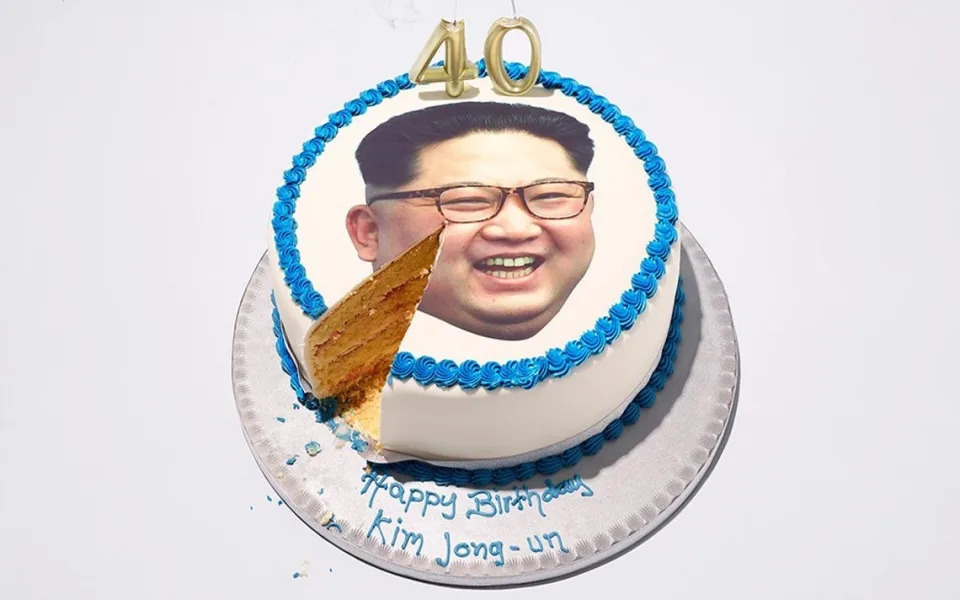
This month, according to our best guesses, Kim turns 40. It’s indicative of how little the outside world knows about him that conflicting sources will put him at 39 or even 38. Either way, the approach of his fifth decade brings new anxieties.
Kim Jong-un turns 40 – Benjamin Swanson
‘He probably feels more mortal now than he did three years ago, and he had Covid earlier this year apparently as well,’ says Peter Ward, a North Korea expert and post-doctoral researcher at Seoul’s Kookmin University.
The regime itself appears to have acknowledged Kim’s mortality, quietly creating the unprecedented role of ‘first secretary’ – a de facto deputy – in the ruling party hierarchy. ‘It seems to be because they are concerned about managing another illness,’ says Ward.
Since 2011, Kim has secured his power base, brutally putting down any threat to his rule. But the impact of a global financial crisis and sanctions on the North Korean economy – along with climate change wreaking havoc on farming – could present the leader with his toughest decade yet, thinks Ward.
Adding to the pressure on Kim will be the battle to block the influx and spread of information that could destabilise his strictly curated persona. To North Koreans, Kim is sold as a benevolent provider and semi-divine figure who inspires devotion and fear.https://www.youtube.com/embed/iKM8C829oN8?enablejsapi=1&modestbranding=1&origin=http://www.telegraph.co.uk&rel=0
To the rest of the world, he is almost a figure of ridicule. Last March, when he appeared in a Top Gun-style propaganda movie, clad in a shiny leather jacket and aviator shades while walking past a monster missile – all in dramatic slow motion – he was mocked by the West.
Yet the threat he poses globally is no joke. One muggy Pyongyang morning in August 2017, Lindsey Miller was woken at 6am by a deep rumbling. Her body shook as she ran out to the garden to look into the sky. ‘It sounded like an aeroplane going overhead but it didn’t fade away,’ she recalls now.
The author of North Korea: Like Nowhere Else, Miller lived in Pyongyang from 2017 to 2019 with her diplomat husband. She is one of the few Westerners to have experienced the roar of a North Korean ballistic missile test as a Hwasong-12 took off from the capital’s airport.
City residents carried on normally, Miller recalls. ‘The thing that made me more nervous was the response internationally. I was scared,’ she says. ‘It felt like a very real sense of danger.’ Diplomats were told to pack a bag in case of an emergency exit. ‘There were North Koreans who said how stressed they felt. They were worried about the potential for real war breaking out,’ she adds.
Kim seems set on raising the stakes. Since January 2022, he has test-launched an unprecedented volley of ballistic and cruise missiles, including a purported hypersonic weapon and his largest missile, the Hwasong-17, designed to carry a nuclear warhead more than 9,300 miles, within reach of the US mainland.
A satellite image taken over Wonsan in 2020 – Reuters
There had been a respite from aggression in 2018, during talks between Kim and then-US President Donald Trump. But the cycle of intense military escalation has since resumed; intelligence officials now warn Kim is gearing up for a seventh nuclear test, possibly a tactical weapon, and further confrontation with Seoul, Washington and the West.
So, what could Kim Jong-un be capable of?
In Asia, the significance of turning 40 is an expectation that a person ‘does not waver in their judgements’, explains Chun In-bum, a former lieutenant general in the South Korean army. ‘Kim Jong-un’s legacy is a Maoist, Stalinist legacy,’ says Chun. ‘So if he is 40, he is probably going to think that, “My path is the right path”… He is going to be more convinced of who he is and he will be very hard line.’
A tendency towards ruthless determination was already evident in Kim as a child. ‘He had such an abnormal childhood and was raised in such a dysfunctional family, there is really no other way that he could have turned out,’ says North Korea expert Anna Fifield. ‘From a very early age he was treated like a princeling in a way that not even the British Royal family would be.’
Fifield’s 2019 biography, The Great Successor, pieces together his life story. As a child Kim knew he would be handed the keys to the kingdom, after his dictator father Kim Jong-il identified him as more suitable for iron-fisted rule than his older brothers.
The stunning vistas along the eastern coastal resort of Wonsan provided the backdrop for Kim’s early years, which he spent sequestered in opulent villas with high iron gates. The vast property still plays a special role in his playboy lifestyle.
Kim’s decadence may be concealed from his hungry subjects, but high-resolution satellite imagery allows the world to view his expanding property empire. Recent pictures of the Wonsan enclave have revealed four cruise ships and a marina, with 10 villas dotting a 530m-long white sandy beach and manicured gardens. One boat is 80m in length and is said to boast dual twisting water slides.
He married Ri Sol-ju in 2008, and is thought to have three children. The Kim family enjoys as many as 30 luxury villas, and several private islands, according to Bruce Songhak Chung of South Korea’s Kyungpook National University. And in September, new verified images showed the expansion of ornate buildings at Kim’s lakeside mansion in South Pyongan province.
Kim Jong-un and his daughter pose in front of the Hwasong-17 ‘monster missile’ – KCNA/Reuters
But now Kim faces the challenge to all midlifers: how to mitigate the threat he poses to himself. Overweight, a heavy smoker (of local brand 7.27 cigarettes) and drinker (he prefers fine spirits and expensive French wines), he frequently ignores the advice of his doctors and wife to exercise and cut back on indulgences. His father died at the age of 69. Kim’s long absences from the public eye suggest he is dealing with an array of serious health problems.
‘I heard he is crying after drinking a lot. He is very lonely and under pressure,’ says Dr Choi Jinwook, a Seoul-based North Korea academic.
In November, Kim unexpectedly pushed his ‘beloved daughter’ Kim Ju-ae into the spotlight. In her first introduction to the world, Kim was seen gently holding her hand in choreographed photographs as they inspected a new intercontinental ballistic missile. Analysts were left guessing about his message. Was the girl in the white puffy jacket and red shoes his heir? Or simply a prop to humanise him? Ju-ae, who was born in 2012, would be too young to take over in the event of his sudden death.
There is wide consensus among observers that the role would temporarily fall to his ambitious younger sister, Kim Yo-jong, who has often been spotted at his side, carrying his files or even his ashtray. ‘Family interests come first,’ says Andrei Lankov, a professor at Kookmin University in Seoul, and an authority on North Korea.
There are no reliable estimates of Kim’s personal fortune – in 2013, South Korean media suggested it could be $5 billion – but his personal assets grow even as dangerous levels of hunger rise in the nation of 26 million.
Last year, he warned citizens to brace for a crisis similar to the 1990s famine, which is believed to have killed up to 3.5 million people. In an interview with me last year, Professor Hazel Smith of the Centre for Korea Studies at London’s School of Oriental and African Studies confirmed that food insecurity is now at a similar level. ‘The conditions that we had in the famine years that precipitated malnutrition are in place today,’ she said. ‘There is starvation in North Korea right now.’
Kim Jong-un watching a Hwasong-12 missile launch
The crisis has been building for years thanks to the Kim family’s mismanagement of the agriculture sector and a centralised system that focuses heavily on providing food for the military and political elites, at the cost of the general population.
In 2019 and 2020, a string of typhoons hammered harvests and sent the cost of maize and rice soaring. ‘There is obviously climate change and long run environmental impacts,’ says Ward. ‘The point is their inability to handle them and the fragility of their supply system is not an environmental issue per se.’
Shortages grew in 2021 even as the pandemic forced the UN’s World Food Programme to suspend operations in the country. It warned that another poor harvest meant the North Korean population, already 40 per cent undernourished, would be short of about 860,000 tonnes of food that year.
Add in the impact of global sanctions and plunging trade with China due to border closures, and by June 2022, the South’s government-backed Korea Development Institute was warning the isolated North could fall into a ‘famine in silence’.
Naturally, Kim has never gone hungry. He was shielded from the 1990s famine as a child in his Wonsan paradise, with huge playrooms filled with toys and kitchens full of pastries and tropical fruits. Yet Fifield’s biography quotes Kenji Fujimoto, a Japanese sushi chef who spent years serving the Kims, as saying that a precocious Kim endured a solitary childhood, cut off without playmates.
Aged 12, he turned up with a ‘pudding-bowl haircut’ under the alias Pak-un at a $20,000-a-year international school in Bern, Switzerland. His maternal aunt and uncle Ko Yong Suk and Ri Gang cared for him and his older brother Jong-chol, later defecting to run a dry-cleaning business outside New York. ‘We lived in a normal house and acted like a normal family,’ Ko told Fifield. ‘I made snacks for the kids. They ate cake and played with Legos.’
Kim, though, was short-tempered, stubborn and intolerant. Classmates from the school recalled a loner who displayed frustration at his academic weaknesses. ‘He kicked us in the shins and even spat at us,’ recounts one in the biography. Others remembered his aggressiveness and trash talk on the basketball court. But his Portuguese friend João Micaelo described him as quiet, decisive and ambitious.
In 1998, Kim’s privileged European bubble imploded after his mother was diagnosed with advanced breast cancer; he returned home to face his destiny, taking on his father’s mantle after his death. His youth and Western education raised hopes that he might be more inclined towards reform, but those expectations quickly fizzled.
‘He realised if he was just treated normally, he wouldn’t be anyone,’ says Fifield. ‘He needed to keep this system completely intact, or his family would lose all of its power and status.’
Kim Jong-un’s 11 years in power have been defined by inhumanity and a determination to establish his reclusive regime as a nuclear state. The glimpse of Kim at the 2018 Singapore Summit, greeting Donald Trump with a wide smile, was all part of an act, says Fifield. ‘The real Kim Jong-un is the one that lives in Pyongyang and is Machiavellian,’ she says. ‘He is trying to strike fear into the heart of the populace and the top officials of the regime, to make sure that they don’t think about crossing him but also to generate the other half of the Machiavellian equation – which is love.
‘He completely played Donald Trump like a fiddle… all of it was designed to bolster his legitimacy at home and give him that brag book of photos where he could show people of North Korea that he is respected and treated as an equal by all these other leaders.’
Meeting with then US President Donald Trump in June 2019 – AFP
His wife Ri Sol-ju – described by Fifield as the ‘Kate Middleton’ of North Korea in the sense that she is an aspirational yet approachable figure – is said to have tried to modernise the dynasty. She was even seen holding hands with the South Korean First Lady at a summit in 2018. But Kim operates with a chilling cruelty.
Nine years ago he reportedly ordered the execution of his influential uncle and mentor Jang Song-thaek, accusing him of treason. Unconfirmed reports suggest Jang was mown down by anti-aircraft guns, and his body incinerated with flamethrowers. The facts were hazy, but the message was clear. It was reinforced in 2017 by his alleged decision to murder his half-brother Kim Jong-nam at Kuala Lumpur airport using a nerve agent.
Lankov describes Kim as a sometimes capricious, but rational ‘third-generation CEO’; a man prepared to be brutal internally, while also building a nuclear weapons deterrent in order to protect himself and his family from foreign invasion. ‘His goal is very simple – to die a natural death in his palace, decades later. He wants to stay in power. He understands… if he loses power, very soon he will probably lose his life and everyone who he loves,’ Lankov says. ‘He is protecting his life, not lifestyle.’
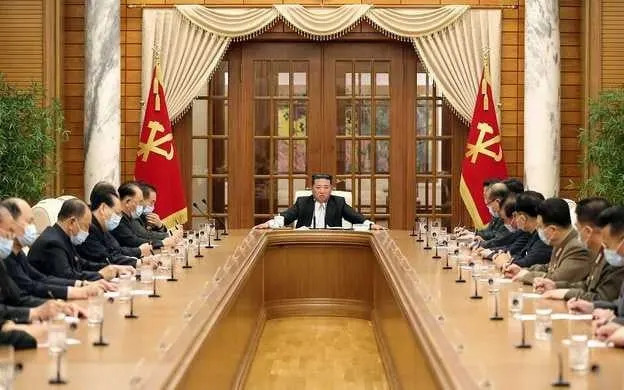
Heading a meeting of the Workers’ Party of Korea last May
Having neutralised the North Korean elites, whose prosperity is entwined with his fate, Kim tried to prevent a popular uprising by enforcing ‘information isolation’. Jihyun Park, 54, a defector and human rights activist who now lives in Manchester, tells me that as a child growing up under Kim Jong-il’s reign, she had no concept of how desperate the North Korean situation was. At school they were ‘brainwashed’ and ‘we believed everything we were told’.
Back then, in the pre-internet era, indoctrination was easier. Kim, while established as royal stock, has a more fragile cult of personality than his father and grandfather, Kim Il-sung, the nation’s founder. The younger Kim’s propaganda is less impressive, reduced to outlandish tales of learning to drive aged three, or a purported ability to control the weather. The first known mural depicting Kim’s exploits – digging at a greenhouse complex – has only recently appeared. It pales in comparison to the resplendent statues of his father and grandfather.
Hanna Song, from the Database Center for North Korean Human Rights in Seoul, said Kim’s youthful interest in technology is also a double-edged sword. He has to keep the younger, tech-savvy generation under control, through draconian laws and punishments for ‘anti-socialist behaviour’. In 2021, he unleashed a crackdown on ‘words, acts, hairstyle and attire of young people’ and a fresh ban on unsanctioned videos, broadcasts and speaking in a ‘South Korean’ style. Radio possession risks years in prison, and access to the open internet is blocked, allowing only a heavily censored state intranet.
Song said defectors’ motivations have shifted, from basic survival in the early 2000s to a new disillusionment with the leadership. ‘We’ve heard about North Koreans who are similar ages to Kim Jong-un who just couldn’t believe they had to serve a leader with his little experience,’ she says.
There could be one more astounding plot twist – and it’s a development that will only add to Kim’s mounting anxieties. In 2017, after his father Kim Jong-nam was poisoned in Malaysia, a young man called Kim Han-sol was spirited out of Macau, via Taipei, the capital of Taiwan, to an unknown destination. He is Kim Jong-un’s nephew.
Now 27, is he the other Kim being groomed in the wings for leadership at the earliest opportunity?
‘He seems to be somewhere in Europe being protected and taken care of, which I think is a great thing to do,’ former lieutenant general Chun tells me, ‘because we need him for some eventualities that might occur in North Korea. I am glad somebody is looking that far ahead.’
I’m homeless in California. And I have an easy, cost-free solution to homelessness | Opinion
Lydia Blumberg – January 8, 2023
Renée C. Byer/rbyer@sacbee.com
I and my fellow residents of Wood Street Commons, an unhoused community in Oakland, believe politicians pushing sweeps of homeless encampments are only making things worse.
One thing that would dramatically improve the lives of unhoused people in California could be done today, wouldn’t cost taxpayers any money and would require no effort by politicians or city workers. It’s as simple as a governor or mayor uttering three words: Stop sweeps now.
Each time a homeless camp is dismantled, people’s lives are destroyed. All the effort we put into creating a home — we do not actually consider ourselves homeless because our camp is our home — is wiped away. Our worldly possessions, including identification, medical records, family heirlooms, clothing, electronics, furniture, instruments, bedding, tents, tools and other items that we use to earn income, are literally thrown into garbage trucks. Our handmade shelters are smashed by giant machines as we watch.
Opinion
How is this acceptable? How can the people who order and carry out sweeps live with themselves?
Each time a homeless camp is dismantled, its residents face more obstacles to overcoming what put them on the street in the first place. We create camps as a way to create stability, cultivate community, and accrue needed resources to pull ourselves up by our own bootstraps. Destroying camps pushes us down and forces us to start over, with nowhere to go and often with nothing but the clothes on our backs.
Any politician who pledges to end homelessness in one breath and then pledges to rid the streets of encampments in the next — looking at you, Gov. Gavin Newsom — is completely out of his mind.
The billions spent “helping” the homeless are profoundly undermined by the daily aggression of sweeps, which many unhoused people experience several times a year. Take it from us, the real experts on this issue: Sweeps make homelessness more entrenched.
Sweeps are also an enormous waste of taxpayer money. A 2021 sweep in Los Angeles’ Echo Park, where which roughly 200 people were removed in a violent show of police force, cost an estimated $2 million. That’s nearly $10,000 per person! These are people whose lives were destroyed at an expense that could have housed them for months.
Yet city leaders declared the Echo Park sweep a rousing success, claiming nearly everyone from the camp was placed in temporary housing. But UCLA studies conducted a year later found that only a dozen or so of them remained in temporary housing. Of the rest, four were placed in permanent housing; seven died; and most returned to the streets.
Large cities routinely sweep one or more camps per day, meaning this cruelty is repeated thousands of times each year across the state and country. Sweeps don’t get rid of camps; they just move them around, causing chaos and wasting millions in the process.
A growing body of research illustrates why we should not only keep camps intact; we should actually encourage and celebrate them. That may sound crazy to many readers, but it couldn’t be more logical.
In a review of research on the topic, the U.S. Department of Housing and Urban Development noted that emergency shelters are unavailable, inaccessible or inhospitable to many unhoused people.
“Encampments may be the best alternative among a limited set of options,” the HUD report said.
It’s important to consider why people choose camps over other alternatives. Most temporary shelter facilities, and many of the permanent housing options designed to house the unhoused, come with a long list of rules that make them a little too much like prison. Among the most common rules are those limiting guests, spouses, pets, cooking, decorations and more possessions than can fit in a suitcase.
Tiny homes and sheds — the latest trends — are often placed like barracks on asphalt lots, surrounded by barbed wire and staffed by rude security guards. Would you give up your freedom to move to one of these places?
Humans need more than food, water and shelter. Autonomy and a sense of belonging are equally important to survival — and are actually the keys to recovery for people who have had a hard time in life. The impersonal facilities that we’re asked to move into are not designed with this in mind.
But autonomy and belonging are the essence of what camps are about. We camp together because it is essential to our physical and mental survival.
Our community on Wood Street in Oakland has recently been subjected to devastating sweeps. Caltrans has cleared an enormous section of the camp.
But the part that remains is stronger than ever. We cook for each other, distribute clothing and bedding, build our own tiny homes, play music, help each other heal, and host cultural events that have been attended by hundreds of housed residents. We see ourselves as part of a movement redefining the identity of American cities for the better: an identity based on an ethos of interdependence rather than the cult of independence that defines the world of the housed.
The last bit of land that we occupy on Wood Street is slated for clearance on Monday. We’ve been trying to work with Oakland officials to find a place where we can set up a new community and begin to rebuild yet again, but they refuse to cooperate. The city loves to tell us where we can’t be but has yet to tell us where we can be.
We do not accept this, which is why we’re taking matters into our own hands. We recently rode our bikes to the Capitol in Sacramento to speak with lawmakers there, and we will continue to press the case at City Hall. We will not be denied the essential human right to exist and exert our free will.
This piece was authored by Lydia Blumberg and other residents of Wood Street Commons, a settlement of unconventionally housed residents in West Oakland founded on the idea of “homeless helping the homeless.”
Come to the ‘war cry party’: How social media helped drive mayhem in Brazil
Elizabeth Dwoskin – January 8, 2023
Supporters of former president Jair Bolsonaro clash with police during a protest outside the Planalto Palace in Brasilia on Sunday. (Eraldo Peres/AP)
In the weeks leading up to Sunday’s violent attacks on Brazil’s congress and other government buildings, the country’s social media channels surged with calls to attack gas stations, refineries and other infrastructure, as well as for people to come to a “war cry party in the capital,” according to Brazilian social media researchers.
Online influencers who deny the results of the country’s recent presidential election used a particular phrase to summon “patriots” to what they called a “Festa da Selma” – tweaking the word “selva,” a military term for war cry, by substituting an “m” for the “v” in hopes of avoiding detection from Brazilian authorities, who have wide latitude to arrest people for “anti-democratic” postings online. “Festa” is the Portuguese word for “party.”
Organizers on Telegram posted dates, times and routes for “Liberty Caravans” that would pick people up in at least six Brazilian states and ferry them to the party, according to posts viewed by The Washington Post. One post said, “Attention Patriots! We are organizing for a thousand buses. We need 2 million people in Brasilia.”
That online activism culminated in busloads of people landing in the capital Sunday, where they stormed and vandalized three major government buildings, reportedly setting fires and stealing weapons in the most significant assault on the country’s democratic institutions since the country’s 1964 military coup.
Brazilian analysts have long warned of the risk in Brazil of an incident akin to the Jan. 6, 2021, insurrection at the U.S. Capitol. In the months and weeks leading up to the country’s presidential election in October – in which leftist Luiz Inácio Lula da Silva defeated the right-wing incumbent, Jair Bolsonaro – social media channels were flooded with disinformation, along with calls in Portuguese to “Stop the Steal” and cries for a military coup should Bolsonaro lose the election.
On TikTok, researchers found that five out of eight of the top search results for the keyword “ballots” were for terms such as “rigged ballots” and “ballots being manipulated.” At the same time, Facebook and Instagram directed thousands of users who plugged in basic search terms about the election toward groups questioning the integrity of the vote. On Telegram, an organizing hub for Brazil’s far right, a viral video taken down by authorities called for the murder of the children of leftist Lula supporters.
In the days following the final election tally on Oct. 30, Bolsonaro supporters who rejected the results blocked major highways across the country. These blockades morphed into demonstrations in dozens of cities, where supporters camped out in front of military bases for weeks. Some held signs saying “Stolen Election” in English, a testament to the close ties between right-wing movements in both countries.
Though Lula’s inauguration last week took place largely without incident, calls for violence and destruction have accelerated online in recent weeks, said researcher Michele Prado, an independent analyst who studies digital movements and the Brazilian far right.
“For years now, our country has been going through a very strong process of radicalizing people to extremist views – principally online,” she said. “But in the last two weeks, I’ve seen ever-growing calls from people incentivizing extremism and calling for direct action to dismantle public infrastructure. Basically, people are saying we need to stop the country in its tracks and generate chaos.”
Posts demanding a coup, along with common pro-Bolsonaro hashtags claiming “election fraud,” and “stolen election,” have circulated on all social media services. The most violent rhetoric as well as the most direct organizing has taken place on the largely unmoderated messaging service Telegram.
Researchers in Brazil said Twitter in particular was a place to watch because it is heavily used by a circle of right-wing influencers – Bolsonaro allies who continue to promote election fraud narratives. Several influencers have had their accounts banned in Brazil and now reside in the United States. Bolsonaro himself was on vacation in Florida on Sunday.
Billionaire Elon Musk, who completed his acquisition of Twitter in late October, fired the company’s entire staff in Brazil except for a few salespeople, said a person familiar with the firings who spoke on the condition of anonymity to describe sensitive matters. Among those fired in early November included eight people, based in Sao Paulo, who moderated content on the platform to catch posts that broke its rules against incitement to violence and misinformation, the person said. The person said they were not aware of any teams actively moderating rule-breaking content on Twitter in Brazil.
Criticism specifically targeting Alexandre de Moraes, a judge at the Superior Electoral Court and the Supreme Federal Court who is despised by Bolsonaro supporters because he has blocked many prominent right-wing leaders from posting online, have also stepped up since the election, Prado and others said.
Footage circulating on social media from Sunday’s demonstration showed rioters pulling a chair from a government building, upon which they placed the seal of the Brazilian republic. One rioter shouted, “Look everyone, it’s Big Alexander’s chair!,” using a derogatory nickname for Moraes. Expletives followed, according to the video. It could not be confirmed if the chair had been taken from Moraes’s chambers.
Despite their seeming similarities, Brazilian researchers said, Bolsonaro supporters are careful not to draw too many comparisons to Jan. 6 in the United States because doing so could trigger arrest for inciting anti-democratic acts, a crime in Brazil. If Jan. 6 is referenced, as it was in a handful of posts this week, the utterances appear in code, said Viktor Chagas, a professor at Fluminense Federal University in Rio de Janeiro state who researches online, far-right movements.
Still, Chagas said, Sunday’s riot was “a clear attempt to emulate the invasion of the U.S. Capitol, as a reproduction of Trumpist movements and a symbolic signal of strength and transnational connections from the global far-right.”
Chagas noted that Jan. 9 is an important nationalist symbol in Brazil, marking the day the country’s first ruler, Emperor Dom Pedro I, declared that he would not return to Portugal, in what is popularly known as “I Will Stay” Day.
“It is as if Bolsonarists were equating Bolsonaro with D. Pedro I, and indicating that the former government will remain,” he said. Some posts have also referenced “I will stay day,” indicating that the demonstrations would probably continue through Monday, he added.
In a tweet on Sunday, Bolsonaro – a prolific social media user who has been relatively quiet since his election defeat – denounced the attacks: “Peaceful demonstrations, by law, are part of democracy,” he tweeted, hours after the assault began. “However, depredations and invasions of public buildings as occurred today, as well as those practiced by the left in 2013 and 2017, were outside of the law.”
Brazilian researchers said that among Bolsonaro supporters, a counternarrative had begun to circulate Sunday, blaming the Lula government and people from Lula’s party for infiltrating peaceful, democratic demonstrations to turn the country against supporters of Bolsonaro. The counternarrative also had echoes of the Jan. 6 insurrection, in which many Trump supporters blamed left-wing activists for the violence.
The mayhem Sunday was “a disaster,” said Paulo Figueiredo Filho, a presenter for the right-wing channel Jovem Pan who lives in Florida and has had his social media accounts canceled by Moraes. “It is Moraes’s wet dream.”
Column: Kevin McCarthy ‘won’ the House speakership. Now the country will pay the price
Mark Z. Barabak – January 6, 2023
Newly minted House Speaker Kevin McCarthy, seen with Georgia Rep. Marjorie Taylor Greene, made so many concessions to win the post he will spend his tenure living on a razor’s edge. (Kent Nishimura / Los Angeles Times)
For years, Kevin McCarthy wanted to be speaker of the House in the worst possible way, and that’s precisely what he accomplished by winning the leadership post after 15 humiliating rounds of voting and days of give-away-the-store negotiations.
McCarthy may have once dreamed of striding boldly forth to claim the mantle of a robust Republican majority.
Instead, with the GOP barely in control and the chamber in chaos, McCarthy crawled into the speakership early Saturday on his hands and knees.
He ceded so much to foes — effective veto power over must-pass legislation, greater say over committee assignments, allowing a sole dissident to trigger a vote on his ouster — that McCarthy will spend his shaky tenure, as long as it lasts, balanced on a razor’s edge. One nick and he’s gone.
Far more troubling, McCarthy’s cowardly concessions leave the country hostage for the next two years to an extreme fringe of far-right zealots, who threaten to turn the normal operation of government and such typically routine business — like raising the debt ceiling to avoid default and economic catastrophe — into a cliffhanging drama.
The deep humbling of McCarthy could be seen as cruel, a snub by fellow lawmakers whose power was made possible by the Bakersfield Republican’s years of hard work as grand strategist and campaigner in chief for the House GOP. But the drip-drip torture of prolonged balloting was so egregiously self-inflicted, so glaring in the making and so abundantly well-deserved that it is impossible to muster even the slightest bit of sympathy.
The fecklessness of McCarthy has been well chronicled, and a further accounting needn’t go on at length. One example stands out: The outrage he expressed at then-President Trump for instigating the Jan. 6 riot quickly melted not just into acceptance but utter capitulation, as McCarthy hastened to Mar-a-Lago to beg forgiveness for having, ever so briefly, dared hold the Oval Office tyrant to account.
There are marshmallows made of sterner stuff.
But McCarthy has long been guided by one thing, and one thing only: the acquisition of power (by whatever means necessary) and ascension to the leadership post that very nearly exceeded his grasp.
Policy has never been McCarthy’s forte. There is no landmark legislation that bears his thumbprint, no law that flowed from the wellspring of his intellect. Campaigns and elections have been his sole skill set and personal relations his great specialty: the backslapping, glad-handing hail-fellow bonhomie that made the nine-term congressman likable enough to fellow Republicans, but not someone they particularly respected.
Though there is nothing wrong with that — you can’t accomplish a great deal in politics without making friends and winning elections — there has never been much more than that. McCarthy has proven a man unworthy of trust, his spine bendable, his values pliable, his beliefs open to barter.
There are weather vanes with more firmly fixed positions.
As a lawmaker in Sacramento when moderate Republican Gov. Arnold Schwarzenegger was in charge, McCarthy fought to keep GOP extremists at bay. As a member of Congress, and major recruiter of Republican candidates, he embraced the GOP fringe, starting with the far-right “tea party” movement and continuing under the QAnon-embracing Trump.
McCarthy helped bring a fire-spitting breed of anti-government, anti-establishment radicals into the GOP tent, and then almost lost his end of the bargain when they turned against him.
The blandishments McCarthy might have offered to horse trade his way to the speakership — fancy titles, perks, a fundraising appearance — meant little to those Republican holdouts who would like nothing more than to burn Washington to the ground.
In the end, a willingness to neuter himself was the price McCarthy was forced, and proved sadly willing, to pay.
There is an epithet thrown at those in the GOP deemed less than 100% pure: Republican in name only. McCarthy, eagerly stepping into a straitjacket of his own design, has earned himself the dubious distinction of becoming speaker in name only.
His rudderless soul and ham-fisted miscalculation stand in notable contrast to his most recent predecessor, Nancy Pelosi.
While the San Francisco Democrat never ruled her caucus as the googly-eyed liberal of popular parody, she was guided by a bone-deep set of left-leaning convictions that helped yield a series of triumphs, including passage of Obamacare after many in her party had given up. Not least, a firm set of guiding principles also helped marshal the unruly cadre on her side of the aisle.
All McCarthy managed to prove in his clumsy reach for power was a bottomless capacity to get pushed around and capitulate to extortion. He won with scarcely a vote to spare.
At bottom, McCarthy had to struggle to claim the prize he long sought because he was too transparently ambitious and too blatantly transactional — which is saying something in an institution fueled by ambition and where mutual backscratching has been elevated to a high art form.
“Kevin McCarthy is not a conservative,” Virginia Rep. Bob Good, one of the original and most fervent of the never-McCarthy Republicans, told Politico in the run-up to the speakership vote. “He kind of just floats with whatever’s politically expedient.”
Joe Biden Wants to Change Social Security: Will the New Congress Help With Reform Efforts?
By Sean Williams – January 7, 2023
KEY POINTS
Social Security is facing a $20.4 trillion funding shortfall through 2096 that, if left unattended, could lead to sweeping benefit cuts.
Prior to his election as president, Joe Biden unveiled a four-point plan to reform Social Security.
Despite a new Congress taking shape just days ago, altering Social Security is highly unlikely.
Social Security is in trouble, and President Biden believes he has the ideal plan to fix it.
In November, nearly 66 million Americans, many of whom are aged 62 and over, received a Social Security benefit. For the 48.5 million who are retired workers, these payouts are widely viewed as a necessity to cover their expenses.
But despite providing a financial foundation for our nation’s retirees, America’s top retirement program finds itself in deep trouble. President Joe Biden believes he has the solution that can resolve what ails Social Security, but he’s going to need the help of newly elected lawmakers to fix it.
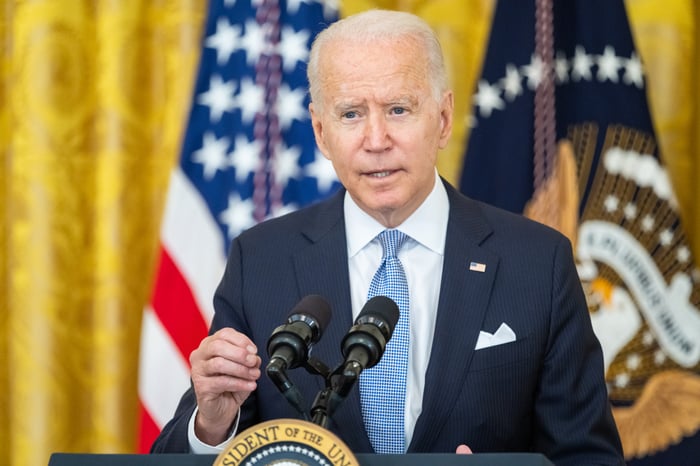
PRESIDENT BIDEN DELIVERING REMARKS. IMAGE SOURCE: OFFICIAL WHITE HOUSE PHOTO BY ADAM SCHULTZ.
Retired workers could be less than 12 years away from having their benefits cut
For each of the past 83 years, the Social Security Board of Trustees has released a report that’s examined the financial status of the program over the short term (the next 10 years) and long term (75 years following the release of a report). The Trustees Report effectively acts as Social Security’s balance sheet and allows anyone to see how revenue is collected and where those dollars end up.
In addition to backward-looking financial data, the Trustees Report factors in changing macroeconomic and demographic factors to determine the financial health of Social Security.
The 2022 Trustees Report showed that Social Security had dug its largest hole yet: an estimated $20.4 trillion funding shortfall through 2096. For what it’s worth, every Trustees Report since 1985 has projected a long-term funding shortfall.
Social Security’s increasingly dire financial footing is primarily a result of demographic shifts. Examples include historically low U.S. birth rates, a near-halving in net immigration into the country over two decades, and growing income inequality, among other factors. With these changes weighing on the worker-to-beneficiary ratio, it would appear the program’s financial foundation will only worsen.
Based on last year’s projections, the asset reserves for the Old-Age and Survivors Insurance Trust Fund (OASI) are expected to run out in 2034. The OASI is the Trust responsible for paying benefits to 48.5 million retired workers each month, as well as nearly 5.9 million survivors of deceased workers. If this excess cash were to be exhausted within the next 12 years, the Trustees believe an across-the-board benefit cut of 23% would be necessary to sustain payouts through 2096. For context, a 23% benefit cut would reduce the average Social Security check by roughly $420 per month (In January 2023 dollars), or $5,000 per year.
Joe Biden has proposed sweeping reforms for Social Security
In 2020, prior to his election as president, then-candidate Joe Biden released a plan he believed would strengthen Social Security for decades to come. Although there are four Social Security changes Biden is seeking, two stand out as key to shoring up the program.
This biggest Social Security change proposed by Biden would tackle income inequality head-on and generate a lot of extra revenue.
In 2023, Social Security’s 12.4% payroll tax is applicable to earned income between $0.01 and $160,200. “Earned income” means wages and salary but not any sort of investment income. Approximately 94% of all working Americans earns less than the maximum taxable earnings cap (the $160,200 figure). For the other 6% of workers, earned income above this $160,200 level is exempt from the payroll tax.
Joe Biden’s proposal would create a doughnut hole between the maximum taxable earnings cap and $400,000 where earned income would remain exempt, as well as reinstate the payroll tax on earned income above $400,000. Since the maximum taxable earnings cap tends to rise over time with inflation, this doughnut hole would eventually close decades down the line. This immediate increase in payroll tax revenue should push back the asset reserve depletion date of the OASI.
Since 1975, the Consumer Price Index for Urban Wage Earners and Clerical Workers (CPI-W) has been used to determine Social Security’s annual cost-of-living adjustment (COLA). Unfortunately, as its name implies, this is a price-measuring index focused on the spending habits of “urban wage earners and clerical workers.” In other words, people who generally aren’t receiving a Social Security benefit.
Biden would like to see the Consumer Price Index for the Elderly (CPI-E) used to calculate COLA instead of the CPI-W. The CPI-E specifically tracks the spending habits of older Americans, which would likely provide a larger annual cost-of-living adjustment.
Is a new Congress the recipe Biden needs to reform Social Security?
The challenge for Joe Biden — and frankly, every other president for more than three decades — is that he needs the support of lawmakers in Congress to amend the Social Security Act. Just a few days ago, the 118th Congress officially took shape.
The big question is: Will this new Congress work with the president to effect Social Security reform? If I were to give the Magic 8 Ball a shake, the “All signs point to no” answer would almost assuredly pop up.
Whereas the previous Congress featured a razor-thin majority in the U.S. Senate for Democrats, as well as a modest majority in the House of Representatives, the new Congress features a shift to a slight majority in the House for Republicans.
Democrats and Republicans both agree that Social Security needs attention. However, they’ve approached their respective fixes from completely different viewpoints. Whereas Biden’s proposal seeks to raise additional revenue from high-earners and boost benefits for low-earning workers, the Republican solution aims to increase the full retirement age and shift the inflationary measure to the Chained CPI. Without getting too far into the weeds, the GOP plan focuses on reducing long-term outlays to save Social Security money. In short, both parties have solutions that work, albeit on very different timelines and with ideologically opposite approaches.
The other challenge for Biden is getting the necessary votes in the Senate to amend Social Security. In the upper house of Congress, 60 votes are needed to amend America’s top retirement program. Since neither party has controlled at least 60 votes in the Senate since 1979, it means all legislation proposing to alter Social Security would require bipartisan support. Garnering that support has proved virtually impossible for every president since Ronald Reagan.
Though a new Congress has taken shape, Biden’s Social Security changes are extremely unlikely to find legislative support.