Millions of debt collections dropped off Americans’ credit reports
Gabriella Cruz – Martinez – Personal finance writer – February 18, 2023
Tens of millions of debt collections disappeared from Americans’ credit reports during the pandemic, a new government watchdog report found, but overdue medical bills remain a big strain on many households nationwide.
The total number of debt collections on credit reports dropped by 33% from 261 million in 2018 to 175 million in 2022, according to the Consumer Financial Protection Bureau, while the share of consumers with a debt collection on their credit report shrunk by 20%.
Medical debt collections also dropped by 17.9% during that time, but still made up 57% of all collection accounts on credit reports, far more than other types of debt combined — including credit cards, utilities, and rent accounts.
Despite the reduction in collections, the CFPB noted that the results underscore ongoing concerns that current medical billing and collection practices can lack transparency, often hurting the credit scores and financial health of those most vulnerable.
“Our analysis of credit reports provides yet another indicator that, due to a strong labor market and emergency programs during the pandemic, household financial distress reduced over the last two years,” Rohit Chopra, CFPB director said in a statement. “However, false and inaccurate medical debt on credit reports continues to drag on household financial health.”
Signage is seen at the Consumer Financial Protection Bureau (CFPB) headquarters in Washington, D.C., (Credit: Andrew Kelly, REUTERS)
Having a debt in collections means your original creditor sent your debt to a third-party agency to collect it. According to the CFPB, common items that can slip into collections include medical debt, student loans, unpaid credit card balances and rent, to name a few.
Once in collections, these debts can stay on your credit report for up to 7 years, Experian noted, potentially harming your chances of gaining access to new credit in the future.
While pandemic-era stimulus benefits may have helped families reduce some of their overall debt, the CFPB noted that the decline in collections was mainly due to some debt collectors underreporting data.
According to the report, debt collectors — particularly those who primarily collect on medical bills — reported 38% fewer collection tradelines from 2018 to 2022. Chopra noted this could be troubling.
(Photo: Getty Creative)
The “decline in collections tradelines does not necessarily reflect a decline in debt collection activity, nor an improvement in families’ abilities to meet their financial obligations,” he said, “but a choice by debt collectors and others to report fewer collections tradelines, while still conducting other collection activities.”
Fortunately, a growing share of Americans may see even more medical debt disappear from their credit history this year, helping to improve their creditworthiness.
In the first half of 2023, Equifax, Experian, and TransUnion will no longer include medical debts under the amount of $500 on credit reports. That followed the credit bureaus’ move last year to remove approximately 70% of medical collection debt tradelines from consumer reports. Additionally, unpaid medical debt would take a year — rather than the current six months — to show up on a person’s credit report, the bureaus said.
About two dozen people eventually filled the “Debt and Collections” courtroom in Poplar Bluff, Missouri. Many of the cases on the docket involved medical debt. (Credit: Michael S. Williamson/The Washington Post via Getty Images)
Those upcoming changes may still be just a drop in the bucket toward reducing medical debt, Chopra said.
“While this will reduce the total number of medical collections tradelines, an estimated half of all consumers with medical collections tradelines will still have them on their credit reports,” Chopra said in the report, “with the larger collection amounts representing a majority of the outstanding dollar amount of medical collections remaining on credit reports.”
The CFPB analysis builds on the Biden-Harris Administration’s aim to strengthen the Affordable Care Act and implement new consumer protections to reduce the burden of medical debt and lower medical costs.
It also follows a string of CFPB reports citing how inaccurate medical debt tradelines could not only unfairly harm consumers’ credit scores, but also create long-term repercussions such as avoidance of medical care, risk of bankruptcy, or difficulty securing employment.
Gabriella is a personal finance reporter at Yahoo Finance.
Donna St. George, Katherine Reynolds Lewis and Lindsey Bever, The Washington Post – February 17, 2023
When Sophie Nystuen created a website for teens who had experienced trauma, her idea was to give them space to write about the hurt they couldn’t share. The Brookline, Mass., 16-year-old received posts about drug use and suicide. But a majority wrote about sexual violence.
“Every time I’ve tried, my throat feels like it’s closing, my lungs forget how to breathe,” wrote one anonymous poster. “I was sexually assaulted.”
These expressions of inner crisis are just a glint of the startling data reported by federal researchers this week. Nearly 1 in 3 high school girls said they had considered suicide, a 60 percent rise in the past decade. Nearly 15 percent had been forced to have sex. About 6 in 10 girls were so persistently sad or hopeless they stopped regular activities.
The new report represents nothing short of a crisis in American girlhood. The findings have ramifications for a generation of young women who have endured an extraordinary level of sadness and sexual violence – and present uncharted territory for the health advocates, teachers, counselors and parents who are trying to help them.
The data comes from the Youth Risk Behavior Survey, conducted by the Centers for Disease Control and Prevention from a nationally representative sample of students in public and private high schools. “America’s teen girls are engulfed in a growing wave of sadness, violence and trauma,” the CDC said.
“It’s alarming,” Education Secretary Miguel Cardona said Thursday of the report. “But as a father of a 16-year-old and 19-year-old, I hear about it. It’s real. I think students know what’s going on. I think sometimes the adults are just now realizing how serious it is.”
But high school girls are speaking out, too, about stresses that started before the pandemic – growing up in a social media culture, with impossible beauty standards, online hate, academic pressure, economic difficulties, self doubt and sexual violence. The isolation and upheaval of covid made it tougher still.
When Caroline Zuba started cutting her arms in ninth grade, she felt trapped: by conflict at home, by the school work that felt increasingly meaningless, by the image her friends and teachers had of a bubbly, studious girl. Cutting replaced the emotional pain with a physical pain.
She confided in a trusted teacher, who brought in the school counselors and her mother. But Zuba’s depression worsened and, at age 15, she attempted suicide. That sparked the first of a series of hospitalizations over the summer and subsequent school year.
Now a 17-year-old junior at a public high school in Potomac, Md., Zuba relies on therapy, medication, exercise and coping strategies. She started a mental health club at her high school to support classmates also struggling with depression, anxiety and suicidal thoughts.
At the lowest point of her depression, she said, she kept many secrets from her friends, parents and teachers because she felt stuck in her role: a cheerful high achiever who had it all together.
“My mom’s like my best friend and there’s no way she would have ever expected it,” Zuba said. “Teens are really good at hiding it, which is really sad.”
While the teen mental health crisis was clear before the CDC report, the stark findings have jolted parents and the wider public.
“These are not normal numbers,” said Surgeon General Vivek H. Murthy. “When you grow up with this, I think the risk is thinking, ‘Well, this is just how it is.'”
The reasons girls are in crisis are likely complex, and may vary by race, ethnicity, class and culture. Harvard psychologist Richard Weissbourd points out that “girls are more likely to respond to pain in the world by internalizing conflict and stress and fear, and boys are more likely to translate those feelings into anger and aggression,” masking their depression.
Weissbourd added that girls also are socialized not to be aggressive and that in a male-dominated culture girls can be gaslit into thinking there is something wrong with them when problems or conflicts arise. “They can be prone to blaming themselves,” he said.
Jean Twenge, a psychology professor at San Diego State University and author of the book “iGen,” said that increases in most measures of poor mental health in the past decade were more pronounced for girls than boys.
She said part of the problem is that digital media has displaced the face-to-face time teens once had with friends, and that teens often don’t get enough sleep. Adding to those influences are the hours teens spend scrolling social media. For girls, she said, this often means “comparing your body and your life to others and feeling that you come up wanting.”
That’s not to say everything that people do on smartphones is problematic, Twenge said. “It’s just social media in general and internet use show the strongest correlations with depression,” she said.
Ben Handrich, a school counselor at South Salem High School in Salem, Ore., said teen girls often feel that “people are watching them – that no matter what they do, there’s this invisible audience judging their movements, their actions, the way they smile, the way they eat.”
Lisa Damour, a clinical psychologist and author of “The Emotional Lives of Teenagers,” said it’s important to note that the CDC data was collected in the fall of 2021, a time when many teens were anxious about returning to in-person school and wearing masks.
“Teenagers were miserable,” Damour said. “It absolutely confirms what we were looking at clinically at that time. We don’t know what the next wave of data will tell us.”
Damour noted that the CDC findings are distressing because today’s teens, in many ways, are in better physical health and more risk-averse than most previous generations.
“We’re raising the best-behaved generation of teenagers on record,” said Damour. “They drive with seat belts, they smoke less, they have less sex, they wear helmets. They do all these things that we did not do.”
And yet they are in crisis.
Many girls across the country describe teen cultures of casual slut-shaming, of peers greeting girls with sexist slurs such as “whore” or “ho,” based on what they wear or how they look.
In Los Angeles, Elida Mejia Elias says it’s a no-win situation. “If you’re skinny, they judge you for being skinny and if you’re fat, they judge you for being fat,” explains the 18-year-old, a senior.
In ninth grade, a friend of Mejia Elias’s sent a naked picture of herself to a boy she was dating, at his urging, and he spread it around to his friends. “Everyone was talking bad about her. They were calling her names, like ‘ho,'” said Mejia Elias. “That affected her mental health. She needed to get therapy.”
In Maryland, at her Bethesda public high school, 14-year old Tulip Kaya said that girls in her friend group hear whistles or “gross comments” about their breasts and are texted unsolicited penis pictures by boys at school. “If there’s anything slightly unique about you, you’re not going to have a fun time, and you will be targeted,” she said.
Social media can be overwhelming. “On Snapchat and TikTok, you see all these pretty girls with tiny waists and a big bottom. I know I’m only 14, but it makes me feel like there’s something wrong with myself,” Kaya said. “When I start to feel like that, I will delete the app for a little while.”
Girls interviewed by The Post expressed uncertainty and self-doubt over everything from what to wear, what to post or comment on social media, what it meant if someone wasn’t following them back on a social platform, and even in daily interactions. When in-person school resumed, during the fall of 2021 for many, routine encounters and moments felt weird after a year or more of separation from peers.
“Sometimes I don’t want to wear shorts because I don’t have the body type I had in middle school,” said Leilah Villegas, of Eastvale, Calif., who ran track before the pandemic. Now in 10th grade, she’s started running again but her changed body brings pangs of self-consciousness.
Aanika Arjumand, 16, from Gaithersburg, Md., who sits on her county’s Domestic Violence Coordinating Council, said she was not surprised by the increases in sexual violence.
“We deal with a lot of cases on like teen dating violence and kind of informing schools about teen dating violence because the health curriculum right now basically does not cover abuse or sexual violence as much as it should,” she said.
School itself can sometimes be physically unsafe, as happened with Harker, a 13-year old in Savannah, Ga., who spoke on the condition that her full name not be used because of the sensitivity of the issue.
At school, she received unwanted attention from a boy in sixth grade. He would whisper in her ears and grab her shoulders. Once, he seized her across her chest and did not release her until she screamed. A teacher was nearby, but she said the boy went unpunished and remained in her classes. The teen has resorted to learning at home.
“They didn’t believe me even though there were witnesses,” she said. “A boy in school can get away with something, but if I do one mess-up, I get called out for it.
At the Bronx High School of Science in New York, 17-year-old Najiha Uddin talks about a White beauty standard perpetuated in mainstream and social media, which she says girls of color can’t possibly meet. She and others describe status-oriented peers and media messages about shoes, clothes, styles and experiences that outstrip their families’ means.
For Montanna Norman, 18, a senior at a private high school in Washington during the fall of 2021, the killing of unarmed Black men by police was foremost in her mind after the murder of George Floyd. At the time she was the co-leader of her school’s Black Student Union. “The toll that that took on my mental health was a lot,” she said.
Some of her friends have contemplated, or attempted, suicide, Norman said. “You wish you could do more to help,” she said.
Garvey Mortley, a 14-year old in Bethesda, Md., who is Black, said she has been teased because of her hair and still feels microaggressions. “Racism can be a stressor for depression or a cause of depression because of the bullying that happens, not just Black kids but Asian kids and Hispanic kids who feel they are unwanted,” she said.
Students who are LGBTQ face some of the highest rates of depressive symptoms and sexual violence, including rape. In 2021, nearly 1 in 4 reported an attempt to take their life.
Rivka Vizcardo-Lichter, a student activist in Virginia, pointed out that high school is a time when many LGBTQ students are still figuring out who they are and solidifying their identity. “Even if you have an accepting environment around you, you are aware that there are millions of people who don’t want you to exist,” she said.
Some of the most alarming data collected by the CDC involved the rise in suicidal thoughts among teen girls – 24 percent of teen girls have made a plan for suicide while 13 percent have attempted it, almost twice the rate for boys.
Rich and Trinna Walker, from New Albany, Ind., searched for a therapist for their 13-year-old daughter Ella but struggled to find one in the overloaded mental health-care system during the pandemic. Once Ella finally started treatment, however, her demeanor seemed to improve, they said.
“I really felt like she was doing so much better,” Trinna Walker said. Ella had been asking her dad how she could earn extra money to buy a birthday gift for her sister. She told her mom she wanted doughnuts for breakfast.
“Then we woke up to a nightmare the next morning,” Trinna said.
Ella died by suicide on Jan. 22, 2022. Her parents said they wish someone would have alerted them to the warning signs. Unknown to them, Ella was being bullied, and she was devastated by a breakup, they said.
Now the couple is urging teens to speak up when their peers are in trouble. “It was like a bomb going off,” Rich Walker said. “It’s like it mortally wounded my wife and me and Ella’s two older sisters, and then it reverberated outwardly to her friends.”
Many of the girls interviewed for this story asked that adults listen to and believe girls, and stop dismissing their concerns as drama. “Adults don’t get all the pressure that teenage girls have to deal with, from appearance to the way they act to how smart they are, to the things they do,” said Villegas, the Eastvale 10th-grader. “It can be very overwhelming.”
Asma Tibta, a 10th-grader in Fairfax County, Va., said she is “close friends” with her mother, but doesn’t talk about mental health at home. “I haven’t told her too much. And I don’t plan to.”
In Savannah, Harker took a break from playing Roblox with her friend to be interviewed. Before heading back to the game, she had one request: “I want adults to believe young girls.”
The Washington Post’s Serena Marshall contributed to this report.
If you or someone you know needs help, visit 988lifeline.org or call or text the Suicide & Crisis Lifeline at 988.
Ron DeSantis requested the medical records of trans students who sought care at Florida’s public universities. Now students are planning a statewide walkout.
Annalise Mabe – February 16, 2023
Students at the University of South Florida gather to protest the request.Justin Blanco
Ron DeSantis told all public universities in Florida to hand over the medical records of trans students who sought care.
Insider has confirmed six of the 12 universities have complied with the request.
Now, college students across the state are planning a walkout to protest the governor’s request.
DeSantis asked to see the records of any student who has experienced gender dysphoria in the past five years. In addition, he wants their ages and the dates they received gender-affirming care. The deadline to submit those records was February 10.
Insider has confirmed that University of Florida, Florida State University, University of Central Florida, Florida A&M University, Florida International University, and the University of North Florida have complied with the request, but has yet to hear back from the rest.
Students at these universities are now planning rallies for next week along with the statewide walkout on February 23. Ben Braver, a junior at the University of South Florida and the outreach officer for the school’s College Democrats chapter, is leading the initiative, known as the Stand for Freedom Florida Walkout.
“Hate is spread when it’s innocuous, when it seems silly, and when it seems like taking a stand is an overreaction,” Braver told Insider. “We, just like any generation, need to stand for the civil rights that have already been fought for, the ones that have been won, and those which are at stake right now.”
Andy Pham, a senior and long-standing member of the University of South Florida’s Trans+ Student Union, said he sees the state’s move as a direct attack on trans rights.
“They want to legislate us out of existence,” Pham said. “That starts with attacking our healthcare, attacking our right to exist in public spaces, attempting surveillance — all of that.”
In January, 20 students at the University of South Florida held a rally protesting DeSantis’ request. They then started an online petition asking the school’s administration not to submit the medical records. The petition received over 2,600 signatures, but officials at the school said they plan to send over the records anyway. Insider hasn’t been able to confirm whether the University of South Florida sent over the data.
“As a state university, USF has an obligation to be responsive to requests from our elected officials,” the university said in a statement, according to WUSF. “However, the university will not provide information that identifies an individual patient or violates patient privacy laws.”
Among those signing on to support the walkout are the Dream Defenders, Florida College Democrats, state lawmaker Anna Eskamani, and 26-year-old Congressman Maxwell Frost.
“The governor’s abusing his power,” Frost told Insider. “He’s targeting folks that disagree with him — people who might not see eye to eye with him, marginalized communities.”
When Insider asked why the state has requested the health data of transgender college students, the state’s deputy press secretary referred to DeSantis’ second inaugural address, in which the governor stated: “We are committed to fully understanding the amount of public funding that is going toward such nonacademic pursuits to best assess how to get our colleges and universities refocused on education and truth.”
The American Civil Liberties Union reports that during this legislative session, Florida lawmakers have introduced 85 bills restricting gender-affirming healthcare, up from 43 bills last year.
Eskamani said DeSantis should prepare for student backlash.
“When students see the visual representation of their peers around them standing up and walking out, they’re going to get plugged in and help us fight back,” she said. “That will happen.”
First it was blood pressure medication. Now FDA eyes more drugs for cancer-causing chemical.
Ken Alltucker, USA TODAY – February 16, 2023
For people managing high blood pressure, recalls of the carcinogen-tainted drug quinapril might sound familiar.
Since 2018, more than 12 million bottles of blood pressure-lowering drugs such as valsartan and losartan have been removed from the market because they contained cancer-risk chemicals called nitrosamines.
The same family of contaminants triggered recalls of the heartburn drug Zantac, the diabetes drug metformin and the smoking cessation medication Chantix.
The flurry of drug recalls because of carcinogens has prompted the Food and Drug Administration to assess the scope of the problem.
The federal regulator has asked drugmakers to evaluate all products for any risk they might contain nitrosamines. Companies that identify any such risk must conduct follow-up testing, report changes and take action by October.
Nitrosamines are found in water, cured and grilled meats, dairy products and vegetables, according to the FDA. While nearly everyone is exposed to trace amounts of nitrosamines, studies link the contaminants to increased cancer risk if people are exposed to large amounts over long periods of time.
Public health experts have long been aware of the small risk associated with sustained exposure to these contaminants.
Food safety experts have worked to reduce nitrosamines in food such as cured meats to far below levels found in the 1970s and 1980s, said Dr. Stephen Hecht, a University of Minnesota professor of cancer prevention.
“The difference is with drugs it’s totally avoidable,” Hecht said. “I don’t think this could have happened in the 1970s because there was much greater awareness of the consequences.”
The FDA has said the risk for anyone exposed to nitrosamines in drugs is small.
The agency has set acceptable limits on six types of nitrosamines, which equal up to one case of cancer per 100,000 people exposed to the contaminant.
Some recalled drugs have exceeded that amount. For every 8,000 people on the highest dose of valsartan for four years, FDA scientists concluded there would be one more cancer case above average rates for that population. Europe’s drug regulator, the European Medicines Agency, estimated the risk to be one cancer case for every 3,000 patients.
As with the valsartan and losartan recalls in 2018 and 2019, the FDA has advised people on recalled quinapril to continue the medication until their doctor or pharmacist can identify a replacement.
Dr. Yul Ejnes, a clinical professor of medicine at Alpert Medical School of Brown University, said people might panic and immediately stop their medication when they hear about a recall. For a patient on a blood-pressure-lowering drug to manage conditions such as heart failure, halting the drug can create an immediate medical problem.
He generally recommends people call their pharmacist, who can check whether their drug is part of the recall. If it is, the pharmacist might be able to locate the same version of the drug that’s not part of the recall. Or the pharmacist and doctor can find a substitute drug.
“The key message is it’s a small risk; there’s no imminent danger,” said Ejnes, chair of the American Board of Internal Medicine. “There’s no need to stop the drug. Now, we can find replacements.”
What’s being done to protect consumers?
Though the FDA said the risk is small for people who ingested these drugs, lawyers have filed thousands of lawsuits in state and federal courts on behalf of people who say they have been harmed.
In 2019, heartburn drug Zantac was removed from store shelves after the FDA found unacceptable levels of a nitrosamine called NDMA, or nitrosodimethylamine, in brand and generic versions.
In December, a Florida federal judge dismissed thousands of claims that alleged Zantac caused cancer. The judge ruled that the plaintiffs’ experts did not use reliable methods linking the drug to cancer.
More than 1,000 claims against valsartan manufacturers are pending in federal court.
Meanwhile, FDA officials said the agency expects drug manufacturers who have identified a potential risk to complete testing and report changes they’ve made by Oct. 1.
“We continue to closely evaluate this type of impurity and will continue to investigate and monitor the marketplace and manufacturing efforts to help ensure the availability of safe, quality products for U.S. consumers,” said FDA spokesman Jeremy Kahn.
Makers of generic drugs, which produce about 9 of 10 prescription drugs dispensed in the United States, have pushed back on the FDA’s required comprehensive review. The generic drug’s industry group, the Association for Accessible Medicines, said in a position paper that to review every drug would be a “Herculean task” that would divert resources and focus and could exacerbate drug shortages.
Instead, the organization wants to conduct a more efficient “risk-based” review that looks for the source of such impurities across all facets of drugmaking.
Why are we seeing so many contaminated drugs?
Independent experts say the recent recalls are partly the result of a system that values inexpensive manufacturing over drug quality.
David Light is CEO and co-founder of Valisure, an independent lab that first discovered Zantac and its generic versions contained nitrosamines. His lab’s testing led to the voluntary nationwide recall of the medication for supermarket and drug stores. Since then, his lab has flagged potential harmful contaminants in consumer products such as hand sanitizers and sunscreens.
Though the FDA sets standards for drug companies to follow, it’s up to the drug manufacturers to ensure their products are safe and free from impurities. This regulatory approach is an “honor system,” Light said, adding that “some manufacturers are going to do a better job than others.”
Generic drug manufacturers want to make inexpensive products and seek to control manufacturing costs. Insurers and consumers expect to pay less for generic medications.
“The fact that we have a broken market system where we’re only valuing price and just assuming quality certainly increases the risk for these kinds of issues to crop up,” Light said.
2nd Amendment sanctuary measure overturned in Oregon
Claire Rush and Lindsay Whitehurst – February 15, 2023
Wednesday, Feb. 15, 2023, that local governments can’t declare themselves Second Amendment sanctuaries and ban police from enforcing certain gun laws within their borders. The opinion was the first court test of the concept, which hundreds of U.S. counties have adopted in recent years. (AP Photo/Andrew Selsky, File)Firearms are displayed at a gun shop in Salem, Ore., on Feb. 19, 2021. An Oregon court decided Wednesday, Feb. 15, 2023, that local governments can’t declare themselves Second Amendment sanctuaries and ban police from enforcing certain gun laws within their borders. The opinion was the first court test of the concept, which hundreds of U.S.
PORTLAND, Ore. (AP) — Local governments in Oregon can’t declare themselves Second Amendment sanctuaries and ban police from enforcing certain gun laws, a state appeals court decided Wednesday, in the first court case filed over a concept that hundreds of U.S. counties have adopted in recent years.
The measure in question, which was approved in Columbia County, forbids local officials from enforcing most federal and state gun laws and would impose thousands of dollars in fines on those who try.
The state Court of Appeals ruled that it violates a law giving the state the power to regulate firearms. The ordinance would effectively, it found, “create a ‘patchwork quilt’ of firearms laws in Oregon, where firearms regulations that applied in some counties would not apply in Columbia County,” something lawmakers specifically wanted to avoid.
Second Amendment sanctuary resolutions have been adopted by some 1,200 local governments around the U.S., including in Virginia, Colorado, New Mexico, Kansas, Illinois and Florida, experts say. Many are symbolic, but some carry legal force like the one in Columbia County, a conservative, rural logging area in deep-blue Oregon.
The sanctuary movement took off around 2018 as states considered stricter gun laws in the wake of mass shootings, but it had not previously faced a major legal challenge.
The Oregon case was filed in 2021 under a provision in state law that allows a judge to examine a measure before it goes into effect. A trial court judge originally declined to rule, a decision that was appealed to the higher court.
The ordinance’s supporters included the Oregon Firearms Federation, which said in a statement Wednesday that the ruling “calls into question the legitimacy of the court and the likelihood of getting fair rulings from it.”
Opponents included the legal arm of the group Everytown for Gun Safety, which had argued that the ordinance violated the U.S. Constitution. Eric Tirschwell, executive director of Everytown Law, called the court’s decision “a win for public safety and the rule of law.”
“Opponents of gun safety laws have every right to advocate for change at the ballot box, statehouse, or Congress, but claiming to nullify them at the local level is both unconstitutional and dangerous,” Tirschwell said.
State Attorney General Ellen Rosenblum, who has also sued two other Second Amendment sanctuary counties, also applauded the ruling.
“Today’s opinion by the Court of Appeals makes it clear that common sense requirements like safe storage and background checks apply throughout Oregon,” Rosenblum said. “Hopefully, other counties with similar measures on the books will see the writing on the wall.”
Trump Plans to Bring Back Firing Squads, Group Executions if He Retakes White House
Asawin Suebsaeng and Patrick Reis – February 14, 2023
trump firing squads – Credit: JIM WATSON/AFP/Getty Images
“What do you think of firing squads?”
That’s the question Donald Trump repeatedly asked some close associates in the run-up to the 2024 presidential campaign, three people familiar with the situation tell Rolling Stone.
It’s not an idle inquiry: The former president, if re-elected, is still committed to expanding the use of the federal death penalty and bringing back banned methods of execution, the sources say. He has even, one of the sources recounts, mused about televising footage of executions, including showing condemned prisoners in the final moments of their lives.
Specifically, Trump has talked about bringing back death by firing squad, by hanging, and, according to two of the sources, possibly even by guillotine. He has also, sources say, discussed group executions. Trump has floated these ideas while discussing planned campaign rhetoric and policy desires, as well as his disdain for President Biden’s approach to crime.
In at least one instance late last year, according to the third source, who has direct knowledge of the matter, Trump privately mused about the possibility of creating a flashy, government-backed video-ad campaign that would accompany a federal revival of these execution methods. In Trump’s vision, these videos would include footage from these new executions, if not from the exact moments of death. “The [former] president believes this would help put the fear of God into violent criminals,” this source says. “He wanted to do some of these [things] when he was in office, but for whatever reasons didn’t have the chance.”
A Trump spokesman denies Trump had mused about a video-ad campaign. “More ridiculous and fake news from idiots who have no idea what they’re talking about,” the spokesman writes in an email. “Either these people are fabricating lies out of thin air, or Rolling Stone is allowing themselves to be duped by these morons.”
Trump’s enthusiasm for grisly video campaigns has been documented before, including in an anecdote from a former aide that had the then-president demanding footage of “people dying in a ditch” and “bodies stacked on top of bodies” so that his administration could “scare kids so much that they will never touch a single drug in their entire life.”
Asked about firing squads and other execution methods, the spokesman refers Rolling Stone to lines from Trump’s 2024 campaign announcement. “Every drug dealer during his or her life, on average, will kill 500 people with the drugs they sell, not to mention the destruction of families. We’re going to be asking everyone who sells drugs, gets caught selling drugs, to receive the death penalty for their pain.”
At an October rally — to cheers and applause from his audience — Trump pitched a form of supposed justice that has been embraced by some brutal dictatorships. “And if [the drug dealer is] guilty, they get executed, and they send the bullet to the family and they want the family to pay for the cost of the bullet,” Trump said at the rally. “If you want to stop the drug epidemic in this country, you better do that … [even if] it doesn’t sound nice.”
The former president’s zeal for the death penalty has already proven lethal. During the final months of his administration, he oversaw the executions of 13 federal prisoners. Since 1963, only three federal prisoners had been executed, including Oklahoma City bomber and mass murderer Timothy McVeigh. In January 2021, in the final stretch before Biden would become president, Trump oversaw three executions in four days.
“In conversations I’d been in the room for, President Trump would explicitly say that he’d love a country that was totally an ‘eye for an eye’ — that’s a direct quote — criminal-justice system, and he’d talk about how the ‘right’ way to do it is to line up criminals and drug dealers before a firing squad,” says a former Trump White House official.
“You just got to kill these people,” Trump would stress, this ex-official notes.
“He had a particular affinity for the firing squad, because it seemed more dramatic, rather than how we do it, putting a syringe in people and putting them to sleep,” the former White House official adds. “He was big on the idea of executing large numbers of drug dealers and drug lords because he’d say, ‘These people don’t care about anything,’ and that they run their drug empire and their deals from prison anyways, and then they get back out on the street, get all their money again, and keep committing crimes … and therefore, they need to be eradicated, not jailed.”
Trump’s firing-squad fixation may address his desire for the “dramatic,” but some experts believe that an instant death-by-gunshot may be more humane than lethal injection. “There’s pain, certainly, but it’s transient,” according to Dr. Jonathan Groner, a professor of surgery at the Ohio State University College of Medicine. “If you’re shot in the chest and your heart stops functioning, it’s just seconds until you lose consciousness.”
Rules made during Trump’s presidency made federal firing squads more feasible. Previously, lethal injection was the only permissible federal method of execution. But under the administration’s new rules, if lethal injections are made legally or logistically unavailable, the federal government can use any method that is legal in the state where the execution is located.
The rule took effect on Dec. 24, 2020, and thus far has not been applied: All 13 Trump-era executions were done by lethal injection. But the expanded methods of execution could be relevant in the future. Opponents of the death penalty have pushed drugmakers to withhold the drugs needed to conduct lethal injections, complicating efforts to impose capital punishment. In Indiana, home to the Terre Haute facility where most federal executions are conducted, the new policies “legally open the door for the authorized use of firing squads, electrocution, or the gas chamber,” the Indianapolis Star reported at the time.
Former Attorney General Bill Barr, the ideological architect of Trump’s execution binge, told Rolling Stone in December that Trump and his administration would have had more people put to death soon, had he won a second term in 2020. “Yes — that was the expectation,” Barr succinctly summarized in a phone interview.
There could soon be a 45th prisoner on federal death row. The Justice Department is seeking the death penalty for convicted domestic terrorist Sayfullo Saipov, who steered a truck onto a bike path and pedestrian walkway in New York City on Halloween in 2017, and is set to be sentenced in federal court in the days ahead. Biden and his attorney general, Merrick Garland, implemented a moratorium on capital punishment, but the sentence would leave Saipov eligible for execution under a future president.
Trump’s plan for a 2nd term reportedly includes firing squads, hangings, and group executions
RafiSchwartz, Staff writer – February 14, 2023
Gallows outside the U.S. Capitol complex on January 6, 2021 Photo by Ricky Carioti/The Washington Post via Getty Images
As Donald Trump’s second re-election bid begins to pick up steam in the new year, details about the former president’s plans for his return to the White House have begun to emerge — including a new report from Rolling Stone, which alleges Trump has begun polling his advisers on whether he should bring back firing squads, hangings, and even the guillotine should he win in 2024.
According to two sources, the former president has even begun exploring the possibility of group executions, with a third person claiming Trump has expressed interest in a government ad campaign to highlight the administration’s lethality and, per Rolling Stone‘s source, “help put the fear of God into violent criminals.” A Trump campaign spokesperson denied the former president had plans for an execution ad campaign in a statement to Rolling Stone.
Trump’s fascination with the death penalty has long been on public display, stretching back to his call to execute the “Central Park Five,” five young Black and Latino men accused of rape and assault in the late 1980s (all were later exonerated). As Rolling Stone had previously reported, Trump had ended his first term by executing more than four times as many convicted persons in his final six months in office as the federal government had killed in total over the prior half-century. He also signed an executive order in those last weeks in office that expanded the federal government’s ability to conduct hangings and firing squads as methods of execution. And during his campaign launch in November, Trump made a special point to highlight a call to execute “everyone who sells drugs [or] gets caught selling drugs” if given a second term.
This latest report has earned harsh rebukes from some, including journalist Oliver Willis, who called it the “kind of fascist s–t Republican primary voters love.” Citing a 2016 campaign event in which Trump enthusiastically lauded the disproven myth that U.S. General John Pershing summarily executed dozens of Muslim prisoners in the Philippines with ammunition “dipped […] in pig’s blood,” Semafor Washington Bureau Chief Benjy Sarlin wryly noted that now Trump was “moderating his stance ahead of 2024, before he just favored summary executions while defiling the bodies.”
DeSantis’ attempt to roll back diversity, equity, and inclusion is doomed to fail | Opinion
Ben Wright – February 12, 2023
I’ve had a front row seat for Gov. Ron DeSantis’ attempts to overhaul Florida’s university system. My eldest son is currently a junior at New College of Florida which is ground-zero in this struggle. He didn’t choose New College because of some liberal ideology; he was excited about small class sizes, accessible professors, and its designation as an honors college. New College has been a great experience. Now, the rug is being pulled out from under him. His tiny school is the first test in a state-wide experiment that is coming to a campus near you.
It’s almost guaranteed DeSantis is running for president. By claiming that Florida’s universities and colleges are filled with radically liberal professors that are indoctrinating our students, the governor has discovered a way to energize his Republican base and present himself as a champion for conservatives. Are independent voters in Arizona and Pennsylvania going to lose sleep over the reshuffling of Florida’s colleges? Probably not. He has found an issue where he can win the hearts of Republicans without alienating the independent voters that he needs to win the presidency.
The governor is targeting many aspects of higher education, but his main line of attack is focused on eliminating “diversity, equity, and inclusion” (DEI) programs from state colleges and universities. Ironically, under DeSantis, the Board of Governors insisted that universities adopt these DEI programs just a few years ago.
DeSantis’ government overreach may be an important building block in his run for the presidency, but it will do long-lasting harm to Florida’s institutions of higher learning. Florida’s universities spend time, money, and resources to attract talented students and faculty … and they have been successful. There are many jokes about our weird and wonderful Florida, but our higher education system has garnered well-deserved respect in recent years.
Universities in other states are now poised to start poaching these talented folks with promises of true academic freedom. Florida will lose talented professors and students through attrition and find it more difficult to attract quality replacements. The governor’s decision to use these schools as pawns in his political games will cause long-term damage to the institutions and the degrees they issue.
In the real world, corporate America has overwhelmingly adopted diversity, equity, and inclusion. All the Fortune 100 companies have made a public commitment to DEI. Why? Because the young, talented workers they want to attract are demanding it. Employees now expect their employer to promote the values they hold. Why did Disney come out against DeSantis’ “Don’t Say Gay” law? Because Disney employees around the country wouldn’t stand for anything less. The unemployment rate is unprecedentedly low … it’s hard to attract top talent. Millennials and Gen-Z are driving the workforce now and they expect DEI to be a priority.
The changes at New College of Florida are just the opening gambit in a much larger plan. DeSantis’ attempt to roll back diversity, equity, and inclusion is doomed to fail. It’s akin to closing the barn door after the horse has already bolted. In the meantime, his political ploy will do lasting harm to our state universities and colleges … and undermine the competitiveness of our college graduates.
Tallahassee resident Ben Wright is a third generation Floridian and former captain in the U.S. Air Force. He graduated from Indian River State College, the University of Florida, and Regis University in Colorado with an M.B.A. He works for a Fortune 500 company and his oldest son attends New College of Florida.
How Hecklers Turned the State of the Union Into a Biden 2024 Ad
Philip Elliott – February 8, 2023
State of the Union 2023
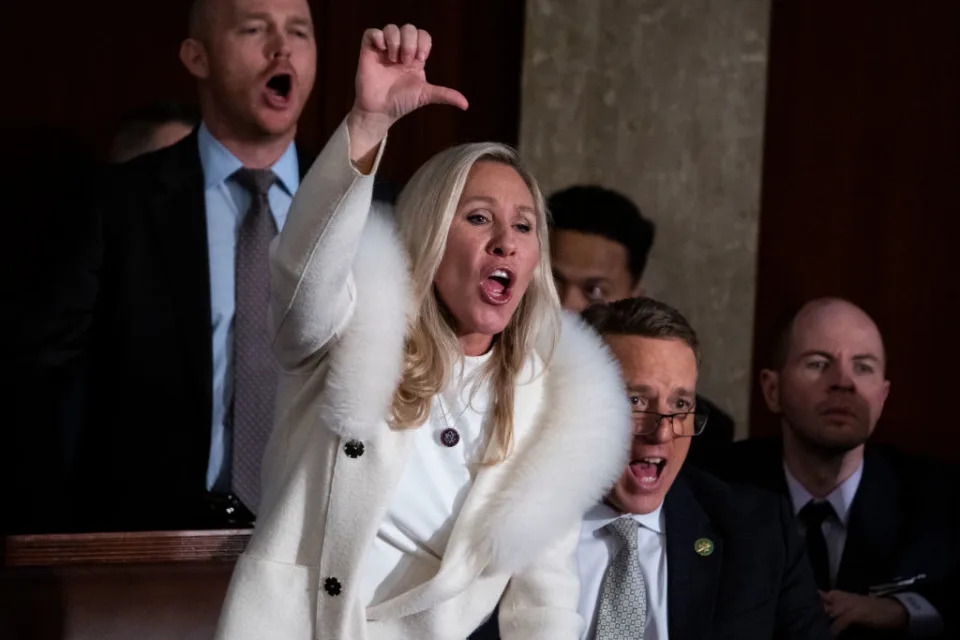
Rep. Marjorie Taylor Greene, R-Ga., yells during President Joe Biden’s State of the Union address in the House Chamber of the U.S. Capitol on Tuesday, February 7, 2023. Credit – Tom Williams—CQ-Roll Call, Inc via Getty Images
When a fur-coiffed Rep. Marjorie Taylor Greene yelled “liar” Tuesday night, among the loudest in an abrupt chorus of boos, the oldest President to ever deliver a State of the Union address didn’t miss a beat. He smiled and went far afield from his script as GOP lawmakers tried to reject his claims that Republicans were ready to gut social entitlement programs.
“Social Security and Medicare is off the books now, right? We’ve got unanimity?” he asked. “Apparently it’s not going to be a problem,” he deadpanned at another moment.
The striking exchange, and Biden’s ease in handling it in front of an audience of millions, illustrated why the Democratic establishment isn’t yet ready to toss their 80-year-old standard-bearer overboard.
Despite a halting, vamped opening to Tuesday’s State of the Union speech—a Super Bowl joke? Why?— Biden proved himself plenty capable of holding his own when his Republican hecklers started to stalk him. In fact, he actually demonstrated how he might be able to troll them into their own self-own status in real time. Give Biden acrimony, he’ll toss back accomplishments. Throw him hostility, he’ll offer hope.
“As my football coach used to say, ‘Lots of luck in your senior year,’” he deadpanned at one point, mocking lawmakers who seemed to think high school was the same as the big leagues of Congress.
Biden baited Greene’s fellow Republicans into pledges of fealty to Social Security. When others pummeled him on the U.S.-Mexican dotted line—”secure the border”—Biden taunted them with an offer to work on comprehensive immigration reform. And when Republicans tried to lay blame at the ongoing drug addiction and overdose crisis at Biden’s feet, he simply asked Republicans if they’d work with him to combat it.
For as much as Democrats are gritting their teeth and girding for the worst when it comes to Biden’s likely 2024 campaign, Tuesday night’s State of the Union gave them reason to hold onto optimism. It wasn’t a robust reason, but it was sufficient. Biden showed he can keep his ground in the face of Republican attack; in fact, he seemed to delight in the heckling that came from the floor of the House. For every “liar”—and worse—that rose from the floor, Biden seemed ready with the rejoinder of his first-term economic record. For every peel of stage laughter coming from his physical left and his political right, Biden stood ready to offer some undeniably impressive facts. And for every protest to his trolling suggestion that Republicans were ready to ditch Social Security, Biden had a taunt right in the margins of his heavy black binder.
Biden’s third joint address to Congress set the tone not just for the next year but also his still-unannounced re-election campaign. Biden laid the trap of bipartisan collaboration as well as anyone in recent memory but also set the timer on some partisan timebombs.
Biden is convinced that he is the only Democrat in the land who can block Donald Trump’s return to the White House and is increasingly itchy to make his 2024 re-election bid real. He has effectively frozen the field of would-be challengers, resetting the nominating calendar in such a way that renders challengers as also-rans. He has never been a strong fundraiser or nurturer of outside moneybags, but the deep-pocketed allies are nonetheless ready to bankroll his efforts to stay in the gig that he has chased since his 20s.
So it’s worth considering Tuesday night’s State of the Union as the prologue to Biden’s next chapter, perhaps the final eighth volume in his Robert Caro-esque chronicle. (For the record, not that I’d write it: the first volume would be the first Senate race; Volume II: his Senate term ahead of the 1988 race; III: his return to the Senate; IV: the 2008 primary: V: his time as Vice President; VI: his time as a free radical from 2016-20; and VII: the last two years, leading us to the present.) Biden holds dear to him the spirit of Irish poets, in that the specter of legacy is always just barely off-stage and always above it. Biden wants wins, and his speech—and the interruptions to it—suggest a measure of confrontation is going to define it.
That said, Republicans weren’t entirely sure that the interludes of heckling and hectoring were useful to their side. In fact, plenty of Republicans groaned in the chamber and groused privately that the likes of Greene managed to make the speech into an interactive experience not terribly dissimilar to the British Parliament’s tradition of P.M. Questions. In public, House Speaker Kevin McCarthy shushed his caucus a number of times as they chucked invectives at Biden. More quietly—but still in view of the public—Utah Sen. Mitt Romney tried to silence a GOP House member who has proven plenty shameful to the brand. Romney—who in 2008 and 2012 thought he would do well to be giving a State of the Union himself as President—told Rep. George Santos that he was an embarrassment. Biden seemed to share that assessment, opting to see Santos and deny him a handshake on the aisle.
Again, Biden mightn’t be the most optimal nominee-in-waiting Democrats have ever had on deck, but he’s hardly the most problematic. And that, right there, is why Tuesday night’s State of the Union leaves a whole of the Democratic Party’s top donor roster less dour than they began their week. It’s also why the ragtag Republican contenders hoping to see a slow, doddering commander in chief ready to be put out to pasture were standing at the starting line with empty hands.
Putin likely supplied the missile that downed flight MH17 over Ukraine in 2014, investigators say
Sinéad Baker – February 8, 2023
Lawyers attend the judges’ inspection of the MH17 wreckage, on May 26, 2021 in Reijen, Netherlands.Photo by Piroschka van de Wouw – Pool/Getty Images
Putin likely gave separatists the missile that hit flight MH17, investigators said on Wednesday.
298 people died when the Malaysian Airlines flight was shot down in 2014.
But prosecutors said they can’t pursue suspects due to the high bar of proof necessary.
Russian President Vladimir Putin likely supplied the missile system that shot down flight MH17 in July 2014, killing 298 people onboard, international investigators said on Wednesday.
The team has been investigating the crash since August 2014, and said in a statement that there are “strong indications” that the Russian president decided on supplying the missile system to separatists in Ukraine.
Investigators have previously said that the Malaysia Airlines plane was shot down by a Buk missile brought from Russia to a field in Ukraine.
They said on Wednesday that the separatists had asked for longer-range anti-aircraft systems and that there is “concrete information” that the separatists’ request was presented to the Russian president, and that this request was granted.
But, they added, it’s not known whether their request explicitly mentioned the missile system that was later used to shoot down MH17.
Nor was it ultimately clear if Putin “deliberately assisted in the downing of MH17.”
The site of a Malaysia Airlines Boeing 777 plane crash near Grabovo in the Donetsk region of Ukraine, July 17, 2014.Reuters
Investigators said on Wednesday that the evidence was not strong enough to formally accuse Putin.
“Although we speak of strong indications, the high bar of complete and conclusive evidence is not reached. Furthermore, the President enjoys immunity in his position as Head of State,” they said in the statement.
Prosecutors also said on Monday that they did not have enough evidence to pursue criminal proceedings against anyone else associated with the crash.
A Dutch court sentenced three men — Russian nationals Igor Girkin and Sergey Dubinskiy and Ukrainian national Leonid Kharchenko — to life in prison last November over the downing of the plane. But the men are still at large.
The plane, a Boeing 777, was flying from Amsterdam, The Netherlands, to Kuala Lumpur, Malaysia. It was shot down over eastern Ukraine, where pro-Russian separatists had taken over parts of the country.