‘Trans people go to dances and find joy and are whole’: A mom’s viral photos of her daughter send a powerful message

Yahoo! Life

‘Trans people go to dances and find joy and are whole’: A mom’s viral photos of her daughter send a powerful message

Beth Greenfield, Senior Editor – February 28, 2023

Jaime Bruesehoff recently shared side-by-side photos of her daughter Rebekah
Jaime Bruesehoff recently shared side-by-side photos of her daughter Rebekah, one at age 10 and one at 16, to show that trans people “find joy and are whole people.” (Photo: Twitter/Jaime Brusehoff)

Rebekah Bruesehoff may only be 16 years old, but she’s spent almost half her life publicly fighting for her rights as a transgender person.

It’s why her supportive, activist mom Jamie took a moment this week to tweet a joyous photo of Rebekah in a green gown and holding white flowers, primped and ready to attend a high school dance — an update to one that went viral in 2017, of Rebekah at a rally holding a sign that read, cheekily, “I’m the scary transgender person the media warned you about.” That image appears alongside the new one.

“There’s this juxtaposition,” Jamie tells Yahoo Life, referring both to the two photos and her daughter’s life. “The photo from six years ago popped up in my memories, and I was struck: It feels so long ago and like it was just yesterday.” When the photo came up, she says, she was at a nail salon with Rebekah, who was getting a manicure before her sophomore cotillion. Sharing both photos, Jamie explains, felt like an opportunity to show a more well-rounded view of her teen, who plays field hockey and loves musical theater.


Image
Image

“She’s spent six years fighting publicly — but she’s also just a teen going to a fun dance,” she says. “That’s so much of what the Twitter thread was about… that trans people go to dances and find joy and are whole people, and that trans people are more than just their fights for rights and for life.”

The original photo of Rebekah, then 10, holding the sign inspired by a story she had found online, was snapped just before a protest in Jersey City, N.J., over the Trump administration rescinding federal support for transgender students. The tween was asked to speak in front of the crowd of 200, which she agreed to, and then her mom posted the image to Facebook, where it “went crazy viral.”

Looking back now, says Jamie, “It’s certainly not what any of us had planned. But what was really powerful was to see her use her voice and say, ‘I deserve a safe school.’ But even more impactful for her was she heard the voices of the other people… trans kids who were not supported, trans adults… it was the first time, at 10 years old, that she realized how good she had it and how much work we had to do.”

That idea, of work left to do, is especially important now, says Jaime on Twitter: “In ways, things are worse than I could have imagined 6 years ago… and yet she continues to resist with advocacy, speaking and education. She resists with her joy, she resists by growing into this beautiful young woman that so many wish she wouldn’t have the chance to become.”

She’s referring to the unprecedented number of anti-trans and anti-gay bills popping up across the country: Just two months into 2023, LGBTQ-rights organization the Human Rights Campaign (HRC) is tracking 340 anti-LGBTQ bills introduced at state levels, 150 of which would specifically restrict the rights of transgender people, 90 of which would prevent trans youth from being able to access gender-affirming medical care; two have become law, in Utah and South Dakota.

“Things are pretty awful right now,” Jaime tells Yahoo Life. “We live in New Jersey … so there’s some privilege and some level of safety that comes with that — and also, you’re not safe anywhere, we know that. My heart breaks for all transgender young people. Their identities are being used as a political football.”

Because Rebekah is an athlete — and luckily having a “really positive experience” on her hockey team — her family “really jumped into” having public conversations supporting transgender athletes, only to see “attacks on health care getting worse by the day,” she says, adding “it’s become very clear” that the anti-trans fight “is not about protecting children. It never has been. It’s about political power and removing transgender people from public life.

“https://www.instagram.com/p/Cm45juJuVbN/embed/captioned?cr=1&v=12

But even in New Jersey, where there are some protections in place — like state’s LGBTQ-inclusive school curriculum and the Babs Siperstien Law, which allows people to change their gender identity on their birth certificate without “proof of surgery” — there’s no way to fully escape the national rhetoric.

“What people don’t understand is that young people are impacted by these messages … They are seeing what’s happening, watching their identity be banned from public conversations in schools,” she says. “People, even in states like New Jersey and New York, know what’s going on. And for a young person to see their identity being debated on every front? That’s exhausting.”

Luckily, the mom notes of her daughter, “Rebekah is a big joy-as-resistance kind of person. She focuses on the positive, has friends, loves to laugh. It’s how she, I think, sustains herself.” She also recognizes her relative privilege: “She’s white, she exists within the gender expectations people have for girls and she has supportive parents who have been behind her and who have resources.”

Rebekah’s glowing spirit, her mom says, has powerfully influenced the entire family — including her “super-supportive” brothers, ages 8 and 13, and her father, a Lutheran pastor who, Jaime says, “preaches the gospel … that calls for us to work towards justice.” She adds that “he preaches the message of inclusion and of celebration of LGBTQ+ people.

“https://www.instagram.com/p/Cncd4buOitt/embed/captioned?cr=1&v=12

But it’s Jamie, who identifies as “queer” and uses “she/they” pronouns (including on her website and social media profiles), who might be most influenced by her teen’s courage.

“I’m bisexual,” she tells Yahoo Life. “I came out more publicly in 2018. I think there was some part of doing this work, of advocating for my daughter to show up in all her authenticity, that started to feel inauthentic for me not to share.” As for her use of she/they, which is new as of about a year, Jamie adds, it’s one way she is “continuing to break down those boxes of gender, and understand myself in the fullness of who I am. ‘They’ feels really great.

“https://www.instagram.com/p/Cnr4xxlOcRJ/embed/captioned?cr=1&v=12

Jamie, who has written a book due out in September — Raising Kids Beyond the Binary: Celebrating God’s Transgender and Gender-Diverse Children, meant to fill a gap wherein there is no guidance about raising “gender expansive kids in faith, when we know it’s people of faith who are doing the most harm” — adds that coming out has been powerful.

“I think with me sharing my identity as a bisexual person and my identity not as nonbinary, but as someone who feels constrained by the gender binary, and I think watching Rebekah live her life as who she knows herself to be and the positive impact it’s had,” she says, “I know that showing up as ourself changes the world.”

Are Cashews Actually Good for You? Registered Dietitians Share What You Need To Know

Parade

Are Cashews Actually Good for You? Registered Dietitians Share What You Need To Know

Emily Laurence – February 27, 2023

Find out how eating them regularly can impact your body.

Trying to get to the end of the debate about whether cashews are good for you can make you feel a little, well, nuts. Similar to potatoes and pickles, cashews are a food there’s a lot of confusion over when it comes to its health benefits (and even what it is—cashews are technically drupes, not nuts).

It’s time to put an end to the questioning. According to both registered dietitian Isabel Smith, RD, CDN and Foodtrainers founder Lauren Slayton, MS, RD, cashews are definitely a nutrient-rich food and have many health benefits.

Related: 11 Types of Nuts to Mix Into All Your Meals (And Get a Little Nutty!)

Cashew Nutrition Facts

First things first: What does the nutritional breakdown of cashews look like? Here’s the breakdown per 1 oz of cashews, per the USDA.

  • Calories: 157
  • Fat: 12 g
  • Sodium: 3 mg
  • Potassium: 187 mg
  • Carbohydrates: 9 g
  • Protein: 9 g
7 Benefits of Eating Cashews, According to Dietitians
1. They provide the body with energy

Half a cup of cashews has roughly seven grams of protein—a key nutrient that provides the body with energy. So if you’re looking for a quick snack to help you push through an afternoon slump or to help your body recover after a workout, a handful of cashews can be a good one to go for.

2. Incorporating cashews into your meal will keep you feeling full longer

In addition to protein, both dietitians say that cashew nuts are a good source of unsaturated fats. Both protein and unsaturated fats are important for satiety. If you have a piece of toast for breakfast, you’ll likely find yourself hungry shortly after. But if you spread cashew butter on it, you’ll be full for longer thanks to these two key nutrients.

3. Cashews are good for your heart

The unsaturated fats in cashew nuts don’t just help with satiety; Smith and Slayton both say that they’re good for heart health too. Smith points to scientific studies showing that a diet that includes unsaturated fats is linked to lower inflammationimproved blood pressure and lower cholesterol.

If you want to incorporate cashew nuts into your diet with the intention of supporting your heart, Slayton says to make sure you stick with unsalted ones, which are lower in sodium.

Related: 25 Foods That Are Good for Your Heart—From Fruits and Veggies to Heart-Healthy Nuts and Seeds

4. Eating cashew nuts supports mental health

“Cashews are a good source of magnesium and eating foods high in magnesium can help those with anxiety or depression,” Slayton says. Sure, snacking on cashews isn’t going to instantly transform your mood, but there is strong science showing a connection between what we eat and how we feel.

5. Cashews are good for cognitive health

There’s another way that cashew nuts support brain health. Slayton says that they contain selenium, a nutrient that’s linked to supporting memory and cognition. “Additionally, they contain phenolic acids that have protective brain benefits and may even decrease or prevent beta-amyloid plaques in the brain,” Smith says. “Plus, they contain different vitamins and minerals, all supporting brain health, including vitamin E, magnesium, copper, and zinc.” Add it to your list of brain-healthy foods, right along with salmon, eggs and berries!

Related: Brain Health Experts Agree That This Is the Absolute Worst Food for Your Mind

6. They help prevent high levels of chronic inflammation

Many of the nutrients in cashew nuts—including their unsaturated fats and polyphenols (a type of antioxidant)—are linked to lowering chronic inflammation, which benefits the body as a whole. High levels of inflammation can lead to a wide range of health problems, including certain cancers, neurological decline and chronic pain, which is why it’s so beneficial to eat a diet rich in anti-inflammatory foods, including cashews.

7. Eating cashews supports digestive health

Slayton says that cashews contain two nutrients that are majorly good for digestion: fiber and magnesium. Fiber is important for adding bulk to stool and keeping the digestive system functioning properly while magnesium is linked to reducing constipation.

The exception to this is if you are sensitive to FODMAPs, foods that are tougher for the body to digest. Smith points out that cashews are a high-FODMAP food so anyone on a low-FODMAP diet should either avoid or minimize their consumption.

Tips for Integrating Cashews Into Your Diet

When shopping for cashew nuts, Slayton reiterates her advice about sticking to ones that are unsalted, which are lower in sodium. Smith adds that it’s also a good idea to avoid cashews that are roasted in oil, as the type of oil used tends to be inflammatory.

Smith also says to avoid bulk bins. “I know they are often more convenient and cheaper, but nuts in bulk bins are consistently exposed to air which can lead to them going bad and oxidizing before you even get to take them home,” she explains.

In terms of incorporating cashew nuts into your diet, there’s no shortage of ways to do so. Cashews can be enjoyed on their own or used as an ingredient in many dishes, including oatmeal, yogurt, stir-fry, chicken dishes and salads. “Cashews have a creamy quality. Soaked and blended cashews are good for plant-based dressings and dips,” Slayton recommends. This is why cashews are often used as the base for many vegan kinds of cheese. You can also find cashew butter at most grocery stores, which can taste delicious on toast, on sweet potatoes or paired with a banana.

However you decide to integrate cashew nuts into your life, your whole body will benefit. Consider the debate on whether or not they’re healthy officially settled.

Study Shows Just 20 More Minutes of These Exercises Can Keep You out of the Hospital

Prevention

Study Shows Just 20 More Minutes of These Exercises Can Keep You out of the Hospital

Madeleine Haase – February 26, 2023

Study Shows Just 20 More Minutes of These Exercises Can Keep You out of the Hospital

New research shows that just 20 more minutes of exercise per day can lower your risk of being hospitalized in the future.

Researchers saw this association with nine health conditions.

Experts offer tips for getting more active.

We all know that exercise is important for your overall health—its benefits go beyond the physical, it’s even essential to your mental wellness. Now, a new study shows that adding 20 minutes more exercise to your day could lessen your likelihood of future hospitalization due to a serious medical condition.

The study, published in JAMA Network Open, used data from 81,717 UK Biobank participants 42 to 78 years old. Participants wore an accelerometer, a type of fitness tracker, for one week (between June 1, 2013, and December 23, 2015) and researchers followed up with them over 7 years. Those participants with a medical history of a condition were excluded from the analysis specific to that condition—so, a person who already had gallbladder disease was excluded from the analysis for that specific condition.

Time spent in sedentary activity (like driving or watching television), light physical activity (like cooking or self-care), moderate-to-vigorous physical activity (ie. walking the dog or jogging), and sleep were estimated using wearable cameras and time-use diaries among 152 individuals in normal living conditions.

After assessing the activity levels of the participants, researchers used a modeling technique to substitute 20 minutes of moderate-to-vigorous physical activity for sedentary behavior. They found that adding only 20 minutes of physical activity proved to significantly reduce potential future hospitalizations.

Further driving the researchers’ point home, higher levels of physical activity were associated with lower risks of hospitalization for the following nine conditions: gallbladder disease, urinary tract infectionsdiabetes (both type 1 and type 2), venous thromboembolism, pneumonia, ischemic strokeiron deficiency anemia, diverticular disease, and colon polyps. Increasing physical activity by only 20 minutes per day was linked to reductions in hospitalization ranging from 3.8% for colon polyps to 23% for diabetes.

Overall, these findings suggest that increasing physical activity by just 20 minutes a day can effectively reduce the risk of hospitalization across a broad range of medical conditions.

Why might exercise help lower the risk of hospitalization?

Exercise and increased physical activity can improve the overall ability to adapt to stressors and decrease frailty, says Dr. Johannes. “It may also reduce the risk of comorbidities, such as ischemic heart disease (coronary artery disease), diabetes, and deconditioning, which can complicate an illness.” Reducing the risk for comorbidities may mean that a medical concern, like a urinary tract infection or pneumonia, may be less severe and in turn, more treatable out of the hospital—therefore preventing hospitalization, he explains.

Since exercise has been associated with a lower risk of ischemic heart disease, it is not surprising that exercise and physical activity are associated with a lower risk of hospitalization due to stroke, which itself is often linked to heart disease, says Dr. Johannes. Exercise can often also improve diabetes management through increasing muscle sensitivity to insulin, so it is not surprising that it is associated with a lower risk of hospitalization due to diabetes complications, he adds.

However, Dr. Johannes explains, it’s important to keep in mind that some of the people who are prone to hospitalization for these certain conditions may have underlying issues that prevent them from being as active, meaning that their lack of physical activity is a result of their medical conditions rather than the other way around.

How can you increase your physical activity?

This study includes walking as moderate to vigorous exercise, so I think this is a great starting point, says Jimmy Johannes, M.D., pulmonologist and critical care medicine specialist at MemorialCare Long Beach Medical Center. “I generally recommend starting out with 10-15 minutes of walking per day, two to three days per week and gradually increasing the time, intensity, and days per week.” For those who have a difficult time fitting exercise into their daily routine, tracking steps with an activity tracker (like on a smartphone or a watch) can help motivate people to stay active by, for instance, taking the stairs instead of the elevator, he adds.

“I recommend getting at least 5,000 steps per day and ideally 7,500 steps or more per day. But in general, something is better than nothing,” says Dr. Johannes.

The bottom line

Exercise can improve strength, balance, energy, mood, cognition, and self-image, says Dr. Johannes. In regard to this new study’s findings, “I think this is more supporting evidence that increased physical activity is associated with better health outcomes. This study provides additional insights about the association between physical activity and lower risk of hospitalization for various conditions that are not typically linked with physical fitness, such as urinary tract infections, gallbladder disease, and pneumonia,” he explains.

At least 150-300 minutes per week is known to lead to a 30-40% reduction in mortality, says Meagan Wasfy, M.D., M.P.H., sports cardiologist from Mass General Brigham. “Exercise can help with risk factors such as blood pressure, blood cholesterol levels, weight management, and type 2 diabetes risk.”

Ultimately, higher levels of physical activity are linked to better long-term health outcomes and decreased risk of hospitalizations for a whole host of conditions across the board, says Dr. Wasfy.

You Might Also Like

In Town Where Train Derailed, Lawyers Are Signing Up Clients in Droves

The New York Times

In Town Where Train Derailed, Lawyers Are Signing Up Clients in Droves

Campbell Robertson – February 25, 2023

A welcome sign on the outskirts of East Palestine, Ohio on Feb. 23, 2023. (Maddie McGarvey/The New York Times)

EAST PALESTINE, Ohio — In the three weeks since a freight train derailed in East Palestine and released more than 100,000 gallons of toxic chemicals, lawyers have poured into the little town, signing up clients, gathering evidence and already filing more than a dozen lawsuits in federal court on behalf of local residents.

They have held information sessions nearly everywhere a crowd can gather, including at a nearby Best Western, at the American Legion hall and in the packed cafeteria at East Palestine High School. Their message overall has been one of warning: It may be months, years or possibly even decades before the derailment’s ultimate effect on people’s health, property values or the soil and water becomes clear.

Further, the lawyers say, early moves by Norfolk Southern, the operator of the train, suggest that getting comprehensive answers from the company will not be easy.

Among a public that is deeply skeptical of official test results — Gov. Mike DeWine, a Republican, and other state and federal officials say they have not shown anything alarming so far — or camera-friendly efforts at reassurance, these warnings have resonated.

The distrust has been deepened by a sense that politicians are not being diligent enough in their response to the disaster; on Friday, President Joe Biden said that he had no plans to visit, although he pointed out that federal officials had arrived there within hours of the crash, and that he was “keeping very close tabs on” the situation.

“They get what’s happening,” Rene Rocha, a lawyer with supersize personal injury firm Morgan & Morgan, said during a state hearing about the derailment Thursday in Beaver County, Pennsylvania, just across the border from East Palestine.

Referring to residents there who had spoken at the hearing about headaches, coughs and other classic symptoms of chemical exposure, he added: “They see they’re not getting the truth from the politicians and the company. That leaves the lawyers.”

Norfolk Southern declined to comment Friday on matters involving litigation.

The huge scale of the chemical burn-off and the harrowing images of the fire, as well as the intense politicization of it all, have made the derailment in East Palestine among the most high-profile environmental disasters in the country in years.

Television cameras are still routine fixtures on the sidewalks of the town’s central street. On Friday night, Erin Brockovich, the famed environmental activist who years ago exposed corporate wrongdoing that polluted drinking water, spoke to a packed town hall at the East Palestine High School auditorium.

The event, billed as an “educational seminar” and organized by a law firm based out of Akron, Ohio, consisted mostly of a detailed presentation by Mikal Watts, a prominent Texas lawyer, about the potential health effects of the derailment and the legal landscape that plaintiffs would be facing. But it began with a short speech from Brockovich to the hundreds sitting in the auditorium and watching an overflow screen in the gym.

“You’re going to be told it’s safe, you’re going to be told not to worry: Well that’s just rubbish,” she said. Of the derailment in East Palestine, she said, “I’ve never seen anything in 30 years like this.”

To some local attorneys, the army that has descended on the town is exasperating. “Did they even know where East Palestine was prior to this accident?” fumed David Betras, a lawyer who has spent his career just up the road in Youngstown, Ohio, and is planning to file a suit on behalf of hundreds of local residents. “They come in with this star power. Like, ‘Oh, Erin’s gonna solve it.’”

On Thursday night, Steve and Kelly Davis sat down in a yet-to-be-opened wine bar a short walk from where the train cars left the tracks nearly three weeks earlier. Thousands of their bees had been found dead after the burn-off, thousands of dollars’ worth of boxes that had housed the bees were now in questionable condition and the reputation of the family honey business was in jeopardy.

Their son, on the verge of buying a house downtown, was suddenly getting a cold shoulder from the bank. No one had come to test their well water. And to top it all off, Steve Davis had developed a cough.

They had come to meet with Robert Till, a Texas-based investigator for the law firm of Cory Watson who for weeks has been meeting people at a table set up in the empty bar. Till has met with hundreds so far, he said, talking with people about their health conditions, learning how their businesses have been affected and asking whether they have cleaned their homes — and if they have held onto the cleaning materials, which he said would contain critical data about contamination.

“I’m putting you guys on for priority testing,” he told the Davises.

“For the water?” Steve Davis asked.

“For everything,” Till said.

The legal machinations are in their early stages. Cases might ultimately be consolidated as class-action or multidistrict litigation; most of the suits will almost surely end up bundled before one or several federal judges in an Ohio courtroom.

Norfolk Southern may offer some sort of resolution voluntarily, whether by setting up a compensation fund with an independent administrator, as BP did after the 2010 oil spill in the Gulf of Mexico, or establishing a court-supervised medical monitoring program, where people could come for free testing related to possible health effects.

The company has already been paying $1,000 in “inconvenience compensation” to people who had to evacuate. Although Norfolk Southern insists that the payments do not curtail anyone’s right to sue, many are skeptical.

Lawyers point to certain moves made by the company — including a letter sent Thursday notifying plaintiffs’ attorneys that they had two days to inspect the rail cars before the cars were removed or destroyed — as signs that it would be combative.

There is no shortage of experience among the members of the plaintiff’s bar arriving in town: Train derailments are not unusual in the United States, nor are oil spills, chemical leaks or industrial accidents.

“It looks like these dadgum railroads would get it right after that many years and stop falling off the tracks, but they just can’t do it,” said Calvin Fayard Jr., a Louisiana lawyer who took the lead in a suit after a train carrying vinyl chloride — one of the substances that spilled and burned in East Palestine — derailed in a small Louisiana town in 1982.

As part of a $39 million settlement arising from the 1982 derailment, a commission was set up to monitor long-term health effects and oversee the decontamination of soil and water. That commission continued its work for more than 30 years, dissolving less than a decade ago, said Fayard, whose law partner has been in East Palestine talking with potential clients.

But a program of that magnitude is never a sure thing. After a train carrying vinyl chloride derailed in Paulsboro, New Jersey, in 2012, a federal judge ruled against any medical monitoring program and dismissed the suit; settlements were ultimately reached in state court.

No sooner had Till signed up the Davises as clients Thursday evening than another couple walked in, keeping him at work. The Davises stepped outside to talk with Michael McKim, the owner of the wine bar, which so far remains on track to open next month.

McKim had met Till in a hotel lobby during the town’s initial evacuation, and had been letting him use his place as an office ever since. This was all new to both couples.

“I feel like a baby seal in the middle of the ocean surrounded by great white sharks,” McKim said. But with as big a shark as Norfolk Southern as the defendant, he said, joining up with a law firm was his best chance. “It’s kind of nice to at least hang out with a shark that maybe understands.”

People Boycott Popular Beer After Producer Breaks Promise to Pull Out of Russia

The Street

People Boycott Popular Beer After Producer Breaks Promise to Pull Out of Russia

It’s not a good look.

Colette Bennett – February 24, 2023

People Boycott Popular Beer After Producer Breaks Promise to Pull Out of Russia

More than 10,000 people are spending their Friday morning on Twitter calling for a boycott of Dutch beer company Heineken.

A tweet featuring an incendiary fan-made image first used the hashtag on Feb. 23, which transformed Heineken’s signature green bottle into pointed bullets and stated “proud supporter of Russian genocide.”

Image

The post also stated: “Heineken launched no less than 61 new products on the #Russian market last year after promising to stop investing there because of the war in #Ukraine.”

Heineken in March 2022 had vowed to pull its business from Russia after the country invaded Ukraine. But an investigative report from Netherlands-based website Follow the Money states that the company’s reports showed its Russian arm “launched 61 new products ‘in record time’ and sold 720,000 hectoliters more beer and soft drinks.”

Heineken was quick to respond to the controversy in a formal statement: “We’re working hard to transfer our business to a viable buyer in very challenging circumstances and we expect at a significant financial loss to the company, amounting to around €300M. 

“In the meantime, our local colleagues at Heineken Russia are doing what they can to keep the business going, after fully delisting the Heineken® brand, to avoid nationalisation and ensure their livelihoods are not at risk.”

Researchers Have Pinpointed One Type of Exercise That Makes People Live Longer—It’s Not What You May Think

Trail Runner

Researchers Have Pinpointed One Type of Exercise That Makes People Live Longer—It’s Not What You May Think

Ali Pattillo – February 24, 2023

If you’re looking to reboot your health this year, you might sign up for your first triathlon, kickstart a meditation habit, or cut down on ultra-processed foods. But the latest science suggests the best way to improve long-term health isn’t physical, it’s social: connection.

Strengthening relationship ties by exercising what experts call “social fitness” is the most influential brain and body hack. Like weight training staves off bone density loss as you age, social fitness counters the downstream effects of chronic stress.

“Not exercising your social fitness is hazardous to your health,” says Robert Waldinger, a psychiatrist and psychoanalyst at Massachusetts General Hospital and a professor of psychiatry at Harvard Medical School.

Waldinger directs the Harvard Study of Adult Development, the longest scientific study of happiness ever conducted. According to the psychiatrist, who recently summed up eighty-plus years of data in his book The Good Life (January 2023, Simon & Schuster), the formula for health and happiness hinges on positive relationships.

“If you regularly feel isolated and lonely, it can be as dangerous as smoking half a pack of cigarettes a day or being obese,” Waldinger cautions.

But even though humans are wired to connect, exercising social fitness can be tricky. There’s no clear roadmap for building–or maintaining–a solid social life.

“Like unused muscles, neglected relationships atrophy,” Waldinger says.

Luckily, Waldinger’s data points to actionable exercises we can all use to supercharge our social fitness.

Studying the Good Life

In 1938, amid the worst economic depression in American history, researchers rounded up 268 Harvard sophomores to better understand how early psychosocial and biological factors influence life outcomes. For over eighty years, a team–now led by Waldinger–has tracked the students and their families, following them through marriages, careers, births, diseases, and deaths. In the 1970s, 456 Boston inner-city residents who were part of another study focused on juvenile delinquency and resilience were incorporated into the Harvard study.

The researchers check in with participants every two years, posing thousands of questions on topics like mood and life satisfaction. Every five years, they take physiological measurements including brain scans and blood work. As of 2023, the ongoing study is still tracking all living members of the original participant set and over 500 members of their offspring. The trove of data provides an unparalleled window into what makes up a good life.

RELATED: Trail Running Might Be the Secret to Happiness – Here’s How You Can Maximize It.

When Waldinger first joined the study as a young psychiatrist at Harvard, he had an inkling that conventional measures of success like achievement, status, and awards were mere distractions on the path to real happiness. As he delved deeper in the data, hundreds of subjects confirmed this suspicion. Across the study, neither wealth nor social class were correlated with happiness levels or longevity. Positive relationships, on the other hand, were consistently linked to happier, longer lives.

Other large-scale data reinforces this link between connection and longevity. One systematic research review from 2010, including over 300,000 participants, suggests people with strong social ties are 50 percent more likely to survive over a given period than those with weak ties. Loneliness and social isolation are associated with immune dysfunction and may even spike the risk of heart attack or stroke by an estimated 30 percent. To help prevent these negative health outcomes, it’s essential to foster social fitness.

What Is Social Fitness?

Scientists have been studying humans’ social psychology in formal labs and universities for over a century, but the idea of flexing your “social muscle,” like you would a bicep or quad, didn’t emerge until 2011. That’s when social neuroscientists John and Stephanie Cacioppo shared results from testing a 10-hour social fitness training program with the U.S. military. The team found that social fitness exercises such as doing someone a favor or practicing conflict resolution reduced loneliness and boosted well-being in soldiers.

While scientists and philosophers had linked positive relationships and optimal health for decades, the Cacioppos and their research team were among the first to suggest positive relationships could be analogous to physical fitness. And just like you can’t remain physically fit without exercising, social fitness–the ability to cultivate and maintain positive relationships– withers without consistent effort.

Social Fitness and the Loneliness Epidemic

When the first Harvard study subjects were in their 80s, Waldinger and his team asked them to look back on their lives and share what they were proudest of. Nearly everyone talked about relationships.

“Almost all said: I was a good parent or a good mentor. I had a good marriage or I was a good friend,” Waldinger recalls. “Almost nobody said: I made a lot of money, I won these awards, or I got to be the chief executive of my organization.”

The team went on to ask subjects: Who could you call in the middle of the night, if you were sick or scared? Some people rattled off a long list. Others couldn’t list anyone.

“That’s real loneliness–this sense that nobody in the world has my back,” Waldinger says. “The costs of that are huge. It makes us feel unloved and unsafe, and eventually breaks down our health.”

In 2023, at the most technologically connected moment in human history, people report feeling farther apart than ever. Forty percent of older adults in the U.S. report chronic loneliness. Add in pandemic-related lockdowns and loneliness has hit record highs, culminating in what Vivek Murthy, physician, and former United States surgeon general classifies as a loneliness epidemic.

“When you lose emotional and social fitness, you lose everything,” says Emily Anhalt, a clinical psychologist, co-founder of Coa, a gym for mental health, and expert on emotional fitness who is not involved in the Harvard Study. “Everything in life is going to feel better if you feel connected to other people to get through the tough things and enjoy the good things.”

Like prescribing a dose of time outside, some physicians go as far to say that encouraging social interactions has the potential to have a healing effect on patients. Emerging data suggests cancer patients have higher chances of survival if they feel satisfied by their levels of social support. Some experts even liken social connection to a vital sign–that measuring people’s loneliness levels hints at general health as accurately as blood pressure or pulse.

RELATED: Women-Only Trail Running Groups Are Key to Growing Female Participation in Trail and Ultrarunning

A Social Cure

To combat widespread loneliness and reap the positive benefits of social connection, it may seem like we’re all supposed to be extroverts or party animals. That’s a common misconception.

Humans are social creatures, but we’re not all social butterflies. Loneliness is a subjective experience. It’s not about the quantity of friends or family you have, but how fulfilling those relationships feel. The antidote to loneliness for some may entail a vast social network, while a few close relationships work for others.

Anhalt says people should treat social fitness proactively. Rather than wait until they feel isolated, people should regularly nurture their social life, which elevates mental well-being by default.

“Our culture’s way of thinking about mental health is very reactive–we make people feel like they have to wait until things are falling apart to get support.” To Anhalt, that’s like waiting until you have early signs of heart disease to do cardio. “I want to help people think about working on their mental health more like going to the gym and less like going to the doctor.”

To exercise your social fitness, try this training plan outlined by Waldinger in his new book, The Good Life:

Map Your Social Universe

To kickstart social fitness, start with self-reflection. Like completing a basic strength training circuit to pinpoint weak muscle groups, the following mental exercises can reveal your shaky social muscles. First, in a journal or notes app, outline how you are devoting your time weekly, and to who. Then ask yourself: What am I giving and what am I receiving? Am I having enough fun with loved ones? Am I getting enough emotional support? Waldinger suggests taking this comprehensive social evaluation annually, maybe every new year or birthday.

Strengthen Keystones of Support

Rather than aim for a total social rehaul, focus on improving the valued relationships you already have. An easy way to do this is by asking loved ones: Is there anything I can do better in our relationship? Can I communicate differently, or should we spend more time together? Based on their answers, tailor your communication or quality time to benefit your inner circle.

Build Routine

A great way to level up–and maintain–healthy relationships is by scheduling regular contact, virtual or in-person. Pencil in a weekly coffee date with a mentor or plan a monthly Zoom call with high school friends. Remove some of the logistical barriers that make connecting feel like a chore. There’s no exact rep of weekly social interactions to hit. For some, one or two a week will suffice, while others may want to schedule daily opportunities for connection. Reflecting on how these interactions make you feel–energized or drained–can help you find your sweet spot.

Create New Connections

One exercise to keep your social muscles in good shape is by expanding your network. But making friends in adulthood isn’t as easy as it once was on the playground or soccer pitch. A surefire way to connect with someone new? Get involved in something you care about. If you love cross country skiing in winter, join a local club. If you enjoy getting your hands dirty outside, volunteer at a local community garden. These activities provide an immediate conversation starter with those who have similar interests. If you’re worried that no one would enjoy your company, volunteer your time to those who may be lonely like the elderly. Forging new connections at an older age may feel impossible– like running a marathon after years spent jogging 5Ks– but the effort leads to major benefits. Friendship shapes mental health and in turn, our physical well-being.

RELATED: Local Running Stores And The Power Of Community

Do Emotional Push-Ups

And here’s a bonus tip from Anhalt: Do “emotional push-ups.” These include striking up conversations with strangers, saying thank you, or accepting compliments without deflection. Start small–Practice one or two emotional push-ups weekly. While there’s no shortcut to social fitness, regularly flexing your social muscles will add up to stronger relationships over time.

Ukrainian soldiers with life-changing war injuries posed for portraits saying they are ‘living monuments’ of a brutal war

Insider

Ukrainian soldiers with life-changing war injuries posed for portraits saying they are ‘living monuments’ of a brutal war

Mia Jankowicz – February 24, 2023

A photo by Marta Syrko of Ukrainian soldier Sasha, whose lower legs were amputated. Sasha, lying on his side and propped up by one elbow, is naked except for a strip of cream cloth over his loin, and looks down. He is muscular, has multiple tattoos and is bathed in a pearly, blue-and-cream light.
Oleksandr lost both his lower legs to a Russian missile.Marta Syrko
  • Ukrainian photographer Marta Syrko has asked war-injured soldiers to sit for her.
  • Oleksandr, who lost his lower legs, said he wanted to show that injured bodies can be powerful.
  • The pictures, both stark and tender, are a reminder of the human cost of Putin’s war.

Last summer, 26-year-old Oleksandr was resting in a trench.

Exactly six months earlier, he had been working as a barista while he trained in graphic design. But after Russia invaded, he became a leader in a mortar batallion.

He was exhausted. The safest place to rest would have been under tree cover along with his squad, but there was no more room there. So he drifted off in the trench.

The next thing he knew he was buried in soil, his legs in excruciating pain. After his friends had scrabbled through the earth, they laid him on his front, not wanting him to glimpse his legs.

It was August 24, Ukraine’s independence day, and Ukrainians suspected Russia would seek grim trophies.

Oleksandr’s lower legs were later amputated.

He told Insider he accepted his injuries “from the first moment” the missile hit him. (He spoke to Insider through an interpreter.)

So when photographer Marta Syrko asked Oleksandr to sit for her, he felt he could send a message with his body: among other things, to show the world the carnage Putin is inflicting and the cost of defending his country.

‘We need an artist, not just a photographer’

One of Syrko’s main subjects is bodies. A skim through her Instagram feed shows the human form in all its glory, from an advertising-perfect washboard stomach to the soft millefeuille creases of her grandmother’s skin.

After Russia’s invasion, however, more and more people were returning to her hometown of Lviv with life-changing wounds.

So she approached a rehabilitation clinic near the city to ask if any of the soldiers — whose bodies had been radically transformed by war — would let her take portraits of them.

Four men agreed, three of whom lost limbs and one who received serious burns.

A black-and-white photo by Marta Syrko of Sergiy, Ukrainian soldier who lost his left lower leg. He is sitting up in a chair, mostly unclothed with tattoos on his torso, and his prosthesis visible. He looks down at a baby swaddled in a white cloth that partially covers him. Part of the foreground is blurred.
Serhii agreed to become one of Syrko’s “Heroes.”Marta Syrko

Among the soldiers was Serhii, pictured above cradling his second child, who had his leg torn off in the shockwave of a blast near Izyum, in Kharkhiv Oblast.

Another, Stanislav, also lost a leg last summer, in Bakhmut — one of the most fiercely contested cities in the entirety of Russia’s bloody war.

Syrko said she was inspired by the classical statues she saw in museums like the Louvre.

Foundational for Western art history, they, too, through wear and tear, are often missing limbs.

A photo by Marta Syrko, of Ilya, Ukrainian soldier who was badly burned. A top-down view shows his bare white legs, one bent sideways at the knee, and his lower arms, both partially burned. He wears a red cloth and sits on a grey floor with dark blue paint marks.
Illya Pylypenko received severe burns in a tank.Marta Syrko

Later, Neopalymi, a charity devoted to treating and rehabilitating people with severe burns, approached Syrko with a request. They asked her to photograph Illya Pylypenko, a soldier who had burns on much of his body after his tank caught fire.

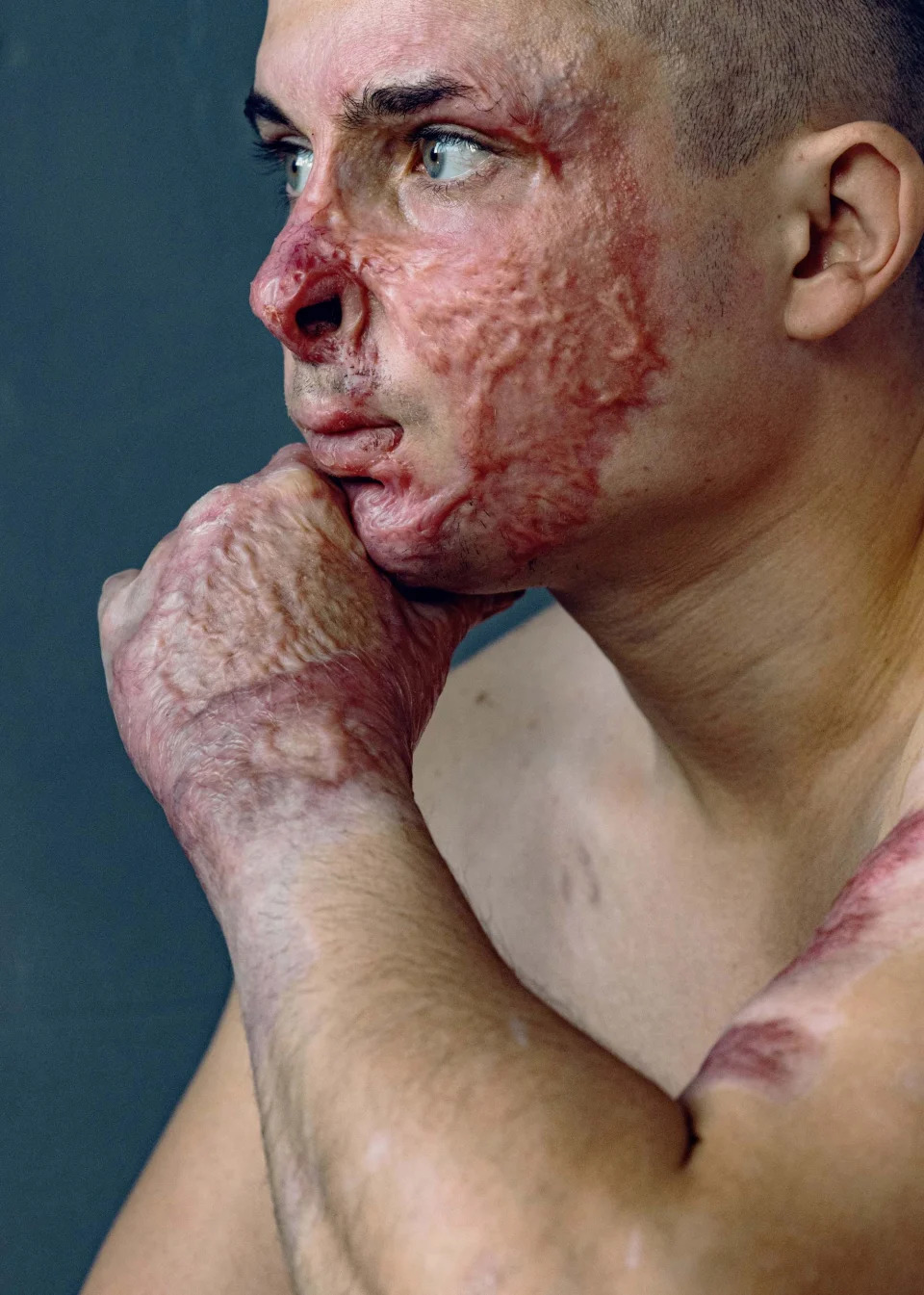
Syrko’s unflinching photos of Pylypenko show how his face, in particular, was transformed.

A photo portrait by artist Marta Syrko of Ukrainian soldier Ilya, who was badly burned. Ilya is seen topless in a three-quarter view, chin in hand, looking ahead. Skin on his hand and arm, and much of his face, is badly damaged with red-colored burns on his otherwise white skin.

Neopalymi, a burns rehabilitation center, asked Syrko to photograph Illya Pylypenko.Marta Syrko

Maksym Turkevych, Neopalymi’s CEO, told Insider in an email that the project needed “an artist, not just a photographer.”

‘We don’t know what to say. How to behave.’

Syrko’s work has many fans, but she said she’s had occasional comments from people who say she’s exploiting disabled people through her work.

Asked about this, Syrko — who is able-bodied — said her aim is to make a real and complex discussion happen.

“It’s a hard question for Ukrainians now, because we don’t know how to act near them,” she said. “We don’t know what to say, how to behave. And so that’s why we have to discuss it.”

A photo by Marta Syrko of Stanislav, Ukrainian soldier whose right lower leg was amputated. He is seen bathed in golden light through wet glass, wearing a cloth round his waist, sitting on the floor. One knee is up, while his amputated leg rests on the ground. Stanlislav rests his forehead on his arm, propped on his raised knee.
Stanislav also lost his lower leg.Marta Syrko

For Oleksandr, the decision to become a “monument” for Syrko’s photos, as he put it, was a deliberate choice that he embraced.

He liked Syrko’s thinking about statues, saying in an Instagram post that people like him are “living monuments, who have been close-up witnesses to war.”

A closely-cropped black-and-white-photograph by Ukrainian photographer Marta Syrko, showing soldier Serhii and his son. Serhii is seated and unclothed except for long bands of white cloth, under which his tattoos can be seen. He looks down at his baby son in his arms. In the lower half of the picture, his prosthetic lower leg is visible.
Serhii, pictured here with his son, lost part of his leg near Izyum.Marta Syrko

But public attitudes can be disappointing, even though he was injured defending their homeland, he said. People “look away, and they break into lively talk when ‘monuments’ walk past.”

Society, he said, stops seeing these bodies as beautiful.

“I wanted to become something that would inspire others like me to feel that people are looking at them not with shame, but with exaltation!” he wrote.

This was Neopalymi’s goal, too. “The main reason for us to do it is to show the society that there is a beauty in it, and that they should not be scared or disgusted by this,” said Turkevych, the CEO.

A photo by Marta Syrko of Ilya, Ukrainian soldier who was burned in combat. A closely-cropped overhead view of his hand, red with burn marks, as well as part of his thigh, other hand, and a swathe of red cloth.
Syrko’s unflinching images of Illya show the effects of his burns.Marta Syrko

With a 122,000-strong Instagram following, Syrko said she had conversations with her subjects about the exposure the pictures could bring.

“I told them that they are probably going to be a little bit popular,” she said. And so they turned out to be — her pictures have been shared by the Ukrainian Ministry of Foreign Affairs’ Twitter account, and by newspaper Ukrainska Pravda.

Oleksandr told Insider, laughing, about his surprise when he arrived at the studio and realized that Syrko wanted him to pose nearly nude.

But he quickly got comfortable. “Marta’s the kind of person with whom you can feel comfortable and free,” he said.

Rebuilding an accessible Ukraine

Oleksandr spoke to Insider from the US, where thanks to a partnership with Ukrainian organization Without Restrictions, he has been undergoing intensive rehabilitation.

There, he’s learning to walk and run on high-tech prostheses. But for some weeks before he flew out, he was using a wheelchair.

A photo by Marta Syrko of Stanislav, Ukrainian soldier whose right lower leg was amputated. He appears to have been photographed through gauzy white fabric, seated on the floor with his right knee up, arm resting on it. Mostly unclothed, his waist is wrapped in white fabric.
Syrko photographed Stanislav in her contemplative artistic style.Marta Syrko

While the Ukrainian government has not confirmed exact numbers of casualties, the number of people with life-changing injuries — whether civilian or soldiers — is likely to make accessibility a key concern for the country’s future.

It’s a realization echoed by disability organizations supporting relief efforts in Ukraine, who at a joint conference last year issued the Riga Declaration, a document calling for the country’s rebuilding to employ universal design principles.

“A lot of cities are in a rebuilding phase,” Syrko said, envisioning a new, post-war Ukraine. “We can start to build it from zero — why can’t we do it correctly?”

Republicans pushing a plan to remove you (yes, you too) from Arizona’s voter rolls

AZ Central – The Arizona Republic – Opinion

Republicans pushing a plan to remove you (yes, you too) from Arizona’s voter rolls

Laurie Roberts, Arizona Republic – February 24, 2023

Voters wait in line at a polling station at Mesa Community College in Mesa, Ariz. on Election Day.

In August, the attorney general of Arizona wrapped up his investigation into the Cyber Ninjas’ claim that hundreds of dead voters cast ballots in the 2020 election.

To the surprise of absolutely no one, braindead or alive, Attorney General Mark Brnovich concluded that the Senate’s vaunted auditors didn’t know what they were talking about. There was no vast graveyard full of dead voters determined to deny Donald Trump his due.

Not even so much as a small crypt of conspiracy.

So naturally, there’s a bill in the Arizona Legislature to take care of this nonexistent problem … by cancelling your voter registration.

I am not making this up.

Senate Bill 1566 would wipe Arizona’s voter rolls clean every 10 years, requiring millions of Arizonans to re-register to vote.

It is but one of the dozens of kooky bills born of MAGA zealots and their absolute refusal to consider the fact that maybe they are losing statewide races because their candidates just aren’t acceptable to a statewide electorate.

Both the Senate and House election committees are chaired by election deniers.

The chairwoman of the Senate Elections Committee is Sen. Wendy Rogers of Flagstaff, who wanted to decertify the 2020 election and regularly calls for the arrest of elections officials. After being tapped by Senate President Warren Petersen to run point on election bills this year, Rogers vowed to engineer a do-over of Maricopa County’s 2022 election, though it seems more like a fundraising gimmick than an actual plan.

The chairwoman of the House Municipal Oversight and Elections Committee is Rep. Jacqueline Parker of Mesa, who, like Rogers, was a co-sponsor of then-Rep. Mark Finchem’s 2022 proposal to decertify Arizona’s 2020 presidential election. Her panel is packed with election deniers.

Every week, we are treated to veritable buffet of bad bills designed to fix problems that exist only in their fevered imaginations.

There’s a bill to do away with early ballots, the voting method of choice by 8 in 10 voters.

There’s a bill to ban ballot tabulators, never mind that hand counts are considered less accurate and more expensive. Or that a hand count of up to 70 races on 3 million or more ballots is likely to last until Christmas.

There‘s a bill to ban unmonitored ballot drop boxes out of some undocumented fear that Eeyore is lurking about and another to return to voting in precincts, never mind it leads to more voters being disenfranchised when they show up to the wrong place to vote.

There’s a bill that would require elections officials to post online the name, year of birth and address of every voter and another that would allow representatives of the Republican and Democratic parties to challenge your signature on an early ballot.

Then there is SB 1566, requiring you to reregister every 10 years if you want to continue exercising your constitutional right to vote.

In pushing the bill, Sen. Sonny Borrelli, R-Lake Havasu City, noted that he decided to look into the issue after the Attorney General’s Office spent “thousands of hours” investigating claims of dead voters.

“So I had my audit team go through voter registrations on dead voters and bounced that against the people that voted,” he recently told the Senate Elections Committee. “They looked at 30 ballot envelopes. Within 45 minutes they found 17 people that somehow voted after they died.”

Fifty-six percent? Clearly, our elections are being determined by those whose forwarding address lies somewhere near the Pearly Gates … or perhaps a good ways south of there.

Curiously, Borrelli didn’t mention the findings of the Attorney General’s Office after all those hours of investigation.

The ninjas, as part of their five-month audit of Maricopa County’s election, reported that 282 dead voters cast ballots in the November 2020 election. The AG’s Office then said it spent hundreds of hours investigating those claims.

The conclusion: 281 of those 282 voters were alive and kicking when they cast ballots.

Our agents investigated all individuals that Cyber Ninas reported as dead, and many were very surprised to learn they were allegedly deceased,” Attorney General Brnovich wrote in an August letter to then-Senate President Karen Fann.

AG investigators also checked out four other reports of up to 6,500 supposedly dead people who either cast ballots or were on the voter registration rolls. They came up with “only a handful of potential cases,” all of them isolated instances.

Yet another conspiracy gone kaput – consigned to the graveyard of crazy to rest in peace alongside Sharpies, green buttons, bamboo ballots, hacked machinery and all the other supposedly nefarious ways in which Arizona’s 2020 election was stolen from Donald Trump.

Only to rise again in the Senate Elections Committee, and to heck with federal law.

The National Voter Registration Act outlines how and when a person’s name can be removed from the voter rolls, for example if he or she requests it or moves or dies.

The act also requires states to make “a reasonable effort to remove ineligible persons by reason of the person’s death, or a change in the residence of the registrant outside of the jurisdiction.”

I’m guessing a wholesale wipeout of every Arizonan’s registration every 10 years might be considered a tad, I don’t know, unreasonable?

“It violates federal law,” Jen Marson, of the Arizona Association of Counties, warned the committee. “It’s totally in conflict with NVRA.”

Even some Republicans were queasy about the proposal. Sen. T.J. Shope, R-Coolidge said he doesn’t view the bill as legitimate. Sens. Ken Bennett, R-Prescott, and John Kavanagh, R-Fountain Hills, agreed.

Then all three voted yes and the bill passed on a party line 5-3 vote.

Voters may not be dead but when it comes to the state Capitol, common sense is a goner.

Support local journalism: Subscribe to azcentral.com today.

What’s the best way to leave your house to your heirs?

Next Avenue

What’s the best way to leave your house to your heirs?

Carmen Cusido – February 24, 2023

The most important thing is to determine whether to transfer the home during your lifetime or after death.
Time passes and estate plans need updating — decide now what you want to do with the family home after you are gone — and then write it down and update as necessary. ISTOCK

This article is reprinted by permission from NextAvenue.org.

Francesca Maresca, 54, of Highland Park, New Jersey, had spoken in passing to her father, John, about whether he had an updated will. It was only when he died at 89 of congestive heart failure in September 2020 that she and her sister, Catherine, learned that he kept their late mother’s name on the deed to the family home and they, rather than their stepmother, had inherited the house.

The sisters sold their childhood home soon after the deed was transferred to them. “There was no squabbling over things,” Maresca said. “I recognize that’s rare.”

Indeed, homeowners who die before they decide and document what they want to do with their property can leave their relatives with a legacy no one wants: a protracted legal fight over what to do with the family home and the possibility of a substantial tax liability.

What is at stake?

Much is at stake. Cerulli Associates, a research and analytics firm in Boston, estimates that $84.4 trillion in personal wealth will be transferred from one generation to the next between now and 2045.

Most of it — more than $53 trillion — will come from baby boomers, people born between 1945 and 1964; another $15.8 trillion from people born before 1945. Primary residences represent more than 70% of that wealth, according to one estimate.

Members of Generation X — people born between 1965 and 1980 — stand to inherit the greatest portion of that transfer — $29.6 trillion over the next 25 years, including $8.9 trillion in the next 10 years, according to Cerulli. The millennial generation, which consists of people born from 1981 to 1996, are expected to inherit more than $27 trillion by 2045.

Such sums suggest why it is important for people to waste no time in deciding how they wish to distribute their assets — particularly their homes.

Weigh your options

You can transfer a home or other property while you’re still alive, but Lazaro Cardenas, an estate lawyer in Freehold, New Jersey, said a drawback in doing so is that if your heirs are sued or otherwise get in trouble with the law, the property can be seized if it’s not adequately insured.

Additionally, by selling their house to their child or children, parents will lose the mortgage-interest deduction on their income tax return.

However, selling your house can generate cash that you may need for nursing care and other medical expenses late in life.

“If you bequeath the property in your will, one of the benefits is you can maintain control of your home until you die,” said Cardenas, a partner at Patel & Cardenas. “The drawback is that end-of-life care becomes expensive and usually is not covered by insurance.”

See$3,000 a week? The enormous cost of care for elderly loved ones that nobody warns you about.

Cardenas added that if you apply for Medicaid to cover end-of-life expenses, the agency could consider your house as your asset if you sold it to your heirs within the previous five years.

“One solution is to sell your property to your child but create a deed that states you’re allowed to live in the house until you die, even if your child or children are now owners,” Cardenas said.

Don’t miss: ‘I feel heartbroken’: My father refinanced my late mother’s house, even though she wanted it to be divided among all the family. What recourse do I have?

Consider a trust

Another option is to place the property in a trust. That way, when you die, the property passes to the trust and the trustee then owns the home. The benefit here is the heir does not have to go to probate court after the last parent dies, Cardenas explained.

“Ultimately, you can leave your property to a child, all your children or none,” he added. “However, in a state like New Jersey, you cannot disinherit your spouse.”

Robert “Bob” Keebler, a Certified Public Accountant based in Green Bay, Wisconsin, with clients all over the world, advises parents to get ahead of potential arguments and create separate trusts for each child if there’s a lot of money involved.

“Lawyers bring CPAs in to get the math right so that there’s a clear delineation of what a client wants to accomplish from an economic standpoint,” Keebler said.

Potential hazards

He gave an example of a case he worked on where a man wanted his business to go to one of his children and the other child to inherit an equal amount of property.

“In this case, Child A must pay a little bit into the business so that it’s mathematically equal to what Child B gets,” Keebler added.

Other cases, though, are more complicated. For instance, children from a first marriage may have an issue with a stepparent or that stepparent’s children inheriting assets.

“As CPAs, we’re doing the tax work and projections on the settlements to defuse the situation with the least amount of tax for the group taken as a whole,” Keebler said. “We have clients who we help while they’re alive, but I sometimes get brought in after someone dies, when people start to understand what’s going to whom.”

The most important thing a person needs to determine is whether to gift their assets during their lifetime or after death.

The benefits of giving

“There are benefits to giving gifts during your lifetime,” Keebler said. “This is where you need to lay out a balance sheet and your goals and work with your accountants to structure your estate best.”

He added that giving real estate to your heirs while you are still alive can reduce the tax they will have to pay.

Inheriting money or other assets can bring up a lot of emotions, even when there are wills and trusts in place.

Jacquette M. Timmons, the president and CEO of Sterling Investment Management in New York City, said there’s often a sense of overwhelming responsibility from someone who inherits a home or a large sum of money. “There’s a sense of grief; you wouldn’t have this house or money if the person had not died,” she said. “Many want to ensure they’re a good steward of what they’re left with.”

Timmons advises her clients to wait at least a year before they make a big decision, like selling a home. “Time and distance bring clarity,” she said. “But I recognize that waiting before deciding is a privilege that few have.”

Instead of emphasizing death when working on wills and trusts, Timmons encourages her clients to view these legal documents as leaving a legacy.

Also see: What happens to my youngest daughter’s share of my estate if I die before she’s 18?

Leave a legal love letter

“When someone has invested the time to put together an estate plan and say what their wishes are, that’s an incredible gift for the people left behind,” Timmons said. “They don’t have to worry about piecing things together. They can leave their loved ones with a full road map of what they’d like done. To me, that’s a love letter you’re leaving someone.”

In Maresca’s case, she and her sister spent two months cleaning their inherited home in Saddle River, New Jersey. They donated most of its contents. The three-bedroom, one-bathroom house went on the market in November 2021, and the sisters had 40 offers.

“We decided in about 10 minutes” Maresca said. “We went with the least amount of work; the investor who made a cash offer.” After the sale closed on Dec. 21, they split the proceeds evenly.

Maresca said the experience taught her the importance of communicating her wishes to her teenage son and establishing a trust in his name.

Carmen Cusido earned a bachelor’s from Rutgers University and a master’s degree from the Columbia School of Journalism. Her work has appeared in Newsweek, Oprah Daily, Refinery29, Health, NBC, CNN, NPR, Cosmopolitan, and other publications. 

This article is reprinted by permission from NextAvenue.org, Twin Cities Public Television.

More from Next Avenue:

I spent a night at The Nuthouse and glimpsed the future of the Michigan Republican Party

Detroit Free Press

I spent a night at The Nuthouse and glimpsed the future of the Michigan Republican Party

M.L. Elrick, Detroit Free Press – February 23, 2023

LANSING — Reporters at last year’s Michigan GOP endorsement convention received credentials with “Whitmer protection team” printed on them.

This year, the candidates for party chairperson should have “Democrat protection team” printed on their credentials.

If you think I’m just provoking pachyderms, consider the literature long-shot chairman and co-chair candidates Kent Boersema and Orlando Estrade distributed at the Lansing Center Saturday. The headline under a photo of the dynamic duo shaking hands says: “AT LEAST WE DIDN’T LOSE STATEWIDE.”

That’s a shot at Matt DePerno and Kristina Karamo, the frontrunners in the race to run the state Republican party. DePerno lost his race for Attorney General by nearly 9 percent in 2022 and Karamo lost her race for Secretary of State by nearly 14 percent (though she still won’t admit it). Neither were prodigious fundraisers. And many GOP stalwarts who deserted the party in 2022 have said they won’t come back until the anti-establishment, election-denier flames fanned by DePerno and Karamo burn out.

More:Kristina Karamo elected chair of Michigan Republican Party

Perhaps choosing to laugh to keep from crying, Boersema and Estrada’s cheeky flyer also refers to the Democrats’ 2022 takeover of the Michigan House and Senate.

“We lost everything already…” Boersema says at the bottom of the flyer, setting Estrada up for their pitch to take over the party: “… what do you have to lose?”

The back of the flyer goes on to steal lines from two Will Ferrell comedy classics. “Everybody love everybody!” from “Semi-Pro” and “If you’re not first, you’re last!” from “Talladega Nights.” Then Boersema and Estrada endorse ballot harvesting — a scheme Republicans accuse Democrats of practicing — and “improving engagement with people who live in ‘blue’ areas.”

But, unless you’re a Democrat, there’s nothing funny about the state of the once-mighty MIGOP.

As recently as 2018, Republicans boasted a governor, Speaker of the House, Senate Majority Leader, chief justice of the state Supreme Court and a dramatic photo-finish victory in the election that made Donald Trump president.

Since then, party infighting and an influx of activists who are so suspicious they don’t even trust other Republicans have left the GOP in such disarray that they picked a ponderous process for counting ballots at the Saturday convention, eschewing a machine count for a hand-count, even though the hand counts they performed after the machine counts at their last convention showed no errors (and not just because Hugo Chavez or Cesar Chavez or Cesar Romero or caesar salad really IS dead and consequently unable to secure the WiFi access required to manipulate Dominion voting machines, which it turns out even Tucker Carlson didn’t believe were rigged, even though he would never admit it on Fox News).

Even though party leadership changes should bear the same warning as investment opportunities — “past performance is no guarantee of future results” — I suspect Democrats were more interested Saturday in the outcome of the Michigan State-Michigan basketball game than who won the race to run the state Republican Party.

I’m not making this up

Stop me if you’ve heard this one before: A reporter walks into a bar hoping to meet a sore loser from Arizona who claims without evidence that she won the governor’s race and who agreed to fly to Michigan to headline a shindig hosted by two losers who say they can turn their party into a winner.

Before you answer, there’s more: The star of the show cancels at the last minute after yet another court found no evidence she won, leaving guests to once again stand in line for photos with Mike Lindell, the My Pillow guy, who seems to turn up at every MIGOP event and who still thinks Donald Trump was cheated in 2020, even though there’s no evidence Trump won.

And it all went down at a bar called The Nuthouse.

DePerno, who won failed Arizona Republican gubernatorial candidate Kari Lake’s endorsement and promoted her visit to the Nuthouse, referenced her setback with an Arizona appeals court when asked Saturday why she did not show up to support him and his running mate, Garrett Soldano. DePerno said he understood, but was not happy about it.

Lake spokesman Ross Trumble told me in a text late Saturday that Lake had a previously scheduled event in Mohave County “and it became logistically impossible to make it to the GOP Convention.” He said she “tried every angle to find a flight that would work but it unfortunately didn’t work out.“ Trumble did not respond to a follow-up inquiring why Lake scheduled an event in the desert when she was supposed to be freezing her butt off with us here in Lansing.

With Lake AWOL, fellow failed gubernatorial candidate Soldano spent most of Friday evening holding down the fort at the Nuthouse and mugging for photos with Lindell and Republican delegates.

Meanwhile, longtime Republican operative Scott Greenlee packed delegates into The Studio at 414, a spacious entertainment venue a few doors from the Nuthouse on Michigan Avenue. The highlight of the night was a video of Ted Nugent endorsing Greenlee. The sound quality was poor, but at least anyone who came to see Terrible Ted didn’t leave terribly disappointed.

I couldn’t find where Karamo was huddling Friday night, but there were more than a few people who enjoyed the free drink tickets and appetizers DePerno and Soldano provided who told me they might vote for Karamo on Saturday.

It could have been a bit of foreshadowing, or a sign that the way to a delegate’s heart might not be through their stomach. Or it could finally give DePerno something worth investigating.

The beauty contest

Delegates arrived at the convention center around 9 a.m. Saturday to cast their votes. But first there was a three-hour debate about a proposed rules change that was so convoluted you would hate me for explaining it, even if I understood it well enough to explain.

So let’s get to the good stuff!

By the time candidates got their turn to take the stage, the field had shrunk from 11 to nine. And we started with a bang.

Scott Aughney scolded delegates for missing opportunities to pick up votes in urban areas. He said he was worried about the future of the party.

“I look at the faces of you and I don’t have a lot of hope,” he said, calling the thousands of delegates “soulless” and only receiving applause after cutting his speech short and storming off stage.

Not long after, state Rep. Angela Rigas of Alto, who complained while nominating DePerno that Democrats had cut off her microphone on the House floor, had her mic cut off by Republicans for talking too long.

Other candidates emphasized their Christian faith, their commitment to reverse the GOP’s losing streak, and their disdain for the party’s traditional leadership. Drew Born disclosed that he slept with four things next to his bed: A Bible, the Constitution, his marriage certificate and a gun.

DePerno didn’t speak, instead showing a video featuring Trump. Karamo told delegates the party “operated like a political mafia,” guided by its “own self-serving agenda.” She did not offer specifics beyond saying that the state GOP was run like a “private social club.”

Then instead of looking forward, she looked back.

“There’s a reason I did not concede the 2022 election,” Karamo said. “Why would I concede to a fraudulent process?”

Again, she offered no specifics.

Sometimes it’s what’s not said that speaks volumes.

The one thing the candidates and their nominators all had in common is that none of them mentioned the massacre at Michigan State University, even though it happened less than a week ago and less than four miles down the road from where they were choosing new leadership and a new direction — if you consider denying election results and worrying about Trump a new direction.

The Donald Trumped

For a guy who promised Republicans that they would get sick of winning, Trump has got to be getting pretty sick of losing in Michigan.

After helping DePerno and Karamo win the GOP nomination for attorney general and secretary of state in 2022, he favored DePerno over Karamo for party chair in 2023. He recorded a videosent a letter hailing DePerno as “the only candidate running who can get the job done” (oops!), proclaimed “I cannot think of anybody who I trust more and look forward to working with and WINNING than Matt” (double oops!), and held an online rally Monday for DePerno.

In a moment unimaginable just six months ago, former state Rep. Terence Mekoski of Shelby Township told delegates as he endorsed Karamo that he loves Trump, Lindell and Nugent, but added: “Do they really know Michigan, and do they really know you delegates?”

About 15 minutes later, Greenlee told delegates: “I love Donald Trump. But as chairman, I don’t work for Donald Trump.”

While other candidates littered the convention hall with signs, literature and free t-shirts, Karamo just soaked up votes.

She led the pack after the first vote but, because she didn’t get to 50 percent, the field was winnowed down to the top three vote-getters. Karamo led DePerno and Greenlee after the second round. The third, and final, round came down to Karamo and DePerno. Karamo crushed her former ally 58-42. (In a refreshing twist, neither candidate alleged irregularities or election fraud.)

If there was any doubt true believers are now in charge of the state Republican Party, Karamo dispelled it in her brief victory speech.

“I am nothing without Jesus. I am a nobody without Jesus,” she said. “We will not betray you, we will not lie to you. We are committed to every promise that we made.”

There are many challenges facing Karamo, from uniting the party, growing the party and raising money to recruiting candidates.

While workers swept the convention floor, Jeff Sakwa, a former state Republican party co-chairman, told my colleague Paul Egan the event was “the Super Bowl of election deniers.” He predicted donors would stay away.

But the biggest challenge Karamo faces may be what to do if it turns out she really was elected Secretary of State.

If that happens, perhaps Governor Lake will finally make that trip from Arizona to the Nuthouse to help swear her in…

M.L. Elrick is a Pulitzer Prize- and Emmy Award-winning investigative reporter and host of the ML’s Soul of Detroit podcast