Florida choking on the poison: DeSantis, GOP lawmakers ready for Culture Wars 2.0 as Florida Legislature convenes

Miami Herald

DeSantis, GOP lawmakers ready for Culture Wars 2.0 as Florida Legislature convenes

Lawrence Mower – March 5, 2023

Daniel A. Varela/dvarela@miamiherald.com

When Florida lawmakers met for their annual legislative session last year, they championed bills that led to months of headlines for Gov. Ron DeSantis about sexual orientation, abortionimmigrationvoting and the teaching of the nation’s racial history.

For this year’s legislative session, which begins Tuesday, DeSantis has a preview: “You ain’t seen nothing yet.”

Emboldened by an overwhelming reelection victory margin and the most compliant Legislature in recent memory, DeSantis is pushing lawmakers to pass the legislation conservatives have been wanting for years.

Lawmakers are preparing to advance bills sought by DeSantis that would require private companies to check their employees’ immigration status. They’re eyeing sweeping changes to limit lawsuits against businesses. They could do away with requiring permits to carry a concealed weapon. More abortion restrictions might be on tap, too, when the 60-day legislative session officially kicks off.

It’s an agenda that’s expected to give DeSantis months of headlines — and springboard his anticipated 2024 presidential run. Some of the bills could help shore up his conservative bona fides against fellow Floridian Donald Trump, who has already announced he’s running to take back the White House, and to further endear him to deep-pocketed donors.

“I’ve never seen a governor in my lifetime with this much absolute control of the agenda in Tallahassee as Ron DeSantis,” said lobbyist Brian Ballard, who has been involved in Florida’s legislative sessions since 1986 and supports the governor.

READ MORE: As culture wars get attention, legislators seek control of local water, growth rules

DeSantis is coy about his presidential ambitions, but legislative leaders are prepared to pass a bill allowing him to run without having to resign. Political observers believe he’ll enter the race after the session ends in May.

Already, DeSantis is promising “the most productive session we’ve had,” aided by his 19-point reelection victory.

And the Republican super-majority Legislature has signaled that it’s along for the ride. Lawmakers in his own party have appeared reluctant to challenge him.

The goal over the next two months, according to House and Senate leaders: Get DeSantis’ priorities “across the finish line.”

Agenda of long-sought reforms

Last year’s legislative session was dominated by “culture war” bills that enraged each party’s base and left lawmakers drained.

The legislation — which included the Parental Rights in Education bill that critics called “don’t say gay” — led to months of headlines in conservative and mainstream media that helped cast DeSantis as the most viable alternative to Trump in a presidential GOP primary.

This year, DeSantis and lawmakers are looking to continue the trend — and check off several bills that failed to get traction in previous years.

DeSantis wants juries to be able to issue the death penalty even when they’re not unanimous.

The governor and lawmakers are also looking to limit liberal influences in schools and state government. A bill has been filed to end university diversity programs and courses, and lawmakers are preparing bills to prevent state pension investments that are “woke.” Legislators are also considering laws governing gender-affirming care for minors.

And when lawmakers craft their budget for the next fiscal year, it’s likely to include DeSantis’ requests for $12 million more to continue the program that sent migrants from Texas to Martha’s Vineyard in Massachusetts. DeSantis also wants a tripling of the size of his Office of Election Crimes and Security, from 15 to 42 positions. And in a dig at President Joe Biden after an official in his administration suggested a ban on gas stoves, DeSantis wants to adopt a permanent tax break for anyone who buys one.

Perhaps his most ambitious proposal is another attempt to make good on his 2018 campaign promise requiring private employers to use the federal online system E-Verify to check that employees have entered the country legally.

In 2020, DeSantis caved after resistance from the business community and legislative leaders; he quietly signed a watered-down version of the bill into law. Late last month, he announced he would try again.

That’s one of several items on some Florida Republicans’ wish lists. Others include:

▪ An expansion of school vouchers to all school-aged children in the state, the culmination of two decades of education reforms;

▪ A measure allowing Floridians to carry concealed weapons without first seeking a permit and receiving training;

▪ Tort reform legislation long sought by the state’s business associations;

▪ A bill making it easier to sue media outlets for defamation, an idea DeSantis’ office pitched last year but that no lawmakers sponsored.

“Now we have super majorities in the Legislature,” DeSantis said. “We have, I think, a strong mandate to be able to implement the policies that we ran on.”

A changed Legislature under DeSantis

If DeSantis has a chance to pass those bills, it’s during this legislative session.

The culture in Tallahassee is far different than it was when Republicans took control more than 20 years ago. Gone are the days when Republicans publicly debated ideas. Today, floor debate among House members is time-limited, and bills are often released in their finished form following backroom deals with Republican leaders. Committee chairpersons could block leadership bills they didn’t like. Today, they’re expected to play along.

In years past, lawmakers would push back hard against the governor, such as in 2013, when they refused to carry out then-Gov. Rick Scott’s plan to expand Medicaid coverage to more than 1 million Floridians.

Today is a different story.

Much as DeSantis has exerted control over schools, school boards, Disney, high school athletics, universities and the state police, DeSantis has thrown his weight around with the Legislature over the last four years.

He’s called them into special legislative sessions six times in 20 months. Once was to pass DeSantis’ new congressional redistricting maps after he vetoed maps proposed by legislators. It was the first time in recent memory that a governor proposed his own maps.

He endorsed Republican Senate candidates during contested primary races last year, something past governors considered an intrusion into the business of legislative leaders. In one race, he supported the opponent of incoming Senate President Kathleen Passidomo, R-Naples. The move was considered to undermine only the third woman to be Senate president in the state’s history.

He’s also shown little regard for the priorities of past House speakers and Senate presidents. In June, he vetoed the top priorities of the then-House speaker and Senate president, joking about the cuts while both men flanked him on stage.

DeSantis is aware of his influence over state lawmakers, according to his book “The Courage to be Free,” released last week. In one part, he writes that his ability to veto specific projects in the state budget gave him “a source of leverage … to wield against the Legislature.”

Legislative leaders say they’re aligned

The state’s legislative leaders in 2023, Passidomo and House Speaker Paul Renner, R-Palm Coast, consider themselves ideologically aligned with the governor.

“We have a very, very similar philosophical view of things on really every issue,” Renner said in November.

Republicans have two-thirds super-majorities in the Legislature, an advantage that allows them to further limit Democratic opposition on bills. The last two Republican legislators willing to publicly criticize their leaders’ agendas left office last year. Multiple moderate House Republicans decided not to run again last year.

DeSantis’ sway over the Legislature has not gone unnoticed.

When Luis Valdes, the Florida director for Gun Owners of America, spoke to lawmakers last month, he was upset that legislators weren’t allowing gun owners to openly carry firearms. He concluded that it must be because DeSantis didn’t want it.

“If he tells the Legislature to jump, they ask, ‘How high?’ ” he said.

Former lawmakers and observers have noticed the shift in Tallahassee.

Former Republican lawmaker Mike Fasano laments that legislators don’t exercise the power they used to have. But Fasano, who supports DeSantis, said the governor’s popularity makes it risky to go against him.

“A Republican in the Legislature, I’m sure, is aware of that,” Fasano said.

The Democrats’ lament

Senate Minority Leader Lauren Book, D-Plantation, who grew up in the legislative process thanks to her father, a big-time Tallahassee lobbyist, said the changes in the Legislature are obvious.

“This is not the same Florida Senate, Florida House, as it was when the titans were here,” Book said.

DeSantis’ culture wars have overshadowed more practical problems in Florida, such as the high costs of rent and auto and homeowners insurance, said House Minority Leader Fentrice Driskell, D-Tampa.

Passidomo has proposed broad legislation to create more affordable housing, but the governor has not endorsed the bill.

Driskell said Floridians want a pragmatist, not a populist, as governor.

“This governor has never seemed to care to know the difference.”

Tampa Bay Times political editor Emily L. Mahoney contributed to this report.

The MAGA KGB party sanctions non believers: Texas GOP votes to censure Rep. Tony Gonzales over support on gun, same-sex legislation

The Hill

Texas GOP votes to censure Rep. Tony Gonzales over support on gun, same-sex legislation

Caroline Vakil – March 4, 2023

The Republican Party of Texas voted on Saturday to censure Rep. Tony Gonzales (R-Texas) over his stance on several pieces of legislation, including his support on a bipartisan gun law passed last year and federal same-sex marriage protection legislation.

In a 57-5 vote within the Texas GOP’s State Republican Executive Committee, the state party censured the Texas House Republican. Only one member abstained.

In the state party’s resolution to censure Gonzalez, the Texas GOP cited his support over the Respect for Marriage Act, which was signed late last year and requires both that same-sex marriages be recognized at the federal level and that, if they happened in states were they are legal, they be recognized in all other states.

The censure also criticized him for being the only Republican in January to vote against a House rules package over concerns of possible cuts to the defense budget in addition to supporting bipartisan gun legislation passed in the wake of several high-profile shootings, including at Uvalde, Texas, which Gonzales represents.

“The Republican Party of Texas officially censured Representative Tony Gonzales today, imposing the full set of penalties allowed by the rules, for lack of fidelity to Republican principles and priorities,” the Texas GOP said in a press release.

A campaign spokesman for the congressman hit back at the state Republican Party in a statement, suggesting Gonzales was representing his constituents through his work.

“Today, like every day, Congressman Tony Gonzales went to work on behalf of the people of TX-23. He talked to veterans, visited with Border Patrol agents, and met constituents in a county he flipped from blue to red,” the campaign spokesman said. “The Republican Party of Texas would be wise to follow his lead and do some actual work.”

Texas congressman who broke with GOP is censured

Associated Press

Texas congressman who broke with GOP is censured

Paul J. Weber and Ken Miller – March 3, 2023

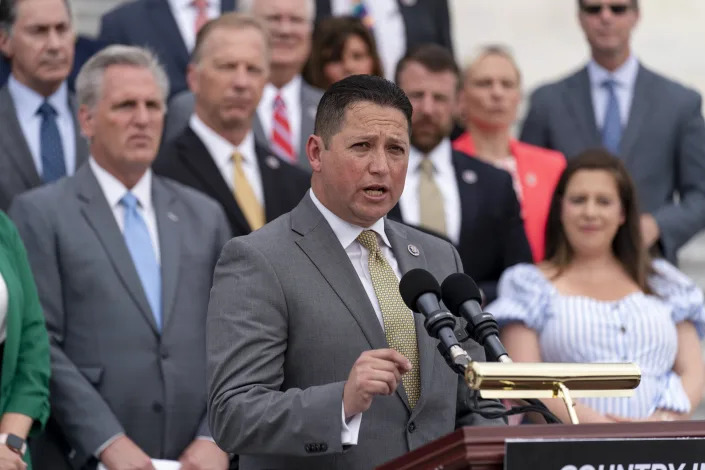
FILE - Rep. Tony Gonzales, R-Texas, center, accompanied by House Minority Leader Kevin McCarthy of Calif., left, and House Republican Conference chair Rep. Elise Stefanik, R-N.Y., right, speaks at a news conference on the steps of the Capitol in Washington, July 29, 2021. Gonzales was censured Saturday, March 4, 2023, in a rare move by his state party over votes that included supporting new gun safety laws after the Uvalde school shooting in his district. (AP Photo/Andrew Harnik, File)
Rep. Tony Gonzales, R-Texas, center, accompanied by House Minority Leader Kevin McCarthy of Calif., left, and House Republican Conference chair Rep. Elise Stefanik, R-N.Y., right, speaks at a news conference on the steps of the Capitol in Washington, July 29, 2021. Gonzales was censured Saturday, March 4, 2023, in a rare move by his state party over votes that included supporting new gun safety laws after the Uvalde school shooting in his district. (AP Photo/Andrew Harnik, File)
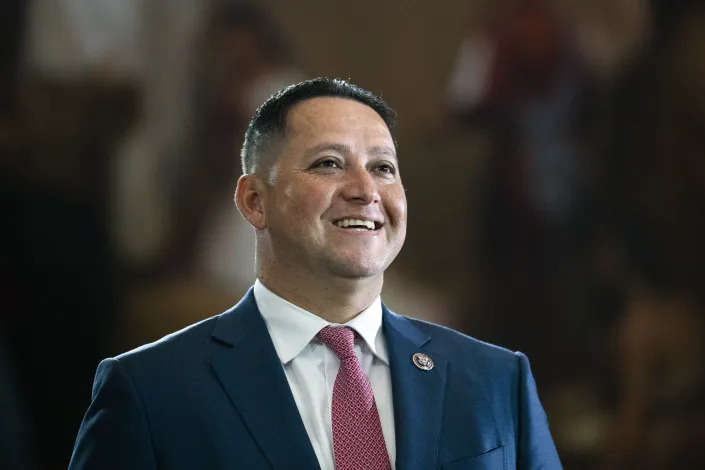
FILE - Rep. Tony Gonzales, R-Texas, is seen before the flag-draped casket bearing the remains of Hershel W. "Woody" Williams lies in honor in the U.S. Capitol, July 14, 2022, in Washington. Gonzales was censured Saturday, March 4, 2023, in a rare move by his state party over votes that included supporting new gun safety laws after the Uvalde school shooting in his district. (Tom Williams/Pool photo via AP, File)
 Rep. Tony Gonzales, R-Texas, is seen before the flag-draped casket bearing the remains of Hershel W. “Woody” Williams lies in honor in the U.S. Capitol, July 14, 2022, in Washington. Gonzales was censured Saturday, March 4, 2023, in a rare move by his state party over votes that included supporting new gun safety laws after the Uvalde school shooting in his district. (Tom Williams/Pool photo via AP, File)

AUSTIN, Texas (AP) — Republican U.S. Rep. Tony Gonzales of Texas was censured Saturday in a rare move by his state party over votes that included supporting new gun safety laws after the Uvalde school shooting in his district.

The Republican Party of Texas voted 57-5 with one abstention, underlining how the two-term congressman’s willingness to break with conservatives on key issues during his short time in office has caused GOP activists and some colleagues to bristle.

That independent streak includes opposing a sweeping House GOP immigration proposal over the U.S.-Mexico border, which includes a large portion of his South Texas district. He has also voted to defend same-sex marriage and was an outright “no” against a House rules package after Republican leader Kevin McCarthy became speaker.

Gonzales was defiant before the vote and did not attend the meeting of Texas GOP leaders and activists in Austin.

“We’ll see how that goes,” he told reporters in San Antonio on Thursday.

Gonzales spent the day working, according to Sarah Young, his spokesperson.

“He talked to veterans, visited with Border Patrol agents, and met constituents,” Young said in a statement. “The Republican Party of Texas would be wise to follow his lead and do some actual work.”

The vote followed an hourlong, closed-door executive session in which party members were allowed to debate the resolution.

There were no public comments by members before or after the executive session, and the vote was held about one minute after the meeting resumed, followed by applause and cheers from committee members.

In practical terms, a censure allows the state party to come off the sidelines if Gonzales runs again in 2024 and to spend money to remind primary voters about the rebuke. Passage of a censure required a three-fifths majority, or 39 votes of the State Republican Executive Committee, according to committee Chair Matt Rinaldi.

More than a dozen county GOP clubs in Gonzales’ district had already approved local censure resolutions.

Gonzales cruised through his GOP primary and easily won reelection last year in his heavily Hispanic congressional district. He first won in 2020 to fill an open seat left by Republican Will Hurd — who also didn’t shy from breaking with the GOP, and whose aides say is now considering a run for president.

The censure illustrates the intraparty fights that still flare in America’s biggest red state even as Republicans celebrate 20 years of having full control of the Texas Legislature and every statewide office.

Last year, former Texas GOP Chairman Allen West stepped down from the job to mount a faint primary challenge against Republican Gov. Greg Abbott. The state party in 2018 also censured a former moderate Texas House speaker who opposed bathroom restrictions for transgender people.

After the Uvalde school shooting, which killed 19 students and two teachers, Gonzales supported a sweeping and bipartisan gun violence bill signed by President Joe Biden. He is also the only Texas Republican in the statehouse or Congress who has called for the resignation of the state’s police chief over the fumbled law enforcement response to the attack.

Miller reported from Oklahoma City.

How Ron DeSantis misreads Corporate America

Yahoo! Finance

How Ron DeSantis misreads Corporate America


Rick Newman, Senior Columnist – March 4, 2023

Culture warrior Ron DeSantis, the Republican governor of Florida, is laying the groundwork for a 2024 presidential bid. That includes a new manifesto against the way corporate America tries to navigate shifting attitudes on race, gender, climate change, and other issues pitting those who want power against those who have it.

DeSantis has been waging a very public war with the Walt Disney Company (DIS) that now looks like a template for a broader crusade against companies practicing “woke capitalism,” as DeSantis and other conservatives put it.

“The left has pressured big corporations like Disney to use their enormous power to advance woke political ends,” DeSantis writes in his new book, “The Courage to be Free,” which The Wall Street Journal excerpted on March 1. “There is little upside for big companies to take positions on contentious political issues.”

Republicans fed up with former President Donald Trump’s antics think DeSantis could be their nominee in 2024. His book became an instant bestseller, and DeSantis won reelection to the governor’s mansion last year in a rout, establishing strong momentum should he run for president. He’s also a military veteran with a Harvard law degree who’s only 44 and could bring the generational power shift many voters crave.

But DeSantis is badly misreading corporate America and, by extension, the convulsive societal forces CEOs are grappling with. The CEOs that DeSantis dings aren’t craven tools of the left or rudderless weather vanes. Big brand-name companies sometimes have no choice but to take a stand on controversial issues, because large blocs of their customers and employees want them to. They mess up sometimes, but as an alternative, staying silent or doing nothing is often worse.

FILE - Florida Gov. Ron DeSantis speaks as he announces a proposal for Digital Bill of Rights, Feb. 15, 2023, at Palm Beach Atlantic University in West Palm Beach, Fla. DeSantis has emerged as a political star early in the 2024 presidential election season even as he ignores many conventions of modern politics. (AP Photo/Wilfredo Lee, File)
Florida Gov. Ron DeSantis at Palm Beach Atlantic University in West Palm Beach, Fla. (AP Photo/Wilfredo Lee, File)
The target was purely political’

The Disney flap arose over a 2022 Florida law that limited what schools can teach young kids about sex and gender issues. Opponents dubbed the measure the “Don’t say gay” law and pressured Florida companies to lobby against it. Disney initially took no stance that angered some Disney employees, who staged walkouts and other types of protests. The CEO at the time, Bob Chapek, then apologized for the company’s silence and said Disney would work to overturn the bill.

That angered DeSantis, who worked with the state legislature to revoke a special self-governing status Disney has enjoyed near its Disney World theme park since 1967. Instead of managing its own municipal affairs, Disney will now have to answer to a five-person board staffed with DeSantis allies. DeSantis characterizes the move as the long overdue end of a corporate boondoggle, yet it reeks of political retribution.

“People ask us: Was there any merit behind this? Was Disney deficient?” says David Kotok, chairman of investing firm Cumberland Advisors, which is based in Sarasota. “When we do the research, there is no merit financially or in a business context for the attack on Disney. Disney is a huge employer, a model citizen, it attracts huge economic interests to Florida. Why attack a model corporate citizen? The target was purely political.”

DeSantis argues that small cadres of “loud and militant” liberals are driving companies like Disney to embrace radical issues most Americans disagree with. He extends this to ESG investing and has taken new steps to prohibit any consideration of environmental, social, and governmental factors for the investors managing Florida’s pension money.

This is another area where DeSantis goes awry: by dismissing substantial shifts in public opinion on hot-button issues as mere manipulation by liberal activists. Those shifts are much deeper. The Florida education bill, for instance, is pushback against new efforts to normalize LGBTQ representation in public education. A company such as Disney needs to think not just about its employees, but about customers, suppliers, partners, and everybody else it does business with.

220122 -- ANAHEIM U.S., Jan. 22, 2022 Xinhua -- Visitors pose for photos with the cartoon character Tigger during the Lunar New Year celebrations at Disney's California Adventure Park in Anaheim, the United States, on Jan. 21, 2022. Disney's California Adventure Park kicked off celebrations of the Year of the Tiger Friday, featuring a string of Chinese culturally-themed performances, art shows, lantern decorations and Asian-inspired dishes. (Photo by Zeng Hui/Xinhua via Getty Images) TO GO WITH Feature: Disneyland celebrates Chinese Lunar New Year with dynamic cultural activities
Visitors pose for photos with the cartoon character Tigger during the Lunar New Year celebrations at Disney’s California Adventure Park in Anaheim, the United States, on Jan. 21, 2022. (Photo by Zeng Hui/Xinhua via Getty Images)

If Disney’s customer base reflects the overall population, then around 7% of them identify as LGBTQ. More than that, public attitudes are clearly liberalizing over time. More than 71% of Americans, for instance, think same-sex marriage should be valid, according to Gallup polling, up from just 27% in 1996.

As society evolves, companies need to update their policies to keep up. That’s not “wokeism” — it’s sensible business. And it’s inevitable that there will be uncomfortable moments when cultures clash and companies get tangled in fights they’d rather avoid because they end up alienating somebody.

Members of the National Rifle Association, for instance, tried to boycott Delta Air Lines a few years ago when it ended an NRA discount in the aftermath of a mass shooting. The flap blew over. Most of the time, the best way for a company to navigate cultural minefields is to take a principled stand that will endure the test of time. You can’t please everybody, yet people respect resolve.

‘Make America Florida’?

Republicans in general are testing the war on “woke capitalism” as a bedrock theme of their 2024 electoral efforts. While the terms “woke” and “antiwoke” are vague, so-called ESG investing is a more tangible target because some adherents call for disinvesting in fossil-fuel companies and others with a big carbon footprint or other demerits.

But again, it’s a mistake to assume this is some goofy liberal plot. Polls show Americans generally support the goals of ESG investing, even if they don’t feel strongly that investment portfolios are the right tool. Solid majorities of Americans favor more action to combat climate change. Young voters are most passionate about the issues fueling ESG investing.

Guess who obsesses about the coveted 18-to-34 demographic? Consumer companies that want to capture young spenders as they’re forming their values, and make them customers for life. This is a much more powerful motivator for companies than any political agenda, liberal or otherwise. Ambitious politicians aiming for a long career might even learn something from successful companies that align with the values of people they aim to convert into customers.

The last chapter of DeSantis’s book is titled, “Make America Florida.” That’s pretty clever. It’s a variation on Donald Trump’s “Make America Great Again” that’s meant to highlight Florida’s booming economic growth and a lifestyle that has made the Sunshine State a top target for relocators. You may hear that in 2024 as a DeSantis campaign slogan.

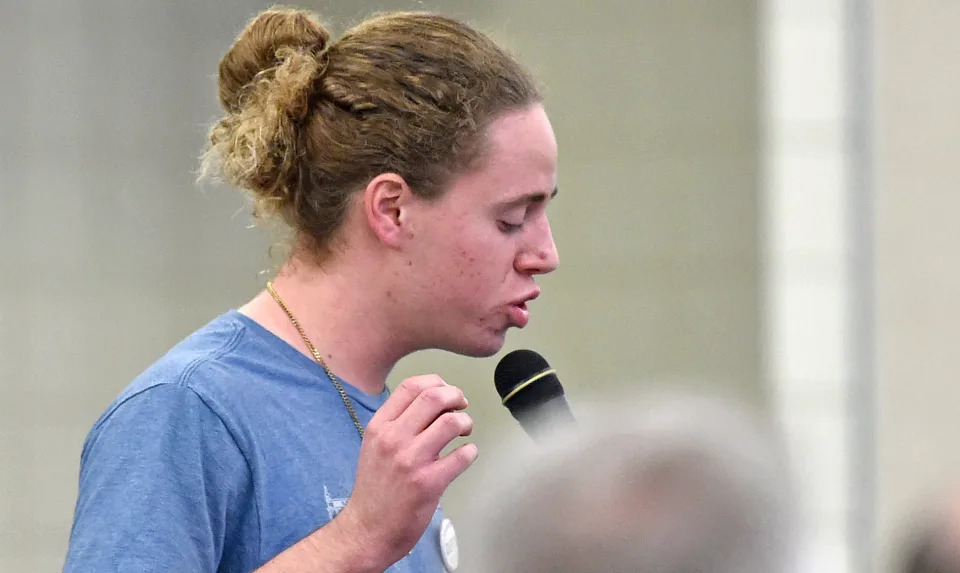
New College of Florida student Fatima Ismatulla speaks during a rally at the New College of Florida, where students staged a walkout from the public liberal arts college to protest against a proposed wide-reaching legislation that would ban gender studies majors and diversity programs at Florida universities, in Sarasota, Florida, U.S. February 28, 2023 .  REUTERS/Octavio Jones
New College of Florida student Fatima Ismatulla speaks during a rally at the New College of Florida, where students staged a walkout from the public liberal arts college to protest against a proposed wide-reaching legislation that would ban gender studies majors and diversity programs at Florida universities, in Sarasota, Florida, U.S. February 28, 2023. REUTERS/Octavio Jones

But how many Americans want to be Florida-fied? Probably a lot fewer than DeSantis thinks. Even some Florida Republicans don’t love DeSantis’s war on business. Billionaire Ken Griffin is a DeSantis supporter who moved both his hedge fund Citadel and his market making firm Citadel Securities from Chicago to Miami last year. He agrees with the “don’t say gay” legislation, but he objects to DeSantis’s heavy-handed tactics against Disney.

“I don’t appreciate Governor DeSantis going after Disney’s tax status,” Griffin said last year. “It can be portrayed, or feel, or look like retaliation.”

Swing voters crucial to winning national elections don’t seem especially interested in wokeism, either for or against it. In focus groups with swing voters in DeSantis’s own state, research firm Engagious mostly evoked yawns on the topic of wokeism, with some respondents interpreting DeSantis’s attacks on business as his own effort to rouse extremists on the right.

“He has clearly tapped into sentiment on the right that is profound,” says Rich Thau, president of Engagious. “But it doesn’t seem to have much traction with swing voters.”

DeSantis may also be undermining the type of support Republicans typically get from businesspeople who favor low taxes and gentle regulation.

“I have Republican friends who are disillusioned with what’s happening in Florida,” says Kotok of Cumberland Advisors. “I’m worried on the business side because I know businesses that are reexamining their investments in Florida and looking at other locations because they don’t like what they see here.”

Maybe DeSantis’s Florida should be a little more like the rest of America.

Clarification: This post was updated to mention both Citadel and Citadel Securities.

House Judiciary Committee Repub’s mimic KGB/GRU tactics: GOP Witnesses, Paid by Trump Ally, Embraced Jan. 6 Conspiracy Theories

The New York Times

GOP Witnesses, Paid by Trump Ally, Embraced Jan. 6 Conspiracy Theories

Luke Broadwater and Adam Goldman – March 3, 2023

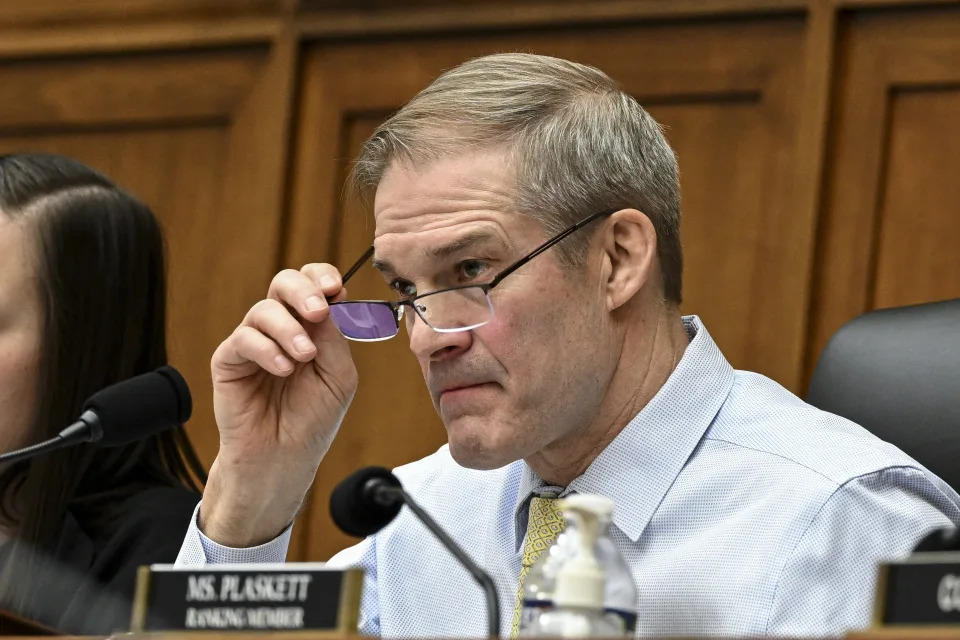
House Judiciary Committee Chairman Jim Jordan (R-Ohio) listens during a House judiciary subcommittee hearing on the weaponization of the federal government, at the Capitol in Washington on Thursday, Feb. 9, 2023. (Kenny Holston/The New York Times)

WASHINGTON — House Republicans have spent months promising to use their majority to uncover an insidious bias against conservatives on the part of the federal government, vowing to produce a roster of brave whistleblowers who would come forward to provide damning evidence of abuses aimed at the right.

But the first three witnesses to testify privately before the new Republican-led House committee investigating the “weaponization” of the federal government have offered little firsthand knowledge of any wrongdoing or violation of the law, according to Democrats on the panel who have listened to their accounts. Instead, the trio appears to be a group of aggrieved former FBI officials who have trafficked in right-wing conspiracy theories, including about the Jan. 6, 2021, attack at the Capitol, and received financial support from a top ally of former President Donald Trump.

The roster of witnesses, whose interviews and statements are detailed in a 316-page report compiled by Democrats that was obtained by The New York Times, suggests that Rep. Jim Jordan of Ohio, the chair of the panel, has relied on people who do not meet the definition of a whistleblower and who have engaged in partisan conduct that calls into question their credibility. And it raises questions about whether Republicans, who have said that investigating the Biden administration is a top goal, will be able to deliver on their ambitious plans to uncover misdeeds at the highest levels.

“Each endorses an alarming series of conspiracy theories related to the Jan. 6 Capitol attack, the COVID vaccine, and the validity of the 2020 election,” Democrats wrote in the heavily footnoted report, which cites scores of statements made by the witnesses. “One has called repeatedly for the dismantling of the FBI. Another suggested that it would be better for Americans to die than to have any kind of domestic intelligence program.”

The report also notes that the men are tied to far-right Republican operatives and former Trump administration officials who have an interest in promoting false claims about the Jan. 6 attack and the Biden administration while working to defend Trump, who is seeking a second term.

The document centers on three men who have been interviewed by the panel’s investigators: George Hill, a retired FBI supervisory intelligence analyst from the bureau’s Boston field office; Stephen Friend, a former special agent who worked in the Daytona Beach, Florida, office; and Garret O’Boyle, a special agent from the field office in Wichita, Kansas, who has been suspended.

Other potential witnesses for the new subcommittee are FBI employees who were disciplined for attending protests on Jan. 6, 2021, according to Jordan.

Friend, who resigned from the FBI, is part of a group of former agents who were placed on leave and called themselves “the suspendables.” In a letter sent last year to Christopher Wray, the FBI director, the group claimed that the bureau had discriminated against conservative-leaning agents.

Hill has claimed on Twitter that the Jan. 6 attack was a “set up,” and that there was “a larger #Democrat plan using their enforcement arm, the #FBI.” He also described the FBI as “the Brown Shirt enforcers of the @DNC,” making an apparent reference to Nazi storm troopers to describe the federal law enforcement agency and its relationship to the Democratic National Committee.

O’Boyle and Friend both testified that they had received financial support from Kash Patel, a Trump loyalist and former high-ranking official in the former president’s administration. Friend said Patel sent him $5,000 almost immediately after they connected in November 2022 and that Patel has helped to promote Friend’s forthcoming book on social media.

In a statement, Patel declined to confirm that he has provided financial support to the witnesses but suggested that his organization has been focused on helping FBI employees facing retaliation for speaking out publicly.

“Whistleblowers who provide credible information exposing government waste, fraud, and abuse serve a critical role for constitutional oversight,” he said.

Democrats said they produced their report after they learned that Republicans on the committee were planning to leak material from the transcribed interviews. It was written by Rep. Jerrold Nadler of New York, the top Democrat on the Judiciary Committee, and Delegate Stacey Plaskett of the Virgin Islands, the top Democrat on the weaponization subcommittee.

Russell Dye, a spokesperson for Jordan, said that Democrats were misrepresenting the testimony gathered to smear public servants who had come forward to expose wrongdoing.

“It is beyond disappointing, but sadly not surprising, that Democrats would leak cherry-picked excerpts of testimony to attack the brave whistleblowers who risked their careers to speak out on abuses at the Justice Department and FBI,” Dye said. “These same Democrats vowed to fight our oversight ‘tooth and nail,’ and they are willing to undermine the work of the Congress to achieve their partisan goals.”

The Democratic report includes excerpts from depositions and evidence of conspiratorial social media posts.

It also details the ties between Trump’s inner circle and the witnesses. For instance, Patel found Friend his next job, working as a fellow on domestic intelligence and security services with the Center for Renewing America, which is run by Russ Vought. The center is largely funded by the Conservative Partnership Institute, which is run by Mark Meadows, Trump’s former chief of staff, and former Sen. Jim DeMint of South Carolina.

“Based on this evidence, committee Democrats conclude that there is a strong likelihood that Kash Patel is encouraging the witnesses to continue pursuing their meritless claims, and in fact is using them to help propel his vendetta against the FBI, Justice Department, and Biden administration on behalf of himself and President Trump,” the report says.

Republicans argue they received useful information from the men for their investigation. For instance, Hill told the subcommittee the FBI regularly conducted nationwide calls involving all 56 field offices after Jan. 6. Hill described the calls as “bordering on hysterical,” according to excerpts from transcripts reviewed by the Times.

Friend has been celebrated in conservative circles, with right-wing pundits seizing on his accusations as evidence of wrongdoing at the FBI. But those claims did not appear to hold up during his testimony.

Friend has said he refused to take part in a SWAT raid of a Jan. 6 suspect facing misdemeanor charges, which at the time he called an “excessive use of force,” to which he was a “conscientious objector.” The suspect, Tyler Bensch, was accused of being a member of a right-wing militia group connected to the Three Percenter movement. Documents in Bensch’s case indicate that on Jan. 6, 2021, he posted a video of himself outside the Capitol wearing body armor and a gas mask and carrying an AR-15-style rifle.

Under questioning, the committee said that Friend “confirmed that ownership of a firearm, even without any additional factors, in fact would be enough of a factor on its own to justify deploying a SWAT team in an arrest.”

Friend also testified about being asked to surveil a person attending a school board meeting, touching on a claim promoted by Republicans that the government mistreated conservative parents. But according to the report, Friend conceded during his interview that the man being tracked was a Three Percenter who was under counterterrorism investigation. He was later arrested with Bensch and three other individuals.

Friend also engaged with Russian propaganda outlets while he was an FBI employee, the report noted, including being quoted extensively in an article in Sputnik headlined “Under Biden Federal Agencies Turned Into Instrument of Intimidation, FBI Whistleblower Says,” and appearing for an interview with Russia Today.

The report cast doubt on the relevance of the witnesses’ accounts. Democrats wrote that nothing in O’Boyle’s testimony “suggests misconduct at the FBI” and that Hill had “made multiple claims about the FBI’s handling of criminal investigations into the Jan. 6 Capitol attack, despite having very little personal involvement in those investigations.”

The report also said that Hill had embraced a conspiracy theory that an Arizona man named Ray Epps was a federal informant who helped to instigate the attack on the Capitol on Jan. 6, 2021. Prominent Republicans — including Trump — have widely promoted the claim, which Epps denies and the House Jan. 6 committee determined to be unfounded.

The witnesses also embraced the language and views of the right wing on other matters. At one point during his testimony, the report said, O’Boyle compared coronavirus vaccine mandates to a Polish reserve police unit during World War II that began as a group of “just normal people,” but ultimately “were basically engaging in genocide just like the rest of the Nazi regime.”

CPAC Didn’t Used to Be This Insane (I Swear)

Daily Beast

CPAC Didn’t Used to Be This Insane (I Swear)

Matt Lewis – March 2, 2023

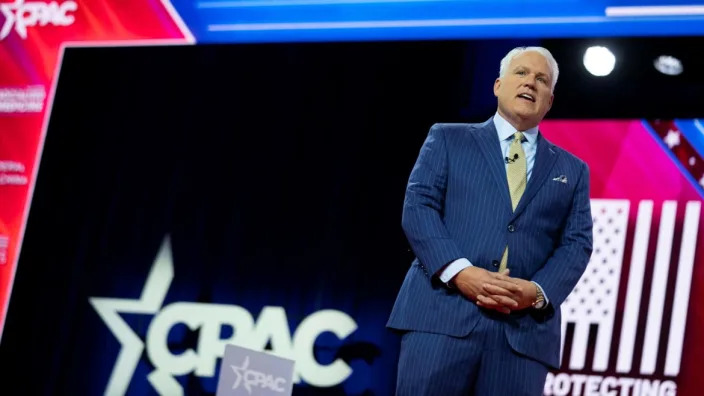
REUTERS/Sarah Silbiger

It’s time once again for the “Mardi Gras for the Right,” also known as the Conservative Political Action Conference (CPAC). The annual gathering has long been a riotous affair, but the bacchanalian revelry once belied a buttoned-down conservative class that ran the event.

These days, they let their freak flag fly. And no, I’m not talking about dubious yarns of after-hours debauchery—though I am old enough to remember Steve Stockman’s hot tub party (no, I wasn’t there). I’m talking instead about political statements that will be uttered on stage by credentialed speakers or on camera by attention-starved activists and attendees. I mean, the event just kicked off Thursday, and already, a video with a self-described “Jan. 6 political prisoner” is garnering buzz.

Biden’s Befuddled Response to the Ohio Train Disaster Is Unacceptable

Those small potatoes will quickly be forgotten. Every CPAC has a narrative, but what will this year be? Attendance could be down. That’d be embarrassing. Big names like Gov. Ron DeSantis are skipping this year’s event. Could it be that CPAC isn’t as relevant as it used to be? What is more, this year’s meeting is taking place on the heels of allegations that the event’s organizer, Matt Schlapp, groped a Herschel Walker campaign aide.

Any of these stories could be the big one. But my money’s on another option: The Trumpification of CPAC.

Kellyanne Conway envisioned this future back in 2017, when she dubbed the event “TPAC.” Of course, back then, Trump was a newly-minted president—not a perpetual drag on the party’s electoral prospects. The fact that CPAC is doubling down on Trumpism now tells you all you need to know about the direction of the movement and the party, not to mention their penchant for lost causes (one of the other big speakers this year will be election-denier Kari Lake).

This is not how it was supposed to go. Trust me, I know. Back in 2012, I was CPAC’s “Blogger of the Year.” I know what you’re thinking: What’s a blogger? It doesn’t matter. The point is that a mere eleven years ago, I wasn’t just the kind of person that CPAC could tolerate, I was feted.

What a long, strange trip it’s been.

CPAC and I were born the same year. In 1974, Ronald Reagan spoke at the very first CPAC gathering. He began by introducing three Vietnam P.O.W.s. One of them was, you guessed it, John McCain. (In 2019, the ghost of John McCain was attacked from the stage of CPAC.)

But even for those who aren’t huge McCain fans, the contrast is clear. My friend Craig Shirley, the acclaimed conservative historian, was recently quoted in The New York Times lamenting the conference’s decline since the ‘70s. “It’s more of like a boat show,” Shirley said.

I can think of other words besides “boat.” Ship might be closer.

Ron DeSantis’ Anti-Free Speech Crusade Would Cancel Fox News

CPAC was serious and wonky back in the Reagan era, but that started to change long before I attended the first of my many CPACs in 2000. By then, the hall was bustling with young college students who had presumably been bussed in by organizers and/or campaigns vying to win the presidential straw poll.

To be sure, there have always been eccentric attendees. A tongue-in-cheek essay I wrote for the Daily Caller in 2012 lamented the “gadflies” and “time burglars” who populate these events.

But there used to be a lot of intellectually stimulating things to do and see.

For example, CPAC long featured an annual conversation between legendary journalists Sam Donaldson and Bob Novak. There were other speakers like P.J. O’RourkeGeorge Will, and Charles Krauthammer, who addressed the crowd.

The modern equivalent is, apparently, Mike Lindell, Marjorie Taylor Greene, and Kimberly Guilfoyle.

The Real Reason Trump Is Calling DeSantis ‘Meatball Ron’

To be sure, CPAC speakers have long existed on a spectrum, somewhere between William F. Buckley and P.T. Barnum. But in the last dozen years, or so (coinciding, it seems, with the election of Barack Obama—and then exploding with Trump’s election), it began skewing very heavily toward the Barnum end.

There are numerous warning signs along the way, but let me remind you of just a few:

In 2009, my friend and former boss Tucker Carlson was briefly booed at CPAC for praising The New York Times for accuracy.

In 2011, CPAC invited Donald Trump—who was just a crazy celebrity touting “birtherism”—to give a speech.

In what might be considered his political coming out (as a conservative) party, Trump “was by far the best-received speaker and the audience lapped up his act,” reported Maggie Haberman.

That same year, libertarian ex Rep. Ron Paul won the CPAC straw poll.

None of these things, in and of themselves, were terribly surprising or noteworthy (the straw poll was always manipulated by campaigns, which is to say the results were far from organic or even scientific). Collectively, however, these developments now strike me as telling. They were harbingers of things to come.

My conclusion is this: If you want to know what the conservative movement will look like in five years, look at what today’s CPAC hall is like.

That is a scary thought, because if that analysis turns out to be true, Donald Trump is the GOP’s future. After all, he’s their celebrated hero. And with Ron DeSantis presumably sitting this CPAC out, he’s the only game in town.

Trump can be sued for Jan. 6 riot harm, Justice Dept. says

Associated Press

Trump can be sued for Jan. 6 riot harm, Justice Dept. says

Eric Tucker and Alanna Durkin Richer – March 2, 2023

FILE - In this Jan. 6, 2021, file photo, President Donald Trump speaks during a rally protesting the electoral college certification of Joe Biden as President in Washington. Trump can be sued by injured Capitol Police officers and Democratic lawmakers over the Jan. 6, 2021 insurrection at the U.S. Capitol, the Justice Department said Thursday, March 2, 2023, in an ongoing federal court case testing the limits of executive power. (AP Photo/Evan Vucci, File)
 In this Jan. 6, 2021, file photo, President Donald Trump speaks during a rally protesting the electoral college certification of Joe Biden as President in Washington. Trump can be sued by injured Capitol Police officers and Democratic lawmakers over the Jan. 6, 2021 insurrection at the U.S. Capitol, the Justice Department said Thursday, March 2, 2023, in an ongoing federal court case testing the limits of executive power. (AP Photo/Evan Vucci, File)
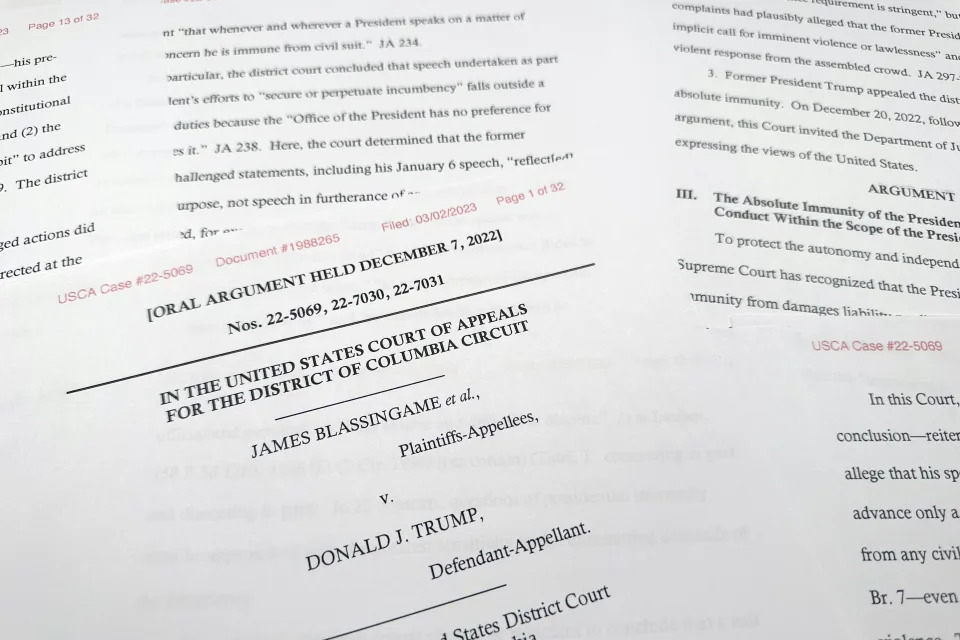
A federal court filing from the Justice Department is photographed Thursday, March 2, 2023. Former President Donald Trump can be sued by injured U.S. Capitol Police officers and Democratic lawmakers over the Jan. 6, 2021, insurrection at the U.S. Capitol, the Justice Department said in a federal court case testing Trump's legal vulnerability and the limits of executive power. (AP Photo/Jon Elswick)
A federal court filing from the Justice Department is photographed Thursday, March 2, 2023. Former President Donald Trump can be sued by injured U.S. Capitol Police officers and Democratic lawmakers over the Jan. 6, 2021, insurrection at the U.S. Capitol, the Justice Department said in a federal court case testing Trump’s legal vulnerability and the limits of executive power. (AP Photo/Jon Elswick)
FILE - In this Jan. 6, 2021, file photo with the White House in the background, President Donald Trump speaks at a rally in Washington. Trump can be sued by injured Capitol Police officers and Democratic lawmakers over the Jan. 6, 2021 insurrection at the U.S. Capitol, the Justice Department said Thursday, March 2, 2023, in an ongoing federal court case testing the limits of executive power. (AP Photo/Jacquelyn Martin, File)
 In this Jan. 6, 2021, file photo with the White House in the background, President Donald Trump speaks at a rally in Washington. Trump can be sued by injured Capitol Police officers and Democratic lawmakers over the Jan. 6, 2021 insurrection at the U.S. Capitol, the Justice Department said Thursday, March 2, 2023, in an ongoing federal court case testing the limits of executive power. (AP Photo/Jacquelyn Martin, File)
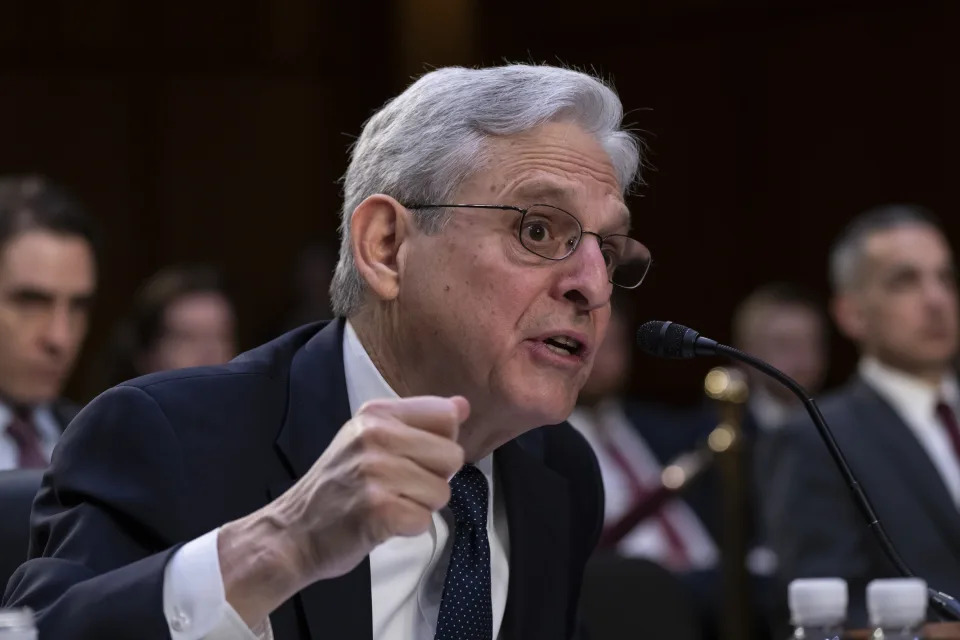
FILE - Attorney General Merrick Garland testifies as the Senate Judiciary Committee examines the Department of Justice, at the Capitol in Washington, Wednesday, March 1, 2023. Former President Donald Trump can be sued by injured Capitol Police officers and Democratic lawmakers over the Jan. 6, 2021 insurrection at the U.S. Capitol, the Justice Department said Thursday in an ongoing federal court case testing the limits of executive power. (AP Photo/J. Scott Applewhite, File)
Attorney General Merrick Garland testifies as the Senate Judiciary Committee examines the Department of Justice, at the Capitol in Washington, Wednesday, March 1, 2023. Former President Donald Trump can be sued by injured Capitol Police officers and Democratic lawmakers over the Jan. 6, 2021 insurrection at the U.S. Capitol, the Justice Department said Thursday in an ongoing federal court case testing the limits of executive power. (AP Photo/J. Scott Applewhite, File)

WASHINGTON (AP) — Former President Donald Trump can be sued by injured Capitol Police officers and Democratic lawmakers over the Jan. 6, 2021, insurrection at the U.S. Capitol, the Justice Department said Thursday in a federal court case testing Trump’s legal vulnerability for his speech before the riot.

The Justice Department told a Washington federal appeals court in a legal filing that it should allow the lawsuits to move forward, rejecting Trump’s argument that he is immune from the claims.

The department said it takes no position on the lawsuits’ claims that the former president’s words incited the attack on the Capitol. Nevertheless, Justice lawyers told the court that a president would not be protected by “absolute immunity” if his words were found to have been an “incitement of imminent private violence.”

“As the Nation’s leader and head of state, the President has ‘an extraordinary power to speak to his fellow citizens and on their behalf,’ they wrote. “But that traditional function is one of public communication and persuasion, not incitement of imminent private violence.”

The brief was filed by lawyers of the Justice Department’s Civil Division and has no bearing on a separate criminal investigation by a department special counsel into whether Trump can be criminally charged over efforts to undo President Joe Biden’s victory in the 2020 presidential election ahead of the Capitol riot. In fact, the lawyers note that they are not taking a position with respect to potential criminal liability for Trump or anyone else.

Trump’s lawyers have argued he was acting within the bounds of his official duties and had no intention to spark violence when he called on thousands of supporters to “march to the Capitol” and “fight like hell” before the riot erupted.

“The actions of rioters do not strip President Trump of immunity,” his lawyers wrote in court papers. “In the run-up to January 6th and on the day itself, President Trump was acting well within the scope of ordinary presidential action when he engaged in open discussion and debate about the integrity of the 2020 election.”

A Trump spokesperson said Thursday that the president “repeatedly called for peace, patriotism, and respect for our men and women of law enforcement” on Jan. 6 and that the courts “should rule in favor of President Trump in short order and dismiss these frivolous lawsuits.”

The case is among many legal woes facing Trump as he mounts another bid for the White House in 2024.

A prosecutor in Georgia has been investigating whether Trump and his allies broke the law as they tried to overturn his election defeat in that state. Trump is also under federal criminal investigation over top secret documents found at his Florida estate.

In the separate investigation into Trump and his allies’ efforts to keep the Republican president in power, special counsel Jack Smith has subpoenaed former Vice President Mike Pence, who has said he will fight the subpoena.

Trump is appealing a decision by a federal judge in Washington, who last year rejected efforts by the former president to toss out the conspiracy civil lawsuits filed by the lawmakers and police officers. U.S. District Judge Amit Mehta ruled that Trump’s words during a rally before the violent storming of the U.S. Capitol were likely “words of incitement not protected by the First Amendment.”

“Only in the most extraordinary circumstances could a court not recognize that the First Amendment protects a President’s speech,” Mehta wrote in his February 2022 ruling. “But the court believes this is that case.”

One of the lawsuits, filed by Rep. Eric Swalwell, D-Calif., alleges that “Trump directly incited the violence at the Capitol that followed and then watched approvingly as the building was overrun.” Two other lawsuits were also filed, one by other House Democrats and another by officers James Blassingame and Sidney Hemby.

The House Democrats’ lawsuit cites a federal civil rights law that was enacted to counter the Ku Klux Klan’s intimidation of officials. The cases describe in detail how Trump and others spread baseless claims of election fraud, both before and after the 2020 presidential election was declared, and charge that they helped to rile up the thousands of rioters before they stormed the Capitol.

The lawsuits seek damages for the physical and emotional injuries the plaintiffs sustained during the insurrection.

Even if the appeals court agrees that Trump can be sued, those who brought the lawsuit still face an uphill battle. They would need to show there was more than fiery rhetoric, but a direct and intentional call for imminent violence, said Laurie Levenson, a Loyola Law School professor and former federal prosecutor.

“We are really far away from knowing that even if the court allows the lawsuit to go forward whether they would be successful,” she said. “Even if the court says hypothetically you can bring an action against a president, I think they’re likely to draw a line that is very generous to the president’s protected conduct.”

In its filing, the Justice Department cautioned that the “court must take care not to adopt rules that would unduly chill legitimate presidential communication” or saddle a president with burdensome and intrusive lawsuits.

“In exercising their traditional communicative functions, Presidents routinely address controversial issues that are the subject of passionate feelings,” the department wrote. “Presidents may at times use strong rhetoric. And some who hear that rhetoric may overreact, or even respond with violence.”

Richer reported from Boston.

New College conservative board votes to abolish DEI office

Associated Press

New College conservative board votes to abolish DEI office

Curt Anderson and Jocelyn Gecker – February 28, 2023

A group of parents of New College of Florida current students and one recent alum protest dressed as handmaids from Margaret Atwood's "The Handmaid's Tale," ahead of a meeting by the college's board of trustees, Tuesday, Feb. 28, 2023, in Sarasota, Fla. A sign in German addressed to Florida Governor Ron DeSantis, reads, "DeSantis, Are you copying the Nazis?" The conservative-dominated board of trustees of Florida's public honors college was meeting Tuesday to take up a measure making wholesale changes in the school's diversity, equity and inclusion programs and offices.(AP Photo/Rebecca Blackwell)
A group of parents of New College of Florida current students and one recent alum protest dressed as handmaids from Margaret Atwood’s “The Handmaid’s Tale,” ahead of a meeting by the college’s board of trustees, Tuesday, Feb. 28, 2023, in Sarasota, Fla. A sign in German addressed to Florida Governor Ron DeSantis, reads, “DeSantis, Are you copying the Nazis?” The conservative-dominated board of trustees of Florida’s public honors college was meeting Tuesday to take up a measure making wholesale changes in the school’s diversity, equity and inclusion programs and offices.(AP Photo/Rebecca Blackwell)
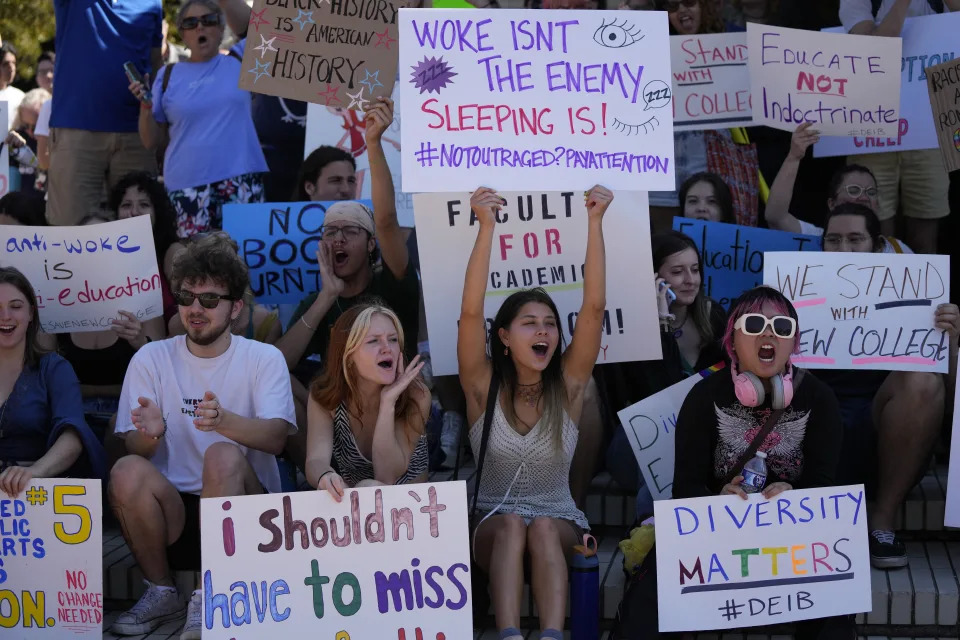
A person cheers as New College of Florida students and supporters protest ahead of a meeting by the college's board of trustees, Tuesday, Feb. 28, 2023, in Sarasota, Fla. The conservative-dominated board of trustees of Florida's public honors college was meeting Tuesday to take up a measure making wholesale changes in the school's diversity, equity and inclusion programs and offices.(AP Photo/Rebecca Blackwell)
A person cheers as New College of Florida students and supporters protest ahead of a meeting by the college’s board of trustees, Tuesday, Feb. 28, 2023, in Sarasota, Fla. The conservative-dominated board of trustees of Florida’s public honors college was meeting Tuesday to take up a measure making wholesale changes in the school’s diversity, equity and inclusion programs and offices.(AP Photo/Rebecca Blackwell)
New College of Florida's Interim President Richard Corcoran, center, listens during a meeting of the college's board of trustees, alongside trustee Matthew Spalding, left, Tuesday, Feb. 28, 2023, in Sarasota, Fla. The conservative-dominated board of trustees of Florida's public honors college was meeting Tuesday to take up measures making changes in the school's diversity, equity and inclusion programs and offices.(AP Photo/Rebecca Blackwell)
New College of Florida’s Interim President Richard Corcoran, center, listens during a meeting of the college’s board of trustees, alongside trustee Matthew Spalding, left, Tuesday, Feb. 28, 2023, in Sarasota, Fla. The conservative-dominated board of trustees of Florida’s public honors college was meeting Tuesday to take up measures making changes
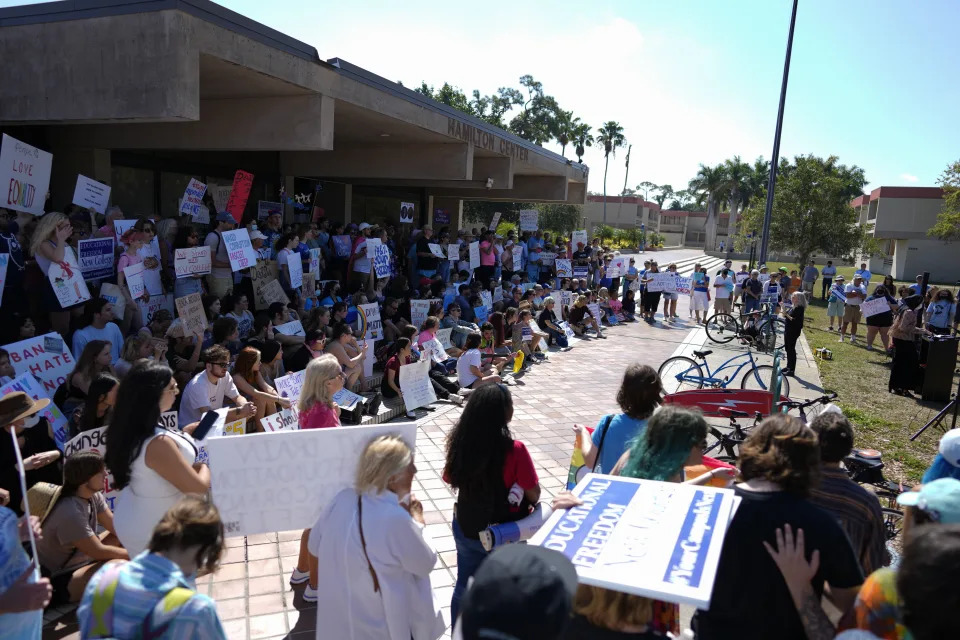
New College of Florida students and supporters protest ahead of a meeting by the college's board of trustees, Tuesday, Feb. 28, 2023, in Sarasota, Fla. The conservative-dominated board of trustees of Florida's public honors college was meeting Tuesday to take up a measure making wholesale changes in the school's diversity, equity and inclusion programs and offices. (AP Photo/Rebecca Blackwell)
New College of Florida students and supporters protest ahead of a meeting by the college’s board of trustees, Tuesday, Feb. 28, 2023, in Sarasota, Fla. The conservative-dominated board of trustees of Florida’s public honors college was meeting Tuesday to take up a measure making wholesale changes in the school’s diversity, equity and inclusion
New College of Florida students and supporters protest ahead of a meeting by the college's board of trustees, Tuesday, Feb. 28, 2023, in Sarasota, Fla. The conservative-dominated board of trustees of Florida's public honors college was meeting Tuesday to take up a measure making wholesale changes in the school's diversity, equity and inclusion programs and offices. (AP Photo/Rebecca Blackwell)
New College of Florida students and supporters protest ahead of a meeting by the college’s board of trustees, Tuesday, Feb. 28, 2023, in Sarasota, Fla. The conservative-dominated board of trustees of Florida’s public honors college was meeting Tuesday to take up a measure making wholesale changes in the school’s diversity, equity and inclusion programs and offices. (AP Photo/Rebecca Blackwell)
New College of Florida students and supporters protest ahead of a meeting by the college's board of trustees, Tuesday, Feb. 28, 2023, in Sarasota, Fla. The conservative-dominated board of trustees of Florida's public honors college was meeting Tuesday to take up a measure making wholesale changes in the school's diversity, equity and inclusion programs and offices. (AP Photo/Rebecca Blackwell)
New College Conservatives Protest
New College of Florida students and supporters protest ahead of a meeting by the college’s board of trustees, Tuesday, Feb. 28, 2023, in Sarasota, Fla. The conservative-dominated board of trustees of Florida’s public honors college was meeting Tuesday to take up a measure making wholesale changes in the school’s diversity, equity and inclusion programs and offices. (AP Photo/Rebecca Blackwell)
Two members of a group of parents of New College of Florida current students and a recent alum who came dressed as handmaids from Margaret Atwood's "The Handmaid's Tale," talk together as they wait to give public comment during a meeting of the college's board of trustees, Tuesday, Feb. 28, 2023, in Sarasota, Fla. The conservative-dominated board of trustees of Florida's public honors college was meeting Tuesday to take up measures making changes in the school's diversity, equity and inclusion programs and offices.(AP Photo/Rebecca Blackwell)
Two members of a group of parents of New College of Florida current students and a recent alum who came dressed as handmaids from Margaret Atwood’s “The Handmaid’s Tale,” talk together as they wait to give public comment during a meeting of the college’s board of trustees, Tuesday, Feb. 28, 2023, in Sarasota, Fla. The conservative-dominated board of trustees of Florida’s public honors college was meeting Tuesday to take up measures making changes in the school’s diversity, equity and inclusion programs and offices.(AP Photo/Rebecca Blackwell)

New College of Florida students and supporters protest ahead of a meeting by the college's board of trustees, Tuesday, Feb. 28, 2023, in Sarasota, Fla. The conservative-dominated board of trustees of Florida's public honors college was meeting Tuesday to take up a measure making wholesale changes in the school's diversity, equity and inclusion programs and offices. (AP Photo/Rebecca Blackwell)

New College of Florida students and supporters protest ahead of a meeting by the college’s board of trustees, Tuesday, Feb. 28, 2023, in Sarasota, Fla. The conservative-dominated board of trustees of Florida’s public honors college was meeting Tuesday to take up a measure making wholesale changes in the school’s diversity, equity and inclusion programs and offices. (AP Photo/Rebecca Blackwell)

SARASOTA, Fla. (AP) — Trustees picked by Republican Gov. Ron DeSantis to oversee New College of Florida voted Tuesday to abolish its small office that handles diversity, equity and inclusion programs targeted by conservatives throughout the state university system.

The trustees voted 9-3 to get rid of the school’s Office of Outreach and Inclusive Excellence, with four full-time staff positions to be transferred elsewhere to vacant jobs. The board also voted to permit interim President Richard Corcoran to consider ending a single online mandatory employee diversity training program that few actually take.

“This is not a very impressive DEI bureaucracy, is what I’m seeing,” said student body president Grace Keenan, who is a trustee and was not appointed by DeSantis. “Any DEI practices we do have here are all about inclusion. We don’t discriminate against anyone here.”

Although they are relatively small programs, some of the seven new trustees at the historically progressive college said it was important to take a stand on issues they believe cause discrimination based on racial, gender, LGBTQ and other group identities rather than focusing on a student, faculty or staff member’s individual merit.

“I think it’s important that we take a position,” said trustee Christopher Rufo, a conservative activist on education issues nationally. “It is essential to say we are taking this mandate seriously.”

The decision comes as DeSantis, widely expected to seek the GOP presidential nomination in 2024, has said a key goal for Florida’s higher education system is to defund DEI programs so they “whither on the vine” on campuses. DeSantis is backing a measure introduced for the upcoming legislative session to prevent colleges and universities from promoting, supporting or maintaining programs related to DEI or critical race theory.

The trustees’ vote to abolish the New College DEI office and transfer staff to other positions will save about $250,000 a year, according to documents provided at Tuesday’s meeting. Although that amount may seem relatively minor, supporters of the change said it will send a message.

“This is a question of what is being imposed and advocated, supported and funded, by the college,” said trustee Matthew Spalding. “If it’s a minor situation, it should be abolished.”

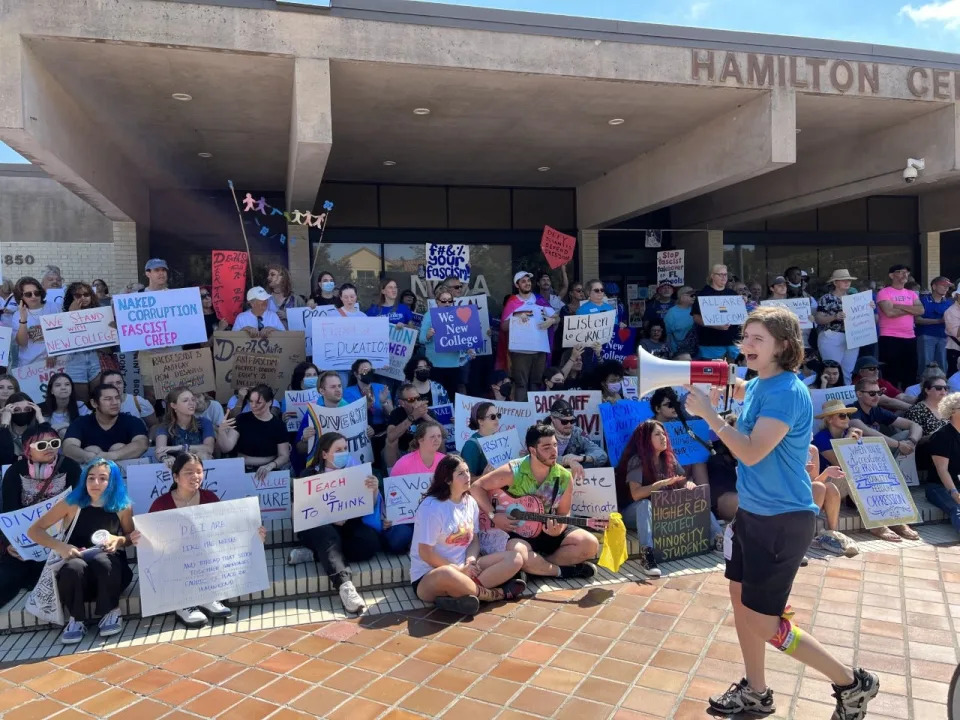
The trustee meeting drew a crowd of about 300 protesters before it began, holding signs that read, “Our Students Are Not Political Pawns” and, “If you’re not outraged, you’re not paying attention,” among others.

Chai Leffler, a third-year student, said he came from a southern, conservative family where being gay was difficult, but New College changed his life.

“I was taught how to love myself again and to stand up for myself like we all are today,” Leffler said. “I understand we are everything DeSantis hates.”

New College, nestled along Sarasota Bay, has fewer than 1,000 students. It was founded in 1960 as a private school in part by funding from the United Church of Christ, said Rev. John Dorhauer, the church’s president and general minister. Dorhauer gave public testimony at the meeting and spoke to the protesters about the “moral outrage” he feels at the changes being made by the conservative trustees chosen by DeSantis.

“The long arc of history will grind you into dust, and they (students) will win this battle and you will be remembered for the sycophants you are,” he told the trustees.

Anderson reported from St. Petersburg, Florida.

Emotional meeting ends with DeSantis’ New College of Florida board abolishing diversity office

USA Today

Emotional meeting ends with DeSantis’ New College of Florida board abolishing diversity office

Zac Anderson, USA TODAY NETWORK – March 1, 2023

Gov. Ron DeSantis proposes a plan to remove and reform diversity-based education programs

Governor Ron DeSantis plans to remove and reform education programs that focus on diversity, equity and inclusion initiatives from state universities.

New College of Florida’s Board of Trustees abolished the office handling diversity, equity and inclusion programs during a contentious and emotional meeting Tuesday that included testimony from students worried that a board reshaped by Gov. Ron DeSantis is making the school unwelcoming to minorities.

DeSantis appointed six members to New College’s board on Jan. 6 in an effort to transform the school, putting the small Sarasota institution at the center of the GOP’s nationwide pushback on education policies aimed at supporting historically marginalized groups, including racial minorities and LGBTQ individuals.

DeSantis has emerged as a key national figure in this debate after he pushed through legislation governing how K-12 schools discuss race and gender identity and recently prohibited an Advanced Placement course in African American studies, which caused an uproar. The governor is now taking aim at university programs.

Eliminating diversity, equity and inclusion (DEI) initiatives − which have become a major flashpoint for conservatives and a target of DeSantis throughout Florida’s public university system − is among the first substantive actions by New College’s revamped board, which also fired the former president last month and hired DeSantis ally Richard Corcoran as interim president. Corcoran’s first board meeting was Tuesday.

How conservatives are reshaping colleges: Board shake-ups, threats to tenure and money

‘Hillsdale of the south’: DeSantis launches conservative overhaul of a Florida college’s board

‘We value academic freedom’: Students walk out in protest of Ron DeSantis’ education policies

A review of DEI programs

Among DeSantis’ New College board appointees is prominent conservative activist Christopher Rufo, who pushed at his first meeting on Jan. 31 to abolish diversity programs.

The board opted to wait until more research could be done. College administrator Brad Thiessen presented the results of his DEI review Tuesday, delving into everything from faculty training to hiring practices and student admissions.

Thiessen said there was little mandatory diversity training and that only recently had prospective faculty been asked to submit a statement in their job application outlining how they would promote diversity.

Richard Corcoran the new interim president of New College of Florida was not welcomed by the majority of students and adult speakers.

Additionally, only one of the employees in the Office of Outreach and Inclusive Excellence was primarily focused on DEI programs. The others managed grants, worked on community outreach and performed other activities that aren’t controversial.

That led Trustees Grace Keenan and Matthew Lepinski to question whether the impacts of the DEI programs had been overstated.

“I’m concerned that we’re solving a problem that isn’t serious, or doesn’t really exist,” Lepinski said.

Keenan wondered if the board was spending a lot of time and energy on something that was relatively limited in scope. She suggested that the effort spent weeding out DEI programs was out of proportion to the amount of DEI that actually exists on campus.

“This is not a very impressive DEI bureaucracy,” Keenan said.

Keenan, Lipinski and Trustee Mary Ruiz voted against eliminating the diversity office.

Conservative appointee Christopher Rufo: DEI efforts discriminatory

Rufo conceded that DEI isn’t as deeply embedded in the college’s practices as he expected, but said it was still important to remove it on “principle.” Rufo and Trustee Matthew Spalding both suggested it is discriminatory to take race into account when setting the college’s priorities.

“It treats people differently on the basis of their skin color,” Rufo said.

“This is discrimination, it should be gone,” Spalding added.

The majority of trustees voted to have Corcoran move forward with eliminating the Office of Outreach and Inclusive Excellence, which handles DEI programs. The Office’s four employees will be offered other jobs.

New College students protest before a board of trustees meeting on campus Tuesday.

Trustees also voted to eliminate the diversity statement when hiring faculty and to direct Corcoran to consider adopting a prohibition on diversity training for employees.

Additionally, the board voted to have Corcoran create a school policy that prohibits spending money on any DEI efforts.

Under the new regulation, DEI will be defined to include “any effort to manipulate or otherwise influence the composition of the faculty or student body with reference to race, sex, color, or ethnicity.”

The definition of DEI also would include: “Any effort to promote as the official position of the administration, the college, or any administrative unit thereof, a particular, widely contested opinion referencing unconscious or implicit bias, cultural appropriation, allyship, transgender ideology, microaggressions, group marginalization, anti-racism, systemic oppression, social justice, intersectionality, neo-pronouns, heteronormativity, disparate impact, gender theory, racial or sexual privilege, or any related formulation of these concepts.”

The rollback of New College’s diversity programs came at the end of a 3-1/2-hour meeting that featured emotional testimony for students, parents and others. About 200 people attended the meeting.

Economics and finance student Joshua Epstein, 17, argued diversity programs are important at a meeting of the board of trustees of New College of Florida Feb. 28, 2023. The board votes to abolish the school's office handling diversity, equity and inclusion programs.
Economics and finance student Joshua Epstein, 17, argued diversity programs are important at a meeting of the board of trustees of New College of Florida Feb. 28, 2023. The board votes to abolish the school’s office handling diversity, equity and inclusion programs.
Where is New College of Florida?

New College of Florida is in Sarasota, in the central part of the state just south of Tampa on the Gulf Coast. The college bills itself as a community of “Free Thinkers, Risk Takers and Trailblazers,” and invites prospective New College students to “discover a public arts and science education driven by your curiosity, career aspirations, and individual learning style.”

Parents, students decry abolishing diversity programs

Economics and finance student Joshua Epstein, 17, said he graduates next year and plans to become a corporate lawyer or banker.

“Folks, I am so far from woke,” Epstein said.

Yet Epstein argued that the school’s diversity programs are important. Epstein said his grandparents on his father’s side survived the Holocaust and his grandfather on his mother’s side was a tank commander in the Israeli Army “where he fought for the survival of a Jewish state to fight to have a place where I’d be safe from persecution if people ever saw Jews as less than human again.”

“Today I fear that other groups of people are being seen as less than human; today I fear that we may eliminate the office that ensures that the composition of our classrooms resemble that of our great nation,” Esptein added.

The concerns raised by the public extended beyond eliminating diversity programs to DeSantis’ broader effort to reshape the school, Corcoran’s $699,000 base salary and other issues.

Corcoran thanked DeSantis during his first public remarks as interim president, saying the governor has “a heartfelt desire to have New College be a leader” in liberal arts education.

Diversity and equity demand: Why are colleges offering up more DEI degrees? Demand for diversity expertise is growing.

Affirmative action: The next legal battle over race and education has already begun

Students vow continued resistance

Earlier in the day students joined religious and political leaders in a large protest before the board meeting.

About 300 people gathered in front of the Hamilton Center on New College’s Sarasota campus to again criticize DeSantis’ conservative takeover of the school and vow continued resistance. Many of the speakers were minority students who criticized the push to eliminate the Office of Outreach and Inclusive Excellence.

DeSantis has targeted DEI programs across all of Florida’s public universities, and New College is first in line.

Lianna Paton, a minority student in her first year at New College, said targeting DEI programs is an attempt to suppress and “erase students of color.”

“You do not get to say diversity is divisive when its very existence is what makes communities like my own feel welcome and safe,” Paton said.

New College supporters protested before a board of trustees meeting on campus Tuesday.

Members of the crowd held up signs saying “Black history is American history” and “Jesus was/is woke.”

Chai Leffler, 21, a gay third year New College student, said he struggled with his sexuality growing up and went through a dark time in high school. He went to a youth center in Sarasota where he met New College students who made him feel welcome.

“There’s one thing they cannot change,” Leffler said. “Us. We the students of New College are the spirit of New College and we will not let that be taken away from us.

Church leader accuses DeSantis’ of prioritizing presidential ambitions

Rev. Dr. John C. Dorhauer leads the church that helped found New College as a private school in 1960 before it became part of the state university system. He said he is outraged by what DeSantis is doing to the school.

“I want to express my moral outrage at Gov. DeSantis willing to compromise and sacrifice the future, the vision, the hopes, the dreams and the safety of the students on this campus for his aspirations to serve as president,” Dorhauer said.

Dorhauer’s United Church of Crist provided funding to create New College and church members were active in the school during its early days.

Dorhauer also spoke at the board meeting, where he told trustees that their actions will be judged harshly by history.

“The long arc of history will grind you into dust and… you will be remembered for the sycophants that you are,” he said. “That’s what history does.”

‘Incomprehensible’: White House slams DeSantis administration for rejecting AP Black studies

AP African American Studies: Here’s what’s actually being taught in the course Florida rejected

Exacting punishment: Florida Gov. Ron DeSantis takes over Disney district on eve of book launch

Putin issues alert after drone strikes 60 miles from Moscow; Russian death toll surpasses all wars since WWII: Ukraine live updates

USA Today

Putin issues alert after drone strikes 60 miles from Moscow; Russian death toll surpasses all wars since WWII: Ukraine live updates

John Bacon and Jorge L. Ortiz, USA TODAY – February 28, 2023

Russian President Vladimir Putin ordered officials to tighten control of the Ukraine border Tuesday after a flurry of drone attacks targeted regions inside Russia – with one drone crashing just 60 miles from Moscow.

Ukraine authorities did not take responsibility for the attacks but have claimed the right to such forays to turn back Russia’s invasion. Pictures of the drone showed it was a small Ukrainian-made model with a reported range of close to 500 miles but no capacity to carry a large load of explosives.

Russian forces shot down a Ukrainian drone early Tuesday over the Bryansk region, local Gov. Aleksandr Bogomaz said in a Telegram post. He said there were no casualties. Three drones also targeted Russia’s Belgorod region along the border, and one flew through an apartment window in its namesake capital, local authorities reported.

Moscow Regional Gov. Andrei Vorobyov said the Moscow-area drone apparently was targeting – but did not hit – a Gazprom gas distribution facility.

“There are no casualties or destruction on the ground,” he said on Telegram. “There are no risks to the safety of local residents.”

Russian President Vladimir Putin delivers a speech during a meeting of the Federal Security Service board in Moscow on Feb. 28, 2023.

Developments:

►Putin followed through on last week’s vow to suspend the last remaining nuclear arms treaty with the U.S., signing a bill to that effect Tuesday. Putin and Russian authorities have said they’re not pulling out entirely from the New START treaty and will respect its caps on nuclear weapons and continue to notify the U.S. about test launches of ballistic missiles.

►Air raid alarms interrupted TV and radio programming in several Russian regions Tuesday. Russia’s Emergency Ministry said in an online statement that the announcement was a hoax resulting from hacking.

►Flights in and out of the main airport in St. Petersburg, the second-largest city in Russia, were stopped for an hour Tuesday, prompting reports that an unidentified drone was the reason. The Russian military later said it was because of air defense drills.

►At least four civilians were killed and five wounded by renewed Russian shelling in the southern Ukraine city of Kherson and surrounding villages, Ukraine authorities said Tuesday.

►One-third of the Ukrainians who fled to European Union nations because of the war eventually want to return home, the same proportion as those who prefer to stay in their host country, according to nearly 15,000 respondents to a survey conducted by the EU’s Agency for Fundamental Rights. About one-quarter of the respondents were undecided.

Wesley Clark: Putin’s war is driven by his fears of Russia’s decline. That gives Ukraine a path to victory.

Yevgeny “Eugene” Vindman: Victory in Ukraine is crucial for America and the world. Biden must do more.

Russian death toll surpasses all its wars since WWII

More than 60,000 Russian troops have died in the first year of the Ukraine war, more than all Russian wars since World War II combined, a new study says.

The analysis by the Center for Strategic International Studies estimates that 60,000 to 70,000 Russian soldiers have died in Ukraine. Russia suffered roughly 200,000 to 250,000 total casualties – personnel killed, wounded or missing – during the first year of the war, the analysis says.

In comparison, Russia had 13,000 to 25,000 fatalities in Chechnya from 1994 to 2009, and 14,000 to 16,000 in Afghanistan from 1979 to 1989.

“Some types of authoritarian regimes are willing to accept high casualties in interstate conflicts, but Russian casualty numbers are unprecedented for post-World War II Russia,” the analysis says.

The Ukrainian military has also performed “remarkably well” against a much larger and initially better-equipped Russian military, in part because of the innovation of its forces, the analysis says. It adds that Putin has thus far been willing to accept large numbers of Russian fatalities with limited political repercussions, “but it is unclear that he will be able to do so forever.”

‘Grinding slog’ in front lines unlikely to pick up in near future

A senior Pentagon official calls the front lines in Ukraine “a grinding slog,” and field conditions don’t augur much change in the near future, perhaps even longer.

“I do not think that there’s anything I see that suggests the Russians can sweep across Ukraine and make significant territorial gains anytime in the next year or so,” Colin Kahl, under secretary of defense for policy, told a House committee Tuesday.

Intense fighting continues in the eastern Donbas region as Russia tries to solidify its control, but neither side has gained much ground in the winter. The warming temperatures and softer soil of the upcoming spring don’t lend themselves to major advances either.

“Both sides stay in their positions, because as you see, spring means mud. Thus, it is impossible to move forward,” a Ukrainian commander identified only as Mykola told Reuters.

Tanks, but no tanks

Before their current insistence on getting fighter jets, Ukrainian leaders clamored for modern tanks to confront Russian troops. That request was finally granted Jan. 25, when the U.S. and Germany announced they had overcome their initial reluctance and would provide the vehicles, opening the door for other countries to contribute them as well.

Only they haven’t done much of that.

Ukraine has asked for 300 tanks, the U.S. and its allies have pledged around 100, and few have made it to the battlefield so far. Some of the delay was expected because of the need for training and the challenging logistics of delivering the tanks — the U.S. M1 Abrams, for example, weighs at least 60 tons.

But the same countries that pressured Germany to allow for their Leopard 2 tanks to be sent to Ukraine are running into obstacles, some based on lack of usable supply, some based on political resistance or other factors, the New York Times reported.

“Of course some nations have delivered, or at least announced that they will,” the newspaper quoted German Federal Minister of Defense Boris Pistorius saying at the Munich Security Conference this month. “But others have not done that.”

Contributing: Maureen Groppe, USA TODAY; The Associated Press