Clarence Thomas’s luxury travel: A threat to the court’s legitimacy?

Yahoo! News 360

Clarence Thomas’s luxury travel: A threat to the court’s legitimacy?

Mike Bebernes, Senior Editor – April 13, 2023
Why Clarence Thomas' lavish vacations with a GOP donor are in the spotlightScroll back up to restore default view.

What’s happening

Supreme Court Justice Clarence Thomas’s friendship with a billionaire real estate developer has come under intense scrutiny following a report last week by ProPublica that details luxury vacations Thomas took part in over the past two decades.

According to the report, Thomas and his wife, Ginni, have enjoyed lavish trips funded by Texas billionaire Harlan Crow “virtually every year,” including global travel on Crow’s superyacht and private jet as well as annual visits to his properties in the U.S. The justice did not report any of these trips in his annual financial disclosures.

Thomas, a staunch conservative who has played a critical role in the Supreme Court’s rightward tilt in his more than 30 years on the bench, released a statement asserting that the trips did not need to be disclosed because they fell under an exception that allows for “personal hospitality from close personal friends.” Legal experts disagree over whether Thomas’s failure to report his travels with Crow violated federal disclosure laws, with some arguing that until recently the rules were too ambiguous to clearly assert that he should have disclosed them.

The Supreme Court is generally left to police itself. Unlike officials on lower federal courts, the nine justices are not bound by a formal code of ethics. Because the country’s founders wanted members of the nation’s top court to be shielded from politics, the other branches of government have little power to influence the court — other than the drastic step of impeachment.

Thomas is no stranger to controversy. His confirmation hearings in 1991 became one of the most heated political fights of the era amid accusations he had sexually harassed a colleague named Anita Hill. He has been a key conservative vote in contentious rulings around equal rights, voting access and abortion. More recently, he faced fierce criticism for refusing to recuse himself from cases that related to his wife’s participation in efforts to overturn the 2020 presidential election.

Why there’s debate

Democrats and liberal commentators have roundly condemned Thomas for failing to disclose the extent of his relationship with Crow as well as his willingness to accept such lavish hospitality in the first place. Progressive Rep. Alexandria Ocasio-Cortez said the justice’s relationship with Crow, who has given millions to fund Republicans, represents an “almost cartoonish” level of corruption and called for Thomas to be impeached. Though there’s no direct evidence that Crow’s generosity influenced Thomas’s rulings, Senate Judiciary Chairman Dick Durbin, D-Ill., said his actions were “simply inconsistent with the ethical standards the American people expect of any public servant, let alone a justice on the Supreme Court.”

Most conservatives have rallied to defend Thomas, arguing that he followed ethics rules as they’re written and insisting that even Supreme Court justices are allowed to have close friends. They also sternly reject the implication that a billionaire could alter a justice’s decision making in key cases by taking him on vacation. Many have accused Democrats of using these trips as an excuse to try to discredit Thomas, who has provided a consistent conservative bulwark against their cause for three decades.

But others say Thomas’s actions, whether or not they constitute actual corruption, bolster the view that the Supreme Court has lost its legitimacy. The public’s faith in the court reached an all-time low last year in the months following its decision to overturn Roe v. Wade. Critics say Thomas’s actions, and the lack of any accountability for them, feed the perception that the conservative justices are merely an extension of the Republican political movement.

What’s next

Durbin said last week that the Senate Judiciary Committee will act in response to the ProPublica report. It’s unclear what steps he and any other members of Congress will take. The scandal has also revived calls for Congress to establish an official ethics code for the Supreme Court, but similar efforts in recent years have fizzled due to lack of bipartisan support.

Perspectives

This is exactly what real corruption looks like

“Corruption is much more than a cartoonish quid pro quo, where cash changes hands and the state is used for private gain. Corruption, more often than not, looks like an ordinary relationship, even a friendship. It is perks and benefits freely given to a powerful friend. It is expensive gifts and tokens of appreciation between those friends, except that one holds office and the other wants to influence its ideological course. It is being enmeshed in networks of patronage that look innocent from the inside but suspect to those who look with clearer eyes from the outside.” — Jamelle Bouie, New York Times

Justices can’t be expected to be lifelong hermits

“Supreme Court justices are allowed to have friends, even if a particular friend is rich and a particular justice is conservative. Clarence Thomas has written a lot of important Supreme Court opinions during his three decades on the bench. I recommend that we spend our time addressing those and leave his personal life to him.” — Scott Douglas Gerber, The Hill

Crow’s money gives him influence that regular people could never imagine

“Crow may not have bought Thomas’s vote, but he sure paid for hundreds of hours of face time. … If you’re a rich Republican friend of the Crows, you had an opportunity to plead your case to the justice. I didn’t. Women … didn’t. Parents of children who were murdered at school because of Thomas’s interpretation of the Second Amendment didn’t. Crow doesn’t invite those parents to his private resort when the justice is around.” — Elie Mystal, The Nation

Democrats want to dismantle the conservative court by any means available

“This non-bombshell has triggered breathless claims that the Court must be investigated, and that Justice Thomas must resign or be impeached. Those demands give away the real political game here.” — Editorial, Wall Street Journal

The country’s most powerful judges shouldn’t have lower ethical standards than regular workers

“While librarians and teachers and FDA inspectors and lawyers turn down water bottles and bagels, Thomas says yes to all this? Are those pesky ethics and rules just for the little people, too? It’s demoralizing, fuels cynicism, and corrodes trust in public institutions.” — Terri Gerstein, Slate

Partisanship makes it impossible to have a real conversation about the issues at play

“There is little doubt that interpretations of Thomas’s ethics fall quite neatly into red and blue camps. … If your guy does something, it’s unprecedented corruption. If my guy does it, it’s a trivial lapse. See: sex scandals of Bill Clinton and Donald Trump.” — Mona Charen, The Bulwark

Thomas’s actions represent a lapse in judgment, not a major scandal

“Thomas was wrong not to disclose apparently free, luxurious trips as a guest of Texas billionaire Harlan Crow. He should amend the record, apologize for the lack of disclosure, pledge to observe disclosure rules more scrupulously in the future — and then move on. Thomas’s nondisclosures are an ethical lapse. They are not, however, major sins.” — Quin Hillyer, Washington Examiner

The lack of any real guardrails for justices poses a threat to the court’s legitimacy

“Ultimately, what’s even more troubling than his behavior is the fact that the Supreme Court does not have its own code of conduct, even though there is one that applies to other federal judges. And if the high court doesn’t take the steps to adopt one on its own, Congress should act swiftly to pass legislation requiring justices to adhere to ethical standards.” — Julian Zelizer, CNN

The country’s legal system will collapse if the public doesn’t believe it’s legitimate

“The Supreme Court has no army or police department that can enforce its rulings outside its walls. … For the sake of the institution and its legitimacy, the justices need to display respect for the trust that should go with the lifetime appointments they have been given — or they will continue to see an erosion of public faith.” — Editorial, Washington Post

The myth of an independent judiciary is long dead

“The unspoken assumption is that, by definition, Supreme Court justices cannot be unethical, partisan cynics. It is an absurd, self-serving mythos propagated by legal elites who have earned the American people’s abhorrence. Thomas’s ethical quagmire exposes the Supreme Court’s self-mythology for the lie that it is.” — Max Moran, The American Prospect

The most worrying thing is that Republicans see nothing wrong

“One singularly unethical justice might be a containable problem. But Clarence Thomas is not seen by conservatives as an embarrassment they’re stuck with. To the contrary, they celebrate him as their moral beacon.” — Jonathan Chait, New York

Is there a topic you’d like to see covered in “The 360”? Send your suggestions to the360@yahoonews.com.

Photo illustration: Jack Forbes/Yahoo News; photos: Chris Goodney/Bloomberg via Getty Images , Alex Wong/Getty Images, Jabin Botsford/The Washington Post via Getty Images
Billionaire Harlan Crow Bought Property From Clarence Thomas. The Justice Didn’t Disclose the Deal.

HuffPost

Billionaire Harlan Crow Bought Property From Clarence Thomas. The Justice Didn’t Disclose the Deal.

Justin Elliott, Joshua Kaplan and Alex Mierjeski, ProPublica

April 13, 2023

This story was originally published by ProPublica.

In 2014, one of Texas billionaire Harlan Crow’s companies purchased a string of properties on a quiet residential street in Savannah, Georgia. It wasn’t a marquee acquisition for the real estate magnate, just an old single-story home and two vacant lots down the road. What made it noteworthy were the people on the other side of the deal: Supreme Court Justice Clarence Thomas and his relatives.

The transaction marks the first known instance of money flowing from the Republican megadonor to the Supreme Court justice. The Crow company bought the properties for $133,363 from three co-owners — Thomas, his mother and the family of Thomas’ late brother, according to a state tax document and a deed dated Oct. 15, 2014, filed at the Chatham County courthouse.

The purchase put Crow in an unusual position: He now owned the house where the justice’s elderly mother was living. Soon after the sale was completed, contractors began work on tens of thousands of dollars of improvements on the two-bedroom, one-bathroom home, which looks out onto a patch of orange trees. The renovations included a carport, a repaired roof and a new fence and gates, according to city permit records and blueprints.

federal disclosure law passed after Watergate requires justices and other officials to disclose the details of most real estate sales over $1,000. Thomas never disclosed his sale of the Savannah properties. That appears to be a violation of the law, four ethics law experts told ProPublica.

The disclosure form Thomas filed for that year also had a space to report the identity of the buyer in any private transaction, such as a real estate deal. That space is blank.

“He needed to report his interest in the sale,” said Virginia Canter, a former government ethics lawyer now at the watchdog group CREW. “Given the role Crow has played in subsidizing the lifestyle of Thomas and his wife, you have to wonder if this was an effort to put cash in their pockets.”

Thomas did not respond to detailed questions for this story.

In a statement, Crow said he purchased Thomas’ mother’s house, where Thomas spent part of his childhood, to preserve it for posterity. “My intention is to one day create a public museum at the Thomas home dedicated to telling the story of our nation’s second black Supreme Court Justice,” he said. “I approached the Thomas family about my desire to maintain this historic site so future generations could learn about the inspiring life of one of our greatest Americans.”

Crow’s statement did not directly address why he also bought two vacant lots from Thomas down the street. But he wrote that “the other lots were later sold to a vetted builder who was committed to improving the quality of the neighborhood and preserving its historical integrity.”

ProPublica also asked Crow about the additions on Thomas’ mother’s house, like the new carport. “Improvements were also made to the Thomas property to preserve its long-term viability and accessibility to the public,” Crow said.

Ethics law experts said Crow’s intentions had no bearing on Thomas’ legal obligation to disclose the sale.

The justice’s failure to report the transaction suggests “Thomas was hiding a financial relationship with Crow,” said Kathleen Clark, a legal ethics expert at Washington University in St. Louis who reviewed years of Thomas’ disclosure filings.

There are a handful of carve-outs in the disclosure law. For example, if someone sells “property used solely as a personal residence of the reporting individual or the individual’s spouse,” they don’t need to report it. Experts said the exemptions clearly did not apply to Thomas’ sale.

The revelation of a direct financial transaction between Thomas and Crow casts their relationship in a new light. ProPublica reported last week that Thomas has accepted luxury travel from Crow virtually every year for decades, including private jet flights, international cruises on the businessman’s superyacht and regular stays at his private resort in the Adirondacks. Crow has long been influential in conservative politics and has spent millions on efforts to shape the law and the judiciary. The story prompted outcry and calls for investigations from Democratic lawmakers.

In response to that reporting, both Thomas and Crow released statements downplaying the significance of the gifts. Thomas also maintained that he wasn’t required to disclose the trips.

“Harlan and Kathy Crow are among our dearest friends,” Thomas wrote. “As friends do, we have joined them on a number of family trips.” Crow told ProPublica that his gifts to Thomas were “no different from the hospitality we have extended to our many other dear friends.”

It’s unclear if Crow paid fair market value for the Thomas properties. Crow also bought several other properties on the street and paid significantly less than his deal with the Thomases. One example: In 2013, he bought a pair of properties on the same block — a vacant lot and a small house — for a total of $40,000.

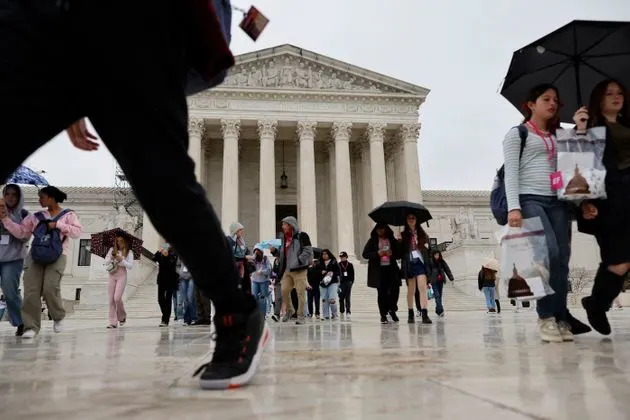
WASHINGTON, DC - APRIL 07: Tourists move through the plaza in front of the U.S. Supreme Court building April 07, 2023 in Washington, DC. According to a ProPublica report published Thursday, Supreme Court Associate Justice Clarence Thomas failed to include in his financial disclosures that for decades he was treated to luxury vacations by Texas real estate magnate and Republican mega-donor Harlan Crow. (Photo by Chip Somodevilla/Getty Images)
WASHINGTON, DC – APRIL 07: Tourists move through the plaza in front of the U.S. Supreme Court building April 07, 2023 in Washington, DC. According to a ProPublica report published Thursday, Supreme Court Associate Justice Clarence Thomas failed to include in his financial disclosures that for decades he was treated to luxury vacations by Texas real estate magnate and Republican mega-donor Harlan Crow. (Photo by Chip Somodevilla/Getty Images)

In his statement, Crow said his company purchased the properties “at market rate based on many factors including the size, quality, and livability of the dwellings.”

He did not respond to requests to provide documentation or details of how he arrived at the price.

Thomas was born in the coastal hamlet of Pin Point, outside Savannah. He later moved to the city, where he spent part of his childhood in his grandfather’s home on East 32nd Street.

“It had hardwood floors, handsome furniture, and an indoor bathroom, and we knew better than to touch anything,” Thomas wrote of the house in his memoir, “My Grandfather’s Son.”

He inherited his stake in that house and two other properties on the block following the death of his grandfather in 1983, according to records on file at the Chatham County courthouse. He shared ownership with his brother and his mother, Leola Williams. In the late 1980s, when Thomas was an official in the George H.W. Bush administration, he listed the addresses of the three properties in a disclosure filing. He reported that he had a one-third interest in them.

Thomas was confirmed to the Supreme Court in 1991. By the early 2000s, he had stopped listing specific addresses of property he owned in his disclosures. But he continued to report holding a one-third interest in what he described as “rental property at ## 1, 2, & 3” in Savannah. He valued his stake in the properties at $15,000 or less.

Two of the houses were torn down around 2010, according to property records and a footnote in Thomas’ annual disclosure archived by Free Law Project.

In 2014, the Thomas family sold the vacant lots and the remaining East 32nd Street house to one of Crow’s companies. The justice signed the paperwork personally. His signature was notarized by an administrator at the Supreme Court, Perry Thompson, who did not respond to a request for comment. (The deed was signed on the 23rd anniversary of Thomas’ Oct. 15 confirmation to the Supreme Court. Crow has a Senate roll call sheet from the confirmation vote in his private library.)

Thomas’ financial disclosure for that year is detailed, listing everything from a “stained glass medallion” he received from Yale to a life insurance policy. But he failed to report his sale to Crow.

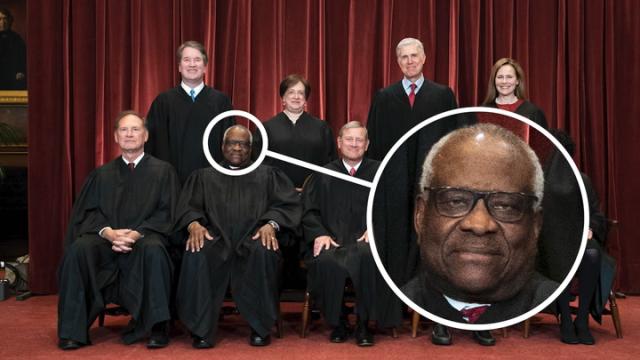
WASHINGTON, DC - OCTOBER 07: United States Supreme Court Associate Justice Clarence Thomas poses for an official portrait at the East Conference Room of the Supreme Court building on October 7, 2022 in Washington, DC. The Supreme Court has begun a new term after Associate Justice Ketanji Brown Jackson was officially added to the bench in September. (Photo by Alex Wong/Getty Images)
WASHINGTON, DC – OCTOBER 07: United States Supreme Court Associate Justice Clarence Thomas poses for an official portrait at the East Conference Room of the Supreme Court building on October 7, 2022 in Washington, DC. The Supreme Court has begun a new term after Associate Justice Ketanji Brown Jackson was officially added to the bench in September. (Photo by Alex Wong/Getty Images)

Crow purchased the properties through a recently formed Texas company called Savannah Historic Developments LLC. The company shares an address in Dallas with Crow Holdings, the centerpiece of his real estate empire. Its formation documents were signed by Crow Holdings’ general counsel. Business records filed with the Texas secretary of state say Savannah Historic Developments is managed by a Delaware LLC, HRC Family Branch GP, an umbrella company that also covers other Crow assets like his private jet. The Delaware company’s CEO is Harlan Crow.

A Crow Holdings company soon began paying the roughly $1,500 in annual property taxes on Thomas’ mother’s house, according to county tax records. The taxes had previously been paid by Clarence and Ginni Thomas.

Crow still owns Thomas’ mother’s home, which the now-94-year-old continued to live in through at least 2020, according to public records and social media. Two neighbors told ProPublica she still lives there. Crow did not respond to questions about whether he has charged her rent. Soon after Crow purchased the house, an award-winning local architecture firm received permits to begin $36,000 of improvements.

People hold signs decrying U.S. Supreme Court Justice Clarence Thomas in front of the Supreme Court Building in Washington, U.S. April 13, 2023. REUTERS/Jonathan Ernst

Crow’s purchases seem to have played a role in transforming the block. The billionaire eventually sold most of the other properties he bought to new owners who built upscale modern homes, including the two vacant lots he purchased from Thomas.

Crow also bought the house immediately next door to Thomas’ mother, which was owned by somebody else and had been known for parties and noise, according to property records and W. John Mitchell, former president of a nearby neighborhood association. Soon the house was torn down. “It was an eyesore,” Mitchell said. “One day miraculously all of them were put out of there and they scraped it off the earth.”

“The surrounding properties had fallen into disrepair and needed to be demolished for health and safety reasons,” Crow said in his statement. He added that his company built one new house on the block “and made it available to a local police officer.”

Today, the block is composed of a dwindling number of longtime elderly homeowners and a growing population of young newcomers. The vacant lots that the Thomas family once owned have been replaced by pristine two-story homes. An artisanal coffee shop and a Mediterranean bistro are within walking distance. Down the street, a multicolored pride flag blows in the wind.

Who is Jack Teixeira, the Massachusetts Air National Guard member arrested in Pentagon leak case?

Yahoo! News

Who is Jack Teixeira, the Massachusetts Air National Guard member arrested in Pentagon leak case?

The 21-year-old intelligence specialist was taken into custody by the FBI at his home in Dighton, Mass., on Thursday.

Dylan Stableford, Senior Writer – April 13, 2023

Jack Teixeira in uniform
Jack Teixeira (via Facebook)

Jack Teixeira, a 21-year-old member of the U.S. National Guard, was arrested Thursday in connection with the alleged disclosure of highly classified military documents on the war in Ukraine.

Teixeira, an airman first class with the Massachusetts Air Force National Guard’s 102nd Intelligence Wing, based on Cape Cod, was taken into custody by federal agents at his home in Dighton, Mass., about 45 miles south of Boston and 15 miles east of Providence, R.I.

Attorney General Merrick Garland announced Teixeira’s arrest in a brief statement at the Justice Department. Garland said that Teixeira surrendered “without incident” and would be charged with the unauthorized removal of classified national defense information. The investigation is ongoing, Garland added.

Texeira is scheduled to make his first court appearance in Boston on Friday, according to Yahoo News partner USA Today.

Two local police officers and patrol cars block the road as the FBI conducts a search of Teixeira's home in Dighton, Mass.
Local police block the road as the FBI conducts a search of Teixeira’s home in Dighton, Mass., on Thursday. (Matt Stone/MediaNews Group/Boston Herald via Getty Images)

Footage from a local television news helicopter showed heavily armed tactical agents taking Teixeira, who was wearing a T-shirt and shorts, into custody along a wooded driveway.

The Pentagon and FBI had been scrambling to identify the source of the leak since Friday, when a trove of U.S. Defense Department slides, many marked “Secret” or “Top Secret,” were posted to a private chat group on the Discord platform.

As Yahoo News reported earlier this week, the documents included “intelligence culled from a host of spy agencies — the CIA, the National Security Agency, the Defense Intelligence Agency, the National Reconnaissance Office and more — with a limitless purview reaching all regions of the globe.”

Speaking to reporters in Dublin earlier Thursday, President Biden said that the United States was closing in on identifying a suspect.

“There’s a full-blown investigation going on, as you know, with the intelligence community and the Justice Department,” Biden said. “And they’re getting close.”

Pentagon spokesman U.S. Air Force Brig. Gen. Patrick Ryder, in uniform, takes questions about the leak investigation during a press briefing in Washington, D.C.
Pentagon spokesman U.S. Air Force Brig. Gen. Patrick Ryder takes questions about the leak investigation. (Alex Brandon/AP)

According to the New York Times, which first identified Teixeira as a suspect, he oversaw the private online group on the Discord site called Thug Shaker Central, where “about 20 to 30 people, mostly young men and teenagers, came together over a shared love of guns, racist online memes and video games.”

The newspaper also spoke with Teixeira’s mother, who said he had recently been working overnight shifts at the base on Cape Cod, and he had recently changed his phone number.

The Military Times reported that Teixeira joined the Air National Guard in September 2019 and that he works as a cyber transport systems journeyman.

Why Republicans Are Overreaching So Hard in So Many States

Time

Why Republicans Are Overreaching So Hard in So Many States

Philip Elliott – April 11, 2023

US-NEWS-KY-ABORTION-BILLS-LX

Kentucky state Rep. Randy Bridges, a Republican, gives a thumbs down as protesters chant “Bans off our bodies” at the Kentucky state Capitol on April 13, 2022 Credit – Ryan C. Hermens—Lexington Herald-Leader/Tribune News Service via Getty Images

In state capitals across the country, Republicans seem to be overplaying their hand. The most obvious example is abortion, which poll after poll shows most Americans support in many, if not most, circumstances. In Iowa, a state policy to cover the costs of abortion and morning-after pills for rape victims is on hold as the Republican Attorney General reviews it. In Idaho, where abortion is already illegal in all cases, it is now a crime punishable by up to five years in prison for adults who help pregnant minors to cross state lines to obtain the procedure. In South Carolina, a bill categorizing abortion the same as homicide—punishable by the death penalty—has seemed to lose steam, but nonetheless remains in play.

And those are just some of the dozens and dozens of efforts undertaken with Republican guidance to further erode abortion rights in a post-Roe world. Look around at other culture-war-flavored topics running on parallel tracks inside the GOP, and it’s clear that their leaders are chasing broadly unpopular goals: banning books and targeting drag queens; making some of the most dangerous firearms even more accessibleblocking health care for transgender individuals; fighting corporations over “wokeness”; and engaging in the most brazen political retaliation.

All of these are polling clunkers—with the important exception of gender-affirming care for trans minors—and stand to leave the 44% of Americans who identify with neither party wondering just what is animating Republican lawmakers this session, be it in statehouses or here in Washington. Here’s the most basic answer: it’s what they need to do to survive.

Now, hear me out. A lot of my liberal friends predictably will retort that this is all part of some scary, hate-filled agenda meant to oppress non-white, female, and marginalized communities. My conservative pals will say these are simply efforts to roll back government’s reach. Both can be true, but if you get down to the realpolitik of the situation, this polarized agenda is merely the logical conclusion of what happens when the party in power looks around and sees there’s no one there to stop them from drawing legislative districts however they please. The extreme gerrymandering that results means red states get redder legislatures—and, to be fair, blue states turn deeper blue; there are just fewer of them—and the resulting policies move to the extremes with few consequences.

Few consequences, that is, until someone falls out of line. It’s really, really rare to lose re-nomination as an incumbent; just 14 of the 435 House seats saw that happen last year, and roughly half were victims of ex-President Donald Trump’s petty endorsement of a challenger. Moving to last year’s November ballot, a study of most of the races on most ballots found 94% of all incumbents won another term, with congressional incumbents posting a staggering 98% win rate and state-level incumbents notching a 96% record in the general election.

This job-for-life patina is not by accident. Incumbents know it’s statistically improbable that any newcomer can credibly boot them from power. Incumbency has huge advantages, including taxpayer-funded (official) travel, the power of the bully pulpit, and donors looking to stay in good graces. But you look at the few case studies about incumbents who didn’t win re-nomination, and there are warning signs. The folks who lose spectacularly often run afoul of orthodoxy inside the party’s most fervent crowds. Rep. Liz Cheney—who dared call Jan. 6, 2021, for what it was—is a prime example. (To be fair, Rep. Caroline Maloney, who had the misfortune of being matched with another longtime institution of New York Democratic politics, is not.)

Then there are the very carefully drawn and high-cost maps themselves. Chris Cillizza smartly noted in his newsletter last week that the Cook Political Report analysis of the current map shows a scant 82 House seats in play, and only 45 would be considered truly competitive. When Cook did this analysis back in 1999, the number of potentially competitive districts totalled 164—double what it is today. Which means this: the head-to-head, D-vs.-R voting isn’t the real race. The true competition is the one that transforms a candidate into a nominee in increasingly homogeneous communities where voters are picking real estate based not only on crime and tax rates, but also their prospective neighbors’ ideologies. Being seen as an oddball for a district—AKA collaborating across the aisle on legislation—is a death sentence in a lot of districts, which explains the steady polarization in Congress itself. The name of the game for incumbents is survival, and veering to an extreme can be a gilded path for another term, while trying for comity can mean a skid toward K Street.

So as you look at the seemingly out-of-touch agenda snaking its way through state legislatures and the Republican-led parts of Washington and think the plans are incompatible with the electorate, that’s only partially true. Broadly, yes, Americans are aghast at parts of this all-culture-wars-all-the-time agenda. Some 76% of Americans tell pollsters that they’re fine with schools teaching ideas that might make students uncomfortable. And a clear majority of all Americans—64%—think abortion should be legal in most or all cases. The same number of Americans say there should be laws protecting transgender individuals from discrimination.

Read moreExclusive: New Data Shows the Anti-Critical Race Theory Movement Is ‘Far From Over’

Dig into the numbers a little, though, and it’s quickly apparent that the lawmakers chasing these divisive notions are not completely irrational, especially when you consider their district borders are drawn to foment hardcore policies. The dirty secret among political professionals is that all voters are not created equal. Take the question of whether schools can teach ideas that make students uncomfortable. Among voters who backed Biden in 2020, just 7% of Americans said they were fine with such a block; look at Trump 2020 voters, and that number gets to 36%, meaning a full third of the GOP universe for 2024 is OK with at least some measure of book bans, and that group is probably more likely to vote in the next primary. On abortion, among Republicans, polls find 58% support for the overturning of Roe, including 35% who said they strongly support it. And while 64% of all Americans favor non-discrimination policies toward trans individuals, 58% of them also say trans student athletes should play on the team that matches their gender at birth, regardless of how they identify. Among Republicans, that number spikes to 85%, an astronomical figure that almost demands action.

Put simply: the culture wars might be less about the fight and more about how the battlefields were drawn well before any of the officeholders even showed up.

That’s a small consolation for liberals in competitive states watching as increasingly conservative lawmakers rush ahead on an agenda mismatched to what constituents actually want. Democrats may be able to claw back some of that imbalance if they ever convince their base of the reality that securing the right handful of state legislature seats would have far more power in shaping national politics than throwing millions at longshot, feel-good candidates who become darlings on social media but are chasing votes that aren’t there. Nonetheless, most of these maps are locked in place until at least 2031. Republicans know it, too, which explains why so many of them are leaning into broadly unpopular—but parochially homerun—policies.

Trump’s tale of crying Manhattan court employees was ‘absolute BS,’ law enforcement source says

Yahoo! News

Trump’s tale of crying Manhattan court employees was ‘absolute BS,’ law enforcement source says

Michael Isikoff, Chief Investigative Correspondent – April 12, 2023

Former President Donald Trump, stony-faced, arrives surrounded by police.
Former President Donald Trump arrives at court on April 4. (Mary Altaffer/AP)

Former President Trump’s claim to a Fox News anchor that New York court employees were “crying” and apologizing for his arraignment on felony charges is “absolute BS” and doesn’t remotely resemble what took place, a law enforcement source familiar with the details of what transpired that day told Yahoo News.

“Zero,” said the source when asked how much truth there was to Trump’s colorful account. “There were zero people crying. There were zero people saying ‘I’m sorry.’”

Trump offered his version of events in an interview with the Fox News host Tucker Carlson that aired Tuesday night.

“When I went to the courthouse, which is also a prison in a sense, they signed me in, and I’ll tell you, people were crying,” Trump told Carlson. “People that work there, professionally work there, that have no problems putting in murderers, and they see everybody. It’s a tough, tough place, and they were crying. They were actually crying. They said, ‘I’m sorry.’ They said, ‘2024, sir. 2024.’ And tears were pouring down their eyes.”

In fact, the source said, aside from his lawyers and Secret Service agents, Trump interacted only with a handful of district attorney employees at the courthouse and had extremely limited exposure with others during his arraignment last Tuesday in lower Manhattan.

Former President Donald Trump sits in court for his arraignment, surrounded by his lawyers.
Trump in court with his lawyers on April 4. (Steven Hirsch/Pool via AP)

Upon his arrival, Trump was informed of the charges against him and was booked on 34 felony counts for falsification of business records to conceal hush money payments to a porn star in the waning days of the 2016 presidential election. The former president, looking glum, said little during the booking, as did Manhattan District Attorney Alvin Bragg’s deputies, who were with him throughout the process, the source said.

The only hiccup came when his fingers were too dry for his fingerprinting, at which point district attorney employees provided lotion for his fingers, the source added.

Carlson’s friendly interview with Trump was especially ironic given its timing. It comes on the eve of a trial slated to begin next Monday in Delaware, in which Carlson, along with his fellow host Sean Hannity and multiple Fox executives, are slated to be witnesses in a $1.6 billion defamation lawsuit brought by Dominion Voting Systems against Fox News for airing debunked claims of 2020 election fraud by Trump and his surrogates.

The suit has already brought to light multiple internal emails and texts by Carlson, in which he expressed his private contempt for Trump and derided the claims of fraud and vote flipping being brought by his lawyers — views he never shared with his audience.

“I hate him passionately,” Carlson said about Trump in a text to one colleague on Jan. 4, 2021, adding in another text, “We are very, very close to being able to ignore Trump most nights.”

A person holds up as sign saying: Fox Lies, Democracy Dies.
A protester at a rally outside Fox News headquarters in New York City in June 2022. (Michael M. Santiago/Getty Images)

In other exchanges, Carlson privately called the claims of Trump lawyer Sidney Powell about vote flipping by Dominion “insane” and “absurd.”

Yet during Tuesday night’s interview, Carlson never challenged or pushed back against any of Trump’s assertions, including an unusual exchange about the Biden administration’s alleged failure to rescue German shepherds from Afghanistan.

“They left everything,” Trump said of Biden’s pullout from Afghanistan. “They left in the dark of night. They left the lights on. They left the dogs, by the way.”

“They left the dogs?” Carlson asked.

“They left the dogs,” Trump responded. “You know, the dog lovers, and you know there are a lot of them. I love dogs. You love dogs. One of the first questions I got was, ‘What did they do with the dogs?’ Mostly German shepherds. They left them. The way they got out was so horrible. … We would have gotten out with strength and dignity.”

In her memoir, “Raising Trump,” the former president’s ex-wife Ivana wrote that Trump “was not a dog fan” and often expressed hostility to her poodle, Chappy.

Americans Are Dying Younger—But Where You Live Makes a Big Difference

Time

Americans Are Dying Younger—But Where You Live Makes a Big Difference

Jeremy Ney – April 12, 2023

US-SHOOTING-SCHOOL
US-SHOOTING-SCHOOL

Alexander Reddy, who’s friend’s little sister is Hallie Scruggs, pays respects at a makeshift memorial for victims by the Covenant School building at the Covenant Presbyterian Church following a shooting, in Nashville, Tennessee, March 28, 2023. – A heavily armed former student killed three young children and three staff in what appeared to be a carefully planned attack at a private elementary school in Nashville on March 27, before being shot dead by police. Credit – BRENDAN SMIALOWSKI-AFP

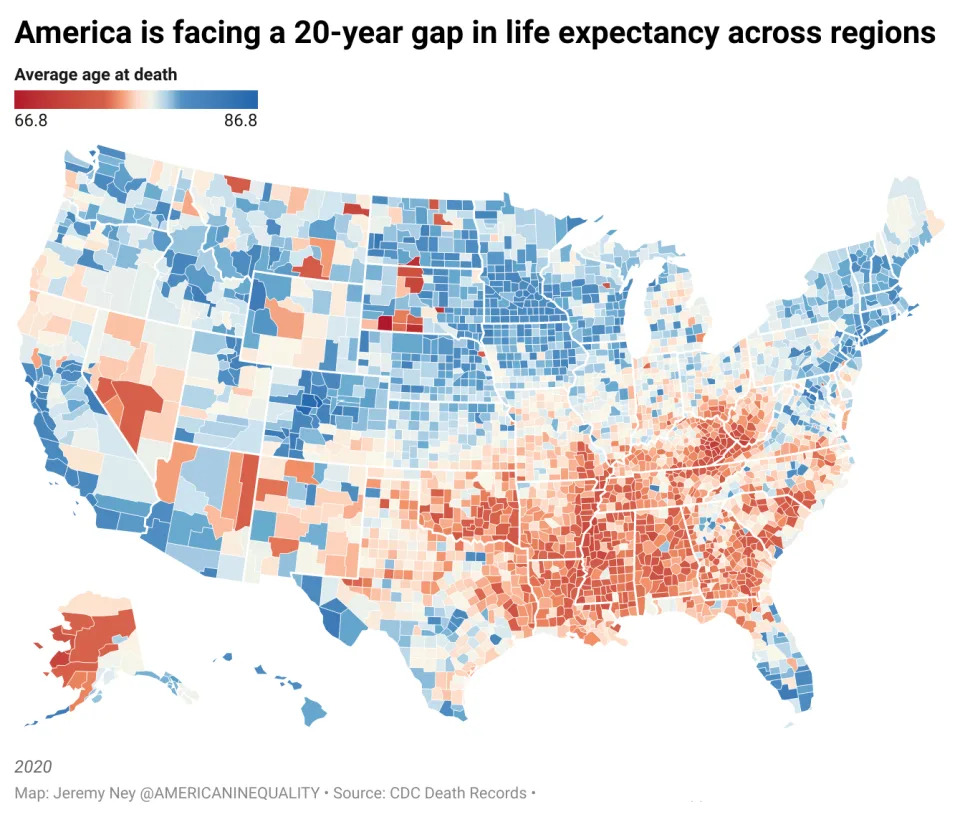
The average U.S. life expectancy has hit its worst decline in 100 years and America’s standing is dismal among peer nations. But the average obscures a more complex story. The United States is facing the greatest divide in life expectancy across regions in the last 40 years. Research from American Inequality found that Americans born in certain areas of Mississippi and Florida may die 20 years younger than their peers born in parts of Colorado and California.

The decline is not occurring equally throughout the country. In the land of opportunity, millions of people are not even given a fair shot at life.

America is facing 20 year gap in life expectancy across the country<span class="copyright">Credit to Jeremy Ney @ AmericanInequality</span>
America is facing 20 year gap in life expectancy across the countryCredit to Jeremy Ney @ AmericanInequality

America is unique among wealthy countries when it comes to how young people die, and the trend is only getting worse. From 2019 to 2020, U.S. life expectancy declined by almost 2 years according to the Center Disease Control and Prevention (CDC), the worst two-year decline since 1921-1923. When Covid hit, America experienced a larger decline in life expectancy than any other wealthy country. Life expectancy in America is now 76 years.

What is driving the differences in who lives and who dies in America? The answer is wealth, demographics, and location.

State policies tremendously influence life expectancy. Income support, medicaid expansion, stronger gun control, drug overdose prevention, and safe abortion access are among the drivers of regional divides in life expectancy. Overdoses kill more than 100,000 people each year. Guns kill more people than cars do. But digging into communities shed light on the country’s biggest issues.

More from TIME
Wealthier Americans live longer

Income is a major driver of higher life expectancies. In the wealthiest regions like Aspen, Colorado and Santa Clara, California, median household incomes reach the hundreds of thousands of dollars and Americans live to 87 on average, the highest in the country. But in poorer regions like or Owsley County, Kentucky or Union County, Florida, the median household income is $35,000 and life expectancy floats around 67 on average, the lowest in the country.

Our research has found a painfully high correlation between household income and life expectancy.

Created with Datawrapper

Poverty in America is not about income alone. Low-income communities, regardless of the state, are more likely to struggle with access to affordable healthcare; they are more likely to live near toxic sites and develop lung cancer; they are more likely to live in food deserts and wrestle with illnesses like heart disease and obesity; and they are more likely to die younger from drug overdoses.

Adequately addressing inequality in life expectancy requires looking across factors and working to improve these challenges for communities.

Black communities die younger

Thomas McGuire, professor of health economics at Harvard Medical School, explained, “In terms of health, there’s approximately a five-year penalty for being African-American compared to being a White male.”

Black Americans in every state have lower life expectancies than their White peers by 4 years on average. This is largely due to the lower-quality care that Black communities receive for conditions like cancerheart problems, pneumoniapain managementprenatal and maternal health, and overall preventive health.

Pemiscot County, Missouri represents this gap most clearly as it has one of the lowest Black life expectancies in America. In Pemiscot, Black residents die at 64 on average, effectively meaning that they will work until they die. 1 in 4 residents in Pemiscot is Black. Pemiscot has one public hospital that almost closed in 2013 and it’s one of the poorest counties in Missouri.

State policies make a big difference

States in the Deep South have lower life expectancies than states north of the Mason-Dixon line. These five factors may be the reasons why the residents of some states live far longer.

1. Expanding the EITC and CTC: More money means more time alive, and certain programs which put cash directly into low-income homes have improved life expectancy. The Earned Income Tax Credit (EITC) and Child Tax Credit (CTC) federally have been some of America’s most successful poverty alleviation programs, but 11 states have enacted their own CTC programs and 31 states have implemented their own EITC programs, putting more cash into the most needy homes. Residents in states that have adopted both the EITC and CTC tend to live 2 years longer than states which have implemented neither. This may even be more cost effective at increasing life expectancy than many other policies. These programs are designed to support children, too.

Created with Datawrapper

2. Medicaid Expansion: States that expanded Medicaid saved more than 200 lives per every 100,000 people and decreased the risk of premature death by roughly 50% for older adults who gained coverage. As Nobel-Prize wining economist Paul Krugman explained, “Some of the poorest states in America, with the lowest life expectancy, are still refusing to expand Medicaid even though the federal government would cover the bulk of the cost.” Such individuals in turn are therefore at the mercy of policies that differ state to state.

3. Gun Control: Stronger gun control measures in states also improve life expectancy. The South, which has some of the most lenient gun control measures, lost 5.7 million years of life expectancy in the period 2009-2018 from firearm related deaths. Conversely, Northeastern states, which tend to have much stronger gun control measures like background checks and secure storage laws, had one-fifth the loss in life expectancy. Guns are now the #1 killer of children in America and 1 in 25 American 5-year olds now won’t live to see 40, largely due to guns. If we stopped these deaths, it would effectively add 3 years of life to every 5-year old in the South.

4. Drug Overdose Prevention: States that introduced policies to prevent drug overdose deaths saw life expectancies increase by 11%. The CDC estimates that half of all the unintentional deaths last year that took people’s lives too early were attributed to drug overdoses. The Food and Drug Administration (FDA) recently approved Naloxone to be sold over the counter at pharmacies, which could help close the state-by-state gap. In the meantime, McDowell County, West Virginia has one of the lowest life expectancies in the country and has the highest rate of opioid overdoses in the country.

5. Abortion Access: Lastly, while the data has not fully revealed the impact of the Supreme Court’s ruling in Dobbs v. Jackson, this decision may drive further divides in life expectancy for Southern states that have in turn limited abortion access. Arkansas has a maternal mortality rate that is 50% higher than the national average. In Mississippi, it is 75x more dangerous for women to carry a pregnancy to term than to have an abortion due to poor healthcare. Mississippi has the lowest life expectancy in America at 71. Causing more women to carry a pregnancy to term may increase deaths of mothers in their 20s-40s.

The 20-year gap in life expectancy across regions tells story of America. The divide is deeply interwoven with healthcare, housing, race, gender, location, education, and more. But improving life expectancy across regions in possible and it starts with state legislatures. States can learn from each other about what has worked best and implement new policies with proven effectiveness. Data will be the driving force for finding patterns of inequality and leading change-makers towards solutions that engender equality.

‘Such An Idiot’: Nicolle Wallace Bursts Out Laughing Over Trump Comment On Fox News

HuffPost

‘Such An Idiot’: Nicolle Wallace Bursts Out Laughing Over Trump Comment On Fox News

Josephine Harvey – April 12, 2023

MSNBC’s Nicolle Wallace laughed in disbelief after showing viewers an excerpt from Donald Trump’s recent interview with Fox News host Tucker Carlson in which the former president lauded authoritarian leaders as “top of the line.”

“You can tell a lot about a person by the company they keep, or in the case of the twice-impeached, disgraced, now-indicted ex-president, the people they praise loudly on Fox News,” Wallace said Wednesday.

She showed viewers a clip from Trump’s Fox News interview, which aired Tuesday. “They’re all top of the line,” Trump said of Chinese President Xi Jinping, North Korean dictator Kim Jong Un and Russian President Vladimir Putin. “Our guy’s not top of the line ― never was,” he added, referring to President Joe Biden.

Trump also called Xi a “brilliant man” and praised Kim and Putin as “very smart.”

Hooting with laughter, Wallace said: “I don’t even know where to start. No one called you top of the line. Ever!”

The MSNBC host noted that she typically avoids amplifying Trump or Fox News, but said that this rhetoric provided important context on the recent Republican-led efforts to strip back abortion rights, implement voter suppression laws and silence dissent in the Tennessee state legislature.

“It’s important to understand they’re not bodily functions. They’re not burping out random policies. They’re following their leader, who’s following the world’s most heinous authoritarians,” Wallace said. “And we showed you that to show you just how dangerous his rhetoric is.”

“He’s such an idiot, on top of all else,” she later added. “And he sounds like such a bleepin’ idiot.”

‘Please don’t punish him’: Louisville shooting bodycam footage, 911 calls paint picture of desperate moments

USA Today

‘Please don’t punish him’: Louisville shooting bodycam footage, 911 calls paint picture of desperate moments

 ‘Get here now!’; 911 calls from panicked employees inside Louisville bank released – Oh my God, there’s an active shooter there. 

Jorge L. Ortiz, John Bacon and Andrew Wolfson – April 12, 2023

LOUISVILLE, Ky. – A frantic call from an Old National Bank employee and a much calmer one from a co-worker hiding in a closet provided Louisville police the first indications of the carnage caused by a gunman’s attack, according to audio of 911 calls released Wednesday.

The shooter’s mother tried to prevent the mayhem, reaching out to police and saying her son “currently has a gun and is heading toward” the bank, but it was too late.

Together, the 911 calls and the body camera video released Tuesday fill out details of the chaotic scene surrounding Monday’s assault and the police officers’ heroic response.

Five people were killed and eight injured by a bank worker identified as Connor Sturgeon, who police said was armed with an AR-15 rifle. Authorities said officers arrived at the scene three minutes after being dispatched, likely saving lives.

“Oh my God, there’s an active shooter there,” says a panicked woman identified as the first 911 caller. “I just watched it on a Teams meeting. … We were having a board meeting with our commercial (lending) team.”

An initial picture of the harrowing Monday morning scene develops as the operator asks the woman for the bank’s address, where specifically the shooting was taking place and what the assailant looked like.

As more calls start to come in, the operator excuses himself and tells her, “We have them (police officers) going that way. … We do have everybody responding. We’re getting them out there.’’

One of the callers says she’s calling from inside a closet in the building as numerous gunshots are heard in the background. She gives a description of the shooting and says she knows the perpetrator: “He works with us.”

Another call came from a woman who says her son was heading toward the bank with a gun, saying his roommate had called expressing concern. She identifies herself as Sturgeon’s mother.

“He apparently left a note,’’ she says. “I don’t know what to do, I need your help. He’s never hurt anyone. He’s a really good kid. Please don’t punish him.’’

The woman says her son is an employee at the bank, is not violent and has never owned a gun. She asks if she should go to the bank and the responder advises her against it, saying officers were already at the scene and it was not a safe location.

INTENSE VIDEO: Louisville shooting updates: Body camera video shows officers fired at in gunman’s ‘ambush’

Louisville police release body camera footage from mass shooting at bank

Latest developments:

►Funeral services will be held Friday for Elliott, a senior vice president at the bank whom Kentucky Gov. Andy Beshear described as a good friend who helped him launch his law career.

►The killer left a note behind and told at least one person he was suicidal, U.S. Rep. Morgan McGarvey said.

A mother’s anguished 911 call

The gunman’s mother appears torn in a 911 call, wanting to protect her son but also warn police about what he might do. She tells the operator her son doesn’t own a gun but may be headed toward the bank with one.

Sturgeon’s mother says she’s shaking and doesn’t know where her son could have gotten a weapon.

“We don’t even own guns,” she says, providing a description of her son – white, 6-foot-4 inches tall.

She asks whether she should go to the bank and the operator warns her against it, saying police officers have responded.

“You’ve had calls from other people?” she asks, sounding incredulous and heartbroken. “So they’re already there?”

Yes, the operator says. “It is an unsafe situation.”

– Donovan Slack

Shooter’s parents can’t explain how ‘Mr. Floyd Central’ became a mass killer

The parents of the 25-year-old bank employee who killed five people in a hail of bullets say they can’t explain how the son voted “Mr. Floyd Central High” seven years ago turned into a brutal killer.

The family of Connor Sturgeon said late Tuesday that he had “mental health challenges” but that there were never any warning signs he was capable of what police described as the targeted shooting of Old National Bank colleagues gathered for a meeting Monday morning.

“No words can express our sorrow, anguish, and horror at the unthinkable harm our son Connor inflicted on innocent people, their families, and the entire Louisville community,” the family said in a statement.

As Louisville police seek a motive, Interim Chief Jacquelyn Gwinn-Villaroel denied reports that Sturgeon was about to get fired from his job at the bank. She told CNN on Wednesday that “there was no discussion about him being terminated.”

Body camera video from the first two police officers who responded shows them taking fire in what Deputy Police Chief Paul Humphrey described as an “ambush.”

Governor, mayor among hundreds paying tribute to victims at vigil

Hundreds of people gathered Wednesday afternoon at Louisville’s Muhammad Ali Center – about a mile from the site of the shooting – for a vigil to honor the five persons killed.

They have been identified as Joshua Barrick, 40, Thomas Elliott, 63, Juliana Farmer, 45, James Tutt, 64, and Deana Eckert, 57. They were all bank employees.

Among those who spoke at the memorial were Kentucky Gov. Andy Beshear and Louisville Mayor Craig Greenberg. Beshear was close friends with Elliott, whom the governor credited with helping launch his law career.

Beshear urged those in attendance to remember to express their love for those they care about.

“We can live for the fallen, and we can live better for them. We can be better,” Beshear said. “We can be better family members. Better dads. Better moms. We can be better community members, and we can be better people. Let’s commit that to them.”

Officer Nickolas Wilt fights for his life

Officer Nickolas Wilt remained in the hospital in critical condition after being shot in the head as he ran toward the gunfire. The released version of Wilt’s footage cuts off before he is shot.

A bullet grazed fellow officer Cory Galloway, Wilt’s field trainer, on his left side. Galloway found cover behind a large planter and eventually fired the round that took down the assailant.

Wilt, 26, graduated from the Louisville Metro Police Academy 10 days before the shooting. Gwinn-Villaroel said she had sworn him in as his family watched, and Wilt’s twin brother is going through the academy now, friends of the family said. Wilt was working just his fourth shift as a police officer.

The two officers’ quick response Monday saved lives, Gwinn-Villaroel said: They “did not hesitate” when the call came in at 8:38 a.m.

“I’m just truly proud of the heroic actions of those two officers and everybody else that responded,” Gwinn-Villaroel said. “They went toward danger in order to save and preserve life, and that’s what you saw yesterday. They stopped the threat so other lives could be saved.

“They showed no hesitation, and they did what they were taught to do.”

 Lucas Aulbach and Madeline Mitchell, Louisville Courier Journal

Galloway: ‘I think I’ve got him down’

Galloway’s video shows him and Wilt as they reach the top of the stairs outside the bank. Wilt is not shown being hit, but Galloway rolls down the stairs and positions himself behind the planter and on the sidewalk. He takes cover there for just over three minutes before other officers arrive.

At that point, Galloway is shown firing several shots. The gunshots are audible, but the footage does not offer a clear view of the fatal shot. Humphrey said Galloway did not have a “close-range shot” and the stairs obscured his camera angle.

“I think I’ve got him down,” Galloway says. He then walks up the stairs and over shattered glass. An image blurred by police shows the shooter down in the lobby, near a second set of glass doors.

“There’s only a few people in this country that can do what they did. Not everybody can do that,” Humphrey said. “They deserve to be honored for what they did because it is not something that comes easily, it is not something that comes naturally. … That’s superhuman.”

– Madeline Mitchell and Lucas Aulbach, Louisville Courier Journal

Impromptu memorial to victims emerges outside bank

The steps outside of Old National Bank have been transformed into a somber memorial crowded with flowers. White crosses with blue hearts bear the names of the victims. Kett Ketterer, who works nearby at KD & Company wholesale flower company, unloaded more than a dozen potted Easter lilies.

“I think everybody’s just in shock, and you have to have some way to express yourself in your grief,” he said. “And I’m trying to understand. It just doesn’t make sense.”

Andrew Thuita came to the memorial because his girlfriend works nearby downtown. She was safe, but he has been too close to tragedy before. In 2018, he had gone shopping at the Jeffersontown Kroger on the same day two people were shot and killed.

“Another statistic in America,” Thuita said. “There is something wrong.”

– Maggie Menderski, Louisville Courier Journal

Timeline for a tragedy

Sturgeon made a number of posts on his now deleted Instagram account shortly before the rampage began. Among them: “They won’t listen to words or protests. Let’s see if they hear this.” Sturgeon, armed with an AR-15 rifle, then livestreamed his assault.

Humphrey said the first 911 call came in at 8:38 a.m., and officers were sent to the scene. Wilt and Galloway arrived at the entrance to the bank three minutes later and were met with gunfire that forced them to back up their vehicle. One minute later they got out of the car, and two minutes after that Wilt was shot and officers returned fire.

At 8:45 a.m., after a burst of gunfire, officers entered the bank and confirmed the suspect was down. Sturgeon died at the scene.

Family statement mourns loss of son, his victims

The shooter’s family reached out to the Louisville community in their statement Tuesday night.

“We mourn their loss and that of our son, Connor. We pray for everyone traumatized by his senseless acts of violence and are deeply grateful for the bravery and heroism of the Louisville Metropolitan Police Department,” the statement read.

“While Connor, like many of his contemporaries, had mental health challenges which we, as a family, were actively addressing, there were never any warning signs or indications he was capable of this shocking act. While we have many unanswered questions, we will continue to cooperate fully with law enforcement officials and do all we can to aid everyone in understanding why and how this happened.”

A star athlete with negative self-image

Sturgeon grew up in southern Indiana and graduated from Floyd Central High School, about 12 miles northwest of Louisville. He earned his bachelor’s and master’s degrees at the University of Alabama, an school spokesperson confirmed.

At Floyd Central, he played basketball for his father, Todd Sturgeon, who was the head coach. The younger Sturgeon was named “Mr. Floyd Central” in 2016 as a senior.

A former friend and teammate at Floyd Central told The Daily Beast this week that Sturgeon was “smart, popular and a star athlete.”

But in a 2018 college essay at the University of Alabama, Sturgeon wrote, “My self-esteem has long been a problem for me,” and as a “late bloomer in middle and high school, I struggled to a certain extent to fit in, and this has given me a somewhat negative self-image that persists today.” The essay was posted to a website called “CourseHero,” CNN and The Daily Beast reported, but it has since been taken down.

How to Fall Back Asleep After Waking Up in the Middle of the Night

Real Simple

How to Fall Back Asleep After Waking Up in the Middle of the Night

Ashley Zlatopolsky – April 11, 2023

Sleep experts share what to do and what to avoid.

<p>jhorrocks/Getty Images</p>
jhorrocks/Getty Images

You’ve probably been here before: It’s 3 a.m., you’re awake for reasons you can’t explain and now you can’t fall back asleep. Should you continue tossing and turning and hope for the best, or get out of bed to do something that makes you sleepy again? The best course of action lies somewhere in the middle. Here’s what sleep experts recommend doing (and avoiding) if you wake up in the middle of the night and need help falling back to sleep.

What causes nighttime waking?
Normal, natural sleep patterns.

There are few things worse than waking up in the middle of the night, whether from anxiety or another reason, and not being able to fall back asleep. But waking up in the middle of the night is actually normal. “Everybody wakes up in the middle of the night,” says Philip Lindeman, MD, PhD and a sleep expert with Ghostbed. “Normal sleep cycles are such that we all enter at least a very shallow phase of wakefulness several times per night.” This can include interludes of getting up to use the bathroom and then going back to sleep. In fact, he adds that you may not even remember many of these awakenings happening.

Related:8 Harmful Habits to Avoid if You Want Better Sleep, According to a Sleep Consultant

Internal health issues and environmental factors.

Other causes of nighttime waking can include stress, anxiety, illness, hunger, discomfort, or changes in your sleep routine and sleep environment, explains clinical psychologist Carolina Estevez, PsyD. Then there are causes like nightmares or night terrors, or environmental noise or light disturbances.

Clearly middle-of-the-night waking is common and far from unavoidable, and is typically fine if we can get back to sleep without much of a problem. The real issue arises when you wake up, either naturally or unnaturally, and can’t fall back asleep afterward. This can actually cause more stress and anxiety that keeps you awake, and of course cause you miss out on precious sleep for your overall health.

How to Fall Back Asleep, According to Experts
Let your mind wander in a “happy place.”

If you’re awake in the middle of the night and wondering how to fall back asleep, Dr. Lindeman first recommends getting yourself in a good headspace. “Try guiding yourself into a ‘happy place,’ ‘flying’ over a place you like, or even ‘walking’ there if it helps,” he says. “Don’t worry if your eyes are open or closed, because it doesn’t matter. What matters is that the room is dark.” Dr. Lindeman says to “let your mind wander and do your best to stay there,” which can lull you into a sleep.

After about 20 minutes, find another place to lie down.

However, Dr. Lindeman adds that it’s important not to force sleep, which he says can have the opposite effect. If more than 20 minutes have gone by and you’re still lying awake in bed, Estevez suggests getting up and going into another room that might help calm your mind. Ideally, this is a room with a couch or even another bed where you can lie down and encourage rest.

Related:3 Reasons to Start Reading a Book Before Bed, According to Research and Sleep Pros

Try simple relaxation techniques.

“You can also try relaxation techniques such as deep breathing or progressive muscle relaxation,” she adds. Some research has shown that slow breathing, together with healthy sleep hygiene and habits, may be more effective for insomnia than interventions like hypnosis or prescription medications. One breathing exercise called 4-7-8 breathing, which involves an elongated exhale, helps deactivate your stress system and activate your rest and digest system.

Get more physical exercise during the daytime.

Estevez also says that incorporating regular physical activity into your day can help promote better sleep quality at night and prevent occurrences of nighttime waking and sleeplessness.

Related:6 Feel-Good Stretches You Should Do Every Night Before Bed

What Not to Do

There’s more on the list of things you should avoid rather than things you should do if you’re wondering how to fall back asleep. The biggest thing to avoid: your cell phone, and then your TV. “Don’t open your phone, tablet, or computer,” Dr. Lindeman says. “It’s the worst thing you can do because the wavelength of light emitted will bottom out your melatonin levels.” Since blue light and bright light stops melatonin production, which is essential to making you feel sleepy, playing around on your phone or putting on a Netflix show can cue your body further for wakefulness.

Dr. Lindeman also cautions against turning on a light, eating, drinking, or taking medicine unless you’re in pain (such as being sick with a virus and unable to fall back asleep because of it). If you’re really struggling to fall back asleep and none of the above has helped, you can try taking a hot bath or diffusing lavender oil in your bedroom, but these should be last resorts, since the act of turning on lights or looking for things to help might in turn wire your brain some more.

Another thing to avoid is the clock. Seeing what time it is can cause anxiety and keep you from falling back asleep, so if you have regular nighttime awakenings that leave you awake for long periods of time, you may want to consider removing any clocks from your room (or at least keeping them out of your sight). If noise is keeping you up, earplugs or a sound machine are other options to consider, while light disturbances can be blocked out with a good set of blackout curtains or a quality eye mask.

Related:10 Soothing Podcasts for Sleep That Will Have You Out Like a Light

What to Do if Nothing Works

If waking up in the middle of the night and not being able to fall back asleep is affecting your mental health or daily functioning, and you’ve tried all of the above to no avail, an underlying medical sleep condition, like insomnia, could be at the root of the problem. To get to the bottom of it, Estevez says, “speaking with a health professional may be helpful in developing an individualized treatment plan.” However, be sure to practice good sleep hygiene, keep a regular sleep schedule and avoid stimulating activities at night, like scrolling your phone before bed or working out late.

Pressured by Their Base on Abortion, Republicans Strain to Find a Way Forward

The New York Times

Pressured by Their Base on Abortion, Republicans Strain to Find a Way Forward

Jonathan Weisman – April 11, 2023

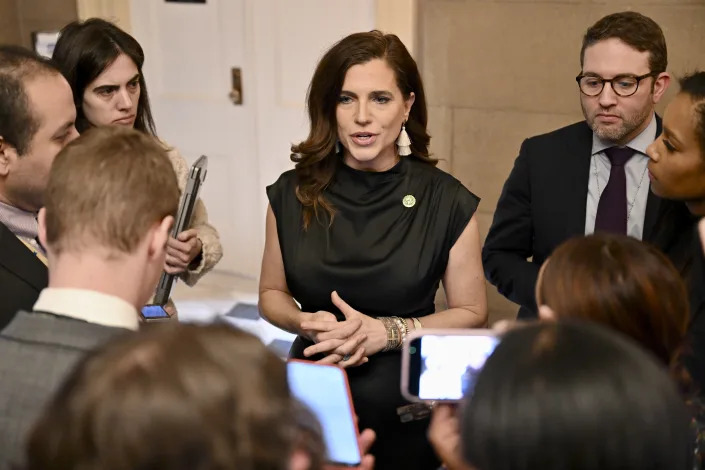
Rep. Nancy Mace (R-S.C.) speaks to reporters at the U.S. Capitol in Washington, on Feb. 2, 2023 (Kenny Holston/The New York Times)

Republican leaders have followed an emboldened base of conservative activists into what increasingly looks like a political cul-de-sac on the issue of abortion — a tightly confined absolutist position that has limited their options before the 2024 election season, even as some in the party push for moderation.

Last year’s Supreme Court decision overturning a woman’s constitutionally protected right to an abortion was supposed to send the issue of abortion access to the states, where local politicians were supposed to have the best sense of the electorate’s views. But the decision on Friday by a conservative judge in Texas, invalidating the Food and Drug Administration’s 23-year-old approval of the abortion pill mifepristone, showed the push for nationwide restrictions on abortion has continued since the high court’s nullification of Roe v. Wade.

Days earlier, abortion was the central theme in a liberal judge’s landslide victory for a contested and pivotal seat on the state Supreme Court in Wisconsin. Some Republicans are warning that the uncompromising position of their party’s activist base could be leading them over an electoral cliff next year.

“If we can show that we care just a little bit, that we have some compassion, we can show the country our policies are reasonable, but because we keep going down these rabbit holes of extremism, we’re just going to keep losing,” said Rep. Nancy Mace, R-S.C., who has repeatedly called for more flexibility on first-term abortions and exceptions for rape, incest and the life and health of the mother. “I’m beside myself that I’m the only person who takes this stance.”

She is far from the only one.

The chair of the Republican National Committee, Ronna McDaniel, has been showing polling to members of her party demonstrating that Americans largely accept abortion up to 15 weeks into a pregnancy and support the same exemptions that Mace wants. Dan O’Donnell, a conservative radio host in Wisconsin, wrote after the lopsided conservative defeat in the state Supreme Court contest that abortion was driving young voters to the polls in staggering numbers and that survival of the party dictated compromise.

“As difficult as this may be to come to grips with, Republicans are on the wrong side politically of an issue that they are clearly on the right side of morally,” he wrote.

The problem goes beyond abortion. With each mass shooting, the GOP’s staunch stand against gun control faces renewed scrutiny. Republicans courted a backlash last week when they expelled two young Democratic lawmakers out of the Tennessee state legislature for leading youthful protests after a school shooting in Nashville that left six dead. Then on Monday came another mass shooting, in Louisville, Kentucky.

“My kids had friends on Friday night running for their lives,” said Mace, referring to a shooting on South Carolina’s Isle of Palms, which elicited no response from most of her party. “Republicans aren’t showing compassion in the wake of these mass shootings.”

The party’s stand against legislation to combat climate change has helped turn young voters into the most liberal bloc of the American electorate. And Republican efforts to roll back LGBTQ rights and target transgender teenagers, while popular with conservatives, may be seen by the broader electorate as, at best, a distraction from more pressing issues.

Rep. Mark Pocan, an openly gay Democrat from Wisconsin, said Monday that in the short term, the Republican attacks on transgender Americans were having a real-world effect, with a rise in violence and bigotry. But he said it is also contributing to the marginalization of the party, even in his swing state.

He pointed to the “WOW counties” that surround Milwaukee — Waukesha, Ozaukee and Washington — where then-Republican Gov. Scott Walker won 73% in 2014, and where the Republican, Dan Kelly, won 58.7% in the state Supreme Court race last week.

“We keep seeing our numbers increase in those counties because those Republicans largely are economic Republicans, not social Republicans,” Pocan said, adding that GOP candidates “definitely are chasing their people away.”

Mace does appear to be correct that her desire for compromise is not widely shared in a party in which analysts continue to look past social issues to explain their electoral defeats.

Kelly was a poor candidate who lost by an almost identical margin in another state Supreme Court race in 2020, noted David Winston, a longtime pollster and strategist for House Republican leaders. And, Winston added, Republicans may have lost female voters by 8 percentage points in the 2022 midterm elections, but they lost them by 19 points in 2018.

If inflation and economic concerns remain elevated, he added, the 2024 elections will be about the economy, not abortion or guns.

Republicans greeted the abortion-drug ruling on Friday, by Judge Matthew J. Kacsmaryk of the U.S. District Court for the Northern District of Texas, with near total silence. The judge gave the Biden administration seven days to appeal, and on Monday, senior executives of more than 250 pharmaceutical and biotech companies pleaded with the courts to nullify the ruling with a scorching condemnation of Kacsmaryk’s reasoning.

Most anti-abortion advocates are not backing down. Katie Glenn Daniel, the state policy director for Susan B. Anthony Pro-Life America, one of the most powerful anti-abortion groups, said Wisconsin’s results were more about anti-abortion forces being badly outspent than about ideology. In her state, Florida, she noted, Democrats scorched Republicans with advertising in 2022 saying they planned to ban abortion without exceptions. Republicans, from Gov. Ron DeSantis on down, easily prevailed that November.

Republicans need to keep pressing with abortion restrictions that will affect Democratic states as well as Republican ones, she said.

“A national minimum standard is incredibly important. Without it there will continue to be late-term abortions, and governors like Gavin Newsom are very motivated to force his views on the rest of the country,” she said of California’s Democratic governor.

Last week, the Florida state Senate approved legislation pushing the state’s ban on abortion from the current 15 weeks into pregnancy to six weeks. If the state’s House of Representatives approves it, DeSantis has said he will sign it. If DeSantis runs for president as expected, his signature would thrust abortion squarely into the 2024 race for the White House.

Last year, John P. Feehery, a veteran Republican leadership aide in the House, urged his party to find a defensible position on abortion that included flexibility on abortion pills, allowed early pregnancies to be terminated and detailed a coherent position on exceptions for rape, incest and health concerns. He said Monday that he was repeatedly told abortion would be a state-level issue and federal candidates should just stay quiet.

“They didn’t want to do the hard work on abortion,” he said, blaming “a lack of leadership” in the party that still has the Republican position muddled.

Guns are another issue where silence is not working. The shooting in Louisville, which left six dead, including the gunman, and eight wounded, kept the issue of guns in the spotlight after last week’s heated showdown in Tennessee — and before a three-day gathering of the National Rifle Association on Friday in Indianapolis. The Kentucky attack was the 15th mass shooting this year in which four or more victims were killed, the largest total in a year’s first 100 days since 2009, according to a USA Today/Associated Press/Northeastern University database.

“You can’t stop paying attention after one horrible event happens. You have to watch what happens afterward,” said Rep. Maxwell Frost, 26, a Florida Democrat who last year became the first member of Generation Z to be elected to the House.

Voices for compromise are beginning to bubble up, in some cases from surprising sources. Carol Tobias, president of the National Right to Life Committee, one of the country’s largest anti-abortion groups, said Monday that even she was “somewhat concerned” that the Republican Party might be getting ahead of the voters on abortion. Her organization has drafted model legislation to ban abortion at the state level in every case but when the life of the mother is in grave danger. But, Tobias said, that legislation comes with language to extend those exceptions to the “hard cases,” pregnancies that result from rape or incest, or that might harm a mother’s health.

“We’ve always known the American public does not support abortion for all nine months of a pregnancy,” she said. “They want some limits. We are trying to find those limits.”

She added, “If we can only at this time save 95% of the babies, I am happy to support that legislation.”