Ukrainian troops say Western military officers have been FaceTiming with them to teach them how to use weapons coming without instructions
Jake Epstein – April 17, 2023
A Ukrainian serviceman fires a rocket-propelled grenade (RPG) from a launcher during a training exercise in the Donetsk region on April 7, 2023.Photo by GENYA SAVILOV/AFP via Getty Images
Ukrainian soldiers have received billions of dollars in Western security assistance to fight Russia.
Sometimes, the weapons they’ve been given don’t come with instructions, or have other issues
Kyiv’s troops say they’ve FaceTimes with Western military officers for help, a new War on the Rocks report says.
Ukrainian soldiers fighting off invading Russian forces have enjoyed the delivery of loads of security assistance from NATO partners, but when this weaponry arrives in Ukraine, things aren’t always the way troops need them to be.
In some cases, the military aid comes in without instructions, so Western military officers have been hopping on FaceTime with Ukrainian troops to teach them how to use the weapons, according to a new report published Monday in War on the Rocks, a platform that covers national security.
Front-line units facing these issues have also been able to communicate with Western forces and NATO personnel through channels like secure messaging apps, the report’s authors said.
The authors wrote that Ukrainian soldiers told them that in one case, Western military officers used FaceTime to teach Kyiv’s troops how to use operate a rocket-propelled grenade that was delivered without instructions, and in another situation, soldiers had problems with aiming sights on guns.
“Most Ukrainian troops appreciate these informal solutions, but the United States and Europe could do a better job of ensuring future war materiel deliveries actually make sense for the Ukrainian military,” the authors said in the report.
It was not clear when these interactions took place, but Ukrainian troops finding issues in their weapons and needing a bit of customer service and tech support from partners is nothing new — they have previously been forced to reach out to Western partners over the phone and through video chats, sometimes even during active combat with the Russians.
A Ukrainian serviceman prepares to fire a rocket-propelled grenade (RPG) from a launcher during a training exercise in the Donetsk region on April 7, 2023Photo by GENYA SAVILOV/AFP via Getty Images
Since NATO doesn’t have troops fighting alongside the Ukrainians, a maintenance team has worked remotely to provide telephone support to Kyiv’s troops as they deal with damaged artillery pieces, among the many other problems that have emerged in the intense fighting in eastern Ukraine.
The US has sent over $35.1 billion in security assistance to Ukraine since the beginning of Russia’s full-scale invasion of its neighbor in February 2022. According to a Defense Department fact sheet from this month, the long list of weaponry includes rockets, missiles, artillery pieces, infantry fighting vehicles, tanks, small arms, ammunition, and so much more.
“The United States will continue to work with its Allies and partners to provide Ukraine with capabilities to meet its immediate battlefield needs and longer-term security assistance requirements,” the Pentagon said in an April statement announcing a recent round of military hardware worth around $2.6 billion for Ukraine.
As Russia’s full-scale assault on Ukraine nears the 14-month-mark and the two countries continue to fight a grinding and brutal war of attrition along a relatively static front line, there are growing concerns about if Western countries will continue to maintain their military support for Ukraine, especially as continuous deliveries strain some partner arsenals and defense production.
Russia’s devastating war in Ukraine has so far taken a heavy toll, and both sides may have suffered upwards of 350,000 casualties, recently leaked Pentagon documents revealed, with the Russian death toll more than double the Ukrainian figures.
Russian oil products are heading to the crude-rich Persian Gulf as the UAE and Saudi Arabia take advantage of cheap barrels
Phil Rosen – April 17, 2023
Russian President Vladimir Putin with Saudi Arabia’s Ambassador to Russia Abdulrahman Al-Rassi.Reuters/Sergei Karpukhin
Gulf nations are snapping up cheap Russian oil products while exporting their own crude at market rates.
Saudia Arabia and the UAE have emerged as key storage and trading hubs for Russian products, the Wall Street Journal reported.
Russia is sending 100,000 barrels a day to Saudi Arabia, up from effectively zero pre-Ukraine war, Kpler data shows.
Petro-rich nations in the Persian Gulf are buying discounted Russian oil products as Moscow continues to seek willing buyers while the West shuns the warring nation.
The United Arab Emirates and Saudi Arabia are using those Russian barrels within their own borders for consumption and refining purposes, while exporting their own products at market rates, the Wall Street Journal reported.
Russian naphtha and diesel sell at discounts of $60 and $25 a ton, respectively, according to the report.
In addition, the two countries, particularly the UAE, have emerged as key trade and storage hubs for Russian oil and fuel. Trading firms import Russia energy to the UAE and re-export it to Pakistan, Sri Lanka or East Africa, the report said.
Kpler data shows Russian oil exports to the UAE more than tripled to 60 million barrels last year. Separate Argus Media data cited by the Journal show Russia now accounts for more than 10% of gas oil stored in Fujairah, the UAE’s main oil-storage center.
Meanwhile, Saudi Arabia is importing 100,000 barrels a day from Russia after seeing effectively zero before Russia war on Ukraine, translating to an annual pace of about 36 million barrels.
US officials have objected to the burgeoning relations between Russia and the Gulf nations. But with Russia’s Urals crude trading at more than a 30% discount to Brent crude, the international benchmark, the arbitrage is particularly attractive.
Moscow has proven capable of navigating Western sanctions and price caps well enough to push oil exports above levels reached before it invaded Ukraine. In the first quarter, Russia’s seaborne crude exports hit 3.5 million barrels a day, compared to the 3.35 million barrels reached in the year-ago quarter.
Meanwhile, Kpler data shows that China and India now account for roughly 90% of Russia’s oil, with each country taking in 1.5 million barrels a day — more than enough to absorb the volumes no longer heading to European nations.
‘He didn’t deserve to get shot’: Good Samaritan who helped Ralph Yarl found him bloody and motionless
Deon J. Hampton and Doha Madani – April 17, 2023
KANSAS CITY, Mo. — Ralph Paul Yarl, the Black teenager who was shot by a homeowner after having rung the wrong doorbell, was motionless and covered in blood when James Lynch found him unconscious.
“I thought he was dead,” Lynch said Monday.
“No one deserves to lay there like that,” Lynch said. “He hasn’t even begun to live his life yet. He didn’t deserve to get shot.”
Lynch, 42, had just gotten out of the shower Thursday night and was getting ready for bed when he heard shouting outside. He went over to his kitchen window and saw a boy banging on the door of a nearby home.
“I heard somebody screaming, ‘Help, help, I’ve been shot!'” Lynch said, adding the shouting was out of place for the normally quiet neighborhood.
Lynch, a father of three, said he ran outside, jumped his fence and sprinted through a neighbor’s yard and across the street to another neighbor’s driveway to get to Yarl.
James Lynch, 42, who helped Ralph Yarl after he was shot. (Deon J. Hampton / NBC News)
His face and arms were covered in blood, and it looked as if Yarl had been shot in his head near an eye socket.
Lynch’s old Eagle Scout training kicked in when Yarl suddenly came to. Lynch told him, “I’m going to grab your hand really tight.” He checked Yarl’s wrist for a pulse before he asked him his name and age and where he went to school.
Yarl struggled to respond before he spelled his name. Another neighbor came over with towels to help stem the bleeding, and she and Lynch waited with Yarl until paramedics arrived.
Yarl, 16, had been trying to pick up his 11-year-old twin brothers from a friend’s home but had gone to the wrong street and house. His family’s attorneys, Lee Merritt and Ben Crump, said he was shot twice after he rang the doorbell.
Ralph Yarl. (via Ben Crump Law)
A warrant was issued for Andrew Lester, an 85-year-old white man, on charges of first-degree assault and armed criminal action, Clay County Prosecuting Attorney Zachary Thompson said Monday.
Merritt said the shot to Yarl’s head left him with a critical, traumatic brain injury. He was also shot in the upper arm, the attorneys said.
Faith Spoonmore, his aunt, said on a fundraising page that Yarl had gone to at least three homes before he received help.
Yarl, a student at Staley High School, loves science, takes mostly college-level courses and plays in the school band, according to North Kansas City Schools Superintendent Dan Clemens.
Protests erupted over the weekend in Kansas City, with some people saying Yarl’s race played a role in the situation.
Reflecting on Thursday night, Lynch said he doesn’t consider himself a hero.
“I didn’t do anything but hold a kid’s hand so he wouldn’t feel alone. He had just gotten shot twice; he had a hole in the side of his head,” Lynch said. “That kid is tougher than I am.”
Deon J. Hampton reported from Kansas City, Missouri. Doha Madani reported from New York City.
Over the past two decades, Thomas has been reporting on required financial disclosures rental income from a family real estate company – but the company ceased operations in 2006.
By itself, the disclosure could be chalked up as an inadvertent error. The original company, named Ginger, Ltd., Partnership, was taken over by a similarly named company, Ginger Holdings, LLC.
Here’s what you need to know.
Supreme Court Justice Clarence Thomas has been under scrutiny for accepting lavish trips and other gifts from a Republican megadonor.
Clarence Thomas reported $270,000 to $750,000 from now-defunct company
The original company, a Nebraska real estate firm named Ginger, Ltd., Partnership, was created in the 1980s and shut down in 2006. In its place, a new company, Ginger Holdings, LLC, was created and assumed control of the previous company, according to The Post.
On Thomas’ recent annual disclosure forms, the Supreme Court justice reported income of between $50,000 and $100,000 from Ginger, Ltd., Partnership, the older, now-defunct company, The Post reported. The forms make no mention of the newer company, Ginger Holdings, LLC.
Since 2006, according to The Post, Thomas reported receiving $270,000 to $750,000 from the older company, where it was described on his forms as “rent.”
Associate Justice Clarence Thomas has been reporting rental income from a family real estate company that ceased operations more than 15 years ago, The Washington Post reported.
Thomas under scrutiny over relationship with GOP megadonor
Along with his wife, Virginia “Ginni” Thomas, the two went on multiple vacations funded by Crow over the past two decades, including trips on his superyacht and stays at his private resort. Thomas did not mention the travel on his disclosure forms.
In a statement this month, Thomas acknowledged that he and his wife joined Crow on a number of “family trips” during the more than a quarter century they have known them. He described the couple as “among our dearest friends.”
“Early in my tenure at the court, I sought guidance from my colleagues and others in the judiciary, and was advised that this sort of personal hospitality from close personal friends, who did not have business before the court, was not reportable,” Thomas said.
He has not responded to requests about the subsequent revelations.
Contributing: John Fritze
Supreme Court Justice Clarence Thomas and his wife, Ginni, leave funeral services for the late Justice Antonin Scalia in Washington in 2016.
For many people, retiring in Florida sounds like the dream. It allows them to escape the cold and snow they put up with for decades in the Northeast or perhaps other parts of the country. Instead of the biting cold and gray skies, you get nonstop sunshine and warm weather. Sounds like a great deal, right?
Perhaps. But there are also some potentially serious downsides of retiring in Florida. Of course, there are the snakes and gators and endless traffic, but there are also financial concerns. If you dream of retiring in Florida, here are some reasons you may want to reconsider.
Homes Can Be Expensive
Many states have watched their housing prices balloon over the past few years, thanks in part to a shortfall in new construction that dates back to the Great Recession. However, none have seen their housing prices skyrocket the way Florida has.
For example, housing prices increased by 22.7% from the year before as of the third quarter of 2022, according to Statista. The median home price in Orlando is $345,000, Redfin reports. So if you intend to retire in Florida, you’ll need to be financially prepared from the get-go.
Healthcare Can Be Costly
Florida has numerous excellent medical facilities where patients can receive top-quality care. As great as that is, though, healthcare can be costly in the Sunshine State. That’s especially problematic for retirees, who are more likely to need expensive medical care.
While Medicare does cover most medical expenses for retirees over 65, there may still be out-of-pocket costs. These include deductibles, premiums and co-pays. There are also costs like long-term care, dental care and vision care that are typically not covered. Plus, Florida’s aging population could further push prices upward for everyone.
Retirement Communities May Be Expensive
In addition to healthcare costs, there is also the cost of retirement communities, which is something many retirees eventually need. On the plus side, retirement communities offer many seniors a comfortable and welcoming lifestyle.
However, these communities can be expensive in Florida. The real cost might vary significantly depending on things like where the community is located and the fees it charges. But some retirement communities charge significant fees for maintenance, security and other services. If you see yourself living in one of these communities, investigate the rates in Florida.
You Might Get Hit by a Hurricane
Florida is known for being at risk for hurricanes, which can cause severe damage to property and be costly to repair. The risk can be significant depending on where you live in Florida. Plus, the risk of hurricane damage may increase due to climate change.
The Atlantic hurricane season runs from June 1st to November 30th, putting you at risk for a large portion of the year. This is one reason the average homeowner’s insurance premium is $1,981 in Florida, making it the 10th most expensive state in the country for homeowner’s insurance.
You May Need Flood Insurance
In much of the country, flood insurance isn’t something people think about as a necessity. But it’s often required in flood-prone areas, which includes much of Florida.
Homes with government-backed mortgages in high-flood-risk areas are required to have flood insurance. It isn’t federally required if you have a mortgage from a private lender, but they may still require it. The average cost of flood insurance in Florida is a little over $600. However, premiums may vary significantly depending on where you live and your property’s risk assessment.
Property Taxes Can Be High
The average property tax rate is 0.89% in Florida, which puts it right in the middle in terms of property tax rates. However, even Florida’s relatively modest property tax rate can still result in significant property tax thanks to the state’s rapidly rising home costs. For example, 0.89% paid on Florida’s median $345,000 home would equate to $3,070.50 in property taxes per year.
Plus, property tax rates may vary depending on where you live within the state. Property tax rates may vary by city, county and school district. This means you could end up paying even more in property taxes if you move to Florida.
Don’t Forget Sales Tax
One thing that sometimes draws people to Florida is its lack of income tax. On the one hand, this could be seen as a good thing for retirees, many of whom live on a fixed income. But don’t forget state and local sales tax, which is 7.02% in Florida. That can significantly impact retirees when they purchase goods and services.
One positive is that certain goods, such as groceries and prescription drugs, are exempt from sales tax in Florida. However, some jurisdictions might still add a tax on these items. The bottom line is that if you are flocking to Florida to escape income taxes, its sales taxes can quickly sour your plan.
Finland starts fence on Russian border amid migration, security concerns
Anne Kauranen – April 14, 2023
Finland starts building border fence on Russian border
IMATRA, Finland (Reuters) – Finland is building the first stretch of a fence on its border with Russia on Friday, less than two weeks after it joined the NATO military alliance to complete a security U-turn taken in response to the war in Ukraine.
Fearing retaliation from the east following its NATO application, the government decided last year to construct the barrier, primarily in case Russia moved to flood the border with migrants.
Finland aims to guard against a repeat of events on the European Union’s eastern frontier in Poland in winter 2021, when the bloc accused neighbouring Belarus – a staunch Russian ally – of engineering a crisis by flying in migrants from the Middle East, giving them visas and pushing them across the border.
Made of steel mesh, the Finnish fence is scheduled to cover some 200 kilometres (125 miles) of the most critical parts of its border by the end of 2026. Project manager Ismo Kurki said on Friday that, while it is not intended to stop any invasion attempt, the fence will have surveillance equipment.
Meanwhile, there has so far been little human activity along the border, which stretches to 1,300 km in all.
Last year, Finland detected only 30 illegal crossings there, while Russian border guards stopped some 800 attempts to enter Finland, the Finnish Border Guard said.
“The situation at the Finnish-Russian border has been stable and is stable at the moment,” said Border Guard Brigadier General Jari Tolppanen, as one of his teams worked on the first 3-kilometre (1.9-miles) stage of the fence at Imatra, some 250km (155 miles) northeast of Helsinki.
“But in this totally changed (security) situation, Finland must have more credible and more independent border control. And Finland needs to be less dependent on the Russian border control,” he added.
Poland and the Baltic States have already began erecting fences on their borders with Russia and Belarus following the February 2022 invasion of Ukraine.
Until now, the Finnish-Russian border has been a mere line in the vast forests covering the area, marked only by a low wire fence intended to stop cattle and other domestic animals but not people.
The new fence will be 3 metres (10ft) high, topped with razor-wire and tracked by a road, and cost an estimated 380 million euros ($417 million).
“Most of (the border area) is very remote and very difficult to access. We construct the target areas which are accessible by vehicle and where large-scale illegal immigration is likely,” Tolppanen said.
($1 = 0.9106 euros)
(Reporting by Anne Kauranen; editing by John Stonestreet)
— Republican Accountability (@AccountableGOP) April 13, 2023
Trump has long had starry eyes for dictators and strongmen, and spent much of his presidency cozying up to such leaders ― while at the same time often keeping the staunchest U.S. allies at arm’s length.
He sided with Putin when questioned about U.S. intelligence that found Russia interfered on his behalf in the 2016 election, and boasted that he got along so well with Kim that they “fell in love.”
And just last week, he bragged to Sean Hannity about how he “got along great” with various dictators.
On the flipside, he dismissed Canadian Prime Minister Justin Trudeau as a “far left lunatic” and accused French President Emmanuel Macron of being “very insulting.”
The Republican Accountability Project has been releasing videos, ads and billboards calling out Trump and the GOP lawmakers who enabled his lies about the 2020 election and supported the Jan. 6 insurrection.
China and India are buying so much Russian oil that Moscow’s now selling more crude than it was before invading Ukraine
Phil Rosen – April 14, 2023
Sergei Karpukhin/Reuters
Russia’s exports of crude oil have now surpassed the volumes hit before its invasion of Ukraine.
China and India account for roughly 90% of Russia’s seaborne crude exports, Kpler data shows.
With Europe largely out of the picture, the two countries are each buying 1.5 million barrels a day from Russia.
Russia has been able to navigate Western sanctions well enough to push oil exports above levels reached before its war on Ukraine — and new data suggests that Moscow has China and India to thank for that.
In the first quarter, Russia’s seaborne crude oil exports totaled 3.5 million barrels per day versus 3.35 million barrels in the year-ago quarter, the tail end of which saw the start of Russia’s war on Ukraine.
China and India now account for roughly 90% of Russia’s oil, with each country snapping up an average of 1.5 million barrels per day, according to commodities analytics firm Kpler,
That’s enough to absorb the shipments that no longer head to European nations, which used to account for nearly two-thirds of Russia’s crude exports. Europe now takes in only 8% of Russia’s oil exports, per Kpler.
“Both China and Russia are taking advantage of discounted Russian crude, benefiting from the sanctions applied on Russian materials by other countries,” Matt Smith, lead oil analyst at Kpler, told Insider Friday.
Behind China and India, Turkey and Bulgaria are the biggest buyers of Russian crude.
Even before Vladimir Putin launched his war on Ukraine, China was already a top buyer of Russian crude, importing 25% of its crude from the country in 2021. That’s since climbed to 36%, Kpler data shows.
India, the world’s third-largest oil importer, relied on Russia for about 1% of its total volumes prior to the war, but now buys 51% of its oil from Russia.
The US has led Europe and other Western nations in imposing sanctions and energy price caps on Russia, designed to maintain market flows while curtailing Moscow’s export revenue.
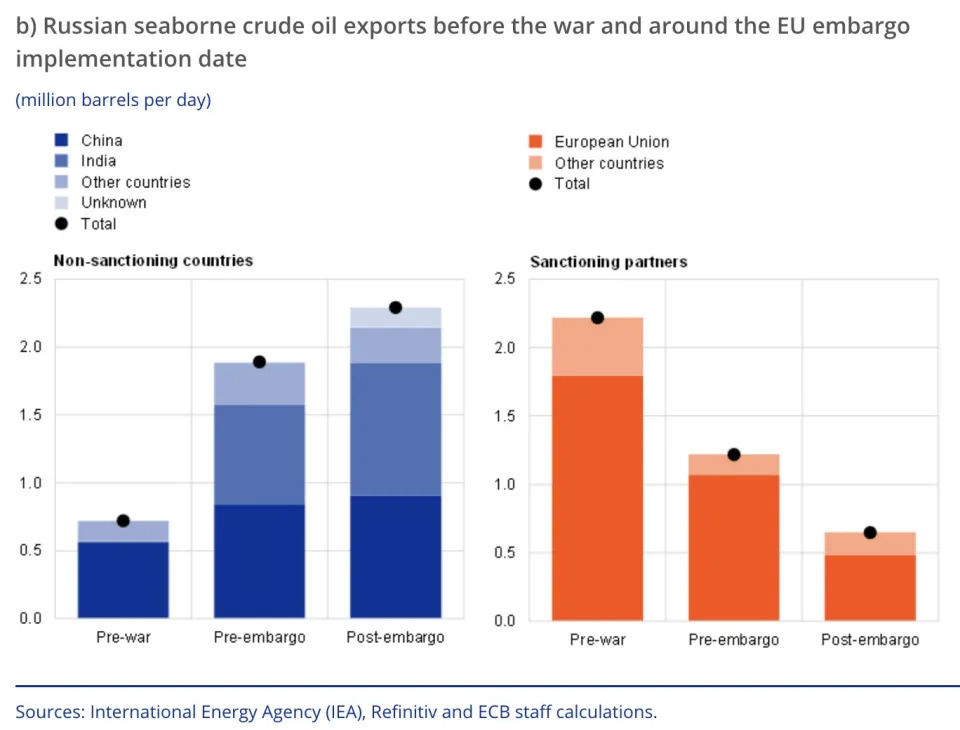
European Central Bank calculations show trade volume between the euro area and Russia has halved since February 2022, with the bloc’s imports of Russian imports seeing particularly steep declines following the bans on coal in August 2022, crude oil in December 2022, and refined oil products in February 2023.
The ECB chart below shows a similar pattern illustrated in Kpler’s data, with Russian seaborne crude exports shifting toward Asian buyers and away from Europe.
European Central Bank, ECB Economic Bulletin
To be sure, the revenue Russia generates from its energy exports has fallen along with the drop in prices, even as volumes remain elevated.
The International Energy Agency said Friday that Moscow’s revenue is down about 43% compared to the same time last year.
But oil prices are heading back up as China’s reopening economy drives demand while OPEC and Russia pinch supplies.
Earlier this month, OPEC+ announced a surprise production cut of over 1 million barrels a day, with Russia extending its 500,000-barrel-a-day pullback through mid-2023.
Leaked documents show Russian special forces have been gutted in Ukraine war: report
Natalie Prieb – April 14, 2023
Leaked documents show Russian special forces have been gutted in Ukraine war: report
U.S. documents included in a leak of sensitive material online show that the war in Ukraine has decimated Russia’s elite special forces, according to a new report.
The Washington Post, citing U.S. assessments it obtained that were initially leaked online through the platform Discord, reported that American officials believe it will take Moscow years to replenish the clandestine special forces’ ranks.
In making the assessment of Russia’s military status, U.S. officials pointed to Russian commanders relying too heavily on specialized units, according to the Post.
The spetsnaz forces are typically assigned to specialized, high-risk missions, but when the Ukraine war began, Moscow’s senior commanders ordered them into direct combat, according to the leaked documents reported by the Post.
The classified information did not specify how many of the elite troops are suspected to have been killed or wounded, though one spetsnaz unit was said to have “lost nearly the entire brigade with only 125 personnel active out of 900 deployed,” the Post reported.
The leak of sensitive and classified documents has roiled the U.S. government, revealing information about Ukraine’s battalion sizes, advanced weaponry and other military capabilities — dealing a blow to the Ukraine war effort.
Jack Teixeira, a member of the Massachusetts Air National Guard, was arrested Thursday in Massachusetts in connection with the leak. He was charged on Friday with unauthorized retention of classified material.
The information reported in the leaked U.S. assessments underscores the toll the Ukraine war has taken on Russian forces.
A report released in February from the Center for Strategic and International Studies detailed that the country’s death toll in its first year of the war likely surpassed the combined death toll of all of its wars since World War II.
Unpacking the flawed science cited in the Texas abortion pill ruling
Lauren Weber – April 13, 2023
(Illustration by Emily Wright/The Washington Post)
A Texas judge’s decision to invalidate federal approval of a key abortion drug cites research based on anonymous blog posts, cherry picks statistics that exaggerate the negative physical and psychological effects of mifepristone, and ignores hundreds of scientific studies attesting to the medication’s safety.
The unprecedented ruling last week by U.S. District Judge Matthew J. Kacsmaryk contradicted the recommendations of numerous medical groups when it assailed the safety of mifepristone, a two-decade-old medication used in more than half of all abortions in the United States. Another federal judge determined on the same day that the drug should remain available in a swath of states.
Kacsmaryk wrote in his decision that “the lack of restrictions resulted in many deaths and many more severe or life-threatening adverse reactions” and accused the Food and Drug Administration of acquiescing to “the pressure to increase access to chemical abortion at the expense of women’s safety.”
The ruling is the first time a court has suspended a medication’s approval after rejecting the assessment of a human drug by the FDA, considered among the world’s most stringent regulators. The agency says that between 2000, when the drug was approved, and last June, it received reports linking mifepristone to 28 deaths out of the 5.6 million who have used the drug. And in those 28 deaths, the agency said information gaps made it impossible to directly attribute the cause to mifepristone; in some cases, the deaths involved overdoses and coexisting medical conditions.
“If it were just up to the science, this case would be thrown out,” said Daniel Grossman, an obstetrician and gynecologist who directs a reproductive health research program at the University of California at San Francisco. The program, like many mainstream medical groups, supports abortion rights. “We have over two decades of science showing how safe this is.”
In the days since Kacsmaryk’s ruling, the scientific community has raised alarms about increasing legal and political attempts to undermine the science that informs modern medicine. Kacsmaryk, a Trump judicial appointee, is presiding over another lawsuit by anti-vaccine advocates who accuse media companies, including The Washington Post, of colluding to censor their views on coronavirus vaccines and treatments.
In the abortion pill case, an author of a Finnish study cited by Kacsmaryk disputed the judge’s characterization of the research, which the judge summarized as revealing that the “overall incidence of adverse events is ‘fourfold higher’ in chemical abortions when compared to surgical abortions.”
Plaintiffs in the lawsuit had also highlighted the study, which compared the records of more than 40,000 women in Finland who had surgical or medication abortions in the early 2000s.
The study identified a higher risk of adverse events among patients undergoing medication abortions compared with those who had surgical abortions, but the judge’s analysis neglects a crucial point: Significant complications were extremely low in both groups. In Finland, adverse events largely reflect patients concerned about uterine bleeding associated with medication abortions, said Oskari Heikinheimo, a professor of obstetrics and gynecology at the University of Helsinki and a co-author of the study.
Heikinheimo said in an interview that the plaintiffs – and now the judge – were purposely misunderstanding his work and overemphasizing “adverse events” despite overwhelming scientific evidence of the drug’s safety and the study itself noting the rarity of serious complications. No one who filed the lawsuit had contacted him to talk about his research, Heikinheimo said.
“The political game has nothing to do with the scientific process,” he said.
Because individual studies often produce conflicting results, the medical community has long relied on a systematic approach known as evidence-based medicine, drawing on accumulated evidence from clinical research to inform their care of patients. Among the hundreds of clinical trials using mifepristone over two decades, more than 400 were randomized controlled studies, which are considered the gold standard of research design.
Kacsmaryk instead peppered his ruling with data from researchers affiliated with the Charlotte Lozier Institute, an Arlington, Va.-based antiabortion group whose website proclaims its mission to “expose the harms of the FDA’s current abortion pill policy that simply ignores the known risks.”
One study by James Studnicki, director of data analytics at the Lozier Institute, found that more than a quarter of women on Medicaid who had used abortion pills between 1999 and 2015 visited an emergency room within 30 days. Critics say the study is flawed because it did not specify the services people received at the ER. Medicaid patients are more likely to visit emergency rooms for routine medical care because they often lack primary care providers.
Studnicki, in an interview, accused abortion rights groups of underplaying the potential complications from abortions involving mifepristone, noting that ER visits are serious matters.
Bleeding is a normal part of a medication abortion, but women will often visit an emergency room as a precaution because they are unsure whether the amount of bleeding is excessive – and because their abortion clinic may be very far away, said Ushma Upadhyay, a UCSF professor and expert in reproductive health and abortion safety.
Upadhyay said the Lozier Institute is known for categorizing any complaint or side effect as a “complication.”
“They blur the lines,” she said. “They’re not using medically endorsed definitions.”
An analysis by the American College of Obstetricians and Gynecologists of hundreds of published studies found that “serious side effects occur in less than 1% of patients, and major adverse events – significant infection, blood loss, or hospitalization – occur in less than 0.3% of patients.”
“The risk of death is almost non-existent,” according to the group’s amicus brief, filed jointly with the American Medical Association, the Society for Maternal-Fetal Medicine and other medical organizations opposing the lawsuit. Complications from wisdom tooth removal, colonoscopy and Viagra use carry greater risk, they said.
Experts noted that most drugs on the market can cause complications, even death. The FDA, in approving a treatment, weighs the risk of the medication versus the benefit – it does not automatically exclude drugs that have side effects, even serious ones.
“I can assure you that that approval process was both comprehensive and quite thorough and was done according to the standard procedures at FDA,” Jane Henney, who led the agency when mifepristone was approved, said during a news conference Monday. The agency had consulted clinical data, preclinical data and the manufacturing process, among other criteria, she said.
The government’s appeal Monday underscored that “serious adverse events are exceedingly rare, just as they are for many common drugs like ibuprofen.”
But Christina Francis, chief executive of the American Association of Pro-life Obstetricians and Gynecologists and a plaintiff in the lawsuit, said the drug safety data used by the FDA is flawed because it relies on reporting by abortion providers – which she said was unlikely to capture the full picture of the complications following abortions.
“Those of us on the front lines are seeing women and girls coming into the ER who have been harmed,” Francis said.
Kacsmaryk also cites studies about the mental health of women who have obtained abortions that researchers criticize as misleading.
One concluded that 77 percent of women who had a “chemical abortion” reported a “negative change.” “Thirty-eight percent of women reported issues with anxiety, depression, drug abuse, and suicidal thoughts because of the chemical abortion,” Kacsmaryk wrote.
Both statistics, according to the footnotes in his ruling, came from a study based on several dozen anonymous blog posts from abortionchangesyou.com. The website is run by the Institute of Reproductive Grief Care.
Adam Unikowsky, a partner at Jenner & Block who has argued before the Supreme Court and writes a legal newsletter, pointed out that the bloggers are a self-selected group that is far from a representative sample of women who have obtained abortions.
“This is roughly like reporting a statistic that ‘83% of people are fans of Judge Kacsmaryk’ without mentioning that the entire sample consisted of posters on JudgeKacsmarykFanClub.com,” Unikowsky wrote in his newsletter.
The judge also referenced another disputed study from 2002 asserting that “women who receive abortions have a 154% higher risk of death from suicide than if they gave birth.”
The study’s authors – including David C. Reardon, an antiabortion activist and associate scholar with the Lozier Institute – say their findings could be explained by “self-destructive tendencies, depression, and other unhealthy behavior aggravated by the abortion experience.” They analyzed California Medicaid records for 173,279 women who had an induced abortion or a delivery in 1989, then linked them to death certificates between 1989 and 1997.
Critics at the American Psychological Association have argued that the California data set is too incomplete to link abortion to a higher risk of death. Reardon defended his work in an interview, claiming “the science is irrefutable.”
“There is no evidence that abortion causes psychological harm to women,” said Brenda Major, a professor emeritus of psychology at the University of California at Santa Barbara, who has led two task forces for the American Psychological Association to analyze studies on mental health and abortion.
But Kacsmaryk chose not to refer to more rigorous studies on mental health that have shown that the most common emotional response after abortion is relief, Grossman said. A well-known study by UCSF researchers of about 1,000 women who sought abortions compared people who received abortions with those who were denied them. The 10-year study found that abortion does not hurt the health and well-being of women and did not increase their rates of depression, anxiety or suicidal thoughts. Being forced to carry an unwanted pregnancy to term, on the other hand, was associated with negative health effects.
Kacsmaryk’s ruling pointed to another study that attributes women’s mental health problems directly to abortion. The 2011 meta-analysis by Priscilla K. Coleman, a retired Bowling Green State University professor of human development and family studies, included her own studies that used flawed research methods, said Major and other critics.
Coleman’s methodology and conclusions have drawn repeated criticism from fellow academics who say her research included in the 2011 paper does not distinguish between mental health problems that were diagnosed before an abortion and those that occurred afterward. Coleman, a co-author in Reardon’s 2002 study, did not respond to requests for comment.
The repercussions of Kacsmaryk’s decision reach far beyond the battle over abortion. Mary Ziegler, an expert on the legal history of abortion in the United States at the UC Davis School of Law, said the disregard for FDA expertise could threaten any drug or vaccine that has already received approval.
“It shows you how important courts are going to be in undermining or undercutting the science,” she said.
The Washington Post’s Rachel Roubein contributed to this report.