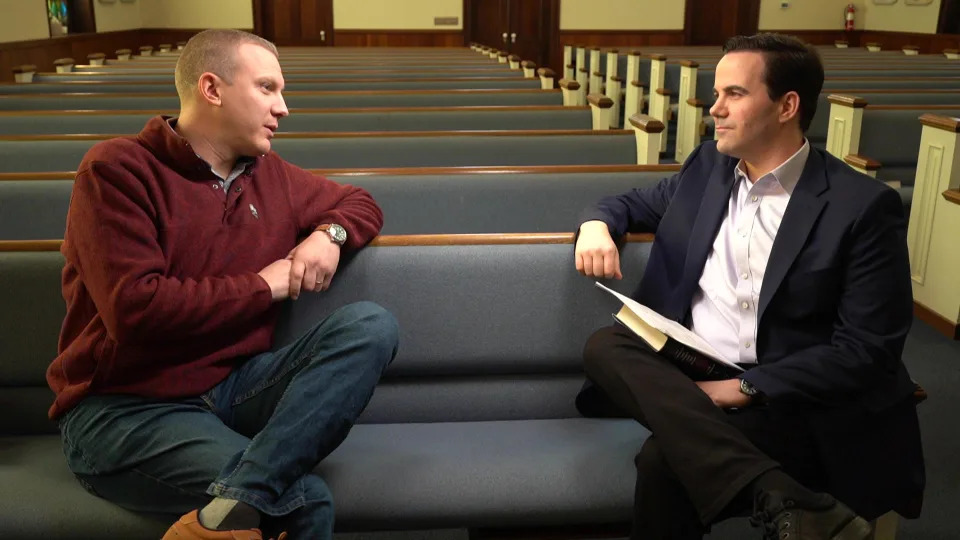
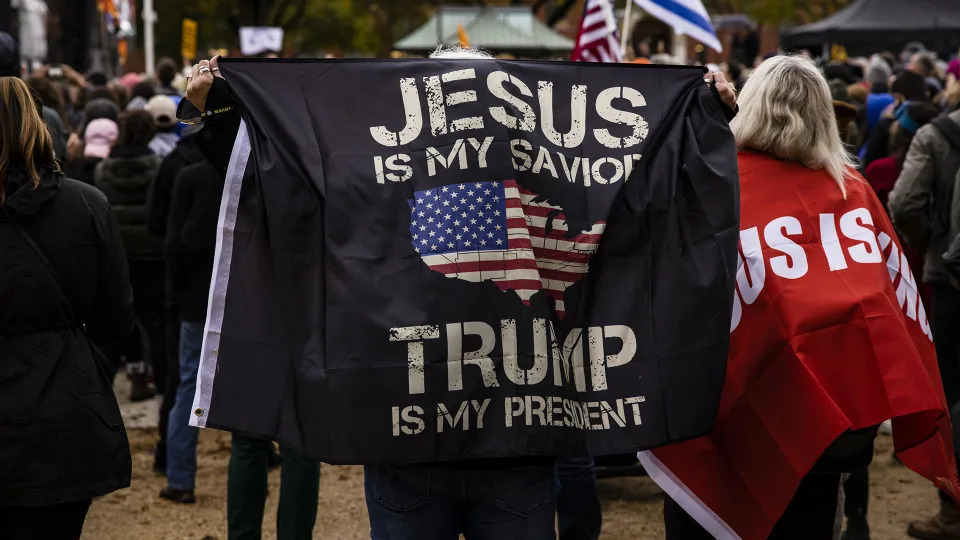
Goodwill Church, in New York’s leafy Hudson Valley, is a special destination for The Atlantic’s Tim Alberta. This was where his family’s faith journey began. “There’s something so deeply familiar about this place, it’s hard to describe,” he said. “My parents always described this church as holy ground for our family.”
Tim’s father, Richard Alberta, was once a pastor on this pulpit, after becoming a born-again Christian here nearly 50 years ago. “I don’t know where he sat,” said Alberta. “I don’t know what the sermon was that day. But something happened: A guy who’d been an atheist for years, you know, decided that he was gonna give his life to Jesus.”
The Alberta family later moved to Michigan, where Tim’s father led Cornerstone Evangelical Presbyterian Church. “My life was completely wrapped up in the church,” said Tim. “It was the sun around which we as a family revolved. It was our whole world.”
Tim Alberta of The Atlantic, with CBS News’ Robert Costa. / Credit: CBS News
But Tim Alberta sought a career in journalism, writing about politics. His father urged him to stay grounded, including in a 2019 chat he’ll never forget: “He keeps saying to me, ‘Don’t spend your whole career around these people. There are so many other stories.’ And that was one of the last conversations we had.”
Days later, Tim’s dad suddenly died.
He recalled, “When I come home to my church, I’m expecting, I guess, something different from what I got.”
While some offered consolation, Alberta also got confrontation from some conservative church members objecting to his reporting on then-President Donald Trump. “A lot of folks right there at the viewing just wanted to argue about politics,” he said. “They wanted to know if I was still a Christian. And my dad’s in a box, like, 100 feet away.”
Costa asked, “The church wasn’t a sanctuary from politics; politics was now part of the church?”
“That’s right. I knew that, to some degree. And in fact, I willfully ignored it.”
Alberta’s reckoning with faith and politics is the basis for his new book “The Kingdom, the Power, and the Glory,” which documents what he calls an “age of extremism” for evangelicals. “There was a real crisis in the American church, specifically a crisis in the white evangelical church,” he said.
/ Credit: CBS News
According to Pew Research Center, about a quarter of American adults (24%) identify as evangelical. And as the Republican presidential race heats up, 68% of white evangelicals are supportive of Trump. Alberta says that reflects a shift away from norms — in the GOP and in the church.
“We should think about the American church almost in parallel to American politics,” he said. “When it gains enough influence, when it gains enough power, the fringe can overtake the mainstream. And that’s what we’ve seen happen in the church.”
The convulsions in today’s churches come after decades of evangelicals gaining influence, from Billy Graham’s stadium crusades, to the stadium rallies of Donald Trump. In recent years, evangelicals have had heated debates over the response to COVID and to Trump, all while many key Republicans (like House Speaker Mike Johnson) count themselves as one of them.
At Goodwill Church, Senior Pastor John Torres (who used to work with Tim’s dad) is uneasy about the shadow of politics over his church and others.
Costa asked Torres, “What do people say about politics?”
“That it’s bad. That it’s dirty.”
“What do they say to you about politics?”
“Don’t get involved,” Torres replied. “I don’t want somebody who’s sitting there, listening to me preach, whatever their views are, I want them to stay put. I wanna talk to them about Jesus. I don’t want to talk to ’em about politics. ‘Cause I don’t really know what I can offer them in terms of politics.”
Other evangelicals don’t mind politics — and see this moment as an affirmation of hard-won power.
Worshippers attend a concert by evangelical musician Sean Feucht on the National Mall on October 25, 2020 in Washington, D.C. / Credit: Samuel Corum/Getty Images
Costa asked, “What do you say to evangelical leaders who might hear your argument and say, ‘You missed the point: Trump wins for evangelical Christians, he wins for conservative America’?”
“Wins what?”
“Supreme Court seats, a seat at the table at the White House?”
Alberta responded, “Show me where in scripture any of that matters.”
But it does matter to many of those standing with Trump as he once again seeks the White House. Alberta said, “You have millions of evangelical Christians who voted for Donald Trump and just sort of gleefully embraced his terrible rhetoric and his un-Christlike conduct.”
“Why did they ‘gleefully’ embrace it, to use your term?” asked Costa.
“Power,” Alberta replied. “Trump campaigned for president in 2016 promising that if he was elected, Christians would have power. He gave it to them. He gave it to them in ways that, arguably, no American president has in modern history. And when you have power, you can very quickly lose sight of your principles, your values and your beliefs.”
Alberta says that, regardless, today his faith has never been better. His faith in reporting is also strong, and he says that is his own calling.
“You and I, we’re reporters,” said Alberta. “We’re not supposed to be the story. I never wanted to be the story. [But] once you see this, you can’t look away.”
Trump’s Pardoning of a Loan Shark Derailed a Federal Investigation: Report
Peter Wade – November 26, 2023
Very early in the morning on Donald Trump’s last day in office, the president announced he was pardoning Jonathan Braun, a loan shark who had been convicted of running a vast marijuana ring. Braun, who at the time was serving a 10-year sentence, was pardoned along with 142 others, including rappers Lil Wayne and Kodak Black.
Trump’s move undermined a years-long federal investigation, The New York Times reported Sunday. The paper also uncovered ties between Braun and the family of Trump’s son-in-law, Jared Kushner.
Federal prosecutors were in the midst of negotiations hoping to secure Braun’s cooperation in a Justice Department investigation into predatory lenders in the merchant cash advance industry when Trump announced his clemency. Investigators felt that an industry insider like Braun could reveal information about predatory lending agreements, but after he was released from incarceration, prosecutors no longer had leverage they could use to compel Braun to talk.
Between 2011 and 2020, while awaiting sentencing in the marijuana case, Braun offered predatory loans to small businesses. Borrowers who took out loans from Braun say in court documents that he threatened them and their families for non-payment. During the nine years he was waiting to be sentenced, Braun was accused of making violent threats to eight people who had borrowed money from him, and a lawsuit claimed Braun had pushed a man off a deck at a Staten Island home in 2018.
A real estate developer who borrowed from Braun said in a court document that Braun threatened him, saying, “I will take your daughters from you.”
According to an affidavit, Braun allegedly told another borrower, “Be thankful you’re not in New York, because your family would find you floating in the Hudson.”
Only months following his release from prison, Braun was banned from making or collecting business loans by the state of New York. In a statement following the ban, New York Attorney General Letitia James claimed that Braun and others had been “harming small businesses through high-interest loans and undisclosed fees.” In a lawsuit, James alleged that “merchant cash advances, which are a form of short-term, high-interest funding for small businesses” offered by Braun and others “were in fact illegal, high-interest loans with astronomical and illegal rates.”
The court ordered Braun’s company — Richmond Capital Group, LLC — as well as two other companies — Ram Capital Funding, LLC, and Viceroy Capital Funding Inc. — to cancel debt owed by thousands of small businesses across the country as well as repay interest and overage charges, amounting to tens of millions of dollars.
The Times also raised questions about Braun’s connections to the Kushners. An investigation by the paper found that Braun was a member of the inaugural class of the Kushner Yeshiva High School in Livingston, N.J., which received a large amount of funding from the Kushner family.
A merchant cash advance dealer who wished to remain anonymous told The Times that a cousin who was running Braun’s business while he was in jail told him that Braun’s father, Jacob Braun, had reached out to Kushner’s father, Charles Kushner, regarding the family’s hopes that Trump would pardon Braun. The cousin, Isaac Wolf, later claimed that the Kushners had helped secure Braun’s release, the merchant cash advance dealer said.
Jacob Braun also regularly called Trump ally Alan Dershowitz to plead for Braun’s release. “Every single Friday by 3 o’clock in the afternoon: ‘Hi this is Jacob Braun, I’m so upset my son is still in prison, what can you do? It’s unfair, he’s a good boy,’” Dershowitz told the paper.
Federal investigators were not made aware of the pardon until the morning it was announced and, according to The Times, they were furious that Trump had sabotaged a possible deal with Braun over predatory lending practices.
Braun, however, maintains his innocence and claims he is a victim of the justice system’s unfair practices. “What is so bad about me?” he told the paper. “I never hurt anybody, never did anything wrong to anybody.”
George Santos says he’ll treat expulsion as a ‘badge of honor’ as he claims his colleagues are drunkenly having sex with lobbyists ‘every night’
Bryan Metzger – November 25, 2023
Rep. George Santos of New York on Capitol Hill. Justin Sullivan/Getty Images
Rep. George Santos went on an extended tirade against his colleagues on Friday evening.
Santos says he expects to be expelled this week and will wear it “like a badge of honor.”
He also called the Ethics Committee chairman a “pussy” and made wild claims about his colleagues.
Days before his likely expulsion from the House of Representatives, Rep. George Santos of New York went on his most unhinged tirade yet.
In an X Space hosted by conservative media personality Monica Matthews on Friday evening, the scandal-plagued Republican said he expects to be expelled when the House votes on the matter, which is likely to happen this coming week.
But he said he’s not sweating it.
“I don’t care. You want to expel me? I’ll wear it like a badge of honor,” Santos said. “I’ll be the sixth expelled member of Congress in the history of Congress. And guess what? I’ll be the only one expelled without a conviction.”
That was just one part of Santos’s lengthy and angry diatribe against his colleagues, during which the indicted congressman made a series of statements and claims that are unlikely to endear him to any colleagues who may still remain on the fence about expelling him.
At one point, he mocked the Republican chairman of the House Ethics Committee — Rep. Michael Guest of Mississippi — in the wake of that committee’s damning report about his conduct.
“It ain’t gonna be the dude from Mississippi that’s gonna kick me, a New Yorker, out of Congress,” Santos said. “No offense to people from Mississippi, but making that very, very clear, it’s going to take a lot more than that.”
He also said Guest needs to “stop being a pussy” and call up the expulsion resolution when Congress returns this week.
Spokespeople for Rep. Guest did not immediately respond to Business Insider’s request for comment sent outside of regular business hours.
And in a moment reminiscent of former Republican Rep. Madison Cawthorn — whose wild claims of cocaine-laden orgies among his colleagues spurred GOP leaders to plot his ouster last year — Santos claimed his colleagues were “hypocrites” who were regularly cheating on their spouses and barely doing their job.
“I have colleagues who are more worried about getting drunk every night with the next lobbyist that they’re gonna screw and pretend like none of us know what’s going on, and sell off the American people, not show up to vote because they’re too hungover or whatever the reason is, or not show up to vote at all and just give their card out like fucking candy for someone else to vote for them,” Santos claimed.
“This shit happens every single week,” he said. “Where are the ethics investigations?”
Santos is no longer seeking re-election and is set to go to trial next September following a federal indictment on charges that include money laundering, identity theft, and wire fraud.
According to the House Ethics Committee’s report on Santos’s conduct, the congressman was largely uncooperative during the investigation.
The report also found that Santos swindled campaign donors, using their money for luxury purchases at Hermes, Ferragamo, Sephora, OnlyFans, and Botox.
Column: Pedophile panic and coming political violence. What the Paul Pelosi case revealed
Anita Chabria – November 24, 2023
This image from police body-worn camera video shows Paul Pelosi, right, fighting for control of a hammer with his assailant, David DePape. (San Francisco Police Department via AP)
A unicorn costume, a hammer and a belief that pedophiles are using public schools to destroy democracy: The trial of David DePape for attacking Paul Pelosi was strange and disturbing.
But take away the costume and the hammer, and the reasoning for DePape’s vicious attack is alarmingly mainstream — pedophile panic.
By that, I mean the outrageous effort not just by hate-mongering conspiracy theorists to frame LGBTQ+ individuals as deviant and dangerous, lumping them in with criminals who sexually abuse children. But also a cynical bid by some politicians, clergy and grifters to do the same.
Anti-LGBTQ+ attacks are everywhere, both physical and political. Hysteria about pedophiles, driven by conspiracy theories, has trampled truth.
As DePape explained it on the stand, he is concerned about “groomer schools,” where teachers are “queering the students, pushing transgenderism to confuse children about their identities to make them more vulnerable to abuse and Marxist indoctrination.”
Sound familiar? It could have been a quote from a Huntington Beach City Council meeting, a Republican presidential rally or a debate on the floor of the Florida Legislature, where the controversial “don’t say gay” bill last year was described by an aide to Gov. Ron DeSantis as an “anti-grooming” law.
The quote is, in fact, DePape’s summary of what he learned from right-wing podcaster James Lindsay about one of DePape’s top targets, a professor of feminist theory and queer studies whose house seemed, to DePape, too difficult to break into. So he went to Pelosi’s brick mansion instead.
When a San Francisco jury came back with a guilty verdict against DePape, it was hardly a bombshell. It is fact that DePape smashed a hammer into Pelosi’s skull, a brutal act caught on camera and uncontested even by his own lawyers.
What was lost with the quickness of the in-an-out, no-surprises trial — and what should be chilling to any supporter of civil rights — was the defense team’s argument about why DePape created his elaborate plot, which was going to involve donning the unicorn costume while interrogating the victim’s wife, Rep. Nancy Pelosi, about government corruption, and, you guessed it, pedophiles.
It wasn’t conventional politics. It wasn’t even aimed at Nancy Pelosi. The powerful San Francisco Democrat was somewhere down a list that included the mother of DePape’s two sons, Tom Hanks, George Soros, Hunter Biden and performance artist Marina Abramovic.
DePape was propelled by the hyper-drive conspiracies that have bled out from internet chat rooms onto streets and into school boards — amped-up paranoia about threats not just to the white Christian values that some perceive as intrinsic to our country’s identity, but to the safety of our children.
“It’s not just that she’s a pedo-activist. It’s that she wants to turn all the schools into pedophile molestation factories,” DePape said of the queer studies professor he was targeting.
“She wants to destroy children’s sense of identity because it’s her opinion that this will lead them to grow up dysfunctional and unhappy. And if they’re dysfunctional and unhappy, they will be maladjusted to society, hate society, and want to become communist activists,” he said.
Those kind of beliefs, ugly and untrue, can no longer be considered extreme, or extremism.
“For parents, rejecting radical gender theory is a matter of protecting their children. The rest of us, though, should reject queer theory’s attempt to gain control of the next generation,” he wrote.
Or Trump’s recent sit-down interview with conservative activists Moms for America, in which he lamented that the “indoctrination programs” at public schools are “out of control” and promised quickly to end them if elected.
Jared Dmello, an expert on extremism and an incoming senior lecturer at University of Adelaide in Australia, told me that mainstream politics is “driving an anti-LGBTQ ideology.”
Where once conspiracy was relegated to dark corners, it now has a symbiotic relationship with the mainstream, he said, each building off whatever “evidence” or current events play into the narrative with such speed and force that the sheer amount of information makes it seem like it must be true.
“The whole goal is to introduce so much chaos into the atmosphere that it’s hard to distinguish what is fact from fiction,” he said.
A recent Public Religion Research Institute (PRRI) poll on threats to American democracy found 59% of Republicans think that what children are learning in school is a critical issue facing the United States. A 2022 poll by USC found that while roughly 60% of Democrats support teaching high school students about gender identity, gay and transgender rights or sexual orientation, only about 30% of Republicans feel the same.
Of course, parents have good reasons to be concerned about public schools, especially in the wake of the pandemic when teachers are burned out, budgets are tight and students are coping with sky-high levels of mental health challenges.
But Joan Donovan, an expert in disinformation and a professor at Boston University, told me that while violence remains rare, vigilantes such DePape aren’t the lone wolves we like to believe. She said violence, whether by individuals or groups, is going to increase as the 2024 election nears.
“I wish it were the case that they were fringe, but they do seem to represent a larger sentiment online,” she said. “Of course taking action in the form of assaulting or attempting to murder people is in and of itself horrendous, but if you look at the kind of discourse that emboldens these people, it’s the natural outcome.”
Support for political violence has increased over the past two years, with nearly a quarter of Americans now agreeing that “because things have gotten so far off track, true American patriots may have to resort to violence in order to save our country.” That comes from the recent PRRI poll on threats to American democracy.
That percentage has increased from 15% in 2021.
But get ready for it: 41% of Republicans who like Trump agreed violence may be necessary, and 46% of Trump supporters who believe the election was stolen also believe violence may be an answer. That’s nearly half.
By all accounts, DePape was just a lonesome loser, unremarkable and peaceful, until he started delving into conspiracy theories during the pandemic. Living in a Bay Area garage that didn’t even have a bathroom, he spent his free time — hours every day — playing video games while listening to conspiracy podcasters pushing what we were then calling QAnon.
I won’t go so far as to say he was a victim, but he was a vessel for a fire hose flow of propaganda, holding it all in until doing nothing seemed unconscionable. He is accountable for his violence, but it is clear he has lost the ability to parse truth from that swamp of what he calls research.
Somewhere along his journey, DePape began believing that a secret cabal of so-called elites was ruling the world and participating in a cult that sexually abused children.
That’s how DePape came up with his list of targets — most of those on it are somewhere in QAnon lore — a set of conspiracies that QAnon expert and Michigan State University professor Laura Dilley told me “absolutely are endemic now.”
At its core, the political turmoil caused by these falsehoods is not much different from the satanic panic that ruled in the 1980s, driven by discomfort with more women joining the workforce and leaving their children in day care. Then, too, conservatives vilified the LGBTQ+ community to fuel fear that children were in danger and American society was on the brink of collapse.
And Donovan points out that even the KKK focused on children and education in the 1920s, with the same arguments about American values.
So none of this is new.
But we are capable of not repeating the past. Hate and conspiracy aren’t normal. They aren’t American values, to be debated as valid political positions.
David DePape was fighting an enemy conjured by lies. That enemy may not be real, but the danger of those lies is.
The Red State Brain Drain Isn’t Coming. It’s Happening Right Now.
Timothy Noah – November 22, 2023
On Memorial Day weekend in 2022, Kate Arnold and her wife, Caroline Flint, flew from Oklahoma City to Cabo San Lucas for a little R&R. They had five kids, the youngest of them five-year-old twin girls, and demanding jobs as obstetrician-gynecologists. The stresses of all this were mounting. That they were a gay married couple living in a red, socially conservative state was the least of it. Caroline was born in Tulsa, spent much of her childhood in Oklahoma, and was educated at the University of Oklahoma. She cast her first presidential vote for George W. Bush. Kate, the more political of the two, was from Northern California and a lifelong Democrat. But her mother was born in Oklahoma City, and she felt at home there; she’d even given some thought to running for the state legislature.
Kate and Caroline flew down with the twins and their 16-year-old daughter. It says a lot about Kate Arnold that she adopted the three older children while she was attending medical school; the birth mother, whom Kate befriended while volunteering at a home for teenage mothers, was an addict who lost custody.
Arriving in Cabo, Kate and Caroline realized that it had been a very long time—too long— since their last date night. So one evening they ordered the kids room service and went off by themselves to a Taco Night theme dinner. “We sat outside with the little colored flags,” Kate recalled, “and they gave us blankets because it was cold and windy. We hadn’t been sitting for very long when I started saying I wasn’t happy.”
A little more than one week earlier, a disturbed high school student named Salvador Ramos had entered Robb Elementary School in Uvalde, Texas, with an AR-15 rifle and killed 19 children and two adults, injuring 17 more. It was the deadliest school shooting since the Sandy Hook massacre in 2012, and it happened just one state over as Kate and Caroline’s two youngest were about to start school. Twomore mass shootings occurred in Oklahoma while they were in Cabo. A man named Michael Louis gunned down, with an AR-15, two doctors, a receptionist, and a patient at the Tulsa offices of his orthopedic surgeon because he was angry that his recent back surgery left him in pain. Then a man named Skyler Buckner killed one person and injured seven others at a Memorial Day festival in Taft, Oklahoma. States with permissive gun laws have a higher rate of mass shootings, and Oklahoma, with some of the most permissive gun laws in the country, has 45 percent more gun deaths per capita than the national average—higher even than in Texas.
That was one reason Kate wasn’t happy.
Another reason was that the state legislature was trying to limit access to contraceptives. In March, the state Senate had voted to require parental consent before a minor could take contraceptives. Kate was chair of the Oklahoma chapter of the American College of Obstetricians and Gynecologists, and she’d lobbied against this change. (The bill later died in the state House of Representatives.)
“You’re just gonna get my nine-year-old birth control without my knowledge?” one state legislator said to her.
“How does your nine-year-old need birth control?” Kate answered. “And yes, if she needs birth control … what’s worse than her coming home pregnant?”
Caroline had reasons to be unhappy, too. One year earlier, Oklahoma’s governor had signed a law barring public schools and charter schools from teaching that “an individual, by virtue of his or her race or sex, bears responsibility for actions committed in the past by other members of the same race or sex.” School boards interpreted this as an invitation to ban any book that touched on race or gender. Among the books targeted in Oklahoma, according to the free-speech organization PEN America, wereNarrative of the Life of Frederick Douglass, A Raisin in the Sun, To Kill a Mockingbird, and Their Eyes Were Watching God. “Books are my thing,” Caroline told me. She couldn’t abide the idea that “books would be censored.”
Also, Caroline’s hospital wouldn’t let her perform gender-affirming surgery. The procedure was legal in Oklahoma, but this was a Baptist hospital, and fairly conservative. “I would do surgeries,” Caroline said, “like hysterectomies for patients who are transitioning. And I’d have to have another indication to do it.… I’d have to say, ‘Oh, they also have pain,’” or find some other reason.
Kate was director of women’s health at a large, federally funded nonprofit health center serving low-income patients. It was, she told me, “A job that I loved.” But five months before their Cabo dinner, Kate published an op-ed at a nonprofit Oklahoma news site criticizing state felony prosecutions of women who miscarried after taking drugs during pregnancy. “Anytime you criminalize drug use in pregnancy,” Kate explained to me, the addicts stop going to the hospital, “and you have worse and worse outcomes.”
After the op-ed appeared, somebody phoned Kate’s health center to complain. After that, Kate’s superiors effectively barred her from making public statements about anything. Kate’s boss explained why: The FBI had alerted the center to threats of violence “just for providing birth control.”
After the op-ed appeared, somebody phoned Kate’s health center to complain. After that, Kate’s superiors effectively barred her from making public statements about anything. That irked Kate until her boss explained why: The FBI had contacted the health center to alert them to threats of violence “just for providing birth control.” Did I mention that Oklahoma allows anybody over the age of 21 to carry a loaded firearm in public, open or concealed, without a license?
The last straw for the couple was Dobbs v. Jackson Women’s Health Organization. That windy June night in Cabo, the Supreme Court was still a few weeks away from overturning Roe v. Wade and allowing states to ban abortion. But it was no mystery what the decision would say, because one month earlier a draft had leaked to Politico. The Oklahoma legislature had already passed several trigger laws whose cumulative effect was to bar doctors from performing abortions starting at the point of conception, punishable by up to 10 years in prison (later reduced to five).
Kate and Caroline didn’t perform abortions themselves; they referred patients to Planned Parenthood. Or rather, they had done so until an Oklahoma law barred them from doing even that. That law would later be ruled unconstitutional, but ambiguities in the Oklahoma abortion ban’s exception for protecting the life of the mother make it potentially dangerous to treat any patient experiencing difficulty during pregnancy.
“When we left dinner that night,” Kate recalled, “we knew we needed to leave Oklahoma. We were both in a bit of shock as we walked back to our room. I said I was sorry, and that I didn’t know I had been thinking all of that till we finally had a minute. Caroline jokingly called me the worst date ever.”
For a day, they thought about moving to New Zealand, but they didn’t want to be that far from their parents, and besides, Kate and Caroline love this country, despite all its flaws; July Fourth is Kate’s favorite holiday. They thought about Northern California, but vetoed that because Caroline doesn’t like cold summer nights. That left Washington, D.C., a place Kate had enjoyed living in while attending medical school at Georgetown. They arrived this past May, settling into a blue bungalow on a quiet, leafy street near the Maryland border.
Kate Arnold and Caroline Flint are two bright, energetic, professionally trained, and public-spirited women whom Washington is happy to welcome—they both quickly found jobs—even though it doesn’t particularly need them. The places that need Kate and Caroline are Oklahoma and Mississippi and Idaho and various other conservative states where similar stories are playing out daily. These two fortyish doctors have joined an out-migration of young professionals—accelerated by the culture wars of recent years and pushed to warp speed by Dobbs—that’s known as the Red State Brain Drain.
Republican-dominated states are pushing out young professionals by enacting extremist conservative policies. Abortion restrictions are the most sweeping example, but state laws restricting everything from academic tenure to transgender health care to the teaching of “divisive concepts” about race are making these states uncongenial to knowledge workers.
The precise effect of all this on the brain drain is hard to tease out from migration statistics because the Dobbs decision is still fairly new, and because red states were bleeding college graduates even before the culture war heated up. The only red state that brings in more college graduates than it sends elsewhere is Texas. But the evidence is everywhere that hard-right social policies in red states are making this dynamic worse.
The number of applications for OB-GYN residencies is down more than 10 percent in states that have banned abortion since Dobbs. Forty-eight teachers in Hernando County, Florida, fed up with “Don’t Say Gay” and other new laws restricting what they can teach, resigned or retired at the end of the last school year. A North Carolina law confining transgender people to bathrooms in accordance with what it said on their birth certificate was projected, before it was repealed, to cost that state $3.76 billion in business investment, including the loss of a planned global operations center for PayPal in Charlotte. A survey of college faculty in four red states (Texas, Florida, Georgia, and North Carolina) about political interference in higher education found a falloff in the number of job candidates for faculty positions, and 67 percent of the respondents said they would not recommend their state to colleagues as a place to work. Indeed, nearly one-third said they were actively considering employment elsewhere.
In Oklahoma, Kate and Caroline belonged to a book group. They read “serious depressing books,” Kate said, like Evicted by Matthew Desmond and Demon Copperhead by Barbara Kingsolver. The book group had six people in it. Now it’s down to three, because another woman in the group moved to Washington state after Oklahoma banned transgender care for minors in May. Kate and Caroline named three additional friends who also left Oklahoma recently for political reasons.
The phrase “culture war” entered the academic lexicon in 1991 with publication of Culture Wars: The Struggle to Define America by James Davison Hunter, a sociologist at the University of Virginia. Hunter saw the culture wars of the late twentieth century as a continuation of American Protestants’ virulent anti-Catholicism and antisemitism during the nineteenth century and much of the twentieth. Where once a Protestant majority demonized rival faiths, today a shrinking cohort of orthodox adherents to all three faiths demonizes progressive rationalists and pluralists. And, just as a century ago politicians gleefully exploited such animosity, they do so today. At the 1992 Republican convention, Pat Buchanan borrowed Hunter’s phrase and turned it into a political truncheon. “My friends,” Buchanan said,
this election is about more than who gets what. It is about who we are. It is about what we believe, and what we stand for as Americans. There is a religious war going on in this country. It is a cultural war, as critical to the kind of nation we shall be as was the Cold War.
Buchanan’s us-versus-them philippic set the tone for congressional Republicans’ hyper-partisan opposition to Presidents Bill Clinton, Barack Obama, and now Joe Biden. It also inspired the snarling us-them rhetoric of former President Donald Trump and the various Trump imitators challenging him for the 2024 presidential nomination.
The culture war moved slowly into state politics, because, at first, Republicans didn’t have much of a foothold there. From 1971 to 1994, Democrats held most governorships. That flipped in 1995, and for the next dozen years, Republicans held the majority of governorships. But Republican governors still couldn’t advance the culture-war agenda, because state legislatures remained dominated by Democrats.
That changed with the 2010 election. In a historic realignment largely unrecognized at the time, the GOP won a majority of governorships and legislative chambers. Today, Republicans control a 52 percent majority of governorships and a 57 percent majority of state legislative bodies, and in 22 states Republicans enjoy a “trifecta,” meaning they control the governorship and both legislative chambers (or, in the case of Nebraska, a unicameral legislature). At the time Dobbs was handed down, Republicans enjoyed even greater reach, with trifectas in 23 states.
The very last restraint on Republicans waging full-scale culture war—the presence of college graduates under the GOP tent—was removed by the 2016 presidential election. College graduates have always tended to be fairly liberal on social issues, but until the 1990s they were pretty reliably Republican, because college grads made more money and didn’t want to pay higher taxes. Even Adlai Stevenson, the Democratic presidential nominee caricatured by Republicans as an “egghead,” won only about 30 percent of college graduates in 1956. The Democrats’ egghead share crept up after that, but it wasn’t until 1992 that a Democrat, Bill Clinton, won the college vote (with a 43 percent plurality in a three-way race). Four years later, Clinton lost it to Bob Dole, and for the next two decades Joe College seesawed from one party to another. As recently as 2012, Mitt Romney eked out a 51 percent majority of college graduates.
But with the arrival of Donald Trump, college graduates left the Republican fold for the foreseeable future. Trump dropped the Republican share to 44 percent in 2016 and 43 percent in 2020. If Trump wins the nomination in 2024, the GOP’s share of college voters could drop below 40, and I don’t see any of Trump’s challengers for the Republican nomination doing much better. It isn’t clear they even want to, because today’s GOP sees college graduates as the enemy.
The heaviest artillery is trained on abortion rights. After Dobbs, wholesale abortion bans took effect in 14 states: Alabama, Arkansas, Idaho, Indiana, Kentucky, Louisiana, Mississippi, Missouri, North Dakota, Oklahoma, South Dakota, Tennessee, Texas, and West Virginia. All but Kentucky and Louisiana are trifecta states. In a fifteenth state, Wisconsin, uncertainty about how to interpret an 1849 statute concerning violence against a pregnant woman put abortions on hold for one year until an appeals court ruled that the statute did not apply to abortions.
Let’s call these hard-core abortion-ban states the Dobbs Fourteen. In 2020, more than 113,000 abortions were performed in the Dobbs Fourteen, according to the nonprofit Guttmacher Institute. During the first six months of 2023, that number fell to nearly zero; in Texas, for instance, about 20 women qualified for that state’s very narrowly drawn exemptions.
The Dobbs Fourteen made it nearly impossible to get an abortion, as intended. But they simultaneously made it much more difficult for a pregnant woman to give birth, because abortion bans drove OB-GYN like Kate Arnold and Caroline Flint away.
It was hard enough for red states to hold onto their OB-GYNs even before Dobbs. A little more than one-third of all counties nationwide are “maternity care deserts,” typically in rural areas, with no hospitals or birthing centers that offer obstetric care and no individual obstetric providers (not even midwives), according to the March of Dimes. This data was collected before the Supreme Court overturned Roe. But even then, those states with the most restrictive abortion laws invested the least in maternal care, affirming former Representative Barney Frank’s memorable complaint that for conservatives “life begins at conception and ends at birth.”
Maternity care deserts are typically in rural areas, not all of which impose strict abortion restrictions. But they’re much more common in states that imposed abortion restrictions after Dobbs, representing 39 percent of all counties in those states, compared to 25 percent in states that imposed no abortion restrictions. Texas has, after California, the highest GDP of any state. Yet 46.5 percent of its counties are maternity care deserts; for some women, the nearest birthing hospital is a 70-minute drive from their home. In some states, including Oklahoma and Mississippi, the majority of counties are maternity care deserts.
Where resources are inadequate for giving birth, infant mortality tends to be high. Among the Dobbs Fourteen, all but Idaho, North Dakota, and Texas have infant-mortality rates higher than the (shockingly high) national average of 5.42 deaths per 1,000 births. In some of these states, infant mortality is substantially higher. In Mississippi, it’s 9.39 deaths per 1,000 births. In Oklahoma, it’s 7.13 deaths per 1,000 births.
It hardly surprised me when Kate, comparing their houses in Oklahoma City and Washington, said their Washington bungalow was “half the size for double the cost.” But the two physicians also took substantial cuts in pay—not quite 50 percent for Caroline, and about 25 percent for Kate. How could that be? If Washington’s cost of living is higher, shouldn’t salaries be higher, too? For most occupations, yes. But OB-GYN salaries, Kate and Caroline explained to me, vary dramatically according to local demand. Washington has plenty of OB-GYNs; the nation’s capital is too urban and too geographically small to be a maternity care desert. Oklahoma, on the other hand, suffers a desperate shortage of OB-GYNs, and therefore must pay top dollar.
Mississippi is the poorest state in the country. But the average base salary for an ob-gyn at Wayne General Hospital in Waynesboro, Mississippi, is $350,000. (I take this and the salary figures that follow from the workforce data company Glassdoor, because the Bureau of Labor Statistics’ information is one year out of date.) Compare Waynesboro’s largesse to the average base salary for an OB-GYN at ClearMD Health Center in Manhattan: $275,000, or 21 percent less. (Even that’s a little high for New York City, where, according to Glassdoor, average ob-gyn pay is $243,000.) In Oklahoma City, average base salary for an OB-GYN at CompHealth Physician Obstetrics and Gynecology is $325,000. In Fort Smith, Arkansas, average base salary for an OB-GYN at CompHealth Physician Obstetrics and Gynecology is $312,500. Meanwhile, average base pay for an OB-GYN in Los Angeles is $235,000.
Throwing money at OB-GYNs helps red states manage the problem, but it doesn’t fix it. One Mississippi-based OB-GYN told the nonprofit news site Mississippi Today in September that the metropolitan area around Meridian (pop. 33,816) has six obstetric providers; as recently as five years ago, it had 12 or 13.
The Milken Educator Award bestows $25,000 each year on early- to mid-career elementary and secondary schoolteachers and administrators who further “excellence in education.” The prize is bankrolled by Michael Milken, the 1980s junk-bond king turned philanthropist who, yes, served two years in prison for securities fraud and was later pardoned by Trump. Notwithstanding that colorful backstory, the Milken Educator Award is quite prestigious, and winners always get fussed over in their home states. The 60 honorees chosen in April 2022 included Tyler Hallstedt, a 35-year-old man who taught eighth grade American history in Mt. Juliet, Tennessee (pop. 42,548), a suburb 20 miles east of Nashville.
Tyler was handed the prize at a school assembly by Tennessee Governor Bill Lee, a Republican. “We have some of the best schools in America in this state,” the governor told the crowd. “We have some of the best teachers in America in this state. And you have one of the best teachers in America in this school.”
Accepting his award, Tyler was a little subdued. “Teaching is a difficult job right now,” he said. “The reason I continue to do it is the relationships with my students are genuinely important to me.… Knowing that I get to see them grow and show them that I genuinely care about them, that’s what overrides the difficult and sometimes unfair parts of being a teacher.”
He could have said more, because at that point Tyler was pretty fed up with the state’s education policies. One month earlier, Lee had signed into law a bill requiring school districts to maintain lists of all teaching materials made available to students, to make these available on the school’s website, and to establish “a procedure to periodically review the library collection at each school to ensure that [it] contains materials appropriate for the age and maturity levels of the students who may access the materials.” Among the books subsequently removed from school curricula was Art Spiegelman’s Maus.
“I literally turned my bookshelf around,” Tyler told me, so that the books faced the wall. That was his silent protest. He kept the backward-facing bookshelf in his classroom all year.
For Tyler, the final straw was a dustup over a video he showed his class a few months after he collected his prize. The video was about the seventeenth-century English settlement in Jamestown, Virginia. It was hosted by John Green, author of the 2012 young adult novel The Fault in Our Stars. Green has engaged in some leftish activism, but the video, the third in a series called Crash Course U.S. History, isn’t notably didactic. It is, however, irreverent and funny in a manner intended to appeal to adolescents, and if you look closely you can see, on the back of Green’s laptop, a sticker that says THIS MACHINE KILLS FASCISTS. The words are borrowed from Woody Guthrie, who, feeling patriotic one day about America’s war against Hitler and Tojo, painted them onto his guitar; factory workers producing war materiel had scribbled these same words onto their lathes. Tyler received an email from a father complaining that the sticker, which you can barely see, was a call for violence. A nonmetaphorical way to use a laptop (or guitar) to kill a fascist does not spring readily to mind, but that wasn’t really the point, Tyler explained to me. “He just doesn’t like John Green.” Green’s sticker had previously drawn criticism from a Republican state legislator in New Hampshire, and Green’s 2005 young adult novel, Looking for Alaska, had been targeted by Moms for Liberty, an influential hard-right group that’s active in book-banning campaigns.
As a result of that single complaint, Tyler’s school barred him from showing his students any videos in the Crash Course series, even though he’d been using them for years. Eventually, the school backed down and permitted Tyler to show some of (but not all) the Crash Course videos; however, the damage was done. “It showed me that just one angry parent has a heckler’s veto,” Tyler said.
Tyler talked to his wife, Delana, and his adult stepson about seeking greener pastures. Delana was a teacher, too. She wasn’t particularly eager to move. But she understood what they were up against, and, at the end of the school year, all three moved to Tyler’s native Michigan, where he took up a post teaching seventh graders in Petoskey, a small resort town on Little Traverse Bay. He got a 35 percent raise, too. “I could tolerate the pay,” he told me, “but the culture wars are what finally convinced me. Things are so much better here.”
Since January 2021, 18 states have imposed restrictions on how teachers may address the subjects of race and gender, according to Education Week’s Sarah Schwartz. These include most of the Dobbs Fourteen and a few add-ons, including Florida and New Hampshire. According to a 2022 study by the RAND Corporation, legislative action not only accelerated after 2021 but also became more repressive, extending beyond the classroom to restrict professional development plans for teachers. Let’s call these teacher-harassing states the Morrison Eighteen, in honor of the late Nobel laureate Toni Morrison, whose The Bluest Eye is number three with a bullet on the American Library Association’s 2022 list of books most frequently targeted for removal. (The 1970 novel ranked eighth in 2021 and ninth in 2020.)
Taking a tour of the Morrison Eighteen, we find Texas teachers quitting at a rate that’s 25 percent above the national average. In Tennessee, the vacancy rate for all public schools is 5.5 percent, compared to a national average of 4 percent. South Carolina has teacher shortages in 17 subject areas this school year, more than any other state.
But Governor Ron DeSantis’s Florida is the undisputed champ. A 2022 study led by Tuan D. Nguyen of Kansas State University found that Florida had the most teacher vacancies in the country, followed by Georgia, Mississippi, and Alabama (all Morrison Eighteen states). Florida also logged the highest number of underqualified teachers.
The availability of state-level data is spotty, but teacher shortages in the Morrison Eighteen states would appear to be getting worse. According to Nguyen’s website, Florida’s teacher vacancies increased 35 percent in the school year after his study was published. Plugging in calculations from the Florida Education Association, teacher vacancies rose another 15 percent in the current school year. In Texas, the number of teacher vacancies more than doubled in the year after Nguyen’s study, and in South Carolina they increased 57 percent. (In fairness, this isn’t happening in all 18 states: Teacher shortages declined in Alabama and Mississippi.)
The culture-war capital of the United States is Tallahassee, Florida, thanks to DeSantis and his (thus far, frustrated) ambition to win the Republican nomination for president. Don’t Say Gay? Check. Don’t Say Race? Check. Pee Where Your Birth Certificate Says? Check. No Kids at Drag Shows? Check. No Preferred Pronouns in Class? Check. Go Ahead and Stuff a Permitless Glock Down Your Britches? Check. Florida also limited abortions to the first six weeks, but six weeks wasn’t quite reactionary enough to include Florida among the Dobbs Fourteen.
Frustration boiled over in Florida’s Hernando County last May, when hundreds of people showed up at a school board meeting to protest that a fifth-grade teacher named Jenna Barbee was put under investigation for showing her students Strange World, an animated Disney adventure film from 2022. Barbee’s offense was that one of the characters happened to be gay. “No one is teaching your kids to be gay,” a teacher named Alyssa Marano said at the meeting. “Sometimes, they just are gay. I have math to teach. I literally don’t have time to teach your kids to be gay.” After the meeting, 49 teachers, including Marano and Barbee, either quit or retired en masse.
Florida is also a recognized national leader in the harassment of college and university professors. Working with his majority-Republican legislature, DeSantis prohibited Florida’s public institutions of higher learning from maintaining diversity, equity, and inclusion, or DEI, programs; he effectively ended tenure at public universities by requiring post-tenure reviews every five years; and he seized control of New College, a well-regarded public institution in Sarasota, abolishing, through a handpicked board of trustees, its gender-studies program, pushing out the school president, denying tenure to five faculty members on political grounds, and abolishing gender-neutral bathrooms.
Amid this tumult, Hampshire College, in Amherst, Massachusetts, offered a place to any New College student who wished to transfer, at the same price they were paying the state of Florida. About 12 percent of the New College students applied for transfer, and in the end roughly three dozen students departed sunny Tampa Bay for the chilly Berkshires. About 40 faculty members left with them, and U.S. News & World Reportdropped New College’s ranking from 76 to 100.
An August survey sponsored by the American Association of University Professors demonstrated low morale among faculty in the Morrison Eighteen states of Florida, Georgia, and Texas. But nowhere was morale worse than in Florida, where 47 percent said they were seeking positions in another state. “I’m a professor,” one Floridian who called himself “Brodman_area11” posted on Reddit in late September. “My university is like watching all the rats escape from the sinking ship. My department alone has lost two pediatricians, and we can’t seem to be able to recruit any qualified replacements. It’s going to be a diaspora.”
And good riddance to them, Florida Republicans would likely say. But that fails to recognize how important university communities, public and private, are in creating and sustaining a state’s economic growth. “The college,” Karin Fischer noted in a recent report by The Chronicle of Higher Education titled College as a Public Good, “has become the one institution that remains in cities and rural regions alike long after the factory shuts down or the corporate headquarters pulls up stakes.” A college isn’t an easy thing to move. And although colleges sometimes go out of business, it doesn’t happen a lot. Of the nation’s 3,600 nonprofit institutions of higher learning, only about five to 12 close each year. We lose more factories than that every day.
Consider Rochester, New York. For more than 100 years, Rochester was a company town, and the company was Kodak. Around the time of Kodak’s 1992 centennial, the company employed 60,000 people, nearly all of them in Rochester, which meant more than one in 10 people working in the Rochester metropolitan area worked at Kodak. When you included indirect employment, Kodak drove perhaps one-quarter of Rochester’s economy. Then came digital photography and bankruptcy. The company is still around, but today its Rochester payroll is approximately 1,300 employees.
Rochester is still a thriving company town, but now the company is the University of Rochester. The university employs 31,000 people, which means more than one in 15 people working in the Rochester metropolitan area work for the university, and that doesn’t even count the economic impact of its 12,000 students. The most recent unemployment figure for Rochester’s metropolitan area was 3.2 percent in September. That was lower than the national average and the average in New York state.
At this point in the discussion, someone is bound to ask: If red states are so awful, why are so many people moving there? It’s true. Between 2020 and 2022, the five states with the biggest net population growth were all red: Idaho, Montana, Florida, Utah, and South Carolina. The two biggest net population losers, meanwhile, were blue states: New York and Illinois. I just got done telling you what terrible places Oklahoma and Tennessee have become to live in. But Oklahoma and Tennessee are two of the fastest-growing states in the country. How can that be?
Part of the answer is that not many of us move at all, so broad migration patterns are not so consequential as you might think. The big migration story is that Americans have grown steadily less geographically mobile for most of the past century. As the Berkeley sociologist Claude S. Fischer pointed out two decades ago, the idea of the United States as a rootless nation, promoted by writers as varied as Vance Packard and Joan Didion, is simply wrong—a fantasy derived from the historical memory of westward expansion during the nineteenth century. Today, even immigrants tend to stay put once they arrive in the United States. During the past decade, the percentage of the entire population that moved from one state to another in any given year never rose above 2.5 percent, not even during the Covid pandemic. Even movement from one county in a given state to another is about half what it was before 1990.
When Americans do move, the motivating factor is typically pursuit of cheaper housing. In a country where decades can go by with no appreciable rise in real median income, it makes sense that if you’re going to move, it’s best to go where it’s cheaper to live. Red states almost always offer a lower cost of living. If the climate’s warm, as it is in many red states, so much the better. Conservatives like to argue that people move to red states because the taxes are lower, and it’s true, they are. But that confuses correlation with cause. In places where the cost of living is low, taxes tend to be low, too. The high-tax states are the more prosperous (invariably blue) ones where it’s more expensive to live.
But there’s an exception to the American reluctance to migrate: Joe (and Jane) College. College-educated people move a lot, especially when they’re young. Among single people, the U.S. Census Bureau found, nearly 23 percent of all college-degree holders moved to a different state between 1995 and 2000, compared to less than 10 percent of those without a college degree. Among married people, nearly 19 percent of college-degree holders moved, compared to less than 10 percent of those without a college degree. More recent data shows that, between 2001 and 2016, college graduates ages 22 to 24 were twice as likely to move to a different state as were people lacking a college degree.
As much as Republicans may scorn Joe (and Jane) College, they need them to deliver their babies, to teach their children, to pay taxes, and to provide a host of other services that only people with undergraduate or graduate degrees are able to provide.
The larger population may prefer to move—on those rare occasions when it does move—to a red state, but the college-educated minority, which moves much more frequently, prefers relocating to a blue state. There are 10 states that import more college graduates than they export, and all of them except Texas are blue. (I’m counting Georgia, which is one of the 10, as a blue state because it went for Joe Biden in 2020.) Indeed, the three states logging the largest net population losses overall—New York, California, and Illinois—are simultaneously logging the largest net gains of college graduates. It’s a sad sign that our prosperous places are less able than in the past—or perhaps less willing—to make room for less-prosperous migrants in search of economic opportunity. But that’s the reality.
Meanwhile, with the sole exception of Texas, red states are bleeding college graduates. It’s happening even in relatively prosperous Florida. And much as Republicans may scorn Joe (and Jane) College, they need them to deliver their babies, to teach their children, to pay taxes—college grads pay more than twice as much in taxes—and to provide a host of other services that only people with undergraduate or graduate degrees are able to provide. Red states should be welcoming Kate and Caroline and Tyler and Delana. Instead, they’re driving them away, and that’s already costing them dearly.
The Surprising Figure Some Democrats Think Can Save Joe Biden
Ellie Quinlan Houghtaling – November 22, 2023
In a bid to save President Joe Biden in the polls, Democrats are turning to a novel, counterintuitive solution: more Donald Trump.
Trump has seemed relatively quiet in the race for the White House. Recently returned to X, formerly known as Twitter, his posts do not receive the torrent of media attention that they did before the January 6 insurrection. Similarly, Trump’s speeches and rallies have received muted attention over the last three years.
Despite this lackluster media presence, he has blown every other GOP candidate out of the water, pulling numbers that nearly quintuple those of his second-place opponent, Florida Governor Ron DeSantis, according to composite polling by FiveThirtyEight.
A quieter Trump also seems to be doing better than a vocal and present Biden, according to a Harvard CAPS-Harris survey published Monday, which found that the Republican front-runner’s numbers are eclipsing the incumbent president’s, with Trump polling at 48 percent compared to Biden’s 41 percent.
Biden’s own actions have damaged his favorability in recent months. His foreign policy failures and firm stance behind Israel in its conflict against Hamas have severely affected his approval ratings, particularly with minority voters. A joint poll released in early November by The New York Times and Siena College found that support for the U.S. leader had fallen sharply among Black and Hispanic voters. Young voters have also bemoaned Biden’s inability to follow through with campaign promises for mass student loan cancellation, which saw its initial demise at the hands of an ultraconservative U.S. Supreme Court in June.
The solution? Reverse course on a party maxim to oust Trump from the public consciousness, according to Democratic leadership, who no longer feel that ignoring the real estate mogul is an effective tactic and instead are quietly hoping for live broadcasting of his notorious campaign rallies, reported The New York Times.
“Not having the day-to-day chaos of Donald Trump in people’s faces certainly has an impact on how people are measuring the urgency of the danger of another Trump administration,” Adrianne Shropshire, the executive director of BlackPAC, an African American political organizing group, told the Times. “It is important to remind people of what a total and absolute disaster Trump was.”
It’s a surprising about-face. From Trump’s descent down the escalator in June 2015 until January 6, 2021, the consensus among mainstream Democrats was that the media was far too beholden to Donald Trump and that, in the cynical pursuit of eyeballs and profits, they essentially allowed him to act as their assignment editor. The notion that the press was “complicit” in Trump’s rise was widely held during this period, as was the idea that the nation would wake up if they covered him as a dictator in training. The press’s coverage of Trump has become more disciplined and aggressive—when it happens—in the aftermath of January 6. But it hasn’t dimmed Trump’s popularity. Now the hope is that more coverage of Trump’s derangement will damage his candidacy.
Voting Rights Act ruling is latest attempt by Trump-nominated judges to overturn Supreme Court precedent
Joan Biskupic, Senior Supreme Court Analyst – November 20, 2023
Mandel Ngan/AFP/Getty Images
A US appellate court decision Monday undercutting the Voting Rights Act of 1965 rejects decades of precedent and appears likely to provoke a confrontation at the US Supreme Court, where the milestone law has been increasingly under attack.
At stake are the voting rights of Blacks, Hispanics and other racial minorities that have been vindicated under a section of the VRA prohibiting discrimination based on race. Section 2 has helped ensure that states draw legislative and congressional districts fairly and that minority voters have an opportunity to elect candidates of their choice.
The Supreme Court – as recently as June – has reaffirmed Section 2. But US appellate judge David Stras, the author of the majority opinion in Monday’s case from Arkansas, observed that Justices Clarence Thomas and Neil Gorsuch have called a key provision of the law into question. His ruling Monday could ultimately gut the law’s protections.
Monday’s appellate court ruling – essentially getting out ahead of the high court – seems certain to instigate a new voting-rights showdown as the nation heads into a presidential election cycle.
The decision is the latest example of former President Donald Trump’s influence over the federal judiciary. Stras, one of Trump’s first appellate court appointees, defied Supreme Court precedent to bolster a conservative interpretation of the law backed by Thomas and Gorsuch, who was Trump’s first Supreme Court appointee.
In Monday’s groundbreaking decision, the 2-to-1 panel of the 8th US Circuit Court of Appeals ruled that private plaintiffs, such as the NAACP Legal Defense Fund or American Civil Liberties Union, have no right to bring litigation on behalf of voters under Section 2. Stras was joined in the majority by Circuit Judge Raymond Gruender, an appointee of former President George W. Bush.
Citing Thomas and Gorsuch, Stras said it has been an “open question” as to how far the law goes. Yet that notion has never drawn as Supreme Court majority.
“For much of the last half-century,” Stras, a former Thomas law clerk, acknowledged, “courts have assumed that Section 2 is privately enforceable.”
But, he added, “A deeper look has revealed that this assumption rests on flimsy footing…”
The decision swept back the history of the legislation and longstanding court interpretations, saying Congress had failed to explicitly detail that private parties could challenge VRA violations. Only the US attorney general has that explicit right, the ruling said.
The dissenting judge countered that a foundational principle of American law is that “where there is a legal right, there is also a legal remedy.” Judge Lavenski Smith, an appointee of former President George W. Bush, added that Congress never intended enforcement of the law – “so foundational to self-government” – to be left only to the federal government.
Conservative assault on Voting Rights Act
The justices on the contemporary court have been deeply divided over the reach of the act passed at the height of the Civil Rights movement and only after the March 1965 “Bloody Sunday” attacks on marchers on the Edmund Pettus Bridge in Alabama.
The high court, dominated by conservative jurists, has over the past decade curtailed federal voting protections, giving states more latitude for redistricting and other electoral practices.
But last June, a 5-4 majority reinforced the act’s protections against discriminatory voting lines by invalidating an Alabama map found to have diluted Black voting power. The Alabama legislature had packed much of the state’s African American population into one district and divided the rest among other districts.
Chief Justice John Roberts, who wrote for the slim cross-ideological majority, said Alabama’s arguments flew in the face of precedent. “The heart of these cases,” he wrote, “is not about the law as it exists. It is about Alabama’s attempt to remake our Section 2 jurisprudence anew.”
Thomas, one of the dissenters in that case of Allen v. Milligan, specifically noted at the time: “The Court does not address whether Section 2 contains a private right of action.” Only Gorsuch joined that portion of Thomas’ dissenting opinion, which echoed a point Gorsuch made two years earlier that Thomas signed on to.
Ruling against the Arkansas State Conference NAACP, which had contended the state diminished Black voting power in redistricting, Stras said neither the text nor structure of the VRA gives private plaintiffs a clear right to sue under Section 2.
“If the 1965 Congress clearly intended to create a private right of action, then why not say so in the statute?” he wrote.
Referring to other voting-rights advocates that had joined the state NAACP, he added, “The advocacy groups argue that courts have been adjudicating Section 2 claims brought by private plaintiffs for years, so they must be available. But assuming their existence, and even discussing them, is different from actually deciding that a private right of action exists.”
That contradicts longstanding Supreme Court and lower federal court interpretations of the law, Chief Judge Smith wrote in his dissent.
“Rights so foundational to self-government and citizenship should not depend solely on the discretion or availability of the government’s agents for protection,” Smith said, citing research showing that “over the past forty years, there have been at least 182 successful Section 2 cases; only 15 were brought solely by the Attorney General.”
Smith contended the 8th Circuit majority should have left resolution of whether Section 2 can be invoked by private plaintiffs to the justices – rather than trying to “predict the Supreme Court’s future decisions.”
Trump has big plans for a second term. Critics say they pose a threat to democracy.
Ben Adler, Senior Editor – November 20, 2023
Donald Trump in 2020. (Drew Angerer/Getty Images)
Former President Donald Trump’s campaign is developing plans to use the federal government to punish his political opponents if he wins a second term next year, and critics — including some prominent Republicans, even some staffers from his first term — say these plans would imperil American democracy.
On the campaign trail, Trump has made numerous public references to exacting revenge upon detractors and rivals, including promising to appoint a special prosecutor to “go after” President Biden for unspecified crimes. Earlier this month, in a speech and in a post on Truth Social, he referred to left-wing Americans as “vermin.”
Historians said such dehumanizing of one’s political opponents is frequently used by fascist dictators. Trump campaign spokesperson Steven Cheung responded by saying, “Those who try to make that ridiculous assertion are clearly snowflakes grasping for anything because they are suffering from Trump Derangement Syndrome and their entire existence will be crushed when President Trump returns to the White House.”
According to the Washington Post, Trump has privately said he would direct the Department of Justice to investigate officials from his first term who have since criticized his tenure, including:
Former White House chief of staff and retired U.S. Marine Corps Gen. John F. Kelly
Former Attorney General William P. Barr
Former Joint Chiefs of Staff Chairman Mark A. Milley
Former Trump White House special counsel Ty Cobb
Chairman of the Joint Chiefs of Staff Mark Milley in 2022. (Ting Shen/Xinhua via Getty Images) (Xinhua News Agency via Getty Images)
According to his advisers, Trump intends to fire up to tens of thousands of career government professionals and replace them with his allies, and will refuse to spend congressional appropriations on programs he opposes.
The New York Times has reported that Trump’s plans to crack down on illegal immigration will include:
Using military funds to erect detention camps
Using a public-health emergency law to shut down asylum requests at the border
Ending birthright citizenship for babies born in the U.S. to undocumented immigrants
Trump also reportedly plans to send the military into Mexico to combat drug cartels, with or without the Mexican government’s permission.
A number of high-profile Republican elected officials, conservative legal scholars and veterans of Trump’s first term in office have said Trump’s intentions would weaken the justice system and threaten the rule of law. Here are some of the most notable criticisms:
Former Rep. Liz Cheney. (Chip Somodevilla/Getty Images) (Chip Somodevilla via Getty Images)
“He cannot be the next president, because if he is, all of the things that he attempted to do, but was stopped from doing by responsible people around him at the Department of Justice, at the White House Counsel’s Office, all of those things, he will do. There will be no guardrails.”
“His policies are not centered around improving the lives of his supporters or Americans in general, it’s centered around consolidating power for Trump, and that way he can wield it to enact that revenge on anyone he deems as an enemy. And that is what is scary.”
“Making prosecutorial decisions in a nonpartisan manner is essential to democracy. The White House should not be meddling in individual cases for political reasons.”
National security adviser John Bolton in 2018. (Evan Vucci/AP) (ASSOCIATED PRESS)
“He doesn’t think in policy directions when he makes decisions, certainly in the national security space. It’s all connected with how things benefit Donald Trump. … In a second Trump term, we’d almost certainly withdraw from NATO.”
“Donald Trump represents a failure of character, which is changing, I think, in many respects, the psyche of our nation and the heart of our nation. And that’s something which takes a long time — if ever — to repair.”
When It Comes to Disdain for Democracy, Trump Has Company
By Jamelle Bouie – November 17, 2023
Credit…Maddie McGarvey for The New York Times
It makes perfect sense to treat Donald Trump as the most immediate threat to the future of American democracy. He has an ambitious plan to turn the office of the presidency into an instrument of “revenge” against his political enemies and other supposedly undesirable groups.
But while we keep our eyes on Trump and his allies and enablers, it is important not to lose sight of the fact that antidemocratic attitudes run deep within the Republican Party. In particular, there appears to be a view among many Republicans that the only vote worth respecting is a vote for the party and its interests. A vote against them is a vote that doesn’t count.
This is not a new phenomenon. We saw a version of it on at least two occasions in 2018. In Florida, a nearly two-thirds majority of voters backed a state constitutional amendment to effectively end felon disenfranchisement. The voters of Florida were as clear as voters could possibly be: If you’ve served your time, you deserve your ballot.
Rather than heed the voice of the people, Florida Republicans immediately set out to render it moot. They passed and Gov. Ron DeSantis signed a bill that more or less nullified the amendment by imposing an almost impossible set of requirements for felons to meet. Specifically, eligible voters had to pay any outstanding fees or fines that were on the books before their rights could be restored. Except there was no central record of those fees or fines, and the state did not have to tell felons what they owed, if anything. You could try to vote, but you risked arrest, conviction and even prison time.
In Wisconsin the same year, voters put Tony Evers, a Democrat, into the governor’s mansion, breaking eight years of Republican control. The Republican-led legislature did not have the power to overturn the election results, but the impenetrable, ultragerrymandered majority could use its authority to strip as much power from the governor as possible, blocking, among other things, his ability to withdraw from a state lawsuit against the Affordable Care Act — one of the things he campaigned on. Wisconsin voters would have their new governor, but he’d be as weak as Republicans could make him.
It almost goes without saying that we should include the former president’s effort to overturn the results of the 2020 presidential election as another example of the willingness of the Republican Party to reject any electoral outcome that doesn’t fall in its favor. And although we’ve had only a few elections this year, it doesn’t take much effort to find more of the same.
I’ve already written about the attempt among Wisconsin Republicans to nullify the results of a heated race for a seat on the state Supreme Court. Voters overwhelmingly backed the more liberal candidate for the seat, Janet Protasiewicz, giving the court the votes needed to overturn the gerrymander that keeps Wisconsin Republicans in power in the legislature even after they lose a majority of votes statewide.
In response, Wisconsin Republicans floated an effort to impeach the new justice on a trumped-up charge of bias. The party eventually backed down in the face of national outrage — and the danger that any attempt to remove Protasiewicz might backfire electorally in the future. But the party’s reflexive move to attempt to cancel the will of the electorate says everything you need to know about the relationship of the Wisconsin Republican Party to democracy.
Ohio Republicans seem to share the same attitude toward voters who choose not to back Republican priorities. As in Wisconsin, the Ohio legislature is so gerrymandered in favor of the Republican Party that it would take a once-in-a-century supermajority of Democratic votes to dislodge it from power. Most lawmakers in the state have nothing to fear from voters who might disagree with their actions.
It was in part because of this gerrymander that abortion rights proponents in the state focused their efforts on a ballot initiative. The Ohio legislature may have been dead set on ending abortion access in the state — in 2019, the Republican majority passed a so-called heartbeat bill banning abortion after six weeks — but Ohio voters were not.
Aware that most of the voters in their state supported abortion rights and unwilling to try to persuade them that an abortion ban was the best policy for the state, Ohio Republicans first tried to rig the game. In August the legislature asked voters to weigh in on a new supermajority requirement for ballot initiatives to amend the state Constitution. If approved, this requirement would have stopped the abortion rights amendment in its tracks.
The supermajority requirement failed. And last week, Ohioans voted overwhelmingly to write reproductive rights into their state Constitution, repudiating their gerrymandered, anti-choice legislature. Or so they thought.
Not one full day after the vote, four Republican state representatives announced that they intended to do everything in their power to nullify the amendment and give lawmakers total discretion to ban abortion as they see fit. “This initiative failed to mention a single, specific law,” their statement reads. “We will do everything in our power to prevent our laws from being removed upon perception of intent. We were elected to protect the most vulnerable in our state, and we will continue that work.”
Notice the language: “our power” and “our laws.” There is no awareness here that the people of Ohio are sovereign and that their vote to amend the state Constitution holds greater authority than the judgment of a small group of legislators. This group may not like the fact that Ohioans have declared the Republican abortion ban null and void, but that is democracy. If these lawmakers want to advance their efforts to restrict abortion, they first need to persuade the people.
To many Republicans, unfortunately, persuasion is anathema. There is no use making an argument, since you might lose. Instead, the game is to create a system in which, heads or tails, you always win.
That’s why Republican-controlled legislatures across the country have embraced partisan gerrymanders so powerful that they undermine the claim to democratic government in the states in question. That’s why Republicans in places like North Carolina have adopted novel and dubious legal arguments about state power, the upshot of which is that they concentrate power in the hands of these gerrymandered state legislatures, giving them total authority over elections and electoral outcomes. And that’s why, months before voting begins in the Republican presidential nomination contest, much of the party has already embraced a presidential candidate who promises to prosecute and persecute his political opponents.
One of the basic ideas of democracy is that nothing is final. Defeats can become victories, and victories can become defeats. Governments change, laws change, and most important, the people change. No majority is the majority, and there’s always the chance that new configurations of groups and interests will produce new outcomes.
For this to work, however, we — as citizens — have to believe it can work. Cultivating this faith is no easy task. We have to have confidence in our ability to talk to one another, to work with one another, to persuade one another. We have to see one another, in some sense, as equals, each of us entitled to a place in this society.
It seems to me that too many Republicans have lost that faith.
Older people are using cannabis more than ever. Here’s what to know about its potential medicinal benefits and side effects as we age.
By Christina Caron – November 16, 2023
Steve Hickerson, 79, was bused to a cannabis event in Santa Ana, Calif., along with about 50 other seniors, where they spoke with different vendors and purchased products. “It was a fun day,” he said.Credit…Jackie Russo for The New York Times
Seniors are one of the fastest-growing populations of cannabis users in the United States. While some older adults have used pot for decades, studies suggest that others are turning to the drug for the first time to help them sleep better, dampen pain or treat anxiety — especially when prescription drugs, which often come with unwanted side effects, don’t work as intended.
In 2007, only about 0.4 percent of people age 65 and older in the United States had reported using cannabis in the past year, according to the National Survey on Drug Use and Health. That number rose to almost 3 percent by 2016. As of 2022, it was at more than 8 percent.
Nancy Herring, 76, has been using cannabis recreationally for her entire adult life — she describes herself as “one of the hippies from the ’60s.” But it wasn’t until her husband was diagnosed with Parkinson’s disease and dementia two years ago that she began to wonder about pot’s medicinal use.
During the course of his illness, her husband, now 79, had developed insomnia. Soon, neither of them was sleeping.
Doctors prescribed pills to help him rest, but “nothing really worked,” she said. At one point, he reacted so negatively to a medicine he ended up in the hospital.
Then they tried an indica strain from a dispensary near where they live in Clearwater, Fla. Now, after one gummy and a hit on a pipe, her husband “can sleep at night, which is a huge thing,” she said.
Marijuana’s medicinal properties have not been well studied, particularly among older users, making it difficult for doctors to counsel their patients on the benefits and risks. Cannabis companies have rushed to fill the void, offering tips to older adults about doses or formulations and even creating products meant to appeal to them. Meanwhile, as more seniors experiment with cannabis, they are evangelizing to one another about its benefits, and sharing the problems they’ve encountered along the way.
“People are just desperate,” said Dr. Aaron Greenstein, a geriatric psychiatrist in Denver. “They’re willing to try anything.”
When his own grandmother became convinced that she was reliving the Holocaust during the later stages of her dementia, taking a dissolvable strip with a small amount of THC — the psychoactive component in marijuana — put an end to her flashbacks and helped her feel at peace.
“I have had dozens of patients who tell me that it has cured their various ailments,” said Dr. Haley V. Solomon, a geriatric psychiatrist in San Diego who, along with Dr. Greenstein, has written about the promise and risks of seniors using cannabis. “I think that it’s really important to listen to them, to acknowledge that and then to study it further.”
Older adults need to be aware of potential drug interactions, she added, and also consider how cannabis can affect cognition, coordination and balance.
Carminetta Verner, 88, started a cannabis club in her Maryland retirement community. She recently used ChatGPT to produce an 89-page manual about medical cannabis for her members. Credit…Greg Kahn for The New York Times
‘Medicine isn’t working.’
Without a North Star guiding older adults on how to use cannabis, there is a grass-roots effort among some seniors to teach one another.
Carminetta Verner, 88, has become the go-to source for cannabis information at her retirement community, the sprawling Leisure World complex in Montgomery County, Md., which houses about 8,000 older adults.
More About Cannabis
With recreational marijuana becoming legal in several states, cannabis products are becoming more easily available and increasingly varied.
In Limbo: Since New York legalized marijuana two and a half years ago, its effort to set up the industry has been a slow and bumpy ride. Here’s why.
A Boom Fuels Envy: Tax revenue has surged since cannabis stores opened in Ontario, Ore., fueling a push in neighboring Idaho to legalize sales and get in on the action.
Weed Addiction: Though the consequences of cannabis use disorder are not as severe as with other drugs, it can affect your quality of life.
In 2018, she founded a club devoted to educating residents about medical cannabis. The club’s membership, which has now grown to about 100 people, might be higher if it weren’t for the stigma still associated with the drug, Ms. Verner said.
“There are a lot of people up here that are suffering and in pain, and medicine isn’t working for them,” she said.
Damien Cornwell, the owner of a dispensary in Binghamton, N.Y., that opened in February, said his business has attracted customers who are “seeking relief they can’t find at the doctor’s office.” They have ailments such as rheumatoid arthritis, anxiety and insomnia, he said.
As more states legalize cannabis — it is now permitted for recreational use in more than 20 states and Washington, D.C., and for medical use in 38 states and D.C. — the number of seniors who turn to marijuana will only continue to grow, experts said. An October Gallup poll found that about two-thirds of adults 55 and older think the use of marijuana should be legal.
Cannabis brands are courting seniors.
Steve Hickerson, who lives in Laguna Woods, Calif., wants to sleep better.
He used cannabis sublingual drops but said they didn’t help, so he’s trying gummies, “which seem to work much better.” In the past, he felt using mind-altering drugs was morally wrong — “I’m a Christian,” he explained — but now, he said, “I’m 79, things are different.” He is willing to explore products that have a medical use.
Companies are capitalizing on the newfound interest. Earlier this year, Mr. Hickerson was bused to an event organized by Glass House, one of the biggest cannabis brands in the country, along with about 50 other people from his retirement community who were offered cannabis products at a substantial discount.
The company Trulieve, which has the largest retail footprint for cannabis products in the United States and a 750,000-square-foot cannabis cultivation facility in north Florida, is also connecting with older people through educational sessions at senior living communities.
Kim Rivers, the co-founder and chief executive of Trulieve, said their “wisdom” customers — those 55 and older — are growing year over year. In Florida, she added, these adults represent 20 percent of their customer base.
Bristol Extracts, which manufactures cannabis in New York, has created a brand called Senior Moments — a collection of tinctures, gummies and mints that debuted in March.
“IT’S TIME TO SPICE THINGS UP A LITTLE!” proclaims the company’s website. “Growing older doesn’t have to be mundane.”
The brand’s edibles also have ingredients like ginkgo biloba that are advertised as supporting “memory and mood.” Soon the line will include body balms and gummies that function as both a sleep aid and an aphrodisiac, said Eric Blazak, the company’s founder and chief executive.
What should older people know about cannabis?
Because cannabis is not federally legal, doctors don’t have enough research to guide them on what conditions it is helpful for, who might be at higher risk for potential harms, how to dose it properly or which strains to recommend, said Dr. Benjamin Han, an addiction medicine specialist at the University of California, San Diego, and one of the few geriatricians in the United States who studies older adults and substance use.
“What makes it even more complicated is cannabis is a very complex plant,” he added, and there are more than 100 cannabinoids — the biologically active components in the cannabis plant — as well as products with different ratios of THC to cannabidiol, or CBD.
Start low and slow. If a patient wants to try cannabis products containing THC, Dr. Han recommends starting at a low dose (generally 1 milligram to 2.5 milligrams) and then “give it one week” before making the decision to increase it.
Taking too many edibles can cause dizziness, confusion, changes in heart rate and blood pressure, panic attacks, anxiety, nausea, vomiting, and can even land some people in the emergency room.
There’s also the potential for cannabinoid hyperemesis syndrome, a condition that causes recurrent vomiting in heavy marijuana users.
One study, led by Dr. Han, found that emergency department visits associated with cannabis use among older adults rose more than 1,800 percent in California — from 366 in 2005 to 12,167 in 2019.
Older users may lean on their prior experience with the drug, but “the cannabis today is very different,” he said. “It is stronger. And then on top of that, there are all these physiological changes with aging that make you more sensitive than you would have been 40 years ago.”
Mr. Hickerson is experimenting with gummies to help him sleep longer. He often wakes up too early, around 4 a.m. Credit…Jackie Russo for The New York Times
Discuss the risks and benefits with your doctor. “It’s important to talk with a clinician or health provider, especially if you’re using it for medical reasons to treat chronic disease or chronic symptoms,” Dr. Han said.
Cannabis can interact with certain medications, like warfarin, a drug used to treat blood clots. And seniors who take sedative-hypnotics like Ambien or benzodiazepines like Xanax — or who drink alcohol — should consider avoiding cannabis, Dr. Solomon said, because when paired with those drugs, it can cause dizziness and confusion and make seniors more susceptible to falls and injuries.
And smoking cannabis can trigger respiratory symptoms in those with chronic lung disease, Dr. Han added.
Educate yourself. Ms. Verner recommended going to licensed dispensaries that sell products that have been tested by a third party. Familiarize yourself with state regulations, too, she said.
“You just need to educate yourself, not be afraid of things — learn for yourself,” Ms. Verner said. “You need to know what may work for you — and you go from there.”
Through trial and error, she discovered that cannabinol, or CBN, which is not psychoactive, was most helpful for her insomnia.
Now she takes fewer pills: just one for her thyroid levels and another to reduce her blood pressure.
Many older adults “end up with all these bottles of medicine,” she said. “And I don’t think that’s necessary.”
A correction was made on Nov. 16, 2023: An earlier version of this article misstated the nature of Trulieve’s outreach to seniors. The company does not offer tours of dispensaries, but travels to senior living communities to provide educational information.