That New Trump Phone-Call Recording Sounds Pretty Bad, Huh?
Shirin Ali – December 26, 2023
“If you can go home tonight, do not sign it. … We will get you attorneys.” —Ronna McDaniel, chairwoman of the Republican National Committee, on a Nov. 17, 2020, phone call with two Republican officials about not certifying their county’s presidential election results
It seems there’s a sequel to Trump’s infamous “perfect phone call.” Last week, the Detroit News published a recording of a November 2020 phone call Trump made to local Michigan Republican officials, pressuring them not to certify their county’s election results.
RNC Chair Ronna McDaniel was also on the line, pushing Monica Palmer and William Hartmann, two GOP canvassers for Michigan’s Wayne County—which includes Detroit—to reject the certification minutes after they attended a canvassers meeting. Both Palmer and Hartmann did not sign the official statement of votes for Wayne County and later tried to rescind their votes in favor of certification but failed. In the end, Wayne County overwhelmingly voted in Joe Biden, with 68 percent of the vote.
While we did already know about this call—the basic facts of it came to light when Palmer testified to the Jan. 6 committee in 2021—the details of what exactly Trump and McDaniel said weren’t known until now.
In Palmer’s testimony to the House Select Committee, she said she didn’t remember exactly what Trump told her or if he had mentioned anything about Michigan’s election. In the newly published recording, however, Trump claims there were more votes in those counties than people, and that “everybody knows Detroit is crooked as hell.” Michigan’s election director, Jonathan Brater, said that was categorically false in a December 2020 affidavit, that in fact there were “fewer ballots tabulated than names in the poll books.”
The new details raise questions about whether Jack Smith could use this to strengthen his federal election interference case, or whether Trump could face state charges in Michigan, where officials have been conducting their own election interference investigation, similar to what Fulton County District Attorney Fani Willis did in Georgia.
Former Trump lawyer Ty Cobb told Politico the phone call shows “the depths to which Trump personally participated in fraudulently pimping the ‘Big Lie.’ ”
Michigan did ultimately send a fake certificate to the National Archives and Congress claiming that Trump won the state’s 2020 election—and 16 Republicans face felony charges for signing on to it.
This phone call echoes the infamous conversation in which Trump pressured Georgia Secretary of State Brad Raffensperger to find “11,779” votes to overturn Biden’s 2020 victory—the one he’s defended as “an absolutely PERFECT phone call.” (Trump now faces 13 state felony charges for allegedly trying to overturn Georgia’s election results.) Then there’s the phone call Trump had with Arizona Gov. Doug Ducey, in which he also pressured the governor to claim there had been voter fraud so Arizona’s election results could be overturned in his favor.
Karl Rove, a former adviser for the George W. Bush administration, told Fox News that Trump’s actions on this Michigan phone call are “what we would call election interference” and that the former president could face a situation that is similar to what he’s currently dealing with in Georgia. Rove also speculated that McDaniel might face legal ramifications. “I think that was highly inappropriate.”
Step by step, Florida Guard inches toward becoming DeSantis’ personal army | Opinion
The Miami Herald Editorial Board – December 25, 2023
The creeping threat of Florida Gov. Ron DeSantis’ new State Guard has increased again, this time with the news that a special unit within the organization recently took lessons at a Panhandle combat training center on things like “aerial gunnery” and treating “massive hemorrhages.”
Gun training? “Massive hemorrhages”? That sounds ominous.
This is the same guard that was supposed to be a civilian disaster response organization but has become increasingly militarized, according critics, including some former guard members. As we have said before, the big danger is that DeSantis will turn the State Guard into his personal militia. In a state that is already trying to squelch dissent and target vulnerable groups, that’s a scary prospect. This latest information only bolsters that fear.
Fleeing strongmen
That holds especially true in Miami. The push to give the governor what amounts to a personal law enforcement unit should ring some terrifying bells of recognition: Too many people here have had to flee countries run by authoritarians or strongmen who keep power through force.
The reason for the special training, which was reported by the Miami Herald, apparently is to allow DeSantis to use the guard, which reports only to him — a recipe for abuse — to stop migrants at sea. That’s a far cry from using the group to distribute hurricane relief supplies or help out an overworked National Guard.
That this is happening, though, can’t surprise anyone who has been paying attention. Florida’s governor has gone ever more extreme as he has watched his GOP presidential nomination hopes slipping away as Donald Trump’s have grown. His language has grown increasingly incendiary. He has described his plan to shoot and kill drug smugglers at the U.S. southern border using in bloodthirsty, B-movie terms: “We’re gonna shoot them stone cold dead.”
And yet his poll numbers keep going down. According to one recent Quinnipiac University poll, former South Carolina Gov. Nikki Haley has now pulled even with him for second place in the primary — both at a mere 11%. In February, DeSantis polled at 36%. Trump, despite his betrayal of the country that many Republicans once spoke against, now has about 67% support, with less than a month before the first primary votes will be cast.
Political points?
With the State Guard, Florida’s governor is no doubt hoping for a wave of people fleeing their country on the high seas so he can unleash his soldiers on them for political purposes. When the State Guard was revived last year by the Legislature at DeSantis’ behest, there was an actual surge of migrants in the Florida Keys, mostly from Cuba and Haiti. But since then, the surge has mostly dried up.
That makes no difference to the governor. Clearly, DeSantis wants to use the State Guard as a pawn in his fight to stay relevant in the primary by focusing on a sure-fire hit with Republicans: the evils of immigration.
It’ll be hard to go any lower than Trump has, though. He recently launched a particularly horrendous attack, saying that migrants crossing the southern border are “poisoning the blood” of the United States. Afterward, he insisted — in his usual attempt at manipulation — that any similarity between his words and those in Hitler’s “Mein Kampf” manifesto — “All great cultures of the past perished only because the original creative race died out from blood poisoning” — was simply all in our heads.
DeSantis’ push to revive the State Guard during his presidential run was political from the start and has only become more so. This latest weapons and wounds training is part of the progression toward a potential abuse of power in Florida that he has created with the full-on support of the Legislature. And we’re the ones who will be stuck with the results after he’s gone from office.
DeSantis delivers a political smackdown as Miami teachers union struggles to survive | Opinion
The Miami Herald Editorial Board – December 25, 2023
Trashing labor unions, in particular teachers unions, has become a talking point for Florida Gov. Ron DeSantis on the presidential trail. He told California Gov. Gavin Newsom during their Fox News debate that Democrats are “owned lock, stock and barrel, by the teachers union.”
What does that look on the ground, when laws DeSantis signed singling out some types of public-sector unions start to take effect?
The results may be upwards of 30,000 school employees being left without representation to bargain for better pay and working conditions.
The state’s largest teachers union, United Teachers of Dade, is close to decertification thanks to a new law that requires unions have at least 60% of union members pay dues, the Herald reported. The law — Senate Bill 256 — was a union-busting one-two-punch that not only raised the threshold for certification from 50%, but also prohibited unions from deducting dues directly from members’ paychecks. UTD, which represents teachers in the state’s biggest school district in Miami-Dade County, has gained 800 new members, but still failed to meet the state’s stringent requirements. In November, the Herald reported union membership was at 58.4%.
‘Right to work’
The Republican anti-union spiel usually leaves out the fact that Florida, unlike many blue states, is among 26 states that have “right to work” laws. That means workers cannot be forced to join a union and pay dues as a condition of employment. In other words, teachers and school staff do not have to be part of United Teachers of Dade to benefit from the 7% to 10% pay raise the union negotiated with the school district this year,
Teacher unions became a preferred target of DeSantis during his fight to reopen schools during the pandemic and to eliminate anything he deems “woke” indoctrination in schools. The governor has gone even further by demonizing teachers, who have been muzzled on what they say about race and LGBTQ issues in the classroom.
Unions, like all organizations, have had very public shortcomings, such as protecting bad employees from accountability. But if we’re talking about unions that are too powerful, we cannot leave out police and firefighter unions, whose endorsements DeSantis and other Republican gladly accept. It turns out SB 256 exempted those unions — along with those representing corrections officers — from that 60% threshold requirement.
Union pushed back
In other words, the law affects organizations that have directly clashed with DeSantis and the Republican-led Legislature. United Teachers of Dade was among the most vocal groups pushing back against the parental-rights law critics call “Don’t say gay,” laws that made it easier for organizations like Moms for Liberty to push schools to ban books, and DeSantis’ infamous “Stop Woke Act,” which bans instructions that some may interpret as making students feel guilty about being white. UTD President Karla Hernandez-Mats ran against DeSantis in 2022 as Charlie Crist’s running mate.
Meanwhile, groups like the Police Benevolent Association, the largest police union in the state, have been in lockstep with Republicans. In June, the PBA endorsed DeSantis for president, despite supporting Donald Trump in 2020.
Masked as a measure to hold unions accountable, SB 256 was a version of the same kind of political payback Disney received when it opposed the “Don’t say gay” law.
United Teachers of Dade will not face decertification immediately. It must now prove to the state that it has support from at least 30% of its bargaining unit. After that, the union must hold a vote seeking recertification and show at least 50% support. Next year, UTD must try again to meet that 60% threshold, the Herald reported, which could put it in a potentially never-ending cycle.
This is exactly the type of pain the new state law appears to seek to inflict. In Florida, opposition to the party in power comes with a high cost.
Ukraine’s effort to isolate Russia’s economy through ‘International Sponsors of War’ list
Daniil Ukhorskiy – December 25, 2023
Editor’s Note: This story was sponsored by the Ukrainian think-tank Center for Democracy and Rule of Law (CEDEM).
What do a Snickers bar, an Oreo cookie, and Haagen-Dazs ice cream have in common?
Apart from being beloved sweet treats, these products are manufactured by companies that were named “international sponsors of war” by Ukraine’s National Agency on Corruption Prevention (NACP) for fuelling Russia’s economy and its war effort against Ukraine.
While some multinational corporations left Russia following the full-scale invasion in 2022, many stayed behind. Household names such as Unilever, Nestlé, and Mondelez offered a range of excuses for their continued presence in Russia. These companies are not targeted by international sanctions since they do not directly contribute to Russia’s war machine. But according to Ukrainian officials, they might as well be: the tax money that these companies pay into Russia’s coffers may be used to finance its military.
The sponsors of war list is a form of “soft sanctions” that harnesses the power of public pressure. Some companies left Russia after being listed, which the NACP claims as their success. In other cases, the Agency negotiated with companies, securing promises to cut ties with Russia. Some of these commitments are yet to be fulfilled.
The “soft sanctions” approach is praised by academia and civil society alike. Yet, some say Ukraine’s policy on isolating Russia’s economy is too arbitrary, and a centralized policy is needed to achieve victory on the economic front.
Multinationals’ Russia Problem
At the start of Russia’s full-scale invasion of Ukraine, the thousands of international businesses operating in Russia faced immense pressure to leave the Russian market.
McDonald’s was one of the first massive corporations to cut ties, halting sales in March 2022 and announcing a complete withdrawal two months later.
Multinationals are an important part of Russia’s economy. According to the Kyiv School of Economics (KSE), which hosts the most comprehensive tracker of international businesses operating in Russia, these companies contributed $25 billion to the Russian GDP in 2021, and paid $2.9 billion in taxes in 2022, according to KSE and their NGO partner on the project, the B4Ukraine coalition.
According to KSE and B4Ukraine, the three most profitable sectors for multinationals in Russia are alcohol and tobacco, mass-market consumer goods, and automobiles.
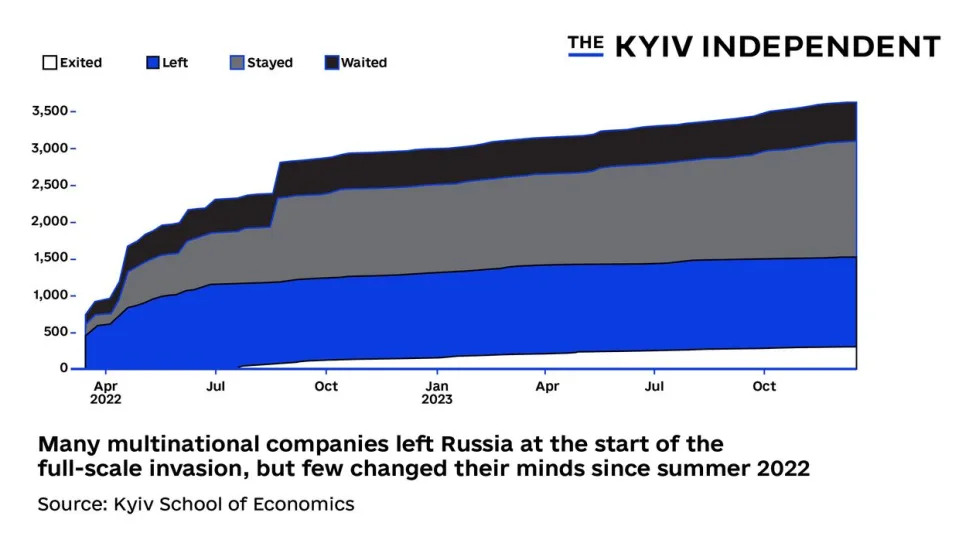
According to the KSE, after April 2022, the flood of companies leaving Russia turned into a drip. The KSE chart shows that most companies decided on whether to leave by summer 2022 at the latest.
A plateau of companies that made commitments to leave (in blue) shows that after an initial surge, few multinationals decided to exit Russia. (Graph by Nizar Al-Rifai)
Shutting the door on Russia isn’t always simple, even for the companies that want to. A recent investigation by the New York Times showed that Russian dictator Vladimir Putin is making withdrawal difficult and costly for foreign companies and enriching Russia in the process.
More than 1,600 foreign companies have continued business as usual in Russia. When challenged about their continued presence, some companies such as Unilever claim only to sell essential goods, while Nestlé cited worries about abandoning their staff, and Carlsberg claims to be unable to find buyers for their business.
These excuses proved thin. Dutch brewer Heineken sold its entire Russian business for the symbolic sum of one euro, showing that withdrawal is possible if a company is ready to take a financial hit. Unilever continued to sell ice cream, under the guise of “essential goods.”
The Kyiv Independent reached out to Unilever, Nestle, and Carlsberg but hasn’t gotten a response as of publication time.
Ultimately, most companies are cynical and profit-driven, and we cannot expect otherwise, says Glib Kanievskyi, co-founder of StateWatch, a Ukrainian transparency watchdog. Any tools that seek to isolate Russia economically must take this into account.
Who are the “sponsors of war’?
The International Sponsors of War list, launched in summer 2022, is an initiative that seeks to turn public opinion against multinationals that stay in Russia and use public pressure to incentivize withdrawal.
Of more than 1,600 foreign companies that stayed in Russia according to KSE, only 45 are listed as sponsors of war. According to Agia Zagrebelska, who oversees the sanctions policy direction at the NACP, there are three main criteria for inclusion: a substantial amount paid in taxes to Russia, any direct connections to the military, and broken promises to withdraw from Russia.
She says the NACP receives suggestions about companies from the public and civil society organizations such as StateWatch. These suggestions are then reviewed in line with the Agency’s criteria.
Some listed companies, like Unilever, snack titan Mondelez, and supermarket chain Auchan, are known worldwide for their consumer goods. Thirteen companies are based in China, a key Russian ally and its largest trading partner.
Of the three most profitable sectors identified by KSE and B4Ukraine, the NACP has widely listed alcohol and tobacco, and mass-market consumer product companies, but the automobile sector is still untouched – no Western automobile companies are on the list.
The list’s purpose is to go after a “gray zone” of companies that are not eligible for sanctions, says Zagrebelska. While there are no legal consequences to being listed, the risk of reputational damage can be enough to change company behavior.
Zagrebelska says the list allows consumers to make informed choices about their purchases, thus enacting a “direct democracy” where the public can vote with their wallets.
‘Soft sanctions’ in action
The NACP points to several companies that stopped dealing with Russia as signs of a successful policy. For instance, British manufacturing group Mondi was listed as a sponsor of war in February 2023, given their sizeable operations in Russia. They were removed from the list in November 2023 following a complete withdrawal.
While Zagrebelska admits that it is difficult to prove that the sponsors of war list had a decisive impact, she says the NACP is confident it pushes companies in the right direction.
In other instances, the NACP negotiated extensively with companies. Three Greek shipping companies saw their status change four times as they made and broke promises to the NACP. Finally, the companies were removed for good when they committed to stop shipping Russian oil entirely.
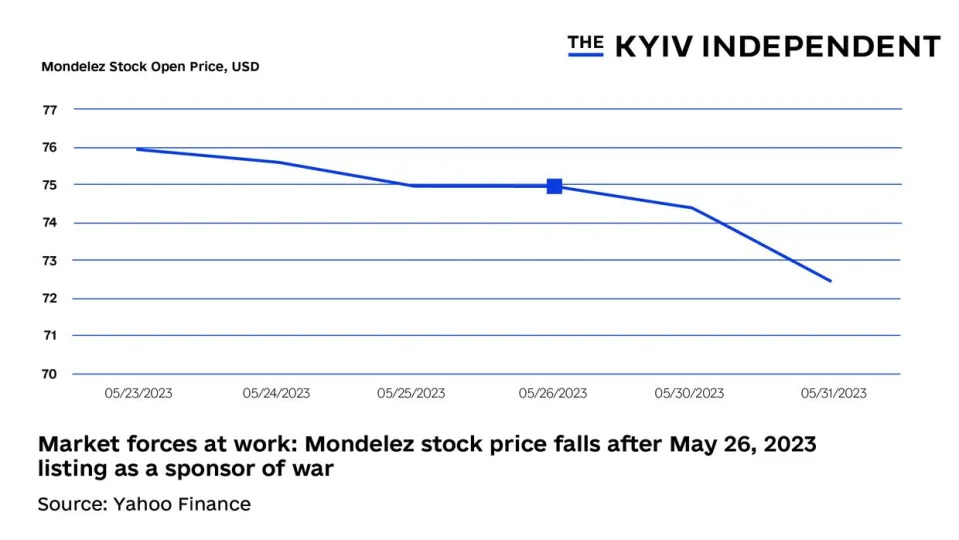
A graph of the Mondelez stock price, the blue square showing the day the company was listed as a sponsor of war by Ukraine’s National Agency on Corruption Prevention. (Graph by Nizar Al-Rifai)
The stock price of Mondelez, the company behind Oreos, Toblerone, and Milka, tumbled by almost five percent after it was labeled a sponsor of war in May 2023. Mondelez has continued its operations in Russia, and its stock price has not recovered.
The snack maker’s financial troubles were likely exacerbated due to a boycott by clients in Sweden and Norway such as Scandinavian Airlines since June 2023. The Nordic companies cited the listing as a sponsor of war as the reason for their decision. Mondelez claimed they were unfairly “singled out.”
The Kyiv Independent reached out to Mondelez but hasn’t heard back as of publication time.
Wrangling with banks
One of the NACP’s most high-profile clashes was with Hungary’s OTP Bank, which operates in Russia and Ukraine and was listed as a sponsor of war in May 2023.
Viktor Orban, Hungary’s prime minister known for pro-Russia stances, was outraged by the listing, and Hungarian diplomats pushed back hard, threatening to derail EU sanctions and Ukraine aid discussions in Brussels.
According to NACP’s Zagrebelska, OTP Bank made significant concessions in discussions with EU and Ukrainian officials and demonstrated a concrete plan for withdrawing from Russia, after which the bank was removed from the list in October 2023. She could not share any details of the plan, which is set to be announced in January 2024, with the Kyiv Independent.
Kanievskyi of StateWatch was skeptical of the NACP’s claim of victory over OTP Bank. He said the likelier explanation is that NACP backed down after internal and external pressure. Passing EU sanctions was more important to the Ukrainian government, he said.
A Ukrainian official who worked closely on negotiations over OTP Bank but was not authorized to speak on the record said the NACP listing caused “a lot of fuss.” They said that the listing of OTP Bank held up the 11th EU sanctions package for up to four weeks and that Ukraine’s Ministry of Foreign Affairs was frustrated with the NACP’s position.
Similar discussions are ongoing about Raiffeisen, an Austrian bank with huge operations in Russia. The bank’s status as a sponsor of war was suspended last week, and Zagrebelska said that NACP is awaiting concrete documentation to show its commitment to withdrawing from Russia.
Once again, the NACP’s decision to remove the bank coincided with Austria’s approval of the latest EU sanctions package. Kanievskyi said the NACP folded to pressure, but Zagrebelska maintained her confidence that Raiffaisen will take concrete steps to withdraw from Russia. She also noted that the bank’s status is only suspended, meaning it can be easily reinstated.
Reflecting on the OTP and Raiffeisen cases, Andrii Onopriienko, a policy expert at KSE, recognized that the sponsors of war list is ultimately a political process that uses these negotiations to try and find a favorable compromise for Ukraine.
On OTP and Raiffeisen, the jury is still out. Should the banks’ promises to exit Russia prove empty, the deterrent power of the list may be weakened. On the other hand, if OTP and Raiffeisen show a real commitment to withdrawing from Russia, the “soft sanctions” and negotiation approach may be vindicated as a powerful tool of economic warfare.
Dealing with the devil?
Another source of criticism has been the inclusion of companies that continue to do business in Ukraine. Philip Morris, one of the “big four” tobacco companies, was listed among sponsors of war in August 2023, having announced a $30 million factory project in Lviv Oblast just two months before.
Japan Tobacco International (JTI), another “big four” cigarette maker is also one of the biggest multinationals still active in Russia and Ukraine, and was also listed as a sponsor of war in August 2023.
Kanievskyi questioned the coherence of listing Philip Morris as a sponsor of war and continuing close cooperation with the company. Many companies on the list maintain significant operations in Ukraine, including Unilever, Nestlé, and Mondelez.
According to Kanievskyi, the cause is a lack of a unified policy and legislative framework.
On the Philip Morris deal, Phil Chamberlain from the campaigning organization Expose Tobacco said that preying on countries in difficult situations to get a better deal was straight out of the “Big Tobacco” playbook. According to Chamberlain, a lack of coherent policy only makes it easier for multinationals to take advantage of the war to increase profits.
According to Hlib Kolesov, a lawyer with the Ukrainian think-tank Center for Democracy and Rule of Law, it is hypocritical of tobacco companies to be contributing to Russia’s economy as they claim to support Ukraine amid war.
“On the one hand, tobacco companies position themselves as good partners of Ukraine, investors in its economy, in recovery, but, on the other hand, the same tobacco companies earn money in Russia and pay huge taxes to the budget of the Russian Federation,” Kolesov told European Pravda.
A picture taken on Aug. 21, 2018, shows the research and development campus of cigarette and tobacco manufacturing company Philip Morris International, in Neuchatel, western Switzerland. (Photo by Fabrice Coffrini/AFP via Getty Images)
Yet, Ilona Sologoub, an economist and head of the VoxUkraine think tank, recognized the challenges faced by Ukraine’s government in elaborating a coherent policy in this area.
Ultimately, Sologoub agreed with the NACP’s “gray area” logic. She said that “soft sanctions” fill a valuable gap, targeting companies that cannot be sanctioned because of the possible negative impact on Ukraine’s economy.
For NACP’s Zagrebelska the presumable “whitewashing” efforts by Philip Morris and other companies are too little, too late. She said she was confident that consumers can see through the efforts and will continue to pressure companies to exit Russia.
The Kyiv Independent requested a comment from Philip Morris but hasn’t heard back as of publication time.
Coordinated policy
Experts were broadly positive about the sponsors of war list and its contribution to Russian economic isolation. “There is no perfect solution,” said KSE’s Onopriienko, “but it is an all-out war. We all do our part.”
Kanievskyi, whose organization StateWatch collaborates extensively with the NACP, emphasized the lack of central government policy as the biggest challenge for Ukraine in this area.
He said that in the early months of the all-out war, companies were more afraid of reputational damage for staying in Russia, while now many are ready to take the risk. For him, this highlights an urgent need for a centralized policy on sanctions and other economic restrictions from the authorities. Ultimately, he says a lack of a clear policy undermines the communications efforts of the NACP which is crucial to the list’s success.
A lack of centralized policy also led to tensions over OTP Bank, with different Ukrainian government agencies pushing for different outcomes, as recounted by the Ukrainian official who worked closely on internal and external negotiations and who is not authorized to speak with the media.
The NACP and partners are looking to develop new initiatives to isolate Russia economically and increase the effectiveness of sanctions. A newly launched project tracks electronic components used in Russian weapons that continue to bypass sanctions. Zagrebelska said that in early 2024, the Agency plans to launch a mobile application allowing consumers to spot products by companies listed as sponsors or war.
In the meantime, Kanievsky underscores the importance of having a coordinated policy on the sponsors of war list. Lacking proper guidance from the central government, Ukrainian officials and civil society may struggle to do their part in isolating Russia’s wartime economy.
The Supreme Court could correct Mitch McConnell’s huge mistake
Opinion by Dean Obeidallah, CNN – December 24, 2023
The holiday season is filled with classic movies like “A Christmas Carol” that tell us we still have time to right the wrongs of the past. Well, now the US Supreme Court — even without a visit from the ghost of “Christmas yet to come” — may get the chance to correct the wrongs of GOP senators like Mitch McConnell, who refused to convict former President Donald Trump during his January 6 impeachment trial.
The Supreme Court justices can do so by agreeing with the Colorado Supreme Court’s recent decision that found Trump engaged in an insurrection and was therefore “disqualified from holding the office of president under Section 3 of the 14th Amendment to the United States Constitution.”
As a reminder, shortly after January 6, 2021, Trump was impeached by the House of Representatives for inciting an insurrection. That single article of impeachment — approved by 10 House Republicans along with all the Democrats in the lower chamber — specifically cited Section 3 of the 14th Amendment as a reason to move forward with the proceedings.
While the Senate failed to reach the two-thirds threshold necessary to convict Trump, the vote did garner the support of a simple majority (57-43) that included seven Republicans. That means the majority of both chambers of Congress voted in favor of removing Trump from office given his role in the January 6 insurrection.
After the vote was tallied, Senate Minority Leader Mitch McConnell took to the floor to brutally slam Trump for his actions. He declared that on January 6, 2021, “American citizens attacked their own government. They used terrorism to try to stop a specific piece of democratic business they did not like.” He then made it clear that Trump was to blame: “They did this because they had been fed wild falsehoods by the most powerful man on Earth – because he was angry he’d lost an election.”
McConnell added, “Even after it was clear to any reasonable observer that Vice President (Mike) Pence was in danger, even as the mob carrying Trump banners was beating cops and breaching perimeters, the president sent a further tweet attacking his vice president.”
The GOP Senate leader went on to call out Trump’s response during the attack, saying that “a mob was assaulting the Capitol in his name” and former aides and allies begged him to publicly call off the attack. “But the president did not act swiftly,” McConnell said. “Instead, according to public reports, he watched television happily as the chaos unfolded. He kept pressing his scheme to overturn the election.”
However, despite those strong words, McConnell voted to acquit because Trump was already out of office at the time of the trial, and in the senator’s view, “We have no power to convict and disqualify a former officeholder who is now a private citizen.” If the Senate had convicted Trump instead, it could have barred him from running for federal office again.
Putting aside whether McConnell was correct from a constitutional point of view, the courts now have the power to “disqualify a former officeholder who is now a private citizen.” That is exactly what the Colorado Supreme Court did with their 4-3 ruling. As the court laid out, Trump’s goal with the insurrection, which “he himself conceived and set in motion,” was to “prevent Congress from certifying the 2020 presidential election and stop the peaceful transfer of power.” And like McConnell, who pointed out that Trump did not act quickly to call an end to the insurrection, the Colorado Supreme Court noted Trump “continued to support it” with his tweet that day targeting Pence.
No one knows with any certainty what the US Supreme Court will rule in this case. In fact, lost in much of the discussion is the question of whether Trump will formally appeal the Colorado ruling, as he has vowed to do.
But as I discussed Thursday on my SiriusXM radio show with Mario Nicolais — one of the lawyers who won the case to disqualify Trump from the ballot in Colorado — Trump must appreciate the risk that the US Supreme Court could rule against him. If that happens, Trump would be definitively barred from holding office ever again, whereas he would only be barred from the ballot in Colorado — a state he lost to Joe Biden by more than 13 points in 2020 — if the ruling stands.
If Trump appeals and the US Supreme Court hears the case, they will have the opportunity to uphold the US Constitution by disqualifying Trump from serving in any office for his role in the January 6 insurrection, in violation of Section 3 of the 14th Amendment. And redressing these past wrongs would make them very much like Ebenezer Scrooge on Christmas morning.
General Staff: Russia has lost 352,390 troops in Ukraine
The Kyiv Independent – December 23, 2023
Russia has lost 352,390 troops in Ukraine since the beginning of its full-scale invasion on Feb. 24, 2022, the General Staff of Ukraine’s Armed Forces reported on Dec. 23.
This number includes 1040 casualties Russian forces suffered over the past day.
According to the report, Russia has also lost 5,854 tanks, 10,871 armored fighting vehicles, 10,995 vehicles and fuel tanks, 8,286 artillery systems, 932 multiple-launch rocket systems, 611 air defense systems, 327 airplanes, 324 helicopters, 6,384 drones, 22 ships and boats, and one submarine.
Ukraine’s Air Force Commander Mykola Oleshchuk had said on Dec. that Ukrainian forces downed three Russian Su-34 supersonic fighter-bomber aircraft on the southern front.
Air Force spokesperson Yurii Ihnat said a Su-34 has not been included in the statistics of Russian losses for a long time, and each one costs “at least 50 million dollars” on air.
‘A Very Large Earthquake’: How Trump Could Decimate the Civil Service
Ian Ward – December 20, 2023
For the past two decades, Max Stier has distinguished himself as Washington’s foremost champion of the federal civil service, a quiet but influential voice in favor of practical reforms to make federal bureaucracy work better both for the people who serve in it and for the people that it serves. The Partnership for Public Service — the nonpartisan, nongovernmental organization that Stier helped found in 2001 and still runs today — works largely behind the scenes in Washington to grease the wheels of the bureaucracy, doing everything from crafting common sense proposals for modernizing government programs to hosting a much-beloved annual awards ceremony honoring the country’s top performing civil servants.
These days, though, Stier is increasingly preoccupied with what he sees as a fundamental threat to that work: former President Donald Trump’s sweeping proposal to convert thousands of career civil servants into political appointees if he wins a second term in the White House. That plan — which has won the support of powerful, Trump-aligned conservative think tanks such as the Heritage Foundation and the America First Policy Institute — is modeled on an executive order from Trump’s first term that redesignated 20,000 civil servants in policy-related positions as “Schedule F” employees, thereby allowing them to be fired unilaterally by the president.
The Biden administration reversed the Trump administration’s order upon assuming office in 2021, but Trump has vowed to reinstitute an expanded version of the Schedule F order if he is reelected in 2024, converting as many as 50,000 civil servants into political appointees and stripping them of the career protections that they currently enjoy.
For Stier, Trump’s proposal is as ironic as it is dangerous. Although Trump and his allies have argued that their plan is necessary to vanquish the “deep state” that allegedly undermined Republican policy initiatives during Trump’s first term, Stier argues that a revamped order on Schedule F would in fact go a long way toward creating the sort of “deep state” that conservatives now rail against.
“If you were to convert a significant segment of that professional workforce into one that is being chosen by political fiat, then you end up in a system that is responsive to the political desires of the individual rather than the larger responsibilities to the Constitution and to law,” Stier said when I spoke to him recently. “You wind up with a workforce that is not only going to deliver poor service, but also that is going to be a tool for retribution and actions that are contrary to our democratic system.”
Even so, Stier cautioned, Americans should not underestimate the damage that the reforms would do to the federal government’s ability to deliver basic services in a timely and efficient manner. “At the end of the day, it’s intuitive,” he said. “If you are selecting people on the basis of their political persuasion or their loyalty as opposed to their expertise and their commitment to the public good, you’re going to wind up with less good service and more risk for the American people.”
The following has been edited for concision and clarity.
How seismic would the changes wrought by Trump’s proposal be? Is there any precedent for it?
It would be a very large earthquake. There is precedent, but it’s precedent from the 19th century. In effect, when you talk about implementing Schedule F, you’re talking about turning the clock back to the late 19th century, when our government operated under the spoils system. That all changed, importantly, when President [James] Garfield was assassinated by a disgruntled job seeker [in 1881], resulting in the passage of the first piece of legislation that professionalized our government, the Pendleton Act.
Frankly, Schedule F is now used as a handle for a larger set of dramatic changes to our government, but they are entirely designed to — and will have the consequence of — making our government responsive to the will of the individual holder of the office of the president rather than the broader allegiance to our Constitution and the rule of law.
Is there evidence that a merit-based civil service — as opposed to a bureaucracy run according to the spoils system — actually makes the government more effective?
No question. One way to know that is to look at our peer countries across the world, and the reality is that every effective democracy on the planet today has a professionalized, merit-based civil service that is the core of their governmental function. If anything, we are an outlier in the numbers and the extent to which political appointees are [spread] throughout government institutions. We have 4,000 political appointments that are made by a president — and that is dramatically more than anybody else out there. So one direct piece of evidence is to look at our peers to see how capability and government performance are directly related to the professional capability of the other civil service. In our own country, the same is true. We have many instances in which organizations have foundered when they’ve had too many political appointees.
At the end of the day, it’s intuitive: If you are selecting people on the basis of their political persuasion or their loyalty as opposed to their expertise and their commitment to the public good, you’re going to wind up with less good service and more risk for the American people.
Do we know which career positions would likely be converted to appointed positions under a second Trump administration?
The best evidence we have so far is what was attempted at the back end of the last Trump administration. At that point, they were looking at converting effectively the entire Office of Management and Budget. For most people, that’s just another government acronym, but in fact, it’s the nerve center of the entire government and the office that really is responsible for coordinating and allocating all the resources of our government — and it’s one of the most capable and professionalized elements of our government.
If you converted just those positions alone, then all kinds of choices in government would be made not on the basis of what delivers the best service to the public, and not on the basis of choosing according to transparent criteria that match Congress’ objective desires. They would be entirely based on the political implications — and that is a worse world.
What about beyond OMB?
We don’t know what the full sweep would be, but it’s also true that you don’t have to convert all the positions to have a much larger impact. The chill that would exist for the larger workforce would be profound. For instance, we currently have a system that respects whistleblowers in order to make sure that if something illegal is occurring inside an agency, the individuals who raise them are actually protected. In a world with Schedule F, that would be incredibly hard to see that happening.
Which areas of the government stand to suffer the most under a return to the “spoils system,” as you called it? What would that look like in terms of the delivery of government services?
It depends a lot on how broad of a brush is ultimately wielded in making the changes. You can start from the most obvious, life-saving components of our government.
If you ask the public today if they want a professional government service, they say “yes” in very, very large majorities. So I think that the intuitive point is very strong. The challenge is that there’s a narrative that has been sold around this notion of a deep state, which is just wrong. Indeed, the proposals that are on the table would create a deep state, rather than the effective state that we all should be pursuing.
What do you mean?
I don’t think we have a deep state today. The vast bulk of career civil servants understand that their role is to execute the policy choices that our elected leaders make and that they have a responsibility to follow the law and to make sure their actions are consistent with the Constitution. But if you were to convert a significant segment of that professional workforce into one that is being chosen by political fiat, then you end up in a system that is responsive to the political desires of the individual rather than the larger responsibilities to the Constitution and to law.
You wind up with a workforce that is not only going to deliver poor service, but also that is going to be a tool for retribution and actions that are contrary to our democratic system.
The Biden administration has issued a rule that’s designed to limit the scope and efficacy of any subsequent Schedule F reforms by future administrations. How effective do you think that rule will be?
It’s an important effort and recognition that it would be wrong and damaging. At the end of the day, though, Congress speaking to this would be much more efficacious. I actually think that, even absent the rule or legislation, there would be real legal reasons to challenge the creation of something like Schedule F.
What would a legal challenge look like?
There are statutes that Congress passed that enshrined the merit principles, and one of the main principles is that employees should actually be hired on the basis of merit and not on the basis of politics. So I believe there would be credible and important legal questions that could be raised about those kinds of changes.
But again, I’m not suggesting that they necessarily win — and in the meantime, an awful lot of damage could happen. The very effort and attempt [to reimplement schedule F] would be incredibly damaging in and of itself, so people should not feel sanguine about the possibility that this couldn’t happen or could be delayed, because the harm is profound even in just attempting to do so.
Past administrations from both parties have struggled to fill the 4,000 appointed jobs that currently exist. Is it feasible for a future administration to fill somewhere in the ballpark of 50,000 appointed roles?
The biggest challenge in placing political appointees comes from the Senate confirmation process and all the delays and difficulties that are involved in actually nominating and getting the Senate to confirm them. That’s a deeply broken process. But none of these positions would require that. So I don’t believe that people should be heartened by the notion that they can convert them and it won’t matter because they won’t be able to fill those jobs. I don’t think that is either a true or adequate answer to the problem.
I imagine many people reading this will think, “Well, our government doesn’t work all that efficiently as it is, so what’s the problem with making it a little bit less efficient?” How do you answer that?
This is a difference in kind and not in degree. It’s not like, Yeah, we might just have a slightly less efficient government. No — we would actually have a government that fundamentally fails in its responsibilities to the American people. It would become an instrument of political achievement rather than an instrument of problem-solving and addressing critical issues for the public.
But I think the point is a very important one, because the American public should demand even better than they’re getting right now from our government. I believe that there actually are really good ways of improving the capability of the civil service that do not involve burning down our government. That’s fundamentally the choice that is here to be made. I don’t think it’s efficient to simply say that Schedule F is bad. You also have to offer a plan of attack on improving our government — and frankly, we have that. We have a whole roadmap of the changes that should take place. But the reality is that none of it should be viewed as an indictment of career public servants. It’s an indictment of the leadership over the years that has failed to modernize and invest in the systems of our government.
What does that roadmap look like?
To give one example, the pay system is based on a law from 1949 and it fundamentally hasn’t been modernized since then. That ought to be modernized, because it was built at an age in which our federal workforce was largely clerical, whereas today it’s largely professional. The system isn’t designed for market connectivity to get the technologists, the AI specialists and so on that are necessary to deliver the best services to the public.
There are changes that ought to take place in the way accountability is done in our government. You can actually fire federal employees — and many do leave because they’re threatened with being fired for performance issues — but the systems should be modernized and updated and simplified. There are lots of things that can be done that would actually improve the public service and that would result in better outcomes for the public, rather than blowing it up.
What happens to those reforms in a world with Schedule F? Is there a kind of dual-track future where you can do sensible civil service reform even with Schedule F in place, or are they completely crosswise with each other?
I think they’re crosswise because they come from different visions. One vision is a spoils system, and the other is a professional, capable and effective state. Those are very, very different visions, so I don’t think you can marry the two.
Ultimately, the Schedule F approach swamps the entire system. It cuts the legs out from the idea that we want people who are not only selected on the basis of their capabilities but also based on the fact that their loyalty is to the rule of law and our Constitution rather than to the individual [in power]. Again, we have way too many political appointees as it is, and it really is important for people to see that we are such an outlier in the world — in a bad way.
I suspect that some people on the right simply do not care if government efficiency suffers as a result of these reforms. In fact, that might be part of the goal. How do you think about appealing to people who might be thinking about it that way?
There’s an entirely legitimate and appropriate debate to be had about the role of our government. But there should be no debate about ensuring that, whatever the public actually desires the government to do, it’s done well and effectively. The vast majority of civil servants are focused on national security issues — on actually keeping us safe. I don’t think there are very many Americans who would dispute the value of that outcome or the need for an effective government to do it.
How aware are people in Washington of the potential consequences of these reforms? And how prepared do you think they are to deal with them?
I do not believe that the public has good insight into the nasty consequences that would come out of the proposals that are part of Project 2025. At the end of the day, if you look at the polling [about the public’s view of the civil service] it’s clear as can be: Americans actually want the people who are serving them to be chosen because they’re the most expert and capable — not because they’ve sworn loyalty to the person in the Oval Office.
Putin: There must be severe action against ‘foreign agents’ who help Ukraine, destabilize Russia
Nate Ostiller – December 20, 2023
Editor’s note: A previous version of this article said that Sergei Skripal’s wife was injured in the poison attack. Skripal’s daughter Yuliia, not his wife, was injured.
Russian leader Vladimir Putin said that there must be a “severe” response against foreign intelligence services that “directly” support Ukraine and seek to “destabilize the socio-political situation in Russia” in a video address published on the Kremlin’s website on Dec. 20.
Putin has long accused Ukraine of being guided by foreign powers, especially the U.S., and has claimed that its actions are dictated by Washington.
While the U.S. openly supports Ukraine and provides the country with funding, weapons, and strategic military assistance, there is no evidence that U.S. intelligence services actively assist Ukraine on the ground, especially within Russia.
The comments came on Russia’s Security Officer’s Day. Putin congratulated them for their work, particularly in parts of Ukraine that Russia illegally annexed in 2022.
He also accused Ukraine of pursuing “state terrorism” by engaging in sabotage and targeted assassinations. He did not elaborate on the statement.
Ukraine occasionally acknowledges its involvement in various operations within Russia, although it does not take direct responsibility.
Ukraine’s military intelligence (HUR) published a video on Nov. 30 saying that trains in the region around Moscow were disrupted at the end of November “as a result of a special measure implemented together with the resistance movement.”
A pro-Russian former lawmaker, Illia Kyva, who was charged with treason in Ukraine, was assassinated in Moscow Oblast on Dec. 6. in a special operation conducted by the Security Service of Ukraine (SBU), according to the Kyiv Independent’s source in law enforcement.
Russian intelligence is widely believed to be behind a significant number of operations in foreign countries to sow chaos and destabilize society.
Russian operatives have also assassinated perceived opponents of Putin’s regime in foreign countries, such as the poisoning of Russian double agent Sergei Skripal in the U.K. Skripal and his daughter survived the attack, but an innocent passerby who found the poison was killed.
More Than Half of Children Losing Medicaid Coverage Live in Just 5 States
Michael Rainey – December 19, 2023
Getty Images
As individual states continue to disenroll millions of people from Medicaid and the Children’s Health Insurance Program (CHIP) now that pandemic-era suspension of participation guidelines has come to an end, new data from the U.S. Department of Health and Human Services shows that more than 50% of the children who have lost health coverage this year come from just five states.
From March 2023, when the disenrollment process began, to the end of September, 2.2 million children were removed from Medicaid and CHIP, two programs that overlap and are typically lumped together. The five states with the largest total declines in enrollment – Texas, Florida, Georgia, Ohio and Arkansas – accounted for 54% of the reductions, or more than 1.2 million children.
All five states are led by Republicans, and the first three have refused to expand their Medicaid systems as allowed by the Affordable Care Act. In terms of total disenrollment, the 10 states that have refused Medicaid expansion – Texas, Florida, Georgia, Mississippi, Alabama, South Carolina, Tennessee, Kansas, Wisconsin and Wyoming – have removed more children from coverage than all of the expansion states combined, HHS said.
Echoing the worries of many healthcare experts, the Biden administration has expressed concerns that some states have been too aggressive in removing beneficiaries from their Medicaid and CHIP rolls, with many people losing coverage simply because they failed to complete various kinds of paperwork. HHS said Monday that Secretary Xavier Becerra has sent letters to the nine states with the highest disenrollment rates urging them to “adopt additional federal strategies and flexibilities to help prevent children and their families from losing coverage due to red tape.”
Among other things, Becerra called on governors to remove barriers to participation such as CHIP enrollment fees and premiums; to make it easier to automatically renew children for coverage; to expand efforts to contact families facing renewal; and to expand their Medicaid programs so that children do not fall into a coverage gap. “I urge you to ensure that no eligible child in your state loses their health insurance due to ‘red tape’ or other bureaucratic barriers during the Medicaid enrollment process,” he wrote.
Liz Cheney Tells Fox News Viewers Why They Should Not Vote For Donald Trump: “This Isn’t About Policy … It’s About The Republic. It’s About The Constitution”
Ted Johnson – December 18, 2023
Liz Cheney, in a sometimes contentious interview with Fox News’ Bret Baier, at one point addressed the network’s viewers with a message: Don’t vote for Donald Trump.
“We can have conservative policies without having to torch the Constitution,” Cheney said. “And so what I would urge people watching today who are going to be voting in those caucuses and in those primaries, vote for somebody else. Do not vote for somebody who already tried to seize power.”
Now an outcast from the Republican party for her criticism of Trump and her warnings about giving him a second term, Cheney has made numerous appearances across other media outlets as she promotes her book, Oath and Honor. Her first big sitdown was with MSNBC’s Rachel Maddow, and there was some question as to whether she would appear on Fox News at all. On CNBC, Cheney criticized Fox News host Sean Hannity for “enabling” Trump.
On Special Report on Monday, Baier told her, “We have a policy here to hear from all sides, and we wanted to invite you to talk about your book.”
The interview, which ran just short of 10 minutes, did not start with Cheney’s book but with Baier’s question about how she views President Joe Biden’s response to the Israel-Hamas war. “I’m worried that they’re getting to abandon Israel, and I think we’re in a situation where Hamas must be destroyed,” Cheney said, offering some criticism of the administration.
But that fed into a point she made several times throughout the interview: Her opposition to Trump is not about policy, but of his efforts to remain in power after the 2020 election, including his conduct on January 6, 2021, along with what he has vowed to do in a second term.
“He tells us every day,” she said. “If you look at the steps he would have to take in terms of simply refusing to enforce court orders, or comply with court orders with which he disagrees, putting people in key positions …. unethical lawyers who would help him, frankly, blow through many of the guardrails in our Constitution. I think it is a very real concern.”
Then Baier read from a Wall Street Journal op ed from last week in which the writer, Allysia Finley, called the notion of “Trump as dictator” a “classic case of projection.” Finley went on to claim that it is Biden who has abused executive power, ignored the law and “run roughshod over individual liberties,” while Trump “would have to contend with a hostile media and a federal bureaucracy that would be throwing pots, pans and candlesticks at him at every step.”
“Well, I think they’re wrong,” Cheney told Baier. “We would not have to guess about what the next President Trump would do because he did it before. He would not have around him the people that were around him, frankly, the people that the country will hear from as his trial moves forward, who were all his appointees…people that told him on January 6th, as you and I were talking that day, actually, that he needed to tell the mob to go home.”
Baier, though, stuck with the op ed, contending that Cheney has not been vocal about Biden’s executive orders to cancel student loans, ban evictions and mandate Covid vaccines. For a time, he and Cheney talked over one another.
Cheney said that she didn’t think it was true that she had not weighed in on some of the topics, before making the point that Trump’s case was different. She even cited Baier’s own book on George Washington.
“The last chapter of your book is called “The Gift of a Peaceful Transition of Power.” That is what we are talking about,” she said.
“This is not about me,” Baier said.
“That’s right. But that’s a very important concept….Every single president, Republican and Democrat, since George Washington, has ensured the peaceful transition of power. Donald Trump tried to seize power.”
“This isn’t about policy. I voted with Donald Trump 93% of the time. This is about the nation. It’s about the republic. It’s about the Constitution.”
Cheney, who was once a Fox News contributor, also seemed to be making an appeal to the Fox News workforce, invoking one of its late conservative commentators. “I come here to Fox, and I sit in the Charles Krauthammer green room, and I know how much, how revered Charles was, by you, by me,” she said. “And Charles taught us a whole bunch of things. But one of them is that some things have to matter, and rising above politics, rising about partisanship, recognizing our duty to the Constitution, is the most conservative of all conservative principles.”