There are big problems with the way the Kremlin drone incident went down, and war experts say Russia ‘likely staged’ it

Insider

There are big problems with the way the Kremlin drone incident went down, and war experts say Russia ‘likely staged’ it

 Mia Jankowicz – May 4, 2023
kremlin explosion drones ukraine russia
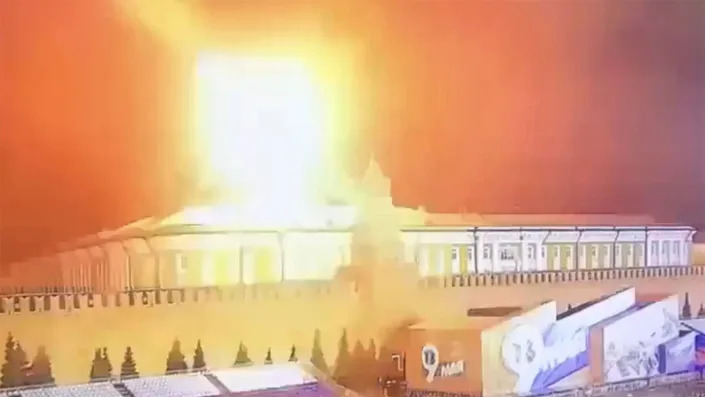
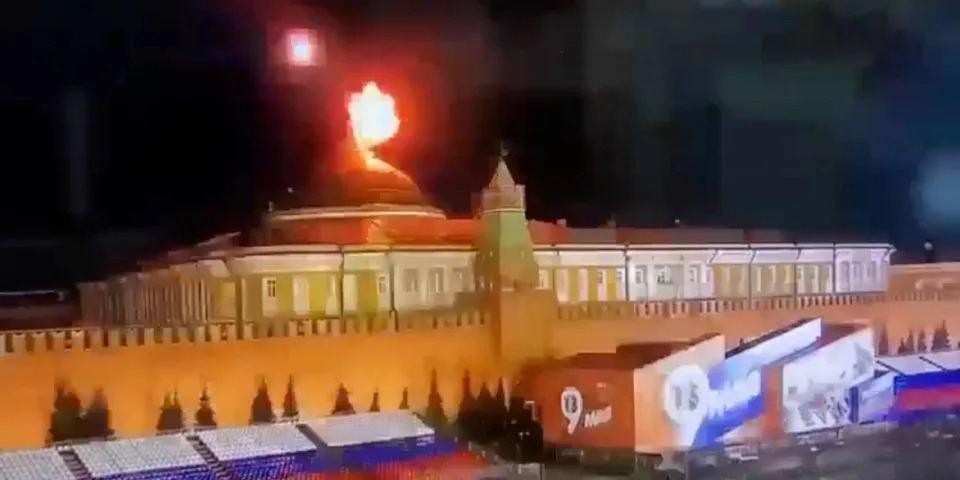
Unverified footage on social media appeared to show an object flying over the Kremlin in Moscow.Reuters
  • Much remains unknown about the drone incident that the Kremlin announced on Wednesday.
  • A US think tank, however, argues it was “likely” a Russian false-flag operation.
  • Several commentators have cautiously noted the potential political benefits for Russia.

A US think tank says Russia “likely” staged a drone attack on the Kremlin as a false-flag operation, with other observers noting how politically advantageous the incident would be for Russian President Vladimir Putin.

Russia on Wednesday claimed that two drones — one of which was apparently caught on camera exploding — were sent over the Kremlin as a “planned terrorist act and an attempt on the president’s life.” It characterized the incident as a Ukrainian attack.

Ukrainian President Volodymyr Zelenskyy quickly denied any involvement.

The Kremlin was largely unharmed in the incident, and Putin wasn’t in the building at the time.

As military experts told Insider, many details of the incident — and ultimate responsibility for it — remained unconfirmed as of Thursday.

But the Institute for the Study of War, a US think tank that produces a detailed daily situation update on Russia’s invasion of Ukraine, says “several indicators suggest that the strike was internally conducted and purposefully staged” by Russia.

Russia has bolstered its multilayered air defenses around Moscow, making it “extremely unlikely” that two drones could get close enough to explode “just over the heart of the Kremlin in a way that provided spectacular imagery caught nicely on camera,” the ISW said.

The think tank pointed to geolocated images of Russia installing advanced Pantsir surface-to-air missile-defense systems around Moscow earlier this year.

Moscow and the central industrial district are defended by the 1st Air and Missile Defense Army, equipped with S-300 or S-400 surface-to-air missile systems, as Defense News reported. The Russian defense ministry is also working to further bolster these capabilities by year-end.

The highly coordinated public statements made immediately after the incident also suggest it was no surprise to Russia, the ISW said.

Russia’s much-hyped annual Victory Day celebrations are looming on May 9 — but have been pared back nationwide over security concerns.

Some observers have argued that the celebrations could turn into a show of dissent against Russia’s invasion of Ukraine, as the BBC reported.

The Kremlin could use the drone incident to justify scaling them back even further, which would help it in “framing the war in Ukraine as directly threatening Russian observance of revered historical events,” the ISW wrote.
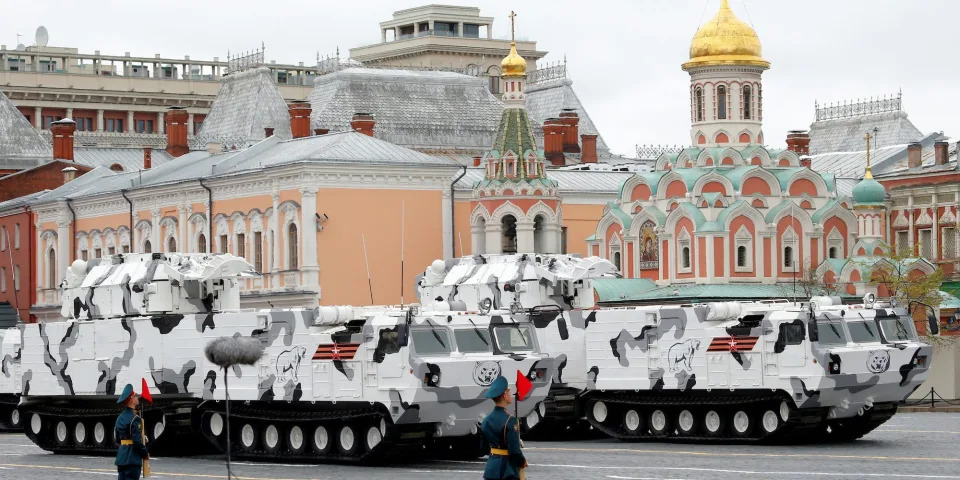
A 2017 image of two Pansir air defense systems, painted in white and grey, in Moscow.
A 2017 image of two Pantsir-SA surface-to-air missile systems during a parade in Red Square.Sergei Karpukhin/Reuters

Several commentators have speculated on the positive political possibilities for Russia in staging such an attack, both domestically and on the international stage.

“Russia needs some sort of justification for why they are continuing to stay in Ukraine,” Marina Miron, a postdoctoral researcher at the Department of War Studies at King’s College London, told Insider, speaking hypothetically about the incident.

“And so this has a message for the domestic populace to say: ‘Look how dangerous Ukraine is. They’re even trying to kill Putin.'”

“The motives are all really in Russia’s favor,” an unnamed UK senior defense source told the Sky News correspondent Tamara Cohen.

The source echoed Miron’s sentiments, saying it would encourage “the public to rally round; excuse for more random and reckless bombardments; trying to gain sympathy for Russia over Ukraine.”

Russia also has a history of false-flag attacks and is known to make demonstrably false claims around international incidents.

Still, other theories — such as the drone incident being a warning signal from Ukraine or the work of Russian dissidents — are far from closed off, experts told Insider.

Some commentators have said Ukraine’s denial is undermined by the fact that it has also denied prior incidents on Russian territory that have been widely attributed to Kyiv.

James Patton Rogers, a drone expert, hypothesized that the drones used could have been the Ukrainian UJ-22, which was most likely used in a prior attempt on a Gazprom site near Moscow in February. He said the earlier strike could have been a test to feel out Moscow’s air defenses.

The Russian defense and foreign ministries didn’t immediately respond to requests for comment.
This is why nobody watches Russian movies; False flag attempts are unconvincing: Russia says Ukraine tried to kill Putin with night-time drone attack on Kremlin

Reuters

Russia says Ukraine tried to kill Putin with night-time drone attack on Kremlin

Mark Trevelyan – May 3, 2023

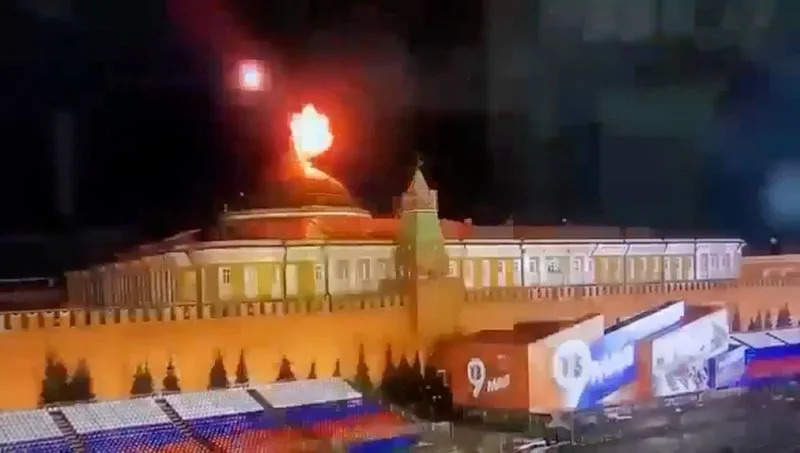
A still image from video said to show alleged Ukrainian drone attack on Kremlin

(Reuters) -Russia accused Ukraine on Wednesday of attacking the Kremlin with drones overnight in a failed attempt to kill President Vladimir Putin.

A senior Ukrainian presidential official denied the accusation – the most serious that Moscow has levelled at Kyiv in more than 14 months of war – and said it indicated Moscow was preparing a major “terrorist provocation”.

The Kremlin said Russia reserved the right to retaliate, and hardliners demanded swift retribution against Ukrainian President Volodymyr Zelenskiy.

“Two unmanned aerial vehicles were aimed at the Kremlin. As a result of timely actions taken by the military and special services with the use of radar warfare systems, the devices were put out of action,” the Kremlin said in a statement.

“We regard these actions as a planned terrorist act and an attempt on the president’s life, carried out on the eve of Victory Day, the May 9 Parade, at which the presence of foreign guests is also planned …

“The Russian side reserves the right to take retaliatory measures where and when it sees fit.”

Baza, a Telegram channel with links to Russia’s law enforcement agencies, posted a video showing a flying object approaching the dome of the Kremlin Senate building overlooking Red Square – site of the Victory Day parade – and exploding in an intense burst of light just before reaching it. Reuters could not immediately verify the video’s authenticity.

Ukrainian presidential adviser Mykhailo Podolyak said in comments sent to Reuters: “Ukraine has nothing to do with drone attacks on the Kremlin. We do not attack the Kremlin because, first of all, it does not resolve any military tasks.”

He added: “In my opinion, it is absolutely obvious that both ‘reports about an attack on the Kremlin’ and simultaneously the supposed detention of Ukrainian saboteurs in Crimea … clearly indicate the preparation of a large-scale terrorist provocation by Russia in the coming days.”

The powerful speaker of the lower house of Russia’s parliament, Vyacheslav Volodin, issued a statement demanding the use of “weapons capable of stopping and destroying the Kyiv terrorist regime”.

Margarita Simonyan, head of the state broadcaster RT, wrote on Telegram: “Maybe now things will get started for real?”

PUTIN WAS NOT IN KREMLIN – RIA

The statement from the presidential administration said fragments of the drones had been scattered on the territory of the Kremlin complex but there were no casualties or material damage.

RIA said Putin had not been in the Kremlin at the time, and was working on Wednesday at his Novo Ogaryovo residence outside Moscow.

Another video circulating on Russian social media appeared to show a plume of smoke over the Kremlin after the purported attack.

The video was posted in the early hours of Wednesday on a group for residents of a neighbourhood that faces the Kremlin across the Mosvka River. It was picked up by Russian media, including the Telegram channel of the military news outlet Zvezda.

Victory Day is a major public holiday commemorating the defeat of Nazi Germany in World War Two, and a chance for Putin to rally Russians behind what he calls his “special military operation” in Ukraine.

Russia marks the occasion with a huge military parade on Red Square, for which seating has already been erected.

The state news agency TASS said the parade – for which the Kremlin last week announced tighter security – would still go ahead.

Moscow Mayor Sergei Sobyanin said earlier on Wednesday that the city had introduced an immediate ban on unauthorised drone flights.

Russia has accused Ukraine of numerous cross-border attacks since the start of the war, including strikes in December on an air base deep inside Russian territory that houses strategic bomber planes equipped to carry nuclear weapons. In February, a drone crashed in Kolomna, about 110 km (70 miles) from the centre of Moscow.

Ukraine typically declines to claim responsibility for attacks on Russia or Russian-annexed Crimea, though Kyiv officials have frequently celebrated such attacks with cryptic or mocking remarks.

(Additional reporting by Felix Light and Jake Cordell; writing by Mark Trevelyan; Editing by Kevin Liffey)

Drone Attack On The Kremlin In Moscow (Updated)

The War Zone

Drone Attack On The Kremlin In Moscow (Updated)

Howard Altman – May 3, 2023

Russia claims numerous Ukrainian drone attacks, including against the Kremlin.

Video has emerged showing what appears to be a drone striking at the dome of the Senatsky Dvorets in the Kremlin in Moscow. Russian officials claim that the building came under attack by Ukraine and have vowed to retaliate, while Ukraine’s president denied Kyiv’s involvement in the incident.

The video shows what appears to be a drone approaching the dome and then exploding in a ball of fire that lit up the sky. It seems that this drone did not impact the dome itself, but detonated very close to it, sending flaming debris falling. Two drones are suspected to have attacked the dome in succession.

Stills captured from another video appear to show two drone strikes, one at 2:27 A.M. and another at 2:43 A.M.

Moscow residents say the sound of the explosion could be heard from across the Moskva River, according to the Yakimanca Telegram channel, a Moscow neighborhood social media site.

“The strength of the [explosion] was like a roll of thunder, neighbors from Serafimovicha Street write,” according to Yakimanca. “Also, residents of the House on the Embankment saw sparks in the sky and people with flashlights near the Kremlin wall after the claps. The illumination of the Kremlin and the Kremlin embankment is now off.”

Residents of the House on the Embankment, an iconic block-long apartment building along the banks of the Moskva River, reported “a strong bang and smoke in the center at about 2:30 a.m.,” according to Yakimanca, which posted videos of the incident. “A few minutes later, the popping repeated.”

Putin’s press service blamed Ukraine for the attacks, which could be viewed as a major symbolic victory for Ukraine, especially ahead of Victory Day on May 9. There is hardly a higher profile target than the Kremlin. On the other hand, they could also be used to rally Russians to support Putin’s war efforts. This has already led to speculation that this was a calculated move by Russia.

The video also shows people climbing the tower just prior to the detonation of one of the drones, which has led to suspicions as to exactly how all this played out.

“Last night, the Kyiv regime attempted a drone strike against the residence of the President of the Russian Federation at the Kremlin,” Russia’s official Presidential Press Service stated.

“Two unmanned aerial vehicles targeted the Kremlin. Timely action by the military and special services involving radar systems enabled them to disable the devices. They crashed in the Kremlin grounds, scattering fragments without causing any casualties or damage.”

“We view these actions as a planned terrorist attack and an assassination attempt targeting the President, carried out ahead of Victory Day and the May 9 Parade, where foreign guests are expected to be present, among others.”

Putin “has not suffered in this terrorist attack. His working schedule remains unchanged and follows its ordinary course. Russia reserves the right to take countermeasures wherever and whenever it deems appropriate.”

However, Mikhail Podolyak, an advisor to Ukrainian President Volodymyr Zelensky, denied Kyiv’s involvement.

“As for the drones over the Kremlin. It’s all predictable,” Podolyak said in a tweet. “Russia is clearly preparing a large-scale terrorist attack. That’s why it first detains a large allegedly subversive group in Crimea. And then it demonstrates ‘drones over the Kremlin.’ First of all, Ukraine wages an exclusively defensive war and does not attack targets on the territory of the Russian Federation. What for? This does not solve any military issue. But it gives RF grounds to justify its attacks on civilians.”

Podolyak’s comment about Ukraine not attacking Russian territory is also specious, as we have repeatedly reported numerous incidents where Russian towns along the border and targets beyond have come under attack by various means.

Regardless of who is to blame, Russia has clearly anticipated some kind of attack on its capital, installing a Pantsir air defense system on top of at least two different government buildings in Moscow, including the Ministry of Defense’s headquarters in January. You can read more about that in our coverage here.

We don’t know at this point what kind of drones were involved or from where they were launched, but there have been other apparent attempts by Ukraine to strike near Moscow and Ukrainian drones have gotten closer and closer to the capital in recent months. On April 24, an explosives-laden Ukrainian drone, most likely a UJ-22, was found a short distance from Moscow. You can see it in this tweet below.

We also reported about an incident in February, where a Ukrainian drone came within 70 miles of Moscow. You can read more about that in our coverage here.

But despite the attack, the Victory Day parade will go on and Putin will take part, said Kremlin spokesman Dmitry Peskov, according to TASS.

Putin is working today at his residence near Moscow in Novo-Ogaryovo, Peskov told RIA Novosti.

“The president’s schedule continues without changes,” he said.

As a result of the attack, Moscow’s mayor issued an order banning drone flying in the city.

Moscow’s mayor announced a ban on unauthorized drone flights over the Russian capital Wednesday after the Kremlin said it had shot down two Ukrainian drones targeting President Vladimir Putin. (Photo by NATALIA KOLESNIKOVA/AFP via Getty Images)

Meanwhile, there was yet another Ukrainian attack in Bryansk Oblast, which sits roughly 100 miles away from the Ukrainian border.

“UAVs of the Armed Forces of Ukraine attacked a military airfield in the Bryansk region on the night of May 3,” the Russian Baza news agency reported on its Telegram channel.

“According to preliminary data, a total of five UAVs participated in the attack,” according to Baza. “Two of them were destroyed by small arms, two more exploded on the territory of the airfield. Another drone was not found”.

As a result of the attack, a “non-operating” An-124 cargo jet “received minor damage,” according to Baza. “There were no casualties.”

Bryansk Oblast, which borders Ukraine, has been a frequent target of attacks.

There was also a suspected drone attack on a Russian oil facility in Krasnodar Oblast Russia, across the Kerch Strait from Crimea, according to a local government official.

“A fire at an oil depot in the Temryuk district of the Kuban is seen from Mount Mithridates in Kerch,” Krasnodar Krai Governor Veniamin Kondratyev wrote on Telegram channel, adding that there are no victims and no danger to the public.

The fire response “was assigned the highest rank of difficulty. The fire area was 1,200 square meters. The drone attack has not yet been officially confirmed, but local public reports report that the fire was preceded by an explosion.”

Residents of the village were not evacuated, said Kondratyev.

The resulting fire and smoke could be seen from the Kerch Bridge, itself the site of a Ukrainian attack last October.

These are just some of several suspected Ukrainian attacks noted by Russian milblogger Igor Girkin.

Ukrainian President Volodymyr Zelensky denied his country’s involvement in the Kremlin attack.

In response to this incident, Deputy Chairman of the Russian Security Council, Dmitry Medvedev, called for the assassination of Zelensky and his cabinet.

“After today’s terrorist attack, there are no options left except for the physical elimination of Zelensky and his cabal,” he said on his Telegram channel. “It is not even needed to sign the act of unconditional surrender. Hitler, as you know, did not sign it either. There will always be some kind of changer like the Zitz President Admiral Dönitz.”

Medvedev’s statement elicited a response from Podolyak.

CIA director Bill Burns will brief the Senate Select Committee on Intelligence on the incident, according to CNN.

Ukrainian Defense Minister Oleksii Reznikov echoed Zelensky’s denial.

Conflict deepens Russia’s demographic crisis

AFP

Conflict deepens Russia’s demographic crisis

May 2, 2023

President Vladimir Putin has long promised to address low birth rates that have shrunk Russia's labour force
President Vladimir Putin has long promised to address low birth rates that have shrunk Russia’s labour force

Russia’s offensive in Ukraine has aggravated a long-simmering demographic crisis that President Vladimir Putin has struggled to tackle, which could further damage its sanctions-hit economy.

For a country already suffering from a shrinking labour force because of persistently low birth rates, the conflict means even more difficulties that could persist for years.

The mobilisation of hundreds of thousands of men took them off the job market, while prompting many of the most educated parts of the population to flee the country.

“Russia lacks workers,” Alexei Raksha, a demographer who previously worked at the Rosstat statistics agency, told AFP.

“It’s an old problem, but it has gotten worse due to mobilisation and mass departures,” he said.

Russia inherited low birth rates with the collapse of the Soviet Union in the 1990s, when birth rates had halved due to economic hardship and uncertainties over the country’s future.

Putin has since tried to push families to have children, heralding “traditional values” as a way to solve what he believes to be an existential crisis.

As part of his efforts to boost population growth, he introduced a financial bonus for a second and every following child.

– Already hit by Covid –

Russian authorities have not given updated estimates of troop losses in Ukraine since September 2022, when the Defence Ministry reported 5,937 dead.

Western estimates suggest around 150,000 dead and wounded on each side.

“We don’t know about the exact losses in the military operation, but 300,000 people were mobilised, further reducing the number of young people working,” said Natalya Zubarevich, an expert at the Moscow State University.

The battlefield losses come on the heels of a deadly coronavirus pandemic, which “hit Russia hard”, demographic expert Igor Yefremov told AFP.

Official figures count around 400,000 deaths from Covid-19, but the actual toll is estimated to be much higher.

Given the shrinking labour force, Russia’s low unemployment rate of 3.5 percent is not a healthy sign — showing instead a shortage of recruits, with various sectors struggling to fill posts.

A survey published on April 19 by the Russian Central Bank confirmed “acute” tensions, particularly in “processing industries”, transport and “water supply”.

– Will some ‘come back’? –

A study last month from the Higher School of Economics said Russia needed to take in 390,000 to 1.1 million migrants every year until the end of the century to avoid population shrinkage.

But some sectors will not be able to compensate the losses of workers, particularly industries requiring high levels of education.

Raksha said the Ukraine conflict triggered two waves of departures, with “many highly qualified people, including IT specialists”, leaving Russia.

He estimated that around 150,000 people, including around 100,000 men, quit Russia in February-March 2022, just weeks after the conflict erupted.

After Putin announced a mobilisation for the country in September, Raksha estimates that another half a million left.

A recent law has imposed economic restrictions on draft dodgers, which could encourage those who have fled abroad to settle there permanently.

Still, Zubarevich said more than 60 percent of those who left continue working for Russian companies remotely.

“And some of them will come back,” she said.

Putin Grooms Russians for Defeat in Leaked Crisis Manual

Daily Beast

Putin Grooms Russians for Defeat in Leaked Crisis Manual

Allison Quinn – May 2, 2023

Sputnik/Mikhail Klimentyev/Kremlin via REUTERS

After spending the last year reassuring Russians that victory is inevitable in the war against Ukraine, the Kremlin is now frantically working to lower expectations—and rolling out a contingency plan to lessen the impact of a humiliating defeat.

A new manual prepared by Russia’s presidential administration and distributed to the Kremlin’s army of propagandists contains some surprising instructions: Do not “underestimate” Ukraine’s impending counter-offensive and do not spread the idea that Kyiv is somehow “not ready” for it.

That’s according to the independent news outlet Meduza, which says it obtained a fresh copy of the manual and spoke to sources close to the Kremlin about it.

“If the offensive is unsuccessful, it will be possible to say: the army [of Russia] skillfully fended off an attack that was superior in power,” making the “victory” that much more impressive, the sources were quoted saying.

But perhaps more importantly, the sources explained, if the Ukrainian military manages to take back territories and claim battlefield victories “with the help of weapons from the U.S. and Europe,” Russia’s losses will be understandable—after all, they were up against the “entire West.”

Putin Secretly Snubbed From Major Summit Over Arrest Fears

In that case, the sources said, the Russian military will also be seen as having “pulled through.”

And just in case any Russian citizens begin to wonder about the colossal amount of funds the government is funneling to the very same Ukrainian territories it decimated before declaring them “part of Russia,” propagandists are advised to steer clear of the subject.

Instead, Kremlin spin doctors want their mouthpieces to churn out material on Russia upgrading schools and kindergartens, or hospitals.

“It’s clear there will be problems with the economy, and it’s clear why. Spending on the ‘special military operation’ isn’t going anywhere,” one source close to the presidential administration said, noting that funds will go towards the “new regions” rather than the old ones and people will inevitably feel neglected. “It is better not to show in specific amounts how much was taken [for the new regions].”

The Kremlin’s new guidelines are a stunning reversal from just a year ago, when propagandists were still pushing the idea that Russia would soon be reborn as a mighty superpower taking control of huge swathes of Ukraine.

At that time, the war was still a distant reality for many Russians—unlike now, when even residents in St. Petersburg and Moscow are on edge over drone attacks and even, in some cases, bomb-toting “Ukrainian pigeons.”

Security concerns were cited as the reason for the cancellation of Russia’s beloved Victory Day celebrations in some cities on May 9.

This Is Make or Break Time for Desperate Vladimir Putin

“There will be no parade, so as not to provoke the enemy with a large concentration of equipment and military personnel in the center of Belgorod,” the governor of the border region said last month.

Even in Moscow, the country’s biggest Victory Day parade this year will forgo its traditional procession of the Immortal Regiment, which sees thousands march carrying portraits of loved ones who died fighting in World War II. Authorities reportedly feared some people might show up carrying portraits of troops killed in Ukraine, inadvertently calling attention to the staggering losses there.

The Kremlin reportedly instructed its propagandists not to “play up” preparations for the parade.

And Moscow officials are also on high alert over any potential embarrassing disruptions in the parade: Utility workers have been ordered to patrol the city in search of bombs or drones ahead of the event, according to Sota.

That move came after a Ukrainian banker publicly offered 20 million hryvnias (about $545,000) to anyone who can design a drone—ideally painted with “Glory to Ukraine!”—that will land on Moscow’s Red Square in the middle of the parade.

Massive Shockwave From Russian Strike May Have Been A Rocket Storage Facility Detonating

The War Zone

Massive Shockwave From Russian Strike May Have Been A Rocket Storage Facility Detonating

Howard Altman – May 1, 2023

The city of Pavlograd was struck by a Russian missile attack.

The massive explosion and ensuing shock wave seen in video from the Ukrainian city of Pavlograd in Dnipropetrovsk Oblast was most likely the result of a giant secondary detonation. What seems to have been hit, although not confirmed as of yet, was a plant that is used for missile fuel and other highly volatile explosive applications. The facility has been a cause of great concern for locals in the past.

Ukraine claims it downed 15 of 18 Russian cruise missiles launched by Tu-95MS Bear-H strategic bombers, but three missiles apparently evaded air defenses. Videos posted on social media after the Russian barrage show explosions and their aftermath brightly lighting up the night sky.

https://twitter.com/Capt_Navy/status/1653034719502643202 https://twitter.com/DefMon3/status/1652771900198723593 https://twitter.com/Faytuks/status/1652762984727429127

Ukrainians say a residential area and an industrial complex were hit while Russians claim that Ukrainian supplies for its looming counteroffensive were targeted.

“An industrial enterprise was damaged in Pavlograd,” Dnipropetrovsk Oblast Military Administration Serhiy Lysak said Monday on his Telegram channel. “A fire broke out there, which the rescuers have already put out. In the residential area, 19 high-rise buildings, 25 private houses, six schools and pre-school education institutions, and five shops were mutilated.”

There were also dozens of buildings in the surrounding communities damaged as well, Lysak said, including almost 40 residential buildings In Verbkivska. It was the second devastating Russian missile strike on Ukraine in the past several days. More than 20 civilians, including at least four children, were killed Friday in the first mass Russian attacks on Ukrainian cities in more than a month, officials in Kyiv said last week.

More than 30 people were injured and dozens of buildings were damaged or destroyed by a Russian missile strike on Pavlograd, said Dnipropetrovsk Oblast Military Administration Serhiy Lysak.(Serhiy Lysak Telegram channel photo)

The Russians, meanwhile, say they were targeting military facilities.

“The Armed Forces of the Russian Federation launched a long-range high-precision air and sea-based missile strike against Ukrainian military-industrial complex facilities,” the Russian Defense Ministry (MoD) reported on its Telegram channel Monday. “The goal of the attack has been reached. All the assigned targets have been neutralized. The enterprises producing ammunition, weapons and military equipment for Ukrainian forces have been disrupted.”

The city is strategically located in an area through which that counteroffensive drive toward Crimea could take place, a route we examined in December.

Pavlograd is located on one possible route for a Ukrainian counteroffensive toward Crimea. (Google Earth image)

But it is also home to the Pavlograd Chemical Plant. That’s where fuel for Ukrainian missiles is produced, according to Euromaidan Press.

“The plant participates in tests of the rocket firing system with corrected ‘Alder-M’ [guided rockets] and anti-ship cruise missile Neptune,” according to the Ukrainian Dnipr Bridge media outlet. Domestically produced Neptune missiles were used to sink the Russian Navy’s Project 1164 Slava class cruiser Moskva. You can read about the Alder-M, known by its Ukrainian name Vilkha-M, in our deep dive here.

The plant is also where old Soviet-era SS24 ICBMs were stored and ultimately supposed to be dismantled as part of the Defense Department’s (DoD) Cooperative Threat Reduction (CTR) program. Also known as the Nunn-Lugar program, the CTR was created “for the purpose of securing and dismantling weapons of mass destruction (WMD) and their associated infrastructure in the former states of the Soviet Union,” according to the U.S. State Department.

The Defense Threat Reduction Agency said it completed the provision of technical assistance to the State Space Agency of Ukraine and Pavlograd Chemical Plant in December 2018 to: “safely store SS-24 loaded solid motor cases; support the safe removal of propellant; and deliver and commission a complex Eisenmann incinerator to eliminate empty motor cases.”

https://youtube.com/watch?v=9Y_VV4z_fD0%3Ffeature%3Doembed

In 2020, the BBC reported on local residents’ concerns about what would happen if the plant were to explode, with some people calling it a “ticking time bomb” where more than 1,800 tons of expired rocket fuel was stored.

“If we already have a strategic facility in the city with a large amount of explosive fuel, then under no circumstances should the disposal process be stopped,” Svitlana Shaperenko told the BBC at the time. “We’re just a ticking time bomb. If there’s an explosion, that’s the end.”

The administrative building of the Pavlograd Chemical Plant as photographed in 2020. (Mykola Miakshykov / Ukrinform/Future Publishing via Getty Images)

Old ICBMs aren’t the only explosive items stored at Pavlograd.

The facility is also used to store part of the 55 million stockpiled antipersonnel landmines designated for destruction under the Mine Ban Treaty, according to the International Campaign to Band Land Mines (ICBL).

“In Ukraine, we regret that has been no stockpile destruction since 2020 and the end of an agreement between Ukraine’s Ministry of Defense and NATO’s Support and Procurement Agency to destroy the remaining stockpiled mines at the Pavlograd Chemical Plant,” ICBL stated in November 2022.

What appears to be a large storage facility to the north of the town could have been targeted, although the plant has extensive facilities in the city. We are working to clarify this. (Google Earth)

Whatever the case, the explosions in the town of Pavlograd were remarkably powerful. Obviously any production capability for rocket propellant would be a prime target for Russian forces, but a storage area with large decommissioned rockets could have presented a huge secondary explosive potential that Russia specifically pursued.

As of now, cloud cover has made commercial satellite imagery impossible to obtain, so we can’t see exactly what was struck or the extent of the damage. We will update this post when we find out more.

Ukrainian units go for counterattack in Bakhmut: Russians leave some positions

Ukrayinska Pravda

Ukrainian units go for counterattack in Bakhmut: Russians leave some positions

Ukrainska Pravda – May 1, 2023

Ukrainian defenders repelled all Russian attacks on the Lyman front and captured 10 occupiers; in Bakhmut, the defence forces made invaders leave some occupied positions with their counterattacks.

SourceMilitary Media Center citing General Oleksandr Syrskyi, Commander of the Eastern Group of the Armed Forces of Ukraine

Quote: “To advance, the enemy uses maximum effort and does not care about anything. Despite significant losses, new assault groups of Wagner, fighters of other private companies, and paratroopers are constantly rushing into battle. But the enemy is unable to take the city (Bakhmut – ed.) under control.

The situation is quite complicated. At the same time, the enemy was counterattacked by our units and left some positions in some parts of the city.”

Details: According to Syrskyi, intensive combat operations continue on the Bakhmut front, but Russians have not succeeded in breaking through the defence of Ukrainian positions.

During the last few days, defenders of Ukraine have repelled numerous assaults on the Lyman direction. Russians were also unable to seize Ukrainian positions. The occupiers suffered losses, and 10 invaders were captured.

US says 20,000 Russians killed in Ukraine war since December

Associated Press

US says 20,000 Russians killed in Ukraine war since December

Aamer Madhani and Zeke Miller – May 1, 2023

National Security Council spokesman John Kirby speaks during the daily briefing at the White House in Washington, Thursday, April 20, 2023. (AP Photo/Susan Walsh) (ASSOCIATED PRESS)

WASHINGTON (AP) — The White House said Monday it now estimates that just since December Russia has suffered 100,000 casualties, including more than 20,000 killed, as Ukraine has rebuffed a heavy assault by Russian forces in eastern Ukraine.

In what has become a grinding war of attrition, the fiercest battles have been in the eastern Donetsk region, where Russia is struggling to encircle the city of Bakhmut in the face of dogged Ukrainian defense.

White House National Security Council spokesman John Kirby said the U.S. estimate is based on newly declassified American intelligence. He did not detail how the intelligence community derived the number.

Gen. Mark Milley, the chairman of the Joint Chiefs of Staff, said in November that Russia had suffered well over 100,000 killed or wounded in the first eight months of the war. The new figures suggest that Russian losses have dramatically accelerated in recent months.

Troops from Russia’s Wagner mercenary group and other forces are fighting Ukrainian troops house-to-house to try to gain control of what has become known as the “road of life” — the last remaining road west still in Ukrainian hands, which makes it critical for supplies and fresh troops. Both sides have cited gains in recent days.

Kirby said nearly half those killed since December are Wagner forces, many of them convicts who were released from prison to join Russia’s fight. He said the Wagner forces were “thrown into combat and without sufficient combat or combat training, combat leadership, or any sense of organizational command and control.”

The White House has repeatedly sought to highlight the cost — both human and weaponry — to Russia of Bakhmut, which it argues has limited strategic importance to the overall trajectory of the war. Some analysts, however, note that taking control Bakhmut could be helpful to Russian efforts to advance on the larger cities of Kramatorsk and Sloviansk in the Donetsk region

Kirby said the Russian casualty count for “this little town of Bakhmut” was in line with some of the fiercest periods of fighting during World War II, including the Battle of the Bulge, the last major German offensive campaign on the Western Front, and the Guadalcanal campaign, the first major Allied offensive against Japan.

”It’s three times the number of killed in action that the United States faced on the Guadalcanal campaign in World War II and that was over the course of five months,” Kirby said.

Col. Gen. Oleksandr Syrskyi, the head of Ukrainian ground forces, said Russia continued to exert “maximum effort” to take Bakhmut but that it so far had failed.

“In some parts of the city, the enemy was counterattacked by our units and left some positions,” he said.

Kirby declined to say how many Ukrainian troops have been killed or wounded in the fighting. Milley said in November that Ukrainian casualties were probably also about 100,000.

AP writer Lolita C. Baldor contributed reporting.

Ukrainian defenders oust Russian forces from some positions in Bakhmut -Ukraine general

Reuters

Ukrainian defenders oust Russian forces from some positions in Bakhmut -Ukraine general

Reuters – May 1, 2023

FILE PHOTO: Ukrainian service members fire a howitzer D30 at a front line near the city of Bakhmut

KYIV (Reuters) -Ukrainian units have ousted Russian forces from some positions in Bakhmut amid fierce battles, a top Ukrainian general said on Monday, as the White House believes that more than 20,000 Russian fighters have been killed in Ukraine since December.

“The situation (in Bakhmut) is quite difficult,” Col. Gen. Oleksandr Syrskyi, the Ukrainian commander of ground forces, said in a statement on the Telegram messaging app.

“At the same time, in certain parts of the city, the enemy was counterattacked by our units and left some positions” in recent days, he said.

The 10-month-long battle for the eastern Ukrainian city has taken on a symbolic importance for both sides. It has become the fulcrum of a war that has seen little shift in front lines since late 2022, leaving both sides looking for a breakthrough.

On Monday, Russia unleashed a fresh volley of missiles on Ukraine overnight that killed two people in the east, set off huge blazes and damaged dozens of homes and other buildings.

The White House said on Monday that Russia has exhausted its military stockpiles and its armed forces with some 100,000 Russian troops killed or wounded in Ukraine in the past five months. Of the 20,000 killed, half have been from the Wagner Group.

Yevgeny Prigozhin, head of Wagner, said on Telegram on Monday that his fighters needed some 300 tonnes of artillery shells a day for the assault on Bakhmut, but were receiving only a third of that amount.

“Three hundred tonnes a day is 10 cargo containers – not a lot at all,” said Prigozhin, who has often clashed with Russia’s defence establishment over its conduct of the war in Ukraine.

In a separate posting on Monday evening, Prigozhin said his troops had advanced some 120 metres (400 feet) into Bakhmut at the loss of 86 of his fighters.

Syrskyi said that new Russian units are being “constantly thrown into battle for Bakhmut” despite taking heavy losses, Syrskyi said, adding: “But the enemy is unable to take control of the city.”

Russian forces have steadily made incremental gains in Bakhmut, but Ukraine said on Sunday that it was still possible to supply the defenders with food, ammunition and medicine.

Kyiv is widely expected soon to launch a counter-offensive to retake swathes of territory in the east and south that were occupied by Russian forces following the invasion 15 months ago.

(Reporting by Dan Peleschuk; Olekshandr Kozhukhar, Ron Popeski and Lidia Kelly; Editing by Simon Cameron-Moore, Gareth Jones, Cynthia Osterman and Michael Perry)

A muddy mess in Ukraine is making trouble for new howitzers so sensitive to dirt they come with their own vacuum cleaners

Business Insider

A muddy mess in Ukraine is making trouble for new howitzers so sensitive to dirt they come with their own vacuum cleaners

Jake Epstein – May 1, 2023

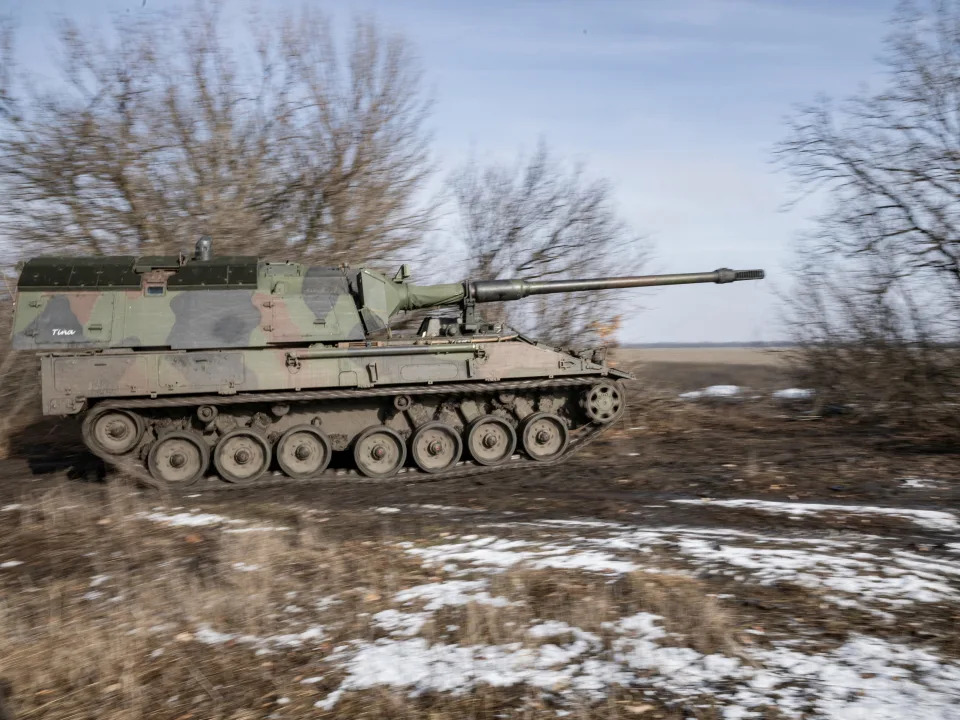
Ukrainian army from the 43rd Heavy Artillery Brigade fire the German howitzer Panzerhaubitze 2000, called Tina by the unit, amid Russia's attack on Ukraine, near Bahmut, in Donetsk region, Ukraine, February 5, 2023.
Ukrainian army from the 43rd Heavy Artillery Brigade fire the German howitzer Panzerhaubitze 2000, called Tina by the unit, amid Russia’s attack on Ukraine, near Bakhmut, in Donetsk region, Ukraine, February 5, 2023.REUTERS/Marko Djurica
  • Spring conditions have limited mobility for both Ukrainian and Russian troops.
  • Ukraine’s recently obtained German-made self-propelled howitzers are particularly vulnerable to mud.
  • Soldiers have to be very clean and careful when entering the vehicles, The New York Times reported.

Springtime mud is plaguing the war-torn battlefields of eastern Ukraine, creating mobility issues for Russian and Ukrainian forces, slowing down their respective operations. It’s also affecting some weapons.

The state of the terrain is proving to be a hurdle for Kyiv’s troops assigned to a specific piece of military hardware acquired from Germany during winter — German-made 155mm howitzers that are extremely sensitive to the dirty and grimy conditions.

Germany has sent 14 Panzerhaubitze 2000 self-propelled howitzers to Ukraine, according to an inventory of its military support to Kyiv. These weapons contain electronics that are so vulnerable to dirt and moisture that soldiers have to wear slippers or booties when they enter the vehicles so they don’t track in any mud, the New York Times reported on Monday.

Each howitzer even comes with a vacuum cleaner, and the barrels sometimes have to be cleaned with a long brush. “The Panzer really loves cleanliness,” an artillery commander named Mykola told the Times, referring to a nickname for the Panzerhaubitze. “If you fire off two full loads of ammunition, you need to spend a day servicing it.”

Serhii, a lieutenant with the 43rd Separate Artillery Brigade, even decided to recall the howitzers from the field out of fear that should the machines come under Russian fire, mud will prevent them from escaping the bombardment, the Times reported. In Germany, these vehicles were kept in climate-controlled garages.

That said, the Ukrainian forces operating the German-made howitzers have reportedly seen some successes against Russian tank and infantry units despite the current conditions on the ground.

Ukrainian soldiers from the 43rd Heavy Artillery Brigade drive the German howitzer Panzerhaubitze 2000, called Tina by the unit, amid Russia's attack on Ukraine, near Bahmut, in Donetsk region, Ukraine, February 5, 2023.
Ukrainian soldiers from the 43rd Heavy Artillery Brigade drive the German howitzer Panzerhaubitze 2000, called Tina by the unit, amid Russia’s attack on Ukraine, near Bakhmut, in Donetsk region, Ukraine, February 5, 2023.REUTERS/Marko Djurica

It’s not the first time that Ukraine’s forces have dealt with the challenge of weaponry getting stuck in the mud. Units have reported that their Soviet-era T-64 tanks were getting trapped in the sludgy terrain — one of several issues troops found with the decades-old tanks.

Britain’s defense ministry shared in a recent intelligence update that mud was likely impacting operations on both the Russian and Ukrainian side in the wake of the cold winter months, although the surface conditions were expected to improve within a few weeks as the weather gets better.

“With soft ground conditions across most of Ukraine, severe mud is highly likely slowing operations for both sides in the conflict,” the April 21 update read.

Ukrainian forces have been gearing up to launch a much-anticipated counteroffensive against Russia after receiving a massive influx of heavy armor and advanced military hardware from the US and its Western partners. NATO Secretary General Jens Stoltenberg told reporters last week that nearly all the combat vehicles promised to Ukraine have been delivered, and Ukraine’s defense minister said his country was nearly ready to hit with an “iron fist.”

“That means over 1,550 armored vehicles, 230 tanks and other equipment, including vast amounts of ammunition,” Stoltenberg said of the deliveries. “In total we have trained and equipped more than nine new Ukrainian armored brigades, this will put Ukraine in a strong position to continue to retake occupied territory.”