State grapples with rampant algae that can cause lung infections and neurological disorders: ‘A bullet in the chamber’
Stephen Proctor – July 25, 2023
Toxic algae is overtaking the largest freshwater lake in Florida, hampering the summer plans of thousands — and the situation is likely to worsen. While plans are underway to alleviate the problem going forward, some are skeptical.
What’s happening?
Lake Okeechobee in southern Florida is currently half full of bright green toxic algae, which is expected to increase throughout the summer.
“We’re looking at a bullet in the chamber here,” Eve Samples, executive director of the conservation group Friends of the Everglades, told The New York Times of the growing bloom.
A handful of conditions allow the dangerous algae to thrive. According to reporting, the severity of the algal bloom is largely due to our overheating planet, which has caused increased storms and rainfall that have stirred up phosphorus that the algae need to grow. The phosphorous has mostly been sourced by fertilizer runoff from rivers upstream that feed into the lake. Rising levels of carbon dioxide pollution, which the algae need, intensify the problem.
While blooms of algae aren’t uncommon for Florida in the summer months, blooms of this magnitude are, and they seem to be occurring more often.
In 2018, Lake Okeechobee experienced a similar bloom that leaked into surrounding canals and the Caloosahatchee River. That year, toxin-producing algae exploded in both fresh and saltwater ecosystems, leading to former Governor Rick Scott to declare a state of emergency.
Downstream algae outbreaks from Okeechobee’s outflows also significantly impacted coastal communities in 2013, 2016, and 2018, causing beaches to be closed and businesses to shut down. Some residents were evacuated as well.
Why toxic algae is concerning
The Florida Department of Health issued a health alert in June warning the public to exercise caution in and around the area of Lake Okeechobee. Those looking for summer fun in the lake were warned not to swim, wade, ski, or boat where there is a visible bloom. They were also told to keep pets away from the water, and for good reason.
The toxic algae overtaking Lake Okeechobee can cause major health issues for humans and animals, including lung infections, organ damage, and neurological disorders. The algae-contaminated water is so harmful that even boiling it will not eliminate the toxins, according to health officials.
What’s being done about the toxic algae
The Army Corps of Engineers is undertaking a massive project to combat the growing issue of toxic algae affecting not only Lake Okeechobee, but the surrounding area as well.
A 10,500-acre reservoir expected to be completed in 10 years or so will capture at least some of Okeechobee’s toxic outflows. This is in addition to the recently completed 6,500-acre artificial wetland designed to remove nutrient pollution before water flows out into the Everglades.
Some are skeptical, though, of the project’s impact, as the new reservoir will fill to capacity after draining only 6 inches of water from Lake Okeechobee, per The New York Times.
An earlier proposal for a 60,000-acre system was scrapped due to objections from the local agricultural community.
There’s enough blame to go around for Florida’s insurance crisis, but not where you think | Opinion
Robert Sanchez – July 24, 2023
There have been many good reasons to criticize Gov. Ron DeSantis, especially during his second term, but Florida’s property insurance crisis is not among them. It’s a problem that has festered for years and began long before DeSantis came along.
Even so, Florida’s increasingly desperate Democrats tried to blame him and his fellow Republicans last week after Farmers Insurance abruptly announced that it would be reducing its risks by scuttling thousands of policies.
The Farmers move occurred in a state where more than a dozen insurers have recently gone broke, and where others are selectively non-renewing some of their policies, especially for properties in high-risk areas such as barrier islands.
The burden of providing coverage has fallen upon Florida’s “insurer of last resort,” the state-owned Citizens Property Insurance. Now it’s being forced to raise its own rates lest it become insolvent after the next major natural disaster.
Seeing the insurance problems as a political opportunity, Democratic Party Chair Nikki Fried, noting the obvious that Florida’s insurance premiums are “through the roof,” declared that the situation is “totally unacceptable,” and complained that solutions proffered by legislative Democrats “have gone completely unheard.”
Meanwhile, one of Democrats’ legislative leaders had an especially far-fetched notion of what to do to fix the state’s otherwise intractable problems, which are contributing to premiums way above the national average: Her suggestion: Let the insurance commissioner be elected rather than appointed.
That was a solution suggested by House Minority Leader Fentrice Driskell, D-Tampa. She was a 19-year-old Harvard undergraduate back in 1998, when Florida voters resoundingly approved amending the state Constitution to shrink the elected Cabinet and, among other changes, have the insurance commissioner be appointed rather than elected.
It seems that voters had noticed that running a statewide political campaign in a state the size of Florida required tons of money. When candidates for insurance commissioner ran, lots of that money came from — surprise! — the insurance industry itself, including the companies, brokers and agents. Moreover, the successful candidates sometimes had more political skills than useful insights into insurance issues.
As for realistically addressing the underlying factors causing Florida’s property insurance crisis, some of them are — and will remain — beyond the capability of any governor, legislator or insurance commissioner to address.
For instance, to the extent that natural disasters are factors in Florida’s higher rates at a time when forecasters expect windstorms to be more frequent, intense and destructive, no public official — whether elected or appointed — can do much to change the geography of a peninsular state bounded by the warming (and rising) waters of the Atlantic and Gulf.
This has not escaped the attention of the global reinsurance companies, which provide insurance for insurance companies. As a result, they’re charging higher rates to the insurance companies, which pass them along to Florida’s property owners.
Another major factor contributing to the higher rates is inflation. The costs associated with repairing and/or replacing damaged properties have soared, arguably more so in Florida than in other states because Florida’s population surge has outpaced the housing supply, driving up property values.
This came atop generalized inflation throughout the economy as a factor in higher insurance rates. For that, President Biden and Gov. DeSantis could jointly take a bow.
Inflation surged worldwide in part because the Biden administration’s energy policies and profligate spending drove up prices, and Putin’s attack on Ukraine added to the problem.
DeSantis’ short-sighted stance on immigration is causing an exodus of some of the migrant workers who will be needed in the next rebuilding effort. The labor shortage will cause delays and inevitably increase costs after the next big storm.
So, if Florida can do little about the intractable insurance problems related to weather, the reinsurance market or inflation, is there anything left that the state could or should do?
Yes, and the 2023 Florida Legislature did it by enacting a law to end “assignment of benefits” and other kinds of abuses practiced by some of Florida’s politically powerful personal injury lawyers.
DeSantis signed the legislation into law, but just before it took effect the personal injury attorneys filed more than 70,000 lawsuits that will be handled under the former rules, which were favorable to the plaintiffs.
Therefore, this constructive step won’t have an immediate impact, and its long-term impact remains to be seen. Meanwhile, as Florida’s property owners and other residents warily monitor the approach of the busiest portion of the June 1-Nov. 30 hurricane season, they might try resorting to the tactics recommended after each mass shooting: thoughts and prayers.
Florida’s insurance crisis isn’t about ‘woke.’ It’s about state leaders in a stupor | Opinion
The Miami Herald Editorial Board – July 24, 2023
Pedro Portal/pportal@miamiherald.com
Upon Farmers Insurance’s announcement that it was pulling out of Florida, Jimmy Patronis, the state’s chief financial officer went right to the heart of the state’s continuing insurance crisis: “The more we learn about Farmers Insurance, the more it’s clear its leadership doesn’t know what they’re doing. While they’re bad at helping people, they’re good at virtue signaling.”
As reported in the Herald, Patronis criticized what he called Farmers’ “ ‘sustainable insurance’ and aligning investments with its social values, like avoiding investing in polluters or companies that sexually or racially discriminate against employees.” The concept is called environmental, social and governance investing — ESG, for short — a political target for Republicans lately.
Basically, Patronis blames Farmers for doing business while incorporating a “woke” ideology, the go-to scapegoat these days, the convenient and facile argument in Gov. Ron DeSantis’ Florida.
We beg to differ.
Whether Farmers Insurance rightly values the principles of ESG is irrelevant here. What’s important is that 100,000 policies in Florida — auto, property — are going belly up.
The wrong excuse
It’s not that the company might be woke; it’s that state lawmakers and the governor were asleep at the wheel as other insurance companies fled Florida long before Farmers.
It’s that lawmakers have been in a stupor as Floridians cried out for relief from soaring property insurance rates.
It’s that those same elected leaders were single-minded zombies who protected insurance companies, not homeowners, during two special sessions.
And yet these are the same legislators who were filled with boundless energy when it came to carrying out Gov. DeSantis’ culture wars in his now-lackluster drive toward to the White House.
Now Patronis, not to be left out, is skirmishing with Farmers. When the Editorial Board asked his office what specifically the insurance company had done in the offending area of ESG, Deputy Chief Financial Officer Frank Collins III doubled down: “While Farmers Insurance is keeping their commitment to the United Nations, they’re dumping 100,000 Florida policyholders; too bad their affection for ESG standards couldn’t stop these Floridians from being dropped.”
Know what else is too bad? That this is Patronis’ politically lame attempt to distract Floridians from the fact that 13 companies have gone insolvent in Florida. Others have stopped writing policies in the state, sending property owners’ premiums soaring into the stratosphere and leaving Citizens as the insurer of last resort for so many property owners. Tim Cerio, Citizens president and CEO, has predicted that the number of policies to reach 1.5 million by the end of the year.
Launch a probe?
And while he was denigrating Farmers, Patronis added he planned to look into complaints against the company, which could trigger a market investigation and — perhaps — fines and fees. This, of course, sounds like a retaliatory move in the same vein as our thin-skinned governor’s costly fight against Disney.
If there truly is something for Patronis to investigate, why did he wait until now to actually do his job? As CFO, the state’s so-called “business manager,” he oversees insurance and consumer services, responding to Floridians on finance-related queries, especially complaints about insurance fraud and related matters.
Interestingly, he found the time this month to tout the launch a new online site: “This morning, we deployed the Florida IRS Transparency Portal where Floridians can submit complaints about individual IRS agents,” Patronis announced on July 13. “We will take this information to look for patterns on how the IRS is targeting Floridians, which will help us craft laws to protect our businesses. We also want to provide the public with a tool where they can report harassment by the IRS.”
His curious use of the militaristic word “deploy” aside, we, too, don’t believe individuals and entities should be targeted by the IRS, especially for their political beliefs, and hope that Floridians across the political spectrum will have equal access to his concern.
But while Patronis is protecting Floridians from the tax collector, he’s among the many state leaders who have left us exposed and vulnerable to the state’s insurance crisis.
CDC: Toxic blue-green algae is infecting humans, animals in Michigan summers
Mika Travis, Detroit Free Press – July 21, 2023
Harmful algae blooms in Michigan and other states are spiking during the summer in freshwater bodies such as lakes, according to a recent CDC report.
Harmful algae blooms are often caused by a rapid growth of cyanobacteria, known as blue-green algae, a naturally occurring bacteria. Gary Kohlhepp, Lake Michigan unit supervisor of the Michigan Department of Environment, Great Lakes, and Energy, said that a small amount of cyanobacteria is a safe and natural part of the water system, but it can become toxic when it begins to cluster in large quantities and creates blooms. Toxins produced in these blooms can lead to illness in humans and animals.
According to the National Oceanic and Atmospheric Administration, blue-green algae blooms are a common occurrence in the Great Lakes, specifically Lake Erie.
CDC report results
The CDC report collected voluntary data from public health agencies across 16 states on harmful algae bloom events in 2021, referred to as harmful algal blooms in the report. Here were the findings:
Most reported events occurred during the summer, with a peak in August (25% of reported events).
Most of the events (90%) reported were in lakes, reservoirs or other freshwater bodies.
A third of the reports of human illness occurred in June.
The most common symptoms in humans were gastrointestinal, generalized (headaches and fevers, for example), and dermatologic.
Reports of animal illnesses occurred primarily in August (86%), mostly involving wildlife.
The most common symptoms in domestic pets were gastrointestinal, such as vomiting, and generalized, such as lethargy.
A harmful algae bloom event in Washington killed 2,000 bats.
There were 368 harmful algae bloom events reported, resulting in 117 human cases of illness and at least 2,715 animal cases of illness. (Animal cases are underrepresented because some group animal reports did not provide the number of total animals impacted, or indicated that the number they gave was an underestimate.)
Kohlhepp said that EGLE had seen an increase in reporting on harmful algae blooms, though that may not indicate an actual increase in the quantity of blooms in the state.
“I think some of that increase is just that people are more aware of it and more likely to report it,” he said.
These harmful algae blooms can appear as accumulations of algae that coat the surface of the water or as a neon green color in the water.
Kohlhepp said that if there aren’t any visible signs of a harmful algae bloom in the water, there’s a good chance it’s safe, though the only certain way to tell whether a body of water is toxic is by testing.
In one instance, Kohlhepp’s team tested a clear spot in a lake that had a harmful algae bloom in another part of it. In the spot that appeared clear, there was only a miniscule amount of cyanobacteria picked up.
“The good news is, generally, if you don’t see a bloom, the toxins are not present,” Kohlhepp said. “There’s almost always an indication that there’s something going on when the toxins are present, either that bright color or the surface accumulation.”
According to Michigan Sea Grant, the most common type of blue-green algae in the Great Lakes is microcystis, a bacteria which produces a liver toxin and skin irritant.
When exposed to these harmful algae blooms, humans often develop a rash. Other possible symptoms include nausea, headache and fever.
Animals, such as dogs, who experience symptoms may appear sluggish. Other symptoms found in animals include vomiting and dark urine.
Steps to take after exposure
Because humans usually experience dermatologic symptoms, Kohlhepp recommends washing off as soon as possible after coming in contact with a harmful algae bloom. If they notice symptoms, they should visit a doctor for next steps.
Dogs and other animals should also be rinsed off after exposure, though symptoms may still arise if they ingested the algae-filled water. Pet owners should watch for symptoms and take them to a veterinarian if they notice any symptoms.
How to report a harmful algae bloom
EGLE collects reports of harmful algae blooms through email at algaebloom@michigan.gov. They recommend sending a photo alongside the report, so that they can more easily identify algae blooms and send someone to test the water.
Farmers Insurance this month announced it would depart the Florida market with all its proprietary products – no new housing contracts, and no renewals for things like auto insurance. Pulling up stakes. Getting out.
While the Florida governing apparatus grappled with inapt hogwash, an actual crisis of critical impact was creeping from the shadows — despite the Legislature’s two-year policy of aggressively whistling past this particular graveyard.
The housing insurance rate in Florida is four times the national average, and the national average is higher than ever.
The problem has its roots in several ugly places – several likely out of the direct control of lawmakers. The reinsurance folks, who indemnify the insurers, have jacked up their rates in Florida by as much as 30%. They lost money here over the past 4-5 years and are looking to repair their profit margins. So, as costs to insurers rise, they are passed on to customers. Additionally, the hurricane seasons of the past few years have been brutal. The loss of life and property has risen and climate change, altered coastlines, beach erosion and failing breakwaters have contributed, as well.
All this damage comes with a gargantuan price tag. The cost of simply fixing things has risen – whether it be lines of roof tiles or an entire apartment block falling into the sea. That damage is covered by insurance – we hope – and the insurance folks pay out. And pay out. Squeezed between reinsurers and the insured, they raise premiums to preposterous levels until finally the roof caves in. They are, after all, in business and business demands a profit, and the profits the insurance folks are used to making are pretty astronomical.
There is an interconnectedness to all this, too. No housing insurance, no loans; no loans, no new moderate income or middle-class homeowners. No homeowners, no loans, and banking profits spin for the floor. It begins to look like a negative reversal of the housing “bubble” of 2007, which was driven by banks loaning too much on housing, whatever the risks.
Now, home loans are drying up because they cannot insure them. There’s a ripple effect spreading out into truly damaging areas. Middle management in businesses is often peopled by folks recruited out of college, and they have to have a place to live. When a potential employee is offered a job here, the appeal is high but unless the employer wants to take on the additional housing costs, the potential employee is likely to look elsewhere.
The cost of simply employing people in Florida could theoretically go through the uninsured roof. And the folks that are already here? Wages cannot keep pace with the rising costs. Moving from Florida is not popular, but it could become so, if the cost of living continues to soar.
Another oddity is the backwash from one thing the Legislature did do, although not with the intent of affecting the insurance world. The new immigration bill is causing what appears to be an ever-growing flood of immigrant workers out of the state or an increasing hesitancy to come at all. This has immediate implications on the construction labor market, much of which comes from immigrant labor. As it dries up, and as wages rise to attract scarce labor, the price of rebuilding goes higher each day.
I’d love to have a fistful of answers to this but I don’t. What we do know is, as long as the governing and policymaking end of government here in Florida is laser-focused on banning books and drag queens, we’re not going to find them.
Texas’ Harsh New Border Tactics Are Injuring Migrants
Edgar Sandoval, Jay Root and J. David Goodman – July 20, 2023
Texas law enforcement officers stand near concertina wire on the bank of the Rio Grande river in Eagle Pass, Texas on July 19, 2023. (Go Nakamura/The New York Times)
For more than two years, Gov. Greg Abbott of Texas has pursued an increasingly aggressive approach to the border, sending thousands of National Guard troops and police officers to patrol the Rio Grande and testing the legal limits of state action on immigration.
But in recent weeks, Texas law enforcement officials have taken those tactics much further, embarking on what the state has called a “hold-the-line” operation, according to interviews with state officials and documents reviewed by The New York Times. They have fortified the riverbanks with additional concertina wire, denied water to some migrants, shouted at others to return to Mexico and, in some cases, deliberately failed to alert federal Border Patrol agents who might assist arriving groups in coming ashore and making asylum claims, the review found.
The increasingly brutal, go-it-alone approach has alarmed people inside the U.S. Border Patrol and the Texas Department of Public Safety, the agency chiefly responsible for pursuing the governor’s border policies. Several Texas officers have lodged internal complaints and voiced opposition.
The reality of those tactics in one area of the border, around the small city of Eagle Pass, was detailed in an email by one state police medic, who described exhausted migrants being cut up by razor wire, a teenager breaking his leg to escape the barriers and officers being directed to withhold water from migrants struggling in the perilous heat. The actions described in the email drew broad condemnation from Texas Democrats in Congress and from the White House after the email was reported by the Houston Chronicle.
“If they are true, it is abhorrent. It is despicable. It is dangerous,” said White House press secretary, Karine Jean-Pierre, referring to the reports. “We’re talking about the bedrock values of who we are as a country.” The Justice Department said Wednesday that it was assessing the situation.
But the objections within the Texas Department of Public Safety extended far beyond a single medic: At least three other officers working around Eagle Pass, a main arrival point for migrants who are crossing illegally, have expressed their outrage and misgivings to higher-ups about the actions they have seen, according to internal correspondence and interviews with state officials briefed on the border response.
And it was not only officers describing the harshness of the new tactics. In several interviews with the Times in Eagle Pass, about two hours southwest of San Antonio, migrants nursing wounds said they had encountered phalanxes of law enforcement officers along banks of the United States that were newly bristling with barbed wire, some of it underwater.
“They kept yelling at us, ‘Go back, go back!’” said Reyna Gloria Dominguez, 42, who arrived in Eagle Pass from Honduras in a wheelchair. “We said, ‘We can’t.’ My son told them, ‘She needs help. She’s hurt.’”
Similar scenes have been playing out elsewhere along the border, including in the Texas city of Brownsville, near the mouth of the Rio Grande, where state police officers have been standing guard at crossing points behind two layers of concertina wire.
The increasing aggressiveness has created international tension with Mexico because, in addition to placing concertina wire, Texas also deployed a 1,000-foot floating barrier of buoys into the Rio Grande in Eagle Pass this month. Mexican officials have said the barrier may have violated international treaties and could encroach on Mexican territory.
Texas officials have blamed the Biden administration for allowing a chaotic situation on the border. They said the buoy barrier and concertina wire were designed to deter people from risking a dangerous swim across the Rio Grande and direct them to safe, official border-crossing stations.
“No orders or directions have been given under Operation Lone Star that would compromise the lives of those attempting to cross the border illegally,” Abbott said in a joint statement with top officials from the Texas Department of Public Safety and the Texas Military Department, using the name of the state operation.
The new Texas tactics have frayed relations between state and federal law enforcement agencies that have long worked together to monitor the border.
In a memo to the Texas DPS last month, Border Patrol officials in the Eagle Pass area raised concern that the concertina wire placed along the water by Texas officials was creating new hazards for migrants as well as for federal border agents.
At the same time, state police supervisors have been directed by their own superiors not to alert Border Patrol when encountering groups of migrants, but rather to handle the situation themselves, according to a departmental text message addressed to sergeants, obtained by the Times.
“Can you please push out a message to your troopers,” the text read, referring to those stationed in a city-owned park by the international bridge in Eagle Pass. “They are NOT to call BP when they see a group approaching or already on the bank.” Officers were instead directed to make arrests for criminal trespassing, an element of Operation Lone Star.
The text message, which was sent last week and has not been previously reported, also directed officers to tell migrants to “go back to Mexico” and to cross the border at one of the international bridges.
Many of the migrants who arrived in Eagle Pass after passing through the treacherous new gantlet were left shaken, and some were injured.
Gleyders Durant, 27, a migrant from Venezuela, peeled off bandages on his right foot to reveal several wounds. He said that as he crossed the river on Friday and stepped onto U.S. soil — his 3-year-old son on his shoulders and his wife following them — he felt a sharp pain. Blood gushed through one of his tennis shoes.
“That’s when I realized that I had stepped on a stretch of wire hidden under dark waters,” he said. Panicked, he extended his arms and carried his wife over it. “It was hidden, under the water.”
Nearby, in a respite center in Eagle Pass, another migrant from Venezuela, Marjorie Escobar, 32, described a harrowing encounter Saturday between her group of about 20 people, including children as young as 4, and several law enforcement agents in Texas.
As some in her group threw inflatables and blankets over the concertina wire to avoid injury, she said, the agents began yelling, “Go back to Mexico!” and “If you cross, we are going to arrest and charge you.”
Then, she said, an agent wearing a brown uniform and a cowboy hat who appeared to be a Texas state trooper roughly pulled a blanket off the barrier as people were climbing over it. The abrupt maneuver caused a young woman to hit her face on a spike, leaving a gash on her forehead, Escobar recalled. She said several of the agents stood still for several minutes, until an officer wearing what looked like a soldier’s uniform offered help to the wounded woman.
State officials did not immediately respond to a request for comment on the incident.
“I was still in the river, about to jump over, when I saw what that agent did and was horrified,” she said of the officer in the cowboy hat. “She was crying, saying, ‘Help me, help me.’”
Because of the increased number of migrants being taken to the lone hospital in Eagle Pass, residents have often been waiting up to eight hours to receive medical care, said Mayor Rolando Salinas Jr. “I support legal migration and orderly law enforcement,” he said in an interview Wednesday. “What I am against is the use of tactics that hurt people.”
The tactics by Texas appear to have intensified in the lead-up to the lifting in late May of Title 42, a public health policy imposed during the coronavirus pandemic that allowed federal agents to rapidly expel most arriving migrants.
The Department of Public Safety has defended its approach and said officers were providing assistance to migrants in medical distress. “There is not a directive or policy that instructs troopers to withhold water from migrants or push them back into the river,” an agency spokesperson, Travis Considine, said.
At the same time, Considine said, officers, who have been directed to keep migrants from entering and to instruct them to return to Mexico, are given some discretion in how they carry out those orders.
“If there are women and children who are asking for water, they’re getting water,” he said. “A group of 30 adult males comes, and they’re begging for water. I’m not going to say there are not troopers saying, ‘We’re not going to give you water.’” He said that if the migrants did not seem to be in distress, troopers might tell them to go get water in Mexico.
The four officers who raised concerns said there were explicit orders to deny water to migrants and to tell them to go back to Mexico. Three said they had been told by supervisors that troopers were not to inform the Border Patrol when migrants were in the water or at the Texas riverbank.
One of the officers, Trooper Nicholas Wingate, was a medic. In an email to supervisors July 3, he said numerous migrants, including a pregnant woman, had gotten tangled in the razor wire. He said the woman, 19, was “doubled over” and “in obvious pain, stuck in the casualty wire.” A 4-year-old girl who attempted to cross was “pressed back by Texas Guard soldiers due to orders given to them,” he wrote in the email.
With temperatures soaring past 100 degrees that day, the girl passed out and became “unresponsive,” Wingate wrote. She was taken away by emergency medical workers.
Wingate also described seeing a father with lacerations on his leg after extricating his child from what he called a “barrel trap,” a plastic barrel floating in the water with concertina wire surrounding it. “I believe we have stepped over the line into the inhumane,” he wrote.
Considine said the agency did not deploy “barrel traps.” But he said it was possible that a barrel that had been wrapped in concertina wire in one part of the river to hold it in place had floated away in rising waters, though he said that the agency had not confirmed that was the case.
On the question of coordinating with Border Patrol, Considine said officers did not alert Border Patrol when arresting migrants for criminal trespassing. He said the number of such arrests had increased recently in and around Eagle Pass.
But federal law entitles people who enter the United States, even unlawfully, to claim asylum by stating that they faced persecution in their home country.
It is not clear how many migrants have died while crossing the border in recent weeks.
The river is always treacherous, and four people, including an infant, drowned this month in the span of a few days. According to the sheriff’s office in Maverick County, which includes Eagle Pass, 26 migrants have drowned so far in 2023. There were 77 migrant drownings in the county in all of last year.
For some local officials, the hardened border was sending the wrong message.
“Seeing barbed wire on the bank of the river, it doesn’t look good for the USA,” said Sheriff Tom Schmerber of Maverick County. “We’re used to seeing all that in communist countries. Now we have them here in Texas.”
“It’s kind of like a black eye. And it’s not working anyway,” he added. “It’s not stopping the immigrants.”
Florida’s CFO blames wokeness for insurers leaving the state: ‘I do call them the Bud Light of the insurance industry’
Chris Morris – July 20, 2023
As yet another insurance company is pulling back from issuing policies in Florida following a string of natural disasters, the state’s chief financial officer has accused the industry of pulling out not because of losses, but due to wokeness.
Jimmy Patronis, CFO of the state, lit into Farmers Insurance for its plans to leave the state on CNBC recently, saying “if they would just leave ESG [environmental, social, and corporate governance ] and put it away, and focus on the bottom line, they may not have made this decision to leave the state of Florida with the tail between their legs.”
“I do say they’re too woke,” he added. “I do call them the Bud Light of the insurance industry. I do feel like they have chaos in their C-suite.”
The accusations aren’t helping the state hang onto insurers, though. This week, AAA announced it would not renew the auto or homeowners policies of some customers in Florida, making it the fourth insurer in the past year to back away from the state. (Bankers Insurance and Lexington Insurance, a subsidiary of AIG, left Florida last year.)
All of the companies that have reduced or eliminated their presence in the state have said the string of local hurricanes, including last year’s catastrophic Hurricane Ian, have made it too expensive to cover residents of the state.
The shrinking number of insurance options and the growing number of disasters is hitting Floridians in the wallet. The average homeowner’s premium in the state costs over $4,000, compared to the U.S. average of $1,544, according to E&E News, a division of Politico that focuses on environmental and energy news.
The companies are leaving the state despite legislation meant to encourage them to stay. Last year, Florida created a $1 billion reinsurance fund and set up laws meant to prevent frivolous lawsuits.
Insurance companies have also stepped back from California, with AIG, Allstate and State Farm no longer taking new customers, as wildfires in that state have driven up costs.
Homes become ‘air fryers’ in Phoenix heat, people ration AC due to cost
Isabella O’Malley – July 20, 2023
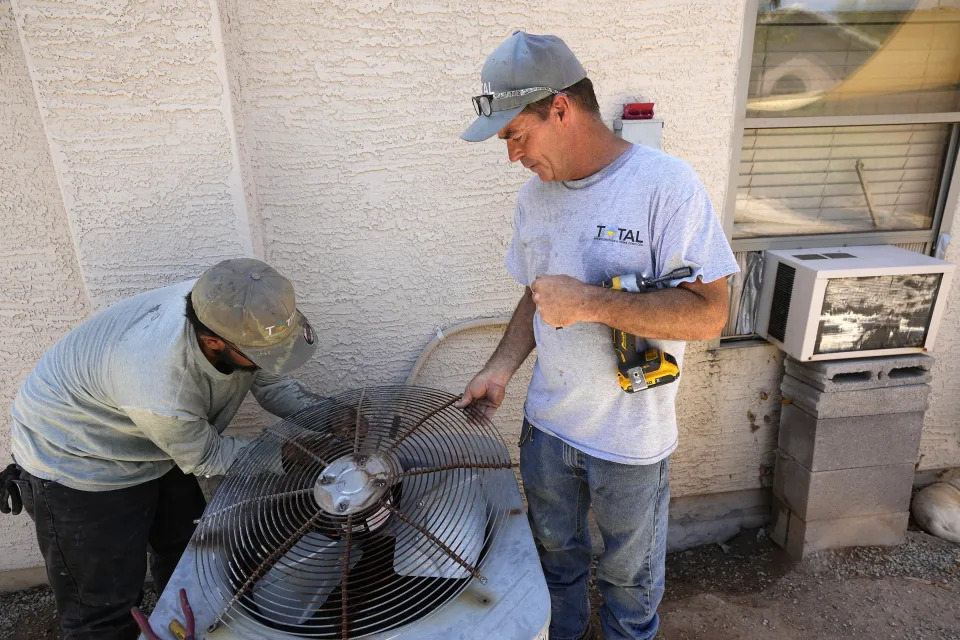
Manuel Luna, left, a volunteer at the Salvation Army, gives out items to a patron at a cooling station on July 19, 2023, in Phoenix. (AP Photo/Ross D. Franklin, File)JP Lantin, right, owner of Total Refrigeration, and service tech Michael Villa, work on replacing a fan motor on an air conditioning unit July 19, 2023, in Laveen, Ariz. (AP Photo/Ross D. Franklin, File) After finishing up an air conditioning repair call, Michael Villa, a service tech with Total Refrigeration, finds shade as he wipes sweat from his face July 19, 2023, in Laveen, Ariz. (AP Photo/Ross D. Franklin, File)
Temperatures have peaked at or above 110 degrees Fahrenheit (43.3 degrees Celsius) the entire month of July in Phoenix. Air conditioning, which made modern Phoenix even possible, is a lifeline.
When a cloudless sky combines with outdoor temperatures over 100 F, your house turns into an “air fryer” or “broiler,” as the roof absorbs powerful heat and radiates it downward, said Jonathan Bean, co-director of the Institute for Energy Solutions at the University of Arizona. Bean knows this not only from his research, he also experienced it firsthand this weekend when his air conditioner broke.
“This level of heat that we are having in Phoenix right now is enormously dangerous, particularly for people who either don’t have air conditioning or cannot afford to operate their air conditioner,” said Evan Mallen, a senior analyst for Georgia Institute of Technology’s Urban Climate Lab.
Yet some are cutting back on AC, trying to bear the heat, afraid of the high electricity bills that will soon arrive.- ADVERTISEMENT -https://s.yimg.com/rq/darla/4-11-1/html/r-sf-flx.html
Camille Rabany, 29, has developed her own system to keep herself and her 10-month-old Saint Bernard Rigley cool during the Arizona heat wave. Through trial and error, Rabany found that 83 F is a temperature she is willing to tolerate to keep her utility bill down.
By tracking the on-peak and off-peak schedule of her utility, Arizona Public Service, with the help of her NEST smart thermostat, Rabany keeps her home that hot from 4 to 7 p.m., the most expensive hours. She keeps fans running and has a cooling bed for Rigley, and they both try to get by until the utility’s official peak hours pass.
“Those are the hours that I have it at the hottest I’m willing to have it because I have a dog,” she said. Last month, Rabany said her utility bill was around $150.
Emily Schmidt’s home cooling strategy in Tempe, Ariz. also centers around her dog. Air conditioning is “constantly a topic of conversation,” with her partner, too, she said.
“Sometimes I wish I could have it cooler, but we have to balance saving money and making sure the house isn’t too hot for our pets.”
With the unrelenting heat of the recent weeks, “I’m honestly afraid what the electric bill will be, which makes it really hard to budget with rent and other utilities.”
Katie Martin, administrator of home improvements and community services at the Foundation for Senior Living, said she sees the pet issue, too. Older people on limited incomes are making dangerous tradeoffs and often won’t come to cooling centers when they don’t allow pets.
“In recent years we are finding that most of the seniors we serve are keeping their thermostat at 80 F to save money,” she said.
Many also lack a support network of family or friends they can turn to in case of air conditioner breakdowns.
Breakdowns can be dangerous. Models from Georgia Tech show that indoors can be even hotter than outdoors, something people in poorly-insulated homes around the world are well acquainted with. “A single family, one-story detached home with a large, flat roof heats up by over 40 degrees in a matter of hours if they don’t have air conditioning,” Mallen said.
The Salvation Army has some 11 cooling stations across the Phoenix area. Lt. Colonel Ivan Wild, commander of the organization’s southwest division, said some of the people visiting now can’t afford their electricity bills or don’t have adequate air conditioning.
“I spoke to one elderly lady and she that her air conditioning is just so expensive to run. So she comes to the Salvation Army and stays for a few hours, socializes with other people, and then goes home when it’s not as hot,” he said.
While extreme heat happens every summer in Phoenix, Wild said that a couple of Salvation Army cooling centers have reported seeing more people than last year. The Salvation Army estimates that since May 1, they have provided nearly 24,000 people with heat relief and distributed nearly 150,000 water bottles in Arizona and Southern Nevada.
Marilyn Brown, regents professor of sustainable systems at Georgia Tech, said that high air conditioning bills also force people to cut spending in other areas. “People give up a lot, often, in order to run their air conditioner… they might have to give up on some medicine, the cost of the gasoline for their car to go to work or school,” she said.
“That’s why we have such an alarming cycle of poverty. It’s hard to get out of it, especially once you get caught up in the energy burden and poverty,” Brown added.
Beatrice Dupuy contributed to this story from New York and Melina Walling contributed from Chicago.
Associated Press climate and environmental coverage receives support from several private foundations.
Grocery prices are bringing many Florida residents to their wit’s end. What can we do?
Edward Bunch III, Pensacola News Journal – July 20, 2023
High food costs are stretching the budgets of consumers across Florida. In the face of inflation, housing issues and insurance crisis, many residents have enough on their plates before ringing up their usual groceries for more expensive receipts than they are accustomed to.
Residents of Pensacola are likely no stranger to the slow uptick on prices that inflation has created. Price fluctuation of gas, food and more commodities have been an issue so important that it’s become a mainstay in the policymaking platforms for local, state and national public official candidates. Across the state, Floridians are receiving the short end of the stick and scrambling to find solutions.
Inflation in the U.S. stood at 3% in June, its lowest point since early 2021 when the world was still reeling from the complications of the pandemic. Despite this, Florida’s inflation rate remains above its peers at 6.9% in the Miami, Fort Lauderdale and West Palm Beach areas. Data outside of these areas, including Pensacola, were not included in the report.
Data provided by the Joint Economic Committee of Congress indicates that Florida’s inflation rates surpassed the national average nearly two years ago in November 2021. The state has maintained its position relative to the rest of the country.
In May 2022, workers in the Pensacola area had an average hourly wage of $24.37 compared to the national average of $29.76, an 18% discrepancy.
Floridians are also spending double the amount of money for groceries than they spend on food outside of their home. According to the same survey, food is the third-highest expense for Floridians behind costs for transportation and housing.
Despite food and groceries being the most crucial product for consumers everywhere, housing remains the biggest expense for Floridians and has likely become the highest priority.
Florida’s homeless population totaled at nearly 26,000 individuals last year, third-highest number in the nation according to the Annual Homelessness Assessment Report and the Department of Housing and Urban Development.
Research conducted for the U.S. Census determined that Florida had surpassed Idaho in 2022 to become the fastest-growing state in the nation, a distinction Florida hasn’t earned since 1957. Despite Florida’s population increasing by 1.9%, the costs of living and inflation rates across the state could suggest that many newcomers may struggle with maintaining their standard of life soon after arrival.
Much of Florida’s housing inventory was scooped up following the implementation of low-interest rates which allowed many to purchase their first home or refinance their existing one. This drove up home prices, another factor in the current housing crisis.
According the Bureau of Labor Statistics, grocery prices have risen by four percent since May 2022. Despite the livelihood of families being a priority for Florida’s government officials, it is unclear whether there will be meaningful reductions in the price of groceries across the state.
A recent protest was planned by truckers with a distaste for Gov. Ron DeSantis’ recent immigration bill SB1718 that could have crippled the state’s food distribution network. Although the protest bore little fruit due to many of the truckers needing the hours, some are questioning what state officials plan to do to combat the issue without fanning the flames.
How can I get affordable groceries?
Here are some ways shoppers can save on groceries:
Join reward programs for perks like cashback or member-exclusive deals. Chains like Publix and Target have free-to-join programs which allow you to clip digital coupons and eventually personalizes them to your needs and usual items.
Speaking of coupons, utilizing both digital and physical coupons can save you extra as well. Buy one, get one offers can help stock up your shelves for an extended period of time.
Check often for sales, either seasonal or markup, that can offer similar buy one, get one deals.
If possible, purchasing a membership at stores like Sam’s Club or BJ’s can save time and money intended for your next groceries trip. Buying in bulk can feel expensive upfront, but families can save in the long run even with the membership costs. Sam’s Club has two membership levels with varying perks that costs either $50 or $110 annually. BJ’s also has two membership options that cost $55 and $110 respectively. Both stores offer a credit card alongside its higher-priced membership option that rewards you with two percent cashback from purchases at the store and more helpful perks.
Freezing food is an effective way to store food for longer periods of time. If a sale or bulk purchase is more than one can handle at the moment, saving it for later is better than letting it spoil.
Buy fruits and vegetables while they’re in season, making them more nutritious and cheaper overall.
Take advantage of cheaper generic items, they often have the same ingredients as their name brand counterparts.
Comparing prices across stores can save you money at your preferred grocer with a price-matching system.
Re-grow vegetables like celery, potatoes and green/white onion at home and slowly take them off your grocery list.
Don’t buy food items that were prepared previously before being packaged. Not only are they more expensive, sometimes they are prepared due to being close to unsafe for sale. Items like meat, vegetables and cheese are cheaper before being prepared into something else.
Make a budget that you can reference or stick to in order to shop smarter.
If you’re not much of a chef, many restaurants and fast-food chains have implemented rewards systems for purchases that may save consumers some money in the long run.
What are Florida’s public officials doing about inflation?
DeSantis signed the ‘Live Local Act’ earlier this year to incentivize new housing development and assist more Floridians with getting access to housing in their communities.
U.S. Rep. Matt Gaetz, R-Florida, lays blame for inflation at the feet of the president. “With the Biden administration overspending, the principal mandate for Republicans is to curb inflation,” Gaetz said in an interview with NewsNation.
Tornado damages Pfizer plant in North Carolina as scorching heat and floods sock other parts of US
Ben Finley and Hannah Schoenbaum – July 19, 2023
Debris is scattered around the Pfizer facility on Wednesday, July 19, 2023, in Rocky Mount, N.C., after damage from severe weather. (Travis Long/The News & Observer via AP)
RALEIGH, N.C. (AP) — A tornado heavily damaged a major Pfizer pharmaceutical plant in North Carolina on Wednesday, while torrential rain flooded communities in Kentucky and an area from California to South Florida endured more scorching heat.
Pfizer confirmed that the large manufacturing complex was damaged by a twister that touched down shortly after midday near Rocky Mount, but said in an email that it had no reports of serious injuries. A later company statement said all employees were safely evacuated and accounted for.
Parts of roofs were ripped open atop its massive buildings. The Pfizer plant stores large quantities of medicine that were tossed about, said Nash County Sheriff Keith Stone.
“I’ve got reports of 50,000 pallets of medicine that are strewn across the facility and damaged through the rain and the wind,” Stone said.
The plant produces anesthesia and other drugs as well as nearly 25% of all sterile injectable medications used in U.S. hospitals, Pfizer said on its website. Erin Fox, senior pharmacy director at University of Utah Health, said the damage “will likely lead to long-term shortages while Pfizer works to either move production to other sites or rebuilds.”
The National Weather Service said in a tweet that the damage was consistent with an EF3 tornado with wind speeds up to 150 mph (240 kph).
The Edgecombe County Sheriff’s Office, where part of Rocky Mount is located, said on Facebook that they had reports of three people injured in the tornado, and that two of them had life-threatening injuries.
A preliminary report from neighboring Nash County said 13 people were injured and 89 structures were damaged, WRAL-TV reported.
Three homes owned by Brian Varnell and his family members in the nearby Dortches area were damaged. He told the news outlet he is thankful they are all alive. His sister and her children hid in their home’s laundry room.
“They got where they needed to be within the house and it all worked out for the best,” Varnell said near a home that was missing exterior walls and a large chunk of the roof.
Elsewhere in the U.S., an onslaught of searing temperatures and rising floodwaters continued, with Phoenix breaking an all-time temperature record and rescuers pulling people from rain-swamped homes and vehicles in Kentucky.
Forecasters said little relief appears in sight from the heat and storms. For example, Miami has endured a heat index of 100 degrees Fahrenheit (37.8 degrees Celsius) or more for weeks, with temperatures expected to rise this weekend.
In Kentucky, meteorologists warned of a “life-threatening situation” in the communities of Mayfield and Wingo, which were inundated by flash flooding this week from thunderstorms. Kentucky Gov. Andy Beshear declared a state of emergency there Wednesday as more storms threatened.
Forecasters expect up to 10 inches (25 centimeters) of rain could yet fall on parts of Kentucky, Illinois and Missouri near where the Ohio and Mississippi rivers converge.
The storm system is forecast to move Thursday and Friday over New England, where the ground remains saturated after recent floods. In Connecticut, a mother and her 5-year-old daughter died after being swept down a swollen river Tuesday. In southeastern Pennsylvania, a search continued for two children caught in flash flooding Saturday night.
Meanwhile, Phoenix broke an all-time record Wednesday morning for a warm low temperature of 97 F (36.1 C), raising the threat of heat-related illness for residents unable to cool off adequately overnight. The previous record was 96 F (35.6 C) in 2003, the weather service reported.
Lindsay LaMont, who works at the Sweet Republic ice cream shop Phoenix, said business had been slow during the day with people sheltering inside to escape the heat. “But I’m definitely seeing a lot more people come in the evening to get their ice cream when things start cooling off,” LaMont said.
Heat-related deaths continue to rise in Maricopa County, where Phoenix is located. Public health officials Wednesday reported that six more heat-associated fatalities were confirmed last week, bringing the year’s total so far to 18. All six deaths didn’t necessarily occur last week as some may have happened weeks earlier but were confirmed as heat-related only after a thorough investigation.
By this time last year, there had been 29 confirmed heat-associated deaths in the county and another 193 under investigation.
Phoenix, a desert city of more than 1.6 million people, had set a separate record Tuesday among U.S. cities by marking 19 straight days of temperatures of 110 F (43.3 C) or more. It topped 110 again Wednesday.
National Weather Service meteorologist Matthew Hirsh said Phoenix’s 119 F (48.3 C) high Wednesday tied the fourth highest temperature recorded in the city ever. The highest temperature of all time was 122 F (50 C), set in 1990.
Across the country, Miami marked its 16th straight day of heat indexes in excess of 105 F (40.6 C). The previous record was five days in June 2019.
“And it’s only looking to increase as we head into the later part of the week and the weekend,” said Cameron Pine, a National Weather Service meteorologist.
The region has also seen 38 consecutive days with a heat index threshold of 100 F (37.8 C), and sea surface temperatures are reported to be several degrees warmer than normal.
“There really is no immediate relief in sight,” Pine said.
A 71-year-old Los Angeles-area man died at a trailhead in Death Valley National Park in eastern California on Tuesday afternoon as temperatures reached 121 F (49.4 C) or higher and rangers suspect heat was a factor, the National Park Service said in a statement Wednesday.
It is possibly the second heat-related fatality in Death Valley this summer. A 65-year-old man was found dead in a car on July 3.
The entire globe has simmered to record heat both in June and July. Nearly every day this month, the global average temperature has been warmer than the unofficial hottest day recorded before 2023, according to University of Maine’s Climate Reanalyzer.
Finley reported from Norfolk, Virginia. Associated Press reporters Anita Snow in Phoenix, Freida Frisaro in Miami, JoNel Aleccia in Temecula, California, and Rebecca Reynolds in Louisville, Kentucky, contributed to this report.