Shell leaves experts fuming with latest admission on 2050 pledge: ‘They are making so much money right now’
Erin Feiger – October 9, 2023
Shell has backpedaled on its climate change pledges to provide bigger payouts to shareholders, in a move slammed by many as shady.
What’s happening?
After a surprising announcement last year, in which Shell set 2050 as its target to reach net-zero planet-overheating gas pollution, the company became the latest to join others like BP in scaling back their climate pledges, according to Euronews.green.
Shell said oil production levels will remain stable until 2030, justifying it by saying selling its interest in the Permian Basin oilfield in 2021 allowed it to reach production reduction goals until then.
Euronews.green further reported that the company will invest $40 billion in oil and gas production through the next 13 years, all of this amid record profits, leaving many questioning the dirty energy company’s alleged commitment to shift to clean energy.
Mark van Baal, founder of Follow This, which unites shareholders to push Big Oil to clean up its act, told the Washington Post, “We have to regain momentum, or these companies will keep on saying they can continue with oil and gas because the majority of shareholders want them to do that. The fact that they are making so much money right now is not helping.”
Carla Denyer, co-leader of the U.K. Green party, told Euronews.green that Shell’s actions are “pure climate vandalism,” with Friends of the Earthadding that “like other fossil fuel giants which have also scaled back their ambitions, Shell now admits that it has no plans to change its business model.”
Why is this climate pledge pivot concerning?
Dirty energy sources, like oil, gas, and coal, are the largest contributor to Earth’s rising temperatures, accounting for more than 75% of the world’s overall heat-trapping gas pollution and nearly 90% of harmful carbon pollution, according to the U.N.
Because they’re such a huge part of the problem, dirty energy companies like Shell need to be a big part of the solution.
Making pledges like the ones Shell is now scaling back on to convince us that the company is a friend to our planet is called greenwashing, which is when a company makes false or misleading statements about the environmental benefits of one of its products or practices.
Greenwashing is a particularly sinister problem because it prevents real and very necessary progress from being made, while duping customers into spending our money with companies that are lying to us and hurting our planet.
What can be done?
Many organizations are working to hold Big Oil companies accountable for enacting real change, but it’s a long road.
As individuals, we can work to mitigate the harm done by these big companies by moving away from using their dirty energy sources.
We can switch from gas-powered cars to electric vehicles, limit the amount of single-use plastics we use, and switch to alternative sources of power at home when possible.
Join our free newsletter for cool news and actionable info that makes it easy to help yourself while helping the planet.
Scientists warn of ‘silent pandemic’ stirring across the globe: ‘[This] could cause 10 million deaths per year by 2050’
Leo Collis – October 7, 2023
After the coronavirus pandemic, the world is on high alert for the next global health emergency.
Scientists are now warning about the risk to humans from the food production network, and factory farms are among the most concerning areas that could spawn the next virus.
What’s happening?
At the Compassion in World Farming event in London in May 2023, scientists, policymakers, and farmers met to discuss challenges within the industry and potential threats to human health.
Among the issues discussed was the use of antibiotics in factory farming, which has been found to lead to a potential problem when humans eat meat.
“Most antibiotic resistance in human medicine is actually due to the human use of antibiotics,” scientific adviser at the Alliance to Save Our Antibiotics Cóilín Nunan told Euronews.green. “However, there is clear evidence that the farm use of antibiotics is also contributing, not just to antibiotic resistance in farm animals, but also to infections in humans.”
With animals kept in close quarters on factory farms, hygiene standards are poor, and disease spreads more easily, so antibiotic use is frequent.
Why is this a concern?
The World Health Organization has described antimicrobial resistance (AMR) as a “silent pandemic” and one of the top 10 global public health threats. Bacterial AMR has already been estimated to kill 1.3 million people a year.
If antibiotics are overused in farming, it could impact humans higher up the food chain as bacteria develop resistance to the drugs and multiply.
“If some of the bacteria have developed resistance, then these bacteria are unaffected by the antibiotic and can continue to proliferate, spreading from human to human, or from animal to animal, or from animal to human,” Nunan explained, per Euronews.green.
Nunan also described how animals fed antibiotics could end up with resistant bacteria in their gut at slaughter, leading to potential contamination of the carcass. This can spread to humans when handled or when undercooked meat is eaten.
Further, resistant bacteria can also enter the food system via animal manure, which is used to fertilize crops.
How can we prevent a “silent pandemic”?
Controlling AMR is essential, as experts predict it “could cause up to 10 million deaths a year by 2050,” per Euronews.green.
Nunan noted that better animal husbandry, such as providing animals with more space and improving hygiene, is one of the keys to preventing the spread of disease and, thus, the overuse of antibiotics. But there are already positive changes happening in the farming industry.
The EU has banned all forms of routine antibiotics on farms and the use of antibiotics to make up for poor farm husbandry.
The U.K. has also seen a 55% decrease in antibiotic use on farms since 2014, Euronews.green reported.
Consumer choices like buying responsibly sourced meat can also make a difference and discourage cheap and intensive farming methods that lead to animal disease and potential problems later on in the food chain.
How hot is too hot for humans? Local physician tells how climate change affects us
Carolyn Krause – October 6, 2023
As the Earth heats up owing to increased fossil fuel use and deforestation, Americans should be aware that heat waves are the leading cause of weather-related deaths in the country and that certain high temperature ranges can endanger our health and even the ability of our cellphones to work.
That was the message presented by Elaine Bunick, a retired endocrinologist who has traveled to Ghana, Haiti and other countries on medical mission trips. In her recent talk to Altrusa International of Oak Ridge, she presented extensive information on the effects of climate change on the environment, human health and healthcare facilities.
She provided advice on how to protect yourself from excessive heat. And she relayed predictions on impending health care worker shortages that likely made some audience members hot and bothered.
This summer in Oak Ridge, she said, residents experienced 33 days with temperatures greater than 90 degrees Fahrenheit. July was the hottest month. Bunick said people can expect to have to endure 20 to 30 more days a year of sizzling heat with peak temperatures over 90.
A check with Methodist Medical Center of Oak Ridge indicated that the emergency room reported more cardiac issues and interventions this year than in the past, but an increased death rate was not observed. Heat waves and air pollution from burning forests can cause heart problems.
Heat is greater risk for some
Bunick said people with chronic medical conditions, such as heart disease, respiratory disorders, diabetes, obesity and kidney ailments, have a greater risk for succumbing to heat illnesses.
“Medications such as antidepressants, beta blockers, calcium channel blockers, diuretics, antipsychotics and opioids alter your ability to handle the heat,” she added.
The increased heat, she said, will especially endanger the health of outdoor workers, such as farmers, police officers, firefighters, road workers, power line maintenance workers and transporters of supplies to stores and homes. The loss of labor hours, she added, will hurt the economy.
Others who are most susceptible to falling ill from excessive heat are persons older than 65, infants, children, pregnant women, people with pre-existing medical conditions and disabilities, athletes and people living in lower-income households or those who are homeless.
Take care of each other
“We have to be adaptable and protect each other to survive,” Bunick said. She cited statistics on the future of health care in the nation.
“The U.S. is predicted to have a shortage of 129,000 doctors and 200,000 nurse practitioners, physician assistants and technical personnel by 2034,” she said. “That’s scary. Our population has an increasing number of seniors – we’re almost 25% of the population. Who is going to care for us? We’re going to have to care for each other.”
She noted that “in the early 2000s, the U.S. government put a cap on the number of doctors, nurses and physician assistants that can be trained. To this day they have not rescinded that order, so we have a growing shortage of trained medical staff. It takes 15 years to train a specialist like me and six years to train a nurse.”
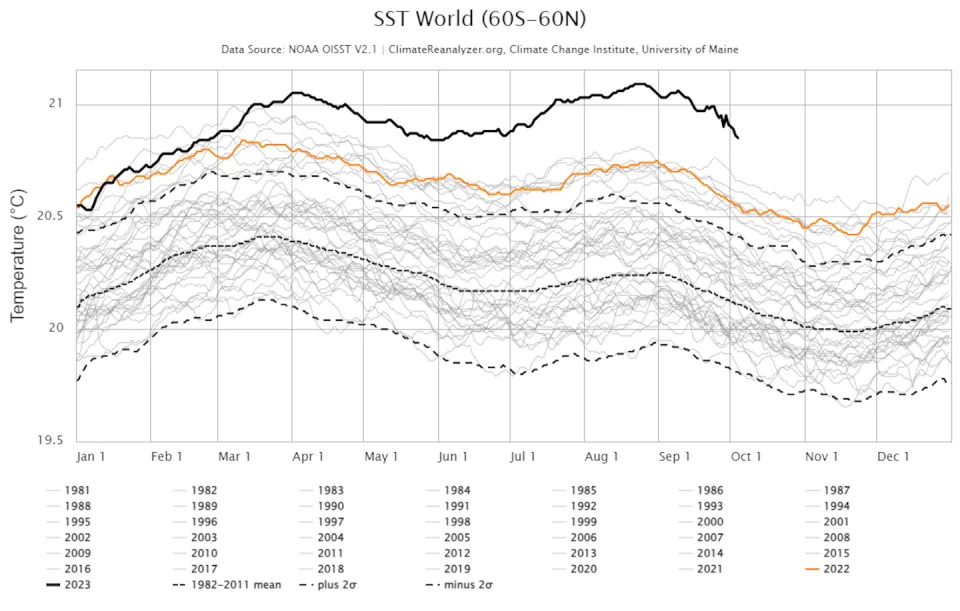
The average temperature of the earth’s surface has been around 58 degrees Fahrenheit. This year, Bunick said, “the earth’s average surface temperature rose to 62.9 degrees and the oceans reached a peak of 69 degrees, almost the temperature of bath water. That was hottest ocean temperature ever recorded.”
Heat indexes, heat exhaustion and more
So, how hot is too hot? What are the dangerous temperatures and heat indexes for humans?
A normal adult body temperature, when taken orally, can range from 97.6 to 99.6 degrees Fahrenheit. According to Bunick, “The hottest air temperature for human survival is 123.8 degrees; beyond that you’re unlikely to survive. A body temperature over 108.14 degrees causes the body to become scrambled because the heat fries the proteins, denaturing them and causing dysfunction of enzymes and harm to the brain. Death can occur within six hours. Building heat tolerance and acclimatization takes about six weeks.”
According to one of her slides, a human body temperature of 103 to 104 degrees Fahrenheit can cause confusion and impaired judgment, and a temperature of 109 to 110 degrees Fahrenheit can cause brain damage, seizures, cardio-respiratory collapse, shock and death. The highest temperature recorded of a person surviving a heat stroke was 115.7 degrees Fahrenheit.
The heat index is a measure of the interaction of temperature and humidity. “Sweat cools the body by evaporation but if it’s too humid, you can’t add any more moisture to the air,” she said. A heat index of 95 degrees is considered the absolute limit of human tolerance above which the body cannot lose heat efficiently enough to maintain core temperature and avoid brain and organ damage within about six hours.
According to the U.S. Centers for Disease Control and Prevention (CDC), symptoms of heat exhaustion and heat stroke are headache, nausea, dizziness, weakness, irritability, thirst, heavy sweating, elevated body temperature, confusion, altered mental status, slurred speech, loss of consciousness, profuse sweating, and seizures. Under these conditions, the body temperature is higher than 104 degrees Fahrenheit.
To protect yourself from heat exhaustion or heat stroke when you’re outdoors on hot days, the CDC recommends that you wear lightweight, light-colored, loose-fitting clothing and a sun hat; take breaks to drink water and cool down in an air-conditioned or shady place; wear sunscreen and sunglasses when you’re outside; drink Gatorade or other drinks with electrolytes; avoid alcoholic beverages, splash yourself with water or use a cold, wet cloth to cool down and check your body temperature periodically.
To treat someone with heat exhaustion, move them to a cool area, give frequent sips of cool water, apply cold and wet compresses, remove unnecessary clothing, call 911 or take the individual to the ER for medical evaluation and treatment. If you and others are on a hike on a hot day, she warned, be sure you keep your cellphone cool and out of direct sunlight or a hot car (120 degrees). Between 96 and 109 degrees the battery will be so damaged that your phone will no longer allow you to make emergency calls.
Bunick noted that weather-related and climate-related events can threaten human health and safety in other ways. Wildfires and house fires can release cancer-causing and other irritating particles to the air, causing respiratory disease and heart issues. She advised checking on the EPA Air Quality Index (stay inside when the air is labeled Code Orange, Red, Purple or Maroon) and wearing N95 or KN95 masks if you must be outside when the air is unhealthy.
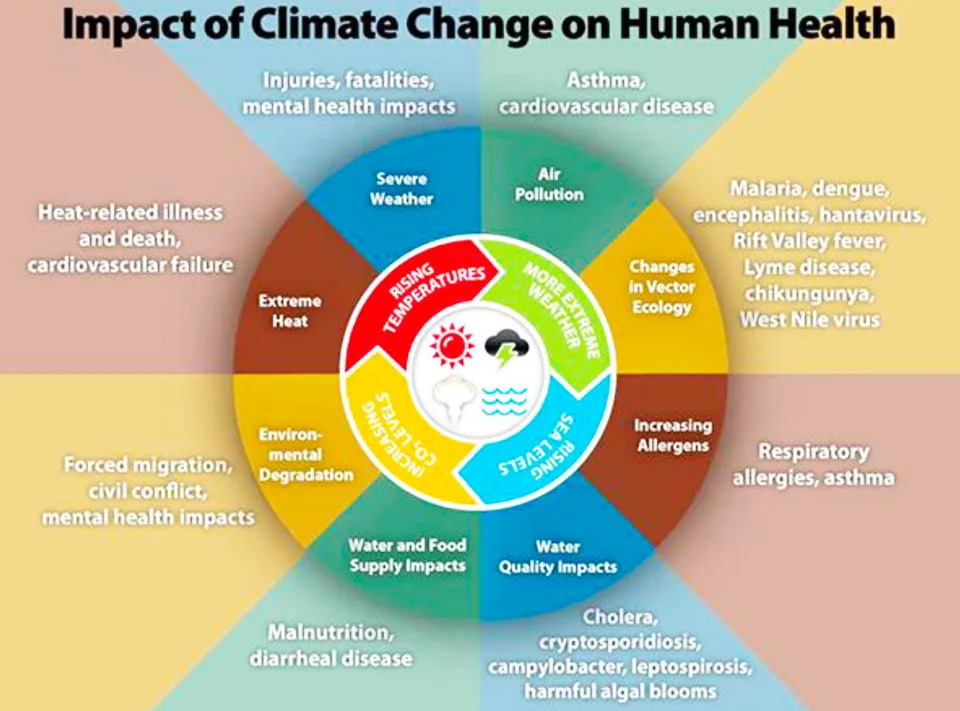
Wear insect repellant because ticks and mosquitoes migrating north as the climate warms carry Lyme disease, West Nile virus, dengue fever and malaria, according to one of her slides. Climate change can increase the probability that people get sick from disease-carrying organisms entering drinking water and from harmful algal blooms caused by algae and bacteria present in waters where people swim, causing eye irritation and respiratory illness especially in people with asthma.
“In 2022 the National Oceanic and Atmospheric Administration announced there were 18 weather-related disasters costing over $1 billion each,” Bunick said.
Some of these disasters caused flooding, leading to drownings and homes destroyed by unhealthy mold. The disasters included heat waves, drought, flooding, hailstorms, hurricanes, tornadoes and winter storms. The death and destruction from these disasters cause mental health problems in victims.
Hospitals are preparing
Bunick said that administrators of hospitals, which use lots of electricity and produce 10% of U.S. greenhouse gases, as well as their healthcare workforce, are preparing for climate-related emergencies and extreme weather events that can disrupt operations, including hurricanes, floods and wildfires. Medicines in hospital pharmacies may be damaged by floods or by the heat, causing them to lose their potency. She gave an example close to home.
“Many hospitals keep their computers, medicines and other important supplies in the basement,” she said. “Recently, there was a water main break at Fort Sanders hospital in Knoxville. My son-in-law, who’s in charge of home infusion therapy at Fort Sanders, had to rush to save the medication in the hospital basement pharmacy from six inches of water!”
People have been quick to blame climate change – and they’re right: Human-caused global warming does play the biggest role. For example, a study determined that the weekslong heat wave in Texas, the U.S. Southwest and Mexico that started in June 2023 would have been virtually impossible without it.
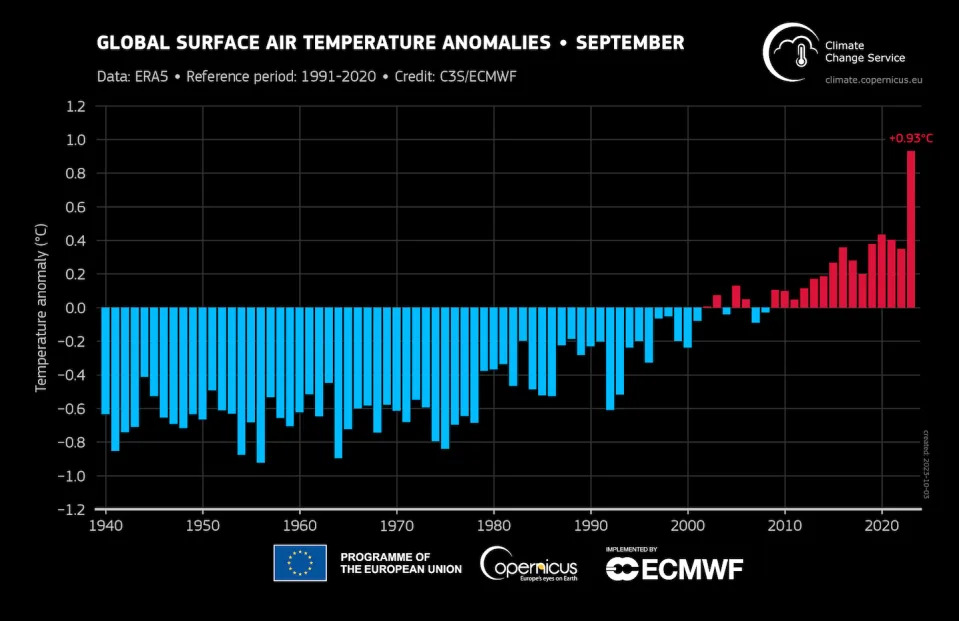
However, the extremes this year are sharper than anthropogenic global warming alone would be expected to cause. September temperatures were far above any previous September, and around 3.1 degrees Fahrenheit (1.75 degrees Celsius) above the preindustrial average, according to the European Union’s earth observation program.
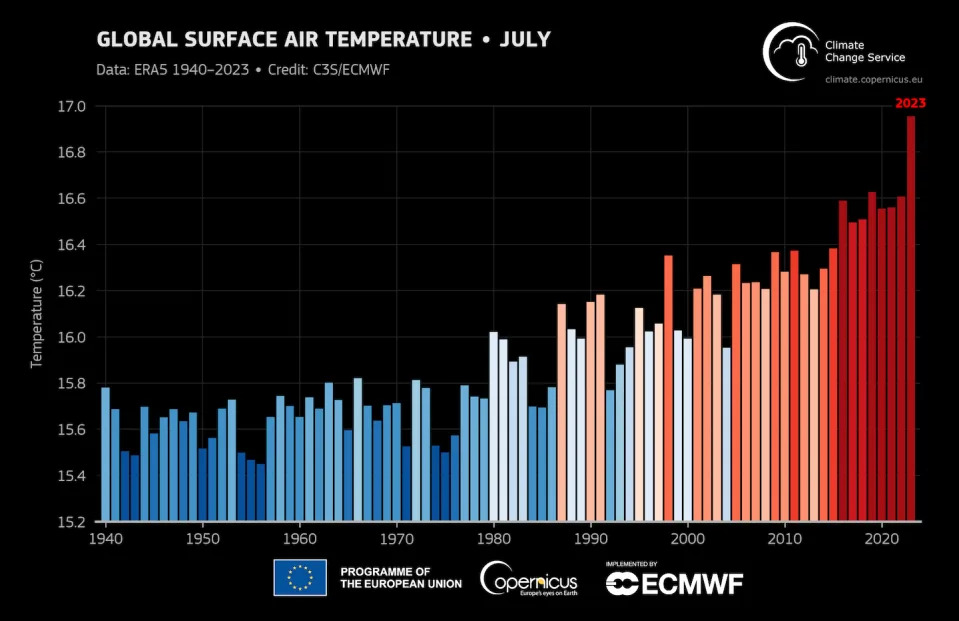
July was Earth’s hottest month on record, also by a large margin, with average global temperatures more than half a degree Fahrenheit (a third of a degree Celsius) above the previous record, set just a few years earlier in 2019.
September 2023’s temperatures were far above past Septembers. CopernicusJuly 2023 was the hottest month on record and well above past Julys. Copernicus Climate Change ServiceMore
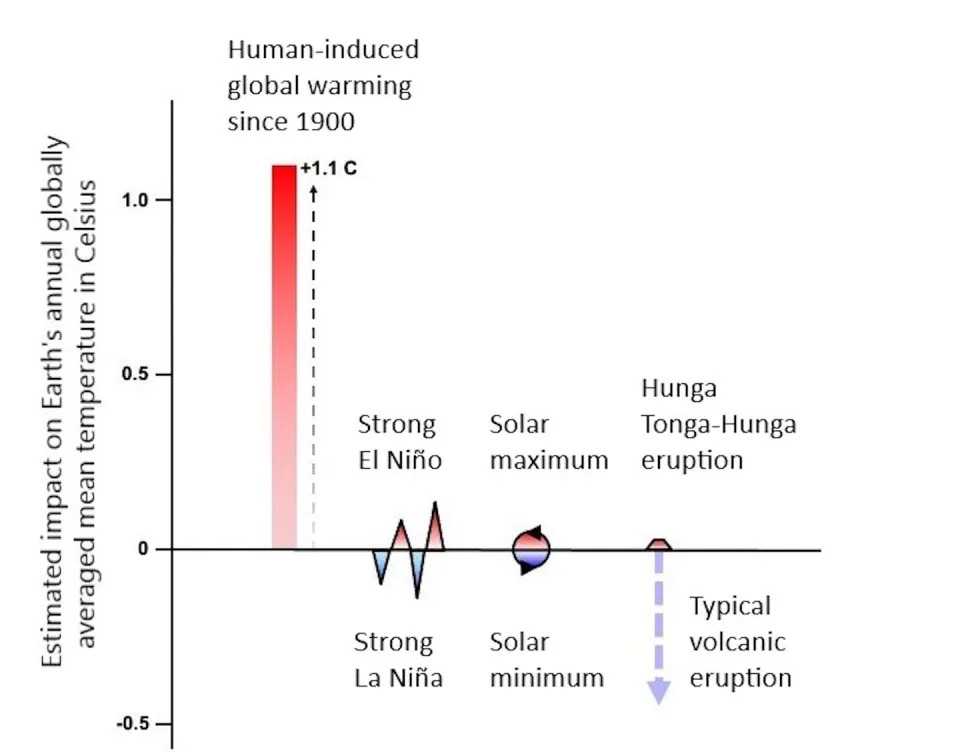
Human activities have been increasing temperatures at an average of about 0.2 F (0.1 C) per decade. But this year, three additional natural factors are also helping drive up global temperatures and fuel disasters: El Niño, solar fluctuations and a massive underwater volcanic eruption.
Unfortunately, these factors are combining in a way that is exacerbating global warming. Still worse, we can expect unusually high temperatures to continue, which means even more extreme weather in the near future.
An illustration by the author shows the typical relative impact on temperature rise driven by human activities compared with natural forces. El Niño/La Niña and solar energy cycles fluctuate. The Hunga Tonga-Hunga Ha’apai volcano’s underwater eruption exacerbated global warming. Michael Wysession
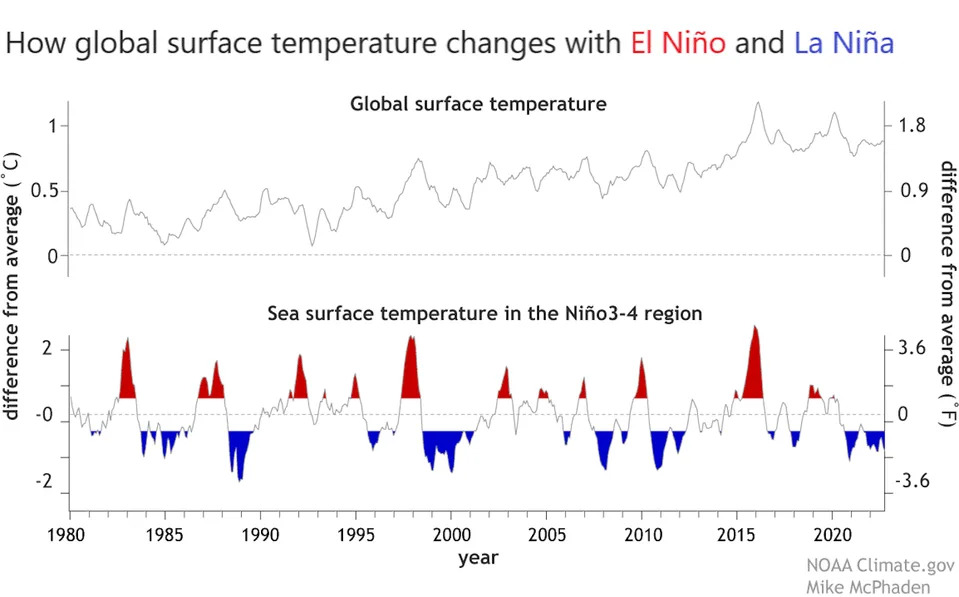
Essentially, the atmosphere borrows heat out of the Pacific, and global temperatures increase slightly. This happened in 2016, the time of the last strong El Niño. Global temperatures increased by about 0.25 F (0.14 C) on average, making 2016 the warmest year on record. A weak El Niño also occurred in 2019-2020, contributing to 2020 becoming the world’s second-warmest year.
El Niño’s opposite, La Niña, involves cooler-than-usual Pacific currents flowing westward, absorbing heat out of the atmosphere, which cools the globe. The world just came out of three straight years of La Niña, meaning we’re experiencing an even greater temperature swing.
Based on increasing Pacific sea surface temperatures in mid-2023, climate modeling now suggests a 90% chance that Earth is headed toward its first strong El Niño since 2016.
Combined with the steady human-induced warming, Earth may soon again be breaking its annual temperature records. June 2023 was the hottest in modern record. July saw global records for the hottest days and a large number of regional records, including an incomprehensible heat index of 152 F (67 C) in Iran.
Solar fluctuations
The Sun may seem to shine at a constant rate, but it is a seething, churning ball of plasma whose radiating energy changes over many different time scales.
The Sun is slowly heating up and in half a billion years will boil away Earth’s oceans. On human time scales, however, the Sun’s energy output varies only slightly, about 1 part in 1,000, over a repeating 11-year cycle. The peaks of this cycle are too small for us to notice at a daily level, but they affect Earth’s climate systems.
Rapid convection within the Sun both generates a strong magnetic field aligned with its spin axis and causes this field to fully flip and reverse every 11 years. This is what causes the 11-year cycle in emitted solar radiation.
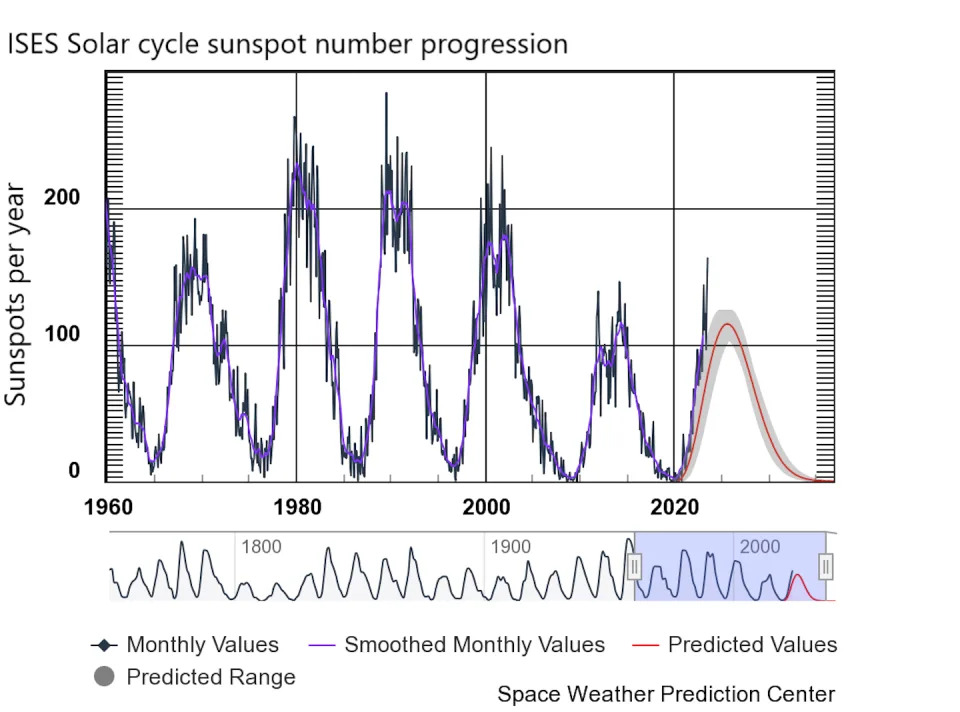
Sunspot activity is considered a proxy for the Sun’s energy output. The last 11-year solar cycle was unusually weak. The current cycle isn’t yet at its maximum. NOAA Space Weather Prediction CenterMore
Earth’s temperature increase during a solar maximum, compared with average solar output, is only about 0.09 F (0.05 C), roughly a third of a large El Niño. The opposite happens during a solar minimum. However, unlike the variable and unpredictable El Niño changes, the 11-year solar cycle is comparatively regular, consistent and predictable.
The last solar cycle hit its minimum in 2020, reducing the effect of the modest 2020 El Niño. The current solar cycle has already surpassed the peak of the relatively weak previous cycle (which was in 2014) and will peak in 2025, with the Sun’s energy output increasing until then.
A massive volcanic eruption
Volcanic eruptions can also significantly affect global climates. They usually do this by lowering global temperatures when erupted sulfate aerosols shield and block a portion of incoming sunlight – but not always.
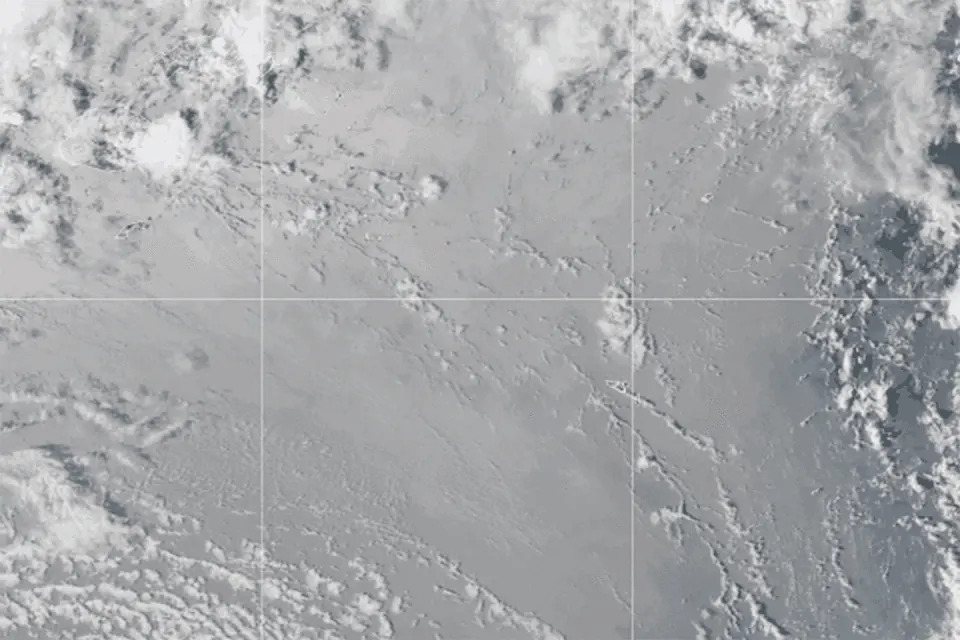
The eruption released an unusually small amount of cooling sulfate aerosols but an enormous amount of water vapor. The molten magma exploded underwater, vaporizing a huge volume of ocean water that erupted like a geyser high into the atmosphere.
Water vapor is a powerful greenhouse gas, and the eruption may end up warming Earth’s surface by about 0.06 F (0.035 C), according to one estimate. Unlike the cooling sulfate aerosols, which are actually tiny droplets of sulfuric acid that fall out of the atmosphere within one to two years, water vapor is a gas that can stay in the atmosphere for many years. The warming impact of the Tonga volcano is expected to last for at least five years.
Underlying it all: Global warming
All of this comes on top of anthropogenic, or human-caused, global warming.
Humans have raised global average temperatures by about 2 F (1.1 C) since 1900 by releasing large volumes of greenhouse gases into the atmosphere. The amount of carbon dioxide in the atmosphere is up 50%, primarily from the combustion of fossil fuels in vehicles and power plants. The warming from greenhouse gases is actually greater than 2 F (1.1 C), but it has been masked by other human factors that have a cooling effect, such as air pollution.
If human impacts were the only factors, each successive year would set a new record as the hottest year ever, but that doesn’t happen. The year 2016 was the warmest in part because temperatures were boosted by the last large El Niño.
What does this mean for the future?
The next couple of years could be very rough.
If a strong El Niño develops over the coming months as forecasters expect, combined with the solar maximum and the effects of the Hunga Tonga-Hunga Ha’apai eruption, Earth’s temperatures will likely continue to soar.
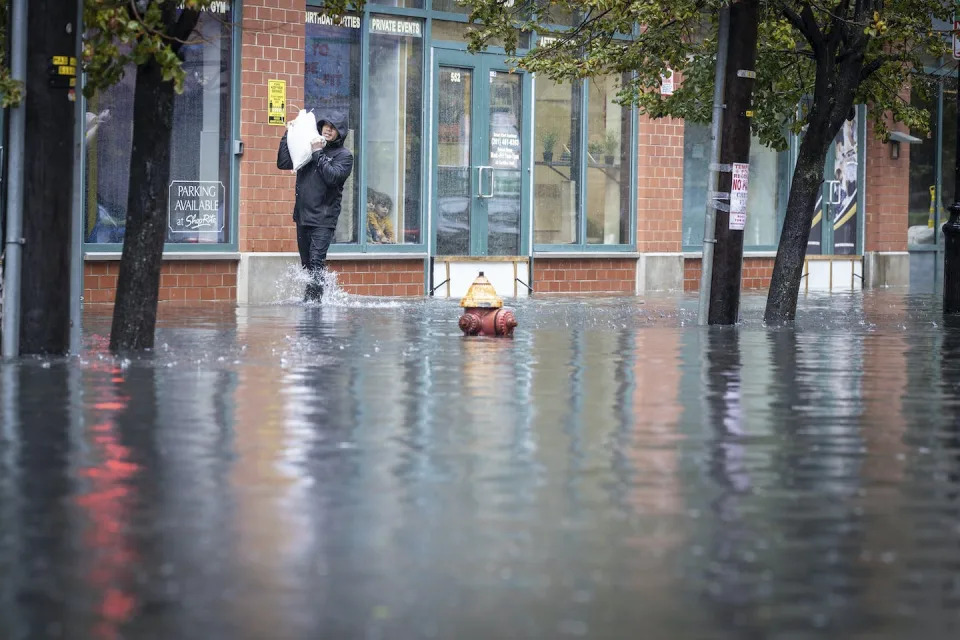
A heavy downpour flooded streets across the New York City region, shutting down subways, schools and businesses on Sept. 29, 2023. AP Photo/Jake OffenhartzMore
In January 2023, scientists wrote that Earth’s temperature had a greater than 50% chance of reaching 2.7 F (1.5 C) above preindustrial era temperatures by the year 2028, at least temporarily, increasing the risk of triggering climate tipping points with even greater human impacts. Because of the unfortunate timing of several parts of the climate system, it seems the odds are not in our favor.
This article, originally published July 27, 2023, has been updated with September’s record heat.
Michael Wysession does not work for, consult, own shares in or receive funding from any company or organization that would benefit from this article, and has disclosed no relevant affiliations beyond their academic appointment.
The ultra-rich are not just the worst polluters–their donations to climate action are also another way of hoarding money and gaming the system
Alan Davis – October 4, 2023
Getty Images
Everyone should know that we’re heading to a climate disaster that can best be modified by immediate actions addressing the causes. But it doesn’t appear that the excessively rich are feeling the heat and stepping up to the plate. Their philanthropic foundations announce commitments to fight climate change but in reality, they are building up endowments to save for the future.
It is estimated that it could take $3 to 10 trillion (twelve zeroes) per year to avoid climate disaster. Even if they wanted to fix the climate problem, it would require extraordinary collective action for philanthropists to pony up enough money to fix the climate problem. Only governments (funded by taxes on these very ultra-wealthy donors) can effectively do that. In short, the philanthropic investments now being made are necessary but insufficient.
We need to hold the ultra-rich responsible for the role their investments play in worsening the climate crisis, call out their insincere philanthropic efforts aimed at “addressing” climate change, and hold them accountable for paying their fair share of taxes to provide funding for clean energy.
Extreme inequality and wealth concentration undermine humanity’s ability to stop climate breakdown. The richest of the rich play the largest role in driving and accelerating the climate crisis with out-of-control carbon footprints due to extravagant lifestyles, excessive wealth-hoarding, corporate greed, and investments in polluting industries. Poor and middle-class communities who share the least responsibility for the problem will bear the brunt of climate change and suffer the most as shifting weather patterns, destructive storms, floods, wildfires, and heat waves wreak havoc across the globe, with the potential to displace 216 million people from their homes (and countries) by 2050.
According to the most recent data, the world’s top 125 billionaires have “an average of 14% of their investments in polluting industries, such as fossil fuels and materials like cement….Only one billionaire in the sample had investments in a renewable energy company.” When combining the impact from both their investments and lifestyles, carbon emissions exceed 3 million tons per billionaire, about a million times greater than the average person! The same report finds that through campaign contributions and lobbying, the wealthiest among us have an oversized impact on election outcomes and more political power than anyone else to protect their investments and shape climate policies in their favor.
And therein lies the biggest problem: We must have a functioning democracy to address society’s most pressing issues, including climate change–one where an exclusive ruling class doesn’t control our policies. When the government is beholden to the excessively wealthy, backroom deals influence laws and shape the rules without the public’s knowledge or ability to change the outcomes. The only way to limit the power of the excessively wealthy is to stop the hoarding of excessive wealth.
Extremely rich Americans hoard their wealth through tax loopholes and preferential policies enforced by their armies of lawyers, accountants, wealth advisers, and politicians. Four simple tax solutions would address excessive wealth hoarding: a multi-millionaire income tax, a robust wealth tax, closing gaping estate tax loopholes through an estate or inheritance tax, and finally, changes to the tax rules to foster increased, transparent and more equitable charitable giving.
We are facing a collective emergency: to save the planet from–and for–ourselves. The rapidly accelerating climate crisis is a class issue that impacts all of humanity. The reality is that our futures are interconnected with one another–and economic and climate inequality reinforce each other. To develop solutions that slow or solve climate change, we must address the deep-seated conflicts of interest and the systemic inequalities of our unjust wealth system.
It’s true NJ, your commute stinks. Census data says it’s third-worst in U.S.
Manahil Ahmad – October 4, 2023
Recent data on travel times in the United States has found that New Jersey has the third-longest average time people spend getting to work.
The U.S Census shared these results, highlighting the tough daily journeys faced by people in the state of New Jersey due to crowded roads and public transportation.
The study looked at data from big cities all over the country. It showed that in New Jersey, people spend about 30.3 minutes on an average going to work each day. This is almost five minutes more than the national average, showing just how tough commuting is in the Garden State.
Being very close to major cities like New York City and Philadelphia makes things harder, as many folks cross state borders for work, making the traffic situation even worse.
Arizona moves to end Saudi firm Fondomonte’s groundwater deals to grow, export alfalfa
Stacey Barchenger, Arizona Republic – October 2, 2023
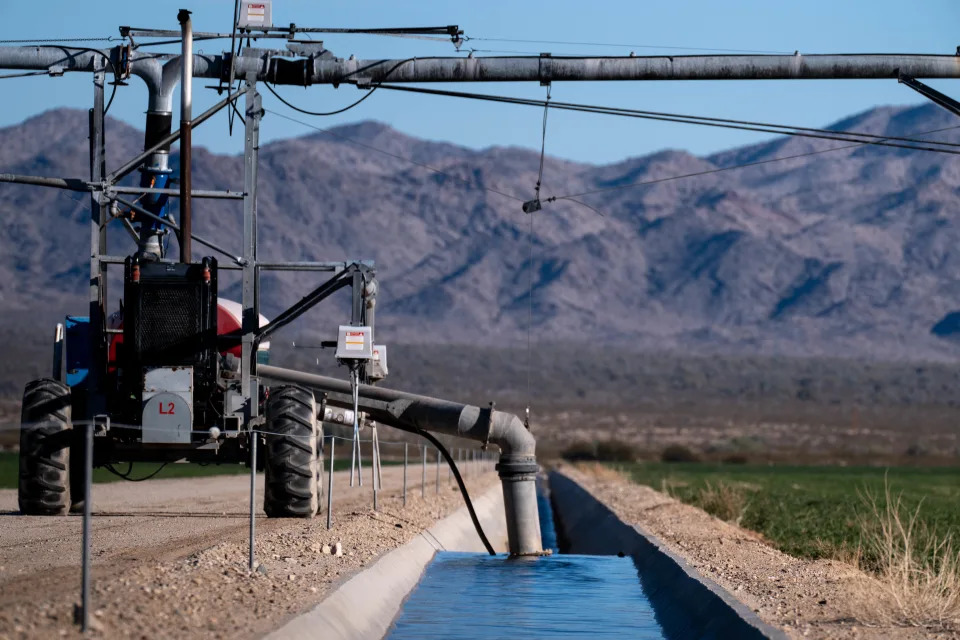
Gov. Katie Hobbs’ administration on Monday announced two steps to stop a controversial Saudi Arabian company from using groundwater beneath state land in western Arizona to grow and export alfalfa.
Hobbs said in a statement that the Arizona State Land Department had canceled one of its leases to Fondomonte Arizona, and would not renew three others that are set to expire in February.
Those four account for all of Fondomonte’s leases in the Butler Valley near Bouse, though the company leases other state land elsewhere, according to the Governor’s Office.
The company farmed about 3,5000 acres of state land in Butler Valley to grow feed for dairy cows in Saudi Arabia and is allowed to pump groundwater for that purpose entirely unchecked and unpaid for.
The issue was brought to light last year by The Arizona Republic, which highlighted Fondomonte as an example of companies that get below-market-rate leases on Arizona’s vast stretches of state land. Fondomonte was unique in that its leases allowed it to draw water from a groundwater supply earmarked as a possible future source for Phoenix and other metro areas.
Fondomonte’s presence in western Arizona became a political lightning rod as policymakers grappled with a megadrought, a decreasing supply from the Colorado River and increasing demand for water in the form of a growing population.
“I’m not afraid to do what my predecessors refused to do — hold people accountable, maximize value for the state land trust, and protect Arizona’s water future,” Hobbs said in a statement. “It’s unacceptable that Fondomonte has continued to pump unchecked amounts of groundwater out of our state while in clear default on their lease.”
While leases of state land carry penalties for early termination, the Governor’s Office said the first Fondomonte lease was canceled because the company was in default on “numerous items,” including failing to properly store fuel and diesel exhaust fluid. Fondomonte was given notice of those issues in November 2016, and nearly seven years later, a mid-August inspection showed the company had not fixed those problems, according to Hobbs’ office.
The other leases would not be renewed because of Fondomonte’s draw on “excessive amounts of water” in the Butler Valley, one of five water transportation basins that allow water to be moved around the state and that has been earmarked as a possible future water supply for Phoenix and other metro areas.
Fondomonte said through a spokesperson it was reviewing the notifications from Hobbs and the State Land Department but that it believed “the state is mistaken that the company is in breach of its lease.”
“Fondomonte will work with the Governor’s Office to highlight these factual errors,” spokesperson Barrett Marson said. “Fondomonte is adhering to all the conditions of the lease, and thus we have done everything required of us under these conditions.
“As for the other leases the state intends to not renew, this would set a dangerous precedent for all farmers on state land leases, including being extremely costly to the state and Arizona taxpayers. Fondomonte will explore all avenues to ensure there is no discrimination or unfair treatment.”
Arizona leases vast stretches of its publicly owned land to private companies, turning a profit that funds the State Land Trust and its various beneficiaries, the largest of which is K-12 education. In 2021, the state received $4.3 million for its about 160,000 acres of leased land for agriculture, according to the department.
The Republic’s reporting highlighted other shortcomings of those leases, including agricultural rental rates that haven’t changed in more than 15 years.
Republican La Paz County Supervisor Holly Irwin has been raising concerns for eight years about such leases and their toll on the state’s water supply.
“I’m just so glad we have leadership in this current administration that listened to La Paz County’s voice,” she told The Republic. “For the first time, I feel like there’s real hope in dealing with the water issues here.”
Irwin commended Hobbs, as well as Democratic Attorney General Kris Mayes and U.S. Rep. Ruben Gallego, D-Ariz., for their work on the state’s water issues.
Mayes has taken aim at well drilling permits given to Fondomonte and criticized the state Department of Water Resources, which she has said is not following groundwater management laws.
Gallego, who is running for U.S. Senate next year, introduced a bill in Congress that would levy a 300% tax on the sale and export of any water-intensive crop by a foreign company or government.
“For all of our leaders to come together to take a look at this issue and realize it’s wrong, it shouldn’t matter what side of the aisle you’re on,” Irwin said. “It demonstrates how government should work.”
Mayes, however, suggested the government’s response didn’t happen fast enough or reach to systemic issues with state land leases.
“This decision to protect Arizona’s precious groundwater resources and uphold the integrity of our state land trust is a good step in the right direction for the future of Arizona,” Mayes said in a statement. She said while the announcement was “commendable, it should have been taken by state government much earlier.”
“The failure to act sooner underscores the need for greater oversight and accountability in the management of our state’s most vital resource. … The decision by the prior administration to allow foreign corporations to stick straws in the ground and pump unlimited amounts of groundwater to export alfalfa is scandalous.”
Hobbs was sworn in as governor on Jan. 2, following former Gov. Doug Ducey, a Republican, who served two four-year terms in office.
Years in the making, this rock star’s winery is a new ‘focal point’ in Arizona wine country
Richard Ruelas, Arizona Republic – October 2, 2023
For years, before Cottonwood became a destination for wine fans, the plot of land sat abandoned. It was as if no one had use for a parcel on a hill with soaring views of the Verde Valley.
When Maynard James Keenan saw it, he knew it was the perfect spot to showcase not only his wines, but that also could, quite literally, elevate the state’s wine industry as a whole.
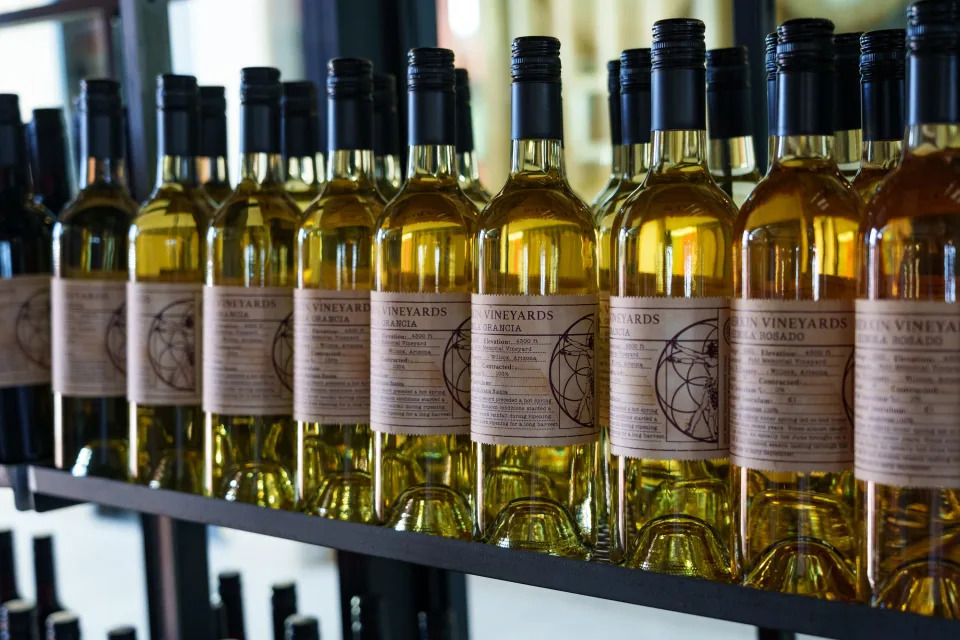
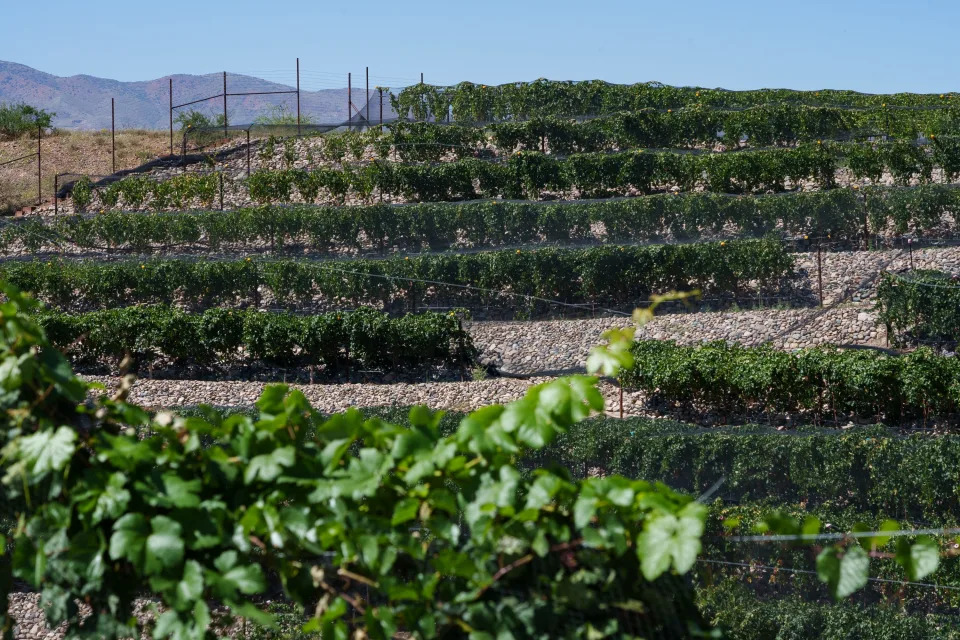
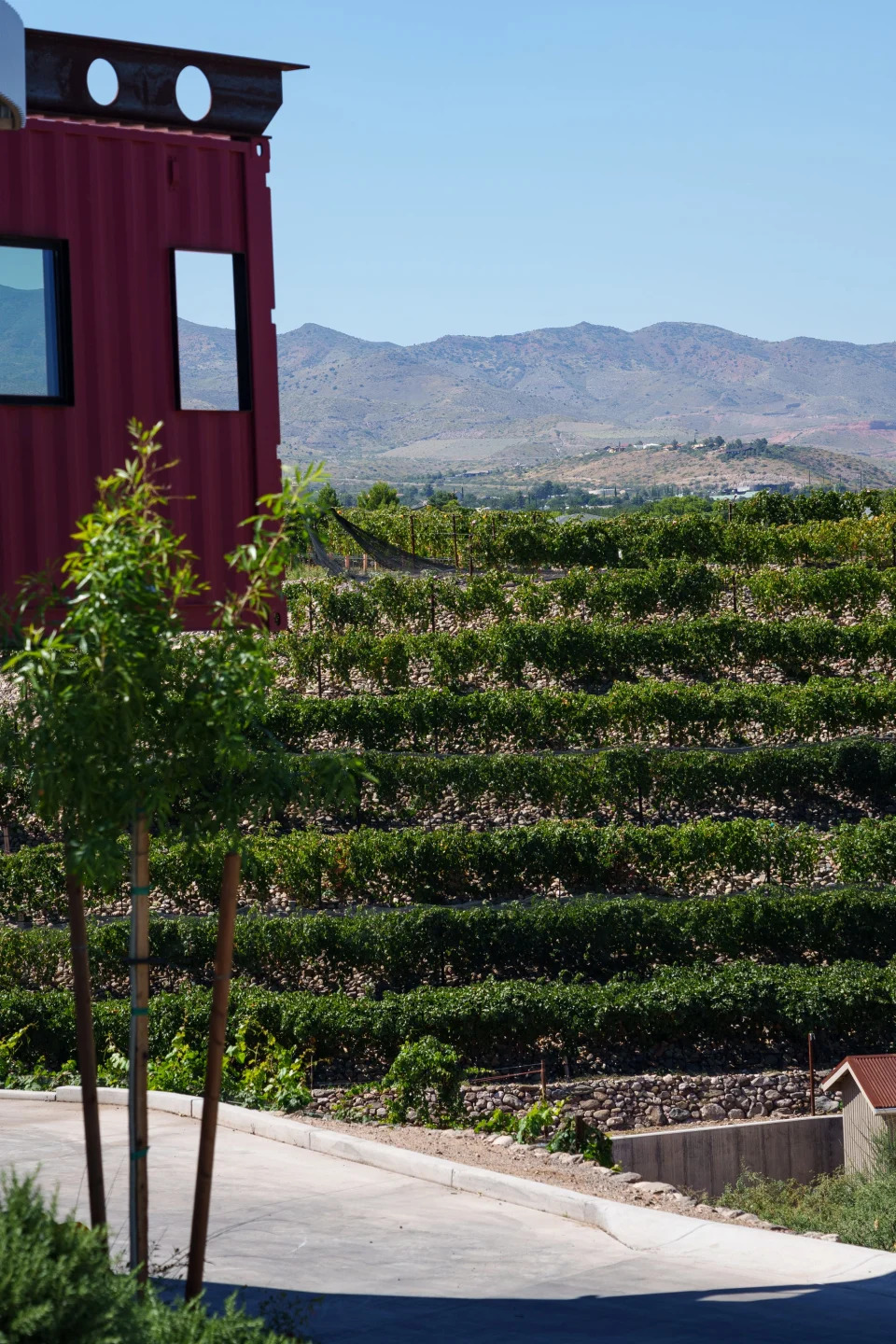
Keenan has planted an eye-catching vineyard on the steep hillside. Two wineries on the site, one partly open-air and the other with large windows, will let spectators spy a hint of the winemaking process. And he has built a trattoria offering pastas and pizzas designed to pair with his wines, meant to be enjoyed on the expansive patio that offers sweeping views over Old Town Cottonwood and the Verde Valley.
“That’s where I stood…and said, ‘this is the view,’” Keenan said pointing to the patio during a late September tour of the facility, days before Merkin Vineyards Hilltop Winery & Trattoria’s scheduled opening.
To get to the restaurant, visitors can take a staircase. Or ride the motorized tram up the 50 feet to the top.
Keenan started planning to build on the land nearly eight years ago. In 2016, as he showed a Republic photographer and reporter the tasting room, Merkin Osteria, on Main Street in Old Town Cottonwood he was opening, he walked them up the hill to show off the vacated building where he eventually planned to build a winery.
That plan has come to fruition. Keenan expects the completed Merkin Vineyards facility to serve as gateway for the Arizona wine industry, spilling customers out onto Main Street to try the other tasting rooms that “don’t have the budget to build something insane like this.”
Keenan, who is the singer for the bands, Tool, A Perfect Circle and Puscifer, has a flair for the theatrical. And the largely open-air facility was designed to attract the eye.
“The attention is the initial foot in the door, but recognition is the goal,” Keenan said. Once someone has wandered into his funhouse, Keenan expects to seriously hook them with his wine. “Recognition has legs,” Keenan said. “That has longevity, the staying power.”
This Merkin Vineyards project converted a property that had previously been used by the Cottonwood chapter of the Freemasons. That group intentionally designed its building to be insular. Keenan, with a $1.9 million loan taken out by a company he controls, has transformed it into an open-air showpiece.
The Masonic lodge closed in 2005, consolidating with the Sedona chapter amid declining membership. The building and parcel of land would sit vacant.
At the time, Old Town Cottonwood was known for its rock shops and antique stores. There wasn’t much at night, other than a thriving methamphetamine trade that centered around a run-down motel on Main Street.
In 2010, Cottonwood started courting area wineries to open tasting rooms in the area. That effort, coupled with a methamphetamine crackdown, revived the street. It’s now dotted with restaurants, shops and nightlife. The former drug den on the north end of Main Street converted to a boutique hotel called the Iron Horse Inn.
Some businesses started looking at the site on top of Verde Heights Road, seeing if they could make a project feasible, said G. Krishan Ginige, president of Southwestern Environmental Consultants, who was hired for initial consultations. All the businesses that looked at the land were related to wine, Ginige said, and none pursued it very far.
Part of the reason was the unique topography. “It’s a huge site with a very small footprint on top,” Ginige said during a phone interview.
Making the site work economically would mean figuring out what to do with the land on the hillside, Ginige said.
Keenan was the only one who came to Ginige with the idea of planting a vineyard there, he said. And that presented its own challenges.
Ginige said his company spent about two months trying to figure out how to create a vineyard on the steep hillside that would be both practical, economical and stable. He studied other hillside vineyards, including some in Italy, but couldn’t find an exact parallel. “It’s not something you see in any other place,” he said.
One hillside vineyard was Keenan’s own Judith’s Block in Jerome, also along a steep grade. That Keenan already had a similar vineyard planted let him know it could be done and made him somewhat exasperated that the new project was taking so long to engineer.
Keenan also knew he was setting himself up with another vineyard, like Judith’s Block, that couldn’t be harvested using machines.
“It’s so hard to farm. Hand-picked, hand-sorted, hand pruned,” he said. “All those fun words.”
Keenan also wanted to build two wineries on the land on top of the hill, one for his Merkin Vineyards line and another for his higher-end Caduceus Cellars. With so little usable land on top of the hill, Ginige said, the answer came from digging the building 10 feet into the hillside and holding them up with concrete pillars set deep into the mountainside.
Doing so keeps the wineries well insulated. Keenan said it is a hedge to protect the wine in the fermenting tanks and barrel room in case of a long-term power failure.
The building that held the Masonic Lodge became the restaurant, said Reynold Radoccia of Architecture Works Green, the architect on the project. Though it had to be reconfigured. The Masons built it in 1952 with few windows, Radoccia said.
“The Masons weren’t necessarily interested in the great views of the Verde Valley,” he said. “They required more privacy in their building.”
Radoccia said he tried to honor the construction style in the new building, attempting to mimic the style to honor the history.
Then there was the tram, a conveyance on fixed track similar to what was built to transport miners in another era of the Verde Valley.
Keenan thought of a tram early on in the project. He did not want his winery to tower above Main Street. Instead, he wanted to be a part of it. So, he envisioned a tram that would take visitors from Main Street up the hill, giving the winery something of an amusement park vibe.
Cottonwood Mayor Tim Elinski said adding that tram has expanded the footprint of Old Town Cottonwood. “Before, I didn’t think about (that site) being in Old Town,” he said. “But, now it’s a focal point. He’s done a great job of punctuating it.”
The project attracted no words of protest as it went through the required zoning hearings, , a measure of the city’s support.
“Really, the entire community has wrapped its arms around the wine industry,” Elinski said.
The Merkin Winery will replace the previous one housed in an anonymous industrial building off Old Highway 279, south of the city. The Caduceus Cellars winery will add capacity to the previous “bunker” Keenan had built alongside his home near Jerome.
The restaurant will replace the Merkin Osteria that had been on Main Street. That building will be converted to a fried chicken restaurant that will pour wine from another Keenan project, Four Eight WineWorks.
A winery for connoisseurs and casual drinkers alike
Keenan said he thought the facility would appeal to people with disparate types of wine knowledge.
The casual tourists, including the ones who might not believe Arizona can grow wine grapes, will be able to see proof with a thriving vineyard on the hillside, Keenan said.
Wine aficionados, from the hilltop view, will recognize the similarities between this area and other wine regions around the country and world. It’s a similarity Keenan himself recognized when he first moved to northern Arizona.
And for those with the means and desire, Keenan will offer a $199-a-person food and wine tasting experience in an exclusive room where he hopes aficionados will note the unique characteristics of the state’s wines. The Ventura Room experience will offer the only opportunity for guests to tour the winery and taste and buy Caduceus Cellars wines with the grapes grown on the hillside vineyard.
Grapes for other Caduceus and Merkin wines come from vineyards in the Verde Valley and Willcox.
Although the price might be high by Cottonwood standards, Keenan said the omakase-style tasting experience can stand alongside tourist offerings in Sedona. And he’s not worried about shooting too high.
“Every time someone’s tried to raise the bar, it’s worked,” Keenan said.
Everything in service to the wine
On a late September afternoon, Keenan walked through his trattoria as staff were being trained. His pizza chef, an 18-year-old named Kai Miller brought out pies with blistered crusts from the wood-fired oven. Keenan looked at a margarita pizza and mocked exasperation. “What is this?” he yelled, channeling his inner Gordan Ramsey, the chef from television’s “Kitchen Nightmares.” Miller showed no reaction as he strolled back into the kitchen.
Miller, a former state wrestling champion, came to Keenan’s attention through a clinic for the team Keenan held at his Brazilian jiu-jitsu studio. Instead of ending up a trainer, Miller said he had a passion for pizza and was hired.
The menu at the trattoria mirrors the one at the former Merkin Osteria on Main Street. Vegetables and herbs will largely come from a farm Keenan has at a property near Jerome and a greenhouse on the hilltop Merkin Vineyards site.
As Keenan settled in a booth and ate and praised the pizza, one of his restaurant managers brought something new out from the kitchen — calamari, lightly breaded and fried.
Keenan said he liked the dish, but said that it didn’t fit the overall mission of the restaurant. Not unless the calamari came directly from the Verde River. “It’s not really what we do here,” he said.
Keenan said he’s not aiming to merely create an Italian restaurant, but a place that celebrates what can be grown in Arizona. And one that compliments the Arizona wine that will be served alongside it.
For Keenan, this project was intended to be a winery, first and foremost. Everything else — the food, the gelato stand, the tram, the view — is in service to the wine.
“We do wine,” Kennan said. Everything else “is literally there to support what we all know is the cornerstone of what we’re doing in Arizona, which is wine.”
France set to destroy enough wine to fill over 100 Olympic-sized swimming pools: ‘It’s going to cost the nation about $216 million’
Sara Klimek – October 2, 2023
Wine lovers might hate to see millions of gallons of wine destroyed without so much as a taste, but that’s the reality for many vineyards in France amid the changing climate and low demand.
What’s happening?
The French are currently set to dump 100 Olympic-sized swimming pools worth of wine, estimated to cost the government nearly $216 million, according to The Washington Post.
The European Union gave the country $172 million to destroy 80 million gallons of wine in June 2023, and the French recently announced they had scraped together the remainder of the money needed.
Though it might seem like a waste, this wine is not going down the drain. Producers are expected to use the funds to distill the wine into pure alcohol to be used for other cleaning products and perfumes.
Why is it important?
France is experiencing a wine crisis. Consumption of the beverage has plummeted significantly in the country since its peak in 1926, when the average Frenchperson consumed about 36 gallons every year. Now, that amount hovers around 10.5 gallons. Experts trace the drop in consumption to individuals having more drink options.
A dramatically changing climate also plays a big role in the French wine industry. The above-average temperatures in its wine-growing regions, like Bordeaux, paired with more frequent droughts and storms, are changing how fast the grapes ripen.
Merlot, which encompasses 60% of the vineyard production in Bordeaux, is expected to be one of the first species to succumb to the changing climate entirely.
The adaptions needed to grow wine grapes are becoming more costly for vineyards, which, when paired with the lower demand, is causing it to be cheaper to convert the wine into other products than to grow and sell it.
What’s being done to stop it?
Experimental laboratories in France are looking for more drought-tolerant grape species that can keep the cost of production low for vineyards and stay alive as the climate continues to change.
Meanwhile, experts hope the wine buy-back will hold space and time to consider alternative solutions. “We need to think in terms of … long-run adaptation to these changing conditions,” said food and wine researcher Olivier Gergaud.
“We need to help this market to transition to a better future, maybe with more wines that would respect the environment. Adaptation to climate change is a real challenge.”
The scope of the season’s impact, while minimal, was exacerbated by the scalding summer conditions and multiple heat records in a slew of categories.
Thunderstorms were hard to come by this year. Rainfall totals for the monsoon season, which ends Sept. 30, will likely result in the driest-ever summer season at Phoenix Sky Harbor International Airport, where the National Weather Service records the official figure. The rain gauge there posted just 0.15 of an inch, less than half the total of 1924, previously the driest with 0.35 of an inch.
Some areas did fare better, primarily in the East Valley and Cave Creek, where some gauges snagged upward of 4 inches, but the spotty season will still place Maricopa County on the infamous dry list behind 2020’s “Nonsoon.”
Ultimately, this lack of storms helped fuel the full effect of triple-digit temperatures and the sweltering sun to be felt across the state.
In fact, each of the three branches of the National Weather Service — Flagstaff, Phoenix and Tucson — recorded Julys that surpassed the month in years prior, posting their hottest-ever totals.
Flagstaff sees hottest monsoon season on record; Tucson and Phoenix hottest-ever Julys
Climate summary data from the weather service’s website highlights the month’s ferocity. In the Phoenix area, for example, average high temperatures for July were 114.7 degrees, more than eight degrees above the recorded norm between the years 1991-2020.
The average mean temperature was 102.7 degrees, about seven degrees higher than the recorded norm. The most revealing stat was for warm-lows, as nights in Phoenix averaged 90.8 degrees, more than six degrees north of the month’s typical mean.
For Tucson and Flagstaff, climate reports echo a similar song. Tucson posted its hottest July, with an average monthly temperature of 94.2, six degrees hotter than normal. Flagstaff witnessed its warmest July, with a 4.7-degree temperature spike above its typical mark, bringing the overall average figure for the month to 71.4 degrees.
Flagstaff is on pace for its warmest monsoon season on record by just 0.2 degrees, surpassing the number one spot set in 1980.
Rainfall totals shallow compared to recent years
Total precipitation for 2023’s monsoon, recorded at Phoenix Sky Harbor, Flagstaff Pulliam and Tucson International airports, varied across the board:
Flagstaff: 4.24 inches
Tucson: 4.73 inches
Phoenix: 0.15 of an inch
As a whole, the deviation from the norm for Tucson is not that negative.
A typical season usually produces around 5.7 inches of rain for Tucson’s airport, coming mainly in July and August. This was mirrored in 2023, as the prime months brought 2 and 2.39 inches, respectively, making up for a zero in the June column and a lackluster September
Tucson held close to its 2022 mark as well, coming just 0.20 of an inch from eclipsing that year’s total.
In Flagstaff and Phoenix, things get a lot less pretty.
At the high country’s airport, 2023’s accumulation of 4.24 inches puts it well below its average of 7.68. The year was also dwarfed in comparison to 2022 (10.63 inches) and 2021 (10.90 inches).
In Phoenix, Sky Harbor caught an abysmal 0.15 of an inch of rain this season, easily placing it as the driest on record, pushing out 1924 at 0.35 of an inch. Usually, Sky Harbor gets around 2.43 inches of rain during the season.
When compared even to 2020’s “Nonsoon,” a total that both Tucson and Flagstaff handily exceeded, Phoenix’s 2023 comes nowhere close. Sky Harbor got exactly 1 inch of rain that year, according to NWS statistics.
Overall for Arizona, precipitation in 2023 was more in line with typical seasons than that of 2020 and 2021.
“I would say as far as precipitation patterns, it was more typical because of the variability,” NOAA Warning Coordination Meteorologist Kenneth Drozd told The Arizona Republic. “(In) 2022, there were more places that were above normal than below normal, but it was still pretty mixed. Kind of like this year, there are more places that are below normal than above normal, but it still varies quite a bit depending on where you’re at.”
In 2020 and 2021, Drozd said, conditions were “unique” because of their widespread consistencies, with 2020 being so dry and 2021 being much wetter.
Maricopa County on pace to be wetter than 2020
While Sky Habor couldn’t catch a break, Arizona’s most populous county as a whole is set to end the monsoon season in a better position.
According to data from the Maricopa County Flood Control District, the county posted wetter numbers than it did in 2020, in large part due to healthier amounts falling in Cave Creek, Wickenburg, Apache Junction and portions of the East Valley.
Throughout Maricopa County, totals from data stretching back 108 days from the season’s Saturday endpoint bounce around from lows in central Phoenix at 0.39 of an inch to upward of four inches in parts of Cave Creek.
A notable area that performed the best in the county was near rural Crown King north of the Valley, where there were spots receiving nearly eight inches during the storm span.
“In general, the closer to the mountains you are, the more rain you’re going to receive during monsoon because the storms form over them,” National Weather Service Phoenix office meteorologist Mark O’Malley told The Republic. “That just became exacerbated this year where the areas of south Phoenix through Laveen, down through Avondale and Goodyear, some areas didn’t even receive a tenth of an inch.”
According to O’Malley, the lack of storms this season was primarily due to the weather pattern setting up with strong high pressure over southern Arizona, bringing hotter temperatures and lackluster storms.
“The weather pattern was set up to where it favored the heat and the storms were more removed from the area, more frequently,” O’Malley said.
SRP: 3 monsoons touched down in the Valley in 2023
According to data from Salt River Project, three major monsoon storms hit metro Phoenix in 2023: on July 26, Aug. 31 and Sept. 12.
These storms left their marks, too, with SRP reporting estimated outage numbers at the height of each storm:
July 26: 50,000 customers out of power
Aug. 31: 71,000 customers out of power
Sept. 12: 39,000 customers out of power
APS customers were affected as well, with the company reporting approximate outages during peak storm hours:
July 26: 7,750 customers without power
Aug. 31: 18,000 customers without power
Sept. 12: 11,000 customers without power
Each event brought its own force, bringing down power lines, overturning planes, destroying mobile homes and uprooting trees. While par for the course during the season, rainfall totals certainly weren’t.
For July 26, chunks of the storm covered the greater Phoenix area into Scottsdale and swaths of the East Valley, with downtown Phoenix only registering 0.04 of an inch of rain. Paradise Valley and Apache Junction received as much as one full inch during the duration of the storm.
On Aug. 31, more portions of Maricopa County got involved but with far less rain. Only two areas throughout the metro saw upward of a half inch. Much of the rain that fell did so in the Cave Creek and New River areas, ranging from 1.45 to 3 inches through the course of the storm.
A storm on Sept. 12 produced the best results for the Valley, with multiple areas getting over the half-inch hump. Again, much of the wealth ended up in Cave Creek, with various areas tabulating over 1.5 inches.