India facing its worst water shortage in history, report says

CNN

India facing its worst water shortage in history, report says

By Swati Gupta      June 15, 2018
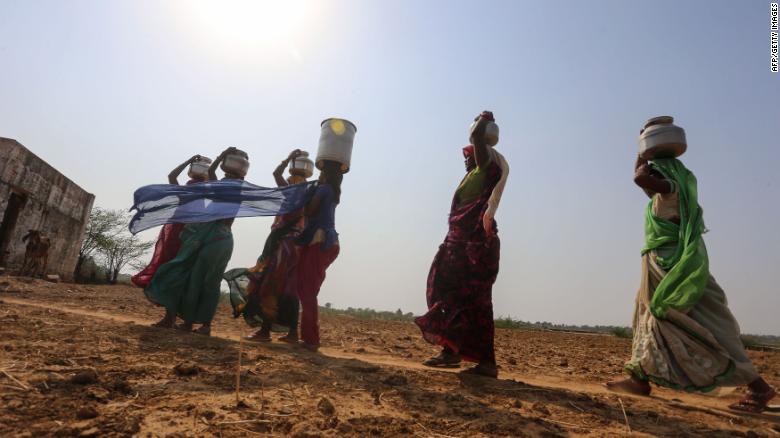
Indian women fetch water from a pit in the bed of Lokpal Sagar Lake in Madhya Pradesh.

Story Highlights

Six hundred million people are dealing with high to extreme water shortage

“We have 4% of the global water and 16% of the global population,” an expert notes

(CNN)India is facing its worst water shortage in history. Six hundred million people are dealing with high to extreme water shortage, according to a report by Niti Aayog, a policy think tank for the Indian government.

The report states that an average of 200,000 Indian lives are lost every year due to inadequate supply or contamination of water.

Sustainable water development has seen slow progress in India in recent years. Though 80% of the country’s states have water conservation legislation, bad data management and nonexistent pricing of water have kept the country from making significant change, the report states.

Poor irrigation techniques and severe contamination of groundwater have brought India to the edge of this crisis.

India is predominantly an agricultural country, with 80% of its water used for irrigation, the report says. The irrigation practices followed by farmers are inefficient at best.

Cape Town rejoices as rain falls on drought-stricken city
“Policies like several states giving free electricity to farmers or giving financial support for groundwater extraction — borewells and tube wells — results in uncontrolled exploitation and wastage of resource,” said Suresh Rohilla, director of urban water management at the Centre for Science and Environment.

Drip irrigation, which is a method to provide an exact amount of water directly to the root of the plant, has seen few customers. The implementation is costly for the average farmer, and state government provides limited support, said Samrat Basak, director for urban water at the World Resources Institute.

“Primarily, water is not valued in India. It is very cheap in India. People think it is free,” Basak added.

According to the report, three-quarters of the Indian population is affected by contaminated water, and 20% of the country’s disease is thought to directly correlate.

India does not have an adequate number of sewage treatment plants, so untreated urban wastewater is often added to water flowing downstream — the same contaminated water used in rural areas for drinking, according to the report.

Twenty-one major Indian cities are estimated to run out of groundwater by 2020 — just two years away.
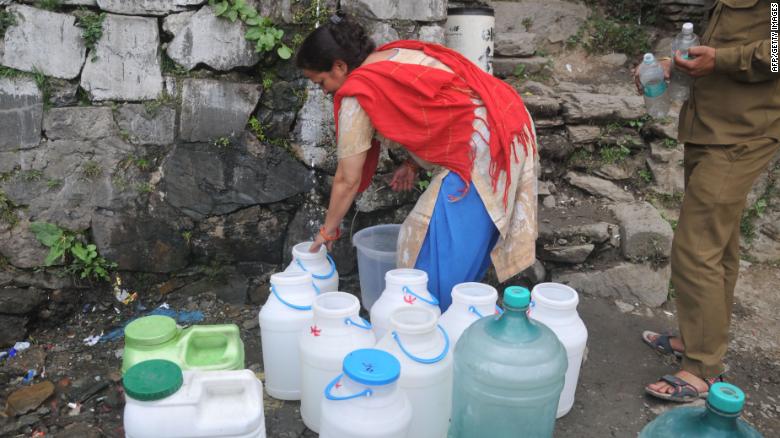
Indian residents wait to collect drinking water in Shimla as the city faces water shortage.

One hundred million people, including those in the large cities of Delhi, Bangalore and Hyderabad, will be living in zero groundwater cities, according to the report.

“People think that if they own the land, they own the water. India as a country extracts the highest amount of groundwater in the world,” Basak said.

As India develops and grows to support its 1.3 billion people, the country is on the brink of an inescapable crisis.

Some states have shown a marked improvement in water quality standards during the past year.

“There have been time to time policies and programs launched by central and state governments,” Rohilla said. However, the government has not shown that it is serious enough to translate its goals into reality,” he added.

Authorities have launched better water management practices and legislation for the protection and restoration of water bodies, the report says.

The initiative to release this report is a step in the right direction, Basak said.

State governments have control over water-related policies, and the lack of legislation for groundwater extraction and the inability to price water for every home due to political constraints has led to a paralysis in the formation of a sustainable framework.

Cities have seen a return to the use of water tankers due to a lack of groundwater and in turn no water being supplied to the taps in people’s homes.

At a single tap at the back of the tanker, hundreds of people line up with cans and containers to get a few liters every day.

“We have 4% of the global water and 16% of the global population. The minute you bring this statistic into the equation, there is a non-rocket-science understanding of how this has happened,” Basak said.

New Delhi orders construction halt as pollution levels soar

Associated Press

New Delhi orders construction halt as pollution levels soar

AP      June 14, 2018

NEW DELHI –  New Delhi officials have ordered a two-day halt to construction in an attempt to reduce choking pollution that has cloaked the city in smog and dust.

The government’s Central Pollution Control Board rated the city’s air quality Friday as “severe” — the worst possible category — for the fourth day in a row.

New Delhi’s level of PM2.5, tiny particulate matter that can dangerously clog lungs, exceeded 170 Friday morning, more than six times higher than the World Health Organization considers safe.

The New Delhi government has made scattered attempts in recent years to try to control worsening air pollution, including stricter emission norms for cars and a tax on diesel-fueled trucks entering the city. But the pollution has only gotten worse.

Is the Trans Mountain Pipeline (and Other Fossil Fuel Investments) a Future Stranded Asset?

Resilience

Building a world of resilient communities

Is the Trans Mountain Pipeline (and Other Fossil Fuel Investments) a Future Stranded Asset?

 By Martin Bush. Orig. pub in DeSmog Blog    June 11, 2018

Reposted with permission from ClimateZone.org.

The Dakota Access pipeline being installed between farms, as seen from 50th Avenue in New Salem, North Dakota. Credit: Tony Webster, CC By SA 2.0

Several major economies, including the U.S. and Canada, rely heavily on fossil fuel production and exports. But the surging market penetration of renewable energy technologies, energy efficiency improvements, and climate emission policies are certain to substantially reduce the global demand for fossil fuels.

In a seminal paper published a week ago in Nature Climate Change, researchers present the results of sophisticated multi-dimensional modeling of the macro-economic impacts of future technology transformations and climate change policy, as the demand for fossil fuels declines and the price of oil falls.

This is a peer-reviewed paper that was scrutinized by other experts for almost a year before it was accepted for publication. Its warnings should be taken seriously.

Irrespective of whether or not new climate policies are adopted, global demand growth for fossil fuels is already slowing due to the accelerating transition to a low carbon global economy. Given the pace of low-carbon technology market penetration, fossil fuel assets are likely to become stranded due to advances in renewable energy deployment, improvements in energy efficiency, and the electrification of the transportation sector.

There can be no doubt that a global energy transition is fully underway. Last year was another record-breaking year for renewable energy — characterized by the largest ever increase in renewable power capacity, falling costs, increased investment, and advances in enabling technologies.

Solar photovoltaic capacity installations were off the chart — nearly double those of wind power (in second place) — and adding more net capacity than coal, natural gas, and nuclear power combined. Check out the numbers.

The Paris Agreement aims to limit the increase in global average temperatures to below 2°C. Attaining this objective absolutely requires that a fraction of existing reserves of fossil fuels remain in the ground, and that a part of present production capacity remains unused — effectively becoming stranded assets.

Since investors had assumed that these reserves will be commercialized, the stocks of listed fossil fuel companies may soon be judged to be over-valued. This situation gives rise to the possibility of a “carbon bubble” — which may eventually burst with global economic consequences.

The modeling results show that the lower demand for fossil fuels leads to substantial stranded fossil fuel assets if climate change policies are not adopted. For individual countries, the effects vary depending on their  marginal costs of production, with oil production becoming concentrated in OPEC member countries–where costs are lower. Regions with higher marginal costs experience a steep decline in production (for instance Russia), or risk losing a substantial part of their oil and gas industries — like Canada and the U.S.

The Sell-out

The magnitude of the economic impact depends on a variety of factors. The analysis suggests that the behavior of low-cost producers and/or the adoption of 2°C policies can lead to an amplification of the losses. If low-cost producers decide to increase their ratio of production relative to reserves to outplay other asset owners and minimize their losses by selling out early–in effect a “sell-out” — this strategy has a major and very negative impact on higher cost producers.

The low carbon transition generates a modest GDP and employment increase in regions with limited exposure to fossil fuel production (for example, most of the EU and Japan). This is due to a reduction of the trade imbalance arising from fossil fuel imports, and higher employment arising from new investment in low carbon technologies. The improvement occurs despite the general increase in energy prices and hence costs for energy intensive industries.

However, fossil fuel exporters experience a steep decline in their output and employment due to the near shutdown of their fossil fuel industry. These patterns emerge even though there is only a modest overall impact on global GDP — indicating the impacts are primarily distributional with clear winners — the EU and China, and clear losers — the U.S. and Canada.

Gains and Losses

The figure below shows the gains and losses for major economies including the U.S. and Canada through to 2035.  The units are in trillions of U.S. dollars. The principal winners are the EU, China and India. The main losers are the U.S. and Canada.

Cumulative GDP gains and losses by country/region. Credit: Mercure et al., Nature Climate Change 2018. 

Although the U.S. losses are larger in absolute terms, the percentage loss of GDP for Canada is much larger — increasing to over 20 percent within the next ten years. Unemployment increases to around 8 percent over the same time frame. These projections are shown in the graphs below.

Percentage change in GDP. Credit: Mercure et al., Nature Climate Change 2018. 

For Canada, the higher marginal costs of oil sands production (including transport to tidewater via pipelines or oil trains) doom the industry to a future of increasingly curtailed production and stranded assets.

It’s in the context of these long term macroeconomic projections that the proposed Trans Mountain Expansion pipeline should be viewed. Within a decade there will be no market for the oil sands production of heavy oil and bitumen. Low-cost producers, sensing the end of an era, will start to sell off their assets. Oil prices will tumble.

It makes no sense to build a pipeline intended to increase production from the oil sands when even maintaining the existing level of production is seriously in doubt.

Justin Trudeau, now the proud owner of an obsolete and very expensive pipeline, should check the fine print.

Maybe he’s still got a few days where he can change his mind.

Capitalism is killing the planet and needs to change, says investor Jeremy Grantham

CNBC

Capitalism is killing the planet and needs to change, says investor Jeremy Grantham

“Capitalism and mainstream economics simply cannot deal with these problems. Mainstream economics largely ignore [them],” Grantham says.
“We deforest the land, we degrade our soils, we pollute and overuse our water and we treat air like an open sewer, and we do it all off the balance sheet,” he adds.

By Fred Imbert         June 13, 2018

Getty Images

Jeremy Grantham, the longtime investor famous for calling the last two major bubbles in the market, is urging capitalists and “mainstream economists” to recognize the looming threat of climate change.

“Capitalism and mainstream economics simply cannot deal with these problems. Mainstream economics largely ignore [them],” Grantham, who co-founded GMO in 1977, said Tuesday in an impassioned speech at the Morningstar Investment Conference in Chicago. “We deforest the land, we degrade our soils, we pollute and overuse our water and we treat air like an open sewer, and we do it all off the balance sheet.”

This negligence is due in large part to how short-sighted corporations can be, Grantham said. “Anything that happens to a corporation over 25 years out doesn’t exist for them, therefore, as I like to say, grandchildren have no value” to them, he said.

        Getty Images

2016 is likely to have been the hottest year since global temperatures were recorded in the 19th century.

Grantham has been outspoken about his concerns over climate change for years. In 1997, he started the Grantham Foundation for the Protection of the Environment, which gives money to entities that look to protect the environment. Grantham’s company also launched the GMO Climate Change fund last year, which invests in wind and solar companies.

Throughout his presentation, Grantham cited a slew of data showing how climate change is impacting soil, grains, temperature as well as general human health. Those numbers, coupled with Grantham’s speech delivery, scared a lot of people in attendance at the conference.

Grantham also pointed out that many of the problems with how capitalists deal with climate change stem from the very nature of corporations. “A corporation’s responsibility is to maximize profit, not to spend money and figure out how to save the planet,” he said.

But Grantham added: “We’re racing to protect much more than our portfolios. … We’re racing to protect our grandchildren and our species, so get to it.”

Grantham correctly called the bursting of the dotcom bubble in 2000 as well as the sharp market downturn in 2008. These calls helped solidify his reputation in the investment world as a legendary investor. However, Grantham’s GMO has taken massive hits in recent years. The firm’s assets under management have dropped to $71 billion in March from about $124 billion in June 2014 following big bets on emerging markets.

MORE FROM CNBC

Cramer: Stocks aren’t down because market believes Trump is ‘right’ about trade

‘Trump is being played,’ says expert on the Koreas

This new water bottle could put the ‘squeeze’ on the $8 billion reusable water bottle industry

Scientists at a company part-owned by Bill Gates have found a cheap way to convert CO2 into gasoline

Trump and Kim have lunch: Here’s the guest list — and the menu

Elon Musk admits Tesla will have to turn a profit one day

Republicans propose penalties for states that oppose offshore drilling

The Hill

Republicans propose penalties for states that oppose offshore drilling

By Luis Sanchez       June 13, 2018

© Getty

House Republicans unveiled a draft proposal this week that would place fines on states that block offshore gas and oil drilling.

The Republican draft proposal, first reported by The Washington Post, will be discussed at the Natural Resources Committee on Thursday.

It would allow states to disapprove of offshore drilling for gas and oil in half of its lease blocks without facing any penalties.

However, states with proposed lease sales that disapprove of drilling in more than 50 percent of the blocks would have to pay a fee equal to at least one-tenth the estimated revenue the government would have made if it had leased the blocks.

The proposal also sets up a revenue-sharing scheme for states that allow drilling.

The move would help pressure local politicians to fall in line with President Trump’s plan to increase offshore leasing.

Earlier this year, Trump called for offshore drilling in nearly all U.S. coastal waters, negating a drilling ban former-President Obama imposed near the end of his term.

Many Democrats and some Republicans in coastal areas have resisted Trump’s plan, and some have pledged to keep the federal government from allowing offshore leasing in their states.

The pushback led Trump’s interior secretary, Ryan Zinke to tell Congress he would scale back Trump’s plan.

Democrats are opposed to the proposal, arguing it could cost states millions or billions in fees if they choose to oppose drilling.

Republicans on the committee have said that the proposal could still be changed, the Post reported.

Tuesday’s special elections in Wisconsin: What you need to know

Green Bay Press Gazette

Tuesday’s special elections in Wisconsin: What you need to know

Patrick Marley, Milwaukee     June 11, 2018

       (Photo: Craig Gilbert / Milwaukee Journal Sentinel)

MADISON – Wisconsin will hold two closely watched special elections  Tuesday, the latest test of whether a “blue wave” could be coming this fall.

Why are the elections being held?

Tuesday’s elections will fill the seats of former Sen. Frank Lasse (R-De Pere) and former Rep. Keith Ripp (R-Lodi), who stepped down in December to take jobs in Gov. Scott Walker’s administration.

Walker didn’t call special elections at the time. Voters in those districts — with the help of a group run by former Obama Attorney General Eric Holder — sued and courts ruled Walker had to call the special election.

Who’s running?

In Senate District 1, Republican Rep Andre Jacque of De Pere faces Democrat Caleb Frostman, the former head of the Door County Economic Development Corp. The district includes all of Door and Kewaunee counties and parts of Brown, Manitowoc, Calumet and Outagamie counties.

In Assembly District 42, Republican Jon Plumer, a Lodi Town Board member and owner of karate schools, is running against Democrat Ann Groves Lloyd, a Lodi alderwoman and University of Wisconsin-Madison academic adviser.

The district is just north of Madison and includes most of Columbia County and parts of Dane, Dodge, Fond du Lac, Green Lake and Marquette counties.

     Caleb Frostman (left), the Democratic candidate in Tuesday’s special election for state Senate, talks to Sturgeon Bay voter Tom Fernandez.  (Photo: Craig Gilbert / Milwaukee Journal Sentinel)
Are the races being closely watched? 

Since President Donald Trump took office last year, 25 legislative and congressional seats have flipped from Republican to Democrat, according to Charles Franklin, a pollster and political scientist at Marquette University Law School. Just five have flipped the other way.

Among the seats that went to Democrats was a state Senate seat in western Wisconsin won by Patty Schachtner in January. Walker called that result a “wake-up call” that should warn Republicans they could be in trouble this fall.

Election experts say people shouldn’t draw too many conclusions from one election night, but Tuesday’s results could help guide the narrative about whether a “blue wave” is coming.

Candidates for Assembly District 42 seat meet in Lodi for candidate forum. WisconsinEye

How long will the winners hold the seats?

Not long. The districts are up for election again in November, so both the winners and the losers will have to stay in election mode.

Election observers say Tuesday’s winners will have an edge in the fall election, but no guarantee they will win again. Turnout in the fall is certain to be much higher in the fall than on Tuesday.

What’s at stake?

In one sense, the stakes are low because the seats will immediately be up for election again. In another, they’re high because the Senate seat is an important part of Democrats’ strategy to try to take over the upper house.

Republicans control the Senate 18-14 and Democrats would need to net three seats in the fall to take power in that house.

Republicans have a much firmer, 63-35 margin in the Assembly.

Rising CO2 poses bigger climate threat than warming, study says

UPI – Home / Science News

Rising CO2 poses bigger climate threat than warming, study says

New research suggests geo-engineering efforts designed to encourage cooling and reduce rising temperatures are likely to do little to prevent damaging weather extremes.

By Brook Hays     June 12, 2018

New research suggests CO2 concentrations are a better predictor of the extreme weather events associated with global warming. Photo by Reinhard Tiburzy/Shutterstock

June 12 (UPI) — Even if global warming is curbed and the increase in global temperature is limited to 1.5 degrees Celsius, scientists warn rising CO2 concentrations could still trigger a dangerous increase in extreme weather.

Broadly speaking, more CO2 translates to higher temperatures, but the relationship between atmosphere and climate is complex, and scientists say there are scenarios in which warming could be limited to 1.5 degrees, despite a sizable increase in atmospheric CO2.

New climate models developed by researchers at the University of Bristol and the University of Oxford suggest CO2 levels, not global temperatures, are a better predictor of the most damaging consequences of climate change.

“Future work is needed to confirm exactly why we see this direct CO2 effect, but current research points to a combination of circulation and cloud cover changes, and an increase in the amount of direct radiation on the Earth’s surface due to simply having more CO2 in the atmosphere,” Hugh Baker, a PhD student in physics at Oxford, said in a news release.

In a new study, published this week in the journal Nature Climate Change, scientists argued climate change mitigation agreements need set targets for atmospheric CO2.

The new research suggests geo-engineering efforts designed to encourage cooling and reducing rising temperatures are likely to do little to prevent damaging weather extremes.

“Geo-engineering techniques that reduce the amount of sunlight hitting the Earth’s surface are increasingly thought of as a way of achieving the Paris Goals because they decrease surface temperature,” said Bristol scientist Dann Mitchell. “However, our results show that for extreme climate such as heatwaves, changing the global mean temperature is not enough, you need to reduce CO2 concentrations themselves.”

Related UPI Stories

Study reveals missing drivers of ocean deoxygenation

Taking CO2 out of the air is more economical than scientists thought

Atmospheric CO2 levels in April hit highest average ever recorded

First global CO2 maps published using China’s TanSat data

Incredible footage of a rare White Moose has been captured in Sweden.

Native American Wisdom

February 13, 2018

Incredible footage of a rare White Moose has been captured in Sweden. There are only an estimated 100 of them left in the country!!

*BeatyWhiteMoose*

Incredible footage of a rare White Moose has been captured in Sweden. There are only an estimated 100 of them left in the country!!Please Post where you're from so i can track how far the video going…?💞Thankyou💖💗

Posted by Native American Wisdom on Tuesday, February 13, 2018

Water wars! Investors looking to profit off water shortages, including the Colorado River.

DeSmogBlog

June 11, 2018

Investors are eyeing water shortages as investment opportunities including the Colorado River which provides water for 40 million Americans.

Water wars? Investors look to profit off of water shortages

Investors are eyeing water shortages as investment opportunities including the Colorado River which provides water for 40 million Americans.

Posted by DeSmogBlog on Monday, June 11, 2018

Florida’s ‘city of the future’ is first solar-powered town in America

Fox News

Florida’s ‘city of the future’ is first solar-powered town in America

By Phil Keating, Fox News

America’s first solar community coming to life in Florida

Jasmin Day is pregnant and when her girl or boy is born later this year—she’s keeping the gender a surprise—her baby will become the first child ever born in Babcock Ranch, Fla.

“Almost all the boxes are undone,” she says while stepping over the just delivered new bed. She, husband Josh, and little kids, Judson and Elliot, just moved into their new house and this brand new community – dubbed the city of the future.

The young couple from Memphis, Tenn. could not be happier.

“To be able to be a part of a community of everyone that cares,” Josh Day said, “and wants that for them, not only for themselves but also for their children and their grandchildren, to have it be a more clean Earth whenever our children are older.”

His wife added: “I think we’re pretty all in! We live here. We work here.”

Babcock Ranch, near Fort Myers on state’s west coast, was developed from the beginning with a massive solar power farm generating 100 percent of the electric needs. About 350,000 photovoltaic solar panels stretch across a swath of land the size of 200 football fields.

When developer Syd Kitson, a former NFL lineman with the Dallas Cowboys and Green Bay Packers, bought the 17,000-acre property, it was all old mining and farmland.

Babcock Ranch, near Fort Myers on state’s west coast, was developed from the beginning with a massive solar power farm generating 100 percent of the electric needs. About 350,000 photovoltaic solar panels stretch across a swath of land the size of 200 football fields.

It’s now the country’s first, fully solar city, with a very low carbon footprint, a soon-to-open school, electric shuttles that will eventually be driverless, a cute town square with shops and an emphasis on the environment and preservation.

Where most developers would build and sell as many homes as possible, for greater profit, Kitson’s vision from the beginning was preserving most of the open space, now encompassing several lakes and 50 miles of bike trails.

The homes run from $190,000 to about $499,000. Residents can work in the town, but are not required to do so.

The fully completed footprint will eventually be 19,500 homes.

“We think about the way we develop differently…. It’s the most environmentally responsible, the most sustainable new town that’s ever been developed,” Kitson said. “And, it’s the first solar-powered town in America. And we’re very proud of that.”

In January, the first two people moved in. Now, there are 150 homes under contract with an expectation that will there will be 250 families moved in by December. Eight developers are now building homes. The vision is a unique creation of a 45,000-person small city.

But first came the enormous solar farm. Kitson gave the land to Florida Power & Light for free, which then spent more than $100,000,000 installing all the panels, wires and storage batteries. That solar-generated power now is shared throughout FPL’s grid, as Babcock Ranch’s demand, at this point, remains very small.

John Woolschlager, an urban planning professor at nearby Florida Gulf Coast University, said all cities can ultimately follow Babcock Ranch’s model, but it will take years. Babcock Ranch’s huge advantage was that it’s being built from scratch with the self-sustainability and pro-environment philosophy on the ground first.

“I think, also, if you look to the distant future, it’s going to be a necessity,” Woolschlager said. “If we want to have a good life in the future, we have to think more sustainability, because if we don’t, we’re going to run out of energy, run out of water and run out of resources.”

For Josh Day, he’s landed a physical therapy job in the town square’s Life Wellness Center. So, if he doesn’t bike to work and home, he can just ride a solar powered, electric shuttle, in a town which – for now – has no traffic nor rush hours.

Phil Keating joined Fox News Channel (FNC) in March 2004 and currently serves as FNC’s Miami-based correspondent.