Building Dignity for the Homeless Through Farming

Civil Eats

Anthony Reyes: Building Dignity for the Homeless Through Farming

The farm manager at the Homeless Garden Project in Santa Cruz, Reyes approaches agricultural systems from a justice lens.

Anthony Reyes found his calling working at the intersection of farming and social justice with organizations such as the Tilth Alliance in Seattle, the youth education program Common Threads Farm in Bellingham, and now with the Homeless Garden Project in Santa Cruz. Reyes credits his college days at the University of California, Santa Cruz, for his passion for sustainable agriculture with a food justice focus. Reyes, a biracial Millennial with Mexican-American roots, always wanted to return to the area, a hub for farming with a mission. In 2017, he returned to the community where he first learned to grow food and view agricultural systems through a justice lens.

In his first year at the Homeless Garden Project, Anthony Reyes says he was asked about every stereotype imaginable when working with this marginalized population. Chief among them: Do homeless people really work? There’s a lot of stigma associated with this population, he says. “For the record, the crews here are some of the most hardworking people I’ve ever met,” says Reyes of the participants in the non-profit’s year-long employment-training program at Natural Bridges Farm.

The project serves people in Santa Cruz County who are homeless or formerly homeless, who have experienced barriers to employment, and who want to maintain a stable productive place in society. “The crew tackles every task seriously with passion and heart.”

Reyes spends his days on the farm bouncing between different posts—whether the field, greenhouse, farm stand, or kitchen—helping crews with their tasks on the 3.5-acre farm, which grows row crops and flowers. He’s also in charge of the organization’s three-pronged Community Supported Agriculture program. CSAs, an alternative marketing model that features a direct relationship between farmer and consumer, accounts for about 10 percent of the 25-year-old institution’s income.

The program includes a traditional CSA, a U-pick version, and a scholarship fund, where people can donate to a CSA program for 10 local organizations serving the needy. Flowers go to a local hospice program and the program includes a value-added enterprise making and selling jams, dried herbs, and floral wreaths, which are sold at their downtown store, in a new shop in nearby Capitola, and online.

Relationships are central to Reyes’s job, he says, and inform every aspect of work on the farm, which is slated to expand to a 9-acre permanent site expected to be fully operational in 2020. The 28-year-old strives to treat each crew member with care, compassion, and respect. He says he learns as much from his 17-member crew as they learn from him. “Every single day they inspire me. The farm itself is such a place of radical inclusivity. Everyone is embraced and welcomed,” he says. “And that is reflected in the pride people take in the work and the collaboration on the farm. It’s really a beautiful thing to witness on a day-to-day basis.”

Reyes has farming in his blood: Wisconsin dairy farmers make up his mother’s side of the family. His father is of Mexican heritage and his paternal grandfather ran a “mow and blow” business in Los Angeles. The smell of grass and a four-stroke engine is embedded in childhood memories, he says, and he looked up to his grandfather, a gentle soul. In college, Reyes says his studies helped him begin to see agriculture and outside work though a social justice lens. A key mentor on campus: a UC Santa Cruz lead groundskeeper whom he worked with, Jose Sanchez.

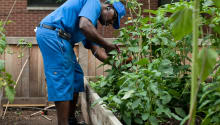
anthony reyes at the Homeless Garden ProjectHis “juiciest” days, Reyes says, are whenever he can get his hands in the earth. “I make some of the deepest connections with our crew members simply working alongside them,” he says. “Working the soil creates a safe space for people to be seen and heard for who they are.”

Reyes has seen first-hand what a difference growing food can make in someone’s life. “There’s something very restorative and transformative about planting a seed and watering it and watching it grow into a flourishing plant that can provide sustenance,” he says. “From a little speck in your hand to the harvest for your lunch: That has a calming, therapeutic effect.”

Crew members see the fruits of their labor and the value that it brings. “There are very real, tangible benefits at the end of the day, whether someone has spent it building a bed, weeding, or picking. You can see the difference you’ve made,” says Reyes. “There’s ownership and a sense of accomplishment.”

As Reyes points out, homelessness and joblessness go hand in hand. Lack of job skills, a spotty work history, an absent social support network, and low self-esteem can all make the transition out of homelessness more difficult. The Homeless Garden Project’s program is designed to address these concerns, in addition to the challenges that come with substance abuse, mental health issues, physical or developmental disability, and the unique problems faced by veterans—all obstacles that disproportionately impact the homeless community.

Housing is one of the most immediate problems. Some of the Homeless Garden Project’s clientele live in shelters, while others camp outside or in cars, or reside in tenuous subsidized housing situations. A team of social work interns help garden crew members find stable employment and housing. The interns also help the crew find resources to address other obstacles like transportation, substance abuse, and mental health problems.

feeding people at the Homeless Garden Project“Every single person on the crew has personal challenges they’re trying to work through. We very much meet people where they are,” says Reyes. In a region known for exorbitant rents and real estate, Reyes is well aware that many residents of the greater community—including some farm project volunteers—are just a paycheck or two away from homelessness themselves.

Measuring success comes in multiple ways. More than 90 percent of participants in the program find stable housing and employment at the end of their garden project tenure. There’s also the less quantifiable personal growth that Reyes observes in his crews over time: “I watch people try new things and come out of their shell.”

His own on-the-job goals? “I remind myself constantly to show up, and what it means to be present. I’ve learned so much about myself in this line of work,” he says. “It’s also given me more confidence and allowed me to be okay with, and find strength in, vulnerability. It’s not just me. Every single person who steps onto the farm is changed by it.”

Reprinted with permission from Hungry for Change, a publication of the Berkeley Food Institute. Read about other California emerging food systems changemakers here.

Photos: Fabián Aguirre and Maya Pisciotto, The Understory.

Immigrant Farmers Help Grow Organic Ag in Wisconsin and Beyond

Civil Eats

Immigrant Farmers Help Grow Organic Ag in Wisconsin and Beyond

Hmong farmers Blia and Phua Thao put their 40-plus years of experience to work in Spring Valley, where they grow organic produce entirely by hand.

Sandwiched among dairy farms and fields of conventionally grown corn and soybeans outside Spring Valley, Wisconsin, Thao’s Garden, is the only immigrant-owned, certified organic farm for miles.

“We grow all kinds of vegetables,” says Phua Yang Thao, who owns the farm with her husband, Blia Tou Thao. Phua corrects herself with a laugh, “mostly Caucasian vegetables.” She says vegetables common to cooking in the Thaos’ community of Hmong Americans, like bok choy and Asian bitter melon, are not as popular in the Upper Midwest as crops like asparagus and rhubarb.

The 28-acre farm has been the Thaos’ full-time occupation since 2007, building on more than 40 years of farming experience in the United States. They grow a diverse complement of garden vegetables, including peas, carrots, potatoes, beets, and peppers, and raise 400 chickens for eggs and meat. Phua says they don’t use pesticides and have no need for irrigation—though sometimes, after a wet spring, they must wait for the soil to dry out before planting.

The "organic farm" sign outside of Thao's Garden.

The “organic farm” sign outside of Thao’s Garden.

Consistent with the farming practices used in the Hmong culture, Phua and Blia weed and harvest exclusively by hand. That’s why, for the past several seasons, they’ve kept less than half their land under active cultivation, farming on the same 13 acres each year.

This hands-on approach leads to a farm powered by many hands. They have assistance from extended family members, many of whom live nearby in Minnesota’s Twin Cities, and they sometimes hire local people to help out. Their son Boun, who lives with them, works on the farm most summer mornings before making a one-hour commute to Minneapolis for his job in the Hennepin County library system.

Phua’s highest concern as a farmer is growing food without pesticides or synthetic fertilizers. “Organic foods must be the future,” she says. “The conventional American farmer uses too many chemicals.”

Back in Laos, she says, many of her friends and neighbors lived long lives and died in their sleep. But after more than 40 years in the United States, she has seen members of the Hmong community face health issues unheard-of in Laos. “Now we have heart attacks, cancer, diabetes, strokes,” she says. “Is this from the food?”

The Thaos were invited to give the keynote address at The Food Group’s Emerging Farmers Conference in Minnesota earlier this year. But their journey to this green patch of farmland in the Upper Midwest started thousands of miles away and decades ago.

The Secret War

In 1961, Blia was 21 years old when he left Laos for a year of military training in Thailand led by the U.S. Central Intelligence Agency (CIA). In the years that followed, he joined the 30,000 men who were to serve as CIA guerilla fighters during the Vietnam War. Their covert military operations are now referred to as the Secret War.

“I had some schooling when I was young,” Blia says, “so the CIA trained me to operate radios.” The job meant he was not on the front lines, but he recalls the challenges of traversing an almost entirely roadless region of rugged mountains and dense jungle in Laos. “Sometimes they would pick us up in helicopters,” he says. “But sometimes the helicopters did not come. Then we walked for days.”

After American forces left the region and communist leadership assumed control in 1975, Blia recalls, “The CIA said we must leave.”

Phua (left) and Blia Thao at Thao's Garden

Phua (left) and Blia Thao at Thao’s Garden.

Blia and Phua moved to a refugee camp in Thailand with their four children, and the family’s future was unclear. Blia gave birth to their fifth and youngest child, a daughter, in the camp. After a year, they learned they could move to the U.S.

“Because of the war,” Phua says, “we never farmed in Laos.” But agriculture had long been an important part of Hmong culture, and her parents grew corn, rice, and squash. In her youth, Phua learned from them while helping to raise her younger siblings.

The Thaos stablished their first farm outside Beatrice, Nebraska, where the family moved in 1976 after leaving the refugee camp. A local Lutheran church sponsored their move, and its members also helped them take night classes to learn English. Blia took a job as a janitor and inspector with AT&T and worked for the company for 22 years.

Blia and Phua moved to western Wisconsin after one of their grown sons, a medical doctor, moved to Minnesota’s Twin Cities, 50 miles west. And for the past 11 years, they have been part of the Upper Midwest’s farm community.

Contributing to the Local Organic Producers’ Community

The Thaos’ deep commitment to organics has helped them connect to a network of other producers in the region. According to a 2017 University of Wisconsin organic agriculture report, the state ranks second only to California in its number of organic farms, and third nationwide in organic acres.

It’s not clear how many organic farmers in Wisconsin are Hmong. But according to the 2010 U.S. Census, the state’s Hmong population of around 47,000 is the third-highest in the country, and Hmong producers are significant contributors to the area’s farmers’ markets.

Diane Mayerfield, the Wisconsin Sustainable Agriculture Research and Education state coordinator and an  outreach specialist with the University of Wisconsin-Madison Extension, notes that many Hmong producers in Wisconsin also grow ginseng to sell into the commodity market. But she says that diversified producer growers like Phua and Blia are more visible to the general public.

For example, Hmong producers at the enormous Dane County Farmers’ Market in Madison comprise nearly 20 percent of the market’s 270 members.

MOSES headquarters in Spring Valley, Wisc.

MOSES headquarters in Spring Valley, Wisc.

Many Hmong growers share Blia and Phua’s commitment to chemical-free farming, Mayerfield says, but the Thaos stand out for their full organic certification. They worked with the Spring Valley-based farmer resource nonprofit Midwest Organic & Sustainable Education Service (MOSES) to go through the process in 2012. They’ve also participated in trainings at the MOSES annual conference, the largest event of its kind in the U.S.

Blia and Phua know that organic certification makes their farm unique, but they’re reluctant to consider themselves innovators in other areas. More than anything, they prize the close personal connection they their land and their produce.

While the Thaos grow their produce in Wisconsin, all their off-farm sales occur in Minnesota. In addition to the farmers’ market, they have a contract to sell bulk produce to a Twin-Cities-based food hub, The Good Acre. The Good Acre works to expand producers’ access to markets, especially among immigrant and underserved farmers, and includes the Thaos’ vegetables in multi-farm CSA boxes.

Blia and Phua's son Boun changes the oil in Thao's Garden's tractor.

Blia and Phua’s son Boun changes the oil in Thao’s Garden’s tractor.

“Their product is always good,” says Rhys Williams, executive director of The Good Acre. “Becoming a good farmer takes time, and I respect the work they do. And it’s all by hand!”

This summer, staff from The Good Acre will work with Phua and Blia to build an unheated high tunnel greenhouse at Thao’s Garden. Also known as a hoop house, high tunnels are season-extenders, Williams explains, because they provide protection from late-spring and early-fall frosts. “And since [The Good Acre’s] whole point is helping farmers make more money, season extension is one way to do that.”

They will also host a field day this fall for other farmers who are considering building their own high tunnels. Staff at the Good Acre and MOSES will invite other immigrant and underserved farmers to learn from the Thaos.

Family Traditions Take Root

The Thaos are grateful for the help they’ve been offered since coming to the U.S.—from Nebraska to Wisconsin. “Anything we need, we go to any neighbor,” Blia says.

Asked about the future of Thao’s Garden, Blia tells a story about Isabella, one of his 12 grandchildren, who lives in nearby Stillwater, Minnesota, and visits often to help on the farm. Recently she said, “Grandpa, someday I want to take over your farm.”

“I am 78 this year,” Blia says, a hint of concern in his voice. Then he smiles. “Isabella is 17.”

Phua (left) and Blia Thao at Thao's Garden.

Phua (left) and Blia Thao.


Owning the Future: Strategies for a Democratic Economy

Deep and intersecting crises confront us. Growth is anemic; wages and productivity are stagnant; inequality is stark; investment is low; consumer debt is high; and asset bubbles are frequent. Future trends, from the rise of the data oligarchs to the disruption of automation, threaten to deepen the inequalities and inefficiencies of neo-liberalism. Overarching everything, an extractive model of capitalism is driving escalating environmental collapse, threatening the conditions upon which all of human society ultimately depends.In the face of a failing economic model, tinkering won’t suffice. Our future will depend on our capacity for institutional reimagining, on our ability to rethink and reshape how we produce and distribute wealth in more democratic and sustainable ways than present. Fundamental to this must be a new architecture of ownership. Co-operatives Unleashed, our new report for the New Economics Foundation (NEF), not only looks at how to grow pure co-ops, but also how to transform patterns of business ownership across the economy.

Ownership matters. Who owns and controls the productive wealth of nations and communities is fundamental to how an economic system operates and in whose interests. The nature and distribution of ownership intimately shapes the distribution of power and reward within society, undergirding the present and shaping our economic futures.

For 40 years, the economy has been a one-way-street. Assets and equity have flowed upwards and outwards, and with them wealth. Margaret Thatcher promised a world ‘where owning shares is as common as having a car’. But the grand promise of a share-owning democracy, and with it broad-based economic power, has crumbled. Now, more than half of UK company equity is owned abroad and only just over 12% by individuals, while the richest 10% own more than 60% of the nation’s financial wealth. The interests of those who own Britain’s businesses, moreover, are often misaligned with those of other stakeholders, such as employees, customers, service users and local communities. And even where they are better aligned, a concentration of shareholding and the distant power of capital markets hollows out the agency of individual shareholders and workers.

Piecemeal reform that leaves current models of ownership and the distribution of economic assets untouched will leave the fundamental values, operations, and outcomes of our economic system unchallenged. In place of extractive, disconnected and short-termist forms of ownership, we have to build forms of ownership that are distributive by design, generative in purpose, democratic in orientation, and have a sense of connection to place.

There is no single step that can achieve this. What is required is a pluralistic and proactive strategy to scale alternative models of ownership that can reorient enterprise towards the common good, shape production toward democratic needs, stem financial leakage and build a future of shared economic plenty by sharing the rewards of our collective economic endeavours.

The co-operative advantage

Co-operatives – a tried and tested means of democratising and equitably sharing the benefits of enterprise – must be central to this agenda. At their heart, they are free and democratic enterprises. Indeed, in the countries in which they have thrived, they are often rooted in resistance to oppressive government or the march of a market economy that is prejudiced in favour of an extractive and financialised model. Co-ops are by nature organisations with a purpose, and are very often established to achieve a specific social or environmental goal by pooling the resources of a defined group of people.

Co-ops exist to share risk, power and reward. They are therefore more democratic and accountable forms of business that cannot sell equity on capital markets and so are beyond the influence of the shareholding conglomerates. Recent studies have also shown them to be more enduring and resilient in the face of market disruption, more profitable, more productive, happier and longer-lasting than non-co-operative forms of enterprise.

A hostile economic environment

Yet co-operatives – and indeed all alternative forms of ownership – operate in a hostile economic environment. From challenges in accessing finance to poorly tailored regulatory and legal systems to an underpowered supportive infrastructure, they face an uphill challenge. By contrast, the most successful co-operative economies such as Italy, France, and the USA, provide the legal, financial and operational arrangements for the sector to thrive. It is not surprising then that the co-op sector in those countries is much deeper than our own.

Given this, we should not expect significant co-operative expansion to happen in the current institutional context. Nor can or should we expect co-operativism to expand dramatically through the force of ethical example and exceptional effort, not least because co-operatives are currently subject to intense external pressures due to their operating in a wider, extractive and dysfunctional economy.

Instead, it should be because they are a form of purposeful, successful enterprise that most effectively brings together the ability and interests of ordinary people backed by a supportive institutional, financial and legal framework. Co-operatives should thrive, in other words, as a form of economic organisational ‘common sense’.

A winnable future

Public policy – and an ambitious politics for a new economy – are crucial to creating the conditions for this to occur. NEF’s new report, Co-operatives unleashed, sets out how this can be done.

First, a new legal framework for co-operatives should be established, including a statutory underpinning for the creation of co-operative indivisible reserves and an asset lock, and the introduction of a ‘Right to Own’ to support employee buyouts and the co-operatisation of existing businesses.

The second step is to develop a range of financial instruments and institutions tailored to the needs of the co-operative economy. This should include the creation of mutual guarantee societies, common across Europe, that help co-ops and SMEs pool risk and access funding, as well as the introduction of tax relief on profits reinvested in asset-locked indivisible reserves and on profits paid into a co-op development fund to incentivise common wealth creation.

Third, to develop and extend the capabilities of the co-operative movement, a new Co-operative Development Agency for England and for Northern Ireland should be established. These would seek to replicate and expand on the success of Cooperative Development Scotland and the Welsh Cooperative Center in developing the capacity of the co-op movement across the rest of the country. It should focus on facilitating knowledge exchange and sectoral co-ordination, supporting co-op business development, and help replicate, shelter and expand successful co-op models by providing an accessible co-op replication service.

Finally, cooperatives must be supported to thrive in their communities and localities as genuinely rooted businesses capable of retaining power and control within that place and returning value to communities. This requires creating real life contexts across the UK where people can come into contact with coop ideas and realise how they can be applied to their livelihood and community. Innovative place-based community wealth building and local industrial strategies are crucial to this and hence to co-operative development. This could include encouraging local procurement and commissioning strategies to support, where appropriate, co-operatives and social enterprises, and local authorities, in combination with the community, social oriented enterprises and unions, should work together to increase the capacity of co-ops and other local businesses to bid for anchor institution contracts.

Scaling democratic ownership

As the political sun sets on neoliberal economics, and demand grows for greater wealth-building and sharing of value with those that add it, there is a real need for policy that creates the kind of enterprises that can fulfil this demand.

What is needed – alongside an expansion of the co-operative sector – is a deep economic heartbeat that consistently and over time transfers the ownership and control of businesses to workers and other key stakeholders. Alongside the co-operative specific proposals, we therefore set out a new institution called an Inclusive Ownership Fund to do just that. Under this proposal, all shareholder or larger privately-owned businesses would transfer a small amount of profit each year in the form of equity into a worker or wider stakeholder-owned trust. Once there, these shares would not be available for further sale.

When the fund reached a controlling level of ownership of a firm (or, in the case of businesses succession, proposed takeover or crisis, a lower but significant level of ownership) the stakeholders controlling the fund could opt to assume control of the business. But prior to that, steps could be built into the fund that would see incremental improvements in worker or wider stakeholder participation when the fund reached certain levels. In other words, the Inclusive Ownership Fund would act as a mechanism for transforming ownership over time, putting power and control in the hands of people rooted in places that depend on the success of purposeful business rather than remaining the preserve of rootless capital.

Ownership matters. It is both a force and fulcrum; it is no coincidence that the two major transformations in the UK’s political economy were under-girded by changes in ownership models, with nationalization securing the post-war settlement, and privatization driving its undoing. As we urgently seek a third transformation, new models ownership – as today’s report sets out – must be at the heart of our economic re-imagining.

Plastic Recycling

EcoWatch shared a video.
July 26, 2018

Think recycling is good enough?

Plastic water bottles rarely become bottles again. Here’s what you should know about plastic recycling.

Make sure to follow The Swim on Seeker and Discovery!

What Happens To Your Plastic Water Bottles? | The Swim

Plastic water bottles rarely become bottles again. Here’s what you should know about plastic recycling.#TheSwim #BenLecomte #PlasticFreeJulyMake sure to follow The Swim on Seeker and Discovery!

Posted by Seeker on Monday, July 9, 2018

These shocking images show how polluted the U.S. was before the creation of the E.P.A.

Seeker Video

July 19, 2018

These shocking images show how polluted the U.S. was before the creation of the E.P.A.

See Photos Of The U.S. Environment Before The E.P.A.’s Creation

These shocking images show how polluted the U.S. was before the creation of the E.P.A.

Posted by Seeker on Thursday, July 19, 2018

Everything’s Bigger in Texas—Except Its Support for Small Farmers

Civil Eats

Everything’s Bigger in Texas—Except Its Support for Small Farmers

Attorney, farmer, and activist Judith McGeary and the Farm and Ranch Freedom Alliance support small and sustainable farmers in the Lone Star State.

By Cat Modlin – Jackson, Farming, Local Eats    July 24, 2018

Judith McGeary wanted answers that the State of Texas wasn’t willing to give, so the lawyer-turned-farmer fought the law—and won.

When McGeary learned she needed a food manufacturer’s license to keep selling meat at her local farmers’ markets, she contacted the Texas Department of State Health Services (DSHS) for clarification. “The response was, ‘that’s for you to decide,’” says McGeary.

Judith McGearyJudith McGeary

Without the license, McGeary would have been unable to store packaged meat in a home freezer during the days between processing her grass-fed lamb meat and selling it at the market. Meeting requirements for the license was expensive, but there was no viable alternative if she wanted to stay in business. When McGeary learned she might have to spend hundreds of dollars on water testing to attain the permit, she asked the state for a concrete response. But instead of answers, she was told to take a gamble.

The decision is fraught: On one hand, paying steep fees for potentially unnecessary processes, and on the other skipping the testing and running the risk of punitive fines down the road. The incident illustrates a bureaucracy that hinders small-scale farmers, says McGeary. “The laws and regulations are just so opaque that a reasonably intelligent human being—even one with legal training—who reads through them will have significant difficulty figuring out just what do you have to do.”

And McGeary has more tools than just legal training. The one-time federal appeals court clerk is executive director of the Farm and Ranch Freedom Alliance (FARFA), which she founded in 2006 to support independent family farmers and protect them from convoluted regulations like the one she encountered. McGeary and the national organization she operates with the help of one other employee work to level the agricultural landscape by liaising between a predominantly Texan base of 1,000 members and lawmakers in both Austin and Washington, D.C.

Through her advocacy with FARFA, McGeary lobbied in 2013 for the successful passage of the state’s Better Communications Bill (HB 1392) requiring officials to answer farmers’ questions about how to follow the law.

In spite of the state’s reputation as a friend to small business, it’s no friend for small farmers, says McGeary. “The regulations are just not designed for small-scale or diversified production. They’re designed for large-scale single product lines.”

Since the organization was founded, FARFA has racked up a list of wins for small farmers. The first came after FARFA rallied a group of activist organizations across the country to stop the National Animal Identification System (NAIS), an elaborate livestock-tagging program that opponents said would have brought devastating costs and complications for small ranchers.

FARFA also led led a nationwide lobbying effort to get the Tester-Hagan amendment attached to the Food Safety Modernization Act (FSMA). The amendment kept small farmers from needing to comply with safety standards that FSMA opponents like McGeary said were designed for large-scale operations and burdensome, if not impossible, for small-scale farms to meet.

And under McGeary’s direction, FARFA has also brought cottage food laws to Texas, blocked legislation that would have inhibited rural communities’ access to vital water resources, and pushed to make it easier for permaculture farmers to receive the same benefits afforded to corporate monocropping operations.

A Texas native, McGeary started her career as an environmental lawyer in 1997, but she found herself frustrated trying to solve problems within the confines of the legal system. She decided to pursue a master’s degree in biology and become a consultant. But her path changed after meeting Dick Richardson, a professor of environmental studies at the University of Texas.

“If you care about the environment, you should care about where your food comes from,” Richardson told McGeary, and also offered a number of reading recommendations on sustainable agriculture. She studied independently for years, learning about the ways that sustainable agriculture is beneficial for both the planet and its people, and was so inspired by her education that she decided to put her knowledge into practice. In 2003, McGeary made the leap and became a sheep farmer in a town just outside of Austin.

Now McGeary is on the final leg of FARFA’s 2018 Raise Your Voice tour, traversing nearly 20 towns across Texas to hear from other farmers trying to survive.

Bucking a One-Size-Fits-All Approach to Regulation

From the Coast to the Panhandle, McGeary has heard from Texas farmers concerned about keeping up with the costs of licenses, permits, and equipment necessary to grow their business. A common complaint comes from those wanting to can vegetables at home for market sales.

McGeary wants what she calls a “scale-sensitive approach” to food safety regulation. She’s spent years advocating for looser laws on the sale of raw milk and policies that make it easier for farmers to process their food.

The cottage food laws she helped pass in 2011 and 2013 allow people to make and sell up to $50,000 of certain “non-potentially hazardous foods” in their home without having to pay thousands of dollars for a food manufacturers’ license and access to a commercial kitchen. But canned vegetables other than cucumber pickles don’t fall under the law’s purview—and McGeary says that’s preventing growers from applying sustainable practices to maximize profits. She plans to keep pushing lawmakers to include a practice that would allow farmers to extend harvests, prevent food waste, and, in some cases, keep from going under.

Few of the 48 states with cottage food laws allow producers to can food. The Food and Drug Administration reports that improperly canned foods can cause botulism, a potentially deadly illness. A representative with the Texas Department of State Health Services told Civil Eats that current canning regulations “are required to maintain a baseline of safety, regardless of the size of the operation.”

But local food advocates like McGeary say the real safety issues stem from the conventional labyrinth, wherein food from various farms is funneled into a centralized processing location, making it difficult to trace the source of a food-borne illness outbreak. Cottage production, however, closes the gap between producer and consumer, making it easier for both ends of the supply chain to troubleshoot in the event of an outbreak.

“The best way to protect food safety,” says McGeary, “is to reduce the complexity and scope of these distribution systems.”

Fighting for Small-Scale, Sustainable Farmers in the Land of Big Ag

Glen Miracle can testify to the impact that FARFA is having in Texas. McGeary is working to help farmers like Miracle, who struggled to get his 21-acre diversified vegetable farm recognized by officials as agricultural land.

The Texas Department of Agriculture is more concerned with the interests of large farms, says Miracle. “We needed somebody like Judith to set up advocacy for small farmers.”

When Miracle started farming vegetables and sheep full-time in 2012, he went to the Waller County Appraisal Office to apply for agricultural valuation, an assessment that would save him about $4,000 a year in taxes—no small sum in what’s often a break-even profession, at best. But he was denied.

Under Section 23.51 of the Texas Tax Code, land qualifies for agricultural use valuation if the space has been “devoted principally to agricultural use to the degree of intensity generally accepted in the area” for at least five years.

In Waller County, there are no clear guidelines for mixed vegetable farmers. Each of those farms is considered case-by-case, says the county’s chief appraiser, Chris Barzilla, who makes the final decision on what land meets the county definition for agriculture. Barzilla explains that one reason he denied Miracle the valuation in 2012 was because he had not been farming long enough. But that was only part of the problem. For diversified farmers like Miracle, who also keeps livestock and bees, it can be difficult to meet the county’s requirements of animal or crop density per acre.

It didn’t matter that Miracle made a living off income combined from his vegetables and sheep. “We don’t piecemeal it together,” says Barzilla. Were Miracle to qualify because of his sheep, he would have had to have at least three sheep per acre, a standard Barzilla says was set by a board of large farmers.

That definition of agriculture runs contrary to the principles of permaculture farming that Miracle lives by, however. “They have a set of rules that aren’t supported by science,” Miracle says. “They told me I had to have 60 ewes on this property… [but] this of course leads to overgrazing and erosion.” Ultimately it was Miracle’s bees that garnered the valuation in 2018, because Waller County residents with at least 20 acres and eight hives are also eligible.

Miracle says this is a prime example of the nonsensical approach to agricultural regulations in Texas. “How in the world does 60 ewes relate to eight beehives?”

Erin Flynn of Green Gate Farms, a FARFA supporter.

Erin Flynn of Green Gate Farms, a FARFA supporter.

For the past three sessions, McGeary has lobbied the state legislature to make it easier for farms like Miracle’s to be recognized as agricultural for tax purposes. FARFA has proposed so-called fair property tax bills that would specify vegetable and fruit production as agricultural activity and encourage appraisers to consider farming methods, as opposed to just outcomes, when determining what land qualifies for the tax exemption.

Joe Outlaw, an agricultural economist at Texas A&M University who’s spent his career analyzing policies in Texas, explains that what seems like common sense doesn’t always translate into policy, especially in a state where land value feeds the budget.

“There’s a lot of people that question a lot of what happens in the government, but nothing happens that someone didn’t want,” says Outlaw. “[And] every time somebody wants something there’s going to be somebody on the other side.”

On the side of farmers and consumers nationwide, McGeary is one of the few lobbyists interested in sustainably produced food, says Brad Stufflebeam, a former president of the Texas Organic Farmers Association who played a role in FARFA’s creation.

“When we helped set FARFA up, it was because we saw the need for a national organization that would give small farmers and consumers a lobbying organization,” he says. “Judith grabbed the baton and ran with it.”

Working for a Win-Win System

As state lawmakers prepare for the 2019 session and congressional representatives butt heads over the farm bill, FARFA has its work cut out for it. The organization is pushing for legislation that McGeary says will help farmers stay in business.

Now that McGeary’s nearing the end of her listening tour, she’s using notes from the road to write FARFA’s legislative agenda for 2019. Small farmers want expanded cottage food laws, fairer taxes, and an agriculture ombudsman to help navigate the “regulatory maze,” she says.

Chasing after lawmakers is tiresome business, says McGeary, but local and sustainable food is worth fighting for because it benefits folks on all sides of the political spectrum.

“It doesn’t have to be a trade-off,” she says. From left-leaning environmentalists to far-right constitutionalists, “it’s something that’s good for everyone that can appeal to everyone.”

Top photo: Cowhands drive the 200-head longhorn herd at the 1,800-acre Lonesome Pine Ranch, a working cattle ranch that is part of the Texas Ranch Life ranch resort near Chappell Hill in Austin County, Texas. (Photo by Carol M. Highsmith / Library of Congress). All other photos courtesy of FARFA.

In Camden, a Hot Sauce is Helping Young Urban Entrepreneurs Fight Poverty

Civil Eats

In Camden, a Hot Sauce is Helping Young Urban Entrepreneurs Fight Poverty

Eco Interns, a teen-focused entrepreneurial program in Southern New Jersey, offers job training and education in community gardens and farmers’ markets for an underserved urban community.

By Susanne Cope, Food Deserts, Urban Agriculture – July 24, 2018


Last fall, a half-dozen teenagers from the Southern New Jersey city of Camden brought hot peppers they’d grown in an urban garden to a rented industrial kitchen. Donning latex gloves, they de-seeded and chopped the chilies before adding them to vinegar and salt. A few days later, they processed and bottled the resulting product into their own brand of hot sauce, Kapow!

The group is part of a teen-focused entrepreneurial program called Eco Interns, offered by the Camden-area Center for Environmental Transformation (CFET). The mission of this nonprofit is to create a sustainable, healthy source of fresh fruit and vegetables—through community gardens and a farmers’ market—for an underserved urban community, while offering job training and education with a focus on meeting environmental challenges.

The interns do everything from picking and preparing the peppers to processing and selling their hyper-local, all-natural hot sauce. And they’re paid a competitive hourly wage to do so. In the early stages of the annual summer program, about a dozen interns work in one of the organization’s urban gardens, cook nutritious food, and run a stand at a weekly summer farmers’ market. The garden has both raised and in-ground beds, a greenhouse, a beehive, and a fruit orchard, all tended primarily by the teenagers.

young farmers planting cropsIn a neighborhood where jobs—particularly for young people—are hard to come by, participants say they appreciate the program and the training it provides. “I was very grateful to have this experience,” one teenager reflected in a writing activity at the end of the summer. “I learned a lot of things that I plan on carrying with me for the rest of my life.”

The inaugural cohort of teenagers conceived of Kapow! three seasons ago from the ground—or garden—up, working with a designer and small-business consultant to get the product into the hands of customers. During the first year of this entrepreneurial enrichment program, which takes place after the summer Eco-Intern program has ended, they made and sold a little more than 100 bottles; in 2017, that number rose to 450.

kapow hot sauceBottles of Kapow! are mostly sold at CFET events, and through people and organizations that reach out to the group directly. Recently a representative of Subaru came across Kapow! at a CFET event and ordered a few dozen bottles to use as corporate giveaways. All of the proceeds are invested back into the program, where they help pay for additions like the recent beehives that CFET has acquired for its gardens.

Participants learn much more than how to produce a condiment; they gain experience with every aspect of developing and building a small business. The initiative provides not just diverse job training but also nutritional education and a source of fresh, locally grown produce in a region labeled a food desert for its lack of access to fresh food. CFET grew out of an effort by parishioners at the nearby Sacred Heart Church, who were so moved by volunteer work they had performed in New Orleans after Hurricane Katrina that they sought to create similar change in their own backyard.

The entrepreneurship program that developed Kapow! began with the help of a grant from New Jersey’s Office of Faith-Based Initiatives as a way to extend CFET’s efforts. As the program grows in size and popularity, community groups say local nutrition and food security is improving and area youth are better prepared for higher-paying jobs and further schooling—opportunities that long felt out of reach in this community.

In addition to making Kapow!, CFET manages urban garden spaces around Camden that include community gardens, fruits orchard, and a plant nursery, and offers gardening programs to younger children (called Garden SEEDS).

“Our first mission is respect for the environment,” says Teresa Niedda, CFET’s program director, of the group’s goals. “But we are also concerned with food issues: the availability of fresh, local food for the youth workers and the local community. Also, of course, we’re committed to youth development—giving Camden youth a safe place they can go to learn about the environment, health, and job training, among other things.”

Meeting a Need in Camden

The decade-old CFET is located in the city’s Waterfront South neighborhood, a mix of residential and industrial areas where shipbuilding was once the biggest industry. Throughout Camden, more than a third of the almost 75,000 residents live in poverty, compared to the United States’ 12.7 percent average poverty rate.

And whereas 14 percent of Americans nationally receive federal nutrition assistance programs, 65 percent of Camden County residents are eligible, and studies have shown that there are many food-insecure families in the city who don’t qualify for or receive SNAP. In response to the widespread food insecurity and the limited job opportunities available for young people, CFET chose to focuse on teenagers.

Participants have the ability to work their way up from an eco intern to a senior farmer, at which point they can take part in community food justice discussions, lead workshops, speak at Earth Day events, and collaborate with high schools and colleges that now come to Camden for service learning and to learn about food justice issues.

young entrepreneurs at the farmIn addition to benefitting participants, the program serves the local community. The farm offers growing space and a green oasis for the urban neighborhood. The weekly farm stand the teenagers run provides one of the few sources of fresh produce in the area and the kids are allowed to bring home any excess from the week.

Rutgers researcher Kate Cairns studied the effect of the program on its participants and found that the added income and fresh food home have both made noticeable differences in their lives. It has also taught them skills that will affect their ability to provide for themselves throughout their lives. “Now I don’t have to worry about [accessing fresh food] because I can do it myself if it ever got serious,” one participant in the study was quoted as saying.

Cairns’s research also highlights the lack of opportunity for teenagers in Camden. In her article, she shared participants’ stories of being encouraged to sell drugs instead of working at CFET.

She says one youth told her that a student had been approached by a man who asked, “Why you doin’ this for $9 an hour?” While waving a stack of cash, he continued, “Do you know how fast I can make this much money?” Cairns notes how appreciative the participants are to be part of a program that provides options beyond those neighborhood pressures.

young entrepreneurs at a farmers' marketWhile CFET doesn’t yet have a system for tracking youth who have finished the program, Niedda says it’s clear that interest is growing. They no longer have to advertise for summer workers, and as many as 35 people applied this summer through word-of-mouth alone. Interest in the locally grown produce has increased as well. “When I first started, the youth just weren’t into the healthy food,” she says with a laugh. “Last year’s group fought over taking the extra food home. It was amazing.”

In 2013, Niedda notes, only three Camden high school graduates who took the SATs were considered college-ready. But things are changing. “[Last year’s] senior farmer and assistant farmer are both in college,” she says, while another former participant is majoring in botany thanks to his work at CFET.

The success of Kapow! has led students to expand their offerings. Last fall, they created Midas Touch Honey, made from last summer’s newly productive hives. Working with a pro-bono designer, they came up with a branding concept: a queen who turns everything she touches into golden honey. This is a fitting metaphor for their own experiences: As a result of the program, they see their futures looking brighter. As one teenage participant says, “I know I could sustain myself because I learned so much from here.”

Photos courtesy of CFET.

In Farm Country, Grappling With the Taboo of Talking about Climate Change

Civil Eats

In Farm Country, Grappling With the Taboo of Talking about Climate Change

Despite the heated political rhetoric on both sides of the issue, the realities of the changing climate are driving farmers of all stripes to take action.

In November 2014, agriculture journalist Gil Gullickson challenged the readers of Successful Farming—mostly conventional corn, soy, and livestock farmers—to consider the reality of climate change. He started off by writing, “I know what you’re thinking. Climate change is just some figment of Al Gore’s imagination. A communist-socialist-liberal plot hatched by a gaggle of Third Reich eco-Nazis aiming to run the U.S. economy into the ground.”

The article, “How to Cope with Climate Change,” then went on to lay out the historical record: increasingly wetter springs, growing severity of droughts, higher-volume downpours. Gullickson pointed out that 97 percent of climate scientists, with the backing of over 10,000 peer-reviewed studies, agree that climate change is happening now and that we humans are the cause. Then he laid the groundwork for positive steps that farmers could take in response.

It was a surprising piece, and one some might characterize as brazen, as nearly all of today’s mainstream agricultural leaders tend either to ignore, or vehemently deny, the existence of climate change.

Not too long ago it seemed possible that stance might change. Under President Obama’s U.S. Department of Agriculture (USDA), there was a clear focus on reducing the volume of greenhouse gases in the atmosphere as a result of agriculture and food systems. Part of this effort involved integrating the language of “climate adaptation,” “carbon sequestration,” and “climate action” into a great deal of the agency’s materials. USDA budgets were crafted in part around how the agency was approaching the issue. The Climate Hub Initiative convened top agricultural scientists to deliver research and data to farmers and rural communities in need of information.

Then, under Trump—a champion for fossil fuels and agribusiness in Middle America—everything changed. In February of 2017, shortly after the new administration came to power, the USDA’s Natural Resource and Conservation Service (NRCS) employees were directed to avoid using the term, “climate change,” full stop. “Weather extremes,” would be the new language of choice. Likewise, “climate change adaptation” would become “resilience to weather extremes.”

The Guardian uncovered the directive, and published emails from Dr. Bianca Moebius-Clune, Director of Soil Health for NRCS.

“We won’t change the modeling, just how we talk about it—there are a lot of benefits to putting carbon back in the sail [sic], climate mitigation is just one of them,” she wrote. But the message was loud and clear: Most conventional farmers don’t want to hear about climate change and this administration wasn’t going to push the envelope.

Last June, the Trump Administration announced it was leaving the international Paris Climate Agreement. Secretary of Agriculture Sonny Perdue, issued a supportive statement at the time saying: “The Earth’s climate has been changing since the planet was formed—on this there is no disagreement. At USDA, we rely on sound science and we remain firmly committed to digging ever deeper into research to develop better methods of agricultural production in that changing climate.”

And yet, even as the official line has shifted, the evidence that agriculture is a major contributor to greenhouse gases in the atmosphere—as well the role farm practices can play in both in mitigating and helping farmers adapt to climate change—has only mounted. And while some advocates are working to bring the conversation to the fore among rural communities, others are more focused on supporting farmers to change their practices and build healthy soil, regardless of what language they use.

A group of farmers discuss weather extremes and recent historical data as part of a Rural Climate Dialogues convening. Photo: Center for Rural Strategies.

QUESTIONING THE EVIDENCE

Today’s changing climate raises serious questions about the viability of agriculture in many of the same regions where it has thrived over the last century (and the places where climate denial is common). Precipitation, temperatures, and atmospheric circulation patterns have changed. So has vegetation. Not only has the West become more drought-prone and arid, but the 100th Meridian—the line that separates the dry cattle-rangeland-and-wheat agricultural zone from the more fertile, productive land used for corn, soy, and pasture—is expanding to the East, changing the landscape for Midwest farmers.

According to a new study, around half of rural residents say they “Believe global warming/climate change has affected their community.” But many farmers seem to see it as something that is merely happening, unrelated to the causes most scientists seem to agree on. According to one 2014 study by Purdue and Iowa State universities, only 8 percent of farmers said they believed it was associated with human activities.

And 2015 research from Iowa State University found that these opinions are often tied to where farmers received their information. “Farmers who said they trusted environmental groups for information about climate change were more likely to believe [it] was occurring and that it was due to human activity. However, farmers who said they trusted farm groups, agribusiness, and the farm press were less likely to believe climate change was happening and due to human action,” according to Scientific American.

INDUSTRY LOBBYING

The American Farm Bureau Federation (AFBF), one of the more powerful agriculture lobbying groups, rarely mentions the words “climate change.” Their official policy on the topic mainly describes its stance in relation to greenhouse gas regulations. (And, unsurprisingly, they’re opposed to just about all of it.) But the AFBF—and many of the other industry groups it works with—have also actively opposed climate policy and worked to sway the conversation in other ways. Take the federal Waxman-Markey cap and trade bill that went before Congress in 2009 and failed. The AFBF, the National Pork Producers Council (NPPC), and the National Cattlemen’s Beef Association (NCBA) were among a handful of ag industry groups that opposed the bill and actively lobbied to stop it from passing.

Chris Clayton, a long-time farm policy and farm economy reporter, points to the election of Barack Obama in 2008 as the turning point for agriculture’s rejection of climate change and climate science.“You had Farm Bureau and NCBA issuing news releases saying EPA was going to tax your cows [for the climate-warming methane they release]. This all came out within weeks of when President Obama won the election, well before he had even named an EPA administrator or anything, and it spread like wildfire,” Clayton said.

In December of that year, The New York Times published a story titled, “Farmers Panic About a ‘Cow Tax.’” In that story, New York Farm Bureau spokesperson Peter Gregg said that the emissions tax would represent a “massive hit on our industry here in New York,” and that you “could take all of our cows together and they probably wouldn’t have the same effect on the atmosphere than the average traffic jam on the Tappan Zee Bridge.”

“You really want to go back and look at ‘fake news,’ that’s the perfect example,” Clayton said, referencing the period. Clayton’s book, The Elephant in the Cornfield, covers the topic. “That thing spread to the point where the cable networks were all covering it,” he said.

Clayton said the fear incited by the ag lobby ultimately sunk any chance for farmers’ groups to consider the possibility of embracing the opportunities for addressing climate emissions. “By the time that the Obama Administration was in office, you already had this large resistance that was all based on a lie,” Clayton said. “And it gridlocked anything that was going on regarding climate policy in rural America.”

The ties between the agriculture lobby and climate change denial resurfaced again earlier this year, when Austin Frerick, a candidate for U.S. House of Representatives in Iowa, dug into the investment history of the Iowa Farm Bureau, the largest of the state-level bureaus working with the AFBF. He issued a press release stating:

The documents reveal significant conflicts of interest for the Iowa Farm Bureau and raise questions about whether the Iowa Farm Bureau’s public denials over the existence of climate change and its opposition to classifying carbon dioxide as a pollutant as recently is 2015 is influenced by its extensive investments in Exxon Mobil and Royal Dutch Shell.

A DIFFERENT TAKE

Not all farm groups are opposed to direct talk about the existence of climate change. “Agriculture is one of the few sectors of the economy where you can actually take carbon out of the atmosphere. Family farmers, with their intimate relationship with the land, have the room to make an enormous contribution,” said Tom Driscoll, Director of Conservation Policy at the National Farmers Union (NFU).

“That said, it’s important to understand that farmers and rural people are not homogeneous on the climate change issue. Farmers are just as diverse in opinion as any other population,” Driscoll said.

NFU also has a history of engaging on climate change, such as facilitating access to the voluntary carbon credit market and supporting the Paris Climate Accords. The group’s approach, according to Driscoll, is to support information and opportunities that lead to a greater adoption of conservation practices by farmers—many of which can help mitigate climate change. “Our producers, our approach, involves seeing farmers as advocates for the rural communities where they live. This historical identity is what drives the transition to conservation. It’s not necessary that the farmer-to-community relationship be antagonistic,” Driscoll said.

Farmers Tom Pyfferoen (left) and Curt Tvedt examining the soil structure of no-till soybeans in a cereal rye cover crop. Photo: Land Stewardship Program.

ALTRUISM OR SURVIVAL?

Take Minnesota farmer Tom Cotter, who has lived the reality on the front-lines of a changing climate. Cotter raises corn and soy for animal feed as well sweet corn and peas for a regional vegetable canning business in Southeastern Minnesota. He is up to date on climate science, and he has thought a lot about how best to communicate with farmers in his community.

“I talk with farmers about the issue in terms of global weather extremes,” Cotter said. He works with other farmers, presenting at workshops and helping them procure cover crop seeds, which can be hard to find in his area. “Farmers experience the reality of heavy storms, dry springs, and colder than normal springs like this year.”

A member of the Land Stewardship Project (LSP), Cotter is committed to tilling his field much less than most farmers do, using cover crops and planting a wider than average variety of crops. These practices also help him build up his soils with more organic matter, which helps to capture, or “sequester” carbon in soils. Conveniently, many of these practices are also subsidized as “conservation” practices by the Department of Agriculture.

Cotter believes he’s responsible to his neighbors and to others further downstream. He considers the impact of runoff from his land will have on fishermen in the Gulf of Mexico and sees capturing carbon issue in the same light. Why wouldn’t I want to feed my soil and put carbon back in the ground at the same time? That helps everyone,” he said. But not everyone shares that motivation.

“Our approach is driven by pocketbook issues for farmers,” said Shona Snater, organizer for LSP’s ambitious “Bridge to Soil Health” Project, which links crop and livestock producers with scientists and other farmers around a soil health community in the Upper Midwest. Rather than using language about climate change, they address soil as a way to help farmers first and foremost stay in business in a tough market.

“For us, it’s a blatant, ‘How can I stay on the farm?’ conversation. Soil health is our focus, and many farmers are finding that cover crop and no till systems can cut costs,” said Snater.

She adds that working with farmers and rural people requires a bottom-up approach. The vast majority of farmers are small and medium-sized, but the industry is dominated by the largest producers who are well-connected to policy makers and sources of capital. “There’s a general lack of confidence in government,” Snater noted. “There’s a general skepticism of science and scientists. People ask the questions, ‘Who funds the science?’ and ‘Who is going to benefit?’”

LSP is one of many grassroots groups that works to hold industrial agriculture accountable to communities and the environment for the pollution risks they pose. From this perspective, government has made it possible for the largest industrial agriculture players to benefit from government policy. The Republicans and Democrats have clear policy differences, but as many farmers see it, neither party has done much to challenge those companies’ power.

The key to Rural Climate Dialogues’ success, says Anna Claussen, is meeting people where they’re at. “It’s not about ‘bringing people along,’” she says. Photo: Center for Rural Strategies.

BUILDING A CONSENSUS

In Minnesota farm country, the climate change discussion is taking a much more direct form.

“For rural Americans, and farmers in particular, the benefits don’t seem that clear when it comes to discussing the climate crisis,” said Anna Claussen, co-founder of the Rural Climate Dialogues, a long-term project designed to empathetically engage with rural people on climate issues. “Farmers tend to have very high energy costs. They have fuel for the tractor. They have fertilizer costs. They have to move their products to market.”

The Dialogues bring together a selective but demographically representative group of community leaders forming a “citizens jury” panel charged with creating a shared, community-based response to “climate change and extreme weather events.” The project has been able to draw out thoughtful responses to climate change, even from some participating climate skeptics.

As Claussen sees it, the Dialogue’s successes can be attributed to the historical nature of the climate data she presents. “In the middle of the country, we don’t have sea level rise. We don’t have droughts to the same extent they do in other parts of the country. We don’t have these wildfires like California or Texas,” she said. “Instead, when looking at the climate history you can see real evidence of extreme rainfall events, the volume and duration of storms are changing. People look at that history, and start to say, ‘Yes, we do have climate change here in the Midwest, too.’”

Raised on a Minnesota family farm that struggled to survive during the Farm Crisis of the 1980s, Claussen described how the jury process also leads to breakthroughs and participation. “I think it was the tailored data, and treating the participants as jurists. They were able to look at the data, measure its bias, figure out facts and truth. If something wasn’t accepted as truth, we threw it out.”

Just like in a court of law, the jurors decided if an expert or data point was valid, factual, and relevant to their final consideration. “It was positive to focus on the presentation of the history as we know it instead the fear of the climate projections in the unknown future,” Claussen said.

The key, says Claussen, is meeting people where they’re at. “That doesn’t mean talking down to them or talking in a different way to them. It’s not about ‘bringing people along.’ This is not an intellectual game.” Rather, she believes it’s a matter of inviting people to work together as stakeholders with an equal amount to gain (and lose) as we move forward into an unknown climate future.

In order to follow the advice of meeting farmers where they are, the realities of the farm economy must be front and center. Family farmers that raise livestock and row crops are struggling with low prices and lack of access to markets. Farm incomes have declined steadily since the boom years of 2011-2014. President Trump’s NAFTA re-negotiation and tariff threats with China have shaken up international export markets. Bankers are worried about farmers’ ability to service their debt. Dairy farmers are leaving the business as corporate-controlled industrial dairy factories expand. The mood in farm country is understandably sour.

It’s possible, though, that the lessons of the Rural Climate Dialogues can demonstrate a way through the politics and the gridlock of the moment. Perhaps agriculture could lead the way to a low-carbon economy by looking at the evidence.

To Chris Clayton, the most heartening sign of change is the soil health movement and the rise of farmers like Tom Cotter, and more well-known experts like Gabe Brown. As he sees it, national farmer gatherings such as the No Till on the Plains conference and the Soil Health Institute Meeting are bringing together a growing number of people who appear to be taking climate change mitigation by the horns.

“This whole issue is focused around climate, but they still have a hard time wrapping their heads around explaining it and implementing it in that vein,” says Clayton. “So what they’ve come to is a focus on soil health. If you were to go to that meeting, you would hear a room full of people talking about climate issues without actually saying the words.”

The American Farm Bureau Federation opted not to comment for this story.

This story is part of a year-long series about the under-reported agriculture stories in our rural communities.

Slowing Gulf Stream current to boost warming for 20 years

BBC News

Slowing Gulf Stream current to boost warming for 20 years

gulf stream Image copyright SPL


The prospect of the Gulf Stream slowing down and even stopping altogether has worried many experts in recent years.

Some believed that this would cause a rapid cooling around the world with resulting global chaos.

But a new study finds the Gulf Stream go-slow will have a significant impact on planetary temperatures, but not in a chilled out way.

The Gulf Stream is an ocean current that keeps the UK warmer than it would be given its latitude alone.

Researchers say a slower current will carry less heat down to the deep oceans meaning more will enter the atmosphere.

Worries over the fate of the Atlantic Meridional Overturning Circulation (Amoc), of which the Gulf Stream is part, were graphically illustrated in the 2004 film, The Day After Tomorrow.

It focused on a sudden collapse of the Amoc caused by global warming leading to a disastrous freezing and the dawning of a new ice age.

So much for Hollywood – the reality according to the corresponding author of this new study is very different.

“The headlines have said that the Gulf Stream is collapsing and the Ice Age is coming sooner than scientists think,” Prof Ka-Kit Tung from the University of Washington told BBC News.

Instead Prof Tung and his colleagues have reconstructed what’s happened with the flow of the Amoc over the past 70 years. They found a natural pattern with declines, flat periods and increases over the decades.

What is the Gulf Stream?

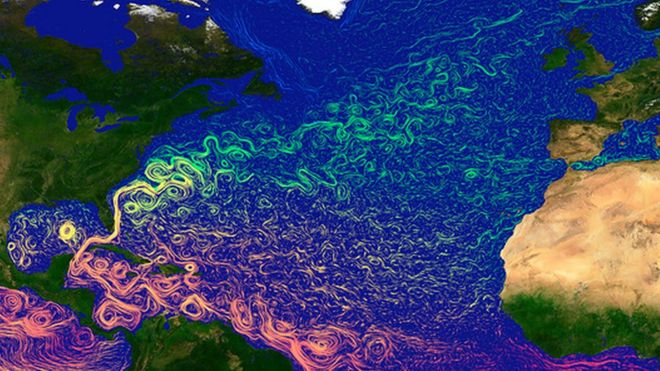
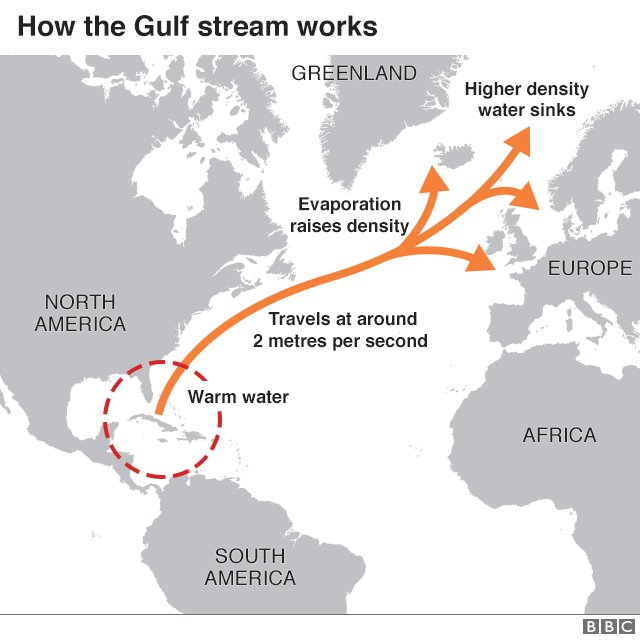
It’s a powerful ocean current that is part of the Amoc and it flows from the Gulf of Mexico, around Florida and up along the east coast of the US, before crossing the Atlantic towards Ireland, the UK and Europe.

Map showing how the Gulf Stream works

Why is it important?

For decades we’ve believed that the Gulf Stream and the Amoc were like a giant hot water bottle, keeping Europe and the Eastern US warm in the winter.

It’s believed that the impact was as much as 5C, keeping London and Western Europe far less cold than say parts of Canada which are at the same latitude.

But this new study indicates that the Amoc plays a far more important role as a massive global heat distribution system than it does in keeping Europeans toasty.

gulf stream Image copyright SPL

Image caption
A colorised satellite image showing the Gulf Stream

It works like this – The warm waters from tropical regions are carried up to the North Atlantic where the current sinks them deep into the oceans, with cooler waters then returning south in their stead.

When the Amoc current moves faster, more of the heat that is trapped in our atmosphere from the burning of fossil fuels is taken and stored up to 1,500m below the surface of the ocean. When it slows down, less heat is sequestered in the seas and so our land surface temperatures increase.

What’s the evidence for this new Amoc theory?

When the Amoc was at a minimum between 1975 and 1998, more heat entered the atmosphere and global temperatures gradually went up. When the current started to accelerate from the mid-1990s to the early 2000s, and sink more heat it coincided with a so-called slowdown in the pace of global warming.

Now the authors say that the big decline is Amoc flow since 2004 means less heat going into the waters and more into the air, leading to higher global temperatures. And that is likely to continue.

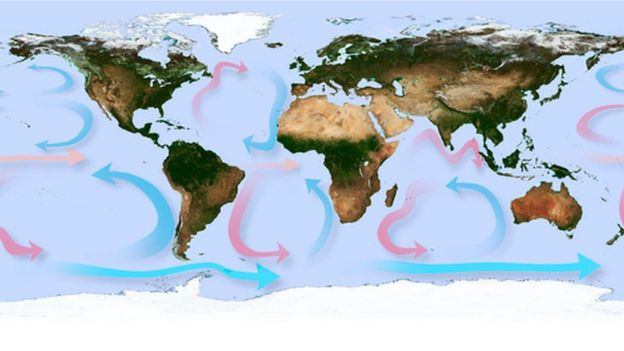
ocean currentsImage copyright SPL . Image caption The flow of ocean currents around the world


“It is difficult to predict changes,” said Prof Tung.

“But under the scenario that greenhouse gas forcing hasn’t changed much, it would be comparable to the warming in that period of 1975-1998, if slightly lower, but it’s comparable.”

Will the slowdown in the Atlantic current continue?

That’s unlikely according to this study.

“We think that the decline of Amoc is reaching the minimum and if history repeats, we will think this one will last about two decades.”

“Where we have direct measurements, such as off the coast of Florida, the measurements there have flattened since 2011. In the northern Atlantic it is still declining.”

So what will this mean for the UK?

While the waters of the North Atlantic will definitely cool as a result of changes in the flow, the experts says it’s likely that the UK will see continued impacts of climate change over the next 20 years according to this study.

“The air temperatures globally will be warming and there’s no barrier for that so there won’t be much cooling in the UK, you will probably still see the normal global warming,” said Prof Tung.

The study has been published in the journal Nature.

Big Oil Knew: Denial and Distraction

War On Our Future  June, 2018

Big Oil Knew: Denial and Distraction

The oil industry discovered the links between fossil fuels and climate change back in the 1960’s. Here’s what they did when they found out… #YEARSproject #BigOilKnew

Big Oil Knew: Denial and Distraction

The oil industry discovered the links between fossil fuels and climate change back in the 1960s. Here's what they did when they found out… #YEARSproject #BigOilKnew

Posted by War On Our Future on Wednesday, June 13, 2018