Scientists Found Microplastics in Every Human Semen Sample They Examined

Futurism

Scientists Found Microplastics in Every Human Semen Sample They Examined

Victor Tangermann – June 11, 2024

A team of researchers has found microplastics in all 40 semen samples they examined from healthy men, highlighting the urgent need to study how these tiny particles could affect human reproduction.

In a paper published in the journal Science of the Total Environment, researchers from a number of Chinese institutions identified eight different polymers in the samples, with polystyrene being the most prevalent.

As The Guardian reports, it’s only the latest in a string of studies that have equally found microplastics in semen.

While their effect on reproduction and human health still isn’t entirely understood, researchers have also been documenting a global decline in sperm count and other issues plaguing male fertility, linking them to a number of environmental and lifestyle factors.

Other studies have found that microplastics can reduce sperm count in mice and disrupt the human endocrine system.

It’s also yet another stark reminder of how ubiquitous microplastics have become in the world. They’ve been found clogging human arteries, in bottled waterinside clouds, and even in a cave that was sealed off from all humans.

Given the latest research, these tiny pollutants could even have troubling consequences for our ability to reproduce.

“As emerging research increasingly implicates microplastic exposure as a potential factor impacting human health, understanding the extent of human contamination and its relation to reproductive outcomes is imperative,” the researchers wrote in their paper.

Studies involving mice “demonstrate a significant decrease in viable sperm count and an uptick in sperm deformities, indicating that microplastic exposure may pose a chronic, cumulative risk to male reproductive health,” they added.

different study published in the journal Toxicological Sciences last month found microplastics in all samples of 47 canine and 23 human testicles.

“At the beginning, I doubted whether microplastics could penetrate the reproductive system,” coauthor and University of New Mexico professor Xiaozhong Yu told The Guardian at the time. “When I first received the results for dogs I was surprised. I was even more surprised when I received the results for humans.”

Worse yet, the samples dated back to 2016, suggesting that the “impact on the younger generation might be more concerning,” given the particles’ growing prevalence, Yu added.

As a result, experts are calling for action to reduce the amount of plastic being produced worldwide, much of which will end up polluting the environment and our bodies.

“In particular, there is a need for action to avoid additional permanent damage to the planet and the human body,” University of Rome’s Luigi Montano, who coauthored a separate study that found microplastics in human semen, told The Guardian.

“If microplastic pollution impacts the critical reproductive process, as evidenced in particular by the decline in seminal quality recorded in recent decades globally, it may prove to be [even worse] for our species in the not too distant future,” he added.

More on microplastics: Whoever Figures Out How to Remove Microplastics From the Human Body Is Going to Make a Fortune

Mexico’s new president ran on climate goals. Will she follow through?

The Guardian

Mexico’s new president ran on climate goals. Will she follow through?

Thomas Graham in Mexico City – June 10, 2024

<span>Claudia Sheinbaum in Mexico City, Mexico, last week.</span><span>Photograph: Raquel Cunha/Reuters</span>
Claudia Sheinbaum in Mexico City, Mexico, last week.Photograph: Raquel Cunha/Reuters

The month before Mexico’s 2 June presidential vote the country was bedeviled by water cuts and blackouts as a record heatwave took the country beyond red and into an ominous purple on the weather map.

As dehydrated monkeys dropped dead from trees, the landslide victory of Claudia Sheinbaum, a climate scientist, might look like salvation. But her record paints a more complicated picture – one where climate convictions have often, and may still, come second to political pragmatism.

Sheinbaum will inherit a country that has slipped from frontrunner to laggard on climate policy – in part due to the policies of her predecessor and ally, Andrés Manuel López Obrador, which she has promised to continue.

López Obrador, who comes from the oil-rich state of Tabasco, prioritised “energy sovereignty” by growing the role of state companies and striving for self-sufficiency.

Related: Mexico was once a climate leader – now it’s betting big on coal

This was manifested in a $17bn oil refinery and colossal injections of cash and tax cuts for Pemex, the most indebted state oil company in the world, and one of the biggest historical polluters.

One result was to entrench a dirty-energy matrix, with almost 80% coming from fossil fuels.

Meanwhile, Mexico’s climate commitments were left to languish. It is one of just two G20 countries not to have a net-zero target, and it’s a long way from reducing emissions by 35% by 2030, under the Paris agreement.

“Not only are we nowhere near it, but we don’t have any specific and detailed plans to achieve it, let alone financing and concrete infrastructure projects,” said Diego Rivera Rivota, a researcher at Columbia University’s Center on Global Energy Policy.

This is despite the fact that Mexico is highly vulnerable to climate change – as was driven home by the extraordinary hurricane that hit Acapulco in October 2023, killing dozens and causing catastrophic damage.

“Acapulco taught us a big lesson. We weren’t prepared for that,” said Gustavo Alanís, general director of CEMDA, an environmental NGO. “These floods, droughts, hurricanes and heatwaves aren’t just going to continue, but possibly get more severe and frequent.”

Many hope Sheinbaum’s background as a climate scientist – one who contributed to the reports of the Nobel prize-winning Intergovernmental Panel on Climate Change – will shine through once she takes office on 1 October, notwithstanding her reliance on López Obrador to win the presidency.

When she was mayor of Mexico City, there were certain signs of the approach she might take as president, with an emphasis on solar energy, electrified public transport and a new cable car line.

But then, the city saw no great improvement in either of its fundamental environmental problems: air pollution and water shortages.

Related: A tale of two cities: a month after Hurricane Otis, Acapulco exposes gaps in disaster response

Meanwhile, on the campaign trail, Sheinbaum promised all things to all people, saying she would both continue López Obrador’s policies but also do more for the environment.

This means the Maya Train – one of López Obrador’s flagship infrastructure projects to develop historically poorer regions – will continue to cut through Latin America’s second-largest tropical forest. Sheinbaum has even suggested expanding it to neighbouring Belize and Guatemala.

There will also be more backing for Sembrando Vida, López Obrador’s pet forestry and rural development initiative that has had money plowed into it as budgets for state environmental agencies have been slashed – even though its results are little understood, and there are reports it even promotes deforestation.

And there will be more public money for Pemex as it staggers on under its debt burden and tries to increase its oil output.

On the other hand, Sheinbaum has also suggested that Pemex expand its remit to include mining for lithium, a crucial element of electric batteries.

And there was a campaign pledge to spend $14bn on clean-energy projects. That would mark a radical change from López Obrador’s government, which not only invested very little in renewables, but also revoked or blocked permits for private projects.

Experts also expect to see more action on the demand side of the equation, with an emphasis on electrification of public transport and incentives for residential solar panels. “This is a country with 300 days plus of sun,” said Rivera Rivota. “It has massive potential for that.”

Although Sheinbaum’s proposals lack detail at this stage, she has repeatedly emphasised the need for long-term planning for both energy and water – looking not just to 2030, but to 2050 and beyond.

“[Long-term planning] was not guaranteed during the current administration. We had several legal and regulatory changes, and other attempts at change that led to battles in court,” said Rivera Rivota. “As long as it’s clear what the rules of the game are, what the legal framework is, I think Mexico has enormous potential for investment in renewable energy.”

The scale of victory for Sheinbaum’s Morena party, which seems to have given it a supermajority in one and perhaps both houses of congress, as well as the governorships of 24 of Mexico’s 32 federal entities, has given Sheinbaum a huge mandate as president-elect.

But whether she wants or will be able to move away from her predecessor’s policies is an unknown.

López Obrador will remain a powerful figure – and his continued support may be needed to help hold together Morena, the party that he founded but has since expanded to house disparate ideologies, and fractious groups.

“She was never going to contradict the president during the campaign,” said Rivera Rivota. “But who knows what will happen when she’s sitting in the Palacio Nacional and making the calls herself.”

“There is hope, and there is a vote of confidence [in Sheinbaum],” said Alanís of CEMDA. “But here we will be vigilant, and we will be checking the actions of her administration every day.

“And if necessary, we will raise our voice.”

N. Korea sends more balloons as Kim’s sister warns of ‘new counteraction’

AFP

N. Korea sends more balloons as Kim’s sister warns of ‘new counteraction’

Hieun Shin and Cat Barton – June 10, 2024

In recent weeks, North Korea has sent hundreds of balloons into the South, carrying trash like cigarette butts and toilet paper (Handout)

North Korea has sent hundreds more trash-carrying balloons toward South Korea, Seoul’s military said Monday, after Kim Jong Un’s powerful sister warned of further responses if the South keeps up its “psychological warfare”.

In recent weeks, North Korea has sent hundreds of balloons into the South, carrying trash like cigarette butts and toilet paper, in what it calls retaliation for balloons laden with anti-Pyongyang propaganda floated northwards by activists in the South, which Seoul legally cannot stop.

The South Korean government this month fully suspended a 2018 tension-reducing military deal and restarted loudspeaker propaganda broadcasts along the border in response to Pyongyang’s balloons, infuriating the North which warned Seoul was creating “a new crisis”.

Kim’s sister and key government spokeswoman Kim Yo Jong said in a statement released early Monday that South Korea would “suffer a bitter embarrassment of picking up waste paper without rest and it will be its daily work”.

In the statement carried by the official Korean Central News Agency, she slammed the activists’ leaflets as “psychological warfare” and warned that unless Seoul stopped them and called off the loudspeaker broadcasts, the North would hit back.

“If the ROK simultaneously carries out the leaflet scattering and loudspeaker broadcasting provocation over the border, it will undoubtedly witness the new counteraction of the DPRK,” she said, referring to both countries by their official n

Seoul’s military said the North had sent more than 300 trash-carrying balloons overnight, but that the winds had not worked in Pyongyang’s favour.

“Although they launched over 310 balloons many of them flew toward North Korea,” the Joint Chiefs of Staff said, adding that around 50 had landed in the South so far, with more expected.

They said that the latest batch of trash balloons had been found to contain waste paper and plastic, but nothing toxic.

“So far we haven’t seen any special movement within the North Korean military,” a JCS official said, adding that they had “detected signs of North Korea installing loudspeakers to broadcast to the South in the front area.”

North Korea has also used its own loudspeakers along the border since the 1960s, typically broadcasting praise of the Kim family, but it suspended them in 2018 as ties warmed

– ‘Beyond our imagination’ –

The statement from Kim’s sister shows that “North Korea is raising its voice in order to shift the blame for the current situation to South Korea and also to justify their provocation,” Kim Dong-yub, professor at the University of North Korean Studies in Seoul, told AFP.

The cycle of escalation will likely continue and “North Korea will do something beyond our imagination,” Kim said.

Pyongyang could do “something creative like throwing flour (which) will cause absolute panic in the South which they will be happy about,” Kim added, referring to the possibility of the North faking a biological attack on the South.

The tit-for-tat balloon blitz started in mid-May when activists in the South — including North Korean defectors — sent dozens of missives carrying anti-Kim propaganda and flash drives of K-pop music northwards.

In 2018, during a period of improved inter-Korean relations, the leaders of the two Koreas agreed to “completely cease all hostile acts”, including stopping the leaflets and broadcasts.

The South Korean parliament passed a law in 2020 criminalising sending leaflets to the North, but activists did not stop and the law was struck down by the Constitutional Court last year as an undue limitation on free speech.

In 2018, Seoul also dismantled some of the loudspeakers, a tactic that dates back to the Korean War and which infuriates Pyongyang, which previously threatened artillery strikes against the loudspeaker units unless they were switched off.

Both sides are now facing a risky proposition, said Leif-Eric Easley, a professor at Ewha University in Seoul.

“Seoul does not want military tension at the inter-Korean border, and Pyongyang does not want outside information threatening the legitimacy of the Kim regime,” he said.

“North Korea may have already miscalculated, as South Korea’s democracy cannot simply turn off NGO balloon launches the way an autocracy would expect.”

The Success Narratives of Liberal Life Leave Little Room for Having Children

By Anastasia Berg and Rachel Wiseman – June 10, 2024

Dr. Berg and Ms. Wiseman are the authors of the forthcoming book “What Are Children For?: On Ambivalence and Choice.”

A baby atop a podium next to a man standing at another podium.
Credit…Andrea Settimo

For young, secular, politically progressive men and women, having children has become something of an afterthought. Liberal conventional wisdom encourages people to spend their 20s on journeys of personal and professional self-discovery and self-fulfillment. Children are treated as a bonus round, something to get to only after completing a long list of achievements: getting a degree, forging a satisfying and well-established career, buying a house, cultivating the ideal romantic partnership.

The standards of readiness for family are at once so high and so vague that it’s hardly a surprise when people fail to reach them. Indeed, the data suggest that people are having children later than they used to and are having fewer than they’d like.

For progressives, waiting to have children has also become a kind of ethical imperative. Gender equality and female empowerment demand that women’s self-advancement not be sacrificed on the altar of motherhood. Securing female autonomy means that under no circumstances should a woman be rushed into a reproductive decision — whether by an eager partner or tone-deaf chatter about ticking biological clocks. Unreserved enthusiasm for having children can come across as essentially reactionary.

Over the past four years, we’ve conducted interviews and surveys with hundreds of young Americans about their attitudes toward having children. These conversations revealed that the success narratives of modern liberal life leave little room for having a family. Women who want kids often come to that realization belatedly, at some point in their early 30s — the so-called panic years. If they are lucky, their partner (if they have one) will fall in line. If they are not, they face a choice of returning to the dating pool, freezing their eggs (if they haven’t done so already), single parenting or giving up their hope of having kids of their own.

In this way, the logic of postponement that has been promoted by liberals and progressives — and bolstered by overblown optimism about reproductive technologies — robs young people of their agency. How many children they have, and even whether they have them at all, is increasingly a decision made for them by circumstance and cultural convention.

This is not just a recipe for unhappiness; it also reflects a deep confusion. There is nothing inherently unprogressive about embracing the prospect of children. Even Simone de Beauvoir, the philosopher who was among the first to critique reproduction and family as instruments for the oppression of women, acknowledged that shaping the character and intellect of another human being was “the most delicate and the most serious undertaking of all.” While certain conservative visions of family life — such as “trad wives” and Silicon Valley pronatalism — no doubt have little to offer those on the left, our fellow progressives need to stop thinking of having children as a conservative hobbyhorse and reclaim it for what it is: a fundamental human concern.

The family — recognized as the seat of customs and traditional values — has long been central to the appeal of conservatism. Yet it wasn’t that long ago that Republicans and Democrats fought over who could rightfully claim to be the party of “family values.” Bill Clinton, while campaigning for president against George H.W. Bush in 1992, assailed the Republican Party’s commitment to families as little more than hypocrisy. “Where are they,” he asked, “when there is no health care for pregnant women? When too many children are born with low birth weights?” Mr. Clinton went on to announce a 14-point “American Family Values Agenda.”

But in time, liberals and progressives came to shy away from publicly embracing the American family as a symbol and an ideal. After Mr. Clinton was impeached in the wake of his own family-values hypocrisy and George W. Bush was elected with the help of energized evangelical voters, family-friendly rhetoric became anathema to liberals — perceived as phony, intrusive and toxic. (The notable exception was gay marriage, whose legalization was won with the help of arguments that promoted the virtues of families.) Today, the left proudly defends the sacrosanct right to abortion and reproductive justice while almost entirely sidestepping the question of whether having children is a worthy project to begin with.

The stark polarization of today’s public discourse has only heightened the left’s wariness of children, both privately and politically. Progressive policy defeats are often met with anti-natalist grandstanding. Members of the ecological activist group BirthStrike, founded in 2018, declared that they were protesting climate inaction by refusing to have kids. The following year, shortly after proposing legislation for a Green New Deal, Representative Alexandria Ocasio-Cortez of New York broadcast progressives’ hesitancy to reproduce in the face of climate change to her 2.5 million Instagram followers when she said, “It does lead young people to have a legitimate question: Is it OK to still have children?”

The Supreme Court’s Dobbs decision, which overturned the constitutional right to abortion in 2022, has also made liberals and progressives more uneasy with the idea of starting a family. A year after Dobbs, the reproductive-rights journalist Andrea González-Ramírez wrote that she had been contemplating having children in her early 30s, before the Supreme Court’s decision put an end to all that: “I have never been sure that I desire to be a mom, let alone that I desire it enough to assume the risks. These days, however, that door is shut. I choose myself.”

That choice is not uncommon. In a recent study, 34 percent of women ages 18 to 39 reported that they or someone they know had “decided not to get pregnant due to concerns about managing pregnancy-related medical emergencies.” That might sound like a worry about abortion access, but the study suggested that Dobbs intensified ambivalence about having children more generally. Indeed, of the women who said they were forgoing having children because of the Dobbs ruling, about half lived in states where abortion rights were still protected.

One can’t help noting the irony: In permitting the conservative movement to alienate them from the question of whether they want to have and raise children, these liberals and progressives are allowing the right to shape their reproductive agendas in yet another way.

But the partisan framing of the issue is flawed at a more fundamental level. The question of children ultimately transcends politics. In deciding whether to have children, we confront a philosophical challenge: Is life, however imperfect and however challenging — however fraught with political disagreement and disaster — worth living?

To be sure, having children is not the only way to address this question. But having children remains the most basic and accessible way for most of us to affirm the value of our lives and that of others. This is in part because becoming a parent represents one of the greatest responsibilities one human being can assume for another. And it is also because the perpetuation of human life is the condition of possibility for every other thing we care about.

Committing oneself to long-term leftist causes like economic, environmental, racial and social justice is more than just compatible with embracing children and family life. It presupposes a willingness to take personal and collective responsibility for the next generation — raising, nurturing and educating those who will decide the fate of our country and our planet.

Surely, progressives and conservatives will give as vastly different answers to the question of what raising children ought to look like as they will to the question of how American society ought to be governed. But progressives must not let partisan loyalties stop them from thinking about the ways in which having children does or does not express their values, and what shape they really want their lives to take. Children are too important to allow them to fall victim to the culture wars.

Anastasia Berg is an assistant professor of philosophy at the University of California, Irvine, and an editor of the magazine The Point, where Rachel Wiseman is the managing editor. They are the authors of the forthcoming book “What Are Children For? On Ambivalence and Choice.”

South Korea to resume loudspeaker broadcasts over border in balloon row

BBC News

South Korea to resume loudspeaker broadcasts over border in balloon row

Shaimaa Khalil and Thomas Mackintosh – June 9, 2024

A balloon carrying various objects including what appeared to be trash, believed to have been sent by North Korea, is pictured at the sea off Incheon, South Korea
The move comes as North Korea continues to send balloons carrying rubbish across the border into South Korea [Reuters]

South Korea has said it will resume propaganda broadcasts against North Korea for the first time in six years in response to Pyongyang’s campaign of sending rubbish-filled balloons across the border.

Over 300 North Korean balloons were detected over Saturday and Sunday with around 80 landing in the South carrying scrap paper and plastic sheets.

North Korea is yet to respond to the announcement, but Pyongyang considers the loudspeaker propaganda broadcasts an act of war and has threatened to blow them up in the past.

Last month North Korea appeared to send at least 200 balloons carrying rubbish over the border in retaliation for propaganda leaflets sent from the south.

I recent weeks Pyongyang has launched around one thousand sacks of waste paper, cigarette butts and excrement across the border
South Korean officials warn the public not to touch the balloons, but to report them [Reuters]

Over the weekend North Korea resumed its waste campaign against its neighbour by sending balloons carrying sacks of rubbish over the border into South Korea.

It was in retaliation for activists in the South sending 10 balloons containing leaflets critical of the North Korean regime on Friday, according to AFP news agency.

South Korea’s military said there are no more balloons in the air adding that no hazardous materials have been found.

It has warned the public not to touch the balloons and to be aware of falling objects.

The public should report any sightings to the nearest police or military unit, the military added.

Following the latest batch of balloons, South Korea’s National Security Council said loudspeaker broadcasts on the border would resume on Sunday after agreeing to restart the loudspeakers for the first time since 2018.

On Thursday an activist group in South Korea said it had flown balloons into North Korea carrying leaflets criticising the leader Kim Jong Un, dollar bills and USB sticks with K-pop music videos – which is banned in the North.

In recent years, the broadcasts have included news from both Koreas and abroad as well as information on democracy and life in South Korea.

The South Korean military claims the broadcasts can be heard as much as 10km (6.2 miles) across the border in the day and up to 24km (15 miles) at night.

In May, a South Korea-based activist group claimed it had sent 20 balloons carrying anti-Pyongyang leaflets and USB sticks containing Korean pop music and music videos across the border.

Seoul’s parliament passed a law in December 2020 that criminalises the launch of anti-Pyongyang leaflets, but critics have raised concerns related to freedom of speech and human rights.

North Korea has also launched balloons southward that attacked Seoul’s leaders.

In one such launch in 2016, the balloons reportedly carried toilet paper, cigarette butts and rubbish. Seoul police described them as “hazardous biochemical substances”.

These are the 10 most bacteria-polluted beaches in America, group says

Fox Weather

These are the 10 most bacteria-polluted beaches in America, group says

Hillary Andrews – June 9, 2024

One of nation's most polluted beaches making California residents sick

The Surfrider Foundation just released its list of the top 10 most bacteria-polluted beaches in America during 2023. At two beaches, every sample taken throughout the year exceeded state health standards.

The organization set up the Blue Water Task Force (BWTF) which sampled water at 567 different sites across beaches, oceans, estuaries and freshwater creeks throughout the U.S. They collected 9,538 samples. About 22% of the samples showed high bacteria levels and 64% of the almost 600 beaches monitored didn’t pass state health standards at least once.

According to the report, funding is leading to a reduction in the number of beaches being monitored by government agencies on a regular basis.

“Chronic underfunding has forced states to prioritize which beaches to monitor, reduce sampling frequency, and limit beach seasons in order to stretch their federal grant dollars as far as possible,” stated the Surfrider’s Clean Water Report 2023.

“Most chapter water testing programs are designed to fill in the gaps and extend the coverage of state and local agency beach monitoring programs,” the report continued. “Surfrider volunteers are not only testing beaches that are not covered by agencies, but they are also monitoring potential sources of pollution, such as stormwater outlets, rivers, and creeks that discharge onto our beaches.”

Some beaches only monitor in the summer. About 67% of the samples showed low bacteria levels and 11% showed medium levels.

“The majority of the water samples that failed to meet health standards were collected from freshwater sources, such as rivers, creeks, and marshes, which are influenced by storm water runoff, or at beaches near these outlets,” wrote Surfrider. “These results are consistent with national trends, which show that storm water runoff is the number one cause of beach closures and swimming advisories in the U.S.

FECAL MATTER POSED RISK AT 90% OF TEXAS BEACHES LAST YEAR, REPORT SAYS. HERE’S HOW TO TRACK IT

Stormwater washes chemicals and other pollutants from streets and lawns into local waterways and down to the beach, the group said. Stormwater and flooding after heavy rain can also cause wastewater systems, like cesspools, septic systems and sewers, to fail and send untreated sewage into rivers, streams, oceans and lakes.

“Nearly 10 trillion gallons of untreated stormwater runoff flow into U.S. waterways every year, carrying a cocktail of pollutants including road dust, oil, animal waste, fertilizers, and other chemicals,” Surfrider wrote. “Sewage can contain bacteria, viruses, and parasites that make people sick with gastrointestinal symptoms, rashes, skin and eye infections, flu-like symptoms, and worse.”

Both Imperial Beach in San Diego County, California, and Nawiliwili Stream at Kalapaki Bay in LihueHawaii, on the island of Kauai, failed every test. That means that bacterial levels were so high, the state deems the beach unsafe for swimming.

HOW TO TRACK YOUR BEACH’S WATER QUALITY

Authorities have closed Imperial Beach for 930 days, according to local media. However, closing the beach to swimming still won’t keep everyone safe.

“These closures don’t fully prevent people from getting sick as some toxins are aerosolizing and contaminating the air in Imperial Beach and other nearby border communities,” said Surfrider. “People are getting sick just by breathing the air as they go to work, school, and even trying to enjoy their own backyards.”

South Bay Urgent Care in Imperial Beach told FOX 5 San Diego that in the past year the number of patients needing breathing treatments grew by 140%.

RAINWATER POLLUTED BY FOREVER CHEMICALS WORLDWIDE, STUDY SAYS

File: A dog competes during the 5th annual Loews Coronado bay resort surf dog competition in Imperial Beach, south of San Diego, California on May 22, 2010.

“Every day is another patient getting sick, and we don’t want that anymore. We see newborns come in. It’s tough for people over 100,” Dr. Mathew Dickson said. “They’re coughing, eyes are running, eyes are watering, and they’re wheezing a lot.”

He is on a task force researching long-term effects of pollution exposure.

The Scripps Institute of Oceanography linked 34,000 illnesses to Imperial Beach pollution in 2017.

“Coastal waters along Tijuana, Mexico, and Imperial Beach, USA, are frequently polluted by millions of gallons of untreated sewage and stormwater runoff,” the research stated. “Entering coastal waters causes over 100 million global annual illnesses, but CWP (coastal water pollution) has the potential to reach many more people on land via transfer in sea spray aerosol.”

Hurricane Hilary alone released 2.5 billion gallons of contaminated stormwater through the Tijuana River Valley, according to the Clean Water Report. Volunteers found bacterial levels almost 100 times higher than California’s health standard for safe recreation.

TOXIC ALGAE BLOOM BECOMING DEADLY FOR SEA LIONS, DOLPHINS IN PACIFIC OCEAN

SAN DIEGO, CALIFORNIA - AUGUST 19: A surfer walks out of the Pacific Ocean at Ocean Beach shortly after sunset with Hurricane Hilary approaching on August 19, 2023 in San Diego, California. Southern California is under a first-ever tropical storm warning as Hurricane Hilary approaches with parts of California, Arizona and Nevada preparing for flooding and heavy rains.
File: A surfer walks out of the Pacific Ocean at Ocean Beach shortly after sunset with Hurricane Hilary approaching on August 19, 2023 in San Diego, California.

HOW TO WATCH FOX WEATHER

Scripps study from 2021 pointed out that in the U.S. alone, an estimated 90 million cases of waterborne illness of the gastrointestinal tract, ear, eye, respiratory tract and skin occur every year from recreational contact. The estimated cost of that is $2 billion every year.

“These priority beaches represent a variety of recreational waters and access points that are important to local communities, yet water quality conditions could be putting public health at risk,” Surfrider said. “No one should get sick from spending time at the beach.”

Other beaches and waterways on the list are recreational waters and access points to rivers and bays for paddleboarders and kayakers in local communities.

Nawiliwili Stream in Hawaii flows across a Kauai, Hawaii, beach where families bring kids to play in the calm shallow waters, according to Surfrider.

HOW FLOODWATER CAN MAKE YOU VERY SICK

Linda Mar Beach in Pacifica, California is a popular surf break. Kahalulu on Oahu in Hawaii is an access point for snorkeling, boating and fishing in Kaneohe Bay.

File: Beachgoers walk at Linda Mar Beach in Pacifica, Calif., on Wednesday, June 15, 2023.

The BWTF posts recent water test results on their website. The EPA has a list of all beaches that are monitored. The EPA also posts beach closures and advisories along with water test results.

Records tumble across Southwest U.S. as temperatures soar well into triple digits

Associated Press

Records tumble across Southwest U.S. as temperatures soar well into triple digits

Scott Sonner – June 6, 2024

Sofia Ramirez, left, of Mexico drinks water as she waits in line to take a photo at the Welcome to Fabulous Las Vegas sign in Las Vegas Thursday, June 6, 2024. (Steve Marcus/Las Vegas Sun via AP)
Dean Leano takes a water break while photographing tourists at the Welcome to Fabulous Las Vegas sign in Las Vegas Thursday, June 6, 2024. (Steve Marcus/Las Vegas Sun via AP)

RENO, Nev. (AP) — Records tumbled across the U.S. Southwest on Thursday as temperatures soared past 110 degrees Fahrenheit (43 degrees Celsius) in some areas, and the region’s first heat wave of the year was expected to maintain its grip for at least another day.

Although the official start of summer was still two weeks away, roughly half of Arizona, California and Nevada were under an excessive heat alert, which the National Weather Service said it was extending until Friday evening.

At a campaign rally for presumptive Republican presidential nominee Donald Trump in Phoenix, 11 people fell ill from heat exhaustion by late afternoon and were taken to the hospital, where they were treated and released, fire officials said.

The weather service in Phoenix described the city experiencing “dangerously hot conditions.”

And in Las Vegas, the Clark County Fire Department said it has responded to at least 12 calls for heat exposure since midnight Wednesday. Nine of those calls ended with a patient needing treatment in a hospital. A spokesperson for the county said the number is likely higher, as the heat can also play a role in other types of calls to the fire department, including those related to alcohol intoxication or when conditions like fainting, dizziness or nausea are reported.

New record highs Thursday included 113 F (45 C) in Phoenix, breaking the old mark of 111 F (44 C) set in 2016, and 111 F (44 C) in Las Vegas, topping the 110 F (43 C) last reached in 2010. Other areas of Arizona, California and Nevada also broke records by a few degrees.

The heat has arrived weeks earlier than usual even in places farther to the north at higher elevations — areas typically a dozen degrees cooler. That includes Reno, Nevada, where the normal high of 81 F (27 C) for this time of year soared to a record 98 F (37 C) on Thursday.

The National Weather Service in Reno forecast mild cooling this weekend, but only by a few degrees. In central and southern Arizona, that will still means triple-digit highs, even up to 110 F (43 C).

____

Associated Press writers Anita Snow and Ty O’Neil in Phoenix, and Rio Yamat in Las Vegas contributed to this report.

The Pesky Natural Mineral Shaking The Foundations Of Massachusetts Real Estate

Benzinga

The Pesky Natural Mineral Shaking The Foundations Of Massachusetts Real Estate

Eric McConnell – June 2, 2024

The Pesky Natural Mineral Shaking The Foundations Of Massachusetts Real Estate

mineral known as pyrrhotite, which occurs naturally in New England, is wreaking havoc on homeowners across Massachusetts. Pyrrhotite causes concrete, the foundation material for many homes in Central Massachusetts, to deteriorate and then crumble. When pyrrhotite deterioration is discovered, the homeowner has two equally undesirable choices: make expensive repairs or risk the home’s foundation crumbling.

Because of the extensive scope of the necessary work, it’s not uncommon for the repairs to cost tens or even hundreds of thousands of dollars. According to a FEMA case study on pyrrhotite in neighboring Connecticut, the only way to properly repair a foundation where pyrrhotite has been discovered is to “lift the house off the foundation and completely replace all the concrete.”

Many homeowners get an even nastier surprise when they discover their home insurance won’t cover the repairs. Many others don’t have insurance at all. Even if they did, the issue for insurers regarding covering pyrrhotite-related damages is that it does its devastating work slowly over time. If it destroyed the foundation immediately, catastrophic loss coverage might kick in.

However, pyrrhotite takes years to destroy a foundation. Because of this, area insurers have adopted a policy of refusing to cover repair costs associated with pyrrhotite-related damage. This exacerbates the problem for homeowners. Many area banks and lenders are reluctant to lend homeowners the money they need to make the repairs, even if they have home equity.

Loan underwriters take a purely risk and numbers-based approach to loan approvals. Given this, why would they lend money on an asset where the foundation is crumbling? If the homeowner defaults, the bank will be stuck foreclosing on an investment with a crumbling foundation and trying to recoup that money at a public auction. It sounds like a recipe for losing money.

All of this is having a devastating effect on homeowners. Many have horror stories about suddenly being in a position where their most valuable asset is rendered worthless unless they make repairs they can’t afford. Even if they try to sell, real estate disclosure laws will mandate they inform the buyer of the presence of pyrrhotite in the foundation. Decades of asset appreciation are being wiped away.

Few things make a house less desirable than the knowledge it has a crumbling foundation that could cost several hundred thousand dollars to repair. The saddest aspect of this story is that the fates of many affected homes were sealed the day their foundation was poured. Because pyrrhotite is naturally occurring, it inevitably made its way into the concrete supply of quarries statewide.

Over several decades, developers across Massachusetts ordered and poured countless tons of pyrrhotite-contaminated concrete. Unfortunately for affected homeowners, the slow pace of pyrrhotite destruction means they are well beyond the time limit within which they could still hold their homebuilders liable for the damages.

State laws have also been updated, and quarries are now required to test for the presence of pyrrhotite in their concrete before shipping it. However, that only provides future relief and residents dealing with pyrrhotite-related foundation decay are suffering right now.

Many are banding together to fight back by seeking legislative relief by having Massachusetts adopt a solution similar to the one Connecticut employed to handle its pyrrhotite problem. State Sen. Ryan Fattman is one of the most vocal proponents of the proposed legislation.

During a meeting with affected homeowners, he said, “That is the main mechanism for which we can create a statewide program similar to what Connecticut did, where they added a fee onto homeowners’ insurance and then seeded that money with a fund to fund out the change of foundations for homes that have this pyrrhotite crumbling foundation. And that’s what we hope to do here.”

The future of the legislation isn’t clear; however, it does appear there is a consensus that something must be done. If not, Massachusetts homeowners could continue to see their property values decline while pyrrhotite slowly destroys their home’s foundation from within. That would eventually hit county budgets all over the state because assessments on private property are how most Massachusetts counties fund vital services like public education, fire, and police.

Pyrrhotite is a naturally occurring problem that few people could have seen coming. Now that it’s here, Massachusetts lawmakers, homeowners, and insurance companies must arrive at a mutually amenable solution. If not, this pesky natural mineral could potentially threaten the foundations of Massachusetts’ real estate market.

Mexican officials again criticize volunteer searcher after she finds more bodies

Associated Press

Mexican officials again criticize volunteer searcher after she finds more bodies

Associated Press – June 1, 2024

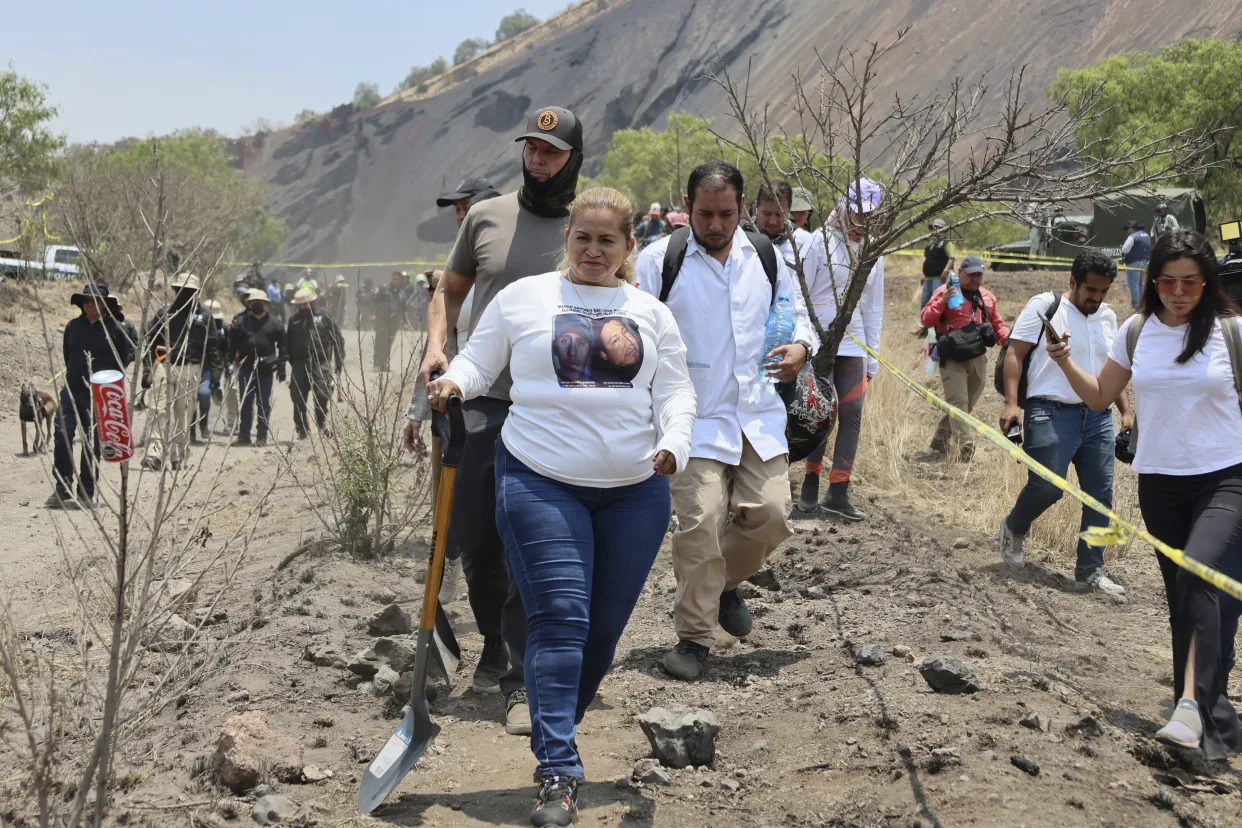
FILE – Ceci Flores, leader of a “searching mothers” group from northern Mexico, carries a shovel at the site where she said her team found a clandestine crematorium in Tlahuac, on the edge of Mexico City, May 1, 2024. The Mexican volunteer searcher who has been attacked in the past by the government found more bodies in Mexico City in the final days of May 2024. (AP Photo/Ginnette Riquelme, File) (ASSOCIATED PRESS)More

MEXICO CITY (AP) — A Mexican volunteer searcher criticized in the past by the government has found more human remains in Mexico City and officials have attacked her for it — again.

The existence of clandestine body dumping grounds is sensitive for Mexico’s ruling Morena party. Morena, which is running the former Mexico City mayor for president in Sunday’s elections, claims the kind of violence that plagues other parts of the country has been successfully combatted in the capital.

But volunteer searcher Ceci Flores, who has spent years searching for her two missing sons, says that’s because officials haven’t bothered to look for bodies. It’s a common complaint by relatives of missing people in many parts of Mexico, where drug cartels and kidnap gangs use shallow pits to dispose of the bodies of their victims.

On Thursday, Flores posted a video showing what appeared to be human femurs and craniums in the tall dry grass of a hillside on the city’s east side. She suggested there were at least three bodies, and noted there could be more on the hillside.

“We don’t want to disturb them,” Flores said in the video, pointing to a pile of bones with her shovel from a distance of several feet. “We don’t want to go in and disturb them.”

Flores has sparred with the government before, accusing officials of ignoring the plight of Mexico’s more than 100,000 missing people.

In late April, Flores drew the ire of city prosecutors when she claimed she had found charred bones and at least two people’s identification cards in another semi-rural area on the city’s east side. Prosecutors quickly concluded the bones were from dogs, and that the ID cards had been discarded or stolen and their owners were alive.

Soon after, President Andrés Manuel López Obrador played a government-produced video at his daily press briefing, accusing searchers like Flores of morbidity and claimed they were suffering from “a delirium of necrophilia.”

But by Friday, acting Mexico City prosecutor Ulises Lara was forced to acknowledge that Flores had indeed found bones, and that they were apparently human. Lara said police, forensic experts, National Guard officers and soldiers were dispatched to the scene.

That raised the obvious question of why the vast team of official manpower had never been able to find the bodies, while a lone searching mother armed with only a shovel did.

Lara lashed out at Flores without mentioning her by name, claiming “the chain of custody” of the evidence had been broken and the bones had been “handled.”

“This violated the dignity and respect that people searching for the relatives deserve, and some of them have expressed their discontent with this situation,” Lara said, implying it would have been better not to have found them.

In a video posted on social media Saturday, Flores reacted with disbelief.

“Seriously? These remains were unknown. We did the work they are supposed to do,” Flores said. “You (Lara) didn’t even know about them, weren’t aware of them, had not located them.”

Regarding the accusation that other searching relatives were angered by her actions — mass searches of the kind Flores carries out in her native Sonora are not common in Mexico City — Flores shot back, “they should be angry at you for not doing your job.”

López Obrador’s administration has spent far more time and resources looking for people falsely listed as missing — people who may have returned home without advising authorities — than in searching for grave sites that relatives say they desperately need for closure.

Flores is a very accomplished searcher, and like many mothers of disappeared people, she has a deep sense of mission. One of her sons, Alejandro Guadalupe, disappeared in 2015. Her second son, Marco Antonio, was abducted in 2019. Authorities have told her nothing about the fate of either of them.

In her home state of Sonora, authorities confirmed in April they had identified 45 missing people from among 57 sets of remains at a body dumping ground known as “El Choyudo” that was originally discovered by Flores’ group, The Searching Mothers of Sonora.

The “madres buscadoras” (searching mothers) usually aren’t trying to convict anyone of their relatives’ disappearances. They say they just want to find their remains. Many families say not having definite knowledge of a relative’s fate is worse than it would be to know a loved one was dead.

At least seven volunteer searchers have been killed in Mexico since 2021.

Southern US city tops list of dirtiest in the nation, study says

Fox News

Southern US city tops list of dirtiest in the nation, study says

Pilar Arias – May 29, 2024

Southern US city tops list of dirtiest in the nation, study says

A recent survey named the “dirtiest” city in the U.S., and earning the top spot this year is none other than Houston, taking the crown from last year’s dirtiest, Newark, New Jersey.

Houston’s ranking in the study from LawnStarter came after a comparison of 152 U.S. cities in the categories of pollution, living conditions, infrastructure and customer satisfaction.

The study says Houston, also known as Space City, is the third most polluted of all the cities ranked, behind San Bernardino, California, and Peoria, Arizona. It cites another study that “found that the city’s petrochemical facilities severely violate EPA safety guidelines.”

LawnStarter data says Houston ranks “third worst in greenhouse gas emissions from large industrial facilities,” and the city has “the biggest cockroach problem, too.”

A spokesperson for the Houston Solid Waste Management Department — which is in charge of waste collection, disposal and recycling — did not immediately respond to a Fox News Digital request for comment.

ALLIGATOR DISCOVERED TAKING BITES OUT OF DEAD WOMAN IN HOUSTON

Last year’s reigning champion, Newark, slipped to the overall rank of No. 2.

Rounding up the top 10 are San Bernardino; Detroit; Jersey City, New Jersey; Bakersfield, California; San Antonio; Fresno, California; Oklahoma City; and Yonkers, New York. New York City came in at No. 12.

RESIDENTS IN TEXAS, OKLAHOMA SEEK SHELTER AS TORNADO DAMAGES HOMES, OVERTURNS TRUCKS

The Houston, Texas skyline
The Houston skyline and I-45 commuter traffic at dusk.

So why does any of this matter? LawnStarter said the study is meant to have people look beyond garbage, pests and poor waste management, saying the negative effects from living in dirty cities can be worse than people realize, citing health problems such as lung cancer, heart disease and stroke that can stem from air pollution.

“Here’s the bottom line: Dirty cities aren’t just an eyesore — they also damage our bodies and our wallets,” LawnStarter says.

NYC looting from TMX
New York City, where a store is seen after a looting in 2022, did not even make the top 10 list of dirtiest cities in the U.S.

LawnStarter provides lawn care providers to customers via its website and mobile application. The company used the survey as an opportunity to attract new business.

“Clean cities tend to have lots of tidy, healthy, green lawns,” they said.

Original article source: Southern US city tops list of dirtiest in the nation, study says