Did you know German foresters used to teach bullfinches to sing? Their ability to mimic is incredible 😲(Headphones essential!) Hear more at BBC Radio 4 👉🏽 bbc.in/2imPRAu
The Story of Plastic: A new movie about plastic waste
By Eliza Erskine October 14, 2019
Lead Image Source : eddie howell on Unsplash
Support OneGreenPlanet
Being publicly-funded gives us a greater chance to continue providing you with high quality content. Please support us!
The Story of Plastic is a new movie all about plastic waste, from production to pollution. The movie is directed by Deia Schlosberg and is presented by The Story of Stuff Project.
The Story of Stuff is known for its digital shorts on topics like plastic waste and consumption. The film includes scenes from around the globe and shows how companies contribute to the plastic problem.
The film made its world premiere at the Mill Valley Film Festival on October 6. The film tells a true “story” of plastic, going through the supply chain. It starts with how plastic is made and then shows it in landfills and other sites of plastic waste. The Story of Plastic shows how plastic recycling is essentially a myth better suited for glass and metals.
Statistics like plastic’s 14% recycling rate are shown in the film. The film shows the impact plastic has on third world countries and where it’s being shipped to once it’s thrown into a trash can in the United States. Much of plastic is only seen as trash or as marine pollution. The film hopes to show plastic through all stages in order to put pressure on plastic production and stop it at the source.
Watch The Story of Plastic teaser trailer:
Executive Producer Stiv Wilson spoke to the Revelator about the movie and what he hopes it will accomplish, “For a long time, I think, the plastic pollution issue has been framed as an ocean issue, and what we haven’t really talked about enough is what the whole system of plastic looks like. Plastic pollutes at every stage of its life cycle. I don’t think most people know that if you want it to stop plastic from going into the ocean in Indonesia you need to ban fracking in the Ohio River valley. The U.S. is the largest exporter of oil and gas as feedstocks for plastic — we feed China, we feed Europe — because of the fracking boom here.”
For more Animal, Earth, Life, Vegan Food, Health, and Recipe content published daily, subscribe to the One Green Planet Newsletter! Also, don’t forget to download the Food Monster App on iTunes — with over 15,000 delicious recipes it is the largest meatless, vegan and allergy-friendly recipe resource to help reduce your environmental footprint, save animals and get healthy!
Lastly, being publicly-funded gives us a greater chance to continue providing you with high quality content. Please consider supporting us by donating!
Trump Kills a Tariff Loophole in Latest Blow to Renewables
Brian Eckhouse and Christopher Martin October 4, 2019
(Bloomberg) — The Trump administration dealt a fresh blow to renewable energy developers on Friday by stripping away an exemption the industry was counting on to weather the president’s tariffs on imported panels.
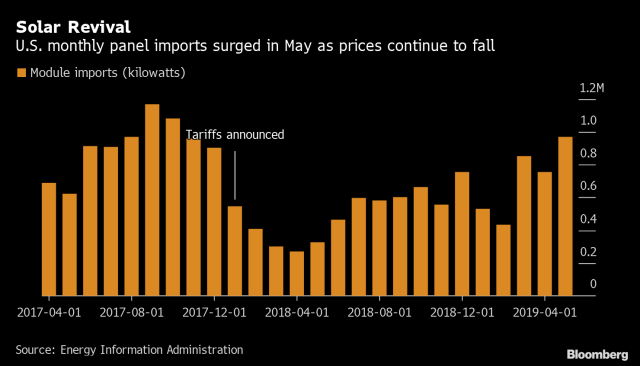
The U.S. Trade Representative said Friday it was eliminating a loophole granted about four months ago for bifacial solar panels, which generate electricity on both sides. They’ll now be subject to the duties Trump announced on imported equipment in early 2018, currently at 25%. The change takes effect Oct. 28.
The exclusion had been a reprieve for the solar industry, which lost thousands of jobs and put projects on ice as a result of the tariffs. Some panel manufacturers had already begun shifting supply chains to produce more bifacial panels. Stripping the exemption is a blow to developers who build big U.S. solar projects. American panel makers First Solar Inc. and SunPower Corp. will regain an edge on foreign competitors.
“The solar tariffs are back,” Tara Narayanan, an analyst at BloombergNEF, said in an interview Friday. “U.S. solar developers cannot buy products with lower costs and higher output as they briefly thought they could.”
First Solar, the largest U.S. solar panel maker, rose 0.5% to $59.60 at 5:16 p.m. SunPower gained 0.7% to $10.62.
What BloombergNEF Says
“The withdraw of tariff exemption for bifacial will cool down its popularity in the U.S. a little, but not stop the rise of the technology, which introduces improved economics even without tariff exemption.”– Xiaoting Wang, solar analyst
Developers that have used bifacial panels and stand to take a hit from ending the exclusion include Renewable Energy Systems Americas Inc.and Swinerton Inc.
While bifacial panels accounted for just 3% of the solar market last year, BloombergNEF had projected a swift ramp-up in production as manufacturers tried to insulate themselves from U.S. tariffs.
The trade group Solar Energy Industries Association fought to preserve the exemption, saying bifacial technology held “great promise for creating jobs, right here in America.”
“We’re obviously disappointed,” the group’s general counsel, John Smirnow, said Friday. “We look forward to making sure the bifacial exemption gets a fair hearing” during the solar tariff’s mid-term review process.
The U.S. Trade Representative said in its filing that “the exclusion will likely result in significant increases in imports of bifacial solar panels, and that such panels likely will compete with domestically produced” products.
SunPower, based in San Jose, California, opposed the exemption without a cap, saying that it would otherwise defeat the purpose of the tariffs. “It just means everyone is going to make a bifacial,” the company’s chief executive officer, Tom Werner, said in a Sept. 23 interview.
–With assistance from Joe Ryan and Ari Natter.
To contact the reporters on this story: Brian Eckhouse in New York at beckhouse@bloomberg.net;Christopher Martin in New York at cmartin11@bloomberg.net
To contact the editors responsible for this story: Lynn Doan at ldoan6@bloomberg.net, Joe Ryan, Pratish Narayanan
Audio of private meeting shows oil industry ripping into Trump administration
By Ben Lefebvre, Politico September 27, 2019
At a closed-door meeting this summer, oil and gas industry lawyers criticized the Trump administration’s failure to recruit enough qualified people to secure policy victories that would outlast this presidency, according to a recording of the gathering.
The audio from an Independent Petroleum Producers of America meeting in Colorado Springs, Colo., obtained by the Western Values Project and shared with POLITICO, contains some of the most unvarnished opinion coming from an industry that has been happy with the administration’s talk on oil and gas but frustrated with its results.
“Two and a half years later, I don’t see the agencies getting better,” Mark Barron, head of energy litigation in the Denver office of Baker – Hostetler, told the group. “I don’t see that leadership or competence in the administration.”
The June meeting came amid mounting frustration over the slow pace of the Trump administration’s major energy policies, including regulatory rollbacks at EPA and efforts from the Interior Department to spur new production. A commitment to open up more federal waters to offshore drilling has stalled amid legal and political pushback, the administration’s move to expedite permitting of pipelines, including for Keystone XL and the Mountain Valley Pipeline has been challenged in court, and states have sued over a rollback on methane emissions rules that even some oil companies have complained is too broad.
During the meeting, Wayne D’Angelo, head of energy litigation at D.C.-based Kelley Drye & Warren LLP, noted that EarthJustice, Natural Resources Defense Council and other groups had sued the administration more than three hundred times over its rollbacks of Obama-era rules, including those on methane emissions and hydraulic fracturing.
“There is a metric buttload of litigation going on in respect to the regulatory agenda,” D’Angelo said, adding that there were “a lot of early wins for environmental lawsuits.”
“I think you’ll see the agencies focusing on fewer high impact rules” as the 2020 election nears, D’Angelo added. “Maybe continue to do stuff with guidance, in full knowledge that’s easy-come, easy-go. Whatever you do through guidance can be taken away through guidance.”
Barron said the agenda was struggling because of a talent deficit at federal agencies, which he attributed to an unwillingness among many experts to work for President Donald Trump.
“For some, the reticence that comes out of the administration on non-energy components, some of the things he may say about some other issues or you may read tweets about, may suggest to yourself that you don’t want to have speeches like this for the next 25 years or get introduced as such-and-such from the Trump administration,” he said. “There’s a real reluctance for some real competent people to serve in this administration, apart from the fact they weren’t going to invite you in if you weren’t supporting him from the beginning.”
Barron singled outInterior Secretary David Bernhardt as a rare “competent technocrat,” among a mostly inexperienced staff. “They may want to implement policy, but at some point you need people who are familiar with Washington, who know how to draft a regulatory rule, have experience doing that at a big level,” he said.
The trade association did not dispute the recording’s authenticity. “It seems to be from that meeting,” IPAA spokesperson Jennifer Pett said in an email. “However, it was off-the-record, so we did not transcribe or record the conversation; so this document cannot be verified as 100 percent accurate.”
In the audio, Katie Schroder, a partner at Davis Graham & Stubbs LLP in Denver who focuses on energy development on federal lands, noted that government lawyers could drop defense of the ongoing lawsuits if Trump loses in 2020.
“At this point, we have to look at the shot clock,” Schroder said at the meeting. “We’re not far from 2020, we’re not far from the next election. Will some of this litigation be resolved by the time the next administration comes in? That’s always part of the calculus.”
She said the industry wanted to see more than guidance documents and executive orders from the administration.
“The real win is to get some regulatory changes in place. … I don’t know if there’s enough energy and drive at Interior to do those things,” she said.
CORRECTION: An earlier version of this report misstated the name of the Independent Petroleum Association of America.
‘We’ve been talking about saving the Amazon for 30 years.’ — Harrison Ford urged UN leaders to listen to young people and let them save the planet from the climate crisis
‘We’ve been talking about saving the Amazon for 30 years.’ — Harrison Ford urged UN leaders to listen to young people and let them save the planet from the climate crisis
10,000 Farmers And Ranchers Endorse Green New Deal In Letter To Congress
Alexander C. Kaufman, HuffPost September 18, 2019
Nearly 10,000 farmers and ranchers are endorsing the Green New Deal as the climate policy battleground expands from the oil fields to the agricultural fields.
In a letter sent to Congress on Wednesday morning, the newly formed bipartisan coalition U.S. Farmers & Ranchers for a Green New Deal threw its weight behind the sweeping industrial plan outlined in a resolution that Rep. Alexandria Ocasio-Cortez (D-N.Y.) proposed in February.
But zeroing out the country’s planet-heating emissions by mid-century requires a transformation in agriculture as dramatic as shifting the energy sector away from fossil fuels, the letter says.
“We believe these climate goals are achievable,” the letter argues, “but only if the GND includes policies that spur two large-scale transitions: the transition away from fossil fuels toward renewable energy alternatives, and the transition away from industrial agriculture toward family farm-based organic and regenerative farming and land-use practices that improve soil health and draw down and sequester carbon.”
The letter was signed by more than 500 individual farms and 50 organizations representing close to 10,000 members. Regeneration International, a sustainable farming nonprofit, organized the missive with the climate justice group Sunrise Movement. It also hosted a Wednesday morning press conference in Washington.
A month ago, the United Nations released a dire new report urging major changes to food production and land management and warning that emissions cuts alone will fall short of halting catastrophic global warming.
Taking cues from those pushing for a Green New Deal, several Democratic presidential hopefuls have made farming practices central to their climate proposals. Sen. Bernie Sanders (I-Vt.) earmarked $410 billion in his Green New Deal proposal to help “farms of all sizes transition to ecologically regenerative agricultural practices.” Sen. Elizabeth Warren (D-Mass.) called for breaking up agriculture monopolies as part of her broad rural platform. South Bend, Indiana, Mayor Pete Buttigieg vowed to “support farmers” by “paying them to capture carbon.”
Yet even as farmers reel from the effects of President Donald Trump’s trade war with China, Democratic candidates are far from guaranteed their votes. Farmers supported the Trump administration’s proposal last week to finalize the rollback of the Obama-era Waters of the U.S. rule, which had put new restrictions on which waterways agribusiness could pollute. Early on, Republican opposition to the Green New Deal itself coalesced around the idea that such a program would ban beef production, although supporters have clearly said it would not.
“We call on Congress to put the ‘Green’ in the Green New Deal,” Wednesday’s letter reads, “by empowering us to revitalize the health and economic security of this country’s middle class, to make family farming economically viable again, and to help reverse climate change and improve America’s air and water quality by making our ecosystems healthy again.”