Girls Won All Five Top Prizes at the Broadcom Masters STEM Competition

A Mighty Girl

For The First Time In History, Girls Won All Five Top Prizes at the Broadcom Masters STEM Competition

When the winners were announced at this year’s Broadcom MASTERS Competition, America’s premiere science and engineering competition for middle school students, the stage looked a little different than previous years — for the first time ever, all of the top prize winners were girls! 14-year-old Alaina Gassler won the top award, the $25,000 Samueli Foundation Prize, while 14-year-olds Rachel Bergey, Sidor Clare, Alexis MacAvoy, and Lauren Ejiaga each took home $10,000 prizes. “With so many challenges in our world, Alaina and her fellow Broadcom MASTERS finalists make me optimistic,” says Maya Ajmera, President and CEO of the Society for Science & the Public, which runs the competition, and Publisher of Science News. “I am proud to lead an organization that is inspiring so many young people, especially girls, to continue to innovate.”

The Broadcom MASTERS — which stands for Math, Applied Science, Technology, and Engineering for Rising Stars — was founded in 2011 and aims to encourage middle school students to see how their personal passions can lead to career pathways in STEM. The competition is open to students in 6th, 7th, and 8th grades; science fairs affiliated with the Society for Science & the Public nominate the top 10% of their participants, who then apply for the chance to join the national competition. This year, there was a pool of 2,348 applicants; 30 finalists were chosen, including 18 girls and 12 boys — the first time the finalists have been majority female as well.

In this blog post, we introduce you to these clever and creative Mighty Girls and their incredible projects. Their initiatives include reducing the size of blind spots in cars, creating new methods for protecting trees from an invasive insect species, studying how to build bricks on Mars, inventing a water filter that can remove heavy metals, and researching how increased ultraviolet light from ozone depletion affects plant growth. Their innovation and curiosity is sure to inspire science-loving kids everywhere!

To encourage your Mighty Girl to see herself as a scientist, just like these competition winners, check out our blog post Ignite Her Curiosity: The Best Books to Inspire Science-Loving Mighty Girls.

Meet The Winners Of The 2019 Broadcom MASTERS


Alaina Gassler: Making Vehicles Safer By Removing Blind Spots

Alaina Gassler’s mother hates driving their Jeep Grand Cherokee: the large A-pillar design around the windshield, which provides protection in a rollover crash, also impedes her view with blind spots. The problem piqued the curiosity of the 14-year-old from West Grove, Pennsylvania: “I started to think about how blind spots are a huge problem in all cars,” she says. Alaina knew that her solution had to be inexpensive, easily accessible, and work in different lighting conditions. She created a mount for a webcam that could be installed on the passenger side A-pillar, and 3D printed a part that allowed a projector to display the image at close range inside the car. Her invention won the $25,000 Samueli Foundation Prize, but she’s not done yet: she’s already got plans to create a new prototype with an LCD screen, which is easier to see in bright light. “There’s so many car accidents and injuries and deaths that could have been prevented,” she says. “Since we can’t take [the pillar] out of cars, I decided to get rid of it without getting rid of it.”


Rachel Bergey: Trapping Invasive Insects to Protect Trees and Agriculture

In Rachel Bergey’s home in Harleysville, Pennsylvania, spotted lanternflies are a huge problem: “thousands of them have invaded my family’s maple trees,” she says. The invasive species, which is originally from Asia, damages trees and threatens over $18 billion worth of agricultural crops in Pennsylvania alone. One trap currently in use is sticky tape, but tape needs frequent replacement, doesn’t always catch the spotted lanternflies, and it can hurt helpful insects and even birds. As an alternative, Rachel came up with a trap made of a tinfoil dome with a tunnel that leads to insect netting: once the spotted lanternflies are inside, they can’t get out. When she tested it, “the tinfoil and netting trap… caught 103 percent more spotted lanternflies and 94 percent less other insects” than tape. Rachel won the $10,000 Lemelson Award for an invention that shows a promising solution to a real-world problem with her trap. She tells other young scientists to remember that most of science is hard work: “You don’t have to be super smart to be a scientist,” she says. “You just have to be observant… Hard work pays off.”


Sidor Clare: Making Bricks on Mars

Like many kids today, Sidor Clare is imagining a future Mars mission but one of her questions was how to build structures when the astronauts arrived. “Astronauts need sturdy building materials,” the Sandy, Utah native points out, “and it takes 9 months and a ton of money to ship materials to Mars.” She and her partner Kassie Holt decided to  find a binding agent that would allow people to make bricks with regolith, Martian soil. The girls used Mars Global Simulant MGS-1, a soil mix that imitates the chemical and mechanical properties of regolith, and tried different binders, including polyester resin, polystyrene, and recycled high density polyethylene, or HDPE. The resin brick was the strongest — so strong that they had to use construction equipment to test it: “Our Mars resin brick can withstand more pressure than concrete.” Sidor won the $10,000 Marconi/Samueli Award for Innovation, which recognizes a young inventor with vision and promise. “A lot of people want to go to Mars,” she says, “and I wanted to help further that exploration.”


Lauren Ejiaga: Studying The Effects of Ozone Depletion

“I was always fascinated by nature,” Lauren Ejiaga says, so when she learned about how the thinning of the ozone layer let more ultraviolet rays through the atmosphere, she wondered how that change was affecting plant growth. The aspiring doctor from New Orleans, Louisiana decided to analyze the effects of increased UV radiation on plants, particularly UVB rays. She grew pansies in hollow growing cases that she built from plastic pipes and connectors. Each case had a filter that filtered UVA ray, UVB rays, or neither. She found that plants that got UVA radiation only lost 14% of their chlorophyll, the pigment that allows plants to photosynthesize, compared to her control group, while plants that got UVB radiation only lost 61% of their chlorophyll. “[Ozone depletion] affects us in more ways than what we know,” she concludes. Lauren won the $10,000 STEM Talent Award, sponsored by DoD STEM, which celebrates leadership and technical ability in STEM. She hopes to show other students that you can do science with minimal resources. “[You] don’t really need a bunch of fancy gadgets or whatever to prove that something’s happening,” she says. “They can do it in their home, their backyard. If they want to do a topic, they can go for it.”


Alexis MacAvoy: Designing Low-Cost, Eco-Friendly Water Filters

Alexis MacAvoy’s home in Hillsborough, California is near San Francisco Bay, where efforts to clean up heavy metals in the water have cost millions of dollars — a cost that could have been avoided if people had filtered their wastewater. But even today, she says, “80% of the industrial wastewater isn’t filtered whatsoever.” Activated carbon filters can effectively remove these heavy metals, and Alexis wondered if it was possible to make these filters using biowaste like coconut shells or sawdust. After testing several materials, she created filters using sawdust and walnut shells, ground to a specific mesh size and treated with sodium bicarbonate and fluoride; these filters absorbed up to 30 times more copper than a commercial filter! Alexis won the $10,000 Robert Wood Johnson Foundation Award for Health Advancement for her work to make it easier to keep our water clean. She hopes her win will raise public awareness of the multiple benefits of water filtration: “preserving ecosystems so that no further damage is conducted can actually benefit our health as well.”

Animal World’s Revenge !

Amanda Jayne
October 27, 2019


Wild Goat in hot water for posting a photo on Twitter of himself after killing an American trophy hunter on a remote Scottish Island.

When reached for comment, the goat explained: ‘Human population growth is causing alarming levels of planetary destruction. These kind of culls are necessary for population control and environmental harm reduction’. 😂

Image may contain: one or more people and outdoor

Keystone oil pipeline leaks 383,000 gallons in North Dakota

Associated Press

James MacPherson, Associated Press               October 31, 2019
A pumping station along the Keystone pipeline outside Cogswell, N.D. Built in 2011, this week's major oil spill in North Dakota isn't the pipeline's first.
A pumping station along the Keystone pipeline outside Cogswell, N.D. Built in 2011, this week’s major oil spill in North Dakota isn’t the pipeline’s first. UCAS OLENIUK/TORONTO STAR/GETTY IMAGES

Someday, They’ll Be Amazed We Didn’t Impeach Trump Over the Climate Crisis

Esquire

Someday, They’ll Be Amazed We Didn’t Impeach Trump Over the Climate Crisis

Jack Holmes             October 25, 2019
Photo credit: JOSH EDELSON - Getty Images
JOSH EDELSON – Getty Images


Right now, out in sunny California, 50,o00 people have been forced to evacuate their homes. That’s just in Los Angeles, where at least four wildfires are currently ravaging the nation’s second-largest city. The largest is the Tick fire, which is burning through the canyons north of town and scything towards heavily residential areas at pace, The New York Times tells us. All schools in the San Fernando Valley have been closed due to “air-quality and safety concerns.” An entirely separate blaze, known as the Kincade fire, has burned 16,000 acres of Sonoma County. 13,000 firefighters are battling it, but it’s so far only 5 percent contained.

The 2019 fire season has actually been a let-off from previous years, particularly the one just past. Only 300 structures have been destroyed so far, compared to 23,000 in 2018. 163,000 acres have burned, compared to 1.6 million (!) last year, though the 2019 season is far from over.

In fact, as David Wallace-Wells detailed this year for New York magazine, the fire season never really ends anymore. Both scientists and firefighters have suggested dropping the “season” term. It is always fire season, and fire season is always getting worse, because it is always getting hotter and drier. About half of the 88 cities in Los Angeles county are classified as “Very High Fire-Hazard Severity Zones,” raising the prospect that in the future, the gleaming jewel of the West—our great American dream factory—will come to resemble a very particular kind of hell. After all, as Wallace-Wells tells us, some of these fires grow an acre a second. Some grow three times faster still. You cannot outrun fire traveling 60 miles per hour on the Santa Ana winds.

Photo credit: JOSH EDELSON - Getty Images
Photo credit: JOSH EDELSON – Getty Images


All this, of course, is just one spasm of our almighty planet’s sprawling reaction to the great disturbance we have caused in it. Someday, we will appreciate that if you put the 4 billion-year history of Earth on a 24-hour clock, human history is the equivalent of one second. We are ants crawling about on a particularly fancy rock in a galactic backwater, one that is determined to maintain an equilibrium we have disrupted. If need be, it will sweep us off like the ants we are, with increasingly powerful storms and incredible rain events and oppressive heatwaves and rising seas and epidemic diseases and failing crops and yes, raging wildfires. In the meantime, we will likely tear each other apart to escape the near-term consequences. But like those fires traveling on the Santa Ana winds, there will be no outrunning them in the end.

And all the while, we squabble over taxes and The National Debt and whether the president should be impeached for selling out the national interest in favor of his own when dealing with foreign countries like Ukraine. He should be, of course: he violated his oath of office and abused his power. But someday, assuming we make it that far, future generations will surely wonder why we did not remove him from the world’s most powerful office simply because he denied the existence of a fundamental threat to human civilization as we know it. The president has not just said the climate crisis is a Chinese hoax, or suggested he has some different opinion on whether it’s a problem compared to the scientists—you know, people who have devoted their lives to studying this phenomenon. He has actively rolled back our efforts in pretty much every department, to combat a crisis that will upend not just our children’s lives, but our own.

Photo credit: Chip Somodevilla - Getty Images
Photo credit: Chip Somodevilla – Getty Images


Surely, this constitutes a high crime against humanity. His apparatchiks will laugh at the suggestion now, and call it liberal delusion. But soon enough, they won’t be laughing. The people who actually know a goddamn thing about this say we have 12 years to change course in order to avoid this onrushing doom. The president wants to dig more crap out of the ground. He’d like to force New York State to do it, to abandon its commitment to future generations so some energy executives—who perhaps have some sort of relationship with the president—can make a buck.

Donald Trump, for his part, likely figures he’ll be dead and it won’t matter. This is also his view on The National Debt, but at least that’s an overblown problem. His radical solipsism permits him to dismiss small concerns like the future of the human species, not to mention all the other species, which are currently dying off at a prodigious pace in what scientists are calling the sixth mass extinction event. Meanwhile, his rich cronies probably believe they can make enough money to outrun whatever the consequences may be if they’re still around when the time comes. That will require covering an acre a second. Better get your track spikes on.

Trump Admin Begins Official Withdrawal From Paris Agreement

With all the daily nonsense and diversions perpetrated by trump and his republi-con congressional collaborators, America needs to keep their eyes and focus on the damage being done every day to destroy our environment, pillage our national treasures and reward their fossil fuel benefactors. Vote blue in 2020 like yours and your future generations lives depends on it, because it does.   John Hanno

Trump Admin Begins Official Withdrawal From Paris Agreement

Trump visits French President Emmanuel Macron and his wife Brigitte Macron at the Elysee Presidential Palace in Paris on Nov. 10, 2018. Chesnot / Getty Images

President Trump confirmed Wednesday that his administration will start its official pullout from the 2015 Paris agreement, a long expected move that sacrifices the country’s ability to be a leader in the fight against the global climate crisis.

Trump’s withdrawal, which can officially begin on Nov. 4, is part of his “America First” policy, he argued at a natural gas conference in Pittsburgh, as Reuters reported.

“The Paris accord would have been shutting down American producers with excessive regulatory restrictions like you would not believe, while allowing foreign producers to pollute with impunity,” said Trump, who was flanked on stage by workers in hard hats, as Reuters reported.

“What we won’t do is punish the American people while enriching foreign polluters,” he claimed, adding: “I’m proud to say it, it’s called America First.”

By the rule of law, the U.S. can submit to the UN a written intention to leave on Nov. 4. It can then officially leave, one year later, which will be one day after the 2020 election.

If the U.S. does withdraw, it will leave the U.S. and Syria as the world’s only two countries not in the Paris agreement — the world’s biggest economy and a war-torn nation. The Paris agreement is essentially a voluntary commitment from countries around the world to cut emissions. The Obama administration agreed to cut emissions 28 percent below 2005 levels by 2025, but the state department under Trump has not turned over any documents showing progress toward that goal, as The New York Times reported.

“I withdrew the United States from the terrible, one-sided Paris Climate accord. It was a total disaster,” claimed Trump in his speech yesterday, as The Hill reported. “I was elected to represent the citizens of Pittsburgh, not Paris.”

How a commitment from nearly 200 countries around the world is one-sided was not explained. However, environmentalists, policy makers and scientists quickly criticized the move, noting that leaving damages the ability of the U.S. to lead in the lucrative transition to cleaner energy, as Reuters reported.

“This is really a betrayal of the next generation,” said Malik Russell, a spokesman for The Climate Mobilization, a youth-led environmental advocacy group, who added that the decision was insanity, as the The New York Times reported.

“President Trump’s anti-science stance that climate change is not a serious threat demanding meaningful action puts the profits of fossil fuel polluters above the health and well-being of current and future generations,” said Alden Meyer, director of strategy and policy at the Union of Concerned Scientists and a leading expert on the United Nation’s international climate negotiations process, in a statement. “It also impedes the ability of American companies and workers to compete with other countries like China and Germany in the rapidly expanding market for climate-friendly technologies.”

“Fortunately, no other country is following President Trump out the door on Paris,” he added.

The original agreement to cooperate to curtail a mounting crisis was rejected by Nicaragua, a poor central-American nation, because the agreement did not go far enough to slash emissions. Nicaragua subsequently joined in 2017, saying it was the only available instrument that has a unity of intentions to face the climate crisis and natural disasters, as Reuters reported.

“It will take some time to recover from this train wreck of U.S. diplomacy,” said Andrew Light, a former State Department official during the Obama administration and currently a senior fellow at the World Resources Institute, as Reuters reported.

How safe is your tap water? This database can tell you

The Worst Day in Earth’s History Contains an Ominous Warning

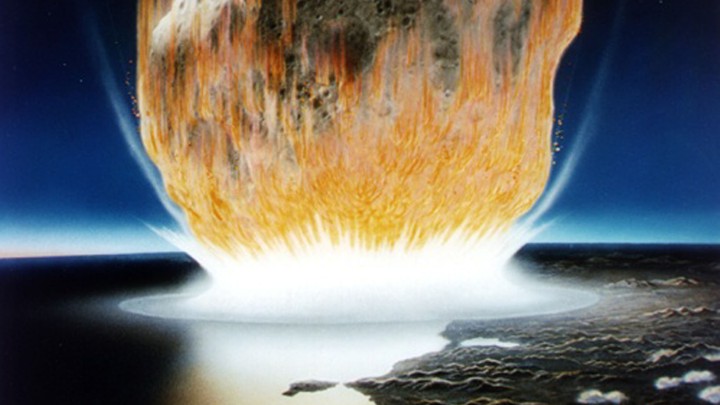
An artist's depiction of the K-T impact, which wiped out all nonavian dinosaurs.
NASA / REUTERS
The worst day in the history of life on Earth, so far, happened almost exactly 66 million years ago, when an asteroid roughly the size of Manhattan slammed into the Yucatán Peninsula.

You may know the story. The asteroid—which arrived, probably, in June or July—immediately drilled a 20-mile hole into the planet’s surface, vaporizing bedrock and spewing it halfway to the moon. The planet shuddered with magnitude-12 earthquakes, loosing tsunamis across the Gulf of Mexico. Some of the ejected debris condensed in orbit and plunged back to Earth as searing spheres of molten glass, which torched the land and turned forests into firestorms. Other debris remained high in space, where it blocked the sun’s rays and began to chill the surface of the planet.

By the time it was over, about 75 percent of all species on Earth had died, including all nonavian dinosaurs. The event, which ended the Cretaceous Period and began the Tertiary Period, is named the K-T extinction.

Since 1980, when the K-T impact hypothesis was first proposed, the Day the Dinosaurs Died has attained almost mythic significance. But questions remain about the theory. None of the Earth’s other big mass extinctions were caused by an asteroid impact. Why did this one end the 180-million-year reign of the dinosaurs?

A new paper, published this week in the Proceedings of the National Academy of Sciences, offers a possible answer: The impact changed the chemical content of the ocean, rendering seawater more acidic and inhospitable to the tiny plankton that form the base of the marine food chain. Combined with the other effects of the asteroid—darkened skies and a snap of global cooling—this ecologic disruption doomed much of life on Earth.The finding may be satisfying for asteroid fans, but it is an ominous one. Ocean acidification, a hallmark of the planet’s previous mass extinctions, is happening again today.

How does an asteroid prompt an extinction? It chooses the right location. The Yucatán Peninsula was an excellent one, says Pincelli Hull, an author of the paper and a geology professor at Yale. The peninsula is essentially an “old buried reef,” she told me, an accumulation of dead coral and other sea life that is now more than a mile thick. When the asteroid hit, untold megatons of that old organic material—rich in nitrogen and sulfur—instantly became dust and shot up into the atmosphere.

Soon it began to fall back down, now as nitric oxide and sulfuric acid. “It was raining brimstone and acid from the sky,” Hull said. The air would have reeked of acrid smog and burnt matches. The acid accumulated in the oceans, wearing away the shells of the small, delicate plankton that serve as the basis of the marine food chain. Within a few centuries of the impact, ocean acidity had jumped by at least 0.3 pH units.

This spike in ocean acidification may have lasted for less than 1,000 years. But even that pulse “was long enough to kill off entire ecosystems for sure,” Hull said. Ocean acidification also likely worsened other sweeping environmental changes wrought by the impact, such as the years-long darkness caused by orbiting debris and ash from the global wildfires.

With this new finding, it now appears that all three of the worst mass extinctions in Earth’s history featured huge spasms of ocean acidification. They include the K-T extinction; the End-Triassic Extinction, when volcanoes in New Jersey killed 75 percent of all species; and the dread End-Permian Event, the worst extinction in the history of the planet, which killed roughly 85 percent of all species and nearly sterilized the oceans. Scientists call that event “the Great Dying.”

And that pattern is worrying, because the oceans are acidifying again today. Carbon dioxide—the same air pollutant that causes global warming—also dissolves in the oceans and increases the acidity of seawater. Since the late 1980s, the planet’s oceans have become about 0.02 pH units more acidic every decade, according to a report last month from the Intergovernmental Panel on Climate Change. More than a fifth of all modern carbon pollution has already dissolved into the oceans, the report also found.

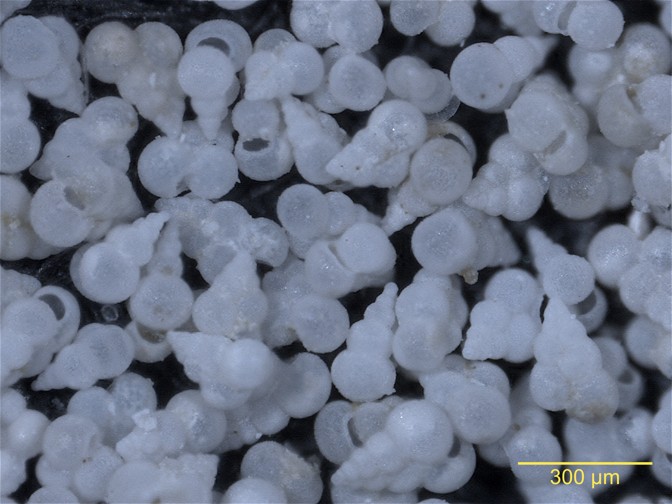
The researchers collected more than 7,000 of these tiny fossils—each half the size of a grain of sand—from Geulhemmerberg Cave in the Netherlands, the only place on Earth that contains fossils from the oceans in the decades and centuries after the K-T impact. (Michael J. Henehan / PNAS)


Modern acidification is not yet at the same magnitude as the K-T pulse. It’s “moving toward that scale, but it’s not quite there yet,” Hull said. What unites our world and the K-T period, she said, is that a number of environmental catastrophes can overlap with ocean acidification to produce a major upheaval.

“You should think of [ocean acidification] as the straw that broke the camel’s back” during the K-T extinction, she said. “It’s dark, it’s really cold after the impact—and the ocean has acidified.”Chris Lowery, who studies the oceans of the past at the University of Texas at Austin, told me that the paper represents “a big leap” in our understanding of the extinction. “We’ve known for a while that there was some amount of ocean acidification due to the Chicxulub impact, but this is the first time that the acidification has actually been quantified,” he said in an email, referring to the town in the Yucatán Peninsula for which the impact crater is named.

While paleontologists have long hypothesized about how an asteroid impact could produce the K-T extinction, this is some of the first evidence that supports those mechanisms, he added. And while the asteroid struck Mexico, the crucial evidence for this study came from a cave in the Netherlands that preserves fossils from the oceans in the decades or centuries immediately after the impact. Michael Henehan, a scientist who was then a postdoc in Hull’s lab, collected more than 7,000 tiny plankton fossils from the cave—each half the size of a grain of sand—and crushed them to analyze their chemical signatures.

“It was a herculean effort to get these measurements,” Hull said. “There’s just one place in the world where we think these fossil preserved.” (Henehan is now a professor at the German Research Centre for Geosciences.)

Two years ago, another study found the first geological evidence of global cooling, another proposed mechanism, following the impact.

Notably, the study’s findings do not support the idea that enormous eruptions from volcanoes in modern-day India, called the Deccan Traps, prompted the surge in ocean acidification and resulting mass extinction. That hypothesis has a small number of ardent advocates, among them Gerta Keller, a geologist at Princeton who was the subject of a profile in this magazine last year.

But “this study pretty definitively shows that those eruptions had no effect on ocean chemistry,” Lowery said. In an email, Keller disputed the paper’s dating of the impact, arguing the asteroid actually struck Earth “over 100,000 years” prior to the extinction’s start.

We want to hear what you think about this article. Submit a letter to the editor or write to letters@theatlantic.com.

Robinson Meyer is a staff writer at The Atlantic, where he covers climate change and technology.

Farmers, Residents Try to Stop Massive Factory Hog Farm

NowThis Politics

Residents in this town are fighting against a factory farm that plans to move in, bringing 6.5 million gallons of hog manure with it

Farmers, Residents Try to Stop Massive Hog Farm From Bringing Manure and Environmental Hazards Into Wisconsin Town

Residents in this town are fighting against a factory farm that plans to move in, bringing 6.5 million gallons of hog manure with it

Posted by NowThis Politics on Monday, October 21, 2019

The Incredible Generational Memory of the Starling

BBC Spring Watch

These birds not only learned to speak fluent “engine” – they taught it to their kids, too.

The incredible generational memory of starlings

These birds not only learned to speak fluent "engine" – they taught it to their kids, too. Via BBC Radio 3

Posted by BBC Springwatch on Thursday, September 26, 2019