‘Potentially the worst drought in 1,200 years’: scientists on the scorching US heatwave

‘Potentially the worst drought in 1,200 years’: scientists on the scorching US heatwave

<span>Photograph: Aude Guerrucci/Reuters</span>
Photograph: Aude Guerrucci/Reuters


The heatwave gripping the US west is simultaneously breaking hundreds of temperature records, exacerbating a historic drought and priming the landscape for a summer and fall of extreme wildfire.

Salt Lake City hit a record-breaking 107F (42C), while in Texas and California, power grid operators are asking residents to conserve energy to avoid rolling blackouts and outages. And all this before we’ve even reached the hottest part of the summer.

Among the 40 million Americans enduring the triple-digit temperatures are scientists who study droughts and the climate. They’d long forewarned of this crisis, and now they’re living through it. The Guardian spoke with researchers across the west about how they’re coping.

The paleoclimatologist: ‘Potentially the worst drought in 1,200 years’

Kathleen Johnson, California
Associate professor of Earth system science at the University of California, Irvine

I feel a little bit lucky because I’m in Orange county, relatively close to the coast – so the temperatures are not as severe here as they are in other parts of California and the west. I’m worried about this summer – this doesn’t bode well, in terms of what we can expect with wildfire and the worsening drought. This current drought is potentially on track to become the worst that we’ve seen in at least 1,200 years. And the reason is linked directly to human caused climate change.

As a paleoclimatologist my main point, always, is that we are able to look into the past. By looking at tree rings and other paleoclimate records, we’re able to gain really important perspectives about how climate has varied and changed in the past. And having done that, it’s clear that what we’re experiencing now is not natural. This is undoubtedly being caused by human activities, by greenhouse gas emissions.

The more we see these extreme events, piled on top of each other, and not just in the western US but globally, the more I think the reality of climate change becomes inescapable. And it feels absolutely overwhelming and sad. We are going to have less water, increased wildfires and more extreme heatwaves. But it’s also motivating. We need to continue to push for urgent action on climate change

The climate scientist: ‘The most distressing part? This was predictable’

Daniel Swain, Colorado
Climate scientist, Institute of the Environment and Sustainability,University of California, Los Angeles

This is really, really bad. Here on the eastern side of the Rockies, here in Boulder, we’re seeing record high temperatures. That’s the case in other parts of the state and in other states. And we’re seeing smoke plumes – not from local fires but from fires in Arizona and Utah. I think for a lot of people, it’s traumatic. The fires we saw in the last couple of years were really awful, and this year it seems like we’re on that same trajectory. It kind of feels like deja vu.

It does get rough sometime – talking about these things year after year. I live in the west, and all my family, pretty much, lives in the west. Most of my friends live in the west. It’s where I grew up, and seeing the landscape-scale transformations that are happening here, and seeing how it’s affecting people is overwhelming sometimes. But actually to me, the most distressing part is that this is very much in line with predictions. Climate scientists have been repeating essentially the same messages and warnings since before I was born.

Climate change is a major contributor to, if not the dominant factor, in a lot of the changes that we’re seeing out west and elsewhere. And it just is going to keep getting worse unless we do something about it. And so far, you know, we have yet to do the kinds of things, on a large enough scale, that are actually going to make a meaningful difference.

The atmospheric scientist: ‘It’s surreal to see your models become real life’

Katharine Hayhoe, Texas
Climate scientist and chief scientist at the Nature Conservancy

The extreme heat and the wildfires aren’t surprising. But it is just surreal to see what you only ever saw before in your research studies and models, actually happening in real life. And you’re almost dumbfounded by the speed at which your projections have become reality.

Climate change is loading the weather dice against us. We always have a chance of rolling a double six naturally, and getting an intense record breaking summer heatwave. But decade by decade as the world warms, it’s as if climate change is sneaking in and taking one of those numbers on the dice and turning it into another six, and then another six. And maybe even a seven. So we are seeing that heatwaves are coming earlier in the year, they are longer, they are stronger.

Still, public opinion data shows that there’s a disconnect, where even though about 72% of people in the US say global warming is happening, only 40% say that they think that it will affect them directly. But we actually did a recent study, looking at climate and weather extremes – and we found that really hot, dry conditions are the only thing that most people in the US directly connect to climate change. So right now is a really important time for scientists to communicate with the public that climate change is here, and climate action matters.

The meteorologist: ‘The ground is burning like a hotplate’

Simon Wang, Utah
Professor of climate dynamics at Utah State University

Yesterday, when Salt Lake City hit record temperatures, we went to one of our grad students’ back yards to barbecue some burgers and do some work. But it was so hot – oh my gosh, 107F (42C). So hot that, actually three out of five students’ computers overheated and broke. I was the first to throw in the white flag and ask to go home – I really hurting.

As a meteorologist, of course this isn’t a surprise. The warming climate is making these dry, hot periods even drier and hotter. Since we’re in a drought, we don’t really have much moisture in the soil. And without that moisture, the sun really heats up the ground and the air much faster. So, really what we’re seeing in the south-west is, the ground is burning like a hotplate. And we’re standing on it.

But you know, I actually feel kind of optimistic. In the restaurants and beer houses right now, everybody is talking about the weather, and how hot it is. And a few of them will even comment, “This is the new normal.” And I mean – we’re in Utah! Whatever people believe in, they know it’s really hot, and the climate is changing – and they don’t like that. These compounding extreme weather events are really bad – but they’re going to keep happening, no matter what. Maybe if there’s some good to come out of it, it’s that people are becoming more aware. And the sooner the general public starts to become aware of this issue, the sooner, hopefully, they’ll push for changes to address the crisis. So actually, if you saw me walking around outside this week, I probably had a smile on my face as I listened to some of these conversations.

Electric heat pumps use much less energy than furnaces, and can cool houses too – here’s how they work

Electric heat pumps use much less energy than furnaces, and can cool houses too – here’s how they work


<span class="caption">Heating or cooling? I do both.</span> <span class="attribution"><a class="link rapid-noclick-resp" href="https://flic.kr/p/2kKjBWT" rel="nofollow noopener" target="_blank" data-ylk="slk:FanFan61618/Flickr">FanFan61618/Flickr</a>, <a class="link rapid-noclick-resp" href="http://creativecommons.org/licenses/by-sa/4.0/" rel="nofollow noopener" target="_blank" data-ylk="slk:CC BY-SA">CC BY-SA</a></span>
Heating or cooling? I do both. FanFan 61618/Flicker, CC BY – SA


To help curb climate change, President Biden has set a goal of lowering U.S. greenhouse gas emissions 50%-52% below 2005 levels by 2030. Meeting this target will require rapidly converting as many fossil fuel-powered activities to electricity as possible, and then generating that electricity from low-carbon and carbon-free sources such as wind, solar, hydropower and nuclear energy.

The buildings that people live and work in consume substantial amounts of energy. In 2019, commercial and residential buildings accounted for more than one-seventh of U.S. greenhouse gas emissions. New heating and cooling strategies are an important piece of the puzzle.

Fortunately, there’s an existing technology that can do this: electric heat pumps that are three to four times more efficient than furnaces. These devices heat homes in winter and cool them in summer by moving heat in and out of buildings, rather than by burning fossil fuel.

As a scientist focusing on renewable and clean energy, I study energy use in housing and what slowing climate change means for industrialized and developing countries. I see powering buildings with clean, renewable electricity as an essential strategy that also will save consumers money.

Heat pumps work by moving heat, not air

Most heating systems in the U.S. use forced-air furnaces that run on natural gas or electricity, or in some cases heating oil. To heat the building, the systems burn fuel or use electricity to heat up air, and then blow the warm air through ducts into individual rooms.

A heat pump works more like a refrigerator, which extracts energy from the air inside the fridge and dumps that energy into the room, leaving the inside cooler. To heat a building, a heat pump extracts energy from outdoor air or from the ground and converts it to heat for the house.

Here’s how it works: Extremely cold fluid circulates through coils of tubing in the heat pump’s outdoor unit. That fluid absorbs energy in the form of heat from the surrounding air, which is warmer than the fluid. The fluid vaporizes and then circulates into a compressor. Compressing any gas heats it up, so this process generates heat. Then the vapor moves through coils of tubing in the indoor unit of the heat pump, heating the building.

In summer, the heat pump runs in reverse and takes energy from the room and moves that heat outdoors, even though it’s hotter outside – basically, functioning like a bigger version of a refrigerator.

More efficient than furnaces

Heat pumps require some electricity to run, but it’s a relatively small amount. Modern heat pump systems can transfer three or four times more thermal energy in the form of heat than they consume in electrical energy to do this work – and that the homeowner pays for.

In contrast, converting energy from one form to another, as conventional heating systems do, always wastes some of it. That’s true for burning oil or gas to heat air in a furnace, or using electric heaters to heat air – although in that case, the waste occurs when the electricity is generated. About two-thirds of the energy used to produce electricity at a power plant is lost in the process.

Retrofitting residences and commercial buildings with heat pumps increases heating efficiency. When combined with a switch from fossil fuels to renewables, it further lowers energy use and carbon emissions.

Going electric

Growing restrictions on fossil fuel use and proactive policies are driving sales of heat pumps in the U.S. and internationally. Heat pumps are currently used in 5% of heating systems worldwide, a share that will need to increase to one-third by 2030 and much higher after to reach net-zero emissions by 2050.

In warmer areas with relatively low heating demands, heat pumps are cheaper to run than furnaces. Tax credits, utility rebates or other subsidies may also provide incentives to help with up-front costs, including federal incentives reinstated by the Biden administration.

In extremely cold climates, these systems have an extra internal heater to help out. This unit is not as efficient, and can significantly run up electric bills. People who live in cold locations may want to consider geothermal heat pumps as an alternative.

Infographic advertising rebates for installing geothermal heat pumps in New Jersey.

These systems leverage the fact that ground temperature is warmer than the air in winter. Geothermal systems collect warmth from the earth and use the same fluid and compressor technology as air source heat pumps to transfer heat into buildings. They cost more, since installing them involves excavation to bury tubing below ground, but they also reduce electricity use.

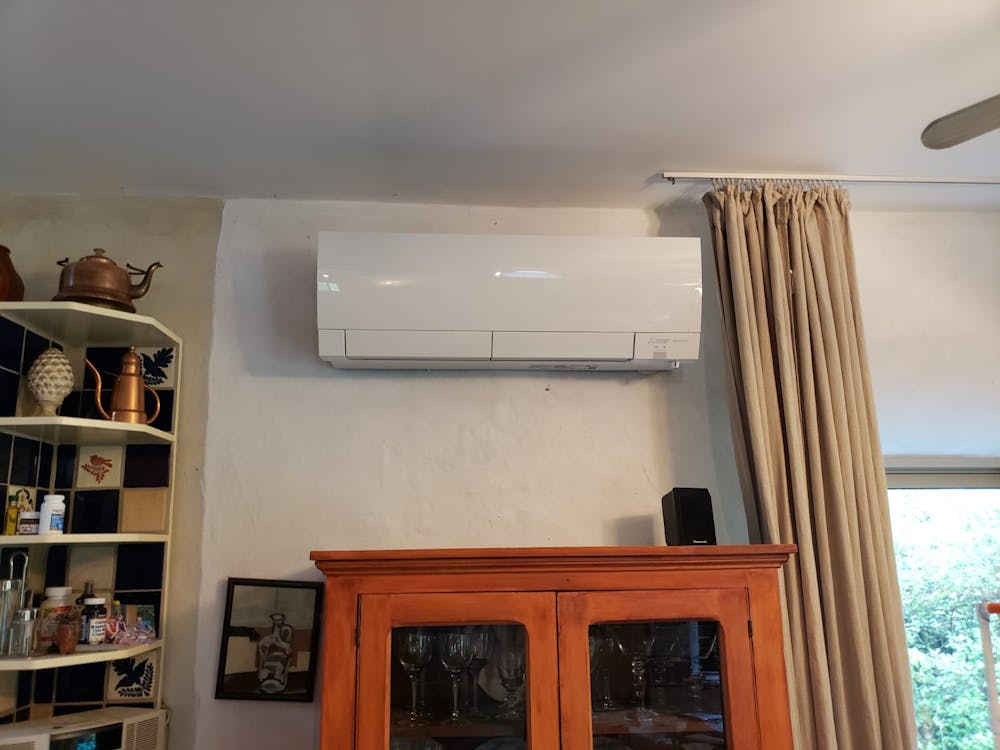
New, smaller “mini-split” heat pump systems work well in all but the coldest climates. Instead of requiring ducts to move air through buildings, these systems connect to wall-mounted units that heat or cool individual rooms. They are easy to install and can be selectively used in individual apartments, which makes retrofitting large buildings easier.

Even with the best heating and cooling systems, installing proper insulation and sealing building leaks are key to reducing energy use. You can also experiment with your thermostat to see how little you can heat or cool your home while keeping everyone in it comfortable.

Mini split heat pump indoor unit mounted over a fireplace.


For help figuring out whether a heat pump can work for you, one good source of information is your electricity provider. Many utilities offer home energy audits that can identify cost-effective ways to make your home more energy-efficient. Other good sources include the U.S. Department of Energy and the American Council for an Energy Efficient Economy. As the push to electrify society gains speed, heat pumps are ready to play a central role.

Read more:

Robert Brecha does not work for, consult, own shares in or receive funding from any company or organization that would benefit from this article, and has disclosed no relevant affiliations beyond their academic appointment.

Habitat for Humanity is building a 3D-printed home in Arizona to help solve the affordable housing crisis. See how it’s being constructed.

Habitat for Humanity is building a 3D-printed home in Arizona to help solve the affordable housing crisis. See how it’s being constructed.


Habitat for Humanity is building a 3D-printed home in Arizona to help solve the affordable housing crisis. See how it’s being constructed.
The home being 3D printed
The site of the 3D-printed home. Habitat for Humanity
  • Habitat for Humanity in Central Arizona is building a 3D-printed home in Tempe, Arizona.
  • The home will have three bedrooms and two bathrooms.
  • Prefabricated and 3D-printed homes are increasingly being seen as solutions to our housing crisis.

A massive housing crisis and shortage has been tearing across the US.

A portion of the home with plumbing
The site of the 3D-printed home. Habitat for Humanity

In an effort to help alleviate this issue, Habitat for Humanity in Central Arizona is now building a 3D-printed home in Tempe, Arizona …

Constructing the 3D-printed home
The site of the 3D-printed home. Habitat for Humanity

Source: Habitat for Humanity Central Arizona

… designed in partnership with luxury architecture firm Candelaria Design.

Documents from the City of Tempe
Documents from the City of Tempe for the 3D-printed home. Habitat for Humanity

According to Habitat for Humanity, 3D printing could be an economical way to address said crisis.

A person constructing the 3D-printed home
A person and machinery on the site of the 3D-printed home. Habitat for Humanity

“When we consider the housing issues facing Arizona, the need for affordable homeownership solutions becomes clear,” Jason Barlow, president and CEO of Habitat Central Arizona, said in the press release.

People and machinery on the 3D-printed home&#39;s site
People and machinery on the site of the 3D-printed home. Habitat for Humanity

Source: Habitat for Humanity Central Arizona

“If we can deliver decent, affordable, more energy-efficient homes at less cost, in less time and with less waste, we think that could be a real game-changer,” Barlow continued.

The home being 3D printed
The site of the 3D-printed home. Habitat for Humanity

Homebuilding methods like 3D printing or prefabrication are increasingly being considered as feasible alternatives to “traditional” construction.

The home being printed
The site of the 3D-printed home. Habitat for Humanity

Using a 3D printer to create homes is often seen as a more efficient and sustainable alternative to traditional construction methods.

People and machinery on the 3D-printed home&#39;s site
People and machinery on the site of the 3D-printed home. Habitat for Humanity

“In addition to affordable homes, the market increasingly demands innovative housing concepts,” Yasin Torunoglu, the housing and spatial development alderman at the municipality of Eindhoven, said in regards to a different 3D-printed home in the Netherlands.

The home being 3D printed
The site of the 3D-printed home. Habitat for Humanity

Source: Insider

The home in Tempe is being built using both a 3D printer and “traditional” construction techniques.

The site of the 3D-printed home
The site of the 3D-printed home. Habitat for Humanity

Between 70 to 80% of the home will be printed, including the walls.

The home being 3D printed
The site of the 3D-printed home. Habitat for Humanity

The team is relying on a printer from Germany-based Peri: the “build on-demand printer,” or the BOD2.

The 3D-printer
Machinery on the site of the 3D-printed home. Habitat for Humanity

Peri is a European formwork and scaffolding maker, and its 3D printer has also been used to print another home and a three-floor apartment building in Germany.

The home being printed
The site of the 3D-printed home. Habitat for Humanity

Source: Insider

The printer was sent to the US in March and moved to Arizona in April. It officially began its printing work in Tempe one month later.

A person and machinery on the 3D-printed home&#39;s site
A person and machinery on the site of the 3D-printed home. Habitat for Humanity

Peri describes the BOD2 as a “gantry printer.”

The home being printed
The site of the 3D-printed home. Habitat for Humanity

The printing mechanism can move left, right, forward, backward, up, and down …

The home being 3D printed
The site of the 3D-printed home. Habitat for Humanity

… which allows the printer head to move anywhere within the construction space.

The home being 3D printed
The site of the 3D-printed home. Habitat for Humanity

The printer can also be used while workers are completing other on-site construction projects, creating a human and machine team that works in harmony.

People on the 3D-printed home&#39;s site
People and machinery on the site of the 3D-printed home. Habitat for Humanity

The home is still in progress, but Habitat for Humanity projects the project will be ready in August or September.

A portion of the home with wiring
The site of the 3D-printed home. Habitat for Humanity

By October, the home could be occupied by “income-qualified homeowners,” according to the team.

Renderings of the 3D-printed home
The site of the 3D-printed home. Habitat for Humanity

Source: Habitat for Humanity Central Arizona

In total, the home will sit at 2,433 square feet, but its living space will fall a bit shorter at 1,738 square feet.

The home being 3D printed with machinery and a person
The site of the 3D-printed home. Habitat for Humanity

All of this space will then accommodate three bedrooms and two bathrooms.

overhead view of the site of the 3D-printed home.
The site of the 3D-printed home. Habitat for Humanity

“Beyond our city borders, this project can serve as a model for other communities as we all work to meet the critical needs of families who truly are the faces of this growing housing affordability crisis,” Corey Woods, the mayor of Tempe, said in the press release.

The home being printed
The site of the 3D-printed home. Habitat for Humanity

Source: Habitat for Humanity Central Arizona

Driest summer in 50 years a glimpse of the future

Tribune Publishing

EDITORIAL: Driest summer in 50 years a glimpse of the future


Clatsop County Oregon


Jun. 13—For growers of everything from pears to cannabis, the news is grim. Irrigation water may be shut off by Aug. 1, just as crops enter the stage when they need it most. The long-term outlook is even more dire.

Drought is not a new phenomenon in Southern Oregon. In fact, if you want to get technical about it, every year is a drought year, because farmers must use stored water to irrigate crops in the summer months. That’s according to the U.S. Geological Survey’s summary of weather trends.

But in most years, that stored water, held in reservoirs until released, is enough to last through the growing season. Not this year. Coming off a dry year in 2020, there was not enough precipitation to replenish reservoirs for the 2021 season.

State climatologist Larry O’Neill, an associate professor at Oregon State University, told Oregon Public Broadcasting that the data indicate this part of the world is experiencing the driest 20-year period in the past 1,000 years. The evidence points to something more ominous than just a couple of dry years.

All across the country, temperatures are climbing, a symptom of climate change. The National Oceanographic and Atmospheric Administration issued its latest “climate normals” last month, based on measurements of temperature, rain, snow and other variables from thousands of points nationwide.

The New York Times reported that the “normals” — issued every 10 years since 1930 — show a steadily warming climate when compared with the 20th century average.

Precipitation totals have changed, too — and on the surface that should be a good thing, because warm air holds more moisture. Oregon is expected to see more precipitation in coming years, according to the state’s latest climate assessment. But more of it will be rain, and less will be snow. In addition, warming temperatures mean what snowpack there is will melt sooner in the year, rather than the slow, steady melting that fills reservoirs. Rain, even torrential rain, is no substitute for snowpack, because it runs off before it can be captured.

All that is likely to mean longer and more severe droughts. And that could mean fundamental changes to the Rogue Valley’s agriculture industry.

The problem is not confined to the Rogue Valley, or even to Oregon. And the reality is, it may not ever go away. As the Los Angeles Times wrote in a recent editorial, “Droughts are deviations from the norm. What we have now is no deviation. It is the norm itself. Our climate has changed. As much water falls from the sky as before, but at different times and in different ways.”

That might be the result of natural cycles. It might be the result of human activity. Either way, we had better get used to it.

Turkey hoovers up vast blooms of sea snot in biggest ever maritime cleanup

Turkey hoovers up vast blooms of sea snot in biggest ever maritime cleanup

eams continue cleaning process of mucilage
Teams continue cleaning process of mucilage.


Turkey launched the biggest maritime cleanup operation in its history this week to tackle an unprecedented bloom of marine mucilage in the Sea of Marmara that experts say is an unsightly symptom of a much larger environmental problem.

In recent weeks “sea snot” has blanketed much of the shoreline around Istanbul in the waterway between the Aegean and the Black Sea. Underneath the waves curtains of the sludge hang in sheets, with the blooms depleting oxygen levels in the ocean, choking aquatic life and threatening Turkey’s fishing industry.

Turkey&#39;s president has promised to rescue the Marmara Sea from an outbreak of &quot;sea snot&quot; that is alarming marine biologists and environmentalists
Turkey’s president has promised to rescue the Marmara Sea from an outbreak of “sea snot” that is alarming marine biologists and environmentalists.


President Recep Tayyip Erdogan promised to designate the Sea of Marmara a conservation area this week, vowing to save Istanbul’s shorelines from “the mucilage calamity.”

“We must act without delay,” he said, as officials dispatched a fleet of surface cleaning boats and an army of workers equipped with trucks with vacuum hoses to suck up the worst of the scum along the shoreline.

The algal bloom first appeared in Turkish waters in 2007 but this year’s outbreak is the worst on record, experts say.

The floating organic matter is secreted by a booming phytoplankton population, whose out-of-control growth has been fuelled by a nutrient-rich cocktail of raw sewage, agricultural runoff and other pollution, according to an academic committee formed by Turkey’s Higher Education Council.

Children swim in the Marmara sea covered by sea snot
Children swim in the Marmara sea covered by sea snot.


While overfishing, ocean acidification and the impact of invasive species are other interrelated factors, the experts believe that warmer waters associated with climate change are turbocharging the bloom.

“The impact of rising sea temperatures due to climate change also plays an important role,” said President Erdogan.

According to researchers at the Institute of Marine Sciences at Turkey’s Middle East Technical University, the temperature of the Sea of Marmara has increased by an average of 2-2.5 degrees over the past two decades.

Between the immediate cleanup efforts and the long-term effects of climate change, Turkey is looking at solutions to improve water water treatment and reduce pollution.

A view of the sea, on the Caddebostan shore, on the Asian side of Istanbul
A view of the sea, on the Caddebostan shore, on the Asian side of Istanbul.


Environmental protection has failed to keep pace as the population of Istanbul and its surroundings has increased massively in recent decades, with around 20 million people now living around the Sea of Marmara.

That is about to change, with Environment Minister Murat Kurum pledging to reduce nitrogen levels in the sea by 40 percent .

“We will take all the necessary steps within three years and realize the projects that will save not only the present but also the future together,” he said, speaking aboard a marine research vessel.

Meanwhile the mucilage has began to infiltrate portions of the adjoining Aegean and Black seas.

Developer officially cancels Keystone XL pipeline project blocked by Biden

Developer officially cancels Keystone XL pipeline project blocked by Biden


A TC Energy pump station sits behind mounds of dirt from the Keystone XL crude oil pipeline as it lies idle near Oyen.


(Reuters) -A $9 billion oil pipeline that became a symbol of the rising political clout of climate change advocates and a flash point in U.S.-Canada relations was officially canceled on Wednesday.

Keystone XL, which was proposed in 2008 to bring oil from Canada’s Western tar sands to U.S. refiners, was halted by owner TC Energy Corp after U.S. President Joe Biden this year revoked a key permit needed for a U.S. stretch of the 1,200-mile project.

Opponents of the line fought its construction for years, saying it was unnecessary and would hamper the U.S. transition to cleaner fuels. Its demise comes as other North American oil pipelines, including Dakota Access and Enbridge Line 3, face continued opposition from environmental groups. ​

“This is a landmark moment in the fight against the climate crisis,” said Jared Margolis, a senior attorney at the Center for Biological Diversity. “We’re hopeful that the Biden administration will continue to shift this country in the right direction by opposing fossil fuel projects.”

The Keystone XL pipeline was expected to carry 830,000 barrels per day of Alberta oil sands crude to Nebraska, but the project was delayed for the past 12 years due to opposition from U.S. landowners, Native American tribes and environmentalists.

TC Energy owns the existing Keystone oil pipeline, which runs from Alberta to the U.S. oil storage hub in Cushing, Oklahoma, and to the U.S. Gulf, along with a power and storage business. It pledged to ensure a safe termination of the project.

“We remain disappointed and frustrated with the circumstances surrounding the Keystone XL project, including the cancellation of the presidential permit for the pipeline’s border crossing,” Alberta Premier Jason Kenney said in a statement.

Former U.S. President Donald Trump had approved a permit for the line in 2017, but it continued to face legal challenges that hampered construction. Biden had committed to canceling the project during his campaign and revoked the permit soon after taking office.

TC Energy swung to a loss in the first quarter, hit by C$2.2 billion ($1.81 billion) impairment charge related to the suspension of Keystone XL.

Its shares closed largely flat on the Toronto Stock Exchange.

(Reporting by Ankit Ajmera in Bengaluru and Rod Nickel in Winnipeg; Editing by Shinjini Ganguli, Anil D’Silva and Lincoln Feast.)

How Third-Party Auditors Make Oil Industry Fraud Possible

DeSmog

How Third-Party Auditors Make Oil Industry Fraud Possible

The accounting companies hired by oil companies to evaluate their inflated financial claims are on the hook from investors frustrated by the lack of accountability.
By Justin Milulka                                    
 

An offshore drilling platform in the distance at sunset with mountains behind.Oil or gas platform in Cook Inlet, Alaska Range Credit: sf-dvs <ahref=”https: creativecommons.org=”” licenses=”” by=”” 2.0=”” “=””>(CC BY 2.0)</ahref=”https:>

Major accounting firm KPMG is under fire from investors who filed a class action lawsuit against the firm for overstating the asset values of now-defunct oil exploration company Miller Energy Resources. And last month, a judge dismissed KPMG’s attempt to have the case thrown out.

At issue in the lawsuit, filed in 2016, is a $4.55 million purchase by Miller Energy in 2009 for land and offshore oil assets in Alaska which included existing oil production infrastructure. Miller Energy then claimed those same assets were worth approximately half a billion dollars, a claim which would require approval by third-party auditors.

But according to the Securities and Exchange Commission (SEC), the property and old oil infrastructure in Alaska was worth only a fraction of those claims; inflating its value beyond its worth amounted to fraud, according to the SEC. The SEC stated that “Miller Energy overvalued the Alaska assets by more than $400 million.” But the oil company wasn’t the only one at fault, said the SEC. In January 2016, the SEC sent a cease and desist order for Miller Energy detailing the major fraud case and focusing in part on the role that third-party auditors such as KPMG played in making it possible.

The onshore and offshore Alaskan oil assets purchased by Miller Energy had been abandoned by the previous owner because the asset retirement obligations (AROs) — the amount of money required to properly decommission the existing assets — were likely greater than the value of the remaining oil in the ground. The property was essentially worthless once the cost of the AROs was considered. But Miller Energy then told the SEC in 2010 that property was worth half a billion dollars and KPMG signed off on that estimate for several years, starting in 2011.

In an August 2017 cease and desist order for KPMG, the SEC summarized the extent of KPMG’s failure to perform a valid audit of Miller Energy:

“[T]he KPMG engagement team performed an inadequate assessment of the risks associated with the Miller Energy engagement. Among other things, KPMG’s initial evaluation, which was completed by Riordan and approved by KPMG management, failed to adequately consider Miller Energy’s bargain purchase, its recent history as a penny-stock company, its lack of experienced executives and qualified accounting staff, its existing material weaknesses in internal control over financial reporting, its long history of reported financial losses, and its pressing need to obtain financing to operate the newly acquired Alaska Assets.”

The Miller Energy executive who signed off on the overvaluation ultimately paid an SEC fine of $125,000, while KPMG was fined $1 million.

Oil reserves fraud — in which companies overestimate the amount of oil that can be produced from their assets — has been recognized as a growing problem in the oil and gas industry, as DeSmog has previously reported. But in order for companies to succeed in convincing investors of their incredible claims, it is critical to have independent third-party auditors — like KPMG — to support these claims.

A Seal of Approval on Fraud

Having third-party professionals sign off on corporate financial reporting is a standard part of doing business. The idea is to have independent parties verify that the reports are accurate. When companies are engaged in fraud, getting an apparently reputable third party to put its name on the financial reporting is one way to hide the fraudulent dealings, while also offering plausible deniability to those committing the fraud.

Much like the role of Enron’s auditor, the major accounting firm Arthur Andersen, whose “audits were meant to, and did, act as a seal of approval, a willingness to put a stamp of good practice on Enron transactions,” as Slate described in 2002, Miller Energy found a third party to sign off on its questionable financials: the small firm Sherb & Co.

And just like that seal of approval by a supposedly independent auditor ended up being the downfall of Arthur Andersen — then part of The Big Five accounting firms in the U.S. — and saw Enron’s top executives go to prison, so too are Miller Energy and its auditors’ activities now under scrutiny.

Sherb & Co. completed audits for Miller Energy in 2009 and 2010. Then, in 2013, the SEC found “that Sherb & Co. LLP and its auditors falsely represented in audit reports that they had conducted the audits in accordance with U.S. auditing standards when in fact they were riddled with failures and improper professional conduct.”

But by that time Miller Energy had switched, in 2011, to a new auditing firm to validate the claim that the land and oil infrastructure the company purchased in Alaska was worth one hundred times what it paid for it: Big Four accounting firm KPMG.

SEC and Miller Energy

In August 2017, the SEC charged KPMG with “audit failures” in its work with Miller Energy.

“Auditing firms must fully comprehend the industries of their clients. KPMG retained a new client and failed to grasp how it valued oil and gas properties, resulting in investors being misinformed that properties purchased for less than $5 million were worth a half-billion dollars,” Walter E. Jospin, Director of the SEC’s Atlanta Regional Office, said in a statement at the time.

The SEC’s 2016 order against Miller Energy recounted the details of a 2010 call in which the management discussed how to validate the oil company’s inflated asset valuations. On that call, the Miller Energy CFO reportedly told the other participants that “a professional had to sign off on it, not us, some third party…”

"Upon hearing the news that a new report might take two to three weeks, Alaska personnel, including the Alaska CEO, called the CFO. According to one participant on this call, the CFO said he could not wait weeks for a new report. He “needed it quickly and he needed to base it on something . . . a professional had to sign off on it, not us, some third party. . . .” During the call, the CFO and the Alaska CEO decided to rely on numbers in the insurance report as replacement costs, despite the Alaska CEO having been told by the broker that it could not provide Miller Energy with replacement costs."
Source: SEC Cease and Desist Order to Miller Energy, January 12, 2016

Financial reporting at the heart of the matter in 2010 showed an increase in asset value of over $490 million for Miller Energy, compared to 2009 when the company had assets of less than $10 million. Essentially, the company’s entire value in 2010 was attributable to the Alaskan assets.

Miller Energy 2010 Financial Statement. Source: SEC filing

Both Sherb & Co, and later KPMG, audited and approved that valuation.

Then, in April 2011 the SEC sent a letter to Miller Energy with some questions about its annual 10-K filing from the previous year, first asking the oil company to explain its valuation of the Alaskan property.

Starting with its response to this question, Miller Energy went all-in on its fraudulent claims and shielded itself with the veneer of credibility from a Big Four accounting firm.

“The Management is Incompetent” 

According to SEC documents, KPMG was retained as Miller Energy’s independent auditor on February 1, 2011. Two months later, on April 13, executives for the oil exploration firm rang the opening bell on the stock market floor as the company was listed on the New York Stock Exchange. It was a big moment for a company with no history of profits and that had been trading as a penny stock before the Alaska purchase.

That day, Miller Energy CEO Scott Boruff gave an interview on the trading floor, mentioning his company’s “explosive growth” and its bright future prospects. Boruff was paid $7.6 million in 2011.

Boruff was joined that day by company founder Delroy Miller, who also happened to be his father-in-law. While this arrangement apparently didn’t raise any questions with auditors, in 2014 their relationship was flagged in more SEC correspondence from “Concerned Miller Shareholders (CMS)”:

“In the absence of proper qualifications, CMS has raised reasonable questions surrounding Mr. Boruff’s appointment as Miller’s CEO and specifically, whether it was motivated by his close familial ties to the Company’s founder.”

Boruff had no oil industry experience before being appointed in 2008 as CEO by his father-in-law. However, Boruff did have experience with companies involved in financial fraud, as lawyers for CMS noted.

According to CMS correspondence with the SEC, in a section titled “The Management is Incompetent,” Boruff had previously worked at the firm GunnAllen Financial, leaving in October 2006, and that “GunnAllen has since been closed by regulators [in 2010] and entered bankruptcy in the wake of investor lawsuits and allegations of a major Ponzi scheme involving Provident Asset Management.”

Provident was a good old-fashioned Ponzi scheme, promising investors eye-popping 18 percent returns from oil and gas royalties. In reality, however, the company paid those returns with money coming from new investors. The scam involved almost a half-billion dollars.

But Boruff, who worked as a broker at GunnAllen, was not charged in that Ponzi scheme. Instead of distancing himself from it, however, as the new head of Miller Energy, he hired Darren Gibson in 2009, who according to documents sent to the SEC, “was Provident’s former National Sales Director during the alleged Ponzi scheme.”

Announcing the new hire in a press release, Boruff said “[Gibson]’s proven track record in raising capital will allow Miller to aggressively pursue our acquisition and drilling program goals.”

But Boruff and Gibson’s proven track record should have raised red flags to auditors evaluating the company’s financial records, especially given the pair’s lack of oil and gas industry experience.

Despite all this, KPMG continued rubber-stamping Miller’s financial statements even after the concerned shareholders had been communicating with the SEC.

Reserves Fraud and Asset Retirement Obligations

As DeSmog has reported, oil and gas companies inflating the values or volumes of their reserves estimates lies at the heart of much of the fraud now surfacing in the industry. Miller Energy is just one example of many.

Another major factor is how oil companies get around financial obligations to clean up their old wells and surrounding lands after they are done extracting oil and gas — known in the industry as asset retirement obligations (AROs). These obligations are increasingly becoming an issue as oil and gas companies try to sell old assets because the cleanup liabilities are likely greater than the value of the oil and gas. This was the case with Miller Energy.

The asset retirement obligations for the Alaskan property Miller acquired were the reason why no one else wanted to buy it.

In July 2010, the SEC asked questions about Miller’s AROs and noted that in 2009, “a third party report had indicated that the AROs for these assets were $41 million.”

Miller Energy’s finances were rife with red flags. Enough even to get one engineering firm, with prior experience with the Alaskan property Miller purchased, to walk away. According to the SEC, this was because the firm “refused to assign any value to a property known as the Redoubt Shoal field [a major part of the Alaskan assets Miller acquired, which was then valued at $291 million by Miller], because it was uneconomical … and the prior firm had explained that it would not put its ‘name on a report that implies value exists where it likely does not.’”

After its Alaska deal, Miller Energy not only needed an auditor to give its seal of approval to claims that its property and oil infrastructure in Alaska had some value, it would require an auditor to agree it was worth half a billion dollars. KPMG was willing to do this.

Third-Party Auditors and KPMG

In 2017, the SEC laid out the many failures of KPMG in the Miller Energy case, including that the evidence that something was wrong should have been obvious to anyone who knew to look for it: “All of these facts were readily ascertainable from the publicly available bankruptcy records of the prior owner of the Alaska Assets. If they had reviewed those records, KPMG would have learned that their understanding of the facts leading to the acquisition was inaccurate.”

The SEC also noted that, like the CEO of Miller Energy, the partner whom KPMG put in charge of the audit, John Riordan, lacked relevant oil and gas industry experience, “resulting in departures from professional standards.”

But the issue was not just one partner at KPMG, according to the SEC, which noted that company management and national personnel “became aware of the unusual and highly material prior-year transaction,” yet “the firm did not take sufficient action.”

KPMG 2015 Audit Quality Report 


As the SEC also noted in this case, due diligence requires an auditor to exercise professional skepticism — something the Miller valuation should have raised. Yet in 2011, when the financial website Street Sweeper published research challenging Miller Energy’s financial claims, KPMG chose to overlook those red flags as well, says the SEC. Now defunct, Street Sweeper was known for reporting on “over-valued, over-hyped stocks on Wall Street.”

The SEC noted that KPMG’s Department of Professional Practices (DPP), which was responsible for developing the firm’s internal auditing standards and guidance, failed to step in despite its knowledge of the Miller Energy case.

The SEC concluded that “DPP’s decision not to inquire further about the valuation of the Alaska Assets was unreasonable in light of the circumstances.” It also added that once KPMG learned of the 2011 Street Sweeper report, the department should have provided oversight of both Miller’s assessment and its own company procedures for the valuation.

In August 2017, the SEC found KPMG guilty of a long list of violations with regard to its audits of Miller Energy, including “lack of competence” and “highly unreasonable conduct.”

While not specifically implicated in the Miller Energy audit, David Middendorf, the former head of KPMG’s DPP where he was responsible for “audit quality and professional practice,” was sentenced to prison in 2019 for his part in trying to cover up KPMG’s dismal auditing results from 2013 and 2014.

After being misled about the oil company’s financial realities, many investors in Miller Energy lost their entire investments, which is why they are now suing KPMG.

Investors Lose, Fraudsters Walk Away 

In the end, the SEC settled the charges against KPMG and John Riordan, its partner overseeing the case. KPMG agreed to give back the money it earned from working for Miller Energy, which was a little over $5 million when interest was included. Additionally, KPMG paid a civil penalty of $1 million while Riordan was fined $25,000. Riordan remained a partner at KPMG until he retired in 2020.

KPMG did not respond to a request for comment on whether anyone at KPMG was held accountable for their role in the Miller Energy audit.

Miller Energy was also fined $5 million, but due to its 2015 bankruptcy, it is not clear if that amount was ever paid in full during the three years it had to make the payments. In 2016, the company was reorganized into new entities controlled by Apollo Investment Corporation.

The SEC did not respond to a request for information on the status of that payment.

For their roles in the fraud, Miller’s CFO Paul Boyd and COO David Hall were both personally fined $125,000.

Scott Boruff, the CEO who oversaw all of the fraudulent activity, was not fined. After leaving Miller Energy in March 2016 when the bankruptcy was finalized, Boruff was sued by his father-in-law for failure to repay a $6 million personal loan.

Meanwhile, defrauded investors have turned to a lawsuit against KPMG to try to recoup their losses. That lawsuit is now expected to proceed next year.

Jeffrey Skilling, CEO of Enron, spent 14 years in jail for misleading investors. Arthur Andersen ceased to exist as one of the Big Five accounting firms due to its role in the Enron fraud. Meanwhile, Miller Energy executives and KPMG have essentially walked away with fines irrelevant to the scale of the fraud.

The oil company executives who oversaw the company during this fraud kept the money they were paid.

As this case and many others make clear, there is little incentive for oil industry executives to play by the rules when a company can engage in blatant fraud, get caught, and suffer almost no consequences. However, these frauds require the help of a third-party auditor willing to look the other way.

And while there are clearly auditors and engineering firms who will not put their “name on a report that implies value exists where it likely does not,” as the SEC wrote, there are plenty of others who will — including some of the biggest names in the business.

Justin Mikulka is a freelance investigative journalist. Justin has a degree in Civil and Environmental Engineering from Cornell University.

Rural Arizona residents wait as wildfire spreads uncontained

Rural Arizona residents wait as wildfire spreads uncontained


PHOENIX (AP) — Firefighters in Arizona were fighting Tuesday to gain a foothold into a massive wildfire, one of two that has forced thousands of evacuations in rural towns and closed almost every major highway out of the area.

The so-called Telegraph Fire, straddling two counties, has burned 112 square miles (290 square kilometers) and is at zero containment. The blaze was first reported Friday south of Superior in Pinal County, about 60 miles (97 kilometers) east of Phoenix.

Residents in neighboring Gila County, which includes Globe, Miami and smaller communities, have been in various stages of the evacuation process. The town of Miami is among those under an evacuation order.

Arizona House Speaker Rusty Bowers confirmed that a family home he owns in the woods southeast of the Globe-Miami area burned down overnight. He toured the gutted property Tuesday. The home was not his primary residence but a family retreat, said Andrew Wilder, a spokesman for House Republicans. Bowers, who lives in Mesa, would go there weekly and often do his artwork.

At least 2,500 homes in Gila County have been evacuated, said Carl Melford, the county emergency manager. He estimated that there are twice as many households who are in “set” mode with bags packed just in case.

“Over the past three years, we’ve had some pretty extreme fire seasons,” said Melford, who has bags at his front door. “We’ve become very familiar with the process, with what it takes to evacuate a community. But this is the largest evacuation to date.”

Becky Stephenson, 37, whose Globe home sits on a hill near the U.S. Highway 60, is feet away from a zone under “set” status. Still, she decided to have essentials, including her pet parrot, Buddy, and his travel cage, ready to go.

Watching flames climb trees Monday night from her home as the fire made its way into the Pinal Mountains and create an eerie orange glow was surreal, Stephenson said.

“Honestly, it just makes me feel like I can’t wait till they get it under control and I can go out and start helping them revegetate,” said Stephenson, who is a plant biologist. “It’s just really sad to think about all of the torched plants and all of animals that lost their habitat during breeding season.”

Meanwhile, Superior residents remain in “set” mode. But about 400 people in nearby Top-Of-The-World have been evacuated, said Lauren Reimer, a Pinal County Sheriff’s Office spokeswoman.

Officials with the American Red Cross say 90 residents in total stayed Monday at shelters in Globe and Mesa.

Nearly 750 firefighters are working on the blaze, which gained momentum in the past few days thanks to gusty winds and low humidity. The Southwest Area Type 1 Incident Management Team, the highest tier, is conducting some controlled fires and dropping flame retardant by air in other areas.

Dean McAlister, a spokesman for the fire’s incident command center, said crews were having success as of Tuesday afternoon holding the fire at bay in some places. They are closely monitoring a constructed fire line that on the fire’s east side.

“The intent is to try to create a catcher’s mitt to trap the fire as it continues to move east, and our intent is to try to stop the fire before it gets any further into the Globe area,” McAlister said.

The fire was human-caused. But fire officials have not shared further details.

Several miles east of the wildfire, the smaller Mescal Fire was at 23% containment Tuesday. Fire officials lifted evacuation orders for residents of the community of San Carlos and in the areas of Soda Canyon and Coyote Flats. But the community of East El Capitan was still on mandatory evacuation.

The fire has burned nearly 105 square miles (13 square kilometers) — mostly desert brush, oak and grass. It was first reported June 2 southeast of Globe.

The cause is still under investigation.

Meanwhile, in northern Arizona a much smaller wildfire closed a stretch of U.S. Highway 180 on Tuesday. The fire, only 2 square miles (5 square kilometers), was reported Monday 23 miles (37 kilometers) northwest of Flagstaff. The cause is unknown. ____

Associated Press writers Bob Christie and Paul Davenport in Phoenix contributed to this report.

Salmon face extinction throughout the US west. Blame these four dams

Salmon face extinction throughout the US west. Blame these four dams


Knee-deep in the rumbling waters of Rapid River in western Idaho, Mike Tuell guided his dip net between boulders and tree branches in search of the calm pockets where salmon rest.


It was a Tuesday evening in May, and his first time out fishing this season. The spring-summer Chinook were just beginning their treacherous journey back to their natal spawning areas.

His shoulders tensed as he pushed the net deeper. With each passing stroke, Tuell, 53, a member of the Nez Perce tribe, settled into a rhythm with his net, becoming less an intruder on the river and more a natural part of its ecosystem.

Crouched on the rocks behind him was his girlfriend’s 12-year-old son, Nat’aani McCaskey. Decades ago, Tuell had been taught to fish along this same waterway by his uncle, and he was now passing that knowledge on.

“If we want to have the way of life we have now, or the life we used to have, he’s got to learn to do it now and do it right so he’s not wasting fish or doing it for the wrong reasons,” explained Tuell, who also serves as production division deputy director for the tribe’s fisheries department.

Not quite big enough to manipulate the pole himself, Nat’aani held a knife and club, ready to take over once Tuell caught a salmon. He listed off the steps: “Hold it by its tail, club it, cut its gills out, and then put it in the ice.”

But the opportunity never came. After nearly two hours, with sweat glistening across Tuell’s forehead, the pair weren’t able to catch a single salmon.

•••

It’s a scene that has increasingly played out in recent years across the 1,078-mile Snake River and some of its tributaries, due in large part to four towering and closely spaced dams in eastern Washington state. The dams act as massive hurdles to the salmon’s migration.

Today, experts have voiced concern that the salmon are headed toward a point of no return.

The loss of these anadromous fish along a waterway that twists through western Wyoming, Idaho, Washington and Oregon, would wreak havoc on over 130 species that depend on salmon – from salamanders to whales – and leave a gaping hole in a region that prides itself on hosting them. Thirteen populations of Columbia-Snake salmon and steelhead are protected under the Endangered Species Act.

It puts us in a situation where we start asking the question, who would we be if we didn’t have salmon?

Alyssa Macy

But for the Nez Perce community and other Columbia River basin tribes, whose physical sustenance and cultural and spiritual practices have been tied with salmon for millennia, it would be pure devastation.

“It puts us in a situation where we start asking the question, who would we be if we didn’t have salmon? If they became extinct, then as salmon people, who would we become?” said Alyssa Macy, CEO of the Washington Environmental Council and a member of the Confederated Tribes of Warm Springs. “Obviously, that’s a question that none of us want to answer.”

•••

Just as the situation reaches a fever pitch, an unlikely pair of bipartisan US congressmen out of Idaho and Oregon have come on to the scene, championing a $33.5bn solution centered on breaching the four dams.

Mike Simpson, the Republican congressman from Idaho who first introduced the proposal, is resolute in his efforts to get ahead of what he described as an impending “train wreck”: the Bonneville Power Administration – the federal agency which markets electrical power from 31 hydroelectric dams – facing key financial problems due in part to salmon mitigation costs, or the dams being removed without any thought to the communities and industries that rely on them, or ultimately the salmon disappearing altogether.

While many different political choices can be made, “salmon don’t have a choice”, he said. “They need a river. And right now, they don’t have a river.”

The dams back up the water flow for miles, increase water temperature and create an overall much longer and thus more dangerous journey for them, explained Jay Hesse, director of biological services for the Nez Perce tribe.

Mitigation efforts involve a complex and costly system of fish ladders for adults, spillways for juveniles to get through, a barge transporting them down river, and even wires and loud noises to keep predators away.

The proposal to breach the dams is timely: the Biden administration has signaled an appetite for big spending on infrastructure; the flood of renewables have created uncertainty for hydropower; and leaders in a wide array of sectors have signaled interest in finding solutions, explained David Moryc, senior director of wild and scenic rivers and public lands policy at the non-profit conservation organization American Rivers.

In other words, he said, there’s a unique merging of both crisis and opportunity.

•••

Salmon don’t have a choice. They need a river. And right now, they don’t have a river

Congressman Mike Simpson

In north-east Oregon, the creation story for the Confederated Tribes of the Umatilla Indian Reservation begins with a sacrifice by the salmon, explained Don Sampson, a member of the tribe and an advisory board member for the Northwest Tribal Salmon Alliance. Out of a crowd of animals, they were the first to respond to a call from the Creator warning that the humans were coming and would need nourishment.

The story goes that the salmon’s responsibility would be to travel through the waters, ingesting food in order to provide nourishment to humans. In exchange, the tribe was given the sacred duty of taking care of the salmon and honoring them through prayer and ceremony.

“This is part of our religious belief. We do it every Sunday at our church,” said Sampson. “We sing our ceremonial songs. We teach our kids about who they are by these religious beliefs and the relationship to the animals and the plants. And that is our identity.” Similar stories can be found across the Pacific north-west.

For thousands of years, both the salmon and humans remained largely in step. The Native communities would eat what they needed, while large portions of the population would be left to complete their lifecycle of hatching in fresh water, traveling downstream to the ocean and then returning to their birthplace to spawn and die.

But a little over a century ago, the situation started to shift. Initially, largely unregulated commercial fishing fueled by the expansion of salmon canneries resulted in the population declining. In the years that followed, the runs were further strained by habitat loss.

By 1975, the US army corps of engineers completed construction of a series of four dams across just 137 miles of the lower Snake River in Washington in an effort to produce renewable energy while facilitating barge transportation.

After construction of the dams was completed, wild salmon returns fell by more than 90%, according to American Rivers. The Idaho Conservation League reported that before the dams, about 1.5 million spring-summer chinook salmon returned each year to the Snake River. By 2017, only about 5,800 wild spring-summer chinook completed that journey.

The impact is especially evident when looking at the smolt-to-adult returns below the dams, compared with above. While 3.5% of salmon survive the ocean and make it through three dams to return to the John Day River to spawn, only 2.4% return to the Yakima River after passing through four dams (2% is considered the minimum needed for salmon persistence). By comparison, less than 1% of salmon return to the Snake River after crossing eight dams, according to Trout Unlimited, a conservation non-profit organization.

The dams are spaced so closely that they have created a type of “pressure point” for the salmon population, explained David Montgomery, author of King of Fish: The Thousand-Year Run of Salmon. Removing them wouldn’t get rid of all of the historical impacts that there have been, according to him, “but it’s an impact that can be undone in a single stroke that is acknowledged to be very likely to have a major effect”.

•••

Last February, 68 of the country’s top salmon and fisheries experts sent a letter to north-west leaders stating that in order to avoid extinction and restore the once abundant salmon runs, these four dams would need to be removed. Two months later, the American Rivers listed the Snake as the country’s most endangered river, citing the dams, along with the climate crisis and poor water quality, as its biggest threats.

A Columbia River system impact statement last year reported that breaching these dams would have the greatest positive impact on Snake River salmon. But the report, which was authored by the US army corps of engineers, Bureau of Reclamation and Bonneville Power Administration, ultimately did not endorse such a plan due to the “adverse impacts to other resources such as transportation, power reliability and affordability, and greenhouse gas emissions”.

In 2016, it was reported that the four dams were producing on average over 1,000 megawatts of energy each year – or enough to power 800,000 American homes. But as the renewable energy sector continues to shift and hydropower competes against low-cost renewable energy, including solar and wind, there is some uncertainty when it comes to what the future will look like for the industry.

Against this backdrop, more than $17bn has been spent in recent decades as part of federal salmon recovery efforts.

The local tribes have contributed through habitat recovery efforts and extensive salmon hatchery work. The Nez Perce Tribal Hatchery has been working toward releasing 825,000 Spring Chinook this year – 200,000 more than last year.

•••

Erik Holt, a member of the Nez Perce tribe and its fish and wildlife commission chair, was seven the first time he caught a salmon. It was the summer of 1977, and he and his family had hiked the two miles up to the Blue Hole on the Imnaha River, a tributary of the Snake River, in Oregon.

Clutching an 18ft gaff and tied to his grandpa to make sure he didn’t fall in, Holt struggled against the strength of the creature.

“I could feel the power and the spirit of it all because it just absorbs you,” Holt said. “Even as a young boy, I could feel that.”

We ceded 13m acres to the US government to be held in trust for our way of life. That way of life included salmon

Shannon Wheeler

Since then, he’s worked to introduce the tribe’s younger generations to fishing, including his 10-year-old nephew. He’s taught him the basic mechanics of the practice, and also about how to treat such a sacred place:

“When you get to the river, you pray for your pole and then you put it in the water and you say another prayer … [Then] you got to get in the water yourself. And that’s what we call washing the bad medicine away. Before you even go fishing, you get in that water, you wash off and purify yourself.”

Holt’s nephew was excited to travel out to the Clearwater, a tributary of the Snake in Idaho, to carry on the tradition. He had his hook, line and mini dip net ready to go when Holt broke the news that the fishery had been closed because of the lack of salmon.

He said it was “devastating” to have to explain it to him and see the forlorn look on his face.

Already this season, the Nez Perce tribe has closed virtually all of the lower Snake River to fishing, along with most of the middle and upper parts of the Salmon River, in an effort to protect the salmon. The Clearwater has recently been opened, but with very limited harvest.

These closures can affect Native families’ ability to travel out together to fish and share songs and prayer, and also the tribe’s ability to feature the salmon in their first foods ceremonies and funeral services, explained Shannon Wheeler, the Nez Perce tribal vice-chairman.

The possibility of losing salmon altogether also gets in the way of treaties the federal government signed with Nez Perce and many other local tribes. About 150 years ago, they fought to secure rights to fish these waterways. Having to close down fisheries because there’s not enough salmon is a huge infringement on crucial contracts.

“In that treaty, we bargained for a way of life,” said Wheeler. “We ceded well over 13m acres of land to the United States government, to be held in trust for our way of life. That way of life included salmon.”

•••

The fight to remove these dams is more than just about the survival of salmon. It’s also about the cultural impact these structures have had on the surrounding Native community.

Standing on a dock in the middle of a largely motionless section of the Snake River in Colton, Washington, Louis Reuben looked out on to what had once been his ancestors’ home. He pointed out the spot he believed had held a series of rock formations perfect for fishing, and the hills that may have housed graveyards.

But it’s difficult to be sure, he explained, as the winter home for the Wawawai Band of the Nez Perce is now underwater due to the dams.

“The dams displaced us, disconnected us from our place of origin for me,” said Reuben, a Nez Perce tribal member and descendant of the Wawawai Band of the Nez Perce. “It’s difficult to go back to a place that’s underwater. It really kind of put a huge dent in my identity as an Indigenous person.”

For Reuben, a free-flowing Snake River would finally give him the chance to return to the cave where his great-grandfather was born, and the place where his ancestors lived before being moved on to the reservation.

In April, representatives from 12 tribes located throughout the north-west devoted two days to discussions on breaching these dams and the overall proposal first presented by Mike Simpson and then supported by Congressman Earl Blumenauer, a Democrat from Oregon.

Simpson is resolute in his effort. “Everything we do on the Lower Columbia and Snake River can be done differently if we choose to do it,” he told the Guardian.

Kat Brigham, the Confederated Tribes of the Umatilla Indian Reservation board of trustees chair, said that they support the proposal, applauding the lawmakers for thinking outside the box. She highlighted the fact that there have been periods where parts of the Columbia River basin had no salmon runs, but they were able to rebuild them.

“We know it’s possible,” she said. “But we have to do it together. No tribe, no state, no federal agency, or no individual organization can rebuild these runs. It has to be collaborative, partnership approach.”

In addition to breaching the dams, the proposal would include funds to replace the energy lost and help the agricultural community reconfigure transportation. But it would also involve waiting about 10 years before the dams are breached, offer a 35-year license extension for other dams in the Columbia River basin and provide a 35-year dam litigation moratorium.

Some stakeholders still have plenty of questions about its viability.

In May, Washington’s governor, Jay Inslee, and Senator Patty Murray released a statement rejecting the proposal.

Kristin Meira, executive director for Pacific Northwest Waterways Association, made up of ports, barge companies, steamship operators and farmers, also spoke out against the proposal, citing the toll it would take on hydropower and barge transportation.

More than a dozen environmental organizations sent a letter in March to Democratic lawmakers in Washington and Oregon explaining that while they support removing the four dams, it should not be at the expense of environmental protections.

Simpson said that he put the proposal out there to continue the discussion and is open to hearing ideas and suggestions. But after about 500 meetings with tribes, environmental groups, state representatives and a variety of other stakeholders over the last three years, he said it was clear that salmon recovery will need to involve removing these dams.

•••

Back at Rapid River, Tuell lifted up his dip net and began the short walk with Nat’aani through the high grass away from the river. The sound of water crashing against rocks and branches slowly began to dim.

Nat’aani turned to Tuell: “Next week might be better.”

The two continued on in silence. The uncertainty of the season ahead hung in the air.

U.S. report concluded COVID-19 may have leaked from Wuhan lab – WSJ

U.S. report concluded COVID-19 may have leaked from Wuhan lab – WSJ


Outbreak of the coronavirus disease (COVID-19) in Wuhan


(Reuters) -A report on the origins of COVID-19 by a U.S. government national laboratory concluded that the hypothesis of a virus leak from a Chinese lab in Wuhan is plausible and deserves further investigation, the Wall Street Journal said on Monday, citing people familiar with the classified document.

The study was prepared in May 2020 by the Lawrence Livermore National Laboratory in California and was referred to by the State Department when it conducted an inquiry into the pandemic’s origins during the final months of the Trump administration, the WSJ report https://on.wsj.com/3pw8T5F said.

Lawrence Livermore’s assessment drew on a genomic analysis of the COVID-19 virus, the Journal said. Lawrence Livermore declined to comment on the Wall Street Journal report.

President Joe Biden said last month he had ordered aides to find answers to the origin of the virus.

U.S. intelligence agencies are considering two likely scenarios – that the virus resulted from a laboratory accident or that it emerged from human contact with an infected animal – but they have not come to a conclusion, Biden said.

A still-classified U.S. intelligence report circulated during former President Donald Trump’s administration alleged that three researchers at China’s Wuhan Institute of Virology became so ill in November 2019 that they sought hospital care, U.S. government sources have said.

U.S. officials have accused China of not being transparent about the virus’ origins, a charge Beijing has denied.

Separately, Mike Ryan, a top World Health Organization official said on Monday the WHO cannot compel China to divulge more data on COVID-19’s origins, while adding it will propose studies needed to take understanding of where the virus emerged to the “next level”.

Earlier this month, U.S. infectious disease expert Dr. Anthony Fauci called on China to release the medical records of nine people whose ailments might provide vital clues into whether COVID-19 first emerged as the result of a lab leak.

(Reporting by Akriti Sharma and Kanishka Singh in Bengaluru and Eric Beech in Washington; Editing by Chris Reese, Leslie Adler and Edwina Gibbs)