Wildfires break out across Western states amid hottest week in history

Wildfires break out across Western states amid hottest week in history


Last week featured one of the worst June heat waves in decades across the West, shattering hundreds of daily records, as well as several all-time hottest temperatures recorded for the month.

Death Valley soared to a blistering 128 degrees, and Denver saw a rare hat trick of three 100-degree days in a row.

Tucson saw eight straight days of temperatures 110 degrees or higher, breaking the record for the number of consecutive days above that barrier and making it the city’s hottest week. Phoenix endured a record-setting six straight days of temperatures 115 or higher.

All of this heat contributed to a high fire danger which came to fruition over the weekend when multiple blazes broke out in several Western states including California, Colorado, Arizona and Oregon.

The Willow Fire in Monterey County, which forced evacuations Friday, continued to burn over the weekend sending smoke billowing into the Bay Area.

The Cow Fire in Shasta County also prompted evacuation orders, and at one point Sunday required a large air tanker to be diverted off the Willow Fire for increased firefighting efforts.

On Monday, 7 million people were under red flag warnings across six Western states where the combination of hot temperatures, wind gusts to 40 mph and bone-dry humidity lead to a critical fire threat.

Las Vegas was included in the risk zone for the fire danger.

The most recent heat wave was focused over portions of the Four Corners, desert Southwest and Southern and Central California. Next week, however, the area of most exceptional heat could park over northern California and the Pacific Northwest.

California Wildfires (Ringo Chiu / via AP)


This will lead to another week with a high risk of wildfires due to the already desiccated landscape void of much precipitation whether falling from the sky or locked in the mostly-melted snowpack.

With ground fuels already sitting at highly flammable and record-dry levels, all experts can do is warn people of the impending danger and hope for the best in what has already proven to be an early and destructive start to the Western wildfire season.

With climate change making heat waves three times more likely compared to 100 years ago and contributing to the current 22-year megadrought, wildfire seasons are starting earlier and lasting longer into the year. As the gap closes, experts say there isn’t so much a defined wildfire season in the West anymore, but instead it lasts year round.

The US could be facing its worst drought in 1,200 years, and summer hasn’t even reached its peak yet.

The US could be facing its worst drought in 1,200 years, and summer hasn’t even reached its peak yet.

A thermometer display showing record high temperatures in Death Valley National Park
A thermometer display showed a temperature of 130 degrees at the Furnace Creek Visitor Center at Death Valley National Park on June 17 in Furnace Creek, California. Patrick T. Fallon/Getty Images 

  • California is bone-dry after a heat wave hit the state, with water levels dipping to all-time lows.
  • Experts said this may become the worst drought the US has seen in 1,200 years.
  • In the meantime, the West and Southwest continue to sizzle, and summer has yet to hit its peak.

Residents on the West Coast are in for a miserable, sizzling summer filled with prolonged drought and record-breaking temperatures, experts said.

A scientist The Guardian spoke with even warned that the US could experience one of the worst droughts in its modern history.

“This current drought is potentially on track to become the worst that we’ve seen in at least 1,200 years. And the reason is linked directly to human-caused climate change,” Kathleen Johnson, an associate professor of Earth system science at the University of California, Irvine, told the Guardian.

The projection came as California’s rivers and reservoirs dried up and the state recorded historically low water levels.

In particular, if water levels in Lake Oroville, California’s second-largest reservoir, continue to dwindle, it could have devastating effects on the state’s power supply. This is because the lake generates energy by flowing through the Edward Hyatt Power Plant. Low water levels may force this power plant to close. A closure would leave about 800,000 homes without energy when wildfire season swings around, CNN reported.

The heat wave hitting California prompted Gov. Gavin Newsom to declare a statewide emergency last week. Newsom called on the state’s residents to conserve energy, saying that the heat “has and will continue to put significant demand and strain on California’s energy grid.”

Energy troubles amid the heat wave are also hitting Texas. The Electric Reliability Council of Texas said many power plants in the state went offline last week, months after a major outage left Texans without heat during in the middle of winter.

The Washington Post reported on June 18 that more than 40 million Americans saw triple-digit temperatures where they live in the prior week. Temperature records were also broken in Salt Lake City last Tuesday when the weather services measured a high of 107 degrees, breaking the area’s 147-year record for temperatures in June.

What makes the US’s weather troubles worse is that summer hasn’t even peaked.

The National Centers for Environmental Information’s archive of temperatures across the US from 1981 to 2010 showed that the amount of the sun’s rays reaching Earth tends to peak on the summer solstice on June 21. But the US tends to see warm temperatures increasing into July. The National Oceanic and Atmospheric Administration said the summer of 2020 was one of the hottest ever seen in the US, with August, in particular, being especially “dry and destructive.”

‘It’s brutal’: Las Vegas cooks amid blazing heatwave – and it’s going to get worse

‘It’s brutal’: Las Vegas cooks amid blazing heatwave – and it’s going to get worse


By midnight on Wednesday, two days into a scorching heat wave to hit the US west, the air in Las Vegas had barely cooled.


Throughout the day and for the days that followed, temperatures in the desert city hovered close to historic highs, peaking at 116 degrees Fahrenheit (46.6 Celsius), and setting a new record for such dangerously hot weather so early in the year. Meanwhile, dust and smoke from nearby wildfires hung in the stiff hot air, casting a brown haze over the valley.

Throngs of tourists still ambled along scorching-hot sidewalks on the Vegas Strip, and many others lined the labyrinths of slot machines, restaurants and shops inside air conditioned casinos. But not everyone is able to escape indoors.

“I am dying – I feel like I’m going to pass out,” said Violet, a woman clad in a denim thong and crop top.

Violet makes her living outside on the strip, posing for pictures with passersby. She was glistening, both from the body glitter covering her arms and chest and the beads of sweat collecting on her face in the midday sun. She has a heart condition, she said while leaning against a planter where she and several other women had stored water bottles to empty in-between selfies. “I am out here because I have to pay rent, but it is so hot and I get dehydrated so quickly.”

Researchers predict this week’s heatwave to be the first of several to hit the US south-west before the summer ends. Driven by the climate crisis and intensified by the city’s expansive growth, Vegas is already cooking – and it is going to get worse.

Las Vegas’s population is booming and the city is sprawling into the surrounding desert. The extra concrete adds to the sizzle. On hot days, the highways and roads are littered with broken-down automobiles – commuter cars, ambulances, delivery trucks and buses that overheat as they made their way to and from the city-center.

“Nevada’s climate is changing,” the Nevada government’s Climate Initiative website reports. “In fact, Nevadans say, they are already noticing and impacted by these changes. Climate change has come home.”

The changes are particularly pronounced in Sin City and its surrounding areas, which is warming faster than almost anywhere else in the US. Heatwaves are not only getting hotter, they are also becoming more frequent. Summer weather is increasingly encroaching on spring, with less and less room for relief.

The increasing intensity hasn’t gone unnoticed among workers who have to brave the dangerous conditions, but “no one in the valley is allowed to talk,” Jeff, a valet and porter said. He declined to give his last name out of fear of retribution from his employer, a hotel off the strip.

“The ins and outs are what get you,” he added, explaining that his duties require him to constantly shift between extreme heat and frigid air conditioning.

“You get into those cars that have been sitting outside and it’s like 140F. Then the sweat just pours,” he said. “I have seen guys pass out and start shaking. It’s brutal.”

But his job offers him health and life insurance so he plans to stick it out.

Rafael Martinez, who works as a security guard, said he stands outside throughout his eight-hour shift. He’s witnessed several people lose consciousness right there on the street. “People pass out all the time,” he said. “I am sweating and I feel the heat, but I am not one to complain.” He drinks water often, which he said helps a little. He always makes sure to stand in the shade. “If you stand in the sun you are going to dry out.”

Heat is one of the most deadly weather disasters, according to data from the federal government, and in southern Nevada, coroner data shows that heat-related deaths are on the rise. Officials have emphasized the importance of not leaving people or animals in cars, and have begun enforcing a new animal cruelty ordinance that cracks down on owners who leave pets outside for more than 10 hours a day during a heat advisory, which typically applies when temperatures reach 105F.

But for workers who have be outside, low-income residents without access to in-home cooling, and the more than 6,000 unhoused residents in Las Vegas, the stifling conditions can exact a considerable toll.

“There will certainly be an impact on people who can’t get cool” said Kristina Dahl a senior climate scientist for the Union of Concerned Scientists, a nonprofit advocacy organization. Though heat stress and heat stroke alone can be fatal, researchers also found that those exposed to high temperatures have higher rates of chronic kidney disease. Hot weather also adds to air quality issues, trapping harmful pollutants while spikes in energy use from air conditioning increase emissions. Studies show that heat affects the brain, slowing cognitive function.

Clark county, where Las Vegas is located, provides cooling centers when the heat spikes but many of them close at night even when overnight temperatures don’t drop. That issue is attributed to the cityscape itself.

“We are seeing urban areas experiencing a more pronounced and more defined rise in the frequency of extreme heat,” Dahl said. “That is due to a combination of the overall warming we are all experiencing but in urban areas, but it gets amplified by the use of manmade materials,” she added. And, it’s not only baking locals. “As cities become more developed, and there’s less natural land cover, that’s going to amplify the signal of warming we see around the globe” she said.

Far from the glitz and glamour of the Strip, new homes seem to march, row-by-row into the desert. Even with the increasingly intense conditions, the population is growing. Numbers of residents increased by more than 64% between 2000 and 2018 in the county. Officials expect that numbers will continue to grow, projecting that in the next 40 years close to 3.2 million people will call the area home—an increase of nearly 40%.

Expecting to run out of space, a new county lands bill has petitioned the federal government for more acreage, pulling roughly 30,000 acres from public lands in the surrounding desert.

Meanwhile, the construction continues. Housing developments in various stages of completion are on full display at the fringes of the city, and even on the hottest days, workers brave the elements to complete them.

“It’s hard and it’s hot but if we don’t work we don’t get money,” said Ignacio Regrelar, who is finishing dry-wall on a development during the 116 degree day. He and his team work for 8 hours through the extreme heat. “The problem is, if the boss says he is ready, and you don’t do it, he will take other people,” he said. “Workers need work. But it’s hard”.

The residential expansion has also enveloped areas that were once rural. Las Vegas Livestock, family-owned operation that has spent six-generations raising pigs in the region, was pushed out of the city in 2018.

The farm utilizes food waste from Las Vegas casinos to feed thousands of pigs and now they are based deeper in the desert, sharing the land offered by the local landfill. “Our family has been in Vegas for 50 years but the city grew up around them so now we are out here,” said farm manager Sarah Staloard. “Hopefully houses won’t come this far but you never know”.

The pigs can handle the heat if they are regularly doused in water, “but I think the question is are we going to have people out here safely if it gets hotter,” she said. She’s worried about the rising temperatures and the Valley she calls home, especially after spending the day working through triple-digits. There’s no energy out there on the farm.

“If it continues to be super hot at night that would be a concern,” she said. “We would have to have someone out here to make sure the pigs are not getting too hot. There’d be no relief for anyone,” she added. “Even the equipment never gets a break.”

Take a look at some of the lakes in California that have been swallowed up by the ‘megadrought’

Take a look at some of the lakes in California that have been swallowed up by the ‘megadrought’


Take a look at some of the lakes in California that have been swallowed up by the ‘megadrought’
California drought
Associated Press
  • California has been hit by a “megadrought” that has dried up key reservoirs in the state.
  • Entire lakes have shrunk exponentially, leaving yachts and docks beached on dry land.
  • Nearly 95% of the state is experiencing “severe drought” and is susceptible to wild fires.

California is facing its worst drought in over four years.

Over 37 million people have already been impacted by the “megadrought” and nearly 95% of the state has been classified as experiencing “Severe Drought,” which puts the land in significant danger of wildfires, according to the National Integrated Drought Information System (NIDIS).

Last year, California land was consumed by over 8,200 wildfires – a number double the state’s previous record. This year, scorching weather has dried out reservoirs and made the state even more susceptible to breakout wildfires than the record 2020 season. NIDIS analysts call the outlook for the land “grim.”

california wildfire
October 15, 2017. Jim Urquhart/Reuters

Water levels of California’s over 1,500 reservoirs are 50% lower than they should be at this time of year, Jay Lund, co-director of the Center for Watershed Sciences at UC-Davis told the Associated Press.

In April, scorching weather turned the San Gabriel reservoir lake bed to dust. The reservoir is not expected to see rain fall until the end of the year.

The drought turned the San Gabriel reservoir lake bed to dust
The drought turned the San Gabriel reservoir lake bed to dust Getty

On Wednesday, the drought dried up a lake so much that it potentially exposed a decades old mystery, allowing officials to find a plane that had crashed in 1965.

A composite image showing Folsom Lake, California, at drought levels in 2017, and a sonar image of a plane underwater there.
Folsom Lake, California, under drought conditions in 2017 (L), and the sonar image of a plane there taken by Seafloor Systems (R) Robert Galbraith/Reuters/CBS13


The California drought has been caused by climate change which has pushed temperatures an average of about 2 degrees hotter, drying out soil and melting Sierra snow rivers, which causes less water to soak into the ground, as well as flow through rivers and reservoirs. The state also endured two unusually dry winters that didn’t bring needed storms to the area.

Officials are predicting the water level of Lake Oroville – a primary body of water that helps the state generate energy through hydroelectric power plants – will hit a record low in August. If that happens, they would need to shut down a major hydroelectric power plant, putting extra strain on the electrical grid during the hottest part of the summer.

Earlier this month, about 130 houseboats had to be hauled out of the lake as its water levels hit 38% capacity. The water levels are only at about 45% of average June levels, according to California Department of Water Resources.

House boats pulled out of Lake Orovill
Getty

It’s going to be a rough summer for boat owners in the state.

Pictures from the Associated Press show massive lakes have run dry, leaving boats and docks completely beached

Boats at Fulsom Lake
Associated Press

Experts say the drought could devastate local wildlife populations, as well as California’s tourism industry.

California drought
Associated Press

In April, Governor Gavin Newsom held a press conference in the dried up waterbed of Lake Mendocino. Where he stood there should have been about 40 feet of water.

“This is without precedent,” Newsom said. “Oftentimes we overstate the word historic, but this is indeed an historic moment.”

California drought
Associated Press

The month before, the California Department of Water Resources reduced farmers and growers to 5% of their expected water allocation in March. A move that has farmers leaving large portions of their land unseeded, while other have been forced to purchase supplemental water, which comes at a hefty cost. Supplemental water was priced at $1,500 to $2,000 per acre-foot in mid-May, according to a report from California Farm Bureau.

It has also made it difficult for ranchers to feed and water their livestock

California drought
Getty

As California temperatures continue to rise while water reservoirs fall, the state could be in for a devastating summer. From increased fears for wildfires to the impact on state agriculture and tourism, California residents are bracing for the worst drought season since 2014.

Republicans are using baffling legalese and underhanded tactics to quietly push through their deeply unpopular policies. Don’t fall for their shady tricks.

Republicans are using baffling legalese and underhanded tactics to quietly push through their deeply unpopular policies. Don’t fall for their shady tricks.

Texas governor Greg Abbott with a feather quill drawing question marks on pieces of old parchment paper on a red background
Montinique Monroe/Getty Image; Samantha Lee/Insider 

  • The GOP’s agenda isn’t popular, so right-wing lawmakers around the country are using technical workarounds.
  • Right-wing policies like abortion restrictions don’t necessarily need to go into effect to be effective.
  • Relying on confusion and stalling tactics is the right-wing approach.
  • Eoin Higgins is a journalist in New England.
  • This is an opinion column. The thoughts expressed are those of the author.

The GOP is winning more battles than a minority party with an unpopular platform should. But they aren’t paying as high of a political price because Republican lawmakers around the country are hiding their unpopular agenda behind confusing technicalities and baffling legalese.

Republicans are using obfuscation tactics to lead Americans to believe that laws are in place when they actually aren’t, that gridlock in Washington is an unshakable truth rather than a parliamentary strategy, and that voting in the country is far harder than it is.

The GOP passes laws they know will never stand up in court, because the message of its passage is likely to change behavior even if the law ultimately falls. These officials pontificate self-importantly about the necessity of keeping parliamentary tradition and rules in place, and then turn around and break them whenever it’s convenient. The GOP deploys whatever means are necessary to bend and even outright break the political rules of engagement.

The right has been pursuing this strategy of confusion for decades. It’s a tried and true tactic to force the window of what is considered “acceptable” policy further and further to the right in hopes that enough challenges slip through and establish a precedent. Winning individual battles in the traditional sense is secondary to this broader war.

Faced with an electorate that’s broadly opposed to the details of their policies, the GOP has relied on passage, not enforcement, to get the results that they’re after. It’s a savvy approach to lawmaking for a party with a broadly disliked policy vision, allowing for various workarounds at the federal and state level to remain in power.

Most people don’t really know

In May, I talked to women in Texas who have had to fight against the state’s existing abortion restrictions. Briana McClellan, a social worker with reproductive rights group the Texas Equal Access Fund, got an abortion in Texas in 2009. The process was arduous, she told me, due mostly to cost and geography.

Today, things are even worse. Republican Governor Greg Abbott signed a bill last month that would restrict abortions to only six weeks after conception, a ban that would effectively end Roe v Wade, which established a Constitutional right to abortion up to 24 weeks. Therein lies the trick. The law, whether or not it goes into effect, is going to make access even more difficult. Even if it is struck down in the courts, the ban’s passage through the state legislature means that there will be more confusion surrounding the issue. McClellan told me that she already frequently needs to remind clients that abortion is still legal.

“I did have to explain to them that what they were doing was legal, because a lot of the time most people don’t really know,” McClellan said.

Access is even more restricted in Mississippi, where there’s only one clinic statewide and social conservatism adds to the stigma. Serita Wheeler, a sociologist in the state, told me that she believes that is by design. Right-wing economic goals are being realized by the use of religious morality to restrict reproductive healthcare access.

“The major industries in this state are food, hospitality, tourism, and retirement; all powered by feminized poverty,” Wheeler said.

Industry and religion work together with the state’s Republican lawmakers to ensure the right to abortion is always up in the air, even while the right to reproductive access is technically in place, leaving people around Mississippi in a constant state of confusion. Just the way the GOP likes it.

Stalling tactics

Abortion laws aren’t the only deliberately confusing ones: Republicans are doing the same with voting rights. Members of the public often do not understand the laws around voting, which can change state by state and year by year. The confusion over which rights are in place and which are not can be a powerful motivator to those going to the polls.

Laws passed in GOP state legislatures, like Georgia’s ban on giving water to people waiting in line to vote, are aimed at restricting rights and making voting seem like a confusing, intractable burden. Republican-sponsored bills in state legislatures around the country are designed to reduce participation and make exercising the franchise difficult – if not impossible.

Federal attempts to solve the problem have stalled out against GOP manipulation of the Senate. Even before nominal Democrat Joe Manchin announced on Sunday that he was voting against the For the People Act, the House Democrats’ omnibus voting rights act, Republicans were blocking the bill’s passage into law in the Senate by holding up the process via the filibuster.

“Democrats’ poster child for why the Senate should change its rules is a bill that would forcibly change the rules for elections in every state in America,” Senate Minority Leader Mitch McConnell said Monday.

By using this age-old parliamentary tactic to stop any legislation from moving forward unless Democrats use reconciliation – a tactical move that the majority party has, for some reason, left to the unelected Senate Parliamentarian to decide when it can and can’t be used – the GOP are ruling from the minority and stopping the ruling party’s agenda in its tracks.

This has created an inertia similar to that seen during the Obama years. GOP Senators, faced with legislation they don’t want to pass, hold it up with a 60-vote majority needed to pass it and enforce the filibuster without having to get on the floor and actually speak.

Not only does this tactic stop the legislation, it allows the GOP to distance themselves from the actual work of opposing whatever bill is in front of the Senate. Not allowing the bills to come to the floor in the first place – by using a largely anonymized system that lets senators stop the legislative process without actually having to actually do the work of stopping it – is perfect for Republicans.

Needed change

One of the primary reasons the right relies on such convoluted, legalese tactics to get their policies into legislatures around the country is that the right-wing agenda just isn’t that popular. Poll after poll shows that the GOP’s policy prescriptions for what ails the US to be massively unpopular on a policy by policy issue (with the possible exception of tax cuts as long as they don’t go to the rich).

Democrats at both the federal and state level are complicit in this approach to governing. Bad messaging, a disinterest in holding the GOP accountable, and multiple tactical errors have left the Democrats wanting when it comes to even playing the game in the same universe as their opponents.

Progressives and rights advocates are thus constantly on the defensive. The use of disinformation and confusion to push forward an agenda as unpopular as the one Republicans have is the only tool the GOP has that can work – but it’s still working due to inertia from the other side.

If American voters don’t know whether they can go to the ballot box, think Washington is hopelessly gridlocked for no reason other than its natural state, and believe basic civil rights like the right to an abortion are up in the air – irrespective of reality – then the battle’s halfway won for the GOP already. It’s up to liberals and the left to fight back.

The lakes in California that have been swallowed up by the ‘megadrought’

Take a look at some of the lakes in California that have been swallowed up by the ‘megadrought’

Take a look at some of the lakes in California that have been swallowed up by the ‘megadrought’
California drought
Associated Press

  • California has been hit by a “megadrought” that has dried up key reservoirs in the state.
  • Entire lakes have shrunk exponentially, leaving yachts and docks beached on dry land.
  • Nearly 95% of the state is experiencing “severe drought” and is susceptible to wild fires.

California is facing its worst drought in over four years.

Over 37 million people have already been impacted by the “megadrought” and nearly 95% of the state has been classified as experiencing “Severe Drought,” which puts the land in significant danger of wildfires, according to the National Integrated Drought Information System (NIDIS).

Last year, California land was consumed by over 8,200 wildfires – a number double the state’s previous record. This year, scorching weather has dried out reservoirs and made the state even more susceptible to breakout wildfires than the record 2020 season. NIDIS analysts call the outlook for the land “grim.”

california wildfire
October 15, 2017. Jim Urquhart/Reuters


Water levels of California’s over 1,500 reservoirs are 50% lower than they should be at this time of year, Jay Lund, co-director of the Center for Watershed Sciences at UC-Davis told the Associated Press.

In April, scorching weather turned the San Gabriel reservoir lake bed to dust. The reservoir is not expected to see rain fall until the end of the year.

The drought turned the San Gabriel reservoir lake bed to dust
The drought turned the San Gabriel reservoir lake bed to dust Getty

On Wednesday, the drought dried up a lake so much that it potentially exposed a decades old mystery, allowing officials to find a plane that had crashed in 1965.

A composite image showing Folsom Lake, California, at drought levels in 2017, and a sonar image of a plane underwater there.
Folsom Lake, California, under drought conditions in 2017 (L), and the sonar image of a plane there taken by Seafloor Systems (R) Robert Galbraith/Reuters/CBS13


The California drought has been caused by climate change which has pushed temperatures an average of about 2 degrees hotter, drying out soil and melting Sierra snow rivers, which causes less water to soak into the ground, as well as flow through rivers and reservoirs. The state also endured two unusually dry winters that didn’t bring needed storms to the area.

Officials are predicting the water level of Lake Oroville – a primary body of water that helps the state generate energy through hydroelectric power plants – will hit a record low in August. If that happens, they would need to shut down a major hydroelectric power plant, putting extra strain on the electrical grid during the hottest part of the summer.

Earlier this month, about 130 houseboats had to be hauled out of the lake as its water levels hit 38% capacity. The water levels are only at about 45% of average June levels, according to California Department of Water Resources.

House boats pulled out of Lake Orovill
Getty


It’s going to be a rough summer for boat owners in the state.

Pictures from the Associated Press show massive lakes have run dry, leaving boats and docks completely beached

Boats at Fulsom Lake
Associated Press


Experts say the drought could devastate local wildlife populations, as well as California’s tourism industry.

California drought
Associated Press


In April, Governor Gavin Newsom held a press conference in the dried up waterbed of Lake Mendocino. Where he stood there should have been about 40 feet of water.

“This is without precedent,” Newsom said. “Oftentimes we overstate the word historic, but this is indeed an historic moment.”

California drought
Associated Press


The month before, the California Department of Water Resources reduced farmers and growers to 5% of their expected water allocation in March. A move that has farmers leaving large portions of their land unseeded, while other have been forced to purchase supplemental water, which comes at a hefty cost. Supplemental water was priced at $1,500 to $2,000 per acre-foot in mid-May, according to a report from California Farm Bureau.

It has also made it difficult for ranchers to feed and water their livestock

California drought
Getty


As California temperatures continue to rise while water reservoirs fall, the state could be in for a devastating summer. From increased fears for wildfires to the impact on state agriculture and tourism, California residents are bracing for the worst drought season since 2014.

Maine tries to shift the cost of recycling onto companies instead of taxpayers

Maine tries to shift the cost of recycling onto companies instead of taxpayers


TRENTON, Maine – At the height of tourist season, the recycling bins at this coastal town used to swell with glass and plastic, office paper and piles of cardboard from the local boatyard. But the bins are gone, and their contents now join the trash, destined either for an incinerator to generate electricity or a landfill.

Trenton is one of many Maine towns that had to cut back or close their recycling operations after events both global and local. In 2018 China, which used to take much of America’s plastic waste, banned most of those imports. Last year, a plant in Hampden, Maine, that promised to provide state-of-the-art recycling for more than 100 municipalities shut down.

With mountains of boxes and bubble wrap from online pandemic shopping now going in the trash, lawmakers are trying to make Maine the first state to shift some of the costs of its recycling onto companies – not taxpayers. If the bipartisan bill passes, Maine will join several Canadian provinces, including neighboring Quebec, and all European countries, which have for decades relied on so-called extended producer responsibility programs, or EPR, for packaging.

“It’s good that the bottom fell out,” said Rep. Nicole Grohoski, D-Ellsworth, the bill’s Democratic sponsor, whose district includes Trenton. She doesn’t believe the old system of shipping products halfway around the world to China made sense as countries try to reduce their carbon footprints.

“We have to face this problem and use our own ingenuity to solve it,” Grohoski said.

The proposed legislation, which is vehemently opposed by representatives for Maine’s retail and food producing industries, would charge large packaging producers for collecting and recycling materials as well as for disposing of non-recyclable packaging. The income generated would be reimbursed to communities like Trenton to support their recycling efforts. EPR programs already exist in many states for a variety of toxic and bulky products including pharmaceuticals, batteries, paint, carpet and mattresses. At least a dozen states, from New York to California and Hawaii, have been working on similar bills for packaging.

“Ten years ago, this would have been unthinkable,” said Dylan de Thomas, vice president of external affairs at the Recycling Partnership, who said he is seeing far more openness to EPR bills from such corporate giants as Coca-Cola and Unilever than in the past.

“It’s a reflection of the pressure they are seeing from corporate investors,” said de Thomas, who anticipates there may be similar shifts in national policies.

“That’s the big enchilada,” he said.

EPR programs for packaging, which accounts for about 40 percent of the municipal waste stream, have worked well in other countries, said Scott Cassel, CEO of the Product Stewardship Institute, who said benefits include new jobs as well as reinforcing the circular economy – or continual reuse of resources.

“These are tried-and-true strategies,” he said. None of these first bills will be perfect. But this is a path that we need to start down in the U.S.”

In Maine, the bill’s opponents raise concerns about the logistics retailers may face policing the new policies and the potential for food costs to rise for consumers who are just emerging from the pandemic. They cite a study from Toronto’s York University, which analyzed New York’s EPR bill and estimated an additional $36 to $57 per month in grocery costs for the average family of four. EPR advocates contest those findings, saying there is little evidence of significant costs ending up with consumers in other countries.

For many rural Mainers who don’t enjoy the benefits of free curbside waste collection, the debate over recycling seems irrelevant. They haul their own trash to transfer stations to avoid the $6 weekly charge for having it collected.

“I’ve never been one to recycle,” said Penny Lyons, a Trenton resident, although her family has a stash of bottles and other beverage containers on a flatbed trailer that can be turned in for cash. Her husband, who works in car sales, is able to dispose of their solid waste at work, she said.

Chocolate maker Kate McAleer, who owns chocolate maker Bixby &. Co, said that to follow federal food safety guidelines her company uses metalized film that is a challenge to recycle but protects against pests, air, sunlight and tampering. Changing that would have an impact on her products’ shelf life.

She doesn’t believe legislators understand the complexity of food safety. “I think they think there are solutions that there aren’t,” Bixby said.

Christine Cummings, executive director of the Maine Grocers and Food Producers Association, said her primary concern is “the unknowns” for businesses in a state that sits at the end of distribution routes and relies heavily on incoming goods.

“What is this going to do on our supply chain?” she asked.

Grohoski dismisses such concerns.

“We won’t be out on a limb for long,” she said, anticipating that if her bill passes, other states will soon follow suit.

In the meantime, some communities are paying a premium to continue recycling programs by shipping materials south to Portland, the state’s biggest city. Others are devising ways to process and sell recyclable materials.

In Unity, Maine, about 90 miles north of Portland, Steve Wright and Jeff Reynolds are running an eight-town sorting operation, feeding paper and plastics into giant green balers and glass into a machine that grinds bottles into a glistening powder that can be used for insulating boxes around lithium batteries or with aggregate to make driveways.

Each of the surrounding towns pays in according to its population – Unity has 2,000 residents – and individuals from further away can join for an annual fee of $30.

The pandemic has increased the piles of cardboard, particularly from pet owners leery of going inside stores, Wright sad..

The operation is powered by 40 solar panels and has room to expand – particularly if the EPR goes through.

“We have to move now,” said Rep Stanley Paige Ziegler, D-Montville, whose district includes Unity and who has worked alongside Grohoski to advance the EPR bill.

Sarah Nichols, Sustainable Maine director at the Natural Resources Council of Maine, sees the bill as the logical next step for a state that has led the way in environmental policies. Maine passed one of the first bottle bills in the 1970s and in 2004 the first laws requiring manufacturers to pay the entire cost of recycling computers and televisions. In 2019, the legislature passed the nation’s first statewide ban on Styrofoam food containers that will soon go into effect.

“Maine is seen as a national leader in environmental policy,” Nichols said. “That’s why people move here and visit. It’s part of our state’s personality.”

Nichols points out that Department of Environmental Protection estimates show it can cost 67 percent more to recycle than dispose of packaging. Taxpayers pay at least $16 million annually to manage packaging material through recycling or disposal – costs they have no control over.

Nichols argues the EPR bill would give manufacturers an incentive to reduce packaging and design packaging that is more easily recycled.

Old recycling habits die-hard at the transfer station in Southwest Harbor, with its stunning views toward the forested slopes of Acadia National Park.

Residents drive up to pitch their waste into bays still bearing green signs reminding them of the old days when they sorted their waste: Glass, tin, aluminum and plastic in one; magazines, catalogues and other paper goods in another.

The baler that used to package up paper hasn’t been used for a couple of years, according to the site’s owner, Mark Worcester. Instead, Worcester is sending out a 25-30 ton container of trash – sometimes two – every day, usually to be incinerated for electricity.

“We get tons and tons of cardboard,” Worcester said.

On a busy Saturday morning, car after car pulled up loaded with packaging materials, folded ready for the recycling that would not happen.

“It’s a reflex,” said Jon Zeitler, as he broke down a box and chucked it into the bay that used to be for paper goods.

“Mentally, I have to,” said Jonathan Quebben as he, in turn, pitched his cardboard in.

Susan Raven, a third-grade teacher, said she has made a point of telling her students how to be responsible custodians of the earth. But it’s hard for them to put that into practice, she said, as she pulled out of her car’s trunk the plastic boxes her family of four always used to sort their recycling and then pitched it all into the trash.

“We can’t break the habit,” she said.

South Dakota rocked again as a wind turbine plant shuts its doors

South Dakota rocked again as a wind turbine plant shuts its doors


John F. Kerry, the special presidential envoy for climate, said only months ago that those losing fossil fuel jobs in coal and hydraulic fracturing will find they have a better choice of jobs in either the solar industry or as wind turbine technicians.

That was then. Now, a wind blade manufacturing plant located in Aberdeen, South Dakota, has announced it is shutting its doors permanently in less than two months.

The disappearance of Molded Fiber Glass will displace over 300 workers and their families. It marks another major loss of energy jobs in the state following President Joe Biden’s halting of the Keystone pipeline on the first day of his administration.

MFG said in a news release that the closure will happen because of changing market conditions, foreign competition, and proposed revisions to tax policies affecting the wind energy industry in the United States.

Since 2007, the Aberdeen plant has been producing wind turbine blades. The plant will remain in operation for the next two months until it has fulfilled existing orders.

A family member of one of the workers said they were informed of the closure last Monday. Employees were completely taken off guard by the announcement. She was also perplexed by it. “They should be swimming in orders right now,” she said.

In 2017, MFG threatened to kill 400 jobs at the plant and shut down because of the “proposed revisions to tax policies.” At that time, Republican U.S. Sen. John Thune stopped the closure by pushing for revisions of the 2017 tax bill to be more favorable to the industry.

Thune, in an emailed statement, said it is troubling that at a time when wind energy is seeing record investment that this growth is not translating to American jobs. It’s especially hard for those working these good-paying jobs in Aberdeen to face uncertainty yet again. Thune criticized Biden’s statement from his address to Congress: “There’s no reason, the president said, “the blades for wind turbines can’t be built in Pittsburgh instead of Beijing.” But Beijing is getting all the business.

Bloomberg New Energy Finance’s recent ranking of global wind turbine manufacturers last year showed that seven of the top 10 wind turbine manufacturers are Chinese companies. General Electric, an American company, is first, but Goldwind of China is in second place. The study also found more than half of the world’s newly installed wind power capacity was built in China in 2020.

Last month, Thune proposed an amendment to the Democrats’ expansive energy tax credit bill, requiring the administration to certify that U.S. manufacturers would not be undercut by foreign suppliers using low-cost labor and creating higher emissions. MFG, in closing its 14-year-old plant, cited precisely these two adverse factors as its reasons.

One day after the announcement, TC Energy, the Canadian pipeline company that sought to build the Keystone XL pipeline, announced that it was terminating the project, a 1,700-mile pipeline intended to carry 800,000 barrels of oil a day from Alberta to the Gulf Coast, passing through five states, including South Dakota.

Although the wind and pipeline industries are different sides of the climate change coin, both were considered economic lifelines to small-town South Dakota. Both promised economic stability and a revenue stream that would keep many towns hopping until tourism hit its stride once again.

“We are a smallish community of 28,000 people, so 300 jobs is a big deal,” said the family member of a worker. “Granted, two facilities in town, 3M and Banner Engineering, have recently doubled capacity, so most of the hourly employees should be absorbed by that,” she said. “However, some of these people have been with the company since 2008. How do you start over after 13 years?”

It is a question that has been asked by many Americans in manufacturing jobs, who have had to compete with cheaper overseas products for generations. And it is a question many workers in the energy industry may be asking soon.

Aldi claims first place in major retailer race to 100 pct renewables in Australia

Renew Economy

Clean Energy News and Analysis

Aldi claims first place in major retailer race to 100 pct renewables in Australia


Aldi Australia says it has hit the target of powering all of its operations with 100 per cent renewable electricity six months ahead of schedule, marking a national first for major supermarkets and setting a cracking pace for the rest of corporate Australia.

The Australian arm of the German supermarket chain said on Tuesday that it had achieved the milestone this month, putting it well ahead of the targeted end-of-2021 deadline, which the company set for itself in August of last year.

The achievement – notched up through a mix of on-site solar, wind farm off-take deals and renewable energy certificate purchases – makes Aldi the first supermarket chain in Australia to have all offices, stores and warehouses powered entirely by renewables, and cuts its carbon footprint by 85 per cent.

And that is no small achievement, considering Aldi is the 67th biggest user of electricity in Australia, with 555 stores and eight distribution centers nationwide.

“We have always been a business that prioritizes doing the right thing over talking about it,” said Aldi Australia CEO Tom Daunt in a statement.

“We hope that other businesses across the country are encouraged by what we have been able to achieve and accelerate their own plans around renewable energy.”

As RenewEconomy sister site One Step Off The Grid reported here, Aldi’s rooftop solar roll-out kicked off at a Tweed Heads store in Northern NSW in 2015. By the end of 2021 it will have been extended across 274 stores and six distribution centers.

Much of the on-site solar has been installed in partnership with NSW-based outfit, Epho, which last year noted that the average Aldi store was generally fitted with a 100kW rooftop PV system, which “coincidently is also what is needed to off-set the day-time energy consumption of the store.”

On the distribution centers, Epho said the commercial arrays had ranged in size from 1.5MW at the Dandenong facility in Victoria, to 1MW in Brendale Queensland, and 650kW in Regency Park, South Australia.

“Last year, at the peak of the program, we delivered 100 solar systems on Aldi stores in 100 business days,” said Epho managing director Oliver Hartley in a statement this week.

“This kind of speed is only possible because Aldi and Epho have built a strong partnership over the years,” he said.
For its wind energy, the company teed up two power purchase agreements in the first half of 2020, including a 10-year deal with Ratch Australia to buy just under 20 per cent of the power generated by its 227MW Collector wind farm in the New South Wales Southern Tablelands.

The second PPA, secured in April 2020, was a 10-year deal with Tilt Renewables to buy around 6 per cent of the output of its massive 336MW Dundonnell wind farm in Victoria.

At the time they were made, the wind farm deals – both of which were scheduled to kick in in January of this year – were expected to generate more than 180,000MWh of electricity to go towards powering Aldi Australia.

On top of this, the supermarket chain had invested in more efficient systems to reduce energy usage and carbon emissions, including LED lighting, energy-efficient chillers, and upgrading to natural refrigerants.

Any shortfall in renewable supply from the solar and wind is being covered through the purchase of renewable energy certificates.

“Our customers care about ensuring they purchase with purpose and every time someone walks through our doors they can feel confident their weekly shop isn’t costing the earth,” said Daunt.

“We’re already known for our high quality products at incredibly low prices and as a responsible Australian business, we’re thrilled to be maintaining this great value without compromising the environment.”

Greenpeace Australia Pacific CEO David Ritter welcomed the milestone as an example of genuine corporate climate leadership in action.

“Renewable energy is the cheapest form of new energy, and capable of powering Australia’s biggest businesses. Aldi’s leadership in the race to power all Aussie supermarkets with renewables is a landmark day,” Ritter said.

“Aldi’s deals with two new wind farms in Victoria and New South Wales are contributing to regional economic activity and new, future-proof job creation in clean energy at a time when we need it most,” he added.

Sophie Vorrath  is editor of One Step Off The Grid and deputy editor of its sister site, Renew Economy. Sophie has been writing about clean energy for more than a decade.

Insurance Giants Under Fire from First Nations for Backing Trans Mountain Tar Sands Pipeline

DeSmog

Insurance Giants Under Fire from First Nations for Backing Trans Mountain Tar Sands Pipeline

Dozens of events on four continents hope to turn up the pressure on the insurance industry that underwrites Canada’s Trans Mountain Expansion pipeline.
By Nick Cunningham               
 
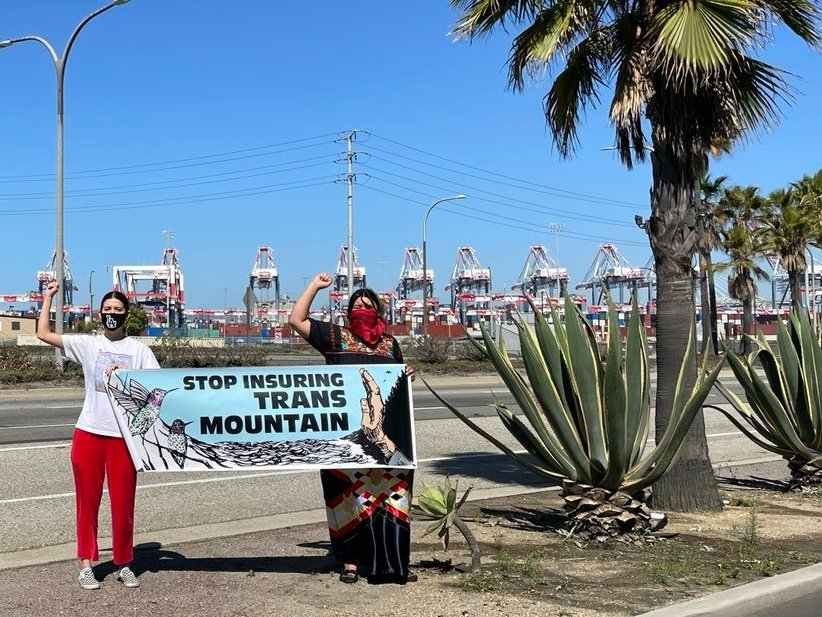
International Indigenous Youth Council protest outside Port of Long Beach, CA. Credit: IICY LA

Indigenous peoples in Canada and a coalition of environmental groups launched a “Global Week of Action” for June 14-21, aimed at pressuring an array of insurance companies to cut ties with a long-distance tar sands pipeline under construction in Canada.

On Wednesday, the Braided Warriors, an Indigenous youth group in British Columbia, held a rally in front of Chubb Insurance Canada in Vancouver, B.C. On Friday, activists in London are set to protest outside Lloyd’s of London — one of the world’s largest insurers of fossil fuels. Other acts of solidarity are planned as far away as the Pacific Islands and Sierra Leone.

The Indigenous and environmental groups are targeting the handful of global insurance companies that provide coverage for the Trans Mountain pipeline system, a long-distance pipeline running from Alberta’s tar sands to the Pacific Coast near Vancouver.

Canoe protest in Manitoba. Credit: Manitoba Energy Justice Coalition


The original pipeline has been operating for decades, but Canada is building what has been termed a “twin” pipeline that would nearly triple the capacity of the existing system to 890,000 barrels of oil per day. For years the Trans Mountain Expansion struggled to get off the ground. It met intense resistance from multiple First Nations in British Columbia, and as it became ensnared in legal limbo, it grew into a financial boondoggle.

The former owner Kinder Morgan sought to bail on the project, and instead of letting it die, Prime Minister Justin Trudeau bought the system in 2018 for C$4.5 billion, effectively nationalizing it to keep it alive and push it forward.

Since then, the Trans Mountain Expansion has broken ground, felling trees and digging trenches along part of its 700-mile route. At the start of 2021, the project was roughly 22 percent completed, and despite the ballooning cost, is scheduled to come online at the end of 2022.

“The Trans Mountain pipeline and tanker project is an existential threat to Tsleil-Waututh Nation. It also fuels the climate crisis, which is a threat to us all. This is why Tsleil-Waututh Nation does not grant our Free, Prior, Informed Consent, and why we are calling on all insurance companies to drop Trans Mountain and recognize the violation of Indigenous rights as a material risk,” Charlene Aleck of the Tsleil-Waututh Nation Sacred Trust Initiative, said in a statement.

The Tsleil-Waututh Nation has lived on the Burrard Inlet in what is now Vancouver for millennia. The expanded pipeline system is estimated to result in a sevenfold increase in oil tanker traffic in the inlet. That would boost the number of tankers navigating the island-studded waters leading to the pipeline’s terminal from 60 per year currently to over 400 per year. A technical assessment conducted by the Tsleil-Waututh Nation found that there is a 79 to 87 percent likelihood of an oil spill in the inlet over a 50-year period.

Turning up the Pressure

But completion is not inevitable, and First Nations and environmental groups opposed to the project see the insurance industry as a key point of leverage. Without insurance, the pipeline cannot proceed.

DeSmog previously reported on the effort by First Nations and environmental groups to pressure global insurance companies to sever their ties with Trans Mountain, among other acts of resistance.

The campaign has proven to be partially successful thus far. In early June, Argo Group said it would stop insuring the pipeline when its policy expires at the end of August. “This type of project is not currently within Argo’s risk appetite,” Argo said in a statement to Insurance Journal.

Last year, other insurance giants — Zurich Insurance, Talanx, and Munich Re — also backed out. At least 14 major insurance companies have ruled out insuring the pipeline, according to Stand.earth, an environmental group pressuring the industry.

The shrinking pool of insurance is also part of a larger story. Greater scrutiny over the oil industry in general, and Canada’s tar sands in particular — some of the dirtiest forms of oil production — has led to a growing number of insurance companies restricting coverage to the sector.

“They’re standing on the wrong side of history. They should know and understand that the fossil fuel industry is in a state of demise. They shouldn’t be investing their funding into a dying industry that has proven itself to be incredibly destructive to the environment,” Grand Chief Stewart Phillip, president of the Union of British Columbia Indian Chiefs, told DeSmog, referring to the insurance companies backing the project.

Joe Seeger, an expert in insurance for oil projects, told the CBC that the number of large insurance companies providing coverage to Canadian tar sands has fallen roughly in half over the past decade. “It really is a supply and demand situation where we always go to our clients and have the bad news of [explaining there] are fewer insurers and we have to try to figure out new ways to do the business,” Seeger told the CBC in May.

The insurers that remain have tightened up their offerings. The major insurers in London have restricted the amount of coverage for tar sands operations to just $200 million, according to Willis Towers Watson, an international insurance broker. As recently as 18 months ago, those companies would offer $500 million in coverage.

Activists hand petitions to Chubb Insurance in Zurich, Switzerland. Credit: Campax
Credit: Texas Campaign for the Environment


The pressure from activists and First Nations apparently had enough of an impact on the project that Trans Mountain appealed to the Canada Energy Regulator in February to allow them to keep the names of its insurers secret.

In its application, Trans Mountain said that “insurance companies have faced negative pressure for insuring the Trans Mountain Pipeline” and that Trans Mountain “experienced a significant reduction in available insurance capacity” in 2020. If the growing pressure from activists continues, the pipeline operator said, it would “likely result in material loss to Trans Mountain.”

The federal regulator agreed and allowed the insurers to remain confidential. “It’s a troubling example of Trans Mountain’s culture of secrecy and attempts to evade transparency and accountability to its owners, which are the Canadian taxpayers,” Elana Sulakshana, an energy finance campaigner with Rainforest Action Network, told DeSmog.

DeSmog reached out to eight insurers that are thought to be the remaining companies backing the Trans Mountain system — AIG, Chubb, Energy Insurance Limited, Liberty Mutual, Lloyd’s, Starr, Stewart Specialty Risk Underwriting, and W.R. Berkley. AIG declined to comment and the rest did not respond.

Trans Mountain did not respond to a request for comment.

“The key companies that were insuring the project last year have yet to cut ties and for the most part have not commented publicly on their support for the project. And that’s why we’re having this week of action, to ramp up the pressure and keep the public scrutiny on them so that they are forced to respond,” Sulakshana said.

A ‘paradigm shift

Even as the Trans Mountain Expansion is proceeding without the consent of some First Nations, there is something of a reckoning unfolding at the moment in Canada surrounding its relationship with Indigenous communities.

Both British Columbia and the Canadian parliament are moving legislation forward that would align provincial and federal law with the principles laid out in the U.N. Declaration on the Rights of Indigenous Peoples (UNDRIP), an attempt at some form of reconciliation. On June 16, the Canadian Senate passed the bill.

“Grand Chief Stewart Phillip” by The Narwhal Canada is licensed under CC BY 2.0 


The practical impact is unclear as of yet, but the legislation is a “paradigm shift,” according to Grand Chief Stewart Phillip, potentially shifting more power to First Nations when it comes to resource extraction on Indigenous lands.

“We have a federal bill and a provincial bill that seeks to send a strong message to governments at all levels, to industry, business — that it’s a new day,” he said.

But he doesn’t expect the legislation to defuse simmering tension in British Columbia. “We’re expecting to hear the usual racist backlash from industry,” Phillip said. He pointed to the epidemic of Missing and Murdered Indigenous Women and Girls (MMIWG), concerns about radicalized violence, and also the recent revelation that the remains of 215 children were found on the grounds of the Kamloops Indian Residential School, one of many schools that forcibly sought to assimilate Indigenous children and which operated until the late 1970s. The discovery made national, and indeed, international headlines.

“It’s a very, very volatile situation here in British Columbia,” Phillip said. And the construction of the Trans Mountain Expansion “could be a flashpoint, no doubt about it.”

But opposition to the pipeline continues. “This resistance has been consistent and unrelenting,” Phillip said. “We intend to continue to vigorously oppose TMX [Trans Mountain Expansion] until it’s dead.”