Greener growth could add $26 trillion to world economy by 2030: study

Reuters

By Alister Doyle and Nina Chestney, Reuters      September 4, 2018
FILE PHOTO: A man kite surfs in front of the Burbo Bank wind farm near New Brighton
A man kite surfs in front of the Burbo Bank wind farm near New Brighton, Britain, September 3, 2018. REUTERS/Phil Noble/File Photo

By Alister Doyle and Nina Chestney

OSLO/LONDON (Reuters) – Strong action to combat climate change could cumulatively add at least $26 trillion to the world economy by 2030, according to a study on Wednesday which seeks to dispel fears that a shift from fossil fuels will undermine growth.

President Donald Trump, for instance, said last year that he will pull the United States out of a global climate pact called the Paris Agreement because it would impose what he called “draconian financial and economic burdens” on his country.

By contrast, the Global Commission on the Economy and Climate, which includes former heads of government, business leaders and economists, said there was “unprecedented momentum” toward greener growth that would boost jobs and countries’ economies.

Bold climate action could deliver at least $26 trillion in net cumulative benefits from now until 2030 compared with business as usual, it said.

“There’s still a perception that moving toward a low-carbon path would be costly,” lead author Helen Mountford told Reuters. “What we are trying to do with this report is once and for all put the nails in the coffin on that idea.”

The commission’s study adds detailed projections since it first issued a report in 2014 to highlight economic opportunities from a shift away from fossil fuels.

Smarter investments in cleaner energy, cities, food and land use, water and industry could generate 65 million new jobs in 2030, equivalent to the workforces of Egypt and Britain combined, the study said.

A shift from fossil fuels to cleaner energies such as wind and solar power would avoid 700,000 premature deaths from air pollution in 2030, it added.

The report recommended high prices on carbon dioxide emissions of $40-$80 per tonne by 2020 in major economies.

Subsidy reforms in the energy sector, coupled with higher carbon prices, could raise $2.8 trillion a year in government revenues in 2030, it said.

Former Mexican President Felipe Calderon, honorary chair of the Commission, said it was “a manifesto for how we can turn better growth and a better climate into reality”. Co-chairs include Paul Pohlman, chief executive of consumer goods group Unilever, and Professor Nicholas Stern of the London School of Economics.

Trump, who doubts that man-made emissions of greenhouse gases are the prime cause of climate change and wants to promote the coal industry, has said the 2015 Paris Agreement could cost 2.7 million U.S. jobs by 2025.

But the report predicted that U.S. jobs lost in fossil fuels can be more than offset by a rise in employment in renewables and construction. It said 476,000 people were now employed in wind and solar power in the United States.

Despite signs of climate action the report said “we are not making progress fast enough” to limit a rise in temperatures linked to more floods, heat waves, wildfires and rising sea levels.

(editing by David Stamp)

If Trump Ever Got Impeached?

Randy Rainbow

August 27, 2018

***NEW VIDEO***

Some people without brains do an awful lot of talking.

IF YOU EVER GOT IMPEACHED – Randy Rainbow Song Parody

***NEW VIDEO***Some people without brains do an awful lot of talking. 🌪🌈🎵❤️🧠

Posted by Randy Rainbow on Monday, August 27, 2018

One of the best political ads of the season!

NowThis Politics

August 13, 2018

Watch one of the most viral political ads of 2018

MJ Hegar Has One of the Most Viral Ads of 2018

Watch one of the most viral political ads of 2018

Posted by NowThis Politics on Monday, August 13, 2018

The GOP tax cuts for the wealthy is helping them funnel that money into the 2018 midterms.

August 28, 2018

The GOP tax cuts for the wealthy has another layer: It’s helping them funnel that money into the 2018 midterms

Robert Reich on the GOP Tax Cuts for the Rich and the 2018 Midterms

The GOP tax cuts for the wealthy has another layer: It's helping them funnel that money into the 2018 midterms

Posted by NowThis Politics on Tuesday, August 28, 2018

What does Big Sugar have to do with Florida’s toxic water problems?

Everglades-Trust shared a video.

August 27, 2018

What Floridians are enduring is decades in the making. Agricultural runoff polluting the water and Big Sugar blocking its natural flow. Bianca Graulau with 10News in Tampa Bay does a remarkable job telling the story here.

What does Big Sugar have to do with Florida's red tide?

You've been hearing a lot about the toxic algae situation in Florida. But what's causing it? @Bianca Graulau explains.https://on.wtsp.com/2oddXNH

Posted by 10News WTSP on Sunday, August 26, 2018

Paying for groceries with plastic waste! Wonderful!

World Economic Forum

August 8, 2018

You can trade it for groceries, fuel or even school fees. Learn more about the fight against plastic waste:

These stores accept plastic waste as money

You can trade it for groceries, fuel or even school fees. Learn more about the fight against plastic waste: https://wef.ch/2JC1fEx

Posted by World Economic Forum on Wednesday, August 8, 2018

Vote today to save the everglades and Florida waters!

Everglades-Trust

August 25, 2018

Like George was calling out Big Sugar by name: “They spend billions of dollars every year lobbying, lobbying, to get what they want. Well, we know what they want. They want more for themselves and less for everybody else.

But I’ll tell you what they don’t want: They don’t want a population of citizens capable of critical thinking. They don’t want well informed, well educated people capable of critical thinking. They’re not interested in that. That doesn’t help them. That’s against their interests.”

VOTE ON TUESDAY AUGUST 28!

Like George was calling out Big Sugar by name: “They spend billions of dollars every year lobbying, lobbying, to get what they want. Well, we know what they want. They want more for themselves and less for everybody else. But I'll tell you what they don’t want: They don’t want a population of citizens capable of critical thinking. They don’t want well informed, well educated people capable of critical thinking. They’re not interested in that. That doesn’t help them. That’s against their interests.”

Posted by Everglades-Trust on Saturday, August 25, 2018

Costa Rica will be 100% renewable by 2021

U.S. Senator Bernie Sanders — US Senator for Vermont

August 26, 2018

Despite Trump and Scott Pruitt, the world is making progress to address climate change. Costa Rica is proving that it’s possible to rapidly transition away from fossil fuels to renewable energy. (via The Years Project)

Costa Rica 100% Renewable

Despite Trump and Scott Pruitt, the world is making progress to address climate change. Costa Rica is proving that it's possible to rapidly transition away from fossil fuels to renewable energy. (via The Years Project)

Posted by U.S. Senator Bernie Sanders on Sunday, August 26, 2018

1 in 3 Americans have less than $5,000 saved for retirement

CNBC – Money

1 in 3 Americans have less than $5,000 saved for retirement—here’s why so many people can’t save

Kathleen Elkins       August 27, 2018

NUP_180652_0628.jpgCloud 9. Michael Yarish | NBC.

The vast majority of Americans, 78 percent, say they’re “extremely” or “somewhat” concerned about not having enough money for retirement, according to Northwestern Mutual’s 2018 Planning & Progress Study.

And for good reason: A shocking 21 percent of Americans have nothing at all saved for the future, and another 10 percent have less than $5,000 tucked away, the study finds.

That means about a third of Americans have only a few thousand dollars, or less, put away for their golden years.

Of course, some people are more prepared: A quarter report having $200,000 or more stashed away, while 16 percent have between $75,000 and $199,999. But overall, Northwestern Mutual found that Americans with retirement savings have an average of $84,821 saved, which is far from enough. Experts typically recommend trying to accumulate at least $1 million.

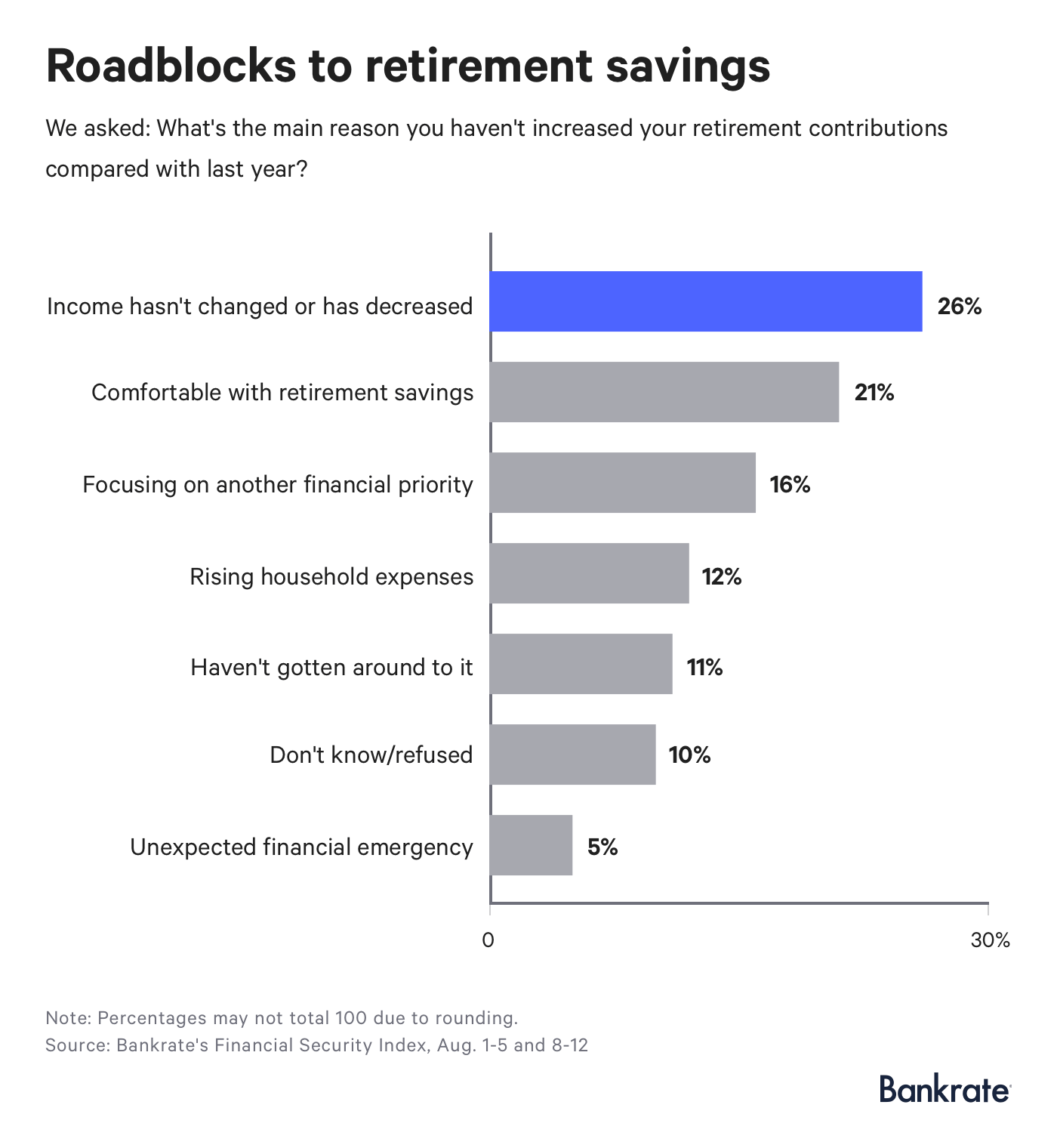
Meanwhile, a new survey from Bankrate finds that 13 percent of Americans are saving less for retirement than they were last year and offers insight into why much of the population is lagging behind. The most popular response survey participants gave for why they didn’t put more away in the past year was a drop, or no change, in income.

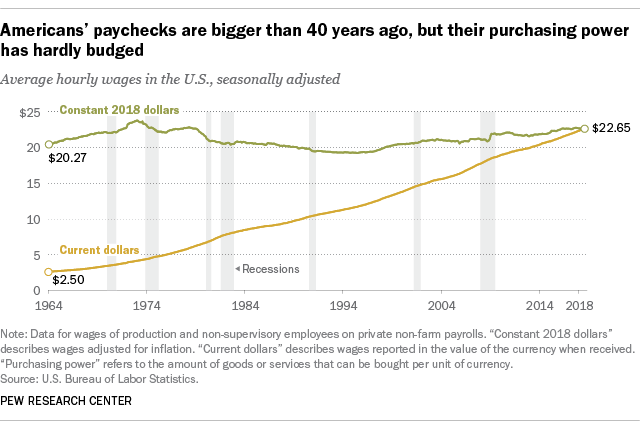
“That’s consistent with federal data that show real wages have barely budged in decades,” Bankrate reports. According to the Pew Research Center, the average paycheck has the same purchasing power it did 40 years ago.

Day-to-day costs continue to soar, and salaries don’t go as far as they once did to cover the necessities, author and executive director of the Economic Hardship Reporting Project Alissa Quart tells CNBC Make It. That makes it more difficult to set aside money for the future.

Still, the longer you put off planning for your golden years, the farther behind you’ll fall.

The good news is there are ways to make progress without feeling cash-strapped or committing to any drastic lifestyle changes. Here are three effective strategies:

1. Start ASAP. The sooner you begin putting your money to work, the less you’ll have to save each month to reach your goals, thanks to the power of compound interest.

If you start at age 23, for instance, you only have to save about $14 a day to be a millionaire by age 67. That’s assuming a 6 percent average annual investment return. If you start at age 35, on the other hand, you’d have to set aside $30 a day to reach seven-figure status by age 67.

Here's how much you should save at every age

Here’s how much you should save at every age.
2. Automate. If you automate your retirement savings — meaning, you have a portion of your paycheck sent directly to a retirement account, such as a 401(k), Roth IRA or traditional IRA — you’ll never even see the money you’re setting aside and will learn to live without it.

Ideally, you’ll want to work your way up to setting aside at least 10 percent of your pretax income, but if you’re only comfortable with setting aside 1 percent, start there!

Check online to see if you can set up “auto-increase,” which allows you to choose the percentage you want to raise your contributions by and how often. This way, you won’t forget to up your contributions or talk yourself out of setting aside a larger chunk when the time comes.

If you can’t find the feature online, call your retirement plan provider to find out what’s possible.

3. Bank any surplus money. Whenever you come across any extra cash — a bonus, birthday check or small windfall — rather than blowing it on a new pair of shoes or a vacation, send at least a chunk of it straight to savings.

To resist the temptation to spend any surplus money, deposit it right away, so you never even see it.

Don’t miss: The economy is booming, yet Americans are struggling. An award-winning author explains why

Here’s how this North Carolina couple could retire in their 30’s.
https://www.cnbc.com/video/2017/04/06/heres-how-this-north-carolina-couple-could-retire-in-their-30s.html

Trump admin ‘turned its back on young people’