AG Bill Barr’s election deceptions go from bad to worse
Attorney General Bill Barr didn’t have credibility to spare, which makes it all the more unfortunate that he keeps making matters worse for himself.
By Steve Benen September 16, 2020
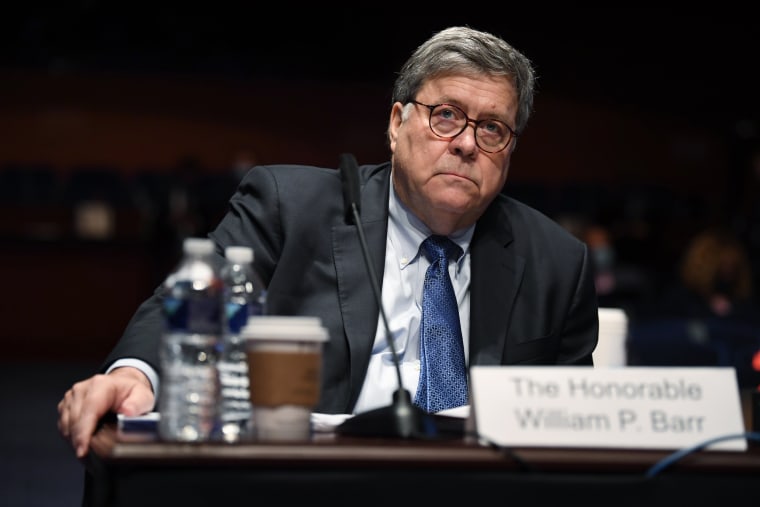
Attorney General William Barr appears before the House Oversight Committee on Capitol Hill in Washington, on July 28, 2020.Matt McClain / The Washington Post via AP file
Attorney General William Barr sat down with CNN’s Wolf Blitzer two weeks ago, and fielded a series of questions about voting access. It didn’t go well: the Republican struggled with a question about whether North Carolinians can vote twice; he used deceptive rhetoric about Russian election interference; and he told a voter-fraud tale that was so ridiculous that even his own Justice Department had to concede it wasn’t true.
Between this unfortunate display and the attorney general’s penchant for peddling demonstrable falsehoods, common sense suggests Barr should probably exercise greater caution when discussing the elections.
And yet, Barr spoke to the Chicago Tribune‘s John Kass last week and jst kept going.
“There’s no more secret vote with mail-in vote. A secret vote prevents selling and buying votes. So now we’re back in the business of selling and buying votes. Capricious distribution of ballots means (ballot) harvesting, undue influence, outright coercion, paying off a postman, here’s a few hundred dollars, give me some of your ballots,” the attorney general said.
This isn’t just wrong; it’s bizarre. The idea that postal balloting is an invasion of one’s privacy has been fact-checked and discredited. The idea that “we’re back in the business of selling and buying votes” is belied by the fact that several states have relied on mail-in voting for years without incident.
Indeed, let’s not forget that many members of Team Trump have voted by mail — including Bill Barr himself — without any concerns about systemic corruption.
But it was especially bizarre to see the attorney general describe a made-up scenario in which nefarious forces pay bribes to U.S. Postal Service employees as part of an elaborate fraud scheme. For the nation’s chief law-enforcement official to concoct and peddle such a tale — without a shred of evidence or substantiation — is as irresponsible as it is bonkers.
University of Kentucky law professor Josh Douglas, an expert in election law, described Barr’s rhetoric as “wild, fanciful, and completely false lies,” adding, “This is beyond unprofessional.”
And yet, Barr couldn’t seem to help himself. “Someone will say the president just won Nevada. ‘Oh, wait a minute! We just discovered 100,000 ballots! Every vote will be counted!'” the Republican added in the interview with Kass, describing an imagined scenario. “Yeah, but we don’t know where these freaking votes came from.”
None of this reflects reality in any way. Barr is describing a corrupt dynamic that doesn’t exist.
The attorney general proceeded to again take aim at Americans he doesn’t like. “You know liberals project,” Barr added. “All this bulls— about how the president is going to stay in office and seize power? I’ve never heard of any of that crap. I mean, I’m the attorney general. I would think I would have heard about it. They are projecting. They are creating an incendiary situation where there will be loss of confidence in the vote.”
Ah, yes, of course. As Donald Trump wages a months-long effort to undermine public confidence in his own country’s electoral system, it’s “liberals” who are trying to create a situation in which “there will be loss of confidence in the vote.”
Barr didn’t have credibility to spare, which makes it all the more unfortunate that he keeps making matters worse for himself.
“You might think, given all the crimes Trump has bragged about committing during his time in office, that the primary path to prosecuting him would involve the U.S. Justice Department,” Wise wrote. “If Joe Biden is sworn in as president in January, his attorney general will inherit a mountain of criminal evidence against Trump accumulated by Robert Mueller and a host of inspectors general and congressional oversight committees. After the DOJ’s incoming leadership is briefed on any sensitive matters contained in the evidence, federal prosecutors will move forward with their investigations of Trump.”
Trump could try to pardon himself on his way out of the White House, which would certainly complicate matters, but Wise believes that Manhattan district attorney Cyrus Vance Jr. would likely charge the president with falsifying business records and tax fraud.
“To build a fraud case against Trump, Vance subpoenaed his financial records,” Wise wrote. “But those records alone won’t be enough: To secure a conviction, Vance will need to convince a jury not only that Trump cheated on his taxes but that he intended to do so.”
Unfortunately for the president, his former attorney Michael Cohen and longtime accountant Allen Weisselberg have already signaled they’re willing to cooperate with prosecutors and both would have strong evidence to prove Trump’s intent.
“Once indicted, Trump would be arraigned at New York Criminal Court, a towering Art Deco building at 100 Centre Street,” Wise wrote. “Since a former president with a Secret Service detail can hardly slip away unnoticed, he would likely not be required to post bail or forfeit his passport while awaiting trial. His legal team, of course, would do everything it could to draw out the proceedings.”
Accounting for those legal delays, experts told Wise that Trump would likely go on trial by 2023 and last no longer than a few months, and the president’s own supporters have already been persuaded to convict former campaign chairman Paul Manafort.
“Trump’s conviction would seal the greatest downfall in American politics since Richard Nixon,” Wise wrote. “Unlike his associates who were sentenced to prison on federal charges, Trump would not be eligible for a presidential pardon or commutation, even from himself. And while his lawyers would file every appeal they can think of, none of it would spare Trump the indignity of imprisonment.”
“Unlike the federal court system, which often allows prisoners to remain free during the appeals process, state courts tend to waste no time in carrying out punishment,” he added. “After someone is sentenced in New York City, their next stop is Rikers Island. Once there, as Trump awaited transfer to a state prison, the man who’d treated the presidency like a piggy bank would receive yet another handout at the public expense: a toothbrush and toothpaste, bedding, a towel, and a green plastic cup.”
(Bloomberg) — BP Plc said the relentless growth of oil demand is over, becoming the first super-major to call the end of an era many thought would last another decade or more.
Oil consumption may never return to levels seen before the coronavirus crisis took hold, BP said in a report on Monday. Even its most bullish scenario sees demand no better than “broadly flat” for the next two decades as the energy transition shifts the world away from fossil fuels.
BP is making a profound break from orthodoxy. From the bosses of corporate energy giants to ministers from OPEC states, senior figures from the industry have insisted that oil consumption will see decades of growth. Time and again, they have described it as the only commodity that can satisfy the demands of an increasing global population and expanding middle class.
The U.K. giant is describing a different future, where oil’s supremacy is challenged, and ultimately fades. That explains why BP has taken the boldest steps so far among peers to align its business with the goals of the Paris climate accord. Just six months after taking the top job, Chief Executive Officer Bernard Looney said in August he’d shrink oil and gas output by 40% over the next decade and spend as much as $5 billion a year building one of the world’s largest renewable-power businesses.
That’s because he suspects oil use may already have peaked as a result of the pandemic, stricter government policies and changes in consumer behavior. BP’s energy outlook shows consumption slumping 50% by 2050 in one scenario, and by almost 80% in another. In a “business-as-usual” situation, demand would recover but then flatline near 100 million barrels a day for the next 20 years.
Read: BP Walks Away From the Oil Super-major Model It Helped Create
BP isn’t the only big oil company adapting its business to the energy transition. Royal Dutch Shell Plc, Total SE and others in Europe have announced similar pivots toward cleaner operations as customers, governments and investors increasingly call for change.
Three Possible Futures
BP’s report comes ahead of three days of online briefings starting Monday on its clean-energy and climate strategy. The study considers three scenarios, which aren’t predictions but nevertheless cover a wide range of possible outcomes over the next 30 years and form the basis of the new strategy Looney announced in August.
The “Rapid” approach sees new policy measures leading to a significant increase in carbon prices. The “Net Zero” course reinforces Rapid with big shifts in societal behavior, while the “Business-as-usual” projection assumes that government policies, technology and social preferences continue to evolve as they have in the recent past.
See also: New EU Climate Plan Brings End of the Combustion Engine Closer
In the first two scenarios, oil demand falls as a result of the coronavirus, the report shows. “It subsequently recovers but never back to pre-Covid levels,” according to Spencer Dale, BP’s chief economist. “It brings forward the point at which oil demand peaks to 2019.”
That contrasts with what many others are forecasting. Russell Hardy, chief executive officer of trading giant Vitol Group, said on Monday that oil demand is poised for 10 years of growth before a steady decline. He predicts consumption will return to pre-virus levels by the end of next year.
BP’s outlook last year contained a scenario called “More energy,” which had oil demand growing steadily to about 130 million barrels a day in 2040. There’s no such scenario this time.
“Demand for oil falls over the next 30 years,” BP said in the report. “The scale and pace of this decline is driven by the increasing efficiency and electrification of road transportation.”
Covid Impact
The pandemic shattered oil consumption this year as countries locked down to prevent infections from spreading. While demand has since improved, and crude prices with it, the public health crisis is still raging in many parts of the world and the outlook remains uncertain in the absence of a vaccine.
The impact, including lasting behavioral changes like increased working from home, will affect economic activity and prosperity in the developing world, and ultimately demand for liquid fuels, according to BP. That means it won’t be able to offset already falling consumption in developed countries.
Demand for liquid fuels is seen falling to less than 55 million barrels a day by 2050 in BP’s Rapid scenario, and to around 30 million a day in Net Zero. The drop is mostly in developed economies and in China. In India, other parts of Asia and Africa, demand remains broadly flat in the first scenario but slips below 2018 levels from the mid-2030’s in the second.
Other points in the energy outlook:
The Rapid scenario has carbon emissions from energy use falling by around 70% by 2050, while they drop by more than 95% in Net Zero. Business-as-usual sees them peaking in the mid-2020’s.Demand for all primary energy — the raw materials from which energy is derived — increases by about 10% in Rapid and Net Zero in the period, and by around 25% in the third scenario.In Rapid, non-fossil fuels account for the majority of global energy from the early 2040’s.Growth in China’s energy demand slows sharply relative to past trends, reaching a peak in the early 2030’s in all three scenarios.Renewable energy — excluding hydro — increases more than 10-fold in both Rapid and Net Zero, with its share in primary energy rising from 5% in 2018 to more than 40% by 2050 in Rapid and almost 60% in Net Zero.Natural gas consumption is seen broadly unchanged to 2050 in Rapid and around 35% higher in business-as-usual. Demand falls by about 40% by 2050 in Net Zero.
(Updates with BP briefings in the seventh paragraph, Vitol CEO comments in the 10th.)
For more articles like this, please visit us at bloomberg.com
Oregon Wildfires Are Decimating Homes Near Me And I’m Terrified About What’s Next
Emily Halnon September 13, 2020
Water continues to flow from a pipe amid the charred remains of homes and businesses after the passage of the Santiam fire in Gates, Oregon, on Sept. 10. (Photo: KATHRYN ELSESSER via Getty Images)
It’s been hard for me to sleep this week ― because there’s been a steady storm of evacuation notices at all hours of the day and night, as catastrophic wildfires ravage Oregon. Hundreds of thousands of people have been ordered to leave their homes ― or to get ready to ― including neighborhoods in the town next to mine.
I spend my midnight hours refreshing the sheriff’s page for the latest evacuation map and scrolling through the unending stream of heart-wrenching news ― haunted by the images of charred homes and ashen ghost towns that were decimated by the fires just up the river from us.
I lie awake listening for the jarring alarm of an official emergency alert, notifying us of the newest parts of our county that need to leave their homes immediately.
“Make sure your cell phone is turned way up at night,” my firefighting friend advised me when I asked her if I should start packing a bag myself, as I watched the evacuation zones spread across the county map like spilled paint ― sometimes going from green to red in less than two hours.
“And, yes, it wouldn’t be a bad idea to have a bag ready,” she said.
Her advice was guided by the reality that things can rapidly change with the current fire situation across the West. Climate change has ushered in hotter and drier conditions that have turned our forests into a tinderbox and extended our fire seasons into the fall months. The lush vegetation that coats the ground has browned from the lack of rain and the scorching heat, and water-starved grass crunches beneath your feet. The land is primed and ready to ignite into a roaring fire.
A rogue spark or a downed power line that hits the crisp earth can quickly escalate into an uncontrollable and devastating blaze ― something that’s happened all over the state in the last week ― fueled by hot and furious winds from the east. Oregon went from a few small fires to 1 million acres actively burning ― a swath of land larger than Rhode Island steamrolled by uncontainable wildfires in a matter of days.
So, I decided to pack a go bag full of the necessities I would need if the blaze continued to grow toward us ― or if a new one started in the forested hills of our neighborhood. I grabbed extra clothes, dog food for my pandemic puppy, a sleeping bag, and my handful of prescriptions. And I made sure my car’s gas tank was full, in case we got stuck in evacuation traffic or unexpectedly rerouted by fire ― new blazes have been shutting down major highways and sections of the interstate all week.
Where we would go with our packed bags and full tank of gas is punctuated with a question mark, as I’m sure it has been for the thousands of displaced families who have already been forced to abandon their homes.
In this aerial view from a drone, homes destroyed by wildfire are seen on Sept. 12 in Talent, Oregon. Hundreds of homes in Talent and nearby towns have been lost due to wildfire. (Photo: David Ryder via Getty Images)
A thick plume of toxic smoke is choking most of the state right now ― and the entire West Coast. You can barely see the end of our street through the heavy haze, and ash has been falling from the sky like gray rain, coating our house and everything outside of it with a thick layer of ominous soot.
When I open the door to let my puppy out to pee, I am walloped with the smell of a smoldering campfire. It lingers in my hair and all over my clothes when I duck back inside my house. I’ve barely stepped outside in the last four days because the air is so toxic ― some of the most hazardous air in the world is smothering Oregon.
We’ve tried to seal ourselves off from it, but it seeps into the slender crack beneath our front door. My eyes sting with dryness, my head pounds, and my throat burns like I smoked a pack of cigarettes for breakfast. The homemade air filter that we run all day and night is coated in an alarming amount of dark debris.
During other fire seasons, we’ve escaped the heavy smoke that settles over the valley by fleeing to the coast or a higher town for fresh air. But clean air and blue skies are an elusive thing in Oregon right now. The air quality map advertises hazardous skies from Mexico to Canada. You’d have to drive for hundreds of miles to find refuge from the wildfires.
So, I don’t really know where we’d go, but we’re packed just in case we have to.
I also packed a bag of my most sentimental items because that’s what I would really want to save from a fire ― the things that I would be gutted to lose forever ― including cherished belongings of my late mother, years of journals and handwritten cards, and the coffee mug from my first trail race in Oregon. As I delicately placed everything into a huge duffel, I was grateful for the luxury of time to pack these irreplaceable things, something many people in my community did not have as they woke up to emergency responders banging on their door in the middle of the night telling them to go! Go! Go!
As I moved methodically through my house, deciding what to take and what to leave, I imagined losing it all in a fleeting moment ― a horrendous reality that I’d never really considered until this week. I’m sure many of the Oregonians who have seen their lives upended and their homes scorched by these fires probably felt the same way.
As I delicately placed everything into a huge duffel, I was grateful for the luxury of time to pack these irreplaceable things, something many people in my community did not have as they woke up to emergency responders banging on their door in the middle of the night telling them to go! Go! Go!
It struck me how fragile so much of life is: our homes, our health, our loved ones, our earth, our own lives. We can lose just about anything or anyone without much notice at all. It’s something that’s always been true, but feels persistently more threatening in a year defined by so much loss, so many devastating disasters, and so many blazing red flags that the climate crisis is getting worse and worse all over the world.
I glance out the window at the blood orange sun burning behind the chalky sky. It’s an apocalyptic landscape. I wonder when we will see blue skies again. When we will be able to take a deep breath and not worry about the damage to our lungs.
I think foolishly of my last run through the wilderness around Oregon’s Mount Jefferson, a mountain north of us that’s currently engulfed in flames. On that day, a storm obscured the views of its most scenic spots, where alpine meadows spill into sweeping views of the glaciated volcano.
“It’s OK, it’s not like it’s going anywhere,” I told my friend, as we darted through the rain and clouds. “I’ll see it next time.”
Now we’re inhaling shards of the trees that once dotted that iconic landscape.
Some of life’s fragility is out of our control ― a painful and cruel reality that sits especially heavy in a year when I’ve lost two family members to cancer.
But, some of the huge losses that we’re experiencing right now are things we can influence. The climate crisis that’s fueling the wildfire devastation across the west is one of them.
It’s likely that Oregon is going to see more casualties caused by these wildfires than ever before, and a historic number of homes, structures, and miles of wilderness scorched by these destructive blazes. It’s also likely that these losses will just get worse in Oregon ― and across the entire West ― if we choose to let our climate crisis continue to spiral out of control instead of doing something about it.
Oregon residents evacuate north along highway Highway 213 on Sept. 9 near Oregon City, Oregon. Multiple wildfires grew by hundreds of thousands of acres Thursday, prompting large-scale evacuations throughout the state. (Photo: Nathan Howard via Getty Images)
This is not my first fire season in Oregon, but it is the first time that I’ve legitimately feared losing my home. The first time that I’ve texted several friends and neighbors asking them if they are packed and ready to flee. The first time I’ve studied evacuation maps and wind patterns and fire acreage during a sleepless night. And it’s the first time that I’ve cried over wildfire news coverage ― over entire towns wiped out and stories of people who didn’t make it out in time. The grief of the widespread loss across Oregon knocks me over like an angry linebacker.
It’s gutting that so many people have already suffered so much destruction. I feel lucky that all I’ve had to do is pack a bag and take shallower breaths all week, but the massive losses happening all around Oregon have fueled my fear for future fire seasons ― for my friends and community, for land and people across the west. It’s terrifying to imagine what it would look like for things to get much worse.
But I know things will get worse without aggressive climate action. I know more go bags will get packed. More homes will be decimated. More wilderness will be singed. And more lives will be unnecessarily lost ― unless we do something to stop it.
Emily Halnon lives and writes in Eugene, Oregon. She spends as much time as humanly possible exploring the trails of the Pacific Northwest and she recently set the fastest known time for running the 460-mile Oregon stretch of the Pacific Crest Trail. She’s published essays in The Guardian, Salon, and Ravishly.
An ominous map shows the entire West Coast with the worst air quality on Earth as historic wildfires spew smoke
Morgan McFall-Johnsen September 11, 2020
A thick layer of wildfire smoke tints the skies orange in San Francisco, California, on September 9, 2020. Katie Canales/Business Insider.
The US West Coast has the worst air quality in the world due to wildfire smoke across California, Oregon, and Washington.
Maps of air-quality index measurements show hazardous levels of particulate matter from wildfire smoke across the entire West Coast.
Research has linked particulate matter from wildfires to heart and lung problems, increased hospital visits, and worse flu seasons.
The EPA recommends residents stay indoors with filtered air, keep physical activity levels low, and wear an N95 respirator if they have to go outside.
The West Coast has the worst air quality on Earth right now, as nearly 100 active wildfires — including three of California’s four biggest ever recorded — spew smoke.
Particulate matter from the smoke has made the air unhealthy to breathe all along the coast, as this map from air-quality monitoring company PurpleAir shows.
The numbers in the colored circles indicate the air quality index (AQI) detected by various monitoring sensors across the country. AQI is a metric measuring the level of pollutants in the air and how hazardous those levels are to human health, as determined by guidelines from the Environmental Protection Agency.
A higher AQI indicates more pollutants in the air and a greater health hazard. The EPA considers any AQI above 150 to be unhealthy for all people. Anything above 300 is considered a “health warning of emergency conditions.”
The EPA does not make recommendations for AQI levels above 500, since they’re “beyond index.”
But PurpleAir’s monitors around Salem, Oregon, reported AQIs as high as 758 on Friday morning.
Those levels are comparable to some of the worst days for air quality in Dehli, India — the world’s most polluted city, according to the nonprofit Berkeley Earth.
Satellite imagery shows fires and smoke along the US West Coast, September 8, 2020. CIRA/NOAA Goes – West
None of PurpleAir’s monitors at other locations across the globe were reporting AQIs anywhere near 400 on Friday morning.
Fires have burned millions of acres and forced mass evacuations
California has been battling blazes for several weeks following a dry lightning storm on August 16 that ignited hundreds of fires. The state’s Doe Fire in the Mendocino National Forest is now the biggest in history at more than 471,000 acres. California’s third- and fourth-biggest fires ever are currently burning, too.
Firefighters keep an eye on the Creek Fire along state Highway 168, September 6, 2020, in Shaver Lake, California. Marcio Jose Sanchez/AP Photo.
In California, more than 3.1 million acres have burned so far — an area more than 100 times the size of San Francisco and far more than any other year on record. Fire season doesn’t normally peak until late September.
In Oregon, meanwhile, fires spanning more than 1 million acres have forced about 40,000 people to evacuate. Flames encroaching on the Portland metro area prompted Mayor Ted Wheeler to issue a Fire Emergency Order on Thursday evening.
More than 500,000 acres have burned in Washington.
In total across the West Coast this fire season, at least 25 people have died.
The fires have spread quickly because forests are dried out by years of record heat. Some blazes are emitting so much smoke that they create their own weather systems, and the haze has tinted the skies orange and red over San Francisco and other parts of the coast.
Particulate matter from smoke has serious health consequences
The AQI numbers on PurpleAir’s map refer to the quantities of tiny particulate matter in the air — specifically, particles that measure 2.5 micrometers across or less. These are known as PM2.5.
Wildfire smoke carries many of these invisible particles, which come from the buildings and vegetation fires burn as well as chemical reactions in the gases it produces.
When humans inhale these particles, they can penetrate deep into the lungs and even the bloodstream. Research has connected PM2.5 pollution to an increased risk of heart attack, stroke, and premature death. In healthy people, it can irritate the eyes and lungs and cause wheezing, coughs, or difficulty breathing.
The map below, from the EPA’s air-quality monitoring website, shows a band of dangerous PM2.5 pollution along the West Coast (similar to what PurpleAir is reporting). The circles are color-coded by AQI ranges: Green indicates good air quality, while maroon indicates “hazardous” conditions with an AQI above 300.
AirNow.gov
“Decades of research have shown that elevated air pollution exposure is associated with a number of adverse health impacts, including compromised immune systems,” Erin Landguth, an associate professor at the University of Montana’s School of Public and Community Health Sciences, told The New York Times.
She added that research indicates that “after bad fire seasons, one would expect to see three to five times worse flu seasons.”
A 2017 study found that hospitals saw a 7.2% increase in admissions for respiratory issues following wildfire smoke events that produced two or more days of moderate PM2.5 pollution.
To reduce exposure to particulate matter, the EPA recommends people stay indoors with filtered air (ideally in a room with few windows or doors and an air purifier), keeping windows and doors closed. Physical activity levels should remain low, and those who must go outside should wear an N95 respirator. Those masks have been in short supply this year, however, due to the coronavirus pandemic.
What he really thinks: Trump mocks Christians, calls them “fools” and “schmucks”
David Cay Johnston, Salon
Donald Trump with thumbs up in front of elderly white congregation in church Drew Angerer/Getty Images/Salon
Michael Cohen’s book about his years as Donald Trump’s fixer is a clarion call to Christians to wake up; recognize the man many of them revere as a heavenly agent is a religious fraud; and act.
Trump loathes Christians and mocks their faith, but pretends to believe if it suits his purposes.
In Disloyal, published today, Cohen shows how Trump is a master deceiver. He quotes Trump calling Christianity and its religious practices “bullshit,” then soon after masterfully posing as a fervent believer. In truth, Cohen writes, Trump’s religion is unbridled lust for money and power at any cost to others.
Cohen’s insider stories add significant depth to my own documentation of Trump’s repeated and public denouncements of Christians as “fools,” “idiots” and “schmucks.”
In extensive writing and speeches, Trump has declared his life philosophy is “revenge.” That stance is aggressively anti-Christian. So are Trump’s often publicly expressed desires to violently attack others, mostly women, and his many remarks that he derives pleasure from ruining the lives of people over such minor matters as declining to do him a favor.
Cohen describes himself as an “active participant” with Trump in activities ranging from “golden showers in a sex club in Vegas” to corrupt deals with Russian officials.
The author offers new anecdotes about Trump’s utter disregard for other people and his contempt for religious belief. Cohen’s words should shock the believers who were crucial to his becoming president, provided they ever read them.
By denouncing the book Trump has ensured that many of those he has tricked into believing he is a deeply religious man will never fulfill their Christian duty to be on the lookout for deceivers.
None of the evangelicals I have interviewed in the past five years knew Trump has denounced in writing their beliefs and written of the communion host as “my little cracker.”
Trump detests Christianity
Despite the irrefutable evidence that Trump detests Christianity and ridicules such core beliefs as the Golden Rule and turning the other cheek, America is filled with pastors who praise him to their flocks as a man of God. Trump himself has looked heavenward outside the White House to imply he was chosen by God.
Pastors who support Trump were scolded two years ago by Christianity Today, a magazine founded by Billy Graham, for not denouncing Trump as “profoundly immoral.” Many evangelical pastors then attacked the magazine rather than following the Biblical exhortation to examine their own souls.
Cohen writes that as a young man who grew up encountering Mafioso and other crooks at a country club he fell into the “trance-like spell” of Trump, whom he describes as an utterly immoral, patriarchal mob boss and con man.
Trump is “consumed by the worldly lust for wealth and rewards,” Cohen writes, which puts him at odds with the teaching of Jesus Christ about what constitutes a good life.
“Places of religious worship held absolutely no interest to him, and he possessed precisely zero personal piety in his life,” Cohen writes.
Prosperity gospel embraced
Cohen explains that the only version of Christianity that could possibly interest Trump is the “prosperity gospel.” That is a perverse belief that financial wealth is a sign of heavenly approval rooted in 19th Century occult beliefs that is anathema to Christian scripture.
Early in Trump’s aborted 2012 presidential campaign, Cohen writes, he was ordered to reach out to faith communities. Soon Paula White, now the White House adviser on faith, proposed a meeting at Trump Tower with evangelical leaders. Cohen writes that Trump liked White because she was blonde and beautiful.
Cohen said that among those attending were Jerry Falwell Jr., who recently resigned in disgrace over sex and greed allegations as head of Liberty University, and Creflo Dollar, who solicited donations for a $65 million corporate jet and who was criminally charged that year with choking his daughter. Dollar said those charges were the work of the devil.
Once the evangelical leaders took their seats, Cohen writes, Trump quickly and slickly portrayed himself as a man of deep faith. Cohen writes that this was nonsense.
Laying on hands
After soaking in Trump’s deceptions, the leaders proposed laying hands on Trump. One purpose of laying on hands is to call on the Holy Spirit for divine approval.
Cohen was astounded when Trump, a germa-phobe, eagerly accepted.
“If you knew Trump as I did, the vulgarian salivating over beauty contestants or mocking Roger Stone’s” sexual proclivities “you would have a hard time keeping a straight face at the sight of him affecting the serious and pious mien of a man of faith. I knew I could hardly believe the performance or the fact that these folks were buying it.
“Watching Trump I could see that he knew exactly how to appeal to the evangelicals’ desires and vanities – who they wanted him to be, not who he really was. Everything he was telling them about himself was absolutely untrue.”
To deceive the evangelicals, Cohen writes, Trump would “say whatever they wanted to hear.”
A perverse epiphany
Trump’s ease at deception became for Cohen an epiphany, though a perverse one.
In that moment, Cohen writes, he realized the boss would someday become president because Trump “could lie directly to the faces of some of the most powerful religious leaders in the country and they believed him.”
Later that day, Cohen writes, he met up with Trump in his office.
“Can you believe that bullshit,” Trump said of the laying on of hands. “Can you believe that people believe that bullshit.”
Cohen also writes about Trump’s desire, expressed behind closed doors, to destroy those who offend him. Trump has said the same, though less vividly, in public.
“I love getting even,” Trump declared in his book Think Big, espousing his anti-Christian philosophy: “Go for the jugular. Attack them in spades!”
He reiterated that philosophy this year at the National Prayer Breakfast. Holding up two newspapers with banner headlines reporting his Senate acquittal on impeachment charges, Trump said, “I don’t like people who use their faith as justification for doing what they know is wrong. Nor do I like people who say, ‘I pray for you,’ when they know that that’s not so.”
Trump spoke after Arthur Brooks, a prominent conservative, told the breakfast meeting that “contempt is ripping our country apart.”
Brooks went on: “We’re like a couple on the rocks in this country…Ask God to take political contempt from your heart. And sometimes, when it’s too hard, ask God to help you fake it.”
Everyone in the room rose to applaud Brooks except Trump, though he finally stood up as the applause died down.
Taking the microphone, Trump said, “Arthur, I don’t know if I agree with you… I don’t know if Arthur is going to like what I’m going to say.”
Trump then said he didn’t believe in forgiveness. That is just as Cohen wrote: “Trump is not a forgiving person.” Trump’s words at the prayer breakfast made clear that he rejects the teaching of Jesus at Luke 6:27: “Love your enemies, do good to those who hate you.”
The question pastors should raise in their Sunday sermons, the question Cohen’s book lays before them, is how can any Christian support a man who mocks Christianity, embraces revenge as his only life philosophy and rejects that most basic Biblical teaching—forgiveness.
Samuel L. Jackson Hits Donald Trump’s Supporters With A Damning Question
Lee Moran
Samuel L. Jackson— never shy about slamming Donald Trump— asked a damning question about the president’s supporters on Friday’s episode of “Jimmy Kimmel Live!”
The actor, who was standing in for comedian Jimmy Kimmel as guest host, listed just some of the scandals that Trump has caused in only the last week.
He then asked: “Who can still be voting for this guy after all the stuff that has gone down on his watch?”
“The fact of the matter is that Donald Trump is dangerous for our country,” Jackson later added, cutting to a spoof Trump campaign ad detailing the possible side effects of voting for the president.
Plastic Doesn’t Actually Get Recycled Like You Think It Does
Madison Vanderberg
Most of the plastic you put in the recycling bin is just going to a landfill
If you live anywhere in America, chances are you have between one and three trash bins outside your home or apartment and one of those is designated for recycling. However, if you’ve been dutifully washing, drying, and recycling all the plastic that comes in and out of your home, it might all be for naught. Over 350 million metric tons of plastic are produced annually across the world, but according to the Organization for Economic Co-operation and Development, only 14-18% of that is actually recycled. But why? Because it’s cheaper to make new plastic than it is to recycle it.
Related: Americans don’t know how to recycle
Essentially, we’ve been sold a lie about recycling thanks to marketing. It makes us feel good to know that recycling exists, but when it comes to plastic, it just goes to the landfill or is burned. Up until two years ago, the U.S. sent the majority of its plastic to Chinese landfills, but now they just land in domestic dumps. It would appear that this is a new problem since China cut off our plastic chain, but according to a new NRP expose, the plastics industry has known about this issue all along.
According to research from NPR and PBS, the plastic industry sold the public on the idea that the majority of plastic could be recycled, despite knowing it wouldn’t be economically feasible to do so and while making billions of dollars making new plastic. Basically, all used plastic can technically be recycled into new things, but sorting it out is more expensive than just making brand new plastic items from oil and gas. Also, plastic degrades each time it’s reused, so it can only actually be reused once or twice. New plastic is cheaper to produce and of better quality, so there’s literally no financial incentive to recycle old plastic, now add powerful lobbyists for the major oil companies into the mix and well.. that’s why we don’t recycle enough plastic.
Hyoung Chang/MediaNews Group/The Denver Post via Getty Images
As for those ubiquitous recycle symbols on the side of plastic containers, industry officials told NPR that the recycle code seen on plastic items is to help recycling facilities sort plastic, but that information hasn’t been clarified to the consumer at all. Ask any person what the recycle symbol means, and most people would tell you that means the plastic is safe to go in the recycling bin. In fact, Earth911 says that if you want to know which plastics you can actually toss in your curbside bin, you have to call your local recycling service provider, as the types of plastics accepted differ by location. For example, those plastic clamshells that strawberries come in during the summer? That’s just one example of something you aren’t supposed to throw in the recycling bin. But since nobody knows which plastics should actually be going to their local recycling center, everyone throws all sorts of different plastic into their recycle bins and it all arrives at the plant and there is no feasible way to sort through it all that makes sense financially. So? Most of that plastic remains unsorted and ends up in a landfill.
As more people are starting to get privy to the plastic disaster, a brand new plastics plant in Texas claims they will recycle 100% of the plastic it makes by the year 2040. Though they don’t know exactly how they’ll achieve that, Jim Becker, the vice president of sustainability for Chevron Phillips’ $6 billion plastics plant told NPR that “recycling has to get more efficient, more economic. We’ve got to do a better job, collecting the waste, sorting it. That’s going to be a huge effort.”
Despite the fact that environmentally-minded companies claim to be committed to developing new sorting and recycling methods, it could likely just be more marketing mumbo jumbo as The World Economic Forum expects plastic production to triple by 2050.
So what can you do? Well, nows a good time to invest in a reusable water bottle and start consuming fewer single-use plastic products.
Climate Point: Big Oil battered by lawsuits. America battered by extreme weather.
Mark Olalde, USA TODAY September 11, 2020
Welcome to Climate Point, your weekly guide to climate, energy and environment news from around the Golden State and the country. In Palm Springs, Calif., I’m Mark Olalde.
Hard to believe it’s been 19 years. Nearly two decades since those planes flew into the Twin Towers, into the Pentagon and into a field in Pennsylvania, we still must pause to reflect on those innocent lives snuffed out on 9/11. I was a youngster in elementary school that fateful day, but I still remember it clearly.
I have no grand, environmental lesson to draw from this yearly, dark milestone. But I do have a question: When tragedy strikes, be it terrorism or slow-moving catastrophes, how do we respond? We’re watching unseasonal snow fall in one part of the country while another part burns. Rising seas chew up the coast, while droughts and floods condemn interior agriculture. How do we respond?
Staring down threats from climate change, a groundswell of citizens, cities and states are taking Big Oil to court. Many of these lawsuits aim to force fossil fuel companies to pay costs associated with mitigating extreme weather, but they’re also an attempt to break the industry’s grip on global politics. It’s been a big week climate litigation.
Men row on the lake of oil created by the 1910 Lakeview Gusher.
MUST-READ STORIES
There will be fraud.Bloomberg’s also out with a new, damning piece that digs into unfilled promises made by oil executives. According to the story, top-level employees at oil and gas company Anadarko have been accused of lying about their potential reserves — and therefore profitability — while taking home handsome golden parachutes. It’s not an isolated case study in the modern oil business.
Grief through the flames. We can rip up, pave over and build on as much nature as we want. Humans will still have a deeply held connection to the natural world. I was on the scene while the Dome Fire was still burning in the Mojave National Preserve, ultimately torching more than 43,000 acres of some of the densest Joshua tree woodlands in the world. Join me as I, for The Desert Sun, explore what this tells us about how climate change fuels catastrophic wildfires and how this doesn’t bode well for iconic species like the Joshua tree.
Plant life that burned in the Dome Fire, right, contrasts with an adjacent area that did not burn in the remote Mojave Desert near Cima, California, September 2, 2020.
POLITICAL CLIMATE
Water wars bubble up again. Ian James of The Arizona Republic tracks water in the West as closely as anyone, and he’s out with a new report on a proposed 140-mile-long pipeline in Utah that would draw on Colorado River water. The other six states that touch the river basin are pushing back.
Coal in the Cowboy State.Investigative newsroom WyoFile this week published a new report digging into carbon capture and storage. It’s the process of pulling carbon dioxide out of the air to reduce the greenhouse effect, but it’s pushed less by environmentalists and more by the fossil fuel industry as a way to justify the burning of hydrocarbons. In Wyoming, which produces 40% of America’s coal, a fight is brewing over whether the technology actually has a viable future.
This photo taken on Thursday, Jan. 19, 2012, near Frederick, Colo., shows an oil well being drilled on a property across from a subdivision.
Oil facing a major setback. The fight to mandate buffer zones — otherwise known as setbacks — between oil wells and homes, schools and other important infrastructure has been won time and again by the fossil fuel industry. In the last election, massive spending from oil and gas companies led to one such easy victory. But, the Colorado Sun reports, times might be changing in the Centennial State, as “four of the five commissioners (who oversee oil and gas) voiced support for an extended setback to protect public health and safety.”
In the black no more. Even the coal industry itself no longer argues whether King Coal has been dethroned. In the latest example of this fall, Taylor Kuykendall from S&P Global Market Intelligence reports that a bankrupt mining company called Rhino Resource Partners LP asked a bankruptcy court to let it sell its assets for pennies on the dollar. A mine went for $213,366. One preparation plant went for $25,000 with only one bidder.
Back in blackout. Do you question how a state like California — which by itself would be one of the world’s largest economies — could be hit by blackouts from not enough electricity in 2020? You’re not alone. Sammy Roth of the Los Angeles Times recently published a Q&A with Stephen Berberich, president of the California Independent System Operator, which manages most of the Golden State’s grid. It’s an interesting read for anyone wondering what or who is to blame.
The sun begins to set behind an energy power pole near Coachella on Wednesday, Sept. 9, 2020
AND ANOTHER THING
A hot new destination. This summer has absolutely obliterated many heat records here in the Southern California desert. In Palm Springs, we already hit 55 days of 110 degree weather or hotter by Sept. 1. Maybe I’ll move back to Chicago. Together, Desert Sun business reporter Melissa Daniels and I examined new research that predicts, by the end of the century, rising temperatures will doom a large swathe of local tourism economies if we don’t act soon. It’s an important case study that has implications from California to Florida.
Scientists agree that to maintain a livable planet, we need to reduce the atmospheric carbon dioxide concentration back to 350 ppm. We’re above that and rising dangerously. Here are the latest numbers:
Greenhouse gas concentrations in the atmosphere continue to rapidly rise.
And one last thing before I sign off. If you’re interested, riled up or concerned about what’s going on with climate change, you should learn more. The Cooper Union, a university in Manhattan, will soon be hosting an intriguing week of virtual talks on international climate policy, sustainable agriculture, scientific activism and other inter-sectional subjects.
Democratic presidential nominee Joe Biden is visiting swing-state manufacturing regions to bash President Trump’s record on factory jobs. “President Trump has broken just about every promise he’s ever made to American workers and he has failed our economy and our country,” Biden said in Warren, Mich., on Sept. 9. Voters will hear a lot more of that. Biden specifically points to a manufacturing recession in 2019, the increased offshoring of jobs under Trump, and a slower pace of job creation under Trump than under the last three years of the Obama administration.
While running for president in 2016, Trump promised to “bring back manufacturing,” which may have helped him win crucial Rust Belt states like Pennsylvania, Ohio, Michigan and Wisconsin. Did he bring it back? The answer could very well determine who wins those states—and the White House—in 2020.
Business shutdowns associated with the coronavirus recession have hammered manufacturing, like many other sectors. Manufacturers have lost 720,000 jobs since February, though employers have been slowly rehiring since May. But some voters may give Trump a pass on the coronavirus and try to assess his record on manufacturing during the first three years of his presidency, before the virus upended things.
From that perspective, Biden’s criticism largely holds up. Trump claims to have created the “greatest economy ever” before the coronavirus arrived, which is a comical exaggeration. In many respects, the U.S. economy grew at a similar pace from the last three years of the Obama administration into early 2020. Overall employment growth slowed a bit under Trump, but wages rose, which is typical of an expansion moving from middle to later stages. On manufacturing, however, one factor—Trump’s trade disputes with China and other countries, and the protectionist tariffs he imposed on many imports—may have caused a manufacturing slowdown and undermined the promises Trump made in 2016.
After taking a huge hit during the 2007-2009 recession, manufacturing recovered at a consistent pace from 2010 to 2015, as the following charts show. There was a slowdown toward the end of Obama’s second term, but manufacturing output picked up again near the end of 2016 and continued into 2018. Then another slowdown occurred in 2019. Biden calls that a manufacturing recession, and technically, that’s correct, since it entailed two consecutive quarters of declining manufacturing output. Production recovered in the third quarter of 2019 but dipped again in the fourth quarter, before output plunged in 2020 amid the coronavirus outbreak.
Graphic by David Foster
Graphic by David Foster
During the manufacturing slowdowns in 2015 and 2019, hiring flattened out—but manufacturers didn’t start laying off workers. That’s probably because CEOs saw the softness as temporary, rather than the start of another recession. They turned out to be right. Production and employment picked up after each slowdown.
Graphic by David Foster
Blame the trade war
Biden blames the Trump tax cuts for the modest manufacturing recession in 2019, claiming they gave manufacturers an incentive to move some production overseas. But Trump’s trade wars were probably the more likely cause of the 2019 slowdown. Trump began imposing tariffs on many Chinese imports, along with steel and aluminum from other countries, in 2018, and most of these nations imposed their own retaliatory measures on U.S. exports. By 2019, the trade war some analysts expected to peter out was escalating, instead. Trump ultimately slapped tariffs on about $361 billion worth of imported goods, imposing a cost of about $57 billion on the U.S. economy, according to the American Action Forum think tank.
Before the coronavirus contraction, Trump could credibly that manufacturers created about 100,000 more jobs during the first three years of his presidency than during the last four years of Obama’s. The Trump tax cuts may have helped a bit, by boosting after-tax income at most companies. But Trump also benefited from the recovery he inherited, with many deep scars of the prior recession finally healing by the time Trump took office. And there’s no evidence of manufacturing jobs that had left for other countries returning to the United States during the last three years, as Trump promised.
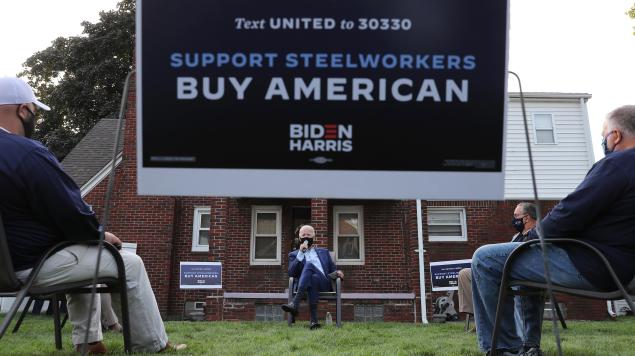
Democratic presidential candidate former Vice President Joe Biden arrives to speak during a campaign event on manufacturing and buying American-made products at UAW Region 1 headquarters in Warren, Mich., Wednesday, Sept. 9, 2020. (AP Photo/Patrick Semansky)
Factoring in the coronavirus shutdown, manufacturing has lost 237,000 jobs during the entirety of Trump’s presidency, which still compares fairly well with the performance of other presidents. On the Yahoo Finance Trumponomics Report Card, Trump still ranks third out of the last seven presidents on manufacturing employment. That’s because the manufacturing sector lost even more jobs at the same point in the first term of Presidents Obama, both Bushes and Reagan. During Obama’s second term, things got better, with manufacturers adding 386,000 jobs.
Biden says he’ll do better than Trump, through tax incentives meant to punish companies sending work overseas and reward those reopening closed factories here at home. Biden also says he’ll establish more muscular Buy America policies for the federal government than Trump has. Factory workers hear these types of promises every four years, and sometimes decide to give the promiser a shot. That helped Trump in 2016, but now he’s the one who has to prove he kept those promises.



 Satellite imagery shows fires and smoke along the US West Coast, September 8, 2020. CIRA/NOAA Goes – West
 Firefighters keep an eye on the Creek Fire along state Highway 168, September 6, 2020, in Shaver Lake, California. Marcio Jose Sanchez/AP Photo.
 AirNow.gov