Column: Closing out 2022, Trump has supplanted Nixon as the saddest figure in post-presidential politics
Jonah Goldberg – December 27, 2022
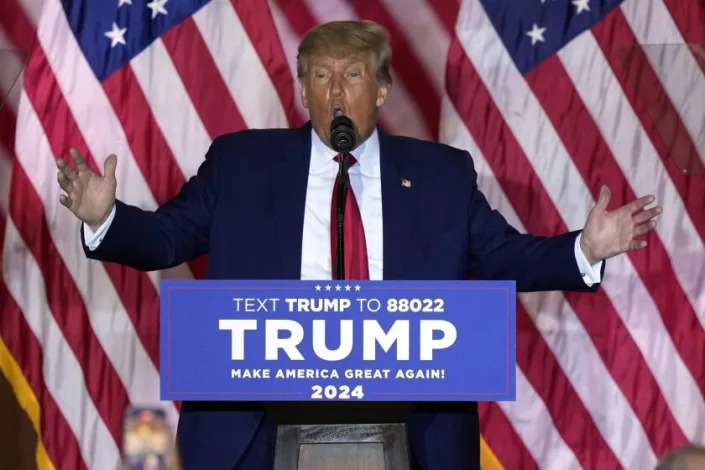
Former President Trump announces a third run for president on Nov. 15 at Mar-a-Lago in Palm Beach, Fla. (Rebecca Blackwell / Associated Press)
“The tapes are the real man — mean, vindictive, panicky, striking first in anticipation of being struck, trying to lift his own friable self-esteem by shoving others down,” Gary Wills wrote of Richard Nixon in the 2017 preface to his book, “Nixon Agonistes.” Wills added, perhaps unfairly, that “Nixon’s real tragedy is that he never had the stature to be a tragic hero. He is the stuff of sad (almost heartbreaking) comedy.”
The passage comes to mind as we close out Donald Trump’s annus horribilis, during which he supplanted Nixon as the saddest figure in post-presidential politics. The Jan. 6 committee, despite its flaws, succeeded in establishing a damning official record (largely told by his own aides) of his attempt to steal the presidency. A special prosecutor is on his case(s). His tax returns are out for all to see.
A week after a disastrous midterm election for his party and his power, he announced he’s running for president again. The party and public shrugged.
Then, he teased a “major announcement” which turned out to be a line of digital trading cards, some of which appear to be little more than Photoshopped images from Google searches with his face pasted on. What Trump described as “amazing ART of my Life & Career!” show him as, among other things, an astronaut, a sheriff and a superhero with laser beams shooting out of his eyes (causing even Russian state TV to snicker).
I can report that Trump was neither an astronaut nor sheriff. If he had heat vision, Mike Pence would now be a pile of ash.
The contrast with Nixon’s post-presidency is poignant. Nixon in exile wrote 10 books, all quite serious, including his memoirs. He clawed back a reputation as a wise man who dispensed advicetopresidents.
But that’s not the poignant part. Nixon was surrounded with a loving family, lifelong friends and loyal aides who gave him the sort of succor that politics couldn’t. His first — and only — wife was the love of his life. Long after Nixon’s death, they cherished his memory. Nixon in exile still enjoyed the respect not just of his friends but of his enemies.
The famouslyfriendless Trump has admitted that he never had much use for real friends. Trump prefers to be surrounded by people who will tell him what he wants to hear, and what he wants to hear is: You’re awesome. Reportedly, this is why he hit it off so well with a neo-Nazi toady who heaped praise on him at that now notorious dinner with the artist formerly known as Kanye West.
This is what makes Trump such a pathetic figure. Wills titled his book “Nixon Agonistes” — a reference to the Milton poem “Samson Agonistes” — because Nixon was a man of struggle, both internal and external, hungry for respect.
Trump isn’t merely hungry for respect; he’s, as the kids say, “thirsty” for respect — respect for his strength, his “very stable genius,” his masculinity and, of course, his money. When Trump read a 2015 column of mine in the New York Post mocking his potential run, he turned to his aide Sam Nunberg and muttered, “Why don’t they respect me, Sam?”
Of course, there are people who respect Trump, but most of them aren’t friends, they’re fans, the sorts of people who don’t get the joke of his trading cards. In 2016, he told a New Hampshire audience: “I have no friends, as far as I’m concerned,” he said. “You know who my friends are? You’re my friends.”
Fans are generally the last people to tell you hard truths. Worse for Trump: His definition of fans are people who think he can do no wrong.
The key difference is that Nixon’s hunger for respect was tempered by a reciprocal respect, admittedly flawed, for the presidency, his party, the country and for those closest to him. Nixon spared them all the ordeal of impeachment; Trump was impeached twice, then ran again, lost, and then tried to steal the presidency. He recently called for the suspension of the Constitution to reinstall him, because no impediment to his self-glorification deserves respect.
Nixon’s struggle was complicated because he was complicated. Trump’s struggle is simple because he is simple: All he is is appetite — for fame, power, sex, admiration — shorn of any interior life and unencumbered by exterior attachments.
Wills may have been right that the secret tapes displayed the “real” Nixon. We don’t need secret tapes to know Trump, because the real Trump is always on display for those with eyes to see him. And, finally, the sight is becoming wearying, even for his fans.
Older and unappreciated: Workers over 50 face a rough time on the job
Katrin Park – December 26, 2022
Forget the Great Resignation. The shakeup of Generation Z workers, seeking fulfillment and treating their jobs like a game of musical chairs, will sort itself out over time. They have their whole lives ahead of them to find something that fits.
The larger crisis is what to do with all the older-than-50 workers searching for gainful employment. This is one of the worst times to be a worker in the twilight of a career. Only half of Americans are steadily employed throughout their 50s. Last year, more than a quarter of workers ages 55 to 59 were out of the workforce, which meant that they didn’t have jobs to retire from.
Across the globe, full-time, stable employment that culminated in pensions has become a relic of the pre-pandemic past. In the United States, an increasing number of workers can’t afford to retire, not with inflation and uncertain retirement savings. Now, a worker must wait to age 70 to collect maximum Social Security benefits, and Congress is expected to discuss raising the age for Social Security eligibility next year.
Multiple factors create challenges for older workers
The disappearance of stable employment with a living wage and benefits – once the driver of upward mobility – has added to growing inequality. Global crises like COVID-19, changing business models and emerging technologies have led to the rise of low-quality, temporary jobs.
If workers have physically demanding jobs such as in retail or hospitality, poor health can force them to drop out. Many workers in their 50s also have caregiving responsibilities for older generations, which temporary gigs don’t accommodate. And of course there’s ageism.
A Brookings Institution report found a strong relationship between holding steady employment in one’s 50s and working in their 60s and beyond. So interventions to support older workers must start earlier on, even in one’s 40s. This can be done by improving the quality of low-wage jobs – including through higher minimum wages, greater work schedule flexibility and paid leave – to reduce turnover. That will help people work longer.
Likewise for firms, this is an opportunity to avoid productivity losses in the long run by maintaining a stable workforce. Firms that rely on disproportionately large numbers of hourly workers tend to have higher turnover rates. They are also less likely to invest in employee training and technologies.
Assisting older workers with developing skills that are in demand can help them get jobs again and meet businesses’ needs.
Such efforts are vital to maintain Social Security benefits, projected to be cut by more than 20% come 2034 unless Congress and the president intervene. Without action, monthly benefits would shrink by hundreds of dollars on average, and anyone 55 or younger would never get a full benefit.
And yet, unemployment statistics tend to leave out 50-something workers who are forced into early retirement. That happens because they are not part of the prime-age workforce, and they haven’t yet reached the benchmark ages associated with retirement, according to Beth Truesdale, a sociologist and author of the Brookings paper. Labor force policy and retirement policy should be considered as one system but are not, and these workers fall through the gap.
It’s a gap that’ll only get wider and harder to fill with the passage of time.
Which is alarming, given that an aging population, not a growing one, is the ticking time bomb.
The global population has just hit the 8 billion milestone, with life expectancy soaring and fertility rates dropping. Across the world, people 75 and older are the fastest-growing group in the labor force. Today, 40 million Americans are 65 and older, a figure expected to double over the next 40 years.
Opinion alerts: Get columns from your favorite columnists + expert analysis on top issues, delivered straight to your device through the USA TODAY app. Don’t have the app? Download it for free from your app store.
Not preparing for this inescapable demographic shift will result in a shrinking workforce that struggles to support a ballooning number of “retirees.”
To be sure, improving the working conditions of low-wage jobs or training programs alone will not solve the myriad challenges older workers face. Age discrimination persists.
Katrin Park is a freelance writer and a former director of communications with the International Food Policy Research Institute.
Unfortunately, among the more than 40 million Americans 50 and older in the labor force, according to a 2018 analysis by ProPublica and the Urban Institute, half of them are likely to be laid off or forced into retirement regardless of income, education level or geography.
Without stronger legal protection for older workers and changing business models so they value work experience as a competitive advantage necessary for greater productivity, older workers will face fewer opportunities, resulting in higher rates of poverty in old age.
The disappearance of 50-something workers should factor more prominently in future of work debates. Even if all the quirks of Gen Z work habits were resolved tomorrow, a massive demographic work crisis still looms.
In Arizona, Colorado River crisis stokes worry over growth and groundwater depletion
Ian James – December 26, 2022
The Central Arizona Project Canal running through the desert in Arizona. (Albert Brave Tiger Lee / Los Angeles Times)
Kathleen Ferris stared across a desert valley dotted with creosote bushes, wondering where the water will come from to supply tens of thousands of new homes. In the distance, a construction truck rumbled along a dirt road, spewing dust.
This tract of open desert west of Phoenix is slated to be transformed into a sprawling development with up to 100,000 homes — a 37,000-acre property that the developers say will become Arizona’s largest master-planned community.
“It’s mind-boggling,” Ferris said. “I don’t think there is enough water here for all the growth that is planned.”
Water supplies are shrinking throughout the Southwest, from the Rocky Mountains to California, with the flow of the Colorado River declining and groundwater levels dropping in many areas. The mounting strains on the region’s water supplies are bringing new questions about the unrestrained growth of sprawling suburbs.
Ferris, a researcher at Arizona State University’s Kyl Center for Water Policy, is convinced that growth is surpassing the water limits in parts of Arizona, and she worries that the development boom is on a collision course with the aridification of the Southwest and the finite supply of groundwater that can be pumped from desert aquifers.
For decades, Arizona’s cities and suburbs have been among the fastest growing in the country. In most areas, water scarcity has yet to substantially slow the march of development.
But as drought, climate change and the chronic overuse of water drain the Colorado River’s reservoirs, federal authorities are demanding the largest reduction ever in water diversions in an effort to avoid “dead pool” — the point at which reservoir levels fall so low that water stops flowing downriver.
Already, Arizona is being forced to take 21% less water from the Colorado River, and larger cuts will be needed as the crisis deepens.
To deal with those reductions and access other supplies to serve growth, the state is turning more heavily to its underground aquifers. As new subdivisions continue to spring up, workers are busy drilling new wells.
Ferris and others warn, however, that allowing development reliant solely on groundwater is unsustainable, and that the solution should be to curb growth in areas without sufficient water.
“What we’re going to see is more and more pressure on groundwater,” Ferris said. “And what will happen to our groundwater then?”
Construction workers erect new homes in a residential development called Sun City Festival in Buckeye. Dwindling Colorado River water is delivered to central Arizona, one of the fastest growing metropolitan areas in the U.S., via the Central Arizona Project Canal. (Luis Sinco / Los Angeles Times)
One of the fastest-growing cities in the Phoenix area is Buckeye, which has plans to nearly triple its population by 2030. According to its 2020 water resources plan, 27 master-planned communities are proposed in Buckeye, which depends primarily on groundwater. If all the proposed developments are fully built, the city’s population, now 110,000, would skyrocket to about 872,000.
In the area Ferris visited, construction has begun on the giant development called Teravalis, where the developers plan to build the equivalent of a new city, complete with more than 1,200 acres of commercial development.
State water regulators have granted approvals to allow an initial portion of the project to move forward. But in other nearby areas of Buckeye, state officials have sent letters to builders putting some approvals on hold while they study whether there is enough groundwater for all the long-term demands.
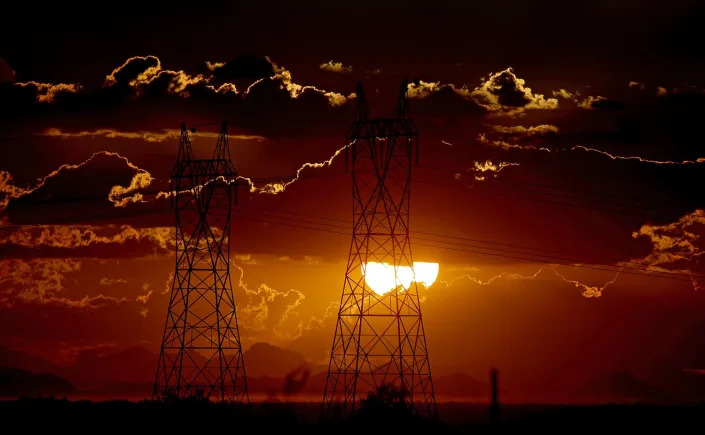
The sun sets on the vast desert landscape along Sun Valley Parkway in Buckeye, Ariz. (Luis Sinco/Los Angeles Times)
“It’s hard for me to imagine wall-to-wall homes out here,” Ferris said, standing on the gravel shoulder of the Sun Valley Parkway, which runs across miles of undeveloped land. “This is the epitome of irresponsible growth. It is growing on desert lands, raw desert lands, where there’s no other water supply except groundwater.”
Nearby, the Central Arizona Project snakes through the desert, filled with Colorado River water. The CAP Canal was built between 1973 and 1993, bringing water that has enabled growth. But its supply came with low-priority water rights that made it vulnerable to cuts in a shortage.
The Phoenix metropolitan area’s population has more than doubled since 1990, expanding from 2.2 million to about 4.9 million people. Subdivisions have been built on former farmlands as development has expanded across the Salt River Valley, also called the Valley of the Sun.
Ferris, a lawyer and former director of the Arizona Department of Water Resources, helped draft the state’s 1980 Groundwater Management Act, which was intended to address overpumping and has since regulated groundwater use in urban areas.
Water from the CAP Canal has enabled cities to pump less from wells. For years, they have banked some of the imported Colorado River water underground by routing it to basins where it percolates down to aquifers.
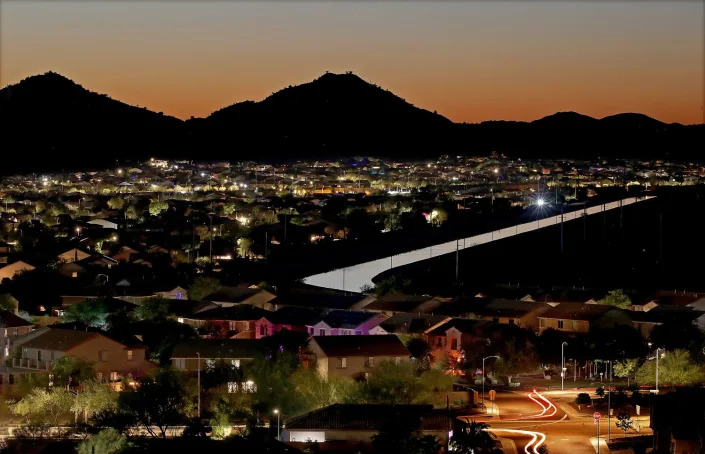
The Central Arizona Project Canal runs beside a community in the suburbs of North Phoenix. Development projects envisioning thousands of new homes around Phoenix now are in question because of lack of water. (Luis Sinco / Los Angeles Times)
The state requires that new developments around Phoenix and other urban areas have a 100-year “assured water supply,” based on a calculation that allows for groundwater to be pumped down to a level 1,000 feet underground. Changes by the Legislature and regulators in the 1990s cleared the way for subdivisions to rely on groundwater as an assured water supply.
Since then, a groundwater replenishment district has been charged with securing water and using it to recharge aquifers, creating an accounting system. The problem with this system, Ferris said, is that groundwater has been overallocated, allowing for excessive pumping in some areas.
“We’ve got to learn to live within our means. Groundwater was always supposed to be a savings account, to be used only in times of shortages. Well, now those shortages look permanent,” Ferris said. “We ought to be saying, ‘How much growth can we really sustain?’ And put limits on how much water we’re going to use.”
The desert aquifers contain “fossil” water that has been underground for thousands of years.
“That water is not replenished. And so once it’s pumped, it’s pretty much gone,” Ferris said.
In recent years, Arizona has received about 36% of its water from the Colorado River. The river has long been severely overallocated, and its flows have shrunk dramatically during 23 years of megadrought intensified by global warming.
One of a growing number of developments in Buckeye, Ariz., that depend on groundwater. (Albert Brave Tiger Lee / Los Angeles Times)
The river’s largest reservoirs, Lake Mead and Lake Powell, now sit nearly three-fourths empty. Federal officials have warned there is a real danger the reservoirs could drop so low by 2025 that water would no longer flow past Hoover Dam to Arizona, California and Mexico.
Ferris said Arizona now needs to plan for years with little or no Colorado River water. She said she feels sad and angry that federal and state water managers, despite warnings by scientists, failed to act sooner to address the shortage.
“The Colorado River is dying,” Ferris said. “It is dying from overallocation, overuse, aridification, mismanagement.”
In the same way that tough decisions about the Colorado River were neglected for years, she said, “we’re not managing our groundwater well.”
“Either we do something about this now or we pay the consequences later. And we’re paying the consequences now with the Colorado River, because we didn’t deal with those problems soon enough,” Ferris said. “If we fail to plan for the idea that our groundwater will no longer be sufficient, then shame on us.”
Alongside the river’s decline, the Southwest is undergoing a parallel crisis of groundwater depletion. Scientists found in a 2014 study, using measurements from NASA satellites, that pumping depleted more than 40 million acre-feet of groundwater in the Colorado River Basin over nine years, about 1.5 times the maximum capacity of Lake Mead.
The sun sets on the vast desert landscape along Sun Valley Parkway in Buckeye, Ariz. (Luis Sinco / Los Angeles Times)
“Our research has shown that the groundwater in the lower basin has been disappearing nearly seven times faster than the combined water losses from Lakes Powell and Mead,” said Jay Famiglietti, a hydrology professor and executive director of the University of Saskatchewan’s Global Institute for Water Security. “Groundwater losses of that magnitude are literally an existential threat to desert cities like Phoenix and Tucson.”
Next year, Arizona’s allocation of Colorado River water delivered through the CAP Canal will be cut by more than a third. Some Arizona farmers are losing their CAP supplies, while irrigation districts are drilling new state-funded wells.
Arizona’s cities have yet to see major reductions. But that could soon change.
Ferris said she thinks growth should happen in areas where sufficient water is available, and from multiple sources.
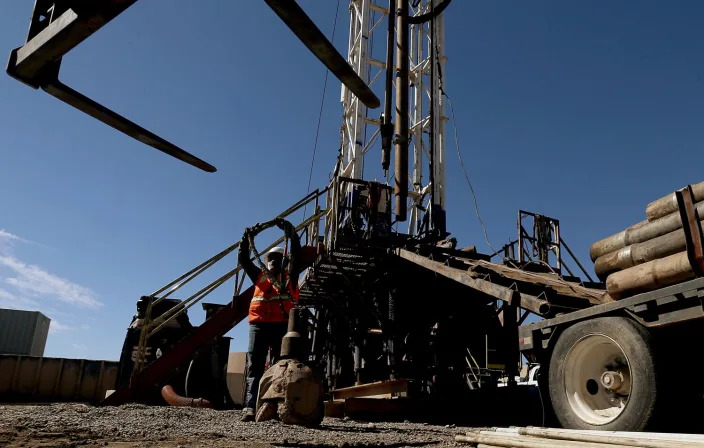
A workman prepares a rig to drill for water in the suburbs of Phoenix. Colorado River flows are at historic lows due to warmer and drier conditions caused by climate change. (Luis Sinco / Los Angeles Times)
The city of Peoria, northwest of Phoenix, is one example of an area with a variety of sources, including the Colorado River, the Salt and Verde rivers and recycled wastewater. Since 1996, the city has been banking water underground, storing treated wastewater effluent and a portion of its Colorado River water.
The city is now drilling wells to pump out some of those supplies.
“Even if the Colorado River went away completely, we expect to have enough water banked underground to last us for years,” said Cape Powers, Peoria’s water services director. “We’ll continue to prepare for whatever comes our way.”
Nearby, a drilling crew was preparing to bore one of eight new wells for the city.
“Every drill rig that my company has is spoken for until May or June of next year,” said Ralph Anderson, the owner of Arizona Beeman Drilling. “The business in the next 3 to 5 years is going to just go through the roof.”
Some cities are maneuvering in other ways, reaching outside the Phoenix area to secure water.
The growing Phoenix suburb of Queen Creek recently won approval for a controversial $22-million deal to buy water rights from an investment company that will leave farmland dry in the community of Cibola, next to the Colorado River.
Queen Creek has also signed a 100-year contract to pay landowners $30 million to leave farmland fallow in the rural Harquahala Valley west of Phoenix, allowing them to pump groundwater and ship it to the suburbs.
Other cities are also looking to pump groundwater in the Harquahala Valley and other areas where they would be allowed to transport the water by canal.
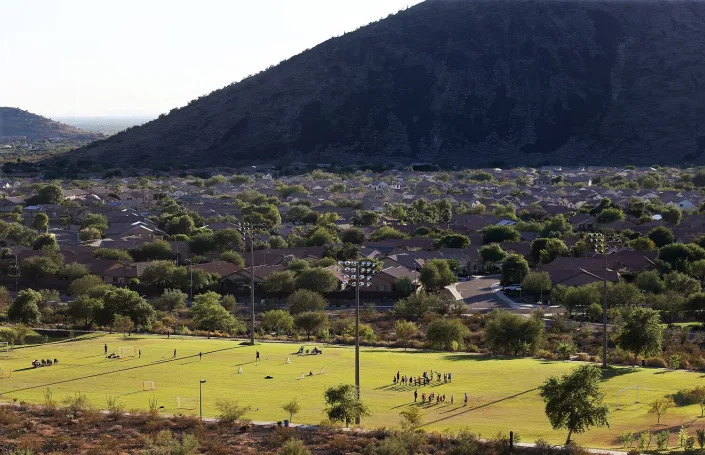
Landscaped yards and green grassy playing fields typify the suburbs of North Phoenix. (Luis Sinco / Los Angeles Times)
Buckeye has a substantial amount of groundwater locally and plans to seek additional water that could be brought in from other areas, said Terry Lowe, the city’s director of water resources.
“It’s a hot market, the Phoenix metro area in general, and we’ve got to be able to have that water to meet that demand,” Lowe said. “And so we’re looking at working with others outside to find sources.”
For the planned 37,000-acre community Teravalis, the developers have two existing water approvals, called certificates of assured water supply, to build about 7,000 homes, and plan to seek additional approvals to build more. The developers plan to pump groundwater from the aquifer beneath the property, which lies in the Hassayampa River watershed.
“It’s one of the most plentiful aquifer basins in the state of Arizona. So we feel pretty good about that,” said Heath Melton, regional president for The Howard Hughes Corp. “We feel like we’re in a really good place.”
Melton said the community will conserve water by having low-water-use plants and fixtures, and will use recycled wastewater for outdoor irrigation and to recharge the aquifer.
Developers are also supporting the state government’s efforts to secure additional water from new sources.
Colorado River water flows into the Agua Fria groundwater recharge basins (or groundwater recharge facilities) in Peoria, Ariz. (Albert Brave Tiger Lee / Los Angeles Times)
Legislation signed this year by Gov. Doug Ducey established a new Water Infrastructure Finance Authority that will have about $1.4 billion for conservation projects and to secure additional supplies, including possibly bringing in water from outside the state. Arizona officials have been looking into a possible deal with Mexico to desalinate seawater at the Sea of Cortez and exchange that water for some of Mexico’s Colorado River water.
In the Hassayampa watershed in Buckeye, state water regulators have been working on an updated analysis of the groundwater basin. In letters to some other developers in the area, they have warned that although their report is not yet complete, they have “information indicating that the proposed subdivision’s estimated groundwater demand for 100 years is likely not met when considered with other existing uses and approved demands in the area.”
The Arizona Department of Water Resources similarly announced in 2019 that projections showed insufficient groundwater available for all the planned developments in Pinal County, between Phoenix and Tucson.
“The amount of groundwater we can allocate for these purposes is finite,” said Tom Buschatzke, the department’s director. He said in the Hassayampa basin, all the proposed developments won’t be able to grow on groundwater alone.
“They’ve got to find a different way to do business than what they’ve historically done,” he said. “They’ve got to find different pathways, more likely more expensive pathways.”
Buschatzke said the area still has options, such as bringing in water from other areas or using recycled water.
Even as the supply of Colorado River water shrinks, some researchers are optimistic about the state’s ability to adapt.
“The whole state is at an inflection point where we have to take some definite actions toward making sure of water supplies to serve the populations that are here now and into the future,” said Sarah Porter, director of ASU’s Kyl Center for Water Policy. “Arizona has a long history of meeting these water challenges, and I think Arizona will do that again.”
Ferris said she feels more pessimistic.
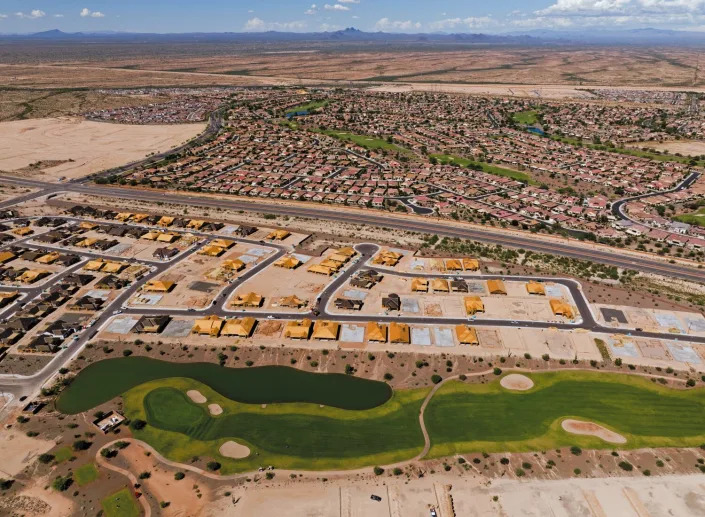
Homes are being built in a new community in Buckeye, Ariz. (Albert Brave Tiger Lee / Los Angeles Times)
Visiting a new development in Buckeye, Ferris drove past an entrance with flowing fountains. She watched workers building homes beside a golf course with ponds.
Nearby, new homes stood beside the open desert. On empty lots, flattened patches of dirt lay ready for the foundations to be poured.
“We have to stop growing these giant developments on groundwater. It is unsustainable,” Ferris said. “We need to limit the growth.”
Column: I begged Santa — let Trump lead the Republican Party to defeat
Nicholas Goldberg – December 26, 2022
Former President Trump at a “Save America” rally in Perry, Ga., in 2021. (Ben Gray / Associated Press)
Prognostication is thankless work, especially when it comes to politics.
But because it’s the happy holiday season, I’m going to pay a little attention to a faint and uncharacteristically optimistic voice in the back of my head and lay out what to me seems to be a not-inconceivable and oh-so-delicious scenario of the future.
It is this — that Donald Trump sticks around to run a real 2024 campaign, as promised. But instead of successfully rallying his loyal troops and cruising demonically back into power, he continues his downward slide in the polls, becomes increasingly desperate — and foments within his own party the sort of self-destructive internecine trouble that he alone has the ability to stir up.
In this scenario, instead of causing fear and trembling in Democrats, he spews his bitterness and bile at his fellow Republicans, further weakening his already splintering party, trolling opponents, sowing chaos, division and confusion and making a bitter, bruising battle out of the primary process because he can still command the loyalty of millions of voters.
As a result, the Republicans lose big in November 2024.
Why would Trump do such a thing? Because why not!
He’s not a party loyalist. He doesn’t feel a smidgen of allegiance to his fellow Republicans or to conservative ideology or to the GOP’s ultimate victory over the Democrats. He’s all about Trump, remember? And anyone who gets in his way is an enemy.
Could it really happen? Could Trump cripple his own party that badly?
Well, the latest holiday elf to hint at these glad tidings is no left-of-center optimist or self-serving Democratic operative. It’s none other than that grand old man of the GOP, former House Speaker Newt Gingrich.
Gingrich told the New York Times that he was worried about what he called a “1964 division” — a rancorous, disabling rift between Trump’s supporters and the anti-Trump wing of the party comparable to the divide in 1964 between the conservative Republicans who backed Barry Goldwater for president and the moderates who supported Nelson Rockefeller.
“I can imagine a Trump-anti-Trump war over the next two years that just guarantees Biden’s reelection in a landslide and guarantees that Democrats control everything,” Gingrich said.
You can be sure that’s what I asked Santa for. It’d be a better gift than 1,000 Trump NFT trading cards depicting the former president in superhero spandex or white tie and tails or riding a giant red, white and blue elephant.
Just imagine how it could play out.
Trump could seek the nomination and, in the process, lay into his fellow Republicans so viciously that the eventual nominee would emerge battered beyond recognition. (Trump’s already starting his attacks on Florida Gov. “Ron DeSanctimonious.” Heh-heh.)
If he loses the nomination, Trump could refuse to endorse the winner. Or come out against the nominee, which would be a big deal given how many supporters he has.
He could lose the nomination and (petulant spoiler that he is) run as an independent.
He could even walk away and start his own party — the MAGA Party, let’s say, which could siphon off millions of rural, non-college-educated white voters from the GOP.
After all, he’s got no sense of fair play or good sportsmanship, and no concept of limited war.
It’s obvious that Republican voters are already badly divided over Trump.
On the one hand, he won 74 million votes in 2020. And some substantial portion of those voters are unwaveringly loyal to him, not to the party. The Q-Anoners, Oath Keepers, Proud Boys and their ilk, for example. They’re not going to shift their allegiances to the Jeb Bushes of the world. Probably not to the Cruzes, Rubios or DeSantises either.
“I don’t think we should underestimate the stickiness of [Trump’s] base,” one Democratic operative told the L.A. Times recently.
On the other hand, Trump is currently declining in the polls, thanks to the Jan. 6 committee hearings, the Justice Department investigation and the other criminal inquiries — and to the embarrassing fact that his handpicked candidates in the midterms performed so badly that his influence is being carefully reevaluated.
He’s damaged goods, to say the least. Some Republicans — the rational ones — are beginning to run for the hills.
In a Wall Street Journal poll released last week, 71% of Republicans said they held a favorable view of him, down from 85% in March and 90% or higher during most of his presidency.
Party bigwigs, eager to see Republican voters united behind a strong presidential candidate, had no doubt hoped Trump would not run again. When he declared several weeks ago that he would, Alyssa Farah Griffin, a former director of strategic communications for Trump, said, “No credible person in the Republican Party wanted this announcement today.”
Fading away quietly is not Trump’s style. And it would be foolish to discount his influence. For all his bombast and bluster and his current travails, he’s shown a remarkable political resilience and acumen.
So an acrimonious, polarizing, punishing 2024 battle is entirely possible.
On the other hand, all my cheerful prognostication could be wrong.
This could be the end of the Trump era; he could slink away from the 2024 battle rather than risk becoming a diminished and rejected “loser,” and the GOP could rebound. Or, worse, he could keep his base and grow it again through his peculiar brand of political charisma and reemerge as president for a second term. That would be an unspeakable disaster.
But from Christmas to New Year’s, at least, I’m choosing to believe in the joyful possibility of a Trump-instigated Republican meltdown.
China is losing its place as the center of the world’s supply chains. Here are 5 places supply chains are going instead.
Huileng Tan – December 26, 2022
China is the factory of the world, but COVID-19 has shown the world needs more than China to keep supply chains robust.Visual China Group/Getty Images
China’s COVID-19 policies are pushing companies to diversify supply chains away from the country.
They had already begun moving out over geopolitical tensions and tariffs from the Trump era.
India, Vietnam, Thailand, Malaysia, and Bangladesh are stepping up to replace the world’s factory.
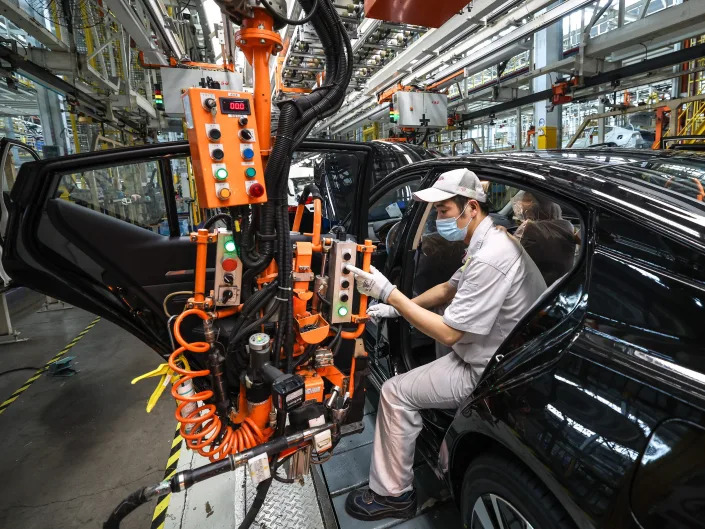
China has been the factory of the world for the past four decades. The pandemic triggered a reckoning of this status.
China’s draconian COVID-19 restrictions have hit global supply chains.Chen Shichuan/VCG/Getty Images
China’s rise as the world’s factory spanned four decades and ushered in an era of globalization and integrated supply chains.
That facade started to crumble around 2018 after President Donald Trump launched a trade war against the East Asian giant. This, in turn, has prompted investors to reassess their geopolitical risks.
While some investors did move parts of their manufacturing facilities out of China at the time, it was the pandemic — and China’s zero-COVID policy — that drove home the importance of not depending on one country for manufacturing needs.
“The geopolitical tensions, in themselves, may not have resulted into this level of realignment of supply chains, but COVID certainly provided that extra vision, extra fillip, the extra fuel to the fire,” Ashutosh Sharma, a research director at the market-research firm Forrester, told Insider this month.
And the effects of the trade war linger. President Joe Biden hasn’t put the kibosh on the elevated tariffs Trump imposed on China — in fact, in October, he imposed export controls on shipping equipment to Chinese-owned factories making advanced logic chips. This further burdened a strained relationship.
To navigate this complicated web of US-China trade tensions, multinationals are, now more than ever, looking to hedge their business risks.
Here are five countries where China’s supply chains are moving to.
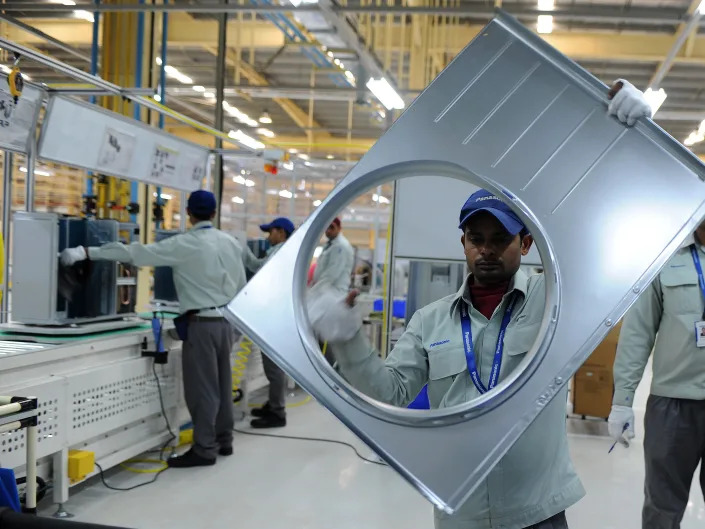
India is trying to unseat China in higher-end manufacturing, with the iPhone maker Apple and chipmakers eyeing its vast land and young population.
India has vast land and a young population.Sajjad Hussain/AFP/Getty Images
With its vast land and large, young population, India is a logical alternative to China as the world’s factory.
Apple has already moved some of its iPhone production to the Indian states of Tamil Nadu and Karnataka and is exploring moving its iPad manufacturing to the South Asian nation. JPMorgan analysts expect Apple to move 5% of its iPhone 14 production to India by the end of 2022, they wrote in a September note. They said they believed 1 in 4 iPhones would be made in India by 2025.
“India has a large labor pool, a long history of manufacturing, and government support for boosting industry and exports,” Julie Gerdeman, the CEO of Everstream, a platform for supply-chain risk management, told Insider. “Because of this, many are exploring whether Indian manufacturing is a viable alternative to China.”
The move is easier said than done.
Indian Prime Minister Narendra Modi has been working on attracting foreign direct investments since he took office in 2014, sending FDI to a record $83.6 billion in the past fiscal year, according to government data.
But significant hurdles still exist — even though the Indian government is boosting its appeal for foreign investments, it’s harder to do business in the country than in China, partly because of bureaucracy and multiple stakeholders that prolong decision-making.
Vietnam has been undergoing rapid economic reform since 1986, which has yielded significant returns.
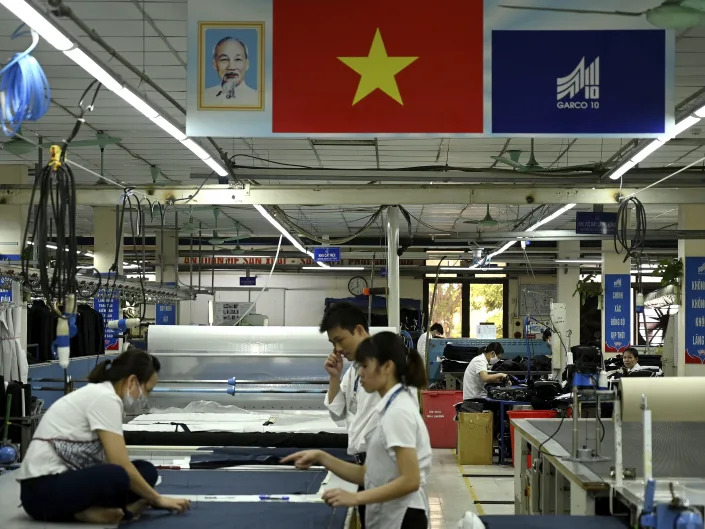
Garment-factory workers in Hanoi, Vietnam.Manan Vatsyayana / AFP
As a communist country, Vietnam — like China — has been undergoing rapid economic reform since 1986.
The reforms have yielded results, propelling Vietnam from “one of the world’s poorest nations to a middle-income economy in one generation,” The World Bank said in a November post.
In 2021, Vietnam attracted over $31.15 billion in foreign-direct-investment pledges — up more than 9% from the prior year, according to the country’s Ministry of Planning and Investment. About 60% of the investments went into the manufacturing-and-processing sector.
Vietnam’s key strengths are in the manufacturing of apparel, footwear, and electronics and electrical appliances.
Other companies that have shifted some of their production lines out of China to Vietnam are Nike,Adidas, and Samsung.
Thailand’s FDI rose threefold between 2020 and 2021.
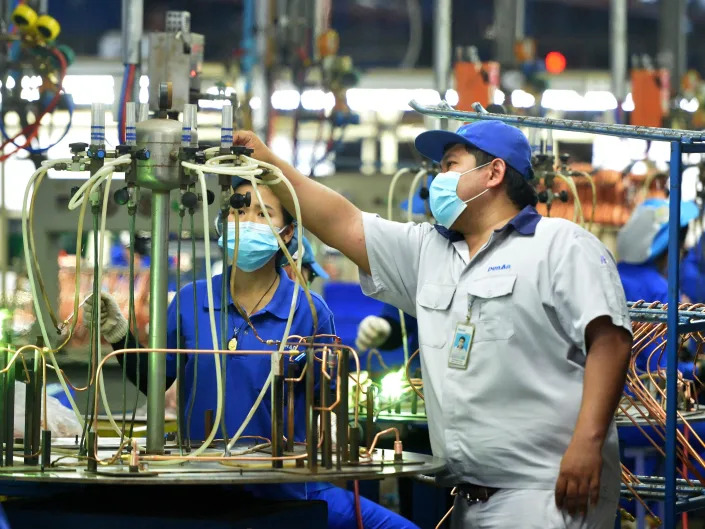
Thailand is a key auto and electronics manufacturing hub.Rachen Sageamsak/Xinhua/Getty Images
As Southeast Asia’s second-largest economy, Thailand has been moving up the value chain in manufacturing and is a production hub for car parts, vehicles, and electronics, with multinationals such as Sony and Sharp setting up shop there.
Sony said in 2019 it was closing its Beijing smartphone plant to cut costs and relocated some of the production to Thailand. Sharp said in the same year it was moving some of its printer production to Thailand because of the US-China trade war.
It’s not just international firms. Even Chinese companies have relocated parts of their supply chains to Thailand. Companies producing solar panels, such as Shanghai’s JinkoSolar, are moving their production to the island nation to take advantage of lower costs and avoid geopolitical tensions, the South China Morning Post reported in July.
“Setting up manufacturing plants abroad didn’t come from [the pursuit of] opportunities, it is more of a strategy to deal with challenges to gain market access,” Zhuang Yan, the president of Canadian Solar, said at an industry event in July, SCMP reported.
Foreign direct investments rose threefold to 455.3 billion Thai baht, or about $13.1 million, between 2020 to 2021, the Thailand Board of Investment announced in February.
Bangladesh is already a beneficiary of the supply-chain shift away from China. It now wants a bigger slice of the pie.
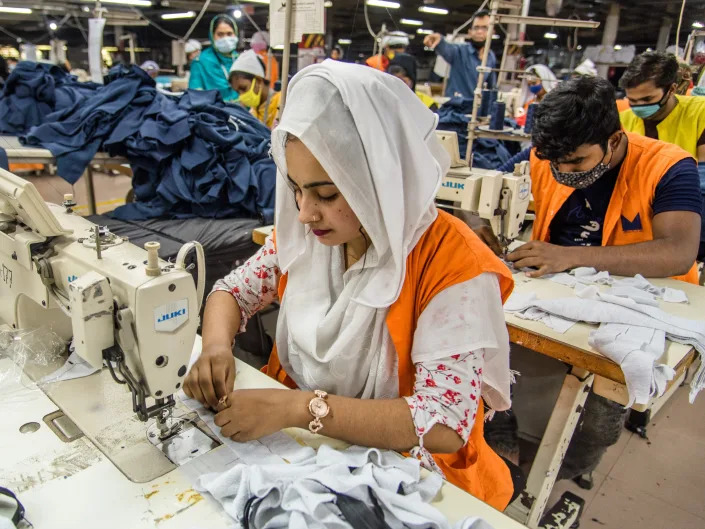
Bangladesh is home to a huge garment-manufacturing sector.Mustasinur Rahman Alvi/Eyepix Group/Future Publishing via Getty Images
Even before the COVID-19 lockdowns crippled China’s manufacturing sector, Bangladesh was a rising star in the garment-manufacturing sector.
Bangladesh’s rise was primarily due to rising labor costs in China predating Trump’s presidency.
The cost difference is large — the average monthly salary of a worker in Bangladesh is $120, or less than one-fifth of the $670 a factory worker takes home in the southern-China manufacturing hub of Guangzhou, Mostafiz Uddin, the owner of the Bangladeshi apparel manufacturer Denim Expert, told Insider.
“Moreover, rising material costs is pushing apparel companies to look for alternative destinations like Bangladesh where production prices are comparatively low,” Uddin said.
Bangladesh is now working to attract investments beyond the garment sector into others, including pharmaceuticals and agriculture processing.
Malaysia has for years been eyeing opportunities emerging from companies shifting away from China.
Malaysia’s FDI inflows hit a five-year high of $48.1 billion in 2021.Manan Vatsyayana/AFP/Getty Images
Malaysia has been eyeing opportunities from the manufacturing shift out of China for the past few years.
It has made some headway with the efforts, as it has attracted at least 32 projects that have relocated from China to Malaysia, the Malaysian Investment Development Authority said in July 2020. The authority didn’t provide details of the projects or of the companies that moved.
But even before the pandemic, tech investments into Malaysia had been rising because of lower labor costs and US-China trade tensions. Major deals over the past few years included a 1.5 billion Malaysian ringgit, or $339 million, investment by the US chip giant Micron over five years starting in 2018. Jabil, a US company that makes iPhone covers, has also expanded its operations in Malaysia.
“We knew quite a number that have expressed their intention to shift from China and we have engaged them. The only thing is timing,” Azman Mahmud, then the CEO of the Malaysian Investment Development Authority, told The Malaysian Reserve in 2020.
Malaysia’s FDI inflows hit a five-year high of $48.1 billion in 2021, with manufacturing of electronics and vehicles being the main contributor, according to official government information.
Colorado River Basin policymakers stand at a critical juncture. They have an opportunity to avert more severe impacts of the crisis by implementing policy and management changes that go beyond the relatively incremental steps taken thus far.
How do we find long-term sustainability?
However, negotiating such major changes is extremely challenging, especially given the basin’s complex legal structure of water rights, its users’ diverse demands and uncertainty around how much water will be available in the future.
This raises the question: How can basin policymakers create transformational change that advances the long-term sustainability of the Colorado River amid this crisis?
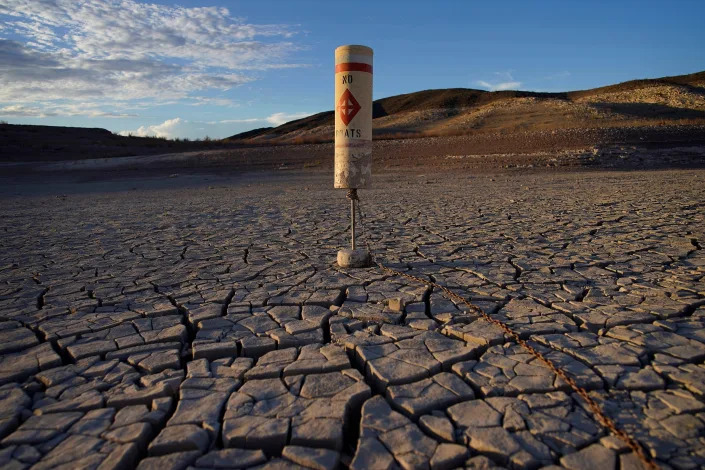
A buoy sits high and dry on cracked earth previously under the waters of Lake Mead at the Lake Mead National Recreation Area near Boulder City, Nev., on June 28, 2022. Living with less water in the U.S. Southwest is the focus for a conference starting Wednesday, Dec. 14, 2022, in Las Vegas, about the drought-stricken and overpromised Colorado River.
First, policymakers must stabilize the Colorado River system, meaning that water use does not exceed water availability. However, because streamflow is expected to continue to decline as temperatures rise, any stabilization solution must be adaptable to changes in water availability as they occur.
One way to achieve this is to change the indicators of system-wide water availability that trigger water management actions. Basin managers currently use slow-responding reservoir levels (which may also be muddled by complex water accounting) for this purpose. A more responsive indicator, such as a 5-year rolling average of inflow, could be used in the short term to minimize reliance on dwindling storage.
In the longer term, Basin managers could also consider an adaptive approach used in other areas of the West that converts fixed-quantity water rights to shares of the total quantity of available water, with the allocation of shares tailored to account for the existing water rights priority structure. The total quantity of available water could be adjusted to slowly refill reservoirs, serving to mitigate large water cuts in dry years. This additional step would help the system move beyond stabilization and into longer-term recovery.
2. Prioritize ideas to reduce uncertainty
Moving to the type of management regime described above will likely mean painful cuts for water users throughout the Colorado River Basin in the coming years. However, it could create more predictability and reliability in the long term – values that Basin managers have previously signaled agreement around.
Managing for a smaller known quantity of water is often easier than managing for the unknown. Achieving this, however, requires that all water users, including historically marginalized tribes and environmental groups, have an equitable seat at the negotiating table in order to reduce uncertainty about future water uses and needs.
3. Think beyond ‘how to share water cuts’
Finally, policymakers must expand their conception of “water sustainability” in the Colorado River Basin. For thriving communities and economies, water is a means, not an end. Beyond water use directly for human, public and ecological health, water enables food production and energy generation.
Broadening our thinking from “how to share water reductions” to “how to maintain regional food and energy security” opens new opportunities for negotiation and collaboration beyond the traditional “zero-sum” mentality.
These could include investing recently allocated federal funds for drought mitigation in improving agricultural water use efficiency, supporting the clean energy transition and conserving ecosystems to achieve more holistic sustainability goals, rather than temporarily buying more time through short-term conservation measures.
Transforming Colorado River Basin management to mitigate the current water crisis and realize long-term water sustainability requires changing not only policies but also the way we think about water use and needs.
The three suggestions presented above can help policymakers to meet this moment of historic challenge and historic opportunity by moving beyond incremental change and fostering a new era of solutions for the Colorado River.
Margaret Garcia, Ph.D, is an assistant professor in the School of Sustainable Engineering and the Built Environment at Arizona State University. Elizabeth A. Koebele, Ph.D., is an associate professor of political science at the University of Nevada, Reno, where she researches the use and implications of collaborative approaches to governing water resources.
This editorial is the sixth in a series, “The Danger Within,” urging readers to understand the danger of extremist violence and possible solutions. Read more about the series in a note from Kathleen Kingsbury, the Times Opinion editor.
Whoever shot the small steel ball through the front window of the Brewmaster’s Taproom in Renton, Wash., this month wasn’t taking chances. The person wore a mask and removed the front and rear license plates of a silver Chevrolet Cruze. The police still have no leads.
The bar’s owner, Marley Rall, thought the motivation seemed clear: The attack followed social media posts from conservatives angry about the bar’s Drag Queen Storytime and Bingo, slated for the following weekend.
The Taproom sits in a two-story office park a 15-minute drive from downtown Seattle. It has a little outside patio and about two dozen local craft beers on tap. Dogs are welcome. A sign on the door reads: “I don’t drink beer with racists. #blacklivesmatter.” Now there’s also a note with an arrow pointing to the hole in the window reading: “What intolerance looks like.”
Over the past two years, criticism of the bar’s long-running monthly Drag Queen Storytime had been limited to nasty voice mail messages and emails. But talk on right-wing message boards has turned much darker, Ms. Rall said. One post this month about the Taproom event read: “Drag Queen Storytime Protest. STOP Grooming Kids! Bring signs, bullhorns, noisemakers.”
Ms. Rall knew how protests like this could escalate. There was an incident in 2019 at a library drag queen story hour about 10 minutes from the bar, where members of the Proud Boys and other paramilitary groups got into a shouting match with supporters of the event.
Was the shot at the Taproom a warning? She had no way to know, so she kept the event on the calendar.
Sitting in a corner of the Taproom a few hours before her story time was set to begin, Sylvia O’Stayformore said she didn’t care if the Proud Boys showed up to an event that was aimed at teaching children empathy. Protesters or not, she had a show to put on. “I’d never be intimidated by all this,” she said.
On Monday, protesters vandalized the home of a gay New York City councilor with homophobic graffiti and attacked one of his neighbors in protest of drag queen story hours held at libraries.
The protests use the language of right-wing media, where demonizing gay and transgender people is profitable and popular. Tucker Carlson, a Fox News host who rails against transgender people and the medical facilities that serve them, has the highest-rated prime-time cable news program in the country. Twitter personalities with millions of followers flag drag events and spread anti-trans rhetoric that can result in in-person demonstrations or threats. Facebook pages of activist groups can mobilize demonstrators with ease.
Some Republican lawmakers are using the power of the state in service of the same cause. Several states are trying to restrict or ban public drag shows altogether, amid a record number of anti-L.G.B.T.Q. bills introduced this year. Republican politicians also used a barrage of lies about trans people in their campaign ads during the midterm elections, funded to the tune of at least $50 million, according to a report released in October from the Human Rights Campaign Foundation.
This campaign isn’t happening in a vacuum. Levels of political violence are on the rise across the country, and while some of it comes from the left, a majority comes from the right, where violent rhetoric that spurs actual violence is routine and escalating. At anti-L.G.B.T.Q. events, sign-waving protesters are increasingly joined by members of the street-fighting Proud Boys and other right-wing paramilitary groups. Their presence increases the risk of such encounters turning violent.
In a series of editorials, this board has argued for a concerted national effort against political violence. It would require cracking down on paramilitary groups, tracking extremists in law enforcement, creating a healthier culture around guns and urging the Republican Party to push fringe ideas to the fringes. Every American citizen has a part to play, and the most important thing we all can do is to demand that in every community, we treat our neighbors — and their civil liberties and human rights — with respect.
One way to do that is to call out and reject the dehumanizing language that has become so pervasive in online discussions, and in real life, about particular groups of people. Calling L.G.B.T.Q. people pedophiles is an old tactic, and it makes ignoring or excusing any violence that may come their way easier. While direct calls for violence are beyond the pale for most Republican politicians, and the causes of specific violent acts are not easily traced, calling transgender people pedophiles or “groomers” is increasingly common and usually goes unchallenged.
Marco Rubio, a Republican senator from Florida, released a TV ad recently in which he said: “The radical left will destroy America if we don’t stop them. They indoctrinate children and try to turn boys into girls.” A conservative activist group recently ran ads in several states, including one that said, “Transgenderism is killing kids.” This year, as Florida lawmakers debated the so-called Don’t Say Gay bill, a spokeswoman for Gov. Ron DeSantis of Florida posted on Twitter: “If you’re against the Anti-Grooming Bill, you are probably a groomer or at least you don’t denounce the grooming of 4-8 year old children. Silence is complicity.”
The silence from a great majority of Republicans on the demonization of, and lies about, trans people has indeed meant complicity — complicity in what experts call stochastic terrorism, in which vicious rhetoric increases the likelihood of random violence against the people who are the subject of the abusive language and threats.
Drag queen story hours aren’t the only current target for right-wing extremists. On Aug. 30, an operator at Boston Children’s Hospital, a pioneer in providing gender-affirming care, answered the telephone at about 7:45 p.m. and received a disturbing threat. “There is a bomb on the way to the hospital,” the caller said. “You better evacuate everyone, you sickos.” It was the first of seven bomb threats the hospital received over several months. The most recent came on Dec. 14.
After extremists posted online the address of a physician who works with trans children at the hospital, the doctor had to flee the home. “These have been some of the hardest months of my life,” the doctor said.
Around the country, at least 24 hospitals or medical facilities in 21 states have been harassed or threatened in the wake of right-wing media attacks, according to a tally this month by the Human Rights Campaign Foundation. To protect their employees, some hospitals are stripping information about the transgender services they provide from their websites. The messages that appear to trigger these attacks are often outlandish lies about what care these medical facilities actually provide. As a result, many hospitals feel they have no choice but to protect their staff, even if it means making the care they provide less visible. Removal of official information creates a risk that more disinformation could fill the void.
Given the transnational nature of extremism, these threats can come from anywhere. The F.B.I. arrested three people in connection with the various threats against Boston doctors. One person lived in Massachusetts, another in Texas and the third in Canada.
Data collected by the Armed Conflict Location and Event Data Project, which tracks political violence, puts the harassment of hospitals into a wider, troubling context. Acts of political violence against the entire L.G.B.T.Q. community have more than tripled since 2021; anti-L.G.B.T.Q. demonstrations have more than doubled in the same period. And the nature of the intimidation is changing: Protesters dressed as civilians have been replaced by men in body armor and fatigues; signs have been replaced by semiautomatic rifles.
Even dictionary publishers have become targets. This year, a California man was arrested for threatening to shoot up and bomb the offices of Merriam-Webster because he was angry about its definitions related to gender identity.
Congress approves new election rules in Jan. 6 response
Nicholas Riccardi – December 23, 2022
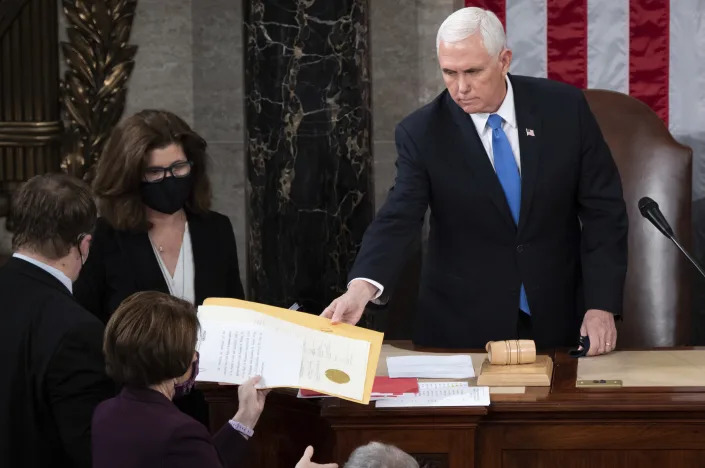
In this image released in the final report by the House select committee investigating the Jan. 6 attack on the U.S. Capitol, on Thursday, Dec. 22, 2022, President Donald Trump talks on the phone to Vice President Mike Pence from the Oval Office of the White House on the morning of Jan. 6, 2021. Congress has passed changes to the arcane law that controls how it ratifies the winner of a presidential election. The legislation is an effort to close loopholes that Trump and his allies tried to exploit so he could remain president after losing the 2020 presidential election to Joe Biden. (House Select Committee via AP) Vice President Mike Pence hands the electoral certificate from the state of Arizona to Sen. Amy Klobuchar, D-Minn., as he presides over a joint session of Congress as it convenes to count the Electoral College votes cast in November’s election, at the Capitol in Washington, Wednesday, Jan. 6, 2021. Congress on Friday, Dec. 23, gave final passage to legislation changing the arcane law that governs the certification of a presidential contest, the strongest effort yet to avoid a repeat of Donald Trump’s violence-inflaming push to reverse his loss in the 2020 election. (Saul Loeb/Pool via AP, File)
Congress on Friday gave final passage to legislation changing the arcane law that governs the certification of a presidential contest, the strongest effort yet to avoid a repeat of Donald Trump’s violence-inflaming push to reverse his loss in the 2020 election.
The House passed an overhaul of the Electoral Count Act as part of its massive, end-of-the-year spending bill, after the Senate approved identical wording Thursday. The legislation now goes to President Joe Biden for his signature.
Biden hailed the provisions’ inclusion in the spending bill in a statement Friday, calling it “critical bipartisan action that will help ensure that the will of the people is preserved.”
It’s the most significant legislative response Congress has made yet to Trump’s aggressive efforts to upend the 2020 election results, and a step that been urged by the House select committee that conducted the most thorough investigation into the violent siege of the Capitol.
The provisions amending the 1887 law — which has long been criticized as poorly and confusingly written — won bipartisan support and would make it harder for future presidential losers to prevent the ascension of their foes, as Trump tried to do on Jan. 6, 2021.
“It’s a monumental accomplishment, particularly in this partisan atmosphere, for such a major rewrite of a law that’s so crucial to our democracy,” said Rick Hasen, a law professor at the University of California Los Angeles. “This law goes a long way toward shutting down the avenues Trump and his allies tried to use in 2020, and could have been exploited in future elections.”
On Jan. 6, Trump targeted Congress’ ratification of the Electoral College’s vote. He tried to exploit the vice president’s role in reading out the states’ electors to get Mike Pence to block Biden from becoming the next president by omitting some states Biden won from the roll. The new provisions make clear that the vice president’s responsibilities in the process are merely ceremonial and that the vice president has no say in determining who actually won the election.
The new legislation also raises the threshold required for members of Congress to object to certifying the electors. Before, only one member of the House and Senate respectively had to object to force a roll call vote on a state’s electors. That helped make objections to new presidents something of a routine partisan tactic — Democrats objected to certifying both of George W. Bush’s elections and Trump’s in 2016.
Those objections, however, were mainly symbolic and came after Democrats had conceded that the Republican candidates won the presidency. On Jan. 6, 2021, Republicans forced a vote on certifying Biden’s wins in Arizona and Pennsylvania even after the violent attack on the Capitol, as Trump continued to insist falsely that he won the election. That led some members of Congress to worry the process could be too easily manipulated.
Under the new rules, one-fifth of each chamber would be required to force a vote on states’ slates of electors.
The new provisions also ensure only one slate of electors makes it to Congress after Trump and his allies unsuccessfully tried to create alternative slates of electors in states Biden won. Each governor would now be required to sign off on electors, and Congress cannot consider slates submitted by different officials. The bill creates a legal process if any of those electors are challenged by a presidential candidate.
The legislation would also close a loophole that wasn’t used in 2020 but election experts feared could be, a provision that state legislatures can name electors in defiance of their state’s popular vote in the event of a “failed” election. That term has been understood to mean a contest that was disrupted or so in doubt that there’s no way to determine the actual winner, but it is not well-defined in the prior law.
Now a state could move the date of its presidential election — but only in the event of “extraordinary and catastrophic events,” like a natural disaster.
Hasen said that while the changes are significant, dangers still remain to democracy, noting that in Arizona, the Republican nominee for governor, Kari Lake, was waiting on a ruling Friday in a lawsuit she filed to overturn the victory of her Democratic opponent, Katie Hobbs.
“Nobody should think that passage of this legislation means we’re out of the woods,” Hasen said. “This is not one and done.”
GOP Sen. Mike Lee said that ‘Rudy is walking malpractice’ after Giuliani left him an accidental voicemail on January 6
Sonam Sheth – December 23, 2022
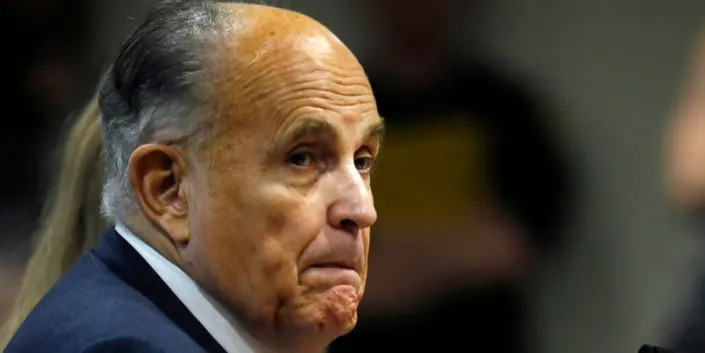
Former New York City mayor Rudy Giuliani.JEFF KOWALSKY/AFP via Getty Images
GOP Sen. Mike Lee described Rudy Giuliani as “walking malpractice” following the Capitol riot.
Lee texted then national security advisor Robert O’Brien after getting a voicemail from Giuliani that was intended for GOP Sen. Tommy Tuberville.
In the message, Giuliani urged Tuberville and “our Republican friends” to delay Congress’ certification of Biden’s victory.
Republican Sen. Mike Lee described former New York mayor Rudy Giuliani as “walking malpractice” in a late-night text to then national security advisor Robert O’Brien.
That’s according to the January 6 select committee, which released its full 845-page report on the deadly Capitol siege late Thursday.
“You can’t make this up. I just got this voice message [from] Rudy Giuliani, who apparently thought he was calling Senator Tuberville,” Lee’s text said. “You’ve got to listen to that message. Rudy is walking malpractice.”
GOP Sen. Tommy Tuberville of Alabama was one of several lawmakers Giuliani tried to contact before Congress resumed its joint session to certify Joe Biden’s victory following the Capitol riot.
“I’m calling you because I want to discuss with you how they’re trying to rush this hearing and how we need you, our Republican friends, to try to just slow it down so we can get these legislatures to get more information to you,” Giuliani said in the voicemail intended for Tuberville.
Lee’s text to O’Brien was buried in an endnote in Chapter 7 of the report, titled “187 Minutes of Dereliction.” He texted O’Brien at 10:55 p.m. ET on January 6, per the endnote.
It’s one of dozens of times Giuliani is mentioned in the committee’s report, which paints a damning portrait of how the former New York mayor and his cohorts relied on dubious and conspiratorial theories to try to nullify Joe Biden’s victory in the 2020 election and install Trump for a second presidential term.
Bill Stepien, Trump’s 2020 campaign manager, told the committee that he was so uncomfortable with Giuliani’s post-election antics that he locked Giuliani out of his office and instructed his assistant not to allow the former mayor to enter.
“I told her, don’t let anyone in,” Stepien testified. “You know, I’ll be around when I need to be around. You know, tell me what I need to know. Tell me what’s going on here, but, you know, you’re going to see less of me. And, you know, sure enough, you know, Mayor Giuliani tried to, you know, get in my office and ordered her to unlock the door, and she didn’t do that, you know.”
“Mayor Rudy Giuliani exposed and took down the mafia not just here in America, but also in Italy,” Ted Goodman, a communication and political advisor to Giuliani, told Insider in a statement. “He rooted out corruption in government, prosecuted some of the largest insider trading cases on Wall Street, and cleaned up the streets of New York. Partisan politics aside, he is unquestionably one of the greatest prosecutors in American history.”
Some of the claims Giuliani and his allies made were so outlandish that even Trump found them hard to believe.
For instance, the committee’s report describes one phone call, on November 20, 2020, between Trump and the GOP-linked lawyer Sidney Powell, who worked closely with Giuliani on election litigation.
Powell spouted baseless allegations of widespread voter fraud during the call, including one claim that the voting tech company Dominion Voting Systems had colluded with the Venezuelan dictator Hugo Chavez — who died in 2013 — to tilt the election in Biden’s favor.
According to testimony from Trump’s top communications aide Hope Hicks, the president muted himself while Powell was detailing these allegations during their call. Hicks testified that Trump laughed at Powell and told others in the room, “This does sound crazy, doesn’t it?”
Giuliani is currently facing possible disbarment as a Washington, DC, ethics panel reviews his efforts to overturn the 2020 election.
His “misconduct” after the election was “so serious that it should never be allowed to happen again,” disciplinary counsel Hamilton Fox said last week.
The DC Board of Professional Responsibility determined in a preliminary finding that Giuliani violated at least one ethics rule by filing a legal challenge in Pennsylvania seeking to throw out millions of votes in the state. The decision is not binding, and the hearing committee will consider alternative sanctions proposals before putting out a report with a final recommendation.
Giuliani vehemently defended himself throughout the proceedings, accusing the disciplinary counsel of engaging in a “personal attack” without presenting proper evidence. He also told Robert Bernius, the chairman of the panel overseeing the hearings, that Fox’s statements were an “outrage.”
Note: This story has been updated with a statement from Giuliani’s representative.
‘Openly Gay’ Rep.-Elect George Santos Didn’t Disclose Divorce With Woman
Roger Sollenberger – December 22, 2022
Photo Illustration by Thomas Levinson/The Daily Beast/Getty
Republican congressman-elect George Santos is under new scrutiny after a New York Times report earlier this week uncovered a string of apparent outright fabrications at the heart of some of the most fundamental facts of his life, but that backstory may also be notable for what Santos did not include—a publicly undisclosed marriage.
Santos, who claims he has “never experienced discrimination in the Republican Party,” broke barriers this year when he became the first openly gay non-incumbent GOP candidate elected to Congress.
But according to court records obtained by The Daily Beast, Santos appears to be the subject of a previously unacknowledged Sept. 2019 divorce with a woman in Queens County, New York. The divorce—which Santos has not discussed publicly—adds new uncertainty to his already shaky biographical and political claims.
“I am openly gay, have never had an issue with my sexual identity in the past decade, and I can tell you and assure you, I will always be an advocate for LGBTQ folks,” Santos told USA Today in October, responding to criticism about his support for Florida’s so-called “Don’t Say Gay Bill” signed into law this year by GOP Gov. Ron DeSantis.
Less than two weeks after his divorce was finalized, Santos filed the official paperwork to launch his 2020 campaign. And while his 2022 campaign bio mentions his husband, who according to Santos lives with him and their four dogs on Long Island, he’s kept this previous marriage out of the public eye entirely.
It’s entirely possible that Santos, who claims he has “never experienced discrimination in the Republican Party,” has been living comfortably as an openly gay man for, as he says, more than a decade. People get married for countless reasons. But Santos’ situation is curious because he never disclosed his divorce to voters, and never reconciled his prior marriage to a woman—which ended just 12 days before he established his first congressional campaign—with his claims of being an out and proud gay Republican.
Santos, 34, made his first bid for Congress in 2020, losing to Rep. Tom Suozzi (D-NY) before toppling Democratic opponent Robert Zimmerman this year. But following a New York Timesinvestigation that suggested Santos had fictionalized key elements of his resume, he’s already facing calls to resign, as well as a possible ethics investigation.
The colleges Santos says he attended don’t have a record of him; Citigroup and Goldman Sachs don’t either, though he claimed to work there; the IRS has no record of his nonprofit; he still faces “unresolved” legal trouble in Brazil; his past business ventures appear flimsy; and even his address was called into question.
In response to the Times report, Santos’ attorney Joseph Murray released a statement that, while stopping short of denying the accusations, painted his client as a victim, because he “represents the kind of progress that the Left is so threatened by—a gay, Latino, immigrant and Republican who won a Biden district in overwhelming fashion by showing everyday voters that there is a better option than the broken promises and failed policies of the Democratic Party.”
The Times story set off a rapid-fire round of criticism that extended not just to the congressman-elect, but to Democratic opposition researchers, Republican vetters, and media who had not called attention to the now-glaring holes in his story before the election.
While those details went largely unnoticed during the campaign, the Times investigation prompted reporters and internet sleuths around the country to dig deeper into Santos’ past—or what they could find of it.
It’s unclear why Santos has not disclosed his apparent marriage and divorce, but it doesn’t fit well with his current biography.
He has previously told U.S. and Brazilian media that he was engaged to a man, a fellow Brazilian whom Santos has identified as a pharmacist, and his campaign bio claims he lives on Long Island with his husband. (The Daily Beast could find no public record of the man’s work in that field, nor could we find a marriage record.)
But New York court records show that, in 2019, someone named George Devolder Santos, with a second initial of “A,” finalized an uncontested divorce with Uadla Santos Vieira Santos. Public records searches only reveal one person in the United States with that name.
Uadla Santos and George Santos did not reply to calls or questions sent via text message to numbers associated with them. (A deed for a $750,000 house purchase in Union County, New Jersey, this June lists Uadla Santos as the buyer, and says she is married; she is the only purchaser listed on the property documents.)
George Santos, whose middle name is Anthony, sometimes uses Devolder, his late mother’s maiden name. He incorporated it into his campaign—“Devolder Santos for Congress”—as well as his own supposed financial services company, the Devolder Organization.
Santos has shifted between different combinations of those four names over the years, sometimes embracing his father’s Santos surname, other times going by his mother’s Devolder.
Santos’ mother died in 2016, according to an online crowdfunding campaign Santos launched to raise money to cover “the costs of the wake.” The GoFundMe page lists “Anthony D Santos” as the beneficiary—and Anthony Devolver of Sunnyside, New York, as the organizer—and the fundraising campaign remains open.
Santos’ campaign bio page claims his mother was “the first female executive at a major financial institution,” though the specific institution is unnamed. The bio also says “George’s mother was in her office in the South Tower” on the morning of Sept. 11, 2001.
“She survived the horrific events of that day, but unfortunately passed away a few years later”—about 15 years later.
And on Wednesday, Jewish outlet The Forward added still more intrigue, suggesting Santos may also have been untruthful when he claimed during the campaign—including on his website—to have Jewish ancestry. The report led incoming House Minority Leader Hakeem Jeffries to declare his future colleague a “complete and utter fraud.”
But the divorce revelation, and the apparent secrecy around it, complicates a central piece of the image Santos has burnished as a dynamic and culturally revolutionary figure.
In an election season where many of his fellow conservatives spouted nonsensical allegations of pedophilia among Democrats, targeted benign drag brunches as epicenters for “grooming,” and inflamed a hateful anti-gay and anti-trans movement—as attacks on the LGBTQ community skyrocketed—Santos made history as the first non-incumbent gay Republican to ever be elected to Congress.
But after achieving that victory, and just two weeks before his barrier-breaking inauguration, Santos’ relationship with the truth is facing tests he somehow dodged for two campaigns.