A Town-by-Town Battle to Sell Americans on Renewable Energy
David Gelles – December 30, 2022
Brendan Burton of Ospur, Ill., an ironworker and farmer, welcomes the wind farm and the jobs it would bring to the area. (Mustafa Hussain/The New York Times)
MONTICELLO, Ill. — Depressed property values. Flickering shadows. Falling ice. One by one, a real estate appraiser rattled off what he said were the deleterious effects of wind farms as a crowd in an agricultural community in central Illinois hung on his every word.
It was the 10th night of hearings by the Piatt County zoning board, as a tiny town debated the merits of a proposed industrial wind farm that would see dozens of enormous turbines rise from the nearby soybean and corn fields. There were nine more hearings scheduled.
“It’s painful,” said Kayla Gallagher, a cattle farmer who lives nearby and opposes the project. “Nobody wants to be here.”
In the fight against global warming, the federal government is pumping a record $370 billion into clean energy, President Joe Biden wants the nation’s electricity to be 100% carbon-free by 2035, and many states and utilities plan to ramp up wind and solar power.
But while policymakers may set lofty goals, the future of the American power grid is, in fact, being determined in town halls, county courthouses and community buildings across the country.
The only way Biden’s ambitious goals will be met is if rural communities, which have large tracts of land necessary for commercial wind and solar farms, can be persuaded to embrace renewable energy projects. Lots of them.
According to an analysis by the National Renewable Energy Laboratory, the United States would need to construct more than 6,000 projects like the Monticello one in order to run the economy on solar, wind, nuclear or other forms of nonpolluting energy.
In Piatt County, population 16,000, the project at issue is Goose Creek Wind, which has been proposed by Apex Clean Energy, a developer of wind and solar farms based in Virginia. Apex spent years negotiating leases with 151 local landowners and trying to win over the community, donating to the 4-H Club and a mental health center.
Now, it was making its case to the zoning board, which will send a recommendation to the county board that will make a final call on whether Apex can proceed. If completed, the turbines, each of them 610 feet tall, would march across 34,000 acres of farmland.
The $500 million project is expected to generate 300 megawatts, enough to power about 100,000 homes. The renewable, carbon-free electricity would help power a grid that is fed by a mix of nuclear, natural gas, coal and some existing wind turbines.
But with more and more renewable-energy projects under construction around the country, resistance is growing, especially in rural communities in the Great Plains and Midwest.
“To meet any kind of clean energy goals which brings consumer benefits and energy independence, you’re going to see an increase in projects,” said JC Sandberg, interim CEO of the American Clean Power Association. “And with those increases in projects, we are facing more of these challenges.”
On Election Day last month, Apex saw its development efforts for a wind farm in Ohio die when voters in Crawford County overwhelmingly voted to uphold a ban on such projects. On the same day, voters in Michigan rejected ordinances that would have allowed construction of another Apex wind project. This month, local officials in Monroe County, Michigan, extended a temporary moratorium on industrial solar projects, delaying plans by Apex to develop a solar farm in the area.
“Projects have been getting more contentious,” said Sarah Banas Mills, a lecturer at the school for environment and sustainability at the University of Michigan who has studied renewable development in the Midwest. “The low-hanging-fruit places have been taken.”
In Piatt County, the zoning board decided to conduct a mock trial of sorts. During the first nine hearings, Apex and its witnesses made the case that property values would not decline and that other concerns about wind farms — that they are ugly, that they kill birds or that the low frequency noise they emit can adversely affect human health — were not major issues.
They won some converts. Meg Miner, 61, a resident who was on the fence about the project, decided to support Apex after considering how the project would help fight climate change.
But others were worried about all the issues that the real estate appraiser mentioned, and more. “I moved here for nature, for trees, for crops,” said Sandy Coyle, who lives nearby and opposed the project. “I’m not interested in living near an industrial wind farm.”
Much of that skepticism appeared to be earnest concern from community members who weren’t sold on the project’s overall merits. On the fringe of the debate, however, was a digital misinformation campaign designed to distort the facts about wind energy.
The website of a group called Save Piatt County!, which opposes the project, is rife with fallacies about renewable energy and inaccuracies about climate science. On Facebook pages, residents opposed to the project shared negative stories about wind power, following a playbook that has been honed in recent years by anti-wind activists, some of whom have ties to the fossil fuel industry. The organizers of the website and Facebook groups did not reply to requests for comment.
As part of the Goose Creek Wind project, Apex has secured a commitment from Rivian, an upstart electric truck company, to buy power from the project, a development that drew skeptical replies in one Facebook group. “Scam artists in it together to fleece middle class taxpayers,” wrote one local resident in response to a news story about the deal. “Wake up.”
That milieu of misinformation appeared to sway some residents.
“These things are intrusive,” said Kelly Vetter, a retiree who opposed the project and disputed the overwhelming scientific consensus that carbon dioxide emitted from the burning of fossil fuels is dangerously warming the planet. “The company’s never going to have the community’s interest at heart.”
Apex declined to comment.
‘We All Want What’s Good for Society’
Smack in the middle of the area where Apex wants to erect its turbines sits the Bragg family’s farm, a roughly 1,500-acre plot that on a cold December afternoon was little more than an expanse of mud after the fall harvest and a week of rain.
Braxton Bragg, 40, who grew up on the land and returned after stints in the Peace Corps that took him to Mali and Mongolia, supports the project. He is concerned about climate change and said he already sees its effects. The rain is harder when it comes, the cold sets in later than it used to and, overall, the growing season is less predictable than it was when his grandfather worked the same land.
But his support for wind comes down to economics. Bragg has agreed to let Apex site one of its turbines on his property, and he expects to earn about $50,000 a year if it is built.
“It’s not going to save the farm or allow me to retire,” he said. “But just having that steady income every year, you know what you’re going to get.”
A few miles down the road is Gallagher Farms, another multigenerational operation. Like Bragg, Gallagher, 34, believes in climate change. She has invested in cover crops, which absorb carbon and lock it away in the soil, and other regenerative agriculture practices.
But Gallagher is opposed to the project. The aerial seeding of cover crops will cost more with wind turbines nearby and make it harder for her to sustainably farm. The use of heavy equipment to install turbines can disrupt drainage patterns in agricultural land, and Gallagher believes her farm will suffer.
Adding to her frustration is the fact that about 70% of the landowners who have agreed to let Apex put turbines on their property live outside Piatt County.
“They don’t live here, so they’re not impacted,” Gallagher said as she tended to her cattle before heading to yet another hearing.
More than anything else, Gallagher fears that the wind turbines, which she would see from her front porch, would disrupt the bucolic land she loves. In the predawn hours, she walks outside and listens to the crickets, which she worries will be drowned out by the low thrum of the turbines. At night, she watches the sun set over a grain silo in the west and doesn’t want the view marred by spinning turbines and flashing lights.
“We all want what’s good for society,” she said. “But it seems to be coming at the expense of our day-to-day lives.”
Bragg was sympathetic. “The only real argument that is valid, in my opinion, is that it’s going to change people’s sunsets and the beauty of living out in the country,” he said.
Still, he said, this was working farmland, and it was his right to put it to productive use.
“If you put your nice country house in the middle of my business, I’m sorry, there’s not much I can do about that,” Bragg said. “I think they probably would do the same thing if they were in my boat. The economics takes precedence over everything.”
Landowners such as the Braggs would receive about $210 million in lease payments over the project’s 30-year life, Apex said. And there would be other economic benefits, including $90 million in local taxes. And if the project is built, the company said it would create eight permanent jobs and employ nearly 600 people during construction, including men such as Brendan Burton.
Burton, an ironworker who has helped build several nearby wind farms, said the jobs would help fill the void created by factories that have closed or moved overseas.
“We’re not building things here like we used to,” he said. “We need the jobs.”
Burton added that he wanted to see his community contribute clean energy to the grid as well.
“We can’t keep burning coal or natural gas,” he said.
‘We’re Going to Make People Angry’
The debate in Piatt County has been remarkably civil. Similar hearings elsewhere have descended into shouting matches. In some cases, activists with ties to organizations that shield their donors have turned communities against proposed wind and solar projects.
That was the case in Michigan’s Monroe County, where local officials recently extended a moratorium that is blocking Apex from developing a solar project.
The opposition in Monroe County includes local residents, but also anti-wind activists with ties to groups backed by Koch Industries, which owns oil refineries, petrochemical plants, and thousands of miles of oil and gas pipelines. On Facebook, those skeptical of the Apex project shared negative stories about solar power, and opponents of the project went door to door distributing misinformation.
On another cold night in December, as the 11th hearing on the Goose Creek Wind project began at the Monticello community building, Phil Luetkehans, a lawyer hired by opponents of the project, called more witnesses, including an audiologist, who discussed what he said were the adverse health effects of wind turbines. A lawyer representing Apex cross-examined him, and the hearing stretched for more than four hours.
“Both sides are getting a full opportunity to portray their position and to put forth the facts, and the people who we elect will make those final decisions,” Luetkehans said. “Some communities end up saying, ‘No, we don’t want an industrial scale wind at this proximity to homes.’ Others say, ‘Yeah, we want the money.’”
Among those in the audience was Michael Beem, a newly elected member of the Piatt County board, which will ultimately decide whether Apex can build its wind farm. From the back of the room, Beem was bracing himself to make a choice that will undoubtedly leave this rural community divided.
“No matter what decision we make,” he said, “we’re going to make people angry.”
EPA finalizes water rule that repeals Trump-era changes
Jim Salter and Michael Phillis – December 30, 2022
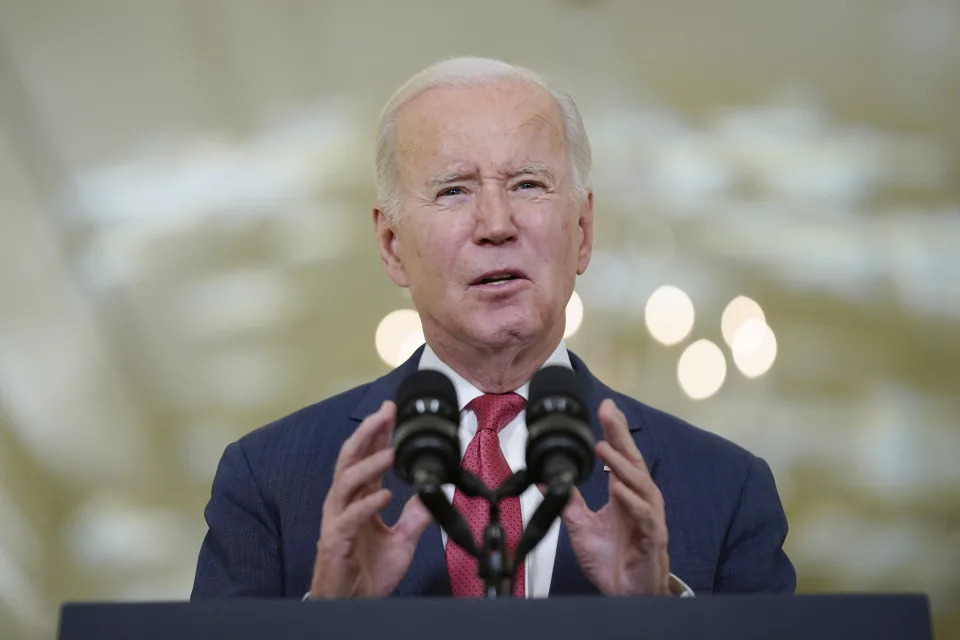
A great egret flies above a great blue heron in a wetland inside the Detroit River International Wildlife Refuge in Trenton, Mich., on Oct. 7, 2022. President Joe Biden’s administration on Friday, Dec. 30, announced a finalized rule for federal protection of hundreds of thousands of small streams, wetlands and other waterways, rolling back a Trump-era rule that environmentalists said left waterways vulnerable to pollution. (AP Photo/Carlos Osorio, File) President Joe Biden speaks in the East Room of the White House ahead of the holidays on Dec. 22, 2022, in Washington. Biden’s administration on Friday, Dec. 30, announced a finalized rule for federal protection of hundreds of thousands of small streams, wetlands and other waterways, rolling back a Trump-era rule that environmentalists said left waterways vulnerable to pollution. (AP Photo/Patrick Semansky, File)
ST. LOUIS (AP) — President Joe Biden’s administration on Friday finalized regulations that protect hundreds of thousands of small streams, wetlands and other waterways, repealing a Trump-era rule that federal courts had thrown out and that environmentalists said left waterways vulnerable to pollution.
The rule defines which “waters of the United States” are protected by the Clean Water Act. For decades, the term has been a flashpoint between environmental groups that want to broaden limits on pollution entering the nation’s waters and farmers, builders and industry groups that say extending regulations too far is onerous for business.
The Environmental Protection Agency and the Department of the Army said the reworked rule is based on definitions that were in place prior to 2015. Federal officials said they wrote a “durable definition” of waterways to reduce uncertainty.
In recent years, however, there has been a lot of uncertainty. After the Obama administration sought to expand federal protections, the Trump administration rolled them back as part of its unwinding of hundreds of environmental and public health regulations. A federal judge rejected that effort. And a separate case is currently being considered by the Supreme Court that could yet upend the finalized rule.https://s.yimg.com/rq/darla/4-10-1/html/r-sf-flx.html
“We have put forward a rule that’s clear, it’s durable, and it balances that protecting of our water resources with the needs of all water users, whether it’s farmers, ranchers, industry, watershed organizations,” EPA Assistant Administrator for Water Radhika Fox told The Associated Press.
The new rule is built on a pre-2015 definition, but is more streamlined and includes updates to reflect court opinions, scientific understanding and decades of experience, Fox said. The final rule will modestly increase protections for some streams, wetlands, lakes and ponds, she said.
The Trump-era rule, finalized in 2020, was long sought by builders, oil and gas developers, farmers and others who complained about federal overreach that they said stretched into gullies, creeks and ravines on farmland and other private property.
Environmental groups and public health advocates countered that the Trump rule allowed businesses to dump pollutants into unprotected waterways and fill in some wetlands, threatening public water supplies downstream and harming wildlife and habitat.
“Today, the Biden administration restored needed clean water protections so that our nation’s waters are guarded against pollution for fishing, swimming, and as sources of drinking water,” Kelly Moser, senior attorney for the Southern Environmental Law Center’s Clean Water Defense Initiative, said in a statement.
Jon Devine, director of federal water policy for the Natural Resources Defense Council, called repealing the Trump-era rule a “smart move” that “comes at a time when we’re seeing unprecedented attacks on federal clean water protections by polluters and their allies.”
But Republican Sen. Shelley Moore Capito called the rule “regulatory overreach” that will “unfairly burden America’s farmers, ranchers, miners, infrastructure builders, and landowners.”
Jerry Konter, chairman of the National Association of Home Builders, struck a similar note, saying the new rule makes it unclear if the federal government will regulate water in places such as roadside ditches and isolated ponds.
A 2021 review by the Biden administration found that the Trump rule allowed more than 300 projects to proceed without the federal permits required under the Obama-era rule, and that the Trump rule significantly curtailed clean water protections in states such as New Mexico and Arizona.
In August 2021, a federal judge threw out the Trump-era rule and put back in place a 1986 standard that was broader in scope than the Trump rule but narrower than Obama’s. U.S. District Court Judge Rosemary Marquez in Arizona, an Obama appointee, said the Trump-era EPA had ignored its own findings that small waterways can affect the well-being of the larger waterways they flow into.
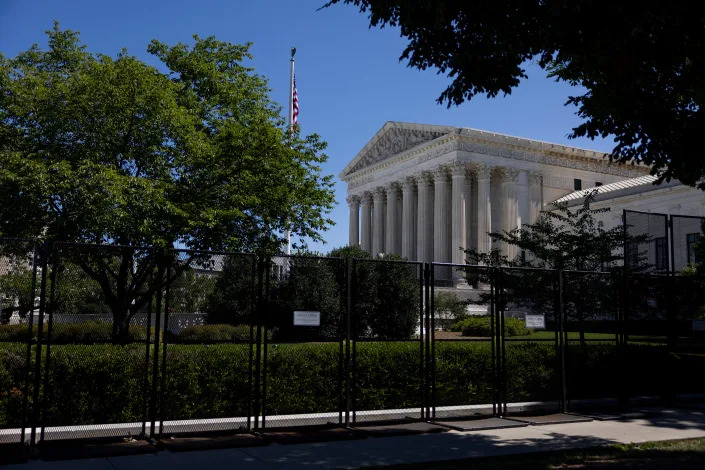
Meanwhile, Supreme Court justices are considering arguments from an Idaho couple in their business-backed push to curtail the Clean Water Act. Chantell and Michael Sackett wanted to build a home near a lake, but the EPA stopped their work in 2007, finding wetlands on their property were federally regulated. The agency said the Sacketts needed a permit.
The case was heard in October and tests part of the rule the Biden administration carried over into its finalized version. Now-retired Justice Anthony Kennedy wrote in 2006 that if wetlands “significantly affect the chemical, physical, and biological integrity” of nearby navigable waters like rivers, the Clean Water Act’s protections apply. The EPA’s rule includes this test. Four conservative justices in the 2006 case, however, said that federal regulation only applied if there was a continuous surface connection between wetlands and an obviously regulated body of water like a river.
Charles Yates, attorney for the libertarian group Pacific Legal Foundation, said the new rule shows the importance of the Supreme Court case since the definition for WOTUS “shifts with each new presidential administration.”
“Absent definitive guidance from the Supreme Court, a lawful, workable, and durable definition of ‘navigable waters’ will remain elusive,” Yates said in a statement.
The Biden rule applies federal protections to wetlands, tributaries and other waters that have a significant connection to navigable waters or if wetlands are “relatively permanent.” The rule sets no specific distance for when adjacent wetlands are protected, stating that several factors can determine if the wetland and the waterway can impact water quality and quantity on each other. It states that the impact “depends on regional variations in climate, landscape, and geomorphology.”
For example, the rule notes that in the West, which typically gets less rain and has higher rates of evaporation, wetlands may need to be close to a waterway to be considered adjacent. In places where the waterway is wide and the topography flat, “wetlands are likely to be determined to be reasonably close where they are a few hundred feet from the tributary …,” the rule states.
Fox said the rule wasn’t written to stop development or prevent farming.
“It is about making sure we have development happening, that we’re growing food and fuel for our country but doing it in a way that also protects our nation’s water,” she said.
The Associated Press receives support from the Walton Family Foundation for coverage of water and environmental policy. The AP is solely responsible for all content. For all of AP’s environmental coverage, visit https://apnews.com/hub/climate-and-environment
People tend to have one of two reactions to the revelation that President Donald Trump has paid little to no taxes in recent years: He’s either an amoral tax cheat or he’s smart.
To me, it reveals just how much is wrong with the U.S. tax code, which Congress treats as a sort of policy Swiss Army knife to deal with innumerable desired social and economic policy goals, from homeownership to protecting the Maine blueberry industry.
I teach a course on “the politics of taxes,” in which we examine how politics shapes tax policy in the United States and other countries – as well as how taxation affects politics. My students are consistently struck by the extent to which Congress uses taxes as its default go-to policy lever.
It wasn’t supposed to be this way.
The tax code takes over
In principle, the main function of taxation is to fund the government. But in practice, Congress also uses it to tackle challenges in virtually every policy area, from promoting conservation and charitable giving to encouraging entrepreneurship and ensuring steady business revenue.
All of these policies, however sound they made be individually, make the income tax system more complicated for ordinary taxpayers and creates a vast array of means by which some wealthy people can reduce their tax payments to levels that feel unfair to many voters. They also, ultimately, aren’t a very good way to reach achieve the policy’s explicit goals.
This convoluted system was thus not created in a big bang of malfeasance or ineptitude but mostly through piecemeal changes that increasingly complicated the tax code. Legislative reforms meant to simplify the tax code, such as those passed in 1986 and 2017, have accomplished little.
“The result of this process is a set of very complex provisions that appear to have no overall logic if the tax law were being designed from scratch,” as the nonpartisan Tax Policy Center put it.
Another result is that social welfare programs in the U.S. can be needlessly complicated.
For example, Canada provides its citizens with cheap child care simply by subsidizing it so that it costs a day. Instead of offering subsidies, the U.S. supports lower- and middle-income parents mainly through the tax code with credits like the earned income tax credit and the child tax credit. But both are very complicated, poorly understood and often do not reach those who need it.
Trump has refused to release his tax returns since the 2016 election. AP Photo/Evan Vucci
Three of the strategies The Times reported that Trump has used to avoid taxes demonstrate this quite well.
In 2006, lawmakers wanted to promote conservation while helping farmers and ranchers, so they expanded conservation easements, in which property holders agree to not develop land in exchange for a tax deduction. Trump used this frequently abused provision to claim a .1 million deduction in 2015 for not developing land near his Seven Springs estate that his family wanted to use as a private retreat anyway.
Another example is how U.S. tax policy allows individuals to walk away from an investment and, if they receive nothing, declare any losses that haven’t yet been taken on their current tax return, reducing income by that amount. The policy aim here is to encourage entrepreneurship by not making business failure too onerous.
Trump used this abandonment rule in 2009 to declare more than 0 million in losses when he walked away from his Atlantic City casinos. Yet it appears he got something in exchange for walking way – stock in a new company – which means he may have technically violated the rules of that tax break.
And in 2009, Congress wanted to help businesses recover from the financial crisis so it made it easier to use the large losses that many companies were experiencing to offset income earned in prior years, which resulted in refunds for taxes already paid. This allowed Trump to claim a refund of .9 million he had paid in taxes in 2005 and 2006.
The government has ways other than tax code to implement a policy with a social or economic aim, such as via regulations or spending on a new or existing government program. Lawmakers have often preferred to use the tax code because it can seem easier and avoids the political costs associated with higher taxes.
Ultimately, however, research shows using tax code is not the best way to achieve a policy’s ends.
Home Depot’s 93-year-old cofounder who said ‘nobody works’ anymore because of ‘socialism’ has donated $64 million to elect Trump and the Republican party over the years
Kelsey Vlamis,Madison Hall – December 29, 2022
Richard Drew / AP Images
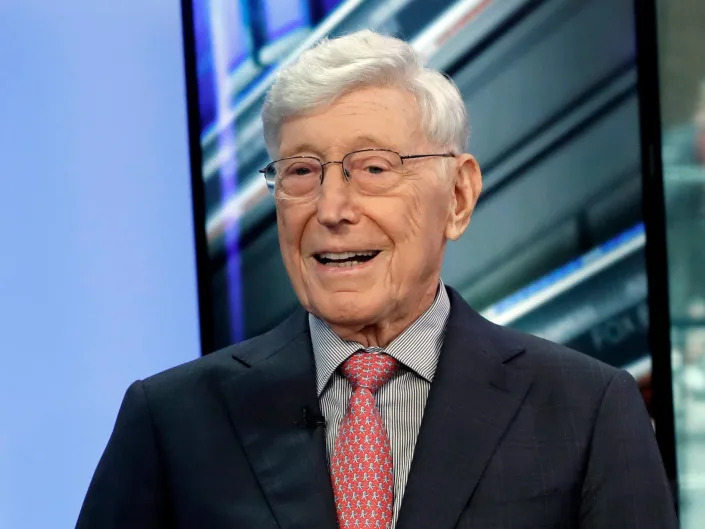
Bernie Marcus, the billionaire cofounder of Home Depot, said Thursday “nobody works” anymore.
Marcus said he believed if he founded Home Depot today it wouldn’t be as successful.
Marcus donated millions to Trump in 2016 and 2020, and more to other Republicans over the years.
A billionaire cofounder of Home Depot who said “nobody works” has donated nearly $64 million to political causes over the years, including the campaigns of former President Donald Trump, Florida Gov. Ron DeSantis, and Sen. John McCain, according to data from the Federal Election Commission.
“‘Just give it to me. Send me money. I don’t want to work — I’m too lazy, I’m too fat, I’m too stupid,'” he said, adding that he thinks if he founded Home Depot today it may not have been as successful.
Home Depot today is worth $321 billion and has around 2,300 stores in North America. As for the current US unemployment rate, it’s at 3.7%, the lowest in decades, despite the hiring challenges some businesses are still experiencing.
Marcus, who cofounded Home Depot in 1978, has become a mega-donor to the GOP over the years, supporting Trump’s presidential campaigns in both 2016 and 2020. His public support for Trump sparked calls to boycott Home Depot, prompting the company to distance from him.
In a statement provided to Insider, a spokesperson for Home Depot said: “Our co-founder Bernie Marcus left The Home Depot more than 20 years ago, and his views do not represent the company.”
But going back to at least 1978, Marcus has donated a total of $63,801,322 to political campaigns and PACs, FEC data obtained by Insider showed.
Many of the donations went to directly supporting Republican candidates, including the presidential campaigns of Trump, McCain, Sen. Marco Rubio, Jeb Bush, and Sen. Mitt Romney, among others.
Some of Marcus’s largest individual donations have gone to conservative super PACS that directly supported Trump.
In 2020, he made two separate donations of $5 million each to the Preserve America PAC, a single-candidate PAC that supports Trump.
In 2016, Marcus made two donations, one for $3 million and one for $2 million, to Rebuilding America Now, a super PAC established to support Trump’s first campaign. He also gave another $2 million to Making America Number 1, a pro-Trump PAC.
Between 2015 and 2022, Marcus donated more than $15 million to the Senate Leadership Fund, a PAC dedicated to helping Republicans gain a majority in the Senate, and more than $5 million to the Congressional Leadership Fund.
Marcus has also donated extensively to House and Senate races, contributing to a long list of Republican lawmakers that includes Sens. Tom Cotton, Mike Lee, Chuck Grassley, Mitch McConnell, and Tim Scott, as well as Reps. Kevin McCarthy and Liz Cheney.
Marcus in 2022 also donated to Herschel Walker, the failed Senate candidate from Georgia, and Sen. Joe Manchin, the West Virginia Democrat who has been accused of impeding his own party’s agenda.
Marcus and his wife, Billi, have also pledged to give away most of their estimated $8.9 billion fortune. In 2010, they signed The Giving Pledge, a commitment to donate most of their wealth to charitable causes.
Democrat Kris Mayes is the winner of Arizona’s attorney general race, a state judge announced Thursday.
Mayes defeated Republican Abraham Hamadeh by 280 votes after a mandatory recount was triggered due to how close they were separated after the initial tally in November, when Mayes led by roughly 500 votes out of 2.5 million cast.
Maricopa County Superior Court Judge Timothy Thomason unveiled the results of the recount in a hearing on Thursday.
Mayes’ lead from November was nearly halved in the recount. The results showed she had 1,254,809 votes to Hamadeh’s 1,254,529 votes.
Mayes’ victory is another win for Democrats this midterm cycle against candidates who endorsed former President Donald Trump’s election denialism. In Arizona, a traditionally red state, Democrats defeated GOP election deniers in races for Senate, governor, secretary of state and now attorney general.
“I will say once again that I’m thankful to everyone who took their time to vote, and democracy is truly a team sport,” she said after the results were announced. “I’m thankful for my campaign, transition and legal teams. I’m excited to get to work as your next Attorney General and vow to be your Lawyer for the People. Onward…”
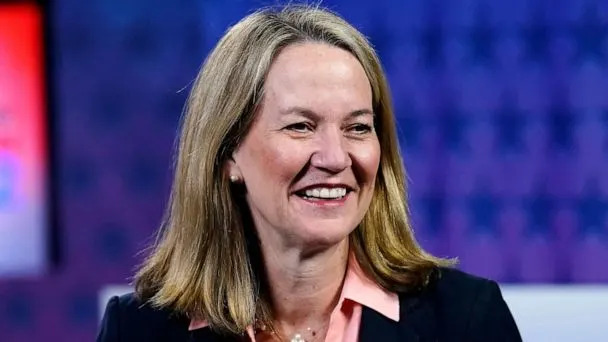
PHOTO: Kris Mayes, a Democratic candidate for Arizona attorney general, smiles before a debate against Republican Abraham Hamadeh, Sept. 28, 2022. (Ross D. Franklin/AP, FILE)
Hamadeh, who was backed by Trump, denied the legitimacy of the 2020 election.
In late November, he sued Mayes and a range of state officials alleging there were procedural and tabulation errors that, if corrected, would make him victorious.
The lawsuit was thrown out last week by Mohave County Superior Court Judge Lee Jantzen, who said Hamadeh failed to prove the errors he claimed happened. Hamadeh’s attorney also acknowledged he hadn’t gained enough votes during the litigation to change the outcome of the contest.
After the lawsuit was tossed, Hamadeh said he would wait for the results of the recount before deciding “next steps,” but continued to maintain the election was mishandled.
Following the announcement of the recount results, Hamadeh again claimed discrepancies and questioned the outcome of the race. He wrote on Twitter, “We MUST get to the bottom of this election. Transparent elections are fundamental to a democracy.”
PHOTO: Abraham Hamadeh, a Republican candidate for Arizona attorney general, is seen prior to a debate against Democrat Kris Mayes on Sept. 28, 2022. (Ross D. Franklin/AP, FILE)
Mayes celebrated the case’s dismissal last week and said she believed the results of the mandatory recount would still show her ahead of Hamadeh.
“The will of Arizona voters will not be undermined,” she said at the time.
Mayes, a former member of the Arizona Corporation Commission and a former Republican, campaigned heavily on reproductive rights and voting rights. She’s vowed not to prosecute abortion ban violations and to pursue threats to election workers.
Judge Thomason on Thursday also announced the recount results of two other tight races for state superintendent and for a state legislative seat. Republican Tom Horne won the race for superintendent of public instruction and Republican Liz Harris won the state legislative seat for House District 13.
Trump’s tax returns released after long fight with Congress
Michael R. Sisak and Jill Colvin – December 29, 2022
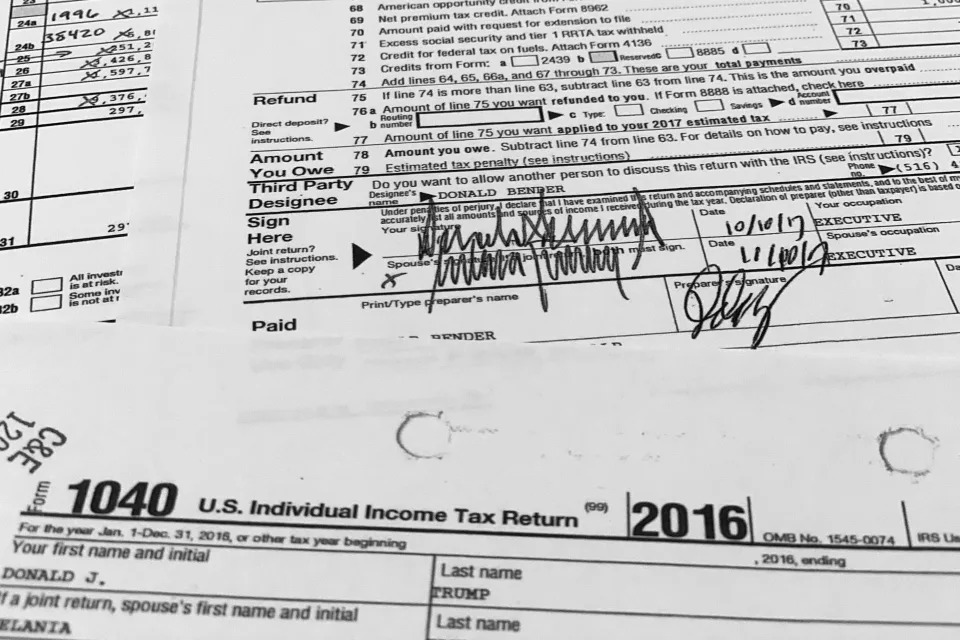
Signatures of former President Donald Trump and former first lady Melania Trump appear on their individual tax returns for 2016, released by the Democratic controlled House Ways and Means Committee, are photographed Friday, Dec. 30, 2022. The returns, which include redactions of some personal sensitive information such as Social Security and bank account numbers, span nearly 6,000 pages, including more than 2,700 pages of individual returns, and more than 3,000 pages in returns for Trump’s business entities. (AP Photo/Jon Elswick) ASSOCIATED PRESS
Democrats in Congress released thousands of pages of former President Donald Trump’s tax returns Friday, providing the most detailed picture to date of his finances over a six-year period, including his time in the White House, when he fought to keep the information private in a break with decades of precedent.
The documents include individual returns from Trump and his wife, Melania, along with Trump’s business entities from 2015-2020. They show how Trump used the tax code to lower his tax obligation and reveal details about foreign accounts, charitable contributions and the performance of some of his highest-profile business ventures, which had largely remained shielded from public scrutiny.
The disclosure marks the culmination of a yearslong legal fight that has played out everywhere from the presidential campaign to Congress and the Supreme Court as Trump persistently rejected efforts to share details about his financial history — counter to the practice of transparency followed by all his predecessors in the post-Watergate era. The records release comes just days before Republicans retake control of the House and weeks after Trump began another campaign for the White House.
The records show how Trump limited his tax liability by offsetting his income against corporate losses as well as millions of dollars in businesses expenses, asset depreciation and other deductions.
While Trump paid $641,931 in federal income taxes in 2015, the year he began his campaign for president, he paid just $750 in 2016 and 2017, according to a report released last week by Congress’ nonpartisan Joint Committee on Taxation. He paid nearly $1 million in 2018, but only $133,445 in 2019 and nothing in 2020, the year he unsuccessfully sought reelection.
The records also detail Trump’s foreign holdings.
Trump, according to the filings, reported having bank accounts in China, Ireland and the United Kingdom in 2015 through 2017, even as he was commander in chief. Starting in 2018, however, he only reported an account in the U.K. The returns also show that Trump claimed foreign tax credits for taxes he paid on various business ventures around the world, including licensing arrangements for use of his name on development projects and his golf courses in Scotland and Ireland. In 2018, according to Joint Committee on Taxation figures, Trump paid more in foreign taxes than he did net federal income.
The documents show that Trump’s charitable donations fluctuated during his presidency but, in his final years, represented only a sliver of his income. In 2020, the year the coronavirus ravaged the economy, Trump reported no charitable donations at all. In 2019 and 2018 he reported writing checks for about $500,000 in donations. In earlier years the numbers were higher — $1.8 million in 2017 and $1.1 million in 2016.
It’s unclear whether the reported sums included Trump’s $400,000 annual presidential salary, which he had said he would forgo and claimed he donated to various federal departments.
The release marks the latest setback for Trump, who has been mired in investigations, including federal and state inquiries into his efforts to overturn the 2020 election. The Department of Justice also has been investigating reams of classified documents found at his Mar-a-Lago club and possible efforts to obstruct the investigation.
In a statement Friday, Trump lashed out at Democrats and the Supreme Court for the release.
“It’s going to lead to horrible things for so many people,” he said. “The radical, left Democrats have weaponized everything, but remember, that is a dangerous two-way street!”
He said the returns demonstrated “how proudly successful I have been and how I have been able to use depreciation and various other tax deductions” to build his businesses.
Presiding over a routine pro forma session of the House on Friday, Rep. Don Beyer, chairman of the Joint Economic Committee, said great care had been taken to ensure the returns were treated with sensitivity, with personal and other identifying information redacted.
“We’ve been trying to be very careful to make sure that we weren’t ‘weaponizing’ the IRS returns,” said Beyer, D-Va. He also is a member of the tax-writing House Ways and Means Committee, which held a party line vote last week to make the returns public.
The returns detail how Trump used tax law to minimize his liability, including carrying forward massive losses from previous years, as allowed by tax law. Trump said during his 2016 campaign that paying little or no income tax in some years “makes me smart.”
His tax returns show he did that by structuring his company as a massive sole proprietorship, with nearly every dollar, pound, euro and yuan passing through his golf courses, hotels and other assets affecting — and in many cases helping — his own bottom line.
For instance, in 2020, more than 150 of Trump’s business entities listed negative qualified business income, which the IRS defines as “the net amount of qualified items of income, gain, deduction and loss from any qualified trade or business.” In total for that tax year, combined with nearly $9 million in carryforward loss from previous years, Trump’s qualified losses amounted to more than $58 million for the final year of his term in office.
Another of Trump’s money losers: the ice rink his company operated until last year in New York City’s Central Park. Trump reported a total of $2.6 million in losses from Wollman Rink over the six years made public. The rink, an early Trump Organization jewel run through a contract with New York City’s government, reported a loss of $1.3 million in 2015 despite taking in $9.3 million in revenue, according to the tax returns. The rink turned a $298,000 profit in 2016, but was back to melting cash in each of the next four years.
Aspects of Trump’s finances had been shrouded in mystery since his days as an up-and-coming Manhattan real estate developer in the 1980s.
Trump, known for building skyscrapers and hosting a reality TV show before winning the White House, did provide limited details about his holdings and income on mandatory disclosure forms and financial statements he provides to banks to secure loans and to financial magazines to justify his place on rankings of the world’s billionaires.
Trump’s longtime accounting firm has since disavowed the statements, and New York Attorney General Letitia James has filed a lawsuit alleging Trump and his Trump Organization fraudulently inflated asset values on the statements. Trump and his company have denied wrongdoing.
In October 2018, The New York Times published a Pulitzer Prize-winning series based on leaked tax records that contradicted the image Trump had tried to sell of himself as a self-made businessman. It showed that Trump received a modern-day equivalent of at least $413 million from his father’s real estate holdings, with much of that money coming from what the Times called “tax dodges” in the 1990s.
A second series in 2020 showed that Trump paid no income taxes at all in 10 of the previous 15 years because he generally lost more money than he made.
The IRS only began to audit Trump’s 2016 tax filings on April 3, 2019 — more than two years into his presidency — when the Ways and Means chairman, Rep. Richard Neal, D-Mass., asked the agency for information related to the tax returns.
Every president and major-party candidate since Richard Nixon has voluntarily made at least summaries of their tax information available to the public. Trump bucked that trend as a candidate and as president, repeatedly asserting that his taxes were “under audit” and couldn’t be released.
Associated Press writers Paul Wiseman and Farnoush Amiri in Washington, Meg Kinnard in Columbia, South Carolina, and Nicholas Riccardi in Denver contributed to this report.
Southwest Airlines grew to become the US’s largest domestic carrier by offering free checked baggage, easy-to-change tickets — and still sticks to unassigned seats
Taylor Rains – December 28, 2022
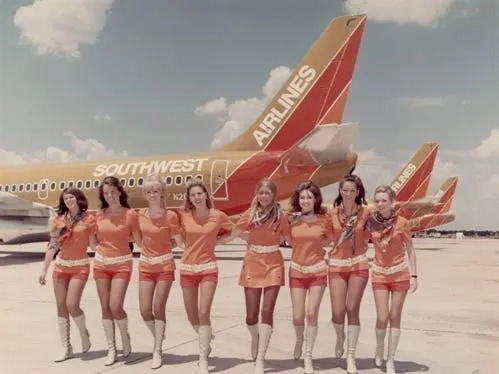
Southwest Airlines flight attendants in an undated historic picture.Southwest Airlines
Southwest Airlines, the US’s largest domestic carrier, experienced an operations meltdown in this holiday season.
Despite its problems, Southwest celebrates its customer- and employee-focused mission.
The airline found success using unconventional marketing strategies focused on humor, booze, arm wrestling, and go-go boots.
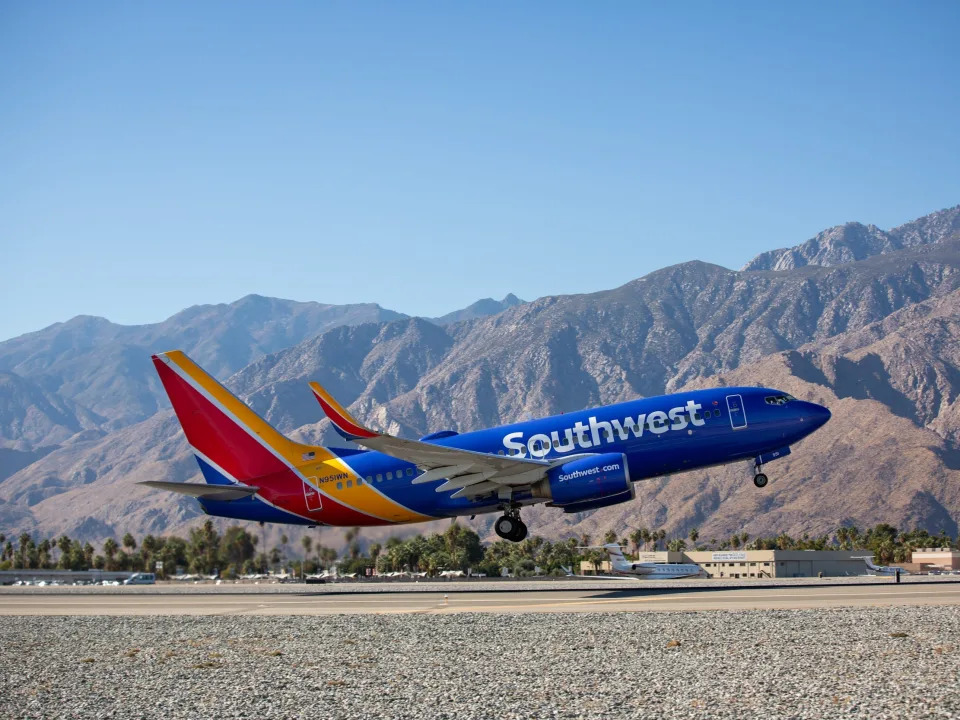
Southwest Airlines is the US’s largest domestic carrier, serving over 100 destinations across the country. The carrier has been in operation since 1971 and just celebrated its 51st anniversary in June.
Stephen M. Keller/Southwest Airlines
With Southwest’s immense size, it has a lot of systems at play to keep it running efficiently and on time. But, sometimes a nasty winter storm can derail even the best carrier’s operations.
Elliott Cowand Jr/Shutterstock
But, Southwest suffered from more than just the weather in the holiday season of 2022.
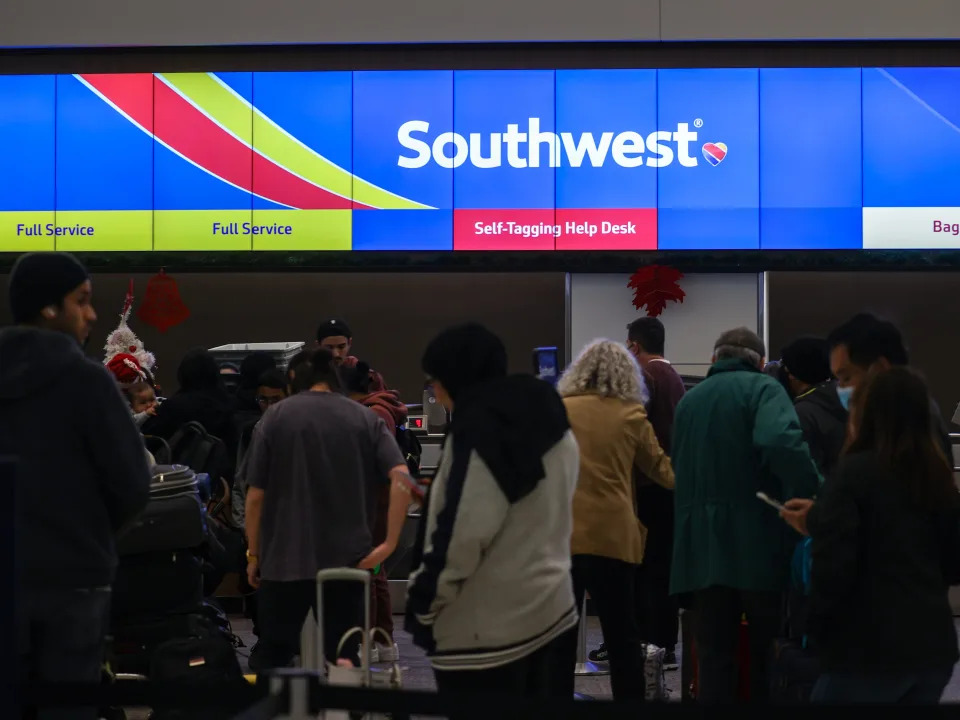
Canceled flight travelers line up in front of Southwest Airlines sign at Denver International Airport.Hyoung Chang/Getty Images
Captain Mike Santoro, vice president of the Southwest Airlines Pilots Association, told Insider the storm was the catalyst of the meltdown, but “outdated” scheduling software created the snowball.
Southwest confirmed to Insider that its systems were unable to handle the “magnitude” of disruptions, which amounted to over 7,000 from Christmas to December 28 alone.
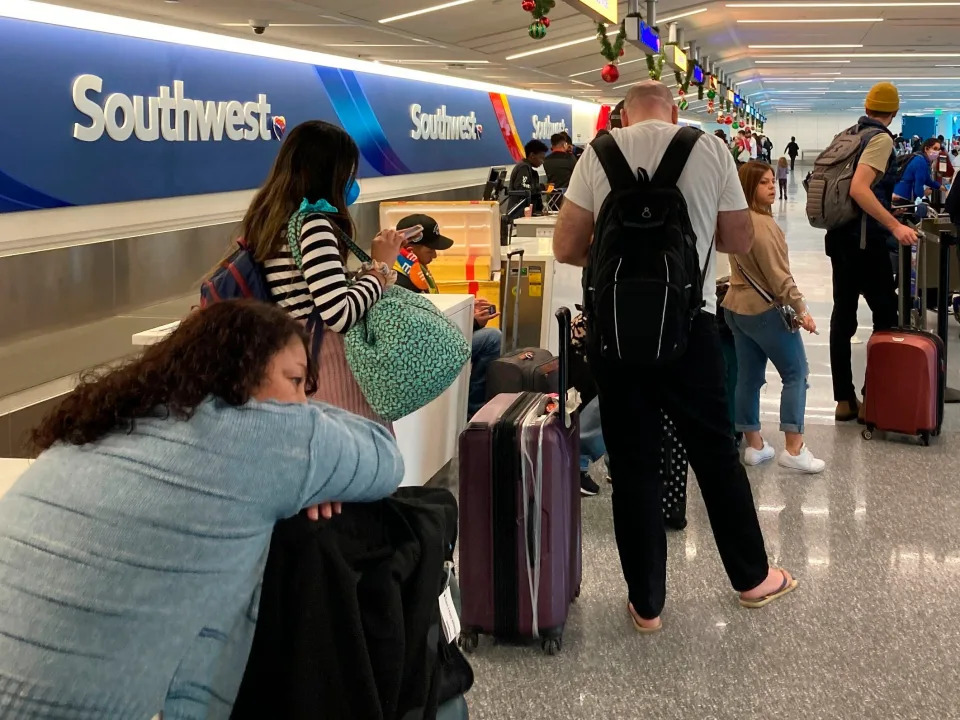
Travelers wait at a Southwest Airlines baggage counter to retrieve their bags after canceled flights at Los Angeles International Airport on December 26, 2022.Eugene Garcia/AP Photo
The company acknowledged its software needs an update, with a spokesperson saying, “we are focused on making investments in technology upgrades to work toward that solution.”
Passengers line up at the Southwest ticket desk at San Francisco International Airport on December 26, amid widespread delays and cancellations for the airline.Tayfun Coskun/Anadolu Agency via Getty Images
Despite its operations issues in the holiday season of 2022, Southwest prides itself on being a customer- and employee-focused airline, bringing “LUV” to its operation, and keeping safety, hospitality, and customer service at the forefront of its mission. (LUV is its stock symbol.)
Southwest Airlines
According to financial information company BrightScope, Southwest has one of the highest-rated employee 401k plans. Meanwhile, J.D. Power reported in May that customers ranked Southwest as having the best economy product in North America.
The grieving owner is planning to sue the airline.MARK RALSTON/AFP via Getty Images
Haley Woods, founder of Girls LOVE Travel — a Facebook group with over one million members — told Insider that when her flight was canceled over the holiday week, she encountered the most “professional” and “upbeat” Southwest employees.
V_E/Shutterstock
“While this disruption might derail others from using SWA in the future — their customer kindness has reminded me that I will absolutely be looking past this and onward for future adventures,” she said.
Passengers wait in line to check in for their flights at Southwest Airlines service desk at LaGuardia Airport, Tuesday, Dec. 27, 2022, in New York.Yuki Iwamura/AP
While it’s could still lose some trust from customers, Southwest is likely to eventually bounce back. See how the airline has grown over the years to be the powerhouse it is today.
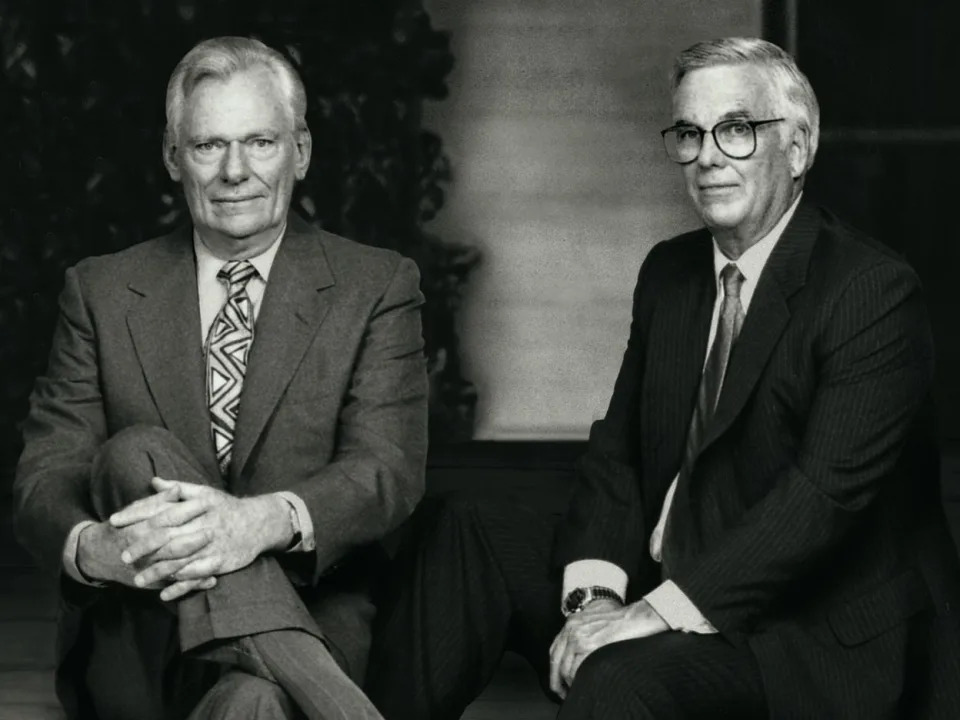
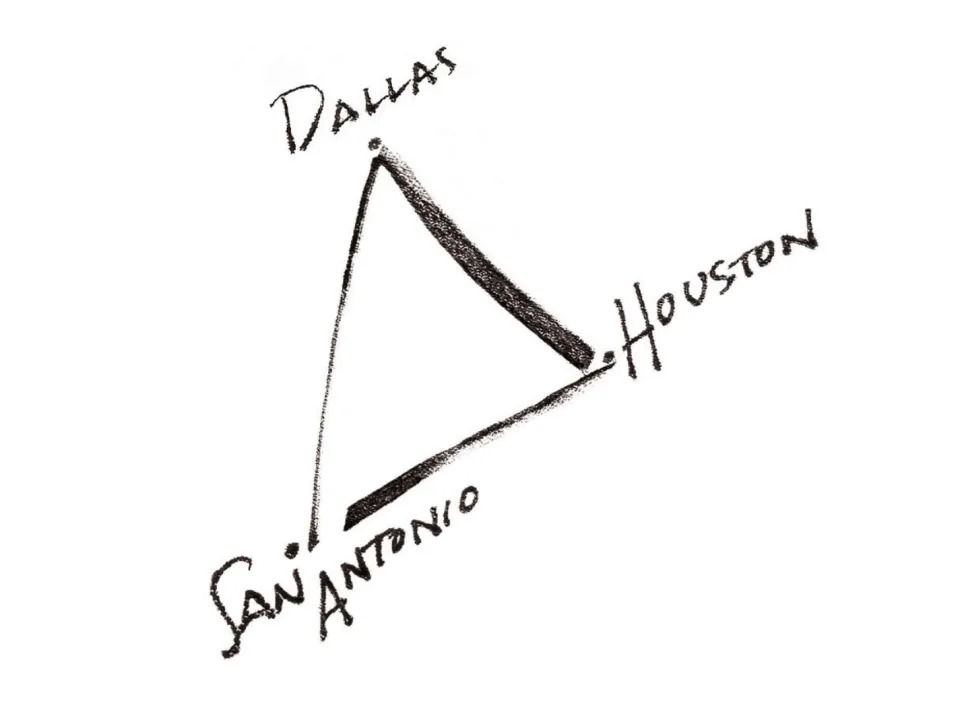
Southwest started as a small carrier based in Texas and only operated intra-state routes between three cities, San Antonio, Houston, and Dallas. The airline, which was originally called Air Southwest, was dreamt up by Rollin King and Herb Kelleher on a cocktail napkin in 1966.
Herb Kelleher (left) and Rollin King (right)Southwest Airlines
King mapped the network he envisioned, making a triangle between the three key cities. He explained to Kelleher that operating solely in Texas would make the company exempt from the Civil Aeronautics Board’s federal regulations, which controlled fares, routes, and schedules.
Rollin King’s “Texas Triangle”Southwest Airlines
From 1938 to 1978, the airline industry was federally regulated under the CAB as means to ensure major carriers like United and Pan Am were profitable. Fares were sky-high and only business travelers and deep-pocket leisure customers could afford the luxury of flight. The downside was that a lot of the time, planes flew half-empty.
Because Air Southwest was certified under the state’s aviation regulator, the Texas Aeronautics Commission, it was not bound to federal rules — a clever loophole King unapologetically copied from California carrier Pacific Southwest Airlines.
Rollin KingSouthwest Airlines
The loophole allowed Air Southwest to fly freely in Texas and undercut competitors’ fares, offering more customers the option to fly instead of drive in the large state. The business model was game-changing and a threat to legacy airlines.
Herb Kelleher with model of Southwest aircraftSouthwest Airlines
In 1967, three airlines operating under federal rules, Braniff, Trans-Texas Airways, and Continental Airlines, took legal action against Air Southwest, saying it does not have the right to fly in Texas.
Lady Bird Johnson, wife of President Lyndon Johnson, steps off Braniff Airways jetHarvey Georges/Associated Press
The lawsuit took three years to resolve, and in 1970, the Texas Supreme Court ruled Air Southwest could fly in the state. The three airlines then took the case to the US Supreme Court, which declined to review it.
Herb Kelleher (left) Lamar Muse (second from left) and Rollin King (center)Southwest Airlines
Air Southwest’s right to fly in Texas was finalized in December of 1970. The carrier officially changed its name to Southwest Airlines in 1971 and commenced operations on June 18 of the same year.
Southwest flight attendant points to schedule Southwest Airlines
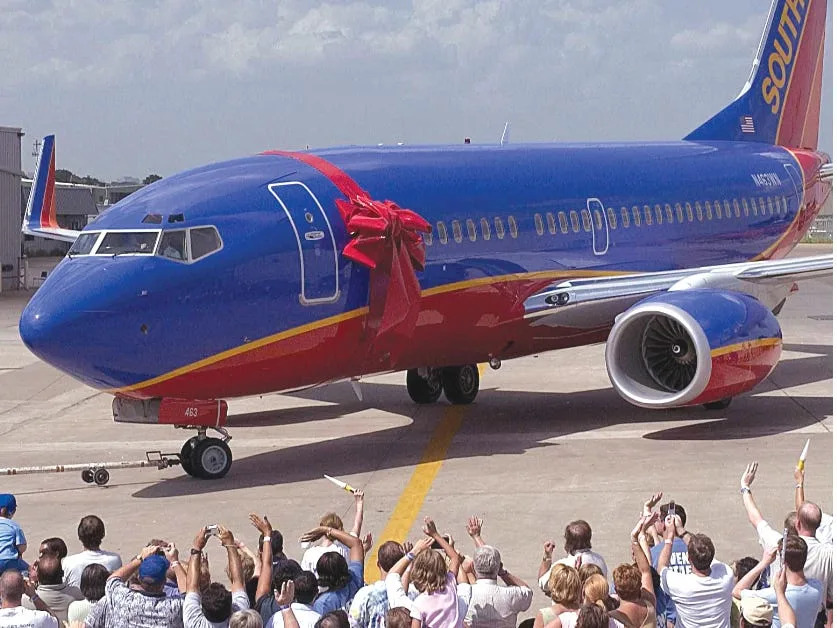
The carrier launched with two routes from Dallas Love Field to Houston and San Antonio using three new Boeing 737-200 aircraft. Flights between Houston and San Antonio commenced in November 1971.
Southwest Airlines Boeing 737-2T4 at Los Angeles International Airport in 1991.Torsten Maiwald/Airliners.net
Part of Southwest’s immense success was due to Kelleher’s focus on unconventional marketing and unique corporate culture.
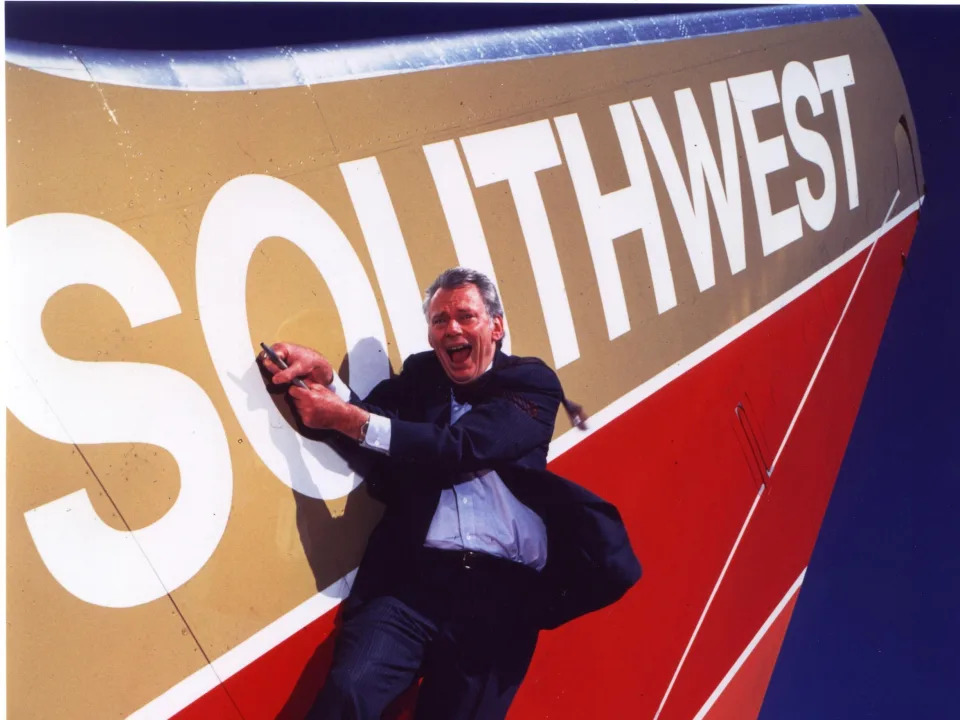
Herb Kelleher on Southwest tail Southwest Airlines
Kelleher used Pacific Southwest Airways’ idea of “Long Legs And Short Nights” for hostesses, as they were called at the time, keeping with the theme of hiring attractive women to work Southwest flights.
Southwest Airlines flight attendants in an undated historic picture.Southwest Airlines
The airline’s first flight attendants were described as long-legged dancers and were handpicked by a committee that included the same individual who picked the hostess on Hugh Hefner’s Playboy jet.
Southwest Airlines first flight attendant uniformsSouthwest Airlines
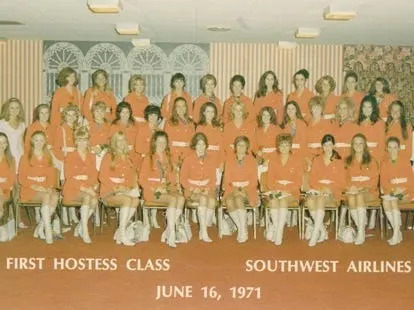
Kelleher dressed the flight attendants in a bright orange top, orange hot pants, a white belt around the hips, and white side-laced go-go boots. He also pushed for a laid-back, casual inflight experience and only hired female hostesses who were fun, engaging, and had a sense of humor.
First Southwest Airlines hostess classSouthwest Airlines
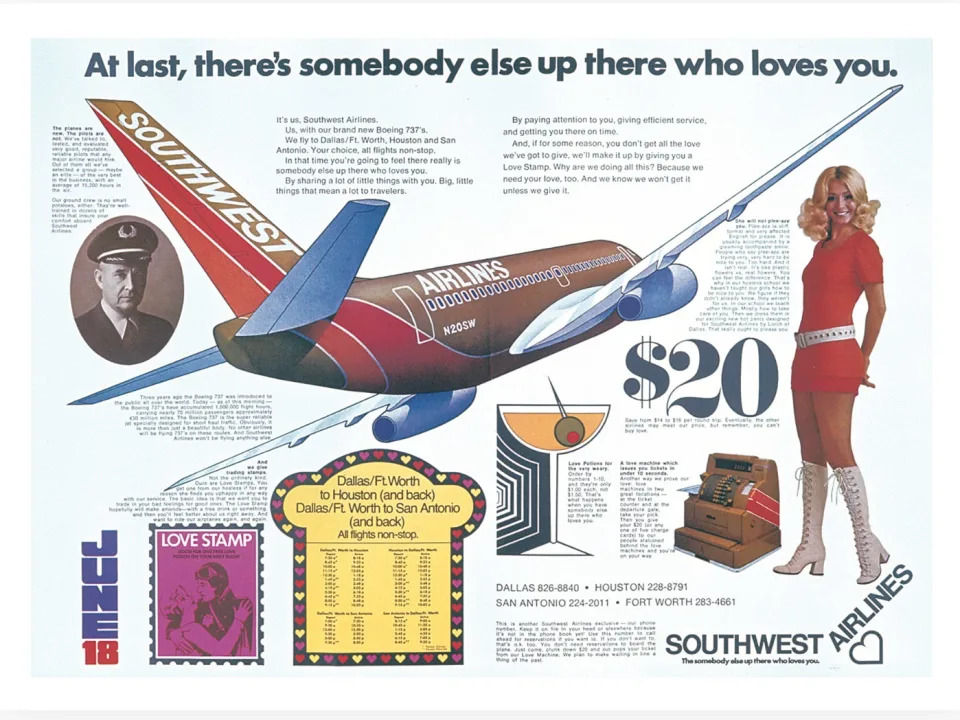
Kelleher continued the playboy theme by creating a “love” culture at Southwest. The carrier was called the “love airline,” automatic ticket dispensers were “love machines,” inflight snacks were “love bites,” and drinks were “love potions.”
The airline also crafted its own special inflight cocktails, which were free for passengers. A few were appropriately named Kentucky Matchmaker, the Pucker Potion, and the Lucky Lindsay.
Southwest Airlines flight attendant preparing beverage orders in the galleySouthwest Airlines
He even went on to create ads centered around humor and attractive women. In the context of the 1970s, using attractive female flight attendants to gain customers was an industry norm.
A 1968 photo of three flight attendants for Southwest AirlinesAlan Band/Keystone/Getty Images
In 1972, Southwest made a game-changing, innovative marketing move. The company introduced the “two-tier” fare system, which established two separate price points aimed at different types of travelers.
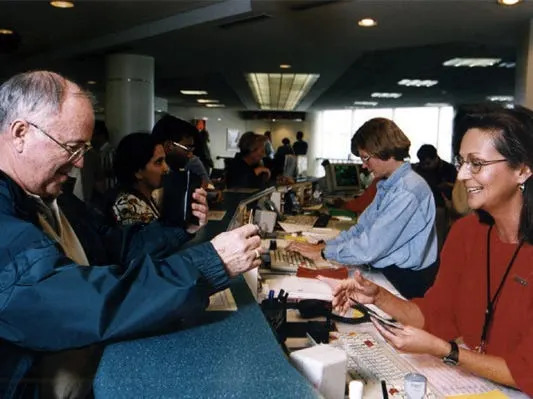
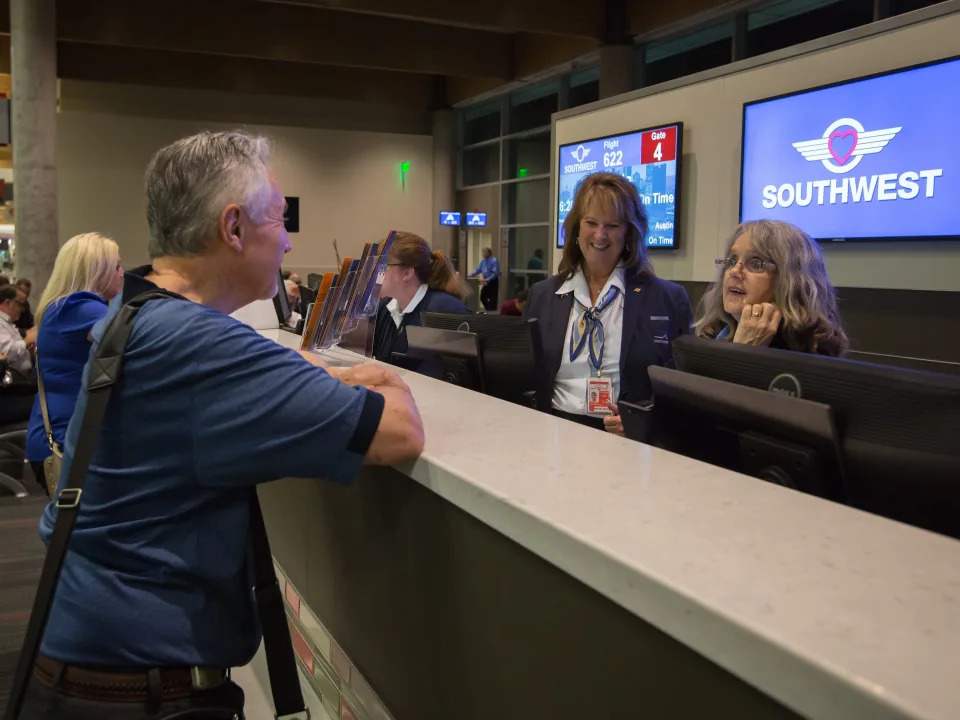
A Southwest Airlines Customer Service Agent checks in a Customer at the gateDavid Woo/Southwest Airlines
The fares were the regularly priced “Executive Class Service” at $26 one-way and the “Pleasure Class” at $13 one-way or $25 roundtrip. “Pleasure Class” fares were available after 6:59 p.m. on weekdays and all day Saturday and Sunday.
Southwest airlines customer service agents with customers at the ticket counterSouthwest Airlines
The two-tier structure was a wild success, with Southwest increasing its average passenger load from 17 before the move to 75 after.
Southwest pilots Southwest Airlines
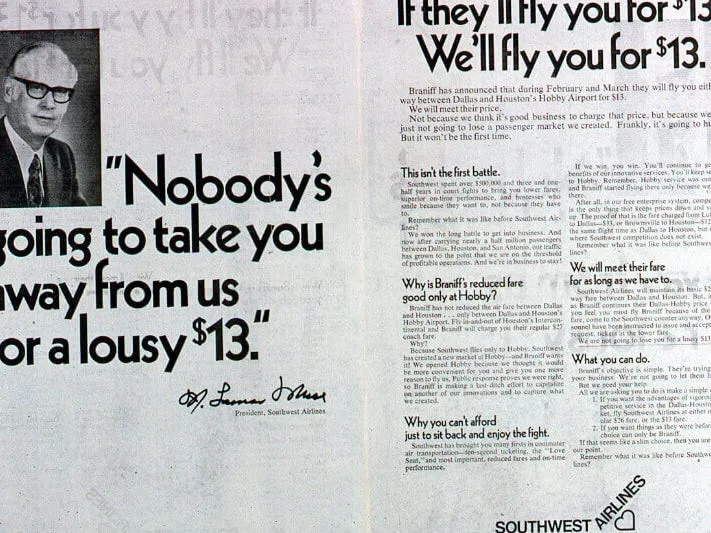
In 1973, the company launched a $13 one-way “half-fare” sale on all flights to San Antonio. Southwest’s rival, Braniff, responded with its own “get acquainted sale” with $13 fares between Dallas and Houston. This was the start of the $13 Fare War.
Southwest’s ad declaring war against Braniff’s fare cut Southwest Airlines
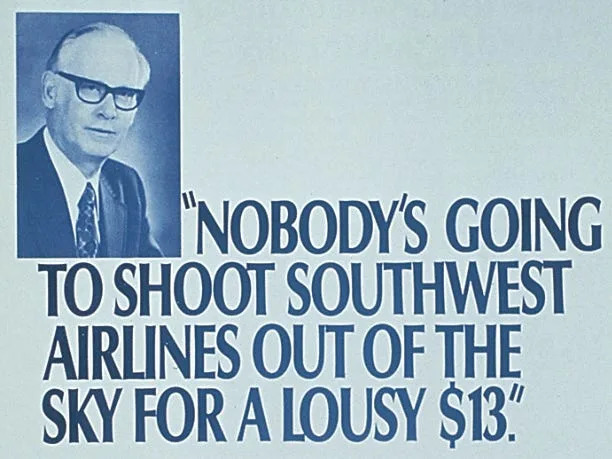
Southwest knew $13 fares on its only profitable route would run it straight into bankruptcy, so King quickly came up with a marketing campaign that would put Southwest on top. “Nobody’s going to shoot Southwest out of the sky for a lousy $13,” read the bold ad.
Southwest ad against Braniff’s $13 fare war Southwest Airlines
Southwest matched Braniff’s fare between Dallas and Houston, which was met with praise and respect from customers. As part of the campaign, the airline also offered a free fifth of liquor for passengers who paid the full $26 fare.
Ticket agent poses with a bottle of Chivas Regal in front of adSouthwest Airlines
Business travelers loved the promotion, and lucky for Southwest, three-fourths of its customers opted to pay full price and pocket the free booze. The airline soon became a fan favorite among many Texas business communities, and Braniff was fuming.
Southwest customer holding advertisement and receiving free liquor Southwest Airlines
By the end of 1973, Southwest finally turned its first profit and would continue to profit for 47 years until the coronavirus pandemic ended the streak. Meanwhile, Braniff lost the battle and the war, ceasing operations in 1982.
Braniff Airways aircraft in PeruCarl & Ann Purcell/Getty Images
Southwest’s early challenges did not end with Braniff. In 1964, the Civil Aeronautics Board demanded the city of Dallas build an airport to serve the entire Dallas/Fort Worth area. In 1968, every air carrier operating out of Love Field agreed to move to DFW when it opened in 1974.
British Airways Concord at DFW in 1973 after the airport was finished-/AFP via Getty Images
However, Southwest was not a part of that agreement and filed suit that it would not move from Love Field when the new airport opened. The airline claimed there was no legal reason to end commercial traffic at Love Field and that the company made no written agreement to move its operations.
Concord and Boeing 747 at DFW after the airport’s completion in 1973-/AFP via Getty Images
The city and the DFW Airport Board sued Southwest, saying the CAB rule applied to the airline even if it was made before Southwest was officially founded. However, Southwest argued that its intra-state flights fell outside the jurisdiction of the CAB, so it did not have to leave Love Field.
Opening day of new Love Field terminal in 2013Southwest Airlines
A federal district court agreed with Southwest and ruled that it could operate out of the airport as long as it remained open. When DFW opened in 1974, every airline except Southwest left Love Field.
Southwest aircraft takes off from Love Fieldstock_photo_world/Shutterstock
Southwest continued to grow through the 70s, acquiring 10 aircraft and carrying its five-millionth customer by the end of 1977.
Southwest’s 3 millionth passenger Bob Pianta in 1976 (middle)Southwest Airlines
By 1976, Southwest Airlines had been profitable for three years and proven that government regulation was not necessary for airlines to be successful. Deregulation was a top priority for Jimmy Carter’s administration, and it passed the Airline Deregulation Act in 1978, effectively abolishing the Civil Aeronautics Board.
President Carter signs the airline deregulation bill at the White HouseBettmann/Getty Images
Finally, Southwest Airlines was free to operate interstate flights and the airline began to thrive. Meanwhile, major carriers like Eastern Airlines, Trans World Airlines, and Pan Am spread themselves too thin as they tried to rapidly expand.
Unlike major carriers, Southwest maintained a simple strategy for success after deregulation, like only operating one aircraft type, cleaning the aircraft before landing to allow for a quicker turn, and focusing on humor in marketing.
Southwest flight attendant cleans the aircraftSouthwest Airlines
And its strategy worked. Southwest was prospering while other airlines like Pan Am and TWA collapsed. However, it was not long before the Wright Amendment put another wrench in the company’s plans.
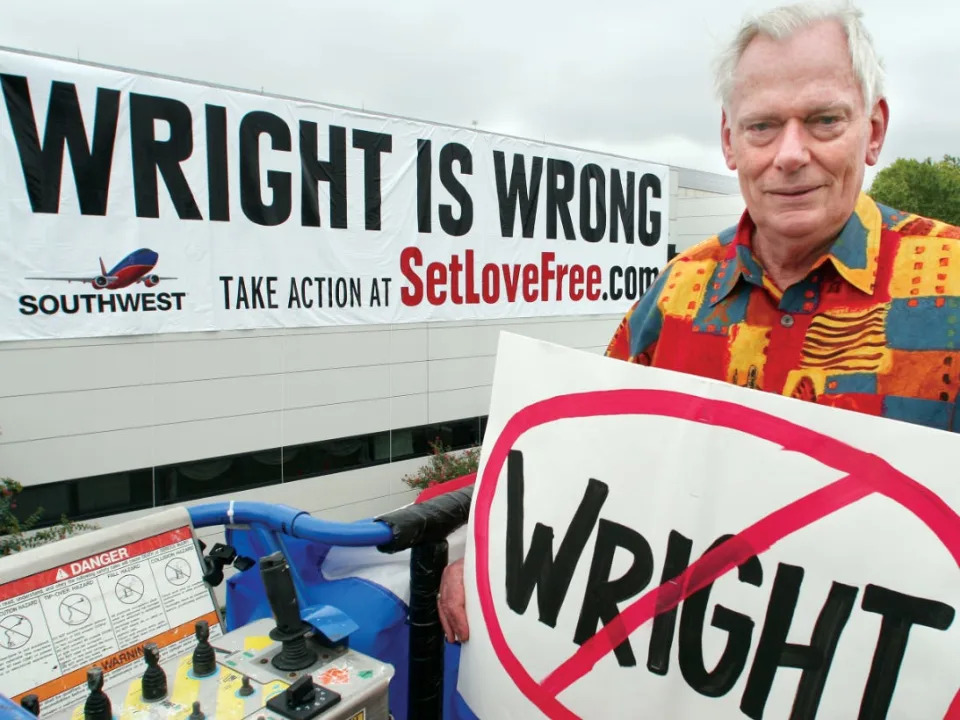
Colleen Barrett with Wright is Wrong petitionsSouthwest Airlines
After deregulation, Southwest wanted to commence interstate flights from Love Field to New Orleans in 1979, but officials at DFW airport feared the increased traffic would hurt the airport financially. So, US Congressman Jim Wright drafted, sponsored, and helped pass a bill restricting passenger traffic at Love Field.
Wright is Wrong sign Southwest Airlines
The law, known as the Wright Amendment, was signed in early 1980 and amended the International Air Transportation Act of 1979. It restricted flying out of Love Field to cities in Texas and the surrounding states of Louisiana, Oklahoma, Arkansas, and New Mexico. The law was meant to keep Southwest from expanding operations out of Dallas.
It only applied to carriers that operated aircraft with more than 56 seats, which Southwest did. So, the airline had to rely on short-haul flights in the five-state area to bolster Love Field operations.
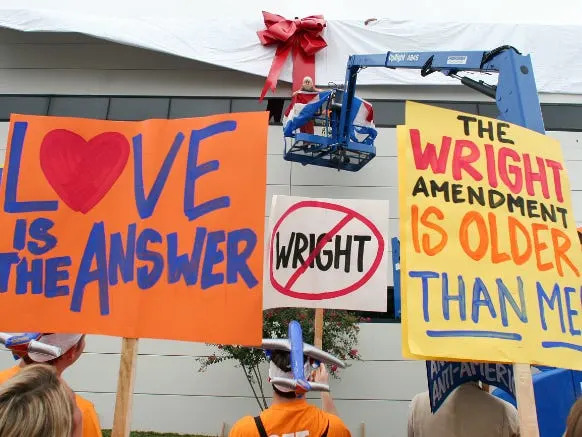
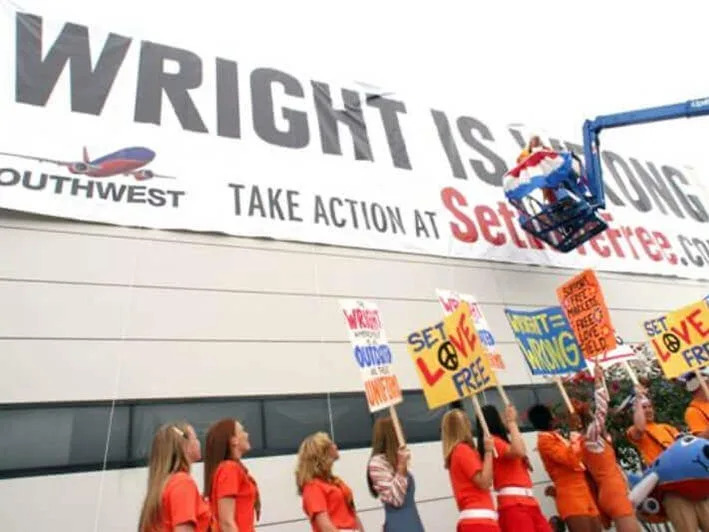
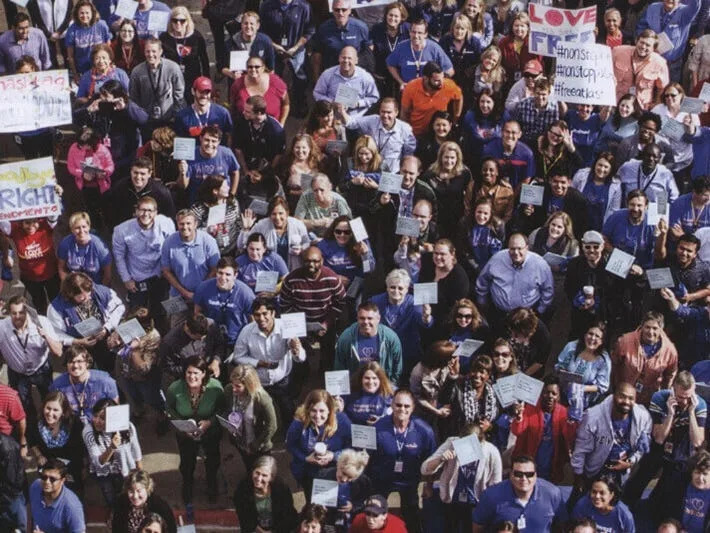
Southwest employees protest the Wright AmendmentSouthwest Airlines
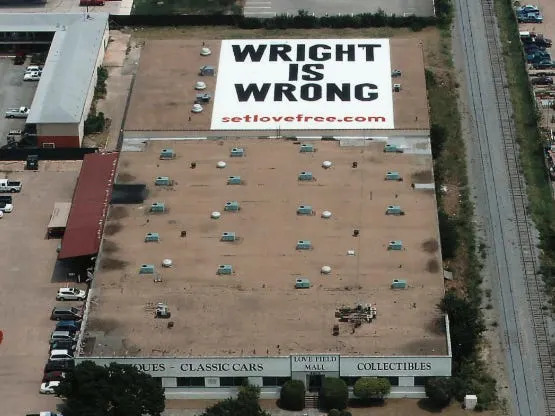
However, in 2004, Southwest CEO Gary Kelly launched efforts to repeal the Wright Amendment, using the slogans “Set Love Free” and “Wright is Wrong” in the campaign.
Herb Kelleher with “Wright is Wrong” slogan Southwest Airlines
In 2006, an agreement was made between Southwest, American Airlines, Dallas, and Forth Worth to phase out the law. They agreed that in eight years, the amendment would be gone, but until then, carriers could fly to any US destination out of Love Field as long as at least one stop was made in any of the nine states under the Wright Amendment.
Passengers sit in new Love Field terminalSouthwest Airlines
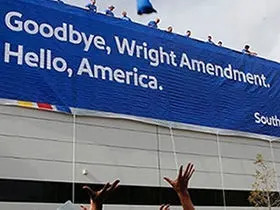
On October 13, 2014, at exactly 12:01 a.m., a countdown clock at Southwest’s Headquarters in Dallas hit zero, officially ending the Wright Amendment. A few minutes after, the airline’s first scheduled flight outside of the nine Wright states took off from Love Field to Denver.
Wright Amendment ends Southwest Airlines
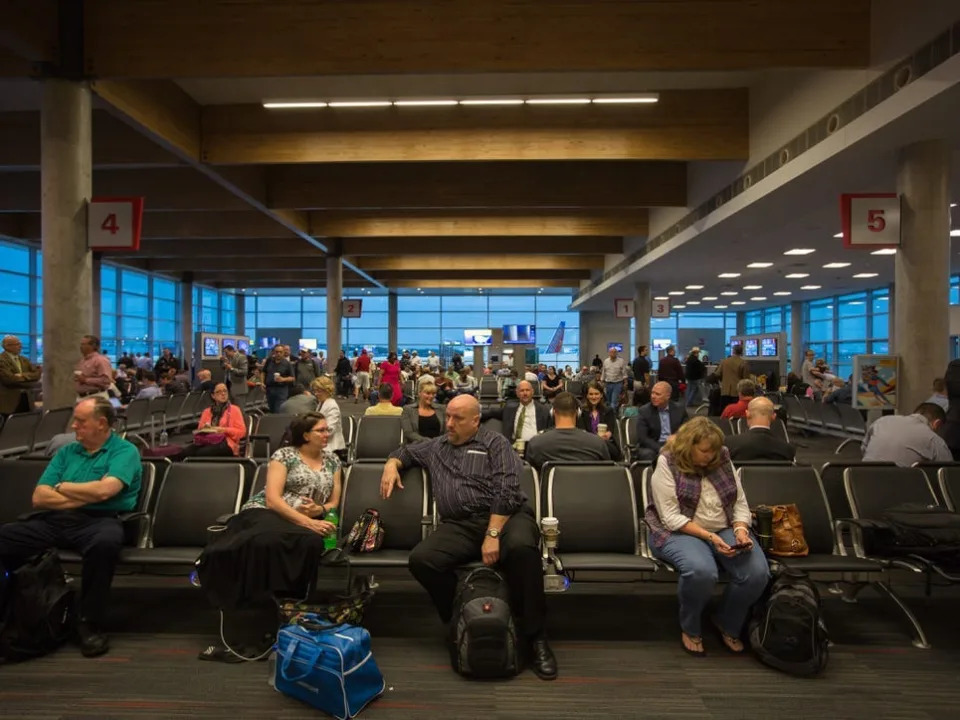
The deal also capped the number of gates at Love Field to 20, and the airport still only has 20 to this day.
Southwest aircraft at gate 2 at Love Fieldstock_photo_world/Shutterstock
While the Wright Amendment restricted expansion out of Love Field, Southwest was still able to bolster its network out of other Texas cities in the 1980s, 1990s, and 2000s.
Customer service employee at Houston HobbySouthwest Airlines
Throughout the 1980s, the airline expanded north into cities like Tulsa, Oklahoma City, and Kansas City, and west to Phoenix, Las Vegas, Albuquerque, and California. The airline moved east in the late 1980s with flights to Nashville and into the Midwest with flights to Chicago Midway and Detroit.
Southwest flight takes off from Vegas Southwest Airlines
The airline also updated its livery in the 1980s. Southwest wanted to stand out in the skies and make its brand easily recognizable, so it wrapped its fuselage in desert gold and other warm colors. It received its first 737-300 jet in 1984, dubbed Spirit of Kitty Hawk.
Herb Kelleher with Spirit of Kitty Hawk aircraft Southwest Airlines
Southwest’s flight attendant uniform was also updated by the 80s. Instead of hot pants and go-go boots, the airline allowed employees to wear real pants and skirts.
In the 1990s, the network expanded further east to cities like Baltimore, Cleveland, Columbus, Tampa, Fort Lauderdale, Providence, Islip, and Raleigh-Durham. The airline also began its Pacific Northwest expansion with the acquisition of Morris Air in 1994.
Southwest aircraft dedicated to Rollin King Southwest Airlines
In 1991, the “Friends Fly Free” campaign was launched to battle the recession. The promotion allowed anyone 18 or older to bring a friend of any age free on their flight. It was so popular that Southwest offered the promotion for the next five years.
Southwest’s Friend Fly Free ad Southwest Airlines
In 1992, Southwest’s most infamous marketing stunt occurred between Herb Kelleher and Kurt Herwald, chairman of Stevens Aviation.
Kelleher and Herwald at the Malice in Dallas Southwest Airlines
Southwest had been using the slogan “Just Plane Smart” in its ads, but Stevens Aviation sent a letter to Kelleher noting its similarity to its “Plane Smart” slogan.
Instead of entering a legal battle over the phrase, a Steven Aviation executive suggested an arm-wrestling competition between Herwald and Kelleher. The victor would have full rights to the slogan.
Herb and Herwald arm wrestle at the Malice in Dallas Southwest Airlines
Kelleher marketed the event, dubbed the “Malice in Dallas,” which received worldwide press coverage. “Smokin” Herb Kelleher and “Curtsy” Kurt Herwald put on a full show at the arena, which even earned a congratulatory note from President George Bush.
Malice in Dallas artwork in Southwest HQ Southwest Airlines
At the turn of the century, Southwest revealed the livery that most people know today. The Canyon Blue color scheme debuted in January 2001.
Debut of Southwest’s Canyon Blue livery in 2001 Southwest Airlines
While many airlines opted to introduce fees for things like checked bags and flight changes to recuperate funds, Southwest refused. Instead, the airline launched its “bags fly free” campaign which allows customers two complimentary checked bags. Southwest has not gone back on the offer to this day.
Throughout the 2000s, Southwest continued to focus on humor in its marketing. Its Wanna Get Away commercials proved successful, which promoted $49 one-way fares.
Southwest Boeing 737-800Steven M. Keller
By 2010, Southwest added “Transfarency” to its brand. The airline would not have any hidden fees and would remain customer-focused with an emphasis on Hospitality and Heart. The recognizable tri-color heart was added to its airplanes and workplace.
Heart One Southwest Airlines
In 2011, Southwest acquired AirTran Airways, which opened slots up out of Atlanta and gave it more network expansion opportunities in Mexico and the Caribbean. The two were fully integrated by 2014.
Southwest acquires AirTran Southwest Airlines
Also in 2014, the company’s livery got another new look, with a harder focus on the heart, a new logo, and a sleek new color scheme.
In July 2014, the airline officially became international with its first flight to Oranjestad, Aruba. In the same month, Southwest also started service to Nassau, Bahamas, and Jamaica.
First international Southwest flight lands in Montego Bay, Jamaica Stephen M. Keller
The company’s flight attendant uniform got an update in 2017, marking the first time in 20 years the airline changed the look. Womenswear included two dresses, one black with blue and red stripes and the other gray with red and black stripes. Menswear included a black blazer, a gray shirt and pants, and a red tie.
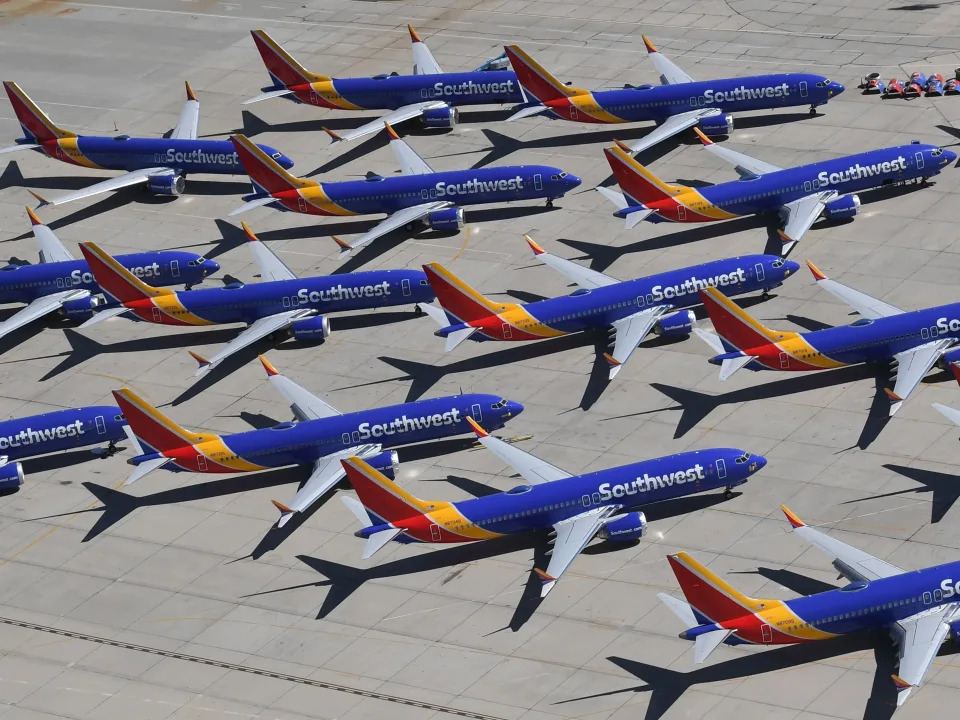
In October 2017, Southwest became the launch customer for the Boeing 737 MAX 8 jet, with its first revenue flight occurring on October 1. However, the aircraft was grounded in 2019 after two fatal accidents involved the MAX. The airline did not fly the plane again until March 2021.
Southwest Airlines Boeing 737 MAX 8 Southwest Airlines
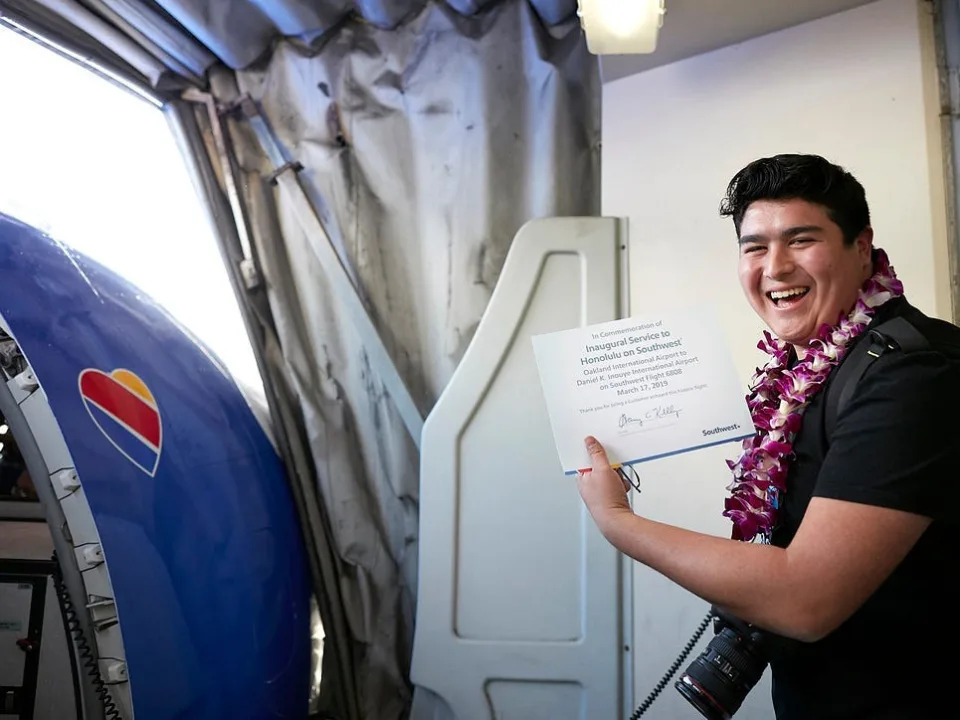
In 2019, Southwest reached its goal of operating flights to Hawaii with its inaugural service from Oakland to Honolulu.
Passenger boards first Southwest flight to Hawaii Southwest Airlines
In 2020, Southwest ended its 47-year profit streak when the coronavirus pandemic hit. Since last March, the airline has remained focused on the health and safety of its customers and employees.
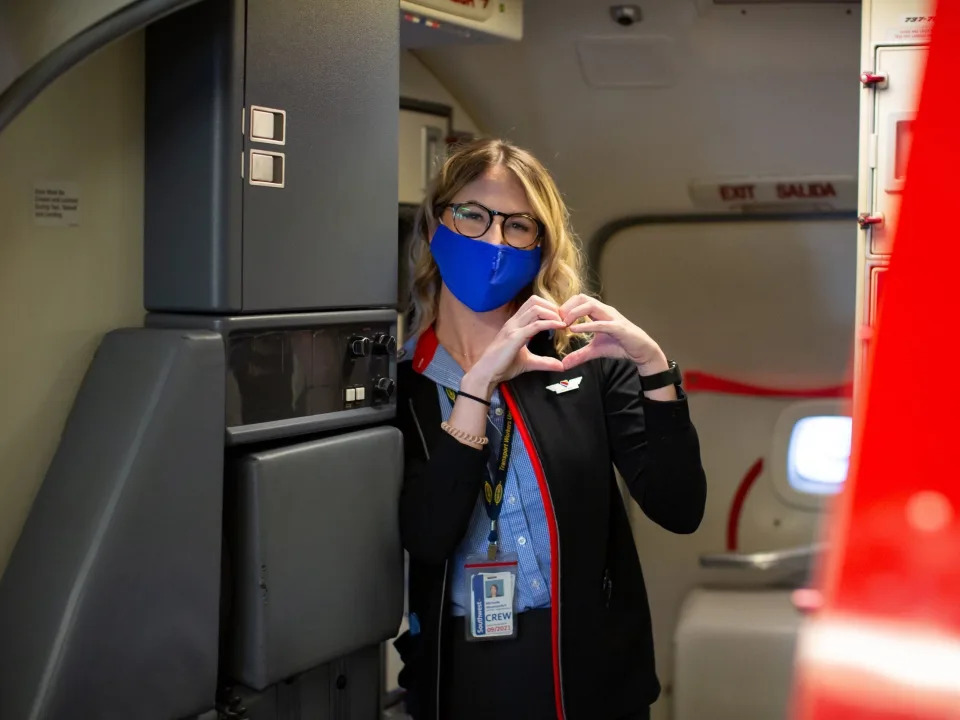
Southwest flight attendant greets passengers during the pandemicStephen M. Keller/Southwest Airlines
Since the pandemic, Southwest has become profitable again and, like other carriers, is trying to keep up with the surge in air travel.
Southwest Heart One Southwest Airlines
Despite its operations meltdown over the holiday of 2022, the carrier has vowed to get its operation back on track, compensate passengers for their time and added expenses, and continue to bring low fares to customers.
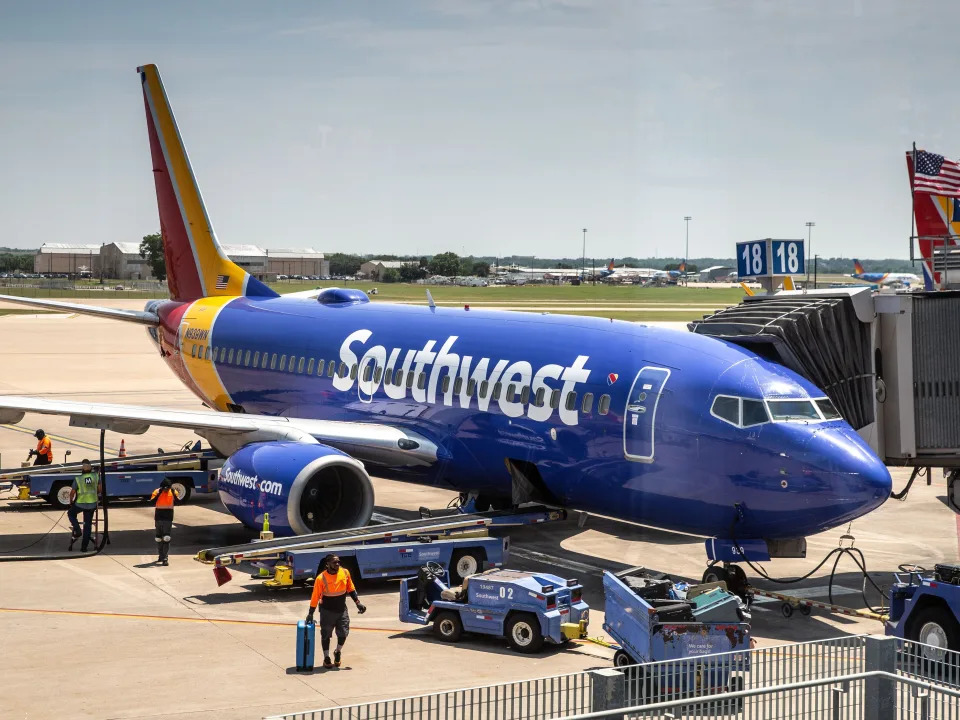
A Southwest Airlines Boeing 737 at a gate in Austin, TexasGeorge Rose/Getty Images
Southwest Airlines pilots union official describes how problems snowballed
The Biden administration is getting involved after a major meltdown causing delays and cancellations of thousands of Southwest Airlines flights across the U.S. Captain Michael Santoro, vice president of the Southwest Airlines Pilots Association, joins CBS News to discuss the problems what what it will take to fix things.
What about my right to live without violence? Supreme Court decisions on guns harm survivors.
Richard Alba – December 27, 2022
I have lived since the age of 2 with the damage inflicted by a gun death.
My father was killed while serving in the U.S. military in late 1945 by another soldier test firing his souvenir Luger in a barracks. I can still feel the powerful reverberations of that shot. It immediately threw the life of what remained of my family onto a much more difficult trajectory – less upwardly mobile, much less happy – than it had been on before.
My mother, though she remarried for a time and bore additional children, never knew sustained contentment and took her own life at the age of 60, three decades later. I struggled through an emotionally fraught childhood into a prickly young adulthood. Only years of psychological therapy and finally finding love in my 30s made it possible for me to break with my anger and melancholy.
The 1939 wedding photo of Richard and Mary Alba. Sgt. Alba died in 1945. He was shot by a soldier test firing a gun in the barracks.
This personal background gives me an unusually intense interest in the current rash of American mass shootings and its relation to our Constitution, as interpreted by a conservative Supreme Court. According to the Gun Violence Archive, there were 609 mass shootings (those with four or more victims) by Thanksgiving this year, though last year’s record of 690 looks safe.
There’s a simple explanation for this level of violence: The American rate of gun ownership is exceptional because of the Second Amendment. That part of the Bill of Rights has made it difficult for government to limit gun ownership and even now to restrict concealed arms in public places.
Right to guns vs. right to live free of gun violence
Recent Supreme Court decisions have torqued that difficulty. The District of Columbia v. Heller decision of 2008 established for the first time an individual right to gun ownership and invalidated a widespread previous understanding that the Second Amendment referred to a collective “right of the people,” organized in a “well regulated Militia.”
Justice Antonin Scalia’s majority opinion offers a tutorial on the conservative doctrine of originalism, as he strove to demonstrate the general acceptance in the 18th and 19th centuries of the principle that guns are necessary for individual self-defense.
But there is a glaring lack of balance in the opinion because Scalia, while admitting limits on Second Amendment rights in the abstract, provides no systematic reasoning or principles that might help us establish where the individual’s right to gun ownership ends and the right of the community to live without the constant threat of gun violence begins.
Recent Supreme Court decisions have hampered government efforts to limit gun ownership and restrict concealed arms in public places.
It then opines, “The exercise of other constitutional rights does not require individuals to demonstrate to government officers some special need (as the New York law did).” Ergo, Second Amendment rights should not require it, either.
One would hope that the average law student could spot the flaw in this reasoning: For when the right of speech is abused, an injured party can seek redress in the courts. But what redress is open to the person shot dead or grievously wounded by a gunman?
This distinction makes evident why government and the public have compelling interests in the exercise of Second Amendment rights that they do not for other rights.
It matters that guns are more deadly
Gun rights pose a severe test for the idea of originalism because of the enormous technological advance of weapons since the 18th century. Today’s semi-automatic firearms bear almost no resemblance to the muskets and rifles of the 18th century, which had to be reloaded after a single shot. Can originalism logically justify the right to own a weapon that could not be conceived when the Constitution was written?
In a recent speech, Justice Samuel Alito declared that the court’s decision extending the anti-discrimination provision in civil rights legislation to sexual orientation and gender was wrongly decided. His originalist reasoning: “It is inconceivable that either Congress or voters in 1964 understood discrimination because of sex to mean discrimination because of sexual orientation, much less gender identity.”
It seems highly doubtful that the Second Amendment as now understood can survive the Alito test. Can anyone seriously maintain that the Founders, whose knowledge of guns was limited to single-shot weapons, would have sanctioned constitutionally the widespread keeping and bearing of modern arms of war, which can tear the human body apart in seconds? Can anyone really believe that they would have intended such sanction for these weapons if given the knowledge that they are being used regularly to massacre American schoolchildren?
When is a society civilized?
The damage of gun violence is a spreading blight on American society. It affects not only the victims themselves but also their survivors, who must live with emotional loss and psychic trauma indefinitely.
In refusing to consider how to balance the Second Amendment’s right to gun ownership with the right of other citizens to live without the constant threat posed by ubiquitous weaponry, the court is contributing to the deterioration of the United States as a civilized society.
In common understanding, a society is civilized when citizens can go unarmed about their daily business without fear of violence. Today, pedestrians in many parts of the United States have to fear that the person walking by may be armed, and that the police can do nothing to protect them until he or she pulls out the weapon and starts shooting.
And then it is too late, as so many recent mass shootings instruct us.
Richard Alba is a distinguished professor of sociology at The Graduate Center at the City University of New York.
Richard Alba is a distinguished professor of sociology emeritus at The Graduate Center, CUNY.
George Santos deleted his campaign biography and blamed ‘elitist’ New York Times for his lies about his employment history
Bryan Metzger – December 27, 2022
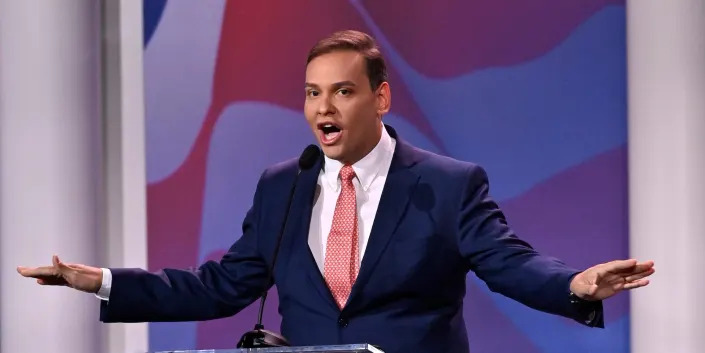
Rep-elect George Santos removed his biography from his campaign website on Tuesday.David Becker/Washington Post via Getty Images
GOP Rep-elect George Santos admitted he fabricated much of his background before he was elected.
On Tuesday, he removed his biography from his campaign website.
In one interview, he blamed the “elitist” New York Times for his lies about his employment history.
As he faced numerous questions over a series of apparent falsehoods in his resume last week, Republican Rep-elect George Santos said he had a “story to tell and it will be told next week.”
On Monday, he began to do just that via a series of largely friendly interviews — and admitted that whole sections of his biography were fake.
The biography included the lie that he had graduated from Baruch College and that his grandparents had “fled Jewish persecution in Ukraine.” The Forward found that his grandparents were born in Brazil.
In an interview with the New York Post on Monday, he came clean about lying about his employment and education history, as well as the fact that he isn’t Jewish.
“I never claimed to be Jewish,” he told The Post. “I am Catholic. Because I learned my maternal family had a Jewish background I said I was ‘Jew-ish.'”
“I worked as a customer service agent for six, seven months of my life or so — eight, maybe, in some — at some point in 2011, 2012,” he said. “The moment I put that on a resume, and I put it out there, elitists like the New York Times like to call blue-collar jobs like that ‘odd jobs.’ “
Santos was apparently referencing a story from the Times that noted that the congressman-elect worked at a Dish Network call center around the same time he purportedly worked on Wall Street.
“It’s those expectations, and those negative connotations, from elitist organizations, such as the New York Times that lead people — like me,” he said before abruptly changing course mid-sentence, saying he was “very comfortable in saying, I come from poverty, I come from a family of absolute nothing.”
“The reality is, yes, I omitted, like, past employment history that was irrelevant to the role,” he added.https://www.youtube.com/embed/E20WpTB4ZgA
During his interview with City & State NY, Santos also addressed his prior marriage to a woman; Santos is the first non-incumbent gay Republican ever elected to Congress.
He said he initiated a divorce after deciding to come out as gay.
“At least I had the courage to do it,” he said. “So many people… live in denial for their entire life, or are frustrated, and then eventually become a trans woman in their 60s.”
Santos Blames ‘Bourgeois’ Media for Pointing Out His Many, Many Campaign Lies
Nikki McCann Ramirez – December 27, 2022
george-santos-admission.jpg U.S. Congressman-elect George Santos – Credit: Alejandra Villa Loarca/Newsday RM/Getty Images
“Did I embellish my resume? Yes I did. And I’m sorry … but I’m still the same guy, I’m not a fraud.”
New York congressman-elect George Santos admitted on Monday to having engaged in “résumé embellishment” and lying about his education and work history. Santos has been embroiled in controversy following a New York Timesreport that raised discrepancies in the incoming congressman’s background. In various interviews responding to the controversy, Santos has now admitted to misrepresenting his job history, lying about his educational background, and exaggerating his financial position.
Despite repeatedly apologizing for misleading the public, Santos still attempted to deflect blame for his lies onto other entities. Santos pointed the finger at elitism in the media as the motivation behind the exaggeration of his credentials. “I worked as a customer service agent for 6-7 months of my life…elitists like the New York Times like to call blue-collar jobs like that ‘odd jobs’ because it just doesn’t fit their bourgeois-style lifestyle.”
And that, Santos says, is what’s to blame for him making a litany of false statements to voters while seeking office. “It’s those expectations and those connotations from elitist organizations such as the New York Times that lead people like me” to embellish their history.
The investigation by the Times was unable to verify claims by Santos regarding his self-reported work for major financial groups Goldman Sachs and Citigroup, as well as his assertion that he had graduated from Baruch College in New York and New York University. In an interview with the New York Post, Santos admitted that he had “never worked directly” with Goldman Sachs or Citigroup. He explained that a financial firm he had worked for, Link Bridge, had done work with the companies and blamed the discrepancy on his “poor choice of words.” “If I was trying to really defraud the people, like everybody keeps saying, I could have just listed bigger — just as big names,” Santos said in an interview with City & State New York.
“I didn’t graduate from any institution of higher learning,” Santos admitted to the Post. “ I’m embarrassed and sorry for having embellished my resume,” he stated. “I own up to that … We do stupid things in life.”
Santos further denied accusations that he had lied about having Jewish heritage, telling the Post that he “never claimed to be Jewish.” “I am Catholic,” Santos said, “because I learned my maternal family had a Jewish background I said I was ‘Jew-ish.’” Santos had previously claimed that his grandparents were Holocaust survivors who escaped persecution in WWII.
Regarding questions on discrepancies in his finances, Santos admitted to little besides a history of bad tenancy and never actually having owned property. Addressing claims that he owned more than 13 properties to City & State Santos said he “never claimed to” have owned property himself. “No I do not own property,” he said, “I’ve never purchased property under my name.” Santos clarified that while his family members owned various properties he helped manage, none outright belonged to him.
The revelations have prompted calls from Democrats for Santos’ resignation, including accusations from his future colleagues that Santos “[defrauded] the voters of Long Island about his ENTIRE resume.” However, the incoming congressman plans to see his term through. ”I will be sworn in. I will take office.” Santos told New York’s WABC.