Trump Plans to Bring Back Firing Squads, Group Executions if He Retakes White House

Rolling Stone

Trump Plans to Bring Back Firing Squads, Group Executions if He Retakes White House

Asawin Suebsaeng and Patrick Reis – February 14, 2023

trump firing squads - Credit: JIM WATSON/AFP/Getty Images
trump firing squads – Credit: JIM WATSON/AFP/Getty Images

“What do you think of firing squads?”

That’s the question Donald Trump repeatedly asked some close associates in the run-up to the 2024 presidential campaign, three people familiar with the situation tell Rolling Stone.

More from Rolling Stone

It’s not an idle inquiry: The former president, if re-elected, is still committed to expanding the use of the federal death penalty and bringing back banned methods of execution, the sources say. He has even, one of the sources recounts, mused about televising footage of executions, including showing condemned prisoners in the final moments of their lives.

Specifically, Trump has talked about bringing back death by firing squad, by hanging, and, according to two of the sources, possibly even by guillotine. He has also, sources say, discussed group executions. Trump has floated these ideas while discussing planned campaign rhetoric and policy desires, as well as his disdain for President Biden’s approach to crime.

In at least one instance late last year, according to the third source, who has direct knowledge of the matter, Trump privately mused about the possibility of creating a flashy, government-backed video-ad campaign that would accompany a federal revival of these execution methods. In Trump’s vision, these videos would include footage from these new executions, if not from the exact moments of death. “The [former] president believes this would help put the fear of God into violent criminals,” this source says. “He wanted to do some of these [things] when he was in office, but for whatever reasons didn’t have the chance.”

A Trump spokesman denies Trump had mused about a video-ad campaign. “More ridiculous and fake news from idiots who have no idea what they’re talking about,” the spokesman writes in an email. “Either these people are fabricating lies out of thin air, or Rolling Stone is allowing themselves to be duped by these morons.”

Trump’s enthusiasm for grisly video campaigns has been documented before, including in an anecdote from a former aide that had the then-president demanding footage of “people dying in a ditch” and “bodies stacked on top of bodies” so that his administration could “scare kids so much that they will never touch a single drug in their entire life.”

Asked about firing squads and other execution methods, the spokesman refers Rolling Stone to lines from Trump’s 2024 campaign announcement. “Every drug dealer during his or her life, on average, will kill 500 people with the drugs they sell, not to mention the destruction of families. We’re going to be asking everyone who sells drugs, gets caught selling drugs, to receive the death penalty for their pain.”

At an October rally — to cheers and applause from his audience — Trump pitched a form of supposed justice that has been embraced by some brutal dictatorships. “And if [the drug dealer is] guilty, they get executed, and they send the bullet to the family and they want the family to pay for the cost of the bullet,” Trump said at the rally. “If you want to stop the drug epidemic in this country, you better do that … [even if] it doesn’t sound nice.”

The former president’s zeal for the death penalty has already proven lethal. During the final months of his administration, he oversaw the executions of 13 federal prisoners. Since 1963, only three federal prisoners had been executed, including Oklahoma City bomber and mass murderer Timothy McVeigh. In January 2021, in the final stretch before Biden would become president, Trump oversaw three executions in four days.

“In conversations I’d been in the room for, President Trump would explicitly say that he’d love a country that was totally an ‘eye for an eye’ — that’s a direct quote — criminal-justice system, and he’d talk about how the ‘right’ way to do it is to line up criminals and drug dealers before a firing squad,” says a former Trump White House official.

“You just got to kill these people,” Trump would stress, this ex-official notes.

“He had a particular affinity for the firing squad, because it seemed more dramatic, rather than how we do it, putting a syringe in people and putting them to sleep,” the former White House official adds. “He was big on the idea of executing large numbers of drug dealers and drug lords because he’d say, ‘These people don’t care about anything,’ and that they run their drug empire and their deals from prison anyways, and then they get back out on the street, get all their money again, and keep committing crimes … and therefore, they need to be eradicated, not jailed.”

Trump’s firing-squad fixation may address his desire for the “dramatic,” but some experts believe that an instant death-by-gunshot may be more humane than lethal injection. “There’s pain, certainly, but it’s transient,” according to Dr. Jonathan Groner, a professor of surgery at the Ohio State University College of Medicine. “If you’re shot in the chest and your heart stops functioning, it’s just seconds until you lose consciousness.”

Rules made during Trump’s presidency made federal firing squads more feasible. Previously, lethal injection was the only permissible federal method of execution. But under the administration’s new rules, if lethal injections are made legally or logistically unavailable, the federal government can use any method that is legal in the state where the execution is located.

The rule took effect on Dec. 24, 2020, and thus far has not been applied: All 13 Trump-era executions were done by lethal injection. But the expanded methods of execution could be relevant in the future. Opponents of the death penalty have pushed drugmakers to withhold the drugs needed to conduct lethal injections, complicating efforts to impose capital punishment. In Indiana, home to the Terre Haute facility where most federal executions are conducted, the new policies “legally open the door for the authorized use of firing squads, electrocution, or the gas chamber,” the Indianapolis Star reported at the time.

Former Attorney General Bill Barr, the ideological architect of Trump’s execution binge, told Rolling Stone in December that Trump and his administration would have had more people put to death soon, had he won a second term in 2020. “Yes — that was the expectation,” Barr succinctly summarized in a phone interview.

There are 44 men on federal death row. The only woman on federal death row in modern times was Lisa Montgomery, whom Trump and Barr put to death on Jan. 13, 2020.

There could soon be a 45th prisoner on federal death row. The Justice Department is seeking the death penalty for convicted domestic terrorist Sayfullo Saipov, who steered a truck onto a bike path and pedestrian walkway in New York City on Halloween in 2017, and is set to be sentenced in federal court in the days ahead. Biden and his attorney general, Merrick Garland, implemented a moratorium on capital punishment, but the sentence would leave Saipov eligible for execution under a future president.

Trump’s plan for a 2nd term reportedly includes firing squads, hangings, and group executions

The Week

Trump’s plan for a 2nd term reportedly includes firing squads, hangings, and group executions

Rafi Schwartz, Staff writer – February 14, 2023

Gallows outside the U.S. Capitol complex on January 6, 2021
Gallows outside the U.S. Capitol complex on January 6, 2021 Photo by Ricky Carioti/The Washington Post via Getty Images

As Donald Trump’s second re-election bid begins to pick up steam in the new year, details about the former president’s plans for his return to the White House have begun to emerge — including a new report from Rolling Stone, which alleges Trump has begun polling his advisers on whether he should bring back firing squads, hangings, and even the guillotine should he win in 2024.

According to two sources, the former president has even begun exploring the possibility of group executions, with a third person claiming Trump has expressed interest in a government ad campaign to highlight the administration’s lethality and, per Rolling Stone‘s source, “help put the fear of God into violent criminals.” A Trump campaign spokesperson denied the former president had plans for an execution ad campaign in a statement to Rolling Stone.

Trump’s fascination with the death penalty has long been on public display, stretching back to his call to execute the “Central Park Five,” five young Black and Latino men accused of rape and assault in the late 1980s (all were later exonerated). As Rolling Stone had previously reported, Trump had ended his first term by executing more than four times as many convicted persons in his final six months in office as the federal government had killed in total over the prior half-century. He also signed an executive order in those last weeks in office that expanded the federal government’s ability to conduct hangings and firing squads as methods of execution.  And during his campaign launch in November, Trump made a special point to highlight a call to execute “everyone who sells drugs [or] gets caught selling drugs” if given a second term.

This latest report has earned harsh rebukes from some, including journalist Oliver Willis, who called it the “kind of fascist s–t Republican primary voters love.” Citing a 2016 campaign event in which Trump enthusiastically lauded the disproven myth that U.S. General John Pershing summarily executed dozens of Muslim prisoners in the Philippines with ammunition “dipped […] in pig’s blood,” Semafor Washington Bureau Chief Benjy Sarlin wryly noted that now Trump was “moderating his stance ahead of 2024, before he just favored summary executions while defiling the bodies.”

‘There’s No Spring Break Here’: Florida’s Gulf Coast Fights to Rebound After Hurricane Ian

The New York Times

‘There’s No Spring Break Here’: Florida’s Gulf Coast Fights to Rebound After Hurricane Ian

Shannon Sims – February 14, 2023

Al Marti, 80, watches the waves roll in on a Sanibel beach as work continues to rebuild the area's infrastructure devastated by Hurricane Ian, on Sanibel Island, Fla., Feb. 9, 2023. (Scott McIntyre/The New York Times)
Al Marti, 80, watches the waves roll in on a Sanibel beach as work continues to rebuild the area’s infrastructure devastated by Hurricane Ian, on Sanibel Island, Fla., Feb. 9, 2023. (Scott McIntyre/The New York Times)

On Sept. 28, Hurricane Ian made landfall on Cayo Costa, a barrier island northwest of Cape Coral and Fort Myers, Florida, as a Category 4 storm with sustained winds of more than 150 mph. Killing 149 people in Florida, it was the state’s deadliest hurricane since 1935. More than four months later, the storm’s extraordinary power remains evident: In Fort Myers Beach, multistory oceanfront apartment buildings are still just piles of twisted steel and concrete rubble, and massive shrimping boats sit tilted and smashed together like toys in the corner of a tub.

The storm’s wrath extended up and down the west coast of Florida. But Sanibel Island, one of the area’s most popular vacation destinations, was hit especially hard. The fish-hook-shaped barrier island, some 12 miles long and 3 miles across at its widest, was devastated. Even the causeway that connects it to the mainland was partly destroyed.

On a recent afternoon, sitting at a table outside the Sanibel Grill, which roof and water damage kept closed for months, the mayor of Sanibel, Holly Smith, 61, was blunt. “There’s no spring break here,” she said. “As far as the recovery of tourism, we have a long way to go.”

Smith said that during the storm, the island had “a complete washover” — the 12-foot storm surge covered everything.

Beth Sharer, 66, a homeowner on the island, said when she went back to her ravaged condo, she couldn’t find the high-water mark that flooding usually leaves. “And then I realized there wasn’t one: The water was higher than the entire apartment,” she said.

When Smith visited the island with Gov. Ron DeSantis in the days after the storm, the area looked like a war zone, she said. “It was like ‘Mad Max,’ with dirt across the roads.”

Fears of Becoming a ‘New Miami’

Before the hurricane, Sanibel and Captiva, a smaller island connected to the north of Sanibel by a short bridge, offered an estimated 2,800 lodging units, including hotel rooms and short-term rentals, according to the Sanibel & Captiva Islands Chamber of Commerce. Today there are just 155 available, the chamber said. “We’ve changed our communication strategy from promoting the island to helping manage guest expectations for the next 12 months,” said John Lai, CEO of the chamber, which is now encouraging visitors to sign up for “voluntourism” options like helping to clear trails at the nature reserve or clean debris from the beaches.

By comparison, Fort Myers Beach had 2,384 hotel rooms before the storm, according to the Lee County government. In the wake of the storm, none of those rooms were open. As of this month, 360 of those rooms were available — just 15% of prehurricane inventory.

Before the hurricane, JPS Vacation Rentals, a local agency, had 32 properties available in Fort Myers Beach, said Heidi Jungwirth, the owner. Seven of those remain standing, but all were damaged, and none are currently rentable, she said. She has turned her office into a distribution center for donations. Distinctive Beach Rentals, which used to be the largest vacation management company in Fort Myers Beach, with 400 properties, saw 380 of those units “wiped out,” said Tom Holevas, the area manager, adding that the company has now pivoted to offering more inland rentals.

At the Lighthouse Resort’s Tiki Bar & Grill, where today the bathroom doors are shower curtains and the kitchen consists of a grill behind the outdoor bar, Betsy Anderson, 50, expressed concern about the area’s future. She owns an apartment in Cape Coral, just inland from the beach, that she rents via Airbnb. She said she had several guests cancel after the storm because the beaches were closed, and she is currently renting to a couple fixing up their own flooded house on Sanibel.

She worries that the storm will accelerate change. “We don’t think it can come back,” she said, referring to the area’s laid-back character and “old Florida” style. “Now people are saying big investors are going to come in with big money and turn this into the new Miami.”

Reviving an Economic Lifeline

On Sanibel, the push to rebuild began early, in part because the island draws so many visitors from across the country to its famous shelling beaches. A temporary causeway opened less than two weeks after the storm, allowing a convoy of electrical companies’ cherry picker trucks to reach the island. On Oct. 19, the bridges — one lane in each direction, with reduced speed limits — were opened to residents. For the rest of 2022, piece by piece, the area started to come back online.

“This place is on a lot of people’s bucket lists,” said Smith, alluding to visitors who “just want a shell from Sanibel.” But it will be at least a year before the island can accommodate tourists in any numbers, she said.

It doesn’t help that the island’s beaches are currently suffering from Florida’s persistent red tide, which is caused by a higher-than-normal level of microscopic algae that produce toxins in the water, turning it a rusty brown color and killing fish. The tide can significantly affect visitors’ experiences, aggravating respiratory problems, leaving beaches littered with rotting sea life and discouraging time spent near the water.

Still, residents and businesses are trudging toward getting tourists — their economic lifeline — back to the shore.

In just the past month, the first hotel rooms reopened for visitors at Sanibel’s Island Inn and the ’Tween Waters Resort & Spa on Captiva Island.

Some restaurants that were only lightly damaged have reopened quickly. Others are now operating out of food trucks. Some shops are back open, too, and many outdoor activities are once again available: renting kayaks and stand-up paddleboards or chartering fishing boats.

In early February, the first wedding since the storm was held at ’Tween Waters; the Bailey-Matthews National Shell Museum reopened with limited hours; and the doomsday-ish electronic sign that met visitors as they came off the bridge into Sanibel — “ALL SANIBEL BEACHES CLOSED” — was turned off, as the first beaches were officially reopened to the public. There is a sense on the island now that the wheels of tourism are finally beginning to turn.

Still, many hotels, restaurants and businesses that cater to tourists are a long way from reopening their doors. Some, like Sanibel Inn, are essentially starting from scratch, their buildings in ruins.

That’s why businesses are handing visitors the most useful item a tourist can pick up in Sanibel today: a printed list of what’s open, where and when.

‘It Breaks Your Heart’

For now, a visit to the area is more a pledge of support than a vacation.

On a sunny day in early February, Lisa Taussig of Overland Park, Kansas, and Christy, her adult daughter, were among the few tourists on the beach in front of the Island Inn, where they were staying. They come to the island about three times a year, Taussig said, and this year is no different. “After the storm passed, we just said, ‘You know what? We’re going to come down here and support Sanibel,’” she said.

“You feel welcome here,” she added, before turning and gesturing to the series of plywood-covered, battered condo buildings behind her. “Now it feels isolated, and there aren’t the lush trees that are usually here.

“It breaks your heart,” she said.

In Fort Myers Beach, residents still pick up their mail at a trailer. Glass, nails and unidentifiable twisted debris remain scattered along the ground. Around town, many flags, bumper stickers and T-shirts are emblazoned with “FMB STRONG.”

On a recent Saturday, a tiny spot called the Beach Bar was packed with a crowd of locals who looked storm-weary but exuded an ornery refusal to retreat. Even before the storm, the bar’s physical structure — right off Estero Boulevard, the beach strip that’s historically packed with visitors cruising in top-down vehicles — didn’t amount to much: It was a two-story, open-air wooden building facing the water. Now only the concrete slab remains.

But that hasn’t stopped the regulars. The crowd showed up with beach chairs and coolers, which they set up on the concrete. “They’re operating right now with a trailer, two outhouses and a band,” said Randy Deutsch, 72, from Chicago, who said he’d been coming to the bar since 1972.

“Our concept didn’t change,” said Matt Faller, the manager. “Cold beer, live music, toes in the sand.”

Witnesses who testified in front of the Georgia grand jury investigating Trump ‘may have lied under oath,’ judge says

Business Insider

Witnesses who testified in front of the Georgia grand jury investigating Trump ‘may have lied under oath,’ judge says

 Jacob Shamsian – February 13, 2023

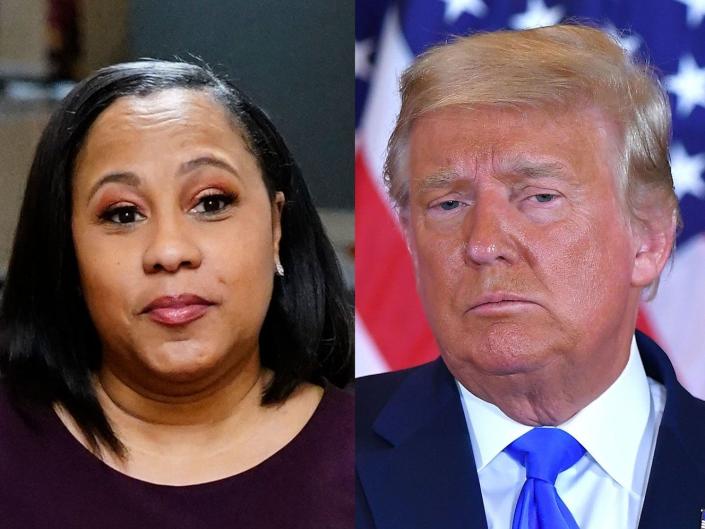
Fulton County District Attorney Fani Willis, former President Donald Trump, and Manhattan District Attorney Cyrus Vance Jr.
Fulton County District Attorney Fani Willis and former President Donald Trump.AP Photo/John Bazemore; MANDEL NGAN/AFP via Getty Images; REUTERS/Jeenah Moon
  • Witnesses “may have lied under oath” to a Georgia special grand jury investigating Trump’s efforts to overturn election results.
  • A judge said he’ll release a portion of a secret report detailing the special grand jury’s findings.
  • Three portions of the report will be unsealed on Thursday, the judge said.

A Georgia special grand jury that investigated Donald Trump’s efforts to overturn his 2020 election loss believes witnesses “may have lied under oath” while testifying, according to a judge who ordered the release of parts of its report.

On Monday, Fulton County Superior Court Judge Robert McBurney ordered the release of portions of a special grand jury report, including a section “in which the special purpose grand jury discuss its concern that some witnesses may have lied under oath.”

McBurney said three portions of the report would be made public on Thursday, February 16, giving the Fulton County district attorney’s office time to discuss redactions. Willis said she does not plan to appeal the judge’s order.

The special grand jury was empaneled throughout much of the second half of last year and heard evidence regarding Trump’s efforts to pressure Georgia officials to “find” votes that would reverse his loss to now-President Joe Biden in the state. Hearing evidence brought by the office of Fulton County District Attorney Fani Willis, the special grand jury also investigated an effort to send fake electors to Washington, DC, on January 6, 2021, and falsely declare Trump the victor in the state’s presidential contest.

In January, the special grand jury completed a report summarizing its findings. According to McBurney’s order published Monday, it includes “a roster of who should (or should not) be indicted, and for what, in relation to the conduct (and aftermath) of the 2020 general election in Georgia.”

That report is now in the possession of Willis, who has the job of deciding whether to refer it to a regular grand jury, which can bring criminal charges in the investigation.

A group of journalism organizations sought to have the special grand jury report made public, arguing its contents were in the public interest and that it was technically a court document in the public record. But Willis argued in an extraordinary hearing in an Atlanta courtroom in late January that its contents should be kept under wraps.

In a decision published Monday morning, McBurney sided mostly with Willis, finding that releasing the entire report’s contents before Willis completes her investigation would impede on the due-process rights of various witnesses.

McBurney did, however, order the release of three parts of the special grand jury report he said were “ripe for publication,” even if Willis wanted them to be kept under lock and key.

“While publication may not be convenient for the pacing of the District Attorney’s investigation, the compelling public interest in these proceedings and the unquestionable value and importance of transparency require their release,” McBurney wrote.

Those three portions, McBurney wrote, include the report’s introduction, conclusion, and a section where the special grand jury discusses whether witnesses lied under oath.

For her investigation, Willis fought high-profile court battles to subpoena figures to testify, including Mark Meadows, Trump’s chief-of-staff at the time; Gov. Brian Kemp; Secretary of State Brad Raffensperger; the state’s Republican Party chairman, David Shafer; Sen. Lindsey Graham of South Carolina; and more than a dozen others who spoke with Trump at the time. The case had 75 witnesses overall.

In his decision Monday, McBurney said the argument for releasing the entire report to the public may be on stronger ground after the district attorney’s office brings indictments, at which point the report may be considered an ordinary court record like a wiretap application.

“When the criminal investigation is complete and an indictment has been obtained, the wiretap application and the search warrant affidavit do become part of the court record through discovery and pre-trial litigation,” McBurney wrote in a footnote. “At that point the public’s right of access accrues. The special purpose grand jury’s final report is no different.

DeSantis’ attempt to roll back diversity, equity, and inclusion is doomed to fail

Tallahassee Democrat – Opinion

DeSantis’ attempt to roll back diversity, equity, and inclusion is doomed to fail | Opinion

Ben Wright – February 12, 2023

I’ve had a front row seat for Gov. Ron DeSantis’ attempts to overhaul Florida’s university system. My eldest son is currently a junior at New College of Florida which is ground-zero in this struggle.  He didn’t choose New College because of some liberal ideology; he was excited about small class sizes, accessible professors, and its designation as an honors college. New College has been a great experience. Now, the rug is being pulled out from under him.  His tiny school is the first test in a state-wide experiment that is coming to a campus near you.

It’s almost guaranteed DeSantis is running for president.  By claiming that Florida’s universities and colleges are filled with radically liberal professors that are indoctrinating our students, the governor has discovered a way to energize his Republican base and present himself as a champion for conservatives.  Are independent voters in Arizona and Pennsylvania going to lose sleep over the reshuffling of Florida’s colleges? Probably not.  He has found an issue where he can win the hearts of Republicans without alienating the independent voters that he needs to win the presidency.

The governor is targeting many aspects of higher education, but his main line of attack is focused on eliminating “diversity, equity, and inclusion” (DEI) programs from state colleges and universities.  Ironically, under DeSantis, the Board of Governors insisted that universities adopt these DEI programs just a few years ago.

DeSantis’ government overreach may be an important building block in his run for the presidency, but it will do long-lasting harm to Florida’s institutions of higher learning.  Florida’s universities spend time, money, and resources to attract talented students and faculty … and they have been successful.  There are many jokes about our weird and wonderful Florida, but our higher education system has garnered well-deserved respect in recent years.

Universities in other states are now poised to start poaching these talented folks with promises of true academic freedom. Florida will lose talented professors and students through attrition and find it more difficult to attract quality replacements.  The governor’s decision to use these schools as pawns in his political games will cause long-term damage to the institutions and the degrees they issue.

In the real world, corporate America has overwhelmingly adopted diversity, equity, and inclusion. All the Fortune 100 companies have made a public commitment to DEI.  Why? Because the young, talented workers they want to attract are demanding it. Employees now expect their employer to promote the values they hold.  Why did Disney come out against DeSantis’ “Don’t Say Gay” law? Because Disney employees around the country wouldn’t stand for anything less.  The unemployment rate is unprecedentedly low … it’s hard to attract top talent. Millennials and Gen-Z are driving the workforce now and they expect DEI to be a priority.

The changes at New College of Florida are just the opening gambit in a much larger plan. DeSantis’ attempt to roll back diversity, equity, and inclusion is doomed to fail.  It’s akin to closing the barn door after the horse has already bolted.  In the meantime, his political ploy will do lasting harm to our state universities and colleges … and undermine the competitiveness of our college graduates.

Tallahassee resident Ben Wright is a third generation Floridian and former captain in the U.S. Air Force. He graduated from Indian River State College, the University of Florida, and Regis University in Colorado with an M.B.A. He works for a Fortune 500 company and his oldest son attends New College of Florida.

A Close Look at the Chaotic House Republican Majority

THe New York Times

A Close Look at the Chaotic House Republican Majority

Karen Yourish, Danielle Ivory and Charlie Smart – February 12, 2023

Speaker of the House Kevin McCarthy of Calif., ends the joint session of Congress after President Joe Biden delivered the State of the Union address at the U.S. Capitol, Tuesday, Feb. 7, 2023, in Washington. (AP Photo/Susan Walsh) (ASSOCIATED PRESS)

The tumult that broke out last month during the election of Kevin McCarthy for speaker illustrated the potential for profound dysfunction in the new House Republican majority. And the spectacle created by Republican lawmakers at the State of the Union address showed the unruly behavior of some in the GOP rank and file that is becoming a new normal.

Many lawmakers who were leading a chorus of boos and heckling were familiar faces from the far right, including some who are poised to wield real power in the 118th Congress. The defining dynamic for House Republicans, who have a four-vote majority, may be the push and pull between the far right and the rest of the Republican conference.

Here is a closer look at the fractious House Republican caucus:

Of the 222 House Republicans, more than 50 lawmakers explicitly denied the 2020 election results, were supported by the House Freedom Fund during the midterms or both. The fund is the campaign arm of the House Freedom Caucus, a hard-line faction founded in 2015 that has often (but not always) aligned with former President Donald Trump, has tried to repeal the Affordable Care Act and has opposed legislation to protect same-sex marriage rights.

Among them are the 20 Republicans who repeatedly voted against McCarthy for speaker, viewing him as insufficiently conservative and too cozy with the Washington establishment.

More than 50 representatives have co-sponsored articles of impeachment against Alejandro N. Mayorkas, the homeland security secretary, so far this session. Hard-line Republicans intent on attacking the Biden administration see Mayorkas as the face of failures at the border.

Some far-right lawmakers and those who have embraced conspiracy theories have landed seats on the House Oversight and Accountability Committee, the main investigative organ in the House. They will be in a position to shape inquiries into the Biden administration and on other issues.

Across the ideological spectrum are 119 of the 139 representatives who objected to certifying the 2020 Electoral College results, including all but one member of the House GOP leadership team.

Mainly tilting toward the other end of the spectrum are the 18 Republicans who represent districts that Joe Biden won in 2020. Many of these lawmakers, who include 11 newcomers, have indicated a greater willingness to work on bipartisan legislation than their peers.

And there are also 20 lawmakers who in 2021 bucked Trump and the rest of the party by voting to impeach him or to form an independent commission to investigate the Jan. 6 attack at the U.S. Capitol.

Departures and Newcomers

The caucus has shifted toward the right in other ways too, because of the departure of conservatives who bucked the party. Nearly three-quarters of Republican House members who did not run for reelection or who lost their primaries in 2022 voted to impeach Trump or to form the Jan. 6 commission. Almost all of that group also voted to certify the 2020 Electoral College results, in defiance of Trump and a vast majority of House Republicans.

Because of redistricting, it is not possible to do a one-to-one match for every seat, but some newcomers who align more closely with the far right were elected to seats previously held by Democrats or Republicans who voted to impeach Trump or to create the Jan. 6 commission.

One of five newcomers who opposed McCarthy’s speaker bid, Rep. Anna Paulina Luna of Florida, took over a seat previously held by a Democrat, Charlie Crist, who ran against (and lost to) Ron DeSantis for Florida governor. Luna has explicitly said the 2020 election was stolen and has joined the House Freedom Caucus.

Rep. Harriet Hageman of Wyoming, who has also denied the 2020 election results, defeated Rep. Liz Cheney in the primary. Hageman was appointed by McCarthy to the House Select Subcommittee on the Weaponization of the Federal Government, which will focus on finding evidence that the government has silenced and punished conservatives.

Rep. Andy Ogles of Tennessee, the member who screamed, “It’s your fault!” when Biden called for an end to the fentanyl crisis during the State of the Union address, replaced Rep. Jim Cooper, a Democrat who retired after redistricting diluted Democrats’ power in the Nashville-area district. Ogles also opposed McCarthy’s speaker bid and has explicitly said the 2020 election was stolen.

In all, more than one-third of the 41 Republican newcomers explicitly denied the results of the 2020 election, were supported by the House Freedom Fund or both.

About a half dozen political experts who spoke with The New York Times said that many members of the Republican caucus have learned there is value in being antagonistic and refusing to compromise — a harbinger of more chaos to come.

“Confrontation attracts attention, and, you know, the attention economy has always been important for politicians,” said Richard H. Pildes, a professor at New York University’s School of Law. “But traditionally you had to go through a series of gatekeepers or mediating institutions to get that kind of attention. The average member of the House wasn’t able to generate that kind of attention for themselves in a way that they, of course, now can very easily.”

Beyond attention, being confrontational appears to have financial incentives as well.

The internet has enabled a flood of money from small donors, which, Pildes said, has allowed politicians to bring in large sums without having to rely on large donors or party funds. Indeed, a Times investigation last year found that objecting to the results of the 2020 Electoral College was politically profitable.

“We’ve come to recognize the role of more extremism and more outrage, provoking more attention, provoking more media coverage, provoking more small-donor contributions,” Pildes said. “And I think that’s part of the story here.”

Living with natural gas pipelines: Appalachian landowners describe fear, anxiety and loss

 The Conversation

Living with natural gas pipelines: Appalachian landowners describe fear, anxiety and loss

Erin Brock Carlson, Assistant Professor of Professional Writing and Editing, West Virginia University and Martina Angela Caretta, Senior Lecturer in Human Geography, Lund University – February 11, 2023

Pipeline construction cuts through forests and farms in Appalachia. Provided by Erin Brock Carlson, <a href=
Pipeline construction cuts through forests and farms in Appalachia. Provided by Erin Brock Carlson, CC BY-SA

More than 2 million miles of natural gas pipelines run throughout the United States. In Appalachia, they spread like spaghetti across the region.

Many of these lines were built in just the past five years to carry natural gas from the Marcellus Shale region of Ohio, Pennsylvania and West Virginia, where hydraulic fracturing has boomed. West Virginia alone has seen a fourfold increase in natural gas production in the past decade.

Such fast growth has also brought hundreds of safety and environmental violations, particularly under the Trump administration’s reduced oversight and streamlined approvals for pipeline projects. While energy companies promise economic benefits for depressed regions, pipeline projects are upending the lives of people in their paths.- ADVERTISEMENT -https://s.yimg.com/rq/darla/4-10-1/html/r-sf-flx.html

As a technical and professional communication scholar focused on how rural communities deal with complex problems and a geography scholar specializing in human-environment interactions, we teamed up to study the effects of pipeline development in rural Appalachia. In 2020, we surveyed and talked with dozens of people living close to pipelines in West Virginia, Ohio and Pennsylvania.

What we found illuminates the stress and uncertainty that communities experience when natural gas pipelines change their landscape. Residents live with the fear of disasters, the noise of construction and the anxiety of having no control over their own land.

‘None of this is fair’

Appalachians are no strangers to environmental risk. The region has a long and complicated history with extractive industries, including coal and hydraulic fracturing. However, it’s rare to hear firsthand accounts of the long-term effects of industrial infrastructure development in rural communities, especially when it comes to pipelines, since they are the result of more recent energy-sector growth.

For all of the people we talked to, the process of pipeline development was drawn out and often confusing.

Some reported never hearing about a planned pipeline until a “land man” – a gas company representative – knocked on their door offering to buy a slice of their property; others said that they found out through newspaper articles or posts on social media. Every person we spoke with agreed that the burden ultimately fell on them to find out what was happening in their communities.

A map shows U.S. pipelines carrying natural gas and hazardous liquids in 2018. More construction has been underway since then. <a href=
A map shows U.S. pipelines carrying natural gas and hazardous liquids in 2018. More construction has been underway since then. GAO and U.S. Department of Transportation

One woman in West Virginia said that after finding out about plans for a pipeline feeding a petrochemical complex several miles from her home, she started doing her own research. “I thought to myself, how did this happen? We didn’t know anything about it,” she said. “It’s not fair. None of this is fair. … We are stuck with a polluting company.”

‘Lawyers ate us up’

If residents do not want pipelines on their land, they can pursue legal action against the energy company rather than taking a settlement. However, this can result in the use of eminent domain.

Eminent domain is a right given by the Federal Energy Regulatory Commission to companies to access privately held property if the project is considered important for public need. Compensation is decided by the courts, based on assessed land value, not taking into consideration the intangibles tied to the loss of the land surrounding one’s home, such as loss of future income.

Through this process, residents can be forced to accept a sum that doesn’t take into consideration all effects of pipeline construction on their land, such as the damage heavy equipment will do to surrounding land and access roads.

One man we spoke with has lived on his family’s land for decades. In 2018, a company representative approached him for permission to install a new pipeline parallel to one that had been in place since 1962, far away from his house. However, crews ran into problems with the steep terrain and wanted to install it much closer to his home. Unhappy with the new placement, and seeing erosion from pipeline construction on the ridge behind his house causing washouts, he hired a lawyer. After several months of back and forth with the company, he said, “They gave me a choice: Either sign the contract or do the eminent domain. And my lawyer advised me that I didn’t want to do eminent domain.”

Pipeline construction cuts through a farmer’s field. Provided by Erin Brock Carlson, <a href=
Pipeline construction cuts through a farmer’s field. Provided by Erin Brock Carlson, CC BY-SA

There was a unanimous sense among the 31 people we interviewed that companies have seemingly endless financial and legal resources, making court battles virtually unwinnable. Nondisclosure agreements can effectively silence landowners. Furthermore, lawyers licensed to work in West Virginia who aren’t already working for gas companies can be difficult to find, and legal fees can become too much for residents to pay.

One woman, the primary caretaker of land her family has farmed for 80 years, found herself facing significant legal fees after a dispute with a gas company. “We were the first and last ones to fight them, and then people saw what was going to happen to them, and they just didn’t have – it cost us money to get lawyers. Lawyers ate us up,” she said.

The pipeline now runs through what were once hayfields. “We haven’t had any income off that hay since they took it out in 2016,” she said. “It’s nothing but a weed patch.”

‘I mean, who do you call?’

Twenty-six of the 45 survey respondents reported that they felt that their property value had decreased as a result of pipeline construction, citing the risks of water contamination, explosion and unusable land.

Many of the 31 people we interviewed were worried about the same sort of long-term concerns, as well as gas leaks and air pollution. Hydraulic fracturing and other natural gas processes can affect drinking water resources, especially if there are spills or improper storage procedures. Additionally, methane, a potent greenhouse gas, and volatile organic compounds, which can pose health risks, are byproducts of the natural gas supply chain.

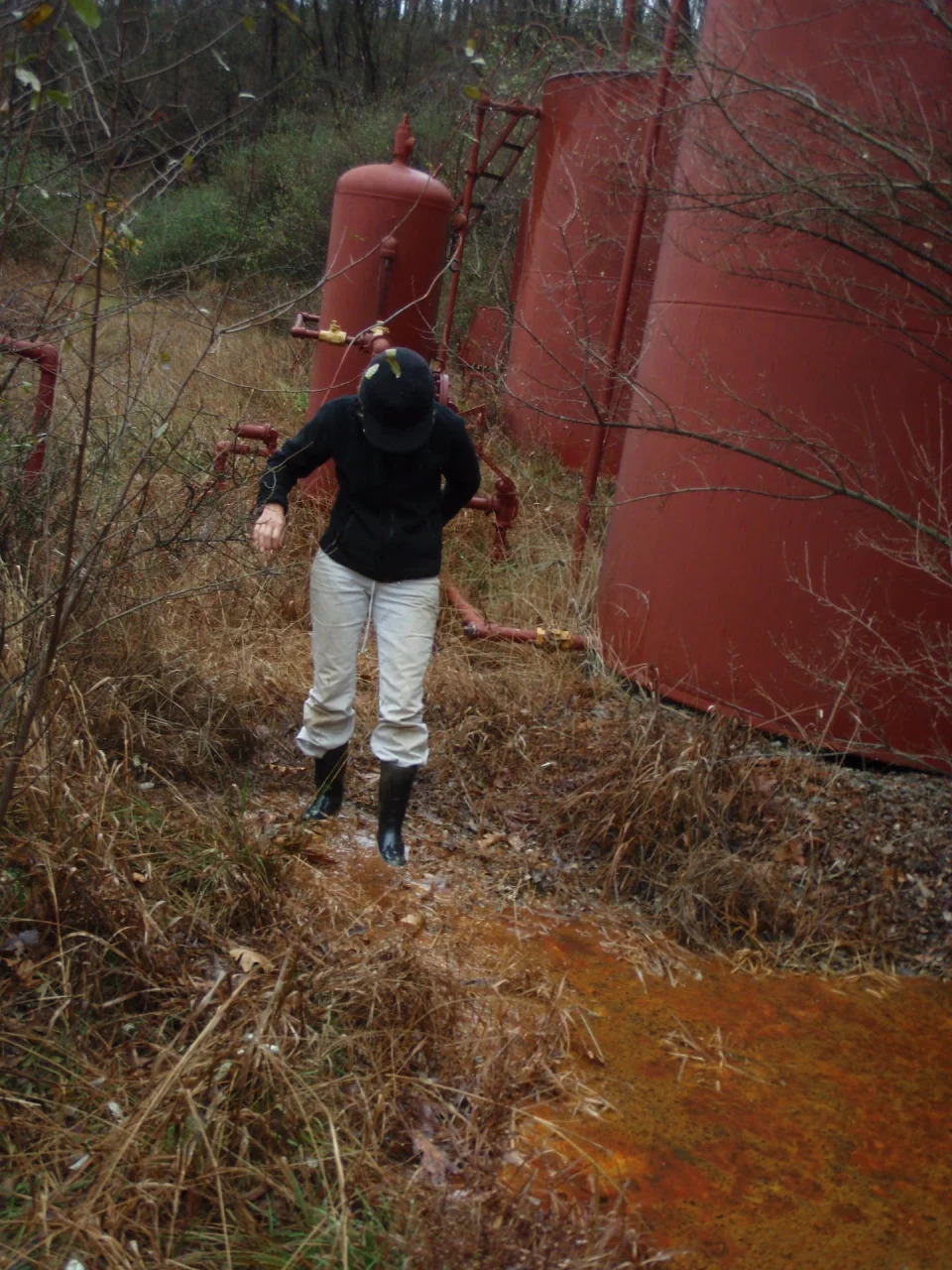
Oil spills are a major concern among land owners. Provided by Erin Brock Carlson, <a href=
Oil spills are a major concern among land owners. Provided by Erin Brock Carlson, CC BY-SA

“Forty years removed from this, are they going to be able to keep track and keep up with infrastructure? I mean, I can smell gas as I sit here now,” one man told us. His family had watched the natural gas industry move into their part of West Virginia in the mid-2010s. In addition to a 36-inch pipe on his property, there are several smaller wells and lines. “This year the company servicing the smaller lines has had nine leaks … that’s what really concerns me,” he said.

The top concern mentioned by survey respondents was explosions.

According to data from 2010 to 2018, a pipeline explosion occurred, on average, every 11 days in the U.S. While major pipeline explosions are relatively rare, when they do occur, they can be devastating. In 2012, a 20-inch transmission line exploded in Sissonville, West Virginia, damaging five homes and leaving four lanes of Interstate 77 looking “like a tar pit.”

A gas line explosion near Sissonville, West Virginia, sent flames across Interstate 77. <a href=
A gas line explosion near Sissonville, West Virginia, sent flames across Interstate 77. AP Photo/Joe Long

Amplifying these fears is the lack of consistent communication from corporations to residents living along pipelines. Approximately half the people we interviewed reported that they did not have a company contact to call directly in case of a pipeline emergency, such as a spill, leak or explosion. “I mean, who do you call?” one woman asked.

‘We just keep doing the same thing’

Several people interviewed described a fatalistic attitude toward energy development in their communities.

Energy analysts expect gas production to increase this year after a slowdown in 2020. Pipeline companies expect to keep building. And while the Biden administration is likely to restore some regulations, the president has said he would not ban fracking.

“It’s just kind of sad because they think, once again, this will be West Virginia’s salvation,” one landowner said. “Harvesting the timber was, then digging the coal was our salvation. … And then here’s the third one. We just keep doing the same thing.”

[Deep knowledge, daily. Sign up for The Conversation’s newsletter.]

This article is republished from The Conversation, a nonprofit news site dedicated to sharing ideas from academic experts. The Conversation is trustworthy news from experts. Try our free newsletters.

It was written by: Erin Brock CarlsonWest Virginia University and Martina Angela CarettaLund University.

Read more:

Dr. Carlson has received funding this project from the West Virginia University Humanities Center.

Dr Caretta has received funding for this project from the Heinz Foundation and the West Virginia University Humanities Center.

Why the Beltway Loves the Second Gentleman

Politico

Why the Beltway Loves the Second Gentleman

Michael Schaffer – February 10, 2023

Andrew Harnik/AP Photo

It was the last Friday of January. In Washington, Vice President Kamala Harris was set to host a White House summit about lead-pipe replacement. It’s a key component of the administration’s infrastructure push and would become part of the president’s looming State of the Union Address. And it was also almost guaranteed to get scant buzz in Washington’s attention industry.

Meanwhile, Harris’ husband, Doug Emhoff, was on a trip to Poland to mark Holocaust Remembrance Day at Auschwitz. He was joined there by Joe Scarborough, the favorite morning host of many of the insiders whose worries about the Vice President’s electoral prospects regularly make news. Scarborough and Emhoff’s much-promoted conversation occupied the better part of an hour on Morning Joe. That’s the sort of exposure a lot of elected officials can only dream about — the political-media equivalent of an invite to the popular kids’ table.

Not long ago, it might have confounded Washington to hear that a middle-aged corporate-lawyer white-guy dad figure would be a breakout media star of the Biden administration even as the Beltway smart set tsk-tsks the barrier-breaking veep’s political chops, the subject of grim stories in the past two weeks in both the New York Times and the Washington Post.

Plainly, Emhoff shines in some ways Harris doesn’t — which reflects his own innate political touch, the kind of instinctive connection that even some Harris supporters worry she doesn’t show.

“He is just a very approachable, normal guy who, within the span of a decade, went from going on a blind date with the California attorney general, to, literally less than 10 years later, flying out on an Air Force jet representing our country at Auschwitz,” says Brian Brokaw, a longtime California Democratic strategist who knows both of them well. “He’s a trailblazer in his own way, one that I don’t think he necessarily sought out to be. But he also seems to be doing a pretty good job at it.”

“People are just charmed,” says Jamal Simmons, Harris’ former communications director. “He’s genuinely a nice guy.”

But Emhoff’s media success might just say even more about the kinds of traits that earn favor in the capital, which makes it a more complicated and fascinating dynamic to watch.

While many of his other forays into the spotlight involve making public appearances around largely ideology-free political-spouse causes like suicide prevention and school reopenings, he’s also snagged attention on trickier issues: When Texas Gov Greg Abbott sent two buses of migrants to be dropped off in front of the home Emhoff and Harris occupy, the Second Gentleman spoke out, calling it “shameful” in an unscripted media interaction that came as news to the Vice President’s communications team, according to Simmons, who was on staff at the time.

The administration has apparently come to see him as a useful tool on the inside-Washington game, too: On Tuesday, ahead of the State of the Union Address, he was the guest star of a call convened by senior advisor Anita Dunn with Democratic allies designed to spark excitement and convey talking points.

There’s only so much you can attribute to the notion that Emhoff is sprinkled with political pixie dust while his wife may not be. To a large extent, the quality of the respective rides he and Harris have gotten from the chattering class is a function of the wildly different jobs they have.

As the principal and the occupant of the position one predecessor said wasn’t “worth a bucket of warm spit,” Harris was always going to have a much trickier task when it comes to generating positive coverage. It doesn’t help that in the Biden administration she’s been handed thankless portfolios like the border — and, for two years, has been obliged to stay close to home lest she have to cast a tie-breaking vote in the 50-50 Senate. Bottom line: It’s a hard job to ace.

Emhoff, by contrast, holds a position where the historic binary hasn’t been whether a person is loved or hated by the general public, but whether the person is noticed at all. A Second Gentleman, like a First Lady, gets to avoid polarizing issues and focus on warm-hearted public events. Unlike a president’s spouse, the veep’s significant other also doesn’t get blamed for White House social booboos, East Wing staff turmoil, unpopular holiday decor, and other pomp-and-circumstances controversies. Bottom line: It’s a hard job to flub.

“He doesn’t have any formal policy responsibility,” Simmons, who left Harris’ team last year, told me this week. “So if you’re attacking the second gentleman, it’s purely a personality or political play. It can’t possibly be based on anything policy related.” No one is dissecting rambling Doug Emhoff speeches on TV because he doesn’t have to make them.

Yet it’s also clear that Emhoff’s presence in the Washington conversation exceeds that of Karen Pence, Jill Biden, or even Lynne Cheney, who was a genuine public figure well before her husband became Vice President — and also could come across as a better public kibbitzer than her guarded spouse. The prior vice-presidential spouses are a much better comparison. But they’re a comparison that also shows some of Emhoff’s strengths as a public figure as well as some bigger things about the Beltway’s built-in assumptions.

Consider the aspect of Emhoff’s persona that people inside Harris’ camp cite most often: his loyalty. “He’s ride or die,” one former Harris staffer told me. “His number one goal has always been, from the jump, to be extremely supportive of his wife.” Of course, being supportive has always been the core of a political spouse’s persona — it’s just that women spouses didn’t typically get credit for it. To his credit, Emhoff has noted this too. But as welcome a model as it is, it’s hard not to think he benefits in Washington’s estimation from playing against millennia of history involving men who do something other than put their wife first.

Likewise, think about a factor dear to the heart of narrative-definers: Being a trailblazer. Like Harris, Emhoff is a first, the inaugural Second Gentleman of the United States. But where her novelty has drawn detractors even as it galvanized admirers — it’s at the core of mean-spirited, sometimes explicitly racist and sexist suggestions that she’s not up to the job because her pick delighted a politically important constituency — his is all upside. Attend charity teas and you look good for deigning to take on historically feminine roles that men of his generation never expected to play; do something less traditional and you look thoughtful for innovating to build a new role.

Then there’s some only-in-2023 stuff that comes into play. Even by the standards of Beltway celebrity, the Biden administration is one of the least star-studded in recent memory; against that backdrop, any administration-adjacent person who gets regularly spotted around town (let alone one whose daughter is a model) is going to seem downright exciting.

And while it’s not something Emhoff or anyone else this side of Ye’s entourage would want, the news environment has also meant that the Second Gentleman’s supposedly non-controversial personal cause — fighting antisemitism — has suddenly become a live issue.

For all the editorial-page paeans to moral seriousness, though, Washington is a place whose likeability economy rewards people who are able to play the loveable golden retriever type — something that, even beyond the embedded gender coding, is much easier for someone in Emhoff’s apolitical position than Harris’ excruciatingly political one. It’s even easier still if you’re genuinely new to the game: Emhoff only married into politics on the cusp of Harris’ Senatorial win. By this point in the electoral ascent, a lot of political spouses have decades of scar tissue, or at least decades of familiar affect that makes them seem less genuine.

Several people around the Vice President told me this week that loyalists have been seething about the recurring Harris-is-doomed pieces, with old allies swapping texts about the pack-mentality behavior that they think drives the coverage. Particularly against that backdrop, they’re leery of any implicit comparison with the kind of coverage Emhoff gets, given the couple’s vastly different jobs, and the respective jobs’ even more different degrees of difficulty.

There are occasional moments, though, when a comparison of how they are deployed feels apt. Just as Emhoff’s issue was elevated by a year of appalling incidents, Harris has also taken on a role as the administration’s spokeswoman on abortion rights. Like Emhoff’s cause, it’s the sort of issue that has hit the news over and over in the past year. But her own role sometimes gets obscured, eating into opportunities to drive news.

Last summer, when national attention was focused on the horrific story of a 10-year-old abuse victim from Ohio who had to travel to Indiana for an abortion, and GOP politicians threatened to investigate the gynecologist who treated her, Harris reached out to the embattled doctor. It was a smart move for a Democratic pol, standing up against an outrage. And it only reached the media nearly a month after the incident, when the doctor talked about it to CBS news. Simmons says that’s because the office was attentive to privacy and legal concerns and the like, befitting the vice president’s careful, prosecutor background. Still, someone whose job description and personal style enabled a looser disposition might have gotten an earlier publicity pop from it.

Which brings us back to this: Watch Emhoff’s media appearances and it becomes clear that he’s pretty good at this stuff. I don’t mean policy or leadership, which he doesn’t try to do. I mean the work of making audiences like you, which involves some combination of seeming loose and genuine and personable.

Is that easier to do when you’re not being vetted as a possible president and subject to the crosswinds of modern U.S. politics? Yep. Does a man in our society get more permission to play the loveable golden retriever sort that Washington tends to value? No doubt. But he’s still pretty good at it.

“I wouldn’t say he has skills that she doesn’t have,” says Simmons. “I would say he has opportunities she doesn’t, because he doesn’t fly with the same footprint. He doesn’t come with the flashing lights, dozens of Secret Service agents and vans and cars full of aides. He can show up in his SUV with a couple of agents and maybe an aide or two and go grocery shopping or walk into a mall or go to a restaurant. … It’s an ability he has that the other three principals don’t really have.”

The Republican Distraction Farm Is Failing Because They’re Employing Less Talented Grievance-Farmers

Esquire

The Republican Distraction Farm Is Failing Because They’re Employing Less Talented Grievance-Farmers

Jack Holmes – February 10, 2023

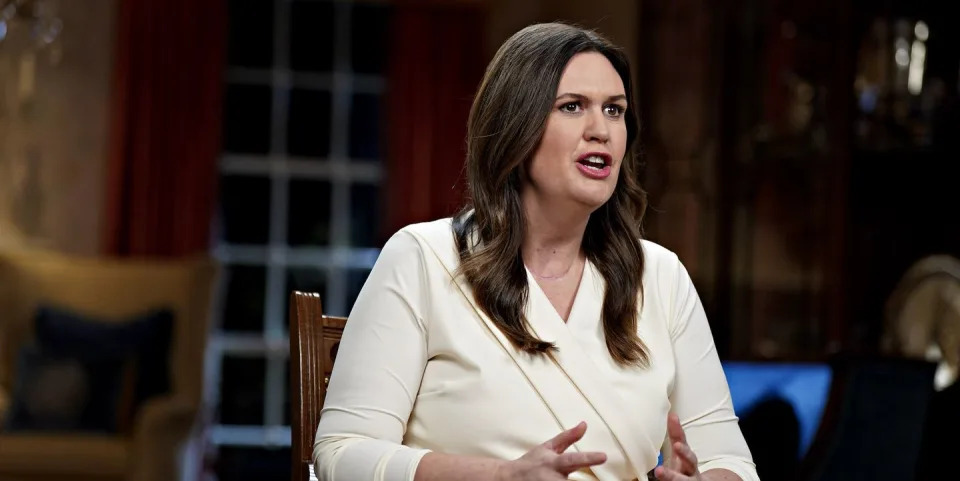
little rock, arkansas february 07 arkansas gov sarah huckabee sanders delivers the republican response to the state of the union address by president joe biden on february 7, 2023 in little rock, arkansas biden tonight vowed to not allow the us to default on its debt by calling on congress to raise the debt ceiling and chastising republicans seeking to leverage the standoff to force spending cuts photo by al drago poolgetty images
Republican Grievance-Farmers Lose Green ThumbsPool – Getty Images


“Hearst Magazines and Yahoo may earn commission or revenue on some items through these links.”

Sarah Huckabee Sanders, now the governor of Arkansas, gave a rebuttal to President Joe Biden’s State of the Union address this week that suggested Republicans have learned precious few lessons from their dramatic underperformance in the midterms. Biden’s speech was a full-throated appeal to everyday Americans on populist economic grounds—one that actually echoed some of Donald Trump’s rhetoric in the 2016 campaign. Sanders brought the now-standard routine about The Woke Mob “that can’t even tell you what a woman is,” and that is ushering in a world where “children are taught to hate one another on account of their race.” She referred to “C.R.T.” as if everyone listening would know that stands for Critical Race Theory (and that it is inherently evil). Sanders did outline a plan to raise starting salaries for Arkansas teachers, which is welcome in an era in which the American right increasingly seeks to paint educators as rogue agents of Woke determined to brainwash your kids.

The latter is the kind of stuff that cost them seats in the midterms. It hits squarely with people who are up-to-date on their Fox News folklore, fluent in the language of culture-war apocalypto. But for most people, it’s probably pretty weird. They mostly like their kids’ teachers, who are usually trying to do the best job they can in sometimes challenging circumstances. For years, the Democratic Party was the one considered out of touch, if only because of the alienating way that some liberals talked about the issues. But that’s now the Republican Party’s stock-in-trade. The right’s rising star—at least in the view of media-politico types—is the governor of Florida, Ronald DeSantis, who has replaced his pandemic anti-interventionist crusade (which at least dealt with a major issue of public concern) with campaigns against Woke Corporations and in favor of the government’s prerogative to police what teachers teach in schools. It’s gotten fewer national headlines that he, too, has sought to raise salaries, but that nugget is competing with news that teachers have been told to remove or cover up books out of fear they could face criminal charges for their content.

Maybe DeSantis is reluctant to talk about other parts of his record because, as the political press finally turns to it, we’re fully realizing how committed he once was to changing Social Security and Medicare. (We’ve also seen how touchy Republicans get when you talk about this since Biden brought it up at the State of the Union. Even a talk-radio host interviewing Ron Johnson was explicitly trying to brand this stuff as “reforms” not “cuts.”) The president pointed out that some Republicans—including chair of the National Republican Senatorial Committee and Lizard-American Rick Scott—have called for sunsetting all federal legislation after five years. This would by definition include Medicare and Social Security.

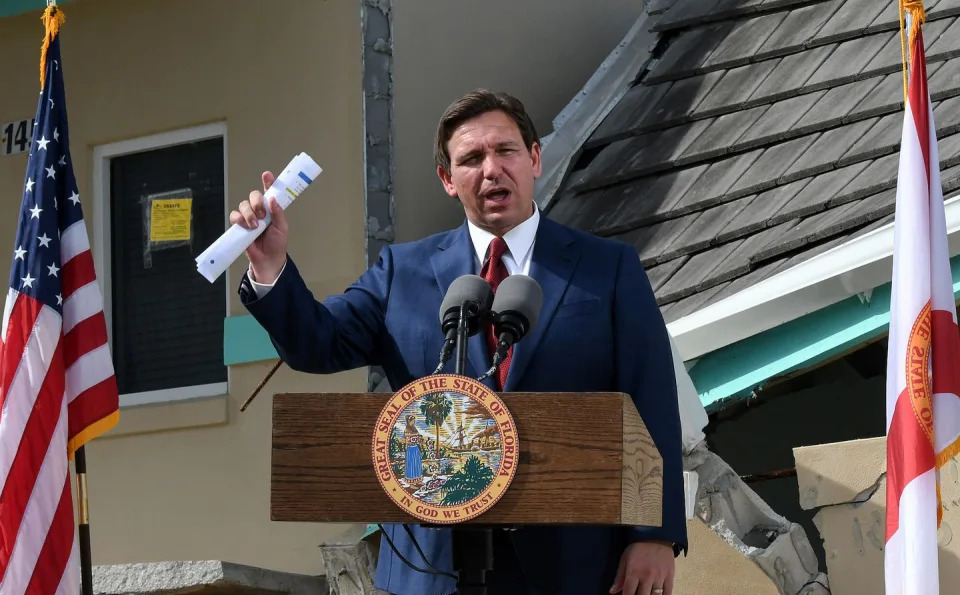
daytona beach shores, florida, united states 20230118 florida gov ron desantis speaks at a press conference to announce the award of $100 million for beach recovery following hurricanes ian and nicole in daytona beach shores in florida the funding will support beach projects within 16 coastal counties, with hard hit volusia county receiving the largest grant, over $37 million photo by paul hennessysopa imageslightrocket via getty images
Time will tell if Ronald DeSantis is the kind of right-winger who can still thread the needle.SOPA Images – Getty Images

Maybe they would be renewed as-is, but that’s quite a bet to make, particularly when you examine the record of the hospital chain Scott once ran. DeSantis, though, used to be even more forthright. He supported privatizing aspects of both programs in his 2012 congressional campaign, CNN found, and once in Congress he supported Paul Ryan’s agenda on “entitlements.” (They are earned benefits.) All this is based on the combined notions that these programs are fiscally unsustainable and raising taxes is a kind of supreme evil. None of this is new: George W. Bush tried to privatize Social Security. Ronald Reagan launched his political career with this stuff. Maybe DeSantis is an example of how how you can get away with this kind of policy record, considering he’s extremely popular in the old folks’ Mecca of Florida. Or maybe we in the press have just done a godawful job.

Republicans lose votes when people get a good look at their proposals on these issues, so maybe it’s no wonder they’re now permanently engaged in culture-war food fights. Except that also seems to have lost its luster outside The Base. Trump at least had a canny ear for the more transcendent gripes, particularly in 2016. His would-be successors are less talented grievance farmers, and some absolute loony toons have joined their ranks in Congress. It’s not a change so much as it’s become more obvious than it was that Republicans have no plans to address problems in normal people’s lives. They’re getting so high on their own supply that they can no longer even explain some of these bedrocks of their politics. The Louisville Courier-Journal‘s Joe Sonka asked Kentucky Senate President Robert Stivers for his definition of “woke” on Friday and he replied, “Woke? That is the definition to me that is a describing of a mentality or a culture that certain individuals have about how things are progressing through society.” Hey man, maybe carve out some time to think about this or just admit that it’s become a hollow vehicle for reactionary rage.

Asa Hutchinson says reelecting Trump ‘would not be healthy for our democracy’

Yahoo! News

Asa Hutchinson says reelecting Trump ‘would not be healthy for our democracy’ as he eyes 2024 bid

Tom LoBianco, Reporter – February 9, 2023

WASHINGTON — Former Arkansas Gov. Asa Hutchinson has been making more noise recently about a possible Republican run for the White House in 2024. The former federal prosecutor has been hitting the trail in Iowa, New Hampshire and South Carolina and is planning to host a border security summit in Arizona soon.

In an interview with Yahoo News Tuesday, he said he is “seriously” leaning toward running and said his time frame for deciding lands around one of the first big political events of the cycle, the Christian right Faith and Freedom Conference being held in Iowa on April 22.

Hutchinson has long cut a figure as a stalwart conservative in the party, leading the impeachment of former President Bill Clinton a quarter century ago, then running the Drug Enforcement Administration in the Bush administration, before serving two terms as governor.

But he has emerged as one of former President Donald Trump’s sharpest critics on the right, after breaking with him when Trump tried to overturn his 2020 election loss.

“My view of [Jan. 6, 2021] is that it was undermining our democracy, our institutions of government. It brought us disrespect globally and because what America always looked at was, my goodness, how we transferred power from one administration to the other,” said Hutchinson, who had chaired Trump’s 2020 reelection bid in Arkansas. “That was all undermined that day. And so it was unacceptable.”

Asa Hutchinson.
Former Arkansas Gov. Asa Hutchinson in an interview in December. (Pablo Martinez Monsivais/AP)

Trump is facing a raft of legal trouble stemming from his efforts to overturn the 2020 election and deny the peaceful transfer of power — from a state-level probe in Georgia to the federal investigation being led by special counsel Jack Smith. Hutchinson said that even if there is evidence of a crime, prosecutors have to weigh the much heavier question of whether to try a former president.

Asked if he had seen any evidence of criminality by Trump, Hutchinson replied, “Well, that’s a big arena.”

He cited the state probes in New York and Georgia and the federal probes of Trump’s involvement in the Jan. 6, 2021, insurrection and the removal of classified documents from the White House. “They’re complicated legal issues,” he said, “so we’ve got to let those play out.”

Hutchinson urged caution in determining whether to prosecute Trump and said the courts may not be the best venue for that.

“The public deals with these things through the elections. And in this case, I think the best answer is that the voters should speak out and say, Donald Trump’s not the best direction for America in the future. And voters can determine that very quickly,” he said.

Pressed on the fact that Trump continues to lead most early polling of the Republican field and could win reelection if he secures the party nomination a third time, Hutchinson stood by his position.

“It takes the voters to exercise that at some point along the way — whether that’s in Iowa or New Hampshire or South Carolina — someone needs to say we need to go a different direction. And thank goodness, there’s going to be alternatives to [Trump],” he said. “It would not be healthy for our democracy to have him reelected. That’s where I think we’re going as a country [and] as a party. It just takes a while and a little bit of pain to get there.”

Extremist groups

Decades before Trump-inspired white supremacist and extremist groups plotted their attack on the Capitol, Hutchinson fought similar extremists as the U.S. attorney for Arkansas. Serving as the youngest federal prosecutor appointed by President Ronald Reagan, whom he called the greatest Republican president of his lifetime, Hutchinson took on a white supremacist militia group in rural Arkansas, called the Covenant, the Sword and the Arm of the Lord.

In the early ’80s, the armed militia group was cooking up plans to bomb federal buildings and assassinate federal officials, even him.

During a three-day standoff in 1985, Hutchinson donned a bulletproof vest and helped negotiate an end to the showdown. “We had SWAT teams from five different states, about 200 law enforcement officers. Very violent, dangerous situation. We got it resolved without a shot being fired.”

Modern white supremacist groups like the Oath Keepers and Proud Boys bear many of the same hallmarks of domestic extremist threats from decades earlier — but now it’s much easier for them to recruit.

“There’s probably more at risk today, in that sense, than back in the ’80s. If you wanted to inspire violence by others, and you were a charismatic leader, you did that face to face, you actually brought these groups together, which is a greater risk of being caught,” Hutchinson said. “But today, you know, with social media, with the internet, with all of the means of communication, you see people being inspired off of the internet.”

“What we see is that … enforcing the law makes a difference. Enforcing the law stops some of this violent suppression and violent actions by extremist groups,” he said. “Sadly, every generation has to face this at some level.”

A conservative lane

Before Trump stormed the Republican Party and ensconced conservative populism as a facet of the modern right, Hutchinson likely would have been viewed as one of the most conservative contenders.

But in the landscape upturned by Trump, Hutchinson has sounded more like an old establishment Republican — even if his positions fit squarely with much of the party.

Asked how he would handle the continued influx of undocumented immigrants across the border with Mexico, Hutchinson said, “It starts with securing the border.” He called for more funding for the Border Patrol and for physical and technological “fences.” He said the U.S. needs to do a better job targeting the Mexican drug cartels that smuggle immigrants and drugs across the border.

“But specifically you need to be able to send them back to their home country,” he said. “You start with putting the resources that are needed to process the cases to put the structures in place to protect our border. Then, down the road, you can talk about more comprehensive immigration reform, but it starts with securing the border.”

With Republicans now in control of the House and the simmering fight over raising the nation’s debt ceiling to pay its outstanding bills, Social Security benefits have moved back to center stage in the national debate.

A handful of House Republicans have talked about reworking Social Security benefits as part of the debt ceiling fight. Former Vice President Mike Pence sparked an uproar last week after he told a Washington audience he wants to “reform” the program and look at implementing “private savings accounts” for future recipients — a Bush-era proposal that generated such a strong backlash that touching Social Security benefits was deemed the “third rail of American politics.”

And President Biden, in his State of the Union speech Tuesday night, appeared to lay a trap for House Republicans — drawing boos from the group when he said that some of them were looking at cutting the program, then goading them into applauding it.

“There’s challenges whenever you look at Social Security, the long-term funding of it. So let’s first just be committed to strengthening Social Security,” Hutchinson said. “I believe the right approach to addressing that is growing the economy, growing the private sector, unleashing their power. And that’s really the only way we’re gonna be able to reduce this burden of debt. You’ve got to be able to grow your way out of it.”

Abortion

In 2019, Hutchinson, as governor, signed a state “trigger” law that would launch a near-total ban on abortions in Arkansas if the Supreme Court ever overturned Roe v. Wade.

“I did expect that it would be overturned. I didn’t know they would be that quickly. I thought they might scale it back, and then look at it again down the road,” he said.

While some Republicans, notably Sen. Lindsey Graham of South Carolina, have been pushing for a nationwide abortion ban, Hutchinson said he sides more with the camp that believes it should be decided state by state.

“If you look at it nationally, I think there’s going to be two debates as you go into the 2024 season. And one is, should there be a national standard, and then, secondly, you know, what should it be? Or should we just stick with every state being able to make their own decision?” Hutchinson said. “I’ve worked very hard for 40 years to say the states can make their decisions on this.”

But Hutchinson said Republicans still need to tread carefully on the issue.

“We want to be able to win the hearts and minds of Americans and you want to be able to win in November. And so you’ve got to approach this with that level of compassion and understanding, and the needs of, for example, a mom that has a pregnancy that might not have been expected or wanted or at risk. And we’ve got to deal with those in a positive way.”