As the Colorado River shrinks, federal officials consider overhauling Glen Canyon Dam

Los Angeles Times

As the Colorado River shrinks, federal officials consider overhauling Glen Canyon Dam

Ian James – February 18, 2023
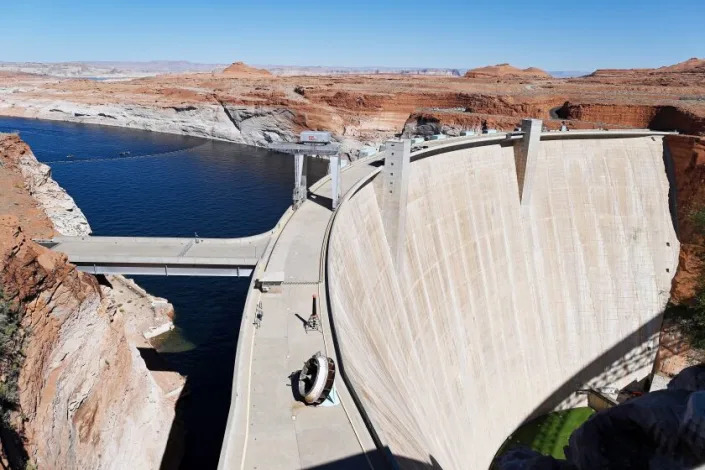
PAGE, AZ - OCTOBER 14: The Glen Canyon Dam sits above Lake Powell and the Colorado River on October 14, 2022 in Page, Arizona. The water in Lake Powell and the Colorado River has been receding due to recent droughts leaving parts of the lake and river parched. The federal government are moving forward with plans to reduce water allocations from the Colorado River Basin to Arizona and is asking millions of residents to reduce their water consumption as the drought get worse. (Photo by Joshua Lott/The Washington Post via Getty Images)
The Colorado River’s decline threatens hydropower at Glen Canyon Dam. Now, officials are looking at retooling the dam to deal with low water levels. (Joshua Lott / Washington Post)

The desiccation of the Colorado River has left Lake Powell, the country’s second-largest reservoir, at just 23% of capacity, its lowest level since it was filled in the 1960s.

With the reservoir now just 32 feet away from “minimum power pool” — the point at which Glen Canyon Dam would no longer generate power for six states — federal officials are studying the possibility of overhauling the dam so that it can continue to generate electricity and release water at critically low levels.

A preliminary analysis of potential modifications to the dam emerged during a virtual meeting held by the federal Bureau of Reclamation, which is also reviewing options for averting a collapse of the water supply along the river. These new discussions about retooling the dam reflect growing concerns among federal officials about how climate change is contributing to the Colorado River’s reduced flows, and how declining reservoirs could force major changes in dam management for years to come.

Among the immediate concerns is the threat of the reservoir dropping below the dam’s power-generating threshold. If that were to occur, water would only flow through four 8-foot-wide bypass tubes, called the outlet works, which would create a chokepoint with reduced water-releasing capacity.

“There is now an acknowledgment, unlike any other time ever before, that the dam is not going to be suited to 21st century hydrology,” said Kyle Roerink, executive director of the environmental group Great Basin Water Network, who listened to the meeting. “They’re not sugarcoating that things have to change there, and they have to change pretty quickly.”

Those who participated in the Feb. 7 meeting included dozens of water mangers, representatives of electric utilities, state officials and others. They discussed proposals such as penetrating through the dam’s concrete to make new lower-level intakes, installing a new or reconfigured power plant, and tunneling a shaft around either side of the dam to a power plant, among other options.

The Interior Department declined a request for an interview, but spokesperson Tyler Cherry said in email that the briefing was part of broader conversations with state officials, tribal leaders, water managers and others “to inform our work to improve and protect the short-term sustainability of the Colorado River System and the resilience of the American West to a changing climate.”

Roerink and two other people who listened to the webinar told The Times that cost estimates for several alternatives ranged from $500 million to $3 billion. The agency will need congressional approval and will have to conduct an environmental review to analyze options.

The Bureau of Reclamation’s presentation, given by regional power manager Nick Williams, included some additional alternatives that wouldn’t require major structural modifications of the dam. Those options included adjusting operations to maximize power generation at low reservoir levels, studying ways of using the existing intakes at lower water levels, and making up for the loss of hydroelectric power by investing in solar or wind energy.

Glen Canyon Dam stands 710 feet tall, anchored to the canyon’s reddish sandstone walls in northern Arizona, about 320 miles upstream from Lake Mead, the nation’s largest reservoir. The dam has been controversial since its inception, with environmental activists and others arguing the reservoir was unnecessary and destroyed the canyon’s pristine ecosystem.

Lake Powell and Lake Mead have declined over the last 23 years during the most severe drought in centuries. Federal officials have sought to boost Powell’s levels in recent months by reducing the amount of water they release downstream until the spring runoff arrives. They’ve said they may need to further cut water releases.

A central concern is that if the water drops below minimum power pool — 3,490 feet above sea level under the current operating rules — the main intakes would need to be shut down and water would instead flow through the dam’s lower bypass tubes. Because of those tubes’ reduced capacity, that could lead to less water passing downstream, shrinking the river’s flow in the Grand Canyon and accelerating the decline of Lake Mead toward “dead pool” — the point at which water would no longer pass through Hoover Dam to Arizona, California and Mexico.

Federal officials prepared the initial studies of alternatives for Glen Canyon Dam using $2 million that the Bureau of Reclamation secured as part of $200 million for drought response efforts.

According to a slide presentation shown at the meeting, officials see potential hazards in some of the six alternatives. Piercing the dam’s concrete to create new low-level or mid-level intakes, for example, would entail “increased risk from penetration through dam,” the presentation says.

They also describe risks due to possible “vortex formation,” or the creation of whirlpools above horizontal intakes as the water level declines. Their formation could cause damage if air is pulled into the system. The presentation says one alternative would involve lowering the minimum power pool limit and possibly installing structures on the intakes to suppress whirlpools, but it said this still would not allow for the water level to go much lower.

One of the possible fixes includes installing a new power plant that would generate electricity with water flowing from the bypass tubes, or taking a similar approach using existing infrastructure. Another would involve excavating a tunnel to the left or right side of the dam, and installing a power plant underground or in the riverbed.

Other options include changing operations at both Glen Canyon and Hoover dams “to maximize power generation under low flow conditions using existing infrastructure.”

“Any of the options are going to be very expensive and they’re going to be very time-consuming,” said Leslie James, executive director of the Colorado River Energy Distributors Assn., who participated in the meeting.

James praised the Bureau of Reclamation for “starting the processes to look at structural options like this.”

“I see what they’re doing here as getting an early start and at least evaluating everything that they can to look and see what may be feasible,” James said. She said she hopes Congress will provide the necessary funding to ensure continued electricity flowing from Glen Canyon Dam, given “how important hydropower is to entire communities.”

Her association represents nonprofit electric utilities that buy power produced by Glen Canyon Dam and other dams that are part of the Colorado River Storage Project. The association includes members in Arizona, Colorado, Nevada, Utah, New Mexico and Wyoming. The utilities supply power in cities, rural areas, irrigation districts and tribal communities.

Power from the dam has long been a vital energy source, though its output has decreased dramatically in recent years as Lake Powell has declined. During the 2022 fiscal year, Glen Canyon Dam generated 2,591 gigawatt-hours of electricity, enough to power more than 240,000 average homes for a year.

James said electric utilities across the region have had to make up for the reduced hydropower by turning to other costlier sources.

“It’s a real challenging time,” James said. “And it is the people in these communities that are ultimately being impacted with higher electricity bills.”

Lake Powell’s level is projected to rise this spring with runoff from the above-average snowpack in the Rocky Mountains. But that boost in water levels is expected to have a limited effect on the deep water deficit that has accumulated over more than two decades.

And in the long term, scientific research indicates warming and drying will continue to take a major toll on the river.

Scientists have found that roughly half the decline in the river’s flow since 2000 has been caused by higher temperatures, that climate change is driving the aridification of the Southwest, and that for each additional 1 degree Celsius (1.8 degrees Fahrenheit) of warming, the river’s average flow will probably decrease about 9%.

Environmental activists have for years urged the federal government to consider draining Lake Powell, decommissioning the dam and storing the water downstream in Lake Mead.

Activists who listened to the Bureau of Reclamation’s presentation said they welcome the agency’s examination of the issues at Glen Canyon Dam but would prefer to see a broader analysis that evaluates other options, including draining the reservoir.

In a report last year, Roerink’s Great Basin Water Network and two other groups warned that the “antiquated plumbing system inside Glen Canyon Dam represents a liability to Colorado River Basin water users who may quickly find themselves in legal jeopardy and water supply shortfalls.”

“The bureau is admitting that the dam is a liability,” Roerink said. “From my perspective, that’s a good first step.”

Beyond the current focus on trying to prop up hydropower generation, Roerink said, “I think we need an option that is just a bypass option without a power plant at the end of it.”

Roerink said he expects there will be a lot of debate about issues such as evaporation from the reservoir and the high costs of modifications to the dam.

“Is it all worth it? Are the taxpayer dollars going to be worth it for those electrons?” Roerink said. “How long will it be until this just proves itself to be a futile exercise?”

John Weisheit, an activist who has advocated for removing the dam, said he was delighted to hear federal officials openly discussing these options for the first time.

“I’m glad we’re having this conversation. It’s long overdue,” said Weisheit, who is co-founder of the group Living Rivers.

Weisheit said he also thinks the agency’s alternatives aren’t broad enough, and leave unanswered questions about the dam’s life span.

“I think it’s imperative that we know exactly what the life span of this dam is,” Weisheit said. “There is so much more that needs to be discussed.”

Weisheit said one major concern should be the accumulation of sediments in the bottom of the reservoir, which, according to a recent federal survey, has lost nearly 6.8% of its water-storing capacity.

Another issue with the agency’s current alternatives, he said, is that they wouldn’t solve problems of intakes or bypass tubes sucking in air at low water levels, “just like everybody’s bathtub does,” potentially causing cavitation that would pit and tear into metal, damaging the infrastructure.

Weisheit said he also was concerned about potential threats to endangered fish in the Grand Canyon.

Overall, the modifications to the dam that the federal government is considering would be “too much investment for very little return,” Weisheit said. “And it’s going to take a long, long time.”

Weisheit said he favors the option of investing in solar and wind energy. Instead of spending up to $3 billion trying to squeeze a shrinking amount of power from the dam, he said, “you can build a lot of solar cells and turbines,” including nearby on the Navajo Nation, which needs electricity.

Weisheit said he thinks the situation shows Glen Canyon Dam isn’t needed.

“Take the dam out,” he said, “because it’s not the right dam for climate change.”
Water crisis in West: Massive reservoir Lake Powell hits historic low water level

USA Today

Water crisis in West: Massive reservoir Lake Powell hits historic low water level

 Colorado River Basin water levels drop to historic low, states mandated to cut use More water is being taken from the river than it can provide. 

Elizabeth Weise, USA TODAY – February 18, 2023

Lake Powell, the nation’s second-largest reservoir and one that provides water and power to millions of people in southern California, has reached its lowest levels since its first filling in the 1960s.

Its companion reservoir, Lake Mead, is at levels almost as low.

Together, these reservoirs, fed by the mighty Colorado River, provide the water 40 million Americans depend on. Despite the storms that brought heavy rain and snow to California and other Western states in January, experts say it would take years of such weather to replenish the West’s water resources.

“In the year 2000, the two reservoirs were 95% full. They’re roughly 25% full now,” said Brad Udall, a water and climate scientist at Colorado State University. “It’s hard to overstate how important the Colorado River is to the entire American southwest.”

What to know about the West’s ongoing water crisis:

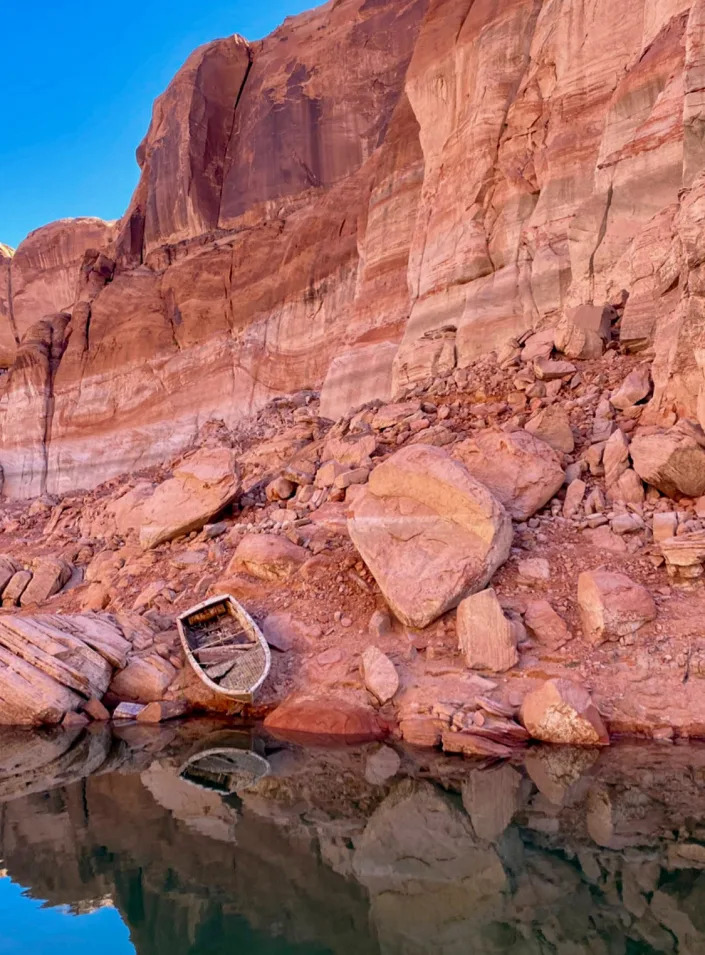
An abandoned and once-sunken boat sits along the shoreline of Lake Powell in this May 2022 file photo. The white ring above shows how high the water level was when the lake was full.
What is Lake Powell?

Lake Powell is the nation’s second-largest reservoir. It was created by blocking the Colorado River at Glen Canyon in southern Utah and northern Arizona.

It stores water as part of the Colorado River Compact and produces electricity through the hydroelectric turbines in Glen Canyon dam.

Work on the dam that created Lake Powell began in 1956 and was finished in 1966. It took 16 years for it to fill. At its highest, in 1983, the lake was 3,708 feet above sea level.

Today it stands at 3,522 feet.

What happens if the water level goes lower?

Lake Powell hasn’t been this low since June of 1965, just two years after it began to fill with water.

  • The biggest worry: If the lake’s level falls much lower, it won’t be possible to get water out of it.
  • Why? Tubes that run water through its out of the lake and into eight hydroelectric turbines could soon be above the water. There are bypass tubes available below that point, but they weren’t designed for continuous use, so it’s not clear how they would fare.
  • Important quote: “If you can’t get water out of the dam, it means everyone downstream doesn’t get water,” said Udall. “That includes agriculture, cities like Los Angeles, San Diego and Phoenix.”
  • Will water stop flowing? “That’s a doomsday scenario,” said Bill Hasencamp, Colorado River resources manager for the Metropolitan Water District of Southern California. Before things get to that point the Department of the Interior will require reductions in use.
  • How long until water stops flowing downstream? If the lake falls another 32 feet – about the amount it fell in the past year – power generation concerns become more urgent, Udall said. Snowmelt this spring is forecast to bring levels up somewhat.
Why is the water level so low?

The water in Lake Powell is low because the amount of water in the Colorado River has been falling for decades. At the same time, demand has risen due to increased population growth in the West.

Overall, the river’s flow is down 20% in this century relative to the 20th century.

BACKGROUND: Western water crisis looms as California complicates critical water deal

More than four scientific studies have pinned a large part of the decline on human climate change. It’s partly that there’s less rain and snow, partly that as temperatures rise, plants use more water and more water evaporates out of the soil which would otherwise have ended up in the river. In addition, the river itself experiences more evaporation.

“It’s unfortunate that the largely natural occurrence of a drought has coincided with this increasing warming due to greenhouse gases,” said Flavio Lehner, a professor of atmospheric sciences at Cornell University. “That has brought everything to a head much earlier than people thought it would.”

What about Lake Mead and the Hoover Dam?

Lake Mead is the nation’s largest reservoir, a companion to Lake Powell. Mead was created when the Hoover Dam was completed in 1935. It supplies water and power to Arizona, California, New Mexico and Mexico.

Lake Mead’s level is 1,047 feet above sea level.  You would have to go back to April of 1937, also two years into its initial filling, to find levels that low. It is forecast to have a new record low next summer, said Hasencamp.

The lake isn’t low enough yet to cause concerns about getting water out, but any hope of it refilling is years away, if ever, due to lowered rain and snow and increasing evaporation.

Some of America’s largest cities depend on the water from Lake Mead. “It’s 90% of the water supply to Las Vegas, 50% to Phoenix, effectively 100% to Tucson and 25% to Los Angeles,” said Udall.

What will happen if water levels keep dropping?

The Department of the Interior had asked the seven states of the Colorado River Compact to come up with a plan to cut between 2 and 4 million acre-feet of water by January. They weren’t able to come up with an agreement.

Because of that, it’s expected that the Department of the Interior’s Bureau of Reclamation, which oversees water management, will mandate one sometime next year.

“This is apparently a decent (water) year, but still, if it turns dry again there are some pretty big reductions on tap and every state could be affected,” said Hasencamp.

It will be painful but it doesn’t mean the area can’t thrive.

“The West might look different,” said Hasencamp. “You might not see the lush lawns of today and endless fields of alfalfa, but you will see thriving communities and agricultural regions.”

Dig deeper on climate change:

Feral cows to be gunned down by shooters in helicopters in US national forest

Good Morning America

Feral cows to be gunned down by shooters in helicopters in US national forest

Jon Haworth – February 17, 2023

Feral cows roaming wild around southwest New Mexico will be gunned down by shooters in helicopters beginning next week, according to a plan approved by U.S. officials.

About 150 feral cattle, which authorities say “are not domesticated animals and pose a significant threat to public safety and natural resources,” will be hunted by “aerial shooting” and will take place over four days beginning Thursday, Feb. 23 at the Gila National Forest, according to the U.S. Forest Service.

MORE: Herd of cows stampede through Los Angeles after breaking free from slaughterhouse

A closure order has been issued in the area of operations of the 3.3 million acre reserve in southwest New Mexico and the public has been asked to avoid the area completely while the culling takes place.

“This has been a difficult decision, but the lethal removal of feral cattle from the Gila Wilderness is necessary to protect public safety, threatened and endangered species habitats, water quality, and the natural character of the Gila Wilderness,” said Camille Howes, Gila National Forest Supervisor. “The feral cattle in the Gila Wilderness have been aggressive towards wilderness visitors, graze year-round, and trample stream banks and springs, causing erosion and sedimentation. This action will help restore the wilderness character of the Gila Wilderness enjoyed by visitors from across the country.”

MORE: Charging cows in England trample man to death in second such attack in 10 days

Authorities say that this is the most “efficient and humane way” to deal with the animals and that Gila National Forest officials are working closely together with the USDA Animal and and Plant Health Inspection Service (APHIS) on this operation.

“All dispatched cattle will be left onsite to naturally decompose,” read a statement detailing the confirmation of the cattle removal from the U.S. Forest Service. “Forest Service staff will ensure no carcasses are adjacent to or in any waterbody or spring, designated hiking trail, or known culturally sensitive area. A wilderness minimum requirements decision guide has been completed and approved before using any methods otherwise prohibited under the Wilderness Act.”

PHOTO: Stock image of Gila National Forest where feral cows roaming wild around southwest New Mexico will be gunned down by shooters in helicopters beginning Feb. 23, 2023, according to a plan approved by U.S. officials. (U.S. Forest Service)

Forest officials say that some cattle growers have expressed concern to them that non-feral branded cattle could have strayed into the Gila National Forest due to fences and water gaps that were damaged during an unusually strong monsoon season over the past several months.

“The Forest Service is committed to continued efforts toward collaborative solutions and will continue to coordinate with permittees in their efforts to locate, gather, and remove their branded cattle from areas where they are not authorized,” officials said.

The issue regarding the feral cattle has been ongoing since the 1990s, according to the official decision memorandum released on Thursday, and several hundred cattle were destroyed between 1996 and 1998 in an effort to control the growing population.

In fact, in the past 25 years, the forest has issued a total of nine contracts that have resulted in the removal of 211 cattle, with the last order coming a year ago in Feb. 2022 when 65 feral cattle were lethally removed. Authorities estimate that around 150 will be eliminated during the cull set to take place next week.

MORE: Pack of dogs attacks and kills young boy, injures mother

If branded cattle are lethally removed during gathering or aerial operations, U.S. Forest Service officials say the owner may request compensation by contacting the U.S. Forest Service, Southwestern Region or the Gila National Forest.

The crisis in American girlhood

The Washington Post

The crisis in American girlhood

Donna St. George, Katherine Reynolds Lewis and Lindsey Bever, The Washington Post – February 17, 2023

When Sophie Nystuen created a website for teens who had experienced trauma, her idea was to give them space to write about the hurt they couldn’t share. The Brookline, Mass., 16-year-old received posts about drug use and suicide. But a majority wrote about sexual violence.

“Every time I’ve tried, my throat feels like it’s closing, my lungs forget how to breathe,” wrote one anonymous poster. “I was sexually assaulted.”

These expressions of inner crisis are just a glint of the startling data reported by federal researchers this week. Nearly 1 in 3 high school girls said they had considered suicide, a 60 percent rise in the past decade. Nearly 15 percent had been forced to have sex. About 6 in 10 girls were so persistently sad or hopeless they stopped regular activities.

The new report represents nothing short of a crisis in American girlhood. The findings have ramifications for a generation of young women who have endured an extraordinary level of sadness and sexual violence – and present uncharted territory for the health advocates, teachers, counselors and parents who are trying to help them.

The data comes from the Youth Risk Behavior Survey, conducted by the Centers for Disease Control and Prevention from a nationally representative sample of students in public and private high schools. “America’s teen girls are engulfed in a growing wave of sadness, violence and trauma,” the CDC said.

“It’s alarming,” Education Secretary Miguel Cardona said Thursday of the report. “But as a father of a 16-year-old and 19-year-old, I hear about it. It’s real. I think students know what’s going on. I think sometimes the adults are just now realizing how serious it is.”

But high school girls are speaking out, too, about stresses that started before the pandemic – growing up in a social media culture, with impossible beauty standards, online hate, academic pressure, economic difficulties, self doubt and sexual violence. The isolation and upheaval of covid made it tougher still.

When Caroline Zuba started cutting her arms in ninth grade, she felt trapped: by conflict at home, by the school work that felt increasingly meaningless, by the image her friends and teachers had of a bubbly, studious girl. Cutting replaced the emotional pain with a physical pain.

She confided in a trusted teacher, who brought in the school counselors and her mother. But Zuba’s depression worsened and, at age 15, she attempted suicide. That sparked the first of a series of hospitalizations over the summer and subsequent school year.

Now a 17-year-old junior at a public high school in Potomac, Md., Zuba relies on therapy, medication, exercise and coping strategies. She started a mental health club at her high school to support classmates also struggling with depression, anxiety and suicidal thoughts.

At the lowest point of her depression, she said, she kept many secrets from her friends, parents and teachers because she felt stuck in her role: a cheerful high achiever who had it all together.

“My mom’s like my best friend and there’s no way she would have ever expected it,” Zuba said. “Teens are really good at hiding it, which is really sad.”

While the teen mental health crisis was clear before the CDC report, the stark findings have jolted parents and the wider public.

“These are not normal numbers,” said Surgeon General Vivek H. Murthy. “When you grow up with this, I think the risk is thinking, ‘Well, this is just how it is.'”

The reasons girls are in crisis are likely complex, and may vary by race, ethnicity, class and culture. Harvard psychologist Richard Weissbourd points out that “girls are more likely to respond to pain in the world by internalizing conflict and stress and fear, and boys are more likely to translate those feelings into anger and aggression,” masking their depression.

Weissbourd added that girls also are socialized not to be aggressive and that in a male-dominated culture girls can be gaslit into thinking there is something wrong with them when problems or conflicts arise. “They can be prone to blaming themselves,” he said.

Jean Twenge, a psychology professor at San Diego State University and author of the book “iGen,” said that increases in most measures of poor mental health in the past decade were more pronounced for girls than boys.

She said part of the problem is that digital media has displaced the face-to-face time teens once had with friends, and that teens often don’t get enough sleep. Adding to those influences are the hours teens spend scrolling social media. For girls, she said, this often means “comparing your body and your life to others and feeling that you come up wanting.”

That’s not to say everything that people do on smartphones is problematic, Twenge said. “It’s just social media in general and internet use show the strongest correlations with depression,” she said.

Ben Handrich, a school counselor at South Salem High School in Salem, Ore., said teen girls often feel that “people are watching them – that no matter what they do, there’s this invisible audience judging their movements, their actions, the way they smile, the way they eat.”

Lisa Damour, a clinical psychologist and author of “The Emotional Lives of Teenagers,” said it’s important to note that the CDC data was collected in the fall of 2021, a time when many teens were anxious about returning to in-person school and wearing masks.

“Teenagers were miserable,” Damour said. “It absolutely confirms what we were looking at clinically at that time. We don’t know what the next wave of data will tell us.”

Damour noted that the CDC findings are distressing because today’s teens, in many ways, are in better physical health and more risk-averse than most previous generations.

“We’re raising the best-behaved generation of teenagers on record,” said Damour. “They drive with seat belts, they smoke less, they have less sex, they wear helmets. They do all these things that we did not do.”

And yet they are in crisis.

Many girls across the country describe teen cultures of casual slut-shaming, of peers greeting girls with sexist slurs such as “whore” or “ho,” based on what they wear or how they look.

In Los Angeles, Elida Mejia Elias says it’s a no-win situation. “If you’re skinny, they judge you for being skinny and if you’re fat, they judge you for being fat,” explains the 18-year-old, a senior.

In ninth grade, a friend of Mejia Elias’s sent a naked picture of herself to a boy she was dating, at his urging, and he spread it around to his friends. “Everyone was talking bad about her. They were calling her names, like ‘ho,'” said Mejia Elias. “That affected her mental health. She needed to get therapy.”

In Maryland, at her Bethesda public high school, 14-year old Tulip Kaya said that girls in her friend group hear whistles or “gross comments” about their breasts and are texted unsolicited penis pictures by boys at school. “If there’s anything slightly unique about you, you’re not going to have a fun time, and you will be targeted,” she said.

Social media can be overwhelming. “On Snapchat and TikTok, you see all these pretty girls with tiny waists and a big bottom. I know I’m only 14, but it makes me feel like there’s something wrong with myself,” Kaya said. “When I start to feel like that, I will delete the app for a little while.”

Girls interviewed by The Post expressed uncertainty and self-doubt over everything from what to wear, what to post or comment on social media, what it meant if someone wasn’t following them back on a social platform, and even in daily interactions. When in-person school resumed, during the fall of 2021 for many, routine encounters and moments felt weird after a year or more of separation from peers.

“Sometimes I don’t want to wear shorts because I don’t have the body type I had in middle school,” said Leilah Villegas, of Eastvale, Calif., who ran track before the pandemic. Now in 10th grade, she’s started running again but her changed body brings pangs of self-consciousness.

Aanika Arjumand, 16, from Gaithersburg, Md., who sits on her county’s Domestic Violence Coordinating Council, said she was not surprised by the increases in sexual violence.

“We deal with a lot of cases on like teen dating violence and kind of informing schools about teen dating violence because the health curriculum right now basically does not cover abuse or sexual violence as much as it should,” she said.

School itself can sometimes be physically unsafe, as happened with Harker, a 13-year old in Savannah, Ga., who spoke on the condition that her full name not be used because of the sensitivity of the issue.

At school, she received unwanted attention from a boy in sixth grade. He would whisper in her ears and grab her shoulders. Once, he seized her across her chest and did not release her until she screamed. A teacher was nearby, but she said the boy went unpunished and remained in her classes. The teen has resorted to learning at home.

“They didn’t believe me even though there were witnesses,” she said. “A boy in school can get away with something, but if I do one mess-up, I get called out for it.

At the Bronx High School of Science in New York, 17-year-old Najiha Uddin talks about a White beauty standard perpetuated in mainstream and social media, which she says girls of color can’t possibly meet. She and others describe status-oriented peers and media messages about shoes, clothes, styles and experiences that outstrip their families’ means.

For Montanna Norman, 18, a senior at a private high school in Washington during the fall of 2021, the killing of unarmed Black men by police was foremost in her mind after the murder of George Floyd. At the time she was the co-leader of her school’s Black Student Union. “The toll that that took on my mental health was a lot,” she said.

Some of her friends have contemplated, or attempted, suicide, Norman said. “You wish you could do more to help,” she said.

Garvey Mortley, a 14-year old in Bethesda, Md., who is Black, said she has been teased because of her hair and still feels microaggressions. “Racism can be a stressor for depression or a cause of depression because of the bullying that happens, not just Black kids but Asian kids and Hispanic kids who feel they are unwanted,” she said.

Students who are LGBTQ face some of the highest rates of depressive symptoms and sexual violence, including rape. In 2021, nearly 1 in 4 reported an attempt to take their life.

Rivka Vizcardo-Lichter, a student activist in Virginia, pointed out that high school is a time when many LGBTQ students are still figuring out who they are and solidifying their identity. “Even if you have an accepting environment around you, you are aware that there are millions of people who don’t want you to exist,” she said.

Some of the most alarming data collected by the CDC involved the rise in suicidal thoughts among teen girls – 24 percent of teen girls have made a plan for suicide while 13 percent have attempted it, almost twice the rate for boys.

Rich and Trinna Walker, from New Albany, Ind., searched for a therapist for their 13-year-old daughter Ella but struggled to find one in the overloaded mental health-care system during the pandemic. Once Ella finally started treatment, however, her demeanor seemed to improve, they said.

“I really felt like she was doing so much better,” Trinna Walker said. Ella had been asking her dad how she could earn extra money to buy a birthday gift for her sister. She told her mom she wanted doughnuts for breakfast.

“Then we woke up to a nightmare the next morning,” Trinna said.

Ella died by suicide on Jan. 22, 2022. Her parents said they wish someone would have alerted them to the warning signs. Unknown to them, Ella was being bullied, and she was devastated by a breakup, they said.

Now the couple is urging teens to speak up when their peers are in trouble. “It was like a bomb going off,” Rich Walker said. “It’s like it mortally wounded my wife and me and Ella’s two older sisters, and then it reverberated outwardly to her friends.”

Many of the girls interviewed for this story asked that adults listen to and believe girls, and stop dismissing their concerns as drama. “Adults don’t get all the pressure that teenage girls have to deal with, from appearance to the way they act to how smart they are, to the things they do,” said Villegas, the Eastvale 10th-grader. “It can be very overwhelming.”

Asma Tibta, a 10th-grader in Fairfax County, Va., said she is “close friends” with her mother, but doesn’t talk about mental health at home. “I haven’t told her too much. And I don’t plan to.”

In Savannah, Harker took a break from playing Roblox with her friend to be interviewed. Before heading back to the game, she had one request: “I want adults to believe young girls.”

The Washington Post’s Serena Marshall contributed to this report.

If you or someone you know needs help, visit 988lifeline.org or call or text the Suicide & Crisis Lifeline at 988.

The war in Ukraine hasn’t left Europe freezing in the dark, but it has caused energy crises in unexpected places

The Conversation

The war in Ukraine hasn’t left Europe freezing in the dark, but it has caused energy crises in unexpected places

Amy Myers Jaffe, Director, Energy, Climate Justice, and Sustainability Lab, and Research Professor, New York University – February 17, 2023

People protest in Dhaka, Bangladesh, over daily power cuts, July 27, 2022. <a href=
People protest in Dhaka, Bangladesh, over daily power cuts, July 27, 2022. Sony Ramany/NurPhoto via Getty Images

Through a year of war in Ukraine, the U.S. and most European nations have worked to help counter Russia, in supporting Ukraine both with armaments and in world energy markets. Russia was Europe’s main energy supplier when it invaded Ukraine, and President Vladimir Putin threatened to leave Europeans to freeze “like a wolf’s tail” – a reference to a famous Russian fairy tale – if they imposed sanctions on his country.

But thanks to a combination of preparation and luck, Europe has avoided blackouts and power cutoffs. Instead, less wealthy nations like Pakistan and India have contended with electricity outages on the back of unaffordably high global natural gas prices. As a global energy policy analyst, I see this as the latest evidence that less wealthy nations often suffer the most from globalized oil and gas crises.

I believe more volatility is possible. Russia has said that it will cut its crude oil production starting on March 1, 2023, by 500,000 barrels per day in response to Western energy sanctions. This amount is about 5% of its current crude oil production, or 0.5% of world oil supply. Many analysts expected the move, but it raises concerns about whether more reductions could come in the future.

How Europe has kept the lights on

As Russia’s intent toward Ukraine became clear in late 2021 and early 2022, many governments and energy experts feared one result would be an energy crisis in Europe. But one factor that Putin couldn’t control was the weather. Mild temperatures in Europe in recent months, along with proactive conservation policies, have reduced natural gas consumption in key European markets such as Germany, the Netherlands and Belgium by 25%.

With less need for electricity and natural gas, European governments were able to delay drawing on natural gas inventories that they built up over the summer and autumn of 2022. At this point, a continental energy crisis is much less likely than many forecasts predicted.

European natural gas stockpiles are around 67% full, and they will probably still be 50% full at the end of this winter. This will help the continent position itself for next winter as well.

The situation is similar for coal. European utilities stockpiled coal and reactivated 26 coal-fired power plants in 2022, anticipating a possible winter energy crisis. But so far, the continent’s coal use has risen only 7%, and the reactivated coal plants are averaging just 18% of their operating capacity

The U.S. role

Record-high U.S. energy exports in the summer and fall of 2022 also buoyed European energy security. The U.S. exported close to 10 million cubic meters per month of liquefied natural gas in 2022, up 137% from 2021, providing roughly half of all of Europe’s imported LNG.

Although domestic U.S. natural gas production surged to record levels, some producers had the opportunity to export into high-priced global markets. As a result, surpluses of summer natural gas didn’t emerge inside the U.S. market, as might otherwise have happened. Combined with unusually hot summer temperatures, which drove up energy demand for cooling, the export surge socked U.S. consumers with the highest natural gas prices they had experienced since 2008.

Prices also soared at U.S. gas pumps, reaching or exceeding US$5 per gallon in the early summer of 2022 – the highest average ever recorded by the American Automobile Association. The U.S. exported close to 1 million barrels per day of gasoline, mainly to Mexico and Central America, plus some to France, and consolidated its position as a net oil exporter – that is, it exports more oil than it imports.

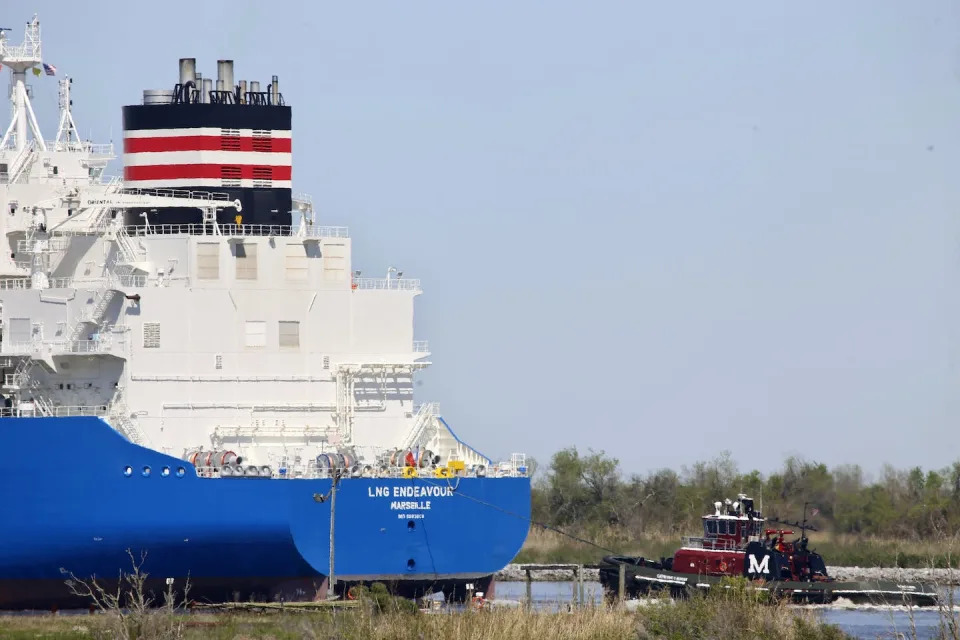
A tugboat helps guide the LNG Endeavor, a French liquefied natural gas tanker, through Calcasieu Lake near Hackberry, La., March 31, 2022. U.S. LNG exports to Europe reached record levels in 2022 as the continent prepared to sever energy ties with Russia. <a href=
A tugboat helps guide the LNG Endeavor, a French liquefied natural gas tanker, through Calcasieu Lake near Hackberry, La., March 31, 2022. U.S. LNG exports to Europe reached record levels in 2022 as the continent prepared to sever energy ties with Russia. AP Photo/Martha Irvine

Much like Europeans, U.S. consumers had to pay high prices to outbid other global consumers for oil and natural gas amid global supply disruptions and competition for available cargoes. High gasoline prices were a political headache for the Biden administration through the spring and summer of 2022.

However, these high prices belied the fact that U.S. domestic gasoline use has stopped growing. Forecasts suggest that it will decline further in 2023 and beyond as the fuel economy of U.S. cars continues to improve and the number of electric vehicles on the road expands.

While energy prices were a burden, especially to lower-income households, European and American consumers have been able to ride out price surges driven by the war in Ukraine and have so far avoided actual outages and the worst recessionary fears. And their governments are offering big economic incentives to switch to clean energy technologies intended to reduce their nations’ need for fossil fuels.

Developing nations priced out

The same can’t be said for consumers in developing nations like Pakistan, Bangladesh and India, who have experienced the energy cutoffs that were feared but didn’t occur in Europe. Notably, Europe’s intensive energy stockpiling in the summer of 2022 caused a huge jump in global prices for liquefied natural gas. In response, many utilities in less developed nations cut their natural gas purchases, creating price-related electricity outages in some regions.

Faced with continuing high global energy prices, countries in the global south – Africa, Asia and Latin America – have had to reevaluate their dependence on foreign importsIncreased use of coal has made headlines, but renewable energy is starting to offer greater advantages, both because it is more affordable and because governments can frame it as more secure and a source of domestic jobs.

India, for example, is doubling down on renewable energy, unveiling plans to produce hydrogen fuel for heavy industry using renewable energy and moving away from imported LNG. Several African countries, such as Ethiopia, are fast-tracking development of hydropower.

Energy prices and climate justice

The energy challenge that the Russia-Ukraine crisis has bred in developing countries has intensified global discussions about climate justice. One less examined impact of giant clean tech stimulus plans enacted in wealthy nations, such as the United States’ Inflation Reduction Act, is that they keep much of the available funding for climate finance at home. As a result, some developing country leaders worry that a clean energy technology knowledge gap will widen, not shrink, as the energy transition gains momentum.

Worsening the problem, members of the G-7 forum of wealthy nations have tightened their monetary policies to control war-driven inflation. This drives up the cost of debt and makes it harder for developing countries to borrow money to invest in clean energy.

The U.S. is supporting a new approach called Just Energy Transition Partnerships, in which wealthy nations provide funding to help developing countries shift away from coal-fired power plants, retrain workers and recruit private-sector investors to help finance decarbonization projects. But these solutions are negotiated bilaterally between individual countries, and the pace is slow.

When nations gather in the United Arab Emirates in late 2023 for the next round of global climate talks, wealthy nations – including Middle East oil producers – will face demands for new ways of financing energy security improvements in less wealthy countries. The world’s rich nations pledged in 2009 to direct $100 billion yearly to less wealthy nations by 2020 to help them adapt to climate change and decarbonize their economies, but are far behind on fulfilling this promise.

U.N. Secretary-General Antonio Guterres has called on developed nations to tax fossil fuel companies, which reported record profits in 2022, and use the money to fund climate adaptation in low-income countries. New solutions are needed, because without some kind of major progress, wealthy nations will continue outbidding developing nations for the energy resources that the world’s most vulnerable people desperately need.

Florida Gov dons brownshirt with his white boots: Ron DeSantis requested the medical records of trans students who sought care at Florida’s public universities.

Insider

Ron DeSantis requested the medical records of trans students who sought care at Florida’s public universities. Now students are planning a statewide walkout.

Annalise Mabe – February 16, 2023

Students at USF gather on USfF campus
Students at the University of South Florida gather to protest the request.Justin Blanco
  • Ron DeSantis told all public universities in Florida to hand over the medical records of trans students who sought care.
  • Insider has confirmed six of the 12 universities have complied with the request.
  • Now, college students across the state are planning a walkout to protest the governor’s request.

Students across Florida are planning a statewide walkout after Gov. Ron DeSantis requested all public universities comply in delivering data from student health services on transgender students who sought gender-affirming care at the institutions.

DeSantis asked to see the records of any student who has experienced gender dysphoria in the past five years. In addition, he wants their ages and the dates they received gender-affirming care. The deadline to submit those records was February 10.

Insider has confirmed that University of Florida, Florida State University, University of Central Florida, Florida A&M University, Florida International University, and the University of North Florida have complied with the request, but has yet to hear back from the rest.

Students at these universities are now planning rallies for next week along with the statewide walkout on February 23. Ben Braver, a junior at the University of South Florida and the outreach officer for the school’s College Democrats chapter, is leading the initiative, known as the Stand for Freedom Florida Walkout.

“Hate is spread when it’s innocuous, when it seems silly, and when it seems like taking a stand is an overreaction,” Braver told Insider. “We, just like any generation, need to stand for the civil rights that have already been fought for, the ones that have been won, and those which are at stake right now.”

Andy Pham, a senior and long-standing member of the University of South Florida’s Trans+ Student Union, said he sees the state’s move as a direct attack on trans rights.

“They want to legislate us out of existence,” Pham said. “That starts with attacking our healthcare, attacking our right to exist in public spaces, attempting surveillance — all of that.”

In January, 20 students at the University of South Florida held a rally protesting DeSantis’ request. They then started an online petition asking the school’s administration not to submit the medical records. The petition received over 2,600 signatures, but officials at the school said they plan to send over the records anyway. Insider hasn’t been able to confirm whether the University of South Florida sent over the data.

“As a state university, USF has an obligation to be responsive to requests from our elected officials,” the university said in a statement, according to WUSF. “However, the university will not provide information that identifies an individual patient or violates patient privacy laws.”

Among those signing on to support the walkout are the Dream DefendersFlorida College Democrats, state lawmaker Anna Eskamani, and 26-year-old Congressman Maxwell Frost.

“The governor’s abusing his power,” Frost told Insider. “He’s targeting folks that disagree with him — people who might not see eye to eye with him, marginalized communities.”

When Insider asked why the state has requested the health data of transgender college students, the state’s deputy press secretary referred to DeSantis’ second inaugural address, in which the governor stated: “We are committed to fully understanding the amount of public funding that is going toward such nonacademic pursuits to best assess how to get our colleges and universities refocused on education and truth.”

The American Civil Liberties Union reports that during this legislative session, Florida lawmakers have introduced 85 bills restricting gender-affirming healthcare, up from 43 bills last year.

Eskamani said DeSantis should prepare for student backlash.

“When students see the visual representation of their peers around them standing up and walking out, they’re going to get plugged in and help us fight back,” she said. “That will happen.”

Fetterman hospitalized to be treated for clinical depression

The Hill

Fetterman hospitalized to be treated for clinical depression

Al Weaver – February 16, 2023

Sen. John Fetterman (D-Pa.) checked into the hospital on Wednesday night to be treated for clinical depression, his office announced on Thursday.

“Last night, Senator John Fetterman checked himself into Walter Reed National Military Medical Center to receive treatment for clinical depression. While John has experienced depression off and on throughout his life, it only became severe in recent weeks,” Adam Jentleson, Fetterman’s chief of staff, said in a statement.

“On Monday, John was evaluated by Dr. Brian P. Monahan, the Attending Physician of the United States Congress. Yesterday, Dr. Monahan recommended inpatient care at Walter Reed. John agreed, and he is receiving treatment on a voluntary basis,” Jentleson said.

According to Jentleson, doctors at Walter Reed “told us that John is getting the care he needs, and will soon be back to himself.”

“I stand by John Fetterman and his family. This a challenge, an unimaginable challenge, that he has faced in life. He deserves the very best in professional care and I’m sure he’ll get it at Walter Reed,” said Senate Democratic Whip Dick Durbin (Ill.).

Asked if Fetterman will be able to serve a full term, Durbin said, “I believe he can.”

“I believe with the proper care, which he will receive, that he’ll be back in our ranks, joining us soon,” he said.

The situation comes a little more than a week after Fetterman was hospitalized after feeling lightheaded during the Senate Democratic retreat.

A Fetterman spokesman said at the time that test results showed no evidence that he suffered a seizure, with tests also showing that he did not suffer a second stroke in less than a year.

He was released from the Washington, D.C., hospital the following day and returned to the Senate on Monday.

The Pennsylvania progressive underwent a procedure shortly after his stroke in May to have a pacemaker implanted.

He also continues to deal with auditory processing issues as a result of that stroke, forcing him to rely on closed captioning in order to converse with other lawmakers.

Fetterman’s desk has been outfitted with a monitor to allow him to follow along with Senate proceedings. The upper chamber’s sergeant-at-arms has also allowed for live audio-to-text transcription for his committees.

“After what he’s been through in the past year, there’s probably no one who wanted to talk about his own health less than John. I’m so proud of him for asking for help and getting the care he needs,” Fetterman’s wife, Gisele Barreto Fetterman, tweeted on Thursday.

Alexander Bolton contributed. Updated at 3:21 p.m.

Tucker Carlson told his producer Trump is ‘the undisputed world champion’ of destroying things and could ruin Fox News if it didn’t back his election lies

Insider

Tucker Carlson told his producer Trump is ‘the undisputed world champion’ of destroying things and could ruin Fox News if it didn’t back his election lies

Sonam Sheth and Jacob Shamsian – February 16, 2023

Tucker Carlson speaks during 2022 FOX Nation Patriot Awards at Hard Rock Live at Seminole Hard Rock Hotel & Casino Hollywood on November 17, 2022 in Hollywood, Florida.
Tucker Carlson speaks during 2022 FOX Nation Patriot Awards at Hard Rock Live at Seminole Hard Rock Hotel & Casino Hollywood on November 17, 2022 in Hollywood, Florida.Jason Koerner/Getty Images
  • Tucker Carlson called Trump the “undisputed world champion” of destroying things, per a new court filing.
  • Carlson texted his producer after the 2020 election that Trump could “easily destroy” Fox News if “we play it wrong.”
  • Carlson’s text came after Fox News ignited Trump’s fury by being the first to call Arizona for Biden.

Two days after Election Day 2020, Fox News host Tucker Carlson texted his producer warning that Fox New’s decision to call the state of Arizona for Joe Biden on election night could spell doom for the network.

That’s according to a newly released court filing Thursday. The document, a 200-page motion for summary judgment in Dominion Voting Systems’ defamation lawsuit against Fox News, featured multiple deposition excerpts and texts from top Fox News figures including Carlson, Sean Hannity, Rupert Murdoch, and others.

Fox was the first cable news network to project Biden’s victory in Arizona, prompting a slew of angry phone calls and texts from people in Trump’s camp.

“We worked really hard to build what we have,” Carlson texted his producer, Alex Pfeiffer, on November 5, 2020, according to the filing. “Those fuckers are destroying our credibility. It enrages me.”

Carlson added that he had spoken with fellow primetime commentators Laura Ingraham and Sean Hannity minutes earlier and that they were “highly upset.”

“At this point we’re getting hurt no matter what,” he wrote, according to the filing.

Pfeiffer replied that “many on ‘our side’ are being reckless demagogues right now.”

“Of course they are,” Carlson wrote. “We’re not going to follow them.” He went on to say that Trump was good at “destroying things. He’s the undisputed world champion of that. He could easily destroy us if we play it wrong.”

At another point the same day, Carlson texted that “we’ve got to be incredibly careful right now. We could get hurt.” It’s unclear who the recipient of the message was.

Dominion became a focal point for Trumpworld’s election-related conspiracy theories shortly after Election Day 2020. “By November 11, Sean Hannity recognized the critical role the Dominion fraud narrative would play in winning back viewers,” Thursday’s filing said.

“In one week and one debate they destroyed a brand that took 25 years to build and the damage is incalculable,” Hannity told Carlson and Ingraham on November 12, a week after the Arizona call.

“It’s vandalism,” Carlson replied, according to the filing.

The host also grew angry when a Fox News reporter fact-checked a Trump tweet accusing Dominion of election fraud.

The reporter, Jacqui Heinrich, wrote in response to Trump’s tweet that top election officials had determined “there is no evidence that any voting system deleted or lost votes, changed votes, or was in any way compromised.”

Carlson dropped Heinrich’s tweet into a group chat with Ingraham and Hannity, per the filing, and told Hannity: “Please get her fired. Seriously….What the fuck? I’m actually shocked…It needs to stop immediately, like tonight. It’s measurably hurting the company. The stock price is down. Not a joke.”

One of Ingraham’s producers, Tommy Firth, struck a more blunt tone.

“This dominion shit is going to give me a fucking aneurysm — as many times as I’ve told Laura it’s bs, she sees shit posters and trump tweeting about it,” Firth wrote to a Ron Mitchell, a Fox executive overseeing Ingraham’s show, according to a partially redacted text featured in the filing.

“This is the Bill Gates/microchip angle to voter fraud,” Mitchell replied. Later that day, he circled back with Firth, writing, “How’s it going [with] the kooks?”

In a statement, a Fox News spokesperson said Dominion’s case is a threat to free speech, and that the company misrepresented the evidence it collected.

“Dominion has mischaracterized the record, cherry-picked quotes stripped of key context, and spilled considerable ink on facts that are irrelevant under black-letter principles of defamation law,” the spokesperson said.

Dominion sued Fox News for defamation in March 2021, alleging that the network pushed conspiracy theories about the company in an effort to win back dissatisfied viewers following Trump’s loss in the election.

“As a result of the false accusations broadcast by Fox into millions of American homes, Dominion has suffered unprecedented harm and its employees’ lives have been put in danger,” Dominion’s attorneys wrote in the lawsuit.

“Fox took a small flame and turned it into a forest fire,” Dominion’s lawsuit said.

How dangerous was the Ohio chemical train derailment? An environmental engineer assesses the long-term risks

The Conversation

How dangerous was the Ohio chemical train derailment? An environmental engineer assesses the long-term risks

Andrew J. Whelton, Professor of Civil, Environmental & Ecological Engineering, Director of the Healthy Plumbing Consortium and Center for Plumbing Safety, Purdue University – February 15, 2023

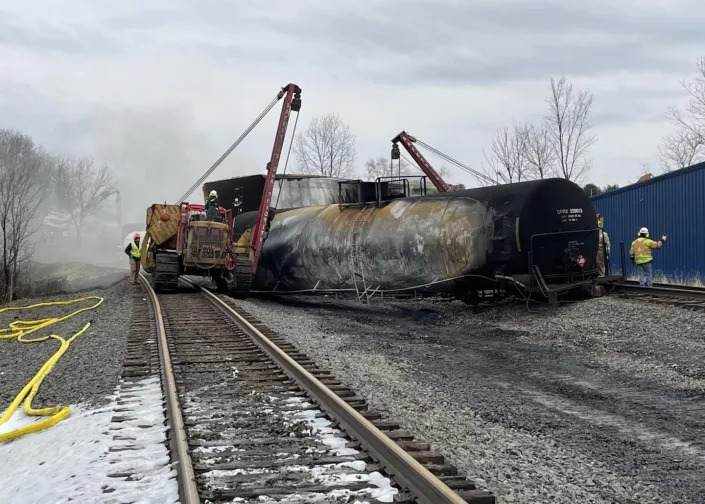
Several cars that contained hazardous chemicals burned after the Feb. 3, 2023, derailment. <a href=
Several cars that contained hazardous chemicals burned after the Feb. 3, 2023, derailment. U.S. Environmental Protection Agency

Headaches and lingering chemical smells from a fiery train derailment in East Palestine, Ohio, have left residents worried about their air and water – and misinformation on social media hasn’t helped.

State officials offered more details of the cleanup process and a timeline of the environmental disaster during a news conference on Feb. 14, 2023. Nearly a dozen cars carrying chemicals, including vinyl chloride, a carcinogen, derailed on the evening of Feb. 3, and fire from the site sent up acrid black smoke. Officials said they had tested over 400 nearby homes for contamination and were tracking a plume of spilled chemicals that had killed 3,500 fish in streams and reached the Ohio River.

However, the slow release of information after the derailment has left many questions unanswered about the risks and longer-term impact. We put five questions about the chemical releases to Andrew Whelton, an environmental engineer who investigates chemical risks during disasters.

Let’s start with what was in the train cars. What are the most concerning chemicals for human health and the environment long term, and what’s known so far about the impact?

The main concerns now are the contamination of homes, soil and water, primarily from volatile organic compounds and semivolatile organic compounds, known as VOCs and SVOCs.

The train had nearly a dozen cars with vinyl chloride and other materials, such as ethylhexyl acrylate and butyl acrylate. These chemicals have varying levels of toxicity and different fates in soil and groundwater. Officials have detected some of those chemicals in the nearby waterway and particulate matter in the air from the fire. But so far, the fate of many of the chemicals is not known. A variety of other materials were also released, but discussion about those chemicals has been limited.

State officials disclosed that a plume of contamination released into the nearby creek had made its way into the Ohio River. Other cities get their drinking water from the river, and were warned about the risk. The farther this plume moves downstream, the less concentrated the chemical will be in water, posing less of a risk.

Long term, the greatest risk is closest to the derailment location. And again, there’s limited information about what chemicals are present – or were created through chemical reactions during the fire.

It isn’t clear yet how much went into storm drains, was flushed down the streams or may have settled to the bottom of waterways.

There was also a lot of combusted particulate matter. The black smoke is a clear indication. It’s unclear how much was diluted in the air or fell to the ground.

How long can these chemicals linger in soil and water, and what’s their potential long-term risk to humans and wildlife?

The heavier the chemical, often the slower it degrades and the more likely it is to stick to soil. These compounds can remain for years if left unaddressed.

After the Kalamazoo River oil pipeline break in Michigan in 2010, the U.S. Environmental Protection Agency excavated a tributary where the oil settled. We’ve also seen from oil spills on the coasts of Alaska and Alabama that oil chemicals can find their way into soil if it isn’t remediated.

The long-term impact in Ohio will depend in part on how fast – and thoroughly – cleanup occurs.

If the heavily contaminated soils and liquids are excavated and removed, the long-term impacts can be reduced. But the longer removal takes, the farther the contamination can spread. It’s in everyone’s best interest to clean this up as soon as possible and before the region gets rain.

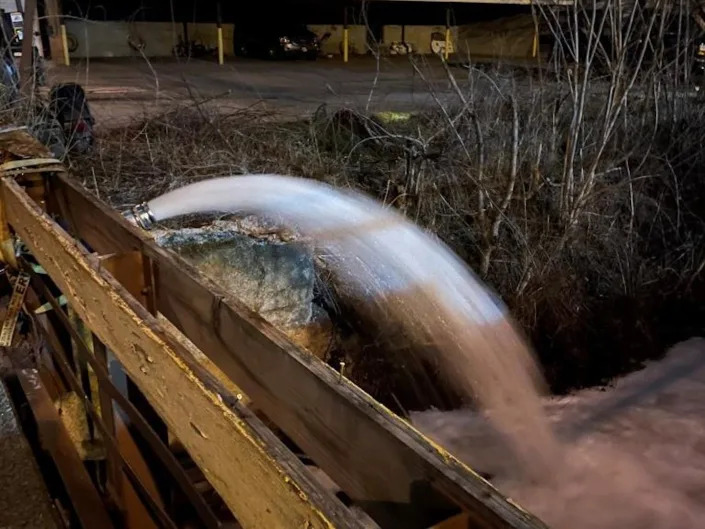
Air-stripping devices, like this one used after the derailment, can help separate chemicals from water. <a href=
Air-stripping devices, like this one used after the derailment, can help separate chemicals from water. U.S. EPA

Booms in a nearby stream have been deployed to capture chemicals. Air-stripping devices have been deployed to remove chemicals from the waterways. Air stripping causes the light chemicals to leave the water and enter air. This is a common treatment technique and was used after an 2015 oil spill in the Yellowstone River near Glendive, Montana.

At the derailment site in Ohio, workers are already removing contaminated soil as deep as 7 feet (about 2 meters) near where the rail cars burned.

Some of the train cars were intentionally drained and the chemicals set on fire to eliminate them. That fire had thick black smoke. What does that tell you about the chemicals and longer-term risks?

Incineration is one way we dispose of hazardous chemicals, but incomplete chemical destruction creates a host of byproducts. Chemicals can be destroyed when heated to extremely high temperatures so they burn thoroughly.

The black smoke plume you saw on TV was incomplete combustion. A number of other chemicals were created. Officials don’t necessarily know what these were or where they went until they test for them.

We know ash can pose health risks, which is why we test inside homes after wildfires where structures burn. This is one reason the state’s health director told residents with private wells near and downwind of the derailment to use bottled water until they can have their wells tested.

The EPA has been screening homes near the derailment for indoor air-quality concerns. How do these chemicals get into homes and what happens to them in enclosed spaces?

Homes are not airtight, and sometimes dust and other materials get in. It might be through an open door or a window sill. Sometimes people track it in.

So far, the U.S. EPA has reported no evidence of high levels of vinyl chloride or hydrogen chloride in the 400 or so homes tested. But full transparency has been lacking. Just because an agency is doing testing doesn’t mean it is testing for what it needs to test for.

Media reports talk about four or five chemicals, but the manifest from Norfolk Southern also listed a bunch of other materials in tanks that burned. All those materials create potentially hundreds to thousands of VOCs and SVOCs.

Are government officials testing for everything they should?

People in the community have reported headaches, which can be caused by VOCs and other chemicals. They’re understandably concerned.

Ohio and federal officials need to better communicate what they’re doing, why, and what they plan to do. It’s unclear what questions they are trying to answer. For a disaster this serious, little testing information has been shared.

In the absence of this transparency, misinformation is filling that void. From a homeowner’s perspective, it’s hard to understand the true risk if the data is not shared.

2nd Amendment sanctuary measure overturned in Oregon

Associated Press

2nd Amendment sanctuary measure overturned in Oregon

Claire Rush and Lindsay Whitehurst – February 15, 2023

FILE - A man enters a gun shop in Salem, Ore., on Feb. 19, 2021. An Oregon court decided Wednesday, Feb. 15, 2023, that local governments can't declare themselves Second Amendment sanctuaries and ban police from enforcing certain gun laws within their borders. The opinion was the first court test of the concept, which hundreds of U.S. counties have adopted in recent years. (AP Photo/Andrew Selsky, File)
Wednesday, Feb. 15, 2023, that local governments can’t declare themselves Second Amendment sanctuaries and ban police from enforcing certain gun laws within their borders. The opinion was the first court test of the concept, which hundreds of U.S. counties have adopted in recent years. (AP Photo/Andrew Selsky, File)
FILE - Firearms are displayed at a gun shop in Salem, Ore., on Feb. 19, 2021. An Oregon court decided Wednesday, Feb. 15, 2023, that local governments can't declare themselves Second Amendment sanctuaries and ban police from enforcing certain gun laws within their borders. The opinion was the first court test of the concept, which hundreds of U.S. counties have adopted in recent years. (AP Photo/Andrew Selsky, File)
Firearms are displayed at a gun shop in Salem, Ore., on Feb. 19, 2021. An Oregon court decided Wednesday, Feb. 15, 2023, that local governments can’t declare themselves Second Amendment sanctuaries and ban police from enforcing certain gun laws within their borders. The opinion was the first court test of the concept, which hundreds of U.S.

PORTLAND, Ore. (AP) — Local governments in Oregon can’t declare themselves Second Amendment sanctuaries and ban police from enforcing certain gun laws, a state appeals court decided Wednesday, in the first court case filed over a concept that hundreds of U.S. counties have adopted in recent years.

The measure in question, which was approved in Columbia County, forbids local officials from enforcing most federal and state gun laws and would impose thousands of dollars in fines on those who try.

The state Court of Appeals ruled that it violates a law giving the state the power to regulate firearms. The ordinance would effectively, it found, “create a ‘patchwork quilt’ of firearms laws in Oregon, where firearms regulations that applied in some counties would not apply in Columbia County,” something lawmakers specifically wanted to avoid.

Second Amendment sanctuary resolutions have been adopted by some 1,200 local governments around the U.S., including in Virginia, Colorado, New Mexico, Kansas, Illinois and Florida, experts say. Many are symbolic, but some carry legal force like the one in Columbia County, a conservative, rural logging area in deep-blue Oregon.

The sanctuary movement took off around 2018 as states considered stricter gun laws in the wake of mass shootings, but it had not previously faced a major legal challenge.

The Oregon case was filed in 2021 under a provision in state law that allows a judge to examine a measure before it goes into effect. A trial court judge originally declined to rule, a decision that was appealed to the higher court.

The ordinance’s supporters included the Oregon Firearms Federation, which said in a statement Wednesday that the ruling “calls into question the legitimacy of the court and the likelihood of getting fair rulings from it.”

Opponents included the legal arm of the group Everytown for Gun Safety, which had argued that the ordinance violated the U.S. Constitution. Eric Tirschwell, executive director of Everytown Law, called the court’s decision “a win for public safety and the rule of law.”

“Opponents of gun safety laws have every right to advocate for change at the ballot box, statehouse, or Congress, but claiming to nullify them at the local level is both unconstitutional and dangerous,” Tirschwell said.

State Attorney General Ellen Rosenblum, who has also sued two other Second Amendment sanctuary counties, also applauded the ruling.

“Today’s opinion by the Court of Appeals makes it clear that common sense requirements like safe storage and background checks apply throughout Oregon,” Rosenblum said. “Hopefully, other counties with similar measures on the books will see the writing on the wall.”

Whitehurst reported from Washington, D.C.