Santa Clara, California-based Marvell said it is eliminating about 320 jobs, or 4 per cent of its global workforce, in response to what the company described as an industry slowdown, according to a statement from the firm on Wednesday.
“We are streamlining our organisation to ensure that our workforce is positioned to take advantage of our most promising opportunities, both now and when we emerge from the current industry downcycle,” Stacey Keegan, Marvell’s vice-president of corporate marketing, said in the statement.
Do you have questions about the biggest topics and trends from around the world? Get the answers with SCMP Knowledge, our new platform of curated content with explainers, FAQs, analyses and infographics brought to you by our award-winning team.
While China remains a large and important market for Marvell, Keegan said the company has decided to “concentrate our China-based resources on customer-facing teams to best support our local customers and business opportunities”. She added, however, that this move has “resulted in the elimination of certain R&D roles”.
The logo of US semiconductor company Marvell Technology is seen at its headquarters in Santa Clara, California. Photo: Shutterstock alt=The logo of US semiconductor company Marvell Technology is seen at its headquarters in Santa Clara, California. Photo: Shutterstock>
Most of Marvell’s latest job cuts will directly affect the firm’s entire research and development operation in mainland China, while only about 5 per cent of these lay-offs will be conducted in the US, according to a report on Wednesday by Chinese semiconductor industry portal Ijiwei, which cited sources familiar with the matter.
Marvell is expected to immediately notify its affected Chinese employees and offer a severance package similar to that provided during the lay-offs last October, the Ijiwei report said.
Before the lay-offs, Marvell had nearly 1,000 employees in China at its peak. About 800 of these workers were located in Shanghai, which had the company’s third-largest research and development team behind its operations in the US and Israel.
Marvell’s latest round of job cuts reflect the increased pressure on the world’s major semiconductor companies owing to the large imbalance between supply and demand in the global market, where chip inventories have risen to record levels.
Meanwhile, US memory chip giant Micron Technology closed its DRAM design operations in Shanghai at the end of last year, with some 150 Chinese engineers asked to relocate to either the US or India amid rising tensions between Beijing and Washington.
Marvell, which designs advanced chips for cloud computing, automotive, 5G mobile communications and enterprise networking applications, earlier this month reported record revenue of US$5.92 billion for its financial year ended January 28, up 33 per cent from a year earlier, on the back of growth from those business segments. But it also posted a US$164 million net loss in its past financial year.
This article originally appeared in the South China Morning Post (SCMP), the most authoritative voice reporting on China and Asia for more than a century.
Judge in Fox News, Dominion Case Says Network’s Legal Woes Mostly the Fault of One ‘Problem’ Host
Josh Dickey – March 21, 2023
In what’s playing out like an extended preview to the $1.6 billion First Amendment prize fight between Dominion Voting Systems and Fox News, both sides threw opening punches Tuesday in a Delaware court, where a judge is hearing summary arguments and other matters ahead of next month’s scheduled trial.
Dominion Voting systems opened this round, arguing before Judge Eric Davis that Fox News made a “household name” out of Sidney Powell, let hosts “run wild” and developed what the judge called a “Lou Dobbs problem.” Fox countered in the afternoon, arguing that a “reasonable” viewer could easily discern that the network was reporting on allegations and newsmakers’ theories.
Both sides have asked Davis to rule summarily in their favor, a routine stop for any civil trial that rarely works. But Fox and Dominion each put significant resources into their summary arguments and supporting documents, which have been widely picked over and scrutinized.
By the time the lawyers assembled Tuesday for their first live arguments before Davis, many details had already become familiar, as each side released troves of sworn deposition testimony, text messages, emails and other discovery-phase records this month – most of them rather embarrassing to Fox News. Davis was not expected to rule on the motions for summary judgment during the pre-trial hearing spanning Tuesday and Wednesday.
However, Davis could rule this week on whether certain redacted material in those evidentiary depositions should be revealed, which could bring another wave (or trickle) of bombshell revelations. Those arguments and other minor pretrial matters were expected to be resolved before the April 17 start date.
Dominion is asking for $1.6 billion in damages – significant, but not a potential death-blow for the crown jewel of Rupert Murdoch’s media empire – for what it says are defamatory statements about its voting machines in multiple reports, guest segments and host commentary immediately following the 2020 election. Defamation cases hinge on “actual malice,” proof that the defendant intended harm – and Dominion has been pushing hard on that front in it pretrial efforts.
Fox has maintained it was merely doing the news, and was protected by its framing of even the wildest election conspiracy theories as allegations and speculation. Fox’s lawyers also argued Tuesday that there were, and still are, legitimate questions about security around Dominion machines.
Dominion’s receipts include 20 on-air instances of what it says are defamation – a notable number of them featuring Lou Dobbs. “Lou Dobbs Tonight” was an engine of the stolen-election narrative, and though Dobbs was fired abruptly after Joe Biden’s win was certified, depositions revealed that Fox brass had been looking to move him out up to a year before.
“This seems to be a Lou Dobbs problem,” Davis commented as Fox attorneys were going through the instances one by one.
The pre-trial hearing was expected to resume Wednesday.
Questions like: Why is Manhattan District Attorney Alvin Bragg’s indictment relating to Stormy Daniels likely to be the first for the former president and not one related to Jan. 6? Is House Speaker Kevin McCarthy in love with Trump or afraid of him? And, this big one: Will we see Trump do a perp walk?
Starting with the perp walk question, The New Abnormal political podcast co-host Andy Levy shares why he isn’t so hopeful with co-host Danielle Moodie on this all-Trump episode.
“I’ve seen supposedly serious people make this comment that we need to be worried about them charging Trump, because it may lead to riots in the streets. You already did that, first of all, [and] no, you don’t get a heckler’s veto if you break the law. If you break the law, you break the law,” says Andy. “That stuff cannot factor into charging someone, [but], it can factor into how you arrest them.”
“Trump was tweeting in all-caps about that they were debating whether to have him do a perp walk in handcuffs. That’s never gonna happen. We are never gonna see that, honestly, as much as I would enjoy it. We don’t really need that,” he adds, to Danielle’s dismay.
“I kind of do,” she jokes.
Then MSNBC legal analyst Katie Phang joins the show and gives Danielle insight into the “why this case?” question. According to Phang, a Trump indictment for something a while ago and not Jan. 6-related is still important.
“We need to appreciate the prosecution of the former President of the United States. Even if it’s for jaywalking. Why? Because you and I would be prosecuted for that crime.
“And so I am glad that even though this is an ‘old event,’ the payoff to Stormy Daniels to keep her quiet, to influence the outcome of the 2016 election may have been years ago, you know, damn it. I am glad. If he’s kicking his dog, he should be arrested and prosecuted. I believe this is the beginning of the fall of dominoes.”
Plus, Phang shares the indictment that she thinks will really “break the dam.”
Then, Jeff Sharlet, author of The Undertow: Scenes from a Slow Civil War, tells Andy what he learned while writing about the post-Trump world—like how right-wing grandmas have nasty things to say about Hillary Clinton—and why he doesn’t actually care about Trump like other Trump-era writers.
Idaho hospital will stop delivering babies as doctors flee state due to abortion ban
Gloria Oladipo – March 20, 2023
Photograph: Emily Elconin/Reuters
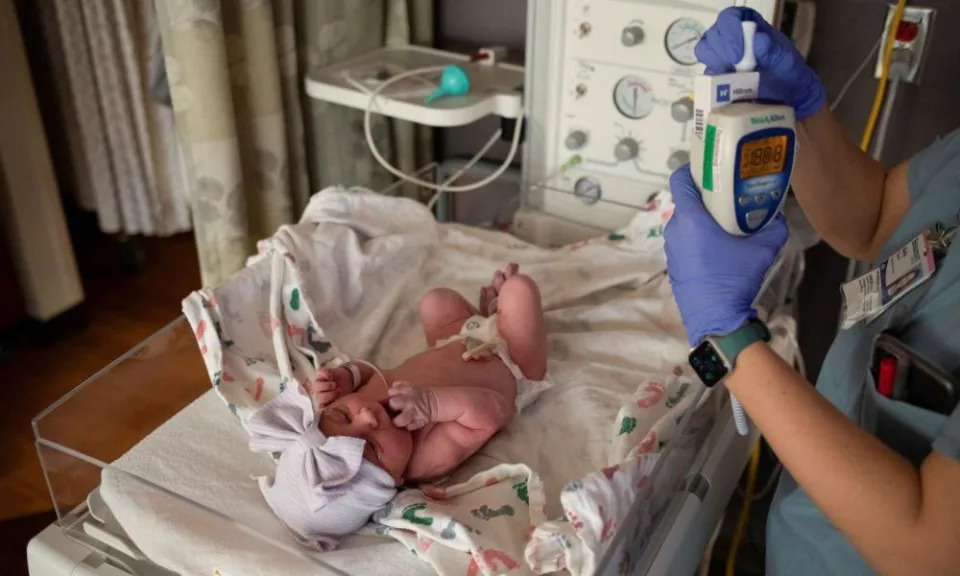
An Idaho hospital has planned to stop delivering babies, with the medical center’s managers citing increasing criminalization of physicians and the inability to retain pediatricians as major reasons.
Bonner General Health, the only hospital in Sandpoint, Idaho, announced on Friday that it would no longer provide labor, delivery and a host of other obstetrical services.
The more than 9,000 residents of Sandpoint are now forced to drive 46 miles for the nearest labor and delivery care, the Idaho Statesman reported.
In a statement, the hospital’s leadership said that the decision to eliminate the obstetrics unit stemmed from the “political climate” in Idaho.
“Highly respected, talented physicians are leaving. Recruiting replacements will be extraordinarily difficult,” hospital officials said in a press release.
“We have made every effort to avoid eliminating these services,” the hospital’s board president, Ford Elsaesser, added in the statement.
“We hoped to be the exception, but our challenges are impossible to overcome now.”
The hospital’s statement also said that the closure comes as the number of deliveries at Bonner continues to decline, with only 265 babies delivered in 2022 and fewer than 10 pediatric patients admitted.
The hospital also lacks enough pediatricians to manage its neonatal resuscitations and perinatal care, finding no permanent solution after reaching out to active and retired physicians to fill vacancies.
Hospital officials are hoping to keep obstetrics services available until 19 May but noted that it largely depends on staffing.
New patients are no longer being seen at the hospital, effective immediately, while current clients are being offered alternative referrals.
Since the supreme court in June eliminated the nationwide abortion rights that Roe v wade established, states with total abortion bans have passed laws that threaten possible prison time for doctors who perform abortions in violation of state law.
The supreme court decision legalized an Idaho state ban on abortions after six weeks of pregnancy. The state is the first to pass a copy of Texas’s controversial bill. It is also one of six that prosecutes doctors for providing the procedure, CBS News reported.
In August, the justice department filed a lawsuit against Idaho for its near-total ban on abortions, with doctors in the state writing in a court brief that physicians were often forced to choose between violating the state ban or federal healthcare law, the Associated Press reported.
The implication of the ban is driving doctors out of the state, the Bonner hospital’s press release noted.
“The Idaho legislature continues to introduce and pass bills that criminalize physicians for medical care nationally recognized as the standard of care,” the hospital’s statement added.
“Consequences for Idaho physicians providing the standard of care may include civil litigation and criminal prosecution, leading to jail time or fines.”
Dr Amelia Huntsberger, a Bonner General Health obstetrician-gynecologist, wrote in an email to the Statesman that she would be leaving the hospital and the state because of its restrictive abortion laws and because the Idaho legislature was terminating its maternal mortality review committee.
“What a sad, sad state of affairs for our community,” Huntsberger wrote, according to the Statesman.
It’s mid-March and the Great Lakes are virtually ice-free. That’s a problem.
Caitlin Looby, Akron Beacon Journal – March 19, 2023
Trumpeter swans find some open water along the Lake Erie shore last month. The ice in Ottawa County has melted since then as temperatures have been unseasonably warm.
It’s the middle of March and the Great Lakes are virtually ice-free.
Ice has been far below average this year, with only 7% of the lakes covered as of last Monday — and no ice at all on Lake Erie. Lake Erie’s average ice coverage for this time of year is 40%, based on measurements over the past half-century. The lake typically freezes over the quickest and has the most ice cover because it’s the shallowest of the five Great Lakes.
But communities along Ohio’s north coast, including Cleveland, Sandusky and Port Clinton, have seen considerably less ice forming on Lake Erie in recent years.
No ice isn’t a good thing for the lakes’ ecosystem. It can even stir up dangerous waves and lake-effect snowstorms.
So, what happens when the lakes are ice-free? What does it mean for the lakes’ food web? Is climate change to blame?
Little ice cover can be disastrous
This winter has already proved how dangerous lake-effect snow can be.
At the end of November, more than 6 feet of snow fell on Buffalo, New York, which sits on the shores of Lake Erie. A few weeks later on Dec. 23, more than 4 feet of snow covered the city and surrounding areas once again. The storm resulted in 44 deaths in Erie and Niagara counties, which sit on Lakes Erie and Ontario, respectively.
Cleveland and Sandusky reside on the shores of Lake Erie as well. The 2022 storm that swept the region on Dec. 23 dropped relatively little snow, only about 2-4 inches, but created dangerous conditions nonetheless.
In some places in Northeast Ohio, temperatures dropped from nearly 40 degrees to zero and below. Wind chills fueled by hurricane-force winds dragged the temperature even lower to minus 30 or even 35 below zero. This storm was the first time in almost a decade that the Cleveland Weather Forecast Office issued a blizzard warning.
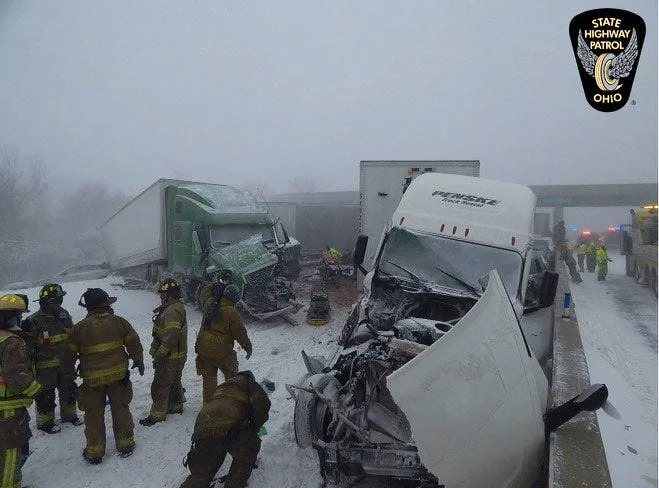
A 46-vehicle pileup killed four people injured many others on the Ohio Turnpike during a winter storm with whiteout conditions Dec. 23.
During stormy winter months, ice cover tempers waves. When there is low ice cover, waves can be much larger, leading to lakeshore flooding and erosion. That happened in January 2020 along Lake Michigan’s southwestern shoreline. Record high lake levels mixed with winds whipped up 15-foot waves that flooded shorelines, leading Gov. Tony Evers to declare a state of emergency for Milwaukee, Racine and Kenosha counties.
And while less ice may seem like a good thing for the lakes’ shipping industry, those waves can create dangerous conditions.
The Great Lakes are losing ice with climate change
The Great Lakes have been losing ice for the past five decades, a trend that scientists say will likely continue.
Of the last 25 years, 64% had below-average ice, said Michael Notaro, the director of the Center on Climatic Research at the University of Wisconsin-Madison. The steepest declines have been in the north, including Lake Superior, northern Lake Michigan and Huron, and in nearshore areas.
But this also comes with a lot of ups and downs, largely because warming is causing the jet stream to “meander,” said Ayumi Fujisaki Manome, a scientist at the Cooperative Institute for Great Lakes Research at the University of Michigan who models ice cover and hazardous weather across the lakes.
There is a lot of year-to-year variability with ice cover spiking in years like 2014, 2015 and 2019 where the lakes were almost completely iced over.
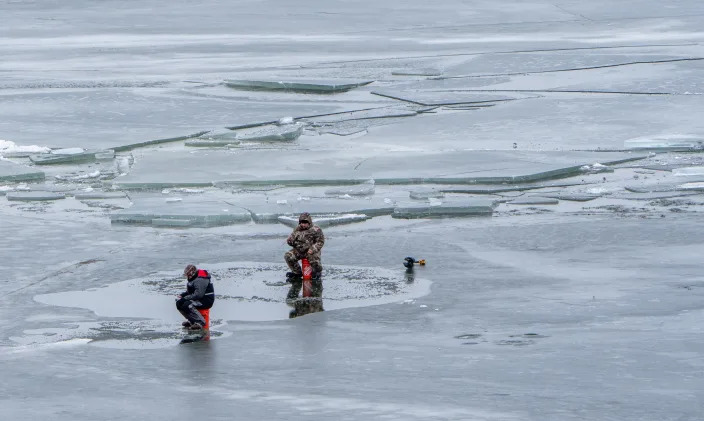
Ice fishermen stay close to shore off of Bay Shore Park in New Franken, Wisconsin, in January, which saw relatively little ice cover on the Great Lakes.
No ice makes waves in the lakes’ ecosystems
A downturn in ice coverage due to climate change will likely have cascading effects on the lakes’ ecosystems.
Lake whitefish, a mainstay in the lakes’ fishing industry and an important food source for other fish like walleye, are one of the many Great Lakes fish that will be affected, said Ed Rutherford, a fishery biologist who also works at the Great Lakes Environmental Research Laboratory.
Lake whitefish spawn in the fall in nearshore areas, leaving the eggs to incubate over the winter months. When ice isn’t there, strong winds and waves can stir up the sediment, reducing the number of fish that are hatched in the spring, Rutherford said.
Whitefish haul from the Great Lakes.
Walleye and yellow perch also need extended winters, he said. If they don’t get enough time to overwinter in cold water, their eggs will be a lot smaller, making it harder for them to survive.
Declining ice cover on the lakes is also delaying the southward migration of dabbling ducks, a group of ducks that include mallards, out of the Great Lakes in the fall and winter, Notaro said. And if the ducks spend more time in the region it will increase the foraging pressure on inland wetlands.
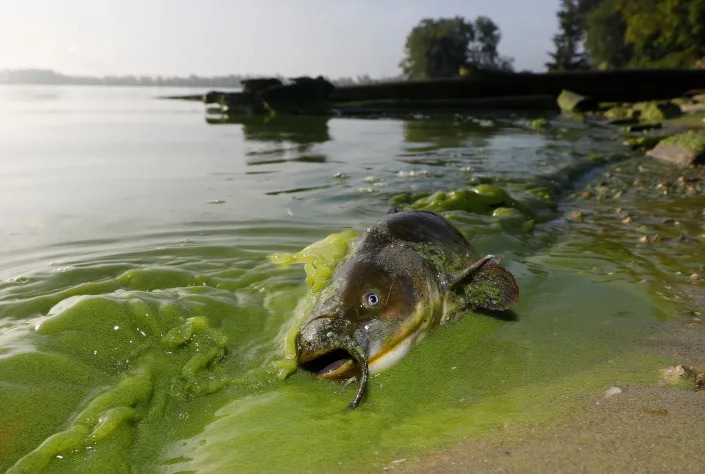
Warming lakes and a loss of ice cover over time also will be coupled with more extreme rainfall, likely inciting more harmful algae blooms, said Notaro. These blooms largely form from agricultural runoff, creating thick, green mats on the lake surface that can be toxic to humans and pets.
In this 2017 photo, a catfish appears on the shoreline in the algae-filled waters of Lake Erie in Toledo.
Lakes Erie and Michigan are plagued with these blooms every summer. And now, blooms cropping up in Lake Superior for the first time are raising alarm.
“Even deep, cold Lake Superior has been experiencing significant algae blooms since 2018, which is quite atypical,” Notaro said.
There is still a big question mark on the extent of the changes that will happen to the lakes’ ecosystem and food web as ice cover continues to decline. That’s because scientists can’t get out and sample the lakes in the harsh winter months.
“Unless we can keep climate change in check … it will have changes that we anticipate and others that we don’t know about yet,” Rutherford said.
Caitlin Looby is a Report for America corps member who writes about the environment and the Great Lakes. Beacon Journal reporter Derek Kreider contributed to this article.
Donald Trump claims he will be arrested Tuesday in Manhattan probe, calls for protests
Ella Lee, Josh Meyer, David Jackson and Kevin Johnson – March 18, 2023
Former President Donald Trump said he expects to be arrested Tuesday in connection with a Manhattan district attorney investigation and called on his supporters to protest, even as uncertainty remained about whether any legal action was actually imminent.
Trump’s advisers Tuesday made clear they had no specific knowledge of the timing of any possible indictment, even as the former president made the comments on Truth Social, the social media network he founded.
Trump is under investigation for a $130,000 payment he made just before the 2016 election to silence adult film star Stormy Daniels about an earlier affair. The former president has denied wrongdoing, and federal investigators ended their own inquiry into the payments in 2019.
An indictment of Trump would send the U.S. political world into unprecedented territory – not just the first indictment of a former president, but one who is in the midst of again running for the White House. And his calls for protest also echoed similar statements by the former president ahead of Jan. 6.
Trump attorney Joe Tacopina confirmed that Trump’s reference to the timing of any possible charge is not based on any contact from Manhattan district attorney’s office.
“No one tells us anything, which is very frustrating,” Tacopina said in an email to USA Today. “President Trump is basing his response on press reports, and the fact that this is a political prosecution and the DA leaks things to the press instead of communicating to the lawyers as they should.”
Danielle Filson, a spokesperson for Manhattan’s District Attorney’s office, declined to comment on the former president’s statement.
Testimony from former Trump lawyer Michael Cohen, who arranged for the payment and already has been convicted and served prison time, could help bring the first charges in history against a former president.
On Truth Social Saturday, Trump urged his supporters to “Protest, take our nation back!”
“The far & away leading Republican candidate & former president of the United States of America, will be arrested on Tuesday of next week,” he wrote in all caps.
A Trump spokesperson speaking on background told USA TODAY that there has been “no notification” of a possible Trump indictment other than news media reports and “leaks from the Justice Dept. and the DA’s office.”
Manhattan prosecutors on Wednesday met with Daniels. She thanked her attorney in a tweet for “helping me in our continuing fight for truth and justice.”
Laurence Tribe, a professor emeritus at Harvard Law School, said Trump’s looming indictment in New York is uncharted waters.
“There really is no precedent for indicting a former president,” Tribe said. “It’s anyone’s guess exactly what would happen.”
Experts say Trump arrest unlikely
Trump says he’ll still run for president again if he’s indicted in any of the current investigations into his conduct. His first rally of the 2024 presidential race is scheduled for March 25 in Waco, Texas.
An indictment is not the same as an arrest; it’s a formal charge of a crime, while an arrest is when a person is taken into custody. An arrest of Trump is not likely, said former federal prosecutor Renato Mariotti.
“Typically defendants are not arrested in cases like this one when they’re represented by counsel,” he said.
Barbara McQuade, a former federal prosecutor and University of Michigan law professor, said a self-surrender is more likely in cases like Trump’s.
“Unless he is a risk of flight or danger to the community, self surrender seems typical in this kind of case,” she said. “He would be booked and have his fingerprints and mugshot taken, and then likely released on bond.”
Tribe said it’s likely that Manhattan district attorney Alvin Bragg will offer Trump a more anonymous way to turn himself in, though it’s unlikely the former president would accept such routes.
“I’m sure he wishes there were an escalator he could descend in order to self-surrender,” he said. “It’s his standard technique to turn everything into publicity, and they will undoubtedly raise a lot of money surrounding his self-surrender.”
Trump’s call for protests raise concerns
While Trump’s spokesperson acknowledged there has been “no notification” related to the timing of possible criminal charges, the former president’s call for protests drew the concern of law enforcement involved in preparing for such an event.
The appeal for demonstrations, said one official familiar with the arrangements, may immediately require a larger security footprint in New York and more agents assigned to shadow the movements of the former president.
The official, who is not authorized to comment publicly on the matter, also was not aware of a definitive time for any possible prosecution announcement.
“Donald’s post is eerily similar to his battle cry prior to the January 6th insurrection; including calling for protest,” Cohen told USA TODAY. “By doing so, Donald is hoping to rile his base, witness another violent clash on his behalf and profit from it by soliciting contributions.”
With Trump facing possible criminal charges, W. Ralph Basham, a former Secret Service director, said the prospect raises unprecedented questions for the Secret Service and the boundaries of the agency’s obligation to provide lifetime protection for the former president. Basham, who served during the George H.W. Bush administration, said he was unaware of any provision that would allow the agency to drop its protection obligation, even if a protectee was sentenced to a prison term. “We are in uncharted territory here,” Basham said. “I’m sure the attorneys are scrambling to find answers to those questions.”
“I’m not aware of anything… that would preclude them (Secret Service agents) from escorting a former president to a detention center in the event of a conviction and prison sentence,” Basham said, adding that the agency would then have to consider “establishing a presence” at a detention center for the duration of any sentence. “I just don’t know,” he said. “The lawyers are going to have to figure this out.”
While a future Trump indictment would be historic, perhaps even greater in significance is that the justice system is working as it should, Tribe said.
“He’s being treated the way he should be treated, like an ordinary citizen,” he said. “Having a mugshot being fingerprinted, having to stand in front of a judge and answer, ‘Do you plead guilty or not guilty?’
“The same thing happens to other ordinary citizens,” he continued.
I Moved To Alabama To Fight Trump. I Thought It’d Be Temporary — Here’s Why I Decided To Stay.
Ellen Gomory – March 18, 2023
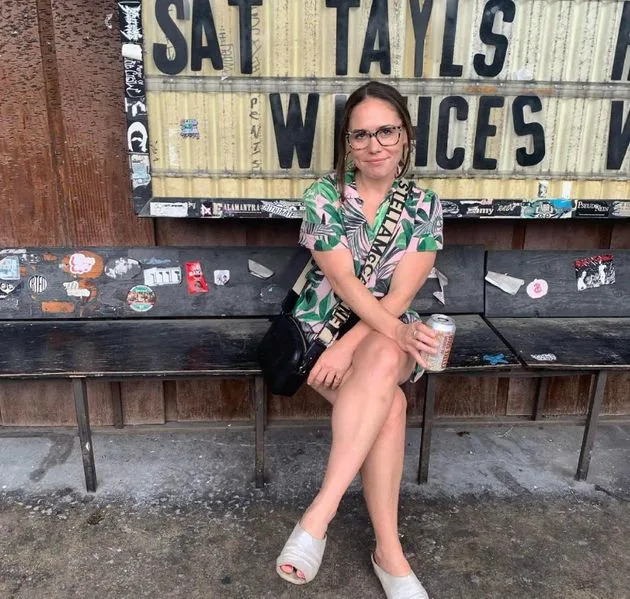
The author at The Nick, a local bar, in Birmingham, Alabama.
In July of 2018, I arrived in Huntsville, Alabama, sight unseen.
My 2009 Honda Accord was packed to the brim with the contents of my Bushwick, New York, apartment, which had started to feel like a distant memory somewhere in the rolling, monotonous beauty of the Smokies. The trunk held garbage bags stuffed with clothing and liquor boxes filled with books. In the backseat was bedding, framed art and a coffee table my uncle made in the 1980s. My plan was to stay for five months ― through the end of the midterm elections ― and then return to the life I had been living in Brooklyn for the better part of a decade.
I had only been down to Alabama once before, several months prior, to volunteer at the Equal Justice Initiative’s opening of its museum dedicated to victims of lynching. It was there that I met Alabama’s Democratic House minority leader, who offered me a job working on the midterms. It was also there, in the Red Roof Inn on Zelda Road, that I picked up a mean case of bedbugs, which left itchy welts across my face and arms that took weeks to disappear.
Now I was headed to meet Alice, a volunteer on the campaign who had offered to put me up for a few nights and rent me an apartment at one of the properties she owned in downtown Huntsville. The rent was $400 per month for a large one bedroom ― less than half of what I had paid for my portion of the dilapidated two-bedroom I’d been renting in Brooklyn.
Alice and her wife lived about 20 minutes outside of Huntsville in Harvest, an unincorporated rural community. Driving around Huntsville, which I had been told would soon be the largest city in Alabama, I wondered Where’s the city part? The sight of cotton fields sent chills down my spine, and by the time I arrived at Alice’s, I was fundamentally questioning my decision to move.
I was not a professional campaign worker. In fact, this was my first job in politics. Until Donald Trump was elected president in 2016, I had been working in book publishing, teaching yoga and generally enjoying the many privileges that my whiteness allowed me. Like so many New York City liberals, that election had been a wakeup call, and I’d committed myself to doing more, to educating myself, to fighting for the rights I’d naively thought were guaranteed.
I’d read myriad think pieces about how we needed to spend more time in those parts of the country that had voted for Trump. But if Hillary Clinton couldn’t even be bothered to go to Wisconsin, did I really need to uproot my life and move to Alabama?
The scene in Harvest, Alabama, outside of Huntsville.
Growing up in New Jersey, I knew about as much about the South as I did about Timbuktu. When I applied to Tulane University, my grandmother, a die-hard New Yorker, said without a hint of sarcasm, “But you know you can’t get a decent education below the Mason-Dixon line.” The bedbugs were surprising to no one ― my decision to move was a shock.
With some trepidation, I let myself into Alice’s house using her keypad and waited for her to come home. The campaign was in full swing, so I occupied the afternoon with calls, fundraising emails and drafting the paperwork for a 501(c)3 tax-exempt organization.
When Alice arrived, we greeted each other cautiously. We’d spoken many times on the phone, mostly about campaign-related business, and her low voice, thick accent and easy demeanor immediately put me at ease. She was understandably more skeptical of me. What was a girl from New Jersey with no prior work experience in politics doing down here in Alabama?
Over dinner and bourbon, we got to know each other. I told her about my family, the guy I was dating and my desire to find more meaningful work. Alice shared her struggle to lift herself out of rural poverty and become the vice president of a major tech company, and the difficulties she’d faced in coming out. We began to develop a friendship.
As part of my Alabama education, Alice pulled out a white board to explain the state’s deepest political divide. On one side she wrote “Alabama.” On the other side she wrote “Auburn,” with a line dividing the two. Under Alabama, she wrote “Roll Tide”; under Auburn, “War Eagle.”
“I don’t get it,” I said. “Why is one team called ‘Alabama’ if both teams are in Alabama? And why is Auburn’s chant ‘War Eagle’ if their mascot is the tigers?”
Alice looked at me like I had two heads.
“What’s not to get?” She asked. “I think you’ve had too much bourbon.”
Football as religion was just one of many cultural discoveries I made over those first months in Alabama, the majority of which could be easily packaged into an early-aughts rom-com. Meat and three’s, Jason Isbell and chatting with people in line at the grocery store were all foreign concepts, and I reveled in their discovery. Well, everything except football.
Alice was my first friend, but I quickly made more, and before long Alabama began to feel like home.
The author on the Edmund Pettus Bridge in Selma, Alabama, where voting rights protesters marched on Bloody Sunday in 1965.
The campaign was busy, but the work felt meaningful. We hoped to capitalize on Doug Jones’ historic Senate win and break the Republican supermajority in the state house ahead of the census and redistricting. Since state lawmakers are responsible for drawing up voting districts, it was crucial that we win in districts across the state where Democrats had not only lost but in many cases had not even run a candidate for many years. Given the state’s history of civil rights organizing and voter suppression, the task felt especially vital.
During the campaign, I visited New York frequently, on both personal and fundraising trips. Each time I came up, I was surprised by how little I missed the city and how eager I was to return to Alabama. The energy and schlep of the city that had energized me throughout my 20s felt draining, and the disdain with which so many Northeasterners treated my new home felt frustrating.
At a fundraising event in lower Manhattan, I told the host about my recent move. He simply responded, “I’m sorry.”
Almost no one I knew had ever visited Alabama, and most seemed to think that the state was populated by illiterate Trump supporters who didn’t wear shoes. The grace that well-meaning liberals offered the Midwest did not extend to a state whose reputation had been solidified during the civil rights movement. Most people I spoke with still associated Alabama with Gov. George Wallace’s proclamation of “segregation forever” and Bull Connor’s assault on peaceful protesters with dogs and fire hoses.
Though Alabama’s brutal, racist history is very much alive and undeniably woven into the fabric of the state, it is far from unique to Alabama. I was consistently surprised by the smugness with which Northeasterners talked about Alabama without any apparent awareness of our own region’s history of racism or, more strikingly, the state’s equally potent history of activism. In sneering at the state as a whole, people seemed not to realize that they were also sneering at activists, organizers and everyday people working to make the best with what little resources they might have.
The joke that Alabamians are shoeless and illiterate is much less funny when you consider the state’s history of racism and lack of job opportunities or public school funding.
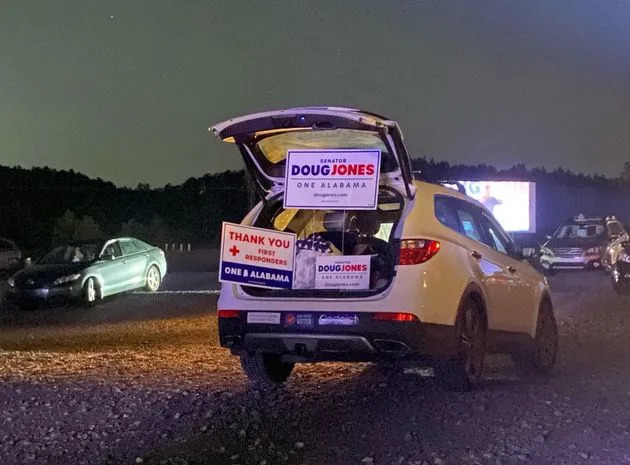
Yard signs at one of Sen. Doug Jones’ COVID-19 drive-in rallies.
Following a brutal midterm loss, I decided to stay in Alabama and work for the state House Democratic Caucus. When the session ended, I went to work for Terri Sewell, our sole Democrat in the U.S. House of Representatives, and then on Doug Jones’ second Senate race. I moved to Birmingham, fell in love and bought a house. I got engaged, started teaching yoga again and completed a master’s program in journalism at the University of Alabama. Before long, 4½ years had passed and I had built a life for myself.
To my friends and family up North, my decision to stay was even more confusing than my initial decision to leave. Then, I had been on a mission with a clear goal and end date. Now, I was just… living?
Gradually, more friends and family came down to visit and started to understand the appeal. The pace down here is slower, the food is excellent and history is everywhere. Politically and culturally, the state is still deeply conservative, but I found a group of friends (largely through political work) whose progressive ideals align with my own. We joke that the only time Alabama makes positive national news is for football, but within challenge and struggle, there is also beauty and culture. Social justice and equity work become more potent in the face of clear and vocal enemies.
As a country, we are still mired in the work of consensus building. We are still deeply and fundamentally divided. Partially, I believe the issue is one of exposure. The echo chambers of social media and online news are further isolating and entrenching people in their beliefs and, despite the commitments many of us made to understanding those with opposing viewpoints, it’s easier to hand-wring with likeminded friends.
Rep. Marjorie Taylor Greene (R-Ga.) recently made headlines for proposing a “national divorce” between red and blue states. Though pundits were quick to ridicule her, it’s a sentiment I’ve often heard in casual conversation with Northern friends on the left. “If the South is going to hold us back from meaningful climate and social progress, why not just let them secede?”
The answer, in simple terms, is that separation hurts those with the least. If creating a fairer, more equitable society is truly what we as progressives care about, then we have a responsibility not to pull away but to lean in.
We’ve seen what leaning in has done in Georgia, but it took Stacey Abrams and many other organizers and activists well over a decade to implement the internal structures that have turned Georgia purple. And still the fight continues. There is still so much important work to be done and so many people fighting to hold on to the ugliness of the past. Dismissing Alabama or the South as a whole does nothing to advance that work; it only confirms to people down here that they have been left behind.
A photo the author took of Rep. John Lewis in Selma, Alabama, a few weeks before he died.
Ellen Gomory is a New Jersey native living in Birmingham, Alabama. She is passionate about storytelling, progressive politics, the Real Housewives and her pug, Eloise.
Trump deregulated railways and banks. He blames Biden for the fallout
David Smith in Washington – March 18, 2023
Photograph: Scott Olson/Getty Images
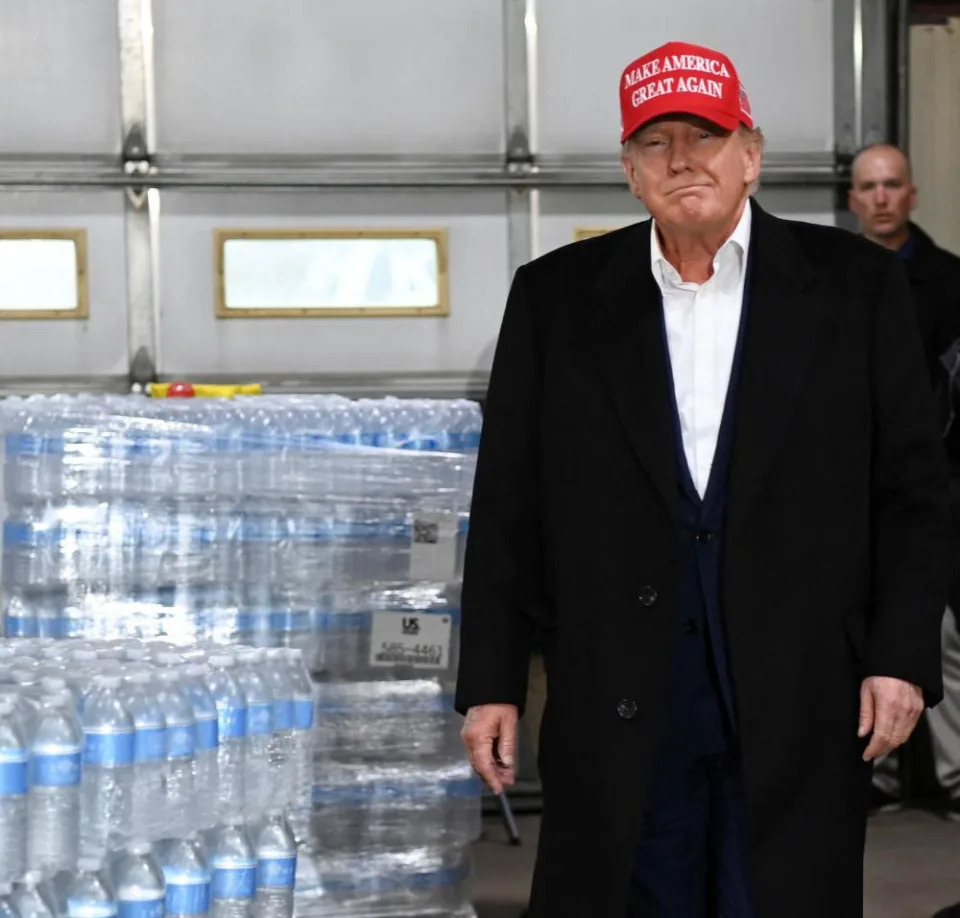
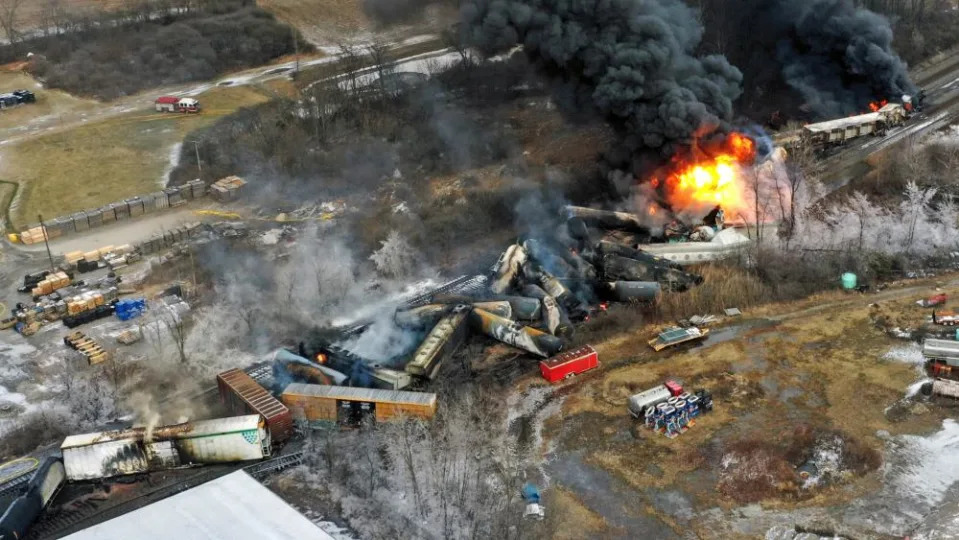
When a fiery train derailment took place on the Ohio-Pennsylvania border last month, Donald Trump saw an opportunity. The former US president visited East Palestine, accused Joe Biden of ignoring the community – “Get over here!” – and distributed self-branded water before dropping in at a local McDonald’s.
Then, when the Silicon Valley Bank last week became the second biggest bank to fail in US history, Trump again lost no time in making political capital. He predicted that Biden would go down as “the Herbert Hoover of the modrrn [sic] age” and predicted a worse economic crash than the Great Depression.
Yet it was Trump himself who, as US president, rolled back regulations intended to make railways safer and banks more secure. Critics said his attacks on the Biden administration offered a preview of a disingenuous presidential election campaign to come and, not for the first time in Trump’s career, displayed a shameless double standard.
“Hypocrisy, thy name is Donald Trump and he sets new standards in a whole bunch of regrettable ways,” said Larry Sabato, director of the Center for Politics at the University of Virginia. “For his true believers, they’re going to take Trump’s word for it and, even if they don’t, it doesn’t affect their support of him.”
The collapse of Silicon Valley Bank on 10 March and of New York’s Signature Bank two days later sent shockwaves through the global banking industry and revived bitter memories of the financial crisis that plunged the US into recession about 15 years ago.
Fearing contagion in the banking sector, the government moved to protect all the banks’ deposits, even those that exceeded the Federal Deposit Insurance Corporation $250,000 limit for each individual account. The cost ran into hundreds of billions of dollars.
Trump with crates of Trump water in East Palestine after a train derailed in Ohio. Photograph: Alan Freed/Reuters
The drama reverberated in Washington, where Trump’s criticism was followed by that of Republicans and conservative media, seeking to blame Biden-driven inflation or, improbably, to Silicon Valley Bank’s socially aware “woke” agenda. Opponents saw this as a crude attempt to deflect from the bank’s risky investments in the bond market and more systemic problems in the sector.
The 2008 financial crisis, triggered by reckless lending in the housing market, led to tough bank regulations during Barack Obama’s presidency. The 2010 Dodd-Frank Act aimed to ensure that Americans’ money was safe, in part by setting up annual “stress tests” that examine how banks would perform under future economic downturns.
But when Trump won election in 2016, the writing was on the wall. Biden, then outgoing vice-president, warned against efforts to undo banking regulations, telling an audience at Georgetown University: “We can’t go back to the days when financial companies take massive risks with the knowledge that a taxpayer bailout is around the corner when they fail.”
But in 2018, with Trump in the White House, Congress slashed some of those protections. Republicans – and some Democrats – voted to raise the minimum threshold for banks subject to the stress tests: those with less than $250bn in assets were no longer required to take part. Many big lenders, including Silicon Valley Bank, were freed from the tightest regulatory scrutiny.
Sabato commented: “The worst example is the bank situation because that is directly tied to Trump and his administration and changes made in bank regulations in 2018. Yes, some Democrats voted for it, but it was overwhelmingly supported by Republicans and by Trump who heralded it as the real solution to future bank woes.”
The minority of Democrats who supported the 2018 law have denied that it can be directly tied to this month’s bank failures, although Bernie Sanders, an independent senator from Vermont, was adamant: “Let’s be clear. The failure of Silicon Valley Bank is a direct result of an absurd 2018 bank deregulation bill signed by Donald Trump that I strongly opposed.”
You do need government to regulate finance … but that point cannot be made if you’ve got Donald Trump inventing reality
Larry Jacobs
Sherrod Brown, a Democratic senator for Ohio who introduced bipartisan legislation to improve rail safety protocols, drew a parallel between the banks’ collapse to rail industry deregulation lobbying that contributed to the East Palestine train disaster. “We see aggressive lobbying like this from banks as well,” he said.
Trump repealed several Barack Obama-era US Department of Transportation rules meant to improve rail safety, including one that required high-hazard cargo trains to use electronically controlled pneumatic brake technology by 2023. This rule would not have applied to the Norfolk Southern train in East Palestine – where roughly 5,000 residents had to evacuate for days – as it was not classified as a high-hazard cargo train.
But the debate around the railway accident and bank failures points to a perennial divide between Democrats, who insist that some regulation is vital to a functioning capitalism, and Republicans, who have long claimed to believe in small government. Steve Bannon, an influential far-right podcaster and former White House chief strategist, framed the Trump agenda as “the deconstruction of the administrative state”.
Antjuan Seawright, a Democratic strategist, said: “The Republican party has gotten by for many years on this idea that less is better. However, we’re now learning in this country that, as America continues to mature, in some cases more is better, and more has to be how we get to better. Otherwise the mistakes can spin out of control and cause generations of people long-term damage.”
A Norfolk Southern freight train that derailed in East Palestine, Ohio, on fire on 4 February 2023. Photograph: Gene J Puskar/AP
Biden called on Congress to allow regulators to impose tougher penalties on the executives of failed banks while Warren and other Democrats introduced legislation to undo the 2018 law and restore the Dodd-Frank regulations. It is likely to meet stiff opposition from the Republican-controlled House of Representatives and even some moderate Democrats.
Biden has also insisted that no taxpayer money will be used to resolve the current crisis, keen to avoid any perception that average Americans are “bailing out” the two banks in a way similar to the unpopular bailouts of the biggest financial firms in 2008.
But Republicans running for the 2024 presidential nomination are already contending that customers will ultimately bear the costs of the government’s actions even if taxpayer funds were not directly used. Nikki Haley, the former governor of South Carolina, said: “Joe Biden is pretending this isn’t a bailout. It is.”
Another potential 2024 contender, Senator Tim Scott, the top Republican on the Senate banking committee, also criticised what he called a “culture of government intervention”, arguing that it incentivises banks to continue risky behavior if they know federal agencies will ultimately rescue them.
Larry Jacobs, director of the Center for the Study of Politics and Governance at the University of Minnesota, said: “This is familiar ideological territory. The battle lines between liberalism and a fake conservatism appear to be playing out here. But the tragedy of the situation is that the liberals are right.
It’s not new that the Republicans will deregulate an industry and then it collapses … look at American political and economic history of the last 50 years
Wendy Schiller
“You do need government to regulate finance and, when you don’t, you get mischief making and bank failures but that point cannot be made if you’ve got Donald Trump inventing reality. He’s demonstrated that facts and position taking don’t matter. It’s an extraordinary political strategy but it’s even more devastating to our whole political system and our media that this could be allowed.”
This poses a huge messaging challenge for Democrats, who after the 2008 financial crisis came up against the Tea Party, a populist movement feeding off economic and racial resentments. Long and winding explanations about the negative impacts of Trump era deregulation are a hard sell compared to the former president’s sloganeering in East Palestine.
Wendy Schiller, a political science professor at Brown University in Providence, Rhode Island, said: “Once again we see that Trump is taking advantage of the Achilles’ heel of the Democratic party by telling voters that the Democrats like big government because it bails out industries and it never provides a bailout for the little guy.”
Democrats’ efforts to point out that Trump was responsible for deregulation are unlikely to cut through, Schiller added.
“Any time it takes more than 10 seconds to explain something, you’re done in politics. This is why Trump has catchy phrases, sound bytes. He understands that all voters see is that rich people made a bad investment and then more rich people are making sure that their money’s available to them within three days, coming off the heels of all the closures during Covid, lost business, lost income, people struggling, inflation.
“Democrats don’t want to call it a bailout but it is a bailout. The high visibility of this bailout smothers anything else the Democrats are doing for the average voter. It’s a perfect issue for the Republicans. It’s not new that the Republicans will deregulate an industry and then it collapses and the Democrats have to save it. Look at American political and economic history of the last 50 years: this is exactly what happens.”
First Republic, SVB, Credit Suisse: The latest banks in trouble and why
Ellen Francis – March 17, 2023
Signage is displayed on an ATM outside of a First Republic Bank branch in Manhattan Beach, California, on March 13, 2023. (Photo by Patrick T. Fallon / AFP) (Photo by PATRICK T. FALLON/AFP via Getty Images) (PATRICK T. FALLON via Getty Images)
First Republic Bank is the fourth bank to face a crisis in the past week, as banking and government officials try to dispel fears of a wider financial meltdown.
Here’s a recap of some of the latest troubled banks, and what this could mean.
– – –
What is First Republic Bank and why did it need rescuing?
It’s a San Francisco lender founded in 1985 that specializes in private banking and wealth management. Its shares plunged earlier this week, raising the specter of a third major U.S. bank implosion in days.
This is why 11 of the largest banks in the United States stepped in with an announcement on Thursday that they would deposit a total of $30 billion into their smaller peer. The bid to stabilize First Republic Bank was coordinated partly by federal officials, The Washington Post reported, and it came on the same day that Treasury Secretary Janet L. Yellen told lawmakers that the U.S. “banking system is sound.”
The intervention, seen as one of the most sweeping in modern U.S. banking history, highlighted concerns in Washington and on Wall Street after the failures of Silicon Valley Bank and Signature Bank last week.
– – –
How did Silicon Valley Bank’s failure spark fears of a global financial crisis?
Financial regulators closed Silicon Valley Bank (SVB), which catered to venture capitalists and start-ups, about a week ago, making it the second-biggest bank failure in U.S. history.
Depositors had rushed to withdraw their money after the firm filed a notice that it was selling billions in assets to shore up its finances. The bank was tightly linked to the tech industry, which is beset by layoffs.
Such a rapid collapse – the first major U.S. banking scare since the crisis that sparked the Great Recession – sent shock waves through the financial system, and it prompted fears that money needed to pay tech workers could be lost or frozen.
That’s because bank deposits in the United States are only insured by the federal government for up to $250,000. At SVB, more than 90 percent of depositors had accounts over that limit – many of them exceeding it by millions of dollars. Businesses couldn’t pay workers if their accounts were frozen or, worse, if SVB hadn’t actually had enough money to cover withdrawals from uninsured accounts.
So last weekend, U.S. officials announced plans to guarantee deposits and to create a new central bank lending program, maintaining assurances that the situation is different from the financial crisis of 2008. The Biden administration also said taxpayers will bear no cost for the backstop, although critics note that the deposit insurance is funded by fees levied on banks, which could, in turn, raise costs for customers.
The Justice Department and the Securities and Exchange Commission have launched investigations into the SVB collapse and the actions of its senior executives, as questions also emerged about regulators missing warning signs.
– – –
Is this connected to the Signature Bank collapse?
Regulators closed Signature Bank, a New York-based financial institution crucial to the cryptocurrency industry, last weekend after a deposit run.
The demise of an institution also enmeshed in the tech industry was prompted in part by the fallout after SVB, New York Gov. Kathy Hochul (D) told a news conference.
Signature Bank served many clients deeply involved in cryptocurrency, which had a sharp drop in value last year, while other depositors included law and real estate firms. Officials extended the same deposit protections to its customers.
– – –
What happened with Credit Suisse this week?
A giant European bank with assets spanning the globe, Credit Suisse had disclosed “material weaknesses” in its financial reporting, before announcing this week it would borrow up to $53.7 billion from Switzerland’s central bank to reinforce its finances.
Credit Suisse’s troubles predated SVB’s collapse, and they’re not caused by the same factors that brought down the U.S. banks. But the failure of SVB spooked markets, and the Swiss bank’s announcements made investors fearful of a broader contagion.
The liquidity lifeline to Credit Suisse from the Swiss central bank – which Reuters described as the first one taken by a major global bank since 2008 – appeared to calm European markets in the immediate aftermath of the announcement.
The Washington Post’s Jeff Stein, Pranshu Verma and Adela Suliman contributed to this report.
U.S. grapples with forces unleashed by Iraq invasion 20 years later
Arshad Mohammed and Jonathan Landay – March 16, 2023
U.S. grapples with forces unleashed by Iraq invasion 20 years later
WASHINGTON (Reuters) – From an empowered Iran and eroded U.S. influence to the cost of keeping U.S. troops in Iraq and Syria to combat Islamic State fighters, the United States still contends with the consequences of invading Iraq 20 years ago, current and former officials say.
Then-U.S. President George W. Bush’s 2003 decision to oust Saddam Hussein by force, the way limited U.S. troop numbers enabled ethnic strife and the eventual 2011 U.S. pullout have all greatly complicated U.S. policy in the Middle East, they said.
The end of Saddam’s minority Sunni rule and replacement with a Shi’ite majority government in Iraq freed Iran to deepen its influence across the Levant, especially in Syria, where Iranian forces and Shi’ite militias helped Bashar al-Assad crush a Sunni uprising and stay in power.
The 2011 withdrawal of the U.S. troops from Iraq left a vacuum that Islamic State (ISIS) militants filled, seizing roughly a third of Iraq and Syria and fanning fears among Gulf Arab states that they could not rely on the United States.
Having withdrawn, former U.S. President Barack Obama in 2014 sent troops back to Iraq, where about 2,500 remain, and in 2015 he deployed to Syria, where about 900 troops are on the ground. U.S. forces in both countries combat Islamic State militants, who are also active from North Africa to Afghanistan.
“Our inability, unwillingness, to put the hammer down in terms of security in the country allowed chaos to ensue, which gave rise to ISIS,” said former deputy secretary of state Richard Armitage, faulting the U.S. failure to secure Iraq.
Armitage, who served under Republican Bush when the United States invaded Iraq, said the U.S. invasion “might be as big a strategic error” as Hitler’s invasion of the Soviet Union in 1941, which helped bring about Germany’s World War Two defeat.
MASSIVE COSTS
The costs of U.S. involvement in Iraq and Syria are massive.
According to estimates published this week by the “Costs of War” project at Brown University, the U.S. price tag to date for the wars in Iraq and Syria comes to $1.79 trillion, including Pentagon and State Department spending, veterans’ care and the interest on debt financing the conflicts. Including projected veterans’ care through 2050, this rises to $2.89 trillion.
The project puts U.S. military deaths in Iraq and Syria over the past 20 years at 4,599 and estimates total deaths, including Iraqi and Syrian civilians, military, police, opposition fighters, media and others at 550,000 to 584,000. This includes only those killed as a direct result of war but not estimated indirect deaths from disease, displacement or starvation.
U.S. credibility also suffered from Bush’s decision to invade based on bogus, exaggerated and ultimately erroneous intelligence about Iraqi weapons of mass destruction (WMD).
John Bolton, a war advocate who served under Bush, said even though Washington made mistakes – by failing to deploy enough troops and administering Iraq instead of quickly handing over to Iraqis – he believed removing Saddam justified the costs.
“It was worth it because the decision was not simply: ‘Does Saddam pose a WMD threat in 2003?'” he said. “Another question was: ‘Would he pose a WMD threat five years later?’ To which I think the answer clearly was ‘yes.'”
“The worst mistake made after the overthrow of Saddam … was withdrawing in 2011,” he added, saying he believed Obama wanted to pull out and used the inability to get guarantees of immunity for U.S. forces from Iraq’s parliament “as an excuse.”
‘ALARM BELLS RINGING … IN THE GULF’
Ryan Crocker, who served as U.S. ambassador in Iraq, said the 2003 invasion did not immediately undermine U.S. influence in the Gulf but the 2011 withdrawal helped push Arab states to start hedging their bets.
In the latest example of waning U.S. influence, Iran and Saudi Arabia agreed on Friday to re-establish relations after years of hostility in a deal brokered by China.
“We just decided we didn’t want to do this stuff anymore,” Crocker said, referring to the U.S. unwillingness to keep spending blood and treasure securing Iraq. “That began … with President Obama declaring … he was going to pull all forces out.”
“These were U.S. decisions not forced by a collapsing economy, not forced by demonstrators in the street,” he said. “Our leadership just decided we didn’t want to do it any more. And that started the alarm bells ringing … in the Gulf.”
Jim Steinberg, a deputy secretary of state under Obama, said the war raised deep questions about Washington’s willingness to act unilaterally and its steadfastness as a partner.
“The net result … has been bad for U.S. leverage, bad for U.S. influence, bad for our ability to partner with countries in the region,” he said.
A debate still rages among former officials over Obama’s decision to withdraw, tracking a timeline laid out by the Bush administration and reflecting a U.S. inability to secure immunities for U.S. troops backed by the Iraqi parliament.
Bolton’s belief that removing Saddam was worth the eventual cost is not held by many current and former officials.
Asked the first word that came to mind about the invasion and its aftermath, Armitage replied “FUBAR,” a military acronym which, politely, stands for “Fouled up beyond all recognition.”
“Disaster,” said Larry Wilkerson, former Secretary of State Colin Powell’s chief of staff.
“Unnecessary,” said Steinberg.
(This story has been refiled to fix the spelling of former U.S. President Barack Obama’s name in paragraph 5)
(Reporting By Arshad Mohammed and Jonathan Landay; Additional reporting by Idrees Ali; Editing by William Maclean)