Putin’s Beast That Would Now Devour Him

The New York Times

Putin’s Beast That Would Now Devour Him

Roger Cohen – June 25, 2023

FILE – Yevgeny Prigozhin, the owner of the Wagner Group military company, arrives during a funeral ceremony at the Troyekurovskoye cemetery in Moscow, Russia, on April 8, 2023. On Friday, June 23, Prigozhin made his most direct challenge to the Kremlin yet, calling for an armed rebellion aimed at ousting Russia’s defense minister. The security services reacted immediately by calling for his arrest. (AP Photo/File) (ASSOCIATED PRESS)More

MOSCOW — Over the course of a month I spent in the Russian capital, the red-and-black billboards of Yevgeny Prigozhin’s Wagner paramilitary group multiplied. “Join the team of victors!” they said, beneath an image of menacing mercenaries in balaclavas and masks, only their eyes visible.

A possible implication was that the Russian forces on the other mushrooming Moscow billboards — regular soldiers recruited by the Ministry of Defense pictured above slogans like “Real Work!” or “Be a hero!” — were the losers of Russian President Vladimir Putin’s reckless gamble in Ukraine.

As heedless Muscovites headed for their offices and gyms, their Italian or Japanese restaurants, their bars and nightclubs, this military recruitment drive on two fronts offered the sole image in the capital of the Russian scramble to contain the fallout, and hide the full impact, of the invasion that began 16 months ago. Easier to order a latte than dwell on lost lives in Mariupol, Ukraine.

Now, with his blunt depiction of that invasion as a “racket” that “wasn’t needed to demilitarize or denazify Ukraine,” and his apparently short-lived armed uprising, Prigozhin has played on one of Putin’s worst fears: division and rebellion, with tanks on the streets, as in the mayhem of the 1990s from which Putin, a former KGB officer, abruptly emerged as the inscrutable president and Mr. Stability.

Since then, over 23 years, Putin has steadily consolidated his power, using his wars that began in Chechnya to cement nationalist sentiment, terrorizing the opposition to the point that dissent has become a crime, and shaping a wildly unequal economy around a coterie of hand-picked oligarchs. He has reverted Russia to type as an autocratic police state under an all-powerful latter-day czar after its brief but heady post-Communist flirtation with a freer society.

“The system Putin built is very stable,” a Western ambassador in Moscow told me this month. “But if I woke up one morning and saw tanks on the street, I would not be totally astonished.”

This surprising disclosure, uttered under customary diplomatic anonymity, is indicative of the close-knit secrecy of Putin’s inner circle that has made Kremlinology during the war in Ukraine as arduous as at the height of the Cold War. There are very few tea leaves to read. Russia, smothered in propaganda and fear, is opaque.

At the same time, even as the government has gone to great lengths, and expense, to maintain an illusion of business as usual, the placid surface Russia has until now presented during the war masks unease.

In muttered expressions across the country of bewilderment and anger, and not least in Prigozhin’s foul-mouthed diatribes against what he sees as the craven incompetence and half-measures of Russia’s generals, lay the seeds of those tanks in the ambassador’s prescient imaginings.

Russia tends not to evolve; it lurches, as in 1917 or 1991, and it circles about. Putin has perpetuated old habits in deploying double-think. He prefers to “forget whatever it was necessary to forget,” and then restore “memory again at the moment when it was needed,” as George Orwell put it.

Hence Putin’s invocation of 1917 in his brief speech Saturday, a time when internal fracture led to the nascent Soviet republic losing significant population and vast swaths of agricultural land in the Treaty of Brest-Litovsk the next year. Therefore, Putin vowed, he would resist the current “deadly threat” of “mutiny” through “brutal” actions.

Suddenly the glorious Soviet victory over Nazis and Fascists of “The Great Patriotic War” of 1941 to 1945, which has been the drumbeat of the quixotic Ukrainian assault, was set aside by Putin in favor of a crushing historical defeat.

He wields the past to his ends, even as he has very little to say about the future.

Nobody, for example, knows what Putin would define as victory in his “special military operation” in Ukraine. Other mysteries abound. The question, for many months now, has been how Prigozhin, a former convict who started in hot dogs in St. Petersburg and went on to provide catering for the Kremlin, has survived.

If the family of a Russian child drawing a picture of a Ukrainian flag risks prison in Putin’s Russia, how could this loudmouth in battle fatigues get away with suggesting that Sergei Shoigu, the defense minister, has enabled genocide, among a torrent of other accusations and insults?

I heard many answers across Russia. But perhaps the most fundamental lay in the recently dug grave of Boris Batsev, aged 42, a railroad worker who was killed six months ago near Bakhmut in eastern Ukraine, leaving a wife and two children.

Brightly colored plastic roses and carnations were piled high around his gravestone, beneath the red-and-gold Wagner flag, in Siberia, near the town of Talofka, thousands of miles from the Ukrainian front.

“Blood, honor, motherland, bravery,” a Wagner inscription said. A mild breeze blew across the Troetskoe cemetery as agents of the Federal Security Service, or FSB, looked on from a vehicle that had abruptly appeared nearby.

With Russian forces often bereft of essential equipment and sometimes operating as a human wave, Putin has needed flesh for the meat grinder. Prigozhin, recruiting in Russian prisons with offers of amnesty and big payouts, could provide that, from as far away as Siberia. He has been too effective and useful to toss aside.

In the long battle for the charred ruins of the eastern Ukrainian city of Bakhmut alone, Prigozhin has said Wagner lost 20,000 troops.

The use of Prigozhin, others suggested, was the apotheosis of Putin’s modus operandi of dividing his subordinates, shifting influence in recent years from Sergey Lavrov, the foreign minister, to Shoigu as the militarization of Russian society proceeded, only to undermine the defense minister through Prigozhin.

“Putin likes competition, he has liked putting pressure on Shoigu, and enjoyed the theater,” Dmitri Muratov, the Nobel Prize-winning editor of the shuttered independent newspaper Novaya Gazeta, told me in an interview. “Meanwhile, the elite around Putin don’t give a damn for their country, they’re just afraid for their lives.”

Prigozhin has been useful in other ways for Putin. Through Wagner, he has helped project a ruthless and lawless form of Russian power across several African countries, including Mali and the Central African Republic. He was also a way, in the midst of an utterly misjudged war, for the Russian leader to play the moderate, to suggest that if it was not for him, things could be even worse and become as unstable as Prigozhin’s temper.

Finally, Prigozhin became an increasingly popular mouthpiece for the widespread resentment of moneyed Russian elites, oblivious to the cost and suffering of the war in Ukraine. This was cathartic, given accumulated Russian frustrations, and perhaps useful to Putin in that sense.

But the paramilitary leader also developed, through adept use of social media and compelling rhetoric over the past nine months, into a true national figure, with a notoriety that has made him the object of much debate and speculation about a possible political future.

Putin has now awakened to this danger, even as Prigozhin may have overplayed his hand.

The Russian president has spoken of an “armed rebellion,” and a former commander of Russian troops in Ukraine has spoken of a “military coup,” but Prigozhin’s description of his actions as a “march for justice” will have resonated with some, perhaps many, Russians.

These sentiments will not disappear overnight, even if, according to Dmitry Peskov, the Kremlin spokesperson, Prigozhin has now ceased moving military convoys toward Moscow and agreed to go to Belarus in exchange for charges being dropped against him and his fighters.

To what degree the whole back-and-forth was orchestrated theater, and to what degree a genuine confrontation, seems unlikely to be clarified soon, if ever.

What is clear is that Putin has deep reserves of support. “The West told Russia that all it has the right to do is yield,” Petr Tolstoy, the deputy chair of the Duma, the lower house of the Federal Assembly of Russia, said in an interview. “Putin said ‘Enough!’ and that ensures him of popular backing.”

The president’s control of the country’s military, security and intelligence apparatus is such that the biggest direct challenge to his rule in more than two decades appears to have been repulsed in short order, even if Putin has suffered the acute embarrassment of allowing a man he called a traitor to get off scot free the day he made that accusation.

It had been a long time since Putin blinked in this way.

There will be reverberations. Very little since the Ukraine invasion on Feb. 24 of last year has gone according to plan for Putin. Hiding a war that has taken 100,000 Russian lives, according to U.S. diplomats in Moscow, has a cost. The exercise of not leveling with the Russian people contributed to Prigozhin’s fury, as was made clear in his repeated statements that the defense establishment was lying.

Prigozhin has styled himself as the man who delivers the hard truth. In the Belgorod region on Russia’s border with Ukraine, which I visited earlier this month, he was infuriated that Putin and his state media would prefer to forget the devastation through cross-border Ukrainian shelling of Shebekino, a Russian town of 40,000 people.

In the city of Belgorod, in a vast improvised dormitory for the displaced at an indoor cycle track, I met Aleksandr Petrianko, 62, half-paralyzed by a stroke.

“Could Mr. Prigozhin have saved Shebekino?” I asked him.

“I don’t know,” he said in a trembling voice. “I hope he is not killed before his time.”
Major Cuts to Social Security Are Back on the Table — What’s Being Proposed Now?

Go Banking Rates

Major Cuts to Social Security Are Back on the Table — What’s Being Proposed Now?

 
Vance Cariaga – June 22, 2023

Shutterstock / Shutterstock

A group of Republican lawmakers aims to balance the federal budget and slash government spending by targeting programs like Social Security — and some seniors could see a major reduction in lifetime benefits if the plan makes it into law.

See: I Lost $400K of My Retirement Savings in a Roth 401(k) — If You’re Not Careful, You Could, Too
Find: 3 Ways To Recession-Proof Your Retirement

The proposal was unveiled June 14 by U.S. House conservatives, Bloomberg reported. One of its main features is to raise the full retirement age (FRA) at which seniors are entitled to the full benefits they are due.

The 176-member House Republican Study Committee (RSC) approved a fiscal blueprint that would gradually increase the FRA to 69 years old for seniors who turn 62 in 2033. The current full retirement age is 66 or 67, depending on your birth year. For all Americans born in 1960 or later, the FRA is 67.

As Bloomberg noted, workers expecting an earlier retirement benefit will see lifetime payouts reduced if the full retirement age is raised. Those payouts could be drastically reduced for seniors who claim benefits at age 62, when you are first eligible.

Lawmakers on both sides of the political aisle have been working to come up with a fix for Social Security before the program’s Old Age and Survivors Insurance (OASI) Trust Fund runs out of money. That could happen within the next decade or so. When it does, Social Security will be solely reliant on payroll taxes for funding — and those taxes only cover about 77% of current benefits.

While most Democrats want to boost Social Security through higher payroll taxes or reductions to benefits for wealthy Americans, the GOP has largely focused on paring down or privatizing the program.

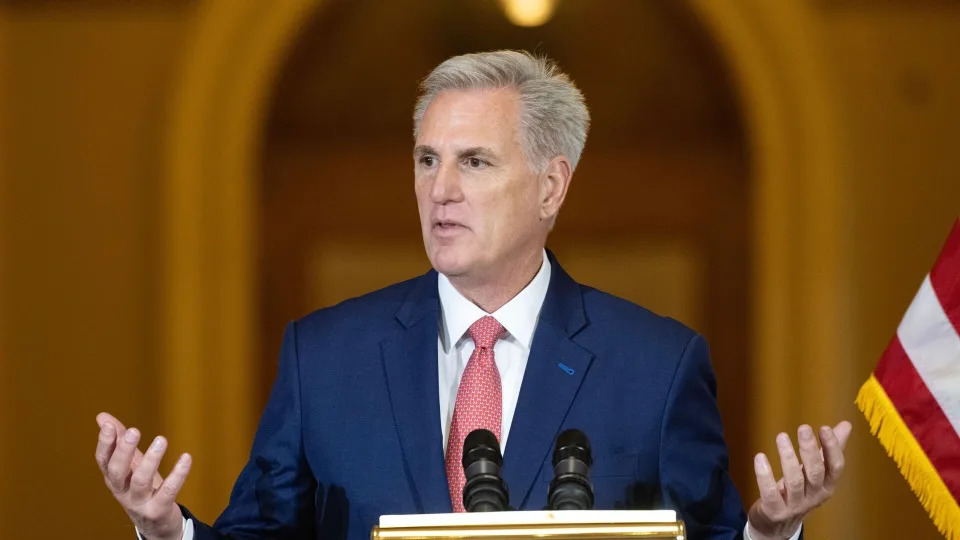
As previously reported by GOBankingRates, House Speaker Kevin McCarthy (R-Calif.) recently told Fox News that this month’s debt limit bill was only “the first step” in a broader Republican agenda that includes further cuts.

“This isn’t the end,” McCarthy said. “This doesn’t solve all the problems. We only got to look at 11% of the budget to find these cuts. We have to look at the entire budget. … The majority driver of the budget is mandatory spending. It’s Medicare, Social Security, interest on the debt.”

As Bloomberg noted, Republicans argue that failing to change Social Security could lead to a 23% benefit cut once the trust fund is depleted. Raising the retirement age is a way to soften the immediate impact. The RSC said its proposal would balance the federal budget in seven years by cutting some $16 trillion in spending and $5 trillion in taxes.

“The RSC budget would implement common-sense policies to prevent the impending debt disaster, tame inflation, grow the economy, protect our national security, and defund [President Joe] Biden’s woke priorities,” U.S. Rep. Ben Cline (R-Va.), chairman of the group’s Budget and Spending Task Force, told Roll Call.

Democrats were quick to push back against the proposal.

“Budget Committee Democrats will make sure every American family knows that House Republicans want to force Americans to work longer for less, raise families’ costs, weaken our nation, and shrink our economy — all while wasting billions of dollars on more favors to special interests and handouts to the ultra-wealthy,” U.S. Rep. Brendan Boyle, (D-Pa.), the Budget Committee’s top Democrat, said in a statement.

Social Security: No Matter Your Age, Do Not Claim Benefits Until You Reach This Milestone
Retirement Savings: Here’s How Much Cash Baby Boomers Need To Retire in the Next 5 Years

Meanwhile, White House Press Secretary Karine Jean-Pierre issued a statement saying the RSC budget “amounts to a devastating attack on Medicare, Social Security, and Americans’ access to health coverage and prescription drugs.”

Although the proposal might make it through the GOP-led House, it’s unlikely to become law – at least while Biden is still president. Even if a bill somehow got approved by the Democrat-controlled Senate, Biden would almost certainly veto it.

Titanic submersible: 5 passengers on missing sub likely dead following ‘catastrophic implosion’

Yahoo! News

Titanic submersible: 5 passengers on missing sub likely dead following ‘catastrophic implosion’

Christopher Wilson – June 22, 2023

The Coast Guard announced Thursday that it believed the five passengers who disappeared while attempting to explore the Titanic shipwreck were likely lost due to a “catastrophic implosion” of their vessel.

U.S. Coast Guard Rear Adm. John Mauger announced at a press conference that on Thursday morning, five major pieces of debris had been found on the seafloor about 1,600 feet from the site of the Titanic, a finding “consistent with the catastrophic loss of the pressure chamber.” Mauger said they then notified the families and offered their condolences.

Shortly before Mauger’s comments, the company running the expedition, OceanGate, announced that the five passengers “have sadly been lost.”

OceanGate's tourist submersible vessel.
OceanGate’s tourist submersible vessel. (OceanGate/Handout via Getty Images)

“These men were true explorers who shared a distinct spirit of adventure, and a deep passion for exploring and protecting the world’s oceans,” read the statement. “Our hearts are with these five souls and every member of their families during this tragic time.”

The grim announcement came four days after a 21-foot tourist submersible named the Titan was reported missing approximately 900 miles east of Cape Cod, triggering a massive search to find the vessel before its occupants ran out of oxygen.

The Titan had been projected to run out of its 96-hour supply of breathable air on Thursday morning. And because the door was bolted from the outside, those inside would not have been able to open it on their own even if they were able to reach the surface. Asked about the possibility of recovering remains, Mauger called the conditions “unforgiving” and said there weren’t prospects for doing so at this time.

A missing sub and extensive search
The five occupants of the Titan and the Titan.
The five occupants of the Titan: Stockton Rush, Hamish Harding, Shahzada Dawood, Paul-Henri Nargeolet and Suleman Dawood, and the Titan. (Shannon Stapleton/Reuters; Courtesy of Jannicke Mikkelsen via Reuters; Courtesy of Engro Corporation Limited via Reuters; J. Sagat/AFP via Getty Images; Courtesy of Engro Corporation Limited via Reuters; OceanGate/Handout/Anadolu Agency via Getty Images)More

The Titan, operated by OceanGate, a private exploration company based in Everett, Wash., launched early Sunday morning to tour the Titanic wreckage with five passengers on board: OceanGate CEO Stockton Rush, 61; British billionaire and explorer Hamish Harding, 58; Pakistani businessman Shahzada Dawood, 48, and his 19-year-old son, Suleman; and Paul-Henri Nargeolet, a 77-year-old French explorer.

The Polar Prince, a Canadian research vessel and support ship for the expedition, lost contact with the submersible about an hour and 45 minutes after launch. OceanGate reported the Titan missing on Sunday evening, triggering a massive international search effort led by the U.S. Coast Guard and assisted by the U.S. Air Force, Navy, Air National Guard, Royal Canadian Navy and Canadian Coast Guard.

Read more on Yahoo News

A Canadian P-3 aircraft equipped with sonar listening equipment detected underwater “banging noises” on Tuesday and Wednesday, raising hopes that the Titan crew might be found alive. But Coast Guard officials cautioned at the time they were not sure what caused the noises even while remaining adamant that the search remain in the rescue phase.

“This is a search and rescue mission, 100%,” Frederick said Wednesday. “We are smack dab in the middle of search and rescue, and we’ll continue to put every available asset that we have in an effort to find the Titan and the crew members.”

Troubling signs
OceanGate's tourist submersible on the surface of the sea.
OceanGate’s tourist submersible on the surface of the sea. (OceanGate/Handout/Anadolu Agency via Getty Images)

Founded in 2009, OceanGate charges up to $250,000 per person for a chance to visit the remnants of the Titanic, which sank in 1912 on its inaugural trip from England to New York. While Rush stated last year that the submersible had made it down to the wreckage a dozen times over the last two years, there had been a number of red flags about the operation. In 2018, more than three dozen oceanographers and deep-sea explorers wrote a letter to OceanGate warning that its “experimental” approach could lead to “catastrophic” consequences for its Titanic dives.

A 10-minute segment from CBS News Sunday Morning in November 2022 foreshadowed the tragedy. Journalist David Pogue discussed some of the paperwork he had to sign in an almost humorous tone, reading, “This experimental vessel has not been approved or certified by any regulatory body, and could result in physical injury, emotional trauma, or death,” before adding, “Where do I sign?”

In the 2022 piece, Pogue noted that while he was on the expedition the submersible never made it to the wreck site because of communications errors. He quoted one passenger as saying, “We were lost for two and a half hours.” Pogue’s own scheduled trip to the Titanic was canceled due to poor weather, and a back-up excursion to the trip to a Continental Shelf was called off due to technical difficulties after 37 feet of descent.

In a tweet Monday, Pogue said the craft was, in fact, lost for five hours and that adding an emergency locator beacon was discussed. Pogue added, “They could still send short texts to the sub, but did not know where it was. It was quiet and very tense, and they shut off the ship’s internet to prevent us from tweeting.” The company cited the need to keep “all channels open” as a reason for cutting off internet access, he said.

Another former passenger on the Titan told the BBC on Tuesday said he had to sign a “death waiver” that “lists one way after another that you could die on the trip,” including “[mentioning] death three times on page one, and so it’s never far from your mind.”

Trump Melts Down as DOJ Turns Over Evidence It Plans to Use Against Him

Rolling Stone

Trump Melts Down as DOJ Turns Over Evidence It Plans to Use Against Him

Ryan Bort – June 22, 2023

Donald Trump fired off a series of desperate pleas on Truth Social, including multiple appeals to Congress to bail him out, hours after news broke that the Justice Department had turned over the first batch of evidence it plans to use against him. The former president was indicted earlier this month on charges related to his handling of classified material after leaving the White House.

“CONGRESS, PLEASE INVESTIGATE THE POLITICAL WITCH HUNTS AGAINST ME CURRENTLY BEING BROUGHT BY THE CORRUPT DOJ AND FBI, WHO ARE TOTALLY OUT OF CONTROL,” Trump wrote Thursday morning.

The former president also dusted off the idea that the DOJ framed him by planting the classified material at Mar-a-Lago — despite the fact that he’s claimed repeatedly that he somehow declassified the material before bringing it to Florida himself. “Congress will hopefully now look at the ever continuing Witch Hunts and ELECTION INTERFERENCE against me on perfectly legal Boxes, where I have no doubt that information is being secretly ‘planted’ by the scoundrels in charge,” he wrote in another post before griping about his other legal woes.

Trump’s indictment is damning, with the DOJ alleging that the former president knowingly took classified documents to Mar-a-Lago, stored them in unsecure locations, and then conspired to lie to authorities about what he was hoarding while suggesting the material should be destroyed. The indictment also outlines a recording it obtained featuring Trump bragging about having a “secret” plan against Iran.

The evidence the DOJ turned over on Wednesday includes more recordings of the former president, described as “interviews” recorded with his consent. It’s unclear what is on the additional tapes. The evidence also includes grand-jury witness testimony — which means Trump now knows who testified against him and what they said — as well as material obtained through subpoenas.

Trump, understandably, seems pretty nervous. “THIS CONTINUING SAGA IS RETRIBUTION AGAINST ME FOR WINNING AND, EVEN MORE IMPORTANTLY TO THEM, ELECTION INTERFERENCE REGARDING THE 2024 PRESIDENTIAL ELECTION,” he added on Thursday morning. “IT WILL BE THERE UPDATED FORM OF RIGGING OUR MOST IMPORTANT ELECTION. LOOK AT THE POLLS – THEY CAN’T BEAT ME (MAGA!) AT THE BALLOT BOX, THE ONLY WAY THEY CAN WIN IS TO CHEAT. STOP THEM NOW!”

Trump pleaded not guilty to all of the charges against him. The DOJ has asked for a speedy trial, and Judge Aileen Cannon earlier this week told both sides to file all pretrial motions by July 24 while slating the trial to begin on Aug. 14. Trump’s team will almost certainly move to delay the start date as long as possible — maybe even until he can retake the White House and appoint an attorney general who will drop the case.

Russia Sought to Kill Defector in Florida

The New York Times

Russia Sought to Kill Defector in Florida

Ronen Bergman, Adam Goldman and Julian E. Barnes – June 19, 2023

Photographs of Sergei Skripal, a former colonel in Russia’s military intelligence service who was convicted in 2006 for selling secrets to British intelligence, in Moscow, Aug. 28, 2018. (Sergey Ponomarev/The New York Times)

As President Vladimir Putin of Russia has pursued enemies abroad, his intelligence operatives now appear prepared to cross a line that they previously avoided: trying to kill a valuable informant for the U.S. government on American soil.

The clandestine operation, seeking to eliminate a CIA informant in Miami who had been a high-ranking Russian intelligence official more than a decade earlier, represented a brazen expansion of Putin’s campaign of targeted assassinations. It also signaled a dangerous low point even between intelligence services that have long had a strained history.

“The red lines are long gone for Putin,” said Marc Polymeropoulos, a former CIA officer who oversaw operations in Europe and Russia. “He wants all these guys dead.”

The assassination failed, but the aftermath in part spiraled into tit-for-tat retaliation by the United States and Russia, according to three former senior U.S. officials who spoke on the condition of anonymity to discuss aspects of a plot meant to be secret and its consequences. Sanctions and expulsions, including of top intelligence officials in Moscow and Washington, followed.

The target was Aleksandr Poteyev, a former Russian intelligence officer who disclosed information that led to a yearslong FBI investigation that in 2010 ensnared 11 spies living under deep cover in suburbs and cities along the East Coast. They had assumed false names and worked ordinary jobs as part of an ambitious attempt by the SVR, Russia’s foreign intelligence agency, to gather information and recruit more agents.

In keeping with an Obama administration effort to reset relations, a deal was reached that sought to ease tensions: Ten of the 11 spies were arrested and expelled to Russia. In exchange, Moscow released four Russian prisoners, including Sergei Skripal, a former colonel in the military intelligence service who was convicted in 2006 for selling secrets to Britain.

The bid to assassinate Poteyev is revealed in the British edition of the book “Spies: The Epic Intelligence War Between East and West,” to be published by an imprint of Little, Brown on June 29. The book is by Calder Walton, a scholar of national security and intelligence at Harvard. The New York Times independently confirmed his work and is reporting for the first time on the bitter fallout from the operation, including the retaliatory measures that ensued once it came to light.

According to Walton’s book, a Kremlin official asserted that a hit man, or a Mercader, would almost certainly hunt down Poteyev. Ramón Mercader, an agent of Josef Stalin’s, slipped into Leon Trotsky’s study in Mexico City in 1940 and sank an ice ax into his head. Based on interviews with two U.S. intelligence officials, Walton concluded the operation was the beginning of “a modern-day Mercader” sent to assassinate Poteyev.

The Russians have long used assassins to silence perceived enemies. One of the most celebrated at SVR headquarters in Moscow is Col. Grigory Mairanovsky, a biochemist who experimented with lethal poisons, according to a former intelligence official.

Putin, a former KGB officer, has made no secret of his deep disdain for defectors among the intelligence ranks, particularly those who aid the West. The poisoning of Skripal at the hands of Russian operatives in Salisbury, Britain, in 2018 signaled an escalation in Moscow’s tactics and intensified fears that it would not hesitate to do the same on American shores.

The attack, which used a nerve agent to sicken Skripal and his daughter, prompted a wave of diplomatic expulsions across the world as Britain marshaled the support of its allies in a bid to issue a robust response.

The incident set off alarm bells inside the CIA, where officials worried that former spies who had relocated to the United States, like Poteyev, would soon be targets.

Putin had long vowed to punish Poteyev. But before he could be arrested, Poteyev fled to the United States, where the CIA resettled him under a highly secretive program meant to protect former spies. In 2011, a Moscow court sentenced him in absentia to decades in prison.

Poteyev had seemed to vanish, but at one point, Russian intelligence sent operatives to the United States to find him, though its intentions remained unclear. In 2016, the Russian news media reported that he was dead, which some intelligence experts believed might be a ploy to flush him out. Indeed, Poteyev was very much alive, living in the Miami area.

That year, he obtained a fishing license and registered as a Republican so he could vote, all under his real name, according to state records. In 2018, a news outlet reported Poteyev’s whereabouts.

The CIA’s concerns were not unwarranted. In 2019, the Russians undertook an elaborate operation to find Poteyev, forcing a scientist from Oaxaca, Mexico, to help.

The scientist, Hector Alejandro Cabrera Fuentes, was an unlikely spy. He studied microbiology in Kazan, Russia, and later earned a doctorate in the subject from the University of Giessen in Germany. He was a source of pride for his family, with a history of charitable work and no criminal past.

But the Russians used Fuentes’ partner as leverage. He had two wives: a Russian living in Germany and another in Mexico. In 2019, the Russian wife and her two daughters were not allowed to leave Russia as they tried to return to Germany, court documents say.

That May, when Fuentes traveled to visit them, a Russian official contacted him and asked to see him in Moscow. At one meeting, the official reminded Fuentes that his family was stuck in Russia and that maybe, according to court documents, “we can help each other.”

A few months later, the Russian official asked Fuentes to secure a condo just north of Miami Beach, where Poteyev lived. Instructed not to rent the apartment in his name, Fuentes gave an associate $20,000 to do so.

In February 2020, Fuentes traveled to Moscow, where he again met with the Russian official, who provided a description of Poteyev’s vehicle. Fuentes, the Russian said, should find the car, obtain its license plate number and take note of its physical location. He advised Fuentes to refrain from taking pictures, presumably to eliminate any incriminating evidence.

But Fuentes botched the operation. Driving into the complex, he tried to bypass its entry gate by tailgating another vehicle, attracting the attention of security. When he was questioned, his wife walked away to photograph Poteyev’s license plate.

Fuentes and his wife were told to leave, but security cameras captured the incident. Two days later, he tried to fly to Mexico, but U.S. Customs and Border Protection officers stopped him and searched his phone, discovering the picture of Poteyev’s vehicle.

After he was arrested, Fuentes provided details of the plan to American investigators. He believed the Russian official he had been meeting worked for the FSB, Russia’s internal security service. But covert operations overseas are usually run by the SVR, which succeeded the KGB, or the GRU, Russia’s military intelligence agency.

One of the former officials said Fuentes, unaware of the target’s significance, was merely gathering information for the Russians to use later.

Fuentes’ lawyer, Ronald Gainor, declined to comment.

The plot, along with other Russian activities, elicited a harsh response from the U.S. government. In April 2021, the United States imposed sanctions and expelled 10 Russian diplomats, including the chief of station for the SVR, who was based in Washington and had two years left on his tour, two former U.S. officials said. Throwing out the chief of station can be incredibly disruptive to intelligence operations, and agency officials suspected that Russia was likely to seek reprisal on its American counterpart in Moscow, who had only weeks left in that role, the officials said.

“We cannot allow a foreign power to interfere in our democratic process with impunity,” President Joe Biden said at the White House in announcing the penalties. He made no mention of the plot involving Fuentes.

Sure enough, Russia banished 10 American diplomats, including the CIA’s chief of station in Moscow.

Repub’s just can’t keep their hands off Social Security: Major Cuts to Social Security Are Back on the Table — What’s Being Proposed Now?

Go BankingRates

Major Cuts to Social Security Are Back on the Table — What’s Being Proposed Now?

Vance Cariaga – June 16, 2023

Shutterstock / Shutterstock

A group of Republican lawmakers aims to balance the federal budget and slash government spending by targeting programs like Social Security — and some seniors could see a major reduction in lifetime benefits if the plan makes it into law.

The proposal was unveiled June 14 by U.S. House conservatives, Bloomberg reported. One of its main features is to raise the full retirement age (FRA) at which seniors are entitled to the full benefits they are due.

The 176-member House Republican Study Committee (RSC) approved a fiscal blueprint that would gradually increase the FRA to 69-years-old for seniors who turn 62 in 2033. The current full retirement age is 66 or 67, depending on your birth year. For all Americans born in 1960 or later, the FRA is 67.

As Bloomberg noted, workers expecting an earlier retirement benefit will see lifetime payouts reduced if the full retirement age is raised. Those payouts could be drastically reduced for seniors who claim benefits at age 62, when you are first eligible.

Lawmakers on both sides of the political aisle have been working to come up with a fix for Social Security before the program’s Old Age and Survivors Insurance (OASI) Trust Fund runs out of money. That could happen within the next decade or so. When it does, Social Security will be solely reliant on payroll taxes for funding — and those taxes only cover about 77% of current benefits.

While most Democrats want to boost Social Security through higher payroll taxes or reductions to benefits for wealthy Americans, the GOP has largely focused on paring down or privatizing the program.

As previously reported by GOBankingRates, House Speaker Kevin McCarthy (R-Calif.) recently told Fox News that this month’s debt limit bill was only “the first step” in a broader Republican agenda that includes further cuts.

“This isn’t the end,” McCarthy said. “This doesn’t solve all the problems. We only got to look at 11% of the budget to find these cuts. We have to look at the entire budget. … The majority driver of the budget is mandatory spending. It’s Medicare, Social Security, interest on the debt.”

As Bloomberg noted, Republicans argue that failing to change Social Security could lead to a 23% benefit cut once the trust fund is depleted. Raising the retirement age is a way to soften the immediate impact. The RSC said its proposal would balance the federal budget in seven years by cutting some $16 trillion in spending and $5 trillion in taxes.

“The RSC budget would implement common-sense policies to prevent the impending debt disaster, tame inflation, grow the economy, protect our national security, and defund [President Joe] Biden’s woke priorities,” U.S. Rep. Ben Cline (R-Va.), chairman of the group’s Budget and Spending Task Force, told Roll Call.

Democrats were quick to push back against the proposal.

“Budget Committee Democrats will make sure every American family knows that House Republicans want to force Americans to work longer for less, raise families’ costs, weaken our nation, and shrink our economy — all while wasting billions of dollars on more favors to special interests and handouts to the ultra-wealthy,” U.S. Rep. Brendan Boyle, (D-Pa.), the Budget Committee’s top Democrat, said in a statement.

Meanwhile, White House Press Secretary Karine Jean-Pierre issued a statement saying the RSC budget “amounts to a devastating attack on Medicare, Social Security, and Americans’ access to health coverage and prescription drugs.”

Although the proposal might make it through the GOP-led House, it’s unlikely to become law – at least while Biden is still president. Even if a bill somehow got approved by the Democrat-controlled Senate, Biden would almost certainly veto it.

As Trump is indicted again, Republican primary foes must answer: Will you pardon him?

USA Today – Opinion

As Trump is indicted again, Republican primary foes must answer: Will you pardon him?

Rex Huppke, USA TODAY – June 14, 2023

As Donald Trump was arraigned in a federal courthouse in Miami, his Republican presidential primary opponents were placed in a metaphorical box. From now until the first votes are cast, the GOP contest revolves around one question: If elected, will you pardon former President Trump?

On the Democratic side, President Joe Biden will have a simple response: “C’mon, man. Heck no!” But for Ron DeSantis, Nikki Haley, Mike Pence or any of the other Republican presidential candidates, there’s no good answer.

A “yes” may help in the primary, but it will be an anchor in the general election. Voters nationally have demonstrated – in the last presidential election and the most recent midterm elections – they’ve had it with Trump, and by 2024, we will have seen both additional evidence of his alleged crimes and, quite possibly, additional indictments.

Of course Trump may eventually be found not guilty and have no need for a pardon. But until that’s clear, the pardon question will be asked.

To pardon Trump or not to pardon Trump? That will be the question

A “no,” on the other hand, will enrage both Trump and his rabid base of supporters, likely dooming any candidate unwilling to pledge allegiance to the MAGA king.

Trump indictment isn’t witch hunt: Be honest. If you saw the evidence, you would have indicted Trump, too.

And in case you think only reporters will be asking it, here’s what GOP presidential candidate Vivek Ramaswamy said Tuesday outside the Miami courthouse: “This is my commitment, on Jan. 20, 2025, if I’m elected the next U.S. president, to pardon Donald J. Trump for these offenses in this federal case. And I have challenged, I have demanded, that every other candidate in this race, either sign this commitment to pardon on Jan. 20, 2025, or else to explain why they are not.”

Good luck with that, everyone!

Promising a pardon when other Trump indictments might be coming seems … unwise?

The first and most obvious peril of signing such a commitment or even answering the pardon question is that Trump will give any candidate who says “no” a devastatingly mean nickname, hammer them with scurrilous accusations that are either hyperbolic or simply fabricated, and sic his MAGA horde on the candidate, the candidate’s family and friends, and anyone the candidate has ever loved or cared about.

Former President Donald Trump arrives at the federal courthouse in Miami on June 13, 2023.

But there are other risks. Trump already carries the distinction of MOST INDICTED PRESIDENTIAL CANDIDATE EVER. He has been indicted twice as many times as he has been elected president. The first involves 34 New York state court counts of falsifying business records.

The second, the one that took center stage Tuesday, involves 37 federal charges ranging from willful retention of national defense information to conspiracy to obstruct justice, all stemming from classified documents he removed from the White House and refused to give back.

But there are two other serious investigations remaining. One involves possible election interference in Georgia, and the other is the federal special counsel investigation into the attack on the U.S. Capitol on Jan. 6, 2021.

GOP presidential hopefuls promising Trump a pardon may well be blindsided by evidence

As Trump was heading to court Tuesday, NBC News reported that “Nevada GOP Chair Michael McDonald, a close Trump political ally, as well as Jim DeGraffenreid, the state party’s vice chair, were spotted” at a federal courthouse in Washington, D.C., entering the room where the grand jury for the Jan. 6 investigation meets. So those wheels are turning.

Why Biden should pardon Trump: If Donald Trump is convicted, President Biden should pardon him. Really.

Candidates can follow Ramaswamy’s lead and promise Trump a pardon right now, but they’ll be doing so knowing two more rounds of indictments could be waiting in the wings.

And even if nothing comes from the other investigations, pledging to pardon Trump before seeing what evidence the prosecution has – in other words, waiting for the trial to unfold – is not just putting the wagon in front of the horse. It’s putting the wagon in front of the horse, giving the horse a powerful laxative then standing behind the horse.

Nobody will want to hear answers to the pardon question more than Trump

I imagine Trump himself will lean into the pardon demand, because why not? He’ll want to hear all the possible Trump replacements answer: Will you pardon the man who degrades you?

This is the bed Republicans made for themselves when they wrapped their arms around a con artist whose moral compass always points toward Trump. Supplicate, or be destroyed.

It’s well-deserved sticky wicket.

Trump Demands GOP Rivals Pledge to Pardon Him … or Else

Rolling Stone

Trump Demands GOP Rivals Pledge to Pardon Him … or Else

Adam Rawnsley and Asawin Suebsaeng – June 15, 2023

In the days since Donald Trump was indicted, his allies have had a unified demand of his GOP primary rivals: promise to pardon the Donald — or else.

It’s not an accident: In the days leading up to his arraignment, the former president worked the phones to vent about the case to his allies and discuss the way forward. According to a person familiar with the matter and another source briefed on it, Trump had one repeated request for his supporters: go on TV and social media and trash Ron DeSantis for refusing to commit to pardoning Trump.

Trump’s demand advances two goals: The first is to protect himself from legal consequences if he loses both the GOP primary and his federal court case. But given that Trump is telling allies he’ll trounce DeSantis and all other primary challengers, the demand for a pardon pledge appears to be more a political move. The question itself offers a trap for any Republican who tries to engage with it: either side with Trump and use the occasion to keep him in the campaign spotlight or share some uncomfortable real estate on the side of Joe Biden and the Justice Department.

“If you’re Ron, you find yourself really in a really tough situation, because if you blast the DOJ and you blast Jack Smith and Biden, you’re essentially defending Trump and admitting Trump was right,” one MAGA-aligned Republican strategist tells Rolling Stone. “If you condemn him, there’s no lane for you running on that. And then silence is an equally bad option because folks notice you not saying anything.”

The DeSantis campaign did not respond to Rolling Stone’s questions about the governor’s position on a potential pardon.

Reached for comment, Trump campaign spokesman Steven Cheung sent a lengthy statement accusing DeSantis of “hiding in a hole” during Trump’s Tuesday indictment and of running a campaign driven by consultants.

So far, DeSantis has tried to mix condemnation of the Justice Department with silence on the subject of a pardon. On the day news of the indictment broke, he blasted the Justice Department and pledged that a DeSantis administration would “bring accountability to the DOJ, excise political bias, and end weaponization once and for all.”

Special counsel Jack Smith charged Trump with 37 counts of retaining classified information and obstruction of justice in keeping at least 31 classified documents at his Mar-a-Lago residence and attempting to hide them from federal law enforcement. The indictment includes damning evidence, including the transcript of what appears to be a confession from Trump that he took war plans he could’ve declassified as president but didn’t.

That hasn’t stopped Trump’s allies from demanding he be pardoned. On Fox News, former George W. Bush spokesman turned Trumpist Ari Fleischer pressed the talking point, arguing that “Every wise Republican should make a pledge they would pardon Donald Trump.” Pro-Trump legal scholar Jonathan Turley also suggested Trump could “run on pardoning himself” and that “If any of these Republicans [running for president] were elected, they could pardon Trump.”

So far, however, Trump-friendly GOP presidential candidate Vivek Ramaswamy has been the loudest voice in the media pressing both DeSantis and the rest of the Republican field on legal absolution for the former president. On Tuesday, the former biotech and finance executive, who Trump has privately praised and joked about hiring in a second administration, held an impromptu press conference demanding every 2024 presidential candidate commit to pardoning Trump if elected.

In an interview with Rolling Stone, Ramaswamy says he’s not focused on DeSantis and has broadly “called on candidates in both parties, regardless of our political interests, to either stand against what I see as a politicized prosecution and say so and commit to a pardon or else explain why.”

But he said he found DeSantis’s attempts to hedge on Trump’s legal fate distasteful.

“I don’t think it’s good when politicians try to hide, try to talk out of both sides of their mouth,” Ramaswamy said. “It’s possible he’ll come out adopting my position later. I think that’s a trend we’ve seen throughout this campaign. If the last six months are any indication, my prediction is he’ll come around to my position.”

The pardon issue also put other Republican candidates who have flirted with criticism of Trump in an awkward position as they try to navigate a middle course.

Former South Carolina governor Nikki Haley initially hedged on the issue of Trump’s guilt. In a Fox News appearance, she said both that the Justice Department has “lost all credibility” but also that, if the event its allegations were true, Trump would have been “incredibly reckless with our national security.” In the days since, Haley has shifted further, saying that she would be “inclined in favor” of a pardon.

Trump’s former Vice President Mike Pence tried to walk a similarly narrow path during an appearance on the conservative Clay Travis & Buck Sexton show. Pence said Trump faces “serious charges” and that he “can’t defend what’s been alleged” but wouldn’t allow himself to be pinned down on the subject of pardons. “I just think it’s premature to have any conversations about that right now,” Pence said.

But those kinds of answers aren’t sitting well with Republicans, as the response from Travis to Pence’s hedging showed: “If you know that these are political charges, and you do, this is not a difficult decision.”

Which 2024 GOP candidates would pardon Trump if they won the presidency?

CBS News

Which 2024 GOP candidates would pardon Trump if they won the presidency?

Cristina Corujo – June 14, 2023

As former president Donald J. Trump was pleading not guilty to all 37 federal charges related to his alleged mishandling of classified documents Tuesday in Miami, some of his Republican rivals were asked about whether they would pardon Trump if he were convicted.

Who’s running for president in 2024? Meet the candidates – and likely candidates – vying for your voteVivek Ramaswamy

Hours before Trump’s arraignment, biotech executive Vivek Ramaswamy said he’d pardon the former president as soon as he’s sworn in.

“This is my commitment, on Jan. 20th 2025 if I’m elected the next U.S. president — to pardon Donald J. Trump for these offenses in this federal case,” Ramaswamy said.

Ramaswamy even went to the Miami federal courthouse where Trump was arraigned and held a press conference, during which he challenged his Republican opponents to sign an agreement committing to do the same if any of them win.

Nikki Haley

Nikki Haley, who served as ambassador to the U.N. in the Trump administration, said she would be “inclined” to pardon her former boss, although she added that “it’s really premature at this point, when he’s not even been convicted of anything.”

During a radio interview with Clay Travis, Haley, who is also the former governor of South Carolina, said that “if the claims in the indictment are true, Trump was incredibly reckless with our national security, and that’s not okay.”

Chris Christie

Former New Jersey Gov. Chris Christie said of Trump on “The Brian Kilmeade Show” Wednesday,  “I can’t imagine if he gets a fair trial that I would pardon him,” adding, “to accept a pardon, you have to admit your guilt.”

Christie also dismissed the idea that Trump could use the Presidential Records Act as a defense. “He’s dead wrong,” Christie said, and added, the Presidential Records Act “does not cover national security and national intelligence documents.

Christie, who was the first major Republican politician to endorse Trump in 2016 and a key adviser during Trump’s 2020 presidential campaign, now says he was “wrong” about Trump and called the evidence in the indictment “pretty damning” during Monday’s CNN town hall.

Asa Hutchinson

Former Arkansas Gov. Asa Hutchinson, who has also slammed Trump, and called on  him to drop out of the 2024 presidential race, said that a pardon “should have no place in the campaign.”

In an interview Wednesday with Scripps News, Hutchinson said that pardoning the former president would be a “misuse of the pardon power” and should have no place in the office of the president.

After Trump was indicted last week, Hutchinson called on him to drop out of the race, excoriating him for “his willful disregard for the Constitution” and “his disrespect for the rule of law.”

Larry Elder

Conservative talk radio host Larry Elder told Scripp News it’s “very likely” he would support pardoning Trump for the federal charges he is facing. But Elder, who supported Trump’s presidency, said that Trump’s electability is at stake, and he said that if he felt that the former president were “electable,” he “wouldn’t be running.”

Presidential candidates who have not weighed inRon DeSantis

Florida Gov. Ron DeSantis, Trump’s main political rival in the primary so far, has not said publicly whether he’d pardon Trump. DeSantis has criticized the Justice Department as “weaponized” in pursuing prosecutions “against factions it doesn’t like” but also said over the weekend, after Trump had been indicted, “As a naval officer, if I would have taken classified [documents] to my apartment, I would have been court-martialed in a New York minute.”

CBS News has reached out to DeSantis’ campaign to ask if he would pardon Trump if he were convicted in the documents case.

DeSantis has also been asked whether he’d pardon those convicted of crimes related to the Jan. 6, 2021, assault on the Capitol. He told conservative radio hosts Clay Travis & Buck Sexton if he’d consider pardoning defendants  convicted for their participation in the Jan. 6, 2021 Capitol riots. DeSantis said  his administration “will be aggressive at issuing pardons… on a case-by-case basis.”

Mike Pence

Former Vice President Mike Pence has not weighed in on a pardon for the former president, but in a conversation with the Wall Street Journal Editorial Board on Tuesday, the day Trump was indicted, Pence said he had read the indictment, and “these are very serious allegations.” He added, “I can’t defend what is alleged. But the President is entitled to his day in court, he’s entitled to bring a defense, and I want to reserve judgment until he has the opportunity to respond.”

But he expressed concern about “the suggestion that there were documents pertaining to the defense capabilities of the United States and our allies, our nuclear program, to potential vulnerabilities of the United States and our allies,” and added, “Even the inadvertent release of that kind of information could compromise our national security and the safety of our armed forces.”

Although he has not made clear if he would pardon Trump, Pence told radio hosts Travis and Baxton Wednesday afternoon that he took “the pardon authority very seriously.”

“It’s an enormously important power of someone in an executive position and I just think it’s premature to have any conversation about that right now,” Pence said.

Tim Scott

Asked whether he’d pardon Trump, the South Carolina Republican said he wouldn’t “get into hypotheticals,” but he added, “We are the city on the hill. We believe that we are innocent until proven guilty.”

Donald Trump

The former president has not publicly mentioned pardoning himself since he was indicted last week. If he were to win the presidency, his ability to pardon himself remains an open question. In 2018, when conditions were different — that is, while he still occupied the White House — Trump claimed he could.

“As has been stated by numerous legal scholars, I have the absolute right to PARDON myself, but why would I do that when I have done nothing wrong,” he tweeted in 2018.

Aaron Navarro contributed to this report.

Xi Jinping’s new world order is collapsing before our eyes

The Telegraph – Opinion

Xi Jinping’s new world order is collapsing before our eyes

Matthew Henderson – June 15, 2023

China's President Xi Jinping speaks during the introduction of members of the Chinese Communist Party's new Politburo Standing Committee - NOEL CELIS/AFP
China’s President Xi Jinping speaks during the introduction of members of the Chinese Communist Party’s new Politburo Standing Committee – NOEL CELIS/AFP

While the UK and US, each embroiled in democracy’s perverse consequences, struggle to thwart Putin’s mad ambitions in Ukraine, their respective China strategies face forceful challenge from Beijing. Xi Jinping is pushing brinkmanship to the edge in the Taiwan Straits and doubling down, as in Honduras, on its global efforts to isolate Taiwan.

Meanwhile, leading Western technology companies, alarmed by geopolitical uncertainty and facing hostile data “legislation,” are marching out of China in droves. Microsoft has already taken LinkedIn out and is moving an expert AI team to Canada to avoid local pressure on them.

Sub-par performance by the best-known Chinese stocks are compelling some seasoned Western asset managers to cut their exposure. Where is this debacle leading, and where might it end?

Risk has been defined as exposure to hostile intentions and capabilities. This dictum omits one vital issue: whether the party at risk is aware of what is going on. Arguably much of the “free” world is either ignorant, or in denial, about Xi Jinping’s policy drivers, intentions and capabilities.

This in itself is acutely risky. A tipping point in China Risk is rapidly approaching, and with it an opportunity to turn this to the West’s advantage.

Xi Jinping is forging ahead with plans for a revisionist New Era in which China becomes the sole super-power in an authoritarian, post-democratic world order. His immediate tactics include expedient alliances with other enemies of the West to defeat sanctions and other preemptive counter-measures short of military conflict.

He is striving to exploit Western political and economic division and disarray, not least through his tacit support for Putin’s illegal invasion of Ukraine. His spuriously neutral Ukraine peace initiative lacks substance – indeed, this may be deliberate – but it symbolises his ultimate aspiration to global authority.

However, Xi is still a long way from achieving this. Though propaganda trumpets China’s triumph over the Covid virus and prospects for renewed growth, part of Xi’s aggressive haste stems from the realisation that the Chinese Communist Party state remains riddled with vulnerabilities.

China rapidly globalised its economic influence by exploiting the West’s illusion that, once admitted to the World Trade Organisation (WTO), it would engage in trade according to WTO rules and norms. But from the outset it denied foreign businesses free and fair access to its domestic market and used massive state subsidies to capture market dominance for its own products and systems across the world.

From 2018, the US has led a de facto trade war against this, while remaining uncomfortably tied to the Chinese economy by enduring debt and supply-chain dependencies.

Subsequent geopolitical and economic tensions have progressively worsened due to China’s human rights abuses, political interference, cyber espionage and IP theft, mistrust and sourcing disruption caused by the pandemic, alignment with Russia, and threats to Taiwan.

This has led to an accelerating exodus of major Western companies from China to more reliable regional bases in South-East Asia, India and Bangladesh. The low cost of factory labour in China, formerly a major draw for FDI, no longer applies. Factory wages in South China are now around three times higher than in equivalent South Asian industries.

The Chinese economy has long been struggling under Xi Jinping’s Marxist ideological chokehold. Covid lockdown early in the pandemic was a kneejerk CCP crisis management response to potential social disturbance. Imposed disastrously late, it slowed transmission but failed to boost immunity.

“Zero Covid” proved powerless against the omicron variant but was not abandoned until the export-led national economy had been badly damaged by needlessly-prolonged coercive lockdowns.

Unsurprisingly, promised recovery has not been realised. Exports are depressed and the property market is in disarray, with more and more major players being delisted on the Shanghai stock exchange. The tech sector remains traumatised by Xi’s politically-motivated crackdown in 2021, which has wiped out many jobs for educated young workers at a time of serious youth unemployment.

Debt remains toxic, demographics are intractable (despite a huge surge in mortality among the under-immunised elderly soon after Zero Covid rules were abruptly relaxed). Environmental stresses, particularly water security, are worsening.

Seemingly ignoring these headwinds, Xi Jinping’s model for economic resurgence is a distinctly ideological formula called the Dual Cycle economy. The idea is to stimulate domestic technical innovation and production, leveraging this to give China a lead in global markets for cutting-edge technologies, while concurrently driving down dependency on technical cooperation with the West.

This construct ties in existing nationalist, anti-market measures and a protectionist, sanction-proofing subtext, sitting badly with claims that China is now open to the world for “business as usual”.  Recent use of arbitrary data-protection legislation to seize records, detain staff and freeze important ESG and other compliance work done by foreign consultancies in Shanghai and elsewhere also undermines this claim.

Xi is hoarding gold, securing energy supplies and building up China’s military capabilities, in particular those used to threaten Taiwan. To argue that he will not, for some time at least, invade Taiwan for fear of the economic consequences misses the real point.

Xi would prefer to annex Taiwan without a fight, but he needs to be able to flex enough military muscle to undermine US support to the point that the Taiwanese lose faith in it and accept the inevitable. But this will not pay for itself, and scaring off FDI won’t fill any coffers.

Xi shows little capacity to tackle the fundamental unsustainability of the Chinese economy.  Failure to do so could sweep away his dreams of a revisionist New Era. There has been much talk lately of “de-risking” from China. This is a two-way process; it should entail renewed, concerted economic pressure, including enhanced sanctions, against a regime that is already far more of a global threat than Russia.

As an Indian commentator has observed, the imperative is to reinforce national power and work in step with China’s sole global “balancer,” the US. The “Atlantic Declaration” is welcome; now it needs to grow some teeth.