Trump and six unnamed co-conspirators were charged by special counsel Jack Smith for their efforts to overturn the election and block the peaceful transfer of power following his loss to Joe Biden. Those efforts came to a head on Jan. 6, 2021, when Trump’s supporters descended on Washington and laid siege to the U.S. Capitol in an attempt to block the Electoral College certification of the election.
Trump at the “Stop the Steal” rally in Washington, Jan. 6, 2021. (Jacquelyn Martin/AP)
‘Just say that the election was corrupt and leave the rest to me’
On Dec. 27, 2020, Trump called the then-acting Attorney General Jeffery Rosen and the then-acting Deputy Attorney General Richard Donoghue and “raised multiple false claims” about the election, according to the indictment.
“When the Acting Attorney General told the Defendant that the Justice Department could not and would not change the outcome of the election, the Defendant responded, ‘Just say that the election was corrupt and leave the rest to me and the Republican congressmen,’” the indictment states.
‘You’re too honest’
Vice President Mike Pence finishes the work of the Electoral College after a mob loyal to Donald Trump stormed the Capitol in Washington and disrupted the process. (J. Scott Applewhite/AP)
According to the indictment, on Jan. 1, 2021, Trump called Pence to berate him for not going along with a plan to have him reject the certification of the Electoral College vote showing Joe Biden had won the election.
“The Vice President responded that he thought there was no constitutional basis for such authority and that it was improper,” the indictment states. “In response, the Defendant [Trump] told the Vice President, ‘you’re too honest.’”
‘Beamed down from the mothership’
By that time Trump had been told multiple times that his claims of fraud could not be backed up with actual evidence.
“As early as mid-November, for instance, the Senior Campaign Advisor had informed the Defendant that his claims of a large number of dead voters in Georgia were untrue,” the indictment reads.
In an email, that campaign adviser lamented, “you can see why we’re 0-32 on our [court] cases. I’ll obviously help on all fronts, but it’s tough to own any of this when it’s all just conspiracy shit beamed down from the mothership.”
While Trump again portrayed the charges against him as part of a series of “un-American witch hunts,” his former vice president issued a strikingly different assessment.
“Today’s indictment serves as an important reminder: Anyone who puts himself over the Constitution should never be President of the United States,” Pence said in a statement.
Ron DeSantis’ newest problem: The majority of likely Republican primary voters don’t want a candidate devoted to fighting ‘woke’
Madison Hall – July 31, 2023
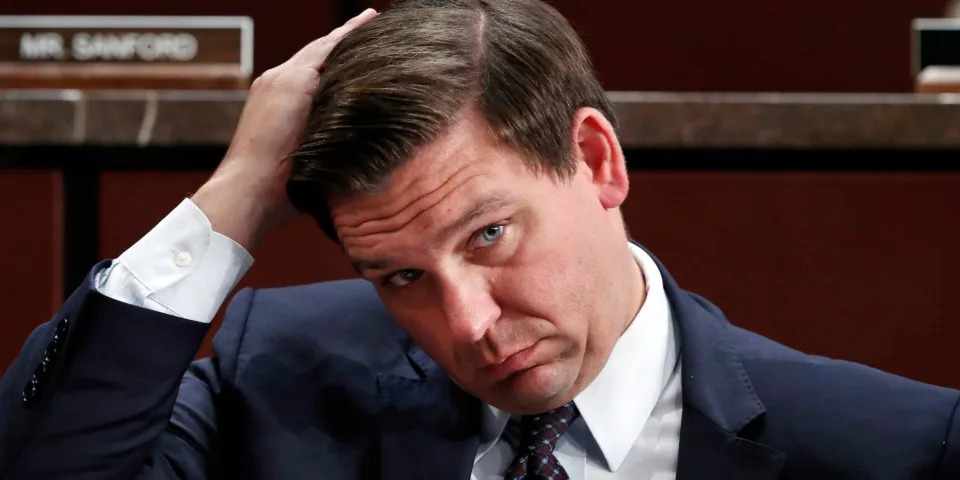
Rep. Ron DeSantis, R-Fla., listens during testimony by Department of Justice Inspector General Michael Horowitz during a joint House Committee on the Judiciary and House Committee on Oversight and Government Reform hearing examining Horowitz’s report of the FBI’s Clinton email probe, on Capitol Hill, Tuesday, June 19, 2018 in Washington.Jacquelyn Martin/APMore
GOP presidential candidate and Florida Gov. Ron DeSantis keeps hammering the idea that he’s fighting “wokeness.”
Likely Republican voters, however, told the New York Times they’d prefer the government stay away from limiting what corporations can support.
Despite this, DeSantis remains focused on attacking Bud Light for a short-lived and innocuous campaign featuring a transgender woman.
He declared war on “woke” and made fighting “wokeness” one of the central points of his campaign. Now, it’s becoming increasingly evident that Florida Gov. Ron DeSantis’ presidential campaign is in hot water after a majority of likely Republican voters said they want the government to stay away from influencing what corporations can and can’t support.
According to a New York Times poll, which was conducted between July 23-27, 52 percent of Republicans who will likely vote in the GOP primary election said they’d support a candidate who thinks the “government should stay out of deciding what corporations can support” over one promising “to fight corporations that promote ‘woke’ left ideology.”
This isn’t ideal for the DeSantis campaign, whose biggest focus on the campaign trail has been how he plans to combat “wokeness” as president and the extent to which he’s done so in Florida through his “Stop WOKE Act,” which currently cannot be enforced in higher education due to a temporary injunction, along with other initiatives.
As he continues to double and triple-down on his anti-woke schtick, it doesn’t seem like it’s doing him many favors in the race to become the GOP presidential nominee.
According to the same New York Times poll, support to put DeSantis in the Oval Office came in 37 percentage points behind that of former President Donald Trump, who appears to be running off with the nomination as DeSantis and every other GOP candidate has failed to keep up.
But as his presidential campaign falters and likely GOP voters make it clear that fighting “wokeism” isn’t a priority, DeSantis keeps belaboring the point.
Three months after beer company Bud Light ran a short-lived marketing campaign featuring transgender content creator Dylan Mulvaney, the governor of Florida continues to think this is what voters are clamoring for, going as far as threatening Bud Light’s parent company, AB InBev, with legal action for breaching “legal duties owed to its shareholders.”
If DeSantis and his team don’t change their focus, he risks becoming part of the next iteration of presidential candidates like Sen. Marco Rubio who quickly got stuck repeating the same talking point again, and again, and again.
And those campaigns don’t tend to end up in the White House.
Is the Atlantic Ocean current system nearing collapse? Scientists weigh in
Li Cohen – July 31, 2023
A study out this week raised a dire warning about the future of the planet and humanity, suggesting a system of currents in the Atlantic Ocean could totally collapse as early as 2025 — a frightening scenario that was the premise for the 2004 film “The Day After Tomorrow.”
But some scientists say that while a collapse is possible, it’s just one of many potential scenarios that could unfold and is unlikely to occur this century.
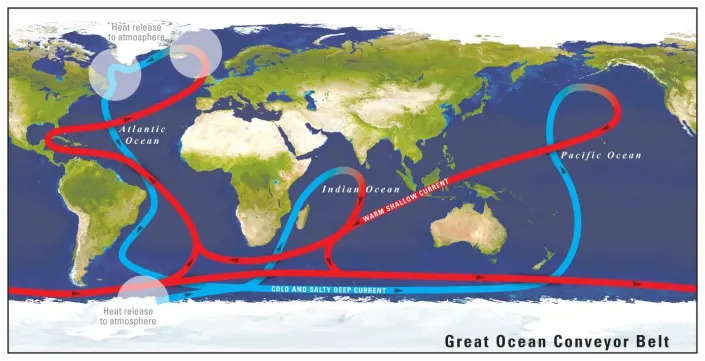
The study, published in Nature Communications, focuses on the Atlantic Meridional Overturning Circulation, or AMOC, a system of ocean currents in the Atlantic Ocean. This system is part of a global conveyor belt as it circulates water from north to south in the Atlantic, helping disperse warm waters. This system, along with other ocean currents, is crucial to helping maintain the Earth’s climate — and scientists believe it is being affected by climate change, as melting ice alters the balance in northern waters.
The AMOC “is a major tipping element in the climate system and a future collapse would have severe impacts on the climate in the North Atlantic region,” the study says, adding that there has been other research in recent years indicating that its circulation is weakening.
“We estimate a collapse of the AMOC to occur around mid-century under the current scenario of future [carbon] emissions,” it says.
Peter Ditlevsen, a professor at the University of Copenhagen’s Niels Bohr Institute and the lead author of the study, told CBS News he believes it’s “most likely” the system could collapse in about 30 years, around 2057. In the study, the range for a collapse was estimated to be anywhere between 2025 and 2095.
But, he says, there’s an “uncertainty”: “You cannot be completely sure.”
That’s because measurements of the AMOC only go back 20 years, providing a small amount of data to work into configurations. So his team looked at records of sea surface temperatures and climate model simulations to try to predict the fate of the current system.
The global conveyor belt, shown in part here, circulates cool subsurface water and warm surface water throughout the world / Credit: NOAA
“We know that there’s a tipping point out there in the future. And that when you approach that tipping point, they start to be unstable in a very specific way,” Ditlevsen said.
But Marlos Goes, a scientist at NOAA’s Atlantic Oceanographic and Meteorological Laboratory, said the likelihood of this study’s results coming to fruition within this century “is very small.” Such a timeframe, he said, is just “one scenario … out of hundreds.”
According to state-of-the-art climate models and the U.N.’s Intergovernmental Panel on Climate Change, a group that works to assess the science behind climate change, “it’s not going to collapse in the 21st century at all,” Goes said.
“It may in the following century. It depends on the [emissions] pathways,” he told CBS News. “If the emissions go unabated the way they are going right now … that could be a potential force for this collapse. But the probability of that single scenario that they analyzed in that study is very unlikely.”
What is the Atlantic Meridional Overturning Circulation?
The AMOC is a long current cycle in the Atlantic Ocean that transports warm water across the globe. It’s an incredibly slow-moving system that takes roughly 1,000 years to move any given cubic meter of water through its entirety, according to NOAA.
It is part of the global conveyor belt, a system of deep ocean currents driven by temperature, salinity and the wind on the ocean surface. The belt begins where warm water from the Gulf is thrust into a cold atmosphere of the Norwegian Sea. From there, the now much cooler water sinks lower into the ocean and is carried south. The conveyor belt takes that cold water all the way down to Antarctica.
/ Credit: USGS
Is the Gulf Stream going to collapse?
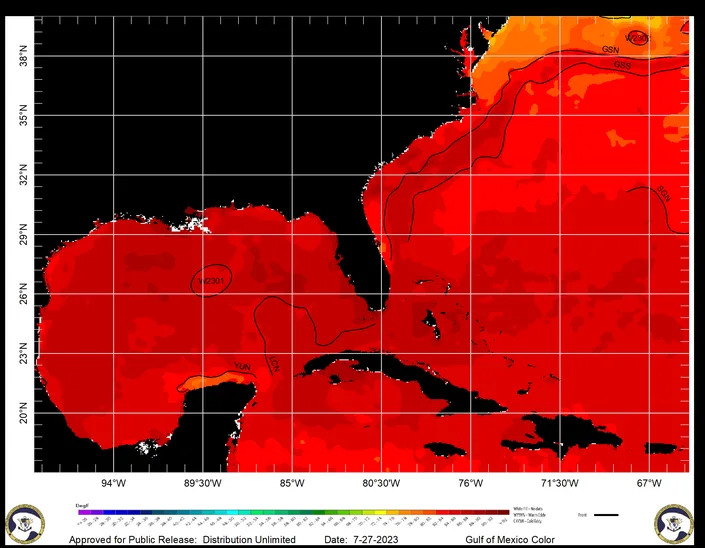
The Gulf Stream is a warm ocean current that runs from the coast of Florida and up to North Carolina, where it then diverts and goes across the Atlantic. It’s also part of the Atlantic Meridional Overturning Circulation. The latest study makes no mention of the Gulf Stream, specifically, but because it is part of this system, it would be impacted by such a collapse.
However, Goes told CBS News that wouldn’t disappear. The Gulf Stream is primarily driven by wind rather than temperature and salinity, as the AMOC as a whole is, meaning it would still function.
This image by NOAA’s Ocean Prediction Center shows the temperature of the Gulf Stream along the U.S. East Coast. / Credit: NOAA Ocean Prediction Center
“We would have a Gulf Stream just if we had the wind, if we didn’t have this formation in the North Atlantic,” Goes said. “…So even if the AMOC collapses, we’ll still have a Gulf Stream, but it would be much weaker.”
What would happen if the AMOC shut down?
A collapse of the system was the inspiration for the 2004 disaster film “The Day After Tomorrow.” In the movie, ocean current systems stopped because of global warming, triggering another Ice Age.
But Ditlevsen said, “That’s not gonna happen.” The principle of it, however, is the same, he said.
“You get colder Europe, northern Atlantic region, which is maybe not nice for us living in Scandinavia because it will be more similar to what’s going on in Alaska,” he said.
“But worse is that, the heat that’s not coming here stays in the tropics, heating them even more,” he continued. “The livelihood of people in the tropics can be severely threatened by this. … These are climate changes that are going to happen very fast.”
The AMOC won’t collapse just yet, some say — but it is slowing
Even though Goes says the chances of the AMOC collapsing within the next few decades are low, the current system is at risk. In 2021, another study found that the system is the weakest it’s been in at least 1,600 years. Researchers found that the current has slowed down an “unprecedented” amount — 15% since 1950.
Other research has found that it could be reduced up to 45% within the next 70 years or so.
Goes said that even just a slowdown of the currents, and not a total collapse, could impact people around the world.
“Generally, when the AMOC weakens or collapses, you have a cooling of the North Atlantic because this heat wouldn’t be carried further north, and there’s a warming of the South Atlantic. This would shift the precipitation patterns further south,” he said. “And that could influence all the sub-Sahara, the African and South American continents in the tropical bands. It would have influence on the storms in the North Atlantic, in Europe.”
But it would also release even more carbon dioxide into the atmosphere. The ocean absorbs 90% of the carbon dioxide from the atmosphere, and without the current, the ocean won’t be able to absorb as much, Goes said, a situation that would only add to the already rampant global warming the planet is facing. It would also increase sea levels along the U.S. coast.
Urgent action could stop a slowdown
A drastic change or shutdown of the AMOC wouldn’t necessarily be detectable right away, Goes said. In fact, it could take 40 to 50 years to emerge.
“By the time we detect that, it will be too late,” he said. “We really need to act now. This is one of the tipping points of the world.”
Once a tipping point such as a slowdown or shutdown of the AMOC is passed, it could cause a cascade of impacts that could cause “irreversible and severe changes in the climate system,” according to the Organization for Economic Co-operation and Development. Even though a full collapse of the AMOC within the next few decades isn’t probable, it is possible, Goes said, and it could come with high risk.
Scientists are continuing to monitor the system to learn what they can about its current state. But to help prevent a continued slowdown or a potential full shutdown, both Goes and Ditlevsen agreed that global emissions must be reduced drastically. Those emissions, largely from the burning of fossil fuels, are trapping heat in the atmosphere and causing sea ice to melt. When that ice melts, it adds fresh water to the AMOC, disrupting the salinity and temperature it relies on to move.
“If we stop our emissions, it will not collapse,” Ditlevsen said. “The disturbing part about this study is that we have to react much faster than we perhaps would like to do. … It’s yet another wake-up call or warning sign that we have to react faster than we do.”
Scientists Say Atlantic Current Collapse Could Lead to Extreme Cold in Europe and North America
Victor Tangermann – July 31, 2023
Researchers are warning that the crucial ocean currents known as the Atlantic Meridional Overturning Circulation (AMOC) could collapse as soon as 2025 — an impending, climate change-fueled disaster that could usher in a new era of extreme temperature fluctuations.
It’s important to note that not every scientist is convinced by this assessment. And though the researchers say the collapse could take place as soon 2025, they also say it could take another 70 years.
That said, a team of researchers led by Peter Ditlevsen, professor and climate researcher at the University of Copenhagen in Denmark anticipate in a paper published in the journal Nature Communications that the currents could collapse anywhere between 2025 and 2095 — if we don’t cut global carbon emissions, that is.
If it were to collapse, much of the Western world could be plunged into an extended period of extreme cold — a counterintuitive result of climate change. Previous collapses, which have predominantly occurred during ice ages many thousands of years ago, have indeed led to temperatures going haywire.
“I think we should be very worried,” Ditlevsen told The Guardian. “This would be a very, very large change. The AMOC has not been shut off for 12,000 years.”
Back in 2021, researchers at the Potsdam Institute for Climate Impact Research in Germany warned in a separate paper that the AMOC is being driven to the brink of collapse due to climate change. In the short term, this collapse could cause temperatures to plunge in Europe and North America, resulting in prolonged periods of extreme cold.
And if the planet’s past history is anything to go by, the stakes are significant. 12,000 years ago, the melting of a massive glacial lake plunged Europe into an extreme cold spell for almost a millennium.
Now, by analyzing statistics from the last 150 years, Ditlevsen and his team say they’ve calculated with a 95 percent certainty that the AMOC will collapse between 2025 and 2095.
“Shutting down the AMOC can have very serious consequences for Earth’s climate, for example, by changing how heat and precipitation are distributed globally,” Ditlevsen said in a statement.
“While a cooling of Europe may seem less severe as the globe as a whole becomes warmer and heat waves occur more frequently, this shutdown will contribute to increased warming of the tropics, where rising temperatures have already given rise to challenging living conditions,” he added.
This change could be far more rapid than the incremental 1.5 degrees Celsius rise caused by climate change over a century. With a collapsed AMOC, we’d be looking at far more extreme changes in the ten to 15 degrees Celsius range over just a decade.
“Our result underscores the importance of reducing global greenhouse gas emissions as soon as possible,” Ditlevsen said.
But while researchers generally agree with this final conclusion, not everybody is convinced the AMOC is about to, well, run amok.
For one, the conclusion contradicts the latest findings of the United Nations’ Intergovernmental Panel on Climate Change (IPCC), which found in its most recent report that the current was unlikely to just collapse within this century.
“The work provides no reason to change the assessment of the [IPCC],” Jochem Marotzke of the Max-Planck-Institute for Meteorology in Hamburg, told Politico.
“We just don’t have the evidence to state that it has declined,” Penny Holliday, researcher at the UK’s National Oceanography Center, told the BBC. “We know that there is a possibility that AMOC could stop what it’s doing now at some point, but it’s really hard to have certainty about that.”
At the same time, while we may never get a 100 percent accurate prediction — after all, our planet’s climate systems are incredibly complex — we should still heed Ditlevsen and his colleagues’ warning.
“We do still have to take the idea seriously that there could be abrupt changes in the North Atlantic climate system,” University of Reading atmospheric scientist Jon Robson told the BBC. “But the exact predictions that it will happen — and within this time frame — you have to take that with some skepticism.”
1. “We need a future that’s made in America. That means using products, parts, and materials built right here in the United States of America. It means bringing manufacturing back, jobs back, building the supply chains here at home, not outsourcing abroad.”
2. “We need to incentivize the repatriation of American capital and investment here in the United States so we can recapture our supply chains and build a strong durable industrial base.”
The first quote is President Biden, from a speech on his economic vision in January 2022. The second is Florida Gov. Ron DeSantis, who’s running for the Republican nomination for president, outlining his own economic agenda on July 31, 2023. DeSantis isn’t plagiarizing Biden, exactly, but it sure sounds like he’s borrowing ideas he’s heard before.
DeSantis, badly lagging Donald Trump in Republican polling for the 2024 race, is trying to establish himself as a conservative populist akin to Trump, but with a better reputation for competence and governing. To further the cause, he outlined a “Declaration of Economic Independence” during a July 31 campaign stop in New Hampshire, his first major effort to present an economic vision.
It’s surprisingly similar to Biden’s. Both men favor protectionism and a heavier government role than usual to steer the US economy toward future prosperity. Both vilify China and say the United States needs to end its reliance on the huge trade partner for key products. And they both bash big corporations for building massive amounts of wealth at the expense of ordinary workers.
The biggest difference between the two agendas, in fact, may be that Biden is already pursuing efforts to achieve many of those goals, while DeSantis is only talking about them as a candidate. There are other differences between the two, some largely rhetorical, others more substantive. But the unusual similarities between a center-left president and a far-right challenger indicate how much traditional political views have shifted as foreign threats have changed during the last decade and the global economy has transformed.
Like most challengers facing an incumbent, DeSantis argues that the current leadership has sent the nation into “decline.” Corporate fat cats and Beltway opportunists are lining their pockets while everybody else falls behind. This is a reprise of Bernie Sanders in 2020, Donald Trump in 2016, and even Barack Obama in 2008.
One big change between then and now is an increasingly aggressive China that seems bent on confrontation with the United States and the democratic West, rather than the trade symbiosis of 10 or 15 years ago. “We have to stop selling out this country’s future to China,” DeSantis demanded in his July 31 speech.
Well, Biden beat him to it. And Trump beat him to it before Biden.
Trump started by decrying the US trade deficit with China and slapping tariffs on hundreds of billions of dollars of Chinese imports each year to fix it. The tariffs raised the cost of US imports to the United States but did almost nothing to alter the trade balance. Then COVID hit in 2020, exposing extreme American dependence on China for medical supplies, electronics, minerals, and other crucial products.
Republican presidential candidate Florida Gov. Ron DeSantis gestures during a campaign event, Monday, July 31, 2023, in Rochester, N.H. (AP Photo/Charles Krupa)
After Biden took office in 2021, he left the Trump tariffs in place and went further. Biden began encouraging allies to join the United States in containing China’s expansionist policies, instead of going it alone the way Trump did. In 2022, Biden lobbied for and signed the CHIPS Act and the Inflation Reduction Act, a huge package of subsidies meant to boost US manufacturing of semiconductors, green energy components, and many other things — much as China subsidizes its own domestic manufacturing. A boom in US factory construction suggests those incentives are working.
So what might DeSantis do on top of all this? He called for an end to normal trade relations with China and said he would ban the import of Chinese products built with stolen technology. That’s not a big expansion of Biden policies and it might be little more than symbolic. China’s “normal” trade relationship with the United States is already undermined by the Trump tariffs and Biden sanctions, and who knows how the US government would assess which of the thousands of Chinese products coming to the United States include pirated technology.
Like Biden, DeSantis also wants to exert a government hand to boost certain parts of the manufacturing sector. He’d seek to repeal Biden’s green energy subsidies, however, and focus more on the domestic fossil fuel industry. If he were president, DeSantis could do a bit of that on his own through regulatory and executive action, but it would require Congress to undo hundreds of billions in green energy subsidies Congress passed last year, and replace them with subsidies directed elsewhere — no easy lift.
DeSantis distinguishes himself from Biden more clearly on cultural issues that have economic implications, such as diversity and inclusion policies and investing focused on environmental factors. DeSantis says he will “end the politicization of the economy” by discouraging or forbidding these kinds of policies in businesses, schools, and other organizations, but critics argue that DeSantis is the one politicizing the economy by focusing on these issues in the first place. Whatever the case, voters haven’t responded very enthusiastically to DeSantis’s “anti-woke” crusade, and DeSantis didn’t use his go-to word—”woke”— a single time in his July 31 speech. The dogs have not responded to this dog whistle. Maybe DeSantis decided to stop blowing it.
Here’s a fresh and interesting DeSantis idea: Hold universities accountable if students take on gobs of debt to get a degree and don’t earn enough once they graduate to pay it off. That does differ from Biden’s approach, which is to forgive a certain amount of debt, which would benefit the borrower but require nothing of the university. Mostly everybody agrees the cost of college in the United States is out of control and the current system of financing badly broken.
Finally, DeSantis finds a familiar bogeyman responsible for America’s economic woes in the Federal Reserve. He says the Fed should worry about inflation alone and stay out of extraneous matters such as saving the US economy during a financial crash or a pandemic. Except guess what: If DeSantis were president during such a crisis, he’d beg the Fed to ride to the rescue, because it’d be foolish to let a depression ruin lives if you had an alternative, and because President DeSantis’s own political survival would depend on a Fed bailout. Tough talk often ends the moment the election takes place.
Far-right Arizona legislators just got rolled on Prop. 400 vote. More of this, please
Laurie Roberts, Arizona Republic – July 31, 2023
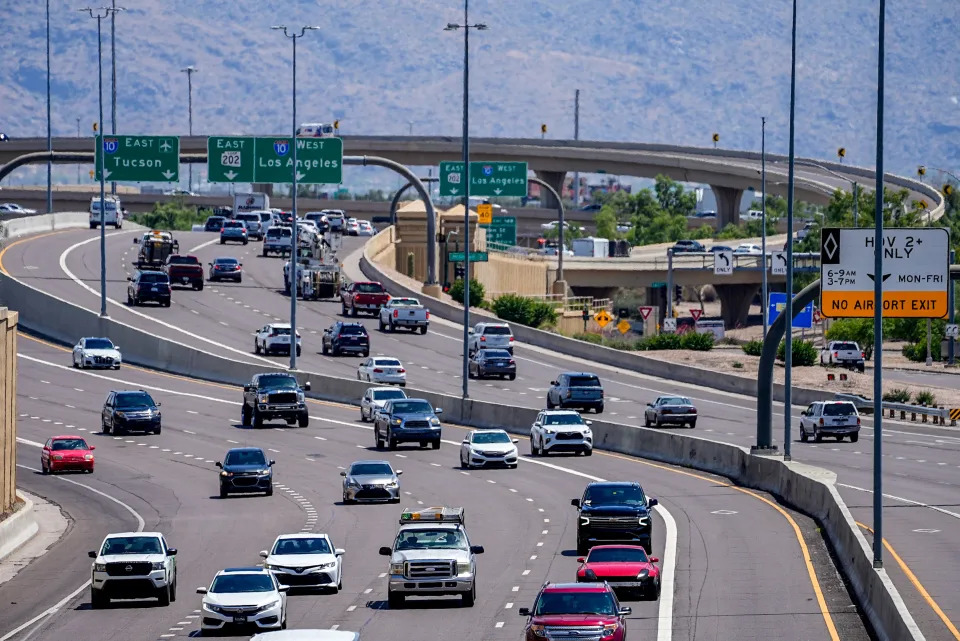
Cars drive along Piestewa Freeway, Arizona State Route 51, near the Ministack, as seen from the pedestrian bridge near Oak Street in Phoenix on May 18, 2023.
By rolling right over the hardest of hard-right crowd that has called the shots all year long.
It was a refreshing bit of bipartisanship in a record-long session that featured precious little of it.
The result is a ballot proposition that will let Maricopa County voters decide whether to continue taxing themselves to fund the Valley’s regional transportation plan for the next 20 years. Recent polls show sizable support for the plan.
“This is great for the taxpayers,” Rep. David Cook, R-Globe, who chairs the House Transportation Committee. “It’s good for the citizens.”
Freedom Caucus crew couldn’t stomach a compromise
Far-right Republicans, meanwhile, were furious.
“Democrats are over-the-moon on this Prop. 400 bill,” Rep. Justin Heap, R-Mesa, tweeted just before the vote. “If we pass this it will be a massive win for Hobbs and the Democrats. We will be giving Democrats a club to bludgeon us with in 2024.”
“Way to end the session with a win for Hobbs and the Democrats,” one of them, Rep. Rachel Jones, R-Tucson, harrumphed right after the vote, while, no doubt, stomping her foot.
You’ll have to excuse Heap, Jones and some of their fellow far righties for seeing this in politically opportunistic terms rather than in terms of what is best for Arizona.
With Republicans clinging to a one-vote majority in each chamber, the Arizona Freedom Caucus that seems to run the Legislature has taken a my-way-or-the-highway approach all year, never seeing any need to compromise.
Thankfully, the majority acted in Arizonans’ best interest
In the view of its members, a veto by Democratic Gov. Katie Hobbs (and she’s had a BUNCH of them) is simply another talking point in their favor with primary election voters – the only ones who matter in the vast majority of legislative districts – come election time.
Fortunately, many of the Legislature’s more traditional Republicans understood the necessity of compromise, especially on an issue so vital to the future growth and prosperity of the Valley and thus the state.
Not to mention to the future prospect of being stuck in horrendous traffic for hours on end if the tax isn’t extended before it expires in December 2025.
And so comes Senate Bill 1102, on Day 204 of this year’s 100-day legislative session.
Both sides scored wins on their priorities on Prop. 400 spending
The $20 billion tax extension, if approved by voters next year, calls for spending 63% of the proceeds on freeways and roads and 37% on transit over the next 20 years.
Among other things, it significantly boosts the amount spent on pavement, kills any future extension of light rail and dictates that “road diets” are a distinct no-no – all Republican priorities.
It also preserves a hefty percentage of the tax for public transit, a priority of Democrats.
And it allows for maintaining the existing light rail system, which should be a priority for everybody given that we spent billions to build the thing.
Overall, Monday’s passage was a welcome exercise in give-and-take by warring politicians who have spent most of the year at each other’s throats. Credit goes to both Republican legislative leaders and Hobbs for finally getting it done.
But the vote also spoke loudly and clearly about those hard right Republicans who spent much of the weekend and all of Monday pitching a fit.
Far-right obstructionists rendered irrelevant when it counted
“Never forget that the democrat goal is to remove private vehicles from the average person completely,” an overwrought Rep. Jacqueline Parker, R-Mesa, tweeted. “It’s already starting. The latest rendition of prop 400 will help with that car-free goal.”
That’s nonsense. Even Senate President Warren Petersen, no slouch when it comes to conservative credentials, praised the plan as a Republican triumph.
“This will be the most conservative transportation plan in the history of Arizona ever passed, ever implemented, ever adopted,” the Gilbert Republican said, ticking off the many concessions Republicans won.
The freedom folk are just mad that they were rendered irrelevant. In the end, seven Senate Republicans and 14 House Republicans voted no on the bill (along with one Democrat, who objected to the light rail cuts).
They wanted the ballot measure split into the two questions – one on freeways and one on public transportation.
They believed voters would have killed the transit portion of the tax given low ridership, thus resulting in a tax cut.
So because so few people – and certainly their own constituents – ride buses … we don’t need them?
We won’t need them in the future as the Valley’s continues to explode with newcomers? With new employers? With new job opportunities?
Yeah, that’s some forward thinking there.
SB 1102 passed 43-14 in the House and 19-7 in the Senate.
Senate Republicans who voted no: Shawnna Bolick of Phoenix, Jake Hoffman of Queen Creek, Anthony Kern of Glendale, J.D. Mesnard of Chandler, Wendy Rogers of Flagstaff and Justine Wadsack of Tucson.
Democrat Sally Ann Gonzales of Tucson also voted no.
House Republicans who voted no: Neal Carter of San Tan Valley, Joseph Chaplik of Scottsdale, Justin Heap of Mesa, Laurin Hendrix of Gilbert, Rachel Jones of Tucson, Alexander Kolodin of Scottsdale, David Marshall of Snowflake, Cory McGarr of Marana, Steve Montenegro of Goodyear, Barbara Parker of Mesa, Jacqueline Parker of Mesa, Michelle Pena of Yuma, Beverly Pingerelli of Peoria and Austin Smith of Wittman.
The big idea: is it too late to stop extremism taking over politics?
Bizarre conspiracy thinking has infiltrated the mainstream in many western democracies. How can we push back?
Julia Ebner – July 31, 2023
Illustration: Elia Barbieri/The Guardian
Welcome to the 2020s, the beginning of what history books might one day describe as the digital middle ages. Let’s briefly travel back to 2017. I remember sitting in various government buildings briefing politicians and civil servants about QAnon, the emerging internet conspiracy movement whose adherents believe that a cabal of Satan-worshipping elites runs a global paedophile network. We joked about the absurdity of it all but no one took the few thousand anonymous true believers seriously.
Fast-forward to 2023. Significant portions of the population in liberal democracies consider it possible that global elites drink the blood of children in order to stay young. Recent surveys suggest that around 17% of Americans believe in the QAnon myth. Some 5% of Germans believe ideas related to the anti-democratic Reichsbürger movement, which asserts that the German Reich continues to exist and rejects the legitimacy of the modern German state. Up to a third of Britons believe that powerful figures in Hollywood, government and the media are secretly engaged in child trafficking. Is humanity on the return journey from enlightenment to the dark ages?
I am often asked why the UK doesn’t have a successful far-right populist party. My answer is: Because it doesn’t need to
As segments of the public have headed towards extremes, so has our politics. In the US, dozens of congressional candidates, including the successfully elected Lauren Boebert, have been supportive of QAnon. The German far-right populist party Alternative für Deutschland is at an all-time high in terms of both its radicalism and its popularity, while Austria’s xenophobic Freedom party is topping the polls. The recent rise to power of far-right parties such as Fratelli d’Italia and the populist Sweden Democrats bolster this trend.
I am often asked why the UK doesn’t have a successful far-right populist party. My answer is: because it doesn’t need to. Parts of the Conservative party now cater to audiences that would have voted for the BNP or Ukip in the past. A few years ago, the far-right Britain First claimed that 5,000 of its members had joined the Tory party. Not unlike the Republicans in the US, the Tories have increasingly departed from moderate conservative thinking and lean more and more towards radicalism.
In 2020, Conservative MP Daniel Kawczynski was asked to apologise for attending the National Conservatism conference in Rome. The event is well known for attracting international far-right figures such as Italy’s Giorgia Meloni, Hungary’s Viktor Orbán, former Fox News host Tucker Carlson and the hard-right US presidential candidate Ron DeSantis. This year, an entire delegation of leading Conservatives attended the same conference in London. It might be hard for extreme-right parties to rise to power in Britain, but there is no shortage of routes for extremist ideas to reach Westminster.
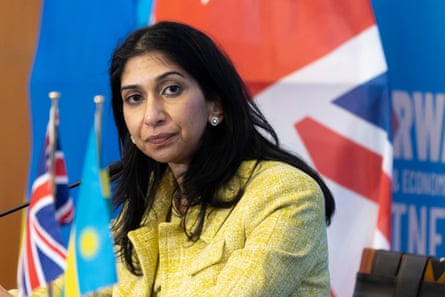
‘Invasion on our southern coast’ … UK home secretary Suella Braverman. Photograph: AP
Language is a key indicator of radicalisation. The words of Conservative politicians speak for themselves: home secretary Suella Braverman referred to migrants arriving in the UK as an “invasion on our southern coast”, while MP Miriam Cates gave a nod to conspiracy theorists when she warned that “children’s souls” were being “destroyed” by cultural Marxism. Using far-right dog whistles such as “invasion” and “cultural Marxism” invites listeners to open a Pandora’s box of conspiracy myths. Research shows that believing in one makes you more susceptible to others.
I sometimes wonder what a QAnon briefing to policymakers might look like in a few years. What if the room no longer laughs at the ludicrous myths but instead endorses them? One could certainly imagine this scenario in the US if Donald Trump were to win the next election. In 2019 – before conspiracy myths inspired attacks on the US Capitol, the German Reichstag, the New Zealand parliament and the Brazilian Congress – I warned in a Guardian opinion piece of the threat QAnon would soon pose to democracy. Are we now at a point where it is it too late to stop democracies being taken over by far-right ideologies and conspiracy thinking? If so, do we simply have to accept the “new normal”?
There are various ways we can try to prevent and reverse the spread of extremist narratives. For some people who have turned to extremism over the past few years, too little has changed: anger over political inaction on economic inequality is now further fuelled by the exacerbating cost of living crisis. For others, too much has changed: they see themselves as rebels against a takeover by “woke” or “globalist” policies.
What they have in common is a sense that the political class no longer takes their wellbeing seriously, and moves to improve social conditions and reduce inequality would go some way towards reducing such grievances. But beyond that, their fears and frustrations have clearly been instrumentalized by extremists, as well as by opportunistic politicians and profit-oriented social media firms. This means that it is essential to expose extremist manipulation tactics, call out politicians when they normalize conspiracy thinking and regulate algorithm design by the big technology companies that still amplify harmful content.
If the private sector is part of the problem, it can also be part of the solution. Surveys by the Edelman Trust Barometer found that people in liberal democracies have largely lost trust in governments, media and even NGOs but, surprisingly, still trust their employers and workplaces. Companies can play an important role in the fight for democratic values. For example, the Business Council for Democracy tests and develops training courses that firms can offer to employees to help them identify and counter conspiracy myths and targeted disinformation.
Young people should be helped to become good digital citizens with rights and responsibilities online, so that they can develop into critical consumers of information. National school curricula should include a new subject at the intersection of psychology and internet studies to help digital natives understand the forces that their parents have struggled to grasp: the psychological processes that drive digital group dynamics, online engagement and the rise of conspiracy thinking.
Ultimately, the next generation will vote conspiracy theorists in or out of power. Only they can reverse our journey towards the digital middle ages.
Fulton County DA says work is done in Trump probe and ‘we’re ready to go’
Sara Murray, CNN – July 30, 2023
Charlie Neibergall/AP
Fulton County District Attorney Fani Willis reaffirmed in a local news interview that she will announce charging decisions by September 1 in her investigation into efforts by Donald Trump and his allies to overturn Georgia’s 2020 presidential election result, while applauding the ramped-up security measures around the local courthouse.
“The work is accomplished,” Willis told CNN affiliate WXIA at a back-to-school event over the weekend. “We’ve been working for two and half years. We’re ready to go.”
Willis has previously signaled in letters to local officials and those providing security that she would make any charging announcements between July 31 and the end of August. She laid out a variety of security provisions her team plans to take beginning Monday.
Willis’ latest commitment to that time frame comes after a judge scheduled an August 10 hearing on the Trump team’s efforts to disqualify Willis, a Democrat, from the case, toss much of the evidence she has collected and remove another judge in Fulton County from presiding over the case.
In the local news interview, Willis also praised the Fulton County sheriff after barricades recently went up around the county courthouse in anticipation of what the sheriff’s office referred to as “high profile legal proceedings.”
“I think that the sheriff is doing something smart in making sure that the courthouse stays safe,” Willis said. “I’m not willing to put any of the employees or the constituents that come to the courthouse in harm’s way.”
Willis said that people may not be happy with her upcoming announcements and “sometimes when people are unhappy, they act in a way that could create harm.”
‘I’m not wanted’: Florida universities hit by brain drain as academics flee
Joseph Contreras – July 30, 2023
Photograph: The Washington Post/Getty Images
With the start of the 2023-24 academic year only six weeks away, senior officials at New College of Florida (NCF) made a startling announcement in mid-July: 36 of the small honors college’s approximately 100 full-time teaching positions were vacant. The provost, Bradley Thiessen, described the number of faculty openings as “ridiculously high”, and the disclosure was the latest evidence of a brain drain afflicting colleges and universities throughout the Sunshine state.
Governor Ron DeSantis opened 2023 with the appointment of six political allies to the college’s 13-member board of trustees who vowed to drastically alter the supposedly “woke”-friendly learning environment on its Sarasota campus. At its first meeting in late January, the revamped panel voted to fire the college president, Patricia Okker, without cause and appoint a former Republican state legislator and education commissioner in her place.
Over the ensuing weeks, board members have dismissed the college’s head librarian and director of diversity programs and denied tenure to five professors who had been recommended for approval.
In a statement given to 10 Tampa Bay about faculty vacancies that was issued earlier this month, NCF officials said that six of the openings were caused by staff resignations and one-quarter of the faculty member departures “followed the changes in the New College board of trustees”. One of those resignations was submitted by Liz Leininger, an associate professor of neurobiology who says she started looking for an exit strategy as soon as she learned about the DeSantis appointments in the first week of 2023.
The 40-year-old scientist joined the New College faculty in 2017, drawn by the opportunities of living near her ageing parents on Florida’s Gulf coast and working closely with undergraduates at a relatively small school where total student enrollment hovers around 700. But as the Republican-controlled Florida legislature passed a series of bills over the last two years that sought to curtail academic freedom and render a professor’s tenure subject to review at any time, Leininger witnessed first-hand the devastating effects of the new laws on her colleagues’ morale.
“All of the legislation surrounding higher education in Florida is chilling and terrifying,” said Leininger, who is rejoining the biology department at St Mary’s College in Maryland this fall where she had been teaching before moving to central Florida. “Imagine scientists who are studying climate change, imagine an executive branch that denies climate change – they could use these laws to intimidate or dismiss those scientists.”
The new laws have introduced a ban on the funding of diversity, equity and inclusion programs at Florida’s public colleges and universities, withdrawn a right to arbitration formerly guaranteed to faculty members who have been denied tenure or face dismissal, and prohibited the teaching of critical race theory, which contends that inherent racial bias pervades many laws and institutions in western society, among other changes.
In the face of that and other legislation backed by DeSantis and Republican lawmakers that has rolled back the rights of Florida’s LGBTQ+ community, many scholars across the state are taking early retirement, voting with their feet by accepting job offers outside Florida or simply throwing in the towel with a letter of resignation.
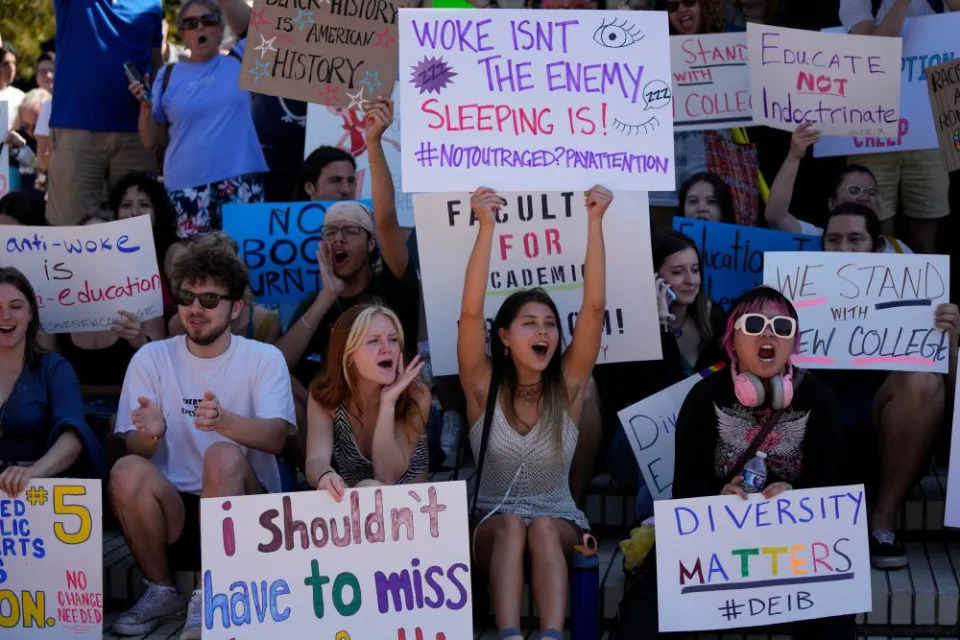
Students protest at New College of Florida, one of Ron DeSantis’s particular targets. Photograph: Rebecca Blackwell/AP
Hard figures for turnover rates will not be available until later this year, and none of the other 11 state-run universities are expected to match New College’s exceptionally high percentage of faculty vacancies.
A spokesperson for the office of State University System chancellor, Ray Rodrigues, issued a statement asserting that the “State University System of Florida has not received any concerns from our member institutions indicating turnover this year has been any higher than previous years. Turnover occurs every year.”
But Andrew Gothard, the state-level president of the United Faculty of Florida labor union, predicts a loss of between 20 and 30% of faculty members at some universities during the upcoming academic year in comparison with 2022-23, which would signify a marked increase in annual turnover rates that traditionally have stood at 10% or less.
James Pascoe moved to the Gainesville campus of the University of Florida in 2018, the same year that DeSantis was first elected governor. Three years later, the Dallas native started looking for jobs elsewhere when new disclosure requirements made it more difficult for Pascoe to apply for grants. An unsuccessful attempt by the DeSantis administration to prohibit three University of Florida colleagues from testifying as expert witnesses in a voting rights case raised more alarm bells in Pascoe’s mind.
Then came the passage of legislation in March 2022 that banned the discussion of gender identity and sexuality with elementary school students between kindergarten and the third grade. Pascoe and his male partner began to worry about their future eligibility for adopting children in an environment that was becoming increasingly hostile to gay couples in their judgment.
“It was becoming clear that the university was becoming politicized,” the 33-year-old assistant professor of mathematics said. “When I was waiting to hear back on job applications, they started passing all these vaguely anti-gay, anti-LGBTQ+ laws. The state didn’t seem to be a good place for us to live in any more.”
In the summer of 2022, Pascoe accepted a comparable position at Drexel University in Philadelphia. His partner followed suit by joining the biology department at Haverford College in a nearby suburb.
The prevailing political climate in Florida has complicated efforts to recruit qualified scholars from outside the state to fill some vacancies. Kenneth Nunn served on a number of appointment committees during the more than 30 years he spent on the faculty of the University of Florida’s law school. He said the task of persuading highly qualified applicants of color to move to Gainesville has never been more difficult under a governor who, earlier this year, prohibited a new advanced placement course in African American studies from being taught in high schools.
DeSantis came under renewed criticism this month when the state department of education issued guidelines recommending that middle school students be taught about the skills slaves acquired “for their personal benefit” during their lifetimes in bondage.
“Florida is toxic,” noted Nunn, one of the few Black members of the law school faculty who says he chose to retire last January in part because of the legislated ban on the teaching of critical race theory. “It has been many years since we last hired an entry-level African American faculty member. They’re just not interested in being in a place where something with the stature of critical race theory is being denigrated and attacked.”
The 65-year-old Nunn will be teaching law in the fall in Washington DC as a visiting professor at Howard University, one of the nation’s leading historically Black colleges and universities.
“I could have stayed in a place where I’m not wanted and tough it out,” he adds. “Or I could retire and look for work elsewhere.”
In the end, Nunn says, concerns about his professional career and even his own physical safety made that decision a relatively easy one.
Why Republicans can’t get out of their climate bind, even as extreme heat overwhelms the US
Analysis by Ella Nilsen, CNN – July 30, 2023
Deadly heatwaves are baking the US. Scientists just reported that July will be the hottest month on record. And now, after years of skepticism and denial in the GOP ranks, a small number of Republicans are urging their party to get proactive on the climate crisis.
But the GOP is stuck in a climate bind – and likely will be for the next four years, in large part because they’re still living in the shadow of former president and 2024 Republican frontrunner Donald Trump.
Even as more Republican politicians are joining the consensus that climate change is real and caused by humans, Trump’s inflammatory rhetoric has driven the party to the right on climate and extreme weather. Trump has called the extremely settled science of climate change a “hoax” and more recently suggested that the impacts of it “may affect us in 300 years.”
Scientists this week reported that this summer’s unrelenting heat wave would have been “virtually impossible” were it not for the planet-warming pollution from burning fossil fuels. They also confirmed that July will go down as the hottest month on record – and almost certainly that the planet’s temperature is hotter now than it has been in around 120,000 years.
Yet for being one of the most pressing issues of the 21st century, climate is rarely mentioned on the 2024 campaign trail.
“As Donald Trump is the near presumptive nominee of our party in 2024, it’s going to be very hard for a party to adopt a climate-sensitive policy,” Sen. Mitt Romney, a Republican from Utah, told CNN. “But Donald Trump’s not going to be around forever.”
When Republicans do weigh in on climate change – and what we should do about it – they tend to support the idea of capturing planet-warming pollution rather than cutting fossil fuels. But many are reticent to talk about how to solve the problem, and worry Trump is having a chilling effect on policies to combat climate within the party.
“We need to be talking about this,” Rep. John Curtis, a Republican from Utah and chair of the House’s Conservative Climate Caucus, told CNN. “And part of it for Republicans is when you don’t talk about it, you have no ideas at the table; all you’re doing is saying what you don’t like. We need to be saying what we like.”
Extreme weather changes GOP minds
With a few exceptions, Republicans largely are no longer the party of full-on climate change denial. But even as temperatures rise to deadly highs, the GOP is also not actively addressing it. There is still no “robust discussion about how to solve it” within the party, said former South Carolina Rep. Bob Inglis, who now runs the conservative climate group RepublicEn, save for criticism of Democrats’ clean-energy initiatives.
“The good news is Republicans are stopping arguing with thermometers,” Inglis told CNN. Still, he said, “when the experience is multiplied over and over of multiple days of three-digit temperatures in Arizona and record ocean temperatures, people start to say, ‘this is sort of goofy we’re not doing something about this.’”
Meanwhile, the impacts of a dramatically warming atmosphere are becoming more and more apparent each year. Romney and Curtis, two of the loudest climate voices in the party, both represent Utah – a state that’s no stranger to extreme heat and drought, which scientists say is being fueled by rising global temperatures.
“There are a number of states, like mine, that are concerned about wildfires and water,” Romney said, adding he believes Republican governors of impacted states have been vocal about these issues.
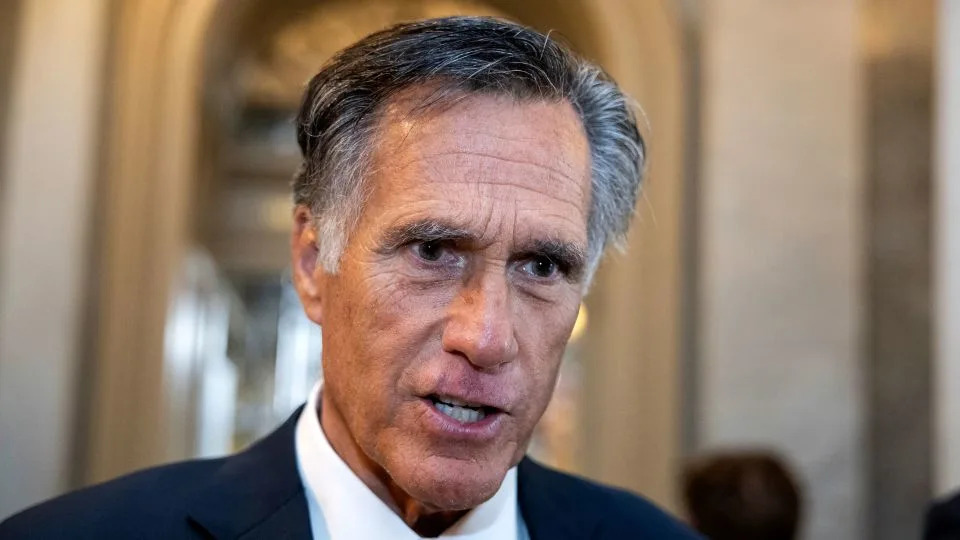
Sen. Mitt Romney is one of a handful of Republicans who wants the party to get proactive on climate solutions. – Francis Chung/POLITICO/AP
Utah and other Western states are looking for ways to cut water use to save the West’s shrinking two largest reservoirs, Lakes Powell and Mead. And even closer to home, Utah’s Great Salt Lake has already disappeared by two-thirds, and scientists are sounding alarms about a rapid continued decline that could kill delicate ecosystems and expose one of fastest-growing metropolitan areas in the nation to toxic dust.
“I think the evidence so far is that the West is getting drier and hotter,” Romney told CNN. “That means that we’re going to have more difficulty with our crops, we’re going to have a harder time keeping the rivers full of water. The Great Salt Lake is probably going to continue to shrink. And unfortunately, we’re going to see more catastrophic fires. If the trends continue, we need to act.”
An issue ‘held hostage’
While Republicans blast Democrats’ clean energy policies ahead of the 2024 elections, it’s less clear what the GOP itself would prefer to do about the climate crisis.
As Curtis tells it, there’s a lot that Republicans and Democrats in Congress agree on. They both want to further reform the permitting process for major energy projects, and they largely agree on the need for more renewable and nuclear energy.
As the head of the largest GOP climate caucus on the Hill, Curtis’ Utah home is “full solar,” he told CNN, and is heated using geothermal energy.
While at a recent event at a natural gas drilling site in Ohio, as smoke from Canada’s devastating wildfire season hung thick in the air, House Speaker Kevin McCarthy was asked how he would solve the climate crisis. He suggested planting a trillion trees to help offset the pollution created by burning fossil fuels – a bill House Republicans introduced in 2020. The measure has not yet passed the House and has an uncertain future in the Senate.
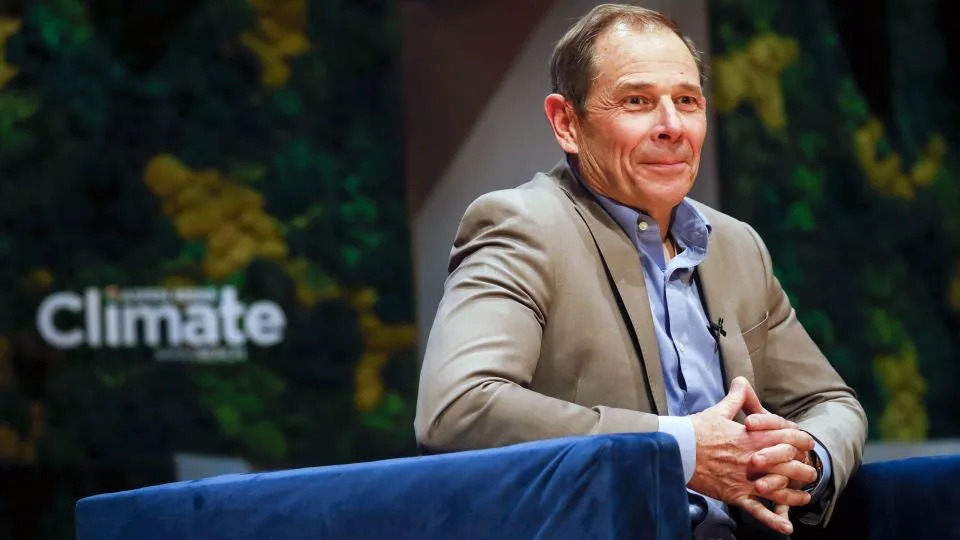
Rep. John Curtis, a Utah Republican, said his home is decked out in solar panels and geothermal energy. – Eva Marie Uzcategui/Bloomberg/Getty Images
But the biggest and most enduring difference between the two parties is that Republicans want fossil fuels – which are fueling climate change with their heat-trapping pollution – to be in the energy mix for years to come.
Democrats, meanwhile, have passed legislation to dramatically speed up the clean energy transition and prioritize the development of wind, solar and electrical transmission to get renewables sending electricity into homes faster.
On Wednesday, Senate Majority Leader Chuck Schumer of New York said Democrats want to pass more climate legislation if they take back a full majority in Congress. He later told CNN the GOP is “way behind” on climate and there’s been “too little” progress on the party’s stances.
“I think we’d get a lot more done with a Democratic House, a Democratic president and continuing to have a Democratic Senate,” Schumer told CNN. “Unfortunately, if you look at some of the Republican House and Senate Super PACs, huge amounts of money come from gas, oil and coal.”
Even though Curtis and Romney are aligned on the party needing to talk about climate change, they differ on how to fix it. While Curtis primarily supports carbon capture and increased research and development into new technologies, Romney is one of the few Republicans speaking in favor of a carbon tax – taxing companies for their pollution.
“It’s very unlikely that a price on carbon would be acceptable in the House of Representatives,” Romney said. “I think you might find a few Republican senators that would be supportive, but that’s not enough.”
The idea certainly doesn’t have the support of Trump, or other 2024 candidates for president, and experts predict climate policy will get little to no airtime during the upcoming presidential race.
“Regrettably, the issue of climate change is currently being held hostage to the culture wars in America,” Edward Maibach, a professor of climate communication at George Mason University and a co-founder of a nationwide climate polling project conducted with Yale University, told CNN in an email. “Donald Trump’s climate denial stance will have a chilling effect on the climate positions of his rivals on the right — even those who know better.”
Even if climate-conscious Republicans say Trump won’t be in the party forever, Inglis said even a few more years may not be enough time to counteract the rapid changes already happening.
“That’s still a long way away,” Inglis said. “The scientists are saying we can’t wait, get moving, get moving.”