Abortion rights won big in Ohio. Here’s why it wasn’t particularly close.
Madison Fernandez, Alice Miranda Ollstein and Zach Montellaro – August 8, 2023
Sholten Singer/The Herald-Dispatch via AP
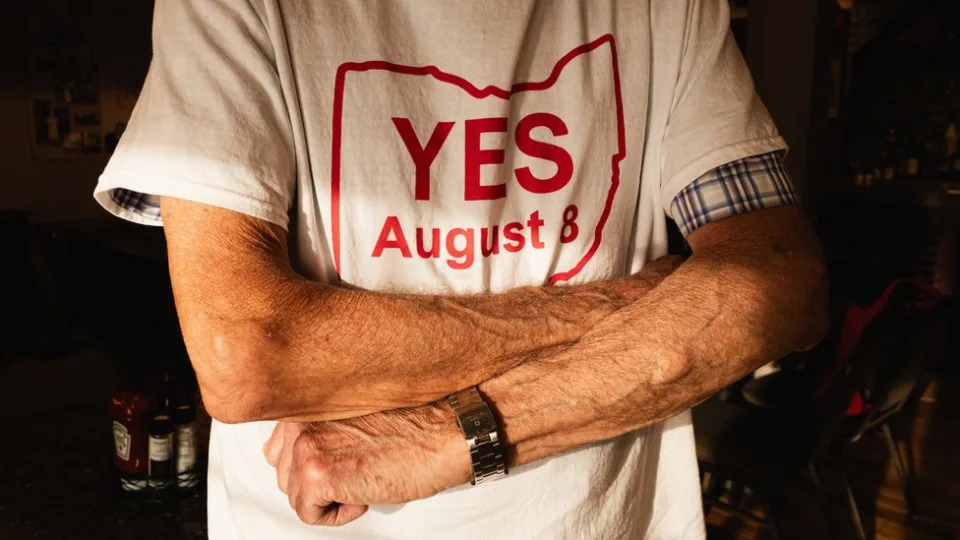
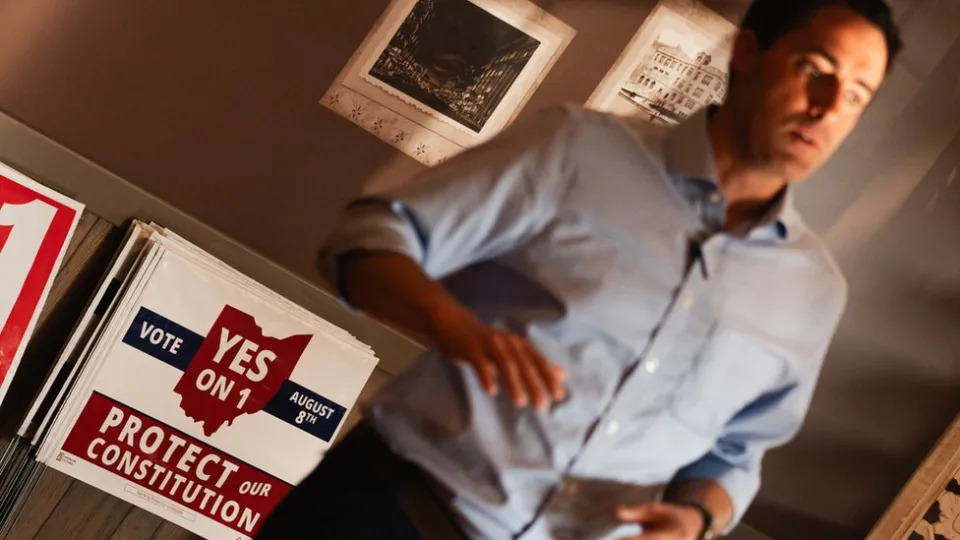
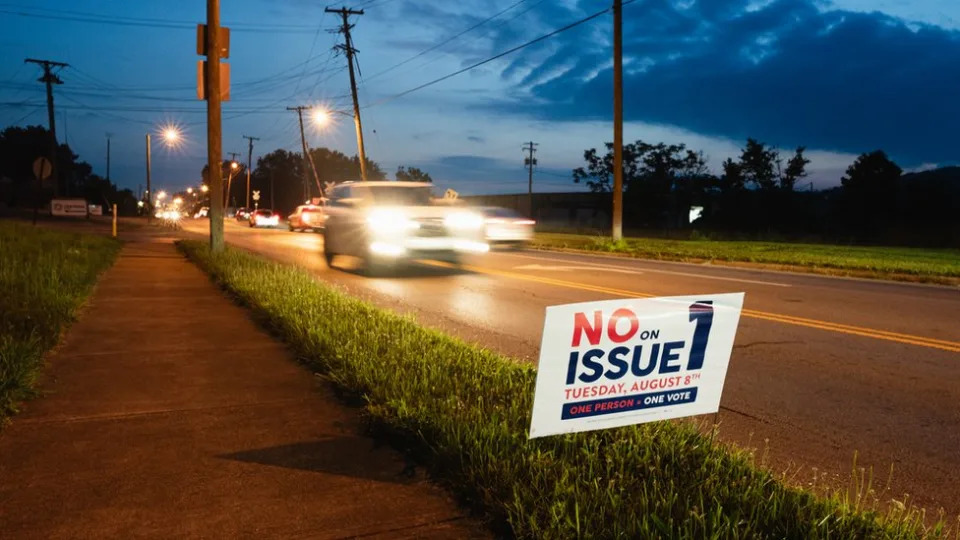
Ohioans on Tuesday soundly defeated a proposal that would have made it more difficult to alter the state’s Constitution.
The move is a lightning-rod moment for abortion rights, even if the issue wasn’t directly on the ballot. After the Supreme Court’s Dobbs decision last year, the issue motivated voters to storm the polls. But this measure, which didn’t directly take on abortion, was a closely watched measure of if the issue still resonates with voters.
Voters had the answer. They overwhelmingly rejected Issue 1, an amendment that would have raised the threshold to pass a constitutional amendment from a simple majority to 60 percent, as well as complicate the process to bring citizen-initiated ballot measures to voters in the first place. Though it had profound implications for a number of issues, it was widely seen in the state as a way to thwart November’s measure that would enshrine abortion rights in the state’s Constitution.
The measure’s defeat now gives abortion-rights supporters a clearer path to victory.
Opponents of Issue 1 view the victory as the first battle on abortion in the coming cycle, when the issue will be a factor in competitive Senate and House races that could help determine who controls Congress — as well as a number of direct ballot measures in swing states in the works.
But opponents also frame their victory as one that protects the power of the simple majority.
“I think sometimes, a lot of these fights get viewed in a single entity and the state gets viewed in a single moment as its value to the presidential battleground map,” said Ohio Democratic Party Chair Liz Walters. “And I get that, but democracy matters everywhere,” pointing to Arkansas and South Dakota, where voters similarly rejected efforts to implement a supermajority requirement for ballot initiatives.
Here are three takeaways from Tuesday’s election in Ohio:
Abortion still a serious turnout driver
Tuesday’s election proved that the state-by-state battle over abortion rights is still a serious motivator to get voters to the polls — even when abortion isn’t directly on the ballot.
Ohio Republicans moved in January to cancel most August elections because they were low turnout affairs that voters rarely paid attention to. Just over 8 percent of voters turned up in an August 2022 state legislative primary election, for example.
So when the GOP-controlled legislature pulled an about face months later by scheduling Issue 1 on the August ballot, abortion rights supporters cried foul, saying it was an attempt to kneecap them without voters noticing.
But voters turned up in droves anyway. More than 600,000 people voted early — a number that could still rise from late-arriving mail ballots — which outpaced the entirety of the turnout for that 2022 August election. It was also more than twice the number of people who voted early in the May 2022 primaries, which featured competitive Senate or gubernatorial contests.
Both pro-abortion rights groups and anti-abortion activists invested heavily in getting their supporters to show up. And conservatives emphasized supporters voting early as well, as Republicans try to close the gap created, in part, by former President Donald Trump’s relentless attacks on early voting.
Instead of a summer snoozer, turnout was off the charts.
Anti-abortion messaging isn’t evolving, or resonating
Anti-abortion groups that have invested millions in ballot initiative fights have deployed similar messages in each state since the post-Roe contests kicked off last summer — focusing on areas they see as political vulnerabilities, including parental consent, abortions later in pregnancy, and gender-affirming care for minors.
In Ohio this week and in Kansas, Kentucky, Michigan and other states last year, groups poured millions into TV ads arguing that codifying abortion rights in the state constitution would lead to the abolition of any restrictions on the procedure — including requirements that parents be notified when a minor terminates a pregnancy and bans on most abortions after the point of fetal viability.
“I don’t think our messaging will change at all, because we’ve seen positive movement from the messaging,” Mike Hartley, a veteran GOP strategist in Ohio and campaign manager for Protect Women Ohio, the coalition against the abortion-rights measure, said last month. “We’re gonna keep hammering … that it’s not just about abortion.”
Though polling indicates majority support for those restrictions, even among Democrats, the arguments have not swayed voters in these races amid a general surge in support for abortion rights in the year since Roe was overturned.
“Dobbs changed everything. Any polling done prior to then is obsolete,” said Ashley All, who led the successful Kansas campaign to defeat an anti-abortion rights ballot measure last summer and is now advising other states through the group Families United for Freedom. “People now see the real consequences of these bans. They see children having to cross state lines to get care. They see women almost dying in childbirth. So they don’t buy the arguments the other side is making.”
The fight drags on
Abortion in Ohio remains legal for now thanks to a court injunction blocking enforcement of the state’s near-total ban. But Ohio voters have an opportunity to directly weigh in on a constitutional amendment on the November ballot to permanently protect the right to the procedure — making any anti-aboriton legislation obsolete.
With Congress lacking the votes to pass either national abortion restrictions or bring back the protections of Roe, abortion-rights groups see state ballot measures as one of their best tools for maintaining or restoring access in red and purple states.
Similar efforts to put abortion rights to a popular vote are also brewing in Arizona, Florida, Missouri, Nevada and South Dakota. Activists in many of these states are hoping to get the issue before voters in 2024, in which turnout will be especially high due to the presidential election.
Arizonans tried and failed to hold a referendum in 2022, falling short in signature-gathering. On Tuesday, they launched a new push, hoping to scrap the state’s current 15-week ban. A poll released by progressive groups Data for Progress and Indivisible on Tuesday found its presence on the ballot would drive higher turnout among Democrats but not Republicans — potentially shaping the results of the state’s Senate and presidential races.
Clarence Thomas’s $267,230 R.V. and the Friend Who Financed It
By Jo Becker and Julie Tate – August 5, 2023
The vehicle is a key part of the justice’s just-folks persona. It’s also a luxury motor coach that was funded by someone else’s money.
Justice Clarence Thomas, circa 2000, with his great-nephew and his Prevost Le Mirage XL Marathon motor coach.
Justice Clarence Thomas met the recreational vehicle of his dreams in Phoenix, on a November Friday in 1999.
With some time to kill before an event that night, he headed to a dealership just west of the airport. There sat a used Prevost Le Mirage XL Marathon, eight years old and 40 feet long, with orange flames licking down the sides. In the words of one of his biographers, “he kicked the tires and climbed aboard,” then quickly negotiated a handshake deal. A few weeks later, Justice Thomas drove his new motor coach off the lot and into his everyman, up-by-the-bootstraps self-mythology.
There he is behind the wheel during a rare 2007 interview with “60 Minutes,” talking about how the steel-clad converted bus allows him to escape the “meanness that you see in Washington.” He regularly slips into his speeches his love of driving it through the American heartland — “the part we fly over.” And in a documentary financed by conservative admirers, Justice Thomas, who was born into poverty in Georgia, waxes rhapsodic about the familiarity of spending time with the regular folks he meets along the way in R.V. parks and Walmart parking lots.
“I don’t have any problem with going to Europe, but I prefer the United States, and I prefer seeing the regular parts of the United States,” he told the filmmakers, adding: “There’s something normal to me about it. I come from regular stock, and I prefer being around that.”
But there is an untold, and far more complex, back story to Justice Thomas’s R.V. — one that not only undercuts the mythology but also leaves unanswered a host of questions about whether the justice received, and failed to disclose, a lavish gift from a wealthy friend.
His Prevost Marathon cost $267,230, according to title history records obtained by The New York Times. And Justice Thomas, who in the ensuing years would tell friends how he had scrimped and saved to afford the motor coach, did not buy it on his own. In fact, the purchase was underwritten, at least in part, by Anthony Welters, a close friend who made his fortune in the health care industry.
A circa 1991 advertisement for Marathon coaches. Credit…Marathon
He provided Justice Thomas with financing that experts said a bank would have been unlikely to extend — not only because Justice Thomas was already carrying a lot of debt, but because the Marathon brand’s high level of customization makes its used motor coaches difficult to value.
In an email to The Times, Mr. Welters wrote: “Here is what I can share. Twenty-five years ago, I loaned a friend money, as I have other friends and family. We’ve all been on one side or the other of that equation. He used it to buy a recreational vehicle, which is a passion of his.” Roughly nine years later, “the loan was satisfied,” Mr. Welters added. He subsequently sent The Times a photograph of the original title bearing his signature and a handwritten “lien release” date of Nov. 22, 2008.
But despite repeated requests over nearly two weeks, Mr. Welters did not answer further questions essential to understanding his arrangement with Justice Thomas.
He would not say how much he had lent Justice Thomas, how much the justice had repaid and whether any of the debt had been forgiven or otherwise discharged. He declined to provide The Times with a copy of a loan agreement — or even say if one existed. Nor would he share the basic terms of the loan, such as what, if any, interest rate had been charged or whether Justice Thomas had adhered to an agreed-upon repayment schedule. And when asked to elaborate on what he had meant when he said the loan had been “satisfied,” he did not respond.
“‘Satisfied’ doesn’t necessarily mean someone paid the loan back,” said Michael Hamersley, a tax lawyer and expert who has testified before Congress. “‘Satisfied’ could also mean the lender formally forgave the debt, or otherwise just stopped pursuing repayment.”
Justice Thomas, for his part, did not respond to detailed questions about the loan, sent to him through the Supreme Court’s spokeswoman.
The two men’s silence serves to obscure whether Justice Thomas had an obligation to report the arrangement under a federal ethics law that requires justices to disclose certain gifts, liabilities and other financial dealings that could pose conflicts of interest.
Vehicle loans are generally exempt from those reporting requirements, as long as they are secured by the vehicle and the loan amount doesn’t exceed its purchase price. But private loans like the one between Mr. Welters and Justice Thomas can be deemed gifts or income to the borrower under the federal tax code if they don’t hew to certain criteria: Essentially, experts said, the loan must have well-documented, commercially reasonable terms along the lines of what a bank would offer, and the borrower must adhere to those terms and pay back the principal and interest in full.
Richard W. Painter, a White House ethics lawyer during the George W. Bush administration, said that when it comes to questions of disclosure, the ethics treatment of gifts and income often parallels the tax treatment. But those intricacies aside, he said, “justices just should not be accepting private loans from wealthy individuals outside their family.” If they do, he added, “you have to ask, why is a justice going to this private individual and not to a commercial lender, unless the justice is getting something he or she otherwise could not get.”
The Times’s unearthing of the loan arrangement is the latest in a series of revelations showing how wealthy benefactors have bestowed an array of benefits on Justice Thomas and his wife, Virginia Thomas: helping to pay for his great-nephew’s tuition, steering business to Mrs. Thomas’s consulting firm, buying and renovating the house where his mother lives and inviting the Thomases on trips both domestic and foreign that included travel aboard private jets and a yacht.
Ethical Issues Inside the Supreme Court
A Crisis of Ethics: A debate over ethical standards for Supreme Court justices has intensified after a series of revelations about lavish gifts and financial largess. Our reporter explains the allegations of misconduct and the growing calls for tighter rules.
Scalia Law: George Mason University’s law school cultivated ties to some of the court’s conservative justices with generous pay and unusual perks. In turn, the school gained prestige, donations and influence.
Justice Thomas has pointed to interpretations of the disclosure rules to defend his failure to report much of the largess he has received. He has said he was advised that the trips fell under an exemption for gifts involving “personal hospitality” from close friends, for instance, and a lawyer close to the Thomases contended in a statement that the justice did not need to disclose the tuition because it was a gift to his great-nephew, over whom he had legal custody, rather than to him.
The Thomases’ known benefactors include wealthy men like the Dallas real estate developer Harlan Crow, the conservative judicial kingmaker Leonard Leo and several members of the Horatio Alger Association of Distinguished Americans, which honors people who succeed despite adversity. Among them: the longtime Miami Dolphins owner Wayne Huizenga, who flew the justice around on his jet.
Mr. Welters, while also a Horatio Alger member, stands apart. For one thing, the two men’s friendship predates Justice Thomas’s time on the federal bench. They met around 1980, when both were members of a small, informal club of Black congressional aides to Republican lawmakers — Mr. Welters worked for Senator Jacob K. Javits of New York and Justice Thomas for Senator John C. Danforth of Missouri.
Anthony Welters, shown with his wife Beatrice in 2016, was a close friend of Justice Thomas’s from their time working as congressional aides. Credit…Astrid Stawiarz/Getty Images for NYU Langone Medical Center
“It wasn’t exactly fashionable to be a Black person working for a Republican, and it was comforting to meet others in the same boat,” the justice wrote in his autobiography, “My Grandfather’s Son.”
They had much in common. Like Justice Thomas, Mr. Welters was raised in poverty, sharing a cramped tenement in Harlem with his parents and three brothers and, after his mother’s death when he was 8, shining shoes under an elevated subway to help make ends meet.
As both men climbed the ladder as political appointees in the Reagan administration, their friendship grew. They stayed close after Justice Thomas joined the federal appeals court in Washington in 1990 and Mr. Welters left government to found AmeriChoice, a Medicaid services provider that he sold to UnitedHealthcare for $530 million in stock in 2002 and continued to lead until retiring in 2016. Mr. Welters and his wife, Beatrice, named Justice Thomas the godfather of one of their two boys, according to The Village Voice.
When Justice Thomas’s 1991 Supreme Court nomination ran into trouble after a former subordinate, Anita Hill, accused him of sexual harassment, Mr. Welters stood by his friend, providing behind-the-scenes advice, according to a book on the hearings written by Mr. Danforth.
And in 1998, the year before the motor coach purchase, Justice Thomas returned the favor. That is when Mr. Welters and his wife, through their foundation, started the AnBryce scholarship program, which gives underprivileged students a full ride to New York University’s law school, along with networking opportunities and career support. Justice Thomas lent his considerable imprimatur to the program, interviewing applicants in his Supreme Court chambers, mentoring scholars and later hiring one graduate as a clerk.
By that point, the justice had become fixated on owning an R.V., and not just any R.V., but the Rolls-Royce of motor coaches: a custom Prevost Marathon, or as he once put it, a “condo on wheels.”
A Toy for the Rich
Justice Thomas was turned on to the luxury brand by Bernie Little, a fellow Horatio Alger member and the flamboyantly wealthy owner of the Miss Budweiser hydroplane racing boat. Mr. Little had owned 20 to 25 custom motor coaches over the years, Mr. Thomas told C-SPAN in 2001.
Back in those days, a basic Prevost Marathon sold for about a million dollars, and could fetch far more depending on the bells and whistles. It was a rich man’s toy, and the company marketed it that way.
“You drive through a neighborhood in South Florida and you see these $10 million homes,” Bob Phebus, Marathon’s vice president, told The South Florida Business Journal in 2006. “You condense that down, put it on wheels and that’s what we have. It’s the same guy that will have a 100-foot yacht and a private aircraft. They’re accustomed to the finer things in life.”Got a news tip about the courts?If you have information to share about the Supreme Court or other federal courts, please send us a secure tip at nytimes.com/tips.
At the time, the Thomases’ primary source of income was the justice’s salary, then $167,900. He had yet to sell his autobiography, and property and other records show that the couple had significant debt: They had purchased their house in 1992 for $552,000 with 5 percent down, then refinanced it two years later, taking out a 15-year mortgage of $496,000. Plus, they had at least one line of credit of between $15,000 and $50,000.
So, in Justice Thomas’s telling, he began searching for a used Prevost at Mr. Little’s suggestion, one with enough miles on it to depreciate the value. “The depreciation curve — it’s very steep,” he made a point of saying in the 2001 C-SPAN interview.
All these years later, he still hasn’t told some of his closest friends how he was really able to swing the purchase.
“He told me he saved up all his money to buy it,” said Armstrong Williams, a longtime friend who worked closely with Justice Thomas in the Reagan administration.
The title history documents reviewed by The Times show that when the motor coach was sold for $267,230 to the Thomases in 1999, it had only 93,618 miles on it, relatively few for a vehicle that experts say can easily log a million miles in its lifetime. It came equipped with plush leather seating, a kitchen, a bathroom and a bedroom in the back. In addition to its orange flame motif, it had a large Pegasus painted on the back, according to Jason Mang, the step-grandson of the previous owner, Bonnie Owenby.
“It was superluxury, really bougie,” he recalled.
On Nov. 19, 1999, after spotting the motor coach on the lot of Desert West Coach in Phoenix and putting a hold on it, Justice Thomas attended a dinner at the conservative Goldwater Institute. In a speech that night, he said he had never yearned to be a federal judge. “Pure and simple, I wanted to be rich,” he said.
Wayne Mullis, the owner of the now-defunct Desert West, said in an interview that Justice Thomas never discussed obtaining traditional financing with him, and that “as far as I know, he paid for it.”
Indeed, Justice Thomas would have been hard-pressed to get a loan from a traditional lender. Banks, and even finance companies that specialize in R.V. loans, are particularly reluctant to lend money on used Prevost Marathons because the customized features are hard to value, according to three leading industry executives interviewed by The Times.
“As a rule, the majority of buyers are cash buyers — they don’t finance the Prevost, generally,” said Chad Stevens, owner of an Arizona-based dealership specializing in high-end motor coaches, whose clients include celebrities and politicians. “In 1999, you would need a very strong down payment and a strong financial portfolio to finance one. It is a luxury item.”
While the terms of Mr. Welters’s loan to Justice Thomas are unclear, rules governing loans of more than $10,000 between friends and family are not.
Loans can be reclassified as gifts or income to the borrower, either of which would have to be reported by the justice under court disclosure rules, if any portion of the debt is forgiven or discharged as uncollectable. But even if a lender does not take those steps, a loan can still be considered a reportable gift or income if it doesn’t meet certain standards.
Loan terms should be spelled out in a written agreement, with a clearly defined, regular repayment schedule, tax experts said. Lenders must charge at least the applicable federal interest rate, which was a little over 6 percent in December 1999, when the deal to buy the motor coach closed. And if a borrower is in arrears, lenders must make a good-faith effort to collect, even to the point of going to court.
“Absent that, it’s more of a gift,” said Rich Lahijani, tax director of Edelman Financial Engines, an independent wealth planning and investment advisory firm.
The title history records held by the Virginia Department of Motor Vehicles do not contain detailed information about the loan itself. What they show is that when the Thomases drove their motor coach back home to Virginia, they registered it in Prince William County, which does not charge personal property tax on R.V.s stored there, unlike Fairfax County, where they live.
Mr. Welters said he released the lien on the vehicle in 2008, and provided this photo of the original title to The Times as evidence. (Addresses and vehicle identification number have been redacted.) Credit…via Anthony Welters
And as of late last month, when The Times reviewed the records, they still listed Mr. Welters as the lien holder, notwithstanding the signed release he said he gave Justice Thomas in 2008 so he could obtain a new, clear title.
Mr. Welters said he could not explain why he was still listed as the holder of the lien. After he gave Justice Thomas the paperwork, he said, “I don’t know what process the borrower should have followed.” (To clear the title, the paperwork should have been brought to the D.M.V., where the lien release would have been recorded and a replacement title issued.) As for Justice Thomas, that was among the matters he declined to discuss with The Times.
‘A Warm, Safe Place’
As details about Justice and Mrs. Thomas’s subsidized trips to vacation homes and resorts have become public in recent months, his professed preference for traveling by motor coach has become something of a “yeah, right” punchline.
But by all accounts, he loves the anonymity, the freedom and the community it affords. He has hosted at least one event at the Supreme Court for a Marathon owners’ club.
Members of the Marathon Coach Club International on the steps of the Supreme Court.Credit…via Marathon Coach
When he hits the road, he often goes unrecognized, which at times has allowed him to travel without a U.S. Marshals’ security detail. Chris Weaver, who worked at Desert West Coach, said the justice had frequently gotten his motor coach serviced there before it closed. “Nine out of 10 times, he was just wearing sweats and a T-shirt,” he said.
Traveling largely through red-state America has also meant that when he is recognized, more often than not it is by fans. Juan Williams, a Fox News commentator who has known Justice Thomas since the Reagan administration, said the motor coach was both the fulfillment of a boyish fantasy and a metaphorical “womb.”
“He talked about the R.V. a lot,” he said. “It was a warm, safe place where he didn’t have to be attacked by liberals and Blacks on the left. What he liked about it was not being pilloried.”
In a 2007 interview, Justice Thomas told Steve Kroft of “60 Minutes” that the motor coach enabled him to escape the “meanness that you see in Washington.” Credit…CBS News
In a 2019 Q. and A. at the court, Justice Thomas said he had made it to nearly two dozen states, and declared himself the proud owner of a KOA campground discount card.
But the Thomases’ road trips have hardly been limited to sleeping at campsites and Walmart parking lots.
In a 2009 call-in to a morning radio talk show, for instance, Mrs. Thomas said they were driving their motor coach through the Adirondacks, on their way to “meet some families from Texas.” ProPublica has reported that the Thomases have spent part of nearly every summer for the past two decades in the Adirondacks as a guest of Mr. Crow, who owns a lakeside resort there with more than 25 fireplaces, three boathouses and a painting of the justice, his host and other guests smoking cigars.
The boathouse at Harlan Crow’s Adirondack resort, where Justice Thomas and his wife have vacationed. Credit…Nancie Battaglia for The New York Times
When the Thomases aren’t houseguests, they have stayed at upscale Marathon-endorsed destinations like the Mountain Falls Luxury Motorcoach Resort in Lake Toxaway, N.C.
There, the justice met Larry Fields, who owns a motor-coach-cleaning business. Mr. Fields said that for several days he had had no idea who Justice Thomas was, telling him he would have to wait in line to have his Prevost washed, which he patiently did.
“He was a great guy,” Mr. Fields recalled. “I think we talked about how great Reagan was. He was low-key. It was just him and his wife and a dog.”
Justice and Mrs. Thomas have traveled to Mountain Falls, a luxury motor coach resort in North Carolina. Credit…Greg Eastman
Upkeep on a motor coach like the justice’s is an expensive constant, and other friends have chipped in to help. While he did not disclose Mr. Welters’s assistance in buying the motor coach, he did report that some former clerks got together and bought him deep-cycle batteries for $1,200 the year after he acquired it. He also reported that in 2002, Greg Werner, who ran a large, family-owned, Nebraska-based trucking company, gave him tires worth $1,200.
And over time, Justice Thomas made the motor coach his own. In a photo The Times obtained that appears to date back to the early 2000s, picturing his great-nephew as a child, the motor coach no longer sported the sizzling orange flames and Pegasus logo. Instead, it was painted in an elegant black-and-gold geometric pattern.
But if the custom coach changed, the justice’s friendship with Mr. Welters endured.
While Mr. Welters was an executive at UnitedHealthcare, Justice Thomas twice recused himself from cases involving the company, in 2003 and 2005. As is the general custom of the court, he did not explain why.
In 2010, Justice Thomas traveled to the capital of Trinidad and Tobago, Port of Spain, at the invitation of the Welterses. By then, the couple had become major Democratic fund-raisers and President Obama had named Ms. Welters ambassador to the island nation. Local newspapers captured the justice and Mr. Welters talking to students at a school.
Justice Thomas at a school in Trinidad and Tobago in 2010 with Mr. Welters, left, whose wife was the ambassador. Flight records show that the Welterses’ private plane flew to and from Dulles Airport on the days Justice Thomas traveled. Credit…U.S. Embassy Trinidad and Tobago
In disclosures, Justice Thomas wrote that the “U.S. Embassy Port of Spain” had paid for his flight. But flight records obtained through the plane-tracking services of MyRadar show that the Welterses’ private Gulfstream G-6 flew from Washington Dulles International Airport and back on the days that Justice Thomas arrived on and departed the Caribbean island.
And Matthew Cassetta, a retired embassy official who helped arrange the visit, said Ms. Welters customarily “offered the plane to people who came down,” always at her own expense to save the taxpayers money.
(Ms. Welters declined to comment on the flights or the loan, except to say, “I just want to tell you that friendships come and go, and that’s what I want to say.”)
The same year, in a speech accepting an award from the Horatio Alger Association, Justice Thomas singled out Mr. Welters as one of his “friends for the whole journey.”
“And for Tony, a special thank you, who understood relationships and who was always there as a friend in the worst times of my life,” he said. “It is a friendship I will treasure forever.”
Reporting was contributed by Steve Eder, Riley Mellen, Robin Stein and Abbie VanSickle.
Jo Becker is a reporter in the investigative unit and a three-time Pulitzer Prize winner. She is the author of “Forcing the Spring: Inside the Fight for Marriage Equality.” More about Jo Becker
Ahead of Ohio abortion vote, Republicans try to change the rules
Holly Honderich – in Washington – August 5, 2023
An upcoming referendum in Ohio has become a proxy fight for abortion
A pro-abortion referendum looked poised to win in the conservative state of Ohio this November. Now, Republican state legislators are accused of moving the goalposts.
Last summer, just like every summer for the past 22 years, Michael Curtin spent his days on the assorted baseball fields of central Ohio, acting as umpire for high school and college games.
Mr Curtin, retired after a 38-year career in journalism and another four in state politics, loves the game. But this summer, Mr Curtin’s umpire equipment has been neglected, shoved somewhere in the basement of his Columbus home so he could focus on the rules of Ohio politics instead.
“I’m not doing one game,” he said. “And I miss it. But this fight’s too important to lose.”
The fight in question is over Issue 1, a deceivingly dull and procedural-sounding referendum on the minimum threshold required to pass constitutional amendments.
The premise is simple: voters will decide on 8 August whether that threshold should remain at 50% plus one, or be raised to 60%.
But Ohio’s vote has become a proxy war over abortion, one of the many state-wide battles that have broken out since the US Supreme Court rescinded the nationwide right to abortion last June.
That’s because Issue 1 is not the only referendum looming. In November, Ohioans will vote on another constitutional amendment, one that would protect abortion access up until foetal viability, around 24 weeks of pregnancy.
The proponents of issue 1 claim that Tuesday’s vote is simply to protect the state’s constitution from outside influence.
But its opponents – a diverse coalition featuring political wonks like Mr Curtin, a retired Supreme Court judge and all of Ohio’s past living governors – have called foul. They claim Issue 1 is a backhanded attempt to change the rules mid-game, raising the voter threshold just in time to thwart the abortion vote.
“Look, everybody knows what’s going on here. Everybody knows,” Mr Curtin said. “This was just bad faith.”
Issue 1 has been championed by Ohio’s secretary of state Frank LaRose
Since Roe v Wade was overturned last June, the country’s abortion fight has increasingly played out in state ballot initiatives. There have been six so far, each one a win for abortion rights.
If Ohio’s vote is passed, it will be the most sweeping affirmation of reproductive rights in a state controlled by a firm Republican majority, said Mary Ziegler, a law professor at the University of California, Davis and a leading authority on the US abortion debate. “It will confirm that there’s some sort of consensus around abortion rights, even in conservative states.”
But if Issue 1 is passed first, and the threshold is raised to 60%, the abortion rights amendment may be finished.
“They [anti-abortion campaigners] very clearly looked at this and said: we cannot win if we don’t change the rules,” said Kellie Copeland, executive director of Pro-Choice Ohio.
Issue 1 has had the full-throated support of Ohio’s chief election official, secretary of state Frank LaRose.
“To allow a bare majority of 50% plus one to change the very ground rules that the state operates on is just not good public policy,” he told the BBC.
Issue 1’s opponents include all four of the state’s living former governors
Mr LaRose, 44, is a veteran of the US Special Forces and now an enthusiastic envoy for the Republican Party, crisscrossing the state for more than 65 pro-Issue 1 events. He is charming, conservative and politically ambitious. In November – at the same time the abortion referendum is held – Mr LaRose will be on the ballot for the US Senate.
In public, Mr LaRose has kept the focus squarely on the constitution. But at a fundraising dinner in May, Mr LaRose made explicit the importance of Issue 1 for the anti-abortion movement.
“I’m pro-life. I think many of you are as well,” Mr LaRose said, in a video recorded by Scanner Media. “This is 100% about keeping a radical pro-abortion amendment out of our constitution. The left wants to jam it in there this coming November.”
In an interview with the BBC, Mr LaRose acknowledged that the “looming abortion amendment” helped bring the Issue 1 vote forward. “But that’s not the only reason,” he said.
To his opponents, Mr LaRose had been caught saying the quiet part out loud.
“There’s an old standard that our grandparents taught us that bears repeating: if you want any credibility in life… never deny the obvious,” Mr Curtin said. “Here is Mr LaRose denying the obvious.”
There have been other accusations of hypocrisy. Earlier this year, Republicans passed a law eliminating nearly all August elections, citing their high cost and low turnout. Then, in an apparent u-turn, they put Issue 1 on the calendar for 8 August.
Even some of Mr LaRose’s fellow Republicans have spoken out against Issue 1.
“You’re talking about changing a part of the Ohio constitution that has been in effect for well over 100 years,” said former Ohio Governor Bob Taft, a Republican. “And it’s worked, it’s worked well, the system is not broken.”
In the 111 years since Ohio first granted voters the power to introduce citizen-led amendments, just 19 of 71 proposed measures have passed. Ohio’s current policy requiring a simple majority is in line with most of the 17 US states that allow citizen-initiated amendments. And in 2015, Ohioans added a new restriction, passing an amendment that prohibited anyone from changing the constitution for their own financial benefit.
“This is an elaborate scheme to suppress the vote of Ohioans… It’s unconscionable,” said former Ohio Supreme Court Chief Justice Maureen O’Connor, also a Republican.
Whatever Mr LaRose’s motivations, Issue 1 has been embraced by Ohio’s anti-abortion lobby. Mike Gonidakis, president of Ohio Right to Life, said he “led efforts” to get signatures from state politicians to put the measure on the ballot.
“In speaking with Frank LaRose I said ‘now’s our time to do this’,” he told the BBC.
Mr Gonidakis, like Mr LaRose, rejected criticism that Issue 1 was underhanded. “It’s not changing the goalposts if Ohioans weigh in and vote on it,” he said.
Experts said they see Ohio’s Issue 1 as part of a broader tactic employed by anti-abortion advocates to circumvent public opinion in service of their ultimate goal, outlawing abortion entirely – a goal that is unsupported by most Americans.
“They think if voters had a straight up and down decision on abortion it wouldn’t go their way, so they’re trying to do what they can to prevent that from happening,” said the University of California’s Ms Ziegler.
As a result, anti-abortion leaders and their Republican allies have found paths around popular support – either relying on the court system or on politicians willing to promote abortion policy regardless of voters’ wishes.
These manoeuvres are possible, Ms Ziegler said, because in so many cases Republican politicians fear the anti-abortion lobby more than their own constituents.
And the strategy suits the movement’s internal logic, in which banning abortion is seen as the worthiest cause.
“There’s a sense in which winning is more important than democracy,” she said.
Democrats are drastically over-performing in 2023’s special elections. Is it a clue for Biden vs. Trump?
Tal Axelrod – August 5, 2023
Trump mounted $40 million in legal fees: Sources
ABC News’ senior congressional correspondent Rachel Scott reports on what some Republicans are saying about the new charges against former President Donald Trump.
But Democrats also say that based on 2023 so far, they see plenty of reason for optimism about their chances with voters.
An analysis from FiveThirtyEight found that in 38 special elections held so far this year, Democrats have outperformed the partisan lean — or the relative liberal or conservative history — of the areas where the races were held by an average of 10%, both romping in parts of the country that typically support the party while cutting down on GOP margins in red cities and counties, too.
For instance, the Democratic candidate in a Wisconsin State Assembly special election last month lost by just 7 points in an area where Republicans have a 22-point edge and where Trump beat Biden by almost 17 points in 2020.
In a New Hampshire special election in May for a state House seat, the Democrat won by 43 points, far beyond the party’s estimated 23-point edge in the district.
The data from FiveThirtyEight does not include regularly scheduled off-year elections, including the Wisconsin Supreme Court race earlier this year in which the liberal candidate, now-Justice Janet Protasiewicz, won by 11 points — in a state famous for its wafer-thin election margins.
“I think when you when you look at things like this, one special election doesn’t mean much on its own. But when you start to see real consistency, it can certainly become predictive of the next election cycle,” said Ben Nuckels, a Wisconsin Democratic strategist who consulted on Protasiewicz’s campaign.
For comparison, according to FiveThirtyEight, Democrats outperformed the weighted partisan lean by about 4% in special elections held between the 2018 midterms and the 2020 elections, when Biden won the White House by 4.5% but Democrats underperformed in House races.
Conversations with eight Democratic and Republican operatives in swing states show some repeated explanations for this success: the public’s general support for abortion access after the Supreme Court reversed the national guarantee for the procedure last year along with angst and anger over Trump’s comeback bid, given how divisive he remains — two factors which might even overcompensate for Biden’s sagging approval ratings.
“Republicans have not had a good election night since before the Supreme Court overturned Roe v. Wade. And, honestly, it seems like post-Roe Republicans couldn’t find their groove even if a DJ played their favorite song on repeat,” Nuckels said. “So I think Democrats are in a very good position here going forward.”
PHOTO: In this undated file photo, the US Capitol building is shown in Washington, D.C. (STOCK IMAGE/Getty Images)
Special and off-year elections are not perfect predictors of major election cycles. Now-Virginia Gov. Glenn Youngkin, a Republican, earned a surprise victory in 2021 — before Democrats’ surprisingly strong performance in the 2022 midterms.
However, similar elections held in 2017 and 2019 did precede Democratic successes in 2018 and 2020.
“I think what we’re seeing is that the Dobbs decision has fundamentally rewired our politics, and almost every other measure than actual votes cast has yet to figure out how to bake that in. And so, whether you’re talking about traditional approval ratings, whether you’re talking about polling, the ground has shifted,” said Wisconsin Democratic strategist Joe Zepecki.
“Almost all of these elections keep ending up different than what you would have expected — in the same direction. And so, that, to me, suggests that there’s some stickiness to this,” he added. “And the only thing that might change it is clarity on this issue, something like a federal codification of [abortion rights]. And you and I both know we’re not going to see that between now and next November.”
Republican operatives also sounded some alarm, telling ABC News the trend cannot be ignored.
“If you’re looking at this plus-22 [pro-GOP] seat and you want to know why this guy won by a lot smaller percentage than what you would have thought … it’s because this issue is still there. Republicans still have to figure out how to address the abortion issue,” said Wisconsin GOP strategist Brandon Scholz.
“I think you have to be very concerned.”
Other Republicans pointed to the current lack of party unity over Trump — amid the 2024 primary — to help explain the special election results.
“You could probably make a connection a little bit to the presidential race, that there’s a lot of candidates in right now. There’s the Trump folks and folks that are backing somebody else, and the party’s not united nationally around one candidate right now, or at least not completely. Sometimes that affects turnout and funding and stuff like that,” said GOP consultant Josh Novotney, who is based in Pennsylvania, where Democrats flipped the state House in special elections earlier this year.
Other conservatives cautioned against taking too much away from how the 2023 results could predict who wins next year.
PHOTO: FILE – Pro-abortion and anti-abortion demonstrators protest outside the U.S. Supreme Court in Washington, May 3, 2022. (Evelyn Hockstein/Reuters, FILE)
Special elections are notorious for funky turnouts, sometimes relying on only the most motivated groups and with other voters at times even unaware they’re happening at all, especially in an odd-numbered year. On top of that, less money is often spent on special elections rather than regularly scheduled races, impacting the outreach campaigns can do to win over voters.
“I am someone who, over the years, has always cautioned about reading too much into specials, regardless of whether they help your cause or hurt your cause,” said veteran Pennsylvania GOP strategist Chris Nicholas.
However, whether or not this year’s special elections are forecasts of next year’s results, strategists on both sides of the aisle expected the Democratic drumbeat over abortion and Trump to continue.
“They thought it could juice their turnout, and they were they were successful in that regard. And they weren’t subtle about it at all. They’re just like, ‘We know this is a hot-button issue for us, and we’re gonna keep milking it till it runs dry.’ I think you’ll see that a lot in the fall and next year as well,” Nicholas said, referencing one special election in Pennsylvania earlier this year.
Democrats who spoke to ABC News were torn over whether the trend is strong enough to last until November 2024, with some pumping the brakes and others appearing more bullish.
“I think it’s less of a tea leaf and maybe an inspiration, that if Democrats are able to control the narrative in these races, where they’re able to talk to voters about the stakes around abortion and then also contrast the Republicans’ focus on the culture war with the real kitchen table issues that a lot of these Democratic candidates are also focusing on — that there’s a path to be able to both motivate more Democrats to turn out and win the swing voters,” said Pennsylvania Democratic strategist J.J. Abbott.
Zepecki, another Democrat, said that “the rules have been rewritten, we don’t know what they are.”
“We’re using old benchmarks to try to forecast going forward. And I think what we need to look at is less of the noise and more of signal,” he said. “Right now, the noise is [what] you see on cable news, and it’s people tweeting all day. The signal, what we should be looking for, are election results. That’s what ultimately is telling the story.”
Outside of 2023’s special elections, Democrats still face a range of high-profile regular races this year that are expected to be competitive — including for Virginia’s entire state Legislature and governorships in Kentucky and Louisiana.
Susan Stancill, the chair of the Democratic Party in Washington County, Va., said she has “a lot” of confidence after this year’s special election results, including in rural counties like hers where Democrats aren’t winning but are cutting down Republicans’ margins.
“We have five constitutional and party candidates on our ballot, and then an additional four school board candidates, and I’m optimistic we’re gonna run the table,” she said. “And you might tell me I’m crazy. But ask me in November.”
‘Morning Joe’ Skewers Lindsey Graham for Saying Judge in Jan. 6 Indictment ‘Hates Trump’: ‘So Embarrassing’
Dessi Gomez – August 4, 2023
“Morning Joe” co-hosts Joe Scarborough and Mika Brzezinski slammed Republican Sen. Lindsey Graham for his words about former President Donald Trump’s latest indictment as well as the judge involved and the broader judicial system of the United States.
“It is so disgusting. Lindsey knows better. He obviously knows better, but he’s slandering the judge. He’s attacking the jury system and it’s very interesting. The judge, who’s gonna actually be overseeing the case, was unanimously confirmed by the Senate in 2013 by a vote of 95 to zero,” Scarborough said. “She was unanimously confirmed by the Senate. It’s just like the Republicans used to defend the FBI. They were the ones defending the FBI against attacks from progressives. The second the FBI actually investigated Donald Trump… well, suddenly they hate the FBI. Suddenly they hate the military. They hate military leaders. They slander the chairman of the Joint Chiefs. We can go on and on.”
Graham appeared on Fox News after Trump was arraigned Thursday.
“Any conviction in DC against Donald Trump is not legitimate. So they’re charging him with the crime of taking bad legal advice. That’s what this is about. They’re trying to criminalize the attorney-client relationship,” Graham said. “They’re trying to criminalize exercising of the First Amendment. The judge in this case hates Trump. You could convict Trump of kidnapping Lindbergh’s baby in DC. You need to have a change of venue. We need a new judge and we need to win in 2024 to stop this crazy crap.”
Brzezinski called the senator’s words “so embarrassing.”
“Lindsey Graham’s attacking the jury, we know and they know, the bedrock, the bedrock of our judicial system. ‘We the People,’ that’s how Madison had it set up. Our former party, from Election Day 2020 through January the 6th, trashed American democracy, told Americans and the world you can’t trust fair and free elections if our side doesn’t win,” Scarborough added. “Fox News paid like close to a billion dollars for the lies that they spread about the election and they’re gonna probably have to pay close to another billion dollars. We turn the page. What lesson is learned from that? Absolutely nothing. Because now they’re trashing the judicial system, which I would say is, it’s Madison’s crown jewel. It’s the great leveler of Madisonian democracy. But now they’re trashing that again, for Donald Trump.”
Scarborough then turned to Charlie Sykes, an American political commentator, to ask if he agreed with what Atlantic staff writer Anne Applebaum tweeted on X Thursday.
“If the Republican Party responds to the Trump indictment solely by attacking courts and judges, and if its leaders continue to work to de-legitimize the legal system, I am not sure how we recover.”
DeSantis says he’d slash federal bureaucratic jobs on his first day as president: ‘We are going to start slitting throats’
Madison Hall – August 3, 2023
Republican Florida governor candidate Ron DeSantis speaks during a Make America Great Again Rally at the Florida State Fairgrounds in Tampa, Florida, U.S., July 31, 2018.Carlos Barria/Reuters
Ron DeSantis railed against the US for having too many federal bureaucrats at a recent campaign stop.
“We are going to start slitting throats on day one,” he said.
DeSantis has previously said he’d eliminate the IRS and other agencies if elected.
GOP Florida Gov. Ron DeSantis continued on his tirade against federal bureaucrats while speaking on the campaign trail Wednesday.
“We are going to start slitting throats on day one,” DeSantis said about federal bureaucrats, leading to some dissatisfaction among the crowd at the campaign stop in New Hampshire, according to New Hampshire Public Radio.
Wednesday wasn’t the first time DeSantis said he’d slash government agencies if elected to the White House. In June, he said he wanted to get rid of the Internal Revenue Service, the Department of Commerce, the Department of Energy, and the Department of Education.
“You also have to bring this administrative state to heel, the bureaucracy in Washington is totally out of control,” DeSantis said. “It is exerting power that is not therefore under the Constitution, and we need a President to come in and really, really clean house and I will do that on day one.
The president of the American Federation of Government Employees, a labor union that represents more than 650,000 federal workers, said in a statement that DeSantis’ comments were “disgusting, disgraceful, and disqualifying.”
“These public servants deserve respect and commendation from our nation’s leaders,” said Everett Kelley. “No federal employee should face death threats from anyone, least of all from someone seeking to lead the U.S. government. Governor DeSantis must retract his irresponsible statement.”
In a recent New York Times survey, DeSantis finished second among currently declared Republican presidential candidates, trailing behind former President Donald Trump by 37 percentage points. The same survey found that likely Republican voters much prefer a presidential candidate who thinks the “government should stay out of deciding what corporations can support” rather than one who promises “to fight corporations that promote ‘woke’ left ideology,” as DeSantis has pledged to do time and time again.
DeSantis does have time to claw back supporters in the GOP primary race: he qualified for and has said he’ll attend the first Republican presidential debate on August 23.. And in an effort to get more eyes on his campaign, DeSantis just accepted an offer to debate California Gov. Gavin Newsom (who’s not running for president).
Kevin McCarthy’s way to defend Trump: Pivot, confuse and corrode democracy | Opinion
Tad Weber – August 1, 2023
Greg Nash
House Speaker Kevin McCarthy is using time-tested political strategies in defense of former President Donald Trump and his legal troubles.
First, pivot. Then deflect. Lastly, confuse.
This was on display recently when the Bakersfield Republican, now the congressional representative for Clovis and eastern parts of Fresno County, was asked about the latest charges added to an indictment against the former president over his alleged mishandling of presidential records.
The Justice Department’s special counsel, Jack Smith, brought additional charges to the indictment that accuse Trump of obstructing justice and willfully keeping a top-secret document. The three charges were added to the 37 already filed.
For review, Trump is being accused of keeping a horde of confidential and top-secret documents at his Florida home in violation of the Presidential Records Act. It requires all such materials to be handed over to the National Archives once a president leaves office.
Trump allegedly did not comply. Among the evidence cited by Smith are photos of documents spilled over the floor at Trump’s Mar-a-Lago home.
In the latest charges, Trump is alleged to have shown some visitors a battle plan for U.S. military forces if they were to attack a foreign country. CNN reported it to be Iran. Trump is heard on an audio recording talking about the document and admitting it is confidential.
In the two obstruction charges, Trump is alleged to have directed a pair of employees to delete security-camera footage at Mar-a-Lago once the Justice Department issued a subpoena for it.
Pivot, deflect, confuse
CNN reporter Manu Raju caught up with McCarthy last Thursday to ask him about the latest charges against Trump.
“What concerns me is you have a sitting president that has a situation like this, but even worse, that had documents, but nothing’s happened,” McCarthy told Raju. “The president, when he was a senator, he took a document. How many years is that and there’s been no prosecution?”
That last point — when Biden was a senator from Delaware — is the attempt to confuse.
McCarthy did not elaborate further, so one is left to assume he is referring to a claim by Trump that Biden has 1,850 boxes of confidential records that he has not turned over.
“By the way, Biden’s got 1,850 boxes,” Trump said at a campaign rally in Georgia. “He’s fighting them on the boxes. He doesn’t want to give the boxes and then they say, ‘Trump is obstructioning’.”
The Associated Press did a fact check of Trump’s claim and found it false.
The National Archives says the 1,850 boxes are actually from Biden’s time in the Senate before he became vice president under then-President Obama. The papers are housed at the University of Delaware.
Records accumulated from serving in the Senate are personal property and not subject to the Presidential Records Act.
“While the FBI has searched the Delaware university records as part of a larger search for classified documents, there is no evidence they were withheld from authorities in any way,” the AP reported.
Corrosive effect
If McCarthy was referring to discoveries earlier this year at Biden’s home and the former private office of official documents from his vice presidential years, the comparison with Trump still does not hold up.
Unlike Trump, Biden has fully cooperated with investigators once the discoveries came to light. He was found to possess a small number of documents. Biden’s attorney general picked a special counsel to investigate the Biden records — a lawyer appointed by Trump when he was president.
Trump, by contrast, has steadfastly opposed efforts by the National Archives to return the documents in his possession. It took an FBI raid at Mar-a-Lago to secure the materials. Thirty-three boxes and 11,000 documents were taken from the Florida home. Trump’s former attorney general Bill Barr said Trump took the documents to “flip the bird” at the government.
As House speaker, McCarthy is one of the most powerful politicians in America today. His constant defense of Trump, in advance of trials, that have not yet even started, is a corrosive agent on American democracy. He stirs doubt and suspicion by regularly repeating that the nation operates with a “two tiers” system of justice — one protecting Biden, one prosecuting Trump.
To see it another way, just flip the script. What if, instead of Trump having been charged for things like obstruction of justice and willful detention of records belonging to the American people, it had been Hillary Clinton? What would McCarthy be saying then?
Column: Is there any way to shift the bizarre Republican conviction that only Trump will save them?
Jonah Goldberg – August 1, 2023
Former President Donald Trump greets supporters as he arrives at New Orleans International Airport on Tuesday. (Gerald Herbert / Associated Press)
“They’re not indicting me, they’re indicting you. I just happen to be standing in the way,” Donald Trump declared (again) in the wake of a new updated federal indictment connected to the classified documents case.
The claim is as effective as it is stupid. The federal government is not, in fact, prosecuting the average Trump supporter for mishandling documents or obstructing justice (save for two Trump aides who allegedly helped him mishandle documents and obstruct justice).
But the idea that Trump is a populist sword-and-shield against the “establishment,” “Deep State,” or “elites” has ensorcelled large swaths of the GOP base, which is at least partly why he’s got a massive lead over his opponents. In the latest New York Times/Siena College poll asking potential Republican primary voters which candidate they would most likely vote for, Trump is at 54%, a 37-point lead over his closest challenger, Florida Gov. Ron DeSantis.
Among his core supporters, about 37% of the party according to a breakdown of the poll by the New York Times’ Nate Cohn, literally nobody thinks he committed any crimes and 94% think the party needs to rally around him against these presumably bogus charges.
Cohn notes that no primary candidate with a lead of at least 20 points at this stage of the race has ever failed to get their party’s nomination.
This alone undermines the MAGA base’s argument for supporting Trump. If the Republican establishment forces were as powerful as Trump and his voters think, they’d be able to do something about it. If the Deep State were half as formidable as they think, Trump would never have been president in the first place.
But large segments of the GOP suffer from the delusion that they are victims of the ruling classes and that the woke left is running everything — or will — if Trump doesn’t stop them.
Even in states with Republican governors and legislative supermajorities, like Tennessee, a certain paranoia that the left could take over at any moment dominates politics. As one GOP state legislator recently said on a leaked conference call, “The left wants Tennessee so bad because if they get us, the Southeast falls and it’s ‘game over’ for the republic.”
Of course, if these left-wing overlords were as fearsome as all that, the GOP would not be in total control of the Volunteer State in the first place. Similarly, if the “RINO” establishment were in charge, Trump wouldn’t be the runaway front-runner.
This is the paradox of Republican politics today. The populists run or at least dominate the party but they derive their power and intensity from the bizarre conviction that they’re powerless victims — and that only Trump can save them.
The delusion is vexing but it also points to the only way to prevent Trump from getting the Republican nomination. The last decade has shown that the only kingmakers in American politics are precisely who they’re supposed to be: the voters. In 2008 Hillary Clinton proved that big money and establishment backing weren’t enough in the face of a popular opponent. Jeb Bush proved the same thing in 2016.
Much of the left and right have convinced themselves that American democracy has been hijacked, to one extent or another, by powerful special interests, billionaire donors, the Deep State, hegemonic party establishments and/or the media. And yet, time and again, the string-pullers have proved to be ordinary people.
Trump will be the nominee unless enough Republican voters either change their minds or consolidate around a challenger. And that remains possible.
Cohn is right that it’s unprecedented for a front-runner to lose with such a lead. But Trump is an unprecedented candidate. A former president with multiple criminal indictments despised by a quarter of his party almost as much as he’s loved by a third of it. You could argue he’s running with an incumbent president’s lead, but for an incumbent president, his lead would be disastrously narrow.
Throughout most of 2003, former Vermont Gov. Howard Dean was seen as the unstoppable, inevitable, Democratic nominee. “Dean has wrapped up the Democratic nomination for president of the United States,” the widely respected analyst Stuart Rothenberg declared (with some minor hedging), in November 2003. By December, Dean was nearly 20 points ahead of his nearest rivals. The next month he was crushed in the Iowa caucuses, as voters started paying attention and changed their minds. Dean didn’t score a single win outside of Vermont.
For those desperate for a Republican nominee other than Trump, hoping voters will change their minds seems scary. But that’s democracy for you.
“Any Republican that doesn’t act on Democratic fraud should be immediately primaried and get out,” Trump told supporters at a campaign rally Saturday in Erie, Pennsylvania. “We got a lot of good, tough Republicans around. People are going to run against them and people are going to win.”
“If (the Biden administration) does not provide the information we need, then we would go to an impeachment inquiry,” McCarthy said at a press conference last week, referencing House Republicans’ various investigations into whether Biden benefitted from Hunter Biden’s foreign business dealings.
Former U.S. President Donald Trump gestures as he enters the Erie Insurance Arena for a political rally while campaigning for the GOP nomination in the 2024 election on July 29, 2023 in Erie, Pennsylvania.
Republican lawmaker: Impeachment is walking ‘the plank’
McCarthy and other GOP lawmakers are finding themselves in a political bind over Trump’s comments. House Republicans only have roughly three weeks when they come back to Washington in September to approve must-pass spending bills, and an impeachment inquiry could take up valuable time needed to avoid a government shutdown.
Rep. Nancy Mace, R-S.C., warned that impeachment could force vulnerable members to “walk the plank.”
“Every time we walk the plank we are putting moderate members, members that won Biden districts, we are putting those seats at risk for 2024. We are putting the majority at risk,” Mace said on “Fox News Sunday.”
Speaker of the House Kevin McCarthy, R-Calif., holds a news conference as the House prepares to leave for its August recess, at the Capitol in Washington, Thursday, July 27, 2023.
“They impeach me, they indict me,” Trump said at his rally in Erie. “And the Republicans just don’t fight the way … they’re supposed to fight.”
GOP leaders are also facing pressure from their right flank in the conference, with members from the ultra-conservative House Freedom Caucus calling to impeach the president.
“I don’t know how anyone, any objective reasonable person couldn’t come to the conclusion that this appears to be impeachment worthy,” Rep. Bob Good, R-Va., a member of the Freedom Caucus said last week, reiterating unsubstantiated claims that Biden was involved as vice president in his son’s business dealings.
House Freedom Caucus Chair Scott Perry, R-Pa., left, and Rep. Bob Good, R-Va., clasp hands before denouncing the fiscal year 2024 appropriations process and so-called “woke” spending by Democrats and President Joe Biden, at the Capitol in Washington, Tuesday, July 25, 2023.
House Republicans walk fine line between investigations and impeachment
Stuck in between the former president’s warnings and the upcoming 2024 elections, GOP lawmakers are struggling between continuing to investigate Biden or swiftly moving to impeach the president.
“We’re working through the process, our constitutional duty to have oversight over the executive branch,” Rep. Kevin Hern, R-Okla., chair of the Republican Study Committee, told reporters last week.
Hern said Republicans are thoroughly investigating whether the president had connections to Hunter Biden’s business dealings and said Democrats “jumped to conclusions” when they impeached Trump.
“The Speaker has said that there may be an impeachment inquiry. That is not impeachment. That is Congress continuing its responsibilities to look into the issues that have been raised,” said Rep. Mike Lawler, R-N.Y., who represents a district Biden won in 2020.
“It’s just an ability to get more information,” House Majority Leader Steve Scalise, R-La., said at a press conference last week, saying an inquiry is “not in of itself an impeachment.”
Rep. Mike Lawler, R-N.Y., listens as Rep. Veronica Escobar, D-Texas, and Rep. Maria Salazar, R-Fla., speak during a press conference on immigration outside the U.S. Capitol Building on May 23, 2023 in Washington, DC.
‘It’s a crisis’: Maternal health care disappears for millions
Alice Miranda Ollstein and Megan Messerly – August 1, 2023
Rogelio V. Solis/AP Photo
Access to maternal health care is evaporating in much of the country, as hospitals close and obstetricians become harder to find for millions of pregnant people.
New data from the nonpartisan health advocacy group March of Dimes shows that the U.S. — which already has the worst maternal mortality rate among developed nations — saw a 4 percent decline in hospitals with labor and delivery services between 2019 and 2020.
But the raw figure masks the inequities playing out across the country, according to the report. Alabama and Wyoming lost nearly one-quarter of their birthing hospitals in that time period, while Idaho, Indiana and West Virginia lost roughly 10 percent.
“It’s a crisis,” said Stacey Brayboy, the senior vice president of public policy and government affairs at March of Dimes. “Women are struggling to access care, and that’s before and during and after their pregnancies, and we’ve seen an increase in terms of maternal and infant deaths.”
Access to care is also likely to worsen in the coming years, according to several public health experts, as obstetrics units struggle to stay financially afloat, more people become uninsured and new anti-abortion laws limit the number of physicians willing to practice in several states.
Nationally, about 5.6 million women live in counties with no access to maternity care, according to March of Dimes. Far more, 32 million, are at risk of poor health outcomes because of a lack of care options nearby. March of Dimes considers more than a third of all U.S. counties maternal care deserts, with no access to reproductive health services. States with large rural populations — Alaska, Nebraska, North Dakota, Oklahoma and South Dakota — are especially prone to shortages.
The scarcity of maternal health care is particularly acute in areas with higher instances of underlying health problems that are risk factors for maternal mortality — such as hypertension and diabetes — and where states have not expanded Medicaid, leaving hundreds of thousands uninsured.
The declining access to maternal care is one reason maternal mortality rates in the U.S are so high and rising, Brayboy said.
In 2021, roughly 33 people died for every 100,000 live births in the U.S., according to the CDC, up 40 percent from 2020. That’s roughly 10 times the mortality rate of other industrialized nations such as Spain, Germany, Australia or Japan. The maternal mortality rate for non-Hispanic Black people was 69.9, two-and-a-half times the rate of non-Hispanic whites, according to the CDC.
The report relies on data from 2020 and 2021 — before the Supreme Court overturned Roe v. Wade — and the full impact of state abortion bans on maternal care has yet to be documented. But Tuesday’s report reveals most states that have restricted abortion access since then, or where the procedure remains in limbo pending a court ruling, have seen access to obstetric care decline in recent years.
“Abortion providers, OB-GYNs, nurse practitioners are being pushed out of certain parts of the country that do have these restrictive abortion laws. That’s having a spillover effect for those that want to continue their pregnancies,” said Jamila Taylor, president and CEO of the National WIC Association.
There isn’t, however, a clean red state-blue state divide in the data. A few states with near-total abortion bans saw an improvement in access to birthing hospitals in recent years — including Arkansas, North Dakota and Mississippi — and a few states where abortion remains legal saw access worsen, including California, Maryland, and Washington state.
The situation is particularly dire in Alabama, where the number of hospitals with labor and delivery services decreased by 24 percent between 2019 and 2020, and where many more could soon go out of business. The Alabama Hospital Association warned earlier this year that half of the state’s remaining hospitals are “operating in the red,” and are “likely on a collision course with disaster.”
“Many of them are just teetering on the edge, almost not able to cover payroll,” Farrell Turner, the president of the Alabama Rural Health Association, said in an interview. “There are at least seven more, according to my calculations, that are at very high risk of closing before the year is out.”
One factor fueling the obstetric unit closures across the country is the financial mismatch facing hospitals — maternal care is expensive to provide and reimbursements are low, particularly from Medicaid, which pays for more than 40 percent of births. That’s a particular challenge for rural hospitals, which have a higher proportion of patients on government-run health insurance than their urban counterparts.
March of Dimes found that nearly a third of women in Alabama already have no birthing hospital within a 30-minute drive and for some residents, the nearest hospital is more than 70 minutes away — factors the group said raised the risk for “maternal morbidity and adverse infant outcomes, such as stillbirth and NICU admission.” More than a third of the state is considered a maternal care desert, and more than 18 percent of people giving birth received inadequate prenatal care or none at all.
“People have to drive quite some distance in order to deliver, and to obtain prenatal care leading up to that time,” Turner said. “And many folks either lack transportation or can’t afford the gas to get to the care they need. There are some telehealth options out there, but a lot of people lack access to broadband, so the uptake and implementation has been slow.”
The problem is similar in Wyoming, where five of the state’s 23 counties are maternity care deserts and more than 15 percent of residents have no hospital with labor and delivery services within 30 minutes. The state’s vastness poses particular challenges to accessing care, with people living in counties with the highest travel times spending nearly 90 minutes on average to reach the nearest hospital with obstetric care.
Abortion remains legal in Wyoming because a judge temporarily blocked the state’s new pill ban in June, and the state’s trigger ban remains enjoined. But Dr. Giovannina Anthony, an OB-GYN in Jackson, Wyo., said those laws are already affecting access to maternal health care.
“Abortion bans just create one more deterrent to anyone who might want to practice obstetrics and gynecology in Wyoming,” Anthony said.
Even in North Carolina, which has fewer maternity care deserts than the national average, access to obstetric care is headed in the wrong direction. The number of hospitals with labor and delivery services in the state decreased by 1.9 percent between 2019 and 2020, and the March of Dimes report found that 13.4 percent of people in North Carolina had no birthing hospital within 30 minutes.
“These rural communities where the maternity care deserts are, these individuals tend to be sicker. They can have chronic hypertension. They can have diabetes,” said Karen Sheffield-Abdullah, a certified nurse-midwife who has a doctorate in nursing from the University of North Carolina at Chapel Hill. “These are individuals who are coming in with what we call these comorbidities, and yet there aren’t providers for an hour away? Absolutely maternal morbidity and mortality goes up.”
Sheffield-Abdullah said access to maternity care in the state is likely to worsen because of a new law banning abortion after the first trimester.
“If we look at the most recent ban, getting more restrictive in the types of care that we provide to perinatal individuals is not going to improve our outcomes,” she said. “It only makes it more difficult for minoritized populations to get the care that they need.”
Hospitals are also struggling to recruit and retain OB-GYNs and other maternal health providers. Two Idaho hospitals, for example, shut down their labor and delivery services earlier this year, citing staffing woes exacerbated by the state’s near-total abortion ban, which went into effect last summer.
Dr. Stacy Seyb, a maternal fetal medicine specialist who has practiced for 23 years in Idaho, told POLITICO that two of his colleagues have left the state in the last few months, with several more also considering a move, and applications for medical residencies have plummeted.
“It’s hurting our ability to find doctors for a state that’s already severely underserved,” he said of the state’s abortion ban, which threatens medical providers with felony charges if they perform an abortion or help someone obtain one. “It’s hard to take care of patients while looking over your shoulder. So residents and young doctors are saying: ‘Why would I go there and deal with that?’”
Idaho saw a 12.5 percent decrease in the number of birthing hospitals in the state between 2019 and 2020, and nearly 30 percent of the state is considered a maternal health desert, according to March of Dimes. More than 27 percent of counties have both a high rate of chronic health conditions and high rate of preterm births.
Idaho providers fear the situation will further deteriorate now that abortion is banned in the state, but warn the public might remain in the dark because officials dissolved the state’s maternal mortality review committee in July.
“It’s scary for sure,” said Dr. Kylie Cooper, a former leader of the state’s chapter of the American College of Obstetricians and Gynecologists who left Idaho after the abortion ban went into effect. “Most states have the ability to track data and trends for why people are dying in pregnancy and post-partum, but now I don’t know how that will be tracked at all in Idaho.”