“How you lose your democracy”: Shocking new research shows Americans lack basic civic knowledge

Salon

“How you lose your democracy”: Shocking new research shows Americans lack basic civic knowledge

Chauncey DeVega – September 26, 2023
 Mario Tama/Getty Images
Mario Tama/Getty Images

Republicans are systematically eroding the basic civil rights of the American people. As we are seeing in other countries that are experiencing what experts describe as “democratic backsliding,” Republicans are doing this by undermining and corrupting America’s democratic institutions from within. If Republicans get their way, free speech, freedom of association, freedom of religion, freedom of assembly, equal protection under the law, the right to privacy, the right to vote, and other basic freedoms and rights will be severely restricted.

In an example of Orwellian Newspeak, Republicans present themselves as defenders of freedom, when they actually oppose it. More specifically, Republicans believe that freedom is the ability and power of a select group of White Americans (rich, white, “Christian” men) to take away and otherwise deny the rights and liberties of other Americans and people in this country they deem to be less than, second-class, not “real Americans” and the Other, such as Black and brown people, the LGBTQI community, women, non-Christians, and other targeted groups.

Unfortunately, many Americans are unaware of their basic constitutional and other guaranteed rights and liberties – and how the country’s democratic institutions are ideally supposed to function. How can the American people defend and protect their democracy and rights, if they lack such basic knowledge?

Such an outcome is not a coincidence: it is the intentional outcome of how the American right-wing and conservative movements have undermined high-quality public education for decades with the goal of creating a compliant public that lacks the critical thinking skills and knowledge to be engaged citizens. Now new research by the University of Pennsylvania’s Annenberg Public Policy Center provides insight into the extent of this crisis. Some of the Annenberg Constitution Day Civics Survey’s findings include:

[W]hen U.S. adults are asked to name the specific rights guaranteed by the First Amendment to the Constitution, only one right is recalled by most of the respondents: Freedom of speech, which 77% named.  
 
Although two-thirds of Americans (66%) can name all three branches of government, 10% can name two, 7% can name only one, and 17% cannot name any.

I recently spoke with Matthew Levendusky, who is a Professor of Political Science, and the Stephen and Mary Baran Chair in the Institutions of Democracy at the Annenberg Public Policy Center, at the University of Pennsylvania, about this new research. His new book is “Our Common Bonds: Using What Americans Share to Help Bridge the Partisan Divide.”

In this conversation, he explains how America’s democracy crisis is connected to a lack of basic political knowledge and civic literacy, the role that education can play in equipping Americans to defend their democracy, and why contrary to what many “conservatives” like to believe, America is not a “republic”.

This interview has been lightly edited for clarity and length. 

How you are feeling about the country’s democracy crisis, given your new research that shows a lack of basic civics knowledge among a large portion of the American public?

I am worried, with occasional glimmers of hope. But mostly I worry. Why? Our data show that people lack key civics knowledge, continuing a trend from recent years. A new report from Pew confirms what many suspected: Most Americans are fed up with government and don’t think it’s working. Those two things are deeply related.

To understand why, it’s helpful to take a step back and think about why civics matters, broadly speaking. The main reason is that we want people to understand how they can make their voices heard in our democracy. But you can’t make your voice heard if you don’t understand our system of government. For example, if you don’t know the three branches of government and their roles, then you won’t know why President Biden and Congress are sparring about spending, immigration, green energy, etc. If you don’t know what rights are protected by the First Amendment or what they mean, then you won’t understand why the government can’t censor the New York Times, but Facebook can make you take down a post that violates its community standards policy. If you don’t know which branch has the responsibility of determining whether a law is constitutional, you won’t understand why the Supreme Court and its rulings are so important and influential. In short, without some basic civic knowledge, you can’t even follow the news of the day to be an informed citizen. If you can’t do that, then you cannot know what to expect out of your government. That is not—at all—to say that a lack of knowledge is the root of dysfunction (it is not). But it is to say that they are related.

The concepts of civic literacy and engaged citizenship are not commonly discussed among the news media and general public. Can you explain those two concepts in more detail and why they matter?

What we can measure in a survey is civic literacy, which is your comprehension of basic facts about our system of government. So, for example, we ask if people know the three branches of government, what rights are protected by the 1st Amendment, who is responsible for determining the constitutionality of a law, and so forth. This gets at the pre-requisite knowledge you need to understand government and to participate in our system. But engaged citizenship—having people really how know to function in our governmental system, and make their voices heard—is the deeper goal.

This matters because we do not just want people to vote, we want them to cast an informed vote. This means, at a minimum, that they know where the candidates stand on the issues that matter to them, and they understand the office’s role in our democracy. For example, if you don’t know that the president is responsible for nominating Supreme Court justices who are then confirmed by the Senate, you won’t know to investigate the types of justices that a candidate might nominate. Likewise, if you don’t know the candidate’s positions (or have been misled about them), then you cannot effectively cast your vote on the issues that matters to you.

But even more importantly, we want people to participate in government more broadly. This can be many things: going to a community meeting (such as a school board meeting), volunteering for an election or civic activity (shout out to poll workers, the unsung heroes of democracy!), or working to solve problems in your community. For most of us, local participation is more important than national participation. Few people can meaningfully participate in national politics beyond voting (this is just as true of political scientists as it is of regular folks). But we can all participate locally, and for most of us, that is where we interface with government the most: local governments help pave our roads, police our streets, teach our children in schools, and so forth. What would this knowledge look like?

Take the case of Philadelphia. Here, the information needed to participate could be identifying your councilperson, knowing what they can resolve, and how to contact them. It could be knowing who controls the schools, and what are the roles of the mayor vs. the school board. You could also investigate what should be reported to 311 to get a response from a city agency, and what a registered community organization can help to address. These would differ from place to place, but the core idea is that it would help citizens see how they could uncover how the government can help them solve problems in their lives.

I went to a very good public school system.  I remember taking social studies and civics courses. Obviously, given my career path, those courses and teachers had a great influence on me. Are such courses still taught today? What is their content?

Many states—including Pennsylvania—have civics requirements, and that’s helpful for teaching this sort of civic literacy. But it is on all of us, as citizens, to help the next generation learn how to participate more meaningfully in our democracy. Happily, there are so many great resources for those who need to do this. For example, the Civics Renewal Network provides thousands of free, non-partisan, high-quality learning materials about civics that anyone can use. For example, Annenberg Classroom provides 65 high-quality videos about various key Supreme Court decisions, as well as extensive materials about our system of government. While much of this is aimed at teachers, who can use it directly in their classrooms, parents and others could also make use of this material. [In full disclosure, both CRN and AC are part of the Annenberg Public Policy Center, but I would endorse their content even if I did not work there.]

If I could add something to civics education in our current moment, it would be teaching people skills on how to have conversations across lines of difference. This is something that I discuss in my new book, and I show can reduce animosity and improve understanding between the two sides.

What does this look like? There are many ways of doing this, but they tend to share a few things in common. These are conversations centered on genuinely listening to the other person and their point of view, what some scholars call “perspective getting” so you can understand why they believe what they believe. The goal is to understand those with whom you disagree, not to persuade them. This means asking probing questions and keeping an open mind. These are also conversations grounded in what Keith and Danisch call “strong civility,” basically the idea that we treat each other as political equals and respect the other person’s right to take part in the political process.

But this takes practice, and can be intimidating, so it’s something we all need help to do well. Happily, there are a number of groups working to do this, but it is a vital civic skill as well that we all should try to master.

What measures of political knowledge and civic literacy were used in the new research? What do those measures help to reveal (or not) about a person’s relationship to democratic citizenship and its demands and requirements?

Surveys like ours ask about the key ingredients of civic literacy. Do you know what the three branches of government are? Do you understand their roles? Do you know key rights guaranteed by the various key amendments?  Do you know what a 5-4 Supreme Court decision means? And so forth. These are some of the benchmark pieces of information people need to know to be informed citizens.

And our survey—like many others—finds that many Americans do not. For example, one-third do not know the three branches of government. While most people know that the First Amendment to the Constitution protects freedom of speech, they don’t know the other rights protected by it (freedom of the press, freedom of religion, right to petition the government, and right to peaceably assembly). And even though most people know that free speech is protected by the First Amendment, they don’t understand what that means: roughly half think (incorrectly) that it requires Facebook to let you say whatever you’d like on its platform.

This sort of lack of basic information is quite troubling, as it highlights that citizens lack that core civic literacy.

Many Americans do not have a basic understanding of politics and government. Yet, we are also in an era of 24/7 news media and the Internet. The high levels of civic ignorance and lack of knowledge among the American people is an indictment of our country’s political culture, political elites and the news media, the educational system, and other key agents of political socialization.

This is why the well-documented decline of local media is so important. If you like politics, there’s never been a better time to be alive. You can read Politico, First Branch Forecast, subscribe to Ezra Klein’s podcast, etc. You can consume politics all day, every day. But if you don’t like politics (and most Americans do not!), it’s never been easier to avoid it, so scholars have found that civic knowledge similarly polarizes based on political interest.

In the days of a robust local media, that was less pronounced: if you subscribed to the local paper to get the sports scores, you also flipped past some national stories, and at least glanced at them. Now, you don’t even get this sort of by-product coverage. This is especially consequential for coverage of sub-national politics. All of the sources I discussed above focus on national politics, covering the minutiae of the debates between McConnell, Schumer, Biden, and so forth. But there is far less attention to state and local issues, and indeed, there are just far fewer reporters covering that today than a generation ago.

Given that the business model of local journalism has collapsed, I don’t have a great solution to this problem, but it is an important one that many scholars are working to solve.

As a function of a deep hostility to real multiracial pluralistic democracy, there is a right-wing talking point that America is actually a “republic” and not a “democracy”. Of course, this is not true. What intervention would you make against that disinformation and propaganda?

As someone who has taught core undergraduate American politics classes at Penn for many years, this is a perennial question that comes up every year. When people ask which is right—are we a republic or a democracy—the correct answer is that we’re both.

For the Founders, “democracy” meant some sort of direct democracy, where the people themselves rule. Functionally, that doesn’t exist anywhere in the modern world, at least not at scale (the closest we get are ballot initiatives and referenda in some states). But we have elements of that spirit animating our government today, most notably when we talk about the “will of the people” and public opinion, which is central to our modern understanding of how our government functions.

But we are also a republic, where it is not just what the people want directly that matters, but how that is filtered through our institutions that shapes outcomes (the Electoral College being perhaps the most striking element of that). I try to emphasize to students that our system has both elements, the key is to harness the best of both without succumbing too much to their weaknesses.

Imagine that you are a doctor of American democracy. What is your diagnosis and prognosis for the patient in this time of crisis? How does your new research (and related work of course) help to inform your conclusion(s)? 

Like many others, I fear for our system, and there are real signs of trouble for American democracy. What, then, is to be done? The first, I think, is to put pressure on elites to a bulwark against backsliding. As many scholars—myself included—have shown, backsliding is more the fault of elites than voters (i.e., it is less about voters demanding elites break norms than it is elites breaking norms that voters then rationalize as unimportant). Our job as citizens is to demand better of them. In 2020, despite real threats—including January 6th—the guardrails of democracy held. They need to be strengthened and reinforced to ensure that they can continue to flourish.

At the outset, I said that I occasionally see glimmers of hope. Those glimmers are the people who are working to make our democracy better. They are working to help us better understand one another, build bridges, and make America live up to its founding promises to all Americans, not just some of them. That is hard, difficult work. But it is the work we need at this moment.

Trump’s threats to Milley fuel fears he’ll seek vengeance in second term

The Hill

Trump’s threats to Milley fuel fears he’ll seek vengeance in second term

Brad Dress – September 27, 2023

Former President Trump’s violent rhetoric toward Gen. Mark Milley is raising fears he will use a second term in the Oval Office to seek retribution against his enemies.

Trump suggested Friday that Milley, the chairman of the Joint Chiefs of Staff who is stepping down from his post at the end of the week, deserves the death penalty for allegedly betraying him and committing an act of treason.

The threat came just days after Milley warned that if Trump wins the presidency in 2024, he would enact vengeance against those he felt have done him wrong.

And Milley believes he is at the top of that revenge list.

“He’ll start throwing people in jail, and I’d be on the top of the list,” Milley told The Atlantic in a profile of the four-star general published last week.

Kristy Parker, a legal counsel at Protect Democracy who leads litigation on abuses of power and interference with government functions, said Trump’s comments about Milley are “deeply troubling” for American democracy.

“Even just the threats have an incredibly chilling effect on public actors’ ability to do the jobs we need them to do to have a functional democracy,” she said.

“Trump has shown and talked about weaponizing the Justice Department to retaliate against people who he perceives as his enemies and he did, in fact, do that to people when he was president the first time.”

The Trump-Milley feud has simmered for years, with the two clashing over the military’s role in the 2020 racial justice protests and the Jan. 6, 2021, attack on the U.S. Capitol.

But long after the administration ended, Milley remains at the top of Trump’s mind as books and articles have documented steps the general says he took to protect against Trump’s erratic behavior.

Last week’s death threat stems from reports that at the end of his presidency, Milley reassured Chinese officials there would be no threat to Beijing in the final days of Trump’s administration, according to the 2021 book “Peril” by journalists Bob Woodward and Robert Costa.

The communication has long infuriated Trump, who took to Truth Social last week to condemn Milley’s years of service as “treasonous” ahead of his retirement from the Joint Chiefs later this week.

“[Milley] was actually dealing with China to give them a heads up on the thinking of the President of the United States,” he posted. “This is an act so egregious that, in times gone by, the punishment would have been DEATH!”

Peter Feaver, a civil-military relations scholar who recently published a new book on public confidence in the military, said Trump is so enraged by Milley because of these public accounts portraying the general as a protector against his presidency.

Feaver said Trump’s quest to castigate Milley is also designed to warn other potential critics from speaking out. He said the strategy has damaged the civilian-military relationship and could backfire on Trump and his allies.

“Trump thinks he can just personalize this to Milley,” said Feaver. “But he’s failing to understand how this is going to be corrosive of civil-military relations more generally [because …] if they haven’t done something wrong and you’re punishing them, then you get a perverse civil-military relationship.”

The spat is the second time this year their feud has come into the spotlight. Trump has also lobbed accusations at Milley over Iran, disputing claims that the general moved to ensure he wouldn’t attack the country and arguing Milley was the one who recommended an attack.

But Milley is not the only one in Trump’s crosshairs: Former Attorney General Bill Barr and former Defense Secretary Mark Esper have also drawn his ire.

Former New Jersey Gov. Chris Christie wrote on X, formerly Twitter, that Esper, Barr and Milley were all once “praised by Trump” but are “now all regularly attacked by Trump because they had the nerve to put the country ahead of him.”

“What kind of person threatens execution on a third-tier social media site? A sad and disturbed person who has no place being near the White House, let alone living inside it,” said Christie, a Republican presidential candidate challenging Trump.

Esper told CNN that Milley “deserves praise and thanks” and “does not deserve what he is receiving from President Trump right now.”

Referring to the China conflict, Esper said after the 2020 election, he told Chinese officials the U.S. was steady and directed Milley to send a similar message to his Chinese counterpart.

Esper said the way Milley’s main offense was offering “candid, frank advice” did not comport with Trump’s expectations.

“He wants to find ‘yes’ men in his office,” Esper said.

“The president has also said that a second term would be about retribution, right? So, I think these are all legitimate concerns,” he later added.

While experts agree Trump would have no case to prosecute Milley for treason, the death threats alone are already alarming advocacy groups.

Abe Bonowtiz, the founder of Death Penalty Action, an organization working to abolish the death penalty, said, “Trump has an unhealthy addiction for the dictatorial power to execute political rivals.”

“The death penalty is a very serious matter,” he said in a statement, “and it’s being tossed around as a political tool by Republican presidential candidates, which should concern everyone.”

What does New York fraud ruling mean for Donald Trump’s business empire?

Reuters

Explainer-What does New York fraud ruling mean for Donald Trump’s business empire?

Jack Queen – September 27, 2023

FILE PHOTO: A worker cleans up one of the Trump Tower’s entrance before the arrival of former U.S. President Trump in New York

(Reuters) – The fate of Donald Trump’s business empire hangs in the balance after a New York judge stripped control of key properties from the former U.S. president as punishment for his “repeated and persistent fraud” over their valuations.

Here’s a look at the ruling and its implications for Trump, the frontrunner for the 2024 Republican presidential nomination.

WHAT DOES THE RULING SAY?

Democratic New York Attorney General Letitia James filed a civil lawsuit against Trump, his adult sons and nearly a dozen business entities in September 2022, alleging they inflated the value of their assets by billions of dollars to secure more favorable loan and insurance terms.

Justice Arthur Engoron of New York state court in Manhattan ruled on Tuesday that Trump and his co-defendants committed fraud and ordered the cancellation of certificates that some of his businesses need to operate in New York. He also said he would appoint independent receivers to manage the dissolution of the canceled certificates.

The order did not provide a timeline for the cancellations. Engoron asked the parties to recommend potential receivers within the next 30 days.

Trump has denied wrongdoing and said the case is part of a political witch hunt.

WHAT DOES THE RULING MEAN FOR TRUMP’S BUSINESS?

The immediate impact of the ruling is unclear as Trump’s holdings comprise a network of roughly 500 entities spanning real estate, licensing and other business ventures.

The ruling covers 10 Trump entities but includes pillars of Trump’s empire, including his commercial property at 40 Wall Street in Manhattan, golf resort in Scotland and Mar-a-Lago resort in Palm Beach, Florida.

Independent receivers could continue to operate the properties as businesses or liquidate them, though Trump would likely be entitled the proceeds of any sale, legal experts say.

Engoron declined to answer whether the assets would be sold or simply managed by an independent receiver when asked by one of Trump’s lawyers during a hearing on Wednesday, saying he would rule on that question later.

WHAT COMES NEXT IN THE CASE?

Trump’s lawyers have said they will appeal the decision, which they described as an “outrageous” attempt to “nationalize one of the most successful corporate empires in the United States and seize control of private property.”

Trump could also seek a stay or pause of the court’s order pending appeal, which would likely be met by a request from James to block any asset transfers while the case plays out.

A trial is scheduled to begin on Monday. Because of Engoron’s fraud ruling, it would largely be limited to how much Trump and his co-defendants must pay in penalties.

James is seeking at least $250 million and has asked the court to permanently bar Trump from serving as an officer or director of any business in New York, and prohibit him from acquiring any real estate or applying for a loan in the state for five years.

James is seeking the same restrictions for Trump’s two adult sons, Donald Jr and Eric.

COULD TRUMP FACE CRIMINAL PENALTIES?

Not in this case, which is civil. But Trump is under indictment in four separate criminal cases.

He has been charged in Florida for his handling of classified documents upon leaving office; in Washington D.C. over his efforts to undo his loss in the 2020 presidential election; in Georgia over his efforts to reverse the election results in that state; and in New York over hush money payments he made to a porn star.

Trump has pleaded not guilty in all four cases.

(Reporting by Jack Queen; Editing by Noeleen Walder and Bill Berkrot)

“The end of Trump’s financial empire”: Legal experts say N.Y. fraud ruling could bring him down

Salon

“The end of Trump’s financial empire”: Legal experts say N.Y. fraud ruling could bring him down

Areeba Shah – September 27, 2023

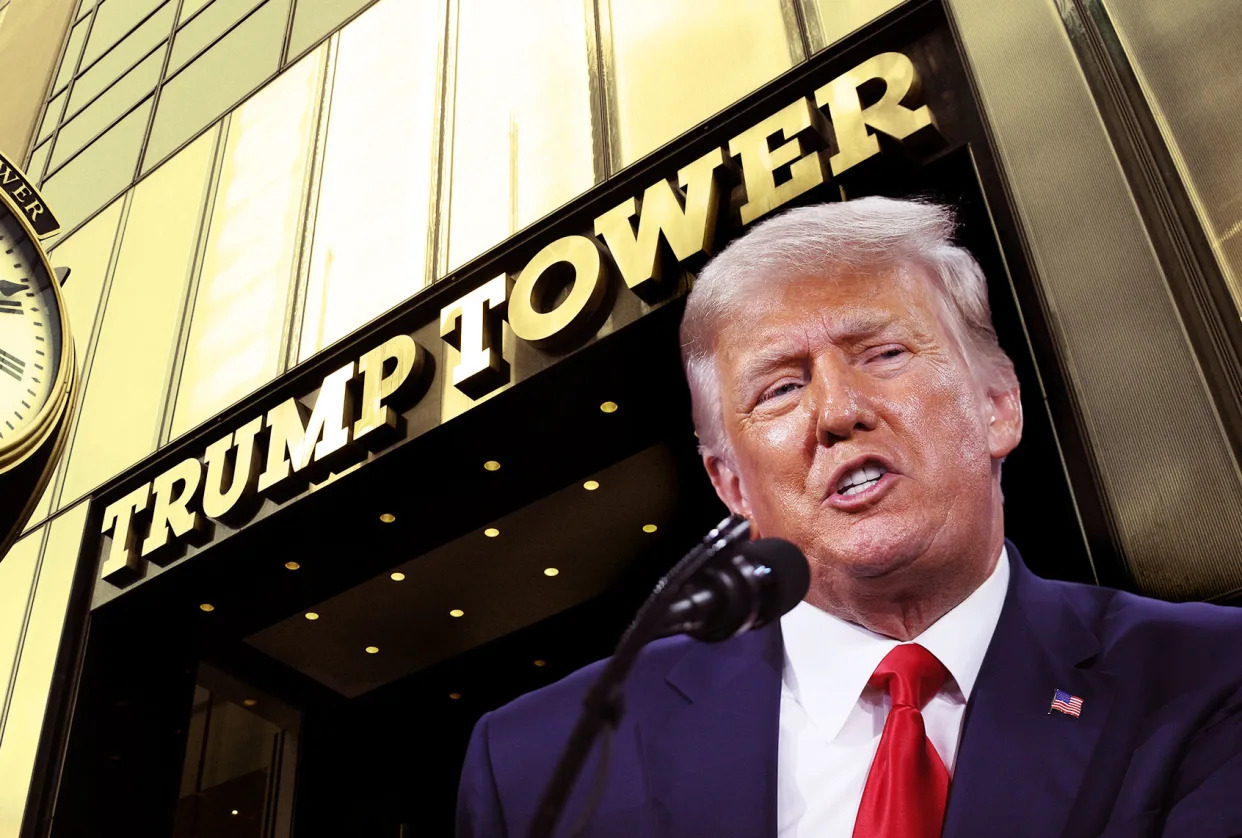
Donald Trump; Trump Tower Photo illustration by Salon/Getty Images

Donald Trump committed massive fraud in New York for years by repeatedly misrepresenting his wealth by hundreds of millions of dollars while building his real estate empire, a state Supreme Court judge ruled on Tuesday afternoon.

This startling decision came in the civil case brought by New York Attorney General Letitia James, who has argued that Trump, along his sons Donald Jr. and Eric and the entire Trump Organization, had “grossly” inflated the value of more than a dozen assets by hundreds of millions in total, and then used those fake values to defraud banks and insurers in order to obtain more favorable deals and secure loans.

James argued that Trump routinely overstated his net worth to financial institutions by between $812 million to $2.2 billion, depending on the year and the specific applications he filed, and is seeking a penalty of about $250 million in a trial scheduled to begin Oct. 2.

New York Supreme Court Judge Arthur Engoron, who issued the summary judgment on Tuesday, ordered that some of Trump’s business licenses be rescinded as punishment and ordered that an outside “receiver” must be appointed to supervise the management of those Trump properties. The ultimate outcome could well be the end of Trump’s ability to do business in the state.

Trump and his adult sons are now “barred from doing business in New York forever” under Engoron’s ruling, said Catherine Ross, a constitutional law professor at George Washington University. “And given that New York was the home base of their business, the base of their fortune, of Trump’s reputation, his credibility, his integrity — it’s all been found lacking.” The former president “is not a good businessman,” she added. “He’s a conman.”

Tuesday’s ruling came summary judgment, a decision indicating that there is no need for a jury trial because the evidence is “so strong” for one side, Ross explained, that no reasonable jury could reach a different decision.

Engoron’s ruling amounts to saying “that the New York attorney general presented an ironclad, well-documented case backed up with lots of evidence,” Ross said. In fact, she added, Engoron had already “lambasted Trump’s lawyers for trying to resuscitate defense arguments and positions that he had already expressly rejected and for essentially misleading the court in a number of instances.”

This decision was viewed as a surprise by legal observers and is clearly a major victory for James, who has been investigating claims since March 2019 that Trump and other executives at his companies had manipulated the values of various properties in order to get better deals from banks and insurers. She filed a lawsuit in September 2022.

Though the trial will determine the exact magnitude of the financial penalty inflicted on the Trumps and their business entity, Engoron has already granted one of the biggest punishments James pursued: the cancellation of business certificates that allow some of Trump’s New York properties, including the Trump Organization itself, to operate in the state. That could have major repercussions for the Trump family business.

This decision “signals the end of Trump’s financial empire,” Bennett Gershman, a former New York prosecutor and law professor at Pace University, told Salon.

“The judge declared that Trump and his family are guilty of a massive, staggering fraud in overvaluing his properties,” Gershman said. “The only issue left to be decided is the penalty to be imposed on him.”

The ruling, if it survives the appeals that are sure to follow, would deprive Trump of his ability to exercise control over critical properties in the state, particularly with regard to strategic and financial decisions. This would effectively dismantle a large portion of the former president’s business empire, and could destabilize his financial standing.

“This ruling cripples [Trump’s] ability to engage in business activities anywhere, and completely terminates his ability to do business in New York state,” Gershman said, adding that Manhattan District Attorney Alvin Bragg could now decide to reopen “his criminal investigation of Trump for falsely stating the value of his properties.” Bragg had earlier declined to prosecute Trump on those charges.

The former president has “boasted” that his personal net worth in the billions, Gershman added, although many observers have concluded that is unlikely. “The truth is that his net worth is far, far less than that,” Gershman said. “The consequences of this ruling and the upcoming trial, while not making him a pauper, will significantly reduce his net worth.”

According to Engoron’s ruling, Trump, along with his company and key executives, engaged in a pattern of false statements about their financial status in annual statements. This resulted in more favorable loan conditions and reduced insurance expenses, among other tangible benefits, the judge found.

Furthermore, these deceptive tactics violated legal boundaries, Engoron said, despite the arguments by Trump’s lawyers that a disclaimer attached to his financial statements absolved him of liability.

“In defendants’ world: rent regulated apartments are worth the same as unregulated apartments; restricted land is worth the same as unrestricted land; restrictions can evaporate into thin air; a disclaimer by one party casting responsibility on another party exonerates the other party’s lies,” Engoron wrote in his 35-page ruling. “That is a fantasy world, not the real world.”

The judge ordered that Trump and the other defendants provide the names of potential independent receivers “to manage the dissolution of the canceled LLCs,” meaning the various Trump business entities, within 10 days of the ruling.

No member of the Trump family will have control over the properties in question, and according to Ross it is “very likely” that many or most will be sold to compensate for the Trumps’ fraudulent gains, a process similar to the “liquidation” that occurs in bankruptcy proceedings.

One notable finding in Engoron’s decision was that Trump had continuously overvalued Mar-a-Lago, his private club in Palm Beach, inflating its value on one financial statement by as much as 2,300%, The Associated Press reported. Engoron also challenged Trump’s claim about the size of his apartment in Manhattan’s Trump Tower, which the former president on at least one occasion had asserted was 30,000 square feet, nearly three times its actual size. Trump had estimated the apartment’s market value at $327 million, a patently implausible number even in the New York City real estate market.

“A discrepancy of this order of magnitude, by a real estate developer sizing up his own living space of decades, can only be considered fraud,” Engoron wrote.

Former federal prosecutor Neama Rahmani told Salon that while the former president is a “fraudster,” his supporters will continue to claim that “he’s a good businessman,” adding that Trump has “proven time and again that he can survive these sorts of stains on him and his company.”

As far as Trump’s business ventures go, Rahmani said: “He’s done doing business in New York. He’s just done.”

In their own motion for summary judgment, Trump’s legal team had asked the judge to dismiss the case, contending that there was no evidence that the public had been harmed by Trump’s actions. They also argued that many of the allegations in the lawsuit were barred by the statute of limitations.

Engoron noted that he had rejected those arguments earlier in the case, and fined Trump’s five defense lawyers $7,500 each as punishment for “engaging in repetitive, frivolous” arguments.

James’ lawsuit is just one of many legal challenges confronting Trump, who remains the frontrunner for the 2024 Republican presidential nomination. Over the past six months, the former president has faced four criminal indictments and is also facing a second defamation suit filed by writer E. Jean Carroll, who earlier won a civil verdict against Trump for sexually assaulting her in the 1990s.

“Maybe this will affect the public’s perception of him not only as an obstructer of justice, who undermined national security and sought to unlawfully undo a fair election, but also as a financial cheat,” Gershman said.

Ross added that Trump “seems to be leveraged up to his eyeballs,” facing “enormous debts” and rapidly mounting legal bills. And this decision creates further legal jeopardy for him, she added.

“If he were to consider taking the stand in one of the many pending cases against him, whether criminal or civil,” Ross said, “this finding of fraud could be used by the other side — by the prosecution, or the other party in a civil case — to impeach his testimony. Fraud goes to the essence of whether you tell the truth.”

The Biggest Bombshells in Trump Whistleblower Cassidy Hutchinson’s New White House Memoir

People

The Biggest Bombshells in Trump Whistleblower Cassidy Hutchinson’s New White House Memoir

Kyler Alvord – September 26, 2023

In her newly published book, “Enough,” the former White House aide shares disturbing allegations involving several D.C. power players, including Rudy Giuliani, Matt Gaetz and President Trump himself

<p>Candace Dane Chambers;  Simon and Schuster</p> Cassidy Hutchinson pictured in Washington, D.C. in September 2023; Hutchinson
Candace Dane Chambers; Simon and SchusterCassidy Hutchinson pictured in Washington, D.C. in September 2023; Hutchinson’s new memoir, “Enough,” out now

After laying low for more than a year, former White House aide Cassidy Hutchinson is returning to the public eye with the release of a new tell-all memoir, Enough, that’s already put some of Donald Trump‘s allies on the defensive.

Hutchinson, who served as a top aide to former White House chief of staff Mark Meadows, became an instant public figure last summer when she testified against Trump in a televised hearing before the House committee investigating the Jan. 6, 2021, Capitol riot. Immediately after her explosive testimony, she had to go into hiding for safety reasons, holed up in a Washington, D.C. hotel for several days before temporarily relocating to Atlanta to wait out the backlash.

In her 356-page book, published Tuesday, Hutchinson puts forth several previously unheard claims, walking readers through the ups and downs of her life, including her once-skyrocketing career. Along the way, the 26-year-old shares countless stories about her time before, during and after working in Trump’s White House, offering a brief on all of the major players in the modern Republican Party and the inner-workings of the Trump administration.

Related: First Look at Cassidy Hutchinson’s Memoir: Trump Whistleblower Details Life After Jan. 6 Testimony (Exclusive)

<p>Candace Dane Chambers</p> Cassidy Hutchinson stands before the U.S. Capitol in September 2023
Candace Dane ChambersCassidy Hutchinson stands before the U.S. Capitol in September 2023

Chock-full of details both consequential and just plain juicy, the book covers everything from Trump officials’ favorite candies (Jared Kushner gravitated to peach rings, she writes) to various lawmakers’ personalities (Sen. Ted Cruz lacked a sense of humor and once called her a “tattletale,” she alleges) to the president’s erratic leadership style (examples of which are too vast to summarize).

Hutchinson explains how various high-ranking Republicans reacted to the Jan. 6, 2021, insurrection, and uses a wide range of anecdotes to exemplify her high-profile friendships in Washington, including with now-House Speaker Kevin McCarthy.

Related: Cassidy Hutchinson Refuses to Respond to Donald Trump’s Insults: ‘Being Ignored Drives Him Mad’ (Exclusive)

<p>Tia Dufour/The White House</p> House Republican leader Kevin McCarthy, White House chief of staff Mark Meadows and powerful GOP Rep. Jim Jordan, walk past the Rose Garden with Cassidy Hutchinson on April 4, 2020
Tia Dufour/The White HouseHouse Republican leader Kevin McCarthy, White House chief of staff Mark Meadows and powerful GOP Rep. Jim Jordan, walk past the Rose Garden with Cassidy Hutchinson on April 4, 2020

Some of the more damning claims in Hutchinson’s book include an alleged incident of groping by disgraced ex-Trump attorney Rudy Giuliani on the morning of the U.S. Capitol Riot, the “vain” reason Trump didn’t want to be seen wearing a N95 mask during the pandemic, Meadows’ apparent sense of guilt surrounding prominent Republican Herman Cain‘s premature COVID death, and a couple of uncomfortable encounters with firebrand House Freedom Caucus member Matt Gaetz.

Asked whether she fears the attacks that may come as people pore over the details in her memoir, Hutchinson tells PEOPLE that she doesn’t, and that she stands by all of her claims.

“If somebody wants to attack the way that they come off in the book, I’m not going to hold myself responsible for what they may say about the way that they’re framed,” she says. “I’m holding them accountable to their own actions.”

Here, five of Hutchinson’s most memorable allegations scattered throughout the pages of Enough.

Trump refused to wear masks during the pandemic because his bronzer turned the straps visibly orange
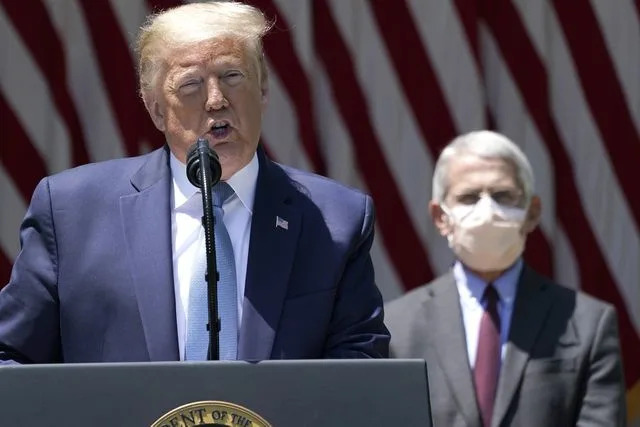
<p>Drew Angerer/Getty </p> President Donald Trump stands in front of Dr. Anthony Fauci while speaking about coronavirus vaccine development in the White House Rose Garden on May 15, 2020
Drew Angerer/GettyPresident Donald Trump stands in front of Dr. Anthony Fauci while speaking about coronavirus vaccine development in the White House Rose Garden on May 15, 2020

According to Hutchinson’s new book, the anti-mask movement that Trump supporters spearheaded during COVID-19 — leading to countless preventable deaths nationwide — stemmed from a makeup mishap involving the president early on in the pandemic.

“The president tried on several N95 masks at the Honeywell plant in Phoenix, Arizona, which manufactured all manner of personal protective equipment (PPE). He was not thrilled that staff urged him to wear a mask, believing it would make him look weak and afraid of the virus,” Hutchinson writes. “He decided on a white mask and strapped it to his face before asking each staffer whether or not he should wear it in front of the press pool.”

Related: Governors Ask Congress to Investigate Trump’s ‘Politicization’ of COVID-19 Response

Hutchinson says that the president looked to her for input, making a “thumbs-up/thumbs-down” gesture. She shook her head, signaling that he shouldn’t wear it.

“I pointed at the straps of the N95 I was holding,” she recalls. “When he looked at the straps of his mask, he saw that they were covered in bronzer. ‘Why did no one else tell me that,’ he snapped. ‘I’m not wearing this thing.'”

“He wore safety goggles on the tour,” she continues in the book. “The press would criticize him for not wearing a mask, not knowing that the depth of his vanity had caused him to reject masks—and then millions of his fans followed suit.”

Related: Dr. Fauci Says He Was ‘Absolutely Not’ Surprised That President Trump Caught COVID-19

Cassidy says Rudy Giuliani groped her on the morning of the Jan. 6 Capitol riot
<p>Eric Lee/Bloomberg via Getty</p>
Eric Lee/Bloomberg via Getty

Buried in Hutchinson’s account of the chaos that ensued on Jan. 6, 2021, is a disturbing allegation that former New York City Mayor Rudy Giuliani groped her — in the presence of a fellow Trump attorney, John Eastman.

In her memoir, Hutchinson recalls frantically looking for Giuliani as the morning’s rally was beginning — she says she was trying to get more information on what Trump and his confidants were planning that day, as well as convince the president’s closest advisers to keep Trump from meeting his supporters at the Capitol. She eventually tracked Giuliani down in a tent near the rally stage, and when Giuliani saw her, she says “the corners of his mouth split into a Cheshire cat smile.”

Waving a stack of documents — which he allegedly told her was evidence that Trump could still win the election — Giuliani approached Hutchinson “like a wolf closing in on its prey,” she writes.

“Rudy wraps one arm around my body, closing the space that was separating us. I feel his stack of documents press into the small of my back,” she writes. “I lower my eyes and watch his free hand reach for the hem of my blazer.”

After complimenting her leather jacket, she alleges, “His hand slips under my blazer, then my skirt. I felt his frozen fingertips trail up my thigh. He tilts his chin up. The whites of his eyes look jaundiced. My eyes dart to John Eastman, who flashes a leering grin.”

Related: Cassidy Hutchinson Claims Rudy Giuliani Groped Her on Jan. 6: ‘Like a Wolf Closing In on Its Prey’

Responding to the groping claim, Giuliani’s political adviser, Ted Goodman, told PEOPLE, “It’s fair to ask Cassidy Hutchinson why she is just now coming out with these allegations from two and a half years ago, as part of the marketing campaign for her upcoming book release.”

Eastman’s personal attorney, Charles Burnham, said his client “categorically denies” the allegation that he witnessed Hutchinson get groped, claiming that Eastman didn’t know who she was until her testimony before the Jan. 6 House committee in June 2022. “Dr. Eastman is considering defamation litigation against those responsible for making or publishing these libelous allegations,” he wrote in a statement shared with PEOPLE.

Related: Rudy Giuliani’s 60-Point Dive in Popularity Poll Stuns Data Reporter: ‘Never Seen Anything Like This’

Cassidy says Matt Gaetz made a pass at her at Camp David, and raised red flags among top Republicans prior to his sexual abuse allegations
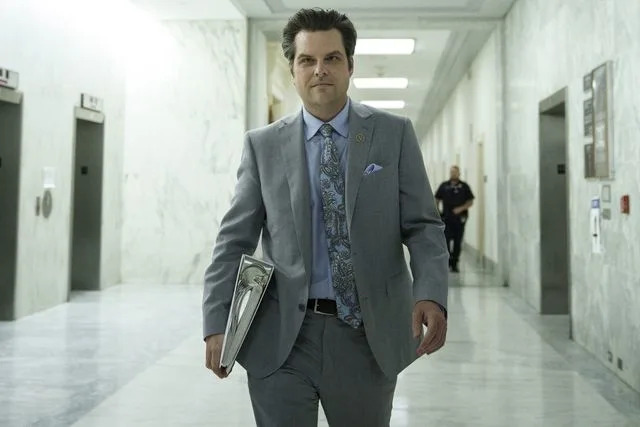
<p>Drew Angerer/Getty</p> Rep. Matt Gaetz leaves a closed-door meeting with former White House counsel Don McGahn on June 4, 2021
Drew Angerer/GettyRep. Matt Gaetz leaves a closed-door meeting with former White House counsel Don McGahn on June 4, 2021

In Hutchinson’s Jan. 6 testimony, she alleged that Florida Rep. Matt Gaetz was among a handful of Republican lawmakers who sought a pardon from Trump before he left office. In her memoir, though, she shares multiple other stories centered around Gaetz — including a couple of uncomfortable moments she allegedly had with the controversial House Freedom Caucus member, resulting in a confrontation at Camp David at which Republican House leader Kevin McCarthy was present.

According to Hutchinson, she organized a May 2020 retreat at Camp David to which some of Trump’s closest friends in the House GOP were invited, including Gaetz and McCarthy. By the time the House members arrived in the evening, Trump and Meadows had already gone off to their cabins for the night. McCarthy “ordered a few bottles of bourbon and wine” from the bar and invited some of the members over to his cabin to drink, Hutchinson writes. Then around 1 a.m., she alleges, the few who were still hanging around heard a knock at McCarthy’s cabin door.

“I thought it was Camp David’s staff coming to quiet us down—Kevin’s cabin was across from the president’s. But when Kevin opened the door, we discovered Matt Gaetz leaning against the door frame,” she writes in the book. “Matt straightened his posture when Kevin asked him what he wanted, and he explained that he had seen my golf cart parked outside and thought that this was my cabin.”

She continues: “Embarrassed, I got up and asked Matt what he needed. He explained that he was lost and needed me to escort him back to his cabin. I told him to proceed around the circle drive—all the cabins were clearly marked and it was impossible to get lost. He asked me one more time to leave with him. ‘Get a life, Matt,’ Kevin said, then shut the door.”

Related: Matt Gaetz May Have Trouble Ahead — House Ethics Committee Quietly Reopens Its Probe into His Conduct: Report

At various points in the memoir, Hutchinson briefly mentions other strange interactions with Gaetz, like at a bar following Trump’s first impeachment vote, when she writes that Gaetz “chuckled and brushed his thumb across my chin” before allegedly asking her, “Has anyone ever told you that you’re a national treasure?”

In the later days of the administration, when Gaetz began dropping by on occasion to seek a pardon from Trump, Hutchinson writes, “I tried to dismiss Matt’s antics but began wondering why he was pushing so hard for a pardon. I raised the issue with Mark one day after Matt had left and asked if there was anything I should know about. ‘Between you and me,’ Mark said, ‘DOJ may be looking into something about Matt. Best to stay away from him. Can you do that for me?’ I nodded and promised I would.”

It was later reported that Gaetz was the subject of a sex trafficking probe for an alleged sexual relationship with an underage girl, but he was ultimately not indicted by the Justice Department. The House Ethics Committee reportedly reopened its own probe into his conduct in June 2023, the status of which is unknown.

Related: Ex-Matt Gaetz Associate Joel Greenberg Pleads Guilty to Sex Trafficking, Says He’ll Help Prosecutors

Asked for comment about the alleged encounters with Hutchinson, Gaetz told PEOPLE in a statement: “I don’t remember either of these events and based on Cassidy’s prior false statements, I doubt they occurred.”

The written statement continued: “I did date Cassidy for a few weeks when we were both single years ago. We parted amicably and remained friends thereafter, even during President Trump’s post presidency when she asked me to help her secure housing in South Florida because she was eager to continue working for President Trump. It is sad to see Cassidy dishonestly turn against so many people who cared about her for fame and book sales.”

Hutchinson denied ever dating Gaetz in a Monday night interview on The Rachel Maddow Show, saying that they were friends at times but that he “does not have the best track record for relationships” and that she has “much higher standards in men.”

Related: Florida Rep. Matt Gaetz Eloped amid Scandal and Sex Trafficking Investigation

Mark Meadows privately took some responsibility for former presidential candidate Herman Cain’s COVID-19 death
<p>NICHOLAS KAMM/AFP via Getty </p> Onetime presidential candidate Herman Cain (seated, left) attends a Trump 2020 rally in Tulsa, Oklahoma. Cain fell ill with COVID-19 days after the rally, and died of complications the following month.
NICHOLAS KAMM/AFP via GettyOnetime presidential candidate Herman Cain (seated, left) attends a Trump 2020 rally in Tulsa, Oklahoma. Cain fell ill with COVID-19 days after the rally, and died of complications the following month.

Hutchinson’s book details the moment she informed Mark Meadows that former presidential candidate Herman Cain died from COVID-19 complications after attending Trump’s first pandemic-era campaign rally in Tulsa, Oklahoma. She alleges that Meadows felt at least some responsibility for Cain’s death.

“I had slipped into Mark’s office when I got the news, my middle finger and thumb tapping together as I gnawed the inside of my cheek, wrestling with my words. ‘Chief, have you heard about Herman Cain?'” Hutchinson writes, recalling the July 30, 2020, conversation.

By her account, Meadows responded asking if Cain was all right, to which she replied, “No, Mark, he’s dead.” Hutchinson says the blood drained from Meadows’ face, and he began asking her questions: “He was in Tulsa wasn’t he?” (Yes, sir.) “That’s where he caught COVID, right?” (Yes, sir.)

“Mark had briefly turned his attention to the TV. I had assumed that he was wondering if the news had been made public,” she continues in the memoir. “He looked back at me and said flatly, ‘We killed Herman Cain.’ I could hear him swallow. ‘Get me his wife’s number,’ he said sadly.”

Related: Herman Cain Dies a Month After Contracting COVID-19: ‘Gone to Be with the Lord’

Earlier in the book, Hutchinson writes that Trump was getting stir-crazy in the first months of the pandemic, leading to the early campaign rallies: “What little patience the president possessed had been exhausted. He wanted to be out on the campaign trail. ‘We have to start doing rallies again,’ he stressed to anyone within earshot.”

“The consensus among senior staff was that rallies were a bad idea both for reasons of public health and because it wasn’t the time to wade into politics. Clearly indoor rallies were off-limits, for the former reason,” she continues in the book. “‘Antifa is having rallies every day on the streets,’ countered Trump, referring to the Black Lives Matter protests. ‘We are going to plan a big rally, and it’s going to happen as soon as possible.'”

Hutchinson writes that Trump’s adamancy signaled the planning of the June 20, 2020, Tulsa rally that Cain would ultimately attend.

“I had seen [Cain] in the risers behind the stage in Tulsa,” Hutchinson recalls in the book. “He grabbed my wrists and pumped my arms above my head, flashing his enigmatic smile as he cried out, ‘We’re going to win! We’re going to win! Four more years! Four more years!'”

Related: Tulsa City Health Official Says Trump Rally ‘Likely Contributed’ to Surge of New Coronavirus Cases

Cassidy says Liz Cheney secretly helped her break free from Trump’s legal team during the Jan. 6 investigation
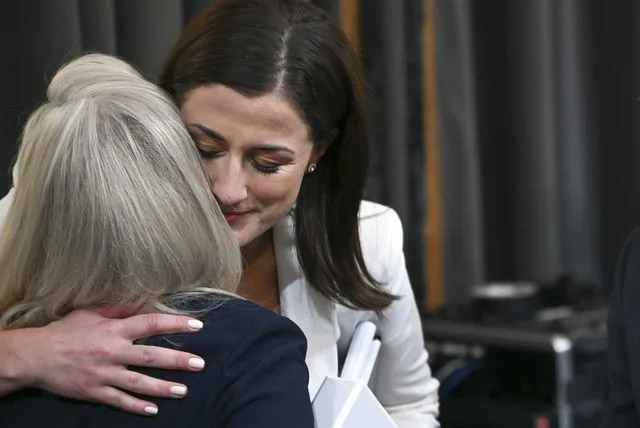
<p>Brandon Bell/Getty</p> Cassidy Hutchinson hugs Rep. Liz Cheney, vice chair of the Jan. 6 House committee, after her two-hour live testimony on June 28, 2022
Brandon Bell/GettyCassidy Hutchinson hugs Rep. Liz Cheney, vice chair of the Jan. 6 House committee, after her two-hour live testimony on June 28, 2022

Initially represented by a Trump-aligned lawyer after getting subpoenaed by the House committee investigating the Jan. 6 Capitol riot, Hutchinson struggled with what she characterized as his alleged instruction to be unforthcoming with the committee’s search for answers — and, eventually, to refuse testifying in subsequent depositions, even if it ran the “small risk” of being held in contempt of Congress.

“I knew in my heart that was a luxury I could not afford,” she writes. “There was only one option — to fulfill my moral and civic obligations.”

Hutchinson says she had already tried finding independent legal representation, meeting numerous lawyers and brainstorming ways to scrape together money — even visiting her estranged father to ask for financial help — but was met with unreasonably high fees at every turn.

Related: Trump Attorney Allegedly Told Cassidy Hutchinson to Give Misleading Testimony to Jan. 6 Committee

“To honor the oath I swore to defend, I had to free myself from Trump World,” she remembers thinking in the book. “All I had to do was figure out a way to free myself without doing anything that would draw their attention and arouse suspicion.”

In an earlier deposition, Hutchinson had tried to slyly feed committee members some helpful answers without appearing insubordinate to the Trump attorney accompanying her, and afterward, committee vice chair Liz Cheney had walked up to her, given her a hug, and whispered, “Thank you.” But she writes that she had more to say, and that she felt her attorney was trying to keep her from saying it.

In a bind, she quietly turned to one of the few people she felt she could trust — Cheney — arranging a phone call to discuss her situation and ask for help finding a new, affordable lawyer so she could come clean about what she saw in Trump’s White House.

The next day, Hutchinson says, Cheney provided her with a list of lawyers to reach out to that she believed would help. “I thanked her and promised that I would figure out a way to do the right thing, regardless of the outcome of the search for new counsel,” she writes. “I could not find the words to tell her that the committee was giving me one of the greatest gifts I could have received: hope.”

Soon, Hutchinson had signed an engagement letter with two lawyers who’d worked in the Justice Department under President George W. Bush. They agreed to represent her pro bono.

Related: Liz Cheney Says Jan. 6 Role May Be ‘Most Important Thing I Ever Do’ amid Televised House Hearings

Hutchinson writes that she formed a friendship with Cheney after breaking free from Trump’s orbit, saying that when she was exiled after testifying live, she knew that she could always look to the Wyoming congresswoman for support.

“Liz checks on me every day,” she writes of the time that she was in hiding after testifying. “She sends encouraging articles, shares stories about the public support we’ve received since the hearing, and relays messages from prominent figures in the Republican Party, our Republican Party. We talk and laugh, I cry, we laugh some more. Liz is becoming my rock.”

Related: Rep. Liz Cheney Says She’s ‘Absolutely Confident’ in Cassidy Hutchinson’s Credibility amid Scrutiny

The acknowledgements section of Hutchinson’s book concludes with a nod to Cheney, who was ostracized from her party for supporting Trump’s second impeachment and ousted from Congress by a Trump-backed challenger in the 2022 midterm elections.

“Liz reminds us that true leadership is grounded in principle, and that change can be achieved through unyielding loyalty to our democratic ideals,” it reads. “May this book serve as a testament to the transformative power of leaders like Liz, who inspire us to be agents of the truth in our republic, and beyond. That we, as individuals, are enough.”

Judge rules Donald Trump defrauded banks, insurers while building real estate empire

Associated Press – U.S. News

Judge rules Donald Trump defrauded banks, insurers while building real estate empire

By Michael R. Sisak – September 26, 2023

FILE - Former President Donald Trump pauses before ending his remarks at a rally in Summerville, S.C., Sept. 25, 2023. A New York judge ruled, Tuesday, Sept. 26, 2023, that the former president and his company committed fraud for years while building the real estate empire that catapulted him to fame and the White House. (AP Photo/Artie Walker Jr., File)
FILE – Former President Donald Trump pauses before ending his remarks at a rally in Summerville, S.C., Sept. 25, 2023. A New York judge ruled, Tuesday, Sept. 26, 2023, that the former president and his company committed fraud for years while building the real estate empire that catapulted him to fame and the White House. (AP Photo/Artie Walker Jr., File)

NEW YORK (AP) — A judge ruled Tuesday that Donald Trump committed fraud for years while building the real estate empire that catapulted him to fame and the White House.

Judge Arthur Engoron, ruling in a civil lawsuit brought by New York’s attorney general, found that the former president and his company deceived banks, insurers and others by massively overvaluing his assets and exaggerating his net worth on paperwork used in making deals and securing financing.

Engoron ordered that some of Trump’s business licenses be rescinded as punishment, making it difficult or impossible for them to do business in New York, and said he would continue to have an independent monitor oversee the Trump Organization’s operations.

A Trump spokesperson did not immediately respond to a request for comment on the ruling. Trump has long insisted he did nothing wrong.

FILE- Attorney Scott Grubman, who is defending Kenneth Chesebro, argues before Fulton County Superior Judge Scott McAfee in Atlanta on Wednesday, Sept. 6, 2023. Past high-profile trials suggest additional scrutiny and stress for the four judges overseeing the indictments against former President Donald Trump. But the challenge facing Fulton County Judge Scott McAfee in Georgia is unlike any of the others. (Jason Getz/Atlanta Journal-Constitution via AP, Pool, File)

With cameras capturing every word, the pressure is on for the Georgia judge over Trump’s indictment

Former President Donald Trump speaks at a rally in Summerville, S.C., Monday, Sept. 25, 2023. (AP Photo/Artie Walker Jr.)

Trump lawyers say prosecutors want to ‘silence’ him with gag order in his federal 2020 election case

FILE - A woman walks across the street with a flag supporting President Donald Trump during a rally Jan. 6, 2021, in Huntington Beach, Calif. A state GOP rule change has opened the possibility that former President Donald Trump could sweep California’s entire trove of delegates in the March 5 primary, the plumpest prize in the party’s nominating contest. The election falls on Super Tuesday, when California is among more than a dozen states holding primaries and the largest number of delegates are up for grabs of any single day. (AP Photo/Jae C. Hong, File)

California, a liberal bastion, may give Donald Trump an unlikely boost in 2024

The decision, days before the start of a non-jury trial in Attorney General Letitia James’ lawsuit, is the strongest repudiation yet of Trump’s carefully coiffed image as a wealthy and shrewd real estate mogul turned political powerhouse.

Beyond mere bragging about his riches, Trump, his company and key executives repeatedly lied about them on his annual financial statements, reaping rewards such as favorable loan terms and lower insurance premiums, Engoron found.

Those tactics crossed a line and violated the law, the judge said, rejecting Trump’s contention that a disclaimer on the financial statements absolved him of any wrongdoing.

“In defendants’ world: rent regulated apartments are worth the same as unregulated apartments; restricted land is worth the same as unrestricted land; restrictions can evaporate into thin air; a disclaimer by one party casting responsibility on another party exonerates the other party’s lies,” Engoron wrote in his 35-page ruling. “That is a is a fantasy world, not the real world.”

Manhattan prosecutors had looked into bringing a criminal case over the same conduct but declined to do so, leaving James to sue Trump and seek penalties that could disrupt his and his family’s ability to do business in the state.

Engoron’s ruling, in a phase of the case known as summary judgment, resolves the key claim in James’ lawsuit, but six others remain.

https://www.documentcloud.org/documents/23991865-trump-ny-fraud-ruling

Engoron is slated to hold a non-jury trial starting Oct. 2 before deciding on those claims and any punishments he may impose. James is seeking $250 million in penalties and a ban on Trump doing business in New York, his home state. The trial could last into December, Engoron has said.

Trump’s lawyers had asked the judge to throw out the case, which he denied. They contend that James wasn’t legally allowed to file the lawsuit because there isn’t any evidence that the public was harmed by Trump’s actions. They also argued that many of the allegations in the lawsuit were barred by the statute of limitations.

Engoron, noting that he had “emphatically rejected” those arguments earlier in the case, equated them to the “time-loop in the film ‘Groundhog Day.’”

James, a Democrat, sued Trump and the Trump Organization a year ago, alleging a pattern of duplicity that she dubbed “the art of the steal,” a twist on the title of Trump’s 1987 business memoir “The Art of the Deal.”

The lawsuit accused Trump and his company of routinely inflating the value of assets like skyscrapers, golf courses and his Mar-a-Lago estate in Florida, padding his bottom line by billions.

Among the allegations were that Trump claimed his Trump Tower apartment in Manhattan — a three-story penthouse replete with gold-plated fixtures — was nearly three times its actual size and valued the property at $327 million. No apartment in New York City has ever sold for close to that amount, James said.

Trump valued Mar-a-Lago as high as $739 million — more than 10 times a more reasonable estimate of its worth. Trump’s figure for the private club and residence was based on the idea that the property could be developed for residential use, but deed terms prohibit that, James said.

Trump has denied wrongdoing, arguing in sworn testimony for the case that it didn’t matter what he put on his financial statements because they have a disclaimer that says they shouldn’t be trusted. He told James at the April deposition, “You don’t have a case and you should drop this case.”

“Do you know the banks were fully paid? Do you know the banks made a lot of money?” Trump testified. “Do you know I don’t believe I ever got even a default notice, and even during COVID, the banks were all paid? And yet you’re suing on behalf of banks, I guess. It’s crazy. The whole case is crazy.”

Engoron rejected that argument when the defense previously sought to have the case thrown out.

The judge said the disclaimer on the financial statements “makes abundantly clear that Mr. Trump was fully responsible for the information contained within” them and that “allowing blanket disclaimers to insulate liars from liability would completely undercut” the “important function” that such statements serve “in the real world.”

James’ lawsuit is one of several legal headaches for Trump as he campaigns for a return to the White House in 2024. He has been indicted four times in the last six months — accused in Georgia and Washington, D.C., of plotting to overturn his 2020 election loss, in Florida of hoarding classified documents, and in Manhattan of falsifying business records related to hush money paid on his behalf.

The Trump Organization was convicted of tax fraud last year in an unrelated criminal case for helping executives dodge taxes on extravagant perks such as Manhattan apartments and luxury cars. The company was fined $1.6 million. One of the executives, Trump’s longtime finance chief Allen Weisselberg, pleaded guilty and served five months in jail. He is a defendant in James’ lawsuit and gave sworn deposition testimony for the case in May.

James’ lawsuit does not carry the potential of prison time, but could complicate his ability to transact real estate deals. It could also stain his legacy as a developer.

James has asked Engoron to ban Trump and his three eldest children from ever again running a company based New York. She also wants Trump and the Trump Organization barred from entering into commercial real estate acquisitions for five years, among other sanctions. The $250 million in penalties she is seeking is the estimated worth of benefits derived from the alleged fraud, she said.

James, who campaigned for office as a Trump critic and watchdog, started scrutinizing his business practices in March 2019 after his former personal lawyer Michael Cohen testified to Congress that Trump exaggerated his wealth on financial statements provided to Deutsche Bank while trying to obtain financing to buy the NFL’s Buffalo Bills.

James’ office previously sued Trump for misusing his own charitable foundation to further his political and business interests. Trump was ordered to pay $2 million to an array of charities as a fine and the charity, the Trump Foundation, was shut down.

Can We Imagine Life Without Oil?

The Nation – Books & The Arts

Can We Imagine Life Without Oil?

Mobility, a novel by Lydia Kiesling, looks at the way fossil fuels defines life in public and private, shaping the very way we tell stories.

Jess Bergman – September 26, 2023 (October 2nd-9th, 2023 issue)

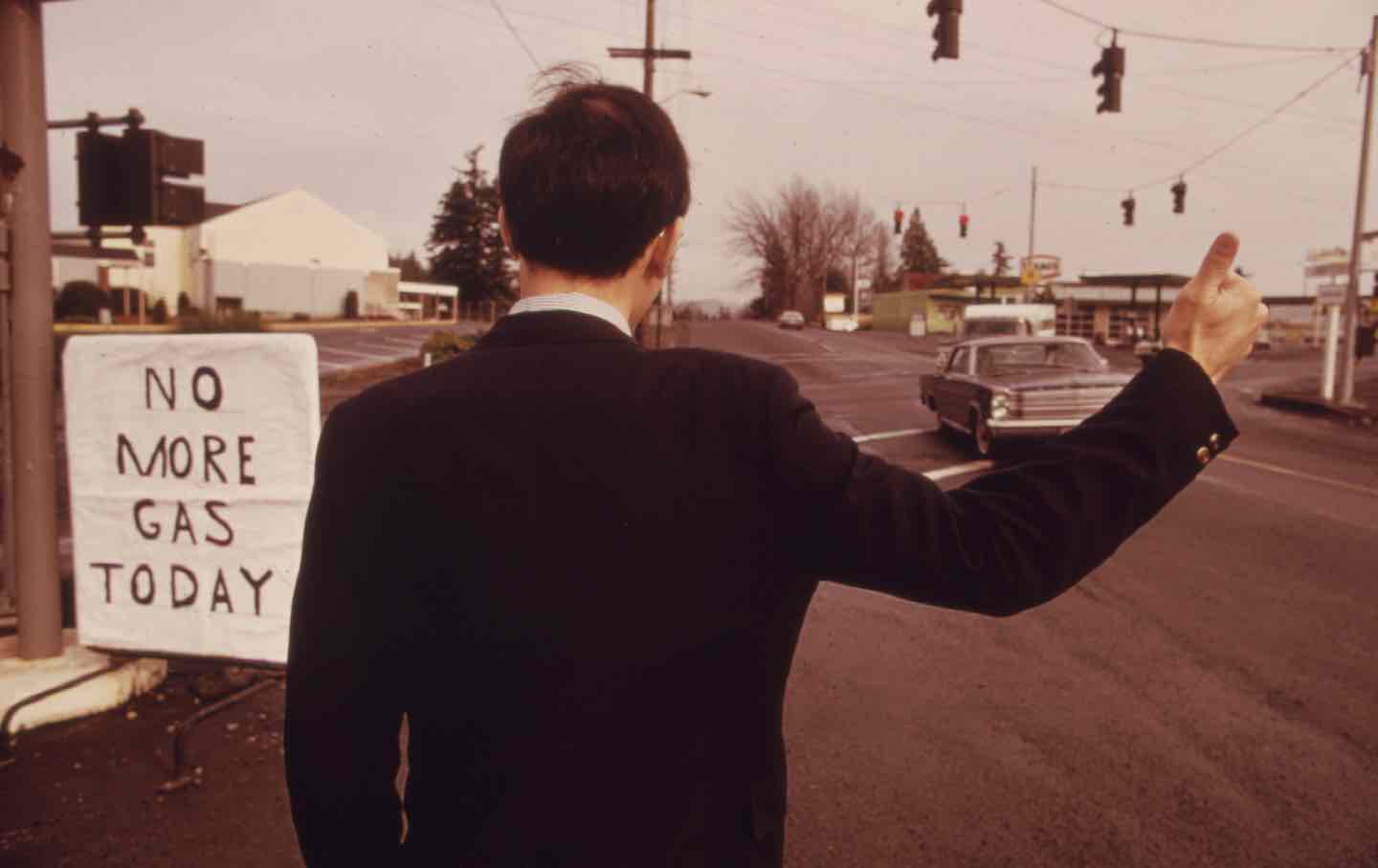
A businessman hitchhiking at a gas station in Oregon, 1973.(Photo by Smith Collection / Gado / Getty Images)

Elizabeth “Bunny” Glenn, the protagonist of Lydia Kiesling’s new novel Mobility, may work for the Turnbridge Oil Company, but that doesn’t mean she’s in oil. As she’s quick to remind anyone who asks, “I work for the non-oil part of it, the part that is moving away from oil; we are targeting batteries and energy storage, not oil.” And as she rationalizes to herself, all she does in her capacity as a marketer and administrator is “relay information, tell stories, shape narratives, soft things, things that didn’t really matter.”

Despite these disavowals, the fact is that Bunny has spent years trying to better understand the oil industry. It turns out to be a Sisyphean task: The basic schema of the industry—where many companies are vertically and horizontally integrated, mergers are a constant, and financialization has spawned its own sprawling sub-industry—intentionally obscures the full picture. The oil landscape is a quicksand of “names and names and names.” Every time Bunny learned a new one, “the map she had constructed in her mind shifted.” Meanwhile, her brother John, a do-gooder Peace Corps veteran who teaches English in Ukraine, teases Bunny that she’ll wind up like their uncle Warren, a garden-variety reactionary with a desk job at Motiva that earns him “a seemingly huge amount of money.”

More than halfway through the novel, John’s partner, Sofie—a Swedish journalist who covers fossil fuels—provides Bunny with a term that describes the oil industry’s elusiveness: “hyperobject.” Coined by the philosopher Timothy Morton in 2010, a hyperobject is something so large and complex, so distributed across both space and time, that it evades our comprehensive understanding, even as we cannot escape its presence in our life. “The more data we have about hyperobjects, the less we know about them—the more we realize we can never truly know them,” Morton argues. Oil is a hyperobject par excellence: Not only is it the result of a geologic process that is millions of years old, but there are reserves of crude oil all over the world, and its byproducts are found in innumerable consumer items: artificial limbs and toilet seats, lipstick and trash bags, refrigerators and contact lenses. As Bunny herself puts it, “It does touch everything. Absolutely everything.”

Even before Bunny started working at Turnbridge, her life had been touched by oil more directly than others’. As a Foreign Service brat in Azerbaijan in the late 1990s, her adolescence unfolded alongside the development of a new international order, and commodities like oil played a starring role in this transition. Four years before her family’s arrival in Baku, and three years after the country restored its independence from the Soviet Union, the State Oil Company of Azerbaijan Republic and a consortium of 11 foreign oil companies signed what was called the “contract of the century”: an agreement to jointly develop—and share the profits from—oil fields in the Azeri sectors of the Caspian Sea. Several of those foreign companies, of course, were American. Bunny’s father is sent to Azerbaijan in part to protect his country’s investment.

In Baku, some of the consequences of the newly privatized oil economy are obvious even to a self-absorbed 15-year-old like Bunny: a sulfuric smell on the beach, or the “mansions with no context” piled up on cliffsides outside of the capital. But most of what she learns about the industry comes via a more sentimental education—namely, crushes on the young men who have flocked to Azerbaijan to witness the so-called end of history. There is Eddie, a mild-mannered Brit making a documentary about the Nagorno-Karabakh War, who rents a room in the apartment above the Glenns’; and then there is Charlie, a hedonistic, hirsute American who publishes a guerrilla newspaper called The Intercock (short for Inter-Caucasian Times) covering “foreign activity in the former Soviet Union.”

At one point, while attending a party at an oil prospector’s mansion in Baku’s ancient inner city, Bunny bumps into her crushes smoking cigars with a gray-haired Amoco bureaucrat. After frightening the oilman off with a veiled reference to his taste for sex workers, Charlie turns to Bunny. “Do you want to hear the story of oil in the former Soviet Union?” he asks. Following her noncommital “I guess,” Charlie proceeds to unspool a profane monologue about the scramble for the Caspian’s riches amid the breakup of the USSR, featuring cameos by Mikhail Gorbachev, Ilham Aliyev, “Condoleezza fucking Rice,” BP, Chevron, Exxon, and more.

This speech, which unfolds across four pages, is for Bunny’s benefit, but also our own. By embedding crucial context in naturalistic dialogue, Kiesling is able to establish the historical conjuncture in which her book is set without resorting to dull exposition. But this formal choice is more than just a canny bit of craft; it also hints at the novel’s true subject. Recognizing the epistemological impasse that Bunny runs up against in her quest to master the industry’s inner workings, Mobility is not really about oil qua oil, but the way it is narrativized—both for good and for ill.

Mobility teems with storytellers, from investigative reporters, podcasters, and filmmakers to spin doctors, government public information officers, and oil CEOs, dictating their memoirs to underpaid female assistants. When Bunny eventually joins their ranks, it’s due less to any conscious choice than to circumstance. Personally and professionally adrift after graduating from college in the midst of the 2008 financial crisis, she moves in with her recently divorced mother in Texas and finds a job through a temp agency at Miles Engineering Consultants, a firm that provides “client satisfaction in the diverse fields of geophysics and seismology, hydrology, hydrogeology, and construction support.” Bunny is assigned to the admin pool, where she puts her English degree to work copy-editing inscrutable reports about prospective megaprojects, such as a nuclear power plant in the Persian Gulf. However tedious, it’s a task at which she excels.

Not long after Bunny is hired, she meets Frank Miles—son of the company’s founder, and son-in-law to oil magnate Frank Turnbridge—who recognizes in Bunny a potential asset to his own ambition. Before long, Frank convinces her to jump ship to Turnbridge, where he’ll be heading up a new arm of the business: one that “over time,” he promises, will begin investing in “renewables, batteries, clean energy.” As she’ll learn, it’s a future that’s always just on the verge of arriving.

Whatever “unease” Bunny feels as a reflexive liberal who believes in global warming but who is now working for an oil company is allayed in short order by the material comforts that the job enables her to obtain: a well-appointed apartment in Houston, Ted Baker dresses, Bare Minerals makeup, Jo Malone perfume (the novel is littered with brand names that increase in value in tandem with Bunny’s professional advancement). It’s a state of affairs that Sofie mocks during a visit to Texas: “I’m sorry, but this is such an American tragedy! You work for the oil complex so you can have health insurance and a place to live!” However much Bunny clings to these justifications, the truth is that she starts to find something magnetic about the industry after immersing herself in its literature.

While attempting to better understand her new workplace, Bunny spends many Saturdays at the Turnbridge Petroleum Library, donated by Frank to a local college, where she reads introductory textbooks (“useful but boring”) as well as “narrative histories, which she infinitely preferred.” The latter are seductive in both the cinematic quality of their imagery and in the sheer enormity of the feats of engineering and labor they describe—so monumental that they reduce the “dead people and filth strewn all over the pages of these books” to mere footnotes. “These tragedies were made small against the inexorability of a steel tube drilling down thousands of feet, drilling sideways a thousand feet more, seeming to subvert the laws of geology or physics,” Bunny thinks. “Literal pipelines laid under the ground and spanning two continents, traveling under the ocean itself, to bring them their standard of living.”

Her encounter with these texts is formative in more ways than one: Bunny will eventually stake her career on building a Lean In version of this emphatically masculine mythos. In 2016, she attends a women-in-energy luncheon in a frigid Texas conference room where the keynote speaker is “one of the first Black women special agents in the FBI.” Bunny, then unmarried and childless, is seated with a number of colleagues discussing the challenges of being a working mother in the oil industry. A geologist with twins who’s recently been let go from Exxon jokes—if you can call it that—that “they always lay the moms off first.” Then one of the only men present at the lunch drops by their table. “What are we talking about here?” he asks. “Shoes?” A less keen novel might leverage this interaction into an epiphany for Bunny, but Kiesling is working in an ultimately ironic register here. At the end of the scene, Bunny lifts a foot out of her “Tory Burch square-heeled croc pumps that didn’t have quite enough room in the toe box…before turning her attention back to the podium.” She, at least, had been thinking about shoes after all.

Over the course of Mobility, Kiesling develops a critique of the fossil fuel industry’s use of women as both a shield and a source of legitimacy. This applies to women on the outside: A recurring motif is the line, supplied by industry flacks like Bunny, that it’s thanks to oil and gas that mothers can give birth in brightly lit, temperature-regulated hospitals, full of high-tech devices made from petrochemical byproducts, rather than in unsanitary sheds, the United States’ high rate of maternal mortality be damned. But it’s women working on the inside who prove to be most useful to the industry. Of course, the benefits flow both ways: On the one hand, the industry’s embrace of corporate feminism allows individual women to recast their environmentally destructive and highly remunerative work as a radical riposte to the old boys’ club. More significantly, this PR strategy plays into the narrative that a lack of diversity, not a profit motive antithetical to life, is responsible for oil’s gravest ills. In this way, reforming the energy industry’s relationship to women and other minorities becomes a metonym for reforming the industry itself. At yet another conference, Bunny listens to a chipper blonde introduce a new professional network for women backed by companies like Shell and Halliburton. Her ambitions for the project are grand: It’s “something that will benefit not only us, but our entire oil and gas industry.” Notably, the woman is a special guest at an event titled “Storytelling Oil and Gas.”

By focusing primarily on the recent past and covering mostly real disasters, natural and otherwise—the Deepwater Horizon spill; Hurricane Harvey—Mobility sets itself apart from most so-called climate change novels, which tend to take place in an alternative present or near future menaced by mysterious adverse weather events. So when the book flashes forward to 2051 in a brief coda knowingly titled “Downstream”—referring to the refining of crude oil and all of its byproducts, as well as their marketing and sale—it comes as a somewhat deflating capitulation to the conventions of the genre. Kiesling depicts this future bluntly; its crises are represented in broad strokes, with minimal stylistic flourishes: “On the first 120-degree-Fahrenheit day [Bunny] ever felt, nearly everything shriveled and died and the crows fell out of the trees.”

Given the destructiveness of Mobility’s final act, it’s tempting to read it as an environmentalist parable, or even an intervention. But the novel is fundamentally ambivalent about the usefulness of stories in fighting climate change. Through Bunny’s occasional insecurities about the meaning of her work for Turnbridge, Kiesling breaks the fourth wall. “Sometimes Elizabeth marveled at how simultaneously irrelevant and critical the shaping of narrative was to reality,” she writes.

Decarbonization was more important than ever. The majors were pulling out of the Permian and Bakken right and left…. And yet Europe was preparing to freeze without Russian gas. The EU had signed a deal to double its supply of LNG from Azerbaijan, great news for Azerbaijan and BP.

In Mobility, the primary function of the stories told by fossil fuel companies is to approximate the feeling of change without actually changing anything—except, perhaps, their names.

For the industry, this proves to be a winning strategy: “Many of the people who got rich from oil put themselves directly atop the next generation of energy just in the nick of time.” For its opponents, the value of narrative is less clear. We learn little about the impact of Sofie’s journalism, other than that her career goes “gangbusters” after she becomes a household name during the Standing Rock protests. And when Bunny bumps into Charlie many years after their initial meeting in Baku, he’s traded in harassing fossil fuel executives for reporting on drone war, because, he explains, “There’s more people with a deep state paranoia who will subscribe to your podcast than there are people who want to hear about oil companies.” Stories, Kiesling suggests, can make us feel better about the path of least resistance, or they can prompt us to consider the cost of our familiar comforts. But given that they tend toward tidy resolution, stories are more likely to produce inertia than action on a mass scale. This makes them no match for the resources of an industry that scaffolds our geopolitical order and produces trillions of dollars in profits a year.

Rather than styling itself as a rallying cry, the closest thing that Mobility offers to a concrete solution is smuggled into a joke in a scene some years before the apocalyptic flash-forward. During a visit to the United States in 2014 from his posting in Tajikistan, Bunny’s diplomat father tells his grown children that the long-defunct oil field their grandparents owned a small interest in might soon become active again, thanks to a tertiary form of oil recovery in which pressurized carbon dioxide is blasted into old wells to loosen whatever remains. Any money it yields, he says, will be passed on to them. Bunny’s brother John is horrified by the prospect of profiting from oil. “Can you do something to shut down production?” he asks.

Bunny laughs. “He owns one-seventy-somethingth of it,” she tells her brother. “Is he supposed to throw a grenade down the well?

Jess Bergman is a senior editor at The Baffler and a contributing writer at Jewish Currents.

Joe Biden makes history by joining UAW picket line

BBC News

Joe Biden makes history by joining UAW picket line

Bernd Debusmann Jr, Sarah Smith, Natalie Sherman September 26, 2023

US President Joe Biden has backed striking cars workers in Michigan during a visit to their picket line – a first for a sitting US president.

Mr Biden said that the workers “deserve” raises and other concessions they are seeking.

The visit comes a day before his would-be challenger, Donald Trump, is due to arrive.

But workers told the BBC they felt the rivals might politicise the strike, and urged them to “just stay away”.

In brief remarks to the picketing workers on Tuesday, the Democratic president said that they “deserve the significant raise you need and other benefits”.

He added that the workers should be doing as “incredibly well” as the companies that employ them.

While US lawmakers – and presidential candidates – frequently appear at strikes to express solidarity with American workers, it is considered unprecedented for a sitting president to do so.

Some workers said they hoped the attention from Mr Biden and his rival would help their cause, but others dismissed the visits as political stunts aimed at getting votes, which would have little practical impact on the negotiations.

“We would much rather neither of them showed up,” longtime Ford worker Billy Rowe told the BBC. “We don’t want to divide people and when you bring politics into it, it’s going to cause an argument.”

Earlier in September the UAW declared a strike targeting Ford, General Motors and Stellantis, pushing the three major car companies for better pay and conditions.

The White House, which was heavily involved in resolving a 2022 labour dispute with rail workers, was “not part of the negotiations”, White House Press Secretary Karine Jean-Pierre told reporters on Tuesday.

Officials had previously refused to be drawn on whether Mr Biden supports the current UAW proposal, with Ms Jean-Pierre insisting the administration would “leave it to the UAW and the big three”.

Mr Biden’s presence in Michigan is instead intended to show support to the car workers, Ms Jean-Pierre said.

The president believes “that the men and women of the UAW deserve a fair share of the record profits they’ve helped to create”, she added.

The White House announced Mr Biden’s visit to the UAW workers last week, soon after Mr Trump announced he would skip the 27 September Republican presidential debate in California to visit Detroit, the heart of US vehicle manufacturing.

On his social media platform Truth Social, Mr Trump said he had provoked the presidential visit.

“Crooked Joe Biden had no intention of going to visit the United Autoworkers, until I announced that I would be headed to Michigan to be with them [and] help them out,” he wrote.

Mr Biden was invited to visit the UAW members by the group’s president, Shawn Fain, who has sometimes been critical of Mr Trump.

In his Truth Social post, Mr Trump – who has not been invited by the UAW – vowed that car workers are “toast” if they do not endorse him and if he does not win the election.

Striking UAW members
UAW members Frankie Worley (L) and Billy Rowe (Centre) have expressed dismay at the visit of both Mr Biden and Mr Trump

On the picket line in Michigan, word of the duelling visits was greeted by groans and “a lot of eye rolls”, according to Billy Rowe, 61, one of half a dozen workers huddled in the rain holding picket signs outside a Ford factory near Detroit, receiving regular honks of support from passing cars and trucks.

Mr Rowe, who has worked at Ford for 27 years, said he saw the dispute as one between workers and the companies.

Another Ford employee, Frankie Worley, said that “politics shouldn’t be involved” in the issue.

“They come down here and get a picture and say they support us, but really, do they?” said Mr Worley, who has spent 28 years at the company, including 20 on the assembly line. “This involvement is just to put their face against us and say they’re helping us. Just stay away.”

The strike, he added, is his first. He said he was partly motivated by the fact that his pay has only risen $4 (£3.2) from $28 an hour 25 years ago to $32 today.

“It’s hard to make a living now,” he said.

The visits by Mr Biden and Mr Trump – currently the frontrunner for the Republican nomination – come as Republicans and Democrats alike focus on the electorally important Midwestern “Rust Belt”, where blue-collar workers such as UAW members form a vital voting bloc.

The battle for those votes in Michigan promises to be intense. Democrats narrowly won the state in the 2020 presidential election after losing there in 2016.

Meanwhile, the UAW endorsed Mr Biden in 2020, but has yet to name a preferred candidate for the 2024 election, saying that the union’s support needs to be “earned”.

Though the UAW has long been allied with the Democratic party, Mr Worley said that many of its members are upset about issues including inflation and illegal border crossings, weakening support for Mr Biden among the rank-and-file.

“I’ve seen a big shift,” he said.

Mr Biden’s visit to the picket line also comes as his administration pushes for more electric vehicle (EV) production in the US – a cause for concern for union members who worry that EVs require fewer workers to build them and could be made in non-union factories for much lower wages.

In a statement issued on Tuesday afternoon, Mr Trump called Mr Biden’s visit a “PR stunt” to “distract and gaslight” the US public from other issues, including immigration and public safety.

Surveys suggest that a majority of Americans back the UAW’s cause, and a recent Gallup poll found that 67% support unions more generally.

Reach’ to Compare Trump to Hitler: If You Don’t See It, ‘You’re Just Stupid’ or ‘You’re One of Them’ (Video)

The Wrap

‘Morning Joe’ Says It’s ‘Not a Reach’ to Compare Trump to Hitler: If You Don’t See It, ‘You’re Just Stupid’ or ‘You’re One of Them’ (Video)

Andi Ortiz – September 26, 2023

Donald Trump has returned to an old favorite insult, calling NBC and MSNBC an “enemy of the people” once again on Monday. As a result, “Morning Joe” host Joe Scarborough argued on Tuesday that, at this point, “it’s not a reach” to liken Trump to Hitler “without any concerns whatsoever.”

In yet another angry screed on Truth Social, Trump wrote that if he were to win re-election, he would likely start charging organizations like NBC to be on the air, and investigate them for their “Country Threatening Treason.” To that, Scarborough only scoffed.

Homing in on the fact that Trump “says that the news network that is most critical of him should be taken off the air,” Scarborough immediately likened Trump to Hitler.

“This is not a reach, I can go back and talk about Nazi Germany and I do it without any concerns whatsoever,” Scarborough said. “And if people can’t start drawing the parallels, well, you’re just stupid or you have your head in the sand, or you’re one of them.”

As the conversation continued, Scarborough also compared Trump to Viktor Orbán, the Prime Minister in Hungary, who heavily restricted free press in that country. But eventually, Scarborough’s musings returned to more graphic Hitler callouts.

“Do I think that Donald Trump’s could be allowed to line people up against a wall and shoot them? No, he’d like to. No doubt! I know him. And I’ve known him for a long time. And we can see this. He would like to; he’s not going to be allowed to.”

That said, Scarborough does expect Republicans to let him restrict the freedom of the press.

“That is something that Republicans — 50% of Americans are supporting him right now, despite the fact he steals nuclear secrets, and he steals war plans, and he says he’s going to terminate the constitution. So sure, they’ll let him shut down TV stations. That’s where we are!”

You can watch Scarborough’s full comments in the video above.

Trump Rant About ‘Batty’ Whales And Windmills Leaves Critics In Stitches

HuffPost

Trump Rant About ‘Batty’ Whales And Windmills Leaves Critics In Stitches

Josephine Harvey – September 26, 2023

Donald Trump’s on the warpath against his mortal enemy again, and it made a big splash on social media.

The former president raged during a campaign speech in South Carolina that “windmills” are driving whales “crazy.”

“Windmills are causing whales to die in numbers never seen before. Nobody does anything about that,” he declared.

“They’re driving the wales, I think, a little batty,” he said.

Trump’s had a yearslong vendetta against wind turbines, ever since a lengthy and unsuccessful legal battle to stop Scottish officials from building what he called a “really ugly wind farm” in view of his Aberdeen golf resort.

The whales tidbit is just the latest in a long list of complaints he’s had about the renewable energy generators, including false claims that they cause cancer and kill “all the birds.

As absurd as it sounds, Trump’s not the first person to make some version of the whales claim, despite a lack of evidence.

Fox News and Republican lawmakers have repeatedly suggested that a spate of whale deaths off the East Coast earlier this year were linked to the early stages of development of offshore wind farms, a claim promulgated by climate deniers with ties to the fossil fuel industry.

Some environmental groups have also raised concerns about how the development and construction of wind farms could impact whales. However, the environmental community has pointed to the absence of any evidence suggesting there’s a link between the projects and whale deaths, and stressed the importance of renewable energy to combat climate change ― the greatest threat to marine life.

On its website, the National Oceanic and Atmospheric Administration says there are no known links between large whale mortalities and offshore wind surveys.

“At this point, there is no scientific evidence that noise resulting from offshore wind site characterization surveys could cause mortality of whales,” the agency said.

The Bureau of Ocean Energy Management also said it had found no evidence, noting: “Past and current research show that vessel strikes and entanglements in fishing gear continue to pose a dangerous, life-threatening risk to whales.”

Users of X, formerly Twitter, were swimming in scorn over Trump’s fishy claim:

Arne Duncan
@arneduncan
·
Follow

You literally could never make this stuff up if you tried, but the SNL skits will write themselves. “The windmills are driving the whales a little batty” tells you all you need to know about his fitness for duty… Deranged and impossibly stupid are descriptors that come to mind