As Colorado River Basin states confront water shortages, it’s time to focus on reducing demand

As Colorado River Basin states confront water shortages, it’s time to focus on reducing demand


<span class="caption">Water flows into a canal that feeds farms in Casa Grande, Ariz.</span> <span class="attribution"><a class="link rapid-noclick-resp" href="https://newsroom.ap.org/detail/ColoradoRiver-Drought-Farmers/829f1440d70544f59500b090305b8d7a/photo" rel="nofollow noopener" target="_blank" data-ylk="slk:AP Photo/Darryl Webb">AP Photo/Darryl Webb</a></span>
Water flows into a canal that feeds farms in Casa Grande, Ariz.
 AP Photo/Darryl Webb


The U.S. government announced its first-ever water shortage declaration for the Colorado River on Aug. 16, 2021, triggering future cuts in the amount of water states will be allowed to draw from the river. The Tier 1 shortage declaration followed the U.S. Bureau of Reclamation’s forecast that the water in Lake Mead – the largest reservoir in the U.S., located on the Arizona-Nevada border – will drop below an elevation of 1,075 feet above sea level, leaving less than 40% of its capacity, by the end of 2021.

The declaration means that in January 2022 the agency will reduce water deliveries to the Lower Colorado River Basin states of Arizona and Nevada and to Mexico, but not to California – yet.
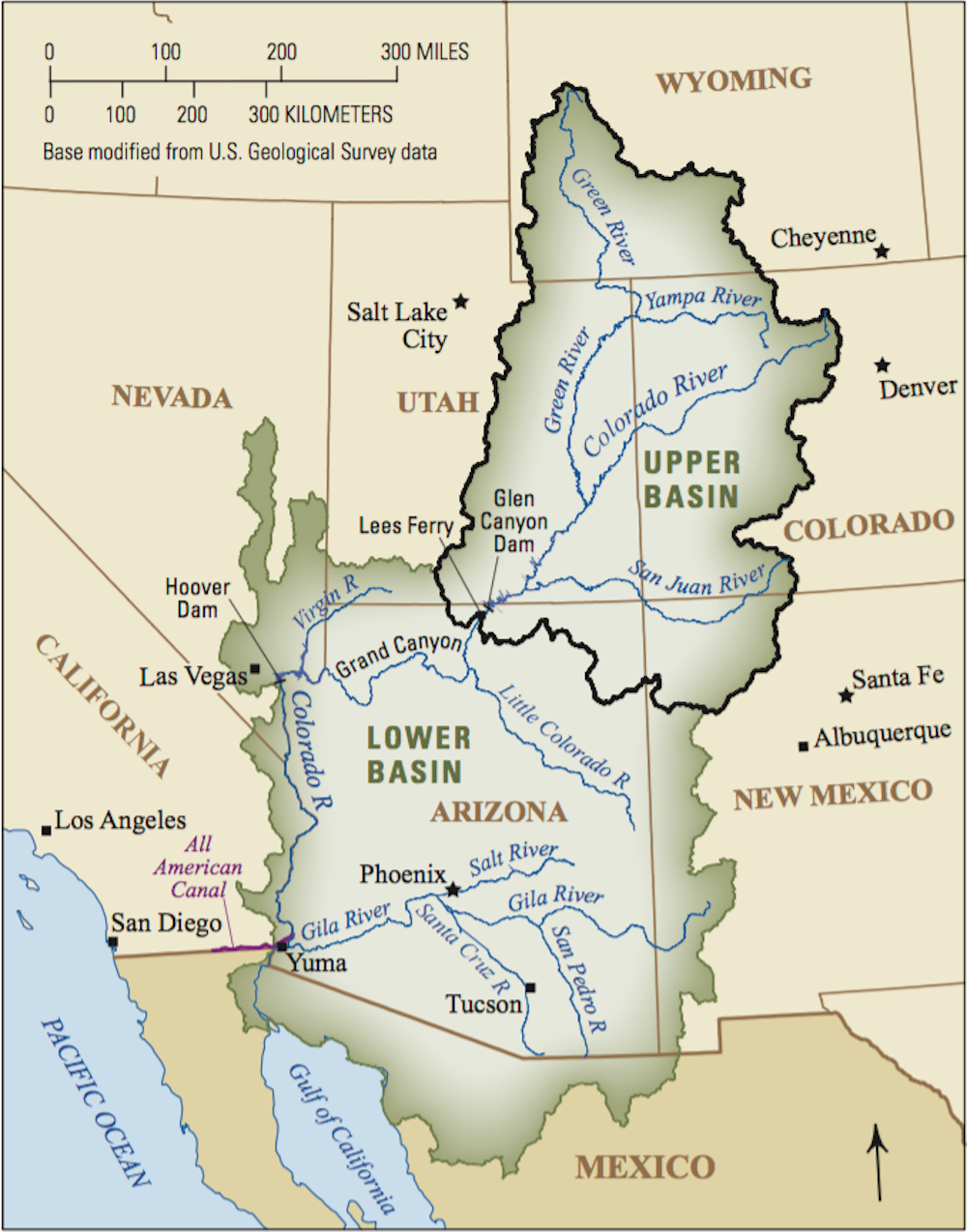
Map of Colorado River Basin.


Arizona will lose the most water: 512,000 acre-feet, nearly a fifth of its total Colorado River allocation of 2.8 million acre-feet. Nevada will lose 21,000 and Mexico 80,000. An acre-foot is enough water to cover an acre of land, which is roughly the area of a football field, to a depth of one foot – about 326,000 gallons.

Central Arizona farmers are the big losers in this first round of cuts. The cities are protected because they enjoy the highest priority in Arizona for water delivered through the Central Arizona Project, a 330-mile canal from the Colorado River. From my experience analyzing Western water policy, I expect that this declaration won’t halt growth in the affected states – but growth can no longer be uncontrolled. Increasing water supply is no longer a viable option, so states must turn to reducing demand.

Conservation remains the low-hanging fruit. Water reuse – treating wastewater and using it again, including for drinking – is also viable. A third option is using pricing and trading to encourage the reallocation of water from lower-value to higher-value uses.

Interstate collaboration

The Colorado River Basin states have formally negotiated who can use how much water from the Colorado River since they first inked the Colorado River Compact in 1922. In 2007 they negotiated interim shortage guidelines that specified how much each state would reduce its use depending on the elevation of Lake Mead. A series of subsequent agreements included Mexico, increased the scale of reductions and authorized the secretary of the Interior, ultimately, to impose truly draconian cuts.

Arizona suffers the biggest cuts because it agreed in the 1960s that it would have the lowest priority among the Lower Basin states.

California does not take a cut until the level in Lake Mead drops even lower. But that could happen as soon as 2023. The water level is dropping partly because of the Western drought but also because of the shape of Lake Mead, which was created by damming Boulder Canyon in 1936.

Like most Western river canyons, Boulder Canyon is wide at the rim and narrow at its base, like a martini glass. As its water elevation drops, each remaining foot in the lake holds less water.

Lake Mead feeds Hoover Dam, one of the largest hydroelectric generating facilities in the country. The plant produces electricity by moving water through turbines. When Lake Mead is high, Hoover Dam’s generating capacity is more than 2,000 megawatts, which produces enough electricity to supply some 450,000 average households in Nevada, Arizona and California.

But the plant has lost 25% of its capacity as Lake Mead has dropped. If the water level declines below about 950 feet, the dam won’t be able to generate power.

Sending water south

The Upper Basin states – Colorado, Wyoming, Utah and New Mexico – will also suffer.

That’s because the Colorado River Compact obligates the Bureau of Reclamation to release an annual average of 8.23 million acre-feet from Lake Powell, the nation’s second-largest reservoir, which extends from southern Utah into northern Arizona.

The Bureau of Reclamation predicted in mid-July that runoff into Lake Powell for 2021 will total just 3.23 million acre-feet, or 30% of average. To make up for this shortfall, the bureau will release more water from three Upper Basin reservoirs: Flaming Gorge in Utah, Blue Mesa in Colorado and Navajo on the Colorado-New Mexico border.

These releases will harm farmers and ranchers, who may be forced to raise less-water-intensive crops or fewer animals due to water shortages. The Upper Basin states get much of their water from snowpack, which has declined in recent years as the West warms.

Doing the math

The ultimate problem facing the Colorado River Basin states is simple. There are more water rights on paper than there is water in the river. And that’s before considering the impact of climate change and evaporation loss from Lakes Mead and Powell.

The urgency of the Tier 1 shortage declaration has generated wild-eyed proposals to import water from far-flung places. In May 2021, the Arizona legislature passed a bipartisan resolution calling on Congress to study a pipeline from the Mississippi River that would augment the Colorado River. Space does not permit me to elaborate all the obstacles to this idea, but here’s a big one: the Rocky Mountains.

Similarly, the city of St. George in southwest Utah has proposed building a 140-mile pipeline from Lake Powell to augment its supply. St. George has some of the highest water consumption and lowest water prices in the country.
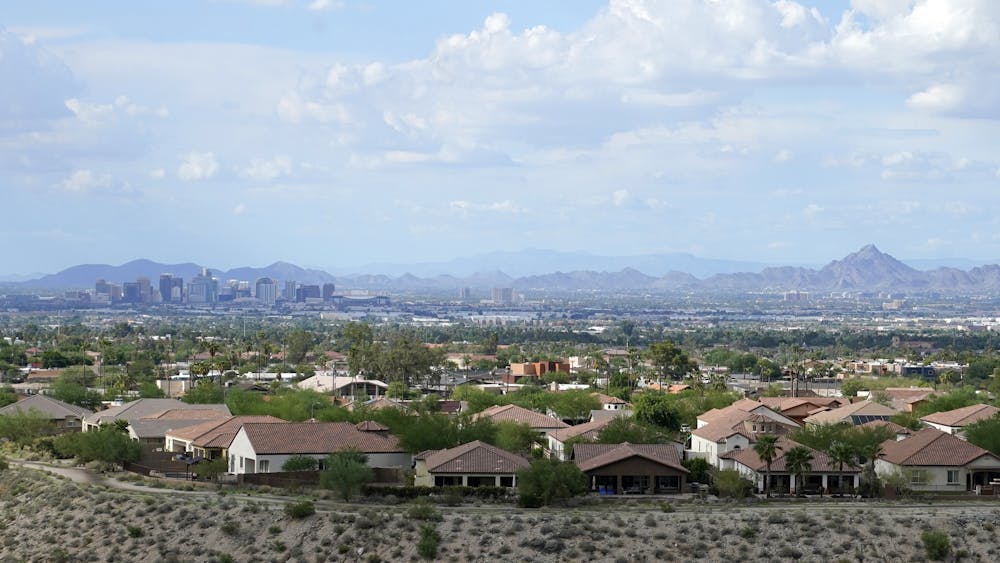
Downtown Phoenix with suburban homes in foreground.


The gospel of growth still motivates some cities. Buckeye, Arizona, on the west side of Phoenix, has a planning area of 642 square miles, which is larger than Phoenix. The city has approved 27 housing developments that officials project will increase its population by 800,000 people by 2040. Yet its water supply depends on unsustainable groundwater pumping.

Other communities have faced reality. In early 2021 Oakley, Utah, east of Salt Lake City, imposed a construction moratorium on new homes, sending shivers up the spines of developers across the West.

Enabling farmers to be more efficient

The Tier 1 declaration gives states and local communities reason to remove barriers to transferring water. Market forces are playing an increasingly critical role in water management in the West. Many new demands for water are coming from voluntary transfers between willing sellers and desperate buyers.

Water markets threaten rural communities because farmers cannot hope to compete with cities in a free market for water. Nor should they have to. Water remains a public resource. I believe the states need a process to ensure that transfers are consistent with the public interest – one that protects the long-term viability of rural communities.

As the West enters an era of water reallocation, most of the water will come from farmers, who consume more than 70% of the region’s water. Cities, developers and industry need only a tiny fraction of that amount for the indefinite future.

What if municipal and industrial interests created a fund to help farmers install more efficient irrigation systems instead of simply flooding fields, a low-tech approach that wastes a lot of water? If farmers could reduce their water consumption by 5%, that water would be available to cities and businesses. Farmers would continue to grow as much food as before, thus protecting the stability of rural communities. This could be a win-win solution to the West’s water crisis.

Many California farmers have water cut off, but a lucky few are immune to drought rules

Many California farmers have water cut off, but a lucky few are immune to drought rules

Kim Gallagher poses for a portrait in one of her rice fields in Knights Landing, California, August 3, 2021.
Kim Gallagher in one of her rice fields in Knights Landing. (Max Whittaker / For The Times)


Driving between her northern Central Valley rice fields with the family dog in tow, fifth-generation farmer Kim Gallagher points out the window to shorebirds, egrets and avocets fluttering across a thousand-acre sea of green flooded in six inches of water.

“People say agriculture uses so much water, but if you knew who lived in these areas and if you saw the animals taking advantage of it, you’d think there’s a lot more going on here,” Gallagher said. “This is where you’re going to find a Great Blue Heron. If you don’t want that type of bird then we shouldn’t be growing rice.”

The nearly 500,000 acres of sushi rice grown in the Sacramento Valley each year serve as the wetland habitat for thousands of migrating birds along the Pacific Coast. Yet the crop also uses more water than most, and about half of the product is exported to countries including Japan and South Korea.

Since the 1920s, farmers have grown rice in the Sacramento Valley, where old hands fly crop duster planes and rice emblems mark the county buildings. Now, due to decades-old agreements with the federal government, rice farmers like Gallagher are going relatively unscathed by unprecedented emergency water cuts to farmers this month as others fallow fields, wells go dry and low water levels imperil Chinook salmon, the native cold-water fish that play critical ecological roles and support a billion-dollar fishing industry.

A handful of districts supplying farmers including Gallagher are receiving nearly 2 million acre feet of water this drought year, enough to supply the city of Los Angeles for roughly four years. Their seniority is a function of the state’s complicated water rights system, which some experts say is ripe for reform as extreme drought magnifies the inequities within it.

Developed in the 19th century by miners who used water to blast gold out of the Sierra foothills, California water rights are based on a concept known as “first in time, first in right.”

An irrigation canal that feeds rice fields in Knights Landing.
An irrigation canal that feeds rice fields in Knights Landing. (Max Whittaker / For The Times)


The principle, which remains central to state water law today, roughly translates to “first come, first served” to a quantity of water from a natural source. During drought, rights are curtailed by state regulators from newest to oldest to protect water for residential use and human health and safety essentials.

Most farmers across the state who rely on the Central Valley Project, the nearly two dozen dams and hundreds of canals that make up the federal water allocation system, are getting 5% or less of their usual water supply this year.

The state water board’s most recent emergency order barred thousands of farmers, landowners and others from diverting water from the massive Sacramento-San Joaquin Delta watershed that stretches from Fresno to the Oregon border, forcing many to turn to groundwater pumping.

Some of them with rights claims predating 1914, the year California enacted its water rights law, say the State Water Resources Control Board lacks authority to curtail them and sued over the issue during the last punishing drought.

Meanwhile, districts like Gallagher’s that have contracts with the water project based on those rights, called the Sacramento and San Joaquin River Settlement Contractors, have never been cut off by more than 25% — even in the driest years.

The fish screen at the Glenn Colusa Irrigation District pumping station in Orland
The fish screen at the Glenn Colusa Irrigation District pumping station in Orland, which supplies water to rice farmers like Kim Gallagher. (Max Whittaker / For The Times)


The largest of this group is Glenn-Colusa Irrigation District, 260 square miles of land best known for rice growing. Its multistory pump station sits on a bend in the Sacramento River near where, in 1883, future state legislator Will S. Green nailed a paper notice to an oak tree claiming millions of gallons per minute of the river’s natural flow.

When the federal government was building the Central Valley Project in the 1940s, irrigators such as Glenn-Colusa sued, settling after nearly 20 years of negotiations for contracts to stored water from Shasta Lake, the state’s largest man-made reservoir.

Regardless of conditions, federal officials operating Shasta Dam are now obliged to fulfill those contracts to rice farmers and others along the San Joaquin River, with the expectation that there will be legal action if they don’t.

‘An unprecedented year’

Built by the federal government in the 1940s in the wake of the Great Depression, Shasta Lake is the cornerstone of the Central Valley Project.

Shasta Dam is operated by the federal Bureau of Reclamation
Shasta Dam is operated by the federal Bureau of Reclamation, which is responsible for distributing water to farms and communities while protecting the watershed’s fish and wildlife. (Max Whittaker / For The Times)


The dam is operated by the federal Bureau of Reclamation, which is responsible for distributing water to farms and communities while protecting the watershed’s fish and wildlife. Although the two obligations are equal in the eyes of the law, they often conflict when there’s not enough water to go around.

Over the years, the impact of the perennial tug-of-war between competing interests has been felt in the increasing die-off of Chinook salmon, one of California’s most iconic fish species.

In April, just as rice farmers in the Sacramento Valley received water to flood their fields, record evaporation of snowpack on the Sierra Nevada mountains meant some 800,000 acre feet of water didn’t melt into reservoirs as expected.

Soon after, the State Water Resources Control Board told the Bureau of Reclamation that it violated requirements to keep water flowing through the watershed, in part by allocating too much to agriculture and failing to adequately prepare for drought after a dry 2020.

The bureau had initially aimed to preserve enough cold water in the reservoir to keep nearly half of this year’s young winter-run Chinook class alive. By July, it said those initial cold storage benchmarks could no longer be met and now expects a death rate of 80%.

According to Bureau of Reclamation Regional Director Ernest Conant, providing water to settlement contractors like Glenn-Colusa impacts storage levels. But predictions changed because of unexpectedly high rates of depletion downriver — evaporation and potentially unlawful diversions directly from waterways that are difficult to track.

“We started this year with a higher storage level than in previous critical years, certainly higher than 2015,” Conant said. “So, I mean, I think we have prudently planned. This is just an unprecedented year.”

Conant said the agency plans to take a critical look at the way it approaches weather forecasting as water managers throughout the West face record snowpack evaporation. This week, federal officials declared the first-ever shortage from the Colorado River as its largest reservoir, Arizona’s Lake Mead, fell to record lows.

‘An indicator from the ocean to the rivers’
The Centimudi boat ramp on a receded Shasta Lake with Shasta Dam in the background.
The Centimudi boat ramp on a receded Shasta Lake with Shasta Dam in the background. (Max Whittaker / For The Times)


Shasta Lake is currently at 29% capacity and falling. And without enough cold water in the reservoir, state officials are warning of a near complete loss of young Chinook salmon in warm waters of the Sacramento River, which runs from the Klamath mountains out to the San Francisco Bay.

Fall-run Chinook salmon, which aren’t endangered but support California’s commercial salmon fishing industry, stand to be adversely affected by drought conditions as well, with the potential for lasting effects on future populations that could raise retail prices in the long run.

Jordan Traverso, a spokesperson for the California Department of Fish and Wildlife, said that the mortality of adult endangered salmon that hadn’t had the chance to spawn was more than 20% higher than average this year due to dry river conditions and high water temperatures.

“The greater challenge for winter-run Chinook salmon in 2021 is ensuring that suitable water temperatures can be maintained in the Sacramento River for the developing eggs and embryos that must remain in the gravel before hatching,” she said in an email.

The winter-run Chinook salmon native to the Sacramento River are born in freshwater rivers, journey to sea and live in the Pacific for two to three years before coming back as adults to spawn the next generation.

The fish historically swam high into the mountains to spawn in cold water, but since the construction of Shasta Dam, they have adapted to breed in front of it.

Cold water releases into the Sacramento River are meant to preserve water temperatures at or below 56 degrees, keeping eggs and young salmon from dying in the warm river. Dwindling cold water in the reservoir means less is available for the fish.

“Winter-run Chinook is a species that’s teetering on the verge of extinction, so losing a whole year class really does not help,” said Andrew Rypel, a fish ecologist at UC Davis.

In the 1960s, adult spawning classes were more than 100,000 large, he said. Now that number is 10,000 in a good year.

Winnemem Wintu tribal chief Caleen Sisk on the shore of a receded Shasta Lake.
Winnemem Wintu tribal chief Caleen Sisk on the shore of a receded Shasta Lake. (Max Whittaker / For The Times)


Unlike rice farmers who benefit from a water rights system that prioritizes seniority, the ancestors of Winnemem Wintu tribe leader Caleen Sisk, who fished Chinook out of the same river for thousands of years, were dispossessed by it.

Construction of Shasta Dam flooded the tribe’s lands, blocking access to ritual sites and breaking what the tribe sees as a covenant with the fish that once swam miles up their native McLoud River into the mountains.

Salmon are a critical part of the ecosystem, transferring nutrients from the sea to freshwater habitats along their journey, said Sisk, but she fears that message falls mostly on deaf ears among government agencies tasked with managing water.

“Can we do without salmon? Some people think we can. We believe we can’t,” she said. “They’re an indicator from the ocean to the rivers. It’s like miners going down into the mines without a canary. They can do it, but there’s gonna be a whole lot more problems.”

A photo of the Winnemem Wintu tribe in the 1890s whose tribal land was flooded by the Shasta Dam.
A photo of the Winnemem Wintu tribe in the 1890s whose tribal land was flooded by the Shasta Dam. (Caleen Sisk)
History repeating

A similar chain of events played out in California’s punishing 2014 drought, when only 5% of the year’s juvenile Chinook survived after the Bureau of Reclamation cited inaccurate computer models for underestimating the amount of cold water storage needed.

“We’re repeating that disaster and it’s very frustrating to watch,” said Doug Obegi, an attorney with the Natural Resources Defense Council in San Francisco.

“Drought makes the challenges much harder, but we have contracts that promise so much water that you have to drain the reservoirs to be able to meet them in a year like this,” he said, pointing to the Bureau of Reclamation’s legal obligations to districts including those that serve Sacramento Valley rice farmers.

If water rights can’t be fulfilled during drought years without letting close to an entire class of endangered Chinook die, Obegi thinks those districts’ contracts need to be reconsidered.

But Glenn-Colusa Irrigation District General Manager Thad Bettner said growers shouldn’t be forced to conserve unless urban areas are doing the same. Measures such as voluntary reductions, which he said the district implemented this year, or selling more water down south by fallowing fields, could help avoid disaster in the next drought.

“This is the water rights system that we inherited from our forefathers. All people say is ‘Well, maybe it’s not working.’ But it’s like, then what do you want to change it to?” Bettner said. “Until we have that sort of conversation, I think this is a system we know we can make work.”

Kim Gallagher stands in a rice field she&#39;s fallowed due to a lack of water in Knights Landing.
Kim Gallagher stands in a rice field she’s fallowed due to a lack of water in Knights Landing. (Max Whittaker / For The Times)


Asked whether flooding fields like hers could have played a role in depleting the cold water pool for salmon, Gallagher said the answer is above her pay grade. She had hoped that letting one of her rice fields fallow and selling the water down south later in the season was doing her part to maintain storage.

“I don’t know how it could be my fault, and I don’t know how it could be [the bureau’s] fault. I just think we don’t have a system that’s working well in a drought year and we’re just doing our best to try and make it through,” she said.

Settlement contractors are one part of the legal battle over the state’s authority to regulate California’s longest-standing water users that makes its water rights system “wholly unsuited to the modern state and even more wholly unsuited to a region facing climate change,” said Michael Hanemann, environmental economist and former UC Berkeley professor.

After studying water rights for 30 years, he said the big question is whether the state can legislate structural changes to the system and extend the authority of regulating agencies to the most senior rights.

The state water board is currently “muddling through” with emergency regulations similar to those that Gov. Jerry Brown empowered the state water board to enact for the first time in 2014, Hanemann said.

“Up to now, legislation that was far reaching enough to change the system could never pass because the vested interests were too powerful,” Hanemann said. “All of this is good, but it’s not doing much without passing legislation.”

Mississippi’s governor says people in the state are less scared of COVID-19 because they ‘believe in eternal life’

Mississippi’s governor says people in the state are less scared of COVID-19 because they ‘believe in eternal life’

Tate reeves
Mississippi Republican Gov. Tate Reeves delivers a televised address prior to signing a bill retiring the last state flag with the Confederate battle emblem during a ceremony at the Governor’s Mansion in Jackson, Mississippi, on June 30, 2020. ROGELIO V. SOLIS/POOL/AFP via Getty Images.
  • Mississippi Gov. Tate Reeves said people in the state are “less scared” of COVID-19.
  • “When you believe that living on this earth is but a blip on the screen, then you don’t have to be so scared of things,” he said.
  • Health services are struggling under a wave of new infections in the state.

Mississippi Governor Tate Reeves, in remarks Saturday, said that people in the state were “less scared” of COVID-19 because they believe in “eternal life,” as new infections reach record levels and hospitalizations spike.

Reeves made the remarks to a gathering of state Republicans at a fundraiser last Thursday in Eads, reported the Daily Memphian.

“I’m often asked by some of my friends on the other side of the aisle about COVID … and why does it seem like folks in Mississippi and maybe in the Mid-South are a little less scared, shall we say,” Reeves said.

“When you believe in eternal life – when you believe that living on this earth is but a blip on the screen, then you don’t have to be so scared of things,” he said.

Read more: Governors of all 50 states are vaccinated against COVID-19

Reeves went on to say, “God also tells us to take necessary precautions. And we all have opportunities and abilities to do that and we should all do that. I encourage everyone to do so.”

Mississippi has recorded more new COVID-19 cases per capita than any other state, with around 127 new cases per 100,000, according to an analysis of data by The New York Times.

The wave of infections in Mississippi has put state health services at breaking point, with 93% of the state’s ICU beds in use and 63% occupied by COVID-19 patients, according to data from the Department of Health and Human Services.

The state also has one of the lowest vaccination rates in the country, with about 37% of the population fully vaccinated, according to data from the Centers for Disease Control and Prevention.

Reeves, throughout the pandemic, has criticized measures to slow the spread of the disease introduced by public health officials and has declined to issue a mask mandate at schools, where the disease is spreading rapidly.

In July, after the CDC issued new guidance for those fully vaccinated to wear a mask indoors to help reduce transmission, Reeves told supporters the measure was part of a political plot.

“It reeks of political panic so as to appear they are in control,” Reeves told supporters, reported the Associated Press.

A program that pays farmers not to farm isn’t saving the planet

A program that pays farmers not to farm isn’t saving the planet


President Joe Biden wants to combat climate change by paying more farmers not to farm. But he’s already finding it’s hard to make that work.

His Agriculture Department is far behind its goal for enrolling new land in one program that has that goal, with participation being the lowest it’s been in more than three decades.

Even though the USDA this summer more than doubled key incentive payments for the program that encourages farmers and ranchers to leave land idle, high commodity prices are keeping it more worthwhile for growers to raise crops.

On top of that, the plan, known as the Conservation Reserve Program, takes land out of production for only 10 to 15 years  so those acres could release carbon into the atmosphere if the land is planted again and thus cancel out its environmental benefit.

The slow pace of enrollment and the temporary nature of the program raise questions about whether it will ever contribute significantly to efforts to reduce carbon emissions. It also shows how difficult it is for government programs to voluntarily draw in the farm industry to combat pollution.

“I guess my bottom line is, it’s not a great climate solution,” said agriculture and environment consultant Ferd Hoefner, who was the founding policy director for the nonprofit National Sustainable Agriculture Coalition.

Zach Ducheneaux, administrator of USDA’s Farm Service Agency, which oversees the conservation program, acknowledges that participation this year has been lower than hoped for, but he is still optimistic that the additional money the administration is providing will spur more landowners to join.

“Our position at the Farm Service Agency is that we have to start to talk about working lands and conservation in the same breath,” Ducheneaux said in an interview.

The added incentives the USDA has introduced “definitely made the program more attractive than it was last year,” said Cristel Zoebisch, policy specialist at the National Sustainable Agriculture Coalition.

But she noted that high commodity prices this year could be more lucrative than any additional money the Biden administration is offering. “It’s a trend that we’ve seen time and time again that whenever commodity prices are good, CRP enrollments go down,” Zoebisch said.

The Biden administration aims to enroll 4 million new acres in 2021 but only 2.8 million have been added so far.

Even last week, when the USDA announced the low enrollment, it touted the added benefits to the environment from the program. By participating in the decades-old initiative, USDA noted that farmers agree to undertake conservation measures such as planting trees or grass that prevent soil erosion, improve water quality or provide habitat for wildlife. In exchange, FSA pays farmers rent for the 10 to 15 years the land is enrolled and shares in the costs of making the conservation changes.

But it’s not clear how USDA measures whether the program is a good conservation effort. Ducheneaux said that the department relies on independent analysis from universities and environmental nonprofits to help quantify the program’s success.

USDA asserts the program has prevented more than 12 million tons of carbon dioxide from entering the atmosphere. Still, that’s a pittance compared with how much of the greenhouse gas the USDA said the ag industry releases each year (698 million metric tons in 2018).

Environmentalists praise certain aspects of the program, which doles out about $2 billion each year to farmers and ranchers. For instance, they have commended other conservation benefits that come from sign-ups, such as improved water quality.

Currently, there are nearly 21 million acres of farmland enrolled in CRP, but the program can enroll up to 25 million acres this year. Ducheneaux attributed the lower enrollment to the fact the program had been cut and ignored for years, even in times when commodity prices were suffering and farmers could have benefited from the added revenue.

“As it was being implemented in the past, folks weren’t being drawn to it,” Ducheneaux said. “The incentives clearly weren’t enough to get folks to even step out of the volatile commodity markets and engage in these conservation practices.”

The program also has supporters including many members of Congress and powerful ag interests that prefer voluntary incentives over mandatory regulations to slash emissions.

Rep. Cheri Bustos (D-Ill.), a House Agriculture Committee member, is among them and noted that CRP isn’t the only tool the Biden administration will use to fight climate change.

“This is a complex problem, and we have got to basically be able to look at what we’re going to be able to do together,” Bustos said. “Bring farmers to the table and figure out how we’re gonna have the most comprehensive approach possible.”

Bustos, who has 10,000 family farms in her Northwest Illinois district, also said she hoped the added financial incentives the administration has introduced will draw in more farmers.

“We can be part of the solution. We want to be part of the solution,” Bustos said. “But we’ve got to connect all those dots as far as being financially healthy, and being able to make a living and helping the environment.”

The American Farm Bureau Federation, the large farm lobby, also backs CRP, because it can help farmers and ranchers stay profitable.

Regions battling wildfires, extreme temperatures and drought such as the Pacific Northwest and the broader Western U.S. might have higher rates of enrollment this year, said Shelby Myers, an economist at the Farm Bureau.

Environmental groups, like the Theodore Roosevelt Conservation Partnership, are also backing the administration’s efforts to attract more farmers to the program.

But some conservationists are worried that FSA will take land that scores low on the environmental benefits index to meet the goal of enrolling more acres, simply to prove that the program fares better under Biden than it did under former President Donald Trump.

The quality of land enrolled in the program is a constant worry, Zoebisch said. She added that taking in land that scores low would be a waste of taxpayer dollars.

“There’s definitely a benefit to having certain parts of agricultural fields taken out of production and protected with permanent grasses and cover,” Zoebisch said. “But we also don’t want to be just allowing any land into the CRP general sign-up. We want it to be of high environmental benefit.”

‘Worst drought conditions we’ve had since 2002’: Alberta farmers struggle to feed cattle, grow crops

‘Worst drought conditions we’ve had since 2002’: Alberta farmers struggle to feed cattle, grow crops

A summer of heat waves and little rainfall has Alberta farmers struggling to make it through the season.

Crops aren’t making enough feed for some cattle farms and Shelby Blosky, owner of Double S Ranch Cattle Co., said farmers like herself are having to buy extra hay bales at steeper prices due to limited supply.

“Typically, we pay around $50 for a round bale of hay and this year there’s prices out there upwards of $300 a bale,” said Blosky, whose farm is about 107 kilometres southwest of Edmonton near Breton. “There’s going to be a lot of farms that are just going to say they are done with it and that’s really heartbreaking to see.”

Blosky said the increased prices of hay and other crops are forcing some farmers to sell off their cattle at auctions, and it’s hard for her to see because farmers don’t farm to be rich.

“We do it because we love it. I can’t imagine family farms that have had the same cattle bloodline for 100 years and they’re being forced to sell their cows — it just makes me sick, to be honest,” said Blosky, adding she still thinks about the cows she had to sell six to seven years ago to avoid going into debt.

Melanie Wowk, chair of Alberta Beef Producers, which represents over 18,000 cattle farmers and ranchers in the province, confirmed that some farmers are being forced to sell their cows.“We’ve definitely heard from the auction markets that cattle numbers are up,” said Wowk. “So, there’s a lot higher numbers going through right now than there typically is at this time of year.”

On July 9, Wowk said she got several calls from producers in the area who said their crops were starting to turn early due to the extreme heat and they were worried the crops would deteriorate to the point that they wouldn’t be worthwhile to turn into feed.

The hotter-than-average summer has been detrimental to the condition of crops and just 18.2 per cent were considered to be in good to excellent condition as of Aug. 10, according to the province’s crop report. The report noted that the 10-year average has seen 69.9 per cent of crops in good to excellent condition.

“In the cropping sector in Alberta, these are the worst drought conditions we’ve had since 2002 when thanada,” said Tom Steve, general manager of the Alberta Wheat and Barley Commissions. “It’s definitely going to take its toll on a number of farmers.”Steve said prices for a lot of crops are very strong due to the drought reaching many regions, however, he said farmers have no or very little crop to sell and are unable to take advantage of the strong prices.“It’s going to cost the same amount of money to harvest that crop. Whether it’s a four bushel per acre yield or a 50 bushel per acre yield, it still costs you the same for fuel, labor and wear and tear on your equipment.”

Regions south of the Trans-Canada Highway have seen the biggest impact due to the drought, he said.

Blosky, Wowk and Steve all said the extreme heat has also brought more grasshoppers.

“It was pretty disheartening to go walk out into the pasture when we turned the cows out and the grasshoppers had already eaten a very large amount of the grass,” said Blosky. “There’s nothing you can do about it. It’s just another thing this year.”

Hay bales are seen in a field near Highway 37 and Highway 2 north of Edmonton, on Wednesday, Aug. 25, 2021. As historic drought conditions have destroyed crop yields across the Prairies, hay prices have skyrocketed. Photo by Ian Kucerak
Hay bales are seen in a field near Highway 37 and Highway 2 north of Edmonton, on Wednesday, Aug. 25, 2021. As historic drought conditions have destroyed crop yields across the Prairies, hay prices have skyrocketed. Photo by Ian Kucerak PHOTO BY IAN KUCERAK /Postmedia

13 U.S. service members killed in Kabul attack: Pentagon

13 U.S. service members killed in Kabul attack: Pentagon


A “complex attack” involving at least two explosions outside the airport in Kabul on Thursday killed 13 U.S. service members and injured at least 15 others, the Pentagon said.

The attack also killed and wounded a number of Afghan civilians. An Afghan official told Associated Press that at least 60 Afghans were killed and 143 others were injured in the attack.

“Let me be clear: While we’re saddened by the loss of life, both U.S. and Afghan [lives], we’re continuing to execute the mission,” Marine Gen. Frank McKenzie, commander of U.S. Central Command, said at a press briefing on Thursday.

McKenzie confirmed earlier reports that a suicide bomb exploded outside one of the main gates at Hamid Karzai International Airport. He said another bomb went off in the vicinity of the Baron Hotel, which is near the airport and is often frequented by Americans in Kabul.

Smoke rises from explosion outside the airport in Kabul, Afghanistan, Thursday, Aug. 26, 2021. The explosion went off outside Kabul&#39;s airport, where thousands of people have flocked as they try to flee the Taliban takeover of Afghanistan. (Wali Sabawoon/AP)
Smoke rises from an explosion outside the airport in Kabul on Thursday. (Wali Sabawoon/AP)


McKenzie also confirmed that ISIS-K, an affiliate of the Islamic State terrorist group in Afghanistan, is believed to be responsible for the attacks. He said U.S. officials believe it is the group’s “desire to continue those attacks, and we expect those attacks to continue.” ISIS-K is also an enemy of the Taliban.

Asked whether the U.S. would take military action against those responsible, McKenzie said, “Yes. If we can find who is associated with this, we will go after them.”

On Thursday evening, President Biden, speaking somberly from the White House, vowed to “hunt down” those who carried out the attack.

“We will not forgive, we will not forget, we will hunt you down and make you pay,” he said.

Biden added that officials “have some reason to believe we know who [the ISIS-K leaders] are, and we will find ways of our choosing, without large military operations, to get them.”

(Yahoo News)
Yahoo News


The Hamid Karzai airport has been the site of a massive airlift operation by the U.S. military to evacuate tens of thousands of Americans, at-risk Afghans and citizens of allied nations out of Afghanistan following the Taliban’s takeover of the country less than two weeks ago.

McKenzie told reporters that the suicide bomber likely made it past Taliban checkpoint outside the airport and was being screened by U.S. Marines for entry at the gate when the attack occurred, highlighting the threats to U.S. troops who are facilitating the airlift.

“We don’t want to let somebody on an airplane with a bomb,” McKenzie said. “Ultimately, Americans have got to be endangered to do these searches, there’s really no other way to do it.”

McKenzie said he doesn’t think there’s any reason to believe the Taliban intentionally let the attack happen.

“Clearly, if they were able to get up to the Marines at the entry point of the base, there’s a failure somewhere,” he said. Still, McKenzie said, U.S. officials have asked Taliban leaders for help providing additional security around the airport, given threats of another possible attack.

“They have a practical reason for wanting us to get out of here by Aug. 31,” McKenzie said of the Taliban, who, he said, want to reclaim control of the Kabul airfield. “As long as we kept our common purpose aligned, they’ve been useful to work with.”

Biden to ISIS-K: ‘We will hunt you down and make you pay’

President Biden addressed the nation Thursday evening following two bombing attacks outside the Kabul airport that killed 12 U.S. service members and dozens of Afghans. Biden blamed Islamic State Khorasan, or ISIS-K, for the attack and vowed to avenge those deaths.

Biden reiterated this point on Thursday, saying that “no one trusts” the Taliban, but that U.S. officials are counting on the group’s “self-interest.”

“It’s not a matter of trust,” Biden said, “it is a matter of mutual self-interest.”

The U.S. has been racing to evacuate as many people from Afghanistan as possible before Aug. 31, when the last American troops are scheduled to withdraw from the country. Earlier this week, Biden confirmed that he intends to stick with that withdrawal deadline, despite calls to extend it. He cited the growing threat that ISIS-K poses to U.S. troops on the ground in Kabul.

“Every day we’re on the ground is another day we know ISIS-K is seeking to target the airport,” Biden said Tuesday. “The sooner we can finish, the better.”

As of Wednesday, Secretary of State Antony Blinken said that more than 4,500 American citizens and their immediate family members had been evacuated from Afghanistan, and that up to 1,500 others were still waiting to leave.

At the Pentagon on Thursday, McKenzie said that before the attack, 104,000 people had been airlifted out of the Kabul airport.

Medical and hospital staff bring an injured man on a stretcher for treatment after two blasts outside the airport in Kabul, Afghanistan, Thursday. (Photo by Wakil Koshar/AFP via Getty Images)
Medical staff bring an injured man on a stretcher for treatment after the explosions on Thursday. (Wakil Koshar/AFP via Getty Images)

What if it’s too late to save our planet without geoengineering?

What if it’s too late to save our planet without geoengineering?

<span>Photograph: Phil Noble/Reuters</span>
Photograph: Phil Noble/Reuters


The realities of climate change are front-page news every day. Temperature records are being smashed. Wildfires are raging. There is no sign of things going back to “normal”. If anything, they will only get worse.

Last year, when the planet was convulsing with the arrival of a pandemic, we pinned our hopes on technology – in the form of an mRNA vaccine – getting us out of our crisis. The vaccine was a technological intervention, injected into the arms of billions of people. Could we (should we?) look to technological solutions to our climate crisis, too?

Related: ‘Fire weather’: dangerous days now far more common in US west, study finds

This is the question posed by Holly Jean Buck in her 2019 book After Geoengineering: Climate Tragedy, Repair, and Restoration. Zooming with me from Buffalo, New York, where she’s a professor of environment at the University of Buffalo, Buck is blunt in her assessment. The pace of climate change, and the insufficiency of humanity’s current response, have effectively already made the choice for us: mankind will have to engage in some kind of “geoengineering” – an umbrella term for various methods of intentional, planetary-scale climate intervention – whether we like it or not.

Geoengineering refers to any number of ways that humans can change our climate through interventions. The two main types of geoengineering are carbon engineering, which aims to suck carbon out of the atmosphere, and solar engineering, which aims to reflect solar energy away from Earth.

“We’re in a climate crisis,” she tells me. “Mitigation isn’t going fast enough. Adaptation needs far more support than it’s getting. It’s clear that we need to remove some amount of carbon from the atmosphere.”

How much? “Hundreds of billions of gigatons,” Buck says. “We have emitted so much, and now we have so much legacy carbon. The challenge isn’t just cutting emissions.” The second challenge is “removing the carbon that’s up there. It’s this massive cleanup operation that we need to undertake this century.”

The idea of deliberately altering the climate can be frightening and distasteful, including to many environmentalists. But Buck argues that climate engineering is coming whether we like it or not. “If people on the environmental left – people who care about climate change – just reject all of these approaches out of hand, then we lose the ability to shape them, which would be a grave mistake,” she says.

The simplest form of geoengineering is the kind of carbon removal many of us learned about in school: planting trees. “Land-based solutions are really important, especially in the next decade or so, because they can be implemented quickly – and we know how to plant forests,” Buck says. She points to other kinds of land-based climate interventions that show promise. Changing agricultural practices can be used to store more carbon in the dirt. Other strategies include storing carbon in wetlandsocean iron fertilization, or different approaches involving rock weathering.

But land-based solutions, though a helpful beginning, probably won’t be enough, Buck says. To plant enough trees to soak up enough carbon to sufficiently cool our planet, we would have to fundamentally change the way we use land in ways that would make our economy and many of our lives unrecognizable. And there are other risks to relying too heavily on land-based techniques.

“A lot of land-based approaches are vulnerable to climate change itself,” Buck explains. “You don’t want a wildfire to wipe out these removals that you’ve been banking on, right?” Massive reforestation efforts could go up in smoke.

But land-based solutions are not the only option. Carbon removal can also be accomplished with industrial technologies. Buck points to a carbon mitigation strategy called geological carbon capture, which is already widely used to reduce the emissions of heavily polluting industries. “You could outfit, well, scrubbers basically, on a factory, and these collect carbon dioxide. Then you inject [the carbon] underground, into a cavern, and keep it there, under the rock, for a very long time. You keep monitoring it, to make sure it stays where you want it to be.”

There are risks to injecting large amounts of carbon into rock; Buck laments the under-regulated “wild west atmosphere” of fracking, which caused earthquakes in some parts of the US. But scientists have learned from that experience, and technologies exist to keep underground carbon in place. And new techniques may make geological carbon capture safer. “There’s a lot of new research about how to get carbon dioxide to turn into rock quicker once you inject it” underground, Buck says.

This is a carbon mitigation technique that has proved efficient in reducing emissions at an industrial scale, and it has been in use for decades, meaning that the safety and science of the technique are well understood. Buck’s hope is that this technology could advance and be used not just for mitigating carbon emissions, but for removing carbon.

“It becomes carbon removal” – as opposed to mitigation – “if you’re removing the carbon just from the ambient air,” Buck says. There are now machines that can “scrub” carbon out of the air; the carbon can then be transported and stored underground. Without these machines, the technique can also be used to create bioenergy, which involves “producing biomass” – say, a very carbon-dense type of plant – “and combusting it at a power plant, and separating out the carbon and storing it underground again”.

This strategy – using a spectrum of carbon-engineering techniques to inject carbon deep beneath rock – is the most effective and safest, Buck believes. But unless humanity gets its act together soon, we may forced to entertain much riskier climate mitigation strategies. “If we don’t remove carbon, and decarbonize, and reform how we use land, and rework our transportation systems, and change industrial systems fast enough,” Buck says, “then there’s the possibility that people will pitch the idea of solar geoengineering.”

Solar geoengineering is a kind of climate mitigation – thus far theoretical – that involves “blocking a fraction of incoming sunlight and sending it back out into space, which has a cooling effect”. Most solar-engineering techniques involve using special planes to inject gas into the stratosphere. The gas particles would reflect sunlight away, changing both the quantity and the quality of sunlight that reaches earth.

This kind of geoengineering would certainly cool the planet, at least for a while. But it would not solve the fundamental problem of too much carbon in the atmosphere. “It doesn’t get to the root,” says Buck. “It doesn’t remove emissions. It’s just a blanket of intentional pollution that cools things down.”

And solar geoengineering might create other problems, Buck says. What would a different kind of sunlight do to humankind, or to other living creatures? What would it do to agriculture, and our food supply? We don’t know. Would there be food shortages? Would the sky still be blue? We don’t have those answers, and solar geoengineering remains a risky proposition until we do.

How optimistic is Buck that humanity will attain a livable future without having to resort to solar geoengineering? More than I expected. The vision that she articulates is ambitious. It would require international cooperation and vast overhauls of infrastructure. It would also mean that the United States and other capitalist countries would have to reorient themselves to a more centrally planned economy, devoted less to maximizing growth than to minimizing carbon. It would mean overcoming vast political differences and competing incentives the world over in order to unite in global common cause.

But Buck thinks that the incentives for cooperation in the existential climate intervention project are great enough to ensure at least some success.

“I do think that if people share a common goal, they might disagree about how to reach that goal, but maybe just having the common goal is enough,” she says.

The greatest cleanup operation of history – the cleanup of carbon in our atmosphere – may well happen within our lifetimes. And, if Buck is right, there is no better time to start it than right now.

  • Moira Donegan is a Guardian US columnist

‘As they’re being intubated, they still don’t believe it.’ The COVID denial won’t die

‘As they’re being intubated, they still don’t believe it.’ The COVID denial won’t die

Our friends in health care have seen plenty to impale the heart in this COVID-19 pandemic, but nothing more tragic than this: the sight of guilt-ridden young children who believe they’ve killed an unvaccinated parent by bringing the virus home.

“And as they’re dying, the kids are at the bedside apologizing,” a hospital nurse tells me.

“You’ve actually seen that?” I ask her.

“Multiple times,” says the nurse.

My Kansas City nurse friend, who can’t use her name because she isn’t authorized to speak to the media, occasionally shares this inconceivable, untold tragedy with dinner companions who obnoxiously insist on spouting their anti-vaccine views to her over burgers and beer.

Some of them are shamed into silence by what she tells them. But others cling stubbornly to their defiance, even after hearing of parents who’ve left their children motherless or fatherless because of it — and left them with a lifetime of self-reproach for something that clearly wasn’t their fault.

Of course it isn’t the kids’ fault they got sick and may have gotten their unvaccinated father or mother deathly ill. While Dad or Mom could’ve easily gotten vaccinated, the children could not have. “But they still just feel terrible, because they feel like they killed their parent,” she says.

COVID vaccine resistance goes on and on and on, even amid the delta variant and amongst the caring hospital workers who can help, if not the dying patients then their survivors. Astonishingly, many of those who’ve seen a loved one die still refuse to get vaccinated.

“We discuss it. We try to push it. Our doctors try to push it,” my friend says of efforts to vaccinate the survivors of COVID’s dead and dying. “It seems more often than not they don’t want it.”

Good God, why not?

The nurse says most complain they don’t know what’s in the shot, or they just don’t trust it or the government. Or they say they’ve gone this long without getting it, so they should be fine — unlike their loved one who succumbed to it.

Vaccine hesitancy — which feeds my friend’s hospital with an unending stream of patients from some of the most intractably vaccine-hesitant counties in America — shows up even in the most desperately ill. One man on the cusp of needing intubation told my friend’s nursing colleague she was an idiot for being vaccinated.

“He asked her if she’d had her vaccine, and he was just like, ‘You’re stupid,’” the nurse says. “Just laid into her about how everybody’s falling for what the government says and COVID’s not real and you shouldn’t get the vaccine. While he’s laying in an ICU bed.”

Walked out tied to oxygen; on a ventilator 12 hours later

Another man — not the only one, mind you — berated the hospital’s emergency room staff for urging him to be admitted. He walked out, albeit tethered to oxygen, insisting angrily that COVID isn’t real.

“And then we found out that he was at (another hospital) within 12 hours on a ventilator,” the nurse says. “He was, the whole time, just saying, like, ‘COVID’s not real. You guys are stupid.’

“I could tell you that story about every day — that they’re just yelling at us and they leave and then they come back or they go to (another hospital) because they’re worse than when they left. And as they’re being intubated they still don’t believe it.

“We’re all so exhausted we don’t want to beg you to stay, but we do because we know you’re going to leave and die.”

This is the tragedy tucked inside COVID’s calamity. As if our heroes in health care need more on their shoulders, they must deal with hostility toward them and toward the hard-won medicine that could’ve saved even the quarrelsome — and perhaps saved their young children a lifetime of groundless guilt for having brought the virus home that killed daddy.

“If that story doesn’t make you change your mind, I just don’t really care to talk with you at all,” my nurse friend says, matter-of-factly. “If that doesn’t bother you, I don’t know what will.

“It’s mind-blowing to all of us. We just can’t fathom it.”

Still, she and her colleagues work long, incessant hours to save even the belligerent unbelievers, all the while compartmentalizing the monstrous tragedies they endure, just to stay sane and functional. There seems no end to the cruelty, because there seems no end to the unmoved and unvaccinated.

“I think the worst part is knowing that there’s just no end in sight. Even if we get a lull, and maybe the census goes down a little bit, it’s going to keep spiking all winter. And we know that, and it’s just exhausting to think about it.”

Ultimately, the worst part has to be seeing kids who will grow up believing they’ve killed an unvaccinated parent, when in fact stubbornness, ignorance or cynicism did the deed.

With wildfire threatening, Lake Tahoe prepares for emergency

Associated Press

With wildfire threatening, Lake Tahoe prepares for emergency

 SOUTH LAKE TAHOE, Calif. (AP) — The decision to flee their home Thursday in the mountains above Lake Tahoe became clear when Johnny White and Lauren McCauley could see flames on the webcam at their local ski resort.

Even as ash rained down under a cloud of heavy smoke, the couple wasn’t panicked because they had an early warning to leave their home near Echo Summit, about 10 miles (16 kilometers) south of the lake, and wanted to avoid last-minute pandemonium if the wildfire continued its march toward the tourist destination on the California and Nevada border.

“You don’t want everyone in the basin panicking and scrambling to try and leave at the same time,” McCauley said.

Firefighters were facing changing weather conditions that could push the fire closer to the Tahoe Basin, a home to thousands and recreational playground for millions of tourists who visit the alpine lake in summer, ski at the many resorts in winter and gamble at its casinos year-round.

Winds and temperatures were expected to pick up in coming days while humidity drops, said Daniel Berlant, assistant deputy director of the state firefighting agency.

“That’s what’s closing the window of opportunity we’ve had to make progress and really get hold of the fire,” Berlant said.

Echo Summit, a mountain pass where cliff-hanging U.S. Route 50 begins its descent toward Lake Tahoe, is where firefighters plan to make their stand if the Caldor Fire keeps burning through dense forest in the Sierra Nevada.

“Everything’s holding real good along Highway 50,” said Cal Fire Operations Section Chief Cody Bogan. “The fire has been backing down real slowly … we’ve just been allowing it to do it on its own speed. It’s working in our favor.”

The fire is one of nearly 90 large blazes in the U.S. There were more than a dozen big fires in California, including one that destroyed 18 homes in Southern California, which has so far escaped the scale of wildfires plaguing the north all summer.

A new fire broke out Thursday in the Sierra foothills forcing evacuations near the historic Gold Rush town of Sonora, just dozens of miles from Yosemite National Park.

Fires in California have destroyed around 2,000 structures and forced thousands to evacuate while also blanketing large swaths of the West in unhealthy smoke.

Climate change has made the West warmer and drier in the past 30 years and will continue to make the weather more extreme and wildfires more destructive, according to scientists.

The Caldor Fire has been the nation’s top firefighting priority because of its proximity to Lake Tahoe, where its tourist economy should be in full swing this time of year.

“This is the week before Labor Day weekend — a busy weekend, normally,” South Lake Tahoe City Manager Joe Irvin said. “That is not going to be the case this year.”

The Federal Emergency Management Agency noted in a report on the fire that “social, political, and economic concerns will increase as the fire progresses toward the Lake Tahoe Basin.” The agency did not immediately respond to a request to elaborate beyond that statement.

Visitors are still crowding the highway that loops the massive lake and riding bikes and walking the beaches, but many are wearing masks. The lake, known for its water clarity and the granite peaks that surround it, has been shrouded in dense smoke that has reached hazardous levels.

The Lake Tahoe Visitors Authority reversed its advice from earlier in the week and recommended tourists postpone their travel. Previously the group that promotes tourism on the south side of the lake advised letting visitors decide whether to cancel their trips amid smoke and approaching fire.

Carol Chaplin, the president and CEO, said hotels and lodges were in lockstep with public safety officials.

“They understand that this is not the experience that their guests are used to or look forward to,” she said.

Irvin issued an emergency proclamation Thursday so the city that’s home to Heavenly Ski Resort can be better prepared if evacuation orders come and be reimbursed for related expenses.

The last time the city declared a wildfire emergency was during the 2007 Angora Fire, which destroyed nearly 250 homes in neighboring Meyers and was the last major fire in the basin.

Not far from the neighborhood that was largely wiped out in that fire, residents hurried to clear pine cones and needles from their roofs and gutters to prepare for the possibility of fire.

The Angora Fire, which was driven by strong winds and took residents by surprise, burned just 3,100 acres, fewer than 5 square miles.

The Caldor Fire has burned over 136,000 acres — or 213 square miles (552 square kilometers) — and was only 12% contained Thursday.

Retired fire district captain Joe McAvoy, who lost his own home in the fire, said wildfires larger than 100,000 acres were once-in-a-lifetime events in his career. Not anymore.

“Now it seems like they’re all 100,000 acres,” McAvoy said. It’s way more extreme. … Now (fires) are 100,000 acres and it’s like, ‘Oh, yeah, big deal.’ You know, it’s every fire.”

___

Melley reported from Los Angeles. Associated Press reporter John Antczak contributed from Los Angeles.

___

Sam Metz is a corps member for the Associated Press/Report for America Statehouse News Initiative. Report for America is a nonprofit national service program that places journalists in local newsrooms to report on undercovered issues.

Returning Home to a Valley Filled With Flames

Returning Home to a Valley Filled With Flames

Heather Kingdon fights back the flames of the Dixie fire as the enormous blaze reaches her family&#39;s home in Genesee, Calif., on Saturday, Aug. 21, 2021. (Christian Monterrosa/The New York Times)
Heather Kingdon fights back the flames of the Dixie fire as the enormous blaze reaches her family’s home in Genesee, Calif., on Saturday, Aug. 21, 2021. (Christian Monterrosa/The New York Times)


TAYLORSVILLE, Calif. — Summers in the tiny towns of Indian Valley did not used to bring megafires. The hottest weeks of the year were for checking cattle, searching for newborn calves, herding the mamas and babies across the fields on horseback. They were for swimming in the creeks of the Feather River amid the cottonwood trees. They were for counting down the days until the Fourth of July rodeo and the Plumas County Fair.

But this summer, the rodeo campgrounds have been covered with the tents of National Guard troops, and the fairgrounds have become the base camp for hundreds of firefighters.

For those residents who have stayed as the Dixie fire has swept across the mountain forests of Northern California for six weeks, hoping to protect their homes and herds and way of life, it is hard to avoid a sense of despair.

Sign up for The Morning newsletter from the New York Times

“They just want to let us burn,” said Butch Forcino, repeating a common refrain heard among the valley’s weary residents, who have watched fire crews appear and disappear. He lost his home in Indian Falls to the fire and, like many of those displaced, has been living in a trailer in a friend’s field.

Many of the people who are still hanging on I have known since childhood. This valley has been my family’s home since about 1950, when my grandparents settled near the tiny enclave of Genesee, a former stagecoach stop about five miles from Taylorsville. My grandfather built a racehorse ranch that doubled as a summer camp for children from Hollywood. My mother moved away but returned with me after her divorce, when I was 4.

My aunt, uncle and cousins are now among the dozen or so ranchers who call the valley home. Most have stayed despite evacuation orders, tending to their hundreds of head of cattle even as the largest wildfire burning in the United States bears down.

Some officials have tried to encourage them to leave, saying they put themselves and firefighting crews at risk. But at a time when about 100 large blazes are burning across the West, stretching federal and state resources to the limit, they fear that if they do not protect their homes, no one will.

“It’s so daunting when you look at that huge, monster fire,” my aunt, Heather Kingdon, 70, told me when I visited Indian Valley last week to report on the blaze. “But people don’t understand. This is our livelihood.”

The Dixie fire wiped out the valley’s largest town, Greenville — whose main street dated back to the California gold rush — on Aug. 4 after flames jumped a containment line and flew down from the mountainside. Homes in other, smaller communities succumbed in the following weeks.

Now Taylorsville is the largest town left standing here, about 150 miles north of Sacramento, the state’s capital. Its few hundred residents have been winnowed down to a few dozen, as the fire has reduced nearby forests to blackened trunks, and authorities have issued mandatory evacuation orders and set up checkpoints on the roads.

On the covered porch of the town’s only store last week, the few remaining residents stopped to peer at a map showing the fire’s progress, as emergency alerts bleated from their phones, signaling the latest evacuation orders.

Wildfires flared up from time to time during my childhood here, but they were nothing like the enormous Dixie fire, now the second-largest on record in California. The summer skies were reliably clear back then, and we could lie on cots under the Ponderosa pines and watch as the night sky — now as blank as the light-polluted expanse above New York City — filled with stars.

My grandfather’s summer camp, the Walking G Ranch, closed years ago, but the lilac bushes I remember smelling after evening chores are still there, though parched. So are the mossy ponds that fill the air with the scent of watercress and mint.

My aunt and uncle’s house stands on a nearby wooded hill. It had already been a bad year, my aunt told me last week. There was the drought, which meant they could not harvest their own hay and had to buy bales to feed the cattle all winter. Then there was a plague of grasshoppers, which swarmed so thick they covered the cows.

Like many in the valley, my relatives have packed their most important belongings into horse trailers, then parked the trailers in the middle of irrigated fields — where they too plan to go, they told me, as a last resort.

To protect their homes, Indian Valley’s residents have cleared brush and chopped down beloved trees as fire breaks. They have repurposed irrigation equipment to beat back the flames and rigged pumps to draft water from ponds. They have watched fire engines arrive and depart, moving in and out of the valley as the blaze advances or retreats.

Even before the recent threat, the valley had seen its population decline sharply over the last several decades, as its mines and lumber mills shut down. Many of those who remain are older, some from families going back generations.

Monroe White, a veteran and a onetime gold miner and logger, is 85. He would only leave, he said while sitting on the porch of the Taylorsville store, “when I can read by the firelight and see it come over that hill.”

Last week, flames shot up over the ridges near Genesee and my family’s old ranch. Police officers patrolled through the night, blasting sirens and commanding, “Please evacuate the area!” My aunt texted her son, asking — as she finished packing — if he wanted a framed print hanging in his childhood bedroom.

People in Taylorsville stalked back and forth to the firehouse, eager for updates. By the next day, the familiar yellow fire engines began to reappear, speeding in from another front on the enormous blaze. Then came the bulldozers and helicopters.

As crews spread out over the forest, digging trenches, the blaze reached the Walking G. My family rushed the animals — the horses and sheep, the chickens and dogs — into stalls and pens in the barn it planned to defend alongside a volunteer firefighter.

As ash rained from the sky, they shot down embers with fire hoses. Then the engines came, too, spilling dozens of firefighters from all over the state.

Finally, the fire moved on, racing over a hillock and down into the valley, where it jumped a creek and started burning in another forest. But the flames have returned in the days since. My relatives remain as planned, beating them back, as water-dumping helicopters thump through the once tranquil air.

In the ridges all around, the Dixie fire continues to burn.

© 2021 The New York Times Company