If the Supreme Court rules against unions, conservatives won’t like what happens next 

Washington Post

Democracy Dies in Darkness

If the Supreme Court rules against unions, conservatives won’t like what happens next 

Janus vs. AFSCME could mean the end of no-strike clauses.

By Shaun Richman          March 1, 2018

Activists rally in front of the U.S. Supreme Court on Feb. 26. (Alex Wong/Getty Images)

On Monday, the Supreme Court heard the case Janus vs. AFSCME, with the fate of the labor movement seemingly in the balance. At stake are agency fees — public sector unions can collect fees for service from employees who don’t join the union that represents them, which the plaintiff argues is an unconstitutional act of compelled speech.

The deep-pocketed backers of Janus aim to bankrupt unions and strip them of whatever power they still have, but if the court rules that an interaction a union has with the government is political speech, they might not be so happy with the results. Many have noted that such an overreaching and inconsistent decision could have unintended consequences by granting a heretofore denied constitutional right to collective bargaining and transforming thousands of workplace disputes into constitutional controversies.

What the Janus backers (and most commentators) miss is that agency fees are not just compensation for the financial costs of representation, but for the political costs of representing all the members in the bargaining unit and maintaining labor peace. As AFSCME’s attorney pointed out in his oral arguments, the agency fee is routinely traded for a no-strike clause in most union contracts. Should those clauses disappear, employers will have chaos and discord on their hands.

American labor laws, and the employers who benefit from them, prefer that if there’s going to be a union, only one should serve as the exclusive representative of all eligible employees in a workplace. That scheme imposes on unions a legal obligation to fairly represent all members of the bargaining unit, and a political imperative to defend the terms of any deal as “the best we could get” (even if it includes concessions on benefits and work rules). It rewards the unions with a guaranteed right to exist and a reliable base of fee-paying membership. But it rewards employers with the far more valuable guarantee of the right to direct the uninterrupted work of the enterprise while union leadership has to tamp down rank-and-file gripes and discord for the length of the contract.

The combination of exclusive union representation, mandatory agency fees, no-strike clauses and “management’s rights” are the foundation of our peculiar labor relations system. No other country structures its labor relations system quite like this. Knock one part out, as the Janus plaintiffs aim to do with agency fees, and the whole system can fall apart. Employers will not like the chaos that this will bring.

Before this system evolved during the New Deal, multiple unions did compete in individual workplaces for dues-paying members and shop floor leadership. They would compete over who made the boldest wage and hour demands and who led the most disruptive job actions, as well as who could forge a more productive relationship with management or just flat-out take a sweetheart deal. But no deal could bring lasting labor peace, as any union cut out of the deal had a political need to disparage its terms and agitate for a fresh round of protests. In the New York City hotel industry, for example, rival anarchist and Communist unions competed with a number of craft unions. Their one-upmanship resulted in half a dozen industry-wide strikes between 1911 and 1934, until the industry voluntarily recognized one merged union council in 1938.

World War II strained this system. As a show of patriotism, unions pledged not to strike to maintain defense production, but were rewarded with federally enforced wage freezes to combat inflation. Workers who were squeezed by rising consumer prices found themselves unable to file a grievance if they were fired for engaging in wildcat strikes; many chose to quit their unions in protest. With their leadership and revenue under threat, union leaders considered abandoning their no-strike pledge.

To maintain production and labor peace, federal arbitrators began granting unions a “maintenance of membership” clause in contracts, which compelled union members to continue to pay dues during the terms of a collective bargaining agreement. That evolved into today’s union shop and agency fee. Public-sector labor laws, which are immediately at issue in Janus vs. AFSCME, are modeled on private-sector labor law and ruled by the same bargaining dynamics.

If the Supreme Court rules against AFSCME in Janus, many unions will abandon exclusive representation altogether. Their primary motivation will be avoiding the “free rider” problem — being required to expend resources on workers who opt out of paying anything for those services. And new unions will form to compete in that abandoned space.

The first unions to compete will probably be conservative. In non-bargaining Southern states that do not recognize formal union representation, organizations already exist that vie with teachers unions by offering minimal services and the promise to refrain from political activity. And right-wing foundations are paying for “organizers” to go door-to-door to convince union-represented workers to stop paying dues where they no longer have to. Would anybody really be surprised if rich and powerful funders encouraged new anti-union “unions” to more closely align members with the GOP agenda?

Those will eventually be followed by new unions that are more left-wing or militant (or at least crankier). They will not be satisfied with the current work rules and compensation and will have little incentive to settle.

Under the current scheme, those kinds of differences of opinion are aired in winner-take-all leadership elections between competing factions. A post-Janus system of voluntary representation would encourage many opposition caucuses to break away and form alternative, minority unions for their members only.

The solicitor general of Illinois — indirectly a party to the Janus case — warned in Monday’s oral arguments “that when unions are deprived of agency fees, they tend to become more militant, more confrontational.” And AFSCME’s counsel warned about the thousands of contracts that would have to be renegotiated in a climate where an agency fee is no longer a trade for a no-strike pledge, raising “an untold specter of labor unrest throughout the country.”

Although Janus vs. AFSCME applies to public-sector unions, this same logic applies to the majority of states that have passed “right to work” laws prohibiting mandatory union fees in the private sector. And the big-money, right-wing plotters who have been pushing Janus are gunning for the blue states, too.

“No-strike” clauses buy employers a period of guaranteed labor peace. They would be basically unenforceable if workers could quit a voluntary association to engage in a wildcat strike, or join an alternative union that eschews signed agreements to have the freedom to engage in sudden unannounced job actions.

Many union organizers, frustrated by the unequal application of constitutional rights in labor relations and hungry for breakthrough strategies to revive the labor movement, will welcome this kind of chaos. Conservatives who just want to deprive unions of financial resources for short-term partisan gain should think twice about this attack — if the court rules their way, they will not like what comes next.

Worshippers clutching AR-15 rifles hold commitment ceremony

USA Today

Worshippers clutching AR-15 rifles hold commitment ceremony

Michael Rubinkam, The Associated Press     February 28, 2018

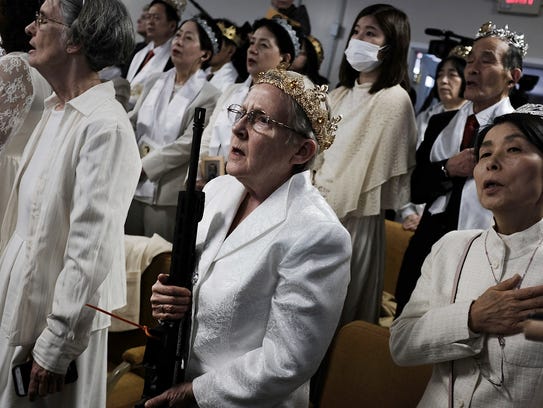
Worshipers clutching AR-15 rifles drank holy wine and exchanged wedding vows in a commitment ceremony at a Pennsylvania church.

   (Photo: DON EMMERT, AFP/Getty Images)

NEWFOUNDLAND, Pa. — Crown-wearing worshippers clutching AR-15 rifles drank holy wine and exchanged or renewed wedding vows in a commitment ceremony at a Pennsylvania church on Wednesday, prompting a nearby school to cancel classes.

With state police and a smattering of protesters standing watch outside the church, brides clad in white and grooms in dark suits brought dozens of unloaded AR-15s into World Peace and Unification Sanctuary for a religious event that doubled as an advertisement for the Second Amendment.

The church, which has a worldwide following, believes the AR-15 symbolizes the “rod of iron” in the book of Revelation, and encouraged couples to bring the weapons. An AR-15 was used in the Florida high school massacre on Feb. 14.

The Rev. Sean Moon, who leads the church, prayed for “a kingdom of peace police and peace militia where the citizens, through the right given to them by almighty God to keep and bear arms, will be able to protect one another and protect human flourishing.”

Moon is the son of the late Rev. Sun Myung Moon, a self-proclaimed messiah who founded the Unification Church, which critics regard as a cult. The younger Moon’s congregation is a breakaway faction of the Unification Church, which had distanced itself from Wednesday’s event.

              A woman holds an AR-15 rifle during a ceremony at the World Peace and Unification Sanctuary on February 28, 2018 in Newfoundland, Pennsylvania (Photo: Spencer Platt, Getty Images)

More: Why the AR-15 keeps appearing at America’s deadliest mass shootings

More: Trump says take guns first and worry about ‘due process second’ in White House gun meeting

More: Walmart bans gun sales to anyone under 21 after Parkland, Florida school shooting

An attendant checked each weapon at the door to make sure it was unloaded and secured with a zip tie, and the elaborate commitment ceremony went off without a hitch. Some worshippers wore crowns made out of bullets.

Tim Elder, Unification Sanctuary’s director of world missions, said the ceremony was meant to be a blessing of couples, not “inanimate objects,” calling the AR-15 a “religious accoutrement.”

But Wednesday’s event, coming on the heels of the high school massacre in Parkland, Florida, which killed 17, rubbed emotions raw.

“It’s scaring people in the community,” one protester told a church member. “Are you aware of that?”

             A man holds an unloaded weapon during services at the World Peace and Unification Sanctuary, Wednesday Feb. 28, 2018 in Newfoundland, Pa. (Photo: Jacqueline Larma, AP)

The ceremony prompted Wallenpaupack Area School District to move students at an elementary school down the street to other campuses.

Lisa Desiena, from Scranton, protested outside the church with a sign that called the group an “armed religious cult.”

She said she owns a gun, but “I don’t need a freaking assault weapon to defend myself. Only thing they’re good for is killing. Period. That’s all that weapon is good for, mass killing. And you want to bless it? Shame on you.”

But Sreymom Ouk, 41, who attended the ceremony with her husband, Sort Ouk, and came with their AR-15, said the weapon is useful for defending her family against “sickos and evil psychopaths.”

“People have the right to bear arms, and in God’s kingdom, you have to protect that,” she said. “You have to protect against evil.”

Couples hold AR-15 rifles and other guns during a ceremony at the World Peace and Unification Sanctuary on February 28, 2018 in Newfoundland, Pennsylvania. (Photo: Spencer Platt, Getty Images)

Ben Carson’s $31,000 dining room shows the gaudy looting habits of Team Trump have no limit

ThinkProgress

Ben Carson’s $31,000 dining room shows the gaudy looting habits of Team Trump have no limit

Versailles on the Potomac.

By Alan Pyke      February 28, 2018

Housing and Urban Development Secretary Ben Carson with President Donald Trump at the White House in January. Credit: Mark Wilson/Getty Images

Too strapped for cash to keep poor people off the street, President Donald Trump’s housing officials are apparently flush enough to buy a $31,000 dining set for a little-used formal space in Housing and Urban Development Secretary Ben Carson’s office.

New political staffers at the agency repeatedly pressured a career staffer to circumvent laws governing public spending on office amenities to get Carson the fancy new furniture, according to reports from the Guardian and the New York Times.

The staffer believes she was punished for insisting on the letter of the law in the face of repeated requests that she “find money” for Carson’s wife, Candy, to redecorate his offices. She has filed a complaint over her subsequent demotion at the agency. Carson, for his part, “does not believe the cost was too steep and does not intend to return” the new dining table and chairs, according to the Times.

Carson’s team made the purchases while seeking multi-billion-dollar cuts to HUD’s actual program offerings, changes that would kick hundreds of thousands of poor people out onto the street.

Carson’s high-on-the-hog taste in office furniture puts him in good company among Trump executive staff, many of whom have been caught treating themselves to frivolous luxuries at taxpayer expense. In less than 14 months, Trump’s Secretaries of Treasury, Interior, Health and Human Services, and Environmental Protection have all been caught making themselves unnecessarily cozy with public funds.

Interior Secretary Ryan Zinke charged a $40,000 helicopter tour of Nevada to a department fund for wildfire preparedness, one of several dubious travel expenses the former congressman has accrued. EPA head Scott Pruitt has taken to flying first class or business class everywhere he goes, with staffers insisting the costs are warranted because people are rude to him if he sits in coach.

Treasury Secretary Steve Mnuchin, who built a fortune through aggressive foreclosure practices in the private sector before joining Team Trump, has billed taxpayers roughly $800,000 for travel on military jets, including a trip to Fort Knox with his wife during the rare eclipse last summer. (The couple had planned to use military planes for their honeymoon too, until scrutiny of Mnuchin’s pricey travel habits began generating embarassing headlines.)

Mnuchin should perhaps count himself lucky to still have a job. Trump’s first HHS Secretary quit over a public airfare tab only half as large. Tom Price was forced to resign in the fall, with long-running Republican schemes to repeal and replace the not-yet-10-year-old overhaul of the nation’s health insurance system still unresolved, after reporters uncovered $400,000 in chartered plane travel incurred by the wealthy former congressman.

Carson’s dining set is chump change compared to the figures Pruitt, Mnuchin, Zinke, and Price have billed the government for cushy rides. But the nature of Carson’s work makes for a more damaging contrast.

Even at current funding levels, HUD is failing to serve hundreds of thousands of families who qualify for housing assistance based on their paltry incomes.  HUD is watching tens of thousands of public housing units collapse into such disrepair that they are unfit for human habitation. Carson saw the human toll of that neglect in person last summer when he visited with hundreds of families facing eviction and dispersal in Cairo, Illinois, because the public housing projects there have been deemed beyond salvage by building inspectors and budget officials.

Yet Carson and Trump are looking to cut HUD funding even further. Trump’s first two budget plans each propose to shred the agency. The cuts — a mix of under-funding, program elimination, and sneakier tweaks to the formulas by which rent support levels are calculated — represent a conscious choice to abandon the government’s decades-long commitment to ensuring the destitute have someplace safe to sleep, cook, and raise children. The plans would evict hundreds of thousands of families — millions of the poorest people in the country — from their homes, with no plan to get them sheltered anew elsewhere.

While Carson’s staff cooked up this recipe for making millions of Americans homeless in the name of taxpayer thrift, the once-adored neurosurgeon and author was looking to spruce up his own offices. Meanwhile, HUD’s career public servants weren’t just watching the new bosses try to gut their ability to actually help people in need. They were also watching Trump suggest that they themselves are the problem with government service provision in his State of the Union, where he demanded that each executive agency gin up a plan to cut staff and shave their operations budgets in the name of efficiency.

Can Food Co-ops Survive the New Retail Reality?

Civil Eats

Can Food Co-ops Survive the New Retail Reality?

From Amazon-Whole Foods to Costco, community grocery stores are being forced to reinvent to stay relevant.

By Stephanie Parker, Food Deserts, Local Eats, Nutrition, Feb. 28, 2018

The Good Earth Market food cooperative in Billings, Montana, which opened its doors 23 years ago, closed in October 2017. Over the last few years, the long-loved community market had a hard time keeping up with increasing competition.

“Costco and Walmart and Albertsons and everyone has organic,” said Carol Beam, board president of the market for the last 13 years. “We knew what we needed to break even every week, and every week we were anywhere from $8,000 to $10,000 short.”

It’s not just in Montana—around the country, food retail is in a state of upheaval. In addition to co-ops being squeezed out of the organic food market they once largely provided, conventional grocery stores are also facing pressure from online retailers. And though food co-ops are no longer the easiest, or even the cheapest, way to access organic and local foods, those that have succeeded for the long haul may offer signs of hope for local economies.

C.E. Pugh, the chief operating officer of National Co+op Grocers (NCG), a cooperative providing business services for 147 food co-ops in 37 states, said co-ops began seeing a change in their fates starting in 2013. “The conventional grocers got very serious for the first time about natural and organic and added lots of products,” he said. “The impacts manifested themselves almost overnight in 2013.”

NCG has seen six cooperatives close since 2012, but has also welcomed 23 new stores in that same period, some of which were newly opened co-ops, and some of which already existed but had not yet joined NCG. The Minnesota-based Food Co-op Initiative, a nonprofit focused on helping new co-ops open and thrive, supported the launch of 134 co-ops in the last 10 years. Of those, 74 percent are still in business.

Minnesota's Cook County Whole Foods Co-op. (Photo credit: Tony Webster)

Minnesota’s Cook County Whole Foods Co-op. (Photo credit: Tony Webster)

While the number of food co-ops in the U.S. is growing overall, some are still struggling against an influx of available local and organic markets. As co-ops face increased competition from mainstream retailers, advocates are considering how to distinguish themselves—and how to adapt to ensure survival.

The Rise of Organic in Conventional Grocery Stores

After 40 years, the East Lansing Food Co-op (ELFCO) in East Lansing, Michigan, closed in February 2017. “I have anecdotal evidence that when the co-op was started in the 1970s, there was almost no access to organic food whatsoever,” said Yelena Kalinsky, president of the co-op board during ELFCO’s last year. “Now there are a number of ways.”

One of which was likely a Whole Foods, which opened a store in April 2016 a mere 200 yards away from ELFCO. Even besides Whole Foods, there were already other natural grocers in town, such as Fresh Thyme and Foods for Living.

“Even Kroger has an organic foods section that’s doing very well,” Kalinsky added. “The positive spin is that we achieved our mission of making organic and local food possible. But after Whole Foods and Fresh Thyme came in, our numbers went down.” In May 2016, sales were down 20 to 30 percent over the previous year, which the co-op blamed on stronger competition.

Annie Knupfer, professor emeritus of educational studies at Purdue University and author of Food Co-ops in America: Community, Consumption, and Economic Democracy, acknowledges the abundance of organic food purveyors in today’s marketplace. “I think today the question would be, why a food co-op, when there are so many other options, like farmers’ markets, CSAs, organic food stores,” she said. “Unless you have a strong commitment to the ideals of food co-ops, you have a lot of options.”

Pugh of NCG echoed this sentiment when discussing the ways conventional mega-retailers like Costco, Walmart, and Kroger encroached on the organic market. Currently, Costco is the largest retailer of organic food in the U.S., with four billion dollars in annual organic sales in 2015, while Whole Foods had $3.6 billion. And in 2017, Kroger reportedly broke $1 billion in sales of organic produce.

“This new thing with the conventional [retailers] was kind of insidious, and people didn’t quite see that,” he said. “[Co-op leaders] thought, ‘Our customers won’t go there,’ but they were already there, buying products the co-ops don’t carry, like Charmin. And so they’re there anyway, and then they see organic milk, and they think, ‘Oh that’s a good price.’”

Distinguishing Co-ops from the Competition

“Each individual co-op and each individual community has to determine its relevance today,” Pugh said. “There’s no question of what its purpose was 10 to 20 years ago, when it may have been the only source or the best source of organic products. [But] why is it relevant today?”

According to Knupfer, one thing co-ops offer is a sense of community and empowerment in decision-making. “You can’t go into a CSA or grocery store and participate,” Knupfer said. “But you can raise concerns at any business. So I think what a co-op needs to provide is a sense of community.”

Coffee time at Ithaca's Green Star Co-op. (Photo credit: Joeyz51)

Coffee time at Ithaca’s Green Star Co-op. (Photo credit: Joeyz51)

Co-ops do this in a number of ways, including hosting community events, organizing local producer fairs, meet-your-farmer events, and other community-building activities. Some co-ops, including the Missoula Food Co-op, which closed at the end of 2017, and the highly successful Park Slope Food Co-op in Brooklyn, have tried to build community and lower prices through a worker-owner model. For most of its existence, the Missoula Food Co-op required all members to work in some capacity for at least three hours a month, and only members were supposed to shop at the store.

However, this was a controversial policy. The time commitment was a limiting factor for some people who might have otherwise joined and supported the co-op. Kim Gilchrist, a board member at the Missoula Food Co-op, thinks that the worker-member policy hurt the organization in a number of ways. Adding the work requirement on to the store’s out-of-the-way location may have sent potential members to more easily accessible retailers, and she says the co-op didn’t do enough outreach in its neighborhood to be economically sustainable.

Gilchrist also believes the worker-owner model might have hurt the co-op through inferior customer service. Worker-owners, not being employees, did not go through a long training, and didn’t have to worry about being fired. When the store opened to non-members, it was still staffed by unpaid, part-time member-owners. The customer service, or lack thereof, became a problem.

“We heard feedback sometimes you walk in and there’s not a cashier, or they’re not super friendly,” Gilchrist said. “Sometimes there’s music playing, sometimes there’s not. If you’re a stranger coming into the store, you want a friendly face, you want some help.”

Adapting to Compete in the Changing Market

While some co-ops are struggling, others are succeeding in a changing market with different adaptations. “The market has gotten tougher, but the difference has been that our member co-ops have been adapting,” NCG’s Pugh said. “As the competition got tighter, management at the individual co-ops just buckled down to find ways to get better.”

Some co-ops, like the Harvest Co-op in Cambridge, Massachusetts and the Food Front Cooperative Grocery in Portland, Oregon have begun offering online sales. Others, like the Seward Community Co-op in Minneapolis, Minnesota, are focusing on ensuring diversity in the food co-op landscape.

Photo courtesy PCC Markets.

Photo courtesy PCC Markets.

Meanwhile, as Whole Foods adapts to its recent acquisition by Amazon, its role as a local foods purveyor has come into question. As it operations are centralized, co-ops may be able to reclaim their role as the best place to buy local food products and support local producers.

Allan Reetz of the Co-op Food Stores, multi-million dollar businesses with two locations in New Hampshire and one in Vermont, stressed the importance of keeping one eye on the local food system while also watching the broader market. “Cooperatives are a way to build security in your local food system and involve the community at a grassroots level,” Reetz said. “But that does not guarantee anything. You still have to compete in the marketplace you find yourselves in.”

The Co-op Food Stores, which date back to 1936, have expanded beyond a regular food co-op to include things such as delicatessens, a sushi bar, and even an auto service center. It sells co-op staples like tofu and raw milk, but also offers a range of conventional food products like Frosted Flakes in order to be a one-stop shopping location.

Despite growing competition, the Co-op Food Stores are thriving. “It’s not to say we’re doing something extra special others have ignored,” Reetz said. “Grocery retail is a tough business. Co-ops have really established a market that now the big chains have moved into over the years, so there’s a lot of attention paid to the turf that we crafted.”

Across the country in Medford, Oregon, the much smaller Medford Food Co-op, which opened in 2011, is also doing well in this difficult atmosphere. Halle Riddlebarger, the store’s marketing manager, credits the co-op’s success to its relative youth, which she says makes the store nimble and better able to respond to people’s requests.

“We’re not set in our ways from having done something one way for 20 years,” Riddlebarger said. Recently, based on member requests for more prepared food, the co-op opened a café and deli. “Co-ops have to be able to respond to what people want and not take a decade to do so.”

In some rural areas, becoming a cooperative can offer a lifeline for struggling grocery stores. The North Dakota Association of Rural Electric Cooperatives runs the Rural Grocery Initiative under the direction of Lori Capouch. Because so many small, rural grocery stores in the state are struggling, the initiative has helped some become cooperatives, giving these stores the support of the local community. These cooperatives are generally conventional grocery stores, selling all the regular staples instead of focusing specifically on local or organic food.

“I think that that cooperative, community-owned business model is going to become more and more important in these small communities that are at a distance from a full-service grocery store,” Capouch said. “That’s going to be the way to keep fresh foods available for people living and working in small towns.”

Indeed, perhaps the biggest challenge food co-ops face is not the competition from Whole Foods or Costco, but finding the balance between their original ideals and the ability to adapt to what consumers want and need now.

“I think some of us have been a little idealistic, and we need to learn more about how businesses work, because a food co-op is a business,” Purdue’s Knupfer said. “How do you make food co-ops a small business that’s also a community? People need to think outside the box.”

Top photo courtesy of The Seward Coop.

Wisconsin Supreme Court deals blow to union elections

The Seattle Times

Wisconsin Supreme Court deals blow to union elections


MILWAUKEE (AP) — The administrative agency that oversees employee union elections in Wisconsin can decertify collective bargaining groups if they don’t file election paperwork on time for an election — even if they miss the deadline by an hour, the state’s Supreme Court ruled Wednesday.

The decision Wednesday reverses lower court rulings that sided with the unions’ argument that the Wisconsin Employee Relations Commission overstepped its authority when it proceeded with decertification. The groups missed the deadline by about an hour each in 2014.

The case stems from the Wisconsin’s Act 10, which effectively ended collective bargaining for most public workers, required them to pay more for their pension and health benefits, and weakened their ability to organize. The law enacted shortly after Republican Gov. Scott Walker took office in 2011 also required annual recertification elections for state and municipal employees by Dec. 11.

 The commission’s rules require filing for recertification by the end of business on Sept. 15 to be able to have an election.

In the ruling, the Supreme Court said the commission “has express authority” to “require a demonstration of interest from labor organizations interested in representing collective bargaining units.” The Supreme Court went on to say the commission also has the power to decertify.

An attorney representing the unions in the case said the groups have since had elections to certify.

“The issue is moving forward whether or not the commission is going to be able to erect this sort of artificial barrier that’s not called for in the law in future elections,” said Nathan Eisenberg, adding, “And the Court held that they can.”

The unions involved in the case are: The Wisconsin Association of State Prosecutors, representing assistant district attorneys, and the Service Employees International Union Local 150, representing food service and custodians in Milwaukee Public Schools and the St. Francis School District.

Walker and conservatives have said the law was needed to help balance the state budget and reduce school and local governments’ costs.

Justice Ann Walsh Bradley dissented, saying state law requires the commission to hold elections for collective bargaining units because the statute reads it “shall,” making it clear that elections need to be carried out.

“In other words, each requires that an election be held annually. Full stop. No conditions,” she said.

She went on to say the court’s decision has “drastic consequences for employees.”

“It denies blameless employees the right to vote for union representation if their union narrowly misses a deadline,” she said.

The Town Where Women found Refuge from Domestic Violence,

22 Words Presents‘s video to the group: LIGHTWORKERS of THE WORLD 

The Town Where Men Are Banned

The Town Where Men Are Banned

Today I learned about a self-sufficient women-only village in Kenya. ♀️ ♀️ ♀️It's a safe haven for women fleeing domestic violence or sexual violence.Thanks INSH for sharing!

Posted by 22 Words Presents on Tuesday, February 6, 2018

Norway is building a hotel that will produce more energy than it consumes


EcoWatch

February 28, 2018. Harvesting the sun’s rays as they reflect off a mountain.

Read more about Norway: ecowatch.com/tag/norway

via World Economic Forum

Norway is building a hotel that will produce more energy than it consumes

Harvesting the sun's rays as they reflect off a mountain. Read more about Norway: ecowatch.com/tag/norwayvia World Economic Forum

Posted by EcoWatch on Tuesday, February 27, 2018

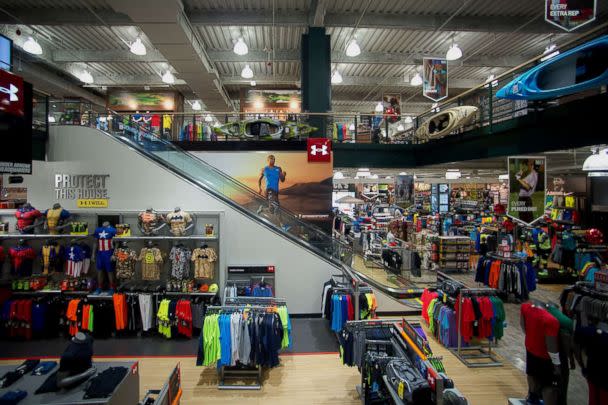
Dick’s Sporting Goods will no longer sell assault-style rifles:

Good Morning America

Dick’s Sporting Goods CEO on decision to no longer sell assault-style rifles: ‘We don’t want to be a part of this story’

David Caplan and Katie Kindelan      February 28, 2018

Dicks Sporting Goods Takes a Stand!

CNN
February 28, 2018

“If these kids are brave enough to organize and do what they’re doing, we should be brave enough to take this stand,” says DICK’S Sporting GoodsCEO Edward Stack, after the company announced it would stop selling assault-style weapons in all of its stores http://cnn.it/2t66Njk

Dick's CEO discusses decision to stop selling assault-style weapons

“If these kids are brave enough to organize and do what they’re doing, we should be brave enough to take this stand," says DICK'S Sporting Goods CEO Edward Stack, after the company announced it would stop selling assault-style weapons in all of its stores http://cnn.it/2t66Njk

Posted by CNN on Wednesday, February 28, 2018

US inequality persists 50 years after landmark report

Associated Press

Study: US inequality persists 50 years after landmark report

By Russell Contreras, Associated Press        February 27, 2018

Lawsuit: Bank cares for foreclosed homes based on racial makeup of neighborhoods