Former congressman says he’s had enough, publicly resigns from the Republican party over trump

Daily Kos

Former congressman says he’s had enough, publicly resigns from the Republican party over trump

By Jen Hayden    March 19, 2018

 RSS

Former U.S. Congressman Charles Djou (Hawaii) penned an open letter announcing he is resigning from the Republican party over their embrace of Donald Trump and his harmful anti-immigration platform, which has been embraced by the Republican party itself at this point. In a lengthy open letter on Honolulu Civic Beat, Djou lays out his reasons for leaving the Republican National Party.

Today, after much consideration, I abandon my party because I am unwilling to abandon my principles. I can no longer stand with a Republican Party that is led by a man I firmly believe is taking the party of Lincoln in a direction I fundamentally disagree with, and a party that is unwilling to stand up to him.

It disturbs me that the Republican Party under President Donald Trump is now defined as a party hostile to immigration. We are the leader of the free world, not because we are great (or need to be great again), but because we are good. […]

Civility is an inner trait of true character. Trump’s belittling of Sen. Jeff Flake and immature name-calling of Sen. Bob Corker reflect a weakness of character. Trump’s penchant for conspiracy theories, such as his assertion that Sen. Ted Cruz’s father was involved in the assassination of JFK, is disturbing. His poorly constructed stream-of-consciousness tweets are not only immature, but provide real harm to the stability of our democracy.

As President George W. Bush recently lamented, “Bullying and prejudice in our public life sets a national tone, provides permission for cruelty and bigotry, and compromises the moral education of children. The only way to pass along civic values is to first live up to them.”

Even George W. Bush gets it! He wasn’t a great president, but at least he had some values, some core principles to guide him. Trump’s only guide is his own fragile ego. But, Djou saved some of his harshest criticism for Republican leaders who stand idly by and/or enable Trump’s boorish, racist, misogynistic behavior:

But I am most disappointed by the failure of the GOP to clearly and consistently condemn Trump’s childish behavior. Sadly today, too many Republicans either applaud Trump’s tirades or greet them with silent acceptance. This leads to an implicit ratification by the GOP of Trump’s undisciplined, uninformed, and unfocused leadership as a core part of the Republican Party. This is something I cannot accept and will not be a part of.

Hopefully more Republicans like Djou will publicly denounce Donald Trump and help Paul Ryan and Mitch McConnell find their spines. If it isn’t already too late.

Donald Trump and the New Dawn of Tyranny

Time

Donald Trump and the New Dawn of Tyranny

By Timothy Snyder       March 3, 2018

Timothy Snyder is Yale University’s Housum Professor of History and the author of On Tyranny

President Trump walks to the Oval Office at the White House, on Feb. 24, 2017. Mark Wilson—Getty Images

The Founding Fathers designed the constitution to prevent some Americans from exercising tyranny. Alert to the classical examples they knew, the decline of ancient Greece and Rome into oligarchy and empire, they established the rule of law, checks and balances, and regular elections as the means of preserving the new republic. Thus far, it has worked. But it need not work forever.

We might imagine that the American system must somehow always sustain itself. But a broader look at the history of democratic republics established since our own revolution reveals that most of them have failed. Politicians who emerge from democratic practices can then work to undo democratic institutions. This was true in the rise of fascism in the 1920s and 1930s, as well as during the spread of communism in the 1940s, and indeed in the new wave of authoritarian regime changes of the 21st century. Indeed, absent a truly decisive revolution, which is a rare event, a regime change depends upon such people — regime changers — emerging in one system and transforming it into another.

It is in this light that we should consider President Donald Trump and his closest advisers and spokespeople. Although they occupy the positions they do thanks to an election, there is little reason to believe that they support the American constitutional system as it stands, and much to remind us of authoritarian regimes changes of the recent past. A basic weapon of regime changers, as fascists realized nearly a century ago, is to destroy the concept of truth. Democracy requires the rule of law, the rule of law depends upon trust, and trust depends upon citizens’ acceptance of factuality. The president and his aides actively seek to destroy Americans’ sense of reality. Not only does the White House spread “alternative facts,” but Kellyanne Conway openly proclaims this as right and good. Post-factuality is pre-fascism.

The function of the press, as the Founding Fathers understood, was to generate the common knowledge on which citizens could understand and debate policy, and to prevent rulers from behaving tyrannically. Whether from the far right or the far left, the regime changers of the twentieth century understood that the media had to be bullied and deprived of importance. When Steve Bannon refers to the press as the “opposition,” or Mr. Trump calls journalists “enemies,” they are expressing their support for the demolition of the historical, ethical, and intellectual bases of the political life we take for granted. Indeed, when Mr. Trump calls journalists “enemies of the people,” he is quoting Joseph Stalin.

Since the end of the cold war, the new authoritarian regimes that have emerged in eastern Europe have taken the form of authoritarian kleptocracies: Russia is the most enduring example of this model; a revolution halted the development of a similar regime in Ukraine in 2014. The Founders, opponents of a British monarchy, were alert to the danger that government might serve to enrich a single family. The emoluments clause of the constitution confirms our common sense: no one can be trusted to defend the interests of citizens if his policy choices can make him richer. This president has not revealed the basic financial information about himself, but we know that he has business interests at home and abroad. Russians and Ukrainians have been quick to notice a familiar pattern.

If there is a common thread that links American political rhetoric from the 18th century to today, through the confrontations with fascist and communist rivals and into the 21st century it is the word “democracy.” Our practice has been imperfect, but the endorsement of the idea of rule by the people has been consistent, until now. This president has defied that norm. He has said almost nothing in favor of democracy or, for that matter, civil and human rights. He admires authoritarians. His one major comment on democracy was that he would contest the outcome of elections if they were not in his favor. That is opposition to democracy. Indeed, not recognizing election results and moving to take power anyway is what authoritarians do.

In recent authoritarian regime changes, in Poland and Hungary as well as Russia, the executive power has been able to sideline the judiciary and then humble the legislature. The idea of checks and balances is enshrined in our constitution, but of course also in theirs, is that none of the three branches of government can dominate the others. In denigrating judges, Mr. Trump attacks the geometry of the system. Once the courts are tamed, the legislature cannot defend itself, and we have authoritarianism. If legislators do not support the judiciary, then their turn for humiliation will come, and the laws they pass will be unenforceable. This has been the pattern in recent authoritarian regime changes around the world.

Right-wing authoritarians today use the threat or the reality of terrorism to seek and hold power. The one consistent policy of the Trump administration thus far has been to encourage a Muslim terrorist attack within or upon the United States. Everywhere the first executive order on refugees and immigrants was understood as directed against Muslims. The major consequence, most likely the intended one, is the alienation of Muslims at home and abroad. The proposal to move the US embassy in Israel to Jerusalem is similar: it will never take place, so serves only to alienate and enrage Muslims. Michael Flynn is in the same category: though he was only national security advisor for three weeks, few Muslims will forget that he referred to their religion as a “cancer.” Modern authoritarianism is terror management, and so modern authoritarians need terror attacks: real, simulated, or both. As James Madison noticed long ago, tyranny arises “on some favorable emergency.”

The experience of the 21st century, as well as the experience of the 1930s, teaches that it takes about a year to engineer a regime change. To what, exactly? We cannot deduce, from the Trump administration’s destructive chaos and ideological incoherence, what the post-democratic American regime would be. We can be sure, however, that we would miss being free. The prospect of children and grandchildren growing up under tyranny is terrifyingly real. History can remind us of the fragile fundaments of our own democracy. But what follows now is up to us.

Timothy Snyder is a professor of history at Yale University and the author, most recently, of On Tyranny: Twenty Lessons from the Twentieth Century.

TIME Ideas hosts the world’s leading voices, providing commentary on events in news, society, and culture. We welcome outside contributions. Opinions expressed do not necessarily reflect the views of TIME editors.

Trump campaign’s connections to Cambridge Analytica.

MSNBC

March 20, 2018

Settle in, turn up the volume, and pay attention to this timeline of the Trump campaign’s connections to Cambridge Analytica.

More: http://on.msnbc.com/2GMhYRJ

The Cambridge Analytica-Trump Timeline

Settle in, turn up the volume, and pay attention to this timeline of the Trump campagin's connections to Cambridge Analytica.More: http://on.msnbc.com/2GMhYRJ

Posted by MSNBC on Tuesday, March 20, 2018

March 20, 2018: This is what results when Republicans keep trying to find new ways to cheat to win elections. It would be great if they spent half the time and money just offering the people good policies and programs that the people would support but no they hold to those failed one the people reject and seek ways to confuse and stack the deck.

In order to try and remain a major party Republicans have allied with all the bad splinter groups and use these underhanded ugly tactics to get power. Because of this and their horribly bad record as managers of our country they must be eliminated. They are no longer worthy of the support of the majority.

The richest 1% took home 82% of the wealth generated around the globe last year.

IJR Blue Presents added a new episode on  Facebook Watch.

January 2018

The richest 1% took home 82% of the wealth generated around the globe last year.

Oxfam says Donald Trump and his “cabinet of billionaires” are partly to blame for the growing inequality.

Wealth Inequality Continues to Grow Under Trump

The richest 1% took home 82% of the wealth generated around the globe last year.Oxfam says Donald Trump and his "cabinet of billionaires" are partly to blame for the growing inequality.

Posted by IJR Blue Presents on Tuesday, January 23, 2018

EPA chief’s security detail on Italy trip cost $30,000: document

Reuters

EPA chief’s security detail on Italy trip cost $30,000: document

Reuters      March 20, 2018 

                                FILE PHOTO: Environmental Protection Agency (EPA) Administrator Scott Pruitt attends during a summit of Environment ministers from the G7 group of industrialized nations in Bologna, Italy, June11, 2017. REUTERS/Max Rossi

(Reuters) – The U.S. government spent over $30,000 on personal security for Environmental Protection Agency chief Scott Pruitt during his trip last year to Italy, according to documents obtained by a watchdog group that said the spending was irresponsible at a time of budget cuts.

According to the document, obtained by the Environmental Integrity Project through a Freedom of Information Act request and shown to Reuters, Pruitt’s personal security detail racked up $30,553.88 in travel costs from June 5 through June 12, 2017, when Pruitt was in Italy for meetings at the Vatican and to attend a summit of foreign energy ministers.

Previous documents released by EIP showed the cost of Pruitt’s trip to Italy at $43,000, not including the security detail. The new documents, which include airfare and expenses for Pruitt, his career and political staff, and his security detail, put the cost over $80,000, EIP calculated.

“Mr. Pruitt’s trip to Rome last summer cost the taxpayers over $84,000,” said Eric Schaeffer, EIP’s director. “That’s a lot of money for Mr. Pruitt to tour the Vatican, pose for photos, and tell his European counterparts that global warming doesn’t matter,” he said.

Spending by top officials in the Trump administration has come under more scrutiny by critics at a time when federal agencies have been making sharp budget cuts. Lawmakers have also criticized Pruitt for frequently flying first-class, and for spending tens of thousands of dollars on a secure sound-proof telephone booth for his office.

EPA spokesman Jahan Wilcox said the security detail “followed the same procedures for the G7 environmental meeting in Italy that were used during EPA Administrators Stephen Johnson, Lisa Jackson, and Gina McCarthy’s trips to Italy. EPA’s security procedures have not deviated over the past 14 years.”

It was unclear from looking at the document how many members were in the security detail, and no breakdown of the spending was provided.

EIP has been critical of Pruitt’s statements questioning the causes of global climate change and his efforts to roll back environmental protections.

EPA has said Pruitt has flown first-class as a security measure, and that the administrator does not make decisions relating to his security detail.

(Reporting by Valerie Volcovici; Writing by Richard Valdmanis; Editing by David Gregorio)

Baseball’s ‘wannabe environmentalist’ thrives with a fastball that doesn’t have any gas

Yahoo Sports

Baseball’s ‘wannabe environmentalist’ thrives with a fastball that doesn’t have any gas

Jeff Passan, Yahoo Sports     March 13, 2018

MARYVALE, Ariz. – Of all the questions that distressed Brent Suter before the Milwaukee Brewers summoned him to the major leagues in 2016 – how his 85-mph fastball would play against the world’s finest hitters or how the rigors of big league life would suit him – only one vexed him enough to ask his Triple-A teammates: Could he bring his food tray?

Suter reached into his locker last week at the Brewers’ spring-training complex and pulled out Smart Planet’s collapsible Eco Meal Kit. He showed how its silicone bottom expanded and raved about the recyclable plastic fork-spoon combination that snapped into the cover. When his teammates tuck into pre- and post-game meals on Styrofoam plates, Suter opts for old reliable: the same reusable container that accompanies him from city to big league city.

“I’m a wannabe environmentalist,” Suter said, and in the world of Major League Baseball, populated disproportionately by conservatives compared to conservationists, the concerns over an $11 food tray were palpable. Suter, a Harvard graduate, didn’t want to paint a picture of himself any stuffier than the one his degree might.

He was, after all, a 31st-round draft pick who had ascended the Brewers’ organization on guile, deception and a fastball that, staying completely on brand, performed without gas. When he was drafted, Suter put on hold plans to join Teach for America, and over the next five years, he pitched too well for the Brewers to keep overlooking him. So up he and his tray came in 2016, and each has proven itself worthwhile ever since, with a 3.40 ERA in 103 1/3 innings and a likely starting rotation spot this season.

Suter’s interest in the environment started early in high school, when his mother rented “An Inconvenient Truth.” He started carrying a water bottle to lessen his use of plastic. He showered for 40 seconds or so on average. He studied environmental science and public policy in college and figured eventually he would wind up consulting companies on how to get greener. Last season, cognizant of farming’s harm to the environment, Suter stopped eating meat midseason. A rotator-cuff strain ended that experiment.

“I had to go back on meat,” Suter said. “Tough decision.”

Suter’s teammates do about everything that would be expected in a baseball clubhouse. He is called a tree hugger. Brewers starter Chase Anderson, a Trump supporter, occasionally refers to Suter as “Hillary.” In Suter’s rookie year, before hazing was outlawed, he wore a cheerleader’s outfit that was amended to note his love of recycling.

Milwaukee Brewers starting pitcher Brent Suter delivers in the first inning of a baseball game against the Pittsburgh Pirates, Monday, Sept. 18, 2017 in Pittsburgh. (AP)

“I’ve had teammates who just look at me and drop napkins in the trash,” Suter said. “And I go, ‘Noooo!’ And then I’ve had teammates who turn on an extra shower.”

What may surprise is that Suter also had teammates who love engaging with him in the sort of civil discourse that barely exists anymore. Over coffee and omelets, Suter, Anderson and minor leaguers Jon Perrin and Kyle Wren will discuss the environment, politics, philosophy, religion. Sometimes it’s the news of the day. Others it’s whatever they’re reading.

“This is one of the last places where you can talk openly about your background, what your beliefs are, have conversations with people from totally different backgrounds and even if you disagree, at the end of the day you still can be friends,” said Wren, a teammate of Suter’s for three years. “You’re still going out on the field and playing for each other. And I think that’s something our society has gotten away from. Just because you disagree doesn’t mean you can’t like each other.”

Currently, Wren is reading “The Moral Case for Fossil Fuels,” and he sent a picture of the book’s cover to Suter, who responded with an upside-down smiley-face emoji. Even if Wren finds himself the near-ideological opposite of Suter when it comes to the environment – he acknowledges climate change but doesn’t believe its dangers are imminent – their conversations stir something the game may not.

“When that cognitive dissonance hits you and you’re fighting it because it runs in conflict to your own beliefs,” Wren said, “I think that makes the world a better place.”

Wren has seen Suter’s influence first-hand. As he did at all of his previous minor league stops, Suter in 2016 offered to buy his teammates food trays. About 10 took him up on the offer, and half used them for the rest of the season.

“In the real world, just him doing that one thing, is he making a difference? It’s probably negligible,” Wren said. “But he’s principled. And I can respect the fact that he believes a certain thing enough to bring a recyclable lunch tray to the field. He says something about his life and lives it out.

“Even if he influences 30 people over the course of his life, that’s a lot of lives he’s changed. It can create a lot of exponential growth from his one decision to carry this lunch tray.”

The conversations invigorate Suter likewise, and the more time he spends in the major leagues, the likelier he’ll be to expand them to a broader audience. Baseball enforces a pecking order that tends to keep the most outspoken voices silent until success turns off the mute button.

“I love it so much,” Suter said. “I really enjoy the debates. We don’t attack each other or get personal. We just have our opinions and respect each other’s points.”

So when they go deep, Suter talks about the importance of water bottles: “They can save a ton of CO2.” He advocates for composting: “Not only is it good for the earth, but when you have food waste, you feel like it’s going to something good.” He encourages people to take shorter showers (while realizing the futility of this inside a postgame clubhouse). At very least, he says, don’t use running water while shaving.

The best, Wren said, came in 2016. It was so good that he screenshotted it for posterity. After he switched phones, the picture didn’t transfer over, but Wren swears that one day, out of nowhere, Suter sent him a text message that may sound farcical but was completely sincere and perfectly earnest.

“Hey,” Suter wrote, “you wanna go plant some trees today?”

Federal judge doesn’t hold back on Kris Kobach’s deceit of Kansas voters

ThinkProgress

Federal judge doesn’t hold back on Kris Kobach’s deceit of Kansas voters

“You are under ethical obligation to tell me the truth,” the judge said. “That’s why lawyers are licensed.”

By Kira Lerner      March 20, 2018

Kansas Secretary of State, Kris Kobach (left) and U.S. Vice President Mike Pence, attend the first meeting of the presidential advisory commission on election integrity in the Eisenhower Executive office building, on July 19, 2017 in Washington, DC. Credit: Photo by Mark Wilson/Getty Images
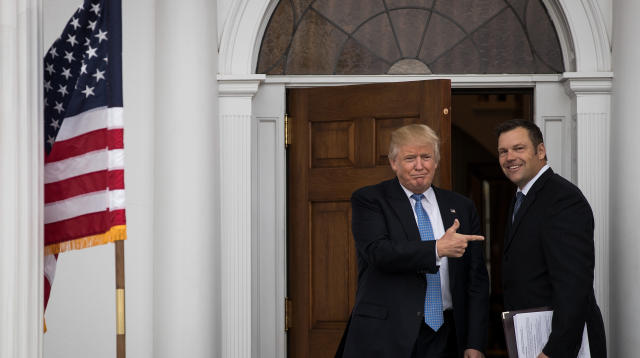
A Kansas federal judge had sharp words for Republican Secretary of State Kris Kobach during a contempt hearing Tuesday, accusing him of misleading the court and failing to inform voters whose registrations were previously suspended that they are eligible to vote.

In May 2016, Judge Julie Robinson issued a preliminary injunction ordering Kobach “to register for federal elections all otherwise eligible motor voter registration applicants,” whether or not they have shown a documentary proof of citizenship. The American Civil Liberties Union, which filed the lawsuit challenging Kobach’s proof of citizenship law, argued that Kobach was failing to add voters to the rolls, making eligible voters cast provisional ballots, and failing to send voters affected by the preliminary injunction a postcard that would notify them of their registration status.

After seven days of trial, the court held a hearing on contempt Tuesday in which Judge Robinson repeatedly chastised Kobach when he argued that he did not violate the order.

“You have a duty to tell them that and to assure me that they complied,” the judge told Kobach about his obligation to tell counties to register all eligible voters. “It’s your duty to make sure they do what they are supposed to do and abide by the law.”

Bryan Lowry: Judge tells Kobach he had no problem making sure counties adhered to his proof of citizenship policy, but not her order. #ksleg #ACLUvKobach

In a telephone conference in October 2016, roughly five months after the injunction, Kobach made a verbal promise that counties would send postcards to voters who had previously been on the suspense list for not showing proof of citizenship, but became registered because of the court’s order, informing them of their registration status.

In court Tuesday, Kobach and his attorneys claimed the judge never ordered them to send those postcards to voters, but the judge didn’t buy that argument.

“Why would I order something you told me you’d take care of?” the judge said, according to ProPublica’s Jessica Huseman, who was in the courtroom. “You are under ethical obligation to tell me the truth… that’s why lawyers are licensed.”

At another point, Kobach grew exasperated, telling Judge Robinson: “I certainly would have no interest in failing to comply with any court’s order.” Last June, the court upheld a $1,000 fine against Kobach for intentionally misleading the court about a document he was photographed carrying into a November 2016 meeting with Trump.

In its motion for contempt, the ACLU had previously argued that Kobach’s violation of the preliminary injunction was already affecting elections.

“These are not merely technical violations of the order; they have real consequences for all affected Kansans,” the ACLU wrote. “The refusal to register the plaintiffs deprives them of the most basic protections afforded to registered voters… Because of the Secretary’s defiance of the Order, covered voters have received no assurance that they may participate in the upcoming election or that their votes will be counted.”

The ACLU claimed that Kobach’s actions could have a “chilling effect,” suppressing turnout in upcoming elections.

“It’s an election year this year, and there’s no more time for games,” Dale Ho, lead attorney for the ACLU, told the judge Tuesday.

Kobach helped draft and enact the documentary proof of citizenship law, which took effect in January 2013, requiring all Kansas residents to show a document like a birth certificate or passport when they registered to vote. The law was in place for more than three years until the court issued the preliminary injunction order before the 2016 presidential election.

The contempt hearing came on the eighth day of a trial that was originally supposed to last just four days, but ended up stretching for far longer because Kobach’s legal team struggled to cross-examine witnesses and follow basic rules of evidence. At the start of Tuesday’s hearing, Ho apologized to the judge for having to address the motion for contempt.

Celia Llopis-Jepsen: ACLU (Dale Ho): Apologizes to judge to spend time on this. Says Kobach could have very easily complied with judge’s preliminary injunction, but he failed to update the online elections manual & to send postcards to voters with info including their polling place. #ACLUvKobach

Ho told the judge that Kobach is refusing to update the online elections manual until the U.S. Supreme Court issues a final judgement on this case, which could take years. “Incorrect information is continually distributed to the general public,” he said.

Sue Becker, an attorney for Kobach, claimed that the secretary of state’s office put the required information on its website and emailed counties with the notice to begin registering voters without documentary proof of citizenship. If individual counties misunderstood the directive, Becker argued, it was not Kobach’s fault.

Judge Robinson said she was not going to take Becker’s word that her office sent notices to the counties. “You’re going to present evidence to that effect or am I supposed to accept your statement?” she said. “I want evidence… In light of everything that’s happened.”

“You all have engaged in gamesmanship with this court,” she said.

Later in the hearing, Kansas Director of Elections Bryan Caskey testified that the state was equipped to register all eligible voters before the 2018 election. But during cross-examination, Caskey admitted to failures by the state in the past.

Bryan Lowry: Judge gets Caskey to definitively say that he does not remember Kobach telling him to tell the counties to send out postcards to these voters. #ksleg #ACLUvKobach

At the end of the hearing Tuesday, Judge Robinson said she will issue a written opinion in the case and on the motion for contempt — the second time the ACLU has sought to hold Kobach in contempt in this trial. Kobach has already indicated his intentions to appeal an unfavorable ruling to the U.S. Supreme Court.

Related:

Republi-con Voter Supression

HuffPost

Kris Kobach Really, Really Did Not Want You To See This Deposition. Read It Here.

Sam Levine, HuffPost      March 19, 2018

The morning after Donald Trump was elected President, Kansas Secretary of State Kris Kobach (R) wrote to an adviser on the president-elect’s transition team and told him that he had already started drafting a preliminary amendment to federal voting law. The amendment would alter the 1993 National Voter Registration Act (NVRA) to make it acceptable for states to ask people to prove they were citizens when they went to register to vote at a motor vehicle agency.

A few weeks later, Kobach traveled to Bedminster, New Jersey, to meet personally with Trump and some of his top advisers. As he was going into the meeting, Kobach was photographed holding a memo outlining a proposal for actions during the first year of Trump’s Department of Homeland Security. The 23rd item on the page, at the bottom of the memo, suggests amending NVRA to allow states to impose a proof of citizenship requirement.

As Kobach defends Kansas’ own proof of citizenship requirement, he has fought hard to block the public release of both the memo and his draft to NVRA. He has also fought having to answer questions under oath about both.

Those efforts were largely unsuccessful, as both a federal district court and the 10th Circuit Court of Appeals said he had to answer questions about them. Kobach sat for an hourlong deposition with the ACLU lawyers suing him last summer, a tape of which was played during trial in Kansas City earlier this month. A partially redacted transcript of that deposition provides a unique insight into Kobach’s conversations with Trump and efforts to change federal voting law to allow states to provide proof of citizenship.

In the deposition, Kobach says that his proposal to amend NVRA was merely a “contingency” should he lose the lawsuit against the ACLU. He said he broadly discussed the issue of noncitizens voting with Trump ― who began tweeting that illegal votes cost him the popular vote shortly after his meeting with Kobach ― but did not come up with a specific plan to impose a proof of citizenship requirement. He also said they talked about ways to incentivize states to impose a proof of citizenship requirement and that he had discussed introducing legislation to amend NVRA with Rep. Steve King (R-Iowa) should he lose the case against the ACLU.

Read the full deposition here:

Kris Kobach Fish v. Kobach redacted deposition (PDF)
Kris Kobach Fish v. Kobach redacted deposition (Text)

Trump wants to eliminate after school programs.

Anderson Cooper 360

March 17, 2018

The White House claims there is no evidence that after-school programs help children succeed. http://cnn.it/2n7APhF

The White House claims there is no evidence that after-school programs help children succeed. http://cnn.it/2n7APhF

Posted by Anderson Cooper 360 on Friday, March 17, 2017