
The Arctic is in a death spiral. How much longer will it exist?

The Guardian

The Arctic is in a death spiral. How much longer will it exist?

Gloria Dickie                       October 13, 2020

At the end of July, 40% of the 4,000-year-old Milne Ice Shelf, located on the north-western edge of Ellesmere Island, calved into the sea. Canada’s last fully intact ice shelf was no more.

On the other side of the island, the most northerly in Canada, the St Patrick’s Bay ice caps completely disappeared.

Two weeks later, scientists concluded that the Greenland Ice Sheet may have already passed the point of no return. Annual snowfall is no longer enough to replenish the snow and ice loss during summer melting of the territory’s 234 glaciers. Last year, the ice sheet lost a record amount of ice, equivalent to 1 million metric tons every minute.

The Arctic is unravelling. And it’s happening faster than anyone could have imagined just a few decades ago. Northern Siberia and the Canadian Arctic are now warming three times faster than the rest of the world. In the past decade, Arctic temperatures have increased by nearly 1C. If greenhouse gas emissions stay on the same trajectory, we can expect the north to have warmed by 4C year-round by the middle of the century.

There is no facet of Arctic life that remains untouched by the immensity of change here, except perhaps the eternal dance between light and darkness. The Arctic as we know it – a vast icy landscape where reindeer roam, polar bears feast, and waters teem with cod and seals – will soon be frozen only in memory.

A new Nature Climate Change study predicts that summer sea ice floating on the surface of the Arctic Ocean could disappear entirely by 2035. Until relatively recently, scientists didn’t think we would reach this point until 2050 at the earliest. Reinforcing this finding, last month Arctic sea ice reached its second-lowest extent in the 41-year satellite record.

“The latest models are basically showing that no matter what emissions scenario we follow, we’re going to lose summer [sea] ice cover before the middle of the century,” says Julienne Stroeve, a senior research scientist at the US National Snow and Ice Data Center. “Even if we keep warming to less than 2C, it’s still enough to lose that summer sea ice in some years.”

At outposts in the Canadian Arctic, permafrost is thawing 70 years sooner than predicted. Roads are buckling. Houses are sinking. In Siberia, giant craters pockmark the tundra as temperatures soar, hitting 100F (38C) in the town of Verkhoyansk in July. This spring, one of the fuel tanks at a Russian power plant collapsed and leaked 21,000 metric tons of diesel into nearby waterways, which attributed the cause of the spill to subsiding permafrost.

This thawing permafrost releases two potent greenhouse gases, carbon dioxide and methane, into the atmosphere and exacerbates planetary warming.

The soaring heat leads to raging wildfires, now common in hotter and drier parts of the Arctic. In recent summers, infernos have torn across the tundra of Sweden, Alaska, and Russia, destroying native vegetation.

This hurts the millions of reindeer and caribou who eat mosses, lichens, and stubbly grasses. Disastrous rain-on-snow events have also increased in frequency, locking the ungulates’ preferred forage foods in ice; between 2013 and 2014, an estimated 61,000 animals died on Russia’s Yamal peninsula due to mass starvation during a rainy winter. Overall, the global population of reindeer and caribou has declined by 56% in the last 20 years.

Such losses have devastated the indigenous people whose culture and livelihoods are interwoven with the plight of the reindeer and caribou. Inuit use all parts of the caribou: sinew for thread, hide for clothing, antlers for tools, and flesh for food. In Europe and Russia, the Sami people herd thousands of reindeer across the tundra. Warmer winters have forced many of them to change how they conduct their livelihoods, for example by providing supplemental feed for their reindeer.

Yet some find opportunities in the crisis. Melting ice has made the region’s abundant mineral deposits and oil and gas reserves more accessible by ship. China is heavily investing in the increasingly ice-free Northern Sea Route over the top of Russia, which promises to cut shipping times between the Far East and Europe by 10 to 15 days.

The Northwest Passage through the Canadian Arctic Archipelago could soon yield another shortcut. And in Greenland, vanishing ice is unearthing a wealth of uranium, zinc, gold, iron and rare earth elements. In 2019, Donald Trump claimed he was considering buying Greenland from Denmark. Never before has the Arctic enjoyed such political relevance.

A melting glacier is seen during a summer heat wave on the Svalbard archipelago near Longyearbyen, Norway in July, 2020.
A melting glacier is seen during a summer heat wave on the Svalbard archipelago near Longyearbyen, Norway in July, 2020. Photograph: Sean Gallup/Getty Images


Tourism has boomed, at least until the Covid shutdown, with throngs of wealthy visitors drawn to this exotic frontier in hopes of capturing the perfect selfie under the aurora borealis. Between 2006 and 2016, the impact from winter tourism increased by over 600%. The city of Tromsø, Norway, dubbed the “Paris of the north”, welcomed just 36,000 tourists in the winter of 2008-09. By 2016, that number had soared to 194,000. Underlying such interest, however, is an unspoken sentiment: that this might be the last chance people have to experience the Arctic as it once was.

Stopping climate change in the Arctic requires an enormous reduction in the emission of fossil fuels, and the world has made scant progress despite obvious urgency. Moreover, many greenhouse gases persist in our atmosphere for years. Even if we were to cease all emissions tomorrow, it would take decades for those gases to dissolve and for temperatures to stabilize (though some recent research suggests the span could be shorter). In the interim, more ice, permafrost, and animals would be lost.

“It’s got to be both a reduction in emissions and carbon capture at this point,” explains Stroeve. “We need to take out what we’ve already put in there.”

Other strategies may help mitigate the damage to the ecosystem and its inhabitants. The Yupik village of Newtok in northern Alaska, where thawing permafrost has eroded the ground underfoot, will be relocated by 2023. Conservation groups are pushing for the establishment of several marine conservation areas throughout the High Arctic to protect struggling wildlife. In 2018, 10 parties signed an agreement that would prohibit commercial fishing in the high seas of the central Arctic Ocean for at least 16 years. And governments must weigh further regulations on new shipping and extractive activities in the region.

The Arctic of the past is already gone. Following our current climate trajectory, it will be impossible to return to the conditions we saw just three decades ago. Yet many experts believe there’s still time to act, to preserve what once was, if the world comes together to prevent further harm and conserve what remains of this unique and fragile ecosystem.

Conservative Columnist Sums Up Donald Trump’s Strong Case For Worst President In History

HuffPost

Conservative Columnist Sums Up Donald Trump’s Strong Case For Worst President In History

Lee Moran, Reporter, HuffPost                                  October 14, 2020

Conservative columnist Max Boot asked a damning question of Donald Trump’s supporters as he summed up in his latest editorial for The Washington Post why he believed Trump had made a “strong case” for being the worst president in the history of the United States.

Boot reeled off in his column published Tuesday a long list of reasons for why Trump should take the “worst president” title — from his mishandling of the coronavirus pandemic and trafficking in racism to his inciting of violence, xenophobia and welcoming “of Russian attacks on our elections.”

The commentator, who quit the GOP following Trump’s 2016 victory, acknowledged “there are single-issue voters to whom Trump has a strong appeal.”

But he also asked of the tens of millions of people who still support the president, given his long list of controversies and scandals, “What are they thinking?”

As hearings begin, a ‘power grab without principle’ comes into view

MSNBC – MaddowBlog

As hearings begin, a ‘power grab without principle’ comes into view

A fundamental question hangs overhead: is there a coherent defense for launching a Supreme Court confirmation process right now?


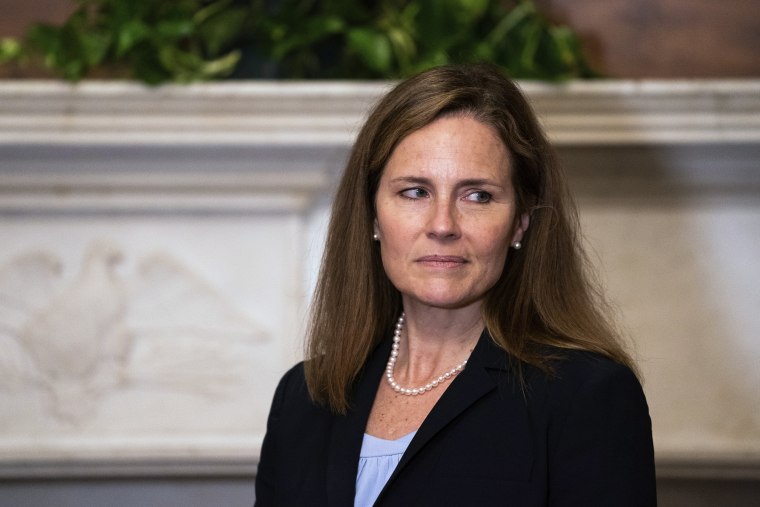
Image:Judge Amy Coney Barrett, President Donald trump’s nominee to the Supreme Court, meets with Sen. Shelley Moore Capito, R-W.Va., at the Capitol on Sept. 30, 2020.

The Senate Judiciary Committee will, as promised, begin consideration today of Judge Amy Coney Barrett’s Supreme Court nomination, and under normal circumstances, the political world would be pondering a variety of routine questions. What are the nominee’s qualifications? What do we know about her ideology? And judicial temperament?

With Barrett, in particular, there are a series of more specific questions. How eager is the young conservative to tear down the Affordable Care Act? What about the jurist’s record of fierce opposition to reproductive rights? How seriously should senators consider her recent disclosure failures?

But as critically important as those questions are, as this week’s proceedings get underway, a more fundamental question hangs overhead: is there a coherent defense for launching this process right now? A recent Washington Post editorial rings true:

Mr. Trump is asking Senate Republicans to perpetrate a damaging injustice by ramming through a nominee on the eve of a presidential election. This move threatens to sully the court and aggravate suspicions over the coming election. Senate Republicans should be disgusted at playing the role they are being asked to play. But so far they seem shameless in their hypocrisy and wanton in their willingness to poison the workings of our democracy.

The editorial added that the GOP effort to ram through Barrett’s nomination, even as millions of ballots are being cast, is “a power grab without principle.”

Much of the American mainstream agrees. A new ABC News/Washington Post poll found that a 52% majority of the country believes the Senate “should delay filling the court’s current vacancy,” leaving the matter to the winner of next month’s presidential election. This is roughly in line with other recent polling on the matter.

What’s more, USA Today reported last week on a focus group with Republican women in swing states, each of whom voted for Donald Trump in 2016, and “none of them favored the idea of moving forward with a confirmation process before the election, and several said they were more likely to support Biden as a result.”

What’s more, there aren’t just issues of basic fairness to consider; there are also pandemic-era practical considerations.

There are 12 Republican members of the Senate Judiciary Committee, and two of them — Utah’s Mike Lee and North Carolina’s Thom Tillis — recently tested positive for the coronavirus. Common sense suggested the diagnoses should delay the proceedings, but Chairman Lindsey Graham (R-S.C.) announced he would push ahead anyway.

Indeed, Graham, who was recently with Lee — indoors, without a mask — is refusing to even be tested for the virus. Sen. Chuck Grassley (R-Iowa), another Judiciary Committee member, has also said he will not take a test to determine whether he’s contracted the virus.

There’s no great mystery here: if Graham and/or Grassley were to get tested, they might receive discouraging news, at which point they’d have to go into quarantine, putting Barrett’s confirmation at risk. It’s hardly a stretch to think this explains their reluctance to get tested.

Sen. Joni Ernst (R-Iowa), a Judiciary Committee member facing a tough re-election fight, conceded over the weekend that it “would be smart” for senators on the panel to get tested before this week’s proceedings begin. Senate Minority Leader Chuck Schumer (D-N.Y.) aded over the weekend, in reference to Ernst’s comments, “She’s right, but will Senator Ernst do anything if Senators Graham and Grassley refuse? Or is this just an empty statement?”

These need not be rhetorical questions.

Wisconsin is battling America’s worst coronavirus outbreak, and the state’s broken politics are partly to blame

Wisconsin is battling America’s worst coronavirus outbreak, and the state’s broken politics are partly to blame


Andrew Romano, West Coast Correspondent       
Coronavirus By The Numbers
Look at a map of daily Covid – 19 cases in the U.S. Most of the Northeast and West Coast is yellow, indicating limited spread. The numbers across the Southeast tend to be moderate, or orange. Move into the Upper Midwest and more red hot spots start to appear.

And then there’s one state that’s covered in crimson: Wisconsin.

Right now Wisconsin is battling the worst coronavirus outbreak in America. The question is why. What about Wisconsin is different from, say, the neighboring states of Michigan, Minnesota and Illinois, where the virus isn’t spreading nearly as fast?

The answer, at least in part, is politics: specifically, the brand of cavalier, it-will-go-away politics propagated by President Trump and parroted by lower-level Republicans who seem hell-bent on resisting efforts to sustain social distancing and mask wearing when the spread is still low enough to contain — and in Wisconsin’s case, who continue to resist even after infections spiral out of control.

As Trump resumes in-person campaigning with a White House event Saturday and a rally Monday in Florida — and with cases rising nationally to their highest level since August — Wisconsin has emerged as a cautionary tale for the rest of the country about what could be coming this fall and winter to places that let politics get in the way of commonsense precautions. Last month Trump held an outdoor rally in Mosinee that attracted thousands of people, most of whom were not wearing masks. Even as case counts soared, he planned to return for back-to-back rallies in Janesville and Green Bay earlier this month — plans that were scrapped only after the president himself tested positive for the virus.

Wisconsin’s numbers are sobering. On Thursday the state’s new daily case count cleared 3,000 for the first time. Its seven-day average (2,491) has more than tripled since the start of September. Daily hospitalizations have also tripled over the same period. Nearly 20 percent of Wisconsin’s COVID-19 tests are coming back positive.

Overall, the Badger State has logged 17,437 new cases over the last seven days — more than any other state except the far more populous Texas and California. On a per capita basis, that’s more new cases (299 per 100,000 residents) than any other state except the far less populous Dakotas, and several times more than Michigan (75), Illinois (123) or Minnesota (137).

Meanwhile, on a list of the 100 counties nationwide with the highest number of recent cases per resident, all but two counties with more than 300 cases in the last seven days are located in Wisconsin: Oconto (365), Winnebago (1,439), Shawano (337), Calumet (395), Waupaca (307), Outagamie (1,023) and Brown (1,409). In total, there are 16 Wisconsin counties on that list — the most of any state. And unlike other hard-hit states such as Idaho, Montana and the Dakotas, Wisconsin’s hot spots aren’t dispersed across vast distances; they’re contiguous and concentrated around cities such as Green Bay in the state’s northeast corner, making the spread harder to contain.

Next week Wisconsin officials plan to open a 530-bed field hospital at the state fairgrounds to keep COVID-19 patients from flooding heath care facilities, which Democratic Gov. Tony Evers recently characterized as being “on the brink” of collapse.

“We hoped this day wouldn’t come,” Evers lamented. “But unfortunately, Wisconsin is in a much different, more dire place today. … There’s no other way to put it: We are overwhelmed.”

As Barry Burden, a political science professor at the University of Wisconsin-Madison, told NBC News earlier this week, “Wisconsin has become the poster child for how things can go wrong.”

Nursing assistant Monica Brodsky, left, and nurse Taylor Mathisen work at a drive-thru testing site for COVID-19 in the parking lot at UW Health Administrative Office Building in Middleton, Wis., Monday, Oct. 5, 2020. (Amber Arnold/Wisconsin State Journal via AP)
Nursing assistant Monica Brodsky, left, and nurse Taylor Mathisen at a drive-through COVID-19 testing site in Middleton, Wis., on Monday. (Amber Arnold/Wisconsin State Journal via AP)

So what went wrong?

The most disturbing thing about Wisconsin’s outbreak is that it didn’t have to be this bad. NBC described the problem as “political trench warfare between the Democratic governor and the Republicans who control the state Legislature.” That’s technically accurate, but it also makes it sound like both sides are defending equally sensible positions aimed at preventing the spread of COVID-19.

They’re not. On the one hand, Evers has repeatedly tried to do everything in his power to contain the pandemic. On the other, Republicans have repeatedly challenged Evers’s authority and thwarted his efforts, blocking the sort of basic public-health measures other states have enacted while touting themselves as champions of “individual liberty.”

The first and perhaps most consequential of these skirmishes came in the spring, when the Legislature’s Republican leaders filed a lawsuit arguing that Evers’s “safer at home” order would leave the state’s economy “in shambles” — even though it was no stricter than dozens of other shelter-in-place orders in effect across the country. On May 13 the state’s Supreme Court, which was also controlled by conservatives, sided with the GOP and overturned the order. Evers was not pleased, telling CNN that the court’s ruling “puts our state into chaos.”

“Now we have no plan and no protections for the people of Wisconsin,” the governor said. “When you have more people in a small space — I don’t care if it’s bars, restaurants or your home — you’re going to be able to spread the virus. And so now, today, thanks to the Republican legislators who convinced four Supreme Court justices to not look at the law but [to] look at their political careers, I guess, it’s a bad day for Wisconsin.”

“It’s the Wild West,” he added.

Wisconsin Gov. Tony Evers speaks during a news conference in Kenosha, Wis. in late August. (Morry Gash/AP)
Wisconsin Gov. Tony Evers speaks at a news conference in Kenosha, Wis., in late August. (Morry Gash/AP)


Bars and restaurants immediately reopened for business. Patrons crowded in. For a while, the state’s case count stayed relatively low, even as the virus surged to record levels in the South and West. But that only bred complacency, and by the time college students started returning for the fall semester, public health efforts had become so politicized that Evers had less power to slow the spread than governors in neighboring states.

In July, for instance, Evers issued a statewide order mandating masks in enclosed spaces, which he extended last month to Nov. 21. Yet even though nearly three-quarters of Wisconsinites favor Ever’s mandate, Republican lawmakers are backing another suit against it. A judge is expected to rule any day now.

Same goes for Evers’s latest order limiting indoor capacity at bars, restaurants and stores to 25 percent as the virus surges. “Do I expect there to be litigation on this?” Ryan Nilsestuen, Evers’s top attorney, told the Milwaukee Journal Sentinel this week. “Absolutely.”

This relentless campaign to delegitimize pandemic precautions as partisan overreach comes with a cost. It discourages compliance. It disincentivizes enforcement. And it preemptively restricts the government’s ability to address a worsening crisis.

Consider the fact that in California and New York, two of the hardest-hit states, indoor dining has only recently resumed at 25 percent capacity despite months of low or declining case counts.

Yet in Wisconsin, people have been drinking and dining indoors since the spring, and it took a full month of exponential spread before Evers felt like he could attempt to limit capacity statewide. (Local jurisdictions such as Madison and Milwaukee put limits in place earlier; today they have lower case counts.) Even now, in the midst of America’s worst outbreak, Wisconsinites can still drink and dine indoors. Partly as a result, infections have been radiating outward from college campuses and blanketing the state.

To be sure, Republicans elsewhere have resisted efforts to combat the virus, including in Michigan, where the state Supreme Court ruled last week that Democratic Gov. Gretchen Whitmer lacks the authority to extend or declare states of emergency in relation to the pandemic. And of course there’s a reasonable debate to be had over the proper balance between business needs and pandemic precautions.

But Wisconsin isn’t having that debate. Instead, it has been fulfilling its role as America’s truest bellwether: a state that parallels our divided national politics both in the tightness of its elections and the conflicts that define them. Over the last decade, Republican activism funded by the Koch brothers has clashed with the state’s deep progressive tradition, tipping the scales in the GOP’s favor and exacerbating polarization between left and right, white and black, urban and rural. After Republicans took control of the governor’s mansion, the U.S. House delegation, one U.S. Senate seat and both chambers of the state Legislature in the 2010 tea party wave, they gerrymandered the state so aggressively that even when Democrats won 53 percent of assembly votes in 2018, Republicans still wound up with 64 percent of the seats.

Evers took office the following year, and Republicans immediately sought to render him powerless for partisan advantage. That was long before the pandemic. Now, with coronavirus cases skyrocketing, the life-or-death consequences of such polarization are becoming harder to ignore. With fall in full swing and winter looming, here’s hoping the rest of America doesn’t go the way of Wisconsin.

Steve Schmidt Responds to trump

Steve Schmidt Responds to trump
Image may contain: 1 person, suit
American’s For Progressive Change
Donald Trump tried to go after former McCain Campaign Strategist Steve Schmidt, the head of The Lincoln Project, on Twitter. Schmidt didn’t hold anything back in his reply:
“You’ve never beaten me at anything. This is our first dance. Did you like, Covita? We are so much better at this than your team of crooks, wife beaters, degenerates, weirdos and losers.
You are losing. We heard you loved Evita. You saw it so many times. Where will you live out your years in disgrace? Will you buy Jeffrey Epstein’s island? One last extra special deal from him? Or will you be drooling on yourself in a suite at Walter Reed? Maybe you will be in prison?
I bet you fear that. The Manhattan District Attorney may not be around to cover for you or your crooked kids anymore. Eliza Orlins doesn’t believe in different sets of rules for the Trumps. What about the State Attorney General? You know what you’ve done.
Oh, Donald. Who do you owe almost $500 million in personally guaranteed loans to? It’s all coming down. You think you and your disgusting family are going to be in deal-flow next year? Are you really that delusional?
You are lucky Chris Wallace interrupted you after Joe Biden said you weren’t smart. You started to melt down. That’s the place that hurts the most. Right? Fred Sr., knew it. You’ve spent your whole life proving it. You aren’t very smart. You couldn’t take the SAT on your own. What was the real score? 970? We both know you know.
Are the steroids wearing off? Is the euphoria fading? Do you feel foggy? Tired? Do you ache? How is the breathing? Hmmm. Are you watching TV today? We will have some nice surprises for you. Everyone is laughing at you. You are a joke. A splendid moron turned deadly clown.
Did you watch Martha McSally in her debate against American hero, fighter pilot, test pilot, astronaut Capt. Mark Kelly? She is so embarrassed by you. She is ashamed and full of self-loathing for the choice she made in following you over the cliff. She is in free fall now. She will lose, like most of them, because of you.
We hear from the White House and the campaign everyday. They are betraying you. They are looking to get out alive and salvage careers and their names. It’s Ivanka Trump and Jared Kushner vs. Donald Trump Jr., and Kimberly Guilfoyle on the inside. They are at war over scraps and who gets to command what will be the remnants of your rancid cult.
It’s almost over now. You are the greatest failure in American history. You are the worst president in American history. Disgrace will always precede your name. Your grandchildren and great-grandchildren will grow up ashamed of their names.
One day, I suppose there will be some small and not-much-visited library that bears your name. It will be the type of place where a drunk walks by, staring at the wall for a minute, before deciding it is beneath his dignity to piss on. That’s what is waiting for you.
Joe Biden is a better man. He’s smarter. He’s winning.
Do you remember when you didn’t want to name Donald Trump Jr., Donald because you were worried about him being a loser named Donald? You were right about that. He is.
But it is you who will be remembered as America’s greatest loser. You will be crushed in the election!”

What if this is the last election in U.S. history?

Chicago Suntimes

What if this is the last election in U.S. history?

People and entire organizations are working to discourage the American people from voting so the power elite can control the outcome and silence the working stiffs.

On Sept 3, workers prepare absentee ballots for mailing at the Wake County Board of Elections in Raleigh, N.C. Nearly 10,000 North Carolinians had their mail-in ballots accepted in the first week of voting, according state data. North Carolina was the first state in the country to send absentee ballots to voters who requested them.
 Gerry Broome/AP


What if this were the last time you ever had a chance to vote? If your children and grandchildren and future generations were to look back on November 2020 as the end of free elections in the United States, would you fail to pick up a ballot this year?

There are those who say it doesn’t matter who you vote for, both political parties are corrupt, their candidates are unworthy and the election process itself is a sham.

That’s a bunch of garbage!

For decades there have been people, entire organizations, working to discourage the American people from voting. It is a political strategy called suppressing the vote, so the power elite can control the outcome and silence the working stiffs.

Should you choose to stay home don’t tell me you didn’t take sides, because you absolutely did.

You chose the side that is trying to destroy our democracy. You chose the side that favors political repression. You chose the side that wants to silence those who would use their voice to defend the defenseless.

Centuries ago, people came here because kings and queens, czars and emperors decided how people would live and how they would die.

Most people were not paid for their work. If they killed a deer to feed their families, they were executed. When there was a war, they were rounded up, handed a spear or a pitchfork and told to go to die for their beloved monarch. This went on for centuries.

People eventually left such places to come to America. They risked their lives on tiny ships trying to reach a hostile country that offered nothing but hope. And once they were here, they created a new kind of government where people had the right to vote for their leaders.

Slaves came here in ships as well. They did not choose to make the voyage. They were placed in chains, sold like cattle and made to work for people who would become rich off their blood, sweat and tears. They were beaten, whipped and lynched for trying to run away.

They dreamed of a better life. Of freedom. One day they were granted that right and tried to exercise it at the election polls.

Black people were burned alive in churches just for holding meetings where they talked about voting. They were shot on the streets walking to the polls. They were lynched from trees because they dared to run for office.

Still, they tried to vote. Still they fought for the right to cast a ballot. And you dare wonder today why you should bother to vote.

There are women who took their small children and walked in the streets campaigning for the right to vote. They worked 18 hours a day in sweatshops, came home and were forced to turn over their money to husbands who beat them and spent their savings at local bars.

They had almost no rights. They couldn’t even own their own homes in some places. But they realized at the ballot box, if they had the vote, they might be able to change that for all women in the future.

They were verbally and physically abused and sent to prison. Some died trying to make the dream of universal suffrage a reality. All so you could vote.

Yet, today there are some women who don’t care to vote. It is their right, they say.

The fate of our country is at stake this November. There are those who may try to stop the election, or at the very least stop you from casting a ballot. You must take a stand and tell your friends and neighbors in other states to do the same.

We vote for all of those who have suffered and died for this right. We vote to preserve this legacy for future generations. We vote to protect the most powerful revolutionary tool in the history of the world: The election ballot.

Biggest election loser: America’s national debt

Biggest election loser: America’s national debt

Rick Newman, Senior Columnist           


If fiscal probity is your top election issue, there’s no candidate for you this year, according to a new report by deficit hawks in Washington.

The Center for a Responsible Federal Budget estimates that Republican Donald Trump and Democrat Joe Biden would each send the federal debt spiraling higher during the next several years. If Trump wins and enacts his agenda, it would push the national debt $5 trillion higher by 2030. Biden’s plan, if fully enacted, would push the deficit up by $5.6 trillion. The national debt held by the public is already equal to 98% of GDP. It would rise to 125% of GDP under Trump and 128% under Biden.

This kind of analysis is a bit of a political parlor game, because no president ever gets his entire agenda passed into law, and sometimes it’s not even clear what their policies are. Trump’s second-term agenda, for instance, is nothing more than a list of 54 bullet points on the campaign website, with no cost estimates or documentation. So CRFB researchers had to hunt around for Republican proposals in Congress or elsewhere that indicate what Trump seems to be proposing.

Biden’s agenda is far more thorough, with 48 discrete plans and more than 800 individual proposals. But those aren’t always spelled out either, with Biden explaining how he’d pay for some plans, but not others.

Biden wants to ramp up spending on education, health care, child and elder care, affordable housing and infrastructure. He’d pay for much of that with higher taxes on businesses, households earning more than $400,000 per year and wealthy investors. Overall, Biden has outlined about $7 trillion in new spending over a decade, along with $4 trillion in new taxes.

Trump’s plan is harder to summarize because of the scarce detail in bullet points such as “return to normal in 2021” and “create 10 million new jobs.” Trump’s main economic idea seems to be to cut or eliminate payroll taxes, but that’s very unlikely because those taxes fund Social Security and Medicare. Trump would presumably continue to axe regulations and press trading partners such as China for better trade deals.

Democratic presidential candidate former Vice President Joe Biden boards his campaign plane at New Castle Airport in New Castle, Del., Tuesday, Oct. 6, 2020, to travel to Gettysburg, Pa. (AP Photo/Andrew Harnik)
Biden gets an edge

Most analysis of the two candidates’ plans give Biden an edge. The whole point of a sound spending-and-taxing plan is to boost economic growth and make more people better off. The Penn Wharton Budget Model finds that Biden’s plan would do that, boosting GDP by 1.4% by 2040, while pushing federal debt 1.5% lower than it would otherwise be.

Moody’s Analytics analyzed four election scenarios—a Democratic sweep, a Republican sweep, a Biden win with split control of Congress, and a Trump win with split control of Congress—and found that a Democratic sweep would be best for the economy. If Biden were able to largely enact his policies, the research firm found, GDP growth would average 2.9% during the next decade and the economy would add 21.7 million jobs. Under the status quo—with Trump as president and Congress split—growth would average just 2.4%, with 13.9 million new jobs.

Oxford Economics found that “Joe Biden’s fiscal policy proposals would provide the U.S. economy with a booster shot as it recovers from the global coronavirus recession.” Even if Democrats controlled both houses of Congress, Oxford argues that Biden’s full plan couldn’t pass in the Senate, where a narrow Democratic advantage is the party’s best scenario. But a more modest “Biden lite” plan might be able to pass, and if it did, it could boost GDP growth by a couple of percentage points and push employment back to pre-pandemic levels sooner.

Another element of a Biden presidency would probably be a large stimulus bill in early 2021. Stocks sank on Oct. 6 as President Trump said he was done negotiating with Democrats on a fourth stimulus bill, and would now wait until after the election. But if Biden wins and Democrats take the Senate, Congress would probably pass a much larger bill than the parties have been negotiating this fall—most likely similar to the $3.4 trillion package House Democrats passed all the way back in May. That would send the 2021 deficit soaring, without a doubt. But most economists think it’s better for Uncle Sam to borrow now and juice the economy than to risk chronic recession and the ongoing misery that entails.

Lindsey Graham, in a dead heat with Senate challenger, pleads for help

Lindsey Graham, in a dead heat with Senate challenger, pleads for help

Christopher Wilson, Senior Writer           

With less than a month until Election Day, Sen. Lindsey Graham’s reelection bid, once thought to be a walkover, is now considered a toss-up, as his Democratic opponent, Jaime Harrison, continues to rake in and spend cash.

The nonpartisan Cook Political Report announced Wednesday morning that it had moved the South Carolina race’s rating from Lean Republican to Toss-Up. Graham has represented the Palmetto State in the Senate since 2003 and won his most recent race by nearly 20 points in 2014, but Harrison’s fundraising and the national political climate have imperiled his seat.

Harrison, who is Black, is a South Carolina native who attended Yale and Georgetown Law before serving as chairman of the state’s Democratic Party. He has raised tens of millions of dollars and has been airing commercials in the state since April. According to Cook, the Harrison campaign has spent or reserved time with TV and digital ads to the tune of more than $60.3 million, versus just $20.6 million spent or reserved by Graham. Harrison has been focusing on Graham’s attempt to repeal the Affordable Care Act, including legislation he co-authored that would have knocked 21 million Americans off their insurance.

Graham, who opposed Donald Trump in the last election, turned into a golf buddy of the president and one of his biggest supporters in the Senate. A group called Republican Voters Against Trump has been running ads with a clip of Graham in 2016 calling Trump “ a race-baiting, xenophobic, religious bigot,” which are meant to boost former Vice President Joe Biden but incidentally highlight what opponents call Graham’s opportunism.

As a member of the Senate Judiciary Committee, Graham displayed high-profile support for the nomination of Brett Kavanaugh as Supreme Court justice in the fall of 2018 that made him a prime target for Democrats. Now, as the committee chairman, Graham has vowed to confirm Amy Coney Barrett to replace the late Justice Ruth Bader Ginsburg, resulting in a flood of donations to Harrison’s campaign.

In late September, Graham started appearing on Fox News repeatedly, begging for conservatives to help him keep up with Harrison.

“I’m getting overwhelmed,” he told host Sean Hannity. “LindseyGraham.com. Help me. They’re killing me, money-wise. Help me. You helped me last week — help me again. LindseyGraham.com.”

Jaime Harrison. (Joshua Boucher/The State via AP)


Last week the Senate Leadership Fund, a Republican PAC, announced it was spending $10 million on radio and TV ads in the state in an attempt to boost Graham’s chances. Harrison said on Twitter Sunday that he had raised over $1.5 million following a Saturday debate with Graham. During the debate, Harrison erected his own plexiglass barrier on the stage, a precaution in response to Graham’s repeated close contact with a number of Republican officials who had tested positive for COVID-19.

“Tonight I am taking this seriously,” Harrison said. “That’s why I put this plexiglass up. Because it’s not just about me — it’s about the people in my life that I have to take care of as well. My two boys, my wife, my grandmother.”

Adding to Graham’s trouble is a national climate that appears to be souring on President Trump and many of his GOP supporters. Multiple national polls released in the past few days have shown Biden with a double-digit lead over Trump as the president attempts to recover from a COVID-19 hospitalization and a poor debate performance. Trump currently holds an approximately 5 point lead in the South Carolina presidential race.

“We are seeing the emergence of what I call a ‘new South,’” Harrison told Yahoo News in September. “[It’s] a new South which is bold, inclusive and diverse. You’re seeing African-Americans being able to run statewide for the nominations and win and be on the cusp of changing the history and direction of this country. It’s great to have people who are allies to the issues that impact all of our communities, but there’s nothing like having people from those communities sit at those tables and make decisions that impact the folks in their communities.”

While Republicans are expected to pick up one Senate seat in Alabama, they’re currently playing defense on roughly a dozen seats, including eight rated as either Lean Democratic or Toss-Up by Cook.

“Don’t cry for my White House staffers.”

Ego maniac trump’s disregard for anyone and anything except his narcissistic self interest. “Don’t Cry for Me Secret Service”

Lincoln Project Trolls Trump’s Balcony Stunt With Singalong ‘Evita’ Parody

Ed Mazza, Overnight Editor, HuffPost                     October 7, 2020

President Donald Trump marked his return to the White House on Monday from hospitalization for the coronovirus with a photo-op at the Truman Balcony ― a scene his critics likened to the iconic moment from the musical “Evita.”

Now his critics on the right turned that comparison into a song parody.

The Lincoln Project ― a group of never-Trump Republicans ― released “Covita,” a parody based on the musical’s showstopper:

The Lincoln Project did not say who sang the track. Asked on Twitter, co-founder Rick Wilson responded: “I’ll never tell.”

Patti LuPone, who originated the role on Broadway and won a Tony as Eva Peron, weighed in on Trump’s balcony appearance a day earlier on social media.

“I still have the lung power and I wore less makeup,” she wrote on Twitter. “This revival is closing November 3rd.”

The “Covita” video was one of several released by The Lincoln Project on Tuesday. The group also dropped a much more somber video on the toll of the infection amid Trump’s continuing efforts to downplay it:

Want to Live Longer? Get Out Of These 30 Most Polluted Cities in the US

Want to Live Longer? Get Out Of These 30 Most Polluted Cities in the US

Soma Dutta                       October 5, 2020

In this article we take a look at the 30 most polluted cities in the United States. Click to skip ahead and jump to the 10 most polluted cities in the U.S.

When comparing cities or regions on their pollution levels, there are several things that need to be considered. First off, cities can be considered polluted from several different angles and aspects. While water bodies surrounding urban cities can get polluted due to discharges or waste disposal, the major factor that affects the daily life of citizens is air pollution. The denser the population of the cities, the higher the level of air pollution tends to rise due to the large amounts of emissions constantly being released into the air, making it unbreathable and detrimental to health and life expectancy.

The absolute pollution figures might point at the US being one of the top polluters in the world, with over 5,145.2 million tons of carbon emissions according to the 2019 BP Statistical Review of World Energy. However, if we look at the air quality of the cities it might seem cleaner than most cities in other parts of the world. This is so because when we compare the livability of cities, it is largely also dependent on the density of population and also the concentration levels of pollutants. While most cities in the US might be emitting greater amounts of air pollutants, owing to the heavy industrialized economy, the concentration levels might be lower compared to its counterparts owing to the large area that the country is spread across.

Air quality also, does not just include CO2 emissions, but largely consists of particulate matter, which is what majorly causes health implications like respiratory diseases, or weakened heart or lung functioning due to prolonged exposure. The United States Environmental Protection Agency (EPA) specified AQI (Air Quality Index) is the best yardstick to measure the level of pollution in the air of a certain region. The major pollutants that are considered in the AQI are Ground level ozone, Carbon monoxide, Sulfur dioxide, Nitrogen dioxide and airborne particles. The higher the AQI figures the greater is the air pollution while anything over 200 AQI is considered to be unhealthy air as stated by EPA.

Air pollution is largely attributable to particulate matter which includes a mix of dust, soot, smoke and liquid particles or aerosols. It is a major determinant of air quality and a major irritant present in the air. Fine particulate matter is what causes major health hazards to citizens , while reducing visibility when in high concentration in the air. According to WHO, prolonged exposure to PM2.5 can increase long-term risk of cardiopulmonary mortality by 6–13% per 10 µg/m3 of PM2.5 (8–10).

The Improving Knowledge and Communication for Decision-making on Air Pollution and Health (Aphekom) in Europe was conducted to understand the implications on average life expectancy if PM 2.5 in polluted cities could be brought down as per WHO recommendations. Among the 25 participating European countries, it was observed that they averaged at 10µg/m3 and residents could live 20 months longer on an average if PM 2.5 levels were perfect. Los Angeles has a PM 2.5 level of 11. Los Angeles residents could live an average of approximately 1 month longer, if their PM 2.5 is reduced to 10 and also could live nearly a year longer if the air quality were perfect.

Given this, a measure of Fine particulate matter (PM 2.5) present in the air is a good focus to determine the level of pollution in a certain region.

As EPA produces a comprehensive track record of different air pollutants that affect individual cities, we have based our rankings on this Air Quality Trends Data and have ranked cities according to the level of PM 2.5 level measured in Wtd AM (µg/m3) for each of these cities.

Other coarse particles or PM10 can also be a cause of irritations and health complications and are majorly released from activities on construction sites, or mining. We have therefore reported PM10 for each of the cities that appear on our rankings as well.

25 Most Polluted Cities in the US in 2017

Kekyalyaynen / Shutterstock.com

Population can be a major contributor too, and cities with greater population can often be greater emitters. We can therefore see some of the cities in our rankings also featuring in the 50 Most Populated Cities in the US.

Air pollution has been a major cause of concern for most big cities with unexpected increases in fine dust situations and smog in the recent past. And, even though 2020 has seen a sudden drop in air pollution levels owing to the pandemic, it might be just a temporary respite and chances are that the levels might shoot right up as soon as economic activities get ready to bounce back in action.

Pollutants in the air can also be a major contributor to climate change. But also, in the recent California wildfires we have witnessed how climate change and environmental factors can in fact lead to sudden increase in air pollution levels as well. It can be easily inferred that air pollution and climate change are quite closely related.

With the talks increasing around Climate Change and the clocks ticking for major nations to get to net zero emissions , let’s take a look at the problem areas and pinpoint the focus on the cities that need attention for their less than favorable air quality conditions.

30. Denver-Aurora-Lakewood, CO

PM 2.5 – 10

PM 10 – 111

While Denver average yearly AQI is at 34 and meets “healthy” air standards, it fails to meet the thresholds for PM2.5. Particularly in winter months, the city experiences pollution swings that makes it one of the most polluted cities in the US.

Pixabay/Public Domain

29. Little Rock-North Little Rock-Conway, AR

PM 2.5 – 10.3

PM 10 – 38

Little Rock area has a moderate level of air pollution with major pollutants being PM2.5 at 10.3 and Ozone that averages at 68 µg/m³.

28.Birmingham-Hoover, AL

PM 2.5 – 10.4

PM 10 – 106

The city has often experienced high levels of Ozone pollution and has therefore had unhealthy air conditions. The PM.25 and PM 10 level have been over threshold as well.

Pixabay / Public Domain

27. St. Louis, MO-IL

PM 2.5 – 10.5

PM 10 – 99

St. Louis’ pollution levels are slightly higher than the limits specified by WHO and therefore poses risks in the long-term. PM 2.5 and PM 10 are the main pollutants.

www.schmanke.com

26. Louisville/Jefferson County, KY-IN

PM 2.5 – 10.5

PM 10 – 40

While Jefferson County had been one of 50 counties across the country that failed to meet federal health standards for fine particle pollution from 2011 to 2013, EPA has recently noted a significant improvement in air quality in the area. The area now meets the National Ambient Air Quality Standard (NAAQS) for sulfur dioxide set to protect public health.

25. Klamath Falls, OR

PM 2.5 – 10.5

PM 10 – 58

Klamath Falls has had a prolonged problem with particulate pollution owing to its topography. Air quality can be largely affected during fire season and impacted greatly by fire smoke.

24. Modesto, CA

PM 2.5 – 10.6

PM 10 – 104

The pollution levels in Modesto are often concerning and touch the “unhealthy” level. While PM 2.5 hovers around 10.6 , it can reach a 114 µg/m³ especially towards the end of the year.

area, bakery, bay, business, california, carlos, chain, editorial, enterprise, food, foods, frozen, groceries, liquor, lucky, meat, neighborhood, only, pharmacy, san, seafood,

jejim / Shutterstock.com

23. Shreveport-Bossier City, LA

PM 2.5 – 10.7

PM 10 – 44

While particle pollution is still a concern in the area, Shreveport fares nicely in the ozone pollution category and also experiences clean air and a favorable AQI.

Most Polluted Cities in the United States

22. McAllen-Mission, TX

PM 2.5 – 10.7

PM 10 – 50

While pollutants level remain low to moderate throughout the year in the area, the PM2.5 level still poses a concern at 10.7 and hence finds a rank among the most polluted cities in the US.

Pixabay/Public Domain

21. Laredo, TX

PM 2.5 – 10.7

PM 10 – 48

Laredo, TX experience average to low AQI conditions across the year. Ozone andPM 2.5 comprise of the main pollutants.

20.Houston-The Woodlands-Sugar Land, TX

PM 2.5 – 10.7

PM 10 – 63

Even though Houston’s pollution conditions have been on the improving trends, there is still way to go to attain EPA’s standards. Despite a population rise in the recent past, the area has majorly been able to tackle its pollution levels.

Most Ethnically Diverse Cities in America

19. El Centro, CA

PM 2.5 – 10.7

PM 10 – 162

The area experiences high ozone days and high levels of particle pollution with AQI often dipping below favorable.

San Leandro, CA
San Leandro, CA

David Brimm/Shutterstock.com

18.Augusta-Richmond County, GA-SC

PM 2.5 – 10.7

PM 10 – 25

While the area ranks higher in 24 hour particle pollution, initiatives have been working in its favor. Augusta has also had no high ozone days in the recent past.

States with the Best Roads in America

Sean Pavone/Shutterstock.com

17. Cleveland-Elyria, OH

PM 2.5 – 10.8

PM 10 – 79

Cleveland ranks highly on the pollution levels, and soot and smoke particles in the air are a major cause of concern.

Dirtiest Cities in America

Henryk Sadura/Shutterstock.com

16. Chicago-Naperville-Elgin, IL-IN-WI

PM 2.5 – 10.8

PM 10 – 73

The region has reported over 100 days of moderate pollution levels and poor air quality in 2018. Higher levels of ground level ozone and particle pollution has been concerning.

Pixabay/Public Domain

15.Atlanta-Sandy Springs-Roswell, GA

PM 2.5 – 10.8

PM 10 – 40

The region experiences favorable days, however, the pollution levels remain moderately high on an average through the year.

15 Highest Paying Cities for Teachers

Pixabay/Public Domain

14. Phoenix-Mesa-Scottsdale, AZ

PM 2.5 – 10.9

PM 10 – 990

Air quality is often poor in the region, with high levels of pollutants. The PM10 levels are high and the region experienced 110 days of poor air quality in 2016.

airport, phoenix, arizona, traffic, air, control, view, aerial, sky, dawn, harbor, tower, usa, travel, built, night, skyline, southwest, sonoran, runway, building, architecture, city,

Anton Foltin/Shutterstock.com

13. New York-Newark-Jersey City, NY-NJ-PA

PM 2.5 – 11

PM 10 – 34

The overall area has experienced over 96 days of poor air quality in 2016, however, recent trends have shown significant decrease in pollutants in New York during the COVID 19 pandemic.

Pixabay/Public Domain

12. Los Angeles-Long Beach-Anaheim, CA

PM 2.5 – 11

PM 10 – 159

Los Angeles has average pollution levels , while maximum pollution levels over a year are greater than the maximum limit specified by WHO. Smog is a major issue that the region faces.

Most Ethnically Diverse Cities in America

11. Fresno, CA

PM 2.5 – 11.2

PM 10 – 234

Air Quality touches very low levels in Fresno, and respiratory issues like asthma is common in the region.

Click to continue reading and see the 10 most polluted cities in America. Disclosure: 30 Most Polluted Cities in the US is originally published at Insider Monkey.