
After judge overturns California assault weapons ban, state officials vow to fight back

After judge overturns California assault weapons ban, state officials vow to fight back

June 5, 2021


Police photos of assault rifles and handguns are displayed during a news conference
Police display a photo of assault rifles and handguns at a news conference after the 2015 San Bernardino mass shooting.
(Chris Carlson / Associated Press)


Families of mass shooting victims, gun control advocates and California officials condemned a federal judge’s decision to overturn California’s 30-year-old ban on assault weapons, largely because of the manner in which he justified his ruling.

In declaring the ban unconstitutional late Friday, U.S. District Judge Roger Benitez compared the AR-15 semiautomatic rifle to a Swiss Army knife, calling it “good for both home and battle.”

Benitez, who was nominated by former President George W. Bush and serves in the Southern District of California, issued a permanent injunction against the law’s enforcement but stayed it for 30 days to give the state a chance to appeal.

California is one of seven states, plus Washington, D.C., that ban assault weapons, according to the Brady Campaign to Prevent Gun Violence.

In his 94-page ruling, Benitez wrote that it was unlawful for California to prohibit its citizens from possessing weapons permitted in most other states and allowed by the U.S. Supreme Court. Advocates for the right to bear arms hailed the ruling.

“This is by far the most fact-intensive, detailed judicial opinion on this issue ever,” said Dave Kopel, an adjunct professor of constitutional law at the University of Denver and adjunct scholar at libertarian think tank the Cato Institute.

State Atty. Gen. Rob Bonta called the decision “fundamentally flawed” and said he would appeal.

“There is no sound basis in law, fact, or common sense for equating assault rifles with Swiss Army knives — especially on Gun Violence Awareness Day and after the recent shootings in our own California communities,” Bonta said in a statement.

Last month, a gunman opened fire at a light rail yard in San Jose, killing nine co-workers and dying of an apparent self-inflicted gunshot wound.

Emergency responders respond to a fire at the house of the suspect of a shooting, after nine people were reported dead including the shooter on May 26, 2021 at the San Jose Railyard in San Jose, California. - Multiple people were killed in a shooting Wednesday at a rail yard in California's Bay Area, police said, the latest instance of deadly gun violence in the United States. "I can't confirm the exact number of injuries and fatalities. But I will tell you that there are multiple injuries and multiple fatalities in this case," Russell Davis, a Santa Clara County Sheriff's deputy, told journalists, adding that the gunman was dead. (Photo by Amy Osborne / AFP) (Photo by AMY OSBORNE/AFP via Getty Images)

Officials said he was armed with three semiautomatic 9-millimeter handguns and 32 high-capacity magazines loaded with additional ammunition.

AR-15s have been used in some of the nation’s deadliest mass shootings, including the attack at Orlando’s Pulse nightclub that killed 49 people in 2016, and one in Las Vegas that killed 58 people in 2017.

“I can assure you — if a Swiss Army knife was used at Pulse, we would have had a birthday party for my best friend last week,” Brandon Wolf, who survived the Florida attack, wrote on Twitter. “Not a vigil.”

Kris Brown, president of the Brady Campaign to Prevent Gun Violence, said the ruling made her do a double-take.

“I have two daughters, and they read dystopian fiction, like the ‘Hunger Games,’ and it was kind of like that,” she said. “It can’t be real. Nobody, ever, who is a thinking human being with a heartbeat, could possibly liken a Swiss Army knife to an AR-15.”

In response to several mass shootings on his watch, President Biden announced in April that his administration would take steps toward greater gun regulation.

They include a proposal to require background checks for self-assembled firearms — so-called ghost guns — and a law that would allow family members or law enforcement agencies to request a court order to take guns away from a person who is a danger to themselves or others. Nineteen states, including California, have already passed such laws.

“Today’s decision is a direct threat to public safety and the lives of innocent Californians, period,” Gov. Gavin Newsom said Friday in a statement. “The fact that this judge compared the AR-15 — a weapon of war that’s used on the battlefield — to a Swiss Army knife completely undermines the credibility of this decision and is a slap in the face to the families who’ve lost loved ones to this weapon.”

The ruling came in response to a lawsuit filed in August 2019 by pro-gun groups, including the San Diego County Gun Owners Political Action Committee, California Gun Rights Foundation, Second Amendment Foundation and Firearms Policy Coalition.

The plaintiffs also included three San Diego County men who said they own legal rifles or pistols and want to use high-capacity magazines in them but can’t, because doing so would turn them into illegal assault weapons under California statutes.

In cases in which the government seeks to limit people’s constitutional rights, such as those guaranteed by the 2nd Amendment, the government has the burden of proving the limitation is helping to advance an important public interest, like reducing mass shootings, Kopel said.

“You’re essentially weighing how much of a burden you are inflicting on law-abiding people versus how much you are reducing whatever problem you’re trying to deal with,” he said. In this case, he said, the judge found that “we’re not getting any reduction in mass shootings, and it’s imposing quite a severe burden on innocent people, like people who want to have these types of firearms for protection in the home.”

Other legal experts found the judge’s reasoning less compelling.

“The judge in this case, in declaring the ban on assault weapons to be a failed policy experiment and therefore unconstitutional, was engaging in his own policy judgment,” said Susan Estrich, professor at the USC Gould School of Law. “His very reasoning undercuts his own conclusion.”

California became the first state to ban the sale of assault weapons in 1989 in response to a shooting at a Stockton elementary school that left five students dead. The ban, signed into law by Republican Gov. George Deukmejian, has been updated multiple times since then to expand the definition of what is considered an assault weapon.

Each time, those who owned the firearms before they were prohibited were required to register them. There are an estimated 185,569 such weapons registered with the state, Benitez said.

In response to the ban soon after it was enacted, the 9th Circuit Court of Appeals found the 2nd Amendment applied only as a limitation on the federal government, not state governments, Kopel said.

But in 2010, the U.S. Supreme Court issued a landmark ruling saying the 2nd Amendment applies to cities and states, which helped pave the way for this decision, he said.

In the current case, the state attorney general’s office argued that assault weapons are more dangerous than other firearms and are disproportionately used in crimes and mass shootings. Similar restrictions have previously been upheld by six other federal district and appeals courts, the state argued.

But the judge said the firearms targeted by the ban are most commonly used for legal purposes.
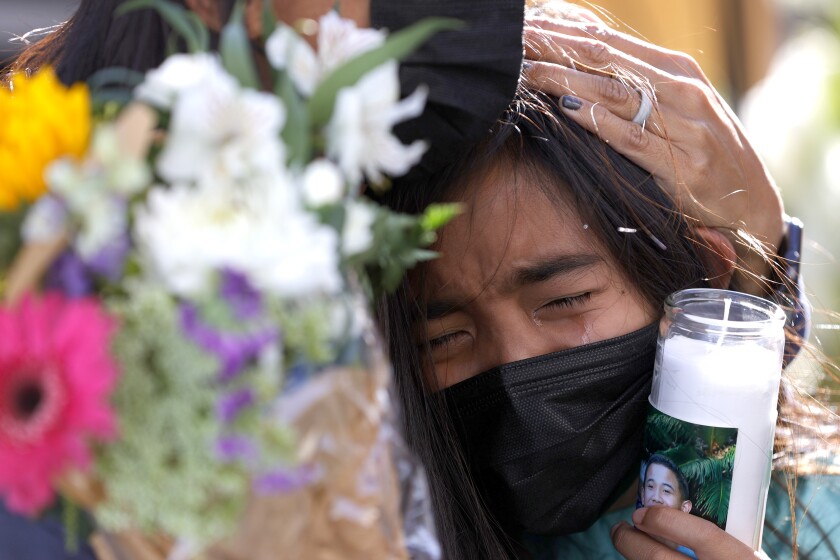
SAN JOSE, CALIFORNIA - MAY 27: A young mourner cries during a vigil for the nine victims of a shooting at the Santa Clara Valley Transportation Authority (VTA) light rail yard on May 27, 2021 in San Jose, California. Nine people were killed when a VTA employee opened fire at the VTA light rail yard during a shift change on Wednesday morning. (Photo by Justin Sullivan/Getty Images)

“This case is not about extraordinary weapons lying at the outer limits of 2nd Amendment protection,” he wrote. “The banned ‘assault weapons’ are not bazookas, howitzers, or machine guns.”

“In California, murder by knife occurs seven times more often than murder by rifle,” he added.

The state is also appealing two other rulings by Benitez: one from 2017 that overturns a ban on buying and selling magazines that hold more than 10 bullets, and another from April of last year that blocks a 2019 law requiring background checks to buy ammunition.

In the case of the assault weapons ban, the decision will almost certainly be stayed beyond 30 days, pending an appeal to the 9th Circuit Court of Appeals, and there’s an excellent chance the court will issue a reversal, given its liberal tendencies, Estrich said.

“Ultimately,” she said, “the question may be whether the United States Supreme Court, with its new conservative appointees, sees this as an opportunity to dig into assault weapons bans.”

That could imperil gun control laws that are on the books across the country, Brown said.

“The Supreme Court overturning these kinds of laws that are designed to promote public safety has huge negative implications, not only for assault weapons bans but for every public safety law that we have ever crafted to regulate guns, including the Brady law.” she said, referring to the 1994 requirement that firearm purchasers undergo federal background checks.

“So yes, I’m very concerned about it.”

Opinion: Republican senators managed to outdo themselves in cowardice

Washington Post

Opinion: Republican senators managed to outdo themselves in cowardice

Opinion by George T. Conway III, Contributing columnist   June 2, 2021


Image without a caption
Republican senators have managed to outdo themselves in cowardice — which is quite a feat.

Last week’s Senate vote blocking a national commission to investigate the Jan. 6 insurrection at the Capitol was even more appalling than either of the Senate’s impeachment trial acquittals of former president Donald Trump.

With few exceptions, Senate Republicans shirked their duties at both trials, despite the oaths they took to defend the Constitution, and, in an impeachment trial, to “do impartial justice.” These derelictions were especially apparent in the first impeachment trial. Faced with overwhelming evidence that Trump had used his official powers to try to coerce a foreign nation into aiding his reelection campaign, all but one Republican (Utah’s Mitt Romney) voted to acquit him, even as the senators refused to call witnesses.
They betrayed their oaths again in February, when 43 of the 50 Republican senators voted to acquit Trump of inciting the insurrection, even though he had largely committed his high crime openly, on television and Twitter, and even though the senators themselves were among the victims.

They acquitted him even though they surely recognized, as their own leader, Sen. Mitch McConnell (Ky.), blisteringly said on the floor on Feb. 13 after voting to acquit, that Trump had engaged in a “disgraceful — disgraceful — dereliction of duty.” Rather than “do his job,” McConnell said, Trump “watched television happily — happily — as the chaos unfolded,” hoping “to either overturn the voters’ decision or else torch our institutions on the way out.”

Trump breached his duties in both cases, and Senate Republicans thus failed to carry out theirs. But at least then the senators had excuses, however feeble.

With the first impeachment, they faced the momentous decision of whether to remove a president from office — something that has never been done. You can’t blame anyone for feeling trepidation at such a prospect.

The second time around, most claimed they couldn’t convict a former president, even though he had been impeached while in office for acts committed while in office. Constitutional text and history refute that proposition, but you could at least understand one underlying motivation: The usual sanction for an impeachment conviction is removal. Trump was already gone, posed no further threat of committing official abuse, had just lost an election by 7 million votes and stood as unpopular as ever. So, at least the theory went, why bother convicting him just to formally disqualify him from ever holding federal offices to which he’d never be elected?

Those may not have been great excuses, but at least the Republicans had them.

There was no excuse — none — for what they did last week.

They weren’t being asked to remove anyone from office; they weren’t being asked to pass judgment of any sort. They were merely being asked to allow a bipartisan commission to look into what happened on, and led to, Jan. 6.

Even worse: They actually weren’t voting on whether to create a commission; they were voting on cloture — on whether even to allow a vote on the issue. Using the filibuster, a Republican minority refused to allow a majority (which would have included seven Republicans) to hold that vote.

And they did so out of raw political fear, this time without fig leaves. McConnell’s own leadership colleague, minority whip Sen. John Thune (R-S.D.), actually admitted that Republicans feared that the commission’s findings “could be weaponized politically and drug into next year,” a midterm election year.

As for McConnell, he pulled out all the stops. Virtually echoing British Prime Minister Neville Chamberlain’s notorious call to partisanship in the decisive 1940 parliamentary debate over his handling of Nazi aggression — “I have friends in the House” — McConnell shamelessly asked his colleagues to kill the commission bill as “a personal favor” to him.

With that, the Republicans’ policy of appeasing Trump prevailed once again. But if Republicans are worried about what would happen if the public learned more of the truth about Jan. 6, they have only themselves to blame.

After all, they were the ones who acquitted Trump in the first impeachment trial and let him remain in office. They were the ones who stood mute before Jan. 6 as Trump propagated the “big lie” after the election. They were the ones who left open the horrifying prospect of letting Trump hold office again. They are the ones who continue to wish his wrongs away.

They quiver in fear of the man who cost them the presidency and both houses of Congress. As they continue to quake, the “big lie’s” cancer upon democracy grows, with spurious election audits in pursuit of fantasies of fraud, and with some insanely claiming — reportedly including Trump himself — that he’ll be “reinstated” in due course.

Four years of Trump have led to the Republican Party becoming a threat to democracy, a declining sect dominated by crackpots, charlatans and cowards. Of these, it’s the cowards, including the senators who killed last week’s legislation, who bear the most blame.

Honeybee Venom Kills Aggressive Breast Cancer Cells, Study Shows

EcoWatch

Honeybee Venom Kills Aggressive Breast Cancer Cells, Study Shows
Honeybee venom has shown promise against an aggressive type of breast cancer. Susan Walker / Moment / Getty Images

Could honeybees hold the key to treating an aggressive form of breast cancer?

A new study out of Australia found that honeybee venom rapidly killed the cells for triple-negative breast cancer, a type of breast cancer that currently has few treatment options.

“It provides another wonderful example of where compounds in nature can be used to treat human diseases,” said Western Australia Chief Scientist Professor Peter Klinken in a Harry Perkins Institute of Medical Research press release.

The research, published in Nature Precision Oncology Tuesday, was led by Dr. Ciara Duffy of the Harry Perkins Institute of Medical Research and the University of Western Australia.

As far back as 1950, bee venom was shown to kill tumors in plants. It has also been shown to work against other cancers like melanoma, BBC News explained. However, Duffy said in the press release that this was the first time honeybee venom had been tested against every type of breast cancer cell, as well as normal breast cells.

Duffy and her team tested both the venom itself and a synthetic version of a compound in the venom called melittin. They found that both were effective against triple-negative breast cancer and HER2-enriched breast cancer cells. In fact, a certain concentration of honeybee venom could kill 100 percent of cancer cells without seriously impacting healthy ones.

“The venom was extremely potent,” Duffy said.

Duffy explained to Australia’s ABC News how the melittin worked.

“What melittin does is it actually enters the surface, or the plasma membrane, and forms holes or pores and it just causes the cell to die,” Duffy said.

The researchers also found that the melittin interfered with the cancer cells’ messaging system, which is essential for the cancer to reproduce and grow.

The fact that melittin makes holes in the cancer cells actually means it could potentially be paired with existing chemotherapies that would enter the cancer cells through the openings it carved and kill them. Duffy found this treatment strategy worked to shrink tumors in mice.

However, outside scientists cautioned that there is a big difference between killing cancer in a lab and successfully treating it in humans.

“It’s very early days,” Garvan Institute of Medical Research in Sydney associate professor Alex Swarbrick told BBC News. “Many compounds can kill a breast cancer cell in a dish or in a mouse. But there’s a long way to go from those discoveries to something that can change clinical practice.”

Duffy agreed that more research had to be done before the melittin could be used on human patients.

“There’s a long way to go in terms of how we would deliver it in the body and, you know, looking at toxicities and maximum tolerated doses before it ever went further,” she told ABC News.

For the study, Duffy gathered venom from 312 honeybees and bumblebees in Perth, Western Australia; England; and Ireland.

“Perth bees are some of the healthiest in the world,” she said.

She found that the national origin of the honeybees did not alter their venom’s impact on the cancer. The bumblebee venom, however, had no cancer-killing powers.

Hundreds of lakes in U.S., Europe are losing oxygen

Hundreds of lakes in U.S., Europe are losing oxygen


Oxygen levels have dropped in hundreds of lakes in the United States and Europe over the last four decades, a new study found.

And the authors said declining oxygen could lead to increased fish kills, algal blooms and methane emissions.

Researchers examined the temperature and dissolved oxygen — the amount of oxygen in the water — in nearly 400 lakes and found that declines were widespread. Their study, published Wednesday in the journal Nature, found dissolved oxygen fell 5.5 % in surface waters of these lakes and 18.6% in deep waters.

The authors said their findings suggest that warming temperatures and decreased water clarity from human activity are causing the oxygen decline.

“Oxygen is one of the best indicators of ecosystem health, and changes in this study reflect a pronounced human footprint,” said co-author Craig E. Williamson, a biology professor at Miami University in Ohio.

That footprint includes warming caused by climate change and decreased water clarity caused in part by runoff from sewage, fertilizer, cars and power plants.

Dissolved oxygen losses in Earth’s water systems have been reported before. A 2017 study of oxygen levels in the world’s oceans showed a 2% decline since 1960. But less was known about lakes, which lost two to nine times as much oxygen as oceans, the new study’s authors said.

Prior to this study, other researchers had reported on oxygen declines in individual lakes over a long period of time. But none of have looked at as many lakes around the world, said Samuel B. Fey, a Reed College biology professor who studies lakes and was not involved in this study.

“I think one of the really interesting findings here is that the authors were able to show that there’s this pretty pronounced decline in dissolved oxygen concentrations in both the surface and (deep) parts of the lake,” Fey said.

The deep water drop in oxygen levels is critical for aquatic organisms that are more sensitive to temperature increases, such as cold water fish. During summer months, they depend on cooler temperatures found deeper in the water, but if deep waters are low on oxygen, these organisms can’t survive.

“Those are the conditions that sometimes lead to fish kills in water bodies,” said study co-author Kevin C. Rose, a professor of biology at Rensselaer Polytechnic Institute. “It really means that a lot of habitats for cold water fish could become inhospitable.”

Other organisms, Rose said, are more tolerant of warmer temperatures found at the surface level and can get enough oxygen by remaining near the surface, where water meets air.

About a quarter of the lakes examined actually showed increasing oxygen in surface waters, which Rose says is a bad sign because it’s likely attributable to increased algal blooms — sudden growth of blue green algae.

In these lakes, he said, dissolved oxygen was “very low” in deep waters and was unlivable for many species.

And the sediment in such oxygen-starved lakes tends to give off methane, a potent greenhouse gas, research shows.

Lakes examined in the new study were in the U.S. or Europe, except for one in Japan and a few in New Zealand. The authors said there was insufficient data to include other parts of the world.

Rose said lakes outside the study area probably are experiencing drops in dissolved oxygen, too. The reason, he said, is that warmer temperatures from climate change reduce the ability of oxygen to dissolve in water — its solubility.

“We know that most or many places around the planet are warming,” he said. “And so we would expect to see declining solubility.”

The Associated Press Health and Science Department receives support from the Howard Hughes Medical Institute’s Department of Science Education. The AP is solely responsible for all content.

Study: California fire killed 10% of world’s giant sequoias

Associated Press

Study: California fire killed 10% of world’s giant sequoias


SEQUOIA NATIONAL PARK, Calif. (AP) — At least a tenth of the world’s mature giant sequoia trees were destroyed by a single California wildfire that tore through the southern Sierra Nevada last year, according to a draft report prepared by scientists with the National Park Service.

The Visalia Times-Delta newspaper obtained a copy of the report that describes catastrophic destruction from the Castle Fire, which charred 273 square miles (707 square km) of timber in Sequoia National Park.

Researchers used satellite imagery and modeling from previous fires to determine that between 7,500 and 10,000 of the towering species perished in the fire. That equates to 10% to 14% of the world’s mature giant sequoia population, the newspaper said.

“I cannot overemphasize how mind-blowing this is for all of us. These trees have lived for thousands of years. They’ve survived dozens of wildfires already,” said Christy Brigham, chief of resources management and science at Sequoia and Kings Canyon National Parks.

The consequences of losing large numbers of giant sequoias could be felt for decades, forest managers said. Redwood and sequoia forests are among the world’s most efficient at removing and storing carbon dioxide in the atmosphere. The groves also provide critical habitat for native wildlife and help protect the watershed that supplies farms and communities on the San Joaquin Valley floor.

Brigham, the study’s lead author, cautioned that the numbers are preliminary and the research paper has yet to be peer reviewed. Beginning next week, teams of scientists will hike to the groves that experienced the most fire damage for the first time since the ashes settled.

“I have a vain hope that once we get out on the ground the situation won’t be as bad, but that’s hope — that’s not science,” she said.

The newspaper said the extent of the damage to one of the world’s most treasured trees is noteworthy because the sequoias themselves are incredibly well adapted to fire. The old-growth trees — some of which are more than 2,000 years old and 250 feet (76 meters) tall — require fire to burst their pine cones and reproduce.

“One-hundred years of fire suppression, combined with climate change-driven hotter droughts, have changed how fires burn in the southern Sierra and that change has been very bad for sequoia,” Brigham said.

Sequoia and Kings Canyon have conducted controlled burns since the 1960s, about a thousand acres a year on average. Brigham estimates that the park will need to burn around 30 times that number to get the forest back to a healthy state.

The Castle Fire erupted on Aug. 19 in the Golden Trout Wilderness amid a flurry of lightning strikes. The Shotgun Fire, a much smaller blaze burning nearby, was discovered shortly afterward, and the two were renamed the Sequoia Complex.

The headline of this story has been corrected to say the fire destroyed 10% of all giant sequoias, not 10% of all redwoods.

A 20-Foot Sea Wall? Miami Faces the Hard Choices of Climate Change.

A 20-Foot Sea Wall? Miami Faces the Hard Choices of Climate Change.

A high rise apartment building in the Brickell neighborhood of Miami on May 19, 2021. (Zack Wittman/The New York Times)


MIAMI — Three years ago, not long after Hurricane Irma left parts of Miami underwater, the federal government embarked on a study to find a way to protect the vulnerable South Florida coast from deadly and destructive storm surge.

Already, no one likes the answer.

Build a wall, the U.S. Army Corps of Engineers proposed in its first draft of the study, now under review. Six miles of it, in fact, mostly inland, running parallel to the coast through neighborhoods — except for a 1-mile stretch right on Biscayne Bay, past the gleaming sky-rises of Brickell, the city’s financial district.

The dramatic, $6 billion proposal remains tentative and at least five years off. But the startling suggestion of a massive sea wall up to 20 feet high cutting across beautiful Biscayne Bay was enough to jolt some Miamians to attention. The hard choices that will be necessary to deal with the city’s many environmental challenges are here, and few people want to face them.

“You need to have a conversation about, culturally, what are our priorities?” said Benjamin Kirtman, a professor of atmospheric sciences at the University of Miami. “Where do we want to invest? Where does it make sense?

“Those are what I refer to as generational questions,” he added. “And there is a tremendous amount of reluctance to enter into that discussion.”

In Miami, the U.S. metropolitan area that is perhaps most exposed to sea-level rise, the problem is not climate change denialism. Not when hurricane season, which begins this week, returns each year with more intense and frequent storms. Not when finding flood insurance has become increasingly difficult and unaffordable. Not when the nights stay so hot that leaving the house with a sweater to fend off the evening chill has become a thing of the past.

The trouble is that the magnitude of the interconnected obstacles the region faces can feel overwhelming, and none of the possible solutions is cheap, easy or pretty.

For its study, the Corps focused on storm surge — the rising seas that often inundate the coastline during storms — made worse lately by stronger hurricanes and higher sea levels. But that is only one concern.

South Florida, flat and low-lying, sits on porous limestone, which allows the ocean to swell up through the ground. Even when there is no storm, rising seas contribute to more significant tidal flooding, where streets fill with water even on sunny days. The expanding saltwater threatens to spoil the underground aquifer that supplies the region’s drinking water and crack old sewer pipes and aging septic tanks. It leaves less space for the earth to absorb liquid, so floodwaters linger longer, their runoff polluting the bay and killing fish.

And that is just sea-level rise. Temperatures have gotten so sweltering over recent summers that Miami-Dade County has named a new interim “chief heat officer.”

“What you realize is, each of these problems, which are totally intersecting, are handled by different parts of the government,” said Amy Clement, a professor of atmospheric science at the University of Miami and the chair of the city of Miami’s climate resilience committee. “It’s divided up in ways that make things really, really difficult to move forward. And the bottom line is, it’s way more money than any local government has to spend.”

The state could help, to a point. Republican lawmakers, who have controlled the Florida Legislature for more than 20 years, acknowledged in late 2019 that they had ignored climate change for so long that the state had “lost a decade.” They have begun to take steps to fund solutions, directing more than $200 million in tax dollars, collected on real estate transactions, to sea-level rise and sewer projects. Legislators also designated $500 million in federal stimulus money for the fund.

The price tag for all that needs to be done, however, is in the billions. The estimate for Miami-Dade County alone to phase out some 120,000 septic tanks is about $4 billion, and that does not include the thousands of dollars that each homeowner would also have to pay.

Enter the Corps, whose engineering projects, if funded by Congress, are covered 65% by the federal government and 35% by a local government sponsor.

No one wants to turn away a penny from Washington, but the proposal for a massive sea wall along one of Miami’s most scenic stretches has produced a rare moment of agreement between environmentalists and real estate developers, who fear harm to the bay’s delicate ecology and lower property values.

“We were like, ruh-roh,” said Ken Russell, the Miami city commissioner whose district includes Brickell. “The $40 billion in assets you’re trying to protect will be diminished if you build a wall around downtown, because you’re going to affect market values and quality of life.”

Other parts of the Corps’ draft plan, which includes surge barriers at the mouth of the Miami River and several other waterways, are more appealing: fortifying sewer plants and fire and police stations to withstand a crush of seawater. Elevating or flood-proofing thousands of businesses and homes. Planting some mangroves, which can provide a first line of defense against flooding and erosion. Miami-Dade County wants all of those portions to take priority; a final draft of the plan is due this fall.

Sticking points remain. Among the homes proposed to be elevated on the taxpayer dime are multimillion-dollar waterfront mansions — a result of the Corps’ mandate to efficiently protect as much life and property as possible, which critics say inevitably leads to more protection for the wealthy, whose properties are worth more.

And then there are the walls. The inland walls — some fairly small, but others up to 13 feet high — would divide neighborhoods, leaving homes on the seaward side with less protection. The sea wall along Biscayne Bay, which could rise to 20 feet and look as formidable as the sound barriers along Interstate 95, would reverse decades of policies intended to avoid dredging and filling the bay.

To some critics, the plan harks back to more than a century of dredging and pumping the Florida Everglades, which made way for intensive farming and sprawling development but disregarded the serious damage to the environment that the state is still wrestling with.

“It is my sense that most Floridians would live with the risk of water to preserve their lifestyle,” said Cynthia Barnett, a Gainesville, Florida-based environmental journalist who has published books about rain and the fate of the oceans. “This idea of working with water rather than always fighting against it is really the lesson of Florida history. If Florida history has taught us one thing, it’s that hardscaping this water that defines us will bring hardships to future generations.”

When local governments have asked the public how they would like to tackle climate change, residents by far prefer what is known as green infrastructure: layered coastal protection from a mix of dunes, sea grasses, coral reefs and mangroves, said Zelalem Adefris, vice president for policy and advocacy at Catalyst Miami, which works with low-income communities in the county.

“The Army Corps’ plan just looks so different,” she said. “It seemed to be really incongruous with the conversations that are being had locally.”

Officials with the Corps, though, say — gently — that they see no way around what they call structural elements. The storm surge threat to Miami-Dade County is just too grave.

“It’s going to be a part of the solution,” said Niklas Hallberg, the study’s project manager.

He said the Corps is committed to working with the community in the next phase of design for the project so “maybe it doesn’t look like so much of a wall.”

That sounds like inching toward the vision that emerged from engineering consultants hired by Swire Properties, a big local developer, after the Corps’ draft plan alarmed Miami’s Downtown Development Authority. The consultants suggested building a berm of earth and rock that could be further elevated over time. (A landscape architectural firm brought in by the Downtown Development Authority developed renderings of the Corps’ plan showing dirty brown water in the bay and, yes, “Berlin” graffitied on the wall.)

On a recent afternoon along the stretch of Brickell Bay Drive where a wall might go, Rachel Silverstein, executive director of Miami Waterkeeper, an environmental research and activist group, stood next to high-rises built right up to the water, which she called “the fundamental problem with Miami” because they leave the storm surge with nowhere to go.

(Silverstein is in the camp of people who favor more natural structural elements to combat storm surge, such as bolstering coral reefs that would also provide an ecological benefit to the bay.)

She pointed over the shimmering blue-green bay.

“Instead of seeing this beautiful water, you would see a gross wall,” she said.

In front of her, a manatee came up for air.

Drought saps California reservoirs as hot, dry summer looms

Drought saps California reservoirs as hot, dry summer looms


OROVILLE, Calif. (AP) — Each year Lake Oroville helps water a quarter of the nation’s crops, sustain endangered salmon beneath its massive earthen dam and anchor the tourism economy of a Northern California county that must rebuild seemingly every year after unrelenting wildfires.

But the mighty lake — a linchpin in a system of aqueducts and reservoirs in the arid U.S. West that makes California possible — is shrinking with surprising speed amid a severe drought, with state officials predicting it will reach a record low later this summer.

While droughts are common in California, this year’s is much hotter and drier than others, evaporating water more quickly from the reservoirs and the sparse Sierra Nevada snowpack that feeds them. The state’s more than 1,500 reservoirs are 50% lower than they should be this time of year, according to Jay Lund, co-director of the Center for Watershed Sciences at the University of California-Davis.

Over Memorial Day weekend, dozens of houseboats sat on cinderblocks at Lake Oroville because there wasn’t enough water to hold them. Blackened trees lined the reservoir’s steep, parched banks.

At nearby Folsom Lake, normally bustling boat docks rested on dry land, their buoys warning phantom boats to slow down. Campers occupied dusty riverbanks farther north at Shasta Lake.

But the impacts of dwindling reservoirs go beyond luxury yachts and weekend anglers. Salmon need cold water from the bottom of the reservoirs to spawn. The San Francisco Bay needs fresh water from the reservoirs to keep out the salt water that harms freshwater fish. Farmers need the water to irrigate their crops. Businesses need reservoirs full so people will come play in them and spend money.

And everyone needs the water to run hydroelectric power plants that supply much of the state’s energy.

If Lake Oroville falls below 640 feet (195 meters) — which it could do by late August — state officials would shut down a major power plant for just the second time ever because of low water levels, straining the electrical grid during the hottest part of the summer.

In Northern California’s Butte County, low water prompts another emotion: fear. The county suffered the deadliest U.S. wildfire in a century in 2018 when 85 people died. Last year, another 16 people died in a wildfire.

Walking along the Bidwell Canyon trail last week, 63-year-old Lisa Larson was supposed to have a good view of the lake. Instead, she saw withered grass and trees.

“It makes me feel like our planet is literally drying up,” she said. “It makes me feel a little unsettled because the drier it gets, the more fires we are going to have.”

Droughts are a part of life in California, where a Mediterranean-style climate means the summers are always dry and the winters are not always wet. The state’s reservoirs act as a savings account, storing water in the wet years to help the state survive during the dry ones.

Last year was the third driest on record in terms of precipitation. Temperatures hit triple digits in much of California over the Memorial Day weekend, earlier than expected. State officials were surprised earlier this year when about 500,000 acre feet (61,674 hectare meters) of water they were expecting to flow into reservoirs never showed up. One acre-foot is enough water to supply up to two households for one year.

“In the previous drought, it took (the reservoirs) three years to get this low as they are in the second year of this drought,” Lund said.

The lake’s record low is 646 feet (197 meters), but the Department of Water Resources projects it will dip below that sometime in August or September. If that happens, the state will have to close the boat ramps for the first time ever because of low water levels, according to Aaron Wright, public safety chief for the Northern Buttes District of California State Parks. The only boat access to the lake would be an old dirt road that was built during the dam’s construction in the late 1960s.

“We have a reservoir up there that’s going to be not usable. And so now what?” said Eric Smith, an Oroville City Council member and president of its chamber of commerce.

The water level is so low at Lake Mendocino, along the Russian River in Northern California, that state officials last week reduced the amount of water heading to 930 farmers, businesses and other junior water-rights holders.

“Unless we immediately reduce diversions, there is a real risk of Lake Mendocino emptying by the end of this year,” said Erik Ekdahl, deputy director for the State Water Board’s Division of Water Rights.

Low water levels across California will severely limit how much power the state can generate from hydroelectric power plants. When Lake Oroville is full, the Edward Hyatt Power Plant and others nearby can generate up to 900 megawatts of power, according to Behzad Soltanzadeh, chief of utility operations for the Department of Water Resources. One megawatt is enough to power between 800 and 1,000 homes.

That has some local officials worrying about power outages, especially after the state ran out of energy last summer during an extreme heat wave that prompted California’s first rotating blackouts in 20 years. But energy officials say they are better prepared this summer, having obtained an additional 3,500 megawatts of capacity ahead of the scorching summer months.

The low levels are challenging for tourism officials. Bruce Spangler, president of the board of directors for Explore Butte County, grew up in Oroville and has fond memories of fishing with his grandfather and learning to launch and drive a boat before he could drive a car. But this summer, his organization has to be careful about how it markets the lake while managing visitors’ expectations, he said.

“We have to be sure we don’t promise something that can’t be,” he said.

Low lake levels haven’t stopped tourists from coming yet. With coronavirus restrictions lifting across the state, Wright — the state parks official for Northern California — said attendance at most parks in his area is double what it normally is this time of year.

“People are trying to recreate and use facilities even more so (because) they know they are going to lose them here in a few months,” he said.

Associated Press writer Brian Melley in Los Angeles contributed to this report.

The Everglades are dying. An alliance between Biden and Republicans could save them

The Everglades are dying. An alliance between Biden and Republicans could save them

<span>Photograph: Jupiterimages/Getty Images</span>
Photograph: Jupiter images/Getty Images


For years environmental groups warned the Florida Everglades, a vast 1.5m-acre (607,000-hectare) subtropical preserve, may be doomed to extinction. Agricultural pollution, saltwater intrusion and rampant real estate development had turned the waterways toxic and the state’s environmental landmark was left to slowly choke to death. Perhaps until now.

A sweeping Everglades restoration effort decades in the making is finally seeing renewed optimism thanks to a cast of unlikely champions: Florida state Republicans. In April, Ron DeSantis, the governor, signed an agreement with the US Army Corps of Engineers to build a massive $3.4bn reservoir west of Palm Beach, which would help restore the flow of freshwater to the Everglades. Other state-funded projects to revitalize the region’s delicate ecosystem are already months ahead of schedule, DeSantis said.

And now, the Everglades have a new ally in the White House. Last week Joe Biden included $350m in his 2022 budget proposal to apply toward environmental restoration efforts in south Florida, a $100m increase from the previous year. But will it be enough? Florida’s congressional delegation, led by Republican Senator Marco Rubio, had previously requested more than double that amount in federal assistance, while local advocates argued the price tag should be closer to $3bn over four years.

There’s also a possibility that Congress could add more federal dollars to Biden’s proposal, especially now that five members of Florida’s congressional delegation sit on appropriations committees, said Chauncey Goss, board chairman of the South Florida water management district, which oversees the state’s Everglades infrastructure projects.

“The $725m would be better, but I am not going to laugh at the $350m,” Goss said. “It’s not exactly what we wanted, but it is really up to Congress.”

Still, Biden’s proposed funding is substantial, Goss added, and will allow the army corps to begin work on the federal portion of the reservoir project, such as building new canals from Lake Okeechobee. “This will definitely keep the ball moving down the field,” he said.

An alligator floats in an algae bloom in Lake Okeechobee on 26 April.
An alligator floats in an algae bloom in Lake Okeechobee on 26 April. Photograph: Joe Cavaretta/AP


Efforts to restore the Everglades’ unique ecosystem hinge on Lake Okeechobee, Florida’s largest body of freshwater located near Palm Beach county. The lake has been used as a dumping ground for farmland pollutants for several decades, allowing high concentrations of phosphorus and nitrates from fertilizers to leach into the soil. During heavy rains and storms, runoff water from the tainted soil flows into dozens of intersecting canals that end up in Lake Okeechobee. To avoid the lake from overflowing and bursting its levee during storm events, the tainted water is often released into rivers that flow to the ocean and the Everglades.

The goal is to treat overflowing dirty water from Lake Okeechobee so that by the time it reaches the Everglades, the water is mostly free of the nutrients that cause toxic algae blooms. Construction is under way to create a network of marshes spanning 6,500 acres made up of non-native plants that act as a natural filtration system to suck up fertilizer nutrients from contaminated water, which will flow from the planned 10,500-acre reservoir that will store excess water that builds up in Lake Okeechobee during rainy months of the year.

John Kominoski, a biological sciences professor at the Florida International University Institute of Environment, says the reservoir project will probably play a critical role in alleviating overflows in Lake Okeechobee during Florida’s wet season, which will be used to replenish the Everglades.

“This reservoir is very important for Everglades restoration,” he added. “It will enable the clean-up of more of the dirty water and hold more of the water longer as opposed to dumping it out to sea.”

Still, environmental advocates remain split about whether the Everglades restoration projects are enough. Some worry the reservoir and the marshes will not have a meaningful impact in reversing decades of pollution and water diversion. Others are concerned the restoration could be upended by recent attempts to bring industrial and commercial activities closer to the ecosystem. Eve Samples, executive director of the advocacy group Friends of the Everglades, said the 17,000-acre footprint for the reservoir and the adjoining wetlands are not large enough to achieve the amount of water flow to keep the River of Grass healthy.

“When the project was first envisioned 20 years ago, it was in the neighborhood of 60,000 acres,” Samples said. “In 2017, when we had the toxic algae blooms on the east and west sides of the state, the project got accelerated. But by the time the bill was approved, the reservoir and the wetlands portion were shrunken down to 17,000 acres.”

One key reason the reservoir was scaled back was due to politics. The state legislature barred the South Florida water management district from using eminent domain to acquire sugar cane fields and farms. To compensate for the lost acreage, state and federal environmental agencies made the reservoir 23ft (7 meters) deep with 37ft (11 meters) high retention walls.

“This project is a shadow of its former self,” Samples said. “It doesn’t look like anything in nature.”

A mangrove tunnel in Everglades national park in Florida.
A mangrove tunnel in Everglades national park in Florida. Photograph: Francisco Blanco/Alamy Stock Photo/Alamy Stock Photo


Another key worry is the compounding threat brought by climate change, Kominoski says. Weather changes in recent years have severely impacted the transition from Florida’s dry season to the wet season, which typically begins in late April and lasts until mid-November. “Last year, the wet season didn’t start until late May,” he said. “We are losing about a month of our wet season window.”

As a result, mangroves and other plant life that help filter pollutants are drying out and dying. “We need water flowing so the wetlands don’t dry out,” he said.

Jason Totoiu, senior attorney with the Center of Biological Diversity’s south-east division, agreed, noting the restoration projects like the $3.4bn reservoir and marshes can significantly increase the flow of freshwater to the Everglades as long as farm pollutants are effectively filtered out. Increasingly hotter summers are threatening large swaths of the Everglades, Totoiu said. “We are seeing an increasing amount of saltwater that can dramatically alter natural habitats,” he said. “Rising sea levels could be a tipping point there.”

The reservoir project and other Everglades infrastructure proposals are about more than just revitalizing Florida’s most important ecosystem, added Julie Wraithmell, executive director of Audubon Florida. “It is also about protecting our vibrant tourism economy, the drinking water for all residents and visitors and against sea level rise,” she said. “With so many projects lined up, it makes sense to strike while the iron is hot.”

Fighting to save the Everglades has been a daunting endeavor for many decades, but Republican and Democratic elected officials on the local, state and federal levels are now putting in the work, Wraithmell added.

“Whether you are far left or far right, everyone has a vested interest in dealing with the effects of climate change,” she said. “There is great reason for optimism.”

Is it covid or Lyme Disease? If you’re vaccinated and have a rash, it’s easier to diagnose

Tribune Publishing


June 3rd—It’s tick season, and with it comes an increased risk of contracting Lyme disease or another tick-borne illness.

Diagnosing the disease can be trickier this year amid the covid-19 pandemic, as some of the symptoms of the diseases are similar.

“There’s a lot of overlap,” Dr. Amesh Adalja said of the symptoms between Lyme disease and covid-19.

Adalja is a Pittsburgh-based infectious disease expert and senior scholar at the Johns Hopkins Center for Health Security.

Lyme disease and covid-19 both can cause fever and aches and pains associated with the flu. But each have symptoms that help to distinguish one from the other, Adalja said.

With Lyme disease, a bull’s-eye skin rash develops around the spot of the tick bite.

With covid, the flu-like symptoms are generally accompanied by respiratory problems not associated with Lyme.

“Most tick bites are innocuous and do not transmit an infection,” Adalja said.

But there are a host of bacterial and viral illnesses, including Lyme disease, that are spread by exposure to certain ticks.

In the U.S. there are 16 different diseases transmitted by ticks, according to the Center for Disease Control and Prevention.

The most common among them in Western Pennsylvania is Lyme disease, transmitted by the deer tick, according to the Allegheny County Health Department.

In 2019, the latest year that data is available, there were 6,763 confirmed and 2,235 probable cases of Lyme disease in Pennsylvania, according to the CDC. Between 2000 and 2018, there have been more than 106,000 cases in the state, according to tickcheck.com, a site managed by Pennsylvania-based tick researchers.

In Allegheny County there were 2,306 cases of Lyme disease reported in 2019, an 11% decrease from the 2,605 cases in 2018, according to the county health department.

Westmoreland County had 435 confirmed cases of Lyme disease in 2019, down from 496 in 2018, according to CDC data. The county had a high of 577 cases in 2017.

To prevent Lyme disease, one needs to use common sense and do things that may be unpopular when spending time outdoors, Adalja said.

They include wearing clothing that covers the arms and legs, using tick repellent, being careful in wooded areas and looking for ticks that may have latched on.

They’re “standard, common-sense recommendations,” Adalja said.

Otherwise, if someone is bitten by a tick, they don’t need to seek immediate medical treatment.

Instead, they should be aware “for the next several weeks” should they develop a rash, fever or muscle aches that are associated with Lyme disease, which is signaled by a “bull’s-eye rash” around the bite.

“Lyme can be treated with an antibiotic,” Adalja said.

Because the symptoms of fever and flu-like symptoms are similar to covid-19, people who may have been exposed to ticks should advise their doctor of it.

He again advised people to get vaccinated for covid. If they are vaccinated against covid and develop symptoms of Lyme disease, they should tell the doctor about their vaccination in order to speed the diagnosis.

For more on Lyme disease, click here for information from the Allegheny County Health Department or click here for information from the Pennsylvania Department of Health.

Tom Davidson is a Tribune-Review staff writer.

A Fatty Heart Puts Your Health at Risk No Matter Your Weight, New Study Suggests

A Fatty Heart Puts Your Health at Risk No Matter Your Weight, New Study Suggests

Photo credit: Rasi Bhadramani - Getty Images
Photo credit: Rasi Bhadramani – Getty Images

  • Having high pericardial fat volume—fat around your heart—can increase your risk of heart failure regardless of your bodyweight, a new study suggests.
  • More than 6 million people in the U.S. are impacted by heart failure, a condition in which the heart can’t pump enough blood for the body’s needs.
  • To reduce the risk of excess pericardial fat, experts recommend working toward habits that contribute to better heart health overall.

Pericardial fat—the fat that surrounds your heart—may be a strong risk factor for heart failure regardless of your bodyweight, according to new research from Mount Sinai in New York.

For the study, which was published in the Journal of the American College of Cardiologyresearchers used CT scans to determine the connection between pericardial fat volume and newly diagnosed heart failure, a condition in which the heart can’t pump the amount of blood the body needs to function. More than 6 million people in the U.S. have heart failure, which a person can develop suddenly or over time.

The CT scans were sourced from the Multi-Ethnic Study of Atherosclerosis sponsored by the National Heart, Lung, and Blood Institute, and included scans from 6,785 men and women between the ages of 45 and 84 without pre-existing cardiovascular disease.

The researchers found that, even though women typically had less pericardial fat than men, women who did meet the criteria for high pericardial fat volume (70 cubic centimeters or more) had double the risk of developing heart failure. Men who met the fatty heart criteria (120 cubic centimeters or more) had a 53% increased risk.

What’s more, a higher amount of pericardial fat was dangerous regardless of the participants’ body weight. That means being thin didn’t necessarily prevent harmful fat build-up around the heart.

The researchers also adjusted for other well-known risk factors for heart failure such as age, tobacco use, alcohol consumption, a sedentary lifestyle, high blood pressure, high cholesterol, and previous heart attacks. Results were similar across all racial backgrounds.

“The fat around the heart is known to be a predictor of heart disease, largely because it can be associated with other risk factors like obesity, diabetes, and high blood pressure,” explains Eugenia Gianos, M.D., associate professor of cardiology at the Zucker School of Medicine who was not involved in the study. “The fact that this association held true even after accounting for all these factors indicates that the fat may have a direct effect on the heart muscle that contributes to the abnormalities associated with heart failure.”

When there is extra fat surrounding your heart, fatty droplets may begin to accumulate within the heart muscle cells, says lead study author Satish Kenchaiah, M.D., associate professor of medicine and cardiology specialist at the Icahn School of Medicine at Mount Sinai. These droplets can interfere with how your heart chamber expands and reduce your heart’s ability to pump blood properly, setting the stage for heart failure, he says.

A fatty heart is also related to plaque buildup in the coronary arteries that supply blood to the heart muscles. This is a known risk factor for heart attacks, which could subsequently increase the risk of developing heart failure down the line, he adds.

Dr. Kenchaiah says more research is needed to determine how to reduce and prevent excess pericardial fat, but working toward habits that contribute to better heart health overall is a good place to start. To keep your ticker in tip-top shape, he recommends the following:

  • Eat a Mediterranean-style diet, which is rich in colorful fruits and vegetables, fiber-rich whole grains and legumes, olive oil, nuts and seeds, and lean proteins like seafood and poultry.
  • Aim for 75 minutes of heart-pumping exercise (such as running) or 150 minutes of moderate activity (like brisk walking) throughout the week.
  • Avoid excessive alcohol intake, which is considered no more than one drink per day for women and two for men.
  • Work with your doctor to lower high blood pressure, high blood sugar, or high cholesterol levels—all of which increase your risk of heart disease.