Parts of the US are getting dangerously hot. Yet Americans are moving the wrong way
David Sirota and Julia Rock
Photograph: Justin Lane/EPA
Science has provided America with a decent idea of which areas of our country will be most devastated by climate change, and which areas will be most insulated from the worst effects. Unfortunately, it seems that US population flows are going in the wrong direction – new census data shows a nation moving out of the safer areas and into some of the most dangerous places of all.
The Census Bureau’s new map of the last decade’s population trends shows big growth in the west and on the coasts – and declines in the inland east coast and Great Lakes region.
Now compare that map to ProPublica maps documenting the areas most at risk of extreme heat, wildfires and flooding, and you see the problem. While there has been some recent anecdotalevidence of pragmatic climate migration, overall the census data shows America’s population growth is shifting out of areas that may be the best refuges from the most extreme effects of climate change, and into many areas that are most at risk.
Put another way: if climate change were an enemy in a war, America is not fortifying our population in the safest places – the country’s population is moving into the areas most at risk of attack.
Some of the examples are genuinely mind-boggling. For instance, upstate New York is considered one of the country’s most insulated regions in the climate crisis – and yet almost all of upstate New York saw population either nearly flat or declining. At the same time, there were big population increases in and around the Texas Gulf coast, which is threatened by extreme heat and coastal flooding.
Similarly, Philadelphia is comparatively well situated in the climate crisis – but it saw only modest population growth of 5%. It was surpassed on the list of biggest cities by Phoenix, which saw an 11% population growth, despite that city facing some of the worst forms of extreme heat and drought in the entire country.
And then there is south Florida, which saw Miami clock in a 10% population increase despite the possibility that large swaths of the city could soon be underwater. Compare that to a place like Vermont, where the population growth was flat.
This isn’t to blame Americans for moving to climate-threatened regions – after all, population growth and decline is often driven by the quest for necessities such as affordable housing and jobs. But the census data illustrate a trend that has been exacerbated by public policy.
For instance, weak zoning and land-use laws have encouraged a population explosion in the fire-prone wildland-urban interface, areas near forests and other vegetation. Likewise, federal flood-insurance subsidies have encouraged continued construction in coastal areas threatened by flooding. And corporations have not yet been forced to disclose their climate risks to investors, which potentially allows them to make investment and location decisions without factoring in such vulnerabilities.
There are ways to change the policies – for instance there has been a push to change zoning laws in ways that discourage or prohibit construction in areas most prone to wildfires. In May, Joe Biden issued an executive order requiring federally funded infrastructure to take into account current and future flood risks during construction, and the Securities and Exchange Commission is preparing a rule to require climate risk disclosures from all public companies.
But, as the census data suggest, the Biden administration has a long way to go.
The Federal Emergency Management Agency (Fema), which runs the national flood insurance program, has longbeenunderfunded and mostly helps wealthy and white homeowners. Moreover, a recent Government Accountability Office report found that while Fema has good information about flood risk to homeowners, it has not acted on that information to encourage homeowners to buy flood insurance. The report called on Congress to update the mandatory purchase requirement for flood insurance.
Meanwhile, homeowners have struggled to access buyout funds for flood-prone properties, which crucially encourage people to move out of high-risk areas and reduce the costs of future cleanup after disasters. Some parts of California have considered using that Fema aid for buyouts in wildfire-prone areas.
This spring, Fema updated its methodology for pricing flood insurance to make it more equitable and adapt to climate change.
But, of course, many of the efforts to fix those policies – or at least force them to factor in climate risks – now face vociferous opposition from powerful Republicans in Washington.
They want to pretend that nothing must fundamentally change – even though we’re already seeing that everything is changing faster than ever.
David Sirota is a Guardian US columnist and an investigative journalist. He is an editor at large at Jacobin and the founder of the Daily Poster. He served as Bernie Sanders’ presidential campaign speechwriter
Julia Rock is a staff writer at the Daily Poster
This article was originally published in the Daily Poster, a grassroots-funded investigative news outlet
What does a Taliban takeover of Afghanistan actually mean?
Gabrielle Debinski August 16, 2021
It happened faster than most people expected, but the US-backed Afghan government has now fallen. The Taliban have taken over the capital, Kabul, and installed themselves in the presidential palace. Thousands of Afghans are scrambling to leave amid uncertainty of what comes next for the war-torn country. Chaos reigns.
What are some of the implications for Afghans and other countries with a stake in the region?
Islamic law will be front and center. Recent developments, and Taliban leaders’ statements, make it clear that when it comes to ideology, ambition and creed, the Taliban of 2021 is the same radical group that was toppled in 2001.
Essentially, Taliban members believe in a fundamentalist Quranic philosophy, which is underscored by stringent prohibitions. As the group has swept the country, there have been reports of summary executions, abuse of women, and closing of schools that teach non-religious curricula. (The Taliban espouse that girls and women should be confined to their homes.) Western influence is sacrilegious, and the Taliban have reportedly been searching homes for alcohol and other contraband.
Politically, they want the Islamic Emirate reinstalled. Under the Taliban, electoral politics in Afghanistan are a thing of the past, and civil society has no role in the decision-making process, which they say, will be left solely to emirs (religious chiefs) and a council of mullahs.
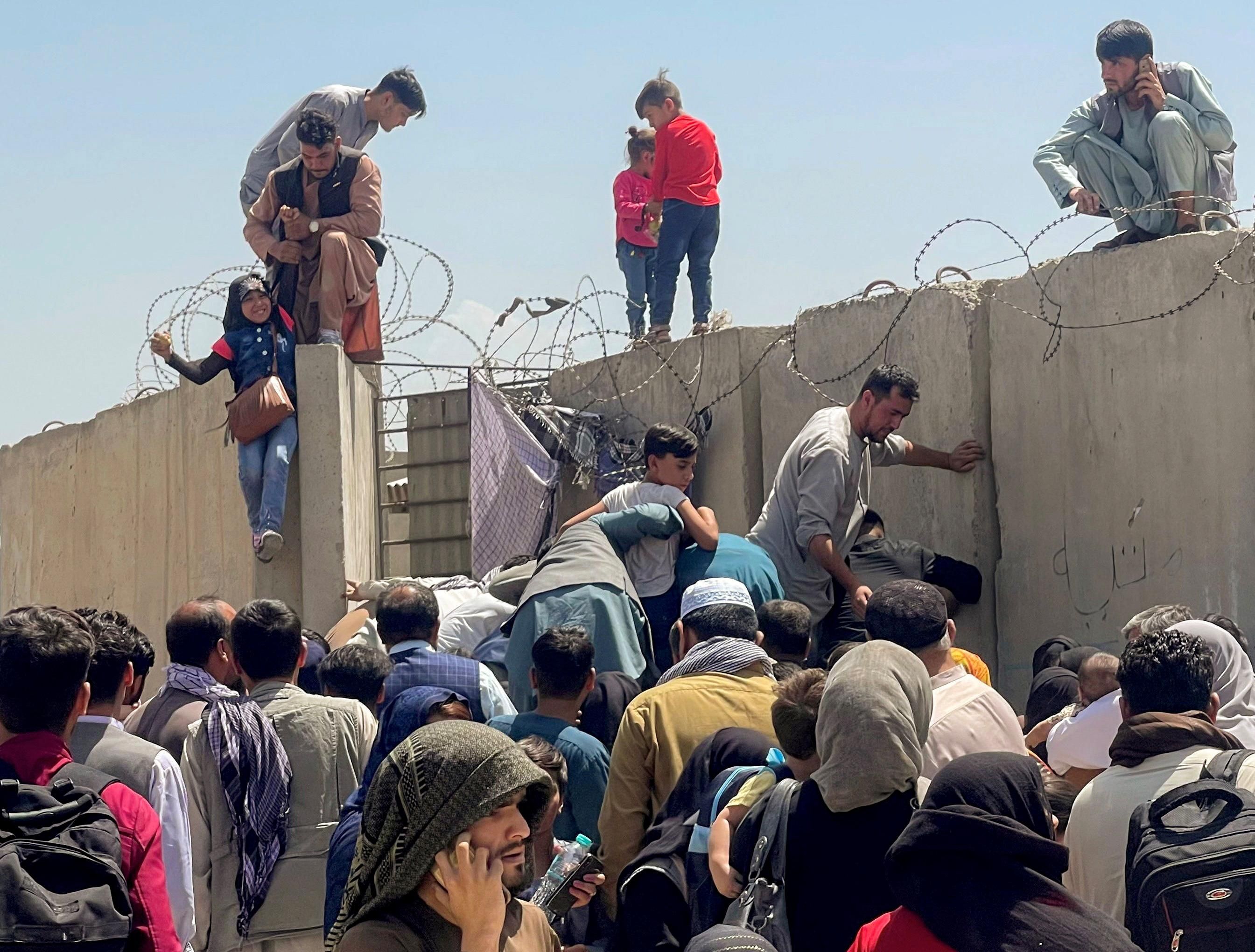
An influx of refugees. As the Taliban stormed dozens of provincial capitals, thousands of Afghans descended on the international airport in Kabul in hopes of fleeing the country. Scenes of anguished people clinging to a US military plane will forever be a symbol of Afghans’ desperation and struggle to escape Taliban terror. But there are no flights to carry these people out.
While the US has been accused of abandoning thousands of Afghans who aided the US-led mission over the past two decades, Canada has said that it will take in about 20,000 vulnerable Afghans, including women leaders and human rights activists. But that’s just the tip of the iceberg. Many analysts say that the burgeoning refugee crisis will soon land on Europe’s doorstep, drawing comparisons to 2015-2016, when more than 1 million refugees, mostly from Syria, arrived in Europe, fueling one of the biggest political crises in the bloc’s history.
Since then, the European Union has beefed up its immigration protocols and border control: surveillance drones are used to monitor migrant flows, and border fences have been constructed bloc-wide. Just days ago, several EU states signed a letter saying that despite the deteriorating situation in Afghanistan, deportations of failed asylum-seekers will continue: accepting refugees “would lead more people trying to leave and come to the European Union.” (However, Germany, the Netherlands, and France have since said they would hold off on deportations — for now.)
Tellingly, EU member states, like Greece — which bore the brunt of the migrant crisis in 2015 — say that they simply don’t have the state capacity to absorb the huge number of people trying to flee Afghanistan. Even German Chancellor Angela Merkel, a staunch refugee advocate, recently said: “we cannot solve all of these problems by taking everyone in.”
But “the risk to the EU is not from a short-term surge in Afghan refugees — the numbers will remain manageable,” Mujtaba Rahman, who leads Eurasia Group’s Europe desk, told GZERO Media. Rather, problems could arise “from the fractious internal debate it will sponsor, distracting from priorities elsewhere.”
The power of international recognition. The last time the Taliban were in power, they turned Afghanistan into an international pariah. While the group maintained relations with Pakistan, as well as with the UAE and Saudi Arabia, it was mostly isolated from the rest of the world.
But 2021 is very different to 2001. With the US more interested in leaving than dealing with the mess it’ll leave behind, in recent weeks senior Taliban leaders have embarked on a whirlwind diplomatic mission, trying to court Western rivals in Moscow and Beijing.
When the Taliban last ruled Afghanistan, Beijing had already suspended ties with Kabul after civil war erupted in 1993. But a pragmatic and increasingly ambitious China has made clear that it may be willing to recognize the Taliban’s rule in Afghanistan if it gives China carte blanche to expand its Belt and Road infrastructure development projects to Afghanistan.
Similarly, some analysts say that the Kremlin is also toying with the idea of recognizing the Taliban, and could use it as leverage to ensure Russian interests are safeguarded across Central Asia.
Meanwhile, the seemingly botched withdrawal is becoming a massive political crisis for the Biden administration both at home and abroad. Domestically, he’s being criticized on the left and right for the hasty pullout. With foreign allies, it’s further undercutting Washington’s global standing, which plummeted mostly under his predecessor. Even though Biden said in an address Monday that he “stands squarely behind” his own decision-making, the optics are very bad for a president who has made “America is Back” the rallying cry of his administration.
Rough road ahead. The situation is still in flux, and much could change in the upcoming days and weeks. For now, the Taliban is certainly in the driver’s seat, both domestically and internationally.
Op-Ed: Afghanistan’s rapid fall shows Biden was right to pull out
By Charles A. Kupchan August 16, 2021
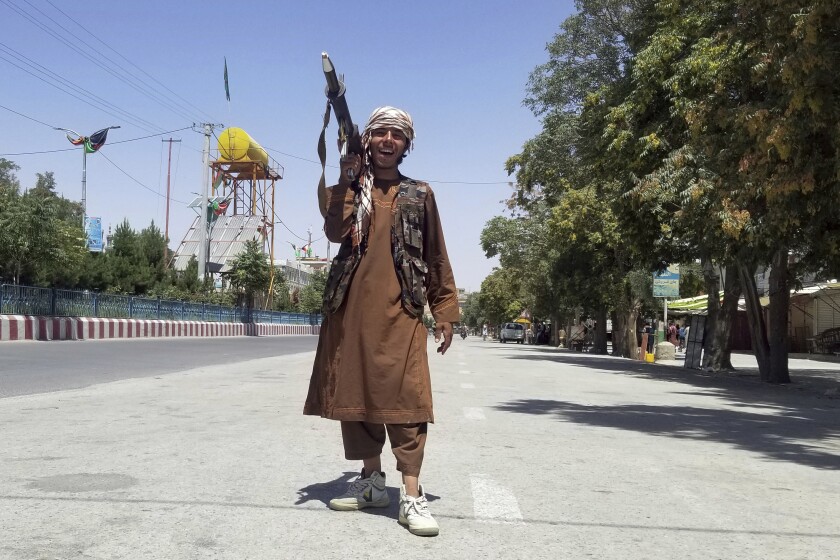
A Taliban fighter in Ghazni, an Afghan provincial capital, last week.
(Gulabuddin Amiri / Associated Press)
It has been excruciating to watch the Taliban roll across Afghanistan, undoing in a matter of months two decades of efforts by the Afghan people and the international community to build a decent, secure and functioning state.
The Taliban’s virtually uncontested takeover raises obvious questions about the wisdom of President Biden’s decision to withdraw U.S. and coalition forces from the country. However, the rapidity and ease of the Taliban’s advance provides a clear answer: that Biden made the right decision — and that he should not reverse course.
Biden doubted that U.S.-led efforts to prop up the government in Kabul would ever enable it to stand on its own. The international community took down Al Qaeda; beat back the Taliban; supported, advised, trained and equipped the Afghan military; bolstered governing institutions; and invested in the country’s civil society. None of that created Afghan institutions capable of holding their own.
That is because the mission was fatally flawed from the outset. It was a fool’s errand to try to turn Afghanistan into a centralized, unitary state. The country’s difficult topography, ethnic complexity, and tribal and local loyalties produce enduring political fragmentation. Its troubled neighborhoods and hostility to outside interference make foreign intervention perilous.
Biden made the tough and correct choice to withdraw and end a losing effort in search of an unattainable goal.
The case for withdrawal is also buttressed by the reality that even if the U.S. has fallen short on the nation-building front, it has achieved its primary strategic goal: preventing future attacks on America or its allies from Afghan territory. The U.S. and its coalition partners have decimated Al Qaeda in Afghanistan and Pakistan. The same goes for the Afghan branch of the Islamic State, which has demonstrated no ability to carry out transnational attacks from Afghanistan.
In the meantime, the U.S. has built a global network of partners with which to fight terrorism worldwide, share relevant intelligence and jointly boost domestic defenses against terrorist attacks. The U.S. and its allies are today much harder targets than they were on Sept. 11, 2001. Al Qaeda has not been able to carry out a major overseas attack since the bombings in London in 2005.
There is, of course, no guarantee that the Taliban won’t again provide safe harbor to Al Qaeda or similar groups. But that outcome is highly unlikely. The Taliban has been doing just fine on its own and has little reason to revive its partnership with the likes of Al Qaeda. The Taliban will also want to maintain a measure of international legitimacy and support, likely quashing any temptation to host groups seeking to organize terrorist attacks against foreign powers. Moreover, those groups have little incentive to seek to regroup in Afghanistan when they can do so more easily elsewhere.
Finally, Biden is right to stand by his decision to end the military mission in Afghanistan, because doing so is consistent with the will of the electorate. Most Americans, Democrats and Republicans alike, have lost patience with the “forever wars” in the Middle East. The illiberal populism that led to Donald Trump’s election (and near reelection) emerged in part as a response to perceived American overreach in the broader Middle East. Against a backdrop of decades of economic discontent among U.S. workers, recently exacerbated by the devastation of the pandemic, voters want their tax dollars to go to Kansas, not Kandahar.
The success of Biden’s effort to repair American democracy depends principally on delivering domestic investment; the infrastructure and social policy bills now moving through Congress are critical steps in the right direction. But foreign policy also matters. When Biden pledges to pursue a “foreign policy for the middle class,” he needs to deliver by pursuing a brand of statecraft that enjoys the backing of the American public.
Afghanistan deserves the support of the international community for the foreseeable future. But the U.S.-led military mission has run its course. Sadly, the best the international community can do for now is help alleviate humanitarian suffering and press Afghans to look to diplomacy, compromise and restraint as their country searches for a peaceful and stable political equilibrium.
Joe Biden’s Surrender Is an Ugly, Needless Disaster
Matt Lewis
–
With the Taliban retaking Afghanistan amid a frenzied U.S. exit, I am reminded that Robert Gates, Barack Obama’s defense secretary, famously said that Joe Biden has “been wrong on nearly every major foreign policy and national security issue over the past four decades.” That isn’t an exaggeration.
Biden opposed the Persian Gulf War (later, reversing his decision and saying George H.W. Bush should have gone all the way to Baghdad) and supported the Iraq War, before opposing the surge in Iraq (not to mention famously wanting to partition Iraq into three countries). As vice president, he opposed the raid that killed Osama bin Laden.
This brings us to Afghanistan. As recently as a month ago, Biden denied a Taliban takeover was inevitable. Everyone knew that was wrong. Everyone except Biden, I suppose. Based on his horrible track record, we can assume he was being sincere. If he wasn’t, he would have demanded a more responsible exit plan before proceeding.
Biden inherited an Afghanistan where Americans were suffering few casualties, and where a small residual force was seemingly maintaining some semblance of order (not to mention preventing the country from once again being used as a staging ground for international terrorists to launch attacks against the U.S.). With his what-could-go-wrong withdrawal, he has managed to turn it into the tragic debacle that is happening now in front of our eyes.
To be sure, Biden didn’t do it alone. His predecessor, Donald Trump, deserves much of the blame. Biden claims that, by withdrawing forces, he’s honoring his predecessor’s commitment. But he has reversed lots of other Trump policies, didn’t adhere to Trump’s May 1 deadline for withdrawal, and could have easily cited examples of the Taliban not living up to their side of the agreement as reason enough to scuttle the deal.
The point is that Biden was not locked in to following through with Trump’s unwise “America First” policy. As much as Trump deserves blame for this situation (and so much more), the fall of Afghanistan is happening on Biden’s watch. This is his rodeo. This is, if not his Vietnam, his fall of Saigon.
Now, Biden is rushing troops back into Afghanistan to try and end or at least mitigate the optics of a desperate evacuation that leaves translators and other allies and Afghans who’d depended on us behind. But it’s already terribly late, as the civilians waiting for flights that may never come can vouch.
Some people believe that Biden’s real problem was his execution. For example, why would he refuse to leave a residual force behind, and why would he time his withdrawal for the summer fighting season? With more prudent logistics and better timing, Biden might have bought a cushion of time between the U.S. withdrawal and the Taliban takeover. That would have resulted in better PR for Biden, but the fundamental problem was the decision to withdraw U.S. troops without leaving a residual force behind—not the hamfisted way he did it.
It could have been even worse. Biden originally had this insane idea of linking the Afghanistan withdrawal to September 11, and that may be why he couldn’t wait for the fighting season to end before giving in. In his mind, he somehow thought that ending a 20-year war on this particular date would be romantic and symbolic. And it would. For the Taliban!
In this pathetic departure, with American arms again ending up with our enemies as they did in Iraq, Biden is reinforcing the notion that our enemies can simply outlast us. Likewise, he is demonstrating (as Trump before him did with the Kurds) that putting your neck on the line for this nation is a fool’s errand. These decisions will make any future military interventions that more difficult.
This naivete is on full display with the anemic threats the U.S. is now issuing. Their behavior could lead to “international isolation.” Executions, our embassy warns, show a lack of “human rights.” It’s not a perfect analogy, but I am reminded of Die Hard, when John McClane tries to use a police radio to report a terrorist attack and is threatened with an FCC violation: “Fine, report me. Come the fuck down here and arrest me!” The Taliban are pillaging, executing and pressing 15-year-old girls into “service” as Taliban brides while we are threatening to, what, ruin their reputation in the international community?
In short, it’s a shit show. If you had told me 10 ten years ago that Biden would be elected president to clean up after Trump, I would have worried about precisely this kind of mess. Trump was so chaotic and dangerous that Biden, who (aside from his track record of bad foreign policy calls) had been a handsy gaffe machine, looked like Abe Lincoln by comparison. Today, however, we are witnessing the one-two punch of the Trump-Biden era. The scene unfolding in Afghanistan is exactly what you might expect from a policy that both men endorsed.
US Veterans View Afghan Collapse With Anguish, Rage and Relief
Dave Philipps
Ginger Wallace, right, a retired Air Force colonel, with her wife, Janet Holliday, a retired Army colonel, in Louisville, Ky., on Monday, August 16, 2021. (Andrew Cenci/The New York Times)
On Javier Mackey’s second deployment to Afghanistan, one of his friends was shot in an ambush and bled to death in his arms. He saw high-ranking Afghan officers selling off equipment for personal gain and Afghan troops running away during firefights. And he started wondering what the United States could really achieve by sending thousands of troops to a distant land that seemed to have never known peace. That was in 2008.
Mackey, an Army Special Forces soldier, deployed there five more times, was shot twice, and, he said, grew more cynical on each trip, until he decided the only sensible thing for the U.S. to do was cut its losses and leave.
Even so, seeing the swift and chaotic collapse of the Afghan government in recent days hit him with the intensity of a bomb blast.
“It’s pain — pain I thought I had gotten used to,” said Mackey, who retired as a sergeant first class in 2018 and now lives in Florida. “I sacrificed a lot, I saw death every year. And the guys I served with, we knew it would probably come to an end like this. But to see it end in chaos, it makes us angry. After everything we gave, I just wish there had been a way to leave with honor.”
In the 20 years that the U.S. military was in Afghanistan, more than 775,000 U.S. troops deployed there, to citylike air bases and sandbag outposts on lonely mountaintops. As the Taliban swept into Kabul on Sunday, wiping away any gains made, veterans said in interviews that they watched with a roiling mix of sadness, rage and relief. Some were thankful that America’s involvement in the country seemed to have ended, but were also dismayed that hard-won progress was squandered. Others were fearful for Afghan friends left behind.
In interviews, text messages and on Facebook, men and women who collectively spent decades in Afghanistan said they were angry that despite a drawdown that has spanned years, the United States could not manage to exit the country with more dignity.
The anguish can be especially raw because veterans often worked side by side with Afghans during the years of attempts at nation-building, and now in that nation’s collapse they see the individual faces of friends who have been enveloped by the anarchy.
“My heart breaks for the Afghan people,” said Ginger Wallace, a retired Air Force colonel who in 2012 oversaw a program that retrained low-level Taliban fighters to clear land mines and work in other jobs that offered an alternative to combat.
At the time, she thought that efforts to stabilize Afghanistan were succeeding, and that U.S. troops would one day leave the country a better place. But her optimism slowly wore down as the Taliban gained ground.
“It’s heartbreaking, absolutely. I hate to see it end like this, but you don’t know what else we could have done,” she said from her home in Louisville, Kentucky. “Do we have an expectation that U.S. service members should stay and fight the Taliban when the Afghan army won’t?”
Wallace met her wife, Janet Holliday, while deployed in Afghanistan. The two normally watch the news each morning, but Monday, as scenes of mayhem unfolded at the airport in Kabul, Holliday, a retired Army colonel, switched to the Food Channel.
“It was too hard to watch,” Holliday said, excusing herself as she became upset. “I just can’t help thinking about what a waste it is. I can’t allow myself to think about how after all that blood and treasure, it ends like this.”
More than with other wars in the nation’s history, Americans have been mostly insulated from the fighting in Afghanistan. There was no draft or mass mobilization. Less than 1% of the nation served and a disproportionate number of troops came from rural counties in the South and West, far from the seats of power.
But veterans have said in interviews over the years that they were cleareyed about the challenges posed by the war, perhaps more so than the rest of the nation. They saw firsthand the deeply ingrained traditional cultures, tribal allegiances and endemic corruption that continually hobbled U.S. efforts.
Mackey agreed with President Joe Biden’s decision to withdraw, but thought the way it was done was slapdash and unprofessional.
“We train to have contingencies. The way it was handled was just irresponsible,” Mackey said. “We didn’t want to have another Vietnam, we wanted to do better.”
Jake Wood was a 25-year-old Marine sniper deployed to a forgotten corner of Afghanistan in 2008 when he started to see how much daylight there was between the optimistic pronouncements of top U.S. leaders and the reality of serving with Afghans on the ground.
Villagers in the district center of Sangin, where he manned an outpost, seemed to have little allegiance to the Afghan government in Kabul or the U.S. vision of democracy.
“We had no idea what our mission was, even back then,” said Wood, who now runs the nationwide veteran volunteering network Team Rubicon. “Were we trying to defeat the Taliban? Were we nation-building? I don’t think we knew.”
The Afghans he served with seemed to accept the uncertainty with a weary fatalism foreign to young Marines. At one point over small cups of tea, he said, he spoke with a young Afghan he served with who said Afghanistan only knows war, and when the U.S. war ended, another would come.
“He told me that maybe the Americans would come back,” Wood said. Then he recalled the Afghan saying, “But if you do, I can’t tell you if we’ll be friends or enemies.”
Wood said the veterans he has been in touch with feel a mix of sadness and fury watching the fall of Kabul: sadness that the folly that seemed so obvious in the ranks took years and thousands of lives for top leaders to accept; fury that the result of that ignorance and hubris was playing out on cable television in a way that would tarnish the reputation of the nation and the hundreds of thousands of troops who fought.
“We already knew we were losing the war,” he said. “But now we are losing it live on TV in front of the rest of the world. That’s what’s so hard.”
The Taliban now controls one of the world’s biggest lithium deposits
By Tim McDonnell, Climate reporter August 16, 2021
REUTERS/MOHAMMAD ISMAIL.
Illegal mining of lapis lazuli, a gem, is a major source of revenue for the Taliban.
When Taliban fighters entered Kabul on Aug. 15, they didn’t just seize control of the Afghan government. They also gained the ability to control access to huge deposits of minerals that are crucial to the global clean energy economy.
In 2010, an internal US Department of Defense memo called Afghanistan “the Saudi Arabia of lithium,” after American geologists discovered the vast extent of the country’s mineral wealth, valued at at least $1 trillion. The silvery metal is essential for electric vehicles and renewable energy batteries.
Ten years later, thanks to conflict, corruption, and bureaucratic dysfunction, those resources remain almost entirely untapped. And as the US looks to disentangle its clean energy supply chains from China, the world’s top lithium producer, to have Afghanistan’s minerals under Taliban control is a severe blow to American economic interests.
“The Taliban is now sitting on some of the most important strategic minerals in the world,” said Rod Schoonover, head of the ecological security program at the Center for Strategic Risks, a Washington think tank. “Whether they can/will utilize them will be an important question going forward.”
Minerals are a double-edged sword for Afghanistan
Global demand for lithium is projected to skyrocket 40-fold above 2020 levels by 2040, according to the International Energy Agency, along with rare earth elements, copper, cobalt, and other minerals in which Afghanistan is naturally rich. These minerals are concentrated in a small number of pockets around the globe, so the clean energy transition has the potential to yield a substantial payday for Afghanistan.
In the past, Afghan government officials have dangled the prospect of lucrative mining contracts in front of their US counterparts as an enticement to prolong the American military presence in the country. With the Taliban in charge, that option is likely off the table.
But Ashraf Ghani, the World Bank economist-turned-Afghan president, who fled the country the day of the Taliban takeover, saw the minerals as a potential “curse.” For one, most economists agree that mineral riches breed corruption and violence, particularly in developing countries, and that they often fail to yield many benefits for average citizens. At the same time, the Taliban have long illegally tapped the country’s minerals (especially lapis lazuli, a gem) as a source of up to $300 million in annual revenue for their insurgency.
What happens now that the Taliban is in control
The Taliban can’t simply flick a switch and dive into the global lithium trade, Schoonover said. Years of conflict have left the country’s physical infrastructure—roads, power plants, railways—in tatters. And at the moment Taliban militants are reportedly struggling even to maintain the provision of basic public services and utilities in the cities they have captured, let alone carry out economic policies that can attract international investors.
Competing factions within the Taliban would make it very difficult for any company to negotiate mining deals, and China is unlikely to extend to the group the scale of infrastructure loans that would be required to bring any sizable mining operations online, said Nick Crawford, a development economics researcher at the International Institute for Strategic Studies think tank. That’s especially true after Chinese investors got burned on a $3 billion copper mining project in Afghanistan, that started in 2007 and failed to produce anything, largely because of challenges related to the lack of infrastructure.
“As long as there are safer and more reliable sources elsewhere, full utilization of Afghan minerals is likely to remain slow,” Schoonover said. However, China and Russia are already retaining diplomatic ties with the Taliban, and will almost certainly do business with the new regime on its home turf.
One reason for China to do so, Crawford said, could be to offshore some of the localized environmental destruction that comes with rare earth and lithium mining. In that case, mining is likely to add to the range of other environmental hazards—including water scarcity, air pollution, and extreme weather disastersrelated to climate change—already faced by the Afghan people.
Cover crop usage sets record as farmers see environmental, financial benefits
Andy Knight, The Herald Bulletin, Anderson, Ind.
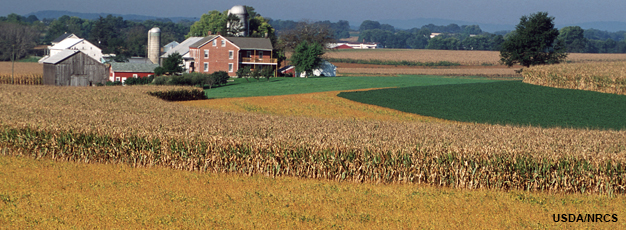
Aug. 14—FRANKTON — Most of the fields surrounding Mike Shuter’s farm in western Madison County had blossomed with corn and soybeans by early August.
But one, situated next to a winding driveway leading to the farmhouse, featured much smaller and less conspicuous greenery.
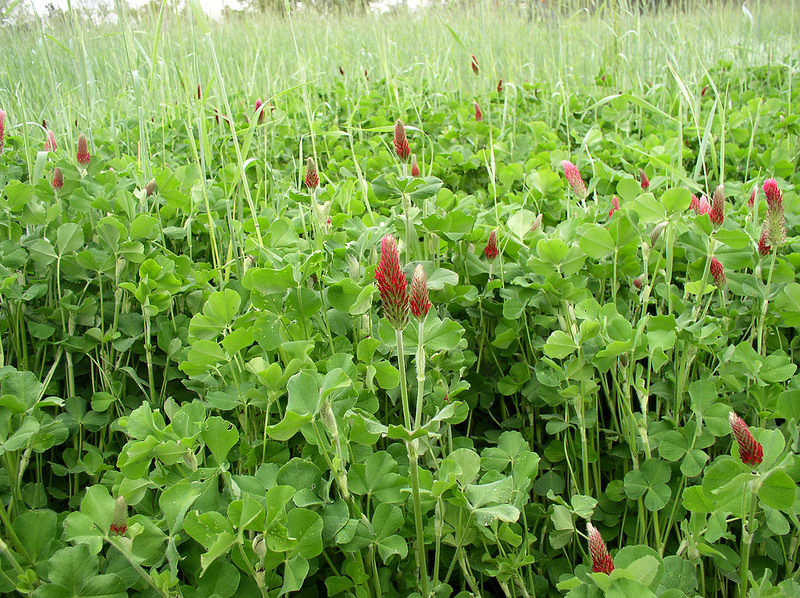
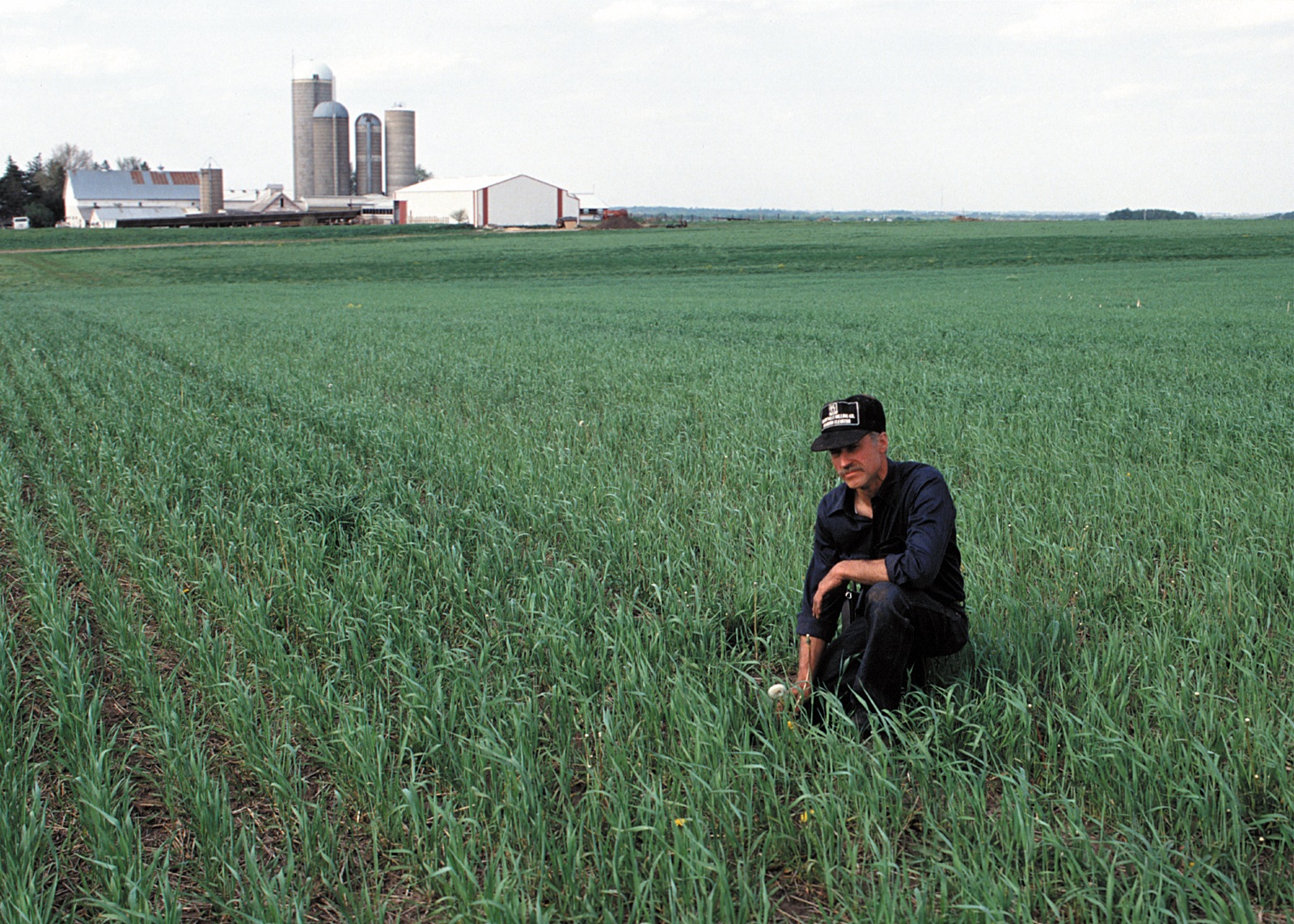
That 180-acre plot, Shuter said, is being used to grow buckwheat seed for use as a cover crop. Once fully grown — probably by early October — it will be harvested and replanted elsewhere to ensure that the microbes in the soil remain healthy, and that the soil itself will remain suitably porous throughout the winter months.
“It’s kind of an ongoing learning process,” said Shuter, the president of Shuter Sunset Farms, a fourth-generation family farm specializing in corn, beans, cattle and pork production. The operation covers about 3,000 acres in the northern and western parts of the county. “The more we understand about soil health and the microbes in the soil and how we’re helping them with cover crops, the deeper we get involved with it.”
Shuter and hundreds of other farmers across Indiana are integrating cover crops into their operations more than ever. According to a recent survey commissioned by the Indiana State Department of Agriculture, the state’s farmers set a record this year by planting an estimated 1.5 million acres of cover crops, also known as overwinter living covers.
Cover crops are important, advocates say, because they promote a variety of environmental benefits. In addition to improving overall soil health by adding living roots to the soil over a greater time period each year, they also improve water filtration and increase organic matter in the soil. Some cover crops, such as legumes, also serve as natural fertilizers.
Shuter began experimenting with cover crops in 2009, and over the years he’s seen technology improve to a point where fine-tuning the ingredients in different herbicides is a more seamless process.
“Part of it was networking with other producers across Indiana and some other states and learning what their experiences have been,” he said. “We still try to network in and out, trying to help other producers understand what we’ve learned and still learning from some other good friends as well.”
By keeping roots in the ground throughout the winter, cover crops can also act as natural filters for ground water, which can prevent sediment from moving into nearby waterways, thus keeping the water supply cleaner.
“All those root channels help us capture those early spring rains,” said Jill Hoffmann, executive director of the White River Alliance, an Indianapolis-based nonprofit organization that promotes the improvement and protection of water resources in Central Indiana. “We’re also sequestering carbon, which helps us with climate change, and it helps the soil hold more water, so that can prevent loss during drought.”
The recent survey, conducted by the Indiana Conservation Partnership, estimated that 1.6 million tons of sediment was prevented from entering the state’s waterways. The practice of cover crop planting also kept approximately 4.1 million pounds of nitrogen and more than two million pounds of phosphorus out of lakes, rivers and streams, the study found.
“By increasing our cover crop practices, we are keeping Indiana waterways and soil healthier for future planting seasons and the next generation of farmers,” Lt. Gov. Suzanne Crouch said in a news release.
Shuter said he normally plants cereal rye ahead of soybeans and rye grass ahead of corn. He’s also taken part in crop study programs through the local Purdue Extension office, as well as other programs that have helped him refine his approach to using cover crops.
“We’ve had a few field days over the years where we talk about cover crops,” he said. “About 20% of our operation is organic now, and we’re using cover crops even more intensely in that. There’s a lot of things we’ve learned that we’ve been able to take advantage of in the years of experience we’ve got.”
In addition to environmental benefits including pollution prevention and carbon sequestration, conservationists say the practice also improves farmers’ bottom line.
“This year’s data may be surprising to some considering the tough farm economy this past year, but over time, our farmers have learned that incorporating a comprehensive management system into their operations that includes cover crops…helped improve the sustainability and productivity of their soils, said Indiana State conservationist Jerry Raynor. “As a result, farmers are sequestering more carbon, increasing water infiltration and improving wildlife and pollinator habitat — all while harvesting better profits and often better yields.”
Hoffmann said it’s encouraging to see many of the state’s farmers recognizing that they can play a role in preserving — and even bettering — the environment.
“As we look at the challenges that we’re facing environmentally, we all have our part to play,” she said. “To see farmers adopting these practices that not only benefit their operations, but also protect our water supply, it’s encouraging to me that they’re taking these actions.”
The Atlantic: The driving force behind ocean circulation and our taste for cod
Suzanne OConnell, Harold T. Stearns Professor of Earth Science, Wesleyan University and Pascal Le Floc’h, Maître de conférences, économiste, laboratoire Amure (UBO, Ifremer, CNRS), Université de Bretagne occidentale
Fishing boats coming into Le Guilvinec, Brittany, France, at the end of the day. Photoneye/Shutterstock
The answer? Yes, over millions of years. And it was the breakup of the supercontinent Pangea, starting some 180 million years ago, that began creating the Atlantic Ocean basin as we know it today.
Earth’s surface is made up of intersecting tectonic plates. For much of our planet’s history these plates have been bumping into one another, forming chains of mountains and volcanoes, and then rifting apart, creating oceans.
When Pangea existed it would have been possible to walk from modern Connecticut or Georgia in the U.S. to what is now Morocco in Africa. Geologists don’t know what causes continents to break up, but we know that when rifting occurs, continents thin and pull apart. Magma intrudes into the continental rocks.
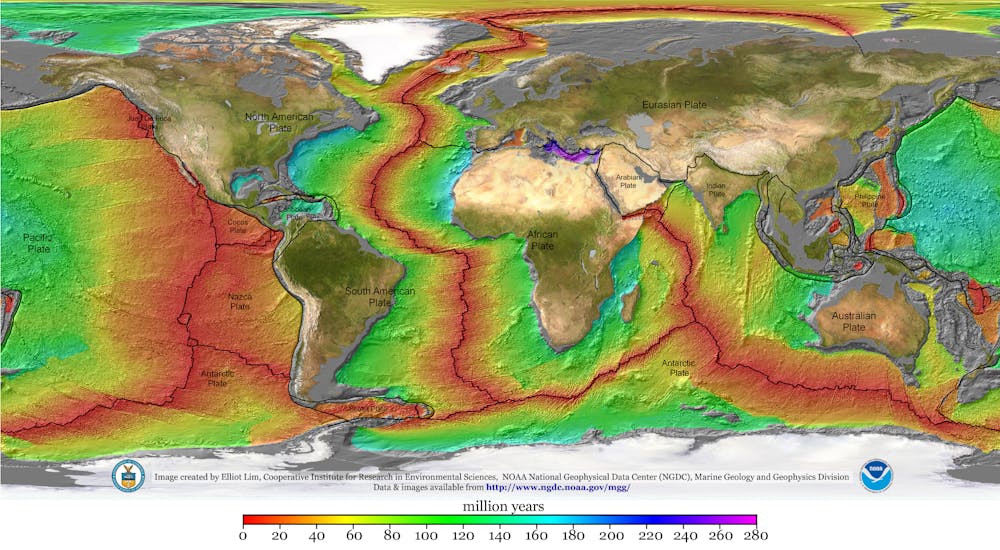
The oldest portions of crust in the Atlantic Ocean lie off of North America and Africa, which were adjacent in Pangea. They show that these two continents separated about 180 million years ago, forming the North Atlantic Ocean basin. The rest of Africa and South America rifted apart about 40 million or 50 million years later, creating what is now the South Atlantic Ocean basin.
Magma wells upward from beneath the ocean floor at the Mid-Atlantic Ridge, creating new crust where the plates move apart. Some of this ocean crust is younger than you or me, and more is being created today. The Atlantic is still growing.
World map with colored zones showing age of ocean plates
Winds and currents
Once the ocean basin formed after Pangea’s breakup, water entered from rain and rivers. Winds began to move the surface water.
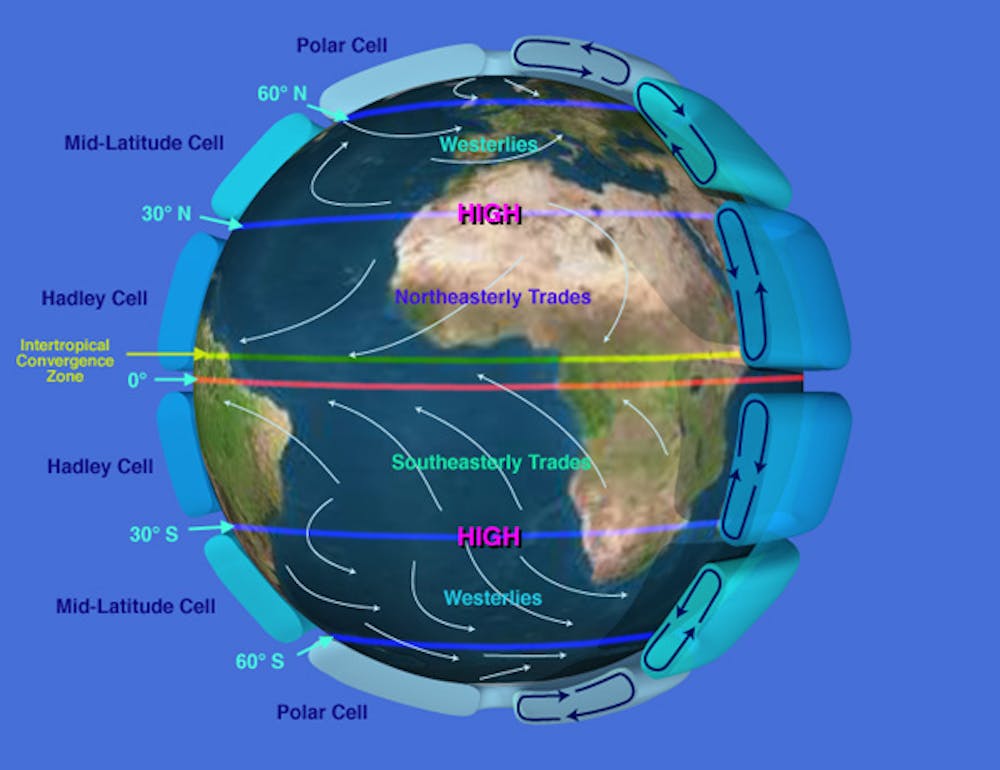
Thanks to the unequal heating of Earth’s surface and its rotation, these winds blow in different directions. The Earth is warmer at the equator than near the poles, which puts air in motion. At the equator the planet’s heat causes moist air to warm, expand and rise. At the polar regions cold, dry, heavier air descends.
This motion creates “cells” of rising and descending air that control global wind patterns. Earth’s rotation dictates that different parts of the globe travel at different speeds. At a pole, a molecule of air would just spin around, while a particle of air at the equator in Quito, Ecuador, would travel 7,918 miles (12,742 kilometers) in a single day.
This different movement causes the air cells to break up. For example, in the Hadley Cell, tropical air, which rose at the equator, cools in the upper atmosphere and descends at about 30 degrees north and south latitude – roughly, near the northern and southern tips of Africa. Earth’s rotation turns this descending air, creating trade winds that flow from east to west across the Atlantic and back to the equator. At higher latitudes in the North and South Atlantic, the same forces create mid-latitude cells with winds that blow from west to east.
Atmospheric circulation diagram
As air flows across the ocean’s surface, it moves water. This creates a circulating system of gyres, or rotating currents, that move clockwise in the North Atlantic and counterclockwise in the South Atlantic. These gyres are part of a global conveyor belt that transports and redistributes heat and nutrients throughout the global ocean.
The Gulf Stream, which follows the U.S. East Coast before heading east across the North Atlantic, is part of the North Atlantic gyre. Since the current carries warm water north, it is easy to see on false-color infrared satellite images as it transports heat northward. Like a river, it also meanders.
Moving water masses
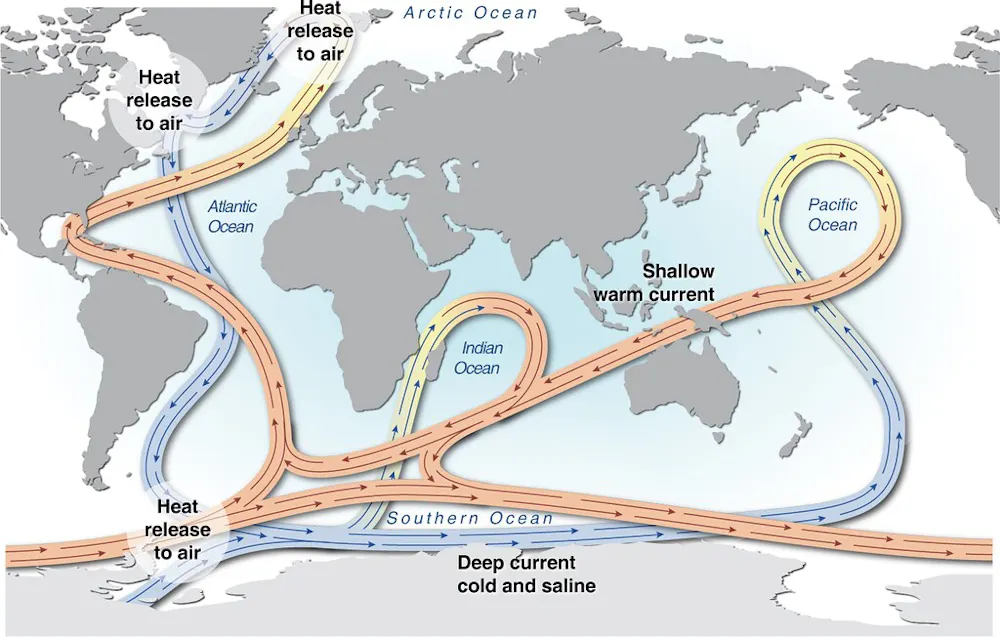
These wind-blown surface currents are important for many reasons, including human navigation, but they affect only about 10% of the Atlantic’s volume. Most of the ocean operates in a different system, which is called thermohaline circulation because it is driven by heat (thermo) and salt (saline).
Like many processes in the ocean, salinity is tied to weather and circulation. For example, trade winds blow moist air from the Atlantic across Central America and into the Pacific Ocean, which concentrates salinity in the Atlantic waters left behind. As a result, the Atlantic is slightly saltier than the Pacific.
This extra salinity makes the Atlantic the driving force in ocean circulation. As currents move surface waters poleward, the water cools and becomes more dense. Eventually at high latitudes this cold, salty water sinks to the ocean floor. From there it flows along the bottom and back toward the the opposite pole, creating density-driven currents with names such as North Atlantic Deep Water and Antarctic Bottom Water.
Thermohaline circulation map
As these deep currents move, they collect surface organisms that have died and fallen to the bottom. With time, the organisms decompose, filling the deep water with essential nutrients.
In some locations this nutrient-rich water rises back up to the surface, a process called upwelling. When it reaches the ocean’s sunlit zone, within 650 feet (200 meters) of the surface, tiny organisms called phytoplankton feed on the nutrients. In turn, they become food for zooplankton and larger organisms higher up the food chain. Some of the the Atlantic’s richest fishing grounds, such as the Grand Banks to the southeast of Newfoundland in Canada and the Falkland/Malvinas Islands in the South Atlantic, are upwelling areas.
Much about the Atlantic remains to be discovered, especially in a changing climate. Will rising carbon dioxide levels and resulting ocean acidification disrupt marine food chains? How will a warmer ocean affect circulation and hurricane intensity? What we do know is that the Atlantic’s winds, currents and sea life are intricately connected, and disrupting them can have far-reaching effects.
Atlantic cod fishing
Now, let’s head back up to the surface, and into the wake of the first sailboats that set out to fish for cod along the Canadian coast. These pioneering ships paved the way for greater exploitation of the Atlantic’s wealth of fishery resources – particularly cod. Communities of people greatly benefited from these resources over the following centuries, until the threat of overfishing became impossible to ignore.
The history of fishing in the Atlantic is often said to trace back to the discovery of the cod-rich Canadian waters of Newfoundland, attributed to Italian navigator and explorer John Cabot, who led an English expedition there in 1497. From the 16th to the 20th centuries, cod-fishing mania swept European fleets. Between 1960 to 1976, ships from Spain, Portugal and France were responsible for 40% of the catch. However, in 1977 Canada extended its territory offshore by 200 miles, taking possession of the Newfoundland cod fisheries, which accounted for 70% of cod production in the Northwest Atlantic.
Fishermen aboard a boat with a haul of cod.
George Kristiansen/Shutterstock
For five centuries, the only thing that mattered was the size of the catch. This drove innovations in the design and equipment of fishing boats. The sailboat cod-fishing industry in Newfoundland and Iceland hit its peak in the late 19th century; from 1800 to 1900, France – the main fishing operator alongside Britain – outfitted more than 30,000 schooners.
At the end of the 19th century, the rowboat was replaced by the dory, a small (two-person) boat from North America, which sharply increased production. A plaque commenting on the new safety of the dory in the French Museum of Fisheries, in Normandy – dedicated to the history of commercial cod fishing – noted that the hazard of losing a man overboard was “built into the mindset of cod-fishing.” But by the early 20th century, steamers had begun to replace these boats.
New productivity gains came with new techniques, such as using back-trawling instead of side-trawling in the 1950s and 1960s, alongside reduced crew sizes.
The biggest cod catch, at nearly 1.9 million tons, was recorded in 1968. After that, overall production declined year after year, reaching less than a million tons in 1973. Numbers slowly picked up again in the 1980s after European fleets were excluded from the Newfoundland area, but this comeback was short-lived. On July 2, 1992, the Canadian government announced a moratorium on cod fishing, confirming that populations had collapsed. This collapse in the northwestern Atlantic has since become a textbook example of the risks of overfishing.
The wider catch
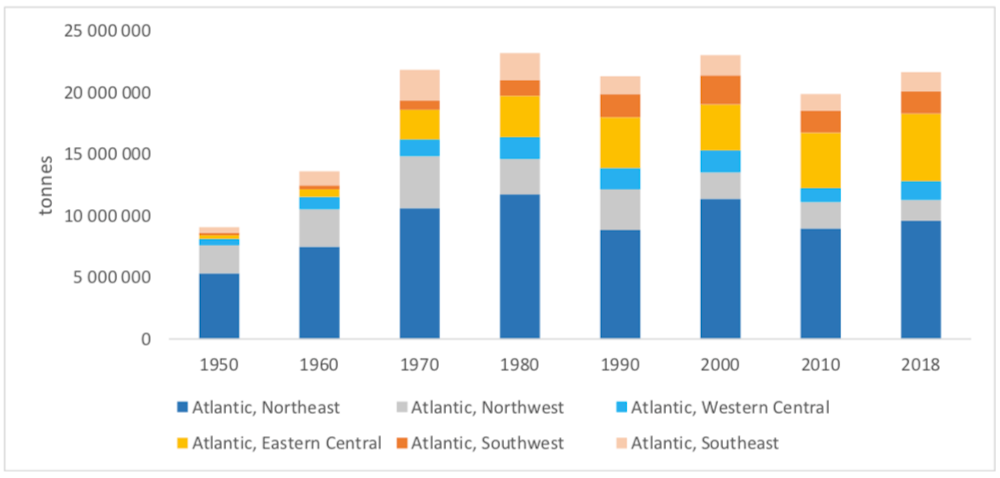
Seafood production in the Atlantic went from an estimated 9 million tons in 1950 to more than 23 million tons in 1980 and 2000, and 22 million tons in 2018. This overall production has remained stable since 1970.
In the North Atlantic, whiting and herring are the two most fished species by tonnage. Sardine and sardinella hold the top spots in the Central Atlantic. In the South Atlantic, mackerel and Argentine hake dominate the catch.
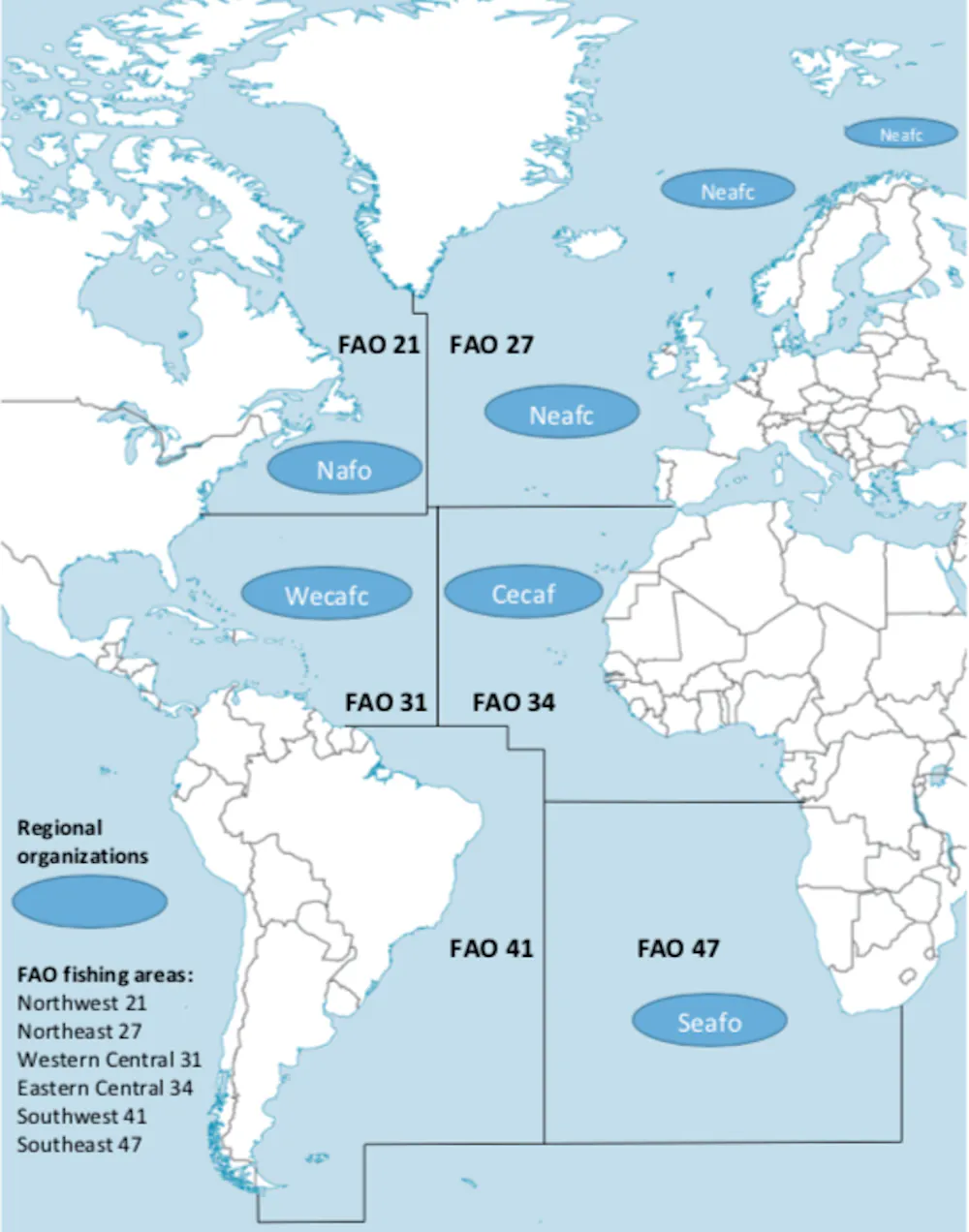
The Food and Agriculture Organization of the United Nations (FAO) has identified six production areas in the Atlantic Ocean, divided up cardinally, as shown on the map below. In 1950, these various areas accounted for 52% of the worldwide catch. From 1960 to 1980, this proportion went down to 37% to 43%. Since 1990, one-quarter of global seafood production is caught by fleets operating in the Atlantic.
Nearly 60% of seafood production now comes from fisheries in the Pacific Ocean, and 15% from the Indian Ocean.
The northeastern Atlantic (FAO Area 27) covers fisheries operated by European fleets. This area is, by far, the most bountiful of the entire Atlantic zone, with a total catch of 9.6 million tons in 2018.
Norway took the lead for seafood production by tonnage (2.5 million tons) in 2018, ahead of Spain (just under a million tons). It is also the most diversified zone, with more than 450 commercial species.
The northwestern Atlantic (FAO Area 21) stretches from the Rhode Island and Gulf of Maine coastlines in the U.S. to the Canadian coasts, including the Gulf of Saint Lawrence and the waters of Newfoundland and Labrador. Cod has dominated the history of fishing in this area since the 16th century. The biggest overall catch was recorded in 1970, at more than 4 million tons. But, after 1990, that number dropped, as a consequence of the 1992 moratorium. Since 2000, the northwest area has accounted for around 10% of the Atlantic catch (1.7 million tons in 2018). There are 220 monitored species in the area.
Eastern Central Atlantic (FAO Area 34) stretches from the Moroccan to the Zairian coasts. Species caught include sardine, anchovy and herring. In 2018, this area accounted for a quarter of the total seafood production of all six Atlantic areas. That same year, West African fisheries recorded the second biggest catches after the northeastern Atlantic. The high number of commercial species identified by the FAO sets this region apart, at nearly 300.
Western Central Atlantic (FAO Area 31) stretches from the southern U.S. to the north of Brazil, including the Caribbean. Since 1970, catch size has remained between 1.3 million and 1.8 million tons (5% to 10% of the entire Atlantic catch). Lobster and shrimp are the target species in the Caribbean waters.
Southeast Atlantic (FAO Area 47) connects the African coastlines of Angola, Namibia and South Africa. Production surpassed 2 million tons in 1970 and 1980, accounting for 10% of the total Atlantic catch. Since 1990, the catch has been stable, with a plateau of 1.5 million tons. It’s the least diversified region in the Atlantic, with 160 species monitored by the FAO. Mackerel, hake and anchovy make up 59% of total production.
Southwest Atlantic (FAO Area 41), which stretches along the coastlines of Brazil, Uruguay and Argentina in South America, was the lowest-producing of the six areas until 1980. It recorded no more than 5% of the total Atlantic catch. But from 1990, fisheries produced 1.8 million to 2 million tons (8% to 10% of the overall catch). This can be attributed to investment from the Argentinian government into fishing fleets in the 1980s. Some 225 commercial species are being statistically monitored, with 52% of total production coming from hake, shortfin squid and shrimp.
Protecting the entire ecosystem
At a time when scientific research predicts that all living marine resources will be exhausted by 2048, a new fisheries approach is required to avoid new tragedies, like the one that befell the cod populations in the northwestern Atlantic.
In this context, protecting ecosystems has become a priority. This growing acknowledgment of the impacts of fishing is a direct result of the successful work undertaken by ecological and social science researchers since the 1970s, who placed the concept of resilience at the heart of their studies.
This new ecosystem-based management approach, now inscribed in law in Europe and Canada, has been positive. A similar U.S. policy was revoked by President Donald Trump, but likely will be restored by incoming president Joe Biden. However, there is still work to do to tackle the main challenge – making this approach a reality in all Atlantic fisheries.
‘I can’t do it’: Portland residents battle grueling heat in unprecedented summer
Dani Anguiano in Portland
Photograph: Mathieu Lewis-Rolland/Reuters
“No, no, no,” Linda Longoria cried as she heard the weather forecast for Portland, Oregon on Friday: 100F (38C). “I can’t do it. Even in the shade it’s so humid.”
Longoria, 65, and her son are homeless and stay in hotels when they can but sometimes are forced to sleep outdoors. A lifelong resident of the city, she shook her head: “A heatwave in Portland. It’s not usually like this.”
Less than two months after seeing its highest temperature on record, 116F, the city of 645,000 was facing more grueling temperatures from yet another intense heatwave scorching the Pacific north-west.
People make use of Multnomah county’s Arbor Lodge cooling center on Thursday.Photograph: Dave Killen/AP
Temperatures in Portland climbed to 103F on Thursday while Bellingham, Washington, hit 100F for the first time. Seattle reached highs in the 90s. Much of the region was under an excessive heat warning through Saturday.
Portland typically sees mild summers with temperatures in the eighties in August. The heatwave, the second of the summer, is particularly dangerous in a region unaccustomed to such extreme heat. Ninety-six Oregon residents died in the June heatwave; 60 were Portland residents. The occurrence of that heatwave would have been virtually impossible without human-caused climate change, a detailed scientific analysis has found.
As the temperatures climbed in south-east Portland on Friday, streets were quieter than normal, save for a handful of cars and scattered cyclists. A haze of smoke from nearby wildfires covered the sky, which forecasters said could help keep temperatures on Friday and Saturday slightly lower than predicted. Some restaurants, food trucks and coffee shops closed early for the day, leaving notes of apology on their doors, citing the heatwave.
Meanwhile, the city closed its outdoor pools on Thursday and Friday afternoon to “protect all visitors and staff”.
Portland ranks third among the least air-conditioned US cities – about 70% of homes have air conditioning. Oregon’s governor, Kate Brown, and the Portland mayor, Ted Wheeler, declared a state of emergency earlier in the week due to the heat, and officials opened cooling centers across the city and state.
A county pool sits closed due to inclement weather, as a heatwave continues in Portland.Photograph: Mathieu Lewis-Rolland/Reuters
“Not everyone has a place to get cool. This climate doesn’t usually get this hot and it’s important people have a place to rest,” said Jake Dornblaser, who was overseeing a cooling center at a middle school in south-east Portland. “There are so many people in Portland that need access to resources.”
The center, which is open 24 hours a day through Sunday, provides people with food, water, beds and other basic items. Longoria had been sitting nearby in the heat with her son when a couple stopped to tell them about the center.
“I was so thankful. My son – he’s in a wheelchair with a broken leg. We were both hot sitting outside. We had never heard of this,” she said.
Crosby Lundbom and Destin Hornych make a water delivery during the heatwave in Portland.Photograph: Mathieu Lewis-Rolland/Reuters
The 65-year-old, who uses a walker, said she relied on water bottles and wet bandanas to survive the summer heat, but that this year had been particularly difficult. Longoria and her son lost their house in the city after her husband died.
“I’m gonna reminisce about my house and then walk in,” she said, looking at the cooling center.
Opinion: Where have all the climate change deniers gone?
Paul Thornton
An 8-year-old child looks at flames near his backyard in Monrovia as the Bobcat fire burns on Sept. 15, 2020. (Los Angeles Times)
In 2013, I unintentionally touched off a journalistic controversy when, in a short piece on counterfactual letters to the editor, I mentioned that denying the existence of evidence for climate change was an example of the kind of factual inaccuracies I try to keep off the page. A follow-up explaining my thinking as an editor on this drew more controversy. In many quarters at the time, climate change denial was considered a mainstream opinion occasionally worthy of print space.
Since the IPCC report was released Monday, our readers have expressed everything from despair to resolve to curb climate change. Letters denying the science still trickle in, but this isn’t anything like 2013.
To the editor: The Times’ Aug. 9 editorial on the U.N. climate report focuses on world leaders and their policies. But as one reader wrote in response to an earlier editorial on President Biden’s electric vehicle push, “Industrial policy is a fool’s errand…. Tastes, incomes and production costs determine what gets bought and sold.”
If that’s the case, then let’s change our tastes, incomes and production costs.
As consumers we can stop buying stuff we don’t need. As manufacturers we can choose not to be overcompensated. We can use the savings in executive salaries to ease production costs and boost the incomes of frontline workers, who could then afford to buy stuff they do need. We can embrace a simpler lifestyle that places less of a burden on the planet.
None of this requires government regulation or policy. What it requires is looking around and asking, whether it’s stuff or money, do I need all this?
Mary Bomba, Los Angeles
To the editor: Even as The Times’ pages fill with scientific warnings about how quickly we must act to avoid the worst of global warming, a Bloomberg article on your Business pages tells us that U.S. carbon emissions will surge this year. The economy is springing back and fossil fuel use is increasing.
The market prices of coal, oil and natural gas in no way reflect the catastrophic effects they are having on our planet. This is why “business as usual” cannot be allowed to continue. Putting a rapidly escalating tax on carbon is essential to rendering fossil fuels less and less attractive economically. That in turn will accelerate the adoption of alternatives.
New fossil fuel exploration should cease now. Clean-energy infrastructure must be placed on a war footing. Conservation, forestation and many other solutions clamor for implementation. And poor nations must be helped by rich ones.
It is high time for the world, led by the U.S., to accept we are all in the same boat that will founder unless we get serious.
Grace Bertalot, Anaheim
To the editor: I do not accept the idea that our response to climate change will fail as it has with the pandemic.
Reducing greenhouse gasses does not rely on micro-level decisions made by individuals. Rather, it depends on the macro policies put in place by government. Placing a substantial price on carbon at its source is the best way to significantly impact global temperatures.
For inspiration, we can look back on the 1980s. It was then that the world became aware of the enlarging hole in the atmosphere’s ozone layer, created by the use of chlorofluorocarbons (CFCs) in aerosol products, refrigeration and air conditioning.
Though initially skeptical about the need for government intervention, President Reagan listened to the science and, ultimately, signed onto the Montreal Protocol of 1987, a global treaty to phase out CFCs. Reagan realized that government needed to quickly address this emergency and, consequently, incentivize the production of CFC-free products.
Likewise, private citizens alone cannot solve climate change. Our environmental story will not echo our COVID-19 tragedy if government does what it is meant to do: Act in big ways to solve big problems.
Sarah Freifeld, Valencia
To the editor: Our beautiful and wondrous planet will undoubtedly regenerate itself and go on with or without humans. What is truly threatened or may need saving right now is humanity.
Perhaps natural selection is already playing out. When the human animal does nothing to protect its young by refusing vaccination, consumes products it does not need, flies in planes and goes on cruises and burns fossil fuels while the very life systems that support it are contaminated and altered by its activities, what else are we to conclude?
It would have been nice if humans could have heeded the wake-up call that was COVID-19. It is beyond sad that we are taking many non-human animals and plants down with us in the mass extinction crisis that is happening right now.
But there is hope. Nature bats last.
Gina Ortiz, Claremont
To the editor: In 1968, I went to a movie theater and watched a blockbuster science fiction movie. The shocking twist ending, that we had destroyed our planet, brought the character played by Charlton Heston to his knees in horror.
Today, my horror is that “Planet of the Apes” was not necessarily science fiction.