Clarence Thomas’s $267,230 R.V. and the Friend Who Financed It

By Jo Becker and Julie Tate – August 5, 2023

The vehicle is a key part of the justice’s just-folks persona. It’s also a luxury motor coach that was funded by someone else’s money.

Justice Clarence Thomas and his great-nephew stand outside, in front of a gold-and-black motor coach.
Justice Clarence Thomas, circa 2000, with his great-nephew and his Prevost Le Mirage XL Marathon motor coach.

Justice Clarence Thomas met the recreational vehicle of his dreams in Phoenix, on a November Friday in 1999.

With some time to kill before an event that night, he headed to a dealership just west of the airport. There sat a used Prevost Le Mirage XL Marathon, eight years old and 40 feet long, with orange flames licking down the sides. In the words of one of his biographers, “he kicked the tires and climbed aboard,” then quickly negotiated a handshake deal. A few weeks later, Justice Thomas drove his new motor coach off the lot and into his everyman, up-by-the-bootstraps self-mythology.

There he is behind the wheel during a rare 2007 interview with “60 Minutes,” talking about how the steel-clad converted bus allows him to escape the “meanness that you see in Washington.” He regularly slips into his speeches his love of driving it through the American heartland — “the part we fly over.” And in a documentary financed by conservative admirers, Justice Thomas, who was born into poverty in Georgia, waxes rhapsodic about the familiarity of spending time with the regular folks he meets along the way in R.V. parks and Walmart parking lots.

“I don’t have any problem with going to Europe, but I prefer the United States, and I prefer seeing the regular parts of the United States,” he told the filmmakers, adding: “There’s something normal to me about it. I come from regular stock, and I prefer being around that.”

But there is an untold, and far more complex, back story to Justice Thomas’s R.V. — one that not only undercuts the mythology but also leaves unanswered a host of questions about whether the justice received, and failed to disclose, a lavish gift from a wealthy friend.

His Prevost Marathon cost $267,230, according to title history records obtained by The New York Times. And Justice Thomas, who in the ensuing years would tell friends how he had scrimped and saved to afford the motor coach, did not buy it on his own. In fact, the purchase was underwritten, at least in part, by Anthony Welters, a close friend who made his fortune in the health care industry.

An ad shows the exterior and interior of a Marathon motor coach and features the text, “Marathon — The Motor Coach That Defines Its Own Class.”
A circa 1991 advertisement for Marathon coaches. Credit…Marathon

He provided Justice Thomas with financing that experts said a bank would have been unlikely to extend — not only because Justice Thomas was already carrying a lot of debt, but because the Marathon brand’s high level of customization makes its used motor coaches difficult to value.

In an email to The Times, Mr. Welters wrote: “Here is what I can share. Twenty-five years ago, I loaned a friend money, as I have other friends and family. We’ve all been on one side or the other of that equation. He used it to buy a recreational vehicle, which is a passion of his.” Roughly nine years later, “the loan was satisfied,” Mr. Welters added. He subsequently sent The Times a photograph of the original title bearing his signature and a handwritten “lien release” date of Nov. 22, 2008.

But despite repeated requests over nearly two weeks, Mr. Welters did not answer further questions essential to understanding his arrangement with Justice Thomas.

He would not say how much he had lent Justice Thomas, how much the justice had repaid and whether any of the debt had been forgiven or otherwise discharged. He declined to provide The Times with a copy of a loan agreement — or even say if one existed. Nor would he share the basic terms of the loan, such as what, if any, interest rate had been charged or whether Justice Thomas had adhered to an agreed-upon repayment schedule. And when asked to elaborate on what he had meant when he said the loan had been “satisfied,” he did not respond.

“‘Satisfied’ doesn’t necessarily mean someone paid the loan back,” said Michael Hamersley, a tax lawyer and expert who has testified before Congress. “‘Satisfied’ could also mean the lender formally forgave the debt, or otherwise just stopped pursuing repayment.”

Justice Thomas, for his part, did not respond to detailed questions about the loan, sent to him through the Supreme Court’s spokeswoman.

The two men’s silence serves to obscure whether Justice Thomas had an obligation to report the arrangement under a federal ethics law that requires justices to disclose certain gifts, liabilities and other financial dealings that could pose conflicts of interest.

Vehicle loans are generally exempt from those reporting requirements, as long as they are secured by the vehicle and the loan amount doesn’t exceed its purchase price. But private loans like the one between Mr. Welters and Justice Thomas can be deemed gifts or income to the borrower under the federal tax code if they don’t hew to certain criteria: Essentially, experts said, the loan must have well-documented, commercially reasonable terms along the lines of what a bank would offer, and the borrower must adhere to those terms and pay back the principal and interest in full.

Richard W. Painter, a White House ethics lawyer during the George W. Bush administration, said that when it comes to questions of disclosure, the ethics treatment of gifts and income often parallels the tax treatment. But those intricacies aside, he said, “justices just should not be accepting private loans from wealthy individuals outside their family.” If they do, he added, “you have to ask, why is a justice going to this private individual and not to a commercial lender, unless the justice is getting something he or she otherwise could not get.”

The Times’s unearthing of the loan arrangement is the latest in a series of revelations showing how wealthy benefactors have bestowed an array of benefits on Justice Thomas and his wife, Virginia Thomas: helping to pay for his great-nephew’s tuition, steering business to Mrs. Thomas’s consulting firm, buying and renovating the house where his mother lives and inviting the Thomases on trips both domestic and foreign that included travel aboard private jets and a yacht.

Justice Thomas has pointed to interpretations of the disclosure rules to defend his failure to report much of the largess he has received. He has said he was advised that the trips fell under an exemption for gifts involving “personal hospitality” from close friends, for instance, and a lawyer close to the Thomases contended in a statement that the justice did not need to disclose the tuition because it was a gift to his great-nephew, over whom he had legal custody, rather than to him.

The Thomases’ known benefactors include wealthy men like the Dallas real estate developer Harlan Crow, the conservative judicial kingmaker Leonard Leo and several members of the Horatio Alger Association of Distinguished Americans, which honors people who succeed despite adversity. Among them: the longtime Miami Dolphins owner Wayne Huizenga, who flew the justice around on his jet.

Mr. Welters, while also a Horatio Alger member, stands apart. For one thing, the two men’s friendship predates Justice Thomas’s time on the federal bench. They met around 1980, when both were members of a small, informal club of Black congressional aides to Republican lawmakers — Mr. Welters worked for Senator Jacob K. Javits of New York and Justice Thomas for Senator John C. Danforth of Missouri.

Anthony and Beatrice Welters stand against a purple backdrop with the NYU Langone Medical Center logo.
Anthony Welters, shown with his wife Beatrice in 2016, was a close friend of Justice Thomas’s from their time working as congressional aides. Credit…Astrid Stawiarz/Getty Images for NYU Langone Medical Center

“It wasn’t exactly fashionable to be a Black person working for a Republican, and it was comforting to meet others in the same boat,” the justice wrote in his autobiography, “My Grandfather’s Son.”

They had much in common. Like Justice Thomas, Mr. Welters was raised in poverty, sharing a cramped tenement in Harlem with his parents and three brothers and, after his mother’s death when he was 8, shining shoes under an elevated subway to help make ends meet.

As both men climbed the ladder as political appointees in the Reagan administration, their friendship grew. They stayed close after Justice Thomas joined the federal appeals court in Washington in 1990 and Mr. Welters left government to found AmeriChoice, a Medicaid services provider that he sold to UnitedHealthcare for $530 million in stock in 2002 and continued to lead until retiring in 2016. Mr. Welters and his wife, Beatrice, named Justice Thomas the godfather of one of their two boys, according to The Village Voice.

When Justice Thomas’s 1991 Supreme Court nomination ran into trouble after a former subordinate, Anita Hill, accused him of sexual harassment, Mr. Welters stood by his friend, providing behind-the-scenes advice, according to a book on the hearings written by Mr. Danforth.

And in 1998, the year before the motor coach purchase, Justice Thomas returned the favor. That is when Mr. Welters and his wife, through their foundation, started the AnBryce scholarship program, which gives underprivileged students a full ride to New York University’s law school, along with networking opportunities and career support. Justice Thomas lent his considerable imprimatur to the program, interviewing applicants in his Supreme Court chambers, mentoring scholars and later hiring one graduate as a clerk.

By that point, the justice had become fixated on owning an R.V., and not just any R.V., but the Rolls-Royce of motor coaches: a custom Prevost Marathon, or as he once put it, a “condo on wheels.”

Justice Thomas was turned on to the luxury brand by Bernie Little, a fellow Horatio Alger member and the flamboyantly wealthy owner of the Miss Budweiser hydroplane racing boat. Mr. Little had owned 20 to 25 custom motor coaches over the years, Mr. Thomas told C-SPAN in 2001.

Back in those days, a basic Prevost Marathon sold for about a million dollars, and could fetch far more depending on the bells and whistles. It was a rich man’s toy, and the company marketed it that way.

“You drive through a neighborhood in South Florida and you see these $10 million homes,” Bob Phebus, Marathon’s vice president, told The South Florida Business Journal in 2006. “You condense that down, put it on wheels and that’s what we have. It’s the same guy that will have a 100-foot yacht and a private aircraft. They’re accustomed to the finer things in life.”Got a news tip about the courts?If you have information to share about the Supreme Court or other federal courts, please send us a secure tip at nytimes.com/tips.

At the time, the Thomases’ primary source of income was the justice’s salary, then $167,900. He had yet to sell his autobiography, and property and other records show that the couple had significant debt: They had purchased their house in 1992 for $552,000 with 5 percent down, then refinanced it two years later, taking out a 15-year mortgage of $496,000. Plus, they had at least one line of credit of between $15,000 and $50,000.

So, in Justice Thomas’s telling, he began searching for a used Prevost at Mr. Little’s suggestion, one with enough miles on it to depreciate the value. “The depreciation curve — it’s very steep,” he made a point of saying in the 2001 C-SPAN interview.

All these years later, he still hasn’t told some of his closest friends how he was really able to swing the purchase.

“He told me he saved up all his money to buy it,” said Armstrong Williams, a longtime friend who worked closely with Justice Thomas in the Reagan administration.

The title history documents reviewed by The Times show that when the motor coach was sold for $267,230 to the Thomases in 1999, it had only 93,618 miles on it, relatively few for a vehicle that experts say can easily log a million miles in its lifetime. It came equipped with plush leather seating, a kitchen, a bathroom and a bedroom in the back. In addition to its orange flame motif, it had a large Pegasus painted on the back, according to Jason Mang, the step-grandson of the previous owner, Bonnie Owenby.

“It was superluxury, really bougie,” he recalled.

On Nov. 19, 1999, after spotting the motor coach on the lot of Desert West Coach in Phoenix and putting a hold on it, Justice Thomas attended a dinner at the conservative Goldwater Institute. In a speech that night, he said he had never yearned to be a federal judge. “Pure and simple, I wanted to be rich,” he said.

Wayne Mullis, the owner of the now-defunct Desert West, said in an interview that Justice Thomas never discussed obtaining traditional financing with him, and that “as far as I know, he paid for it.”

Indeed, Justice Thomas would have been hard-pressed to get a loan from a traditional lender. Banks, and even finance companies that specialize in R.V. loans, are particularly reluctant to lend money on used Prevost Marathons because the customized features are hard to value, according to three leading industry executives interviewed by The Times.

“As a rule, the majority of buyers are cash buyers — they don’t finance the Prevost, generally,” said Chad Stevens, owner of an Arizona-based dealership specializing in high-end motor coaches, whose clients include celebrities and politicians. “In 1999, you would need a very strong down payment and a strong financial portfolio to finance one. It is a luxury item.”

While the terms of Mr. Welters’s loan to Justice Thomas are unclear, rules governing loans of more than $10,000 between friends and family are not.

Loans can be reclassified as gifts or income to the borrower, either of which would have to be reported by the justice under court disclosure rules, if any portion of the debt is forgiven or discharged as uncollectable. But even if a lender does not take those steps, a loan can still be considered a reportable gift or income if it doesn’t meet certain standards.

Loan terms should be spelled out in a written agreement, with a clearly defined, regular repayment schedule, tax experts said. Lenders must charge at least the applicable federal interest rate, which was a little over 6 percent in December 1999, when the deal to buy the motor coach closed. And if a borrower is in arrears, lenders must make a good-faith effort to collect, even to the point of going to court.

“Absent that, it’s more of a gift,” said Rich Lahijani, tax director of Edelman Financial Engines, an independent wealth planning and investment advisory firm.

The title history records held by the Virginia Department of Motor Vehicles do not contain detailed information about the loan itself. What they show is that when the Thomases drove their motor coach back home to Virginia, they registered it in Prince William County, which does not charge personal property tax on R.V.s stored there, unlike Fairfax County, where they live.

A title document reads “Commonwealth of Virginia Department of Motor Vehicles” and contains information about Justice Clarence Thomas’s R.V., along with the names of the justice, his wife and Anthony Welters.
Mr. Welters said he released the lien on the vehicle in 2008, and provided this photo of the original title to The Times as evidence. (Addresses and vehicle identification number have been redacted.) Credit…via Anthony Welters

And as of late last month, when The Times reviewed the records, they still listed Mr. Welters as the lien holder, notwithstanding the signed release he said he gave Justice Thomas in 2008 so he could obtain a new, clear title.

Mr. Welters said he could not explain why he was still listed as the holder of the lien. After he gave Justice Thomas the paperwork, he said, “I don’t know what process the borrower should have followed.” (To clear the title, the paperwork should have been brought to the D.M.V., where the lien release would have been recorded and a replacement title issued.) As for Justice Thomas, that was among the matters he declined to discuss with The Times.

As details about Justice and Mrs. Thomas’s subsidized trips to vacation homes and resorts have become public in recent months, his professed preference for traveling by motor coach has become something of a “yeah, right” punchline.

But by all accounts, he loves the anonymity, the freedom and the community it affords. He has hosted at least one event at the Supreme Court for a Marathon owners’ club.

A crowd of people, in gowns and tuxedos stand on the steps of the Supreme Court.
Members of the Marathon Coach Club International on the steps of the Supreme Court.Credit…via Marathon Coach

When he hits the road, he often goes unrecognized, which at times has allowed him to travel without a U.S. Marshals’ security detail. Chris Weaver, who worked at Desert West Coach, said the justice had frequently gotten his motor coach serviced there before it closed. “Nine out of 10 times, he was just wearing sweats and a T-shirt,” he said.

Traveling largely through red-state America has also meant that when he is recognized, more often than not it is by fans. Juan Williams, a Fox News commentator who has known Justice Thomas since the Reagan administration, said the motor coach was both the fulfillment of a boyish fantasy and a metaphorical “womb.”

“He talked about the R.V. a lot,” he said. “It was a warm, safe place where he didn’t have to be attacked by liberals and Blacks on the left. What he liked about it was not being pilloried.”

A film still from a 2007 “60 Minutes” interview shows Justice Clarence Thomas behind the wheel of his motor coach, with the journalist Steve Kroft in the passenger seat.
In a 2007 interview, Justice Thomas told Steve Kroft of “60 Minutes” that the motor coach enabled him to escape the “meanness that you see in Washington.” Credit…CBS News

In a 2019 Q. and A. at the court, Justice Thomas said he had made it to nearly two dozen states, and declared himself the proud owner of a KOA campground discount card.

But the Thomases’ road trips have hardly been limited to sleeping at campsites and Walmart parking lots.

In a 2009 call-in to a morning radio talk show, for instance, Mrs. Thomas said they were driving their motor coach through the Adirondacks, on their way to “meet some families from Texas.” ProPublica has reported that the Thomases have spent part of nearly every summer for the past two decades in the Adirondacks as a guest of Mr. Crow, who owns a lakeside resort there with more than 25 fireplaces, three boathouses and a painting of the justice, his host and other guests smoking cigars.

A stone and wood boathouse, against a backdrop of trees, with small boats docked in and around it.
The boathouse at Harlan Crow’s Adirondack resort, where Justice Thomas and his wife have vacationed. Credit…Nancie Battaglia for The New York Times

When the Thomases aren’t houseguests, they have stayed at upscale Marathon-endorsed destinations like the Mountain Falls Luxury Motorcoach Resort in Lake Toxaway, N.C.

There, the justice met Larry Fields, who owns a motor-coach-cleaning business. Mr. Fields said that for several days he had had no idea who Justice Thomas was, telling him he would have to wait in line to have his Prevost washed, which he patiently did.

“He was a great guy,” Mr. Fields recalled. “I think we talked about how great Reagan was. He was low-key. It was just him and his wife and a dog.”

Rows of lodges and luxury motor coaches, with trees around the edges and mountains in the distance.
Justice and Mrs. Thomas have traveled to Mountain Falls, a luxury motor coach resort in North Carolina. Credit…Greg Eastman

Upkeep on a motor coach like the justice’s is an expensive constant, and other friends have chipped in to help. While he did not disclose Mr. Welters’s assistance in buying the motor coach, he did report that some former clerks got together and bought him deep-cycle batteries for $1,200 the year after he acquired it. He also reported that in 2002, Greg Werner, who ran a large, family-owned, Nebraska-based trucking company, gave him tires worth $1,200.

And over time, Justice Thomas made the motor coach his own. In a photo The Times obtained that appears to date back to the early 2000s, picturing his great-nephew as a child, the motor coach no longer sported the sizzling orange flames and Pegasus logo. Instead, it was painted in an elegant black-and-gold geometric pattern.

But if the custom coach changed, the justice’s friendship with Mr. Welters endured.

While Mr. Welters was an executive at UnitedHealthcare, Justice Thomas twice recused himself from cases involving the company, in 2003 and 2005. As is the general custom of the court, he did not explain why.

In 2010, Justice Thomas traveled to the capital of Trinidad and Tobago, Port of Spain, at the invitation of the Welterses. By then, the couple had become major Democratic fund-raisers and President Obama had named Ms. Welters ambassador to the island nation. Local newspapers captured the justice and Mr. Welters talking to students at a school.

Anthony Welters and Justice Clarence Thomas stand with children in school uniforms. On the wall behind them are mottos and words of inspiration, including “Respect & Kindness” and “Striving.”
Justice Thomas at a school in Trinidad and Tobago in 2010 with Mr. Welters, left, whose wife was the ambassador. Flight records show that the Welterses’ private plane flew to and from Dulles Airport on the days Justice Thomas traveled. Credit…U.S. Embassy Trinidad and Tobago

In disclosures, Justice Thomas wrote that the “U.S. Embassy Port of Spain” had paid for his flight. But flight records obtained through the plane-tracking services of MyRadar show that the Welterses’ private Gulfstream G-6 flew from Washington Dulles International Airport and back on the days that Justice Thomas arrived on and departed the Caribbean island.

And Matthew Cassetta, a retired embassy official who helped arrange the visit, said Ms. Welters customarily “offered the plane to people who came down,” always at her own expense to save the taxpayers money.

(Ms. Welters declined to comment on the flights or the loan, except to say, “I just want to tell you that friendships come and go, and that’s what I want to say.”)

The same year, in a speech accepting an award from the Horatio Alger Association, Justice Thomas singled out Mr. Welters as one of his “friends for the whole journey.”

“And for Tony, a special thank you, who understood relationships and who was always there as a friend in the worst times of my life,” he said. “It is a friendship I will treasure forever.”

Reporting was contributed by Steve Eder, Riley Mellen, Robin Stein and Abbie VanSickle.

Jo Becker is a reporter in the investigative unit and a three-time Pulitzer Prize winner. She is the author of “Forcing the Spring: Inside the Fight for Marriage Equality.” More about Jo Becker

Are humans a cancer on the planet? A physician argues that civilization is truly carcinogenic

Salon

Are humans a cancer on the planet? A physician argues that civilization is truly carcinogenic

Troy Farah – August 5, 2023

Aerial View City in the US; Cancer Cell Photo illustration by Salon/Getty Images

Humans have existed on this planet for a relatively short time, yet we’ve had a major impact on it, dramatically altering its biodiversity and shifting its global climate in only a few centuries. The burning of fossil fuels has cooked the globe so much that ecosystems are threatening to fall completely out of balance, which could accelerate the ongoing mass extinctions caused by our predilection for exploiting nature.

There’s a very distinct possibility we could trigger our own extinction or, at the very least, greatly reduce our population while completely altering the way we currently live. Little things like going outside during daylight hours or growing food in the dirt could become relics of the past, along with birds, insects, whales and many other species. War, famine, pestilence and death — that dreaded equine quartet — threaten to topple our dominance on this planet. We are destroying our own home, sawing off the very branch we rest on.

Those who refute this reality, or climate change deniers, misinterpret the same sets of data showing a clear anthropological cause as being part of the “natural” cycle of the planet. Things are warming, they argue, and that is normal. Only, it really isn’t normal.

Climatologists and scientists have been sounding the alarm for decades: Global temperatures and planetary homeostasis are spiraling out of control, and we’re to blame. The climate crisis is no longer a hypothetical future. It’s the tangible present, and the evidence is clear in every grueling heatwavenot-so-uncommon “freak” storm and raging wildfire.

On the opposite extreme is a vocal minority, the accelerationists and nihilists who accept that humanity is overwhelmingly destructive to nature, but argue our extinction would be a welcome relief. I received many such comments on social media after interviewing Peter Ward, a paleontologist and professor at the University of Washington, about his “Medea hypothesis,” a theory that life is not a benevolent force and often causes its own extermination. Many species in Earth’s history became so successful that they wiped themselves out — and we could do the same.

In response to that article, many readers said something such as, “Humans are a virus and should be eradicated.” Obviously, inducing human extinction is an outcome for which only a very cynical personality would advocate. But what about the first part of that statement? Are humans really like a virus, a pathogen, a cancer?

Dr. Warren Hern, a Colorado-based physician and author of the new book “Homo Ecophagus: A Deep Diagnosis to Save the Earth,” argues that human civilization indeed has many similarities with cancer. This isn’t a metaphor, but rather a literal diagnosis — and it can be addressed in the same way that an actual cancer diagnosis can be the first step to treatment.

Salon recently spoke with Hern about his new book, which acts partially as a memoir, textbook, dire diagnosis and poetic ode to a disintegrating planet, discussing the implications for such an urgent prognosis, a new name for the human species that reflects our true nature and how we can still fix this crisis.

This interview has been condensed and lightly edited for clarity.

My opinion is that humans are part of nature — we are not separate from it. After I came across your book, I began asking myself, “Are humans really a cancer on the planet?” I thought, “Aren’t we part of this whole ecosystem?” I initially set out to disprove what you’re saying, but the argument you make is so extremely convincing. I know from your writing that when you were first conceptualizing the notion that humans are a cancer on the planet, it was very unpopular. But now it seems like this idea has earned some mainstream acceptance. Is that true?

This is a fundamental scientific and philosophical question. And, first of all, I agree with you that we are part of nature. We evolved in a natural ecosystem, and we have obviously very intimate close ties with other species, other animals. Humans are unique in that they have culture, although we’re learning that other animals have certain levels of culture also, like whales. So, we are really not unique in that sense, but we have a different and higher level of culture that allows us to dominate other species and ecosystems.

These are cultural adaptations that allow us to survive, but they have become malignant maladaptations because they are now threatening our survival and millions of other species. We have essentially made a decision at this point as a species to go extinct. That’s what we’re doing — we’re eliminating our biosphere and our planetary support system. Consciously or not, and I think mostly unconsciously.

When I first came onto this in the late ’60s, I was horrified. It’s not an analogy; nobody ever died from an analogy. It’s a diagnosis, and that’s different. The diagnosis is the same as the hypothesis. The guy comes into the emergency room with a sore belly, and he has right lower quadrant pain. Your diagnosis is appendicitis until proven otherwise. But that’s a hypothesis because he might have some other disease, or if it’s a woman, they might have an ovarian cyst.

I work with the idea from Karl Popper that science is not advanced by proving anything, but by disproving false hypotheses. The purpose of a hypothesis is to explain reality and predict events. This hypothesis [humans as a cancer] explains what we see going on in reality around us —  and has for a long time —  and it predicts what is going to happen. And that means the prognosis, in medical terms, for cancer is death. The cancer continues until the host organism dies.

The difference between us and a cancer — the only difference — is we can think, and we can decide not to be a cancer. If the diagnosis is correct, things will continue until we are extinct. The biosphere can’t go extinct; it can’t die, but we can alter it to the point that we can no longer survive. And that will take out millions of other organisms. Clearly, plenty of organisms are going to survive that process. They might even be more intelligent than us. I don’t know.

That’s sort of the general picture. And whether people accept this or want to even listen to it is another thing. For example, in the book, I talk about the guy who took over the anthropology section at AAAS [American Association for the Advancement of Science] back in the early ’90s. He didn’t like this idea, and he wanted them to drop it from the schedule because his wife had cancer and he was very offended by it. I told him, “Well, I’m really sorry that your wife has cancer, and I certainly hope she recovers. This doesn’t have anything to do with your wife’s cancer.”

I hope people can see that because it’s such a good diagnosis. I mean, it really does fit the bill. You look at maps of cities and tumors, and you can see how they kind of grow similarly. But the similarities don’t end there.

The basic premise is that humans have the capacity of developing culture, and that has millions of manifestations, everything from language and speech and mathematics to constructing shelters, building weapons and having medical care to keep us alive. These adaptations have allowed us to go from a few separate species of skinny primates wandering around in Africa a couple of million years ago to being the dominant ecological force on the planet to the point we’re changing the entire global ecosystem.

These cultural adaptations have now become maladaptive. They do not have survival value. And they are, in fact, malignant maladaptations because they’re increasing in a way that cancer increases. So, this means that the human species now has all of the major characteristics of a malignant process. When I was in medical school, we had four of them that were identified: rapid, uncontrolled growth; invasion and destruction of adjacent normal tissues — in this case, ecosystems; metastasis, which means distant colonization; and dedifferentiation, which you see very well in the patterns of cities.

That’s only one example. We now have 10 or 15 other new characteristics of cancer, and the human species fits all of them. And so the disturbing thing about this? If you have any two of the first four characteristics of cancer, it’s cancer until proven otherwise. And cancer does not stop until the host organism has ceased to function, which for our purposes is the biosphere.

Now, I have given the book the name “Homo Ecophagus.” That is my new name for the human species, which currently has the scientific name of Homo sapiens sapiens, or wise, wise man, which makes us the most misnamed species on the planet. Homo ecophagus means the man who devours the ecosystem — and that’s what we are doing.

We are in the process of converting all plant, animal, organic and inorganic material on the planet into human biomass and its adaptive adjuncts or support systems. The evidence for that is all around us.

So, that’s the basic idea in a nutshell, and then the rest of the book is simply manifestations of this malignancy and an explanation of the analysis. And so, the next question is: Can we do anything about this? Should we do something about this? It’s very hard under the circumstances, for example, to think about Vladimir Putin sitting down with Zelensky if they can fix the ecosystem in Ukraine.

Right, it’s a very, very difficult problem. It’s the biggest problem our society faces right now. Literally, nothing else matters if we don’t address this problem.

That’s the point: It’s an existential crisis. Yes.

I have to say that it seems like we’re not going to solve this problem. I don’t want to be negative and despair that we’re all simply going to die from climate change. I recently made a move across the country from California to Illinois. Everywhere you go, you get that dedifferentiation that you speak of, where everything looks the same. Every freeway has the same strip malls. You see all these people in these giant pickup and semi trucks and all this overconsumption. I just don’t see people giving it up. I just don’t see it happening. Not fast enough, at least.

This is what I call the “ecophasic imperative.” Robert Ardrey, a brilliant anthropologist, about 40 or 50 years ago wrote a number of outstanding books. One is called “The Territorial Imperative,” which is about how humans have an imperative need to have and expand their territories.

One of the most lurid manifestations of what we have right now is Donald Trump. Another one is Putin and the war on Ukraine, but humans have been doing this forever. And now our malignant melanoma patients have been put in a position where we are devouring the Earth. We are devouring the ecosystem. We have an imperative to do that. Look at the open pit mines that we have of various kinds. The whole alternative energy programs depend on destroying certain ecosystems to get the rare metals that we need to do that stuff.

I do not want to be negative, either. I’m basically an optimistic and positive person. I’ve been my whole life. The Intergovernmental Panel on Climate Change gives us a list of horribles, and it gets more horrible every year. But what’s the underlying dynamic? I say this is a malignant process going on for hundreds of thousands of years.

This is not new. When the Australian Aborigines arrived on the continent of Australia, they started changing the ecosystem in very dramatic ways, and a lot of species went extinct. My colleague here at the University of Colorado, Giff Miller, has been one of the people showing that it happened in North America. It happened in the Pacific Islands. It happens every place. Humans have made other species extinct wherever they show up.

Of course, it takes individual actions. The obvious side to that is people can make changes in their lives. I’m in Boulder, Colo, for example, where they have a lot of recycling going on, and people are very conscious of that. But, at the same time, you have China putting in a coal-fired power generation plant every week. So, it’s very hard to see how all these individual actions can really have that effect that we want.

Do you have hope for the future, or maybe feel despair about everything? I often get a little bit paralyzed and feel like there’s no point to anything, like we’re all just going to go off the cliff. I’m hoping something will change, that something will shift on a major level, that we’ll all kind of come together on this issue. But I feel like I’ve been waiting for that moment for years.

It’s hard to know how to answer your question when you ask me, “Is there hope?” One of my main answers — which is true — is that young people like you give me hope, people who are looking at this stuff and thinking about it and figuring out what to do. When I look at the current political scene in the United States, it’s very hard to be optimistic because we have a violent fascist movement that occupies the attention of at least a third, if not more, of the population, supporting a man who is a sociopathic criminal.

I think that we make the decisions about these situations — the environment and our survival — through our political process. I want to be optimistic. Let me just share a little example of something with you. A week ago, I went to New Mexico to attend a special memorial service for Dave Foreman.

Dave Foreman started the organization Earth First! with a couple other people. He was what we call a radical environmentalist, and he was associated with Edward Abbey, who wrote “The Monkey Wrench Gang.” And part of their idea was you throw a monkey wrench into this process to stop it. OK, very romantic idea. Very exciting, but how much did they accomplish with that?

The meeting was held in a campground outside of Los Alamos, and we were a scruffy-looking bunch of backpackers and tree huggers. I felt right at home with these wonderful people, who were some of the hardcore environmentalists of this country, and people who really, really were dedicated, spent their lives working on protecting the environment. We’ve been talking about people with advanced degrees, with PhDs in ecology and biology, wolf conservation, I don’t know what else.

They were an impressive bunch of people. I enjoyed meeting them, and I participated in this meeting. I admire Dave, who was a friend of mine. And I have his books, and they’re worth reading. OK, this is a highly energetic, wonderful, dedicated, altruistic group in this country. What’s been happening since they started Earth First!? Things are a lot worse than they were.

And it’s very hard to see how that has really influenced the broad scale of things, even though they’ve had a lot of very specific local victories. More people need to understand that we are in an impending extinction crisis for ourselves and for the rest of the ecosystem and other species. We are destroying the planet as we speak — as rapidly as possible — and that must stop. We must find ways to do things differently, and that’s going to make big changes in our lives.

Read more about climate change:

The world inches closer to feared global warming ‘tipping points’: 5 disastrous scenarios

USA Today

The world inches closer to feared global warming ‘tipping points’: 5 disastrous scenarios

Elizabeth Weise, USA TODAY – August 5, 2023

Climate change effects usually become clear over decades and centuries, but they seem to be everywhere this summer: temperature records broken constantlyocean waters as warm as hot tubs and world leaders so alarmed they’ve called this the “the era of global boiling.”

And as concerning as these developments are, scientists have long worried about even more dramatic, looming and irreversible changes to the planet that could happen quickly. Even in the past year, there’s evidence some of these scenarios are becoming more likely.

A paper in the journal Science in 2022 looked at several climate “tipping points” – conditions beyond which changes become self-perpetuating and difficult or impossible to undo. While the concept raised the hackles of some scientists, who suggested it was overly simplistic, the paper suggested even the possibility of such no-going-back points provided compelling reasons to limit warming as much as possible.

About a year later, several global systems that scientists have been concerned about are showing signs of becoming increasingly fragile.

Antarctic sea ice is at a record lowfires in Canada are reshaping terrain and polluting the air and record ocean temperatures are threatening coral. There’s even new research published in July that suggests critical Atlantic Ocean currents could collapse sooner than expected, which could trigger rapid weather and climate changes.

But the news isn’t all bad: There’s some good news in the Amazon. And scientists continue to say that if humanity takes climate threats seriously and quickly moves to end carbon emissions, the scenarios below become less likely or at least less extreme.

Here are five tipping points scientists say could start to teeter sooner rather than later:

A July 2022 photo of melting summer sea ice in the Arctic Ocean near Greenland.
Melting ice sheets could overwhelm the oceans

As of July 18, Antarctic sea ice was more than 1 million square miles below the 1981-2010 average. That’s an area larger than the seven southwestern states, including Utah and Texas, according to the National Snow and Ice Data Center. It is also more than half a million square miles lower than last year, which had also been the previous record low.

In Greenland, temperatures over the country’s central-north ice sheet between 2001 and 2011 were the warmest in the past 1,000 years, said Maria Hörhold, a glaciologist at the Alfred Wegener Institute for Polar and Marine Research in Germany and author of a study published this year.

Critical Atlantic ocean currents could stall, reshape climate in US and Europe
  • What could happen: Massive ocean currents that move hot and cold water around could grind to a halt. Some studies have called it an “irreversible transition.”
  • When could it happen: New research suggests it could occur this century.
  • What would the effect on Earth be: Scientists aren’t sure, but some say a stoppage could trigger rapid weather and climate changes in the U.S., Europe and elsewhere. It could bring about an ice age in Europe and sea-level rise in cities such as Boston and New York, as well as more potent storms and hurricanes along the East Coast.
  • What changed since last year? Recent analysis shows the current appears to be weakening or slowing down.

The Atlantic Meridional Overturning Circulation (AMOC), a large system of ocean currents that carry warm water from the tropics into the North Atlantic, could collapse by the middle of the century, or possibly any time from 2025 onward, because of human-caused climate change, a study published last week suggests.

It’s far from certain and many scientists say there’s not enough data yet to tell if there’s a trend that could mean a sudden collapse is in the offing.

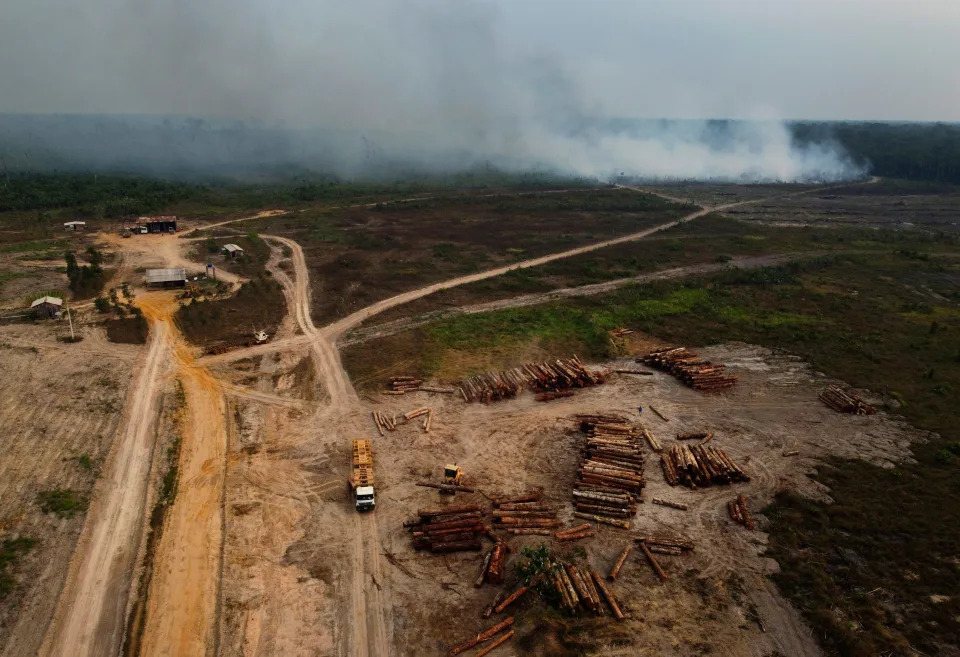
FILE - Smoke rises from a fire near a logging area in the Transamazonica highway region, in the municipality of Humaita, Amazonas state, Brazil, Sept. 17, 2022. Brazil has a major role to play in addressing climate change as home to the world's largest rainforest, but after the Sunday, Oct. 2, election, the subject is less likely to come up than ever. (AP Photo/Edmar Barros, File) ORG XMIT: CLI301
FILE – Smoke rises from a fire near a logging area in the Transamazonica highway region, in the municipality of Humaita, Amazonas state, Brazil, Sept. 17, 2022. Brazil has a major role to play in addressing climate change as home to the world’s largest rainforest, but after the Sunday, Oct. 2, election, the subject is less likely to come up than ever. (AP Photo/Edmar Barros, File) ORG XMIT: CLI301More
The Amazon rainforest could wither
  • What could happen: The Amazon rainforest could shift from lush rainforest to arid savannah. Far fewer species would live there and much less carbon would be sequestered.
  • When could it happen? One estimate suggested it could happen as soon as 2039.
  • What could the effect on Earth be? The Amazon’s 2.5 million square mile rainforest, sometimes called “the lungs of the plant,” is so vast it creates half of its own rainfall and is home to 10% of the world’s species. It also stores a substantial amount of the world’s carbon.
  • What changed in the last year? There’s actually good news – deforestation in the Brazilian portion of the Amazon has dropped to a six-year low, possibly because the nation has a new president who has vowed to protect the rainforest. Illegal logging makes the rainforest much less resilient to climate changes.

As temperatures rise and droughts become more common, the ability of the forest to grow back after fires or logging is of concern. That’s especially a problem in the Amazon where the trees themselves capture water through their roots and then release moisture back through their leaves. It’s estimated a single tree can emit 265 gallons of water a day.

If drought or logging kills trees there may not be enough left to bring water to the area, meaning what grows back in their place would instead be grassland.

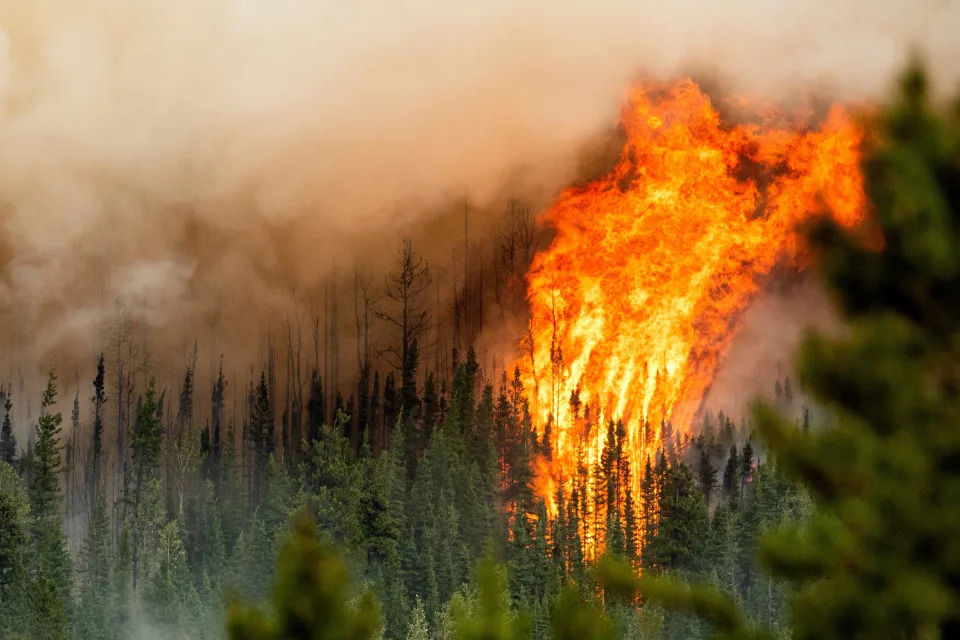
July 2, 2023 : Flames from the Donnie Creek wildfire burn along a ridge top north of Fort St. John, British Columbia.
Wildfires could reshape Alaska and Canada, turning forests into grassland
  • What could happen: Massive wildfires could mean North America’s vast northern forests – sometimes called “snow forests” – could face a future as mostly treeless grasslands.
  • When it could happen: In some areas it could be as much as 50% by 2100.
  • What would the effect on Earth be: These cold-weather forests run across Alaska and Canada and are estimated to store more than 30% of all forest carbon on the planet. Without them, huge amounts of greenhouse gases would be released into the atmosphere, worsening global warming.
  • What’s changed in the last year? Fires in Canada this summer have burned more than 50 thousand square miles of forest. But so far the northern snow forests appear resilient, although which species grow where is beginning to change.

Forests have always burned but what’s happening now is on a different scale, in every part of the country, said Marc-André Parisien, a research scientist with the Canadian Forest Service.

This summer has been a historically bad fire season in Canada. As of August 4, a remarkable 1,054 active fires were burning, according to the Canadian Interagency Forest Fire Centre.

While boreal forests are highly adapted to wildfires, the climate in the forested areas is now hotter and windier than before, making it harder for the seedlings to reestablish themselves. The concern is that in some areas what grows back after these megafires might not be today’s endless forests but instead grassland and shrubland, interspersed with smaller areas of trees.

“The climate in the northern forests has always been changing since the end of the Ice Age,” Parisien said. “But just the sheer speed at which things are happening now is surprising.”

Underwater photo of coral bleaching and hard coral Acropora sp turns white due to high sea surface temperature and climate change
World’s coral reefs could be cooked by the ocean
  • What could happen: Rising ocean temperatures are literally cooking coral to death. If localized die-offs happened across the world’s oceans, it would fundamentally change and diminish undersea life.
  • When could it happen: The Intergovernmental Panel on Climate Change has predicted that 1.5°C of global warming would result in between 70 and 90% of the world’s coral reefs disappearing – which could happen in the early 2030s.
  • What would the effect on Earth be: Corals are vital to the health of the oceans. Although they cover only 0.2% of the ocean floor, they are home to at least a quarter of all marine species. They provide safety for juvenile fish and are home to small organisms and fish that provide food for larger fish. A report released last year showed that almost 15% of the planet’s reefs have vanished since 2009.
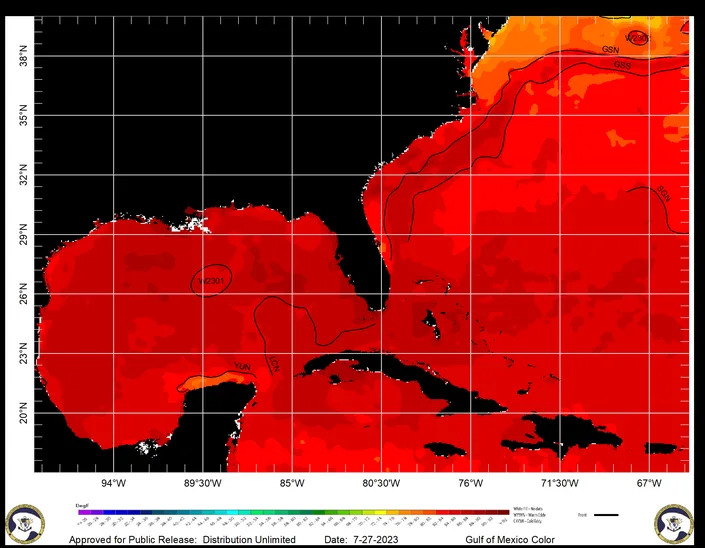
  • What’s changed since last year? Ocean temperatures have reached highs of as much as 101.1 degrees off the coast of Florida and the National Oceanic and Atmospheric Administration says the ocean surface had its third consecutive month of record temperatures. Off the coast of Florida, scientists are racing to save coral specimens by bringing them out of ocean waters that have reached as much as 101 degrees in past weeks and into tanks where they can be saved until the waters cool.

Coral reefs can survive within only a relatively narrow temperature band. The coral that build the reefs get much of their food from algae living in their tissues. When the seawater is too warm, the coral’s stress response is to expel algae, causing the coral to turn white. The process is called coral bleaching, and if it lasts too long, the coral can starve – turning a thriving ecosystem into a cemetery of dead, white shells.

The Coral Restoration Foundation, a group centered around restoring and protecting Florida’s coral reefs, said it visited the Sombrero Reef off the Florida Keys on July 20 and found “100% coral mortality.” The discovery means all corals on the Sombrero Reef, a popular snorkeling area, have died and the reef will not recover on its own without active restoration, the foundation said.

Students from the Urban Homeschoolers in Atwater Village march through the neighborhood chanting and carrying signs on their way to the Los Angeles River and then an overpass on Interstate-5. Photo by Robert Hanashiro, USA TODAY staff
Action, not despair

Even though it appears humanity is on track to miss the United Nations’ hoped-for limit of a temperature rise of no more than 1.5 degrees Celsius, giving up is not the answer, said Anthony Leiserowitz, director of the Yale Program on Climate Change Communication.

No specific number signifies that all hope is lost. Instead, it’s a call for action.

“It’s not like we fall off the edge of the world,” he said. “We can still make a big difference and every single tenth of a degree is enormously important.”

Contributing: Doyle Rice, Emily DeLetterDinah Voyles Pulver

DeSantis just another anti-government bomb thrower: DeSantis says he’d slash federal bureaucratic jobs on his first day as president: ‘We are going to start slitting throats’

Insider

DeSantis says he’d slash federal bureaucratic jobs on his first day as president: ‘We are going to start slitting throats’

Madison Hall  – August 3, 2023

Ron DeSantis
Republican Florida governor candidate Ron DeSantis speaks during a Make America Great Again Rally at the Florida State Fairgrounds in Tampa, Florida, U.S., July 31, 2018.Carlos Barria/Reuters
  • Ron DeSantis railed against the US for having too many federal bureaucrats at a recent campaign stop.
  • “We are going to start slitting throats on day one,” he said.
  • DeSantis has previously said he’d eliminate the IRS and other agencies if elected.

GOP Florida Gov. Ron DeSantis continued on his tirade against federal bureaucrats while speaking on the campaign trail Wednesday.

“We are going to start slitting throats on day one,” DeSantis said about federal bureaucrats, leading to some dissatisfaction among the crowd at the campaign stop in New Hampshire, according to New Hampshire Public Radio.

Wednesday wasn’t the first time DeSantis said he’d slash government agencies if elected to the White House. In June, he said he wanted to get rid of the Internal Revenue Service, the Department of Commerce, the Department of Energy, and the Department of Education.

And in July, DeSantis reiterated his plans while speaking to Maria Bartiromo on Fox News.

“You also have to bring this administrative state to heel, the bureaucracy in Washington is totally out of control,” DeSantis said. “It is exerting power that is not therefore under the Constitution, and we need a President to come in and really, really clean house and I will do that on day one.

The president of the American Federation of Government Employees, a labor union that represents more than 650,000 federal workers, said in a statement that DeSantis’ comments were “disgusting, disgraceful, and disqualifying.”

“These public servants deserve respect and commendation from our nation’s leaders,” said Everett Kelley. “No federal employee should face death threats from anyone, least of all from someone seeking to lead the U.S. government. Governor DeSantis must retract his irresponsible statement.”

In a recent New York Times survey, DeSantis finished second among currently declared Republican presidential candidates, trailing behind former President Donald Trump by 37 percentage points. The same survey found that likely Republican voters much prefer a presidential candidate who thinks the “government should stay out of deciding what corporations can support” rather than one who promises “to fight corporations that promote ‘woke’ left ideology,” as DeSantis has pledged to do time and time again.

DeSantis does have time to claw back supporters in the GOP primary race: he qualified for and has said he’ll attend the first Republican presidential debate on August 23.. And in an effort to get more eyes on his campaign, DeSantis just accepted an offer to debate California Gov. Gavin Newsom (who’s not running for president).

‘It’s a crisis’: Maternal health care disappears for millions

Politico

‘It’s a crisis’: Maternal health care disappears for millions

Alice Miranda Ollstein and Megan Messerly – August 1, 2023

Rogelio V. Solis/AP Photo

Access to maternal health care is evaporating in much of the country, as hospitals close and obstetricians become harder to find for millions of pregnant people.

New data from the nonpartisan health advocacy group March of Dimes shows that the U.S. — which already has the worst maternal mortality rate among developed nations — saw a 4 percent decline in hospitals with labor and delivery services between 2019 and 2020.

But the raw figure masks the inequities playing out across the country, according to the report. Alabama and Wyoming lost nearly one-quarter of their birthing hospitals in that time period, while Idaho, Indiana and West Virginia lost roughly 10 percent.

“It’s a crisis,” said Stacey Brayboy, the senior vice president of public policy and government affairs at March of Dimes. “Women are struggling to access care, and that’s before and during and after their pregnancies, and we’ve seen an increase in terms of maternal and infant deaths.”

Access to care is also likely to worsen in the coming years, according to several public health experts, as obstetrics units struggle to stay financially afloat, more people become uninsured and new anti-abortion laws limit the number of physicians willing to practice in several states.

Nationally, about 5.6 million women live in counties with no access to maternity care, according to March of Dimes. Far more, 32 million, are at risk of poor health outcomes because of a lack of care options nearby. March of Dimes considers more than a third of all U.S. counties maternal care deserts, with no access to reproductive health services. States with large rural populations — Alaska, Nebraska, North Dakota, Oklahoma and South Dakota — are especially prone to shortages.

The scarcity of maternal health care is particularly acute in areas with higher instances of underlying health problems that are risk factors for maternal mortality — such as hypertension and diabetes — and where states have not expanded Medicaid, leaving hundreds of thousands uninsured.

The declining access to maternal care is one reason maternal mortality rates in the U.S are so high and rising, Brayboy said.

In 2021, roughly 33 people died for every 100,000 live births in the U.S., according to the CDC, up 40 percent from 2020. That’s roughly 10 times the mortality rate of other industrialized nations such as Spain, Germany, Australia or Japan. The maternal mortality rate for non-Hispanic Black people was 69.9, two-and-a-half times the rate of non-Hispanic whites, according to the CDC.

The report relies on data from 2020 and 2021 — before the Supreme Court overturned Roe v. Wade — and the full impact of state abortion bans on maternal care has yet to be documented. But Tuesday’s report reveals most states that have restricted abortion access since then, or where the procedure remains in limbo pending a court ruling, have seen access to obstetric care decline in recent years.

“Abortion providers, OB-GYNs, nurse practitioners are being pushed out of certain parts of the country that do have these restrictive abortion laws. That’s having a spillover effect for those that want to continue their pregnancies,” said Jamila Taylor, president and CEO of the National WIC Association.

There isn’t, however, a clean red state-blue state divide in the data. A few states with near-total abortion bans saw an improvement in access to birthing hospitals in recent years — including Arkansas, North Dakota and Mississippi — and a few states where abortion remains legal saw access worsen, including California, Maryland, and Washington state.

The situation is particularly dire in Alabama, where the number of hospitals with labor and delivery services decreased by 24 percent between 2019 and 2020, and where many more could soon go out of business. The Alabama Hospital Association warned earlier this year that half of the state’s remaining hospitals are “operating in the red,” and are “likely on a collision course with disaster.”

“Many of them are just teetering on the edge, almost not able to cover payroll,” Farrell Turner, the president of the Alabama Rural Health Association, said in an interview. “There are at least seven more, according to my calculations, that are at very high risk of closing before the year is out.”

One factor fueling the obstetric unit closures across the country is the financial mismatch facing hospitals — maternal care is expensive to provide and reimbursements are low, particularly from Medicaid, which pays for more than 40 percent of births. That’s a particular challenge for rural hospitals, which have a higher proportion of patients on government-run health insurance than their urban counterparts.

March of Dimes found that nearly a third of women in Alabama already have no birthing hospital within a 30-minute drive and for some residents, the nearest hospital is more than 70 minutes away — factors the group said raised the risk for “maternal morbidity and adverse infant outcomes, such as stillbirth and NICU admission.” More than a third of the state is considered a maternal care desert, and more than 18 percent of people giving birth received inadequate prenatal care or none at all.

“People have to drive quite some distance in order to deliver, and to obtain prenatal care leading up to that time,” Turner said. “And many folks either lack transportation or can’t afford the gas to get to the care they need. There are some telehealth options out there, but a lot of people lack access to broadband, so the uptake and implementation has been slow.”

The problem is similar in Wyoming, where five of the state’s 23 counties are maternity care deserts and more than 15 percent of residents have no hospital with labor and delivery services within 30 minutes. The state’s vastness poses particular challenges to accessing care, with people living in counties with the highest travel times spending nearly 90 minutes on average to reach the nearest hospital with obstetric care.

Abortion remains legal in Wyoming because a judge temporarily blocked the state’s new pill ban in June, and the state’s trigger ban remains enjoined. But Dr. Giovannina Anthony, an OB-GYN in Jackson, Wyo., said those laws are already affecting access to maternal health care.

“Abortion bans just create one more deterrent to anyone who might want to practice obstetrics and gynecology in Wyoming,” Anthony said.

Even in North Carolina, which has fewer maternity care deserts than the national average, access to obstetric care is headed in the wrong direction. The number of hospitals with labor and delivery services in the state decreased by 1.9 percent between 2019 and 2020, and the March of Dimes report found that 13.4 percent of people in North Carolina had no birthing hospital within 30 minutes.

“These rural communities where the maternity care deserts are, these individuals tend to be sicker. They can have chronic hypertension. They can have diabetes,” said Karen Sheffield-Abdullah, a certified nurse-midwife who has a doctorate in nursing from the University of North Carolina at Chapel Hill. “These are individuals who are coming in with what we call these comorbidities, and yet there aren’t providers for an hour away? Absolutely maternal morbidity and mortality goes up.”

Sheffield-Abdullah said access to maternity care in the state is likely to worsen because of a new law banning abortion after the first trimester.

“If we look at the most recent ban, getting more restrictive in the types of care that we provide to perinatal individuals is not going to improve our outcomes,” she said. “It only makes it more difficult for minoritized populations to get the care that they need.”

Hospitals are also struggling to recruit and retain OB-GYNs and other maternal health providers. Two Idaho hospitals, for example, shut down their labor and delivery services earlier this year, citing staffing woes exacerbated by the state’s near-total abortion ban, which went into effect last summer.

Dr. Stacy Seyb, a maternal fetal medicine specialist who has practiced for 23 years in Idaho, told POLITICO that two of his colleagues have left the state in the last few months, with several more also considering a move, and applications for medical residencies have plummeted.

“It’s hurting our ability to find doctors for a state that’s already severely underserved,” he said of the state’s abortion ban, which threatens medical providers with felony charges if they perform an abortion or help someone obtain one. “It’s hard to take care of patients while looking over your shoulder. So residents and young doctors are saying: ‘Why would I go there and deal with that?’”

Idaho saw a 12.5 percent decrease in the number of birthing hospitals in the state between 2019 and 2020, and nearly 30 percent of the state is considered a maternal health desert, according to March of Dimes. More than 27 percent of counties have both a high rate of chronic health conditions and high rate of preterm births.

Idaho providers fear the situation will further deteriorate now that abortion is banned in the state, but warn the public might remain in the dark because officials dissolved the state’s maternal mortality review committee in July.

“It’s scary for sure,” said Dr. Kylie Cooper, a former leader of the state’s chapter of the American College of Obstetricians and Gynecologists who left Idaho after the abortion ban went into effect. “Most states have the ability to track data and trends for why people are dying in pregnancy and post-partum, but now I don’t know how that will be tracked at all in Idaho.”

Ron DeSantis’ newest problem: The majority of likely Republican primary voters don’t want a candidate devoted to fighting ‘woke’

Insider

Ron DeSantis’ newest problem: The majority of likely Republican primary voters don’t want a candidate devoted to fighting ‘woke’

Madison Hall – July 31, 2023

Ron DeSantis
Rep. Ron DeSantis, R-Fla., listens during testimony by Department of Justice Inspector General Michael Horowitz during a joint House Committee on the Judiciary and House Committee on Oversight and Government Reform hearing examining Horowitz’s report of the FBI’s Clinton email probe, on Capitol Hill, Tuesday, June 19, 2018 in Washington.Jacquelyn Martin/APMore
  • GOP presidential candidate and Florida Gov. Ron DeSantis keeps hammering the idea that he’s fighting “wokeness.”
  • Likely Republican voters, however, told the New York Times they’d prefer the government stay away from limiting what corporations can support.
  • Despite this, DeSantis remains focused on attacking Bud Light for a short-lived and innocuous  campaign featuring a transgender woman.

He declared war on “woke” and made fighting “wokeness” one of the central points of his campaign. Now, it’s becoming increasingly evident that Florida Gov. Ron DeSantis’ presidential campaign is in hot water after a majority of likely Republican voters said they want the government to stay away from influencing what corporations can and can’t support.

According to a New York Times poll, which was conducted between July 23-27, 52 percent of Republicans who will likely vote in the GOP primary election said they’d support a candidate who thinks the “government should stay out of deciding what corporations can support” over one promising “to fight corporations that promote ‘woke’ left ideology.”

This isn’t ideal for the DeSantis campaign, whose biggest focus on the campaign trail has been how he plans to combat “wokeness” as president and the extent to which he’s done so in Florida through his “Stop WOKE Act,” which currently cannot be enforced in higher education due to a temporary injunction, along with other initiatives.

As he continues to double and triple-down on his anti-woke schtick, it doesn’t seem like it’s doing him many favors in the race to become the GOP presidential nominee.

According to the same New York Times poll, support to put DeSantis in the Oval Office came in 37 percentage points behind that of former President Donald Trump, who appears to be running off with the nomination as DeSantis and every other GOP candidate has failed to keep up.

But as his presidential campaign falters and likely GOP voters make it clear that fighting “wokeism” isn’t a priority, DeSantis keeps belaboring the point.

Three months after beer company Bud Light ran a short-lived marketing campaign featuring transgender content creator Dylan Mulvaney, the governor of Florida continues to think this is what voters are clamoring for, going as far as threatening Bud Light’s parent company, AB InBev, with legal action for breaching “legal duties owed to its shareholders.”

If DeSantis and his team don’t change their focus, he risks becoming part of the next iteration of presidential candidates like Sen. Marco Rubio who quickly got stuck repeating the same talking point again, and again, and again.

And those campaigns don’t tend to end up in the White House.

Leprosy could become endemic to Florida. Here is what to know.

USA Today

Leprosy could become endemic to Florida. Here is what to know.

Brandon Girod and Kinsey Crowley – July 31, 2023

Rising cases of leprosy in the Southeast U.S. point to the possibility of the disease becoming endemic to the region, and a high concentration of those cases were reported in central Florida.

In a recently published research letter, the Centers for Disease Control and Prevention (CDC) said that Florida is witnessing an increase in leprosy cases lacking traditional risk factors and recommending that travel to Florida be considered when conducting leprosy contact tracing in any state.

The number of reported leprosy cases across the country has doubled over the past decade, according to the CDC. Citing data from the National Hansen’s Disease Program, the CDC says there were 159 new cases reported in the U.S. in 2020. Nearly 70% of these new cases were reported in Florida, California, Louisiana, Hawaii, New York and Texas.

Leprosy, scientifically known as Hansen’s disease, has never been common in the U.S., with most cases previously involving people who immigrated from leprosy-endemic areas. But the new report shows that about 34% of the reported cases between 2015 and 2020 were locally acquired.

A 54-year-old man in central Florida was diagnosed with lepromatous leprosy in 2022.
About the Florida leprosy outbreak

According to the report, Florida may represent an endemic location for leprosy and recommends that physicians consider leprosy in the appropriate clinical context in patients who have traveled to the area, even in the absence of other risk factors. Here is why:

  • Florida is among the top reporting states for cases of leprosy.
  • 80% of cases in Florida were in central Florida.
  • Central Florida alone accounted for nearly 20% of the total number of cases reported nationally.
  • Several new-case patients in central Florida demonstrated no clear evidence of zoonotic exposure or traditionally known risk factors.
What is leprosy and where did it come from?

Leprosy is a chronic infectious disease caused by Mycobacterium leprae that primarily affects the skin and peripheral nervous system. It can sometimes infect other parts of the body like the lining in the airway passages of the nose, according to the Florida Department of Health. It has been around for thousands of years, with the earliest known records appearing in China and India around 600 B.C.

Despite its biblical description, the disease is not easily spread and about 95% of people have natural protective immunity, according to the FDOH. Leprosy can be easy to treat, especially if it’s addressed early. However, going without treatment can result in permanent nerve damage.

The Mycobacterium leprae bacteria is slow growing and it can often take years for signs and symptoms to develop following exposure to the bacteria. Once the first sign of infection appears, it can take anywhere between two weeks to months for it to progress.

Can leprosy be cured?

Yes, leprosy is a curable disease. Doctors prescribe antibiotics to patients with leprosy. Patients are typically no longer infectious after a few days of antibiotics, but the treatment lasts between one to two years due to the bacteria’s slow growth.

What are the signs and symptoms of leprosy?

Early signs of leprosy include pale or slightly red areas or rash on the body that is often associated with a loss of sensation in the affected area, according to the FDOH.

Other symptoms include:

  • Loss of feeling in hands and feet
  • Dry, stiff and sometimes painful skin in the affected area
  • Thinning of the eyebrows and eyelashes (if the face is involved)
  • Nasal congestion is sometimes reported

If the disease goes untreated, weakness in the muscles of the hands and feet can also occur.

Malaria in Florida: Though malaria cases are waning, you should still take precautions, Sarasota County says

How does leprosy get transmitted or contracted?

Leprosy is contagious and can be transmitted by untreated people infected with the disease, however, most people have natural protective immunity. Exposure to people infected with leprosy should still be avoided, especially among family members as protective immunity is genetic.

How leprosy is transmitted isn’t fully known due to how uncommon it is. Scientists do know it’s not spread through casual contact, sexual transmission or from mother to fetus. The prevailing theory is that high levels of the bacteria are developed in a person’s nose and are spread to others not immune through prolonged contact.

The CDC hopes that local physicians can help identify and reduce the spread of the disease through their efforts to report cases and their support in further research to assess routes of transmission.

Can you get leprosy from armadillos?

Yes. A genetic study conducted at the National Hansen’s Disease Program found that armadillos in the southern U.S. develop a high number of M. leprae, that bacteria that causes leprosy. Transmission between animals to humans is low, but the program advises that people still take proper precautions around armadillos.

If you feel better near salt water, you are not making it up. It’s called thalassotherapy.

Insider

If you feel better near salt water, you are not making it up. It’s called thalassotherapy.

Kelly Burch – July 31, 2023

One woman standing on the rock looking out the waves and the sea
Carol Yepes/Getty Images
  • Some people have said they feel physically better after spending time in salt water.
  • Being near the sea can have mental health benefits, too, doctors say.
  • Using salt water for healing is known as thalassotherapy.

When Reina Sultan spent time in Cape Cod, Massachusetts, earlier this summer, she noticed that she felt better than anticipated.

“Has anyone with POTS/hEDS noticed that going in the ocean makes them feel wildly better?,” she wrote on Twitter. “Like i get 2-3 days of feeling like i am not chronically ill when i swim in the ocean and idk if its the salt or the pressure or what but even my joints feel better.”

Postural orthostatic tachycardia syndrome (POTS) and hypermobile Ehlers-Danlos syndrome (HeDS) are neurological conditions that can cause joint pain, dizziness with movement, and fatigue. The Tweet took off, with many others with chronic illnesses saying that their symptoms feel better for days after they’ve been swimming in salt water.

Doctors say that Sultan is onto something — a phenomenon known as thalassotherapy, or using salt water for healing, that dates all the way back to the ancient Greeks.

Salt water has physical and mental health benefits

Anecdotal stories of feeling better in or near salt water — like Sultan’s experience — are common, says Stewart Parnacott, a personal trainer and nurse practitioner with Baylor College of Medicine.

“There is some scientific basis to support these claims,” Parnacott said.

A 2021 scientific review found evidence that thalassotherapy is associated with improved symptoms in patients. It’s particularly effective for people with certain skin conditions and inflammatory diseases, the review found.

“Saltwater contains various minerals and trace elements such as magnesium, potassium, and calcium, which are believed to have potential health benefits,” Parnacott said. “These minerals may promote relaxation, reduce inflammation, and support skin health when absorbed through the skin during activities like swimming or spending time at the beach.”

Being near the beach can have mental health benefits too

As anyone who enjoys a summer trip to the sea has probably realized, being near the ocean can also benefit mental health, says Dr. Elliot Dinetz, a functional medicine doctor and staff member at the University of Miami Miller School of Medicine.

“On the mental health front, being near the ocean, a phenomenon often referred to as the ‘blue space effect,’ has been linked to reduced stress levels and overall mental well-being,” Dinetz said.

A 2021 study that included more than 16,000 people in 18 countries found that spending time near blue spaces, including lakes, rivers, and oceans, was associated with improved well-being. Ocean sounds, like the crashing of waves, can also promote mental health and relaxation.

For the most benefit, get moving near water

While sitting on the beach or floating can be super relaxing, Dinetz says people often get the most benefit when they move their bodies.

“Activities such as swimming or walking on the beach increase these benefits by improving cardiovascular health and promoting the release of endorphins, the body’s natural mood boosters,” he said.

If you don’t live near an ocean or salt lake, don’t worry, Parnacott says. You can get many of the same benefits from visiting a lake or river — or even a pool in a pinch.

“Bodies of water, whether freshwater or saltwater, have inherent qualities that offer health benefits,” he said.

Low-impact exercises like swimming or water aerobics are beneficial for joint health and cardiovascular fitness, while the buoyancy of water reduces the impact on joints, making it an ideal option for individuals with certain musculoskeletal conditions, he says.

“Both freshwater and saltwater environments can offer unique benefits for physical and mental well-being,” Parnacott said. “Finding balance and taking time to unwind in nature can significantly contribute to a healthier and happier lifestyle.”

Is the Atlantic Ocean current system nearing collapse? Scientists weigh in

CBS News

Is the Atlantic Ocean current system nearing collapse? Scientists weigh in

Li Cohen – July 31, 2023

A study out this week raised a dire warning about the future of the planet and humanity, suggesting a system of currents in the Atlantic Ocean could totally collapse as early as 2025 — a frightening scenario that was the premise for the 2004 film “The Day After Tomorrow.”

But some scientists say that while a collapse is possible, it’s just one of many potential scenarios that could unfold and is unlikely to occur this century.

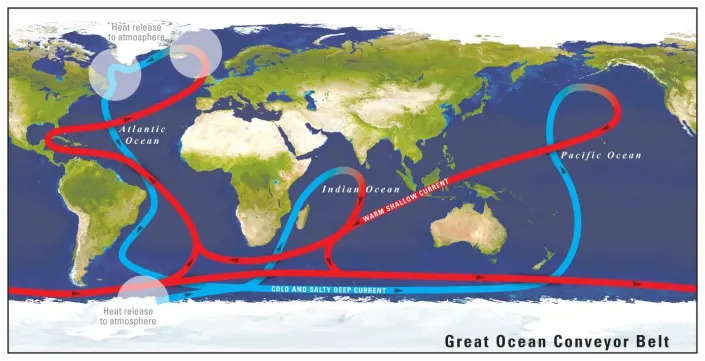
The study, published in Nature Communications, focuses on the Atlantic Meridional Overturning Circulation, or AMOC, a system of ocean currents in the Atlantic Ocean. This system is part of a global conveyor belt as it circulates water from north to south in the Atlantic, helping disperse warm waters. This system, along with other ocean currents, is crucial to helping maintain the Earth’s climate — and scientists believe it is being affected by climate change, as melting ice alters the balance in northern waters.

The AMOC “is a major tipping element in the climate system and a future collapse would have severe impacts on the climate in the North Atlantic region,” the study says, adding that there has been other research in recent years indicating that its circulation is weakening.

“We estimate a collapse of the AMOC to occur around mid-century under the current scenario of future [carbon] emissions,” it says.

Peter Ditlevsen, a professor at the University of Copenhagen’s Niels Bohr Institute and the lead author of the study, told CBS News he believes it’s “most likely” the system could collapse in about 30 years, around 2057. In the study, the range for a collapse was estimated to be anywhere between 2025 and 2095.

But, he says, there’s an “uncertainty”: “You cannot be completely sure.”

That’s because measurements of the AMOC only go back 20 years, providing a small amount of data to work into configurations. So his team looked at records of sea surface temperatures and climate model simulations to try to predict the fate of the current system.

The global conveyor belt, shown in part here, circulates cool subsurface water and warm surface water throughout the world / Credit: NOAA

“We know that there’s a tipping point out there in the future. And that when you approach that tipping point, they start to be unstable in a very specific way,” Ditlevsen said.

But Marlos Goes, a scientist at NOAA’s Atlantic Oceanographic and Meteorological Laboratory, said the likelihood of this study’s results coming to fruition within this century “is very small.” Such a timeframe, he said, is just “one scenario … out of hundreds.”

According to state-of-the-art climate models and the U.N.’s Intergovernmental Panel on Climate Change, a group that works to assess the science behind climate change, “it’s not going to collapse in the 21st century at all,” Goes said.

“It may in the following century. It depends on the [emissions] pathways,” he told CBS News. “If the emissions go unabated the way they are going right now … that could be a potential force for this collapse. But the probability of that single scenario that they analyzed in that study is very unlikely.”

What is the Atlantic Meridional Overturning Circulation?

The AMOC is a long current cycle in the Atlantic Ocean that transports warm water across the globe. It’s an incredibly slow-moving system that takes roughly 1,000 years to move any given cubic meter of water through its entirety, according to NOAA.

It is part of the global conveyor belt, a system of deep ocean currents driven by temperature, salinity and the wind on the ocean surface. The belt begins where warm water from the Gulf is thrust into a cold atmosphere of the Norwegian Sea. From there, the now much cooler water sinks lower into the ocean and is carried south. The conveyor belt takes that cold water all the way down to Antarctica.

 / Credit: USGS
/ Credit: USGS

Is the Gulf Stream going to collapse?

The Gulf Stream is a warm ocean current that runs from the coast of Florida and up to North Carolina, where it then diverts and goes across the Atlantic. It’s also part of the Atlantic Meridional Overturning Circulation. The latest study makes no mention of the Gulf Stream, specifically, but because it is part of this system, it would be impacted by such a collapse.

However, Goes told CBS News that wouldn’t disappear. The Gulf Stream is primarily driven by wind rather than temperature and salinity, as the AMOC as a whole is, meaning it would still function.

This image by NOAA's Ocean Prediction Center shows the temperature of the Gulf Stream along the U.S. East Coast. / Credit: NOAA Ocean Prediction Center
This image by NOAA’s Ocean Prediction Center shows the temperature of the Gulf Stream along the U.S. East Coast. / Credit: NOAA Ocean Prediction Center

“We would have a Gulf Stream just if we had the wind, if we didn’t have this formation in the North Atlantic,” Goes said. “…So even if the AMOC collapses, we’ll still have a Gulf Stream, but it would be much weaker.”

What would happen if the AMOC shut down?

A collapse of the system was the inspiration for the 2004 disaster film “The Day After Tomorrow.” In the movie, ocean current systems stopped because of global warming, triggering another Ice Age.

But Ditlevsen said, “That’s not gonna happen.” The principle of it, however, is the same, he said.

“You get colder Europe, northern Atlantic region, which is maybe not nice for us living in Scandinavia because it will be more similar to what’s going on in Alaska,” he said.

“But worse is that, the heat that’s not coming here stays in the tropics, heating them even more,” he continued. “The livelihood of people in the tropics can be severely threatened by this. … These are climate changes that are going to happen very fast.”

The AMOC won’t collapse just yet, some say — but it is slowing

Even though Goes says the chances of the AMOC collapsing within the next few decades are low, the current system is at risk. In 2021, another study found that the system is the weakest it’s been in at least 1,600 years. Researchers found that the current has slowed down an “unprecedented” amount — 15% since 1950.

Other research has found that it could be reduced up to 45% within the next 70 years or so.

Goes said that even just a slowdown of the currents, and not a total collapse, could impact people around the world.

“Generally, when the AMOC weakens or collapses, you have a cooling of the North Atlantic because this heat wouldn’t be carried further north, and there’s a warming of the South Atlantic. This would shift the precipitation patterns further south,” he said. “And that could influence all the sub-Sahara, the African and South American continents in the tropical bands. It would have influence on the storms in the North Atlantic, in Europe.”

But it would also release even more carbon dioxide into the atmosphere. The ocean absorbs 90% of the carbon dioxide from the atmosphere, and without the current, the ocean won’t be able to absorb as much, Goes said, a situation that would only add to the already rampant global warming the planet is facing. It would also increase sea levels along the U.S. coast.

Urgent action could stop a slowdown

A drastic change or shutdown of the AMOC wouldn’t necessarily be detectable right away, Goes said. In fact, it could take 40 to 50 years to emerge.

“By the time we detect that, it will be too late,” he said. “We really need to act now. This is one of the tipping points of the world.”

Once a tipping point such as a slowdown or shutdown of the AMOC is passed, it could cause a cascade of impacts that could cause “irreversible and severe changes in the climate system,” according to the Organization for Economic Co-operation and Development. Even though a full collapse of the AMOC within the next few decades isn’t probable, it is possible, Goes said, and it could come with high risk.

Scientists are continuing to monitor the system to learn what they can about its current state. But to help prevent a continued slowdown or a potential full shutdown, both Goes and Ditlevsen agreed that global emissions must be reduced drastically. Those emissions, largely from the burning of fossil fuels, are trapping heat in the atmosphere and causing sea ice to melt. When that ice melts, it adds fresh water to the AMOC, disrupting the salinity and temperature it relies on to move.

“If we stop our emissions, it will not collapse,” Ditlevsen said. “The disturbing part about this study is that we have to react much faster than we perhaps would like to do. … It’s yet another wake-up call or warning sign that we have to react faster than we do.”

Scientists Say Atlantic Current Collapse Could Lead to Extreme Cold in Europe and North America

Futurism

Scientists Say Atlantic Current Collapse Could Lead to Extreme Cold in Europe and North America

Victor Tangermann – July 31, 2023

Researchers are warning that the crucial ocean currents known as the Atlantic Meridional Overturning Circulation (AMOC) could collapse as soon as 2025 — an impending, climate change-fueled disaster that could usher in a new era of extreme temperature fluctuations.

It’s important to note that not every scientist is convinced by this assessment. And though the researchers say the collapse could take place as soon 2025, they also say it could take another 70 years.

That said, a team of researchers led by Peter Ditlevsen, professor and climate researcher at the University of Copenhagen in Denmark anticipate in a paper published in the journal Nature Communications that the currents could collapse anywhere between 2025 and 2095 — if we don’t cut global carbon emissions, that is.

If it were to collapse, much of the Western world could be plunged into an extended period of extreme cold — a counterintuitive result of climate change. Previous collapses, which have predominantly occurred during ice ages many thousands of years ago, have indeed led to temperatures going haywire.

“I think we should be very worried,” Ditlevsen told The Guardian. “This would be a very, very large change. The AMOC has not been shut off for 12,000 years.”

Back in 2021, researchers at the Potsdam Institute for Climate Impact Research in Germany warned in a separate paper that the AMOC is being driven to the brink of collapse due to climate change. In the short term, this collapse could cause temperatures to plunge in Europe and North America, resulting in prolonged periods of extreme cold.

And if the planet’s past history is anything to go by, the stakes are significant. 12,000 years ago, the melting of a massive glacial lake plunged Europe into an extreme cold spell for almost a millennium.

Now, by analyzing statistics from the last 150 years, Ditlevsen and his team say they’ve calculated with a 95 percent certainty that the AMOC will collapse between 2025 and 2095.

“Shutting down the AMOC can have very serious consequences for Earth’s climate, for example, by changing how heat and precipitation are distributed globally,” Ditlevsen said in a statement.

“While a cooling of Europe may seem less severe as the globe as a whole becomes warmer and heat waves occur more frequently, this shutdown will contribute to increased warming of the tropics, where rising temperatures have already given rise to challenging living conditions,” he added.

This change could be far more rapid than the incremental 1.5 degrees Celsius rise caused by climate change over a century. With a collapsed AMOC, we’d be looking at far more extreme changes in the ten to 15 degrees Celsius range over just a decade.

“Our result underscores the importance of reducing global greenhouse gas emissions as soon as possible,” Ditlevsen said.

But while researchers generally agree with this final conclusion, not everybody is convinced the AMOC is about to, well, run amok.

For one, the conclusion contradicts the latest findings of the United Nations’ Intergovernmental Panel on Climate Change (IPCC), which found in its most recent report that the current was unlikely to just collapse within this century.

“The work provides no reason to change the assessment of the [IPCC],” Jochem Marotzke of the Max-Planck-Institute for Meteorology in Hamburg, told Politico.

“We just don’t have the evidence to state that it has declined,” Penny Holliday, researcher at the UK’s National Oceanography Center, told the BBC. “We know that there is a possibility that AMOC could stop what it’s doing now at some point, but it’s really hard to have certainty about that.”

At the same time, while we may never get a 100 percent accurate prediction — after all, our planet’s climate systems are incredibly complex — we should still heed Ditlevsen and his colleagues’ warning.

“We do still have to take the idea seriously that there could be abrupt changes in the North Atlantic climate system,” University of Reading atmospheric scientist Jon Robson told the BBC. “But the exact predictions that it will happen — and within this time frame — you have to take that with some skepticism.”