Trump’s Demands for Extreme Loyalty Are Starting to Backfire

Rolling Stone

Trump’s Demands for Extreme Loyalty Are Starting to Backfire

Adam Rawnsley and Asawin Suebsaeng – October 31, 2023

Throughout the criminal investigations of Donald Trump, the former president has expected his co-defendants, alleged co-conspirators, and potential witnesses for the prosecution to stay fiercely loyal to him. This has included — according to people who’ve discussed the matter with him — his belief that some of his former lieutenants should risk jail time rather than turn on him.

As he’s faced an array of criminal charges, Trump’s demands for aides and lawyers to martyr themselves for him hasn’t saved him. If anything, it’s done the opposite, driving several possible key witnesses to consider throwing Trump under the bus before he gets the chance to do it to them.

That’s because, as is often the case with the former president, the notion of extreme loyalty only goes one way. Rolling Stone spoke to seven potential witnesses, former Trump confidants ensnared in the Fulton County, Georgia, and federal criminal probes, their legal advisers, and other sources familiar with the situation. All of them say that Trump’s willingness to hang them out to dry has fueled legal strategies focused on self-preservation.

Three of these sources say that Team Trump’s comically unsubtle search for patsies and fall guys — MAGA die-hards who would take the blame and possible prison sentences in lieu of Trump — drove a larger wedge between the ex-president and many of his former fellow travelers.

“If I went to jail for Donald Trump, if I did that, what would that do for me and my family?” says a former Trump administration official who has been interviewed by special counsel Jack Smith’s office. “I don’t think he would even give us lifetime Mar-a-Lago memberships if I did that for him.”

Lawyer Sidney Powell, for example, put her adulation of Trump to work in the aftermath of the election by filing bogus lawsuits and making bizarre false claims against voting-machine company Dominion Voting Systems. The moves got her sanctioned by a Michigan court, sued for a billion dollars by Dominion, and charged alongside Trump in Fulton County.

But her legal ordeal has brought her no meaningful help from the former president. Trump has gone out of his way to claim publicly that Powell was never his attorney while other Trump allies have worked to try to pin the blame for any criminal wrongdoing after the election on her. She has since also taken a plea deal this month, a move that shocked a number of top Trump lawyers and loyalists. Trump’s communications aide Liz Harrington has recently claimed the former president was “confused” by his allies’ plea deals because, in his apparent belief, “there’s no crimes here.” Powell, for her part, is still trying to have it both ways, portraying herself as a victim of a zealous prosecution and as a stalwart defender of Trump’s election lies.

But as some contemplate potentially cooperating with authorities, others have already publicly flipped, a decision that Trump now associates with “weaklings” who betray him.

In a statement to Rolling Stone, Trump’s lead counsel in the Fulton County Steven Sadow wrote that “[Fulton County District Attorney] Fani Willis and her prosecution team have dismissed charges in return for probation. What that shows is this so-called RICO case is nothing more than a bargaining chip for Willis. Truthful testimony will always exonerate President Trump.”

Jenna Ellis, an attorney for the Trump campaign charged in the Fulton County election-subversion case, has been vocal about her disappointment in the former president’s abandonment of his co-defendants. Ellis wrote on X (formerly Twitter) in August that she had been “reliably informed Trump isn’t funding any of us who are indicted,” and wondered “why isn’t [the pro-Trump Super Pac] MAGA, Inc. funding everyone’s defense?”

After an attempt at crowdfunding her legal fees, Ellis accepted a plea deal from prosecutors last week. “If I knew then what I know now, I would have declined to represent Donald Trump in these post-election challenges,” a tearful Ellis said in a courtroom speech accepting responsibility for making false statements about the election that President Joe Biden clearly won.

For much of this year, Trump attorneys had been concerned that Kenneth Chesebro, one of the legal theorists behind the fake-electors scheme, would end up cooperating with prosecutors. The attorney accepted a plea deal in Fulton County and pleaded guilty to conspiracy to file false documents, but his attorney, Scott Grubman, denied any suggestion that his client was turning against Trump. “I don’t think he implicated anyone but himself,” Grubman told CNN earlier this month. Still, Chesebro and his legal team have been dropping hints for months that the blame and criminal exposure lay elsewhere in Trumpland, not with him.

“Whether the campaign relied upon that advice as Mr. Chesebro intended,” Grubman told Rolling Stone in August, “will have to remain a question to be resolved in court.” He continued: “We hope that the Fulton DA and the special counsel fully recognize these issues before deciding who, if anyone, to charge.”

These public statements came months after some of Trump’s closest allies and legal counselors began amassing informal lists of the best possible fall guys in the Jan. 6 riot-related probes and the Mar-a-Lago documents case. John Eastman, Rudy Giuliani, Mark Meadows, Powell, and Chesebro were indeed among the names. The lawyers, such as Chesebro, were easy scapegoats for Team Trump, who have openly signaled that the former president’s courtroom strategy will lean on an “advice of counsel” defense.

Asked if Chesebro could tell how much of Trumpland wanted him to take the fall to help insulate Trump, a lawyer who’s known Chesebro for years, and has spoken to him about this matter, simply tells Rolling Stone, “Of course.”

In private, Trump reserves some of his harshest words for one-time loyalists who are willing to cut deals with prosecutors, securing light sentences in exchange for likely testifying against Trump and others. However, the 2024 Republican presidential front-runner’s fury often extends to his lieutenants who don’t have formal cooperation agreements — but are simply willing, or legally bound, to answer prosecutors’ questions.

According to people close to Trump, the mere act of talking to federal investigators can sometimes be enough to get you branded a traitor or a snitch in the former president’s mind. This is because, his longtime associates say, Trump often doesn’t see a meaningful difference between witnesses who have formal cooperation agreements (to flip, in other words) and those who happen to tell investigators useful information during interviews.

Further, Trump and several of his closest advisers have been trying for months to find out how generous his former Chief of Staff Mark Meadows has been with prosecutors lately. In June, The New York Times revealed that Meadows had testified before grand juries in both the special counsel’s Mar-a-Lago classified-documents case and its investigation into Trump’s attempts to overturn the 2020 election. This has fueled suspicions among Trump’s inner orbit this year, with some advisers now simply referring to Meadows in private communications by using the rat emoji.

Last week, ABC News reported that Meadows was “granted immunity” by the special counsel in order to spill potentially damaging details about Trump and the aftermath of the 2020 election. Meadows’ lawyer has since disputed much of the report as “inaccurate,” though he refused to say what in the story supposedly wasn’t correct.

In the days since that news broke, a few of Trump’s political and legal advisers have tried to assure him that the ABC story doesn’t mean that Meadows has “flipped,” and that he is just doing what he is legally compelled to do in these conversations with federal investigators.

And yet, Trump isn’t entirely buying it. In the past week, the ex-president has asked confidants, with clear annoyance in his voice, why his former chief of staff would be telling prosecutors anything about Trump’s activities “at all,” two people familiar with the situation tell Rolling Stone. The former president’s position is that Meadows should invoke claims of executive privilege in these cases — the doctrine that some communications with a president should be shielded from outside scrutiny in certain circumstances.

It’s a similar move to what former Trump administration official Peter Navarro attempted in defying a congressional subpoena from the Jan. 6 committee, landing him a conviction for contempt of Congress.

If Meadows and other witnesses indulged Trump’s demands for a blanket defiance of prosecutors, Trump’s ex-chief could also risk jail time. Trump’s attorneys had attempted to block Meadows from testifying before a federal grand jury investigating the effort to overturn the election, citing executive-privilege claims. But in March, Judge Beryl Howell rejected the argument.

Navarro, a former top trade aide in the Trump White House, stonewalled a subpoena from the congressional Jan. 6 inquiry demanding he appear before the panel and turn over documents related to its investigation of the 2021 insurrection. Navarro’s defiance earned him a criminal referral and a conviction on contempt of Congress charges in September. Steve Bannon, Trump’s former White House chief strategist and campaign aide, also defied a subpoena from the Jan. 6 House committee and earned a conviction for contempt of Congress. Both men have appealed their convictions.

Trump’s lack of loyalty to allies facing legal jeopardy for allegedly assisting him in various crimes has landed him in difficult spots in a number of cases.

“Trump’s view of loyalty is one way, and that one way benefits only him. Donald has a history of using and abusing his associates, and he has shown no hesitation in throwing them under the bus when it suits his needs,” Michael Cohen, a former Trump fixer and attorney who experienced that lack of reciprocal loyalty firsthand, said. “This is not the kind of person that people are willing to or should sacrifice their freedom for.”


“It’s done, he’s going to be convicted”: Christie says Mark Meadows poses “deadly” threat to Trump

Salon

“It’s done, he’s going to be convicted”: Christie says Mark Meadows poses “deadly” threat to Trump

Tatyana Tandanpolie – October 31, 2023

Mark Meadows Alex Wong/Getty Images

“It’s over” for Donald Trump, who knows “he’s going to be convicted” in his criminal cases, fellow 2024 Republican presidential candidate Chris Christie declared Tuesday on MSNBC, blaming the former president’s recent flubs on the campaign trail — struggling to remember Joe Biden’s name and forgetting which city he’s stopping in — on the stress of his intensifying legal battles. The former New Jersey Governor and ex-U.S. attorney appeared on the Tuesday edition of MSNBC’s “Morning Joe” to talk Trump’s legal woes, telling the hosts that former White House Chief of Staff Mark Meadows likely adds to the former president’s worries after securing an immunity deal with federal prosecutors.

“I think it’s the stress of what he knows is coming in his criminal problems, and I think this week, because a lot of that was from the last week. That’s all post-Mark Meadows,” Christie said. “Everyone watching needs to understand, from somebody who did this work for seven years, you don’t give Mark Meadows immunity unless the evidence he has is unimpeachable.” He then described what Trump will likely face when Meadows takes the stand in the federal election subversion case’s March 2024 trial. “He’s going to be sitting in a courtroom in Washington, D.C., with Mark Meadows 20 feet away from him, saying, ‘He committed crimes in front of me, on my watch,'” Christie predicted. “Look, this is a guy who was velcroed to Trump’s hip for the entire 2020 campaign and all the post-campaign nonsense, so this is deadly. It’s done, he’s going to be convicted – it’s over,” Christie added later, noting that he doesn’t believe Trump will be able to delay the trial based on his impression of the presiding district court judge, who reinstated a gag order against Trump on Sunday, and the lack of co-defendants in the case.

House GOP unveils $14.3 billion Israel aid bill that would cut funding to IRS

CBS News

House GOP unveils $14.3 billion Israel aid bill that would cut funding to IRS

Caitlin Yilek – October 30, 2023

Washington — House Republicans want to pay for emergency aid to Israel by cutting funding to the IRS, teeing up a collision with the White House and Democratic-controlled Senate over how to support a key U.S. ally.

The House GOP released a $14.3 billion standalone measure on Monday that would pay for aid to Israel by cutting the same amount in funding that was allocated to the IRS under the Inflation Reduction Act, one of President Biden’s signature pieces of legislation.

“We’re going to have pays-for in [the bill],” House Speaker Mike Johnson told Fox News on Monday. “We’re not just going to print money and send it overseas.”

The Republican bill sets up a battle over support for Israel, with Mr. Biden and Democrats in the Senate wanting to pair aid for Israel with tens of billions of dollars in aid to Ukraine, which some House Republicans oppose. The White House asked Congress for a $105 billion aid package two weeks ago, which included $14 billion for Israel and $61 billion related to Ukraine.

Johnson, who supports separating the aid packages, acknowledged that the cuts to the IRS would be unpopular among Democrats, but said he planned to call Senate Majority Leader Chuck Schumer for a “direct” and “thoughtful conversation.”

“I understand their priority is to bulk up the IRS,” Johnson told Fox News. “But I think if you put this to the American people and they weigh the two needs, I think they’re going to say standing with Israel and protecting the innocent over there is in our national interest and is a more immediate need than IRS agents.”

The president signed the Inflation Reduction Act into law in 2022, and it included hundreds of billions of dollars for Democratic priorities related to climate change, health care costs and taxes. It also boosted the IRS’ funding by $80 billion, allowing the agency to hire thousands of agents and revamp decades-old technological systems. Experts said the upgrades and hiring boost were long overdue and would improve the agency’s ability to process tax returns, but the provision was highly unpopular among Republican lawmakers.

When it comes to aid for Ukraine, Johnson has said he wants more accountability for the billions of dollars the U.S. is spending to help repel Russia’s invasion, specifically asking the White House to detail where the money is going and what the end game in the conflict is.

White House press secretary Karine Jean-Pierre called the bill a “nonstarter” and said it would “set an unacceptable precedent that calls our commitment to one of our closest allies into question.”

“Demanding offsets for meeting core national security needs of the United States — like supporting Israel and defending Ukraine from atrocities and Russian imperialism — would be a break with the normal, bipartisan process and could have devastating implications for our safety and alliances in the years ahead,” she said in a statement Monday.

Democratic Rep. Rosa DeLauro of Connecticut, the ranking member on the House Appropriations Committee, said Monday that offsetting emergency aid with cuts to the IRS sets a “dangerous precedent.”

“House Republicans are setting a dangerous precedent by suggesting that protecting national security or responding to natural disasters is contingent upon cuts to other programs,” the Connecticut Democrat said in a statement. “The partisan bill House Republicans introduced stalls our ability to help Israel defend itself and does not include a penny for humanitarian assistance.”

GOP Sen. Susan Collins of Maine, who serves as vice chair of the Senate Appropriations Committee, said Monday she would prefer to pair aid to Ukraine and Israel.

When asked whether she was concerned about offsetting emergency spending with budget cuts, she said, “Right, the question is where does it end?”

The House Rules Committee plans to take up the GOP’s Israel bill on Wednesday.

New GOP House speaker proposes aiding Israel with IRS funds meant to nab rich US tax cheats

The Week

New GOP House speaker proposes aiding Israel with IRS funds meant to nab rich US tax cheats

Peter Weber, The Week US – October 31, 2023

 House Speaker Mike Johnson.
House Speaker Mike Johnson.

House Republicans on Monday proposed giving Israel $14.3 billion in emergency military aid, but their bill would pay for that aid “by cutting IRS funds aimed at cracking down on rich tax cheats and improving taxpayer service,” The Washington Post reported. The aid package is the first substantive legislation released under new House Speaker Mike Johnson (R-La.). And if it passes in the House, it stands no chance of making it through the Senate.

President Biden requested $14.3 billion to help Israel in its war against Hamas but he paired it with $61 billion in aid for Ukraine plus another $10 billion in humanitarian aid for Ukraine, Israel and Gaza. The Senate is following that approach of bundling the aid together in one package, with bipartisan support. The House GOP bill not only removes the Ukraine aid, but also attempts to take another bite out of the Inflation Reduction Act’s $80 billion for increased enforcement of tax laws among noncompliant wealthy individuals and companies, plus money for the IRS’s new free online tax filing service.

According to the nonpartisan Congressional Budget Office, the $80 billion spent on IRS enforcement would reduce the deficit by nearly $200 billion. The White House said the House GOP’s latest attempt to “help the wealthy and big corporations cheat on their taxes” would grow the deficit. Mark Mazur, a former assistant treasury secretary, said the proposed cuts are “like if you take a dollar from the IRS and throw a $5 bill out the window.”

Johnson defended his “first draft of this bill” on Fox News, saying the priority of Democrats may be “to bulk up the IRS” but most Americans would “say standing with Israel and protecting the innocent over there is in our national interest and is a more immediate need than IRS agents.”

US EPA needs to phase out food waste from landfills by 2040 -local officials

Reuters

US EPA needs to phase out food waste from landfills by 2040 -local officials

Leah Douglas – October 31, 2023

FILE PHOTO: Workers use heavy machinery to move trash and waste at the Frank R. Bowerman landfill in California

(Reuters) – A group of local U.S. government officials from 18 states on Tuesday urged the Environmental Protection Agency to phase out food waste disposal in landfills by 2040 to cut emissions of the potent greenhouse gas methane.

Food waste causes 58% of the methane emissions that come from landfills, the EPA said in an Oct. 19 report that calculated those emissions for the first time. The U.S. is lagging on a goal to halve food waste by 2030, and the EPA has been criticized for under-investing in the issue.

“Without fast action on methane, local governments will increasingly face the impacts of warming temperatures, sea level rise, and extreme weather events,” the officials, including the mayors of Seattle and Minneapolis, said in a joint letter to the agency.

They also asked the agency to update landfill standards to better detect and mitigate methane leaks.

More than one third of food produced in the U.S. is wasted, and methane emissions from landfilled food waste are growing, totaling more than 55 million metric tons of CO2 equivalent in 2020, according to the EPA.

Landfills are responsible for about 14% of U.S. methane emissions, according to the EPA. Methane is 28 times stronger than carbon dioxide as a greenhouse gas over a 100-year period.

Some cities and municipalities have voluntary household composting programs for food waste. Residents of New York City, which was not among the cities that signed the letter to EPA, will soon be required to separate food scraps from the rest of their household trash.

The EPA provides resources on its website for household food waste management and has a program for businesses to commit to cutting their food waste, though the agency does not verify their progress.

Food waste will be a priority at this year’s United Nations climate conference, to be held at the end of November in the United Arab Emirates.

(Reporting by Leah Douglas; Editing by Marguerita Choy)

Americans are still putting way too much food into landfills. Local officials seek EPA’s help

Associated Press

Americans are still putting way too much food into landfills. Local officials seek EPA’s help

Melina Walling – October 31, 2023

Shredded organic materials are piled up before being taken to a anaerobic digester at a GreenWaste Zanker Resource Recovery Facility in San Jose, Calif., Friday, Oct. 27, 2023. For the first time since the 1990s, the EPA updated its ranking of preferred strategies for waste reduction, ranging from preventing wasted food altogether (by not producing or buying it in the first place) to composting or anaerobic digestion, a process by which food waste can be turned into energy in the form of biogas. (AP Photo/Jeff Chiu)
A truck loaded with organic material exits a GreenWaste Zanker Resource Recovery Facility with the generators that will convert biogas into electricity at rear in San Jose, Calif., Friday, Oct. 27, 2023. For the first time since the 1990s, the EPA updated its ranking of preferred strategies for waste reduction, ranging from preventing wasted food altogether (by not producing or buying it in the first place) to composting or anaerobic digestion, a process by which food waste can be turned into energy in the form of biogas. (AP Photo/Jeff Chiu)
Generators that will convert biogas into electricity sit at a GreenWaste Zanker Resource Recovery Facility in San Jose, Calif., Friday, Oct. 27, 2023. For the first time since the 1990s, the EPA updated its ranking of preferred strategies for waste reduction, ranging from preventing wasted food altogether (by not producing or buying it in the first place) to composting or anaerobic digestion, a process by which food waste can be turned into energy in the form of biogas. (AP Photo/Jeff Chiu)

CHICAGO (AP) — More than one-third of the food produced in the U.S. is never eaten. Much of it ends up in landfills, where it generates tons of methane that hastens climate change. That’s why more than 50 local officials signed onto a letter Tuesday calling on the Environmental Protection Agency to help municipal governments cut food waste in their communities.

The letter came on the heels of two recent reports from the EPA on the scope of America’s food waste problem and the damage that results from it. The local officials pressed the agency to expand grant funding and technical help for landfill alternatives. They also urged the agency to update landfill standards to require better prevention, detection and reduction of methane emissions, something scientists already have the technology to do but which can be challenging to implement since food waste breaks down and starts generating methane quickly.

Tackling food waste is a daunting challenge that the U.S. has taken on before. In 2015, the U.S. Department of Agriculture and the EPA set a goal of cutting food waste in half by 2030, but the country has made little progress, said Claudia Fabiano, who works on food waste management for the EPA.

“We’ve got a long way to go,” Fabiano said.

Researchers say the EPA reports provide sorely needed information. One report found that 58% of methane emissions from landfills come from food waste, a major issue because methane is responsible for about a quarter of global warming and has significantly more warming potential than carbon dioxide.

With the extent of the problem clearly defined, some elected leaders and researchers alike hope to take action. But they say it will take not just investment of resources but also a major mindset shift from the public. Farmers may need to change some practices, manufacturers will need to rethink how they package and market goods, and individuals need to find ways to keep food from going to waste.

So for the first time since the 1990s, the EPA updated its ranking of preferred strategies for waste reduction, ranging from preventing wasted food altogether (by not producing or buying it in the first place) to composting or anaerobic digestion, a process by which food waste can be turned into biogas inside a reactor. Prevention remains the top strategy, but the new ranking includes more nuances comparing the options so communities can decide how to prioritize their investments.

But reducing waste requires a big psychological change and lifestyle shift from individuals no matter what. Researchers say households are responsible for at least 40% of food waste in the U.S.

It’s a more urgent problem than ever, said Weslynne Ashton, a professor of environmental management and sustainability at the Illinois Institute of Technology who was not involved with the EPA reports. Americans have been conditioned to expect abundance at grocery stores and on their plates, and it’s expensive to pull all that food out of the waste stream.

“I think it is possible to get zero organic waste into landfills,” Ashton said. “But it means that we need an infrastructure to enable that in different locations within cities and more rural regions. It means we need incentives both for households as well as for commercial institutions.”

With the problem clearly defined and quantified, it remains to be seen whether communities and states will get extra help or guidance from the federal level — and how much change they can make either way. The EPA has recently channeled some money from the Inflation Reduction Act toward supporting recycling, which did include some funding for organics waste, but those are relatively new programs.

Some local governments have been working on this issue for a while. California began requiring every jurisdiction to provide organic waste collection services starting in 2022. But others don’t have as much of a head start. Chicago, for instance, just launched a city-wide composting pilot program two weeks ago that set up free food waste drop-off points around the city. But prospective users have to transport their food scraps themselves.

Ning Ai, an associate professor of urban planning and policy at the University of Illinois Chicago, said the report could be bolstered by more specific information about how different communities can adopt localized solutions, since preventing food waste might look different in rural and urban areas or in different parts of the country. But she was also impressed that the report highlighted tradeoffs of environmental impacts between air, water and land, something she said is not often as aggressively documented.

“These two reports, as well as some of the older ones, that definitely shows up as a boost to the national momentum to waste reduction,” said Ai, who was not involved with the EPA’s research.

Read more of AP’s climate coverage at http://www.apnews.com/climate-and-environment

Associated Press climate and environmental coverage receives support from several private foundations. See more about AP’s climate initiative here. The AP is solely responsible for all content.

SC wastes more food than any other state, new study shows. Here’s why and how much

The Island Packet

SC wastes more food than any other state, new study shows. Here’s why and how much

Sarah Claire McDonald – November 1, 2023

With the coming months bringing seasonal food fads and festive holidays, food waste has the potential to be much more prominent around this time of year.

After Cherry Digital, a communications agency, surveyed 3,200 Americans to find out how much was thrown away this past year, it was discovered that U.S. households waste about $907 worth of food annually.

Food waste comes in to Re-Soil, near Elgin, and is composted over a 15 day period.

As for South Carolina, the reported estimation was much higher than the nation’s.

Residents in households around the Palmetto State were reported to waste over $1,300 worth of food each year, according to survey data from the study.

After the findings were broken down state-by-state, the survey found that South Carolinians were the most wasteful overall, getting rid of $1,304.68 worth of food each year.

The least-wasteful state in the U.S. is West Virginia, the study states. This state’s residents reportedly only throw away $404.90 worth of their annual groceries.

Although this could in part be due to wasted leftovers, there could be another issue afoot.

The survey shows that only one-quarter of people know what the “use-by date” actually means for peak product quality.

According to the findings, the survey displayed that 30.4% of individuals believed that this date means the last date the product was edible, 22% thought that it meant that it was the last date the food product could be displayed and sold in a store and 21% believed that it meant the date that the product would be at its best flavor and quality, which is the meaning behind a “best-by date.”

According to the United States Department of Agriculture Food Safety and Inspection Service (USDA FSIS), examples of commonly used phrases and their meaning include:

  • A “Best if Used By/Before” date indicates when a product will be of its best flavor or quality. It is not a purchase or safety date.
  • A “Sell-By” date tells the store how long to display the product for sale for inventory management. It is not a safety date.
  • A “Use-By” date is the last date recommended for the use of the product while at peak quality. It is not a safety date except for when used on infant formula as described below.
  • A “Freeze-By” date indicates when a product should be frozen to maintain peak quality. It is not a purchase or safety date.

The survey also discovered that, for food wasted, 51.1% of people believe that best before dates on fruits and vegetables should be ignored as “it’s easy to tell if something has gone bad,” as detailed by its findings. The study also discovered that the foods Americans would most likely throw away are dairy products at 46.6%, 22.3% for meat, fish at 19.2%, bread at 5.1% and vegetables at 8.5%.

Discarded rotten fruit left for waste after a market.

For those who don’t want their uneaten or unused food to go to waste, your local community may have several food drives, food banks and community help centers that will take all kinds of donations, especially around the holidays.

Although there could be several others, Feeding America’s website lets its users search for nearby affiliated food banks to donate. This website can be found online at https://www.feedingamerica.org/find-food-bank.

More than 50 officials call on the EPA to help local governments cut food waste in their communities

Salon

More than 50 officials call on the EPA to help local governments cut food waste in their communities

Joy Saha – November 1, 2023

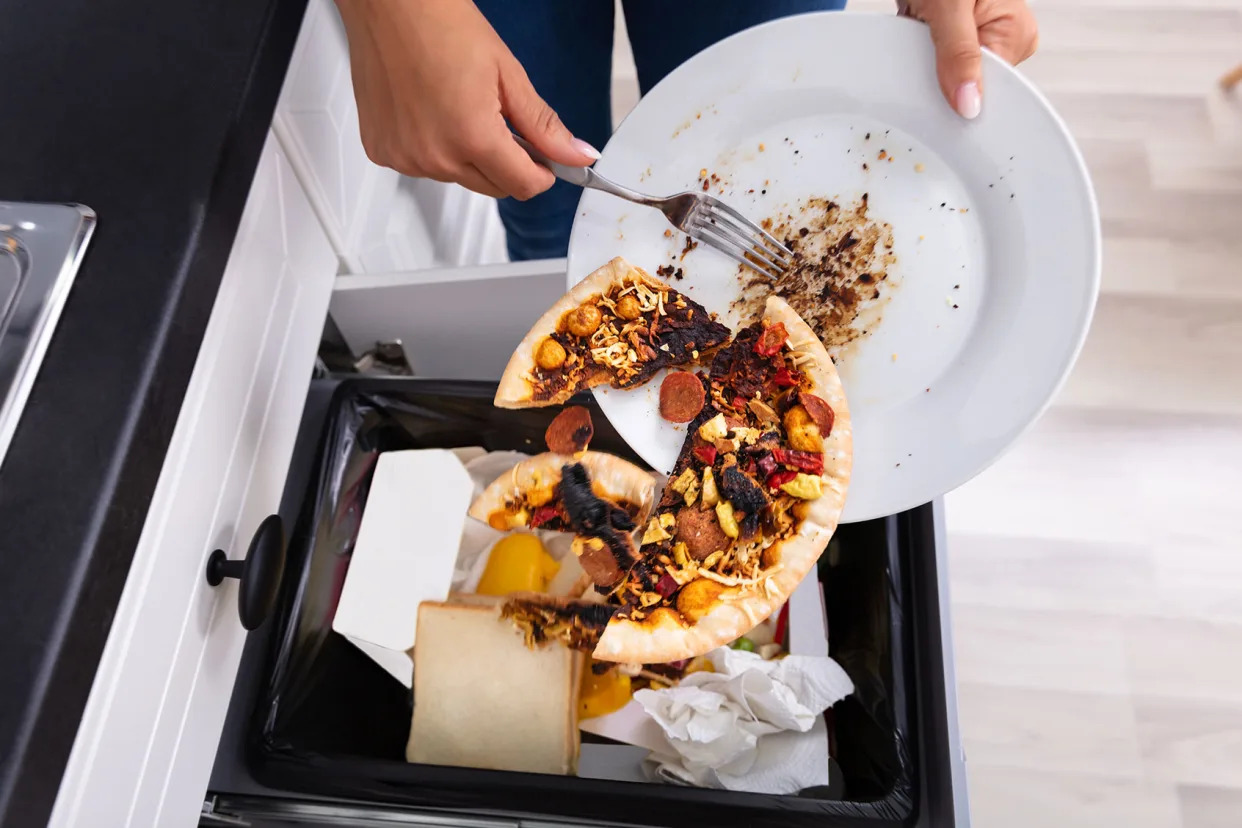
Person Throwing Pizza In Garbage Getty Images/Andrey Popov

On Tuesday, more than 50 local officials penned a letter urging the Environmental Protection Agency to phase out food waste disposal in landfills by 2040 to cut emissions of the potent greenhouse gas methane, Reuters reported.The letter came in the wake of two reports from the EPA that spotlights America’s food waste crisis and its detrimental environmental consequences. More than one-third of the food produced in the U.S. is never consumed. Much of that waste ends up in landfills, where it generates astounding amounts of toxic methane.

Food waste causes 58% of the methane emissions that come from landfills, the EPA said in an Oct. 19 report that calculated those emissions for the first time. The U.S. Department of Agriculture and the EPA set a goal in 2015 to cut food waste in half by 2030. But very little progress has been made and the EPA has been criticized for “under-investing in the issue,” Reuters said.

“Without fast action on methane, local governments will increasingly face the impacts of warming temperatures, sea level rise, and extreme weather events,” the officials said in their joint letter to the agency. They also called on the EPA to update landfill standards to “require better prevention, detection and reduction of methane emissions,” per ABC News. Landfills are responsible for about 14% of U.S. methane emissions, the EPA also found. Reuters added that compared to carbon dioxide, another powerful greenhouse gas, methane is 28 times stronger over a 100-year period.

Ron DeSantis Can’t “Shoe” Away Latest Humiliating Revelation

The New Republic

Ron DeSantis Can’t “Shoe” Away Latest Humiliating Revelation

Tori Otten – October 31, 2023

Ron DeSantis was knocked back on his heels by a new allegation, and his attempts to sidestep the matter failed miserably.

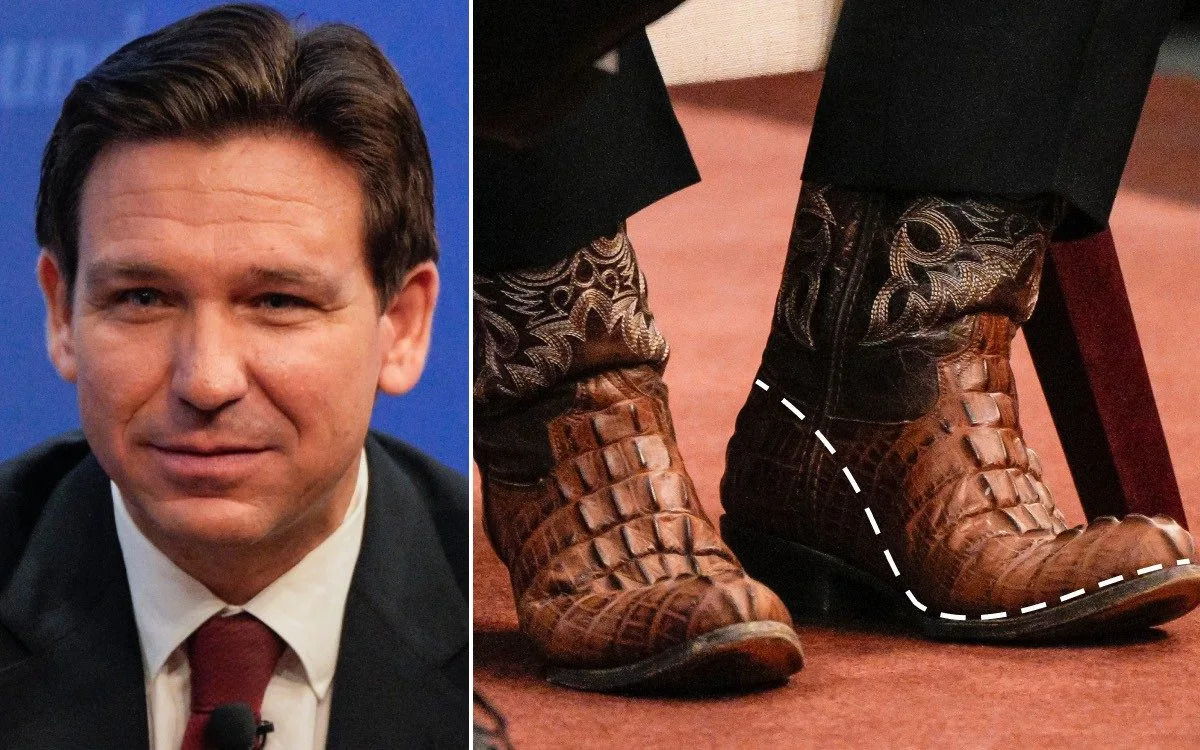
The Republican presidential hopeful has for weeks sparked theories that he’s wearing lifts inside his cowboy boots to make himself appear taller. Internet users and shoe experts alike point to the bizarre fit of DeSantis’s boots and his apparent struggle to walk in them. The Florida governor’s campaign team has vehemently denied the accusations.

But DeSantis was caught flat-footed Monday during an appearance on the PBD Podcast. Host Patrick Bet-David brought up the internet’s theory and showed DeSantis some videos that internet jokesters had edited to show how they thought DeSantis was essentially standing on tiptoes in his boots.

“What are they—I don’t even—I haven’t seen that,” DeSantis said, a little too fast.

Bet-David then produced a pair of flat designer shoes, which he said he had bought for DeSantis so the governor could try them on and prove how tall he is.

“I don’t accept gifts. I can’t accept it,” DeSantis said in an awkward monotone.

If DeSantis and the 1999 Yale baseball roster are to be believed, DeSantis is 5-foot-11. It’s also understandable why he would want to appear tall at all costs. Taller candidates generally (although not always) perform better, but more importantly, DeSantis is facing off against Donald Trump. Trump loves to describe people as “little” as a form of, well, belittlement.

Unfortunately, this could be a massive missed opportunity for DeSantis. If he is shorter, he could embrace his short king status, call Trump out for body-shaming, and seek to prove that good things come in small packages. If the shoe fits, wear it, right?

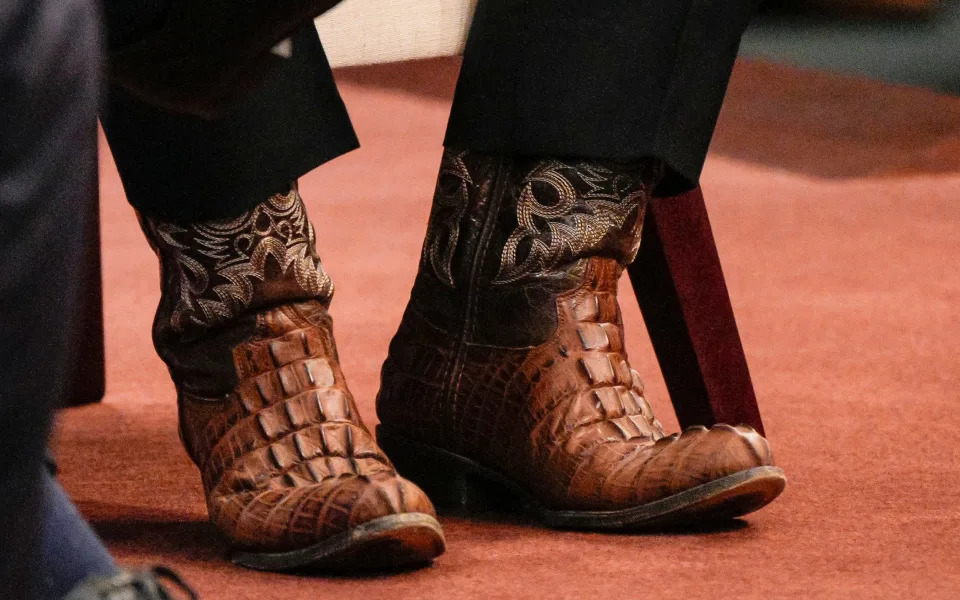
Instead, whatever he’s doing is just creating an incredibly strange, clown-like effect. As menswear expert Derek Guy wrote in Politico, whether or not he has lifts in his boots, DeSantis is still wearing really terribly fitting boots. Guy spoke with three bootmaking-industry veterans, and all  agreed that DeSantis’s boots are far too wide around his calves. The heels are low and the toes turn up abnormally high. The boots bulge and crease in weird places.

All of these things could be signs that DeSantis simply needs to get his feet re-measured—or that he shoved some lifts into his boots.

Ron DeSantis is wearing height-boosting boots, experts claim

The Telegraph

Ron DeSantis is wearing height-boosting boots, experts claim

Rozina Sabur – October 31, 2023

Ron DeSantis and his unusual boots

Ron DeSantis has been wearing height-boosting boots, experts claim, after Donald Trump reportedly considered nicknaming his Republican presidential rival “Tiny D”.

The Florida governor’s unusual cowboy boots have come under intense online scrutiny in recent weeks, with video analyses of their unusual shape being viewed millions of times.

Some political watchers suspected Mr DeSantis, who is thought to be 5ft 11in, of attempting to increase his height by as much as four inches.

Three experts in shoe adaptations interviewed by Politico tended to agree.

“I’ve dealt with these politicians many times. I’ve helped them with their lifts. [DeSantis] is wearing lifts, there’s no doubt,” Zephan Parker, the bootmaker behind Houston’s bespoke Parker Boot Company, told the news website.

Mr Parker said there were two key clues. The first was that Mr DeSantis appeared to have a shorter than average heel on the black cowboy boots he wore at an event in Tampa, Florida.

Ron DeSantis at an event in Atlanta
Ron DeSantis has been seen wearing a pair of black cowboy boots which appear to have a shorter than average heel – Megan Varner/Getty Images North America

Mr Parker said it suggested that the heel had been “cut down” to accommodate shoe inserts.

The second clue was that the top of the boots appeared to be pushing against his trouser legs, suggesting they were “bigger than intended, probably to accommodate his lifts”.

Mr Parker told Politico that most cowboy boots are made to fit snugly, but those adapted to accommodate shoe inserts often have to be sized-up in width which increases all the other measurements on the boot, including the opening at the top.

Another expert, Austin-based Graham Ebner, who trained at one of the country’s best bespoke cowboy bootmakers, gave a similar assessment.

“Three things stick out to me: the instep [where shoelaces usually go], the toe spring and where the ball of his foot is sitting in the boots,” he told Politico.

Mr Ebner said the boot’s pointy end was more pronounced than usual, suggesting Mr DeSantis’ toes didn’t reach to the end.

He added of one photo: “You can see where the ball of his foot is protruding on the right boot.

“It’s a good inch behind where it should be. It should not be in that position unless the heels were being lifted dramatically.”

Ron DeSantis' cowboy boots
Experts say the pointy end of the boots are more pronounced than usual – Jess Rapfogel/FR171914 AP

Mr DeSantis’ campaign has vehemently denied suggestions he is wearing shoes that boost his height.

The Florida governor told the PBD Podcast on Monday that his boots are “just standard, off-the-rack Lucchese boots”.

Meanwhile Bryan Griffin, his press secretary, derided Politico over its piece, adding: “The governor doesn’t pad his boots.”

The reports came after Mr Trump, 77, the frontrunner in the Republican 2024 primary, was rumoured to be mulling over a way to mock Mr DeSantis’ height.

The former president deployed a similar tactic against his 2016 rival Marco Rubio, referring to the 5ft2 Florida senator as “little Marco”.

Mr Trump has claimed he is 6ft 3in, although a copy of his New York driving licence lists the former president’s height at 6ft 2in.

The former president, who enjoys nicknaming his political foes, has already dubbed the 45-year-old Florida governor “DeSanctimonious”.

Reports have suggested he was considering dubbing him “Tiny D”, and Mr Trump has even shared social media posts by users speculating Mr DeSantis’ footwear was adapted.

‘Winning candidates tend to be taller’

While a candidate’s height may be considered low on the criteria for entering the White House, a 2020 analysis by Dr Timothy Judge at Ohio State University found “there is a slight tendency” for winning candidates “to be taller than their opponents”.

There are notable recent exceptions, including Joe Biden, who is at least two inches shorter than Mr Trump, whom he defeated in 2020.

Meanwhile, Nikki Haley has emerged as the leading Republican 2024 rival to Mr Trump after moving into second place in the latest Iowa poll.

The former South Carolina governor, who also served as Mr Trump’s ambassador to the United Nations, is now tied with Mr DeSantis on 16 per cent in the state, the first to vote in the Republican nominating contest.

However, the momentum is with Ms Haley, who was a full 10 points behind Mr DeSantis in the same poll in August.

The boost in Iowa comes weeks after a poll in New Hampshire put her in second place with 19 per cent – nine points ahead of Mr DeSantis.

Mr Trump, however, is still dominating the field according to the polls, with the support of 43 per cent of Republicans in Iowa and 49 per cent in New Hampshire.

Ms Haley’s rise has not gone unnoticed by Mr Trump, who has taken to calling his former cabinet member “birdbrain” in campaign appearances.